Retail Insider’s newest articles are listed below, followed by Canadian Retail News From Around the Web. The Canadian retail market is adjusting as 17 million square feet of space returns to market amid Hudson’s Bay closures, but strong demand remains in food and beverage sectors. A huge announcement on Wednesday was that deals were signed for developers to buy Hudson’s Bay flagships in Vancouver, Calgary and Ottawa (not to mention Windsor ON). La Maison Générale celebrates its first anniversary in Montreal, marking international growth. Cadillac Fairview continues to lead with dominant shopping centre performance nationwide. These updates highlight evolving retail real estate dynamics and strategic expansion efforts across Canada.
In the present age of digital transformation, which is seen today, buying eyewear has become easier, faster, and more affordable than ever before. Online eyewear shopping, which is a growth field, allows customers to look at thousands of frames, to compare prices, and also to custom-fit lenses all from home. With the growth in demand for convenience and affordability, many people are now leaving the traditional optical stores for digital platforms for their vision care.
This article looks at what goes into online glasses shopping, what you should know, and which factors to keep in mind as you choose your pair of prescription glasses from the comfort of your home.
The Rise of Online Glasses Shopping
In the past ten years the eyewear industry has seen a change. Online retailers are now home to a large choice of prescription glasses, sunglasses, and blue light glasses at great prices. Also, it is noted that the global online eyewear market is growing very fast, which is a result of convenience, affordability, and also what may be called advanced virtual try-on technology.
Consumers today have a large selection of frame styles, lens types, and custom options at the click of a button. Also, many of the platforms’ features include virtual try-on tools, which allow customers to see how the glasses will look on them before they buy.
How Buying Glasses Online Works
The purchase of glasses online is easy and user-friendly:
Select your frames There are styles by shape, color, and material.
Select which type of lens there is: single vision, bifocal, progressive, and specialty options.
Enter your prescription Upload or type in the details of your eye prescription.
Give pupillary distance (PD), which is for proper alignment of the lenses to your eyes.
Add options that include anti-glare, UV protection, or scratch resistance.
Place your order, and glasses are shipped directly to your home.
According to health care professionals, when considering the Best place to buy glasses online, what is very important is that prescriptions and measurements be accurate, for even the smallest errors will impact vision quality and comfort.
Benefits of Buying Glasses Online
Online eyewear shopping has many benefits that appeal to today’s consumer.
1. Cost Savings
One of the great benefits is price. Online retailers report offering glasses at much lower prices than physical optical stores. Customers may save up to 40-70%, which again depends on the retailer and frame choice.
2. Wide Variety of Frames
Online retailers present a wide range of frame designs, from economic options to high-end designer styles. This variety in choice makes it easy to find glasses that suit personal taste and face shape.
3. Convenience
The option to shop at any time and any place is great for people with busy schedules or those that don’t have access to a nearby optical shop.
4. Virtual Try-On Technology
Many today have implemented AI for virtual try-on, which allows customers to see how the glasses will look on their face before purchase, thus removing the element of guesswork.
5. Easy Price Comparison
Online prices, features, and customer reviews across different brands may be compared, which is a great benefit.
Important Factors to Consider Before Buying
While at the computer, choosing out glasses is convenient, but also be aware of this:
Accurate Prescription: Always have a prescription current. Incorrect prescriptions can cause headaches, eye strain, and blurred vision.
Pupillary Distance (PD): PD is the distance between pupils, which is key to proper lens alignment. Inaccurate PD measurement may cause issues in vision clarity.
Return and Exchange Policies: Stores that offer flexible return policies in case the glasses don’t fit or meet expectations should be chosen.
Frame Fit and Comfort: Before glasses can’t be tried on, frame dimensions should be checked very carefully before ordering.
Prescription Complexity: People that have complex prescriptions (for example, progressive lenses or high astigmatism) may require extra care or professional fitting.
Why Online Glasses Are Becoming Popular
The eyewear industry is seeing a large shift towards online sales as a result of what consumers want in terms of convenience and affordability. Research shows that online sales of glasses may be much cheaper than from traditional brick-and-mortar stores at the same time, which doesn’t sacrifice quality when buying from reliable sellers.
However, experts report that, which is to say, in-person eye care still plays a large role in the health care they provide, which includes people with complex vision issues.
Tips for a Successful Online Glasses Purchase
To have a smooth experience while shopping for glasses online, these tips can be followed:
Always have an up-to-date eye exam before ordering.
Double-check prescription details before submitting
Use virtual try-on tools if available
Measure pupillary distance carefully
Read customer reviews and ratings
Choose retailers with strong return policies.
These measures reduce error, which in turn produces comfortable and accurate eyewear.
Conclusion
Online eyewear shopping has transformed the way glasses are bought. There is greater access to affordable options, convenience, and an extensive choice in style, which caters to many different needs and preferences. But at the same time it is very important for the purchase to be accurate in terms of prescription and right measurements.
For wearers that are out to find quality eyewear and a smooth online shopping experience, sites like the best place to buy glasses online are a great place to start, which also happen to offer stylish and affordable glasses that meet today’s vision requirements.
$734 per square foot total same stores sales productivity;
-2.1% change in Same Properties Cash Net Operating Income growth (or +1.7% excluding the $2.5 million prior year property tax recoveries recorded in 2025);
89.9% committed occupancy, 86.4% in-place occupancy (including vacancy from disclaimed HBC locations of 1.0 million square feet), and 82.4% long-term in-place occupancy;
78.5% combined recovery ratio;
+5.5% weighted average spread on renewing net rents across 372,000 square feet;
154 CRU lease deals across 288,000 square feet at average net rents of $53.60;
-3.2% change in Funds from Operations per average diluted unit to $0.425; (or +1.6% excluding the $2.5 million prior year property tax recoveries recorded in 2025);
51.8% FFO Payout Ratio;
$41.9 million in net income;
$5.3 billion total assets;
6.0x Average Net Debt to Adjusted EBITDA;
$626.8 million in liquidity;
$4.8 billion in unencumbered assets; and
$21.50 Net Asset Value per unit outstanding.
Patrick Sullivan
“The quarter reflected strong leasing and operational execution across the portfolio,” saidPatrick Sullivan, President and Chief Operating Officer.“Leasing velocity accelerated, with a high volume of lease deals completed at higher rents, while solid CRU occupancy across the portfolio continued to be supported by sustained tenant demand and strong retail fundamentals. At former HBC locations, the team is making continued progress and moving closer to solidifying leasing deals across a number of sites. The leasing activity underway will support structurally higher internal growth over time.”
Alex Avery
“Our first quarter results reinforce the durability of Primaris’ cash flows and the strength of our financial position,” said Alex Avery, Chief Executive Officer. “The portfolio continues to generate solid operating performance, supported by robust leasing activity, and resilient occupancy. With strong liquidity, very low leverage, and a low payout ratio, we are well positioned to fund internal growth, enhance portfolio quality, and create long‑term value for our unitholders.”
Rags Davloor
Rags Davloor, Chief Financial Officer added: “Our low leverage, low payout ratio model is a critical pillar to our strategy. We have significant liquidity with the full availability on our unsecured credit facility with no debt maturing in 2026. The recent credit rating confirmation of BBB high with a stable trend underscores the continued resiliency of our financial profile. Combined with our disciplined approach to capital allocation, these factors provide us with the flexibility to support reinvestment into our platform, future acquisitions, and NCIB activity.”
Primaris said its leasing activities are focused on driving value by actively managing the tenant and merchandising mix at its investment properties.
In-place occupancy for the portfolio decreased 6.8% from March 31, 2025 to 86.4% at March 31, 2026.
In-place occupancy for same properties decreased 4.6% from March 31, 2025 to 89.4% at March 31, 2026. The disclaimed HBC leases negatively impacted occupancy for Same Properties by approximately 4.2% compared to March 31, 2025.
Average in-place occupancy is calculated by averaging the occupied square feet and total GLA for each month in the measurement period. For the three months ended March 31, 2026, the average in-place occupancy rate was 86.1%, a decrease of 7.2% compared to March 31, 2025, due to the impact of the Acquisitions and the disclaimed HBC leases, it said.
HBC Exposure
“Primaris has full control of all 1.3 million square feet of former HBC GLA and has accelerated negotiations with retailers. The Trust’s leasing strategy is twofold: firstly, execute long term leases with single tenant and multi-tenant configurations, (“Re-leasing Plans”) where appropriate; and secondly, repurpose and subdivide space (“Redevelopment Plans”), to accommodate multiple large format tenants, and/or high-value CRU. While design, permitting, and planning activities are underway, Primaris is executing short-term leases with reputable tenants to restore rental income until Re-leasing Plans and Redevelopment Plans are executed,” it said.
“With strong demand from retailers for space and improved visibility into Primaris’ Redevelopment Plans, management now anticipates the retention and redevelopment of a greater portion of the former HBC space than previously contemplated. Management anticipates retaining approximately 90% of the former HBC space. Approximately 35% of this space is under committed or conditional leasing and the remainder is in advanced negotiations with retailers. The capital investment to redevelop this space is expected to be in the range of $175 million to $225 million. Management’s current estimates and assumptions are subject to change.”
The following table illustrates Primaris’ anticipated Re-leasing and Redevelopment Plans for the 11 former HBC locations.
(in ‘000s square feet, unless otherwise indicated)(unaudited)
Property GLA(thousands of square feet)
HBC GLA(thousands of square feet)
Strategy
Cataraqui Town Centre (50% owned)
Kingston, ON
286.3
56.5
Re-leasing
Les Galeries de la Capitale
Québec, QC
988.4
163.0
Re-leasing
Medicine Hat Mall
Medicine Hat, AB
467.8
93.2
Re-leasing
Place d’Orleans Shopping Centre (50% owned)
Orleans, ON
350.0
57.8
Re-leasing
Sunridge Mall
Calgary, AB
803.6
161.3
Re-leasing
Disclaimed on June 16, 2025
2,896.1
531.8
Promenades St-Bruno
Montreal, QC
1,098.3
130.7
Re-leasing
Conestoga Mall
Waterloo, ON
665.8
130.6
Redevelopment
Lime Ridge Mall
Hamilton, ON
810.8
125.3
Re-leasing
Orchard Park Shopping Centre
Kelowna, BC
651.1
127.3
Redevelopment
Oshawa Centre
Oshawa, ON
1,076.3
122.6
Re-leasing
Southgate Centre (50% owned)
Edmonton, AB
422.9
118.3
Re-leasing
Disclaimed November 27, 2025
4,725.2
754.8
11 locations
7,621.3
1,286.6
Primaris is Canada’s only enclosed shopping centre focused REIT, with ownership interests in leading enclosed shopping centres located in growing Canadian markets. The current portfolio totals 15.1 million square feet, valued at approximately $5.2 billion at Primaris’ share.
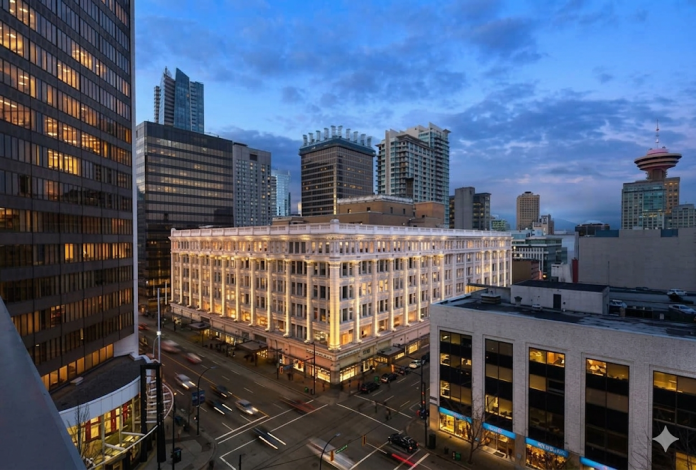
Former Hudson's Bay flagship store in downtown Vancouver. Photo: CBRE
Purchase agreements have been signed for several of Canada’s most prominent former Hudson’s Bay properties, marking a significant step in the dismantling of the retailer’s real estate portfolio following its 2025 insolvency. Court filings show that deals are in place for landmark locations in Vancouver, Calgary, Ottawa, and Windsor. The Ottawa transaction is currently before the court for approval, while the Vancouver, Calgary, and Windsor (Devonshire Mall) transactions have been signed and are expected to be brought forward for approval in the near future.
The properties were part of the RioCan-Hudson’s Bay joint venture, which entered receivership after the retailer ceased operations and closed its stores in mid-2025. The sales process marks a key milestone in unwinding one of Canada’s more complex retail real estate partnerships.
The buyers signal a clear shift in direction — the purchasers are primarily developers and real estate firms. As a result, the future of these sites is expected to move away from traditional department store use toward redevelopment, repositioning, and mixed-use intensification across major Canadian markets.
From Joint Venture to Receivership
The properties were held within the RioCan-HBC joint venture, a complex structure formed in 2015 that combined retail real estate assets under shared ownership. When Hudson’s Bay filed for creditor protection under the Companies’ Creditors Arrangement Act in March 2025, the relationship became increasingly difficult to unwind.
By June 2025, the joint venture was placed into receivership, with FTI Consulting Canada appointed to oversee the assets. Many of the properties were left vacant, and the costs of maintaining them quickly added up. Court filings indicate that carrying costs exceeded $9.8 million during the process, creating pressure to move toward a sale.
A national marketing effort led by CBRE attracted strong interest. Dozens of potential buyers signed confidentiality agreements across the four assets, reinforcing that these were highly sought-after urban properties rather than distressed leftovers.
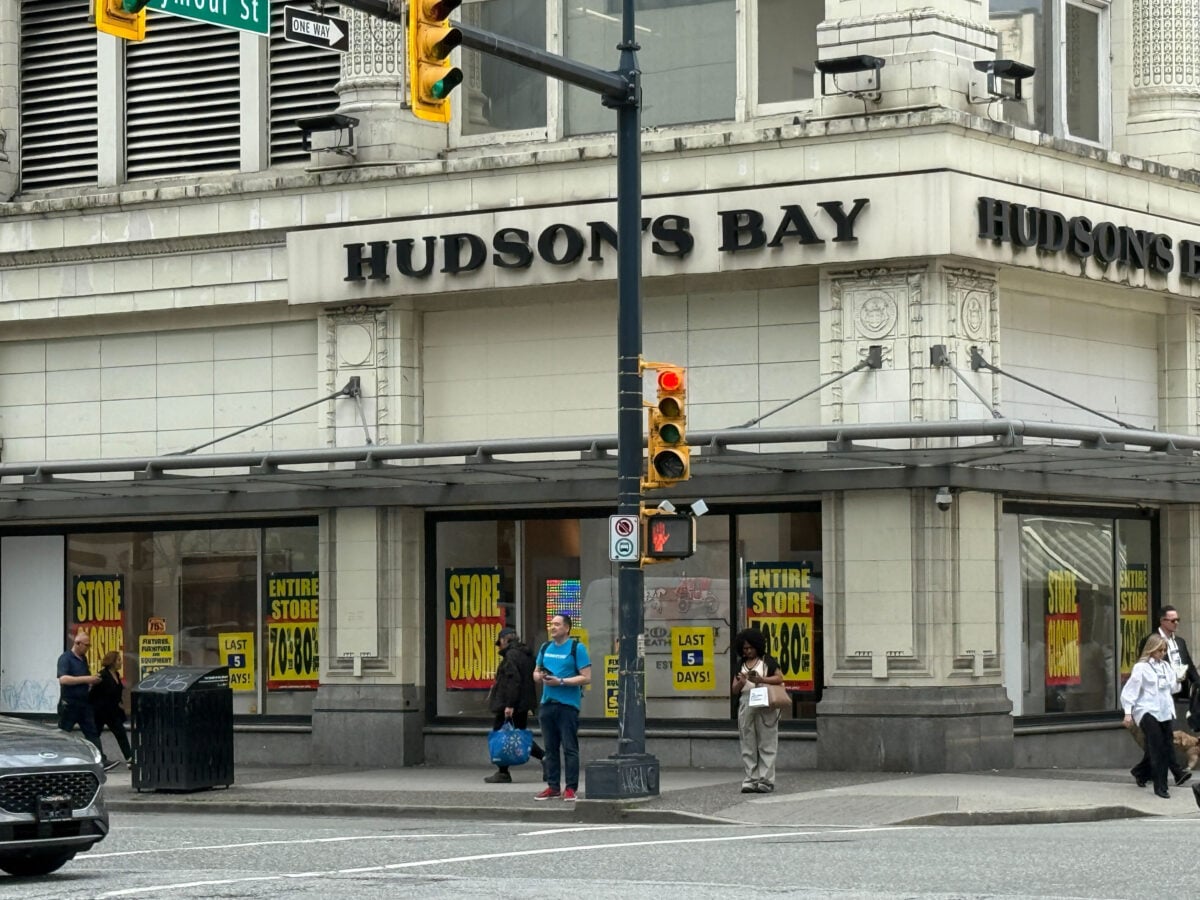
Hudson’s Bay flagship store in downtown Vancouver on Wednesday, May 28, 2025. Photo: Lee Rivett
Vancouver: Onni Targets a Key Downtown Asset
The Vancouver Hudson’s Bay building at 674 Granville Street is being acquired by Onni Group, one of the city’s most active developers.
The property sits in the heart of downtown Vancouver, an area facing ongoing challenges tied to shifting retail patterns and post-pandemic recovery. At the same time, it represents one of the most strategically located redevelopment opportunities in the country.
While specific plans have not been disclosed, Onni is known for large-scale mixed-use projects. Therefore, one might expect the site could eventually incorporate residential, hotel, or office components alongside a reimagined retail presence.
The transaction is notable for including a break fee, an uncommon feature in this process, which reflects the complexity and significance of the deal.
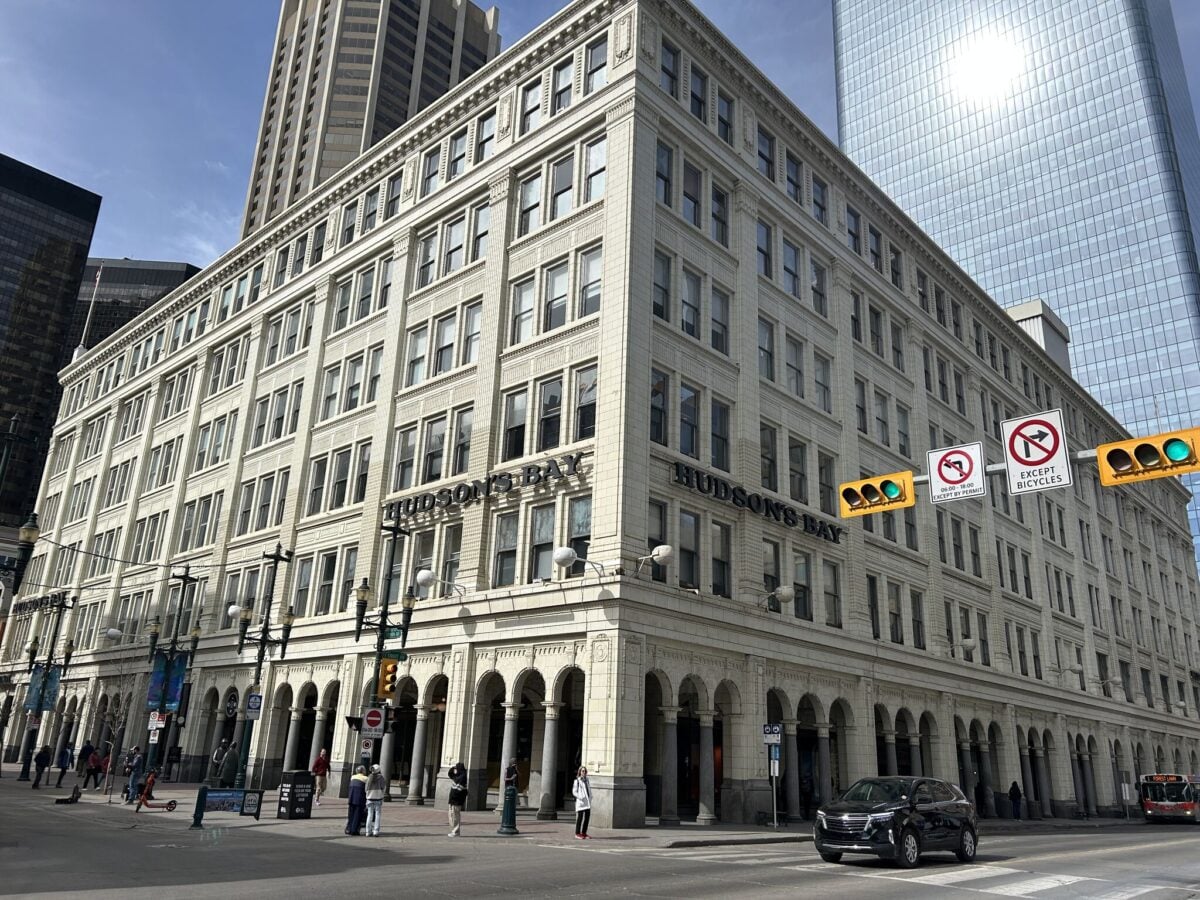
Hudson’s Bay downtown Calgary. Photo by Mario Toneguzzi
Calgary: Conversion Potential in the Downtown Core
In Calgary, the Hudson’s Bay building at 200 8th Avenue SW is set to be acquired by Astra Real Estate Corp., the parent company of Peoplefirst Developments.
The firm has been active in office-to-residential conversion projects, a strategy that aligns with broader efforts to revitalize Calgary’s downtown. As office vacancy remains elevated, conversion to residential use has emerged as a key tool in repositioning underutilized buildings.
The Hudson’s Bay site presents a strong candidate for this type of transformation. Although final plans have not been confirmed, the acquisition signals continued momentum behind adaptive reuse in the Calgary market.
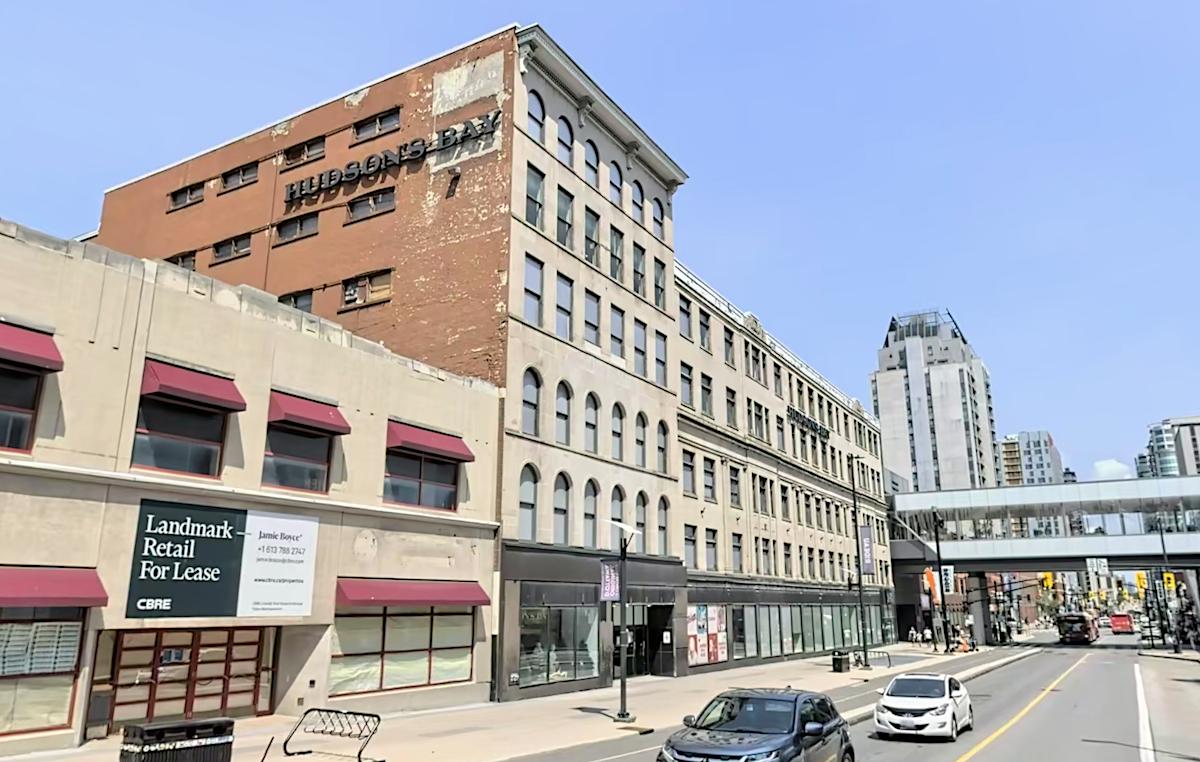
Former Hudson’s Bay flagship store on Rideau St. in Ottawa. Photo: Apple Maps
Ottawa: Residential Intensification in the Capital
The Ottawa Hudson’s Bay property at 73, 85 and 87 Rideau Street is being acquired by 2808771 Ontario Limited, with the agreement signed by Neil Malhotra of Claridge Homes.
Located in the heart of downtown Ottawa, the site sits within a market that continues to evolve as residential demand reshapes the urban core. Claridge has been active in high-density residential development, and the acquisition suggests a similar direction for the property.
The building’s scale and location provide flexibility for redevelopment, including the potential for mixed-use integration that combines residential, retail, and possibly office space.
The Ottawa transaction is the first of the four to be formally brought before the court for approval, according to the Receiver’s Sixth Report.
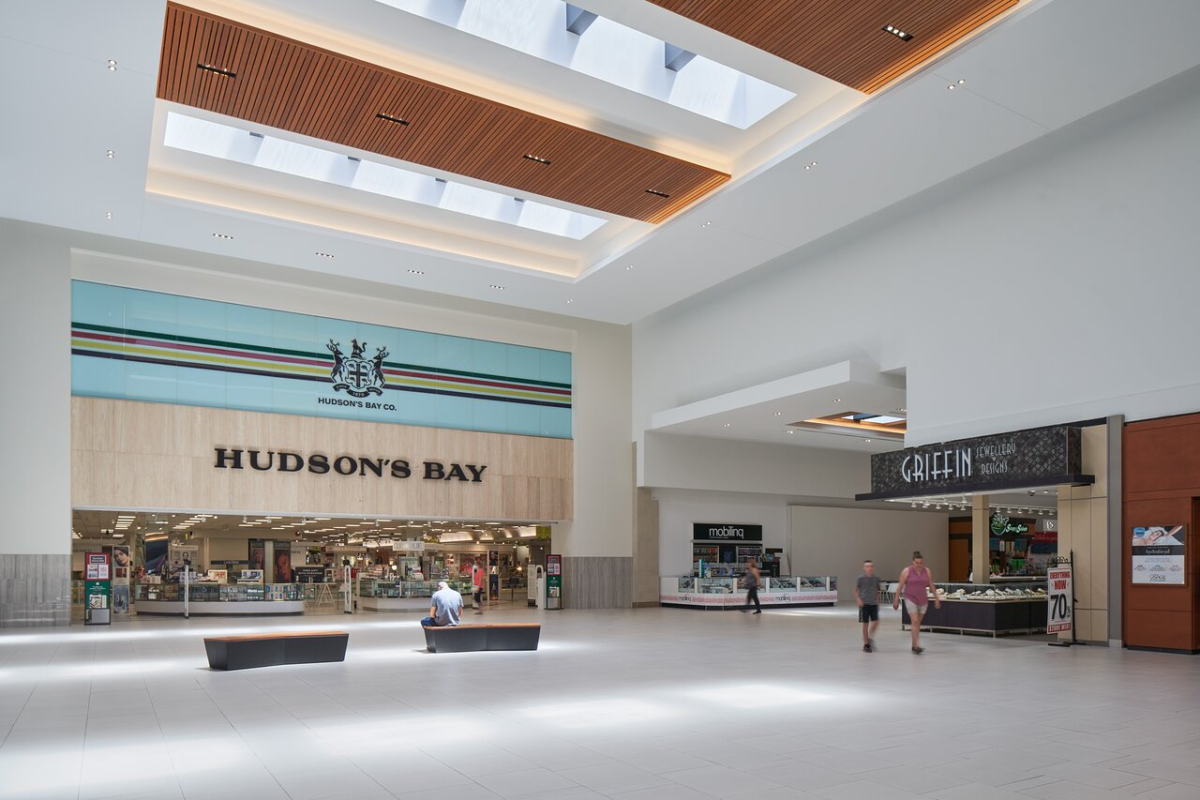
Former Hudson’s Bay store at Devonshire Mall in Windsor, ON. Photo: TripAdvisor
Windsor: Strategic Consolidation at Devonshire Mall
The former Hudson’s Bay space at Devonshire Mall in Windsor is being acquired by Primaris REIT, which already owns the shopping centre.
This transaction stands apart from the others. Rather than a redevelopment play, it represents a strategic consolidation of ownership within an existing retail asset.
By acquiring the space, Primaris gains full control over one of the mall’s key anchor locations. This allows for repositioning, re-leasing, or subdivision of the space in line with evolving tenant demand, without the complications of a third-party owner.
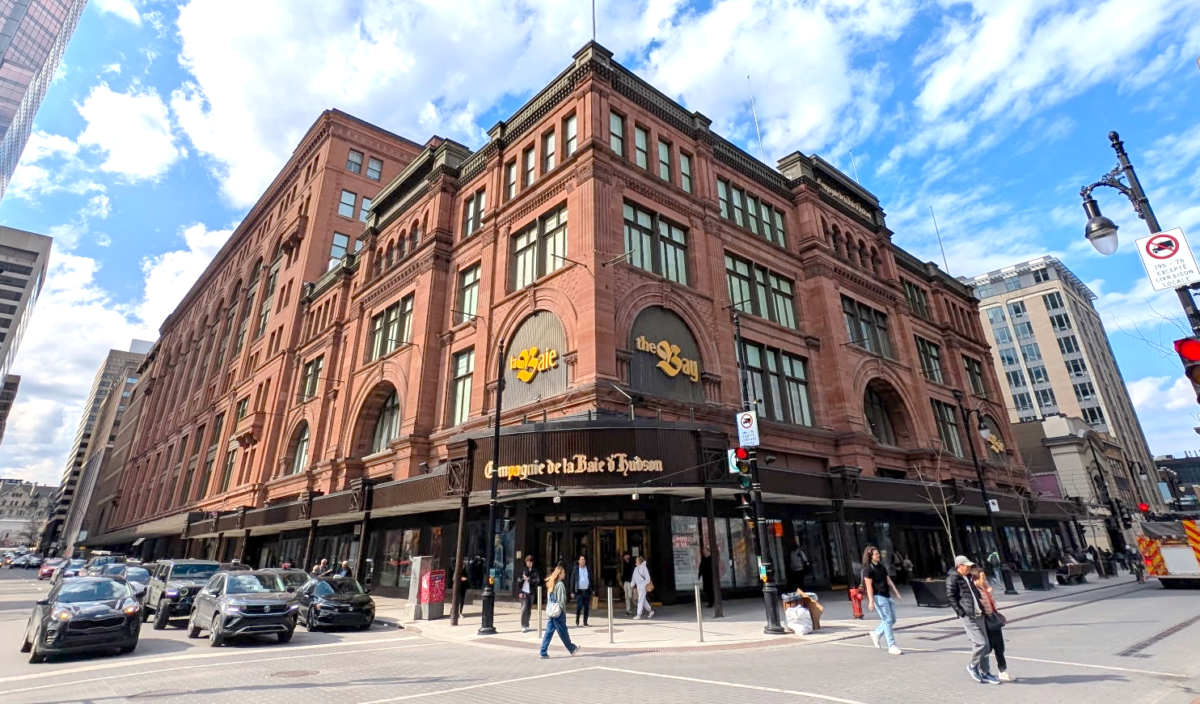
Forerm Downtown Montreal flagship Hudson’s Bay store on April 24, 2025. The building started as a location for the Henry Morgan department store chain, which in decades past operated as an upscale business. Photo: Carl Boutet
Toronto and Montreal Flagships Reflect Diverging Paths
While these four transactions move forward, the most prominent Hudson’s Bay flagship properties in Toronto and Montreal are unfolding under different circumstances.
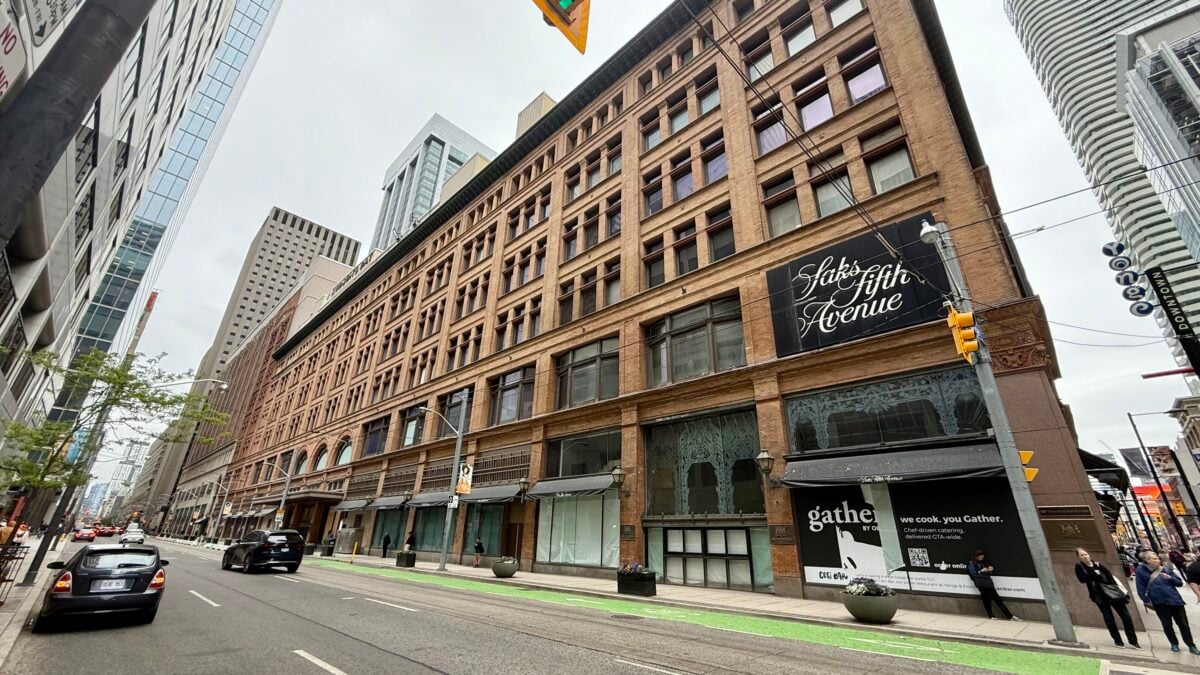
In downtown Toronto, the Hudson’s Bay building on Queen Street is owned by Cadillac Fairview and is not part of the receivership process. The site forms part of the CF Toronto Eaton Centre complex, and its future will be determined independently through Cadillac Fairview’s long-term plans.
Montreal presents a far more transformative proposal. A bid led by the James Bay Eeyou Corporation, in partnership with JHD Immobilier, aims to acquire and redevelop the flagship property at 585 Sainte-Catherine Street West as part of a $400 million mixed-use project.
The proposal would reposition the historic building as a cultural and commercial hub anchored by Indigenous-led programming. Plans include a Cree heritage museum, an Indigenous cultural centre, hospitality uses such as a hotel, as well as retail and office space.
The initiative carries deep historical significance, reflecting the long relationship between the Cree Nation and the Hudson’s Bay Company. It also emphasizes architectural restoration, including preservation of the building’s 19th-century façade. If approved, the project is expected to open later this decade and play a role in downtown Montreal’s broader revitalization.
Saks Fifth Avenue in the Hudson’s Bay Queen Street building, May 2025. Photo: Craig Patterson
Strong Demand Underscores Asset Value
The sale process highlights the continued value of well-located urban real estate, even as traditional retail formats decline.
Court documents indicate that 32 parties signed confidentiality agreements for the Vancouver property, while 16 to 19 parties did so for the other assets. This level of interest demonstrates that, although the department store model has weakened, the underlying real estate remains highly desirable.
At the same time, the agreements reflect current market realities. Purchase prices have been redacted, and the Receiver has described the transactions as the “highest and best” available under current conditions.
A National Shift Away from Department Store Anchors
Taken together, these transactions mark a turning point in how large-format retail spaces are used across Canada.
For decades, Hudson’s Bay locations served as anchor tenants in downtown cores and shopping centres. Today, those same buildings are being repositioned for a very different future.
Developers are exploring residential conversions, mixed-use projects, and experiential retail concepts. Meanwhile, landlords are rethinking how anchor spaces can be subdivided or repurposed to meet modern demand.
This shift reflects broader changes in consumer behaviour, urban development, and the economics of retail. It also underscores how quickly the market is adapting to absorb millions of square feet of former department store space.
What Comes Next
The Ottawa transaction is expected to be the first to receive court approval, with the others anticipated to follow in the near term as administrative steps are completed.
Closing timelines suggest that deals could be finalized as early as May and June 2026, although extensions remain possible.
As these transactions move forward, attention will turn to redevelopment plans and timelines. Each site represents a major opportunity to reshape its surrounding neighbourhood, and together they signal the beginning of a new chapter for some of Canada’s most recognizable retail properties.
Luxury resale retailer Mine & Yours has returned to Calgary for a second pop-up at Holt Renfrew, building on the success of its initial activation and signalling growing demand for pre-owned designer fashion in the market.
The six-month pop-up, which opened this month, features a curated assortment of pre-loved luxury handbags, apparel, and accessories, with pricing reaching up to 70% below original retail. The activation follows a strong debut last year and reflects a deepening partnership between the two companies as resale continues to gain traction within the broader luxury retail landscape.
Courtney Watkins, Founder of Mine & Yours
Calgary Emerges as a Strong Market for Luxury Resale
Courtney Watkins, Founder of Mine & Yours, said the company was encouraged by the response from Calgary consumers during its first pop-up, noting that the market exceeded expectations in both demand and product quality.
“We’re very excited to be back in Calgary,” she said. “When we left, a lot of customers were disappointed, which told us there was clearly an appetite for what we’re doing.”
Watkins added that Calgary shoppers demonstrated a strong interest in designer fashion, particularly apparel, which differed from initial assumptions that handbags would dominate sales.
“I was surprised by how fashion-forward the Calgary customer is,” she said. “There’s a real appreciation for designer clothing and higher price point pieces.”
The current pop-up is located in the former Dolce & Gabbana space on the second floor of Holt Renfrew, offering a darker, more contemporary retail environment than the brand’s typically bright and minimalist stores.
Partnership with Holt Renfrew Continues to Evolve
The return to Calgary highlights an ongoing collaboration between Mine & Yours and Holt Renfrew, one that reflects shifting consumer behaviour and the increasing integration of resale within traditional luxury retail environments.
As part of the Calgary activation, Mine & Yours is offering customers multiple payout options when selling items, including cash, store credit, and Holt Renfrew credit. The latter creates a circular shopping dynamic, where customers can sell luxury goods through Mine & Yours and reinvest directly into new purchases at Holt Renfrew.
“There’s a lot of crossover between our customer bases,” Watkins said. “Many of our sellers are already Holt Renfrew shoppers, so this creates a seamless experience between resale and primary retail.”
The companies are also exploring opportunities to expand the partnership further, including potential promotions and additional locations.
Mine&Yours, Source:
Pop-Ups as a Growth Strategy
Mine & Yours has increasingly used pop-ups as a way to test new markets, build brand awareness, and acquire customers. The Calgary location represents a key step in evaluating the potential for a permanent presence in the city.
“Our goal is to stay in Calgary long term,” Watkins said. “Ideally with Holt Renfrew, but we are definitely looking at establishing a more permanent footprint.”
Beyond Calgary, the company is also considering future pop-ups in Montreal and additional activations in Toronto, as it continues to expand its national reach.
Resale Gains Ground in Luxury Retail
The continued partnership between Mine & Yours and Holt Renfrew reflects broader changes in the retail landscape, where resale is increasingly positioned alongside traditional luxury offerings.
“What was once considered alternative is becoming essential,” Watkins said. “Resale is no longer a secondary option. For many customers, it’s becoming a first choice.”
For the fourth quarter of 2025, compared to the fourth quarter of 2024:
Q4 revenue grew to $7.1M vs. $5.3M, an increase of 35% YoY, marking the 7th consecutive quarter of revenue growth
Gross profit grew to $2.5M vs. $2.1M, an increase of 17% YoY
Adj. EBITDA improved to $205K vs. $12K, marking the 5th consecutive quarter of positive Adj. EBITDA
Cash position at December 31, 2025 grew to $4.1M vs. $3.1M (December 31, 2024), a $1M increase YoY
Full Year 2025 Financial Highlights
For the full year 2025, compared to full year 2024:
Annual revenue increased to $27.7M vs. $19.3M, an increase of 43% YoY
Gross profit grew to $9.9M vs. $7.9M, an increase of 25% YoY. Excluding $0.65M fair value of inventory adjustment related to Tee 2 Green (T2G), a non-cash item, gross margin would be approximately 38.1% vs. 41.0%
Adj. EBITDA improved to $1.5M vs. ($472K), a $1.9M YoY improvement
Cash flow from operations grew to $2.8M vs. $129K
Net income (loss) improved to $279K vs. net loss of ($506K)
“2025 was a breakout year for EMERGE. We delivered another year of organic revenue growth, returned to positive Adjusted EBITDA, and generated meaningful cash flow – achieving all three of our core operational objectives. Our Q4 results marked another strong quarter of growth, despite being a seasonal period for T2G. Both our Grocery and Golf verticals performed well, supported by record holiday B2B sales,” said Ghassan Halazon, Founder and CEO, EMERGE.
Ghassan Halazon
“The acquisition and rapid scaling of T2G exceeded all expectations and validates our EMERGE 3.0 playbook. We’ve carried this momentum into 2026 with the acquisition of Viral Loops, adding a high-margin, recurring revenue stream that further enhances our model. We remain focused on compounding value through profitable growth and disciplined capital allocation. I’d like to thank our team, Board, and partners for their continued execution and unwavering support.”
EMERGE’s recently announced acquisition of Viral Loops is not included in 2025 results. Viral Loops achieved approximately $1.3M revenue, $800,000 Adjusted EBITDA and $700,000 cash flow in 2025 (unaudited), it noted.
For Q1 2026, EMERGE management said it expects to achieve another quarter of strong overall revenue growth year-over-year.
“Q1 is a seasonally softer quarter for the golf vertical, which represented nearly half of EMERGE’s annual revenue in 2025. EMERGE acquired T2G on April 5, 2025 so its results will not be included for the comparative period (Q1 2025),” it said.
“Q1 is typically a strong revenue and customer acquisition period for truLOCAL, driven by increased consumer demand for health and protein-focused subscription offerings. Accordingly, marketing spend is strategically elevated during the quarter. Viral Loops was acquired on March 10, 2026 and will contribute from the day of closing. Q2 2026 will be the first full quarter to include Viral Loops results, which is also peak season for the golf business, particularly T2G.”
The company said its top priorities in the near-term are to i) continue to drive organic growth, ii) extract synergies to drive profitability, iii) explore avenues to enhance cash flow and reduce interest expense; and iv) explore accretive strategic/ tuck-in acquisition opportunities.
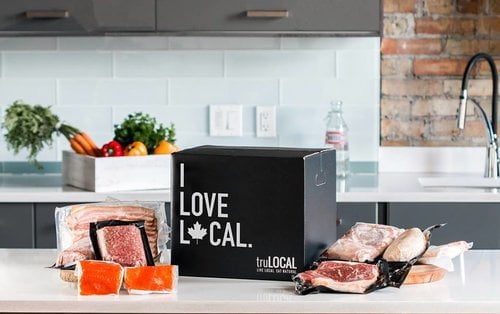
truLOCAL is its flagship Canadian meat and seafood subscription service. Its golf vertical includes UnderPar (discounted golf experiences), JustGolfStuff and Tee 2 Green (discounted apparel and equipment). EMERGE B2Bhouses Viral Loops, its referral marketing platform that enables hundreds of international clients to acquire and retain customers.
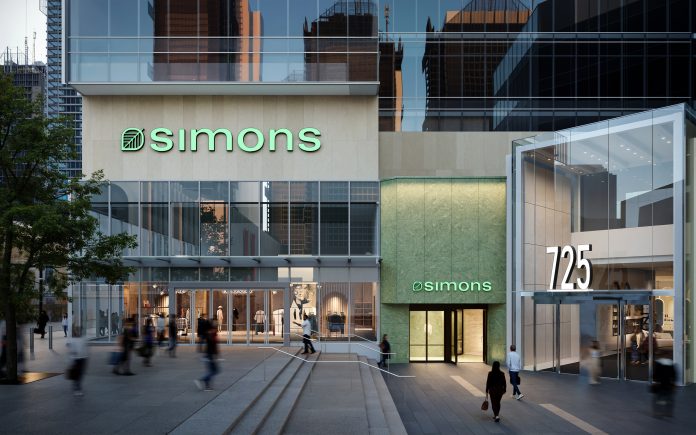
Rendering of Simons’ future store at CF Pacific Centre in downtown Vancouver, scheduled to open in Fall 2027 (Georgia Street entrance). (CNW Group/La Maison Simons)
The announcement that La Maison Simons will open a flagship store at CF Pacific Centre in Vancouver has already made headlines. The more consequential question now is what the move reveals about the future of downtown Vancouver retail, particularly at a time when the market is navigating structural change rather than a simple recovery cycle.
Simons’ planned 92,000-square-foot store, set to open in Fall 2027 within the former Nordstrom space, marks an early phase in the repositioning of one of Canada’s most prominent urban retail nodes, where the traditional department store model has given way to a more fragmented, curated, and experience-driven environment.
For much of the past two years, the closure of Nordstrom and more recently, the nearby Hudson’s Bay Company, created an unusually visible disruption at the intersection of Granville and West Georgia Streets. The loss of two large-format anchors altered pedestrian flow, weakened adjacent leasing activity, and created a perception gap in a part of the city that had long functioned as a primary retail gateway.
According to Martin Moriarty, Vice President at Marcus & Millichap Canada, the scale of those vacancies was enough to ripple across the entire downtown core.
Martin Moriarty
“When you drop a vacancy of that size into a market like Vancouver, it changes everything,” he said, noting that the clustering of the Nordstrom and Hudson’s Bay vacancies compounded the challenge.
However, the reintroduction of a major tenant such as Simons begins to shift that narrative. It signals renewed confidence in the long-term viability of downtown Vancouver as a retail destination.
A Rare Opportunity to Reshape the Core
One of the defining characteristics of Vancouver’s retail market has historically been its lack of large, available spaces. Tight supply has limited opportunities for major repositioning, often forcing brands to compete for smaller footprints or secondary locations.
The vacancy created by Nordstrom’s departure temporarily reversed that dynamic, creating what is now viewed as a once-in-a-generation opportunity to rethink how large-format retail operates in the city’s core.
“You don’t often get the chance to redefine a street or multiple blocks,” Moriarty said. “This is going to have a reverberation not just on Granville Street, but across the entire downtown core.”
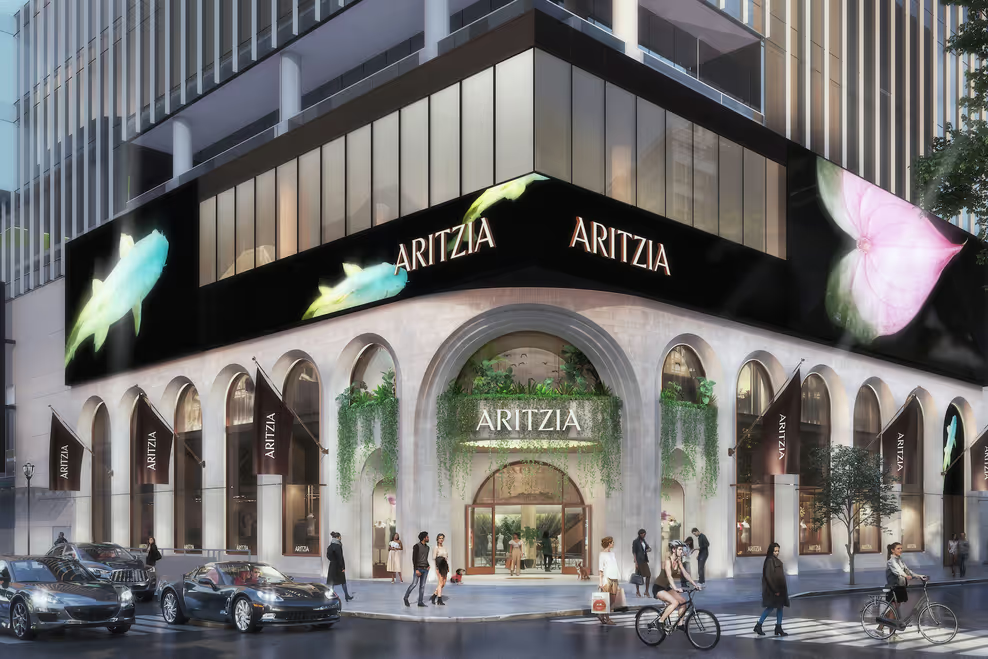
That transformation is already underway. The former Nordstrom space is being subdivided into multiple retail units, with Simons and Aritzia emerging as early anchor tenants. Additional occupants have yet to be announced, but the presence of these brands is expected to accelerate leasing momentum in the area.
Rendering of the future four-level 41,800 sq ft Aritzia store at Robson and Howe in Vancouver. Rendering: Aritzia
A Reset, Not a Return to 2019
While the Simons announcement is widely viewed as a positive development, industry experts emphasize that it should not be interpreted as a return to pre-pandemic conditions.
David Ian Gray
Retail analyst and university professor David Ian Gray described the current moment as a reset rather than a recovery.
“I don’t see a downside,” he said. “But expecting things to go back to 2019 quickly is unrealistic. There’s still hybrid work, and people are more used to shopping closer to home.”
The implications of that shift are significant. Prior to the pandemic, downtown Vancouver benefited from a dense concentration of office workers, tourists, and commuters, all of whom contributed to consistent retail traffic throughout the week.
Today, that ecosystem has become more fragmented. Hybrid work patterns have reduced weekday foot traffic, while the growth of suburban retail nodes has redistributed consumer spending across the region.
As a result, the recovery of downtown retail is expected to unfold gradually, shaped as much by behavioural change as by new investment.
A More Distributed Retail Landscape
The evolution of Metro Vancouver’s retail landscape has introduced a level of competition that did not exist in the same form a decade ago.
Major developments such as Oakridge Park, The Amazing Brentwood, and enhanced suburban shopping centres have expanded the range of high-quality retail options available outside the downtown core. Consumers are increasingly comfortable shopping closer to where they live, particularly when those locations offer comparable brand assortments and improved accessibility.
This does not diminish the role of downtown Vancouver, but it does redefine it. The core is no longer the singular dominant retail destination. Instead, it is one of several key nodes within a broader, more distributed network.
Within that context, the role of a tenant like Simons becomes more strategic. Its ability to draw customers from across the region will depend not only on its brand appeal, but also on how effectively the surrounding retail environment is curated.
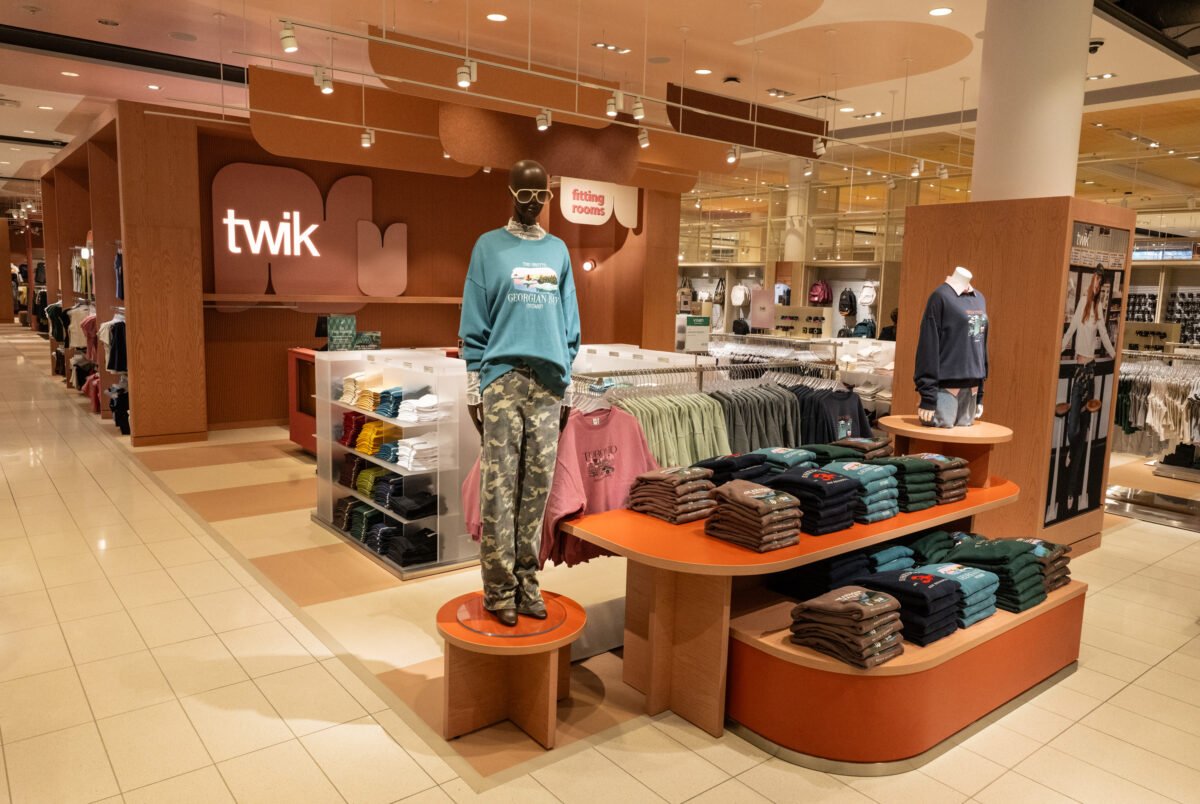
Women’s ‘Twik’ department on the main floor of La Maison Simons at Toronto’s Yorkdale Shopping Centre. Photo: supplied
Why Simons Represents a Different Model
Part of the optimism surrounding Simons is tied to its operating model, which diverges from the traditional department store format that has struggled across North America.
Gray pointed to several key differences, including a more efficient footprint, tighter cost control, and a heavy emphasis on private-label merchandise.
“A large portion of what they sell is private label and thus exclusive,” he said. “You can’t just go online and find the same product somewhere else at a discount. That changes the entire value proposition.”
This approach allows Simons to maintain a distinct identity while avoiding some of the pricing pressures that affected legacy department stores. It also aligns with broader consumer preferences for curated, differentiated retail experiences.
In many ways, the brand represents a modern reinterpretation of the department store concept, one that is more adaptable to current market conditions.
The Clustering Effect and Leasing Momentum
Beyond its individual performance, the presence of Simons is expected to influence the broader leasing environment.
“Good retail attracts more good retail,” Gray said, emphasizing the importance of establishing a critical mass of desirable tenants.
This clustering effect is particularly relevant in a repositioning project of this scale. Once anchor tenants are secured, it becomes easier to attract complementary brands, improve tenant mix, and enhance overall market perception.
For Cadillac Fairview, the landlord of CF Pacific Centre, the opportunity now is to build on this momentum by securing additional tenants that reinforce the repositioning strategy. The same can also be said for landlords in the immediate area.
The outcome will play a significant role in determining whether the redevelopment becomes a true destination or simply a collection of individual stores.
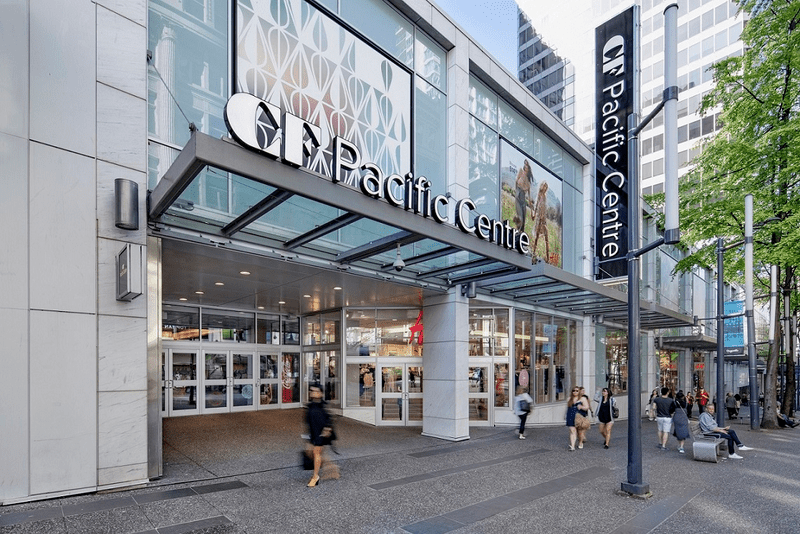
Granville St. entrance to CF Pacific Centre in Vancouver. Photo: Cadillac Fairview
Granville Street at an Inflection Point
The implications of these changes extend well beyond the boundaries of CF Pacific Centre.
Granville Street, which has faced challenges in recent years, stands to benefit significantly from renewed activity at the former Nordstrom site. While nearby corridors such as Robson Street and West Fourth have remained strong, Granville has struggled in part due to the concentration of large vacancies.
“Robson and West Fourth are effectively full,” Moriarty said. “Granville has been the challenge, and a big part of that is these large empty spaces.”
Filling those spaces is expected to restore pedestrian flow and improve the viability of adjacent retail, restaurants, and service businesses.
More importantly, it provides an opportunity to rethink how the street functions within the broader downtown ecosystem.
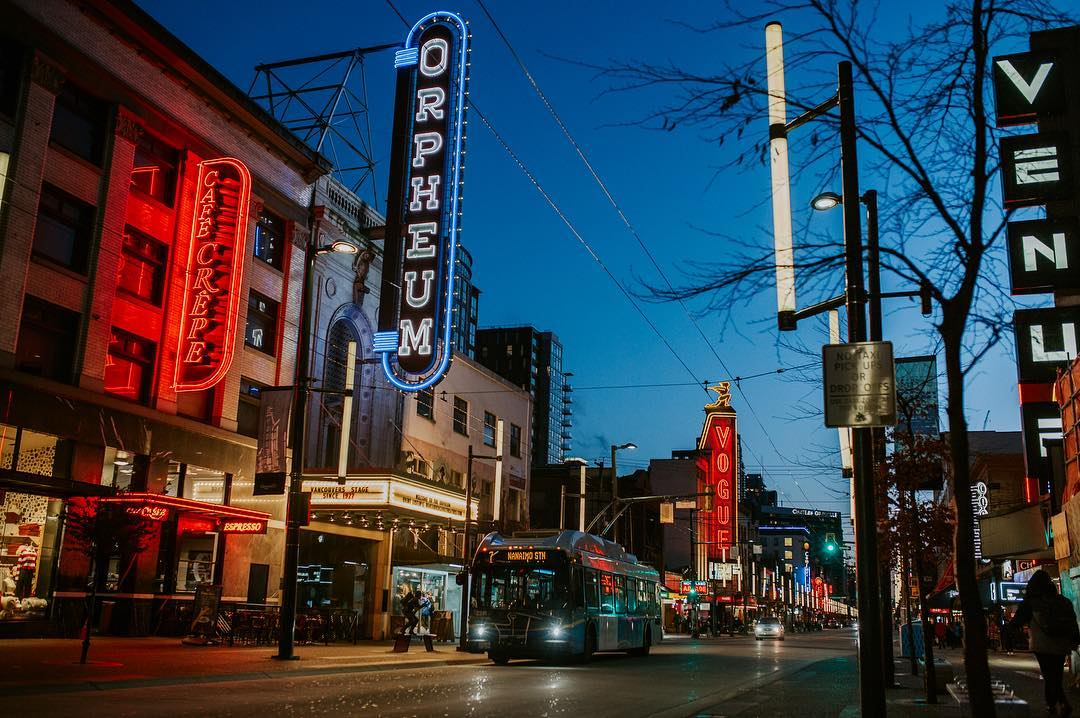
Granville Street in Vancouver. Photo: Destination Vancouver
A New Layer of Competition: Labour
As Metro Vancouver continues to expand its retail footprint, another challenge is beginning to emerge, one that extends beyond consumer demand.
Labour availability is becoming an increasingly important factor, particularly as multiple large-scale developments move toward completion within a relatively short timeframe.
“It’s not just about competing for shoppers anymore,” Gray said. “The entire region is going to be competing for employees as well.”
This dynamic is shaped by several factors, including the high cost of housing, commuting patterns, and the geographic distribution of new retail projects. For retailers, securing and retaining staff may become as critical as attracting customers. Competition from retailers at Oakridge Park and others will no doubt be an issue.
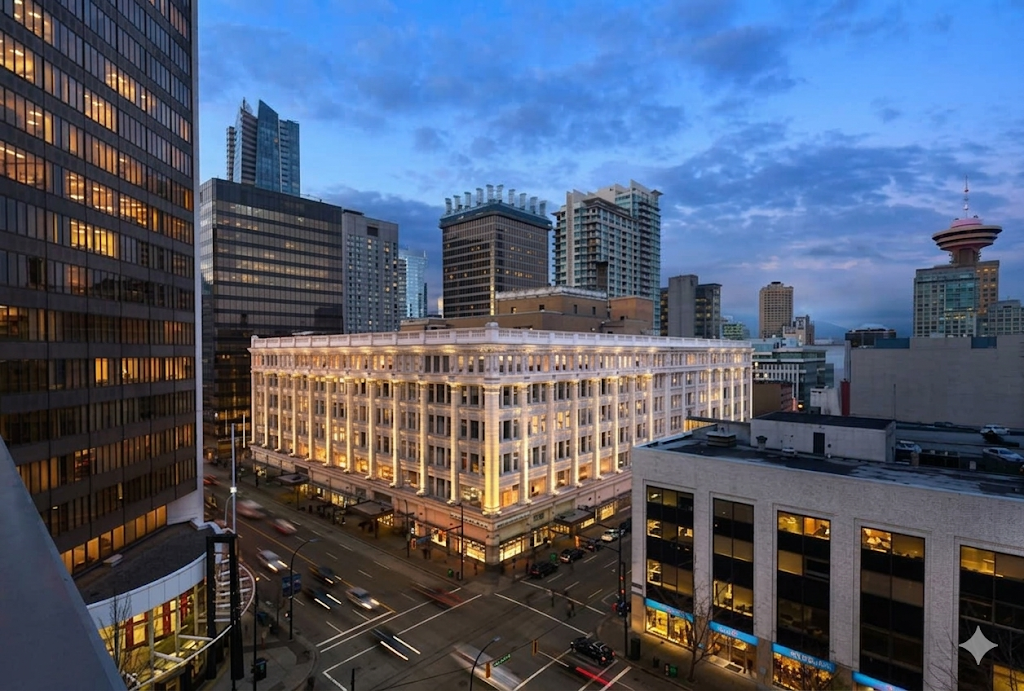
Former Hudson’s Bay flagship store in downtown Vancouver. Photo: CBRE
The Final Piece: The Hudson’s Bay Building
Despite the momentum generated by the Simons announcement, the future of the former Hudson’s Bay building remains a central question.
The property, located directly across from CF Pacific Centre, is one of the most prominent redevelopment opportunities in Canada. Its eventual repositioning is widely viewed as essential to fully restoring the vitality of the Granville and West Georgia intersection.
Until that site is resolved, the transformation of the area will remain incomplete.
However, there is growing confidence within the industry that a solution will emerge, driven by the underlying strength of the Vancouver market and the strategic importance of the location. Redevelopment, in whatever form, will likely take years to come to fruition.
A Measured but Meaningful Shift
Ultimately, the significance of Simons’ entry into downtown Vancouver lies not in the scale of the store alone, but in what it represents.
It reflects a renewed willingness by major retailers to invest in the city’s core, even as the broader retail landscape continues to evolve. It also underscores the shift toward more flexible, curated retail formats that are better suited to current consumer behaviour.
The recovery of downtown Vancouver retail will not be immediate, nor will it replicate the past. Instead, it will be shaped by a combination of new investment, changing habits, and the gradual rebalancing of the urban environment.
As Gray noted, “It’s going to take time, but this is exactly the kind of move that pushes things in the right direction.”
La Maison Générale in Montreal. Photo: La Maison Générale
La Maison Générale is marking a significant dual milestone, celebrating the first anniversary of its Montreal boutique while the French lifestyle brand reaches its 80th year in operation. The Montreal location represents the company’s first international expansion and signals a broader evolution from a regional French concept into a global retail and design brand.
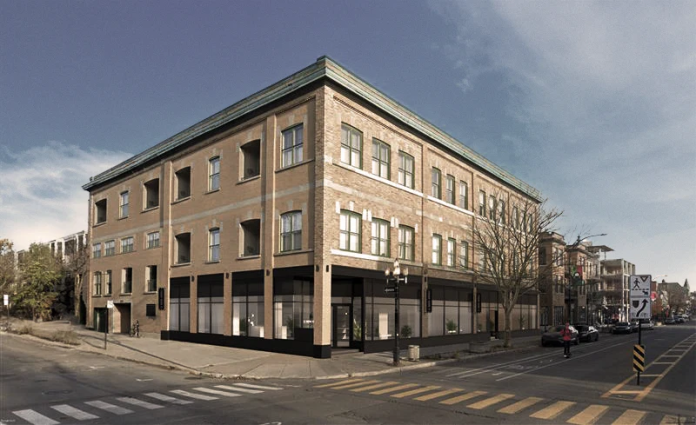
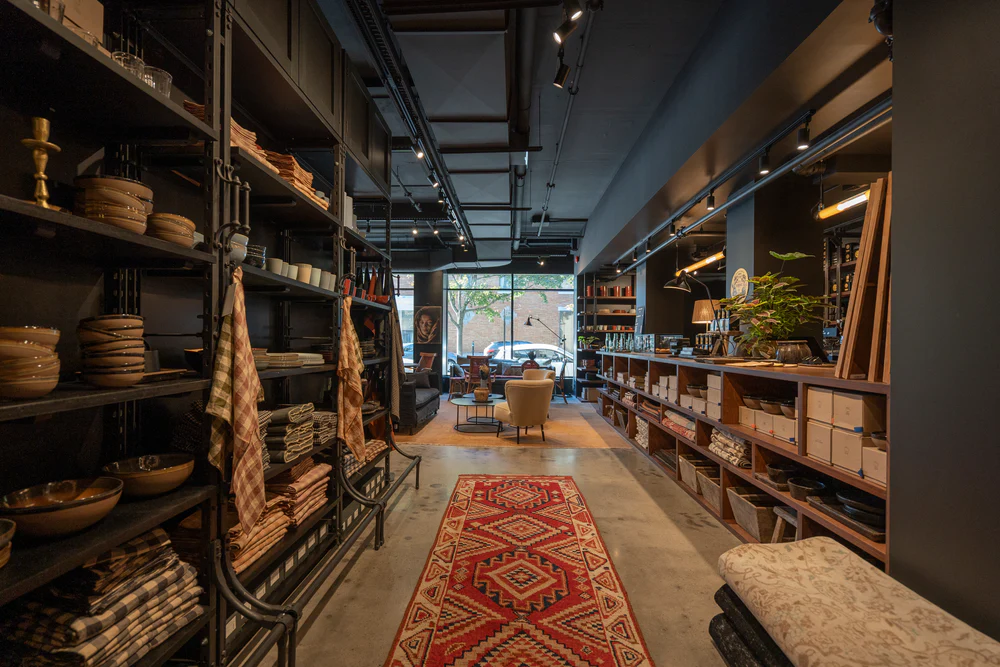
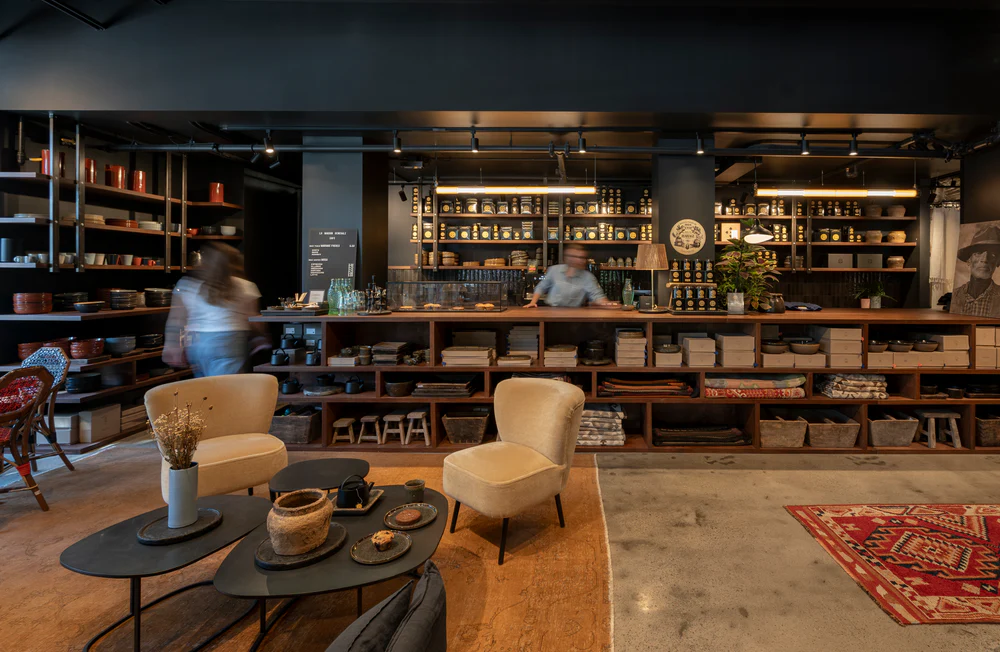
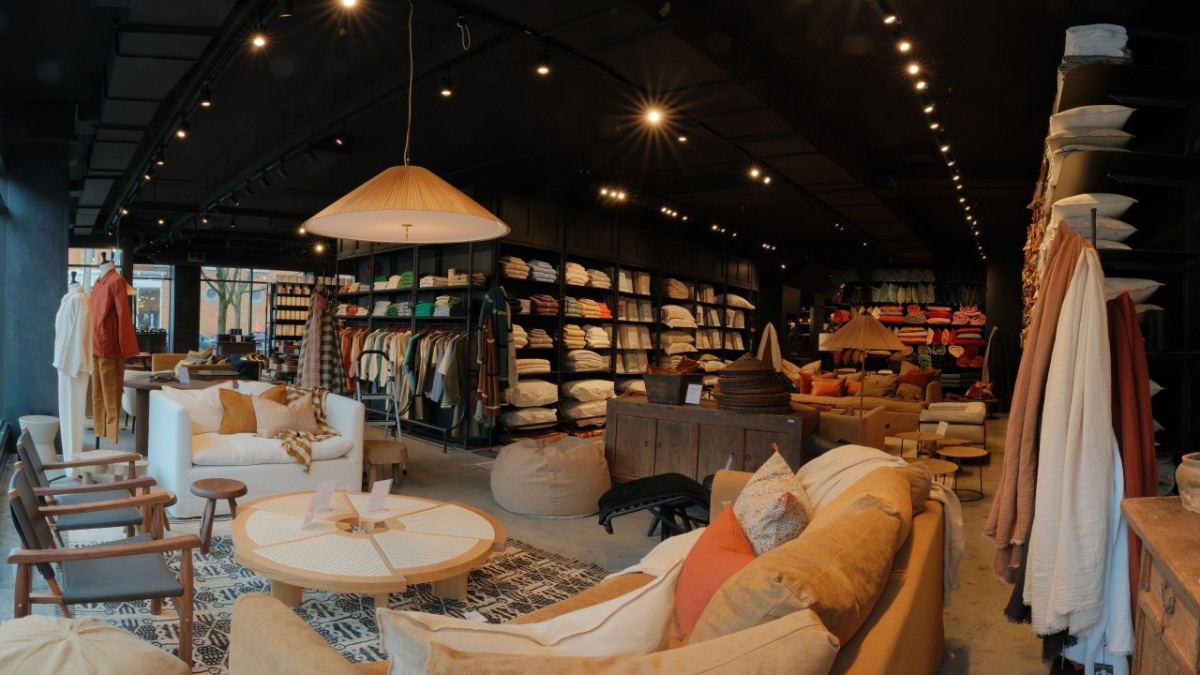
Opened in April 2025 in Montreal’s Mile End neighbourhood, the boutique has quickly established itself as a distinctive retail concept that blends home décor, fashion, and hospitality. Located at 237 Avenue Laurier Ouest, the space combines curated retail with a tea room experience, creating an immersive environment that encourages customers to engage with the brand beyond traditional shopping.
Strong First Year Performance Driven by Experience-Led Retail
Gwenaëlle Thibaut, Co-Founder of La Maison Générale Montreal and granddaughter of founder Lucienne Thibaut, described the first year as both encouraging and revealing in terms of consumer appetite.
“We’re really happy. It’s been incredibly encouraging. People are showing up with curiosity and engaging with the concept,” she said in an interview.
Gwenaëlle Thibaut
The store’s mix of fragrances, furniture, textiles, and design services has resonated with customers seeking more personalized and expressive interiors. Thibaut noted that early concerns about introducing bold colours and textures into a market often dominated by neutral tones proved unfounded.
“We thought everything was beige and wondered if it would work. But people come in and say it’s nice to see something colourful. It creates emotion and allows them to personalize their homes,” she explained.
This emphasis on emotional connection and individuality has become a defining feature of the brand’s positioning in Montreal.
La Maison Générale in Montreal. Photo: La Maison Générale
Expanding Offerings with Design Services and New Showroom Space
Building on early momentum, La Maison Générale has expanded its service offering to include in-home design consultations, custom curtains, and curated furniture placements. The company now brings rugs, furnishings, and decorative elements directly to clients’ homes, reinforcing a service-driven retail model.
At the same time, the business is preparing to open a separate showroom space nearby to showcase rare and antique pieces sourced globally. The approximately 2,000-square-foot space will feature items from the 18th and 19th centuries, sourced from regions including India and China.
“We don’t have enough room in the boutique, so we’re creating a more private experience where customers can discover unique pieces that aren’t widely displayed,” said Thibaut.
This expansion reflects both demand and the brand’s commitment to maintaining a curated, discovery-driven retail environment.
Tea Room Concept Drives Traffic and Engagement
A key differentiator for the Montreal location has been its integrated tea room, which functions as both a hospitality offering and a traffic driver. The concept encourages repeat visits and introduces customers to the brand in a more casual setting.
“When you’re not looking for a sofa, you don’t go to a décor store. But you go for coffee every day,” Thibaut said. “The tea room creates an experience. People come in, relax, and then start imagining how their home could look.”
The café now offers house-made pastries alongside coffee and tea, contributing to a broader experiential strategy that blends retail with lifestyle.
La Maison Générale tea room in Montreal. Photo: La Maison Générale
National Reach Through E-Commerce and Tourism
While the physical store anchors the brand in Montreal, La Maison Générale has seen growing demand from across Canada through its e-commerce platform. Orders are being fulfilled nationwide, supported by a curated assortment that includes heritage brands and specialty products.
The store has also benefited from Montreal’s tourism draw, particularly within the Mile End district. Thibaut noted a diverse customer base that includes local residents as well as visitors from the United States, Europe, and Asia.
“It’s not just Montreal. We have people coming from all around, and also tourists who are looking for something different, something artistic and refined,” she said.
Focus on Montreal Before Broader Expansion
Despite early success, the company is taking a measured approach to expansion within Canada. While exploratory visits to Toronto have taken place, the current priority remains deepening the Montreal operation and scaling services through digital channels.
“We’re a small business, so our focus is Montreal for now. We may consider a pop-up in other cities one day, but we want to develop Quebec and reach the rest of Canada through our website,” Thibaut explained.
The company is also positioning itself to take on design projects nationwide, leveraging its control over logistics and sourcing.
La Maison Générale in Montreal. Photo: Laurier Ouest
Investing in AI to Support Growth
A notable strategic initiative underway is the development of an internal AI-driven platform to streamline operations, including ERP and CRM systems. The project is being developed in Montreal, leveraging the city’s strong AI ecosystem.
“We want to spend more time with customers and less time on administration. AI allows us to automate processes so we can focus on design and relationships,” said Thibaut.
The platform is expected to eventually be implemented across the brand’s operations in France, underscoring Montreal’s role as an innovation hub within the company.
80 Years of Heritage Anchoring Future Growth
The Montreal milestone coincides with La Maison Générale’s 80th anniversary, marking a journey that began in 1946 when Lucienne Thibaut founded the original business in France. The company later evolved under Dominique Tosiani and Gwenaëlle Thibaut into a broader “art de vivre” concept, combining retail, design, and hospitality.
Today, the brand operates three boutiques in France alongside its Montreal location, maintaining a balance between heritage craftsmanship and contemporary retail innovation.
“It feels like we are both a startup and an 80-year-old company at the same time,” Thibaut said.
A grocery store in Alberta. Photo: Craig Patterson
Canada’s grocery sector is facing a growing divide as retailers, suppliers, and distributors clash over who should absorb rising transportation costs.
At the centre of the dispute is the rapid escalation of fuel prices in early 2026, driven in part by geopolitical instability in the Middle East. Disruptions in the Strait of Hormuz, which handles roughly 20 per cent of global oil shipments, have pushed diesel prices higher, with some Canadian regions seeing levels approach or exceed $2.00 per litre this spring.
The result is a mounting standoff over fuel surcharges, with implications that extend well beyond the supply chain and onto grocery shelves across the country.
A Power Struggle Between Retail Giants and Suppliers
The conflict highlights a widening gap between Canada’s largest grocery chains and the rest of the market.
Major retailers such as Loblaw Companies Limited, Empire Company Limited, and Metro Inc. are pushing back aggressively against new supplier-imposed surcharges. These companies benefit from scale, long-term procurement contracts, and in many cases vertically integrated logistics networks.
Per Bank has stated that the company will resist “unjustified cost increases,” including fuel-related fees that lack transparency. Meanwhile, Nicolas Amyot has acknowledged direct pressure on distribution costs, while emphasizing efforts to delay any impact on consumers.
For these large players, refusing surcharges is both a negotiating tactic and a positioning strategy. By holding the line, they aim to maintain price leadership in an environment where consumers are already strained by inflation.
Suppliers, however, argue they have little choice.
Companies such as Maple Leaf Foods have introduced temporary surcharges, in some cases around $0.11 per kilogram on certain products, citing what they describe as a rapid and significant escalation in logistics costs. Diesel is a core input not only for transportation, but also for agricultural production, creating what industry observers describe as a “double whammy” effect on food pricing.
A grocery store in Quebec. Photo: Vergo Construction
Independent Grocers Face the Greatest Pressure
While large chains negotiate, independent grocers are often left with little room to manoeuvre.
The Canadian Federation of Independent Grocers, which represents approximately 6,900 stores, warns that the current environment is accelerating the emergence of a two-tier grocery system.
“A smaller independent grocer certainly does not have the leverage of some of the big chains,” said Gary Sands. “If you don’t pass on the cost, you won’t be an independent grocer, you’ll be an out-of-business grocer.”
Independents typically rely on third-party distributors and wholesalers, where surcharges are often applied as non-negotiable line items. Smaller delivery volumes further exacerbate the issue. A flat surcharge of $15 to $50 per truckload represents a significantly larger share of margins for a small store than for a major distribution centre serving a national chain.
Operational limitations also play a role. Large retailers can optimize logistics through backhauling, filling trucks on return trips to maximize efficiency. Independent grocers rarely have access to such systems, meaning they effectively absorb the cost of empty return miles through higher supplier fees.
Rising Costs Meet Consumer Resistance
The timing of the dispute is particularly sensitive.
Food inflation in Canada outpaced general inflation in 2025, with grocery prices rising roughly 5 per cent compared to 3.5 per cent overall inflation. Consumers have become increasingly price-conscious, leaving little tolerance for further increases at the shelf.
This creates a difficult balancing act. Large chains are resisting surcharges in part to maintain competitive pricing, while independents often have no choice but to pass those costs directly to customers.
The result may be a growing pricing gap between national discount banners and smaller community-based stores, even when selling identical products.
Grocery Code of Conduct Gains Urgency
The dispute is also intensifying calls for reform as Canada moves toward implementing a national grocery code of conduct.
The Grocery Sector Code of Conduct, expected to be fully in place in 2026, aims to address imbalances in negotiating power and introduce greater transparency into supplier-retailer relationships.
Among its objectives are clearer standards around cost pass-through mechanisms, including fuel surcharges, as well as dispute resolution frameworks for smaller players who lack leverage in negotiations.
Proponents argue that the code could help standardize how surcharges are calculated and applied, ensuring more consistent treatment across the sector. Critics, however, question whether it will be sufficient to address structural disparities between large and small operators.
A Structural Shift in Grocery Economics
At its core, the grocery fuel surcharge Canada debate reflects a broader transformation in the economics of retail.
What appears to be a narrow dispute over logistics costs is, in reality, a proxy for deeper questions about scale, power, and resilience within Canada’s food system.
If current trends persist, the industry could see increased consolidation, greater pressure on independent operators, and more pronounced regional disparities in pricing and access.
For consumers, the impact may be subtle but significant. The same product could carry different price tags depending on where it is purchased, not because of retail strategy, but because of the invisible costs embedded in the supply chain.
As one industry observer noted, the issue is not simply about fuel.
After more than two decades building one of Canada’s most loved fast-casual salad brands, Mandy’s Salads is bringing its signature pink-hued world and famous salads to a neighbourhood that’s been waiting for it.
It will be their 15th location in total.
For sisters Mandy and Rebecca Wolfe it marks another exciting milestone in its national expansion.
Mandy Wolfe
What began in 2004 as a folding table tucked inside a Montreal boutique has grown into a household name across Montreal, Ottawa, and Toronto, with Vancouver next on the horizon in Kitsilano and Coal Harbour.
Located at 359 Front St E in the District, the 1,900-square-foot space will offer 30 seats indoors, along with an additional 15-seat patio.
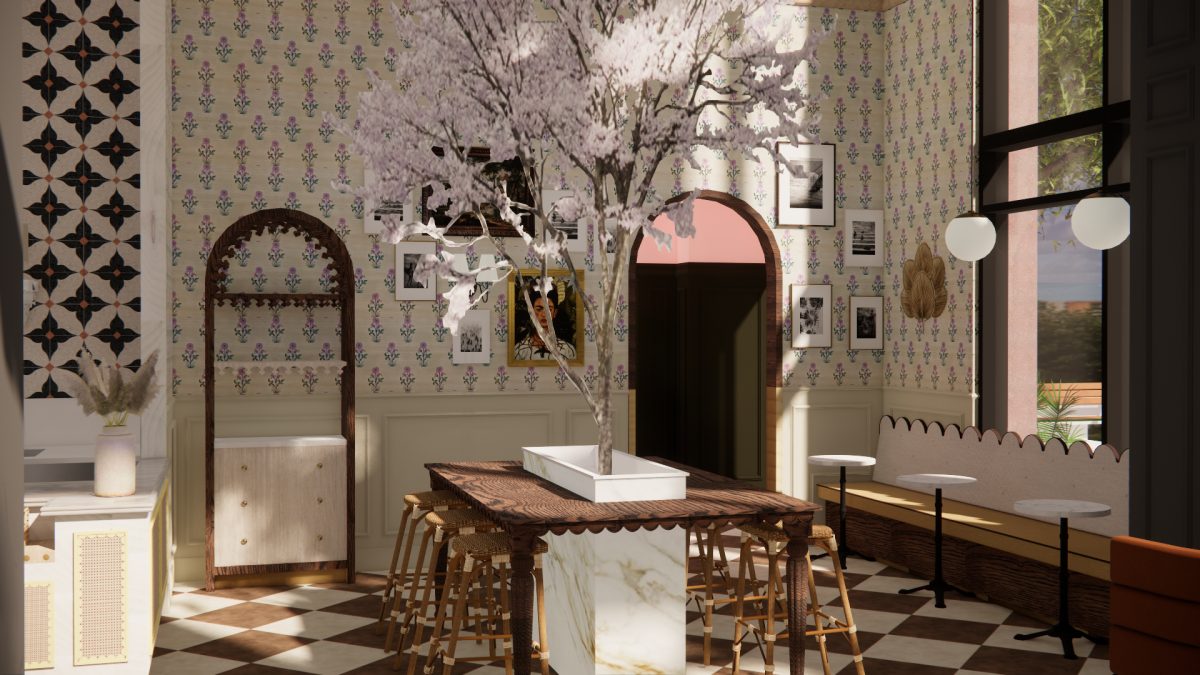
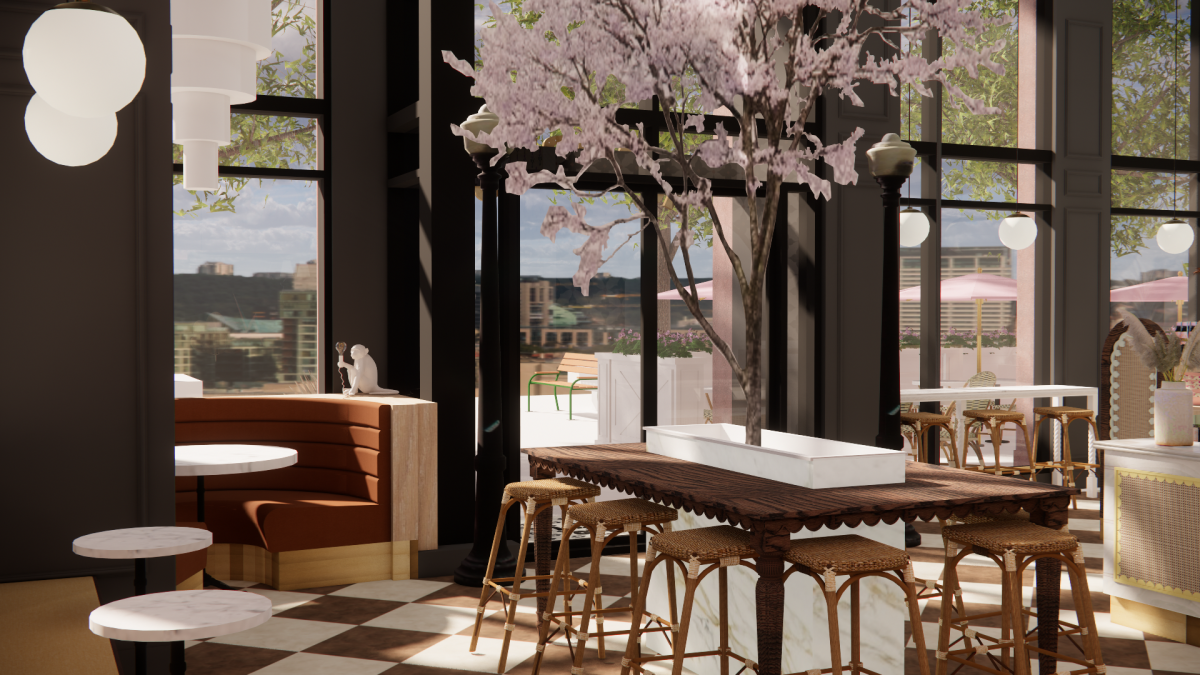
The space also features custom-designed wallpaper created specifically for this location, a curated mix of gorgeous antique pieces, and even restored city lamp posts brought indoors, adding to the charm and character of the restaurant. All of this comes to life under 30-foot high ceilings that make the space feel both grand and inviting.
Rebecca Wolfe
The Distillery District space brings together signature Mandy’s design with new creative firsts. For the first time, the team has customized its own lighting in collaboration with Stray Dog Designs, paired with a bold Tom Dixon fixture that anchors the room.
Known for richly layered interiors, Mandy’s takes it even further here. Adorning the walls with antique and vintage finds, and introducing a brand-new gallery wall of paintings for the first time, alongside its iconic family wall.
The opening follows closely behind the brand’s spring menu launch on April 30, bringing a fresh wave of seasonal flavours to pair with the new space.
“We chose the Distillery because it already has a natural energy, so we didn’t need to make anything up. It’s got a historic essence to it, and it’s a great cross section of locals and tourists. Even when you’re driving on any highway, you’ll see the historic sign—Toronto Historic Distillery District—and we love that feel,” said Mandy Wolfe.
“In Montreal, we have a great location in Old Montreal with cobblestone streets, so there’s something that resonates with our brand very much. There’s historic architecture and character, but we’re in this brand-new building, which is a lovely balance between new and old. We love the experiential aspect of opening in a new neighborhood or maybe an up-and-coming, more gentrified area. That’s always something we love to do—be a community hotspot for anyone that’s living there and moving around there. I think they’re also developing the waterfront around there quite a bit, so that’s lovely.”
Mandy said she doesn’t think the sisters ever fully accepted that the business grew to the level it is today.
“It’s a constant state of awe and appreciation and gratitude—just sort of pinch-me moments. I hope we don’t ever lose that,” she said.
Mandy said the brand is securing a third location in Yaletown in Vancouver and is looking at the Calgary market as well.
“With our team, which is incredible—and we keep adding more superstars to help us grow our vision—we love being a Canadian brand, and we hope to expand from coast to coast. But we also love to go south of the border to warmer climates. We find our menu is very harmonious with warm weather, so somewhere like southern Florida is something that we’re actively working toward as well. In terms of a total number, we’re already pretty much close to 20 now if you include Vancouver, so I think we could go up to 40 if you include expansion into the States,” she said.
Mandy’s Rendering
For the brand itself, it’s been pretty much the same since its initial launch.
“We really wanted to make healthy, delicious eating fun and somewhat glamorous, which you can see through the decor and design when you come in. It’s not a cafeteria or a diet spot. We’re trying to bring fun and whimsy back into healthy eating and eating whole foods that are sustainably sourced and are fun to look at before you even dig into them. Getting really creative with the menu, with inspiration from all over the world—different spices and flavour profiles—and really something for everybody. We’re not vegan, we’re not full protein—we cover the spectrum of all different eating styles. And that’s never changed.”