Rehabilitation plays a vital role in helping patients recover from injuries and return to some state of stability and general wellbeing. Methods of rehabilitation have changed over the years, with many of the latest therapies incorporating modern technology to improve healing capabilities, reduce downtime, and offer drug-free pain relief.
These tools, which can look like a shockwave therapy machine, muscle stimulators, and even wearable sensors, empower both patients and practitioners to accelerate recovery and improve rehabilitation outcomes.
Developments in Recovery Science
Recovery science has come a long way since it was first codified as its own field of study. Early forms of recovery were largely passive, consisting primarily of bedrest and medication. Some physical therapy methods like cryotherapy and hydrotherapy were in use, but the underlying mechanisms of how and why these treatments worked were largely unknown.
Today, recovery science emphasizes the importance of active recovery methods and targeted therapies specifically designed to address precise parts of the body. Technology has played an essential role in facilitating many of these therapies, and it now sees widespread use in mainstream physical therapy and sports rehab techniques.
Benefits of Tech-Driven Rehab
While tech-driven rehab is by no means a miracle cure or one-size-fits-all solution to improving the healing process, these tools can be valuable complements to professionally administered physical therapy.
When used in conjunction with professional methods, tech-driven rehab can help some users see faster healing times through targeted interventions that address specific physiological needs.
Additionally, rehab technologies canimprove patient engagement and progress tracking via sensors and other tools that provide practitioners with additional information.
Proper use of these tools can culminate in minimizing long-term damage and recurrence of injuries. However, these benefits are often contingent on the user’s consistency and adherence to professional guidance.
Examples of Modern Recovery Tools
Given the many types of injuries that can occur as a result of different pathologies and traumas, modern recovery tools are diverse and often specialized to address specific physiological conditions. Some tools see more general use, however, as they assist in wellness, regular diagnostics or pain relief.
For instance, Physiopedia notes the importance of “assistive technology solutions [that] range from basic mobility aids to sophisticated communication devices.” They continue, noting how “these tools serve as bridges, helping individuals overcome specific functional limitations and participate more fully in daily activities.”
Common examples of modern recovery tools include wearable sensors and portable muscle stimulators. In contrast, sensors assist in measuring range of motion and posture correction, muscle stimulators help provide strength maintenance during rest. More specialized tools, such as shockwave therapy machines, can be used to promote tissue regeneration in hard-to-heal areas like ligaments and tendons.
Safe Usage for Best Results
Technically sophisticated therapies can offer notable benefits, but they can be difficult and potentially even dangerous to self-administer, so these tools should be administered under clinical guidance or by trained professionals.
Protocols will vary based on an injury’s type and severity, further necessitating professional oversight for safe and effective use. Patients hoping to employ the use of therapy devices should bear in mind that they are not replacements for core rehabilitation practices, but instead supplements that complement existing therapies.
Modern technology has made rehabilitation impressively safe and effective, helping patients recover more quickly and thoroughly than ever. With more moving parts come more opportunities for complications, however, making these tools best used by professionals for the best possible outcomes.
FAQ
Q: Do therapy devices eliminate the need for physical therapy?
A: No. These devices are intended to complement traditional therapy, ideally accelerating the results from physical therapy.
Q: What kinds of injuries can benefit from tech-based rehab?
A: Tech-enhanced approaches are often used to treat post-surgical recovery, sports injuries, chronic joint issues, and repetitive strain conditions.
Q: Are therapy tools safe for home use?
A: Some are, but professional supervision is best when using most therapy tools to ensure safety and effectiveness.
The idea of a stable, secure second home attracts many thoughtful savers and planners. In simple terms, a golden visa allows qualifying applicants to live, learn, and build roots through clear rules. We focus on just one phrase to anchor the concept: golden visa portugal By naming it once, we set a reference point without pushing any offer. The broader goal is calm: a lawful path that protects families, diversifies options, and adds resilience to long-term plans. For readers who value clarity over hype, this article explains why many investors choose these programs for security, choice, and continuity across generations.
Predictable Rules And Responsible Planning
Programs built on transparent requirements give people confidence to act without guesswork. When timelines, costs, and documentation are clean, making plans becomes practical in place of being disturbing.
Documented steps assist families in mapping actions, budgets, and time limits with much less confusion.
Published criteria reduce surprises and support steady progress toward approvals.
The timelines, once known, mean that schooling, housing, and tax planning align well.
Predictable routes make long-term commitments easier to justify and maintain.
Portfolio Protection Through Place Flexibility
Spreading life options across jurisdictions can complement a diversified financial plan. With a lawful residence path, families are not tied to a single environment for opportunity or security.
Diversified access reduces reliance on one legal or economic framework.
A second base can support education, work, and future business formation.
Lawful residence offers continuity during market, policy, or currency shifts.
Documented status lowers friction for essential services and everyday needs.
Family Stability And Succession Simplicity
Investors often think in decades, not days. Residency that can include close relatives supports unity and smooth succession.
Keeping households together reduces emotional and logistical strain.
Shared status lets spouses and children plan study or work without panic.
Structured residency can align with wills and trusts for generational handover.
Continuity of rights encourages long-term savings and patient investing.
Education Access Without Uncertain Steps
Clear residence rights can simplify learning paths. Households can evaluate schools and skills training with less uncertainty.
Transparent entry removes last-minute hurdles for admissions or enrollment.
Stable status helps students focus on learning rather than paperwork cycles.
Long-term timelines allow thoughtful choices about language and certifications.
Families can compare curricula calmly, using multi-year plans and budgets.
Health, Housing, And Everyday Reliability
Security is not only about markets; it is also about life logistics. Predictable residence supports steady access to daily essentials.
Documented address history simplifies leasing, utilities, and banking setup.
Recognized identification reduces stress at clinics, schools, and local offices.
Stable footing encourages preventive care and regular life routines.
Every day reliability frees time and attention for work and family growth.
Risk Management For Business Builders
Entrepreneurs and professionals value redundancy. Lawful residence in another setting can protect work continuity.
Alternative base reduces exposure to single-market disruptions or policy shocks.
Flexible mobility supports client meetings, hiring, and service delivery planning.
Compliance frameworks guide proper registrations, reporting, and renewals.
Stable rights help founders recruit confidently and retain key teammates.
Costs, Compliance, And True Value
Beyond headlines, the real question is value over time. Carefully review applicants’ degree overall prices, responsibilities, and benefits.
Honest budgeting consists of costs, taxes, coverage, and annual renewals.
Compliance calendars prevent lapses that could slow or opposite development
Comparing routes by flexibility, family coverage, and timelines reveals fit.
The best choice balances lifestyle goals, liquidity needs, and legal clarity.
Ethical Grounding And Good Citizenship
Strong programs expect good conduct. Applicants who follow rules reinforce the program’s reputation and durability.
Transparent background checks keep standards high and communities confident.
Clear investment criteria direct funds into productive, regulated channels.
Ongoing responsibilities, once known, are easier to meet consistently.
Good citizenship protects the integrity of everyone’s status over time.
What Smart Applicants Do Before Committing
Wise applicants prepare, verify, and pace themselves. This reduces friction and supports successful outcomes.
Gather identity, finance, and family records in secure, organized folders.
Study official requirements and note small details that affect eligibility.
Build a realistic timeline with buffers for reviews and translations.
Confirm renewal duties early so nothing is forgotten later on.
Navigating Advisors, Documents, And Deadlines
Many applicants work with licensed experts, yet personal diligence still matters. Clear communication and careful reading help avoid mistakes.
Request step-by-step scopes, itemized costs, and written service boundaries.
Keep personal copies of every submission and receipt for quick reference.
Verify forms line by line; small errors can cause costly delays.
Schedule regular check-ins tied to milestones, not vague promises.
Digital Security And Data Care
Residency processes involve sensitive documents. Protecting them is part of responsible planning.
Use strong passwords and multi-factor authentication for all shared portals.
Avoid public networks when uploading financial or identity records.
Maintain encrypted backups with clear labels and expiration reminders.
Limit access to essential parties; audit who can view which files.
Measuring Life Quality, Not Just Legal Status
The right program should fit daily life, not only paperwork. Applicants look past approval to practical living.
Shortlist communities that match language, schooling, and work rhythms.
Test routines: banking, transport, and connectivity for daily reliability.
Research taxes, insurance, and long-term obligations in simple terms.
Plan social ties and learning goals to ease the first two years.
One Mention About Research Sources
Responsible readers consult reputable places online for policy summaries and updates. For example, some people review provider portals like mercan.com to compare steps and timelines, then cross-check with official notices. The aim is not promotion; it is prudence: reading widely, confirming details, and documenting every requirement before sending any file.
Clarity Over Speed When Stakes Are High
Rushing can ruin good plans. Patience and precision usually pay off.
Wait for complete documents rather than sending partial packages.
Ask for plain-language summaries of any complex legal section.
Build buffers into your calendar so reviews are not rushed.
Track every deadline on a shared calendar with reminders set early.
Long-Term Vision For Global Families
True investors think beyond their lifetime. They seek stability for children, opportunity for heirs, and protection for assets built over decades. Golden visa programs fulfill this by giving families the ability to grow roots in stable environments while preserving their mobility. This balance of permanence and flexibility makes it a foundation for intergenerational planning. It empowers families to invest in education, business, and security without feeling constrained by borders. When viewed as a legacy plan, the golden visa becomes more than a status—it becomes a lasting pathway toward continuity, identity, and calm prosperity.
Peace of mind is the actual product here. A thoughtful residency route can provide balance, choice, and room for boom without drama. With the aid of those who specialize in transparent guidelines, own family insurance, compliance, and cautious budgeting, applicants create resilience that compounds over years. Do the fundamentals well: verify assets, study each line, put together clean information, and appreciate timelines. Programs praise diligence and persistence, not hastiness. In case you choose calm over noise, shape over hypothesis, and continuity over chaos, a nicely-selected golden visa application can be a practical step in the direction of a more secure, greater, stronger destiny for you and your family.
In today’s competitive digital landscape, top-tier SEO strategies that deliver real results require more than just the use of well-placed keywords. As search engines become increasingly sophisticated, businesses need to adopt more holistic approaches to improving search visibility. One such approach is the concept of content clusters, which offer a powerful way to enhance SEO performance by organizing content around central themes.
Content clusters not only improve your site’s structure but also boost relevance and authority, helping search engines understand the relationship between different pieces of content. In this article, we’ll explore how content clusters work, how to create them effectively, and why they’re essential for improving your search visibility.
1. What Are Content Clusters?
A content cluster is a group of interconnected web pages focused on a central topic. The strategy is designed to build a network of related content that revolves around a pillar page, which serves as the central hub of information on that topic. Supporting pages, often referred to as cluster pages, delve deeper into subtopics related to the main pillar.
This structure not only creates a rich user experience but also helps search engines recognize your website as an authoritative source on the subject. By creating a web of content, you’re able to signal expertise and provide comprehensive answers to the questions your target audience is asking.
Why It Matters: Search engines, particularly Google, favor sites that offer comprehensive and well-structured content. Content clusters are one of the most advanced elements of modern SEO. While they help a website rank for a wider range of related search queries, their effectiveness depends on precise structure, intent alignment, and internal linking—making this an area where a Sydney SEO specialist adds real value.
2. How to Create Effective Content Clusters
Building content clusters requires thoughtful planning and strategy. Here are the key steps to creating a successful content cluster:
Choose a Pillar Topic: The first step is identifying a broad topic that is central to your business or industry. This should be a topic that your target audience is consistently searching for, and that has long-term relevance. The pillar page should provide a comprehensive overview of the subject while leaving room for more detailed content on subtopics.
Develop Cluster Content: Once you’ve chosen your pillar topic, create cluster pages that dive into specific subtopics. These pages should each focus on a narrow aspect of the pillar topic and be well-researched and thorough. Examples of cluster pages could include tutorials, case studies, or in-depth analyses related to the pillar subject.
Internal Linking: The key to a successful content cluster is interlinking. Each cluster page should link back to the pillar page, and the pillar page should link to all of the relevant cluster content. This internal linking strategy helps search engines understand the relationship between the pages and improves navigation for users.
3. Choosing the Right Pillar Topics
Choosing the right pillar topics is crucial for building successful content clusters. Start by researching what your target audience is searching for, and analyze keyword trends to ensure there’s enough search volume behind the topic.
Broad but Focused: Your pillar topic should be broad enough to support multiple cluster pages but still focused on a central theme. For example, a pillar topic on “eCommerce Marketing” can be broken down into clusters covering topics like SEO for eCommerce, email marketing, social media strategies, and conversion rate optimization.
Evergreen Topics: It’s also essential to choose pillar topics that are evergreen. This ensures that your content remains relevant over time and continues to attract traffic long after it’s published. Topics that have lasting value help you build authority and sustain search visibility.
4. Improving Internal Linking Strategies
Internal linking is the backbone of the content cluster strategy. The goal is to create a network of interlinked content that enhances the user experience and signals relevance to search engines.
Linking From Cluster Pages to the Pillar Page: Each cluster page should include natural links back to the pillar page, using anchor text that reinforces the topic of the pillar page. This not only boosts SEO but also improves site navigation for users looking for more information.
Linking Between Cluster Pages: Additionally, don’t forget to link between related cluster pages. This creates a web of interconnected content that improves the user journey and helps search engines crawl and index your pages more efficiently.
5. The Benefits of Content Clusters for SEO
Implementing content clusters has multiple benefits for SEO, including:
Boosting Relevance: By covering a broad topic comprehensively, content clusters improve your relevance for multiple search queries related to that topic. This enhances your chances of ranking for both short-tail and long-tail keywords.
Improving Dwell Time: Well-organized content clusters encourage users to stay on your site longer, as they’re more likely to click through to related content. This increases dwell time, which is a positive signal to search engines that your content is valuable and engaging.
Strengthening Authority: Content clusters help build authority in your niche. When your site provides thorough, in-depth information on a particular subject, search engines see you as a trusted source, improving your overall rankings.
Conclusion: Maximize SEO with Content Clusters
Top-tier SEO strategies that deliver real results require going beyond keywords. Content clusters provide a powerful way to enhance your search visibility by creating a structured, interconnected network of content that showcases your expertise on a particular subject. By carefully choosing pillar topics, creating comprehensive cluster content, and implementing strategic internal linking, you can build a solid SEO foundation that boosts your rankings and delivers long-term results.
For more tips on effective digital marketing strategies, visit Retail Insider to stay updated on the latest trends in SEO and business growth.
Amazon announced Thursday the latest step in the decarbonization of its transportation network with the launch of the company’s first electric delivery vans in Canada.
Fifty custom electric delivery vans from Rivian are hitting the road in Greater Vancouver, with benefits for customers, delivery drivers and local neighbourhoods, said the company.
Eva Lorenz
“Amazon has always been committed to offering the fastest delivery speeds for our customers, and it’s tremendously exciting to now launch our first major initiative targeting the decarbonization of our local delivery fleet,” said Eva Lorenz, Vice President and Country Manager, Amazon Canada. “We know that investing in solutions that reduce our impact on the environment also has benefits for our customers, employees and business partners.”
Jasmin Begagic
“We’re thrilled to launch Amazon’s first custom electric delivery vans in Canada. As we advance our local investments and innovations, this initiative reflects Amazon’s broader mission to build a transportation network that works for our customers, our communities, and our planet,” said Jasmin Begagic, Director of AMZL Canada.
The new EDVs will operate out of Amazon’s DYV1 delivery station in Delta, BC, where two local Amazon Delivery Service Partners have incorporated the vehicles into their routes.
Photo: Amazon
The custom EDVs are the product of Amazon’s partnership with Rivian, which the companies announced in 2019 when Amazon co-founded, and became the first signatory of, The Climate Pledge—with the goal of reaching net-zero carbon across its operations by 2040, said Amazon.
Tom Solomon
“Today marks an exciting milestone in our five-year history of operations in Canada,” said Tom Solomon, Rivian’s Vice President of B2B Growth and Business Development. “The Rivian electric delivery van is unlike anything else on the market. We’ve engineered this vehicle to be the superior choice for fleets, intentionally integrating safety, comfort, and sustainability into every detail.”
The company said Rivian vehicles include a range of industry-leading safety, navigation, and design features that raise the bar for drivers, pedestrians and neighbourhoods, including:
A safety-first design focused on superior 360-degree visibility; sensor detection; a large windshield to enhance driver visibility; automatic emergency braking; adaptive cruise control; and collision warnings.
First-of-its-kind embedded technology that fully integrates the Amazon delivery workflow with the vehicle, enabling seamless access to routing, navigation, driver support, package organization, and more.
Features to enhance the driver experience, and create ease on the road, such as automatic door locking/unlocking as the driver approaches or leaves the vehicle, and a powered bulkhead door that opens when drivers reach their delivery location.
Ventilated seats that provide drivers with fast heating and cooling.
An ergonomically designed driver’s cabin and cargo area for safe, easy movement inside the van.
Photo: Amazon
Amazon said it aims to have 100,000 electric delivery vehicles from Rivian on the road globally by 2030, helping to save millions of metric tons of carbon per year. Amazon has more than 35,000 electric delivery vehicles already on the road around the world. More than 1.5 billion Amazon packages have been delivered by electric vehicles globally.
To learn more about Amazon’s global commitment to sustainability, click here.
FYihealth group says it has achieved record growth in 2025, expanding to 370 locations nationwide across its portfolio of eye care brands.
The Calgary-based healthcare organization, which operates under brands including FYidoctors, Visique, solis optics and BonLook, completed 22 mergers and acquisitions this year, extending access to eye care services in communities across the country.
Dr. Alan Ulsifer
“This year has been a milestone for FYidoctors,” said Dr. Alan Ulsifer, CEO and chair of FYihealth group. “Our record growth in Canada reflects our ongoing commitment to providing doctor-led, innovative eye care in communities from coast to coast. Each new clinic we welcome represents another opportunity to deliver on our mission of enhancing lives through better sight and eye health.”
The company’s growth strategy focuses on partnerships with optometrists who share its values of medical excellence, patient-first care and community involvement. Clinics that join FYihealth group gain access to technologies such as Ocumetra, which measures myopia progression, as well as products like the exactFit™ lens portfolio and operational support.
“Partnering with FYidoctors is an exciting step forward,” said Dr. Corine Buettner, lead optometrist at FYidoctors Ottawa Orleans. “We’re now part of a Canada-wide network of optometrists who truly care about patients and support local growth. With access to national resources and high-quality Canadian-made lenses, we’re proud to offer even more to our community.”
In 2025, FYihealth group added new clinics in Alberta (4), British Columbia (3), Saskatchewan (2), and Ontario (6), with seven additional locations expected by early 2026.
Trevor Bartlett
“We are deeply proud of our clinician partners, teams, and support staff whose dedication drives this success,” said Trevor Bartlett, chief operating officer of FYihealth group. “As we look ahead, we remain focused on sustainable growth that prioritizes patient care, innovation, and supporting doctors in doing what they do best.”
FYihealth group has been recognized as one of Canada’s Best Managed Companies from 2020 to 2025 and has been certified as a Great Place to Work® in both Canada and the United States.
Pizza Nova in Hamilton, ON, that opened in June 2025. Photo: Pizza Nova
Pizza Nova’s story begins in 1963, when founder Sam Primucci and his brothers opened their first pizzeria in Scarborough. The aim was straightforward, serve authentic Italian pizza made with quality ingredients, and earn loyalty one neighbourhood at a time. Today, the brand has grown to more than 150 locations across Ontario, all operating with the same emphasis on taste, consistency, and community ties.
“Quality is first and foremost,” says President Domenic Primucci. “When you build a company, you need a strong foundation, and for us the foundation is our pizza. We put everything into the dough, sauce, and cheese, and make sure that is number one.” It is a philosophy formalized in the company’s Puro Promise, a commitment to premium ingredients, from tomatoes packed within hours of picking to the custom mozzarella blend and olive oil imported from Italy.
The company’s scale has changed over six decades, yet the operating model remains intensely local. Franchisees run single-unit businesses that anchor busy corners and main streets, serve surrounding neighbourhoods, and participate in local fundraisers. “We are a collection of small businesses under one brand name,” Primucci explains. “People can look at us as a chain, but our stores are local businesses. The franchisee is part of the community.”
Domenic Primucci, Image: PIzza Nova
From early franchising to a modern operator
Pizza Nova entered franchising in 1969, long before the model matured in Canada. “My dad and his brothers got into it quite early,” Primucci notes. “They were immigrants from Italy who wanted to help entrepreneurs who liked what we were doing to duplicate it in another location.” That early decision set the course for the brand’s growth through the 1970s and 1980s, culminating in a 1983 first for a Canadian pizza chain, a centralized call centre that made consistent service and cross-market marketing possible.
Primucci’s own path has traced nearly every job in the company. He started at age fourteen as a dishwasher, moved into front-of-house roles, worked the call centre, managed restaurants, and later took on marketing. After earning a business degree and launching an import-export venture, he returned full time, bringing operational knowledge and a bias for smart evolution. Under his leadership, the brand added antibiotic-free meats, plant-based pepperoni, dairy-free cheese, and specialty crusts. The menu broadened in response to changing consumer tastes, while core recipes stayed true to the brand’s origins.
The operator now employs roughly 2,500 people across the system, a mix of corporate staff and in-store teams working for franchisees. “At the end of the day, the franchisee has to make money to succeed, and for us to succeed,” Primucci says. That focus informs everything from supply chain controls, the brand continues to centralize key ingredients to guarantee consistency, to the evaluation of new sites and store formats.
Reading the Ontario market, one neighbourhood at a time
Although the brand’s footprint spans the province, its core trading area remains tightly clustered around the Greater Toronto Area. “We are basically all in Ontario, about two to two-and-a-half hours from Toronto in every direction,” says Primucci. That regional concentration has advantages. Brand recognition is high, delivery logistics are efficient, and marketing can be focused. It also means the company pays close attention to new housing, transit expansions, and shifting commuter patterns that change the shape of demand.
The pipeline is measured rather than aggressive. “We opened another location in Hamilton this past year,” Primucci says, noting that broader economic conditions have tempered expansion. “Things are slower than usual. The economy has changed the landscape. There was a lot of building, a lot of homes going up, but that has really come to a standstill. You have to be careful where you go.” In the current environment, the company is concentrating on infill, pockets where delivery service coverage can be sharpened and street presence is underrepresented. “We want to make sure we are servicing areas as best as possible,” he adds.
That cautious stance reflects macro realities retailers recognize across categories. Consumers are watching discretionary spend, and headlines about layoffs and tariffs have weighed on sentiment. “People are tightening their belts,” Primucci says. “Some people do not know if they have a job tomorrow. The negative news puts people in a holding pattern.” He adds that reciprocal tariffs have disrupted some suppliers that sell into the United States. “Those companies have really slowed down, they start looking at layoffs, and it becomes a snowball effect.”
Image: Pizza Nova
Leasing in a high-cost cycle
Real estate strategy has evolved alongside consumer behaviour. Streetfront units, visible corners, and neighbourhood shopping strips remain Pizza Nova’s sweet spot. “You need to be in an area where there is exposure, where people can see that you are there,” Primucci says. Delivery continues to be a core sales driver, so trade areas are drawn for both walk-in traffic and logistics. What has changed most is cost. “Rental rates have gone through the roof,” he notes. “You have to be careful because there is a franchisee in that location. We look at different opportunities, and we are downsizing square footage where it makes sense.”
Smaller footprints align with ordering trends. Phone orders remain part of the mix, though they have diminished as digital channels grow. “Call-in orders are still popular, just not as popular as they used to be,” says Primucci. “We have web and app ordering, and all the mechanisms in place to make it easy.” That omnichannel approach, a familiar playbook in retail, puts pressure on back-of-house layout and prep space rather than front-of-house seating. Many units keep a few stools or a small counter for a quick slice, yet the typical store is optimized for pick-up and delivery.
A classic jingle that still converts
Few Canadian brands can claim a single advertising line that has embedded itself in popular culture the way Pizza Nova’s has. Debuting in 1987, the company’s radio jingle, “439-Oh-Oh-Oh-Oh Pizza Nova,” turned a centralized number into a household refrain. It was written by advertising executive Syd Kessler and sung by Juno Award winner Alfie Zappacosta. Ask a Torontonian to complete the number and you will hear the melody back, nearly four decades later.
“It does work,” Primucci says. “Repetition is always part of getting your voice out there and trying to gain share of voice.” The jingle lives on in new formats, from radio to specialty TV to digital clips, because the utility remains obvious. It is a memory device that shortens the path to an order. Yet the media plan that supports the brand has diversified significantly. “We do specialty channels, ethnic channels, all-day news like CP24 with some ads in there. We do geotargeting, social media, and internet advertising,” he explains. “You have to split your dollars and accommodate where people are going.”
The audience itself is more segmented than it used to be. “Years ago, you would be advertising to one or two demographics,” says Primucci. “Today, there are five or six. Everyone is attracted by something a little different, so you have to be careful.” The company sees AI as part of the marketing and ordering future, though it is early days. “We will keep an eye on it and see where it lands,” he says. What seems certain is that the brand’s memorable audio DNA will continue to carry into whatever platforms come next.
Community investment as a growth engine
There is a philanthropic thread running through Pizza Nova’s history that aligns with its local orientation. The company’s That’s Amore Pizza for Kids campaign has raised more than two million dollars for children’s causes over the years, and in 2023 the brand marked its 60th anniversary with a one-million-dollar gift to the Scarborough Health Network Foundation. Support for organizations such as Variety – The Children’s Charity of Ontario and Villa Charities Foundation further anchors the brand in the communities it serves.
For Primucci, those commitments are part of the business model. The stores sponsor local teams, contribute to neighbourhood events, and host charity promotions. Many franchisees are first-generation owners, often with family members on staff. “Although we are not a small company any longer, we are still a collection of small businesses,” he says. That outlook has earned the executive personal recognition, including induction into the Scarborough Walk of Fame in 2018 and the King Charles III Coronation Medal in 2025.
The customer journey, from click to hand-off
In a category where convenience and speed matter, Pizza Nova positions the in-store human encounter as the capstone to a digital journey. “Customer experience has taken a very strong focus for us,” Primucci says. “A lot of people will order on the web, so there may be no human interaction at that point. However, someone is going to deliver that pizza, or you are going to pick it up in a store, and there will be someone there. We want that experience to be great.”
That framing mirrors broader retail shifts. The transaction often begins online, but brand equity is reinforced at the last mile. Consistent food quality and courteous hand-offs deepen loyalty, which in turn improves the economics of dense, overlapping delivery zones. The approach also fits Pizza Nova’s franchise structure. When the person handing over a box is the local owner or someone hired by them, the incentives for service are direct.
Navigating a cautious cycle
Like many Canadian operators, Pizza Nova is tempering growth plans while maintaining momentum in core markets. The company remains open to new stores where data and street intelligence align, and where a franchise partner can be set up for success. “We will open locations where we see fit,” Primucci says. “We are being careful, and we are looking at infill where we are not servicing as best as we could.”
Higher borrowing costs, elevated construction prices, and a slower pipeline of new housing starts have complicated retail rollouts across the province. Landlords continue to price for inflationary pressures of their own, and operators are doing the math on smaller, more efficient formats. Yet the resilience of the pizza category remains, built on affordable sharing meals, strong delivery habits, and entrenched weeknight routines. For Pizza Nova, the additional tailwind is a six-decade reputation for quality that started with dough, sauce, and cheese, and expanded thoughtfully over time.
Franchising today, values intact
For prospective entrepreneurs, the brand’s pitch leans heavily on its Ontario focus, brand recognition, and operational discipline. Training is comprehensive, ongoing support is baked into the model, and centralized quality control underpins menu consistency. The company still attracts applicants who grew up with the jingle and now want to run a neighbourhood business with established demand patterns.
As Primucci puts it, the values that made the brand work in the 1960s still apply. “We have been in business for the quality, our taste, what we believe in, and the customer experience,” he says. “It comes down to human-to-human relationships.” That is a reassuring message in a market long on uncertainty and short on clarity about where interest rates, tariffs, and household budgets will land next.
Purdys Chocolatier pop-up store at The Centre Mall in Saskatoon, Saskatchewan in 2024. Photo: Purdys Chocolatier
Vancouver-based Purdys Chocolatier is once again expanding its national presence through a new series of Purdys Chocolatier pop-up stores launching across Canada. Beginning October 25, 2025, the century-old Canadian chocolate maker will open eight new pop-up shops in British Columbia, Alberta, Saskatchewan, and Ontario. The initiative marks the third consecutive year of Purdys’ successful temporary retail program, which has evolved into a strategic growth driver for the brand.
The new pop-up stores will be located in shopping centres including Central City Shopping Centre in Surrey, Totem Mall in Fort St. John BC, Brentwood Commons Shopping Centre in Lloydminster AB, Cornerstone Shopping Mall in Okotoks AB, Cornwall Centre in Regina, Quinte Mall in Belleville ON, Lansdowne Place in Peterborough, and Fairview Park Mall in Kitchener. The shops will operate through early April 2026, ensuring coverage across the key holiday and Easter retail periods.
Building on Three Years of Pop-Up Success
According to Kriston Dean, Vice President of Sales and Marketing at Purdys Chocolatier, customer engagement has been central to the success of these temporary stores. “We are so fortunate to have such strong connections with customers who love our chocolates, which allows us to expand our pop-up strategy again this year,” said Dean.
Two of last year’s pop-ups in Courtenay, British Columbia, and St. Catharines, Ontario have now transitioned into permanent locations at Driftwood Mall and Niagara Pen Centre respectively. The company has also opened a new permanent store in Medicine Hat, Alberta, further reinforcing the success of its pop-up to permanent model.
“We recognize there are regions across Canada where we have yet to establish a physical presence,” Dean added. “We combine customer feedback and data from our sales channels to strategically identify locations and opportunities for growth. There is much more to come as we continue to strive to deliver connection and joy through our chocolates, both in our retail locations and through digital commerce.”
Image: Purdys Chocolatier
A Data-Driven Approach to Local Growth
The company’s approach to pop-up expansion blends customer analytics with local market engagement. Using insights from online sales, social media interactions, and fundraising program data, Purdys identifies communities with high brand awareness but limited access to physical stores. This analytical process ensures that Purdys Chocolatier pop-up stores are strategically located in areas with strong potential for long-term success.
By focusing on both qualitative and quantitative feedback, Purdys has refined a formula that balances corporate growth with community connection. The result is a retail model that prioritizes accessibility, familiarity, and customer experience, all while maintaining operational flexibility through modular store design.
Pop-Ups as a Strategic Retail Model
Purdys first began experimenting with seasonal pop-ups in 2023, testing locations in Fort McMurray, Alberta; Cranbrook, British Columbia; and Courtenay, British Columbia. These trial sites were designed to operate through high-demand periods such as Christmas, Valentine’s Day, and Easter, before being evaluated for long-term viability.
The early experiments were a resounding success. By early 2024, two of the pilot stores had exceeded sales expectations and transitioned into permanent shops. The format quickly became a cornerstone of Purdys’ retail growth strategy, allowing the company to test new markets efficiently without the long-term risk of traditional store leases.
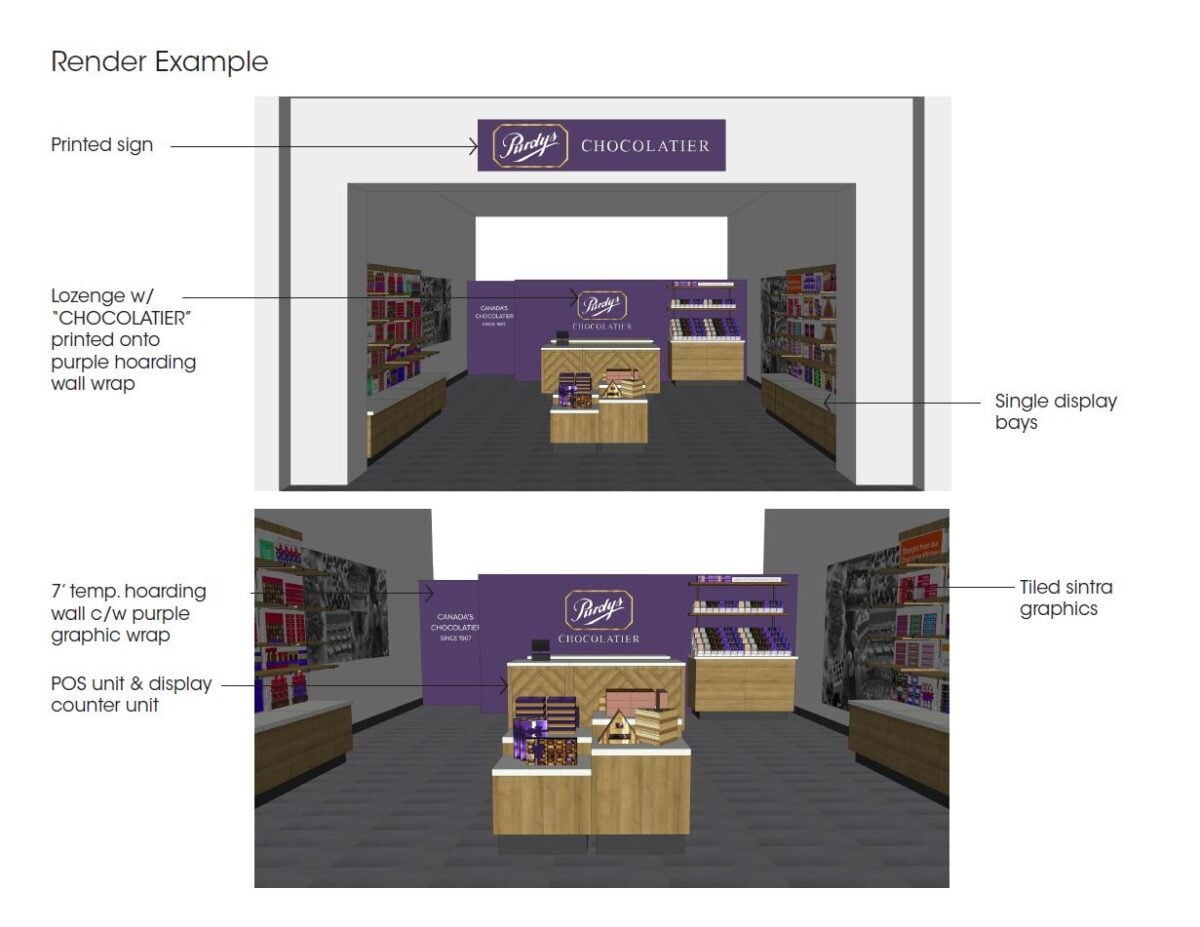
Previous prototype: 2023 rendering of a pop-up store. Image: Purdys Chocolatier
The Design of the Purdys Experience
Each Purdys Chocolatier pop-up store is built to deliver the brand’s hallmark in-store experience within a flexible footprint. Modular fixtures, signature purple branding, and curated product displays ensure that even temporary locations feel like full-fledged Purdys stores.
While some offerings, such as loose chocolates and ice cream, are unavailable due to logistical limitations, the pop-ups feature the company’s most popular items, including boxed assortments, gift collections, and specialty bars. This streamlined product mix helps optimize operational efficiency while maintaining the premium, handcrafted quality that defines the Purdys experience.
The design philosophy behind these pop-ups also speaks to Purdys’ adaptability in the evolving retail landscape. With many shopping centres undergoing tenant turnover and redevelopment, modular pop-up formats provide landlords with attractive short-term tenants while giving brands like Purdys the ability to quickly scale presence during peak seasons.
Heritage Rooted in Canadian Craftsmanship
Founded in 1907 by Richard Carmon Purdy in Vancouver, Purdys began as a small artisan chocolate shop on Robson Street. The brand’s reputation for handcrafted quality and fresh ingredients quickly made it a local favourite. More than a century later, Purdys remains a family-owned business, operating over 80 retail outlets across five provinces and producing all its chocolates in Vancouver.
Signature products such as Sweet Georgia Browns, Hedgehogs, English Toffee, and Himalayan Pink Salt Caramels continue to define the brand’s identity, while newer innovations like ruby chocolate lines have kept it at the forefront of confectionery trends.
The company’s commitment to ethical sourcing and sustainable cocoa has been a key part of its philosophy, with initiatives like Purple Partnerships and its Seasonal Fundraising Program helping communities across Canada. These programs not only reinforce Purdys’ social responsibility but also deepen its connection with customers who view the brand as a symbol of Canadian quality and care.
The deal, valued at $1.35 million plus the value of saleable inventory at closing, marks Dr. Phone Fix’s strategic expansion into Atlantic Canada and supports its goal of national growth.
“This transaction marks Dr. Phone Fix’s strategic entry into Atlantic Canada, advancing our national expansion strategy and strengthening our position as a Canadian leader in consumer electronics device care and resale,” said Piyush Sawhney, founder and chief executive officer of Dr. Phone Fix.
The acquisition includes six operating Geebo stores, as well as retail leases with options for future expansion. The purchase price will be paid through a combination of $600,000 in cash, a $250,000 vendor take–back promissory note, and common shares of Dr. Phone Fix.
Piyush Sawhney
The company will issue $500,000 worth of shares to the seller, along with additional shares equal to the closing value of saleable inventory not covered by the cash portion. The number of shares to be issued will be determined based on the greater of the 21–day volume–weighted average trading price of Dr. Phone Fix shares on the TSX Venture Exchange, or the minimum price permitted under TSXV policies. All shares will be held in escrow and released under the terms of a standard escrow agreement.
“This acquisition marks a significant milestone in Dr. Phone Fix’s ongoing expansion and strengthens our position as a coast-to-coast service provider,” said Sawhney. “Establishing a strong East Coast platform immediately extends our geographic reach, creates operational synergies, and connects us with a loyal regional customer base. It also enhances our OEM-certified repair capabilities, deepens insurance-partner relationships, and reinforces our commitment to sustainable device-care practices.”
Sawhney said the company’s goal is to grow from about 35 corporate locations to more than 70 stores across Canada within the next 12 to 18 months.
Geebo’s management and team are expected to remain in place after the transaction closes to support operational continuity.
Dr. Phone Fix said it remains focused on expanding its network of corporate-owned stores while seeking new partnerships and acquisitions. The transaction is subject to customary closing conditions and approval from the TSX Venture Exchange.
The company said there is no assurance the transaction will be completed as proposed or at all.
Dr. Phone Fix was founded in 2019 and operates 35 corporate locations offering electronics repairs and certified pre-owned devices.
Retail sales in Canada increased 1.0 per cent to $70.4 billion in August, driven by higher sales at motor vehicle and parts dealers, Statistics Canada reported Thursday.
The agency said sales were up in six of nine subsectors, with the largest gain recorded among motor vehicle and parts dealers, where sales rose 1.8 per cent for a third consecutive month. The increase was led by higher sales at new car dealers, up 2.3 per cent, and used car dealers, up 1.5 per cent.
Sales at gasoline stations and fuel vendors fell 2.0 per cent in August, marking the second consecutive monthly decrease. In volume terms, sales at these outlets dropped 2.6 per cent.
Core retail sales—which exclude gasoline stations and fuel vendors and motor vehicle and parts dealers—increased 1.1 per cent in August, following a 1.2 per cent decline in July. Statistics Canada said the rise was “on higher receipts at general merchandise retailers (+2.4%).”
Photo: Lucas Percegona
Higher sales were also reported at clothing, clothing accessories, shoes, jewelry, luggage and leather goods retailers, which were up 3.2 per cent in August. The largest decline in core retail sales came from building material and garden equipment and supplies dealers, where sales decreased 0.3 per cent.
Retail sales increased in five provinces during the month. The largest provincial gain in dollar terms was in Ontario, where sales rose 1.2 per cent on higher receipts at motor vehicle and parts dealers. In the Toronto census metropolitan area, sales were up 2.4 per cent.
In Quebec, retail sales rose 1.8 per cent in August, marking the third straight monthly increase. In the Montréal census metropolitan area, sales increased 2.3 per cent. Nova Scotia saw the largest provincial decline, with sales down 0.5 per cent, led by lower sales at motor vehicle and parts dealers.
On a seasonally adjusted basis, retail e-commerce sales increased 0.1 per cent to $4.3 billion in August, accounting for 6.1 per cent of total retail trade, compared with 6.2 per cent in July.
Statistics Canada also provided an advance estimate suggesting retail sales decreased 0.7 per cent in September. The agency noted that “owing to its early nature, this figure will be revised.” The advance estimate was based on responses from 48.4 per cent of companies surveyed, compared with an average final response rate of 89.3 per cent over the previous 12 months.
Andrew Grantham
“Canadian retail sales have seen plenty of ups and downs this year, but through the volatility sales volumes have had little upward momentum. If the third quarter ends on a sour note, as the advance estimate suggests, then sales volumes for the quarter as a whole will be little changed relative to Q2, pointing to a re-weakening of overall consumer spending. That would justify the further 25bp interest rate cut that we expect from the Bank of Canada next week,” said Andrew Grantham, Senior Economist, CIBC Capital Markets.
Maria Solovieva
Maria Solovieva, Economist, TD, said: “Retail sales data continues to exhibit volatility, with monthly figures alternating between declines and gains.
“As a result, nominal sales are currently tracking at an annualized rate of 1.2% for the quarter. The composition suggests that consumers favoured discretionary retail spending. At the same time, our internal data on credit and debit card spending shows relatively healthy gains in discretionary services categories such as travel, which rebounded sharply in Q3 after contracting in the previous quarter. Although part of this strength likely reflects higher prices.
“Taken together, the notable slow-down in durable goods spending, particularly autos, suggests real personal spending growth should drift to a below trend rate in the second half of 2025. This should give the Bank of Canada further reason to emphasize economic slack, despite September’s unexpected uptick in inflation.”
Starbucks Coffee Company at CF Toronto Eaton Centre (Image: Dustin Fuhs)
Starbucks Canada has announced the launch of the Starbucks Capacity Grants, a new national initiative in partnership with Second Harvest aimed at strengthening local hunger relief efforts. More than $500,000 in funding has been distributed to 87 local charities and food rescue agencies across Canada.
The grants will support the expansion of the Starbucks FoodShare program, one of the largest corporate food rescue programs in the country. According to the company, the initiative is designed to enhance infrastructure, strengthen services and increase the capacity of community agencies to rescue and distribute food.
Lori Digulla
“At Starbucks Canada, we are deeply committed to supporting the communities we serve,” said Lori Digulla, senior vice-president and general manager of Starbucks Canada. “Through the Starbucks Capacity Grants, we’re proud to strengthen our partnership with Second Harvest and expand the reach of our FoodShare program with coffeehouses across the country. Together, we are making a meaningful impact by reducing food waste and helping to ensure more Canadians have access to nourishing meals.”
Since its inception in 2019, the Starbucks FoodShare program has donated food with an estimated value of $25.3 million, rescued 5.8 million meals and diverted 21.7 million kilograms of greenhouse gases by repurposing unsold, ready-to-eat food to local communities.
Second Harvest, the country’s largest food rescue organization, facilitates the FoodShare program by connecting Starbucks locations with local food rescue agencies. These partnerships help ensure that surplus food is redirected to people facing food insecurity.
Lori Nikkel
“Starbucks Canada is making a powerful difference by providing critical support to the non-profit organizations that work tirelessly to feed people and strengthen communities,” said Lori Nikkel, CEO of Second Harvest. “Their leadership in launching the Starbucks Capacity Grants program is a shining example of how corporate partners can help move the needle on hunger in meaningful ways.”
Nikkel added, “With these grants, Starbucks is investing in the financial resilience of local agencies that are essential to the health and wellbeing of people and communities across Canada. We’re deeply grateful for their commitment and inspired by the impact we can achieve together.”
The grants target non-profits and charities tied to Starbucks’ company-operated stores, reflecting a broader strategy to integrate corporate resources into community-led efforts to address hunger and food waste.