Swiss premium chocolatier Läderach is set to make its British Columbia debut with the opening of a boutique at CF Richmond Centre on Friday, September 19. The highly anticipated launch represents a key milestone for the brand as it continues its North American growth strategy.
The grand opening will feature a ribbon-cutting ceremony and a chocolate giveaway for the first 200 customers, offering a warm welcome to chocolate lovers in the region. The Richmond store is Läderach’s first in British Columbia and follows a successful expansion wave across Canada, including last month’s opening at CF Sherway Gardens in Toronto.
“We are delighted to expand our presence of premium Swiss chocolate to British Columbia in this iconic shopping destination and look forward to continuing to expand our presence in Canada with our new Bloor St. location later this year,” said Warren Dunkelberger, President of Läderach North America.
The opening at CF Richmond Centre is part of Läderach’s growing retail network across North America, which has accelerated since 2019. After launching its Canadian flagship at CF Toronto Eaton Centre, the brand rolled out locations at Yorkdale Shopping Centre, Square One Shopping Centre, York Mills Centre, and Sherway Gardens, steadily building a presence in key Canadian markets.
Läderach’s North American expansion gained momentum after it acquired multiple leases vacated by Godiva following its exit from physical retail in 2021. This strategic move allowed the Swiss chocolatier to establish a footprint in prime shopping centres and introduce its “bean-to-bar-to-store” model, which emphasizes transparency and quality control from cocoa bean sourcing to final product.
A Distinctive Retail Experience
The new Richmond Centre boutique will showcase the full Läderach assortment within a bright, modern retail space designed to immerse customers in the world of Swiss chocolate. At the heart of the store is the brand’s iconic FrischSchoggi™ counter, where large slabs of fresh chocolate are displayed and broken to order by Läderach chocolatiers, allowing customers to select their favourite flavours and purchase by weight.
The shop will also offer pralines, truffles, single-origin tablet bars, seasonal assortments, and exclusive creations such as the bestselling milk chocolate Dubai. Each item is crafted in Switzerland using high-quality ingredients sourced directly from trusted suppliers.
Photo: Läderach
Elevating Canada’s Premium Chocolate Market
Since its founding in 1962 in Ennenda, Switzerland, Läderach has earned an international reputation for excellence, operating more than 200 boutiques in 21 countries and maintaining a robust e-commerce platform.
The company employs over 2,500 people globally and prides itself on its commitment to freshness, artisanal skill, and Swiss heritage.
Its focus on freshness sets it apart in the premium chocolate market, with products made bean-to-bar in Switzerland and shipped directly to stores. This dedication to quality has positioned Läderach as a favourite among chocolate connoisseurs seeking an elevated experience.
Läderach’s global profile has risen significantly in recent years, thanks to high-profile openings such as its flagship store on New York City’s Fifth Avenue and its first location in Puerto Rico. In Canada, its expansion is strategic, with a focus on flagship shopping centres and urban retail hubs that attract a mix of local and tourist traffic.
The upcoming Bloor Street boutique in Toronto will further cement its position in Canada’s luxury retail landscape, joining a corridor that includes leading global brands and top-tier chocolatiers.
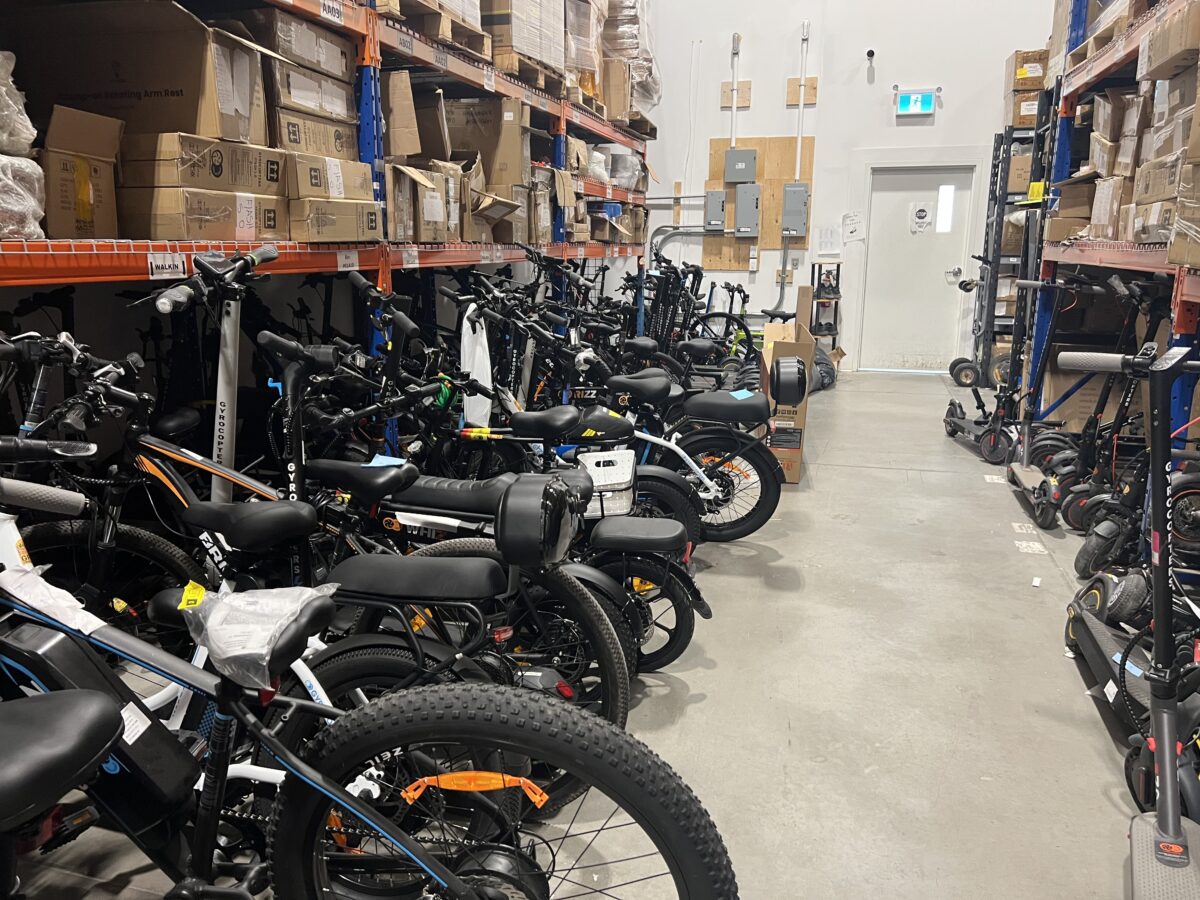
IMGadgets, the Mississauga-based e-commerce company, is celebrating its 10th year in business with impressive growth across multiple product categories, including fitness, home living, and its flagship e-mobility segment where it holds about 60% market share in Canada.
“We literally started with one product, you know, hoverboard,” said Meenu Seda, CEO and co-founder of IMGadgets. “So it’s part of the e-mobility category. We started with e-commerce right off the bat. We were selling on our website and on different marketplaces. Since then, we have grown into a multi-category e-commerce company.”
Meenu Seda
Seda described IMGadgets as a “full-fledged e-commerce company” that handles all operations in-house, from its 25,000-square-foot warehouse in Mississauga to pick, pack, and shipping to consumers. The company currently employs over 25 staff, with plans to double warehouse space to keep pace with growing demand.
Everything sold by IMGadgets is online, with no current retail footprint, though Seda says they are exploring retail options. “At present, it’s 100% online,” she confirmed.
When asked why the company chose to launch and remain online, Seda explained, “Online seemed to be the most economical way of doing business. It’s a little expensive to open a shop and have everything there. So we decided, let’s just start selling online and see how that goes. It just never stopped for us.”
IMGadgets has also found success on emerging marketplaces like Temu, which launched in Canada recently. “We recently launched on Temu, about April this year,” Seda said. “Traction has been really good. To our own surprise, our flagship category, e-mobility, is one of the top-selling products today on Temu.”
Photo: IMGadgets
She highlighted how Temu attracted a new and distinct customer base. “They brought in people who really want to buy on Temu. It did not take any share from other marketplaces; it just added to the revenue we are generating.”
Beyond sales, Seda praised the support Temu provides to sellers. “It’s a true partnership because they have really aggressive account managers and category managers who we are in touch with on a weekly basis. They help sellers sell products, and the marketplace plays a really big role in that.”
As IMGadgets looks ahead, Seda is optimistic about continued growth and maintaining its position in Canada’s e-commerce market. With its strong foothold in e-mobility and expanding multi-category offerings, the company’s decade-long journey demonstrates the power of digital retail.
“IMGadgets is one of many Canadian businesses finding success by reaching a broader customer base through Temu. We offer a low-cost channel for consumers to access a wide range of products and for sellers to connect with new shoppers,” said a Temu spokesperson.
Photo: IMGadgets
Temu is a global e-commerce platform connecting consumers with millions of manufacturers, brands, and business partners. Since launching in Canada in February 2023, Temu has been about making quality products affordable and accessible for everyone. The platform now operates in more than 90 markets worldwide.
Temu fully opened to all Canadian sellers in February 2025 and has since rapidly expanded its network of local merchants. Sellers can list products across more than 600 categories, ranging from CDs and vinyl to furniture.
Temu is helping local businesses grow and strengthen their market presence, and continues to invest significantly in tools and support—from personalized seller guidance through a dedicated team to partnerships with leading ERP providers that help sellers streamline operations and fulfillment.
As part of this collaboration, the CFA has officially become the Official Awards Supporter of the EF100 National Awards Program, strengthening the credibility and recognition of one of Canada’s most prestigious franchise rankings. The EF100, with entries now open, celebrates the top franchise brands in the country, spotlighting innovation, leadership, and impact across the entire industry, according to a news release.
Scott English
“We’re genuinely excited about this new partnership with the Canadian Franchise Association,” said Scott English, CFE, Global Director at Elite Franchise Canada. “As the national voice of franchising in Canada, the CFA brings incredible insight, reach, and credibility to the EF100 program, and having them on board as our official Awards Supporter is a real milestone. Together, we’re building something meaningful for the Canadian franchise community, and this is just the beginning. Let’s raise the bar, celebrate what’s great, and help more brands get the recognition they truly deserve.”
Sherry McNeil
“The CFA is committed to championing franchising as a leading force in Canada’s economy,” said Sherry McNeil, President & CEO of the Canadian Franchise Association. “We are excited to align with Elite Franchise Canada and support the EF100 Awards, to recognize the outstanding contributions of diverse franchise brands and provide them with the exposure and recognition they rightfully deserve.”
The collaboration between Elite Franchise Canada and the Canadian Franchise Association underscores a shared commitment to advancing franchising in Canada. Together, the organizations will:
Strengthen industry collaboration and education
Provide greater exposure for franchise brands nationwide
Celebrate innovation, leadership, and the positive impact franchising has on the economy and within the communities they serve
The EF100 National Awards Program has quickly become one benchmark of excellence for the Canadian franchise industry, and with the CFA’s support, the platform is poised to deliver even greater recognition and opportunities for brands across the country, said officials.
John Pierce, Chief Retail Operations Officer, HHSL; Brent Seguin, Dealer, Essex HHBC; Larry Seguin, Dealer, Essex HHBC; Kimberly Seguin-Gauthier, Dealer, Essex HHBC; Ian White, President & CEO, HHSL; and Darrin Sayles, Senior Director of Retail Sales and Operations, HHSL at the Proud of My Home Achievement Awards. (CNW Group/Home Hardware Stores Limited)
Home Hardware Stores Limited has announced the recipients of the annual Proud of My Home Achievement Awards at the recent 2025 Homecoming event in Toronto. The highest honour of the evening, the Walter J. Hachborn Store of the Year Award, was presented to Essex Home Hardware Building Centre in Essex, Ontario.
The Store of the Year Award recognizes the Home store that best upholds the values on which Home Hardware was co-founded by Walter J. Hachborn 60 years ago—value, service, and dependability. The Essex team was also recognized as Best Home Hardware Building Centre – Central Region. To accept the award on behalf of the store were Dealer-Owners Brent Seguin, Kimberly Seguin-Gauthier, and their father, Larry Seguin.
“This honour is the highlight of an unforgettable year for our family and our stores as we celebrated 60 years of serving our communities,” said Kimberly Seguin-Gauthier, Dealer-Owner, Essex Home Hardware Building Centre. “No matter how much we’ve grown, our heart is still in that small-town, spirit that connects us to our community.”
The Seguin family’s roots in retail stretch back four generations. Larry’s grandmother first ran a feed store in the region, providing the foundation for his father, Arthur, to partner with Home Hardware’s Walter J. Hachborn in 1965. Larry expanded the business in the 1980s, later welcoming Brent and Kimberly into the fold, who now proudly carry on the family tradition, said the retailer.
John Pierce
“The Seguin family exemplifies what it means to be part of the Home Hardware family,” said John Pierce, Chief Retail Operations Officer, Home Hardware Stores Limited. “Their leadership, dedication to their team, and commitment to their community represent the very best of our brand. We are thrilled to recognize them with this year’s Store of the Year Award.”
The Walter J. Hachborn Store of the Year Award is one of 18 awards presented at Homecoming 2025.
PROUD OF MY HOME ACHIEVEMENT AWARDS
All Proud of My Home Achievement Award recipients demonstrate strong staff performance, superior customer service, excellence in interior and exterior store presentation and active participation within their communities, said the company.
Paul Straus Public Relations Award: Coutts Home Hardware – Forestburg, Alberta
Best Home Furniture: Beck’s Home Furniture and Appliances – Montague, P.E.I.
Best Home Hardware: Fennell & Gage Home Hardware – Hamilton, Ont. (Central) Kinlock Home Hardware – Stratford, P.E.I. (Eastern) Nowco Home Hardware – Lacombe, Alta. (Western) Quincaillerie Home Hardware – Aylmer – Gatineau, Que. (Québec)
Best Home Building Centre: Home Building Centre – Lindsay – Lindsay, Ont. (Central) Blackville Home Building Centre – Blackville, N.B. (Eastern) Winnipeg Beach Home Building Centre – Winnipeg Beach, Man. (Western) Nadeau Materiaux de Construction Inc. – Cap-d’Espoir, Que. (Québec)
Best Home Hardware Building Centre: Essex Home Hardware Building Centre – Essex, Ont. (Central) Bennett’s Home Hardware Building Centre – Goulds, Nfld. (Eastern) Meadow Lake Home Hardware Building Centre – Meadow Lake, Sask. (Western) Renomax Roberval – Roberval, Que. (Québec)
Best Young Retailer: Wellesley Home Centre, Jamie Kuepfer – Wellesley, Ont. (Central) Richibucto Home Hardware Building Centre, Julien Richard – Richibucto, N.B. (Eastern) Carlyle Home Hardware, Katie Gavelin – Carlyle, Sask. (Western) Jean Denis, Limitee, Felix Antoine Moisan – Saint-Raymond, Que. (Québec)
Founded over 60 years ago in St. Jacobs, Ontario, Home Hardware Stores Limited is Canadian and the country’s largest Dealer-owned and operated home improvement retailer with more than 1,000 stores operating under the Home Hardware, Home Building Centre, Home Hardware Building Centre and Home Furniture banners.
Shoppers Drug Mart has officially opened the doors of all seven of the Pharmacy Care Clinics in Surrey, announced earlier this year. This significant milestone will provide the community with expanded access to primary care services at a time of rapid growth, ahead of the company’s original schedule, said the company.
“Shoppers Drug Mart is proud to do its part to help the residents of Surrey, one of the fastest-growing cities in the country, by increasing access to the primary care services they need and deserve,” said David Markwell, President of Shoppers Drug Mart. “The seven new clinic locations, with extended, after-hours care, are designed to directly support the community and take pressure off local emergency rooms and physicians. This is about ensuring families can get the care they need, when they need it, right in their own neighbourhood.”
David Markwell
Thoughtfully designed to improve the overall patient experience, each of these seven clinics offer unique features such as child-friendly exam rooms, accessible waiting areas, and an onsite “care concierge” dedicated to providing personalized support and ensuring a smooth visit for every patient. The clinics also provide patients access to a range of pharmacy healthcare services, including the assessment and treatment of injuries and common conditions such as urinary tract infections and pink eye – free of charge with a valid British Columbia health card, said the company.
Josie Osborne
“Timely access to care and trusted health advice are at the heart of pharmacy care clinics,” said Josie Osborne, BC’s Minister of Health. “With the new Evergreen Mall location, along with others opening across Surrey, people will be able to get injections, medication reviews, and assessments for minor illnesses close to home – often with little or no wait.”
“As Surrey continues to grow, access to health care is more important than ever,” said Surrey Mayor Brenda Locke. “These seven new clinics are improving access to care for residents, while helping ease pressure on emergency rooms and family doctors. Thank you to Shoppers Drug Mart for their commitment to our community and for helping to build a healthier future for Surrey residents.”
Brenda Locke
The seven Pharmacy Care Clinics opened by Shoppers Drug Mart in the community of Surrey are located at:
7538 120th Street, Surrey, BC, V3W 3N1
18677 Fraser Hwy, Surrey, BC, V3S 8E7
5157 56 Avenue, Unit 100, Surrey, BC, V3S 9A5
15691 104th Ave, Surrey, BC, V4N 2H4
8962 152nd Street, Surrey, BC, V3R 4E4
2830 96th Avenue, Surrey, BC, V3V 6A8
7322 King George Blvd, Surrey, BC, V3W 5A5
The company is the licensor of full-service retail drug stores operating under the name Shoppers Drug Mart (Pharmaprix in Québec). With more than 1,350 Shoppers Drug Mart and Pharmaprix stores operating in prime locations in each province and two territories, the company is one of the most convenient retailers in Canada. The company also licenses or owns more than 150 medical clinic pharmacies operating under the name Shoppers Simply Pharmacy (Pharmaprix Simplement Santé in Québec).
The Canadian Union of Postal Workers (CUPW) halted the delivery of flyers and other unaddressed advertising mail as of early Monday morning, intensifying its ongoing labour dispute with Canada Post. The strike action, which began at 12:01 a.m. local time, has already prompted urgent warnings from the Retail Council of Canada (RCC) that the stoppage will disrupt one of the most important ways Canadians receive information about weekly sales and promotions.
“Flyers are a critical way for Canadians to plan their weekly shopping and save money. Canadians should not be caught in the middle of this dispute,” said Kim Furlong, President and CEO of the Retail Council of Canada. RCC said it has contacted federal ministers and is urging the parties to return to the bargaining table to prevent prolonged disruption.
Kim Furlong. Image supplied
The job action suspends delivery of all unaddressed admail, known as “Neighbourhood Mail,” which includes the weekly printed circulars used by grocers, pharmacies, and other major retailers. Canada Post confirmed that addressed letters, bills, and parcels continue to be delivered as usual but said it will not process any new flyer mailings during the ban.
Items already in the system are being held securely until the labour dispute is resolved. Canada Post expressed disappointment at the move, warning that the stoppage will hurt thousands of businesses that rely on direct mail to reach customers, especially ahead of the fall and holiday shopping periods.
Retailers Warn of Consumer Impact, Union Says Flyers Are a Burden
Printed flyers remain one of the most powerful marketing tools in Canada’s retail sector. RCC said members collectively invest millions of dollars annually in flyer campaigns, which are a key driver of store traffic and consumer spending.
The association warned that the strike will make it harder for Canadians, particularly seniors, lower-income households, and rural residents, to access promotions and plan their weekly shopping trips. This comes at a time when Canadians are already grappling with high food prices and cost-of-living pressures.
From CUPW’s perspective, the flyer stoppage is a pressure tactic aimed at forcing progress in stalled contract negotiations. Jan Simpson, CUPW’s national president, said postal workers have long raised concerns about the heavy physical burden of delivering bulk flyers, arguing that compensation has not kept pace with the demands of the job.
“The decision to stop delivering flyers is about fairness and about our members’ well-being,” Simpson said. The union maintains that wage increases and improved health and safety measures are needed to reflect the realities of today’s postal work, which has shifted heavily toward parcel delivery.
Photo: Canada Post
RCC Urges Federal Action
The Retail Council of Canada, which represents more than 54,000 storefronts nationwide, said it will continue advocating for a resolution that restores flyer delivery as soon as possible. The organization, founded in 1963 and headquartered in Toronto, is recognized as the “Voice of Retail™” in Canada and regularly engages with policymakers on industry concerns.
The retail sector is Canada’s largest private-sector employer, with more than two million jobs nationwide. RCC argues that flyer delivery is a crucial piece of the infrastructure that helps retailers communicate prices, drive store visits, and support household budgeting.
The flyer ban follows months of job action that began with an overtime ban in May. Postal workers rejected Canada Post’s latest contract offer in August, and both sides remain far apart on wages, staffing levels, and workplace safety issues.
Labour experts warn that CUPW could escalate further if talks continue to stall, potentially through rotating strikes or work-to-rule campaigns that could disrupt parcel delivery. For retailers, this comes at a critical time as they prepare for Thanksgiving promotions and the holiday shopping season.
Some retailers are already accelerating their use of digital flyer distribution through apps, websites, and email campaigns. However, RCC maintains that digital tools cannot yet replace print for many households. “While online tools are growing, printed flyers remain a cornerstone for many households,” Furlong said, emphasizing the potential impact on vulnerable populations.
Montréal-based fashion e-commerce retailer Ssense has secured a major reprieve in its battle to remain solvent, receiving court approval to proceed with a restructuring plan under the Companies’ Creditors Arrangement Act (CCAA). The decision by the Québec Superior Court grants the company interim financing worth nearly $40 million, giving it a critical window to stabilize operations and chart a new path forward.
“With the support of our lenders, we now have the foundation to develop and implement a restructuring plan aimed at securing Ssense’s long-term future,” said co-founder and CEO Rami Atallah in a statement. “We now have the time, resources, and structure in place to begin the process of rebuilding a stronger Ssense.”
The agreement prevents a forced sale that had been initiated by lenders in August, allowing Ssense to remain under the leadership of the Atallah brothers and preserve its 1,100-strong workforce.
The interim financing package includes $15 million from Ssense’s bank lenders, a group that includes the Bank of Montreal, Royal Bank of Canada, Scotiabank, National Bank of Canada, and JPMorgan Chase, and $25 million in new capital from the company’s founders. Court filings show Ssense’s assets total $387 million against liabilities of $371 million.
The liabilities include $135 million in maturing loans, $3.2 million in vacation pay for employees, $93 million owed to suppliers and trade creditors, and a $21 million loan from Investissement Québec related to the company’s fulfillment centre in Saint-Laurent, Québec. Ernst & Young has been appointed as the court monitor to oversee the restructuring process.
The court also granted a 30-day stay of proceedings, shielding the company from creditor actions until October 20. The order allows Ssense to fulfill online customer orders and maintain operations while negotiating with suppliers and creditors.
The Road to Restructuring
The restructuring process follows months of financial strain and tense negotiations. Ssense had hired investment bank Greenhill in July to design a refinancing plan that would appease lenders and keep the business afloat. However, lenders rejected the proposal, and on August 27, they sought to place Ssense under creditor protection to force a sale.
Ssense responded two days later with its own CCAA filing, pledging to fight for the company’s future. “We were deeply disappointed by the lenders’ decision,” a spokesperson said at the time, signaling that the company was unwilling to relinquish control.
Following intensive negotiations, both parties reached an agreement on September 6, paving the way for the court-approved plan.
SSENSE flagship in Old Montreal. Image: David Chipperfield Architects
Business Challenges and Market Pressures
Ssense’s troubles stem from a combination of slowing sales, rising interest rates, and persistent liquidity issues. The retailer reported net losses of $123 million in 2022, $67.7 million in 2023, and $132 million in 2024, despite generating $1.3 billion in revenue last year.
Consumer demand softened after the pandemic, leaving Ssense with a significant amount of unsold inventory. The company implemented several cost-cutting measures to control losses, including reducing purchases of lower-margin brands, marking down older stock, and using proprietary algorithms to reduce advertising spending.
Between January 2023 and May 2025, Ssense laid off nearly 350 employees, cut evening warehouse shifts, and shifted half its workforce into cross-functional roles. These moves generated $36 million in savings for fiscal 2025. The company also froze salaries and adjusted parental leave policies in a bid to conserve cash.
Another blow came in August with the expiration of the de minimis exemption, a loophole that allowed duty-free shipments into the United States under $800 USD. The U.S. is a key market for Ssense, representing 59 percent of its sales with an average order value of $549 USD.
The elimination of the exemption raised costs for U.S.-bound shipments and may have put additional pressure on margins.
Looking Ahead: Sale and Investment Process
Even with fresh financing, Ssense acknowledges that its liquidity problems persist. The company will now launch a Sale and Investment Solicitation Process (SISP) to explore potential buyers, investors, or financing partners.
This process could determine whether Ssense remains independent, finds a strategic partner, or sells a majority stake. The goal, according to filings, is to “stabilize operations and maximize value for stakeholders.”
The turnaround marks a dramatic reversal for the retailer, which was valued at $5 billion just four years ago when U.S. investment firm Sequoia Capital took a minority stake. At the time, Ssense was seen as one of Canada’s most promising global retail players, celebrated for its blend of luxury fashion and streetwear and its influential editorial platform.
Today, the focus is survival. If Ssense successfully navigates the restructuring process, it could reemerge as a leaner, more financially disciplined business better positioned to weather shifting retail trends.
Looking to turn your traffic into revenue with a high-commission, easy-to-promote affiliate program? The TEMU Affiliate Program opens up a powerful opportunity for platforms of all kinds to monetize their user base.
TEMU—short for Team Up, Price Down—is one of the fastest-growing global e-commerce platforms, connecting millions of consumers with a vast network of brands, manufacturers, and merchants. Dedicated to making quality products accessible at unbeatable prices, TEMU has quickly become a household name worldwide.
Building on this foundation, the Temu Affiliate Program enables partners to engage their audiences worldwide and earn top-tier commissions from a diverse range of high-converting products. No upfront investment is required—so why wait? Get started risk-free and unlock powerful new revenue opportunities from day one.
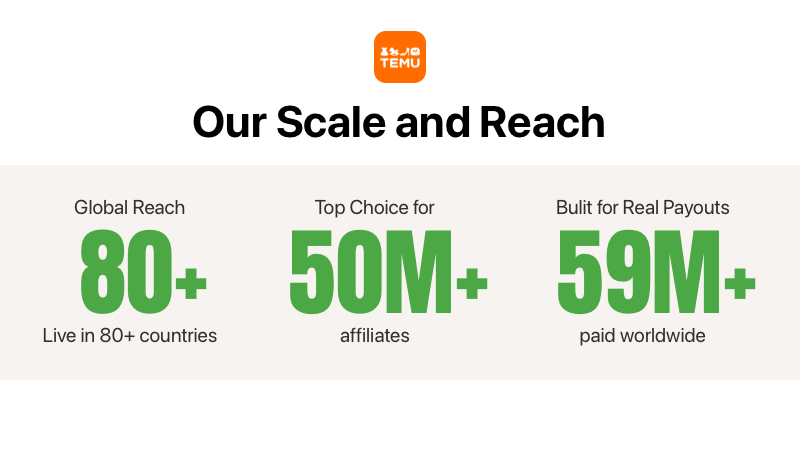
Think of the TEMU Affiliate Program as your gateway to global earnings. Live in over 80 countries, TEMU allows affiliates to connect with millions of shoppers worldwide. No matter if you operate a coupon site, a loyalty program, a payment solution, or simply have traffic to monetize, there’s a place for you here.
Here’s the flow:
📝 Apply for the program and get your referral link, which comes with exclusive TEMU coupons or discounted products
📢 Share it with your audience —be it your Facebook group, website, app notifications, blog, or email newsletter.
💰 Earn commissions when a new user click through your link and place an order. Plus, you’ll receive an extra fixed reward if they download the TEMU app.
Who Should Join the TEMU Affiliate Program
Designed for both individuals and businesses, low barriers and join for free!
If you’ re an individual:as long as you’re active in or run any shopping-related Facebook groups, come join TEMU!
If you own a website or app with user trafiic:let’s grow together via tailored business partnership!
For business publishers, what types of websites or apps can join the TEMU Affiliate Program?
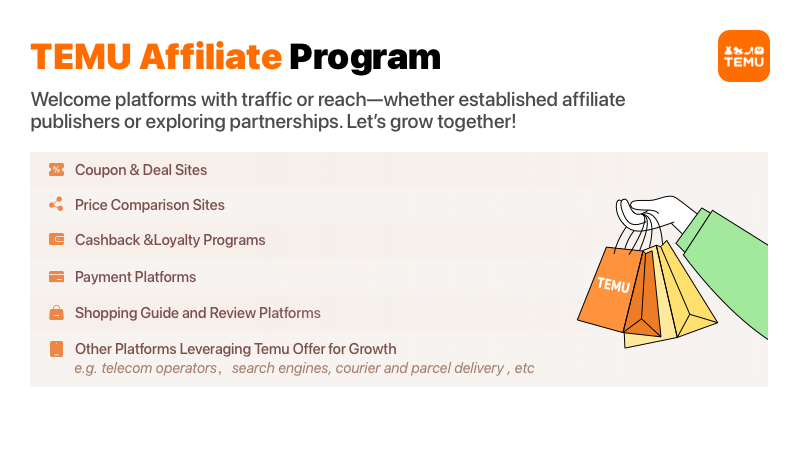
Any platform with user traffic and distribution capabilities is welcome! The partnership scenarios listed are provided as typical examples, but we’re not limited to these. TEMU is open to exploring new ways of partnering with you, even if affiliate marketing is not your core business
Coupon or Deal Sites: Add TEMU’s exclusive coupons to attract deal-seekers.
Price Comparison Sites: Plug in TEMU’s product catalog and sharp prices so your users always spot the best value—while you boost affiliate sales.
Payment Platforms: Embed shopping offers into your payment solutions, such as credit cards, BNPL services, e-wallets, or banking apps with shopping features.
Cashback & Loyalty Programs: Provide cashback incentives for purchases made on TEMU, or leverage TEMU’s exclusive deals as rewards for user engagement activities.
Shopping Guide & Review Websites: Turn buying guides, reviews, and recommendations blogs into revenue by linking directly to TEMU products.
Other Potential Partners: telecom operators, courier & logistics companies, and other platforms looking to expand monetization opportunities.
Why Join the TEMU Affiliate Program
Easy Entry and No Upfront Cost
The TEMU Affiliate Program is completely free to join. With minimal entry requirements, almost anyone—from individuals to established publishers—can participate. TEMU also supplies ready-made promotional materials, including copy and visuals, copy, so you can hit the ground running.
High Commissions to Earn
At TEMU, you don’t just earn order commissions—you also get an extra fixed bonus for every new user who downloads the TEMU app and places their first order. That means your earnings come from both high commissions and extra rewards—doubling your revenue opportunities.
App download rewards: Earn a fixed bonus when a new user downloads the TEMU app via your referral link and completes their first order.
New user commissions: Earn commissions based on the order value of new users you bring in.
Exclusive Benefits for Your Referrals
TEMU provides your referrals with exclusive incentives—high-value coupons and deep discounts across a wide range of categories, with some deals up to 90% off. These offers boost purchase intent, reinforce loyalty, and equip your platform with a proven tool to drive engagement and revenue.
Robust Performance Tracking
Stay on top of your results with TEMU’s powerful tracking tools. From clicks to conversions, everything is measured in time. TEMU’s intuitive dashboards make it easy to understand performance across campaigns and channels, helping you make smarter, data-driven decisions.
Dedicated Account Support
With TEMU, success never goes unnoticed. As your results improve, TEMU will match your growth with dedicated 1-on-1 support and tailored commission structure—helping you push your performance to the next level.
Click to visit the official TEMU Affiliate registration page (or search “TEMU affiliate program”). Choose Affiliate Program to sign up.
For Business Applicants:
Step 2. Fill in Your Information: Provide all required business and contact information accurately.
Step 3. Submit for Review: Your application will be reviewed by the TEMU Affiliate team. Expect an email notification with results within 7 business days.
Step 4. One-on-One Support Contact: Once approved, a TEMU affiliate manager will reach out via email to provide personalized guidance and help you get started. Please keep an eye on your inbox.
For Individual Applicants:
Step 2. Fill in Your Information: Submit your personal information and include the link to your Facebook group.
Step 3. Submit for Review: Your application will be reviewed by the TEMU Affiliate team.
Step 4. Start earning: Once approved, you can immediately access the affiliate panel and start promoting TEMU right away.
How to Maximize Earnings with the TEMU Affiliate Program
Here are some tips to boost your earnings with TEMU by promoting smartly to your audience.
Define Your Niche and Audience – Understand your audience’s demographics, interests, and shopping habits to target your promotions effectively.
Highlight TEMU Deals Prominently – Place high-value coupon bundles and discounted products in visible locations such as website banners, pop-ups, or app notifications.
Build Trust with Your Groups– Regularly post TEMU’s deals and products in your Facebook groups. Instead of only dropping links, share your own reviews, product comparisons, or usage tips.
Build and Leverage an Email List – Send newsletters featuring TEMU deals, seasonal promotions, and curated product selections to engage subscribers.
Promote on Social Media – Use your social channels to push TEMU offers, create engaging posts, stories, or videos that link directly to your referral links.
Produce High-Quality Content – For blogs, review sites, or content platforms, write detailed product reviews, gift guides, or shopping tips highlighting TEMU products.
Frequently Asked Questions (FAQ)
Q1: Who can join the TEMU Affiliate Program?
A: From websites / apps with traffic to individuals running or active in Facebook groups, TEMU welcomes you to turn influence into income.
Q2: Can I reach international users?
A: Yes. With a single registration, you can promote the TEMU Affiliate Program in over 80 countries, engaging users globally and maximizing revenue.
Q3: How can affiliates earn with TEMU?
A: Hybrid CPA + CPS:
App download rewards: Receive a fixed bonus when a new user downloads the TEMU app through your referral link and places their first order.
Purchase commissions: Earn commissions on orders of the new users you bring in.
Q4: How can I promote TEMU deals effectively?
A: Highlight deals on banners or newsletters, create content like reviews or guides, share on social media, and track performance to optimize results.
Q5: What support is provided?
A: Affiliates receive a full suite of resources, including ready-made promotional materials (images, copy, and more), advanced performance tracking tools, and—based on performance—dedicated 1-on-1 account support with customized commission structures.
Q6: Are there upfront costs?
A: No. Partners can start risk-free with no investment required.
Sign Up for the TEMU Affiliate Program Now
Ready to turn your traffic into real revenue? With unmatched earning potential, high-converting products, and global reach across 80+ countries,you can engage users and boost transactions like never before. Click hereto join the TEMU Affiliate Program and start earning today!
Retail Insider is streamlining its Canadian retail news from around the web to include a handful of top news stories that can be viewed quickly during the day. Here are the top stories from the past several days.
Field Agent Marketplace homepage. Image: Field Agent
Field Agent Canada has unveiled its new Marketplace platform, a self-serve solution designed to help businesses of all sizes gain fast, affordable access to retail audits, consumer insights, and product trials. The launch marks a major step forward in democratizing retail intelligence, allowing brands to run their own audits and surveys without the traditional cost or lead time barriers.
“We’ve taken all of our best practices from building projects for clients over the past 14 years and turned them into a templated, easy-to-use platform,” said Jeff Doucette, Founder and General Manager of Field Agent Canada, in an interview with Retail Insider. “You can literally set up a task in 10 minutes, launch it, and start seeing results almost immediately.”
Jeff Doucette
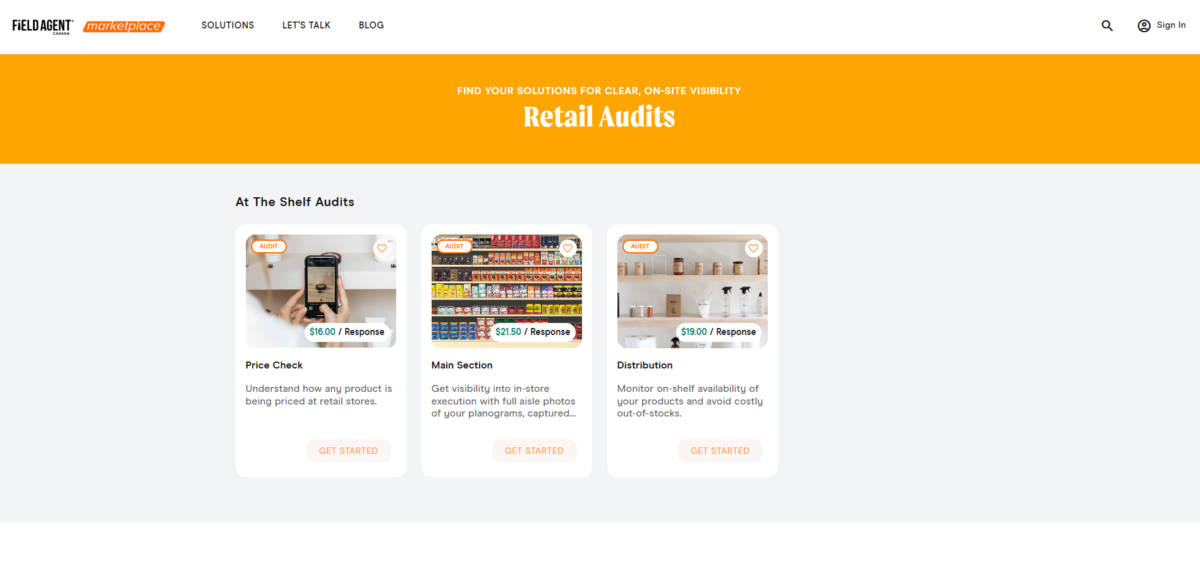
Field Agent Marketplace addresses a longstanding pain point for consumer packaged goods (CPG) companies, restaurants, and retailers: the ability to quickly gather store-level data and customer feedback. Traditional retail audits often require weeks to set up, involve significant costs, and include minimum contract requirements that can deter smaller players.
Under the new platform, businesses can create their own tasks, select from a menu of options, and target specific locations or shoppers across Canada. With a community of over 315,000 agents nationwide, Field Agent Canada can deploy tasks to real consumers who collect photos, confirm prices, and share feedback in real time.
“This is a game-changer for smaller brands and retailers who have historically been underserved,” said Doucette. “Most business owners think retail coverage is unaffordable, that they’d have to sign a big contract and commit for a year. Marketplace strips away those barriers.”
Pay-As-You-Go Retail Intelligence
Unlike traditional research firms that require project fees or minimum spends, Field Agent Marketplace operates on a pay-as-you-go model. Businesses are charged only for the responses they receive, with no setup fees.
“If a company wants to check one store in Nanaimo to confirm pricing or stock levels, they can do that for around $20,” said Doucette. “They don’t have to drive across the province or wait six weeks for a merchandising company to complete the job. This puts control back into the hands of the brand.”
The simplicity of the process was a key focus in development. Businesses upload the product image, provide basic details, and launch the task. The platform handles the rest, from assigning tasks to agents to compiling results.
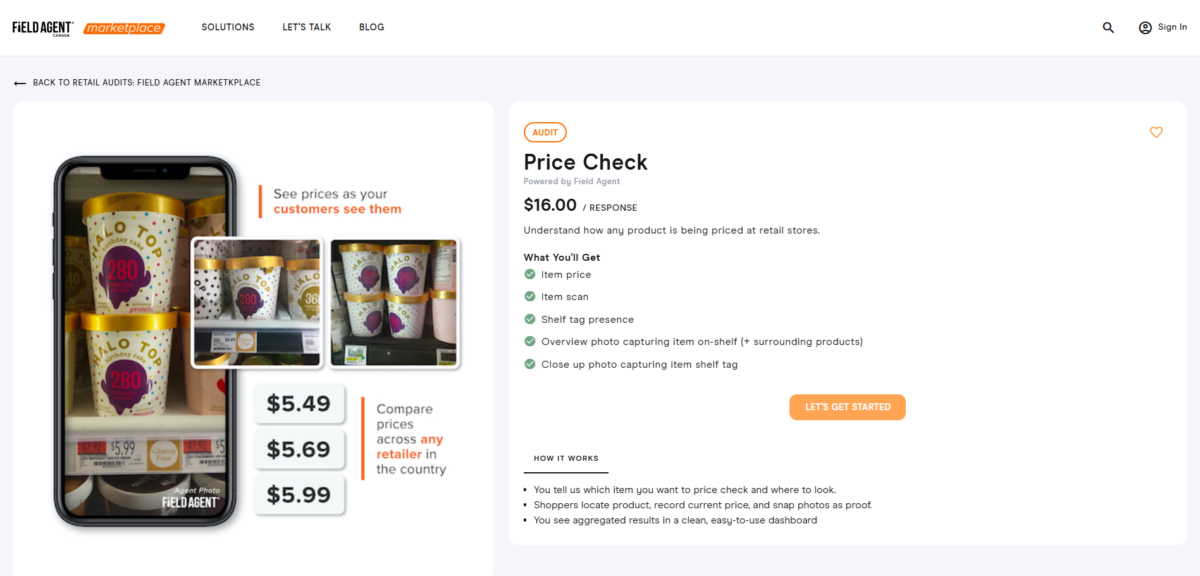
Field Agent Marketplace price audit. Image: Field Agent
Levelling the Playing Field for Small and Emerging Brands
Doucette emphasized that Field Agent Marketplace is designed to make retail insights accessible to smaller and emerging brands that may only have a handful of retail listings. “Whether you’re testing a new product in a few Costco stores or part of a Sobeys local program in the Prairies, you can use Marketplace to make sure your product is on shelf and being sold as intended,” he said.
This ability to act quickly is especially important for companies that may not have field teams or large research budgets. “There are so many small brands trying to grow. Marketplace gives them the same tools that big CPG companies have, but in a format that fits their scale and budget,” Doucette noted.
Marketplace could also transform how companies test new ideas. Instead of relying on anecdotal feedback or waiting for quarterly sales reports, businesses can deploy a survey or audit and receive data within hours.
“That’s really the hope,” said Doucette. “Right now, a lot of brands are operating in the dark, especially once they expand beyond their home city. This tool gives them visibility into stores across the country without having to get on a plane.”
The platform’s flexibility allows businesses to scale their efforts up or down as needed. “You’re not locked into a monthly subscription or a fixed number of stores,” Doucette explained. “It’s like Amazon — you add the items to your basket, check out with a credit card, and that’s all you pay.”
Canadian Rollout and Future Expansion
Field Agent Canada has initially launched Marketplace with a curated set of its most popular services, including retail audits, product trials, and review collection campaigns. Over time, the company expects to expand the available offerings based on customer demand.
“Our U.S. business has a wider range of products available through its marketplace,” said Doucette. “We’re starting with a focused assortment here in Canada, but as we learn what businesses want, we’ll continue to add more.”
The company, which has operated in Canada for 14 years, sees the new platform as a natural evolution of its mission to connect brands with real shoppers to solve retail challenges quickly and affordably.
Field Agent Marketplace Retail Audits. Image: Field Agent
Empowering Brands in a Competitive Landscape
For Doucette, the launch is about more than technology — it’s about giving Canadian businesses a competitive edge. “This platform allows brands to be proactive instead of reactive,” he said. “You can identify problems like out-of-stocks right away, get reviews on your product when it launches, or test a new menu item in days rather than weeks.”
That ability to move quickly could be critical as retailers and suppliers navigate a challenging retail landscape marked by shifting consumer behaviour and increased competition.
With Marketplace now live, Field Agent Canada plans to gather feedback from early users and refine the platform further. The company is also focused on educating the market about how the tool can be used.
“We’ve been doing this work for years. Marketplace just makes it easier and more accessible. Whether you’re a national retailer or a startup food brand, you can now get the same level of retail intelligence and make better decisions faster,” Doucette said.