Alex Miller, President and Chief Executive Officer, said: “With same-store sales growth across all our geographies for the second consecutive quarter, along with strong margins and sequential volume growth in fuel, we are encouraged by the positive momentum we’re continuing to build in our business.
“We are outperforming our industry with an offer that is clearly resonating with our customers — from the continued growth of our Meal Deals and exclusive vendor partnerships to the success of our seasonal Fuel Day events, which are driving traffic and excitement at our sites. Looking ahead, we remain focused on delivering compelling value and investing in programs that drive operational excellence, optimize our supply chain, and enhance the customer experience in the store, at the pump, and digitally. I’m proud of our team’s performance and the progress we’re making together to win our customers,” he said.
Filipe Da Silva
Filipe Da Silva, Chief Financial Officer, added: “We closed the second quarter with growing optimism, reflecting steady progress supported by consistent execution and effective cost management across our operations. Core operating expenses growth remained under control, while we continued to advance our multi-year investment journey to unlock new capabilities that strengthen our network and create greater value for customers. This also marked the first full quarter from GetGo, which further broadens our food and convenience offering in the U.S. and opens new opportunities for customer engagement.”
“During the second quarter, we also repurchased nearly $900 million of our shares through the buyback program, while, for the first half of the year, we invested close to $900 million in capital expenditures, reinforcing our balanced approach to capital allocation. As we look ahead, we remain committed to delivering earnings growth over the course of the year,” he said.
Quarterly Highlights
Net earnings attributable to shareholders of the Corporation were $740.6 million for the second quarter of fiscal 2026 compared with $708.8 million for the second quarter of fiscal 2025. Adjusted net earnings attributable to shareholders of the Corporation were approximately $734.0 million compared with $705.0 million for the corresponding quarter of last year, representing an increase of 4.1%.
Net earnings attributable to shareholders of the Corporation were $0.79 per diluted share for the second quarter of fiscal 2026 compared with $0.75 per diluted share for the second quarter of fiscal 2025. Adjusted diluted net earnings per share1 were $0.78, representing an increase of 5.4% from $0.74 for the corresponding quarter of last year.
Total merchandise and service revenues of $4.7 billion, an increase of 6.6%. Same-store merchandise revenues2 increased by 1.2% in the United States, by 0.5% in Europe and other regions1, and by 5.4% in Canada.
Merchandise and service gross margin increased by 0.9% in the United States to 34.7%, by 0.7% in Europe and other regions to 38.9%, and by 0.6% in Canada to 34.2%.
Same-store road transportation fuel volumes decreased by 0.6% in the United States, and by 1.8% in Europe and other regions, while it increased by 1.1% in Canada.
Road transportation fuel gross margin of 45.86¢ per gallon in the United States, a decrease of 0.24¢ per gallon, US 11.51¢ per liter in Europe and other regions, an increase of US 1.00¢ per liter, and CA 15.07¢ per liter in Canada, an increase of CA 1.72¢ per liter.
Couche-Tard is a global leader in convenience and mobility, operating in 29 countries and territories, with close to 17,300 stores, of which approximately 13,200 offer road transportation fuel. With its well-known Couche-Tard and Circle K banners, it is one of the largest independent convenience store operators in the United States and it is a leader in the convenience store industry and road transportation fuel retail in Canada, Scandinavia, the Baltics, Belgium, as well as in Ireland. It also has an important presence in Luxembourg, Germany, the Netherlands, Poland, as well as in Hong Kong Special Administrative Region of the People’s Republic of China. Approximately 149,500 people are employed throughout its network.
“We’ve seen a really great uptick in people buying local and Canadian goods as the Canada-U.S. trade battle continues. We want to see that trend continue on Small Business Saturday to kick off a strong finish to what has been an extremely turbulent year for small businesses.”
Small Business Saturday, presented by CFIB, is an annual celebration promoting shopping local at the start of the busy holiday shopping season. The initiative is part of CFIB’s ongoing efforts to champion small business resilience amid rising costs, labour shortages, and economic uncertainty, said the national organization, which is Canada’s largest association of small and medium-sized businesses with 100,000 members across every industry and region.
According to CFIB’s latest data, one third (33%) of small businesses count on the upcoming holiday sales. Compared to last holiday season, one in five (20%) small firms expect lower sales revenue, while just over half (52%) expect sales to remain flat. CFIB’s Monthly Business Barometer® has shown lack of consumer demand as the top barrier to small business growth for more than two years.
“Supporting small businesses and choosing to shop intentionally is one of the easiest ways to strengthen our communities and economy. When you shop local, 66 cents of every dollar goes back into the community,” Mallough said. “This holiday season, support Canadian-owned businesses including franchises or check out your local business first instead of ordering from an online giant. Let’s make every dollar count.”
Canadians can visit SmallBusinessEveryDay.ca for free tools and resources to participate in Small Business Saturday and support local businesses year-round.
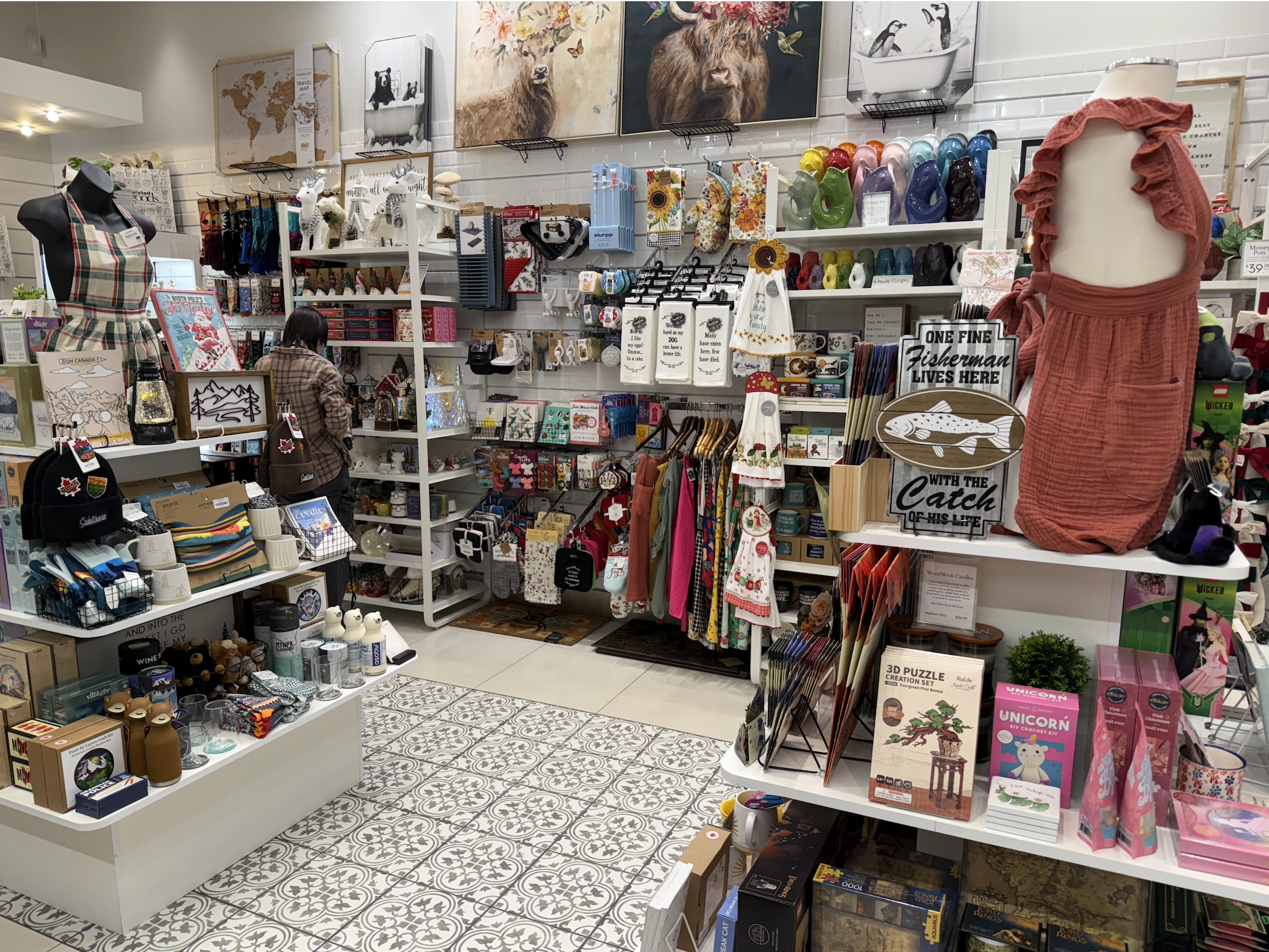
Twisted Goods, Midtown Plaza, Saskatoon. Photo: Mario Toneguzzi
Angelica Fehr, owner of Twisted Goods, calls herself an “accidental entrepreneur”, but she has guided the Canadian gift store chain through years of growth, including recent expansions in Alberta and Saskatchewan.
Fehr took over the Saskatchewan half of Twisted Goods in 2012 and purchased the remaining Calgary stores in 2015, giving her full ownership of the company.
Angelica Fehr
“I took over from Shashi (Behl), the previous owner. I worked for her for several years before that. In 2015, I bought the rest of the company, the Alberta stores, the two Calgary stores,” she said.
The company now operates six permanent stores: two in Saskatoon, two in Calgary, and one in Edmonton, along with occasional pop-up locations, such as a temporary store in Regina in 2021. The most recent permanent store opened in Edmonton’s Southgate Mall in 2020.
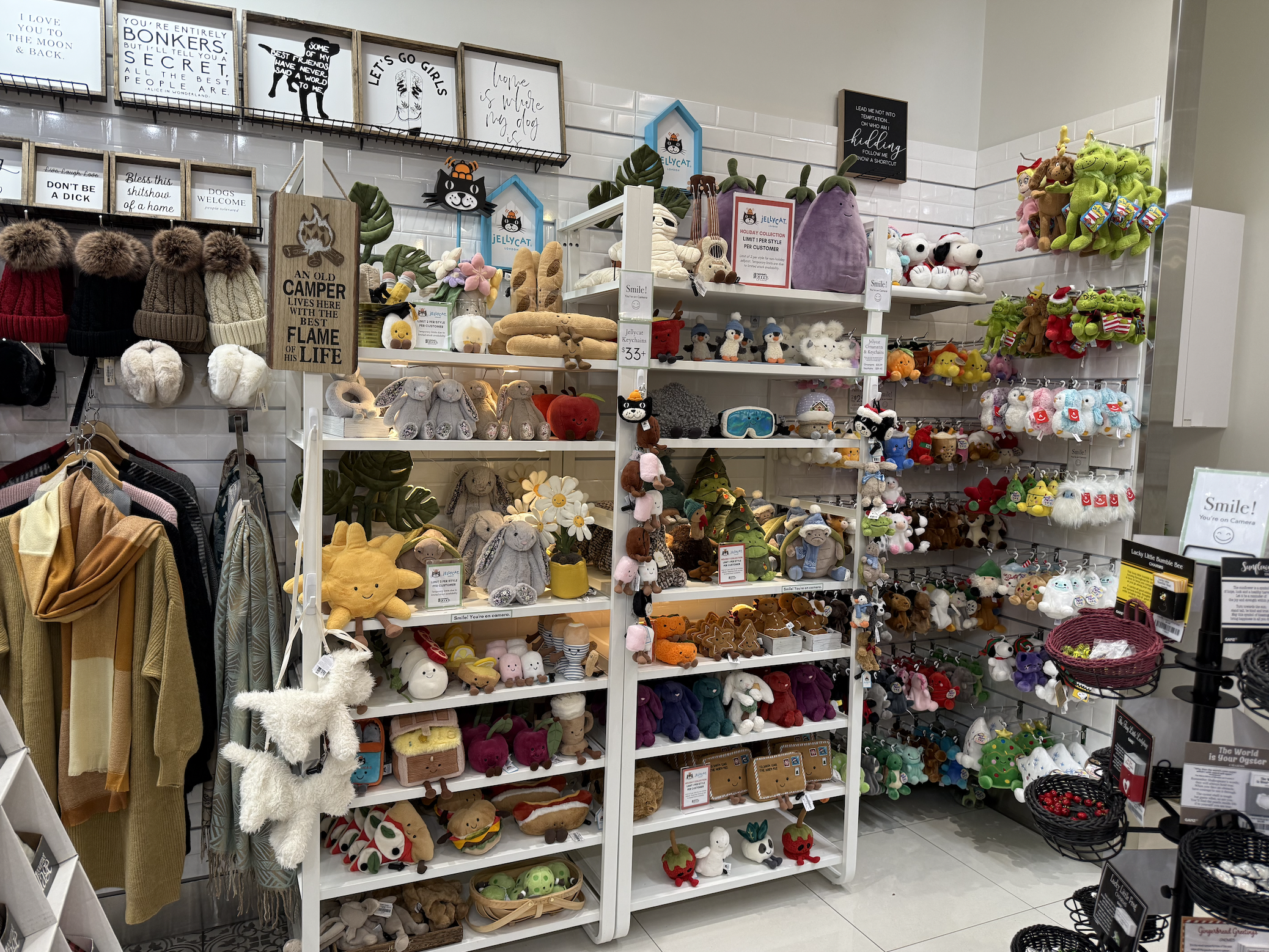
Twisted Goods positions itself as a gift store offering unique items designed to bring joy, whether for oneself or others.
“We see ourselves as a gift store. The idea is that it’s nothing anyone really needs, but just things that make you happy or remind you of someone you love,” Fehr explained. “Something out of the ordinary.”
The company focuses heavily on Canadian vendors, including smaller makers capable of supplying its multiple locations, and women-owned businesses.
“We’ve been so incredibly supported by a base of customers who are women that we really like to pass that on,” she said. The store also sources internationally, ensuring high-quality products at approachable price points and from suppliers with fair practices.
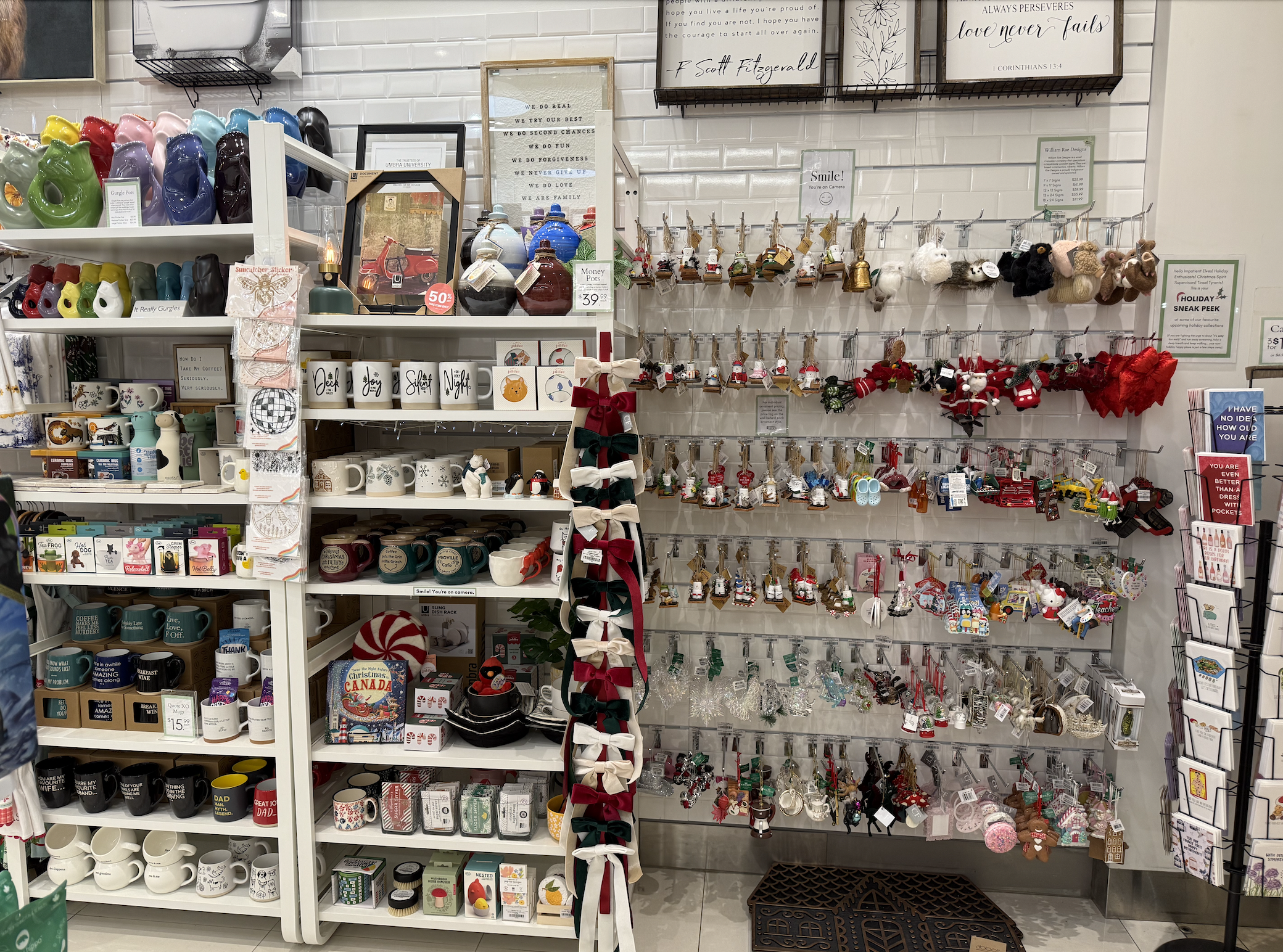
Twisted Goods, Midtown Plaza, Saskatoon. Photo: Mario Toneguzzi
In terms of sales, Fehr noted that Calgary stores are the company’s highest revenue locations, primarily due to population and location. Expansion remains a goal, though Fehr said growth has been intentionally cautious given the evolving retail landscape.
“Expansion is on our list of things to do, probably still a couple years away until we really start considering faster expansion again,” she said.
Fehr grew up in Estevan, southeast Saskatchewan, and now considers Saskatoon home. Her journey with Twisted Goods began with a temporary maternity-leave management position, which evolved into a full-time career.
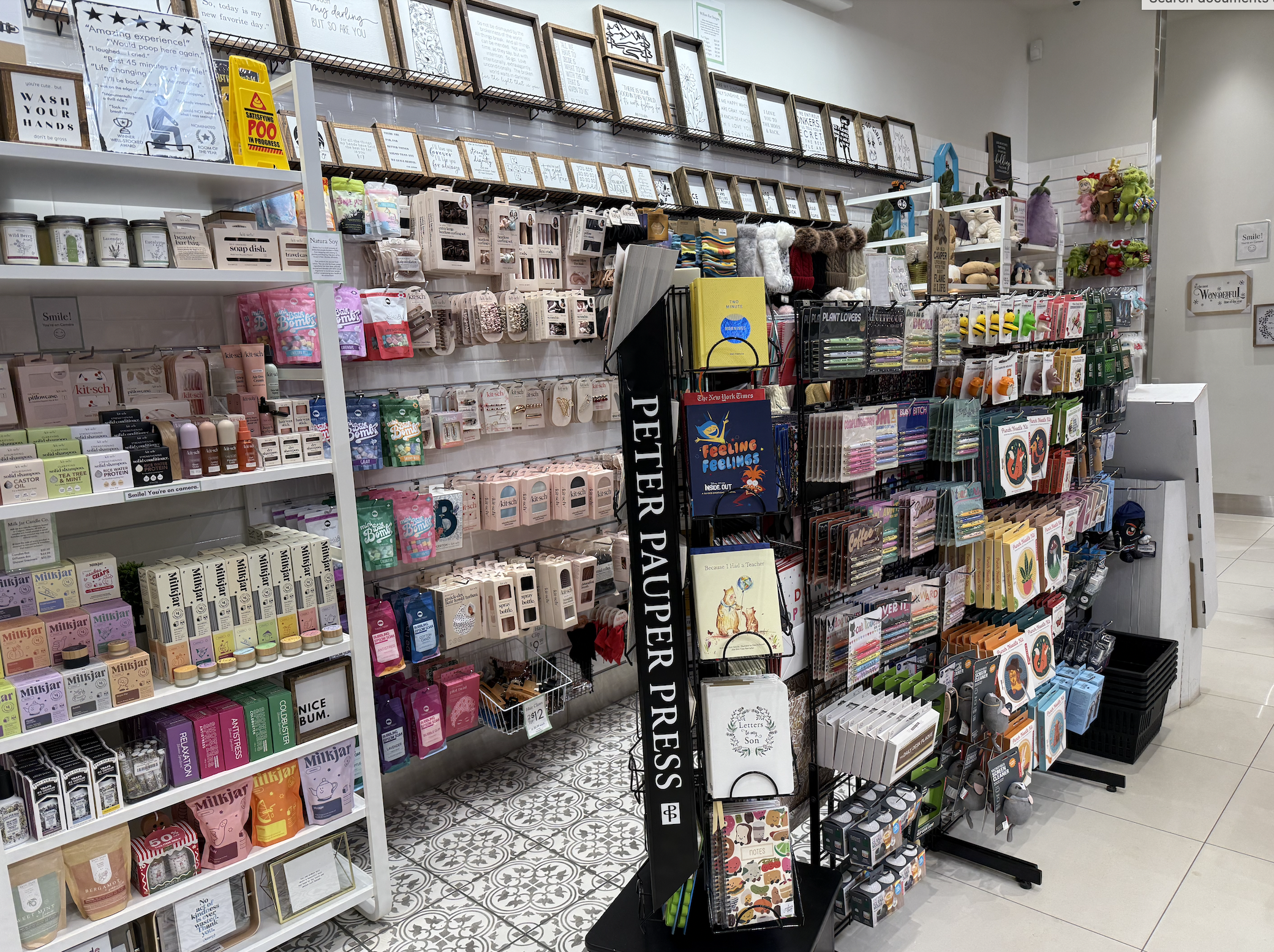
Twisted Goods, Midtown Plaza, Saskatoon. Photo: Mario Toneguzzi
“I have zero management experience. I’ll take this for one year and get some management experience and then go back to my merchandising with the goal of eventually becoming a buyer. Obviously stayed forever after,” she recalled.
“I fell in love with the company. I fell in love with Shashi as a mentor. She was just incredible. I loved the company values.”
Fehr later acquired the Saskatchewan stores from Shashi after initial discussions sparked sleepless nights and careful consideration.
Fehr’s story illustrates the unpredictable paths in retail, highlighting dedication to supporting local businesses, Canadian makers, and women entrepreneurs, while navigating the challenges of a shifting market.
Christmas tree at CF Toronto Eaton Centre. Photo: To Do Canada
Canadian retailers are entering the 2025 holiday period with a compressed shopping window and a late Black Friday that is reshaping how promotions and consumer spending unfold across the country.
With Black Friday falling later in November, the interval between Cyber Monday and Christmas Day has shortened, prompting retailers to advance discounts and encourage earlier shopping. At the same time, Canadian consumers, who have been watching prices closely, are responding when they see meaningful value.
To examine how the season is shaping up and what retailers can expect through Black Friday and Cyber Week, Retail Insider spoke with Caila Schwartz, Director, Consumer Strategy and Insights for Salesforce. A follow-up article will provide an update in December once the full Cyber Week results for Canada are available.
Caila Schwartz
Early online sales climb as discounts start ahead of schedule
According to Salesforce data, the timing of Black Friday is a key factor this year.
“Similar to last year, it is a late Black Friday,” said Schwartz. “With it being later, we have seen a lot of effort on behalf of the industry to pull sales earlier, especially in Canada.”
Salesforce’s Holiday Hub data shows that since the start of October, online sales in Canada are up 2 percent year over year. The first two weeks of November have been notably strong.
“When we look at the beginning of November, week one and week two, we are seeing really strong double-digit growth,” she said. “The first week grew 13 percent year over year. The second week grew 12 percent year over year. So, which is huge growth.”
Discount levels are already elevated. Schwartz noted that in the second week of November the average discount rate reached 28 percent, which is only about one percentage point lower than Salesforce had anticipated for Black Friday.
“The deals are starting early,” she said. “Consumers in this market have really been waiting for deals. They have been focusing on essentials and cutting back, and now that the deals are starting, they are starting to buy.”
Shoppers buy more items per order as pressure shifts from price to volume
Early signs suggest that Canada holiday shopping trends this year are being driven less by higher prices and more by unit volume. Schwartz said Salesforce is seeing a shift in how shoppers build their baskets.
“Average selling prices are remaining steady, so Canadian consumers are not spending more for the products they were buying last year,” she explained. “Units per transaction are increasing over last year. We saw a 2 percent increase in the rate of items purchased per order.”
Salesforce is also tracking a rise in order volumes. That combination implies that growth is coming from shoppers buying more items, not from retailers pushing through higher ticket prices.
“A lot of the growth we are seeing right now is really coming from consumers buying more,” said Schwartz. “They are getting some relief on those macroeconomic factors that they have been dealing with for the last several years.”
Woody the Talking Christmas Tree at Mic Mac Mall in Dartmouth, Nova Scotia. Photo: Mic Mac Mall
Cyber Week remains the focal point for deal-sensitive Canadians
Although early November has been strong, Canadian shoppers remain cautious and are still highly focused on promotional peaks. Schwartz said consumers increasingly recognize that Cyber Week is the period when the deepest discounts are likely to appear.
“They are definitely sales sensitive, but similar to their U.S. and global counterparts, they understand that the best deals they are going to get will be during the holiday season, especially Cyber Week,” she said. “Consumers are telling us that Cyber Week has the best discounts and that they are holding onto spend in anticipation of those deals.”
That pattern also influenced the performance of Amazon’s October Prime event and similar sales.
“What we saw over Prime was not as much engagement this year over the October Prime event in Canada, similar to the U.S.,” she said. “Because it is in such close proximity to Cyber Week and Black Friday, consumers are taking a wait-and-see approach. They know it might go on sale, and if they wait, it might be a better discount.”
Last year, Salesforce observed that digital sales in Canada were highly concentrated in the period immediately surrounding Cyber Week.
“Sales really came in fast the week before Cyber Week, Cyber Week, and then the week after Cyber Week,” said Schwartz. “After that, the last two and a half weeks or so, it really fell off. We did not see much activity on digital channels for shopping. Given it is such a similar season in length, I anticipate that the activity we are seeing right now and through the next week and a half will be indicative of consumer demand, and we will probably see it fall off towards the latter half of the season.”
For Cyber Week itself, Salesforce expects online sales in Canada to reach approximately $3.72 billion.
Retailers balance margin with sharper discounting than last year
For retailers, the challenge is to manage margin while meeting consumer expectations for value. Schwartz said the sector has been juggling rising costs, inflation and uneven sentiment since 2022, and this season is no exception.
“Managing margin is something that we have seen the industry really try to juggle,” she said. “Rising costs, inflation, consumer sentiment have all been something that the industry has tried to balance.”
Last year, some retailers were hesitant to offer deep discounts during Cyber Week and instead adjusted after seeing softer-than-expected demand.
“Retailers came back after Cyber Week with even better deals than during Cyber Week,” she said. “They did not see the level of demand they had anticipated, so they came back post Cyber Week with even better deals trying to pull shoppers in.”
“This year we are not seeing that. We are seeing retailers really lean in, go very early on very strong deals, putting their best foot forward.”
Christmas decorations of CF Pacific Centre in downtown Vancouver on December 19, 2022. Photo: Lee Rivett
AI tools reshape both shopper journeys and retail operations
Another key element influencing Canada holiday shopping trends is the rapid adoption of artificial intelligence across the sector. Schwartz said retailers are using agentic tools in both customer-facing and back-end functions, with the aim of improving efficiency and protecting margins.
“Retail is one of the fastest adopters of agents, not only on the front end but within the business,” she said. “They have to do more with less, and this is a technology that is really helping them.”
On the employee side, retailers are deploying agents in merchandising, customer service and marketing.
“We are seeing retailers lean into merchandising agents and agents within customer service, freeing up customer service agents and delivering better experiences,” she said. “Within marketing, they are building more personalized campaigns and creating campaign briefs. There is a lot of innovation going on there.”
On the consumer side, Schwartz said the past 12 months have transformed how shoppers discover brands and products. AI search tools are now directing a growing share of traffic to Canadian e-commerce sites.
“In Canada, we have seen an 816 percent increase in the rate of traffic year over year since October 1 for these third-party AI tools driving traffic to Canadian e-commerce websites,” she said. “Consumers are leaning into these tools.”
At the same time, many retailers are launching their own shopper agents on their websites to support conversational shopping once customers arrive from an AI search.
“We did a comparison of brands using shopper agents versus those not,” said Schwartz. “Since the start of the season, those particular brands using shopper agents grew about seven times faster than their counterparts not leveraging this technology yet.”
Salesforce has also announced an integration that will allow retailers to connect their product catalogues directly to ChatGPT.
“Retailers will be able to integrate their product catalog directly, so when a user searches for a specific product or use case, the model will be able to pull in details of that product catalog,” she said. “Ideally we will be able to surface inventory, pricing, availability and local availability, which helps drive discoverability more efficiently.”
Luxury, beauty and electronics lead category growth in Canada
While overall Canada holiday shopping trends point to growth around key promotional moments, Salesforce is already seeing standout categories in the Canadian market.
“Luxury is growing the fastest at the moment, 9 percent year over year,” said Schwartz. “Health and beauty is also a strong performer in Canada. And surprisingly, electronics are doing very well right now. We are not seeing that in the U.S. or in Europe.”
She linked the luxury performance to financial markets, interest rate moves and the behaviour of higher income shoppers.
“The stock market generally is very strong right now,” she said. “Higher income consumers often benchmark their sense of stability against financial markets. With interest rates lowering and the stock market being strong, these consumers have a new sense of financial stability.”
Luxury buyers are also placing more items in their baskets.
“In Canada, we are seeing units per transaction increase at 3 percent year over year,” she said. “Average selling price is only up 2 percent, and average order value is growing more. We are also seeing a 4 percent increase in order volumes. That means this consumer is genuinely purchasing more at checkout and placing more orders.”
In beauty, Salesforce data indicates that growth is occurring at both the high and low ends of the market.
“We are seeing growth in beauty at the high end and the low end, and the middle is where there is softness,” she said. “People are either staying at the high end or moving down into that lower end in beauty.”
Electronics, which struggled globally over the last couple of years, appears to be benefiting from both discounting and product lifecycles.
“It has been a category that has struggled on a global scale,” said Schwartz. “Technology lifecycle plays a role. Eventually, you cannot put off upgrading your computer or phone, so knowing that we are heading into a discounting period, consumers are saying, ‘OK, I will finally upgrade.’”
Strong start sets up competitive Cyber Week and busy luxury channels
With strong early-season growth, deep promotions and new digital tools in place, Salesforce expects Cyber Week to be highly competitive in Canada.
“We are seeing really strong growth so far,” said Schwartz. “The growth is going to be centered around those key moments. Early season now, next week and Cyber Week.”
Salesforce will continue updating its Holiday Hub with Canadian data on a daily basis through Cyber Week, including performance by category, discount rates and traffic patterns. Retail Insider plans to revisit these findings in December, once more complete data is available on how the Canadian holiday season played out across Black Friday, Cyber Week and the final shopping days before Christmas.
Canadian consumers are expected to spend nearly $9.3 billion over the Black Friday/Cyber Monday weekend, coming up FridayNovember 28. While Amazon and Walmart remain the top shopping destinations for Canadians this year, new data from Xero, the global small business platform, demonstrates that Canadians are also keeping small businesses at the top of their shopping lists.
According to the report, across all regions, most Canadians intend to include small businesses in their holiday shopping this year, even when it costs more to do so, and 1 in 4 Canadians plan to increase their small business spending this year compared to last year.
Report Highlights:
80% of Canadians feel a sense of pride when shopping from small businesses;
70% are willing to pay more for a product or service to support small businesses;
1 in 4 Canadians (26%) plan to spend more with small businesses this year;
Boomers were more likely to be planning to shop from small businesses and take pride in shopping from small businesses than younger Canadians (69% and 83% vs. 65% and 70% nationally, respectively);
Canadian women were more likely to be planning to shop from small businesses and take pride in shopping from small businesses than their male counterparts (70% and 84% vs. 60% and 75%, respectively).
Ashalee Mohamed
Ashalee Mohamed, Head of Canada GTM, Xero Canada, said more than two-thirds of Canadian consumers plan to shop small this year.
“Canadian consumers are rolling up their sleeves to support local, and it’s a very deliberate movement. Across all regions, even when it costs more, most Canadians intend to include small businesses in their holiday shopping this year. In fact, one in four Canadians (26%) plan to increase their small business spending this year compared to last,” she said.
“The other takeaway that stood out is just how important shopping small has become to Canadians. Sixty-nine per cent nationally say that shopping small is more important this year than in previous years. Canadian consumers have felt the impacts of a weakened Canadian economy first-hand this year, yet this data demonstrates that most consumers feel a continued commitment to support small Canadian businesses as we head into the holiday season. That level of intentionality is really encouraging to see.
“What’s particularly striking is the sense of pride behind these decisions. Eighty percent of Canadians feel a genuine sense of pride when they shop at small businesses. So, regardless of broader trade and economic trends, the motivation we are seeing here is really about Canadians wanting to support their neighbours and keep their local economy strong. That fundamentally aligns with Xero’s ethos of how we support our small businesses as well.
Mohamed said the data represents a really positive signal for the small business economy because it shows that, despite economic pressures, Canadians are making intentional choices to support local businesses during one of the most critical sales periods of the year.
“The holiday season can, in many cases, make or break a small business’s annual performance, so this commitment from consumers comes at exactly the right time,” she said.
Photo: Max Fischer
“What makes this particularly meaningful is that Canadians aren’t just planning to shop small, they’re willing to pay more to do it. Seventy percent of Canadians told us they’re willing to pay more for a product or service if it means supporting a small business. That signals a fundamental emphasis on values. It tells us that Canadians understand their spending power has a direct impact, and they realize that for a small business owner, every single sale counts toward their bottom line.
“We’re also seeing this trend hold strong across demographics. Boomers and women are leading the charge – 69% of Boomers and 70% of women plan to shop small – but even younger Canadians, who are often thought to prioritize convenience, are showing a shift. Nearly two-thirds of 18-34-year-olds plan to support small businesses this year. That broad-based support is exactly what Canada’s small business economy needs right now.”
Mohamed said the data highlights that we have a real opportunity to boost the economy heading into the end of the year and into 2026.
“While Canada’s small business economy has faced significant challenges, from lingering inflation and low consumer spending to the impacts of supply chain disruptions, this consumer commitment to shop local could be a turning point,” she said.
Photo: Taiye Salawu
“For Canada’s small businesses, every sale counts, and even a small shift in consumer buying habits can have a powerful impact on a small business’s bottom line. Based on Xero data from earlier this year, if Canadians switched just 10% more of our spending towards small businesses, this could mean as much as an extra $88 billion a year flowing into Canada’s small business economy. That’s not just about individual businesses surviving; it’s about strengthening the entire ecosystem that small businesses create in our communities.
“When you combine this consumer sentiment with other positive developments like recent interest rate cuts and progress on open banking, there’s good reason for cautious optimism. The holiday season is critical, and if this intention to shop small translates into real spending, it could provide the boost many small businesses need to close out the year on a stronger note and build momentum heading into 2026.”
Mohamed said individual consumer purchases are absolutely fundamental to the health of Canada’s small business economy.
“Small businesses are the cornerstones of the Canadian economy, and they rely on their communities in a way that larger retailers simply don’t. When you shop at a small business, more of that money stays in your local economy; it gets reinvested in the community, it supports local jobs, and it helps create the vibrant, diverse commercial landscapes that make our neighbourhoods unique,” she added.
Photo: London Drugs
“The holiday season amplifies this impact dramatically. For many small businesses, holiday sales can represent 20-30% or more of their annual revenue. That makes the difference between a business that thrives and one that struggles. It’s the difference between being able to hire seasonal help, invest in inventory for the new year, or even just keep the lights on through the slower months.
“What our data shows is that Canadians fundamentally understand this connection. When 69% of Canadians say shopping small is more important this year than ever before, they’re recognizing their role in supporting their local economy, and when they’re willing to pay a premium to do so, that’s a really powerful signal of intentionality.
“My advice to Canadians is simple: embrace that sense of pride in supporting local, and remember that those small purchases truly add up and make a massive difference. It doesn’t have to be all or nothing; even shifting a portion of your holiday spending to small businesses can have a meaningful impact. For small business owners, maintaining clear visibility into your cash flow and consistent financial insights is essential during this period, enabling your business to deliver more timely promotions and informed strategic decisions. Now is the time to make sure you’re in control, engaged with your community, and ready to deliver the kind of personalized service and unique offerings that remind customers why shopping local matters.”
Canada’s toy industry reached a milestone this month with the debut of the Canadian Toy Awards 2025, a new national program created to recognize innovation, creativity, and market leadership across the country’s expanding toy sector. Launched by the Canadian Toy Association in partnership with Circana, the inaugural awards were presented on November 18 at the association’s annual gala, marking the formal introduction of an awards platform expected to become a fixture in the industry’s calendar.
The new program was designed to celebrate companies influencing the direction of play for Canadian children and families. It also reflects the growing sophistication of the domestic toy market, where data-driven insights, licensing partnerships, and rapid product development cycles continue to reshape how brands compete for attention.
The first edition of the Canadian Toy Awards 2025 introduced two headline categories grounded in measurable retail performance through Circana’s POS Retail Tracking Service. The Canadian Toy Association’s Events Committee then evaluated nominees to determine winners, bringing together industry expertise with objective marketplace results.
Graeme Bissett, Chair of the Canadian Toy Association, called the launch of the program “an exciting and meaningful milestone in the celebration of our industry,” adding that this year’s award recipients “embody the innovation, energy, and passion that define our industry.”
The introduction of the awards aligns with a broader period of evolution for Canada’s toy sector. Even as economic pressures continue to influence household spending, the industry has shown resilience, supported by strong demand for toys tied to collectability, licensed entertainment, and hands-on creative play.
ZURU Named Top Rising Manufacturer
ZURU was awarded the Top Rising Manufacturer Award, a category recognizing a company that has demonstrated exceptional growth and momentum. The New Zealand-based manufacturer has steadily increased its presence in Canada in recent years, propelled by an aggressive pipeline of new products and a commitment to design and innovation.
ZURU’s rapid expansion across multiple toy categories has positioned it as a leading disruptor within the Canadian market. The award acknowledges its ability to bring fresh concepts to shelves and respond quickly to changes in consumer behaviour. Its win reflects the company’s increasing influence and its competitive edge in a sector where originality and speed-to-market are critical to success.
Moose Toys Mr Beast Lab, image supplied
Moose Toys Wins Top New Brand for Mr. Beast Lab
The Top New Brand Award was presented to Moose Toys for its Mr. Beast Lab line, a brand that has quickly become a hit with young audiences across the country. The award recognizes standout performance from a newly launched brand, measuring consumer engagement, originality, and market impact.
Mr. Beast Lab’s success demonstrates how entertainment personalities and digital-first storytelling now shape children’s play preferences. Moose Toys has leveraged this shift effectively, building a brand that resonates across both traditional retail channels and online platforms. Its strong early sales underline the power of creator-led narratives in driving demand in the toy aisle.
Data-Driven Selection Highlights Market Momentum
The Canadian Toy Awards 2025 reflect a marketplace in transition, with retailers and manufacturers increasingly relying on consumer data to inform their strategies. Award selections were based on definitive sales performance, helping showcase companies that performed strongly during a year of shifting consumer expectations.
Jeff Bowes, Executive Director, Client Development at Circana, highlighted the sector’s continued strength, noting that “despite broader economic challenges, the Canadian toy industry continues to thrive, fueled by manufacturers who are innovating with new products including those with an element of collectability and unique licensed offerings.”
This year’s award recipients exemplify those trends, providing insight into how product development is adapting to modern play patterns.
The Canadian Toy Association’s Expanding Role
The debut of the Canadian Toy Awards 2025 adds a new dimension to the Canadian Toy Association’s longstanding mandate. Founded in 1932, the association serves as the voice of Canada’s toy industry, representing manufacturers, importers, distributors, and youth entertainment companies. It advocates for safety standards, regulatory alignment, and the benefits of play while working closely with Health Canada and industry stakeholders.
The CTA maintains a formal affiliation with The Toy Association in the United States, allowing members to access broader research, advocacy support, and North American market resources. The association is also a member of the International Council of Toy Industries, reinforcing its role in global safety and compliance efforts.
Each year, the CTA hosts an annual gala and Hall of Fame induction ceremony, now held at the Mississauga Convention Centre. With more than fifty inductees to date, the Hall of Fame recognizes individuals whose leadership has shaped the industry. The addition of the Canadian Toy Awards 2025 brings another layer of visibility and recognition to the companies driving industry momentum.
Bota Bota, spa-sur-l’eau, “the peaceful haven anchored in Montreal’s Old Port”, is celebrating its 15th anniversary with the announcement of a second boat, set to launch in Winter 2026.
“This major expansion further strengthens its status as a pioneer of urban spas province-wide,” said the company. “Born from the vision of a family passionate about wellness and driven by the desire to offer Montrealers a one-of-a-kind urban water circuit, Bota Bota first opened its doors in 2010.
“Since then, the floating spa has become a renowned institution, offering an unparalleled moment of relaxation and breathtaking views of Montreal.
“This new vessel, designed by Sid Lee Architecture and moored perpendicular to the original boat, will significantly increase guest capacity while offering an enhanced and optimized experience for its visitors.”
The company outlined the highlights dedicated to rejuvenation and relaxation:
● Spectacular Sauna and Aufguss Ceremonies: A new, large-scale sauna will host Aufguss ceremonies, true sensory rituals where guides combine essential oils, music, and towel movements to immerse visitors in a unique, captivating experience;
● New Water Features: The water circuit will be enhanced with multiple cold baths to optimize the cooling phase, an outdoor hot tub on the terrace, and an indoor whirlpool featuring an immersive experience combining lights, sounds, and plants. These new spaces will continue to offer spectacular views of Montreal’s iconic landmarks;
● Comfort and Inclusivity: The expansion will include modern new changing rooms, featuring a gender-neutral locker room with universal accessibility.
Geneviève Emond
“As we celebrate 15 years of wellness on the water, we remain guided by the same values that have shaped Bota Bota since day one — human experience and innovation. As a local, family-owned business, the arrival of our second boat marks a major new milestone in our history and reaffirms our long-term commitment to Montreal and our guests from around the world,” said Geneviève Emond, President and Co-founder of Bota Bota.
Anchored in the Old Port of Montreal, Bota Bota, spa-sur-l’eau offers its passengers the healing benefits of a spa while being lulled by the natural movements of the St Lawrence River.
“With its enchanting ambiance, and Old Montreal as a magical backdrop, this innovative floating spa offers to all its passengers the relaxing and energizing properties of the water circuit,” said the company.
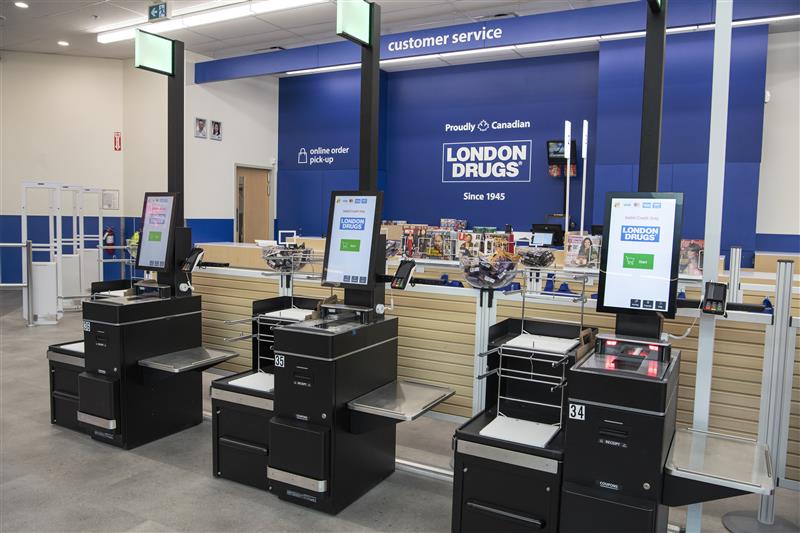
London Drugs has opened its second store in Winnipeg, representing the doubling of its retail footprint in Manitoba and unveiling its second refreshed concept store in Western Canada.
Situated in the CF Polo Park shopping centre with an address at 1485 Portage Avenue, the new store represents London Drugs’ continued commitment to growth in the province and as retailer prioritizing future-forward shopping experiences, said the company.
Covering 29,895 square feet, the company said the store takes residence in a prominent location on the second floor in a unit previously occupied by Zellers. It is the second London Drugs location in Western Canada to launch with a reimagined vision for retail rooted in human-centered design thinking, following London Drugs at The Amazing Brentwood in Burnaby, BC, which opened in May 2025.Custom design in-store stems to a pharmacy division with private consultation rooms and a modernized shopping experience showcasing Canadian-made products.
Building on the success of London Drugs’ St. Vital Centre location, the new store has added up to 90 jobs for local residents across retail, pharmacy, and management roles, further supporting Winnipeg’s economic growth while the company expands across the region, it added.
Clint Mahlman
“Expanding in Manitoba with a store at CF Polo Park shopping centre, Winnipeg’s busiest retail destination welcoming an estimated 10 million visitors annually, is an opportunity we don’t take for granted,” said Clint Mahlman, London Drugs’ president and COO. “Which is why we are opening with our latest design, which was designed to capture the 2035 retail experience, and we now invite the community to experience it.
“CF Polo Park is now home to the 80th London Drugs store in Western Canada, and the second to roll out our innovative design concept. We would like to thank our customers for believing in our brand over the last eight decades and look forward to this next phase of growth here in Winnipeg.”
Under the design project, London Drugs said its CF Polo Park location boasts a seamless flow guided by four principles: assistance, personalization, community, and discovery. The store is equipped with a Connected Health service point for technology education and solutions, pharmacy services, and beauty products with a focus on dermatology. Customers can also bring items including soft plastic packaging and small appliances to the recycling counter in-store to support sustainable practices.
“We are thrilled to welcome London Drugs to the centre. As Winnipeg’s premier shopping destination, this addition reaffirms our commitment to providing a diverse, high-quality retail mix that meets the needs of our community,” said Peter Havens, General Manager, CF Polo Park.
Photo: London Drugs
Founded in 1945, B.C.-based London Drugs sells throughout Canada through its online store, http://www.londondrugs.com/ and has 80 London Drugs locations in more than 35 major markets across British Columbia, Alberta, Saskatchewan and Manitoba.
London Drugs said its multi-year human-centered design project pioneered is targeted at reimagining the retail experience to meet the dynamic and evolving needs of customers. This initiative includes the roll-out of a refreshed vision for retail and in-store design created in partnership with Montreal-based interior architecture firm Rümker, with enhancements for all store departments and a focus on wellness and sustainability. The first London Drugs location to open under the project in May 2025 is at The Amazing Brentwood in Burnaby, British Columbia.
Walmart Canada customers and associates raised 3.8 million to help kids start their mornings with a nutritious breakfast.
From August 29 to October 31, in Walmart Canada’s stores and sites across the country and through Walmart.ca, Canadians came together to raise an incredible $3.8 million for Breakfast Club of Canada, including a $1 million corporate donation from Walmart Canada. These funds will help provide nutritious breakfasts to children across the country so they can head to class fed, focused and ready to learn, said the retailer.
“This year’s campaign builds on a collaboration that’s been changing lives for more than two decades. Since 2003, Walmart Canada and its customers and associates have contributed more than $75 million to Breakfast Club of Canada, helping countless children start their day with a nutritious breakfast in a caring and inclusive environment,” explained Walmart.
“For 30 years, the Club has worked tirelessly to give every student from coast to coast to coast an equal opportunity to succeed through providing access to nutritious breakfasts. With the support of partners like Walmart Canada, the Club now reaches over 890,000 children in more than 5,000 breakfast programs across the country.”
Tommy Kulczyk
“This campaign perfectly illustrates what we can accomplish when communities and businesses join forces to support children,” said Tommy Kulczyk, President and Chief Executive Officer, Breakfast Club of Canada. “We’re proud to count on partners like Walmart, whose commitment makes a real difference in the well-being of children across the country.”
Rob Nicol
“We’re incredibly proud of what our associates and customers have achieved together during this year’s Breakfast Club of Canada campaign,” said Rob Nicol, Vice President, Corporate Affairs and Communications, Walmart Canada. “Their support means even more children can start their school day fueled to learn, grow and thrive.”
For 30 years, Breakfast Club of Canada has been working with partners from all sectors to help children access a nutritious breakfast and reach their full potential. Accredited by Imagine Canada for its effective governance and recognized for its promotion of local food products, the Club helps reach children in every province and territory across the country.
Walmart Canada operates a chain of more than 400 stores nationwide serving 1.5 million customers each day.
Foodism magazine front cover (cropped for editorial/hero image). Image: Foodism
When Krista Faist looks back on her path into publishing, she laughs at the twist of fate that brought her home to Toronto to launch a premium print magazine in an era that was supposed to be everything but. “As soon as I started I realized, this is what I am meant to do,” she said. “I am meant to lead something like this rather than go work for somebody else.” A decade on, her flagship titles Foodism and Escapism have carved out influential positions in the city’s food and travel culture, pairing a high-touch quarterly print product with a responsive digital and social engine that brands want to be part of.
Faist trained as a journalist at Ryerson, now Toronto Metropolitan University, then took detours through marketing and public relations before a leap of faith to the United Kingdom. There, she joined an independent publisher and helped concept and launch consumer titles focused on food, drink, and travel. “We developed Foodism and Escapism around 2014,” she recalled. After four years, she saw a gap in Toronto for premium free media with hand-to-hand distribution and ad funding. Over a pub handshake, she received the blessing to bring the brand to Canada in 2015, adding her own spin and operating independently. The bet has outlasted the industry’s most tumultuous decade.
The inheritance from London was a mindset. The Canadian market, Faist learned quickly, behaves differently from the UK and the United States in how budgets flow. “In Canada we tend to not get our own individual budgets, we tend to have to share with the US,” she said. “So they are smaller, less about population, more about the fact that we have such a beast underneath us that we are usually getting the leftovers of the budget.” Her answer has been to double down on Toronto’s value for advertisers that need precise reach.
The focus on hyperlocal shows up in everything from editorial to sales packaging. Alcohol and consumer packaged goods remain core revenue drivers, and Ontario’s listings, price promotions, and retail rules make the province a natural centre of gravity. “In Ontario we are able to work with brands when they get new LCBO listings and LTOs. That is so specific to Ontario that we get those dollars, versus a national play.” Expansion to other Canadian markets, or across the border, remains a question of opportunity and math. “I would love to expand to the States,” she said. “I would want to know we are going somewhere where the gap is there. You have fabulous food publications down there. I am not about to go in and be another one.”
How the business actually works
Faist has worn every hat. She wrote, edited, sold, and balanced the books in the early years. The only part that felt unfamiliar was sales, until she found language that fit. “As soon as I figured out that it is just marketing partnerships, but asking for money instead, I was like, I have got this,” she said. The commercial engine is built around integrated programs that stitch together print, digital, social, and real-world activations.
Advertorial remains a familiar term, though Faist prefers to describe what brands truly buy. “They are paying for control,” she said. “In editorial, you give my team one hundred percent free rein. In advertorial, you get control from start to finish to a degree. The best clients give us creative freedom to make it look, feel, and sound like us, and those are the best campaigns we do.” The result, she added, should feel seamless to the reader. “We get feedback like, I went through the magazine and I really did not feel like I was being pushed a ton of product.”
Print as the flagship, digital as the accelerator
If there is a surprise in 2025, it is how resilient print has been for Faist’s model. Foodism is approaching its 48th issue and never missed a print cycle, even in April 2020. “We stayed in print,” she said. The magazine is the flagship, a tangible object that asks readers to slow down. Yet digital was intentional from day one. “Our website launched a year before the first print magazine ever came out,” she said. “We started to build momentum online first, and then we were able to convert them to print.”
The editorial operation runs in two distinct tracks. A quarterly cycle prioritizes depth, design, and evergreen storytelling. The digital team, led by a dedicated editor, moves quickly on events, openings, news, and service content, anchored by a weekly newsletter. “We plan our digital content tracker three months in advance now,” Faist said. “Press week is always press week, you are selling last minute, proofreading, fact checking, all of it. The balance is making sure we are not silent on digital or social when print peaks.”
The system depends on a core team that has grown together. “My editor, art director, digital editor, sales director, they have been with me for six, seven, eight years,” Faist said. “We will always get it done. Forty-seven times now we have gotten it to press and we are happy with it.”
Foodism magazine front cover. Image: Foodism
Social reach, and a close call with the algorithms
The social audience behaves differently from print and web, and Faist treats it that way. “It almost has its own audience really,” she said. Instagram is the strongest channel, unsurprising in a food city where photography drives discovery and inspiration. Conversion from social to site traffic remains a challenge many publishers share, but the commercial opportunity is clear. Advertisers want their messages distributed under a trusted halo. “We do a lot of Meta social campaigns under the Foodism payload,” she said. “If I put these under a Foodism halo, it is getting that authority, it is feeling like it resonates more with the audience.”
There was a moment in 2024 when that reach was threatened. “We were accidentally [blocked] for a while,” Faist said. “We were somehow looped into the news category and it took me three weeks of appealing and getting to the head person at Meta to say, look at this, we are not news. They reversed it and we have been in the clear ever since.”
Events as a high-impact touchpoint
The editorial calendar now includes a signature gathering that serves readers, partners, and the broader hospitality community. The Foodism ICON Awards return for their third year on November 25 at the Fairmont Royal York. “Our tagline is ten industry titans, ten awards, one incredible night,” Faist said. Categories include sustainability, DEI, mentorship, mixology, and a legendary honour, with winners kept secret until the show.
Sponsors activate on site behind the bar, at stations, on stage, and through experience moments, including a tourism prize. “Brands want to be on the ground sampling their products, talking to the right people and to our readers and industry VIPs,” she said. “We deliver all of that on one big night, and we include Foodism media as part of it so you get longevity over Q4.”
Faist draws on an earlier career in marketing to shape the evening, supported by an event management firm that handles permits, logistics, and the long list of operational details. “This is the stuff you pay for,” she said, describing a morning when the team produced a Fairmont special-occasion permit within minutes. “Overall direction still comes from me, but if we do not need to outsource it, we absorb it.”
Distribution, costs, and the print reality today
If the product and community are clear strengths, the economics of print remain a moving target. Paper and printing costs climbed during the pandemic and have not returned to old levels. “They increased by one hundred percent during COVID,” Faist said. “Now I would say we have come back to paying probably forty percent more.” The company switched printers a couple of years ago after running an RFP to manage cost pressures.
Distribution is led by Canada Post, blending targeted direct mail with a curated VIP list of roughly three thousand recipients. Labour disruptions have been manageable so far. “One strike delayed us by a week or two, but that was it,” she said. Quarterly timing has helped avoid the worst of it. The model, hungry as it is, still makes strategic sense in a crowded digital market. Physical placement is a competitive moat and a tangible proof of value for partners.
Foodism magazine front cover. Image: Foodism
AI’s promise, and the line the brand will not cross
Artificial intelligence has entered nearly every publishing conversation, and Faist is blunt about what it will and will not be allowed to do inside her shop. “We do not write anything using AI that goes into the magazine,” she said. “We do not write anything with AI that goes into the website or our newsletter.” The team has experimented with fact checking and found the double-checking erased the gain. Where AI has stuck is in research, process, work-backs, and creative mock-ups that help win pitches. “Once we sell people in on the mood boards, we then go and shoot everything authentically ourselves,” she said. “It will never replace my team. Our editorial voice has to be trusted.”
Like many publishers, she is monitoring the other side of the AI debate, the one that reshapes traffic by answering readers’ questions directly. “We are seeing our traffic numbers massively impacted,” she said. “The most authoritative sites are suffering the most because people do not need to go to our site to confirm anything now. We are watching what happens with Google and with the larger lawsuits.”
Why it matters to Canadian retail and hospitality
The mechanics of Faist’s model matter to more than media observers. For retailers and brands, the approach maps to how consumers discover and decide where to spend. A Toronto-led, hospitality-heavy audience is a high-intent cohort for dining, drink, travel, and lifestyle categories, and it is often the same audience that shops urban high streets and mixed-use centres. The omnichannel packaging, which brings together a quarterly magazine, a fast digital cadence, targeted social distribution, and a moment to meet in person, gives marketers multiple ways to move the needle.
The nuance is hyperlocal relevance. A national campaign has its place, Faist said, but so does a district-level activation that points people to specific neighbourhood events and businesses. That is what Foodism can deliver at scale in Toronto. It is also why a single-city focus can be more powerful than spreading thin across many markets without matching budget increases.
The next ten years, with eyes wide open
Independent publishing is rarely a straight line. The last decade brought a pandemic, supply shocks, labour disruptions, and platform pivots that would have undone many operators. Faist describes the present as both challenging and energizing, with a steady team and a clear rhythm to how issues and campaigns get made. Predicting the future is hard. “It is impossible right now to predict,” she said. “We would not have predicted the pandemic, Canada Post strikes, or anything else. There is a lot to look around and be aware of.”
That awareness has not cooled her conviction. She has built an organization that treats print as a signal of quality, digital as a daily service, social as reach, and events as community. She hires people she can trust, and she keeps creative standards tight, even when advertisers pay for control. She is unambiguous about the line on AI, and she is patient about expansion, moving when a real gap appears.
Twenty Two Media is a decade old because it is stubborn about the things that matter and flexible about the things that do not. “We wear a lot of hats,” Faist said. “If we do not need to outsource it, we absorb it. That is how we are where we are.” For readers who still love the feel of a well-made magazine, for brands that need a credible voice to carry their message, and for a city that knows how to eat and travel well, that stubbornness looks like a strategy.