Delta Bingo brings the thrill of Bingo and Vegas-style gaming to Etobicoke with its newest location now open at 360 Evans Avenue. (CNW Group/Delta Bingo & Gaming)
Delta Bingo Etobicoke has opened, offering a reimagined space where fun and excitement take centre stage.
Located at 360 Evans Avenue, this isn’t your typical Bingo facility. Spanning 46,000 square feet, Delta’s flagship venue is its largest location yet, combining the excitement of Bingo with over 200 Vegas-style gaming machines, a welcoming bar, and a menu full of crowd-pleasing bites. With more than 800 Bingo seats, Delta Bingo Etobicoke offers more ways to play, unwind and connect, said the company.
“This venue marks a significant step forward for Delta Bingo & Gaming,” said Cam Johnstone, President. “Our vision was to create a welcoming space where people could come together and enjoy a variety of gaming options, amazing prizes, great food and entertainment. We’re excited to open our doors and share this new chapter with the Etobicoke community.”
With more than 800 Bingo seats, and 200 Vegas-style gaming machines, Delta Bingo Etobicoke offers more ways to play, unwind and connect. (CNW Group/Delta Bingo & Gaming)
Delta Bingo said the location offers a unique blend of experiences, where tradition meets modern entertainment. The city’s newest gaming destination combines the nostalgic charm of classic Bingo with the vibrant energy of Vegas-style gaming. Whether you’re socializing with friends, enjoying a date night, or celebrating a special occasion, this new venue provides the perfect setting for fun, excitement, and unforgettable moments, all under one roof.
“And it’s not just about entertainment–Delta Bingo is deeply committed to giving back. Every game played helps fund essential community programs and services, with over $600 million raised for Ontario charities to date. In 2024 alone, Delta Bingo and its charity partners proudly raised over $40 million for their communities. Delta Etobicoke is continuing that tradition and partnering with 80 local charitable organizations. These partners span a range of causes including health and social services, grassroots community organizations (such as food banks and social clubs), educational initiatives, the arts, youth sports, and more,” said the company.
Spanning 46,000 square feet, Delta’s flagship venue is its largest location yet. (CNW Group/Delta Bingo & Gaming)
Shawn Fisher
“Giving back to the community has always been at the heart of what we do,” said Shawn Fisher, COO. “With this new location, we’re excited to offer an exceptional experience for our guests while continuing to support the incredible work of our charity partners. We’re proud that Delta Bingo Etobicoke is a place that brings people together and contributes to something bigger.”
Delta Bingo & Gaming has been the ultimate destination for gaming entertainment for over 55 years. Partnered with 960+ charitable organizations across 18 locations in Ontario, Delta Bingo & Gaming’s charity partnerships have generated over $600 million for local communities.
Canadian labour leaders standing and smiling (CNW Group/Canadian Labour Congress (CLC))
Canada’s unions are sounding the alarm on the devastating impact of new U.S. tariffs that threaten more than one million jobs in critical sectors, including steel, aluminum, forestry and public services.
Canadian Labour Congress (CLC) President Bea Bruske and Fédération des travailleurs et travailleuses du Québec (FTQ) President Magali Picard called on the federal government to deliver urgent and robust support for affected workers, industries and communities.
“Over one million jobs. That’s what’s on the line. These reckless and unjustified tariffs from President Trump are a direct attack on Canadian workers, our industries and our economy,” said Bea Bruske. “Workers are watching. They want to know if their government has their back and is ready to fight for them. We need a plan to protect livelihoods, stabilize communities and stand up to the United States.”
Bruske emphasized the gravity of the situation, citing the 123,000 jobs in Canada’s steel and aluminum industries and over 587,000 auto and supply chain jobs at risk.
“These are not just numbers on a spreadsheet,” added Bruske. “These are real people, real families and real communities who are already stretched to the brink. The time for warnings is over. This is real, and we need immediate action.”
Beyond manufacturing and resource sectors, Bruske warned that the ripple effects of these tariffs threaten Canada’s broader economy, including critical jobs in healthcare and public services.
“Let’s be clear. When our economy suffers, public services are at risk. Cuts to healthcare and public care services always follow austerity. And right now, in the midst of an election, is not the time to slash support for the very public servants who keep this country running,” said Bruske.
The CLC and FTQ are urging all political parties to deliver bold commitments that put Canadian workers first, including:
Investing in public healthcare and housing affordability
Cracking down on corporate price gouging
Making corporations pay their fair share
Cutting off U.S. access to key Canadian resources—such as electricity, lumber, critical minerals and oil and gas—until tariffs are lifted
Supporting communities through job protections and public service investments
FTQ President Picard echoed Bruske’s call to action and emphasized the unity of Canada’s labour movement.
“This isn’t just an economic crisis, it’s a national emergency for workers and families,” said Picard. “We cannot allow our communities to shoulder the cost of a political game being played in the U.S. Canada’s unions are united. We are ready to fight—together—for the jobs, livelihoods and future of every worker in this country.”
Picard stressed the significance of the upcoming federal election and urged Canadians to hold their leaders accountable.
“This is a defining moment for Canada. We need leaders who are prepared to go to the mat for workers—who won’t waver in the face of pressure from foreign governments or corporate lobbyists. The path forward will be hard, but if we act with courage and unity, we can protect our jobs, our industries and our communities,” added Picard.
Retailers in Canada and beyond are facing historic challenges in filling frontline roles. According to recent industry data, companies met only 47.9% of their hiring targets in 2024—the lowest success rate in four years. Labour shortages, high turnover, and interview no-shows continue to plague the sector.
“The challenges in Canada are very similar to those in the U.S.,” said Jon Puckett, CEO of Cadient, a U.S.-based AI-driven hiring platform that works with several major retailers north of the border, including Costco and PetSmart. “Companies are getting applicants, but not always the right ones—and when they are, it’s hard to get them to stay.”
Jon Puckett, CEO of Cadient
Puckett, who has worked in the hourly hiring space for more than 25 years, says retail is now at an inflection point. “With Gen Z entering the workforce and older workers retiring, the entire ecosystem is shifting. AI is no longer optional—it’s essential.”
AI as a Solution to Turnover and Efficiency
Cadient’s tools are specifically built for high-volume hourly hiring. The company’s SmartTenure platform uses artificial intelligence to identify applicants who are not only qualified but statistically more likely to stay on the job.
“Our clients might get 400 applicants for a single job,” explained Puckett. “Without AI, hiring managers look at the last ten applicants and pick someone just to fill the role. But with our technology, we can reduce that pool to 10 or 20 of the best fits—those with the right skills and higher likelihood to stay.”
AI-driven interviews are another breakthrough. Traditionally, store managers handle screening, but with multiple operational duties, hiring often becomes a rushed afterthought. “These managers are overwhelmed,” said Puckett. “AI interviews let us automate that first screening step, allowing managers to spend their limited time with the best candidates.”
Addressing Gen Z Expectations
As Gen Z becomes the dominant demographic in the hourly workforce, their expectations are reshaping recruitment. “They don’t want to spend 45 minutes filling out an application,” Puckett said. “They want to submit their interest in under five minutes and hear back quickly—ideally through text.”
Cadient offers flexible application tools and integrates texting solutions to speed up communications. “We see a 96% improvement in response time with text over email,” he added. “It’s a massive advantage.”
Additionally, Cadient enables retailers to add realistic job previews to job postings—often in video format—so Gen Z applicants can understand a company’s culture before applying. “If candidates know what they’re getting into, they’re more likely to stick around,” said Puckett.
Post-Hire AI Support: A Full Lifecycle Approach
Once a candidate is hired, Cadient continues to engage with them using AI-driven follow-up calls. Within days of joining, new employees receive an automated call asking for feedback on the hiring experience. At 30 and 90 days, follow-ups assess onboarding satisfaction, training effectiveness, and whether they plan to stay.
“This feedback loop is crucial,” said Puckett. “And because the calls are AI-driven, employees can choose to remain anonymous—giving more honest input.”
These insights allow employers to make real-time improvements to hiring and onboarding processes. “AI can surface what’s working and what’s not—without tying up HR staff,” he said.
Canadian Retailers Embrace Predictive Hiring
While Cadient already works with several Canadian retailers, the company sees strong alignment with national hiring challenges, especially given similarities with the U.S. market.
“Canada’s retail environment is just as competitive when it comes to hiring,” noted Puckett. “We see the same bottlenecks—large applicant pools, ghosting, and poor retention from job board traffic.”
According to Cadient’s internal data, candidates who come in through job boards like Indeed are less likely to stay long-term. “They’re constantly being pinged with other job offers,” he said. “But if someone is referred by a friend who works there, they’re much more likely to stick around.”
To address this, Cadient helps companies build internal referral programs, and also facilitates applicant pooling between store locations. “If you apply at Store A, but Store B nearby has an opening, our system ensures that your application gets reviewed there, too.”
Future-Focused: Predictive Analytics and AI Wellness Checks
Cadient’s roadmap includes even more advanced tools, such as predictive analytics that forecast hiring needs before a role becomes vacant. “Imagine knowing weeks ahead that you’ll need a new cashier at Store 104,” said Puckett. “That’s where we’re heading.”
AI is also being used for employee wellness checks, helping employers maintain engagement post-hire. “Instead of surveys that sit unread in inboxes, we’re using phone-based conversational AI that feels more personal—and again, employees can stay anonymous.”
As AI becomes more advanced, Puckett emphasized the importance of transparency. “We’re very clear when a part of the hiring process is AI-driven. It builds trust. The goal isn’t to replace the human—it’s to make their job easier.”
Building a Better Candidate Experience
Puckett believes that AI will help retailers not only hire more efficiently but also protect brand loyalty. “If an applicant feels ignored or ghosted, they won’t just walk away from the job—they may stop shopping with you.”
Cadient helps clients maintain communication with unsuccessful applicants as well. “Even if they didn’t get the job, they might be a great fit for another role,” said Puckett. “We can automatically notify them when a new opportunity opens.”
Retailers Can’t Afford to Wait
The National Retail Federation has declared 2025 the “Year of the AI Agent,” and Cadient is well-positioned to support Canadian retailers through the transition. While there is some nervousness around AI adoption, Puckett says those who hesitate risk falling behind.
“Some smaller retailers may wait, but the reality is—if you’re not using these tools, you’re going to get left behind,” he said. “This isn’t a passing trend. It’s the future of hiring.”
Retail Insider is streamlining its Canadian retail news from around the web to include a handful of top news stories that can be viewed quickly during the day. Here are the top stories from the past several days.
In the ever-evolving world of SEO, some strategies stand the test of time, and backlinks are a perfect example. Even as algorithms grow more sophisticated, backlinks remain a cornerstone of search engine rankings. They’re more than just links—they’re a vote of confidence from one site to another, signaling trust and authority to search engines. But why do they still matter in 2025, and how can we leverage them effectively?
As Google continues to refine its ranking factors, quality backlinks are more critical than ever. However, not all links are created equal. Building a strategy that prioritizes quality over quantity is key to staying competitive in the digital landscape. Let’s dive into why backlinks remain essential and explore the best practices for creating a winning link-building strategy.
Why Backlinks Still Matter In 2025
Backlinks continue to play a critical role in search engine optimization, maintaining their relevance as a core ranking factor. Their ability to signal trust, authority, and relevance ensures they remain essential in digital strategies.
The Evolution Of Backlinks In SEO
Search engines have transformed how they evaluate backlinks. In the late 2000s, the focus was on the sheer number of backlinks. Now, search algorithms emphasize relevancy, domain authority, and content quality. Factors like contextual relevance, natural anchor text, and source diversity have grown crucial. Google’s updates, including Penguin and recent AI advancements, penalize manipulative practices, rewarding genuine links instead. This shift highlights a steady move toward quality-driven metrics that align with user-focused content.
How Backlinks Impact Search Rankings
Backlinks act as external signals of authority that influence rankings. High-authority sites linking to a page can enhance its credibility, driving better positionings in SERPs. Search engines use backlinks to index content faster, especially when links come from frequently crawled platforms. Additionally, backlinks strengthen semantic relationships between linked pages, helping algorithms understand topical relevance. Combined with content optimization, backlinks amplify SEO performance.
Key Benefits Of High-Quality Backlinks
High-quality backlinks directly improve organic traffic by connecting us to engaged, interested users. They drive referral traffic by guiding visitors from authoritative external sources to our site. Additionally, they boost domain authority, impacting overall SEO performance across pages.
For example, buying backlinks from reputable platforms like Presswhizz establishes industry trust, enhancing branding and visibility. This platform integrates with major SEO tools and provides visibility into key metrics like traffic and domain authority before purchase.
The platform’s intuitive dashboard enables users to easily search, filter, and sort websites based on niche, traffic, domain authority, and pricing, ensuring efficient decision-making.
All websites in the PressWhizz database undergo strict vetting to maintain quality standards, reducing the risk of spammy or low-value links.
Common Misconceptions About Backlinks
Misunderstandings about backlinks often lead to ineffective strategies. Dispelling these myths is essential for creating impactful SEO campaigns.
Backlinks As A Ranking Shortcut
Some believe backlinks alone can guarantee rankings. While backlinks do serve as trust signals, search engines also analyze their context, source, and relevance. Low-quality, spammy links harm rankings instead of improving them. Search algorithms now evaluate the authenticity of backlinks to detect manipulative practices. Earning backlinks that genuinely align with your content focus strengthens your SEO strategy, but there are no shortcuts through quality link-building.
Quantity Over Quality Myth
The belief that more backlinks always yield better results is outdated. A site with 500 irrelevant links ranks lower than one with 50 authoritative, contextually relevant links. Search engines prioritize quality and relevance over volume. For instance, earning a backlink from an industry-specific blog carries more value than multiple low-grade links. Achieving better search performance requires prioritizing backlinks that add genuine value to users and align with the overall content theme.
Effective Link-Building Strategies In 2025
Photo by Growtika on Unsplash
Effective link-building strategies in 2025 focus on creating valuable connections and leveraging updated practices to align with search engine algorithms. Prioritizing authenticity and relevance ensures long-term benefits for SEO efforts.
Creating High-Value Content
High-value content serves as a foundation for attracting authoritative backlinks. By creating in-depth articles, original research, or comprehensive guides, we can offer substantial value to our audience and strengthen our link-building efforts. Content tailored to address specific industry challenges or provide unique insights often encourages organic linking.
To increase visibility, we optimize our content with relevant keywords and ensure it’s shareable through multiple channels. For example, infographics, whitepapers, and case studies can enhance content attractiveness. Using user intent-driven formats, such as FAQs or how-to guides, further establishes credibility and relevance, making content more appealing for linking.
Guest Blogging And Content Collaboration
Guest blogging and collaborations allow us to tap into established audiences while earning authoritative backlinks. Publishing guest posts on reputable niche websites helps establish our expertise and link back to our content contextually. Collaborating with content creators or industry peers expands reach and diversifies link sources.
When pitching guest blogging ideas, we focus on aligning topics with the host site’s audience while delivering high-quality, insightful content. Including data, trends, or actionable advice strengthens the chances of acceptance. Joint projects like podcasts, webinars, or co-authored articles also create opportunities for natural backlinks and cross-promotion.
Leveraging Social Media For Link Building
Social media platforms amplify content reach and indirectly support link-building by increasing visibility. Sharing linkable content like blog posts, infographics, or videos fosters engagement and attracts potential linking opportunities from users and industry pages.
Engaging with niche-specific communities through platforms like LinkedIn or Twitter enhances trust and content discovery. By collaborating with social media influencers or leveraging trending hashtags, we can drive traffic to our pages and build relationships that lead to links. Consistently posting shareable and interactive content helps sustain prolonged engagement.
Building Relationships With Industry Influencers
Relationships with industry influencers open valuable opportunities for backlinks through endorsements and collaborations. Engaging meaningfully with influencers by commenting on their posts, sharing their content, or participating in events fosters mutual trust.
Offering useful resources or co-creating content, like interviews or expert roundups, incentivizes influencers to link back to our site naturally. Maintaining consistent communication and showing authentic interest in their work cultivates stronger partnerships, driving long-term SEO value.
Tools And Technologies For Link-Building Success
Effective link-building in 2025 relies on advanced tools and technologies to optimize strategies and streamline processes. Leveraging suitable platforms ensures accuracy and efficiency in acquiring quality backlinks.
Top Platforms For Analyzing Backlink Profiles
Accurately analyzing backlink profiles is essential for understanding link quality and improving SEO performance. Tools like Ahrefs and SEMrush provide in-depth analysis of backlink sources, anchor text distribution, and domain ratings. They enable us to assess link relevancy while identifying harmful or spammy links that could negatively affect rankings.
Moz Link Explorer offers insights into page authority and domain authority metrics, helping us evaluate potential sites for outreach. Google Search Console allows monitoring backlinks indexed by Google, ensuring our efforts align with search engine expectations. Utilizing such platforms ensures we can maintain a healthy, impactful backlink profile.
Automation Tools For Outreach And Management
Automation tools simplify and enhance link-building outreach by improving management efficiency. Platforms like BuzzStream streamline the process of identifying prospects, managing communication, and tracking responses. These tools enable personalized outreach at scale.
Presswhizz, tailored for content promotion, helps amplify high-value content through targeted campaigns, increasing the likelihood of earning backlinks. NinjaOutreach focuses on influencer engagement, connecting us with industry leaders for collaboration opportunities. By integrating automation tools, we save time while maintaining a consistent, results-driven approach to link-building.
Measuring The Success Of Your Backlink Strategy
According to Moz, backlinks play a pivotal role in determining a site’s relevance and credibility. Tracking performance is essential for understanding the impact of your backlink strategy. Regularly analyzing data ensures continued alignment with SEO goals and highlights areas for improvement.
Key Metrics To Monitor
Analyzing specific metrics helps gauge the effectiveness of backlink efforts. Domain Authority (DA) and Domain Rating (DR) measure the quality and authority of linking sites. Traffic from referral domains identifies sources driving visitors, ensuring links deliver value. Anchor text distribution evaluates whether contextual keywords align naturally with page content, avoiding over-optimization penalties.
Spam Score detects potentially harmful links that could lead to penalties. Link velocity, or the rate of link acquisition, ensures natural growth without triggering red flags. Using tools like Moz Link Explorer aids in monitoring and analyzing these metrics efficiently, reducing time spent manually assessing backlinks.
Adapting Strategies Based On Performance
Adjusting methodologies ensures strategies remain effective in evolving search landscapes. If analysis reveals irrelevant or low-quality backlinks, refining target domains enhances contextual relevance. Poor anchor text diversity might call for outreach adjustments to diversify link profiles.
Boosting links from high-traffic domains increases content visibility. If referral traffic is low, optimized outreach or improved content can attract better backlinks. Tools such as Presswhizz provide actionable insights for refining link-building tactics, enabling targeted performance improvements. Regular adaptation keeps momentum strong and mitigates risks.
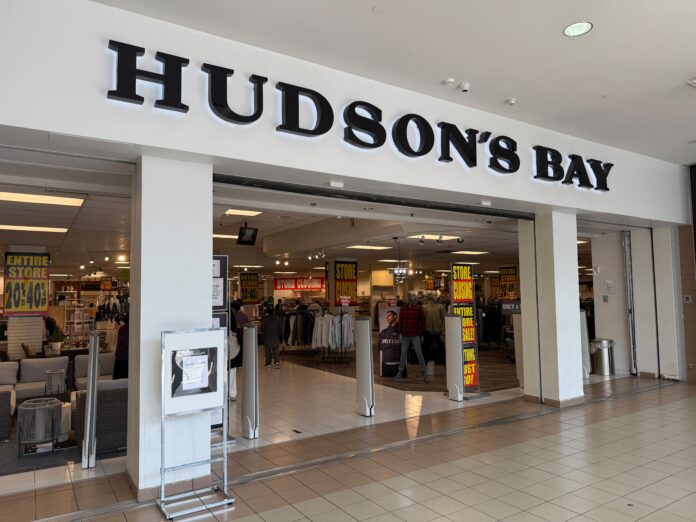
Mall entrance to the Hudson's Bay store at Metropolis at Metrotown in Burnaby, BC, on Saturday, April 5, 2025. Photo: Lee Rivett
The Hudson’s Bay Company is edging closer to a historic turning point, with a critical investor deadline looming and a surprise contender emerging from the West Coast. On Monday, insiders must declare whether they intend to make a bid for any part of the 354-year-old Canadian retailer’s remaining assets, including stores, leases, and intellectual property.
While many await clarity on what exactly is for sale, the process is revealing just how complex—and potentially transformative—this restructuring may be for Canada’s oldest company.
Two-Track Sale Process Underway
The restructuring of Hudson’s Bay is being handled under court supervision, with Alvarez & Marsal leading the restructuring efforts. Oberfeld Snowcap has been retained to oversee lease-related inquiries, while Reflect Advisors is acting as financial advisor for the company. The restructuring plan involves two key tracks: one for leasing assets and another for non-lease assets such as brand IP, the Gluckstein homewares label, the Zellers banner, and even the company’s art collection.
Insiders, including owner Richard Baker, have until Monday to formally express interest in acquiring assets. Any internal bid must be disclosed to Alvarez & Marsal and Reflect Advisors. If a bid involves leases, Oberfeld Snowcap must also be informed.
The process has been designed to ensure fairness, with court orders preventing advisors from disclosing sensitive financial data to insiders until they clarify their intentions. Those from outside the company—including investors, landlords, and other retailers—have more time to get involved, with final bids due by April 30 and lease-specific bids by May 1.
Richard Baker’s Next Move?
Richard Baker, owner and Governor of the Hudson’s Bay Company
The future of Hudson’s Bay may still include its current owner. Richard Baker, who acquired the company in 2008 for $1.1 billion, remains a powerful figure in North American retail. Over the years, Baker has taken the company public and then private again, while selling off prized real estate to generate liquidity. Many of those moves attracted criticism for gutting the brand of its assets without reversing its decline.
Last summer, Baker added another twist to his portfolio by acquiring Neiman Marcus and Bergdorf Goodman for US$2.65 billion. He merged them into Saks Global, which now includes Saks Fifth Avenue and Saks Off 5th. Some observers suspect that stripping Hudson’s Bay of valuable IP and leases was always part of a longer-term play to consolidate luxury under a single umbrella, leaving the struggling Bay chain to collapse under its own weight.
Should Baker decide to bid again, it would offer a lifeline—but potentially at a significant discount compared to the brand’s past valuation. Bidding through a creditor protection process allows insiders to acquire assets free of prior liabilities, making it a strategic option in situations like this.
Hudson’s Bay store at Metropolis at Metrotown in Burnaby, BC, on Saturday, April 5, 2025. Photo: Lee Rivett
The End of an Era?
It’s expected that Hudson’s Bay will shutter the vast majority of its stores by summer. As liquidation sales roll out, up to 74 Hudson’s Bay locations, three Saks Fifth Avenue stores, and 13 Saks Off 5th outlets are anticipated to close, resulting in thousands of job losses nationwide.
Although the company has not published a full list of saleable assets, the scope appears vast. Everything from the brand’s trademarked Stripes motif to valuable downtown flagship leases could be in play. Experts say the company’s real value may lie in its legacy intellectual property, storied customer loyalty, and still-recognizable banners.
A potential wind-down would mark a sobering chapter in Canadian retail history. Founded in 1670, Hudson’s Bay was once the backbone of Canadian commerce and exploration. Today, it faces insolvency with liabilities nearing $1 billion, including $860,000 owed to a surprising potential suitor—B.C.-based shopping centre owner Weihong Liu.
Weihong Liu Declares Her Bid
Weihong Liu, chair of Nanaimo-based Central Walk
Amid the uncertainty, an unexpected contender has stepped into the spotlight. As reported on the weekend by the Toronto Star, Billionaire businesswoman Weihong Liu, chair of Nanaimo-based Central Walk, has publicly declared her interest in acquiring Hudson’s Bay’s retail business. Her statement came through a series of videos posted to Chinese social media network RedNote.
Liu, who resides on Vancouver Island and also owns a mansion in Vancouver’s University Endowment Lands, says she intends to bid on “dozens” of Hudson’s Bay stores. In one video, filmed during a tour of a Bay flagship store, Liu said she feels the sadness Canadians are experiencing as the retailer falters and sees the opportunity as one that comes along “once every 300 years.”
She said in social media that she plans to hold a press conference on April 18 to formally outline her proposal.
Central Walk’s Canadian Footprint
Liu’s company, Central Walk, owns a trio of significant shopping centres in British Columbia: Mayfair Shopping Centre in Victoria, Woodgrove Centre in Nanaimo, and the expansive Tsawwassen Mills south of Vancouver. Her property empire also includes Arbutus Ridge Golf Club in Cobble Hill, all acquired in part using proceeds from the 2019 sale of her former Chinese mall—Central Walk Shenzhen—for the equivalent of C$1.25 billion.
In Canadian retail circles, Liu is known more for her low-profile approach than for public engagement. However, she has recently begun sharing more of her life online, using Mandarin-language video platforms to connect with Chinese-Canadian audiences and promote her shopping malls.
What’s Next for Hudson’s Bay?
Insiders have until end of day Monday to declare interest in the Hudson’s Bay assets. While insiders must act now, outsiders—including Liu—have until the end of April to submit binding bids. These bids must be accompanied by a 10% refundable deposit.
Alvarez & Marsal, Oberfeld Snowcap, and Reflect Advisors will evaluate all proposals, possibly auctioning assets where there are multiple interested parties. Any resulting deals must receive court approval by May 30, while leases not picked up will be disclaimed by July 15.
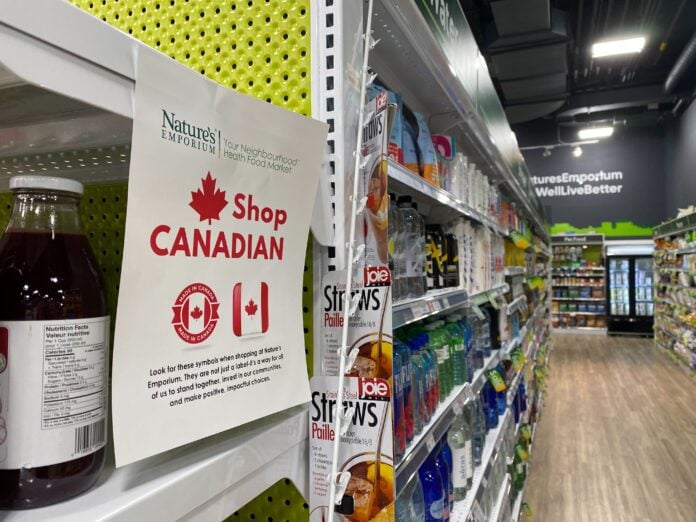
Shop Canadian/Made in Canada/shop local at a grocery store. Photo: Dustin Fuhs
As geopolitical friction between Canada and the United States intensifies, particularly on the trade front, the real battleground may not be in boardrooms or policy circles—but in grocery aisles across the country. Our team at the Agri-Food Analytics Lab at Dalhousie University, in partnership with Caddle, surveyed nearly 10,000 Canadians at the end of March 2025 to assess how consumer sentiment might shift in the face of U.S. tariff actions.
The results are telling—and deeply instructive for food policy analysts, supply chain strategists, and retailers alike.
Majority Willing to Pay More for Canadian Food
Asked whether they’d be willing to pay a premium (5–10%) for Canadian-grown produce, dairy, or meat over cheaper U.S. imports, 60.8% of Canadians said yes, either always or for specific products. This willingness was most pronounced among Baby Boomers, 36.2% of whom said they would always opt to “buy Canadian,” compared with just 25.5% among Gen Z. What this shows is more than patriotic sentiment. It’s a consumer base increasingly aware of the origins of their food and prepared, in many cases, to absorb modest cost differentials to support Canadian producers—especially when they feel national interests are at stake. But the conditional nature of this support (“only for specific products”) underscores the reality: price elasticity still matters. Sentiment alone does not override household budgeting concerns, particularly among younger or more economically constrained demographics.
In the event of U.S. food import restrictions—a not-so-unthinkable scenario given recent policy signals—Canadians are nearly evenly split between turning to alternative international sources (39.6%) and absorbing the cost of Canadian-made substitutes (37.6%). Again, older Canadians lean toward global diversification, while Gen Z skews slightly toward local sourcing, despite their price sensitivity. This finding complicates the common narrative that younger consumers are always more global in orientation. It also highlights a key takeaway for policy-makers and retailers alike: Canadians value access and will adjust if given clear alternatives—but they also expect stability. Disruptions in American supply may not result in a linear shift to Canadian producers; sourcing strategies must remain agile and responsive to evolving market sentiment.
Despite all the goodwill toward Canadian agriculture, only 20.7% of respondents completely trust Canadian grocers and producers to maintain stable prices during trade instability. Another 30.6% somewhat trust them—but 48.7% are either neutral or express active distrust. This trust deficit matters. It speaks to a broader anxiety around pricing mechanisms and the transparency of cost transmission along the food value chain. Even as most consumers are willing to pay more when necessary, they’re not convinced that price increases are always justified—or fairly communicated. Retailers and industry groups should see this as a call to action. Improved transparency on cost structures, tariff impacts, and sourcing could bridge this trust gap. Communication, not just inventory, is part of food security.
Domestic Food Seen as Higher Quality Than U.S. Imports
When it comes to perceptions of food quality and safety, nearly 48% of Canadians believe that domestic products are superior to U.S. offerings. Only 1.5% view American food as better, and roughly 28% consider the two comparable. This represents an underleveraged advantage for Canada’s agri-food sector. “Brand Canada” still holds currency when it comes to food safety and quality—a crucial factor in premium positioning, both domestically and internationally. But with nearly one in three Canadians seeing parity between Canadian and U.S. products, especially among Gen X and Millennials, this perception is not ironclad. Investment in certification, labeling, and public communication could help entrench the comparative advantage.
Loblaw’s recent announcement to label tariff-affected products with a “T” is widely supported—60.6% of Canadians called it a “great idea,” with particularly strong support among women and Ontarians. While some see it as political or irrelevant to their purchasing habits, the initiative underscores something fundamental: consumers want clarity. From a food economics perspective, this is a crucial insight. Consumers are not passive. They seek to understand how macroeconomic forces—like trade policy—affect microeconomic realities, like grocery bills. Retailers who are transparent and proactive in this space can build long-term trust, even during periods of volatility.
Three Strategies for Retailers and Policymakers
For supply chain managers, policymakers, and retail leaders, these findings should catalyze three key strategies: support domestic supply resilience, enhance cost transparency, and leverage Canada’s reputation for food quality. If the public is willing to pay more for Canadian food, ensure that Canadian producers are positioned to scale efficiently when import disruptions occur. Whether through labeling, public communication, or digital tools, clearer messaging about what drives food prices—especially during trade tensions—will build trust and reduce skepticism. And finally, strengthen the domestic brand not just with messaging, but with tangible investment in traceability, food safety standards, and global outreach.
In times of global uncertainty, Canadians still look inward for food security. The willingness to pay more for local goods, the openness to sourcing diversification, and the desire for pricing clarity all signal a mature, engaged consumer base. But goodwill is not infinite. Trust and transparency will be the critical currencies in weathering trade disruptions—and ultimately in safeguarding the integrity of our food system.
In February, Canada’s merchandise exports decreased 5.5%, while imports were up 0.8%. As a result, Canada’s merchandise trade balance with the world went from a surplus of $3.1 billion in January to a deficit of $1.5 billion in February, according to a recent Statistics Canada report.
After increasing 15.9% from September 2024 to January 2025, total exports decreased 5.5% in February. The strong volatility in recent months occurred amid threats by the United States to impose tariffs on Canadian goods. Overall, declines were observed in 10 of the 11 product sections. In real (or volume) terms, total exports declined 5.0% in February, following a real increase of 4.8% in January, said the report.
“Exports of energy products (-6.3%) posted the largest decline in February, the first decrease since September 2024. Several product subcategories contributed to the decline in February 2025. Exports of crude oil (-4.2%) fell on lower prices; refined petroleum product exports (-15.3%) were down due to lower shipments of diesel, mainly to the United States and Panama; coal exports (-26.9%) decreased primarily on lower shipments to Asian countries; and exports of natural gas (-8.9%) fell mostly on lower prices. Excluding energy products, total exports were down 5.3% in February,” said StatsCan.
“After reaching their highest level since 2000 in January, exports of motor vehicles and parts (-8.8%) decreased in February, mainly because of lower exports of passenger cars and light trucks (-15.3%). This decline came after these exports—in the context of tariff threats—reached a peak in January 2025. The Canadian auto manufacturing industry is deeply integrated with the US industry, as 93.4% of exports of passenger cars and light trucks were destined to the United States in 2024 on a customs basis.
After increasing 2.4% in January, total imports rose 0.8% in February, a fifth consecutive monthly gain. The largest contributors to the increase in February were imports of motor vehicles and parts (+5.8%), industrial machinery, equipment and parts (+3.1%), energy products (+5.2%) and metal and non-metallic mineral products (+3.5%). In real (or volume) terms, total imports (+0.0%) were essentially unchanged in February, said the report.
“After rising for three consecutive months and reaching a record high in January, exports to the United States were down 3.6% in February, representing a decrease of $2.1 billion. Meanwhile, imports rose 2.5% in February. As a result, Canada’s merchandise trade surplus with the United States went from a record of $13.7 billion in January to $10.6 billion in February,” explained StatsCan.
“Exports to countries other than the United States fell 12.4% in February, representing a decline of $2.0 billion. Lower exports to the United Kingdom (unwrought gold) and Germany (various products) were partially offset by higher exports to South Korea (various products). Imports from countries other than the United States were down 2.0% in February. Canada’s trade deficit with countries other than the United States widened from $10.6 billion in January to a record $12.1 billion in February.”
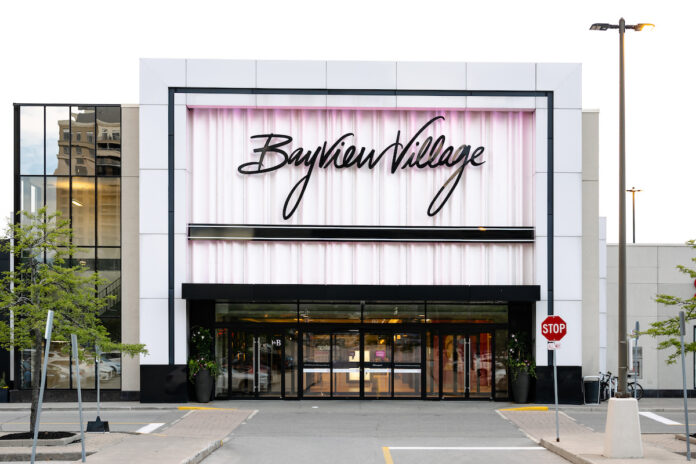
Bayview Village Shopping Centre in Toronto is set to welcome a new culinary arrival with the opening of Ju-Raku, a proudly Canadian-owned, elevated Japanese dining concept. The 4,500 square foot restaurant will officially open its doors on Sunday, April 6, 2025, marking the brand’s first location in Canada. Its debut adds to Bayview Village’s growing list of refined eateries and supports the shopping centre’s strategy of positioning itself as an innovator in upscale retail and gourmet dining experiences.
Ju-Raku promises an immersive experience in high-end Japanese cuisine, bringing a rare combination of omakase sushi and teppanyaki under one roof. The restaurant’s design and menu pay homage to Japan’s culinary traditions while presenting them through a modern lens suited for Toronto’s discerning diners.
“Our guests can expect an unforgettable culinary journey at Ju-Raku,” said HF Tang, Director of Palate Portfolio, which includes Ju-Raku. “Our menu includes the highest grade Japanese beef and freshest seafood sourced directly from Japan and around the world. The experience is elevated not only by the exceptional quality of ingredients, but also by the skills of our highly experienced chefs, many of whom have honed their craft at some of the most recognized Japanese restaurants.”
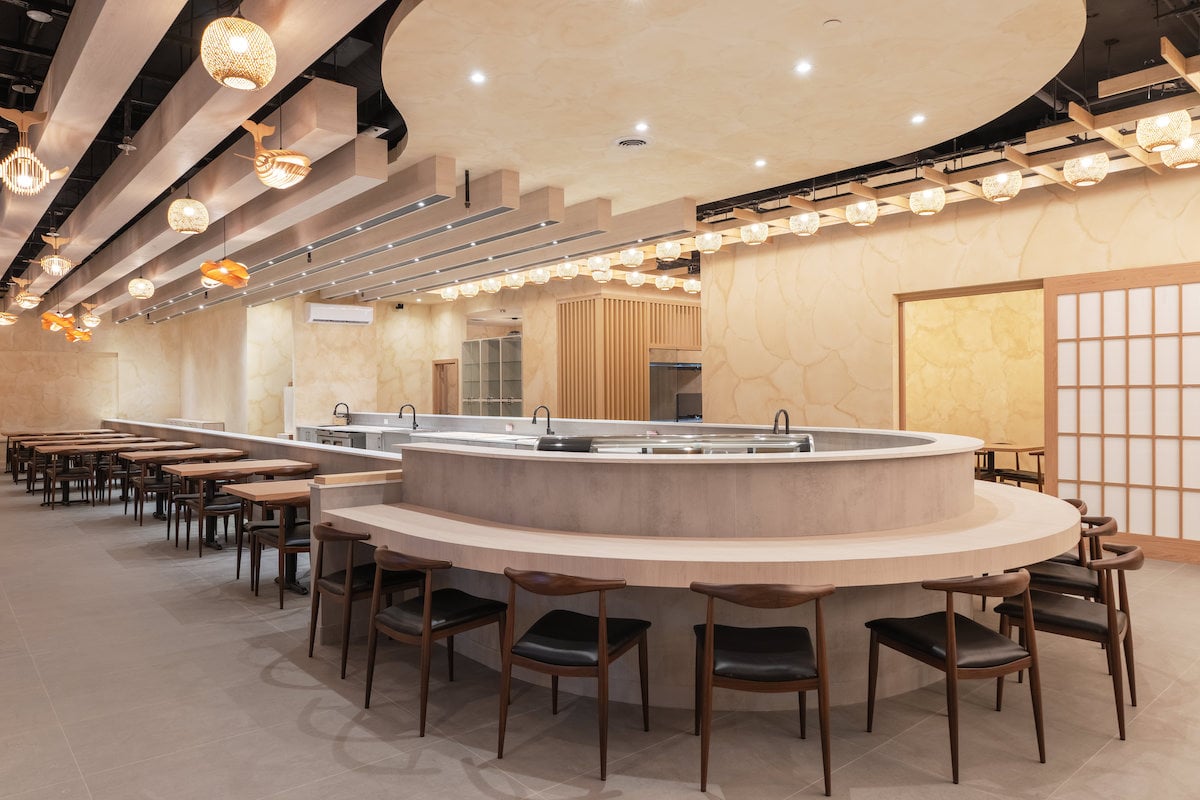
The restaurant will feature a 20-seat teppanyaki bar, described as “interactive and intimate” culinary theatre. It will also offer a chef-curated omakase sushi bar, where diners can enjoy seasonal dishes crafted with precision.
Ju-Raku at Bayview Village in Toronto. Image supplied
Elegant Interiors and Private Dining
Designed to reflect both traditional Japanese aesthetics and the clean lines of Scandinavian modernism, the interior of Ju-Raku was intentionally created to feel serene and sophisticated.
“Our 4,500 square-foot flagship seamlessly blends Japanese aesthetics with Scandinavian modern influences,” said a Ju-Raku spokesperson. “We designed the space with intention, including Toronto’s newest 20-seat teppanyaki bar, a beautifully crafted sushi bar, and private VIP rooms designed for intimate gatherings.”
Private dining rooms within Ju-Raku seat up to 10 guests and are tailored for special occasions or small celebrations. The design avoids conventional wood-heavy accents in favour of a brighter, more contemporary feel that reflects the restaurant’s modern interpretation of Japanese fine dining.
Ju-Raku at Bayview Village in Toronto. Image supplied
A Strategic Fit Within Bayview Village’s Transformation
Known for its elevated offering across fashion, beauty, dining, and lifestyle, Bayview Village continues to transform itself into a premier retail and culinary destination. Located in North York, the centre features upscale tenants and caters to nearby neighbourhoods, including Willowdale, York Mills, and the Bridle Path.
Carrie DeVries, Vice President of Leasing at QuadReal Property Group, expressed excitement for the opening of Ju-Raku. “We are proud to welcome the first Ju-Raku location to Bayview Village, further elevating our collection of distinctive gourmet dining destinations,” she said. “At Ju-Raku, guests will experience a new level of culinary artistry… set within a refined and welcoming ambiance.”
Ju-Raku at Bayview Village in Toronto. Image supplied
Curated Restaurant Lane: A Showcase of Dining Excellence
Bayview Village continues to redefine what a shopping centre dining experience can be through its curated Restaurant Lane, a thoughtfully designed corridor featuring a lineup of unique, upscale eateries. Unlike traditional shopping centre food courts—or “food halls”—Restaurant Lane offers a deliberate and elevated alternative.
Ju-Raku joins a collection of notable dining experiences that illustrate the centre’s intentional curation, including Pür & Simple, a stylish breakfast and brunch concept; Il Fornello, an inviting Italian restaurant that balances casual and upscale elements; and Tabulè, known for its refined take on Middle Eastern fare among others. These restaurants reflect the broader transformation of Bayview Village into a hub of culinary excellence, attracting food-savvy visitors from across the city.
“This highly anticipated addition to our Restaurant Lane speaks to the calibre of exceptional experiences and Canadian-owned brands we strive to bring to the shopping centre,” added DeVries. “Ju-Raku will be a landmark destination at Bayview Village as part of its transformation into a vibrant community hub, synonymous with luxury living.”
Updated renovatons to Bayview Village in Toronto. Image supplied
Bayview Village: A Storied History with a Vision for the Future
Established in 1963 as an open-air shopping centre, Bayview Village has grown into one of Canada’s most prestigious shopping destinations. Over the years, it has evolved with its clientele, maintaining an upscale profile that sets it apart from many shopping centres in the city.
Anchored by Hammam Spa By Céla, LCBO, Shoppers Drug Mart, Goh Ballet Bayview and the GAP (re-opening mid-April), the centre is also home to a variety of upscale retailers, offering a unique blend of everyday necessities and elevated indulgences. It is easily accessible via the Sheppard subway line at Bayview Station and features ample parking.
Through the reimagination of the Bayview Village master plan, QuadReal is transforming the Toronto shopping destination into a visionary, design-forward, master-planned community. With construction already underway for the project’s first phase, the exciting redevelopment will be anchored by a resort-inspired outdoor promenade and include immersive shopping and dining experiences, a public park and condominium apartment residences.
Food Processing Skills Canada (FPSC) has released its consumer research report, Impact of US Tariffs on Canadian Food Consumer Behaviour, indicating Canadian consumers are changing their shopping habits.
“There is an opportunity here for Canadian food and beverage businesses to reach consumers looking for local and Canadian products and for policymakers to use the tools at their disposal to get more Canadian products in front of consumers,” said Jennefer Griffith, Executive Director, Food Processing Skills Canada.
Jennefer Griffith
Research confirmed that the political environment has had a direct impact on Canadian consumer shopping habits. 98% of survey respondents have heard about tariffs or trade restrictions between Canada and the USA and 85% are concerned, said the organization.
“This concern has caused a drastic shift in behaviour with 43% of consumers making significant changes to their grocery shopping habits in the last two months. The primary motivation for these changes is a desire to buy Canadian products (81%) and avoid U.S. products (76%). Seniors prioritize buying Canadian, while immigrants and those under 35 place less emphasis on it. Buying products from one’s own province is more important to Quebecers (82%) and less so to Albertans (48%),” it said.
67% of consumers report buying more Canadian products in the past two months, including 26% who indicate buying “much more.” Consumers are most likely to report buying more Canadian produce, followed by bakery and grains, canned goods, meat/poultry/seafood, and dairy products. Alcoholic beverages are at the bottom of the list. Half of consumers report shopping at Canadian grocery retailers more often, said the report.
“The top motivations for buying more Canadian products are the belief that it’s good for the economy (86%), “anger/frustration” with the U.S. (75%), a desire to help Canadian food and beverage processors (72%), and Canadian pride (71%). Very few are motivated by a belief that Canadian products cost less. 52% of consumers who increased their purchases of Canadian products report an increase in their grocery bills, but only 5% consider the increase to be “much more expensive,” it explained.
Photo by Andrea Piacquadio
“However, identifying Canadian products remains a significant challenge. Only 40% of consumers find it easy to determine how “Canadian” a product is. The most common method for identifying Canadian products is reading product labels (76%), followed by looking for Canadian symbols (e.g., flag) on packaging. Only 11% use mobile apps or online tools and only 47% of respondents correctly identified “Product of Canada” as the “most Canadian” product, highlighting a lack of understanding of labeling.
“The research shows that 48% of those who haven’t increased their purchases of Canadian products want to start doing so, but difficulty identifying Canadian products is a major barrier for this group. 70% of all consumers say they would buy a lot more Canadian products if it was easier to determine how Canadian it is.”
The report is part of a series of consumer surveys gathering insights into Canadians’ grocery shopping habits, perceptions of available products, and response to increasing food prices and inflation. This final report in the series also assessed awareness and concern regarding US tariffs and trade rhetoric.
To learn more about additional consumer insights and industry recommendations download the report here.
Food Processing Skills Canada is the food and beverage manufacturing industry’s skills training and workforce development organization. As a non-profit located in Ottawa with representatives across Canada, the organization supports food and beverage manufacturing businesses in developing skilled and professional employees and workplace environments.