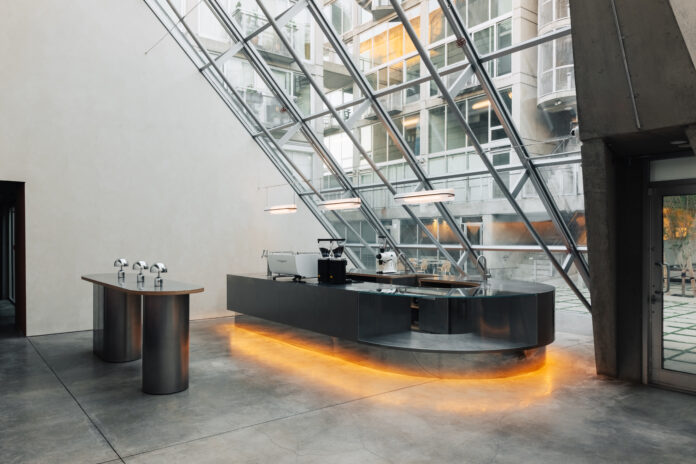
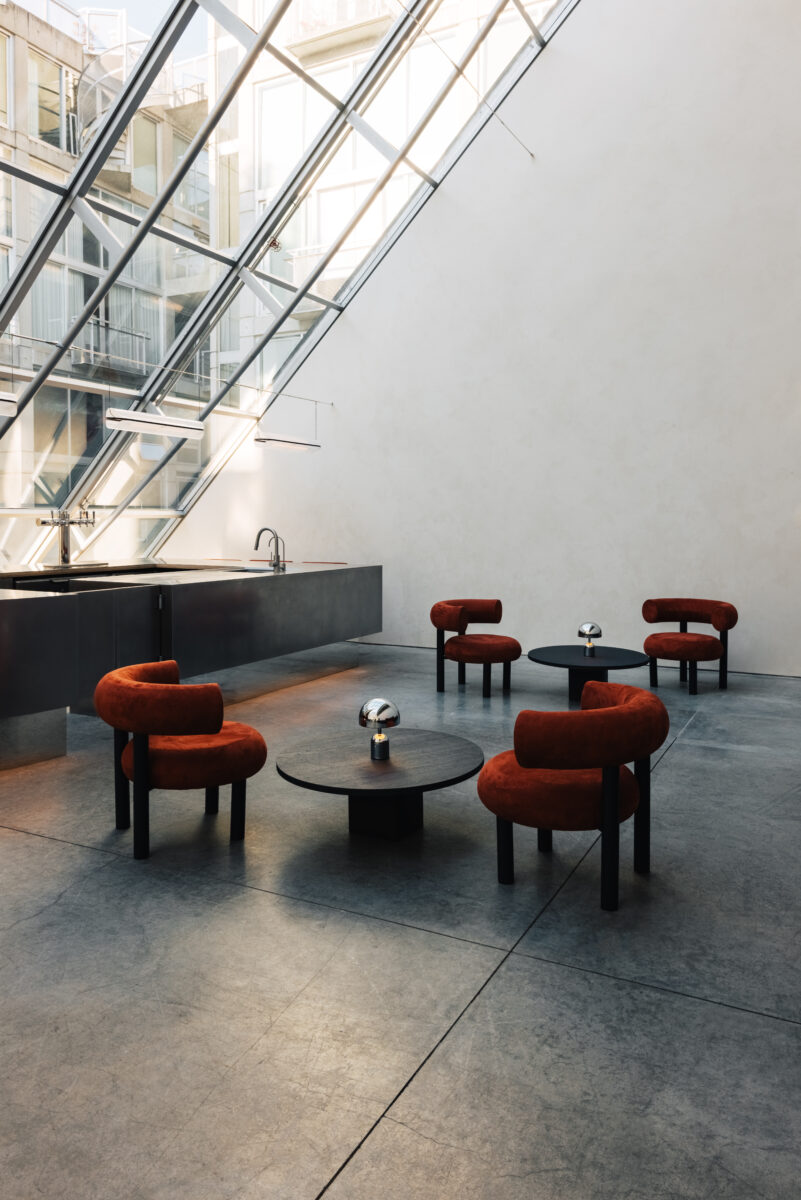
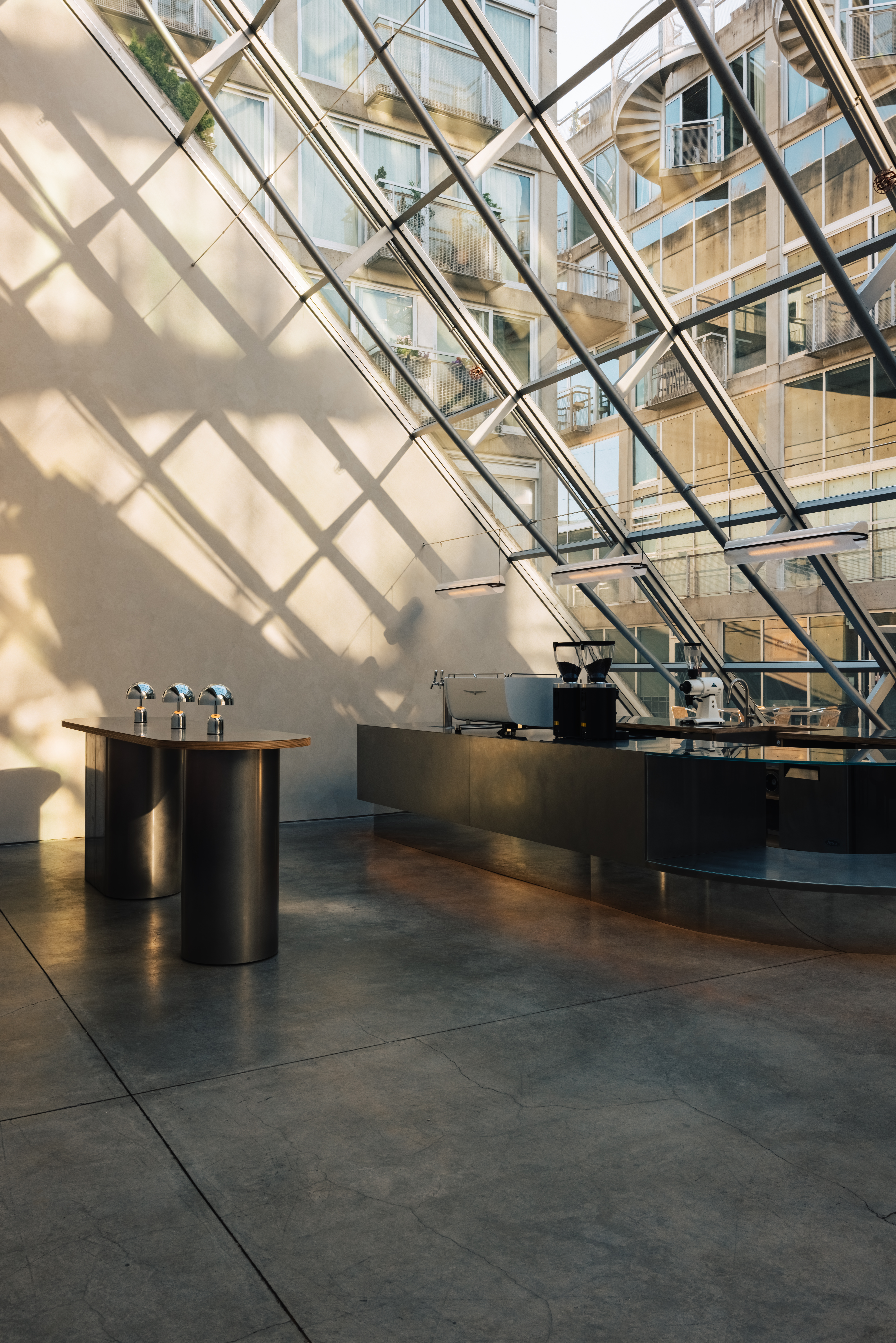
Vancouver is set to welcome a new coffee and cocktail concept promoting taking the time to pause, gather, and connect, opening later this summer.
Anchored in inspiring customers to stop, sit, and stay a while, Ellipsis is a dual bar combining coffee, cocktails, and community under one design masterpiece, says the brand.
“Positioned inside one of the final works of late Canadian architect Arthur Erickson, the reimagined space sits within The Waterfall Building, designed in 1996 in collaboration with Nick Milkovich. The geometrically striking building was originally conceived as an art gallery, and is defined by its soaring triangular form, abundant natural light, and a tranquil courtyard with a waterfall. Featuring expansive concrete walls and a dramatic glass canopy, the unique design encourages natural light to flood the interior, resulting in a beautifully quiet but assertive spatial presence,” said Ellipsis.
It is at 205-1540 W 2nd Ave.
Designed to be a retreat from the hustle, “Ellipsis” symbolizes the ebb and flow of time, endless possibilities and the undefined potential of each individual experience.
“In a world that moves faster and faster, I wanted to create a space that invites us to slow down, to pause, to meet in the moment,” explained owner Ming Yang. “It’s a café, it’s a bar, but more than that, it’s a space for presence, connection and meaning.”
Photo: Ellipsis
Located on the outskirts of Granville Island, the 2,882 square foot, 47-seat space is the brainchild of Yang, a renowned café owner with years of hands-on knowledge in crafting intentional, community-rooted hospitality. While this venture celebrates a completely new offering, the level of care and service will remain the same, noted Ellipsis.
“The thoughtful redesign pays tribute to the original modernist architecture and was led by SML Studio Architecture, in collaboration with Tetherstone Construction, to capture Erikson’s vision. Brushed stainless steel surfaces, geometric millwork, and primary shapes (circles, triangles and rectangles) echo Erickson’s formal language, while reflective elements are balanced with natural materials such as wood and fabric to evoke warmth and comfort. Burnt orange upholstery and warm ambient lighting softens the structural tones, and mirrors at the base of the feature bars extend the sense of continuity and spatial openness,” it said.
Retail Insider is streamlining its Canadian retail news from around the web to include a handful of top news stories that can be viewed quickly during the day. Here are the top stories from the past several days.
The Bank of Canada’s Business Outlook Survey on Monday is expected to show early signs of stabilization in businesses’ expectations for future sales, input prices and hiring in Q2, says an RBC Economics report.
The likely improvement follows marked deterioration in Q1, and was during a survey period (Q2 typically spans from early to late May) when threats specifically targeting Canada had receded, said the report.
“Indeed, as much as Canada was a main focus of trade grievances earlier in Q1, it was excluded from the list of U.S. trade partners facing reciprocal tariffs in April. A duty-free exemption for trade compliant with the USMCA imposed in March also remains in effect,” said RBC.
“Indicators have broadly pointed to a stabilizing economic backdrop in Q2. Job openings from Indeed.com steadied into the summer following earlier declines. Business confidence in Canadian Federation of Independent Business surveys continued to improve in July after plunging in March.
“We expect next week’s BOS will largely mirror these trends. More significantly, the survey could highlight a divergence between sectors directly exposed to trade headwinds (such as manufacturing and transportation), which will likely maintain a softer outlook, while other sectors, particularly consumer-facing businesses, that are more positive.”
The Bank of Canada will be watching inflation expectations closely, after a string of mostly hotter consumer price index reports raised concerns that resilience in consumer spending is also leading to resilience in inflation, said RBC.
“Inflation expectations already drifted broadly higher for businesses and consumers in Q1. The early estimate of retail sales was a 1.1% decline in May from April, but to levels that are still resilient relative to low consumer confidence. Our tracking of card transactions pointed to further resilience in June,” it said.
“Broadly, that kind of a backdrop—better than feared growth and higher than wanted inflation topped with in the prospect of significant fiscal stimulus spending in the year ahead —leaves an high bar for the BoC to make additional interest rate cuts this year. We do not expect further interest rate reductions from the BoC.”
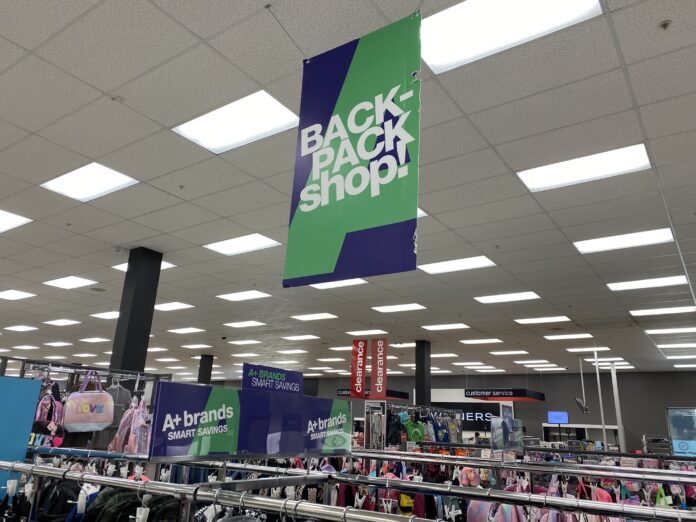
As families begin back-to-school shopping, retailers and consumers alike are quietly grappling with the ripple effects of the latest tariff wave.
David Warrick, EVP at Overhaul, a supply chain risk management company, who previously led global supply chain operations at Microsoft, is advising companies on supply chain risk and resilience at Overhaul, working directly with brands, carriers, and retailers facing tariff-related impacts.
David Warrick
“We’re starting to see price creep on everyday items—including school supplies—but the full impact of tariffs will likely cascade in phases. This growing pressure is driven by a mix of rising raw material costs, tariff exposure on components, and supply-demand imbalances created by uncertainty. School staples like backpacks, lunchboxes, pencils, tech accessories, and even glue sticks are particularly vulnerable, as they often rely on imported inputs—zippers from China, dyes and plastics from Southeast Asia, or packaging from Europe. Many of these categories are caught in the crossfire of the latest tariff expansions, and we’re expecting an average price increase of 12–15% across back-to-school essentials,” he said.
“Retailers have done a solid job front-loading inventory to delay price spikes—so for now, many shelves still reflect pre-tariff costs. But that buffer may run out by late summer or early fall. Sharper increases could land then or into early next year, depending on how long tariffs remain and whether additional goods are affected. Consumers should look for early signs: a name-brand notebook that’s 15% pricier than last year, fewer “3 for $1” deals, or school supply bundles with fewer items inside.”
Some of the most heavily impacted product areas include apparel and footwear—costing more to outfit kids for school—as well as electronics like laptops and calculators, where fluctuating semiconductor and component tariffs have raised costs by as much as 30% in some categories, added Warrick.
“Retailers may also quietly eliminate low-margin SKUs—like generic binders or budget pencil cases—due to shrinking profit potential under higher sourcing costs. That could mean fewer ultra-low-cost options, especially at discount and big-box stores,” he said.
“Supply is another challenge. Many retailers held off ordering due to tariff uncertainty, which softened manufacturing output earlier this year. Now, as demand ramps up, availability is tighter—adding yet another layer of inflationary pressure. Tariffs have disrupted traditional ordering cycles, turning once-routine procurement into a last-minute scramble that’s more expensive to execute.
“If parents want to avoid the brunt of any price increases, the smart move is to shop early while legacy inventory is still in circulation. You may also see some “tariff-beating” bundles as retailers move older stock—but overall, expect prices to rise steadily through the season. It’s less about one big sticker shock and more of a slow tightening of value—smaller packages, higher unit prices, and fewer markdowns.”
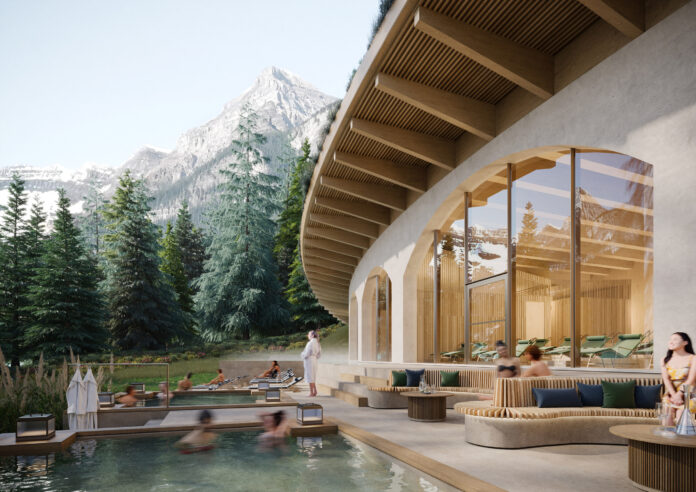
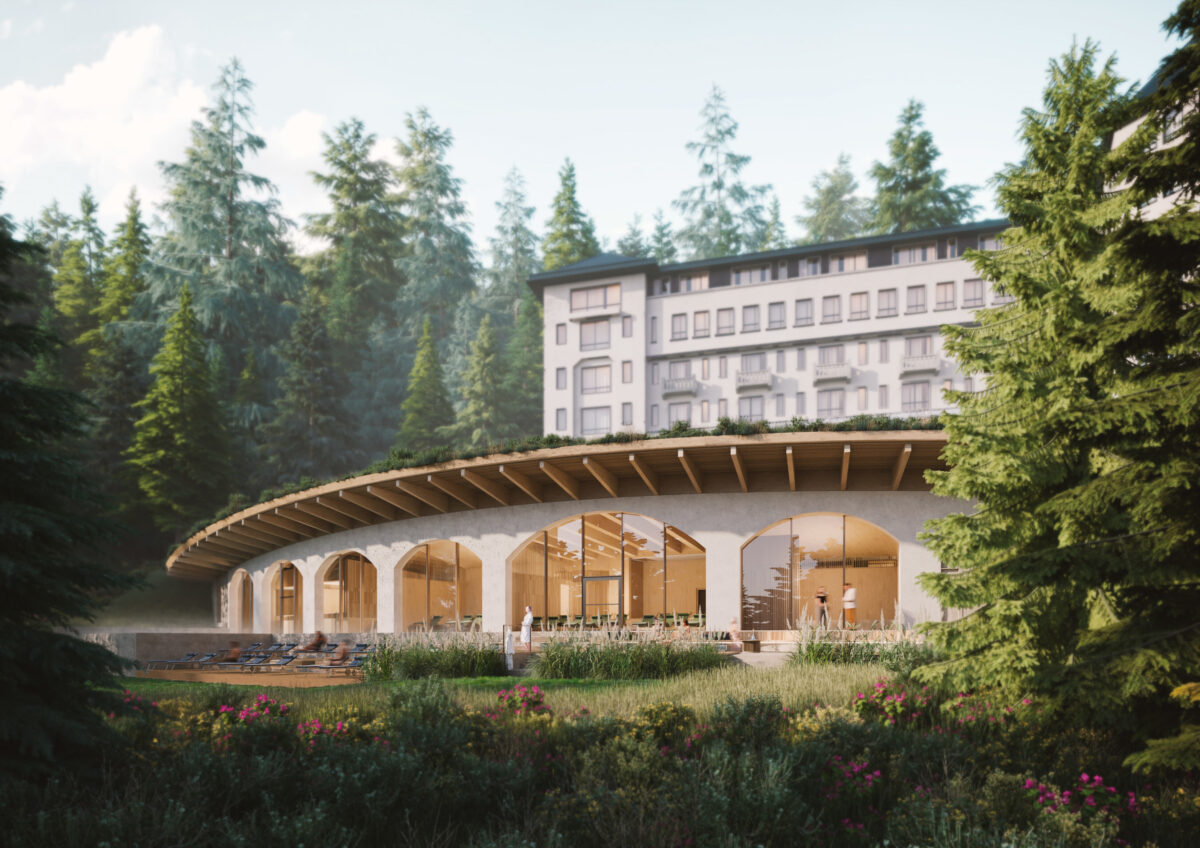
The debut of the world class, indoor-outdoor facility is set to revolutionize wellness in the Canadian Rockies with its contemporary interpretation of a traditional bathhouse – embedded within the landscape of Banff National Park’s high alpine, it said.
Advanced reservations for access into BASIN Glacial Waters – at this time, available exclusively to hotel guests went live Friday July 18.
“A concept two decades in the making and realized by acclaimed AD100 Matteo Thun, BASIN Glacial Waters is inspired by the healing benefits of natural springs, thermal waters, and long-established wellness practices of Nordic sauna culture, yet reimagined through a luxury lens. Resting at an elevation of 1600m (5,200ft) with an uninterrupted vista of Canada’s iconic Lake Louise and the impressive Victoria Glacier – the facility’s mineral-rich, natural water source – BASIN is presented in minimalistic grandeur, with organic textures and a strong sensibility towards conscious sourcing and sustainability,” said Fairmont.
“Capturing the spirit of Lake Louise was at the heart of the architectural intention, to respect the richness of the landscape with a design that represents simplicity, purity, and the uniqueness of the location. Nature and the beautiful surroundings of the lake and the forest become the protagonist – architecture and interior the stage,” said Thun of the concept.
Elements of water – from crushed ice to steam mists – are the basis; an invite to immerse into self-guided circuits flowing between varying heat and humidity states of the traditional Finnish and Bio Saunas, Aufguss Sauna, Steam Rooms, Hot Stone Massage Room, and Silent Salt Relax Room – with its gently warm glow from the Himalayan salt wall naturally ionizing the air. In addition, a series of diverse temperature pools, including the Reflexology Pool, Infinity Pool – spanning onto the outdoor terrace – and Kneipp Walk, for standing contrast bathing. Two wet treatment rooms further enhance the thermotherapy cycle, one of which modelled on a traditional Hammam for full-body exfoliation, explained Fairmont.
‘BASIN Glacial Waters’, designed to be embedded into the landscape. (CNW Group/Fairmont Chateau Lake Louise)
“Guests can also opt to follow one of five thoughtfully curated wellness journeys – named “Trails” – for a preferred wellness outcome. The ‘Stillness Trail’ is a gentle sequence to soothe the nervous system and set the body into the perfect state for a deep rest, the “Presence Trail” for grounding and awareness – to counteract jet lag and calm an anxious mind,” it said.
“Designed to be experienced to an individual’s preferred pace and circuit sequence, BASIN allows for moments of introspective pause and solo reflection combined with spaces for quiet social gathering. The ‘Glacier Lounge’ is an open, communal space to rehydrate and restore indoors, with a menu of simple, light, freshly prepared dishes. A selection of elixirs, tonics, nootropics and adaptogens will also be on hand – and for a sense of occasion, premium Champagne and craft beverages will complement the experience.
“The ‘Aufguss Ceremony’, its roots in European sauna practices, will be a BASIN signature. Led by world-renowned “sauna masters” performing traditional oil-infused steam rituals to an intimate group of guests within the outdoor Aufguss, ceremonies will take place throughout the day.”
“Our vision with this concept was to create an all-sensory space that felt both intentional and immersive, where guests can slow down, take a breath, and feel genuinely restored – all the while, set against the exquisite backdrop of Lake Louise. The BASIN experience is not prescriptive but is instead, deeply connected to the landscape and focused on the guest’s individual mindset. This exciting addition into our global portfolio demonstrates our commitment to innovation, and how the brand is responding to – and seeking to exceed – modern guest demand for luxury wellness experiences.”
From opening, BASIN will be accessible daily and year-round, the indoor-outdoor nature of the thermotherapy experience shifting with Lake Louise’s dramatic seasonal changes. The ‘BASIN Signature Retreat’ has been designed for guests seeking a wellness-inspired resort stay, featuring BASIN access, a ‘Glacier Lounge’ tasting, and guided wellness-in-nature experience. Further, guests can partake in the resort’s diverse program of wellness-focused outdoor activities, such as small-group Forest Bathing, a Silent Meditation Walk to find presence within the alpine, or a natural cold plunge with guided breathwork in the glacial waters of Lake Louise itself, noted Fairmout.
Tracy Lowe
“The introduction of BASIN Glacial Waters marks a new chapter for Fairmont Chateau Lake Louise, the cornerstone of a reimagined resort experience. Set to become a sought-after wellness destination in its own right, its debut signifies the completion of a transformative investment of $130MM across the property – including the renovation of guest rooms and suites, and a redesign of the hotel’s Fairmont Spa. It truly is a remarkable milestone year for our heritage hotel that has graced the shores of Lake Louise for over a century,” said Tracy Lowe, General Manager, Fairmont Chateau Lake Louise.
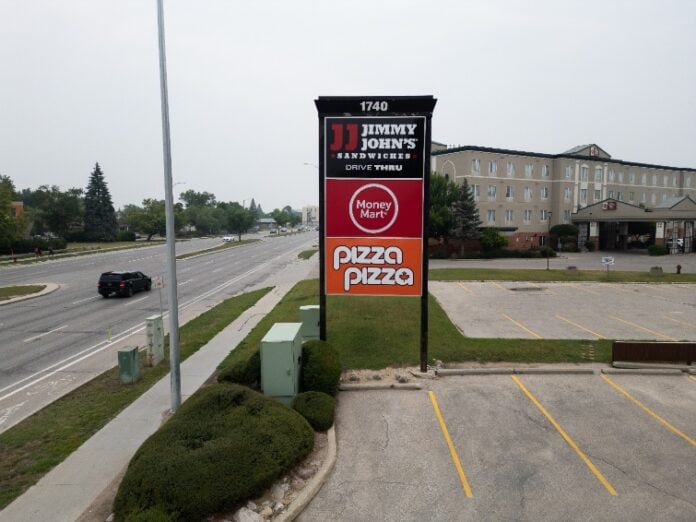
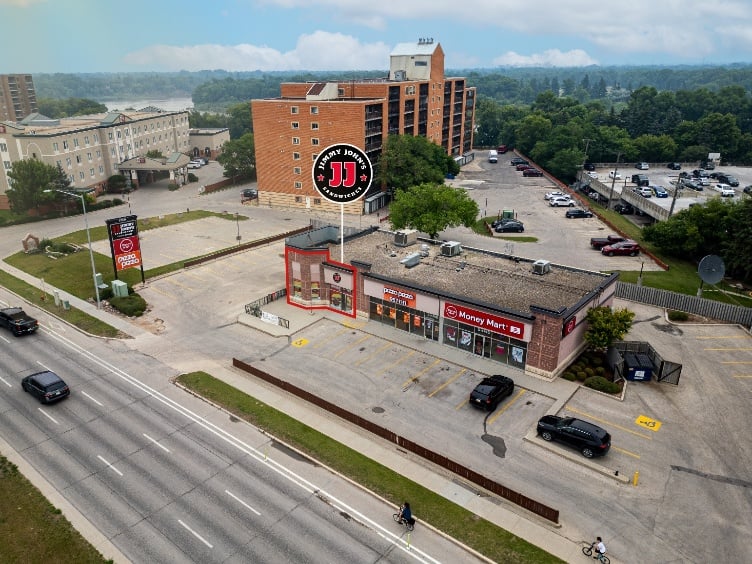
White Spruce Partners has announced it has secured a multi-store area development deal with Foodtastic to franchise Jimmy John’s across Manitoba with the first location at 1740 Pembina Highway. The restaurant is targeting an early fall 2025 opening.
This will be Jimmy John’s first location in Manitoba, following the brand’s Canadian debut in Ontario. The 1740 Pembina location will be particularly noteworthy as the first Jimmy John’s in Canada to feature a drive-thru, marking a milestone in the company’s national rollout strategy, said the company in a news release.
Derek Nieroda
Derek Nieroda, President of White Spruce Partners, said he is excited to bring the brand’s signature fast service and fresh subs with Canadian ingredients to a high-visibility site on one of Winnipeg’s busiest commercial corridors.
This is the first of several Jimmy John’s Derek and General Manager, Mark Beyer, have planned for Winnipeg and the surrounding areas creating fresh & fast new food options and local jobs for Manitobans, said the company.
“Bringing the first Jimmy John’s drive-thru in Canada to Winnipeg is an exciting milestone,” said Nieroda, franchisee of the 1740 Pembina location. “The excitement from the community has been incredible, and we can’t wait to open our doors this fall.”
Photo: Shindico
Shindico Realty announced that a multi-year lease has been secured with Jimmy John’s at 1740 Pembina Highway. Possession was granted on June 15, with demolition and construction beginning the same day.
Sandy Shindleman
Shindico, a vital piece in this expansion, “is proud to bring Jimmy John’s to the Manitoba market,” said Sandy Shindleman, President of Shindico Realty. “This flagship location reinforces our commitment to working with best-in-class brands and delivering high-profile sites that support long-term growth”.
Founded in 2020 and headquartered in Winnipeg, MB, White Spruce Partners is a family office style private capital provider who invests and / or acquires leading small-to-medium sized businesses in order to help owners achieve their desired succession planning goals.
2025 marks Shindico’s 50th anniversary. Founded in 1975, Shindico Realty Inc. is a full-service commercial real estate company and one of the largest privately owned real estate firms in Manitoba. As owners and managers of commercial real estate, Shindico’s diverse portfolio of properties includes shopping centres, office buildings, industrial parks, multifamily apartments, personal storage, and mixed-use developments.
Founded in 1983, Jimmy John’s is a fast-casual sandwich chain known for its fresh ingredients, baked-daily bread, and trademark “Freaky Fast®” service. With over 2600 locations in the United States, and sales of over $2.5 billion USD for 2024, the brand has built a loyal following for its high-quality subs made to order in minutes. Now expanding into Canada.
“To help customers make informed choices, Loblaw is expanding its instore and online labelling program to mark nearly 7,500 products with a “T” symbol, indicating those directly impacted by tariffs. Behind the scenes, about one-third of all inflation-related cost increases submitted by suppliers are tied directly to tariffs — reinforcing why clarity and transparency remain a priority,” it said.
In June 2025, food prices in Canada rose by 2.8% compared to last year — a slower pace than the 3.3% increase seen last month but still higher than the headline inflation rate. The drop in fresh vegetable prices, which fell by 3.1%, helped ease cost pressure on grocery bills, with a welcome shift to more local produce as we head into the summer, said the report.
“The U.S. government continues to throw trading partners into chaos with shifting goal posts during negotiations. At time of writing, many countries (including Canada) have not responded to the latest threats of new tariffs effective August 1 and continue to negotiate; however, it’s important to note many counter tariffs remain in Canada,” it said.
“How these potential tariffs play out have different impacts on food pricing in Canada: 1. If the Canadian government imposes further counter-tariffs on U.S. food, prices at grocery stores are likely to increase; 2. U.S. tariffs on other countries where ingredients are sourced will potentially see higher prices on finished goods destined for Canada. For example, vegetables, proteins, spices, packaging and other ingredients sourced globally by U.S. manufacturers are facing import tariffs into the U.S, increasing the overall production cost; and 3. New trade agreements are signed, and tariffs (or Canada’s counter tariffs) are removed, which would reduce prices of those products,” explained the report.
“The summer months bring some of the best quality and lowest pricing options for certain fresh produce for Canadians. Locally grown lettuces, celery, and field vegetables (beans, eggplant and zucchini) come into season. As international options include higher freight costs and foreign exchange rates, during peak growing season the cost of these can typically be 15-30% cheaper than spring months.”
It’s difficult to argue that climate change isn’t the most pressing threat to our agri-food sector. Farmers, processors, distributors, retailers, and transporters have all been forced to adapt in real time to extreme weather events, shifting growing seasons, and volatile conditions. From droughts to floods to wildfires, climate change has tested the resilience of every link in the food supply chain.
Yet, for all the challenges the sector has faced—and will continue to face—due to climate pressures, it has managed to cope reasonably well. Investments in technology, new crop varieties, smarter logistics, and infrastructure upgrades have helped absorb many of the shocks. But there is another looming threat—quieter, slower, and far more difficult to reverse—that few in the industry appear prepared for: depopulation.
At its core, the food industry is built on one assumption: that there will always be more mouths to feed. Growth in population has long been a proxy for market growth. The logic is simple—more people mean more demand for calories, more diversity in food preferences, and more spending across the value chain. Many strategies across the sector are driven by the idea of expanding “stomach share”—a concept that assumes a continually expanding consumer base.
But what happens when that base begins to shrink?
More than 60 countries around the world are already experiencing population decline, and that number is expected to exceed 100 within the next 25 years. Fertility rates are falling below replacement levels across much of Europe, East Asia, and even parts of Latin America. Japan, Italy, South Korea, Bulgaria, and many others are already seeing their populations shrink year over year. Aging populations and lower birth rates are creating labour shortages, weakening tax bases, and reshaping national economies.
Even countries like Canada and Australia, which have so far used immigration to offset domestic fertility declines, will not be able to avoid the broader demographic shift forever. Immigration policies may adjust, and population levels may stabilize temporarily, but the long-term trend is clear: global population growth is slowing, and in many places, reversing.
While the world has historically worried about overpopulation and the stress it would place on food systems, the more pressing concern now may be how to sustain food systems with fewer people to feed and fewer workers to produce food. For decades, global hunger has been a function not of insufficient supply, but of poor distribution and localized production failures. The fear of “not enough food” was always more political than agricultural.
But in a world of declining population, the question flips: How do we maintain a vibrant, efficient, and innovative food economy when demand begins to shrink?
Canada’s situation underscores this dilemma. While we are not yet in population decline, our fertility rate continues to drop. Without robust immigration, our population would already be contracting. And although the public discourse remains focused on rising food prices and access to affordable groceries, a deeper, more structural issue is emerging—nutritional insecurity.
In 2024, one in eight Canadian households experienced food insecurity, and that number is likely an undercount. Food insecurity is associated not only with hunger but also with poor diet quality, reduced access to fresh and nutritious food, and broader health consequences. More Canadians than ever may be meeting their caloric needs but are failing to meet their nutritional ones.
This brings us to a critical but often overlooked issue: disease-related malnutrition. This condition affects individuals of all ages and is deeply intertwined with both chronic illness and food insecurity. It is estimated that up to one in three Canadian children and one in two adults admitted to hospital are already malnourished upon arrival. Disease can lead to malnutrition, and malnutrition can exacerbate disease, creating a costly and dangerous feedback loop.
This challenge is only growing. As populations age and chronic illnesses become more prevalent, the demand for nutritional care—not just food—will intensify. Malnutrition is not just a clinical issue; it is a systemic one, reflecting broader failures in how we view, measure, and address food insecurity.
So what does this mean for the food sector?
It means we can no longer rely solely on volume. The industry must pivot from selling calories to delivering nutrition, quality, and personalized value. As the population plateaus—or declines—success will depend on a deeper understanding of demographic shifts, health trends, and evolving consumer expectations. We must recognize the increasingly heterogeneous nature of the market. A one-size-fits-all approach will no longer be sufficient. Growth will come not from quantity, but from innovation, specialization, and nutrition-forward offerings.
Public policy will also need to evolve. The current focus on food affordability and access must expand to include nutrition security—a concept that emphasizes consistent access to food that promotes health and prevents disease. This is not just a semantic shift; it reflects a deeper understanding of what a modern food system must deliver.
The transition from a growth-centric model to a resilience- and quality-focused one won’t be easy. But if we fail to adapt, we risk building a food system that is increasingly out of sync with the demographic and nutritional realities of our time. The future of food will not be measured in tonnes—it will be measured in impact per person.
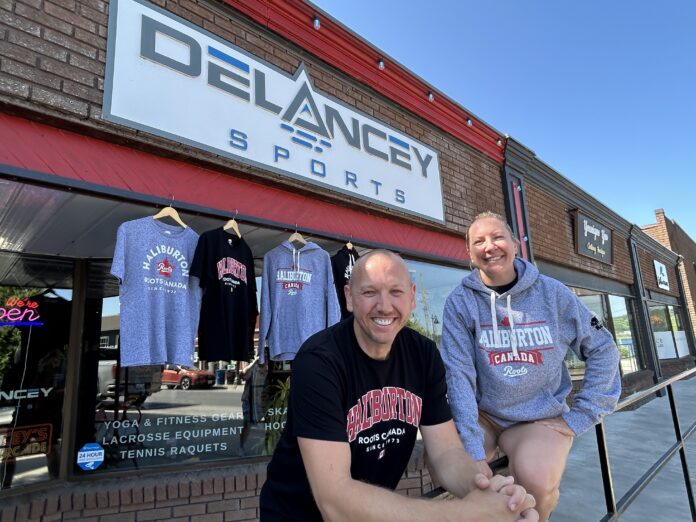
Josh Karam and Erika Mozes. Photo: Delancey Sports
In a world increasingly dominated by e-commerce giants and generic big-box stores, Delancey Sports has emerged as a distinctly personal, community-rooted alternative that blends athletic gear, local spirit, and even retro arcade games. The sporting goods retailer, co-founded by Erika Mozes and Josh Karam, has become a cottage country favourite, with three locations across Haliburton and Muskoka in Ontario. In just five years, what started as an impromptu response to the COVID-19 pandemic has evolved into a growing regional brand with national ambitions—and even a collaboration with one of Canada’s most iconic lifestyle names.
“We were running a tech company in New York City when the pandemic hit,” said Karam in an interview with Retail Insider. “New York was the epicentre, and we had to get out. So we left everything behind and came back to Canada.”
Settling in Haliburton, the couple found themselves drawn to the rhythms of a more outdoor, sport-oriented lifestyle, and quickly noticed a gap in the market.
“We were shocked there wasn’t a dedicated, modern sporting goods store serving the community,” said Mozes. “There was clearly an opportunity.”
By late 2020, Delancey Sports had opened its first store in Haliburton. The name, a nod to their old apartment at Delancey and Suffolk in Manhattan, served as a kind of tribute to their former lives. “We even named our lake house ‘The Suffolk,’” Mozes added with a laugh. “It just felt right to carry that energy into this next chapter.”
Photo: Delancey Sports
Retail With a Twist: Enter the Arcade
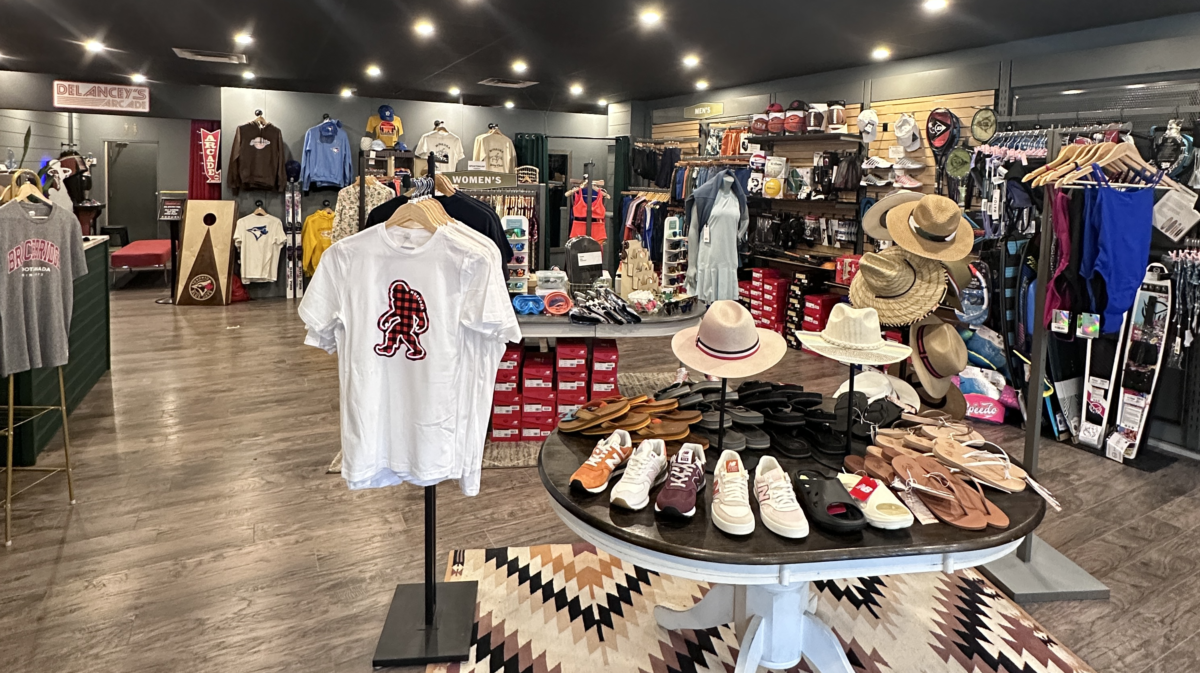
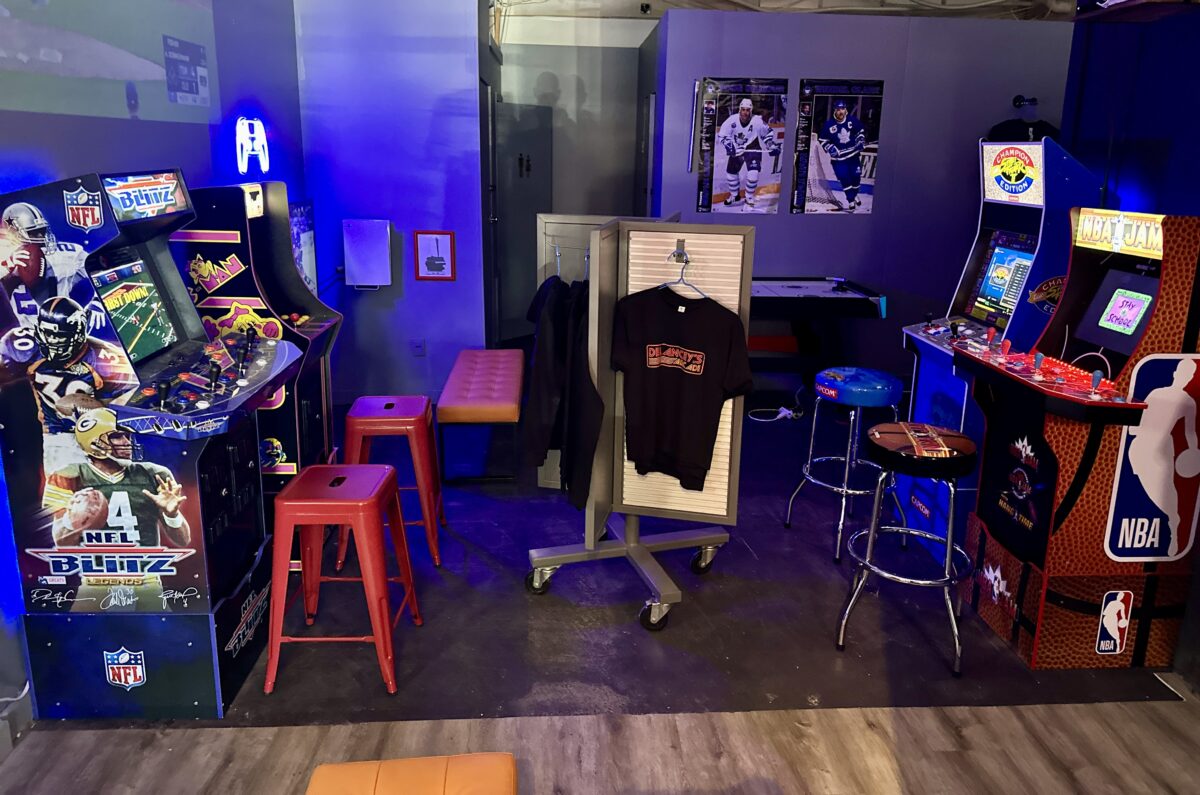
Today, Delancey Sports operates three storefronts: the original 1,500-square-foot Haliburton location, a seasonal pro shop at Sir Sam’s Ski Hill (launched in 2022), and a larger 2,500-square-foot space in Bracebridge opened in 2024. What sets Delancey apart—beyond its curated product mix—is the unexpected presence of a speakeasy-style arcade tucked into the back of its Bracebridge and Haliburton shops.
“I always wanted to open an arcade,” said Karam. “Standalone arcades aren’t always viable from a business perspective, but we realized it could work as a feature that added value to our retail concept.”
The arcade charges a flat $5 entry fee, with all games on free play. “It’s all sports-themed and family-friendly,” Mozes explained. “It gives parents a chance to shop, drop off their kids, or even just hang out with them.”
The idea proved to be more than just fun—it became a community touchpoint. “We’re seeing kids on PD days, grandparents babysitting grandkids—people love it,” said Karam. “There aren’t many intergenerational activities that work for everyone. This ended up being one.”
Curated for Cottage Country
Delancey Sports is not your average sporting goods store. The company focuses on high-quality, emerging brands with a strong Canadian component.
“We’re obsessed with sports ourselves, and everything we carry is tested or vetted by us,” said Mozes. “We’re proud to offer products that you won’t find in a typical big box.”
Brands like Left on Friday, Malvados, and Craft are part of the core assortment. “We’re also constantly looking to add more Canadian brands,” Mozes said. “It’s about showing people what’s new, what performs, and what aligns with the lifestyle out here.”
The company’s strategy targets both year-round residents and seasonal visitors in Ontario’s cottage country. “There’s been a huge population shift since 2020, with more people spending extended time in places like Haliburton and Muskoka,” said Karam. “These are active communities that want great gear. We’re here to serve them.”
Arcade area at Delancey Sports. Photo: Delancey Sports
From Whistler to Bracebridge: A Roots Partnership is Born
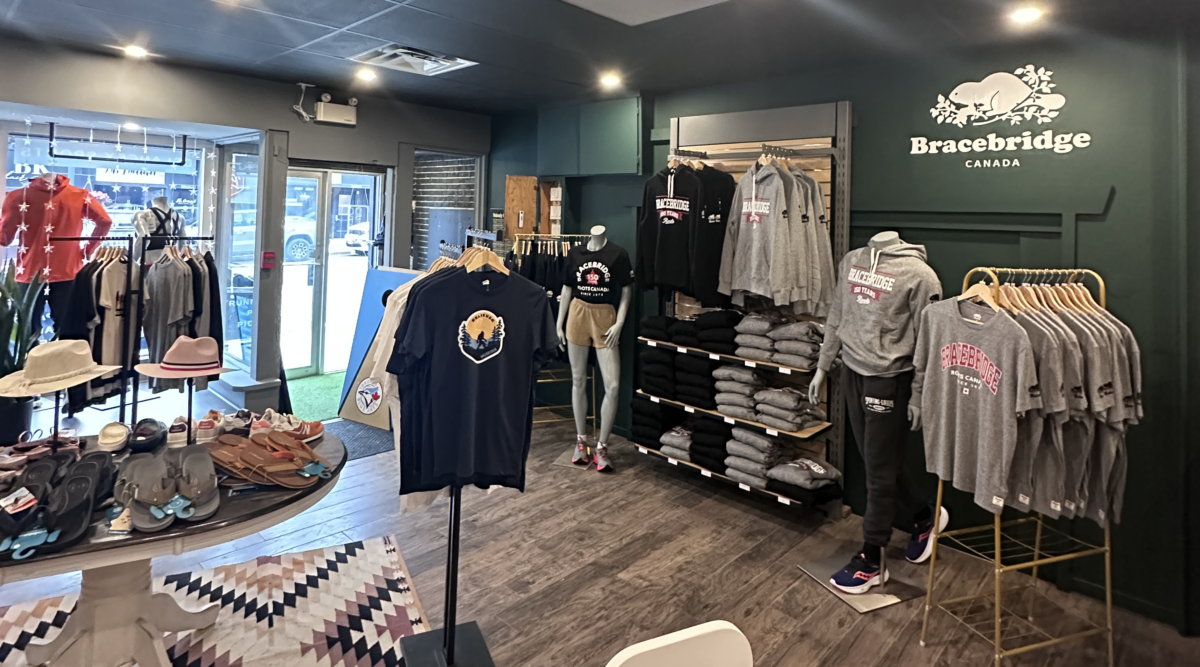
Delancey’s latest milestone is a co-branded product collaboration with Roots, the iconic Canadian lifestyle brand. What began as a chance visit to the Roots store in Whistler turned into something much larger.
“We were just skiing in Whistler and walked into the store,” said Karam. “We saw the location-specific product—like Roots Whistler—and thought, why isn’t there a Roots Halliburton or Roots Muskoka?”
Back home, they reached out to Roots and were thrilled when the brand agreed to collaborate. “For small business owners like us, this is a dream,” said Mozes. “As a kid in Ottawa, I used to go to the Roots store in Westboro. I still have vintage Roots pieces from back then.”
The first co-branded items launched last month in Bracebridge to coincide with the town’s 150th anniversary. Limited to just 150 hoodies and 150 t-shirts, the capsule collection sold briskly. Halliburton’s version is set to launch on Canada Day weekend.
“What’s really special is that Halliburton borders Algonquin Park, where the founders of Roots actually met,” said Karam. “So the Halliburton collection is inspired by that heritage, by the Algonquin vibe.”
Looking to the Future: Expansion and E-Commerce
While the co-founders are not rushing into new openings, expansion remains on the horizon. “I’d be surprised if we didn’t open more stores in the future,” said Karam. “There are still underserved towns, especially with ski hills or strong summer populations. The demand is there.”
In the meantime, the team is focusing on optimizing the existing stores and building out their e-commerce presence. “We already ship across Canada,” said Mozes. “But we want to continue growing in a way that stays true to what makes us different: community, curation, and authenticity.”
Delancey’s digital presence is also being used to spotlight Canadian brands and introduce them to a national audience. “It’s not just about selling product, it’s about telling stories,” said Mozes. “That’s what people connect with.”
Roots partnership with Delancey Sports. Photo: Delancey Sports
Navigating Retail Challenges: Tariffs and Tight Margins
Like many Canadian retailers, Delancey Sports has been affected by rising import tariffs, particularly on goods not manufactured domestically.
“Tariffs have been a challenge,” admitted Karam. “They haven’t been a nightmare, but they’ve definitely forced us to rethink some of our ordering decisions.”
Mozes added that while retail margins are already tight, they’re committed to making it work. “The reality is, we’ve become more focused on sourcing locally where we can,” she said. “That’s also why partnerships like the one with Roots make so much sense.”
A New Chapter for Small-Town Retail
Delancey Sports is more than a store — it’s a reflection of a lifestyle, a location, and a post-pandemic reinvention. For Mozes and Karam, the journey from Manhattan tech entrepreneurs to rural Ontario retailers may have been unexpected, but it’s one they’ve fully embraced.
“We’re entrepreneurs at heart,” said Mozes. “This wasn’t part of the plan, but it’s the best kind of surprise. We love what we’re building, and we’re excited about what comes next.”
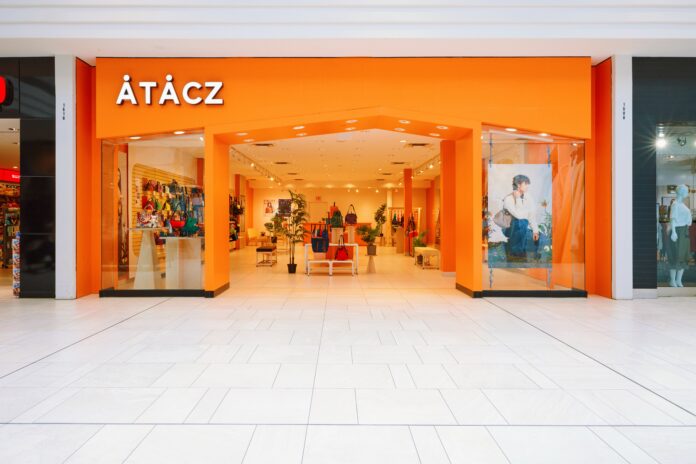
ATACZ, the Vancouver-based, zero-waste brand known for transforming recycled plastic bottles into sleek, functional bags, is opening its first-ever retail store at CF Richmond Centre on July 19.
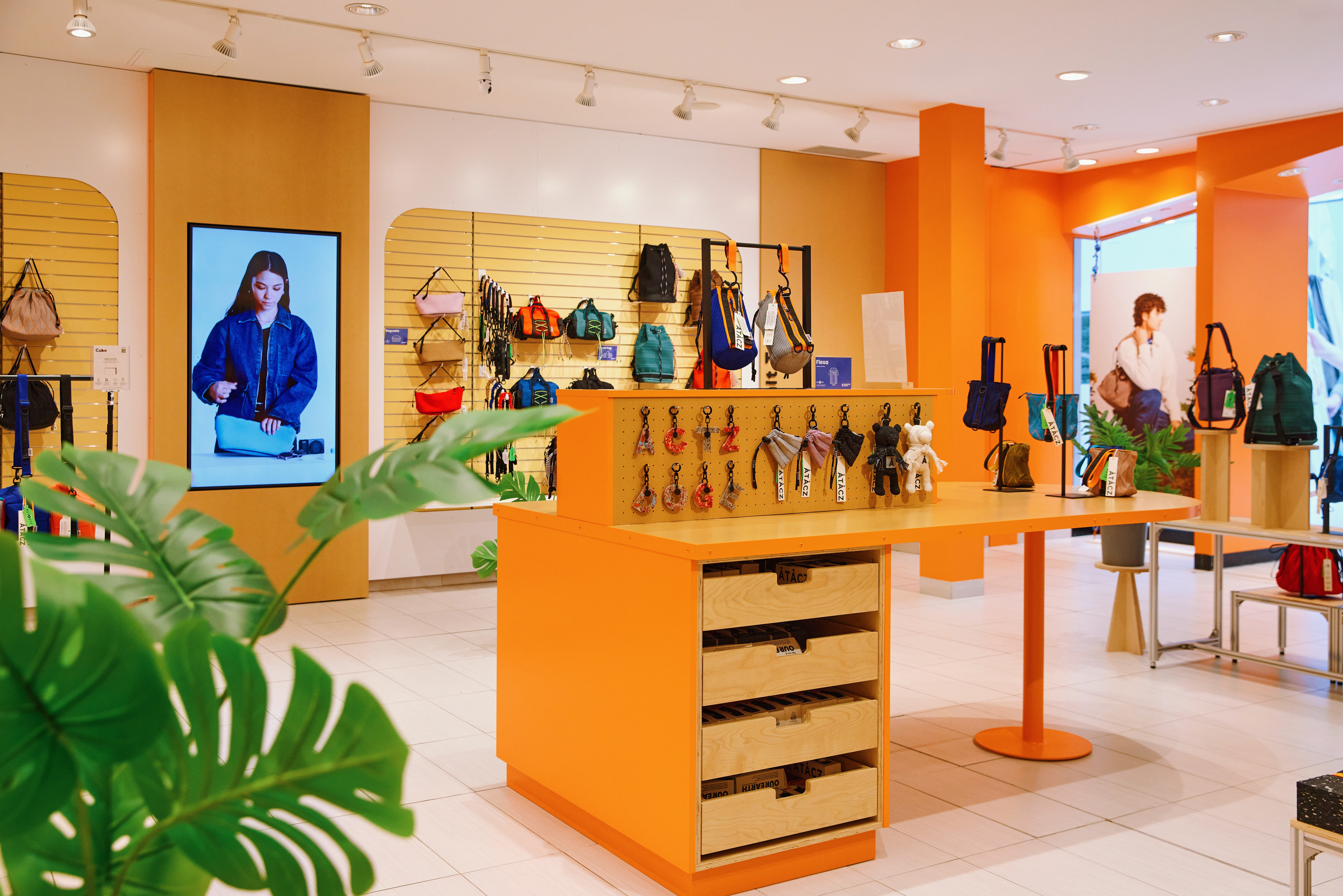
ATACZ has gained a loyal online following for its clean, minimalist designs and sustainable knit material, made from recycled plastic bottles. Now, the brand is excited to open the doors to its first-ever physical space in an 1,800-square-foot space.
Gigi Wong
Co-Founder and Head of Product Design, Gigi Wong described ATACZ as a Vancouver-based, zero-waste fashion brand that transforms recycled plastic bottles into sleek, functional bags.
“Our mission is to revolutionize how people perceive waste and fashion by merging sustainable practices with artistic design. Each ATACZ product embodies minimalist aesthetics, innovative craftsmanship, and a commitment to sustainability. We provide urban explorers with stylish, lightweight, and functional bags that align with their values without compromising on quality or style. By incorporating art and sustainability into every design, ATACZ is more than a brand—it’s a movement toward conscious consumption and a brighter future,” she said.
“ATACZ has built a loyal online community through our e-commerce platform, offering products to eco-conscious consumers across Canada and beyond. Beyond digital, we actively engage with our audience through pop-up shops, including regular appearances at Granville Island and an upcoming debut at Holt Renfrew. These events allow us to connect with customers face-to-face and share the story behind our brand. With the opening of our first retail store at CF Richmond Centre, we are expanding our presence and creating a space where customers can fully experience ATACZ’s commitment to sustainability and artistry.”
She said the retailer is unique because it blends sustainability, art, and functionality into every product.
“Our bags are crafted from recycled plastic bottles, showcasing the potential of upcycled materials in creating stylish, durable designs. We celebrate artistic expression by collaborating with talented artists whose work transforms our bags into wearable canvases. This focus on sustainability, artistic storytelling, and innovative craftsmanship sets us apart from competitors. ATACZ is not just a brand; it’s a lifestyle that empowers consumers to make conscious choices while embracing timeless, minimalist designs,” explained Wong.
“Opening our first retail store allows us to connect with customers in a more immersive and meaningful way. While our e-commerce and pop-up shops have been successful, a permanent retail space enables us to showcase ATACZ’s story, values, and products in a tangible environment. Customers can experience the craftsmanship, design, and sustainability of ATACZ firsthand. This store also represents a milestone in our journey, bringing us closer to our vision of inspiring a global upcycled fashion movement while building a strong community of conscious consumers.”
Photo: ATACZ
Wong said the brand chose CF Richmond Centre because it’s a high-traffic shopping destination that attracts a diverse and fashion-conscious audience.
“As a proudly Canadian brand, opening our first store in Canada was important to us, and Richmond’s vibrant community aligns with our target market. The mall’s mix of innovative and lifestyle-focused brands, including Aritzia and Vessi, makes it the perfect location to introduce ATACZ to shoppers who value style, functionality, and sustainability. CF Richmond Centre provides an ideal platform to gain brand exposure and connect with like-minded consumers,” noted Wong.
“ATACZ has experienced rapid growth in just three years, culminating in the opening of our first store at Richmond Centre. In addition to our retail presence, we regularly host pop-up shops at Granville Island and are excited to debut at Holt Renfrew this month. Looking ahead, we plan to expand our e-commerce platform and organize more pop-up shops across Canada in 2026 and 2027. We also aim to explore collaborations with like-minded brands and hotels to create exclusive, sustainable products. At ATACZ, we’re building not just a brand, but a lifestyle and community that inspires conscious living.”