Simons Taking Over Vacant Nordstrom Spaces in Toronto, Expanding Presence with 2 New Stores [Podcast]
Craig and Lee discuss La Maison Simons’ ambitious expansion into Toronto, focusing on the retailer’s move into spaces vacated by Nordstrom at CF Toronto Eaton Centre and the Yorkdale Shopping Centre. With a $75 million investment, Simons plans to open two new stores which could become the top-sellers in the chain. The expansion reflects Simons’ strategy to grow its footprint and cater to the city’s demand for diverse retail options.
At CF Toronto Eaton Centre, Simons will occupy approximately 110,000 square feet over three floors, featuring a main floor presence and a new hallway connecting the north and south ends of the mall. This corridor, a first in the mall’s history, will improve pedestrian access and enhance the shopping experience. In addition to Simons, a Nike flagship store and Eataly will also take up space in the former Nordstrom location, further enriching the mall’s retail offerings.
Yorkdale Shopping Centre will see Simons take over the first two levels of the former Nordstrom space, catering to the young, fashion-forward shoppers frequenting the mall. The new stores will include luxury designer departments and Simons’ popular private label merchandise, aiming to significantly boost the retailer’s sales. With these expansions, Simons continues its coast-to-coast growth, solidifying its position as a key player in the Canadian retail landscape.
Craig finally speculates that Simons will open in the former Nordstrom building in downtown Vancouver, in a similar fashion to what was announced for CF Toronto Eaton Centre.
Episode Sponsor:
Salesforce – Turn today’s shopping trends into tomorrow’s retail success. Visit Salesforce to see the global insights from Salesforce to boost your bottom line.
The Weekly podcast part of theThe Retail Insider Podcast Network by Retail Insider Canada and is available on Apple Podcasts, Stitcher, TuneIn, Google Play, or through our dedicated RSS feed for Overcast and other podcast players.
Subscribe, Rate, and Review our Retail Insider Podcast!
Drop us a line at Craig@Retail-Insider.com. You can also rate us in Apple Podcasts or recommend us in Overcast to help more people discover the show!
Background Music Credit: Hard Boiled Kevin MacLeod (incompetech.com). Licensed under Creative Commons: By Attribution 3.0 License. http://creativecommons.org/licenses/by/3.0/
Retail Insider is streamlining its Canadian retail news from around the web to include a handful of top news stories that can be viewed quickly during the day. Here are the top stories from the past 24 hours.
Inflationary concerns continue to loom large in consumers’ minds.
PwC Canada’s 2024 Voice of the Consumer survey found that 44 per cent of respondents ranked inflation as the top threat facing the country, eclipsing economic volatility and health risks, despite the rise in the cost of living gradually slowing.
Other key findings include:
More than four in 10 (43 per cent) Canadian consumers would switch to a competing brand that offers better value for their money;
Respondents ranked retail and consumer goods companies third for trustworthiness, behind healthcare, hospitality and leisure sectors;
35 per cent of Canadian consumers say self-checkouts would encourage them to shop in physical stores;
Despite the high cost of living, two-thirds will pay an above-average price for products that are locally produced, manufactured with a lower carbon footprint or have other sustainability characteristics; and
Canadian consumers will pay a sustainability premium of 6.9 per cent, compared to 9.7 per cent globally. One in five would pay a premium of 10 per cent or more.
Elisa Swern, PwC Canada’s National Consumer Markets Leader, said Canadian consumers tend to be pretty loyal to brands.
Elisa Swern
“In this survey, given inflationary pressures, they said they will switch brands based on pricing and promotion which is pretty rare compared to what we’ve seen,” she said.
“I think that value is not going to go away. Consumers’ perception of value is not going to go away. As interest rates start to go down and we start to see a bit of the loosening of the belt from a discretionary spending perspective, we’ll start to see maybe a lessening of it. But I think it’s here to stay. It’s a bit of a wakeup call for all retailers to really understand what value means to their customers and how they achieve that.
“There has to be a value to why there’s a price premium whether it’s luxury goods or the type of services that you’re having or the differentiation in your product. But still I think consumers are pretty smart now especially with the use of social media and being able to compare everything all the time.”
Swern said trust is even more important than it’s ever been in today’s retail industry.
“What’s important is that companies are transparent. Companies make mistakes just like people make mistakes. But it’s about what you’re doing about it, how you’re taking care of things and that you’re being transparent about them. Like cyber incidents for example. Disclosing to the public that you have a cyber incident, disclosing to the people who are impacted by it that their data was impacted by it and what it could mean, what they should be doing, what they should be thinking about,” she said.
“That shows transparency and trust. Does it make consumers nervous and uncomfortable, yes? And you see that also in the data. Consumers are starting to pay attention a lot more to who they’re giving their data to and what they’re sharing.
“Trust is important when consumers are going to share their data. In particular they want to share it with a company who they feel they’re going to get some benefit from and companies that they trust.”
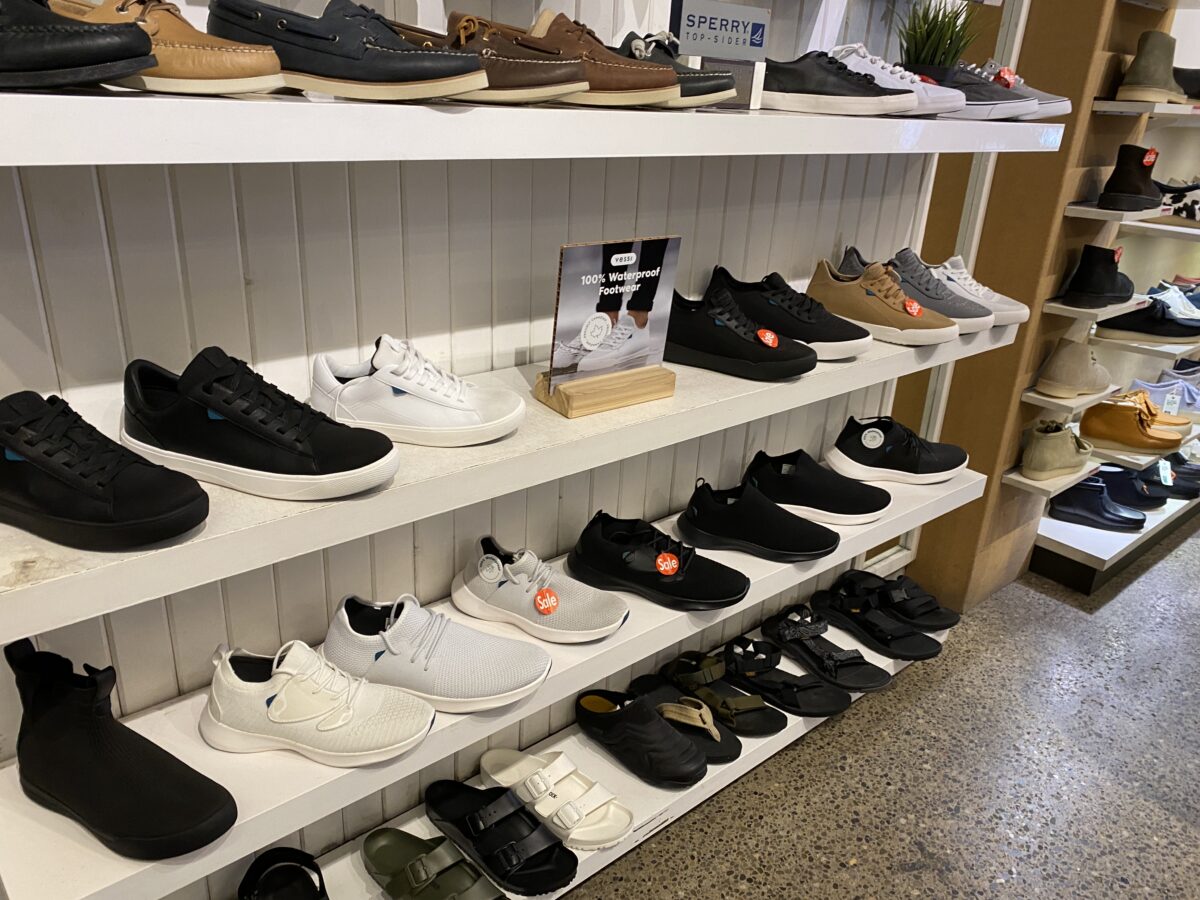
Vessi at Get Outside on Queen Street (Image: Dustin Fuhs)
Swern said this year’s survey also indicated that Canadian consumers would be willing to pay more for sustainability.
“But I think it will come down to the value that they’re seeing in it and how the value of the companies and the trust in the companies align to their own values,” she said.
“When you look at trust and you look at what’s important to consumers, sustainability and the E part on ESG becomes more relevant and important, customers are going to want to deal with companies who they trust, who they feel are transparent with that data and that are doing things that make sense, from both sides of the coin. The consumer wants to feel trust and wants to work with a company where they see these activities underway. For the retailer or the packaged goods company, they also have to be thinking what the value is for them. Otherwise it’s just an additional cost onto their cost of goods.”
Unique retailer Soch, which specializes in Indian ethnic women’s wear, has launched in Canada with its first store in Brampton, Ontario.
Vinay Chatlani
Vinay Chatlani, Executive Director & CEO of Soch Apparels, said the Bangalore, India-based company currently has 176 stores.
The Brampton store is the first for the brand outside of India.
“I’m third generation retail. The retail started a long time ago. For Soch specifically, the first store was in 2005 in Bangalore,” he said.
“We have been looking at southeast Asia, North America and Canada and we saw a good location. It was a franchisee that is actually known to an Indian franchisee of ours. We’ve seen the performance of similar brands, or other brands, in this space and we just thought it was a good place to start. It was either going to be some place in New Jersey or Canada and we just found a really good spot for this store.”
Chatlani said the Brampton area has a good Indian population.
“While we might slowly get into doing a lot more fusion clothing, it’s predominantly ethnic wear right now so it is going to appeal mostly to the Indian population and that’s where one of the biggest populations is,” he said.
“I think Toronto could take another store or two. We’re looking at Vancouver and Montreal next. We’re hoping to have three open in the next two years in Canada.”
The Brampton store is about 1,250 square feet. It’s on the smaller size of the range Soch normally does with stores ranging from 1,200 square feet to 2,400 square feet.
“We deal only in women’s ethnic wear. So it’s Indian clothing. We do feel that we have a mix of fairly contemporary stuff and we also have a fair amount of traditional stuff,” said Chatlani.
“I think as a brand we lean more towards evening wear and occasion wear not necessarily bridal because that’s what a lot of brands do. They specialize in bridal. But we do keep stuff for most occasions.”
Image: Soch CanadaSoch Brampton (Image: Soch)
He said the customer demographic in India is about 60 per cent in the 18 to 35 year old age bracket.
“I think it also depends on the category because we also sell saris which tends to lean towards a slightly older audience. In Canada, we think that the average may be slightly older because younger Indians, especially second, third generation Indians, probably just wear Indian clothing more for occasions and special events,” added Chatlani.
“It’s our first store. We’re really excited to do our international expansion. We’re probably going to be closing on two stores in Malaysia (soon). But we’re hoping to get a couple in the U.S. in this year and hopefully our second Canadian store by the end of the year.
“We’re also excited to start playing around with western wear and fusion wear if the demand asks for it. I think it’s something that we were wanting to do since pre-COVID but obviously everyone wanted things to settle down and we finally got the right partner. So we’re excited about the journey.”
Retail Insider is streamlining its Canadian retail news from around the web to include a handful of top news stories that can be viewed quickly during the day. Here are the top stories from the past 48 hours.
When considering a home remodel, it’s essential to focus on areas that provide the most significant impact. Strategically selecting sections to renovate can dramatically increase your home’s value, enhance its aesthetics, and improve functionality. Homeowners often prioritize changes that reflect both current trends and practical upgrades, enabling effective budget management and maximizing return on investment. This article outlines five key parts of your home that, when remodeled thoughtfully, can yield substantial benefits.
A New Shine for the Kitchen
Renovating the kitchen offers substantial returns both financially and in terms of quality of life. Start by replacing outdated appliances with energy-efficient models to reduce energy bills and modernize the space. Updating countertops with luxurious materials like granite or quartz enhances durability and visual appeal. Installing new cabinetry optimizes storage and workspace, making your kitchen more functional. Consider reconfiguring the layout during kitchen remodeling to enhance workflow, adhering to the kitchen work triangle concept. Incorporate ambient, task, and accent lighting to improve functionality and create a warm, inviting atmosphere. Select durable, easy-to-clean flooring materials like tile or hardwood. Investing in high-quality finishes ensures the kitchen’s utility and appeal are maximized.
A Transformation for the Bathroom
Revamping the bathroom can yield significant value and elevate your daily routine. Adding a bathroom vanity or double vanities enhances functionality, while switching from a standard tub to a walk-in shower offers modern aesthetics and convenience. Heated flooring provides luxurious comfort, especially in colder climates. Installing high-quality, stylish tiles creates a contemporary look, and replacing outdated faucets and showerheads with sleek, modern designs updates the space instantly. Including custom cabinetry in a bathroom remodel maximizes storage, keeping your bathroom organized and clutter-free. Improved lighting transforms the ambiance: vanity lights ensure proper illumination for grooming tasks, while LED strips can highlight design features, adding a touch of elegance. Adding subtle touches such as gold paintings or metallic accents can introduce warmth and refinement, giving the room a polished and inviting atmosphere. Functional storage solutions keep the space tidy and welcoming, ensuring a positive first impression.
An Impressionable Entryway and Living Room
The entryway and living room are where guests form their first impressions of your home. To make a lasting impact, upgrade to stylish lighting fixtures that provide ample illumination. Choose sophisticated flooring options like hardwood or high-quality tiles to elevate the space. Fresh paint, wallpaper, or wainscoting can dramatically transform the walls, adding character and depth. Invest in timeless, comfortable furniture that combines style and function, and incorporate art, mirrors, and other decor that reflects your personal taste while maintaining elegance. Functional storage solutions keep the space tidy and welcoming, ensuring a positive first impression.
A Home Office with Function and Design
Enhancing a home office can significantly improve productivity and comfort, especially in today’s remote work culture. Start with ergonomic furniture to prevent strain and maintain proper posture. Invest in high-quality lighting to reduce eye strain and improve focus. Integrated storage solutions like built-in shelves and cabinets help maintain a clutter-free workspace. Incorporate advanced tech features such as high-speed internet connections, smart devices, and soundproofing to minimize distractions. Personalize your office with aesthetic touches like art or plants to create an inspiring and motivating environment, making the space both functional and inviting.
A Back Patio Oasis
Transforming your back patio into an ideal outdoor living space can greatly enhance your home’s aesthetic and functionality. Begin by installing comfortable, weather-resistant furniture that invites relaxation and socializing. Upgrade your outdoor cooking area with a modern grill cabinet setup or outdoor countertops to make cooking more enjoyable and efficient. Enhance the ambiance with solar or LED lights, creating a warm, inviting atmosphere for evening gatherings. Adding greenery with potted plants or a small herb garden brings a touch of nature to your patio. Focusing on these elements can create a versatile outdoor space that offers both immediate enjoyment and long-term investment benefits.
Wingstop began as a small buffalo-style chicken wing restaurant in Garland, Texas, and today it has more than 2,000 restaurants open across the globe with plans to significantly expand its footprint in Canada.
“Wingstop has been around for well over 30 years in the U.S., and currently sitting just over 2,200 locations globally with plans to 10x their international growth over the next few years,” said Matt Jenkyns, Chief Operating Officer, Wingstop Canada at JPK Capital.
Matt Jenkyns
In 2021, JPK Capital acquired the master franchise rights for Wingstop in Canada.
“In Canada, we’re obviously a big part of that International growth strategy for Wingstop. We’ve committed to a minimum of 100 units across the country over 10 years.”
Image: Wingstop CanadaImage: Wingstop Canada
The brand opened its eighth Canadian location in March. The first opened in July 2021 in Toronto. The ninth location is opening in the middle of June in North York.
“We will expand coast to coast with no plans for any sub-franchising. It’s going to be JPK Capital owning and operating each location,” said Jenkyns.
The American-based brand, which began in 1994, opened its first franchised location in 1997 and by 2002 it had served the world one billion wings.
“I won’t speak to our sales volume but it’s no secret that when we open a location there’s hundreds of people lined up before we open,” said Jenkyns. “I think that’s something that’s been highly attractive to landlords.”
Image: Wingstop Canada
Sari Samarah, President, CEO and Broker of Record and Eli Vladimirsky, Director of Advisory and Transaction Services, for Value Insight Realty, are helping the Wingstop brand find locations in Canada.
“We started off on the smaller side, but I would say 2,200 square feet is the sweet spot for us.” said Jenkyns. “And we have some coming that are upwards of 3,000 square feet.”
Image: Wingstop CanadaWingstop at 432 Church St in Toronto (Image: Wingstop Canada)
The locations are not licensed.
“Wingstop is in the Fast Casual segment, and there’s not too many in Canada that occupy that space. If you were to look at a lot of the brands that people would perceive to be our competitors, a lot of them are sports bars who sell a ton of alcohol and wings are the loss leader,” said Jenkyns.
“For us, we’re fast casual. There’s no alcohol. The wing is the centre of the plate and sole focus for our brand. That’s probably the biggest thing that makes our brand positioning unique.
“We’re mostly in strip malls, but really for us we’re open to anything and everything. I think the common denominator throughout how we do business is a focus on quality. So when it comes to real estate, now that we have presence in the GTA and we’ve signed some really great spaces . . . now so many people are coming to us and now is the time we’re having to really focus on that quality and make sure with all the opportunities that we always maintain the focus on having the most prominent space. All of that presence you get from the street is only going to help our brand recognition. So it’s incredibly important to us that we have a nice frontage, quality real estate.”
Mine & Yours, Vancouver’s premiere luxury resale boutique, is being forced to close its iconic Howe Street location after a decade because of increasing crime rates.
“Howe Street was our first ‘real’ store. Before that, Mine & Yours was a live/work townhouse. As word spread about our hidden gem, we quickly outgrew our initial space and found a great offer at 1025 Howe Street. More than a decade ago, we planted our roots in Downtown Vancouver,” said owner Courtney Watkins.
“While the Howe Street store remains a customer favorite and has grown into a $1 million business, the neighborhood has changed dramatically. After enduring 10 broken windows over eight years, we’ve made the difficult decision to close this location and focus on our newer stores and online business.
“I myself have experienced my personal car being broken into while waiting for our store windows to be boarded up after a break in at Howe Street in recent years and that was kind of the last straw for me.”
Watkins said the last day the store will be open is June 28 but from June 14, it will be the last chance for customers to get the best designer deals at the lowest possible prices on a wide range of designer clothing and accessories at the Mine & Yours Howe Street store. Racks will be filled with leading designer brands starting at only $25 and ranging to $50, $100, and more, plus 20 per cent off on all new arrivals.
Watkins said the store has been compelled to shut its doors due to significant changes in the neighborhood, including the 10 break-ins and substantial inventory losses. The downtown neighborhood has unfortunately declined over time. Factors like safe injection sites across the street from the store and an overarching unsafe feel has become the norm. Numerous shop owners have experienced an increased rate of crime and break-ins in the area as well.
“Our neighbours have also experienced similar situations. The store right next door to us (CityLux Boutique) in fact had someone break in and steal an entire ottoman once,” added Watkins.
“Safety needs to be taken seriously, it is up to the city to see what can be done to make shop owners like myself and my team feel safe enough to continue doing business in certain areas. I think there should also be more accountability in the sense that people should have to pay for vandalism and crimes they commit rather than nothing happening to them.
“Thankfully we still have two great stores in other great areas, including 418 Davie Street in downtown Vancouver and 2061 West 4th Avenue in Kitsilano and now we are at 79 Yorkville avenue as well in Toronto. We also are spending a lot of time and resources on our online store mineandyours.com and exciting pop ups so there’s more retail where that came from.”
Image: Mine & Yours Mine & Yours at 1025 Howe St.Vancouver, BC
Retailers in Canada are increasingly more concerned about the state of Canadian cities with crime, violence and safety issues negatively impacting their businesses.
In British Columbia, it’s reached a ‘crisis point’, according to the Save our Streets (SOS) initiative, which is a new public safety coalition demanding governments step in and deal with the issue.
Recently SOS said a Research Co. public opinion survey confirms that more than half of British Columbians think crime has worsened in the past four years and 51 per cent fear they will be a victim of crime.
The survey also indicates that 56 per cent of BC residents blame addiction and mental health issues for the dire circumstances being experienced in their communities, said SOS.
“Much of the crime and violence we are seeing is because the people suffering from addiction and mental illnesses do not have access to a full continuum of care when and where they need it,” said Jess Ketchum, co-founder of Save Our Streets (SOS). “Long-term solutions will only come if we provide those afflicted with these illnesses with the very best chance of leaving behind a life of addiction and committing crimes to feed a drug habit.”
SOS is calling on the provincial and federal government to:
dramatically increase the opportunity for, and immediate access to, addiction and mental illness treatment, recovery and supportive housing on a regional basis in B.C.;
broker the necessary agreements and judicial and legislative reforms to stop the revolving door for chronic repeat violent offenders; and
invoke policies that make gangs fear their futures just as much as citizens across B.C. fear for their lives.
Image: saveourstreets.ca
Ketchum said the criminal element preying on marginalized people, perpetuating addictions and encouraging crimes to support those addictions are the same people that are shooting up on streets and endangering everyone near them.
“In addition, there are near daily reports of drug dealers and producers exporting drugs to other countries from B.C.,” added Ketchum. “People in B.C. are dying, communities are deteriorating, businesses are closing, family supporting jobs are being lost, and community services are evaporating. It’s time for the public to demand real change.”
Save Our Streets is a coalition of 100 community and business organizations representing every region of B.C., which is committed to seeing governments bring order and public safety back to communities across British Columbia.
As inflation stabilizes, a new type of consumer has emerged, marked by value consciousness digital savviness, and a preference for experiences over material goods. THE CANADIAN PRESS/Cole Burston
This “new consumer” phenomenon appears to be more than just a temporary response to economic hardships. It has since evolved into a more permanent behavioural shift, reflecting a broader transformation in consumer habits and preferences.
As inflation stabilizes and the economy adjusts to a new normal, businesses must adapt to meet the changing needs and preferences of this demographic.
Despite the recent stabilization of consumer prices, the new consumer has retained habits formed during economic uncertainty, continuously seeking deals and discounts. CBC News segment about rising inflation putting pressure on Canadian consumers.
The survey revealed that nearly half of participants would download a brand’s app to access loyalty promotions or exclusive deals, while 70 per cent were inclined to join loyalty programs for free shipping benefits.
Additionally, 45 per cent of respondents have used discount codes or vouchers during online shopping in the past six months. This trend highlights the significant shift towards cost-conscious consumer behaviour.
Consumers are also actively using digital platforms to compare prices and read reviews, making more informed purchasing decisions than ever before. This digital savviness allows them to navigate the online marketplace efficiently, ensuring they get the best value for their money.
Physical store experience is still key
Despite the emphasis on looking for deals and reviews online, the new consumer still values in-store experiences. According to the Ernst & Young survey, 59 per cent of consumers visit stores to see, touch and try items before buying, and 57 per cent prefer in-store shopping to avoid shipping hassles.
Additionally, human interaction is increasingly important during the post-purchase journey. Fifty-six per cent of U.S. consumers consider it crucial for product returns and refunds, and 55 per cent value it for discussing product questions or concerns.
There’s also a notable shift towards experiential spending. Consumers are now more inclined to invest in travel, dining and unique activities over accumulating material possessions. This trend reflects a desire for meaningful and memorable experiences that offer greater satisfaction than physical goods.
Understanding these characteristics is essential in the new age of retailing. The new consumer’s focus on value, informed by digital tools and a shift towards experiential spending, defines their behaviour in a post-inflation world.
This evolving consumer profile presents both challenges and opportunities for brands and retailers, shaping the future of the retail landscape.
Consumers nowadays are continuously seeking deals and discounts, despite consumer prices stabilizing. (Shutterstock)
How retailers can cope
In an era where digital commerce continues to grow, physical retail stores are being forced to reinvent themselves, moving away from transaction points to vibrant hubs of brand experience. For instance, fuelled by the COVID-19 pandemic, retail e-commerce sales increased 67.9 per cent in Canada from February 2020 to July 2022.
This shift underscores the evolving role of physical stores, which are becoming places where consumers can learn, experience and play. As retailers adapt to changing consumer expectations, the notion that a store must be more than a place to transact is becoming a fundamental aspect of retail strategy.
A prime example of this trend is the Nike store in Manhattan, which epitomizes the concept of the store as a medium rather than just a marketplace. Far from the traditional retail setup, this location serves as a “playground” centred around experience.
The store includes a basketball half-court with adjustable hoops and digital screens, an enclosed soccer trial area, a treadmill facing a jumbotron for simulated outdoor runs, a customization shoes bar, touchscreens throughout and dedicated coaches to assist customers testing new sneakers.
The transformation of stores into experience-rich environments reflects a broader trend in retail where the value of a physical location is measured not just by traditional sales per square foot, but by the ability to engage consumers in a more meaningful ways. Retailers who invest in making their stores true extensions of their brand are primed to set themselves apart in an increasingly competitive marketplace.
Lotalty first
To thrive in this new retail landscape, leveraging loyalty programs is essential for retailers. These programs can help bridge the gap between digital and physical retail experiences by offering personalized rewards and exclusive deals that drive both online and in-store traffic.
Retailers should focus on creating loyalty programs that not only reward purchases but also enhance the overall customer experience.
For instance, integrating mobile apps that provide real-time notifications on deals and events, offering exclusive in-store experiences for members and using data analytics to tailor rewards to individual consumer preferences can significantly enhance engagement and retention.
In essence, the future of retail lies in these dynamic, personalized and interactive spaces where shopping is only part of the appeal.
By Omar H. Fares Lecturer in the Ted Rogers School of Retail Management, Toronto Metropolitan University and Joseph Aversa, Assistant Professor, Retail Management, Toronto Metropolitan University
Retail Insider is streamlining its Canadian retail news from around the web to include a handful of top news stories that can be viewed quickly during the day. Here are the top stories from the past 24 hours.