Advertisement
Home Blog Page 658

Hakim Optical Store at Prominent Bloor-Bay Corner in Toronto Shuts Due to Non-Payment of Rent

66 Bloor Street West/1200 Bay Street in Toronto. Photo: Craig Patterson

The Hakim Optical store at the northwest corner of Bloor and Bay Streets in Toronto has shut due to non-payment of rent. The store opened at 66 Bloor Street West during the pandemic and some retailers nearby were quietly unhappy with its presence, given the prominent location along a retail strip formerly known as the “Mink Mile”. 

Hakim Optical opened its ‘luxury flagship store’ in the summer of 2020 as retail was opening up following pandemic lockdowns. The optical retailer opened in part of the space formerly occupied by prestigious and historic Davids Footwear which closed in 2019 after the retailer was put into bankruptcy. 
A notice on the door of the Bloor Street Hakim Optical says, “The Premises have been re-entered and the Lease has been terminated by the Landlord for default in the payment of rent. Particulars of the default have been provided to you in earlier correspondence.” 
No numbers were provided in the notice in terms of the amount of outstanding debts. The notice goes on to note that the landlord is demanding outstanding rents as well as future rents and damages. ProWinko Canada owns the 1200 Bay Street building where Hakim Optical was a tenant. 

Click image for interactive Google Map
Notice on the door of the former Hakim Optical at 66 Bloor St. W. in Toronto. Photo: Craig Patterson
Second page of the notice on the door of the former Hakim Optical at 66 Bloor St. W. in Toronto. Photo: Craig Patterson

The exterior of the Hakim Optical store is in a bit of a state of disrepair, and the sidewalks around it appear untidy. It’s in contrast to other retailers nearby, including some of the world’s top luxury brands. 

Some nearby retailers had told Retail Insider that they were unhappy with Hakim Optical’s occupancy of the former Davids Footwear space. The pandemic proved challenging for the stretch of Bloor Street West between Yonge Street and Avenue Road that for decades was known as the “Mink Mile”. Vacancies prevailed and for a time, there was worry that the street would lose its cache (nothing could be further from the truth as several luxury brands prepare to open flagships in/near The Colonnade this year). 

Hakim Optical did only minor renovations to the former Davids space, and the display windows of the optical store have been neglected with rips and tape marks on the store’s over-the-window branding. More than one retailer said that they got the impression that very little investment was made in the new store, and that it was “bringing down the street”. Some retailers had said that they hoped that Hakim’s lease was temporary, and that a marquee tenant could be found for the prominent corner which is considered to be one of the most important in the country in terms of retail. 

Securing a marquee tenant for the corner could become a challenge, it should be noted, as plans are proposed to demolish the building where Hakim Optical is in to construct a very tall mixed-use tower. The rest of the adjacent block, including the current 80 Bloor Street West office tower and the Harry Rosen building at 82 Bloor Street West, will be eventually demolished for a 72-storey mixed use tower with an absurd number of small condominium units that will be contained within. 

Rips on branding on the windows of the former Hakim Optical store at 66 Bloor St. W. in Toronto. Photo: Craig Patterson
Unsightly tape over on branding on the windows of the former Hakim Optical store at 66 Bloor St. W. in Toronto. Photo: Craig Patterson
More unsightly tape over on branding on the windows of the former Hakim Optical store at 66 Bloor St. W. in Toronto. Photo: Craig Patterson

Plans are also in place to demolish a row of buildings across the street for another major tower proposal at 83-95A Bloor Street West. Construction will take years and will disrupt pedestrian traffic between the eastern side of the Bloor street “Mink Mile” which includes Holt Renfrew and the Manulife Centre, and the western part which is home to large luxury brand flagship stores. 

Customers of the Bloor Street Hakim Optical store won’t have to go far to visit a new location — there are two Hakim Optical stores a few blocks south on Bay Street, and some have been scratching their heads as to why there’s such a high density of locations for the retailer. 

Hakim optical was founded by Karim Hakimi in 1967 and is the largest privately owned optical chain in Canada. The company has over 160 stores and 120 one-hour factory outlets across the country in Ontario, Nova Scotia, New Brunswick, Manitoba, Saskatchewan, Alberta, and British Columbia. The company’s slogan “Your Eyes Can Have it All at Hakim Optical” since 2003 had been named by Huffington Post Canada as one of Canada’s most memorable jingles, and is still used. The company says on its website that it’s sold more than 40 million pairs of eye glasses since its founding. 

We’ll report back when a new tenant is secured for Hakim Optical’s Bloor Street space, or anything else related that is newsworthy. 

Image: Hakim Optical

Club Pilates Launches Canadian Expansion Following Pandemic Slowdown [Interview]

Image: Club Pilates Marda Loop in Calgary, AB

Like all fitness clubs in the past two years, Club Pilates was rocked by the COVID-19 pandemic with the closure of clubs due to health and safety protocols and restrictions.

Now, the brand is back on track and in expansion mode.

Club Pilates currently has 826 locations internationally with 21 in Canada.

Mike Gray, President of Club Pilates, based in Irvine, California, said the brand has another about 35 still in development in Canada.

Mike Gray

“Our Vancouver market is not necessarily sold out. There’s a lot of development still happening in that market. Calgary, Toronto are really kind of the two areas that have lots of opportunity. When you look at the growth aspect, Canada is really unique to how diverse it is and how spread out it is,” he said.

“For us, it’s really finding the right partners and bringing them into the brand and then finding the right demographics in the area to grow and I think it’s really limitless. Our Canada studios have opened stronger in most cases than our domestic studios have here in the States. It’s eye opening.”

Image: Club Pilates

Studios range between 1,800 to 2,100 square feet. Real estate that is attractive to the brand is situated in areas with a strong anchor like a grocery store to drive traffic. Demographics in the area are also important. The brand’s core consumer is 35 to 65 years old and 98 per cent of its consumers are female. Average household income and traffic patterns in the area are also key factors in where the company opens locations.

The company originally began in 2007 in San Diego, California and in 2016 the brand started franchising.

“We had some exceptional growth right away,” he said.

“One of the great things about the brand is that it’s not new. Pilates itself has been around for over 100 years. Originally it was founded to help people get up on their feet. Joseph Pilates founded it back in the day and his goal was to get people, primarily soldiers, back healthy again.

“Now with COVID and everything else, people have a new sense of understanding in what the importance of physical activity is and at the same time they have the understanding that as more gyms open they tend to have more injuries and they tend to fall back into our hands.

“It truly is for everybody. All ages, all shapes, sizes. And that’s the exciting part that kind of separates our modality versus anywhere else out there which is nice. Our ability of consistently opening in smaller footprints and providing top-notch classes with certified instructors is also another great aspect too.”

Club Pilates Waterloo

Gray said the company experienced some really great growth in 2018 and 2019.

“We were opening studios and we were on the upward trajectory and then obviously 2020 was a challenging year for everybody in the world. We went from having 586 locations open to closing them all down and then based off the laws and restrictions we had to find a way to kind of get things going,” he said.

“So what it really did is it allowed us to get more nimble and more resilient in our process that we were doing and allow us to really work with the partners and they started to get more engaged into the process more so than ever.

“We started opening studios. We started pivoting in the process. So in 2020 we pivoted to a virtual element. Then we went from virtual to private training, outdoor classes, really taking it out of the studio and into the parking lot, setting up tents and getting classes going.

“Fast forward to where we are today where we’ve exceeded any target we ever thought in our original planning. Our studios are stronger now than they’ve ever been. We’ve hit new targets and set new records and we consistently do it month over month. Our growth aspect is just tremendous but also the success of the studios and the quality of the workout we’re giving in the communities is amazing.”

Image: Club Pilates

Gray said the company’s partners have gotten more sound in understanding where to spend money and managing the business. It also has a better understanding of consumer needs.

“The other part too is the belief factor how well and how good we are as a brand and company is forthcoming now in the aspect that people not only see it but believe it and the community as far as the name has grown tremendously,” he said.

Don Gregor, of Aurora Realty Consultants, is helping the brand with its expansion plans in Canada.

Club Pilates is part of the Xponential Fitness company, the largest fitness franchise group in boutique fitness.

“For our consumers who can’t make it to the studio every day we’ve had a strong emergence of our virtual platform with XPLUS and then we’ve launched domestically and internationally our XPASS which allows them to use Xponential (fitness locations).”

WWF Championship Belt Finds A New Home In Hitman’s Bar [Interview with Bret Hart]

Bret Hart at the Opening of Hitman's Bar in Calgary (Image: Mario Toneguzzi)

Bret ‘Hitman’ Hart, one of the greatest and most famous wrestlers ever in the world, has officially launched a new dining/bar establishment in Calgary named after him.

Hitman’s Bar is located in Cowboys Casino and Dance Hall beside Calgary Stampede Park.

The one-of-a-kind venue pays homage to the local hero who was a wrestling legend for years. His motto was also legendary: “The best there is. The best there was. The best there ever will be.”

Hitman’s Bar in Calgary (Image: Mario Toneguzzi)
Image: Hitman’s Bar

Hart officially opened the establishment with the presentation of his actual WWF Championship belt which has found a new home in Hitman’s Bar.

On October 12, 1992, in Saskatoon, Saskatchewan, Canadian history was made as Hart defeated Ric Flair and won his first ever WWF Championship.

“This moment 30 years ago was the culmination of all the hard work and sacrifice made since I first entered WWF in 1984. Winning the WWF title from Rick Flair in Saskatoon and holding that belt up perched on the second rope looking at the faces of my fans from long ago was the single greatest moment of my career. The moment it happened, I knew no one could ever take it away or deny me that beautiful moment in time,” said Hart.

Hitman’s Bar in Calgary (Image: Mario Toneguzzi)

This video highlights the official opening of the establishment with Hart and his championship belt.

The Video Interview Series by Retail Insider is available on YouTube.

Connect with Mario Toneguzzi, a veteran of the media industry for more than 40 years and named in 2021 a Top Ten Business Journalist in the world and the only Canadian – to learn how you can tell your story, share your message and amplify it to a wide audience. He is Senior News Editor with Retail Insider and owner of Mario Toneguzzi Communications Inc. and can be reached at mdtoneguzzi@gmail.com.

Interviewed this episode:

Like, Share and Subscribe to Mario Toneguzzi on YouTube!

Follow Mario:

Also check out the other series offered by Retail Insider, including The Weekly podcast and The Interview Series, which are both available on Apple Podcasts, Stitcher, TuneIn, Google Podcasts, or through our dedicated RSS feed for Simplecast and other podcast players.

Follow Retail Insider:

Share your thoughts!

Bed Bath & Beyond to Leave Hundreds of Thousands of Square Feet of Vacant Retail Space with Canadian Exit

Bed Bath & Beyond at South Edmonton Common (Image: South Edmonton Common)

US-based retailer Bed Bath & Beyond will be exiting its Canadian operations and closing all stores following court filings last week. A significant amount of retail space will be left vacant across the country with the shuttering of 54 Bed Bath & Beyond stores as well as 11 of the company’s buybuy BABY locations. 

This follows turmoil for its US parent company — last week Bed Bath & Beyond’s US division managed to raise cash to stave off a bankruptcy. Canada isn’t so lucky with the Canadian division being declared insolvent. Alvarez & Marsal will help wind down the Canadian store operations in the coming weeks which is expected to include clearance sales prior to stores shutting for good.  

As of this month, Bed Bath & Beyond had almost 390 full-time Canadian employees and 1,038 part-time workers according to the court filing. 

Photo: Bed Bath & Beyond

The Canadian arm, Bed Bath & Beyond Canada Ltd., was granted an initial order for creditor protection by the Ontario Superior Court of Justice on Friday under CCAA, with a net loss of $99.5 million for the nine months ending November 26, 2022. 

Retail Insider was recently asked by some landlords if Bed Bath & Beyond’s Canadian stores were expected to stay open even as the US division floundered — court filings in Canada now show that even though some stores were profitable, the overall Canadian division created significant negative adjusted earnings margins to the parent company. 

Stores are quite large, averaging over 30,000 square feet each. Bed Bath & Beyond’s first store in Canada opened in December of 2007 at the Bayview Glen Shopping Centre in Richmond Hill, Ontario, in a 34,000 square foot space. 

A decade ago, Bed Bath & Beyond was a much more successful retailer in Canada when it launched its baby-focused buybuy BABY concept in Canada. Its first store opened in Edmonton December of 2014 and the company now has 11 of these stores in Canada, also set to close. 

BuyBuy Baby at South Edmonton Common (Image: South Edmonton Common)
Photo: Bed Bath & Beyond

Bed Bath & Beyond’s real estate strategy in Canada involved opening big-box stores in a mix of shopping centres, strip malls and big-box centres. Some stores are located near major shopping centres such as in Calgary, where Bed Bath & Beyond has a location across from CF Chinook Centre. Landlords with properties occupied by Bed Bath & Beyond will have to re-tenant these retail spaces, presenting both challenges and opportunities to add new more robust retailers to the mix. 

It’s not known exactly how much space Bed Bath & Beyond and buybuy BABY occupy in Canada. Over the weekend, one broker Retail Insider spoke with estimated the number to be about 2-million square feet. Given that stores are typically in the 30,000 square foot range, they will be easier to back-fill compared to vacancies left by Target and Sears Canada when those retailers shuttered several years ago. 

Existing boxes where Bed Bath & Beyond stores are located could be demised for multiple tenants, or could be filled with larger single tenants depending on what makes sense. Single tenants such as a grocery store, a fitness studio, or entertainment concept could replace some Bed Bath & Beyond stores. Possible individual tenants such as Winners/Marshalls, Staples, Sport Chek, Indigo, Nordstrom Rack, Old Navy, The Brick, Leons, and London Drugs could move in depending on the opportunity and what makes sense depending on the location.  

Unique Furniture Consignment Retailer ‘My City Life’ Opens 3rd Nova Scotia Storefront with Plans for Expansion

Image: My City Life

Mike Melvin describes My City Life as the “Marshalls that married the antiques road show.”

The owner of the furniture decor and antique consignment business has opened its third store in Atlantic Canada, at the Sunnyside Mall in Bedford, Nova Scotia, with plans to grow the business with more locations.

Melvin spent some time years ago working in Alberta’s oilsands, flying back and forth from the western province to his home in New Brunswick.

“That’s where I kind of picked up on the idea for this business while living there and seeing all the consignment stores in Calgary,” said Melvin. “And when I got back to New Brunswick and saw that there was nothing like it there I decided to put my own twist on it a little bit and a business was born.”

Image: My City Life

Melvin is based in Saint John, New Brunswick. 

“I have just incorporated a business called Consignment Canada. As I’m growing I’m finding people want to do business with a corporation versus a name. I thought Consignment Canada would be something we could take across the country and it would be a little more acceptable and people would understand better what it is we’re doing now versus the My City Life, which I love the idea. I love the name My City Life. But I guess I have to make sure people understand what it is we do,” he said.

“We’re a furniture decor and antique consignment shop but we also have new items. We have new decor and we mix it with the old. So ultimately when I get into my larger stores as time will pass the goal is to become the Marshalls that meets the antique road show. Mix it all together.”

Image: My City Life

The company also has two stores in Saint John. Melvin started building the business in August 2019. The first store opened in September 2019 in a 300-square-foot space. The streetfront store opened in the uptown core of Saint John. The two stores are now located in Brunswick Square, literally three doors away from each other. The Bedford store and one of the Saint John stores are about 4,000 square feet. 

“The biggest problem I have to growth is not inventory by any means. I started with 300 square feet. I now have 24,000 square feet in three stores. The biggest problem I have, the barrier to entry, is that other leaseholders in the places I want to be have restrictive covenants that disallow the sale of used goods,” said Melvin. 

“Or certain parts of my product line. So I have to be careful as to what I can sell in each location. Because of me wanting to get into larger stores, also affordability has been a factor as we build. We do okay. We do $300,000 a year. We’ve done $1 million since we started this thing. I see it growing bigger. A 10,000-plus square-foot store that should scale up quite nicely.

“We focus on helping people. Most are downsizing or moving to one spot or another but we see a lot of seniors going to apartments or assisted living. 

We’re not the antique store you’d expect. We position ourselves in malls and high traffic areas that surprises everyone that wanders in. We currently have three stores and soon adding many more. Our five-year plan is to be in every major centre in the Maritimes. Our 20-year plan is to create a legacy that will be the first place people in Canada think of furniture decor and antiques.

“I’ve already considered looking at space in Edmonton, Alberta and St. John’s Newfoundland. Unfortunately I think steps going away from my home base is just not feasible until I can get into a little more secure position to make sure I know exactly what my numbers are going to be.”

Overcoming The Challenges Of Being A Black Entrepreneur

Image: The Sea Moss Guy Inc.

During Black History Month, Intuit QuickBooks has released new small business survey findings, emphasizing the persistent economic and social hurdles the Black entrepreneurial community faces.

The survey found that 55 per cent of Black business owners have been denied a business loan at least once. Despite this, and the many barriers Black business owners face, they have the courage to take risks, show up for their community, and support future generations of business owners.

The survey revealed that 70 per cent of them view their success as important for the success of future generations of Black entrepreneurs.

Key themes and findings from Black business owners in Canada for 2023 include:

Financial struggles and disparities are barriers to success

  • 66 per cent have had to pay expenses and/or employees with personal funds in the last two years
  • 58 per cent needed $10,000 or more to start their businesses – compared to only 41 per cent of non-Black business
  • 56 per cent of Black business owners were able to pay themselves in 2022 – compared to 71 per cent of non-Black business owners
Image: The Sea Moss Guy Inc.

Community is crucial

  • 83 per cent have volunteered their personal time to community service in the last year
  • 70 per cent feel a need for their business to give back to the Black community
  • 49 per cent of Black business owners agree that successful Black businesses are critical for a thriving Black community

Educate and inform future generations

  • 75 per cent think mentorship of the next generation of Black business owners is important for the advancement of successful Black businesses
  • 52 per cent of Black business owners think the next generation will experience less hardships than they have.

Here’s a video interview with Dezie St. Hilaire and Clinton Redhead, of The Sea Moss Guy, who talk about the challenges they’ve faced as Black Entrepreneurs and overcoming those challenges.

The Video Interview Series by Retail Insider is available on YouTube.

Connect with Mario Toneguzzi, a veteran of the media industry for more than 40 years and named in 2021 a Top Ten Business Journalist in the world and the only Canadian – to learn how you can tell your story, share your message and amplify it to a wide audience. He is Senior News Editor with Retail Insider and owner of Mario Toneguzzi Communications Inc. and can be reached at mdtoneguzzi@gmail.com.

Interviewed this episode:

Like, Share and Subscribe to Mario Toneguzzi on YouTube!

Follow Mario:

Also check out the other series offered by Retail Insider, including The Weekly podcast and The Interview Series, which are both available on Apple Podcasts, Stitcher, TuneIn, Google Podcasts, or through our dedicated RSS feed for Simplecast and other podcast players.

Follow Retail Insider:

Share your thoughts!

New Technologies Changing Consumer Expectations of Retailers in Canada [Expert Interview]

ChatGPT / Open AI

International retail expert George Minakakis says retailers often forget that shopping consists of a set group of deliverables aimed at streamlining service and delivering an experience. 

“This value proposition should be in a constant state of improvement, whether those changes are subtle or innovative, in order to surpass what competitors offer and meet new consumer expectations. The other challenge is staying ahead of changes in consumer behavior, which today are driven by either industry leaders or technology and apps that offer greater convenience,” says Minakakis, CEO, Inception Retail Group, and author of The New Bricks & Mortar: Future Proofing Retail.

“For example, smartphones by Apple and Samsung have greatly impacted shopping behaviour as consumers can now browse online, compare prices, products, and quality while shopping in stores. Few retailers were prepared for this change, and they cannot allow that to happen again. Retailers need to stay on top of consumer, technological, and competitive trends, as I noted in the book ‘The Last Retailer Standing’ in 2013. You are either creating trends or chasing them. This is how you grow traffic and sustain customer loyalty; this should never change as a goal for any retailer.”

 Minakakis says today’s consumer is asking for more from retailers. And here’s why:

  1. Consumers hate wasting time and money, they want speed and a price that matches the overall brand promise;
  2.  A sluggish economy is more complicated to navigate through for both retailers who want to manage costs and consumers who are managing a tighter budget;
  3. Technology to consumers has become an addiction and lifeline on many levels namely the need for greater convenience and simplification in all their shopping and service experiences; and
  4. Consumers judge retailers on their ability to connect with ease of access to browse, compare and buy whether they choose to do that in store or online.  

“Today they expect a higher level of responsiveness from retailers in speed and quality of service, availability of products and overall price value perception. If consumers must pay a higher price including inflation, it had better be the best overall choice where no substitutions can be justified. That’s tough in this economy,” explained Minakakis.

One of the big trends in society these days are Chatbots and the retail sector will be dealing with that in the coming years.

Minakakis describes Chatbots as a form of personalized attention to a single customer need. The technology is not new but the consumer facing capability has shocked everyone with its demand. 

“Personally, I have been waiting for this moment to happen where consumers begin to chat with an AI (Artificial Intelligence) unit, and here we are. The first thing to keep in mind is that as we speak about ChatGPT Google is also launching their version called Bard.Ai. It is a very clear message that from a consumer perspective, the largest level of interest with this today will be within search engines,” he said. 

“For example, I asked ChatGPT to pretend that it has access to the internet and that as a consumer I was looking to replace my built-in oven. The task was to create a table highlighting the types of built-in ovens, list the features, warranties and price ranges for each. It did just that in seconds. A consumer would be spending a few hours on their own. So will Chatbots impact the retail industry. Yes, in very many ways. This is the easiest of customer facing solutions for AI and consumers.

“While there is a great deal of hype around Artificial Intelligence itself, Chatbots are a very real and powerful consumer facing tool that is available. ChatGPT from Open Ai supported by Microsoft, Google with Bard.Ai and Baidu with ERNIE will employ them because consumers have already embraced it. When consumers can browse and make purchasing decisions it will be a disruptive moment in this inflationary market. The timing couldn’t have been better planned, when we recover to a healthier economy, retailers will have hopefully embraced this faster than they did e-commerce.”

Minakakis says he expects the e-commerce side of retail will continue to grow.

“We shouldn’t judge it based on the declines because the world is normalizing away from the pandemic. Anyone who thought that the pandemic volumes would stay was not being realistic. Although, I still see a lot of delivery trucks daily dropping off packages in my neighbourhood,” he says. 

“We should also not think that stores will be the destination of choice for browsing or buying only. That will be a mistake. I have heard some suggest that stores will have a resurgence. I completely disagree with them. The shift to e-commerce will continue albeit at a slower pace. However it will grow, and physical retailers will continue to shift more sales to online. The important thing to keep in mind, stores are still a big part of the brand, however very few will be able to survive without having a stronger and visible presence on every channel that works for them. And especially in lieu of the opportunity that Artificial Intelligence and the Chatbots created to personalize a customer’s shopping experience.  

“At the end of the day if you weren’t taking SEO, search engine optimization, as an example seriously you will have to. ChatGPT already has 100 million subscribers and 670 million visitors. If I were operating a retail chain or single brand, I would want to understand this and the implications it can have on my business and how I need to employ it.” 

Minakakis says inflation is beginning to cool off. However, it is now more prevalent in services versus goods. 

“The ball is now in the consumer’s court. We either cut back, or much higher interest rates will do that for us. Retailing will experience stronger competitive activity by larger retailers with the strategic and technological means to take share. Those protecting their positions weakened by past strategic choices and the pandemic will face the biggest challenges,” he says.  

First NBA Courtside Restaurant to Open this Spring in Downtown Toronto [Interview/Renderings]

NBA Courtside Restaurant in Toronto (Image: NBA)

The first NBA Courtside Restaurant, a premium, sports-inspired dining experience celebrating the National Basketball Association, will open this spring in downtown Toronto.

The 10,000-square-foot establishment, at 15 Queens Quay East, near the base of Yonge St., will celebrate the NBA through custom art and decor, a modern food and beverage program, an exclusive retail space, outdoor and private dining, and more.

NBA Courtside Restaurant in Toronto (Image: NBA)

NBA Courtside Restaurant will be operated by Toronto-based Urban Dining Group, a family-owned and operated business serving the Greater Toronto Area since 1989. Toronto-based chef Erica Karbelnik, who won Top Chef Canada Season 9 and Chopped Canada Season 3, will serve as NBA Courtside Restaurant’s Culinary Ambassador and will oversee the development of a globally inspired menu.

Stacie Cohen

“Canada for us is an amazing market for basketball. There’s over 17.3 million fans in Canada. So that’s about half of the population and a lot of our international talent drives interest in their home countries. We had a record-breaking 22 players from Canada on the 2022-2023 opening night rosters. So for us Toronto is definitely a market where we’re very excited to be opening the first Courtside Restaurant,” said Stacie Cohen, Senior Director, Branded Attractions, NBA. “This will be the first one.

“At this point we’re looking forward to be opening the first one in Toronto and from then on we’ll see where our plans lead to. Right now, we’re focused on the first.”

NBA Courtside Restaurant in Toronto (Image: NBA)

The restaurant will be within walking distance of the Scotiabank Arena, the home court for the Toronto Raptors. NBA Courtside Restaurant will showcase the stages of an NBA player’s journey from dreamer to champion through artwork and décor inspired by the league and its influence on popular culture, including historic moments from NBA history. 

The dining rooms will feature artwork by artists KWEST, Victor Solomon, and others. Guests will be able to view a series of NBA Top Shot Moments featuring some of the top plays from the NBA season on display in the restaurant. A large-scale Woodland pop art-style mural titled The Journey by Anishinaabe artist Jenny Kay Dupuis will be featured on one of the restaurant’s exterior walls.

NBA Courtside Restaurant in Toronto (Image: NBA)
Leah MacNab

“There’s no better location for the first NBA Courtside Restaurant than Canada, where basketball has a rich history and tradition,” said NBA Canada Senior Vice President, Leah MacNab, in a statement. “We can’t wait to welcome fans and guests from around the world to this incredible venue, where they can celebrate their shared love of the game in a unique way through a delicious meal and welcoming atmosphere.”

The retail space within NBA Courtside Restaurant will offer a curated collection of both Official NBA and Exclusive NBA Courtside Restaurant apparel and merchandise from 47 Brand, New Era, Mitchell & Ness and Wilson, and will feature a selection of prints and products featuring custom illustrations by Dupuis.

NBA Courtside Restaurant in Toronto (Image: NBA)

“It’s an honour to be a part of something in our city that is so special. Toronto loves the game. It’s part of our culture, and to showcase that in such a creative way is truly amazing,” said NBA Courtside Restaurant Culinary Ambassador, Chef Erica Karbelnik, in a statement. “From the artwork and wine to the food, this is a Toronto gem that will continue our love and passion for basketball. I am lucky to be a part of the NBA Courtside Restaurant and am excited to see what the future holds with the NBA.”

Cohen said the menu is an international cuisine but the concept has included what it calls NBA “easter eggs” which will give nods to the NBA and basketball. The 23 ounce pint glass is a subtle nod to basketball’s GOAT who played with the number 23 – Michael Jordan.

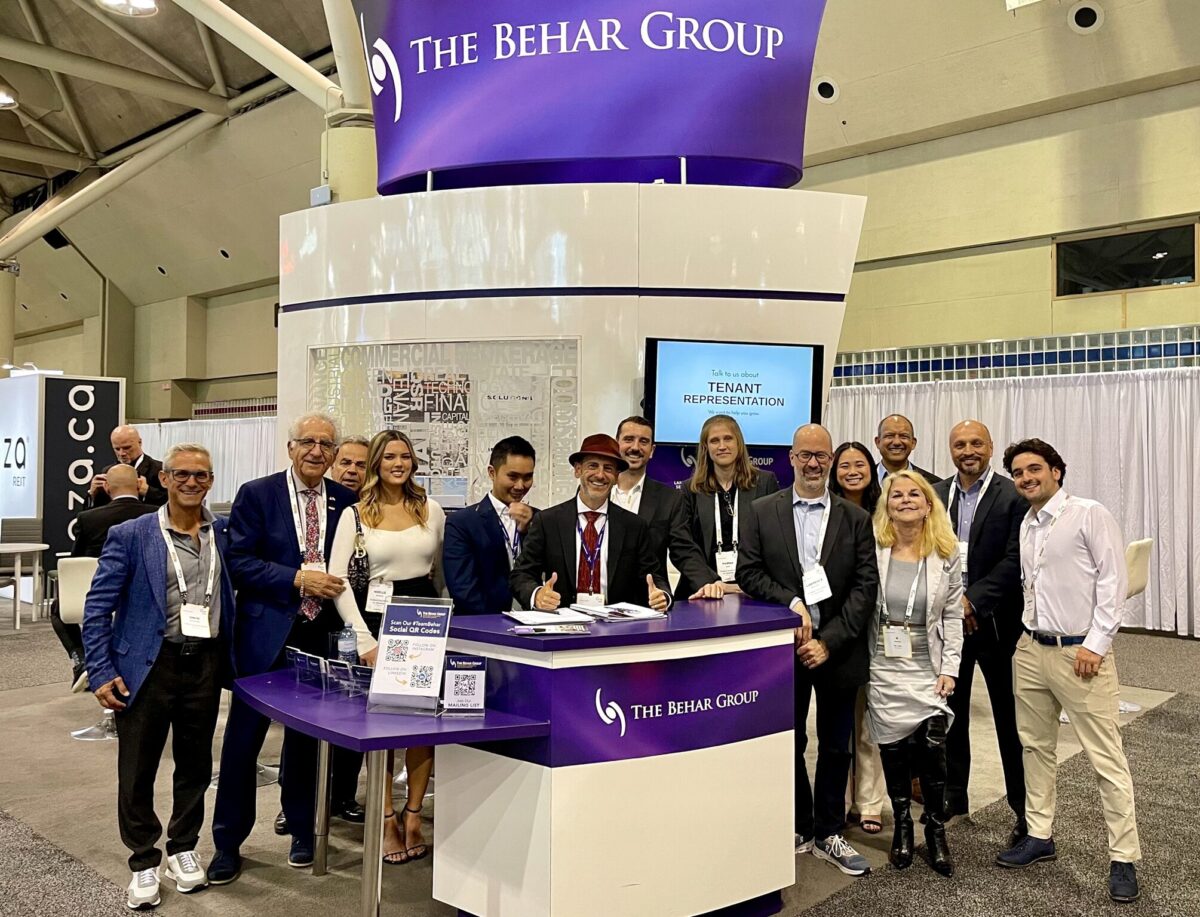
Rami Kozman from The Behar Group Realty Inc., Brokerage and Cityzen Development Group were involved in the deal.

Additional Photos from the NBA Courtside Restaurant

NBA Courtside Restaurant in Toronto (Image: NBA)