Advertisement
Advertisement
Home Blog Page 675

Uncertainty as Retailers in Canada Head into Holiday Shopping Season:

Park Royal South with the Christmas decorations up for Christmas 2021 in West Vancouver (December 2021). Photo: Lee Rivett.

Inflation in Canada has been at historic highs of late impacting consumer spending as the retail sector also deals with rising labour and material costs, staffing shortages, business sustainability and supply chain interruptions. 

For retailers it is indeed a challenging time as they prepare for the upcoming holiday shopping season.

Rob Garf, VP and GM of Retail for Salesforce, said after a couple of years of tremendous growth particularly online we’re now seeing a balancing between store and digital sales.

“And there’s been a shift in mentality for many retailers around the world. And that’s moving from scrappy over the last couple of years in terms of putting in initiatives based on the changing consumer behaviour to scale which is ‘wow, now I need to fully operationalize initiatives like buying online, picking up in store or allowing our associates to provide service whether they’re in the store or hanging out at home on their couch’,” he said.
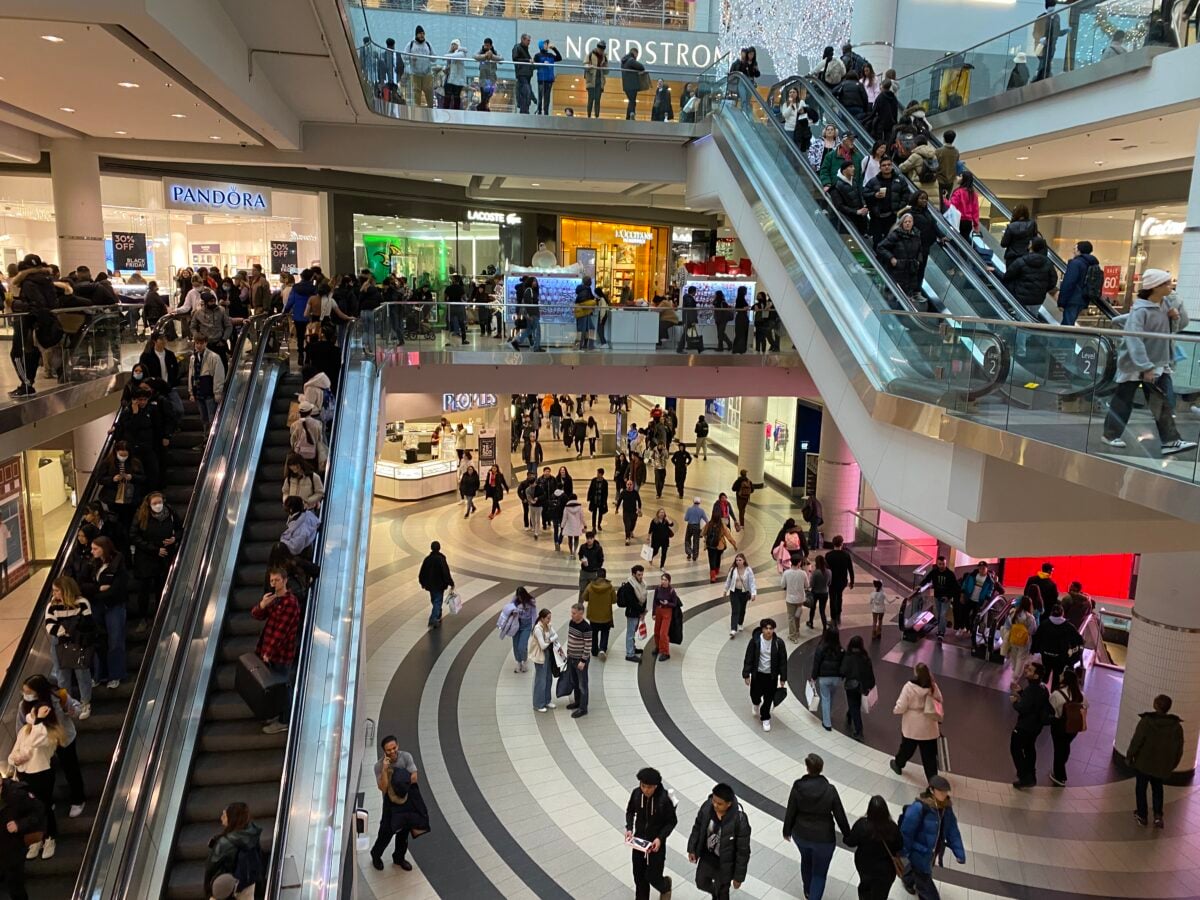
CF Toronto Eaton Centre In the Holidays

“Retailers generally have had somewhat of a wakeup call in the impact these new operational realities have taken. And it’s really putting tremendous pressure on margin and as we’re talking to retailers about holiday that seems to be a common theme in terms of not letting margin be the Grinch that steals Christmas. 

Rob Garf

“Retailers have (implemented) a lot of new technologies. They’ve put in place some critical capabilities and now how do they make sure they can scale, drive automation, drive efficiency.”

Garf said the average selling price in the retail sector has been consistently rising over the last six or seven quarters. Consumer spending is essentially a zero sum game, he added.

“Consumers are now spending more on almost every item but they’re spending the same amount of money total so the math means they’re buying fewer products from less retailers,” said Garf. “So there’s been a shift to a large degree in loyalty and the definition of loyalty. Many consumers are looking for value, they’re looking for experience.

The Eataly Holiday Market in Manulife Centre (Photo by Dustin Fuhs)

“Inflation is real. Last holiday, in particular, retailers, the extended supply chain, they were able to absorb the incremental costs of doing business, partly because they were able to preserve their margin by not having to discount. If you remember, there’s an inventory challenge which is there’s not enough of it because it’s stuck in containers at the ports and not being able to come into the domestic supply chain.

“Consumers got wind of that . . . And consumers got scared. So the retailers didn’t have to discount because they didn’t feel compelled to. This year there’s an inventory problem which is many retailers have excess inventory in categories that aren’t hot anymore whereas last year retailers were able to absorb the incremental costs of goods sold because they weren’t discounting. This year the retailers are passing that along to the consumers but also feeling the pain of margin erosion.”

Garf said people will look back at this time 10 years from now and see that the pandemic was a kick in the butt for retailers and brands to really force them to think about how consumers traverse the online and offline shopping journey.

“On average, according to our research, consumers traverse nine different touch points in any given shopping journey. Obviously with grocery, it’s likely a little less. When it’s a very concerted purchase like furniture it’s probably more but the point here is retailers, even coming up to the pandemic, while omnichannel became a common word in our industry nomenclature, it wasn’t put into practice in a way that incentives changed, processes changed, operations changed, and what the pandemic has shown particularly with the rise in digital is that it’s not a contest against digital versus physical but it’s a blending of the two that will really best serve the consumer,” said Garf.

“It’s a kick in the butt but in a good way. It’s not just about being scrappy anymore, but it’s really about scaling that omnichannel operation and looking at how do we automate, how do we create more efficiency, how do we break down the friction as the consumers traverse the various channels.

“I really feel like this is an interesting turning point for industry and I’m pretty darn jazzed up, and I’m pretty excited about what the future holds for those retailers that embrace it.”

Video Interview: Current Challenges in E-Grocery Business in Canada

Video Interview: Current Challenges in E-Grocery Business in Canada

Reza Bafandeh, CEO, Darwynn Ltd., discusses the current challenges in the e-grocery business.

Bafandeh talks about why many models like click and collect continue to lose money, how companies can shift models to be more profitable, the lack of sustainability that creates plenty of waste, sunken costs for delivery companies, new technology to revolutionize e-grocery, and the history of Darwynn and what it does.

The Video Interview Series by Retail Insider is available on YouTube.

Connect with Mario Toneguzzi, a veteran of the media industry for more than 40 years and named in 2021 a Top Ten Business Journalist in the world and the only Canadian – to learn how you can tell your story, share your message and amplify it to a wide audience. He is Senior National Business Journalist with Retail Insider and owner of Mario Toneguzzi Communications Inc. and can be reached at mdtoneguzzi@gmail.com.

Interviewed this episode:

Like, Share and Subscribe to Mario Toneguzzi on YouTube!

Follow Mario:

Also check out the other series offered by Retail Insider, including The Weekly podcast and The Interview Series, which are both available on Apple Podcasts, Stitcher, TuneIn, Google Podcasts, or through our dedicated RSS feed for Simplecast and other podcast players.

Follow Retail Insider:

Share your thoughts!

The Customer is Still Always Right: Expert Op-Ed

By Solange Strom & Frédéric Dimanche

It is believed that Harry Gordon Selfridge popularized the phrase “the customer is always right” in the early 1900s and the motto was thereafter endorsed by countless retailers. While the statement was ambiguous (after all, the customer is not always right), it created a deeply entrenched habit in North American retailers. One that was taken to extremes by the likes of Nordstrom known for its famously liberal return policies to keep their clients happy. 

Yet, today, this affirmation is put to the test. Retailers and service providers are now asking clients to behave. From signage in stores telling clients that rude or aggressive behavior will not be tolerated to businesses simply shutting their doors and only accepting customers by appointment, it may look like clients have lost the upper hand. Blaming their anxiety and frustration over pandemic related issues, they are being told to shoulder the responsibility for situations that get out of hand. 

But it’s a little too easy to impute the issues on the clients. Doing so removes any service accountability on the part of the retailer; it ignores the fact that many of the frustrations experienced by clients are indeed the retailer’s responsibility, whether it is staffing, service quality or supply chain issues. Finally, it neglects to acknowledge the obvious fact: customers expect retailers to meet their needs, not the other way around. 

Excellence in customer service is the retailer’s responsibility 

We all agree that it is unacceptable for a client to demonstrate rude and aggressive behavior or to use abusive language towards staff. That’s a given. We have all encountered demanding and entitled clients who make unreasonable requests and then become angry when those requests are not met. 

However, a recent study challenges the widely held assumption that clients are always the ones triggering bad behavior. On the contrary, it suggests that when tension escalates between a client and a staff member, it is often due to the employee’s attitude and not the reverse. 

One well-known retailer once said that the best way to manage a conflictual situation with a client was to “kill him/her” with kindness. That may seem evident but it’s obviously not a mainstream attitude. Indeed, many articles such as this one have been published recently about clients conducting themselves poorly towards staff and retailers and other service-oriented companies pushing back with signage asking clients to be respectful to their “valued staff.”

Staffing, service quality, and supply chain issues are the retailer’s responsibility 

We are by now well aware that the pandemic has exacerbated staffing, service quality, and supply chain issues. 

Staffing has always been a problem for retailers and the multiple store closures has compounded it, driving countless employees to leave the industry entirely. Thus, many retailers have entire new teams. One retailer admitted in confidence that 75% of their managers have been less than a year in their role and were, for the most part, promoted from more junior positions. With little to no management training, the consequence is often a scenario akin to the blind leading the blind. 

Service Quality. For about 20 years, the quality of service which results in customer satisfaction has been given increased attention. Retailers have worked towards enhancing customer satisfaction as the pivotal point to drive sales (Farooq & Salam, 2018). 

Several studies in the past decade have noted that service quality is the main driving force behind increased revenue (Elivra & Shpetim, 2016). With better service quality, the reputation of the brand improves, and customers are more loyal. 

However, the pandemic seems to have triggered an erosion of service quality in many places, mostly as a result of a well-documented labour gap, which, itself, results in a skills gap. We have all heard stories of poor or downright atrocious customer service. While most customers understand the issues currently faced by retailers such as lack of personnel and inventory problems, they do not appreciate retailers not taking responsibility for them and not trying to find solutions such as implementing better training programs. Instead, they are often being talked to rudely or dismissively, leading to further dissatisfaction. Ultimately, customers just want to be treated with empathy and be listened to. When their concerns are ignored or disregarded, they rightfully become angry. 

Supply chain issues resulting from the pandemic are global and well documented. While some aspects of these problems are out of the retailers’ control, managing them as far as the clients are concerned is entirely their responsibility. Clients are aware of these issues. They just don’t appreciate a retailer who makes excuses instead of trying to empathize and find solutions. Indeed, retailers already know what products are out of stock, and they can anticipate the clients’ reactions and act accordingly. When staff acknowledge clients’ irritation and works with them to solve the problem, most clients leave on a positive note instead of being angry and frustrated. 

When that is not done and when staff ignore it, the client is legitimately upset. Retailers need to come up with other options to not only keep the client satisfied but also to keep their businesses alive. It’s not by berating clients that this will happen. A sign warning customers about their “anticipated behavior” when they enter a store is a major deterrent and could drive them away, feeling unwelcome. After all, retailers need clients desperately and cannot afford, especially nowadays, to lose a single one. 

Retailers must meet the clients’ needs, not the other way around 

There was a time where the people who shopped in stores were the valued ones. Despite the growth of online shopping, retailers’ goal should always be to deliver the best client experience possible, regardless of their customers’ attitudes. The customer may not always be right, but in the aftermath of the pandemic, we need, more than ever, to address customer concerns, foster service quality and heighten the customer experience. That’s our job. 

Solange Strom
Solange Strom

Solange Strom, visionary and entrepreneurial retail executive with a track record of driving growth through employee-centric strategies. 25 years helming global brands such as Boiron, L’Occitane en Provence and Repetto Paris. Founder of the Radical Retail Method, a training program aimed at supporting retail organizations in their quest for excellence. To contact Solange visit www.solangestrom.com.

Photo: Frederic Dimanche

Frederic Dimanche is a Professor and Director at the Ted Rogers School of Hospitality and Tourism Management at Ryerson University. He has thirty years of professional and academic experience in service marketing and consumer behaviour, particularly in hospitality and tourism. His academic experience includes in the USA, France, and Canada.

eTail Canada Releases Innovation Report Ahead of September Conference in Toronto

Ahead of the highly anticipated  in Toronto on September 28-29, an Innovation Briefing has been released for 2022. []

The report provides insight into how some of the biggest retailers are pushing the boundaries while seeing success with e-commerce at a time when consumers are shopping online more than ever. The report makes readers better equipped to implement and optimize similar strategies through learnings and experience. 

Included is a discussion of how Canadian Tire is investing in its e-commerce — the retail behemoth has seen strong sales from its expanded online channel, as well as its membership program. Walmart Canada, which is investing hundreds of millions of dollars in its Canadian operations, is a point of discussion showcasing how over the course of a decade, it grew its online channel from almost nothing to billions of dollars in annual revenue. 

The discussion then goes to to how Lowe’s and Google Cloud services are supercharging app development and how Loblaws is adapting to evolving shopping trends and eating habits — grocery retailers in particular have seen a huge spike in online business since the start of the pandemic. 

Big-box retailer Costco, known for its busy stores, has seen its online sales rise drastically in the face of changing consumer — while inexpensive hot dogs are an attraction at stores, so is the convince of being able to shop from home. All of these retailers have shown tremendous innovation in developing and expanding online channels.

[]

The highly anticipated  will take place September 28-29 in downtown Toronto at the  located at 370 King Street West. Dozens of speakers have already been confirmed. []

eTail is a two day retreat designed to help businesses increase profits with action-packed strategies and connections made with the top mind’s at Canada’s most successful retailers. 

Download the  to see the completeand inspiring sessions at this year’s eTail Canada Conference, we hope to see you there.

[]

[]

[]

[]

*Partner content. To work with Retail Insider, email: craig@retail-insider.com

Ivanhoé Cambridge Sets Ambitious Goal to Reduce Carbon Footprint and Achieve Net-Zero [Interview]

Vaughan Mills (Image: Ivanhoé Cambridge)

Global real estate owner Ivanhoé Cambridge has set an ambitious carbon neutrality goal to reduce the carbon footprint of its real estate holdings by 35 per cent by 2025 and achieve a net zero carbon balance by 2040. 

And recently the company conducted a pilot project with Turntide Technologies at two of its Canadian shopping centres – CrossIron Mills in the Calgary region and Vaughan Mills in Ontario – to make the malls more energy efficient. The project involved replacing electric motors in HVAC units (heating, ventilation, and air conditioning) with Turntide’s patented Optimal Efficiency Motors. 

Rob Simpson

“This is a great example of a very simple energy efficiency option: it’s a plugin device. We’re replacing the motor in an existing HVAC (heating, ventilation and air conditioning) unit with a more efficient option. Since the installation of three motors, we’ve seen a significant reduction in electricity consumption equivalent to a saving of 56,000 kWh of energy a year,” said Rob Simpson, Senior Director, Sustainability, Ivanhoé Cambridge.

“That’s enough to fully charge nearly five million smartphones. Projects and programs like this are essential because they can be implemented quickly and easily. They’re cost-effective and scalable, and we’re already seeing opportunities to extend this technology to other retail locations and properties across other asset classes.

“We have committed publicly to become net zero operationally across our global portfolio of assets by 2040. That commitment was made in the Spring of 2021. So that’s the big picture. Within that, there’s some interim targets. There’s a 35 per cent reduction by 2025 from a 2017 baseline. We also have a commitment to anything on the development side, starting in 2025 and beyond, will be net zero operationally from that point forward.”

According to the company, energy consumption of the HVAC units at those two malls was reduced by more than 35 per cent at each location. This is equivalent to 39 metric tons of CO2.

In practical terms, said Ivanhoé Cambridge, 39 metric tons of CO2 equates to:

  • The amount of greenhouse gases emitted by a gasoline-powered vehicle that travels nearly 155,000 kilometres; 
  • The amount of carbon sequestered annually by a 46-acre forest; and 
  • The amount of energy required to charge nearly five million cell phones.
CrossIron Mills sign next to Highway 2 freeway connecting Calgary and Edmonton.
CrossIron Mills sign next to Highway 2 freeway connecting Calgary and Edmonton. Photo: Pop-up go | Zenergy Communications

“This pilot project is particularly attractive because we simply replace the existing motor and also because it offers a great return on our investment. It’s also a fine example of what Ivanhoé Cambridge wants to achieve: launch MVPs to test, learn and scale solutions that respond to our objectives, in this case, carbon neutrality,” said Karine Trudel, Director, Innovation and Continuous Improvement, Ivanhoé Cambridge.

Karine Trudel

Simpson said the company has taken a proactive role in the area of property technology. Part of the roadmap the company has laid out will mean investments in technological solutions to help decarbonize its buildings. 

“In shopping centres, typically you have a lot of equipment that is on the roof that provide the main heating, ventilation and cooling services for a building,” he said. “And they are generally outfitted with the typical equipment, including motors that basically drive the fans and what not. Those motors are generally what we refer to as induction motors. They’re either on or off. They don’t phase. They don’t necessarily stage. They don’t necessarily have interval speeds.
“And Turntide is an intelligent motor that adjusts based on the requirement of the given space in terms of heating, cooling or ventilation requirements. So it’s not running any harder than it needs to be for that particular unit to satisfy the requirement of that region or area that it is servicing. So Turntide essentially is a very efficient motor. It is for the most part you remove the old one and you put the new one in . . . It’s not an overly complicated initiative.”

Vaughan Mills (Image: Ivanhoé Cambridge)

Simpson said the installations at the two shopping centres took place at the beginning of this year. 

He said the two shopping centres were chosen for the pilot because they’re relatively straightforward properties, not complicated in terms of the HVAC equipment, and they don’t have central plants.

“The age of the buildings was also appropriate. The age of equipment is a factor. You don’t install these motors on brand new units nor do you install them on units that are going to be replaced next year. So you try to find that sweet spot of five to 10 to 12 years in terms of age,” explained Simpson.

“And we also have two centres that have been quite active in their own ESG initiatives and were just a good fit for pilot sites. We’d like to see them operate through a full year – a winter season and a summer season – to ensure that the results we’ve seen to date continue. Once that’s completed, we anticipate a wider rollout starting with the two centres where the pilots are occurring. We would like to roll it out across those centres certainly on common area equipment. We haven’t done anything with tenant specific equipment yet but that’s perhaps a later phase. 

“So the goal would be that once the annual numbers are confirmed and verified against our initial projections that we would expand across those two centres and then look for opportunities across the rest of the portfolio where the equipment at those locations align with some of those criteria and we would look to do a wider rollout where it makes sense to do so.”

Several New Major Retailers Opening in Upper Canada Mall in Newmarket [Interview]

Upper Canada Mall - Newmarket, ON

The Upper Canada Mall, in Newmarket, Ontario, keeps adding new retailers to service the growing population in the area.

Following the addition of Structube, the shopping centre is gearing up to add a new LCBO store and Winners by the end of this year as well as opening an expanded Aritzia store at the beginning of 2023.

“Upper Canada Mall is looking forward to meeting the needs of our rapidly growing community by welcoming an array of new and exciting retailers in the coming months,” said Leah Walker, General Manager, Upper Canada Mall. “Together with our new retailer Structube, which opened earlier this year, we will be able to provide access to multiple categories connecting our shoppers with a well-rounded retail experience.”

Future LCBO at Upper Canada Mall (Image: Upper Canada Mall)

The new LCBO store will be 10,262 square feet and Winners will be 43,287 square feet. The Aritzia store is expanding from its current 4,035 square feet to 15,755 square feet and also adding its A-OK Cafe concept to the store.

Leah Walker

“A few of these new Aritzia flagships have an actual cafe that is operated within the store in order to elevate the shopping experience. It’s a part of the Aritzia family but it’s almost a shop-in-shop type of experience where they have a storefront which can operate on its own but also you can walk into the store from their cafe,” said Walker.

“The addition of LCBO, Winners and the expansion of Aritzia is going to drive additional traffic of course and will have a significant, positive impact to the property. We anticipate that we’re going to add over a million new shoppers to the centre. But in addition, and more importantly, from the guest experience when they’re coming to the centre, they’re really looking to have a lot of these brands closer to home. And we’re really bringing that experience to the shopping centre so they can have that.

“Upper Canada is a one-stop for our community. You can come here and you’ve got access to so many different brands and it’s what the customers are asking for. When we look at our market requests, and we have conversations with the customers on the brands they want at Upper Canada, the Winners banner has been one for years they’ve been requesting and we’ve been able to bring that to our customers.”

Future Aritzia at Upper Canada Mall (Image: Upper Canada Mall)

The expanded Aritzia is also meeting consumer demand and the presence of an LCBO store within a shopping centre is unique. 

The mall, which has been around for almost 50 years, is 996,183 square feet and encompasses 210 stores, including a large collection of fashion, lifestyle and food labels and brands – the finest in home decor and technology. It includes Apple, Michael Kors, Zara, Aritzia, Uniqlo, Market & Co. (food market), and a newly renovated Sport Chek. In Fall 2018, Upper Canada introduced Market & Co., Canada’s first food market concept within a shopping centre environment. The 40,000-square-foot immersive space features an assortment of fresh foods and take-away options, two full-service restaurants, and Kitchen & Co., a state-of-the-art demonstration kitchen that hosts events, cooking classes, activations and pop-ups.

Upper Canada Mall is co-owned by Oxford Properties and the Canada Pension Plan Investment Board and managed by Oxford Properties Group. Oxford is owned by OMERS, the defined benefit pension plan for Ontario’s municipal employees.

“We have been very successful in maintaining and attracting new tenancies even during the COVID experience. We have very low vacancy at this point. When you walk within the shopping centre, every single storefront is animated. So our leasing team has been working together either to bring a short-term experience in to ensure that when the customer comes they have access to a new shopping experience that they didn’t have before because it’s a new brand that hasn’t been at the shopping centre or even during the COVID experience we have been expanding the different stores that are already in place, bringing in new tenancies,” said Walker.

“So overall it’s a very, very vibrant shopping experience when you come into the shopping centre.”

Future Winners at Upper Canada Mall (Image: Upper Canada Mall)

The mall has also just opened Envy + Grace, a womenswear retailer, also clothing store Pseudio is opening soon. The Laura store relocated recently to provide space for Envy + Grace and also aligned Laura in an area that is high traffic and in front of a court. 

“We’re realigning our current tenancies to make sure that it makes sense for their brands and also bringing in some new players as well,” added Walker.

“We have some new food uses as well. When customers are coming to Upper Canada Mall, they’re really looking for the whole experience. We have a new tenant within Market & Co. called Mango Like Desserts and we also have Saint Germain opening in the Fall.”

Pseudio at Upper Canada Mall (Image: Upper Canada Mall)

Walker said the York Region, where Upper Canada Mall is located, has been identified as the fastest growing municipality in Ontario.

“We’re currently at a population of 1.3 million in our neighbourhood and that’s anticipated to sit at two million by 2051. As Oxford is looking at what our offerings are at Upper Canada, we’re keeping all of that in mind as we continue to grow and serve the community around us and what they’re asking for,” she said. 
“When we’re looking at what the consumer is asking for, you have a lot of transplants from the downtown urban core coming up to us and saying ‘I still want that same experience that I had when I was downtown but I don’t want to go downtown’. That’s really the crux behind what Oxford is doing and what the brands are that we’re looking at when we grow our offerings here at Upper Canada.”

Canadian Consumer Spending at Retailers Remains Consistent for July Amid High Inflation: Mastercard Study

Canadian consumer spending remained consistent in July, while navigating high inflation, says a new report by Mastercard.
According to Mastercard SpendingPulseTM, which measures in-store and online retail sales across all forms of payment, Canadian spending excluding automotive increased 15.4 per cent since pre-pandemic in July, indicating consistent levels of spending despite current high levels of inflation. 
“While we’re seeing a slight acceleration in consumer spending, the latest retail trends clearly demonstrate the impact of decades-high inflation on consumer spending,” said Steve Sadove, senior advisor for Mastercard and former CEO and Chairman of Saks Incorporated. “As retailers grapple with excess inventory and supply chain constraints, it’s likely that promotional activity will continue to be an important strategy for retailers to continue to drive e-commerce sales. This will be especially important in the face of rapid price increases and consumers prioritizing necessities.

The Market by Longo’s at St. Clair (Image: Dustin Fuhs)

“If I look at the Canadian data, you’re in an environment where inflation has accelerated . . . Inflation is higher and the growth in retail overall while still relatively healthy versus the pre-pandemic has slowed dramatically. You have relatively slower retail growth and in a higher inflationary environment.

“You have very high fuel prices and clearly the price of gasoline has backed off a bit from the highest levels but it’s still very expensive and the consumer is starting to slow and it’s likely seeing more evidence in the lower income consumer. They’re having to make more tradeoffs than the higher end consumer, but they’re still shopping and you’re still seeing some very healthy performance in e-commerce. E-commerce growing in a faster rate in July than stores and e-commerce becoming entrenched.”

Some key findings of the Mastercard report include: 

Image: Mastercard SpendingPulse (July 2022)
  • While sales for e-commerce showed steady year-over-year growth, online spending compared to pre-pandemic saw a significant surge (74.7 per cent). Notably, in-store sales also increased (7.7 per cent) since pre-pandemic;
  • Spending growth in July compared to pre-pandemic levels in 2019, was the highest experienced thus far in 2022;
  • Consumers continue to spend, with inflation’s impact varying across sectors: Despite high inflation, consumers continue to spend on wants. The Apparel sector, for instance, saw sales up 17.1 per cent in July from a year ago while Restaurant growth (4.3 per cent) showed demand for experiences as Canadians continued to visit restaurants during summer’s busy season;
  • E-commerce sales climb amid major summer sales events: E-commerce sales remain elevated, up 5.4 per cent from a year ago and  74.7 per cent from the pandemic, with major summer sales and promotions helping entice shoppers to splurge (and save) with online deals; and 
  • High season for vacation, with road-trippers continuing to spend at the pump: With gas prices still elevated across the country and summer vacation plans top of mind for Canadians, Fuel & Convenience spending rose 28 per cent year-over-year and  YOY / 40.4 per cent pre-pandemic.

“The consumer is looking for deals. They’re in a mindset where they’re a little bit more stretched. You’re still seeing what I would call a change in behaviour from the pre-pandemic and then pandemic environment. What I mean by that was in the beginning of the pandemic everybody was at home. They were buying athleisure, sports, sweat pants, they were fixing up their houses. That bevaviour has led to some real issues in the environment because they’re in a post-pandemic environment where they want to change their behaviour and get out, they want to go to parties, they want to go to social occasions,” said Sadove.

Walmart in Oakville (Image: Field Agent Canada)

“And what they’re buying is changing. So it’s a little bit dressier, it’s a little bit get out there and a little sexier than it was. And apparel is very healthy . . . . It’s led to some dislocations because a lot of apparel makers brought more of the stuff that people were buying during the pandemic as there are not enough of the stuff that people want right now. So inventory levels across North America in a number of categories, whether or not they’re apparel or home improvement, outdoor grills, furniture, you’re seeing a lot of excess inventory in the system. And that is something I think is going to affect the next number of months as a lot of retailers try to clear out their inventories.

“You’re seeing somewhat of a slowdown moving away from the restaurants where you were seeing a little bit more growth earlier and some of it may be a squeeze on the consumer because of inflation. My go forward is inflation is going to continue to be an impact. You’re going to see more of this inventory clearance, more of the shift towards different kinds of items than they were buying before and for the lower income consumer it’s not going to get better in the near term with the higher inflation and higher fuel costs and energy costs. This winter is going to be a drag on some of the lower income consumers. But there’s going to be a lot of discounting for people who want to buy some of the other products because the inventories are high for a lot of those items.”

Sadove said many consumers will navigate to lower priced stores such as Walmart and Dollarama because of the high inflation environment. In an environment like this, he said, you tend to get a bifurcation where the high end does reasonably well and people gravitate to the Walmarts and Dollaramas of the world. 

Balenciaga to Open Large Store at West Edmonton Mall

Photo: Boris Shiu

Kering-owned luxury brand Balenciaga will open a storefront at West Edmonton Mall as part of Balenciaga’s ongoing expansion into the Canadian market. Balenciaga is expected to open before the end of the year near other luxury brands in Canada’s largest shopping centre. 

Balenciaga will occupy about 3,900 square feet on the second level of the mall — the storefront was made possible by joining former locations for Matt & Nat (1,775 square feet) and Marc Cain (2,150 square feet), the latter having recently relocated to Phase 1 of the mall near Harry Rosen. 

The Balenciaga store at West Edmonton Mall will be located between an APM Monaco store and Kate Spade. A Tiffany & Co. store is located next to APM Monaco and across the way, three global luxury super brands have opened over the past three years. That includes standalone storefronts for Louis Vuitton (which opened summer 2019), Saint Laurent (opened winter 2020) and Gucci (opened spring 2021). 

Click image for interactive West Edmonton Mall map

Kering also owns Gucci and Saint Laurent, and the French conglomerate is said to have agreed to open Balenciaga after seeing exceptional sales numbers at West Edmonton Mall for its two other brands. Louis Vuitton is also said to be seeing strong sales numbers at West Edmonton Mall, prompting the brand to consider expanding its existing storefront according to sources. 

Edmonton will once again have bragging rights over Calgary with the announcement of Balenciaga — the two cities have an unofficial rivalry and since the pandemic, Edmonton has seen the opening of two luxury brands not currently having standalone Calgary stores. Calgary currently lacks standalone Saint Laurent and Gucci storefronts, though Gucci is said to be looking at opening in the city. Louis Vuitton opened a standalone store at CF Chinook Centre in Calgary in the fall of 2018, exiting a concession in downtown Calgary at Holt Renfrew. It remains to be seen if Balenciaga will open a standalone Calgary location which, as per the ongoing trend, would be located at CF Chinook Centre.

Scoring Balenciaga also means that West Edmonton Mall won’t need a retailer such as Holt Renfrew to move in to service the Edmonton market with luxury goods. Holt Renfrew exited the Edmonton market in early 2020 primarily because its luxury brand concession partners did not see a future in downtown Edmonton, particularly after Louis Vuitton made the decision to exit downtown Edmonton’s Holt Renfrew for West Edmonton Mall. Now West Edmonton Mall is home to most of the top-selling brands at the downtown Holts (including Canada Goose and Hugo Boss) and more brands could be on the way, given the strong sales numbers for high-end retail at West Edmonton Mall. 

Images from the fall 2022 Balenciaga collection via Hypebeast

Kering has been investing in the Canadian market significantly by opening stores. For Balenciaga specifically, a 7,000 square foot two-level flagship store was unveiled in July of this year on Yorkville Avenue in Toronto. It joins a 4,700 square foot Balenciaga location that opened at Toronto’s Yorkdale Shopping Centre in December of 2019. A Vancouver location is said to be next. 

Balenciaga currently operates “world of” concessions at Holt Renfrew in Vancouver and in downtown Toronto at 50 Bloor Street West. Both locations feature the brand’s range of ready-to-wear for women and men as well as bags, accessories and footwear. 

Several other high-end retailers in Canada carry Balenciaga. Saks Fifth Avenue’s flagship at CF Toronto Eaton Centre in Toronto currently features an area for bags and accessories and womenswear and men’s collections are also available.  

Nordstrom’s Vancouver flagship features a Balenciaga accessory boutique on the main floor as well as a dedicated women’s Balenciaga boutique space on the women’s floor. Balenciaga footwear can also be found at Nordstrom’s stores in Toronto and Vancouver. 

In Montreal, Balenciaga has a boutique presence at Holt Renfrew Ogilvy in a licensed arrangement where Holts runs the stores for the time being. 

According to the Q2 2022 Lyst Index (the most recent at press time), Balenciaga was ranked as the world’s second-most popular brand while Gucci was ranked first. It’s a switch from the past several quarters where Balenciaga ranked number one. Balenciaga is also having an ongoing fashion moment — the brand returned to haute couture after 53 years last year, launched a Fortnite collaboration, and teamed up with Kanye West on the launch of his Donda album. Last year the brand also showcased its fashion collection in cartoon format at Paris Fashion Week via popular television program ‘The Simpsons’.