The landscape of retail marketing is undergoing seismic shifts. As technological advancements merge with innovative strategies, the new ways in which we most effectively engage consumers and build brand experiences have never been more crucial.
Modern Marketing: Where Storytelling Meets Community: With top industry leaders like Azim Akhtar from KFC,Ashley Freeborn from Smash + Tess, Kathy Tsolakos from Penn, Jake Karls from Mid-Day Squares, and Jeff Topol from TikTok on board, this opening session will examine what fuels conversations through contemporary storytelling. Learn how to anchor your brand by connecting authentically with your customer community, ensuring messages resonate powerfully.
Ethical Insights: Personalizing Customer Experience with Privacy in Mind: In an age of data, understanding your customer is essential and responsibility handling personal data is paramount. Here, Jan Kestle, President and Founder of Environics Analytics, will guide brands on how to effectively and judiciously use data while ensuring consumer privacy.
Brand Devotion: Global Insights into Customer Loyalty: Jemima Miller, from The Body Shop, will delve into the intricate world of customer loyalty trends from an international lens. Unearth loyalty building strategies that can set your brand apart in a competitive global marketplace.
A Marketer’s Guide to Seamless Customer Retail Journeys: Flawlessly blending online and in-person experiences retail experiences is now expected and vital brand consideration. Gain insights from marketers like Alison Hartnoll of Mastermind Toys, Janelle Shiplett from House of L R & C, Sachin Arora of Next Commerce and Jean-Michel Maltais from New-Look Vision on crafting unforgettable, integrated customer experiences.
Optimizing Digital Advertising Strategies: Stay Agile, Perform Better: Sonia Carreno from The Interactive Advertising Bureau of Canada (IAB) will share how brands can better navigate the complexities of the Canadian digital advertising terrain, exploring trends, tracking, privacy implications and more, to create comprehensive advertising strategies that will deliver on objectives.
AI Powered Retail Efficiency: Sam Vise of Optimum Retailing will showcase real-world examples of AI in retail action. He will cover how AI is helping retailers and their vendor partners work smarter to optimize marketing and merchandising efficiencies.
Mindful Leadership: Leading an Inspired Retail Team: Johnny Russo from Lamour and MLG brands and Chris Parsons from Home Hardware will introduce game-changing leadership techniques, specifically tailored for Canadian retail marketing teams.
The Social Shopper’s Playbook: Inside the Consumer’s Mind: Ransom Hawley from Caddle and Jessica Lee from Edelman Canada share the newest consumer insights driving social shopping, offering strategies to leverage this trend for retail success.
AI in Retail: Navigating the Crossroads of Marketing, Legal, and Technology: A diverse panel, including KPMG’sChristine Andrew and Xavier Beauchamp-Tremblay, WPP’sArthur Fleischmann, and Google’sJamie Gargatsougias, will explore AI’s transformative impact on retail, and discuss balancing everything from marketing strategies to legal considerations, customization, predictive analytics, content ownership and organizational values
RCC’s Retail Marketing Conference 2023 on September 19, 2023, promises targeted discussions on pressing issues Canadian retail marketers face today in an ideally sized forum to foster genuine connections with industry frontrunners. Priced with teams in mind, it’s the can’t-miss event for those aiming to stay ahead.
Early Bird savings on tickets to RCC’s Retail Marketing Conference are in effect until Friday, August 18, 2023. A 20% discount applies to groups of 5 our more.
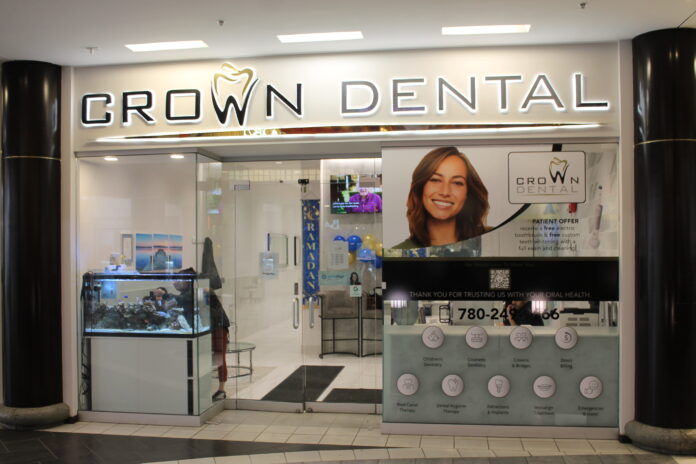
Crown Dental at West Edmonton Mall (Image: Market Dental)
Edmonton-based entrepreneur Ziad Kaddoura has launched a branded dental office concept he plans to expand in the Edmonton region and then beyond.
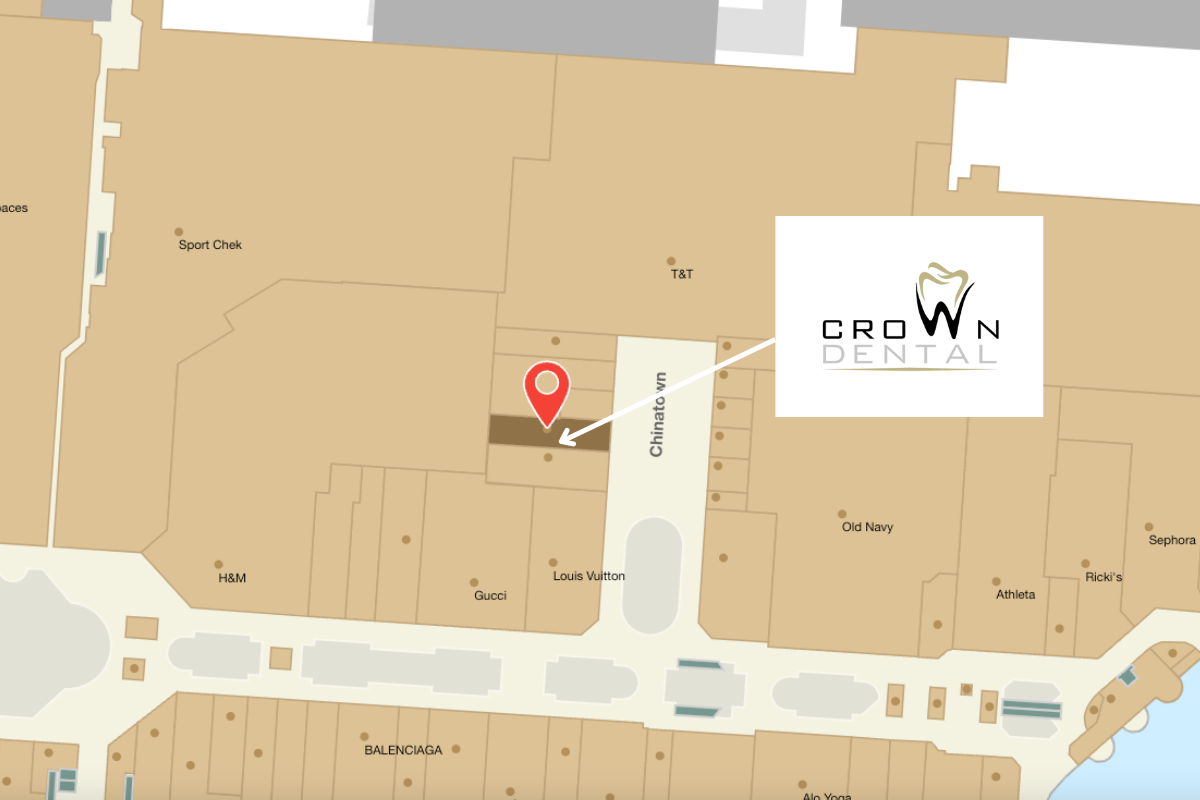
The first Crown Dental Clinic launched early this year in the West Edmonton Mall.
Kaddoura, co-founder of Crown Dental Development Company, said the purpose of the company is to develop the brand Crown Dental Clinic across Canada.
“In the process of opening the brand, we wanted to create an impact with brand exposure and brand availability,” said Kaddoura. “So what better place for us to do it than the West Edmonton Mall.”
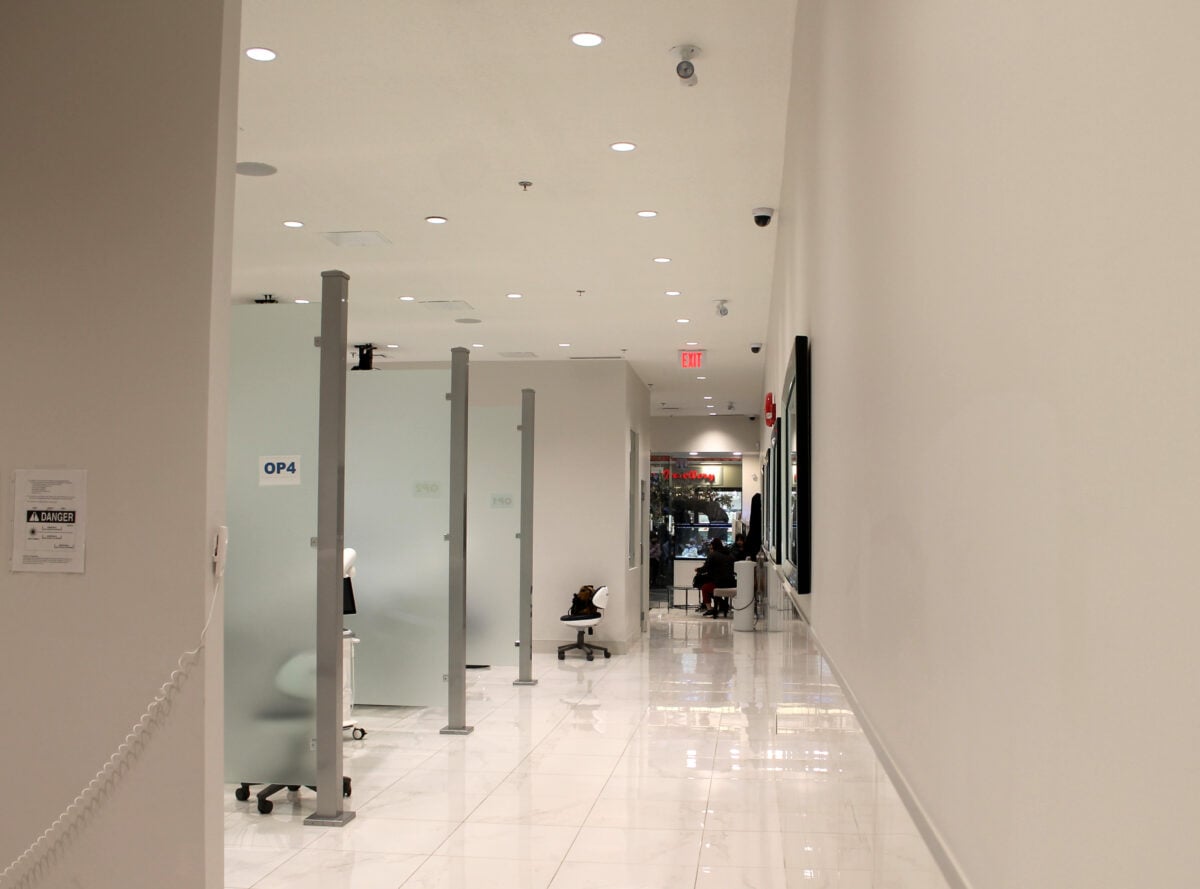
Crown Dental at West Edmonton Mall (Image: Market Dental)
He said the brand is in an area of the shopping centre that is quite busy.
“Why there? Because we felt that Crown Dental Clinic brand awareness is very, very important to us. Like other clinics, we are pushing the name of Crown Dental not necessarily the doctor’s name,” said Kaddoura. “And we are already in negotiation with three more clinics now.
“One of them used to be a GP (general practitioner) that we are repurposing into a dental clinic. The idea is twofold. The idea is to take existing locations that were not made as clinics and repurpose them as dental offices. And when you repurpose them, you’re basically taking real estate that is sitting idle and you’re giving it new life basically.
“That requires an investment from us or whoever becomes the operator of that dental clinic. The second thing as well is you’re able to get a clinic started at a much lower price than starting from scratch, which basically gives the chance for new graduates of the dental school to have their own clinic instead of going working for someone else. The idea behind Crown Dental is really to provide the setup, the office, the operational aspect of the clinic, where the dentist will only focus on the clinical aspect of the clinic, because really the biggest, biggest challenge with any dentist is the administration aspect of it. So Crown Dental Development Company wants to become or is becoming the company that is basically giving a platform for these either new owners to a dental clinic, a new graduate that wants to start a dental clinic instead of going and working for someone else, or we have a case that we’re now looking at, an existing dental clinic that is basically not going well because they are not able to advertise and run the administration aspect of the clinic very well.”
Kaddoura said branding an existing dental clinic, that is struggling, to a Crown Dental Clinic, a banner with several locations, would raise awareness and trust of the name rather than having the name of a doctor that no one knows.
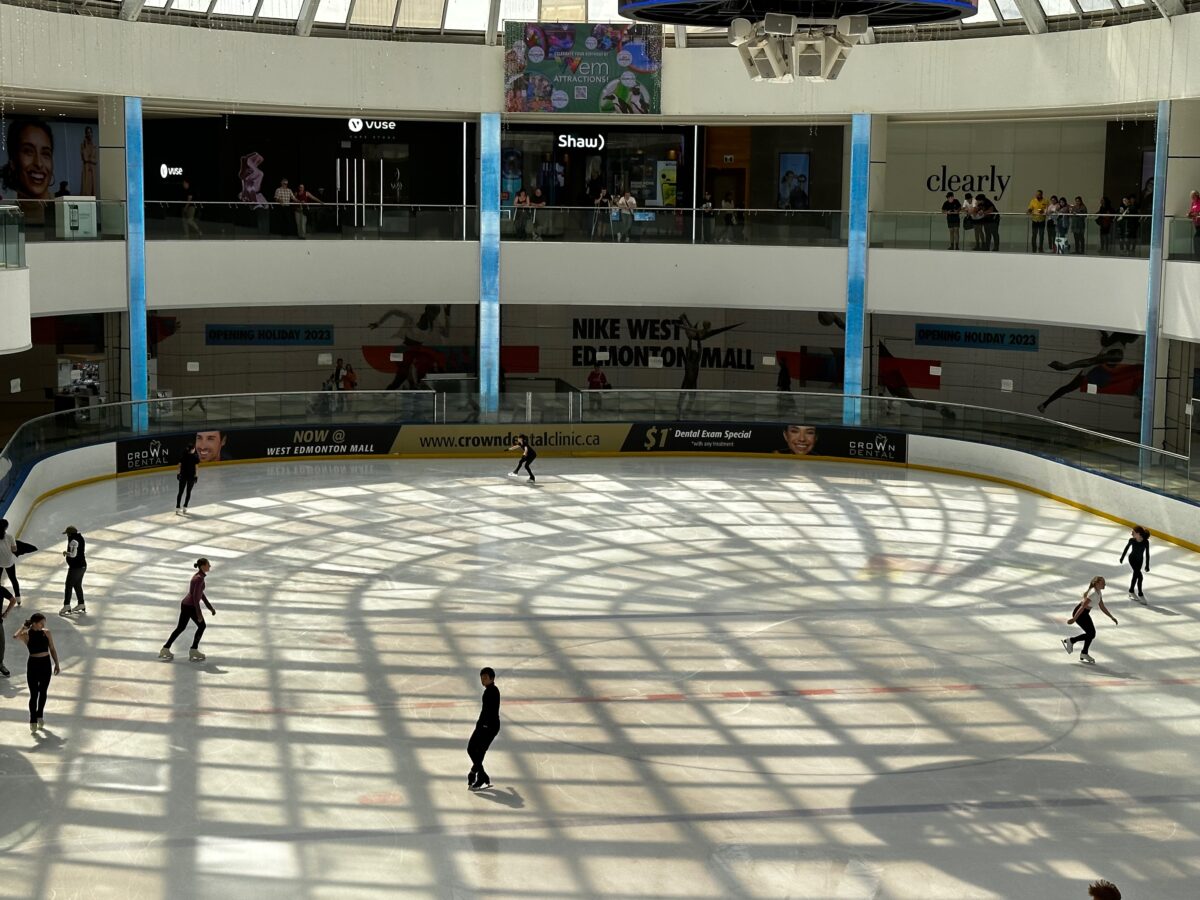
Crown Dental at West Edmonton Mall (Image: Market Dental)
He said the company has launched a huge ad at WEM for the Clinic and recently they had a booth in the mall advertising the clinic.
“So we are basically a dental clinic platform that is thinking of the dental industry as a brand and not specifically a doctor,” he added.
Kaddoura said the company is negotiating on three sites – one of them is a repurpose, another is an existing dental clinic and the third is a dental clinic that closed down that they are looking at reopening.
They are all located in the Edmonton region – one in the downtown, one in the south part of the city and another in the north eastern part of the city.
“I think what I’m looking for honestly for 2023 if we’re able to close the year with two locations and then for 2024 if we’re able to close the year with five locations and then grow the brand year to year by two to three locations. That’s the idea,” said Kaddoura.
Crown Dental Advertisement at West Edmonton Mall (Photo: Jorden Clarke)
“Once we get to about five locations in Edmonton I think we’re going to start looking at expanding maybe something in Spruce Grove. We’ll look at the possibility of St. Albert. But that won’t happen probably until the end of 2024. It’s a new build. They got in touch with us and asked if we would be interested. Opening in West Edmonton Mall did exactly what I expected it to do. It got people interested in talking from the brand point of view. That to me was an objective that was met. If we had opened a clinic in West Edmonton Mall, Dr. Ziad, who would care? But when you start thinking about branding, when you put the huge banner on the ice skating rink and you have 25,000, 30,000 people a day seeing that makes a difference.
“Your challenge is not real estate. Your challenge is never equipment. Your challenge is never money. Your challenge seems to always be people based. So you need to find the right associate. You need to find the right dental assistants and you need to find the right administration people. So it’s always people based . . . What we’re trying to do is create a culture and this is why creating the brand to me is very important because you’re trying to create the culture, you’re trying to create not only the know-how and the operating procedures, how to run the clinic, but how to retain people and how to make it an exciting place to be an employee of choice in the dental industry. That’s what we’re trying to work on.”
King at Yonge Street in Toronto on Monday August 7th, 2023 at 1215pm (Image: Dustin Fuhs)
Retailers located in the downtowns of major Canadian cities have been grappling with a few issues these last few years which have directly impacted their businesses.
First, the pandemic initially created ghost towns in inner cities across Canada with offices locked down as workers worked remotely. Three years later, the impact of that is still evident as downtown office vacancy rates in some cities remain high.
Remote work is here to stay as many companies have also adopted a hybrid work model where people work some days at home and some days in the office.
With fewer people in downtowns these days, it means less consumers for retailers and food establishments. And no one knows if we’ll ever get back to normal.
The second issue for businesses in downtowns is an increasingly growing concern across Canada. It’s one of safety. Some cities like Vancouver and Toronto are worse than others but almost any city of decent size in Canada is feeling the impact of this burgeoning issue – tent cities housing homeless people set up on downtown sidewalks or parks as well as drugs and crime.
Security Incident outside of CF Rideau Centre in Ottawa (Image: Dustin Fuhs)
“Hybrid work has sort of taken hold and those downtown businesses that were dependent on suburban commuters coming in and out every day – the lunch rush or the breakfast rush – have had to adjust,” said Mallough. “It’s still there some days of the week usually in the middle Tuesday through Thursday but it’s quieter Mondays and Fridays and we’ve seen some restaurants that used to be full service breakfast, lunch and dinner are maybe just breakfast and lunch or maybe just lunch and dinner. So there have been some adjustments on that side.
“The other area we have heard concerns around is the public safety side of things. A number of businesses we surveyed and about one in four (24 per cent) said they have been directly impacted by community safety issues like damaged property, theft, that sort of thing. There’s another third that while they haven’t been directly impacted are certainly worried about it.
“There’s a lot of worry about the safety of their customers, the safety of their employees, personal safety, coming off of that as well.”
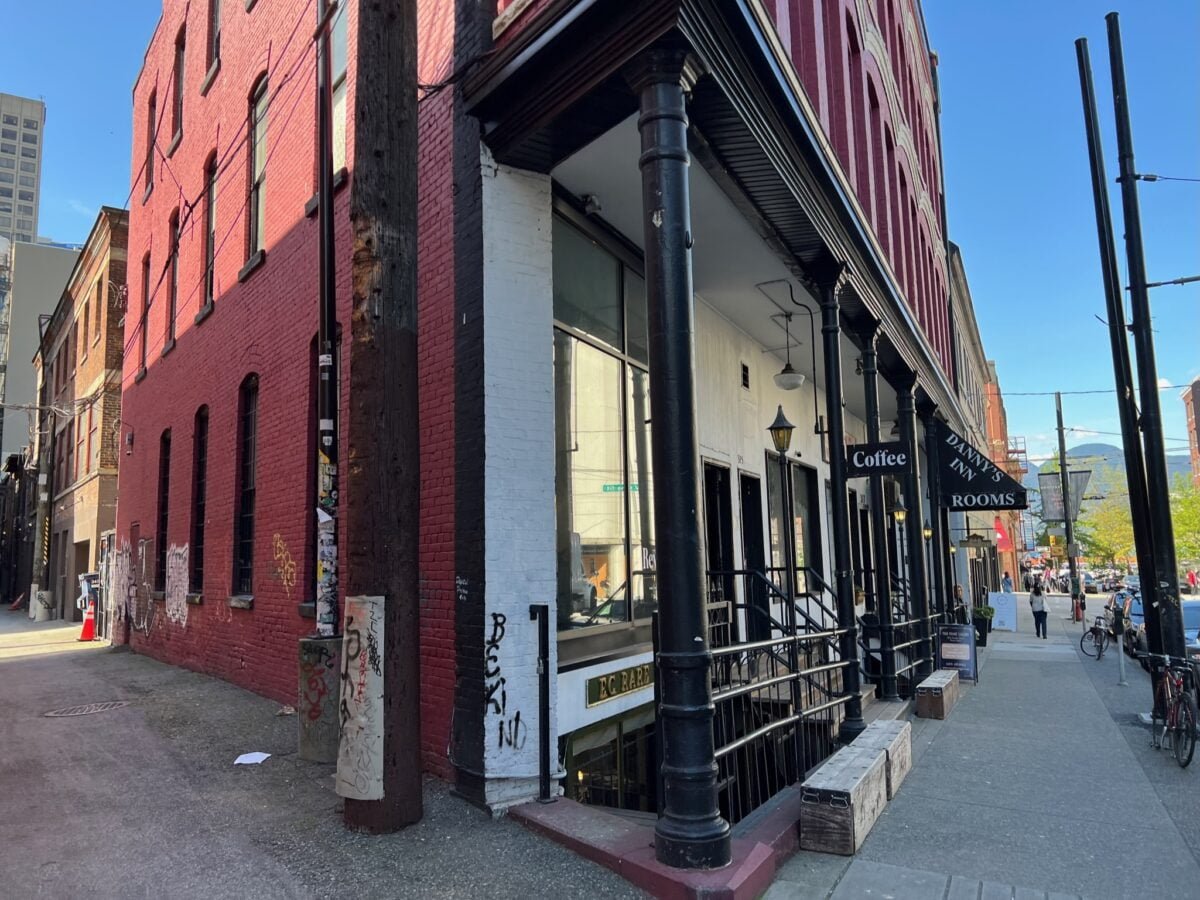
Gastown in downtown Vancouver in May 2023. Photo: Lee Rivett
Mallough said the perception of safety is also important to the well-being of businesses located in downtowns across Canada.
“Anything that is making people nervous about going downtown or preventing them from going downtown is definitely a big concern,” he said.
“It’s something that we (CFIB) are starting to delve into. It’s popping up more than it traditionally has. That’s not to say this was never an issue but it’s certainly more of an issue now . . . We are seeing it on the rise as a concern.
“In terms of what there is to be done about it, that we’re still trying to hash out a little bit. It’s important to work with Mayors and Councils on making sure that the community does in fact feel safe.
“We need to reinforce the message that we do want people to come downtown. We want people to feel safe and we want to make sure that people are coming downtown, they are spending at their local business, supporting their local communities, because if we turn downtown cores into ghost towns we’re all going to be a lot worse off for it. It’s not going to fix anything from the public safety side and certainly not on the local economy side.”
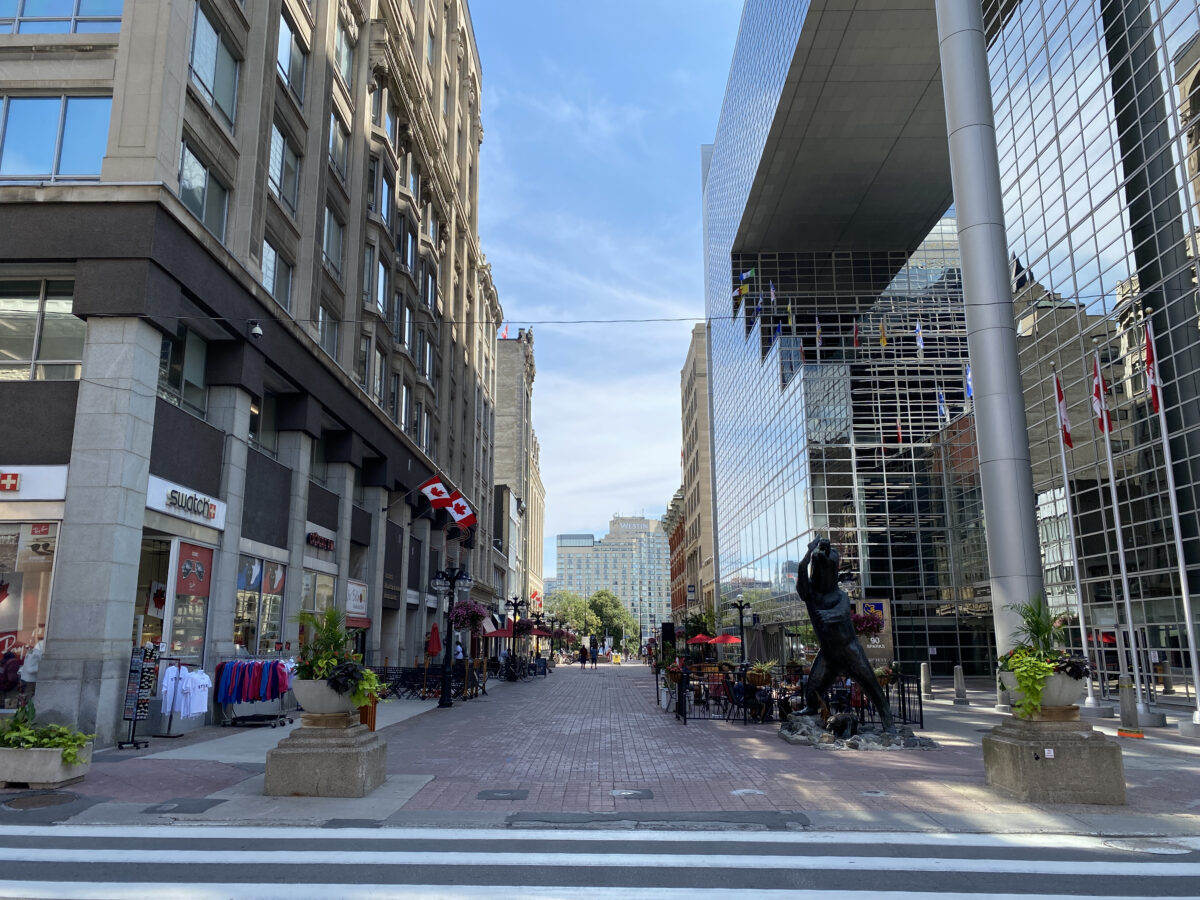
Sparks Street in Ottawa (Image: Dustin Fuhs)Elgin at Gloucester in Ottawa (Image: Dustin Fuhs)
Patrick Gill, Senior Director of the Business Data Lab for the Canadian Chamber of Commerce, said Canada is seeing a dynamic shift in urban centres, particularly in major Canadian markets.
Patrick Gill
“That really is driven by the influence of remote work,” said Gill, adding there’s almost 50 million square feet of vacant office space available within Canadian downtowns – a nearly 40 per cent increase since the pandemic.
“That’s the equivalent of about 89 baseball stadiums the size of the Rogers Centre in Toronto. That has caused a huge ripple effect . . . The downtowns of Canada’s 10 largest cities, the movement of their workforce on a weekly basis, is still 30 per cent below where it was before the pandemic. That has a domino effect on office vacancy, that also has a domino effect, or a ripple effect, on all the different sectors or components of downtown urban centres that rely on workers commuting every single day to the office.
“So you see that ripple effect on main streets and the type of businesses that are specifically around to cater to the typical commuter.”
The other big dynamic shift being experienced now as well is consumer behaviour, added Gill.
Transaction data for July when the Bank of Canada started raising interest rates in June indicates that started a downward trend in consumer spending. Consumers have started to hold onto their wallet more because it’s becoming more expensive. That is having an impact on discretionary consumer spending in Canada’s downtowns.
“When you have a confluence of fewer people in the area and trending towards lower spending because of tighter times, that has knock-on effects broadly,” said Gill.
Despite those challenges, many businesses have been resilient and optimistic.
“They’re feeling optimistic about the future. They’re holding in tight. They still plan on hiring more people. They expect sales to continue to grow,” he said.
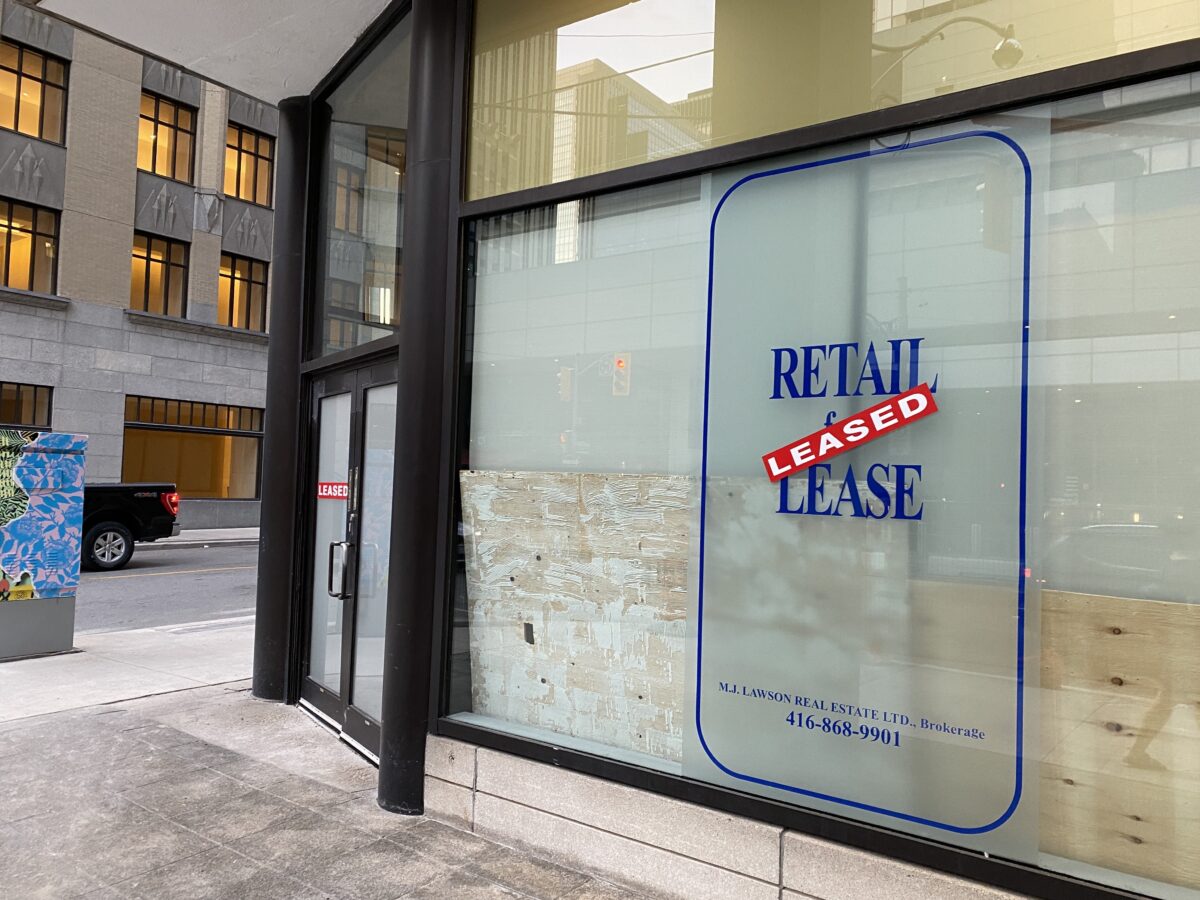
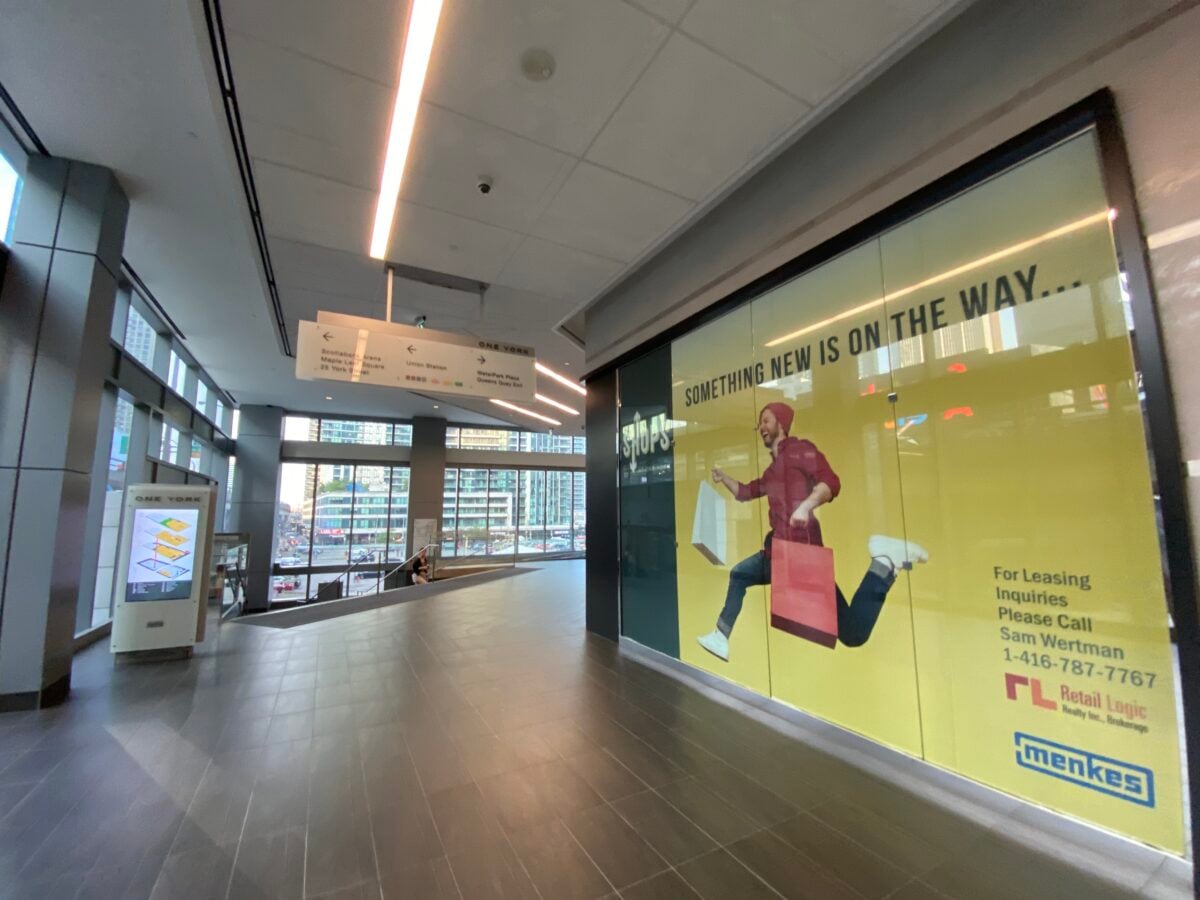
Former Tim Hortons at 90 Adelaide St W has been recently leased (Image: Dustin Fuhs)PATH Connection at the Shops at One York in Toronto (Image: Dustin Fuhs)
David Downey, President & CEO of the International Downtown Association, said there are continuing concerns for small businesses and small business survival in Canadian cities post-pandemic which in part is due to the reduction in daytime foot traffic.
David Downey
“That of course can be attributed in part to reductions in the office worker during the week, in particular. And really the future of the hybrid work environment is something that all downtowns across the world are trying to wrap their arms around and looking for opportunities to move forward,” he said.
Downey said social issues within urban centres are visible everywhere.
“In particular, the presence or visibility of unhoused or our neighbours who are burdened by mental health or substance abuse and addictions is becoming more visible in part because of the people that are on the streets throughout our urban centres,” he said.
“This sort of activity is one that is a negative perception on the safety and security of our urban centres. So ongoing this becomes a challenge for trying to bring people back to the urban centres, hosting events or doing placemaking activities. It’s something where people have to overcome any perceptions that there is in fact unsafe environments. And we can share statistics that crime in urban centres is down and in downtowns it’s lower but there still is the ultimate perception that our sidewalks are seemingly unsafe.”
Downey said many of the association’s members have begun to develop outreach coordinated teams who are trained professionals that can help assist the unhoused and those with mental health and addictions crises and rather than law enforcement, they go in and help provide connection to public services and social services and assist individuals in their time of need.
“Cities are certainly on the rise. Recovery is beginning and getting stronger. And like any disruption it’s going to take the entire community to step forward and really embrace what will be our new future. Downtowns are still fabulous, wonderful places to be. So we’re excited for the future,” he said.
Craig and David Nagy, Founder at eCommerce Canada, discuss the Canadian Digital Adoption Program (CDAP), a $4 billion government-funded initiative to promote digital innovation and transformation for small businesses in Canada. They delve into the application process, grant amounts, interest-free loans, and youth employment subsidies, highlighting the program’s potential impact on businesses and entrepreneurs.
A transcript of the conversation can be found below.
If you prefer to listen to the audio version, it is available below:
The Interview Series audio podcasts by Retail Insider Canada are available on Apple Podcasts, Stitcher, TuneIn, Google Play, or through our dedicated RSS feed for Overcast and other podcast players. Also check out our The Weekly audio podcast where Craig and Lee discuss popular content published on Retail Insider which is part of the The Retail Insider Podcast Network.
Craig Patterson 0:03 Welcome to the Retail Insider Video Interview series. I’m your host, Craig Patterson. And we’re joined here today with a special guest, David Nagy. He’s the founder of eCommerce Canada and is an entrepreneur and has done all kinds of great things. Welcome, David.
David Nagy 0:17 Mr. Patterson, super to see you. Great to join you again. It’s been a while since we’ve chatted. So it’s good to catch up with you and Retail Insider.
Craig Patterson 0:25 And we’re talking today about the Canadian Digital Adoption Program, which is basically free money for businesses to do things online. Can you tell us a little bit about what this is or what we could call it CDAP if you want as well for the abbreviation?
David Nagy 0:39 Affectionately, yes, we refer to it as “CDAP” or “The DAP” as some people call it once they get really familiar. So yes, it’s a $4 billion fund initiated by the government back in March 2022. Pretty great program. Canada Digital Adoption Program is designed to bring innovation and digital transformation opportunities to small businesses in the country.
Craig Patterson 1:04 Now, who can apply for it?
David Nagy 1:05 So it’s delivered in two stages, one of which I spend a lot of time on, the other one of which I’m just affectionate for, but don’t spend too much time on. Stage one is for smaller newer businesses, I think the requirements are to do about $30,000 in revenue and have at least one full-time equivalent employee that’s receiving a T4. It’s oriented towards e-commerce initiatives. So catalog-based websites that need things like eCommerce and folks at Digital Main Street, some of the nonprofits around the company could do a more eloquent job than I can of explaining how that side of the program works. But that’s stage one for micro-businesses.
David Nagy 1:41 Stage two is where people like myself, digital advisors, spend most of their time. That’s for more mature companies. You have to be doing a minimum of $500,000 worth of revenue in one of the three preceding tax years. So it must be reported revenue through your tax return. $500,000 is the bottom line, that’s the entry level, the ceiling is 100 million. So you have to be below 100 million. So it’s a pretty large slot size in there. Most Canadian businesses fall into that. So $500,000 to $100 million. You must be a privately held company (not publicly traded on a stock exchange). This is for independent business; you must have a majority of Canadian ownership. So you can have some foreign ownership, but the majority of the company must be held in Canada. And you must be a ‘for-profit’, not a ‘not-for-profit’.
David Nagy 2:31 Beyond that, just meeting the requirements of a Canadian corporation by and large covers the rest of the requirements. But everything’s available on the grant agency’s website in this case.
Craig Patterson 2:44 Now you’re involved in this as well, in terms of being one of the advisors. Tell us a little bit about what you’re doing with some businesses, including some retailers.
David Nagy 2:52 That got started on day one. You know, the backstory on that is like having something like this come along, I think, is a tremendous opportunity for someone who is in a consulting role. Going into this, I’ve worked with hundreds and hundreds of businesses prior to the Canada Digital Adoption Program. So when this was created, it certainly was an interesting and attractive opportunity. But I didn’t know that it would have such an impact on my life, right? And so I can say from firsthand experience just how inspiring it is, the opportunity to work with businesses at this level, to do a full top-down assessment of their businesses. I work specifically on the first phase of three pieces of value that a small business gets out of the CDAP program, or at least the CDAP stage two that we’re talking about.
David Nagy 3:42 The first is up to $15,000 in the form of a grant, which is designed to match up a digital advisor with a business. If your company applies and is accepted, you have the ability to choose a digital advisor to work with you, and the government will cover up to 90% with a maximum amount of $15,000 in the form of a grant that they’ll contribute to that engagement. The job of the digital advisor, someone like myself, is to put together a strategic roadmap that’s looking at every moving part of the business that we can, and how technology and digital innovation could have an impact on it, right? Let’s include things like IT infrastructure, software stack, sales, marketing, customer data, branding and positioning, market assessments, competitive assessment, cybersecurity, of course, even today, the influence of artificial intelligence in your business. All of these things should be part of the conversation and should be considered. We’re putting together a digital roadmap, right? The final output of that is what we call a CDAP plan, which is a series of recommendations, and kind of collaborating with the business owner to come to the best results of, like, conclusively here’s the business and benefits from it. Those things require a timeline, resource requirements, and a budget to be put forward; that plan needs to get submitted back to the government agency for their review. And if it’s approved, that’s when they release the portion of funding. So the advisor, of course, is invoicing and charging some money for these engagements. And the government will cover 90% of that invoice value to a maximum of $15,000. That’s a summary of the first phase, the first piece of stage two CDAP. It’s a required first phase. So you’re kind of like, you have to do that before you get access to the other pieces of value, right? And so that digital roadmap, the DAP, becomes the framework for the other pieces. There are two other great pieces of value that the digital advisors are using, not as involved in, but we’re opening the gateway to the next two pieces.
Craig Patterson 5:55 Now, David, there’s also a loan that I think the Business Development Canada is providing as part of this CDAP program. Can you tell us a little bit more about that as well, please?
David Nagy 6:03 Your business would qualify for up to $100,000 on an interest-free loan from BDC. Right. So that’s a five-year term on that. Businesses will get up to $50,000 or $100,000, depending on what their revenue is, the dividing line is $5 million in revenue. If you’re over 5 million, you can be accepted $100,000 of interest-free up to. If you’re under 5 million, you can receive up to $50,000 interest-free on a five-year term. Now that’s contingent on the plan. So the digital adoption plan kind of outlines like here’s what the use of the capital would be, this is how this money would be oriented. So it really comes down to how much is requested in there. It doesn’t have to be $50,000 or $100,000, just depending on the needs of the business.
Craig Patterson 6:53 And furthermore, I think there’s a grant involving the hiring of youth. Can you tell us a little bit more about that as well, please?
David Nagy 6:58 That’s a subsidy available for youth employment. So we’re really trying to create this next generation of digital natives, which is a pretty important part of this entire program. There’s a subsidy available for $7,300 to bring someone into your business for a minimum of 450 hours, but we would hope for long-term employment out of this. That is the goal, to bring people into businesses that are going to be valued long-term, right? And so these individuals can be either in post-secondary today or have graduated within the last two years. I believe they have to be under 30 as well, I think that’s one of the requirements. So what’s available there and it is on a 450-hour commitment, your business can be subsidized up to $7,300 on the salary that’s paid to them. So it’s pretty good coverage, that covers the majority of that salary over a 450-hour commitment.
David Nagy 7:55 So three super important pieces. And I would say that the last piece, that $7,300, it’s available. The projects coming out of the digital adoption plan can be mapped really, really nicely to the utilization of that person’s time, right? So there’s a lot of things that your digital advisor should come up with that should be pointing to that piece and saying, like, hey, this would be a really great use of capital if an individual was to come through the youth employment program and be matched up with those work units there.
Craig Patterson 8:29 David, there hasn’t been much of an uptick yet in terms of there’s a lot of money that’s still available for this grant. There has been $4 billion that’s been allocated. But what’s the percentage of that that’s been spoken for so far? And the reason I’m saying this is because we’re trying to push businesses to be part of this so that this program continues.
David Nagy 8:47 My understanding is, Craig, there’s a lot of visibility yet. So relatively low subscription. I can’t quote exact numbers because it’s a bit of a moving target. The last number that I heard was around 3,300 businesses. That was a few months ago. I think uptake has been a little bit quicker since then. But you can imagine that there’s still a long way to go in stage two, 70,000 businesses was the intended target, right, there’s still a lot of money in the chest, so to speak. And about two and a half years, a little bit more than two and a half years left in the program timeline. So we’re still very much interested in having new businesses and new applicants come through. There’s still a high demand and a high need for that. So by all means, if anybody’s watching this video and think that they might qualify, then apply, reach out to Retail Insider, reach out to me, and hopefully we can connect you with the right resources and get you through the application.
Craig Patterson 9:42 And we’re going to be working with you as well here at Retail Insider, so we’ll put your website and information in the show notes as well for eCommerce Canada, because you’re definitely, I think, the person to work with here for businesses, your company, in terms of the Canadian Digital Adoption Program and otherwise.
David Nagy 9:58 That’s very sweet, Craig. There’s a lot of good brainiacs out there. I don’t want to take all the credit for being a digital adviser. There’s a lot of good ones out there, I’m sure. But yes, we’re certainly interested in doing the work. And I would say, you know, as someone who’s been in 10 businesses myself, I’ve been through the wringer and rigors of entrepreneurship, so to speak, and had a few good businesses and a whole bunch that probably could have been doing better things with my time. But it really is a magical connection, right? This has been the highlight of my career to work with people of this level, this capacity, completely unexpected, I didn’t see this coming. But the way this program works and the opportunity that we have to kind of connect with one another, and it’s really a shared experience between an advisor and an entrepreneur, going through with a leadership team and the outcomes, you know, this work takes weeks when it’s done well, if it’s done right? It takes a long time to assemble something like this. So it is a pretty incredible outcome. Once we get to the end of it, and you know, I can say, with sincerity for myself, just the absolute highlight of my career having these experiences with business owners.
Craig Patterson 11:08 I know there’s business owners out there that are busy, this can be a bit of a process in terms of, you know, it’s an extra activity out there. But tell us a little bit about the timeline, how this works and the application process generally.
David Nagy 11:20 I think one of the primary areas of stress, the most business owners would have, myself included, we’re just so taxed today, we’re so busy today, and the hours mean so much. And any time we’re, you know, so to speak, off the floor, not working with our teams or not working with our clientele, you really gotta say that’s worthwhile. I would certainly vouch for this program, kind of start with the application process because that’s the primary concern a lot of small businesses, especially in the past few years, have been through the application process on something like a grant or loan or something like this, the CDAP has been structured well and they just did such a great job with the application process. And it can be some friction with it. But, you know, you’re filling out a survey format, a digital needs assessment, which is about 41 questions, it’s really easy to just get started and create an account and fill out a digital needs assessment. It should take somewhere between 10 to 20 minutes. It’s pretty well thought through, it’s pretty easy to go through, actually learn quite a bit, and it gets the, you know, the synapses firing on digital transformation to begin with. And so the final output is a scorecard and just an assessment and overview of your business. That’s kind of the first piece you have to complete, then you have to go through an identity verification process naturally with anything that is of this scale, $4 billion program, potential fraudulent activity is pervasive. Right? So there’s identity verification required to ensure that the director, the owner of the business is the one completing the application on the business’s behalf. Now, in time, I know there’s a shift coming up that’s going to allow that to be delegated out to a representative of the company as well. So that should reduce a little bit of the friction. But your company needs to be able to log in through either personal online banking to verify that identity or through the business’s CRA my business login. So the connection through the CRA account for the business is certainly one of the best ways to do this. Because we need to, you know, authenticate the credentials of the person who is applying on behalf of the business, once that’s done, which can go very, very quickly and easily, or it can take a little time if the business doesn’t currently have a way to do work and log in and verify that identity, you have to go through, you know, a snail mail code mail load from the CRA to create one of those accounts to ensure that you can still verify, and that can take a few weeks, right? So that can slow down the process just a little bit. Once all that’s done, there’s a little bit more rudimentary information that’s required about the business to complete the application. In certain cases, it’s almost an auto-approval that happens, and your business can be like approved the same day if the match-up to the CRA account happens and they can verify the revenue generation of the business and everything can be complete within 20 minutes, 15 to 20 minutes, the business could be complete. Or it could take a few weeks to get to the identity verification pieces. But regardless, this is amongst the simplest grant application processes that I’m that I’m familiar with. I think they’ve done a great job with the resource consumption on the applications, not that bad. Then the actual process itself, I think, differs by the digital advisor, probably the group who’s doing the work for you, probably largely dictates how much of the time commitment is required on the business side. I can speak from our experience that it’s a four to six-week process that will require you know, somewhere between five and 15 hours from the business, right? It depends very much on how much data they have access to, how much you can deliver, you know, online, through forums, through emails, things like that. So we really try, you know, even though it’s a very involved process, to minimize the day-to-day impact that it’s going to have on the company. Yeah, in our case, a lot of the work can be done somewhat independently as long as we can trade the data and talk over email, this stuff quite a bit. So it shouldn’t be considered, you know, too much of a risk from an hourly commitment perspective.
Craig Patterson 15:27 We’ve been talking about the Canadian Digital Adoption Program. We’ll have more information in our show notes. Thank you so much, David Nagy, for joining us today, you’re the founder of eCcommerce Canada.
David Nagy 15:36 Thank you, Craig. You’re the rock star of retail. So appreciate being here and having the opportunity to share this and look forward to hearing from hopefully and, you know, helping small businesses tap into this program’s pretty meaningful thing and I hope each and every one of you get an opportunity to take advantage of it .
Craig Patterson 15:56 Sounds like a wonderful program. I’m Craig Patterson. I’m the founder and publisher of Retail Insider Media. Thank you so much for watching us today or listening to us. If you’re on one of our podcast channels, be sure to subscribe, whatever platform you’d like to consume this on. Thank you so much. Take care and bye for now.
Subscribe, Rate, and Review our Retail Insider Podcast!
Drop us a line at Craig@Retail-Insider.com. You can also rate us in Apple Podcasts or recommend us in Overcast to help more people discover the show!
Background Music Credit: Hard Boiled Kevin MacLeod (incompetech.com). Licensed under Creative Commons: By Attribution 3.0 License. http://creativecommons.org/licenses/by/3.0/
Retail Insider is streamlining its Canadian retail news from around the web to include a handful of top news stories that can be viewed quickly during the day. Here are the top stories from the past 24 hours.
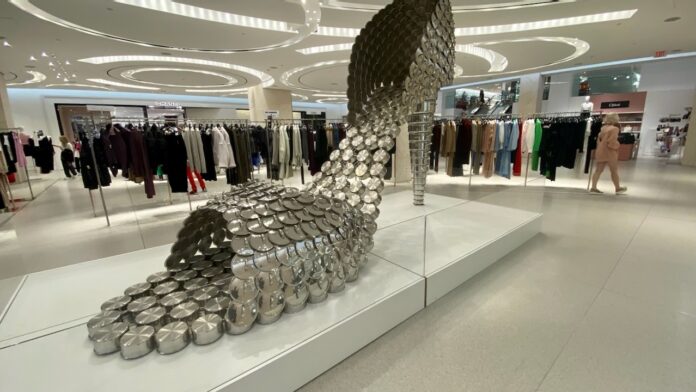
Carmen Miranda (Joana Vasconcelos, Artist) at Holt Renfrew Bloor Street Women's Luxury Designer Floor (Image: Craig Patterson)
The past three years have been a truly unprecedented period for luxury apparel retailing in Canada resulting in Canada being recognized as a major world wide market for luxury brands.
During the period, while the size of the Canadian luxury apparel market decreased because of COVID, the competitive intensity within the market increased significantly along with an unprecedented luxury retailing construction related boom, says a new report by Trendex North America, a marketing research and consulting firm.
“There is no doubt that the increase in the number of luxury apparel retailers, regardless of what country they came from, have served to offer Canadian consumers more luxury apparel choices. During both 2019 and 2020 two new luxury apparel retailers entered Canada. In 2021 the number increased to five and in 2022 nine luxury apparel retailers entered Canada,” says the 2023 Canadian Luxury Apparel Market report.
“In 2022 luxury apparel e-commerce sales increased by 9.8 per cent to C$236 million. The increase was driven by a number of factors: Holt Renfrew selling apparel on its website; Growth of omni-channel retailing and BOPIS; Increased millennial and Gen Z purchasing; and Growth in the number and importance of online luxury retailers including Essence.
“While e-commerce luxury store sales accounted for an estimated 9.4 per cent of 2022 Canadian luxury apparel sales, the channel had been, pre-COVID, growing at a significantly faster rate than the entire luxury apparel market.”
“Luxury creep” at the western end of the future luxury corridor at Yorkdale. Photo: Craig Patterson
Randy Harris, president and owner of Trendex North America, said the luxury apparel market last year grew by 7.4 per cent to C$2.5 billion.
Randy Harris
“The problem was that the market grew by 21.1 per cent, that is all apparel,” said Harris. “Luxury underperformed the total market last year and part of that reason was tourism was down, although it was up from the previous year. It was still way, way down. I think people were spending money on housing and that was taking money away. I think people were worried about inflation so they were holding back their cards.
“I would have thought the market would have grown more because of pent-up demand and stores being open but it just didn’t seem like that happened. I think the other thing is everybody knows there’s been this tremendous growth in luxury apparel retailing in the sense of companies have upgraded their stores and other companies have opened new stores like what’s going on in the mall at Yorkdale.
“So if you look at the big picture out in the street you think luxury is booming. It didn’t boom last year but we predict it will boom this year. We think there’s this delay in what’s happening.”
Yorkdale’s first luxury wing leads to the main entrance of Holt Renfrew. Photo: Dustin Fuhs.
Harris said there is no doubt from a market development standpoint there is increased competitive activity. Whether that expands the pie or all it does is it chops up everybody’s share in a smaller piece nobody knows at this point.
“I’m worried about that because I think competitive activity in a sense is growing at a much faster rate than is demand,” he said. “These companies that are doing all of this development or new stores have a planning cycle that is two or three years in advance.
“I think a lot of these people got ahead of themselves maybe because of COVID where they thought that things were really going to take off and then COVID hits and things slow down. Well, they’re committed. So they go and open all these new doors and I’m not sure if that was a mistake in retrospect but I understand exactly why it happened.
“So the question is really in the long term with more competitive activity can we tolerate it in Canada so that retailers can money. Because right now, except for a very few, I cannot see how they’re making any money.”
The Trendex report said several factors to varying degrees contributed to the growth in 2022 of luxury apparel sales in Canada:
The upgrading of luxury retailer stores. The expansion of luxury zones coupled with relatively low “High Street” rents has resulted in some luxury retailers either upgrading their existing stores or opening new flagship stores;
The expansion of the luxury zones specifically in both Toronto and Vancouver. In both Vancouver and Toronto the apparel luxury zones have continued to expand outward from their traditional boundaries in order to accommodate both the ever growing number of new luxury foreign retailers and facilitate those retailers wanting to open flagships stores. Additionally in Toronto Yorkdale Mall has become a luxury zone;
The upgrading/expansion of key A malls resulting in increased space for luxury apparel retailers. In an attempt to attract more luxury customers, some of Canada’s A malls have, or are in the process of, adding luxury wings (e.g. Yorkdale, West Edmonton Mall). Additionally, they have replaced, when possible, traditional tenants with luxury retailers and have encouraged luxury retailers to add flagship stores (e.g. Balenciaga);
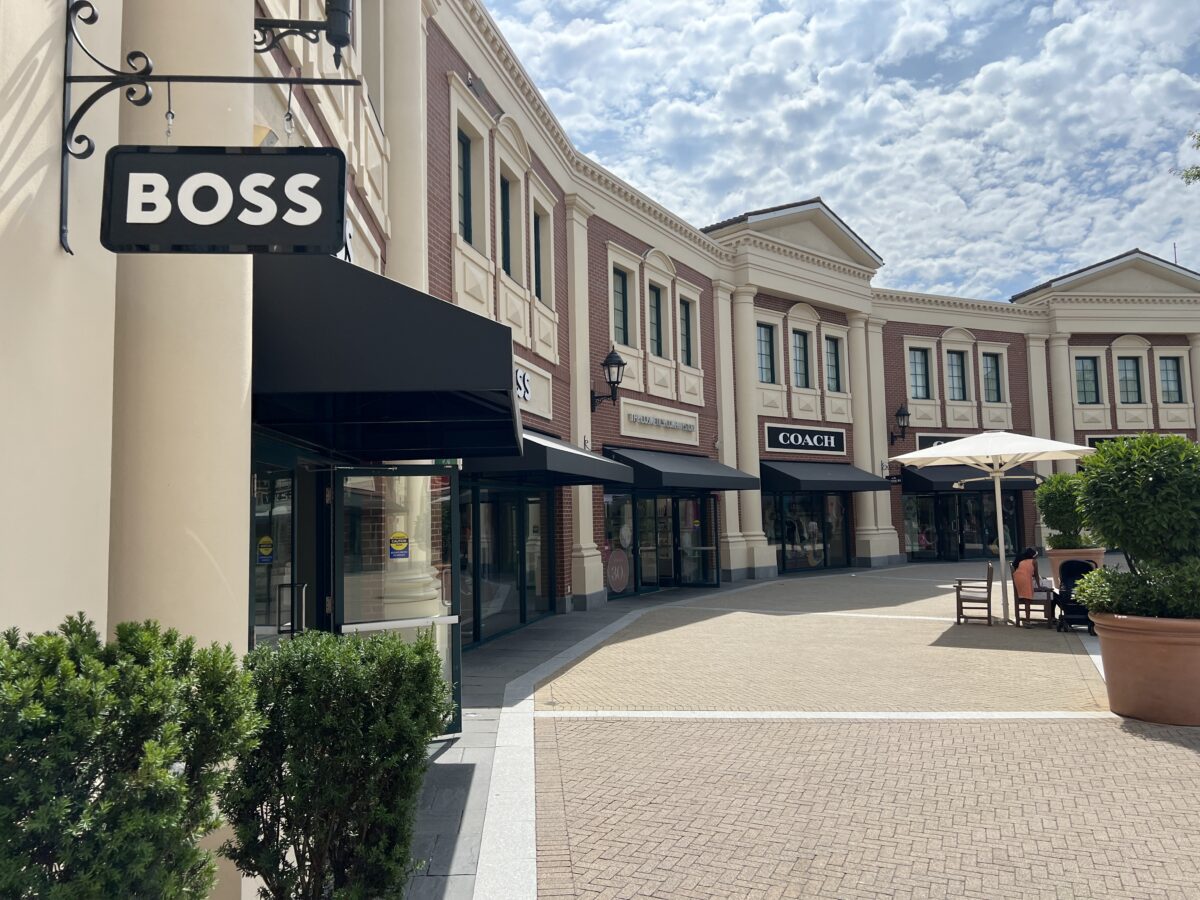
The increase of luxury retailers in Premium Outlet Malls. Over the past three years, there has been an increase in both the number of premium outlet malls (e.g. McArthur Glen Vancouver, Toronto Premium Outlets mall) and the luxury apparel retailers who have been drawn to the malls (e.g. Ted Baker, Armani, Hugo Boss, Gucci, etc.);
The increase in Simons luxury apparel/accessories sales. While historically not known as a luxury apparel retailer, Simons has continued to add a number of lesser known luxury apparel brands in its Edito departments and tailor the offering of the luxury apparel brands to each store’s trade area;
The increasing importance of Millennials. While millennials account proportionally for a small part of the total population, their interest in luxury apparel has made them the fastest growing segment for luxury apparel purchasing. Bain reported that in 2021 Generation Z and Millennials accounted for the majority of Global luxury apparel sales;
Less cross-border luxury apparel shopping by Canadians. The ever expanding number of luxury apparel retailers in Canada has resulted in Canadians buying less luxury apparel from retailers outside of Canada.
Harry Rosen Bloor Street (Image: Craig Patterson)
Harris said both Holt Renfrew and Harry Rosen gained market share in the luxury market. He added that Holt Renfrew has picked up market share with the departure of Nordstrom.
“I find that Holt Renfrew today is the most outstanding luxury retailer probably had one of the best years last year,” he said, adding that Harry Rosen benefited with people going back to the office.
“I think those two are pulling away from the rest of the market if you will because of what they’re doing and everybody is fighting among the rest. If you look at the big four as we call it – Saks, Nordstrom, Harry Rosen and Holt Renfrew – they control 47 per cent of the market. So all of these other boutiques and everything else are fighting over the other 53 per cent. And that’s the competitive framework that I don’t think people understand.”
Harris said he expects the market this year to grow by 11.1 per cent which is almost triple what the total market will grow which is 4.1 per cent.
“Long term if you at from 2022 to 2026 the growth of luxury apparel should be about 42 per cent over that period. That is one year compared to the other. Whereas the total market will only grow 15.4 per cent over that same five-year period,” he said.
“So the bottom line is last year the luxury market underperformed but long term its future is very bright.”
McArthurGlen Designer Outlet in July 2023. Photo: Lee Rivett.
The Trendex report said tourism has historically been an important contributor to the growth of Canadian luxury apparel retailing. However in 2021 the number of non-U.S. tourists visiting Canada declined by eight per cent following an 86 per cent decline the previous year.
“As COVID travel restrictions began to be lifted during 2022, non-U.S. tourism increased from around the world. In 2022, 3,957,570 non-U.S. tourists visited Canada, a 301.3 per cent increase from the previous year. During last year, tourism from Europe, which accounted for 53.4 per cent of non-U.S. tourism, increased by 354.2 per cent, while tourism from Asia increased 184.5 per cent. Tourism from a number of Asian countries including China (+77.6 per cent), Hong Kong (+269.3 per cent), and Japan (+363.6 per cent) increased significantly. The United Kingdom (16.0 per cent), France (12.0 per cent) and Mexico (9.4 per cent) accounted for almost 40 per cent of all non U.S. tourists in 2022.
Harris said there are a couple of things that could affect the Trendex forecast both short and long term. One is the growth of resale luxury apparel. To the degree that people buy used clothes, it’s going to have a detrimental effect on the total luxury market. Also in Canada there is more of a concern about inflation than there is in the U.S.
Loblaw Lower Jarvis in Toronto (Image: Dustin Fuhs)
The food inflation data for July is interesting and offers insights into the complex interplay of factors shaping our grocery bills. While some Canadians may be hesitant to acknowledge it, there is a gradual improvement taking place. The decrease in our food inflation rate from 8.3 percent to 7.8 percent, along with the narrowing gap between food inflation and overall inflation to 4.5 percent, provides a measure of reassurance. In simpler terms, while food prices remain elevated, the rate of food inflation is slowing down.
Consequently, we anticipate a potential decrease in prices for essential unprocessed food items like sugar, flour, and coffee in the coming months. However, the latest figures from Statistics Canada reveal a nuanced depiction of the myriad elements influencing the costs of our food. The impact of factors such as droughts and excessive rainfall, particularly in the eastern part of the country, has already affected food prices this summer. Yet, the broader effects of significant events like the multi-year pandemic and Ukraine’s unauthorized invasion are now clearly behind us.
The current monthly report presents Canadian consumers with a diverse range of price fluctuations across various food categories. For instance, meat prices have experienced a modest uptick of 1.3% from June to July. This could be attributed to a combination of factors affecting beef prices, including shifts in consumer preferences, disruptions in livestock production in Canada and the United States, and fluctuations in international trade dynamics. Similarly, the 1.2% rise in vegetable prices may indicate local and global supply uncertainties, exacerbated by potential weather-related disruptions impacting harvests in certain regions.
Notably, bakery and dairy products have seen slight increases of 0.8% and 0.6% respectively. These subtle increments reflect the intricate processes of production, transportation, and the numerous factors converging to deliver these staples to our tables. Meanwhile, the 1.0% decline in fish prices may highlight evolving consumer behaviours or shifts in the availability of imports.
A significant drop of 3.4% in fruit prices warrants closer examination. While this reduction could be welcome news for consumers, it also underscores the vulnerabilities that can disrupt the intricate journey from orchards to grocery stores during the peak of summer. Transportation bottlenecks, trade imbalances, and shifts in global demand are all contributing factors to such fluctuations.
Even in the broader context of the G7 nations, Canada’s food inflation data presents a unique narrative. Despite the fluctuations, Canada maintains the second lowest food inflation rate within the G7, underscoring a level of economic resilience in the face of global challenges. Only the United States currently boasts a lower food inflation rate, at 4.9 percent.
Quebec and Ontario, the country’s most populous provinces, demonstrate varying rates of food inflation. Quebec, with the highest rate among the provinces at 9.4%, reflects distinctive regional dynamics. In contrast, Ontario’s rate of 7.2% highlights a potentially different balance of supply and demand factors. While Ontario’s weather has been favourable for harvests, Quebec has experienced excessive rainfall that has damaged a significant portion of crops.
The discussion surrounding the carbon tax is also noteworthy. Amidst this intricate landscape, the impact of clean fuel and carbon taxes on food prices warrants consideration. While these policies aim to promote environmental sustainability, their direct influence on July’s food inflation remains uncertain. The complex interplay of market dynamics and government interventions makes it difficult to pinpoint the exact effect of these measures.
In the broader context, the increasing cost of lodging is becoming a significant concern for many Canadians. Rising shelter expenses are likely to place additional strain on Canadian households’ food budgets. The latest quarterly results from grocers reveal a growing preference for store brands and discount stores within a more cost-conscious consumer market, a trend likely to persist into the upcoming fall season.
Ultimately, the food inflation data for July encompasses more than mere numbers; it reflects the resilience of our agricultural systems when compared to other countries worldwide, whether or not Canadians fully recognize it. Having weathered the 18-month food inflation storm that is coming to an end, we should all acknowledge the delicate balance between fragility and resilience within our food supply. This realization should foster a collective commitment to ensure affordable and nutritious sustenance for all Canadians.
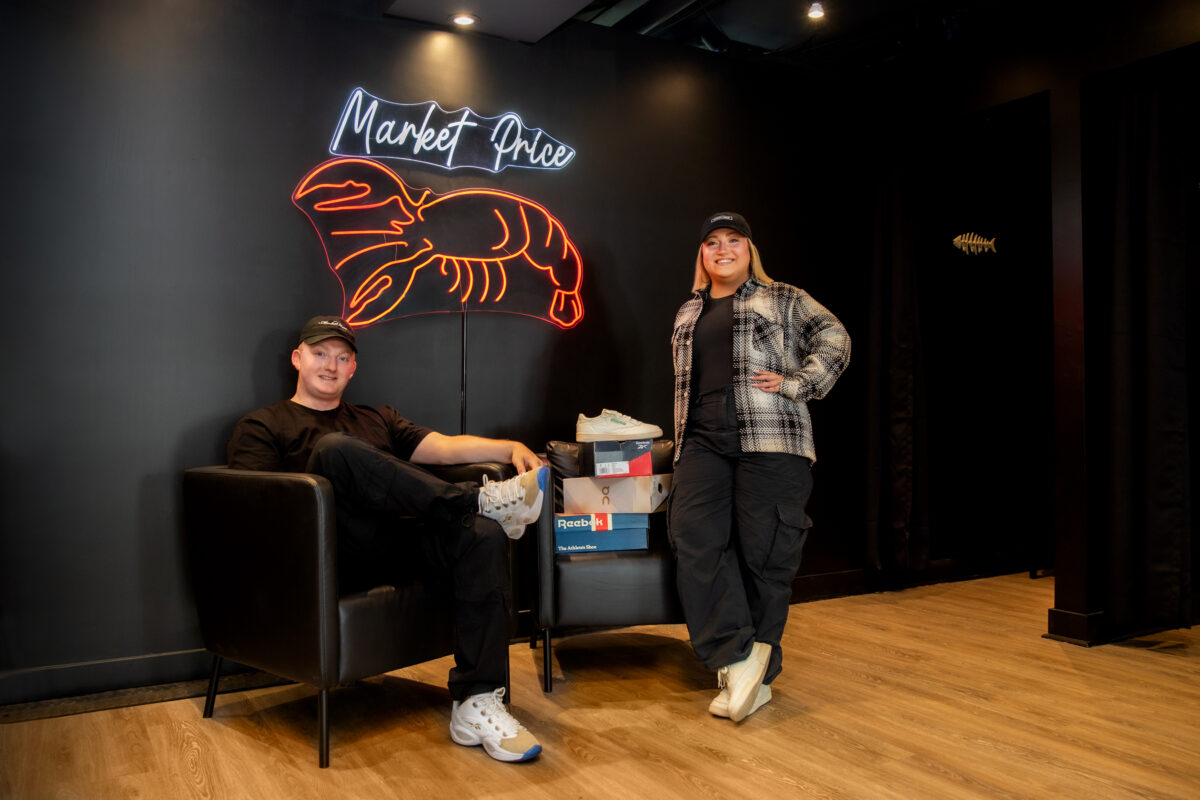
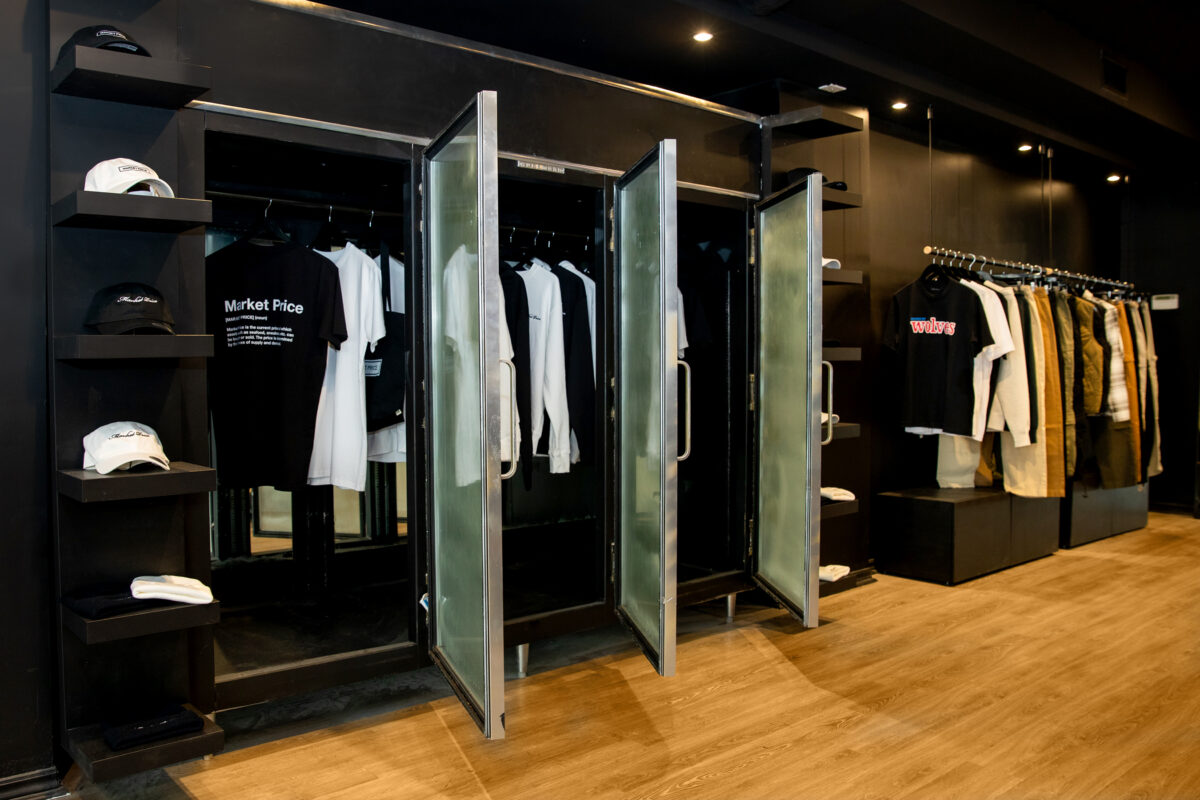
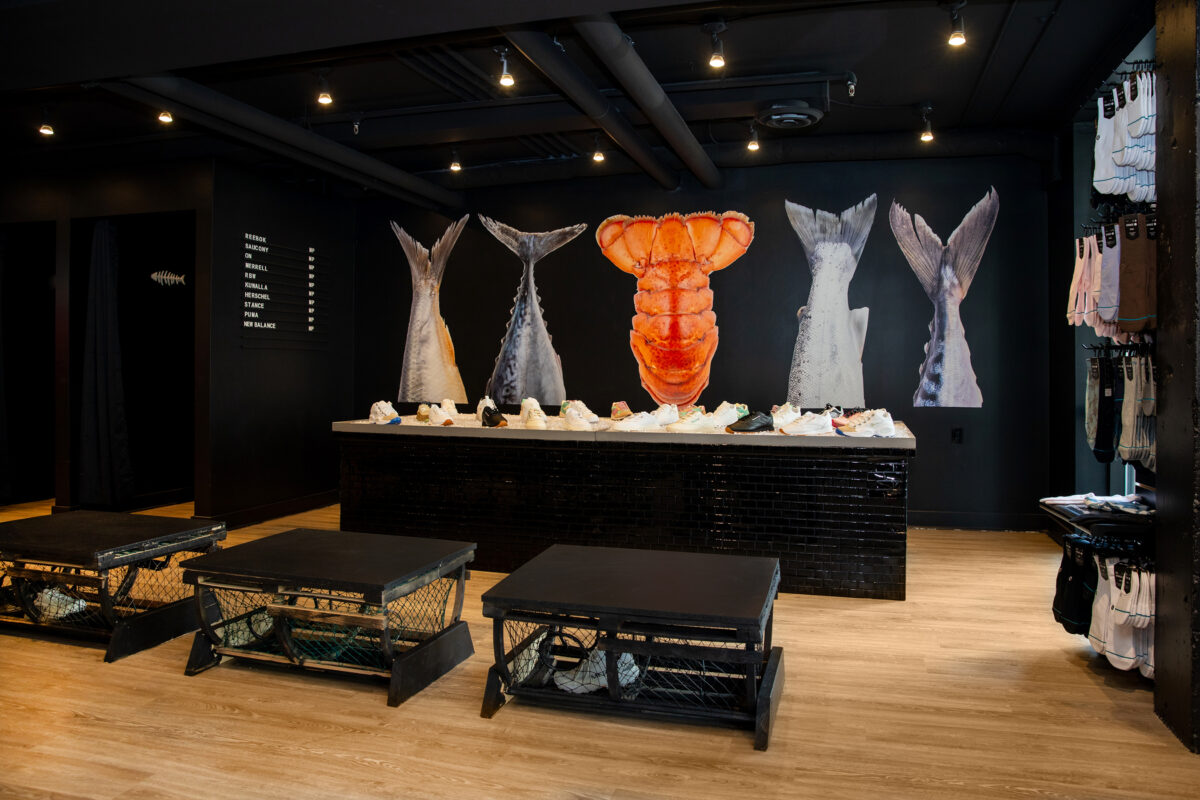
Market Price, a new concept store in Halifax, has opened its first location in Bishop’s Landing and has plans to expand throughout Canada and internationally.
The new location opened July 1st and will have an official grand opening on August 19th where there will be new releases, DJs, promotions, and giveaways. The founders, Lauren Ferguson and Matthew Smith, say the concept behind Market Price is to create a unique sneaker store in Canada that takes inspiration from the seafood industry and the East Coast culture.
“We decided to enter a really underrepresented market and create Market Price, the most unique sneaker store in Canada. In terms of the name, we really saw a parallel between the seafood industry and the sneaker industry when it comes to pricing. The seafood industry is always fluctuating and typically on menus you will see it labeled as market price and right now in the sneaker industry, we are sort of seeing the same thing with the resale of high end sneakers,” says Smith.
Founders Matthew Smith & Lauren Ferguson (Image: Market Price)
Ferguson and Smith decided on Halifax as the first location as the city currently has nothing to offer that is similar. Unlike larger cities such as Toronto or Vancouver, Halifax does not have a good representation of sneakers.
“Nova Scotia is really lacking in that really unique experience in shopping. We have so many students coming from big cities in Canada and internationally as Halifax has a lot of universities, but these students have nowhere to shop. We really saw the opportunity with the demographic here to be able to hone in and open up something really special and unique,” says Ferguson.
The storefront is located at Bishop’s Landing, a mixed use building of residential, shopping, and restaurants on the Halifax waterfront. Ferguson and Smith decided on this location as it was perfect under their seafood concept as it is along the waterfront. The boardwalk also attracts a lot of tourists, is within walking distance from the universities, and Smith says Bishop’s Landing ended up to be the perfect location for the brand.
Brand Partnerships And In-house Collections
Image: Market Price
Consumers can find a variety of products in apparel, footwear, and accessories. Ferguson and Smith say a lot of people think they are a resale store, but are wrong as Market Price works directly with brands under partnerships.
“We have brand partnerships we work with. So on the sneaker side, we have New Balance, Reebok, Puma, Saucony, and a few other brands as well. And then on the apparel side, we really want to focus on Canadian streetwear brands. When we were in New York City, you would walk into a store like Macy’s or Nordstrom and you would see Canadian brands on the shelves, but in stores in Halifax – you are not seeing a representation of Canadian brands,” says Smith.
Market Price also has its own in-house offerings that will be released seasonally. The current collection is Launch 23 and will be offering a limited edition collection at the grand opening.
In terms of shopping online, Market Price is available throughout Canada and for certain products, Smith says they ship internationally.
Coast to Coast Expansion Plans
Image: Market Price
“We would love to keep the same story behind seafood and the East Coast is not the only place where you see that – it is coast to coast. There are lots of people who move from the West Coast from the East Coast and to cities such as Toronto, Calgary, and Edmonton that want to feel the sense of home,” says Smith.
Within the next ten years, Smith says they would like to expand Market Price by adding three or four locations and then in about ten years expand internationally.
Smith and Ferguson see potential opportunities to take Market Price into the international market. Keeping the original connection with seafood, Smith says they would be looking to expand in Asia and in Europe as those places also have a strong seafood culture.
“Our consumers have really thought it is something totally different, something they have never seen before – but they are embracing it and willing to understand what we are trying to do and I think it really does resonate with the East Coast consumer. The seafood culture here is something that is home to people, so it feels comfortable when they come into the store. It takes a really interesting spin on what they are used to and it is really becoming a destination location,” says Ferguson.
Future Kith Toronto Yorkville (Image: Dustin Fuhs)
Craig and Lee discuss the exciting arrival of Kith, an international fashion brand known for its trendy streetwear, in the upscale Yorkville area of Toronto. The 10,000 square foot store will feature a unique ice cream bar concept called Kith Treats. This move is expected to attract a younger, affluent demographic and enhance Yorkville’s reputation as a high-end shopping destination. Other retail developments in Bloor-Yorkville are also covered in this episode.
The Weekly podcast part of theThe Retail Insider Podcast Network by Retail Insider Canada and is available on Apple Podcasts, Stitcher, TuneIn, Google Play, or through our dedicated RSS feed for Overcast and other podcast players.
Announcer 0:00 This is a Retail Insider Podcast. You’re listening to “The Weekly”.
Lee Rivett 0:08 Welcome to this week’s episode of “The Weekly” by Retail Insider. I’m Lee Rivett and I’m joined with the owner and publisher of Retail Insider Media, Craig Patterson, to discuss this week’s most read articles on retail-insider.com. So thanks for joining me, Craig.
Craig Patterson 0:22 Hello, everyone.
Lee Rivett 0:23 And for this week, we have a new retailer coming to downtown Toronto in the Yorkville area called Kith. So where do you want to start, Craig?
Craig Patterson 0:30 Well, this is a really interesting one. We’ve been sitting on this information for a while. It’s a international brand – well its based in the United States, called Kith. A youthful, retail brand and has a few stores around the world. Really hugely popular amongst younger people. I found this out a few months ago when I started talking to people about it asking some questions because I was familiar with the name, but it wasn’t as familiar with the brand – because I’m too old and not cool enough. But learning that Kith was coming into Yorkville was something that ended up being an exciting announcement. Especially when I mentioned it to a couple of the 20-somethings that work with us or associated with us at Retail Insider. They were very, very excited when this announcement was made. And they started explaining to me more what the concept was about and really what it is Ronnie Fieg – who’s been iconic apparently according to Darryl on our team – has founded this brand called Kith. It’s mainly a fashion brand known for its streetwear I guess you would say. Quite casual clothing and the prices are not cheap. It’s not you know, fully a luxury price point but it’s not certainly inexpensive either. T shirts might be $100. A lot of stuff is over $100. Coming coming into Yorkville and creating some excitement.
Lee Rivett 1:49 Well as it comes into Yorkville, do we know what the store is going to look like or what’s going to be in it?
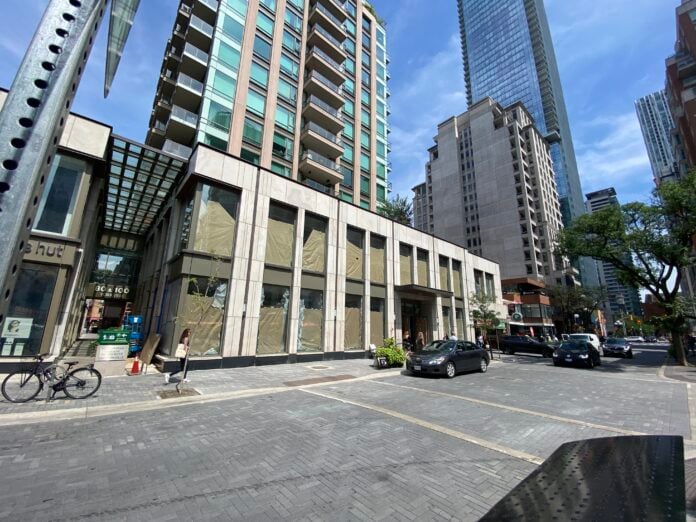
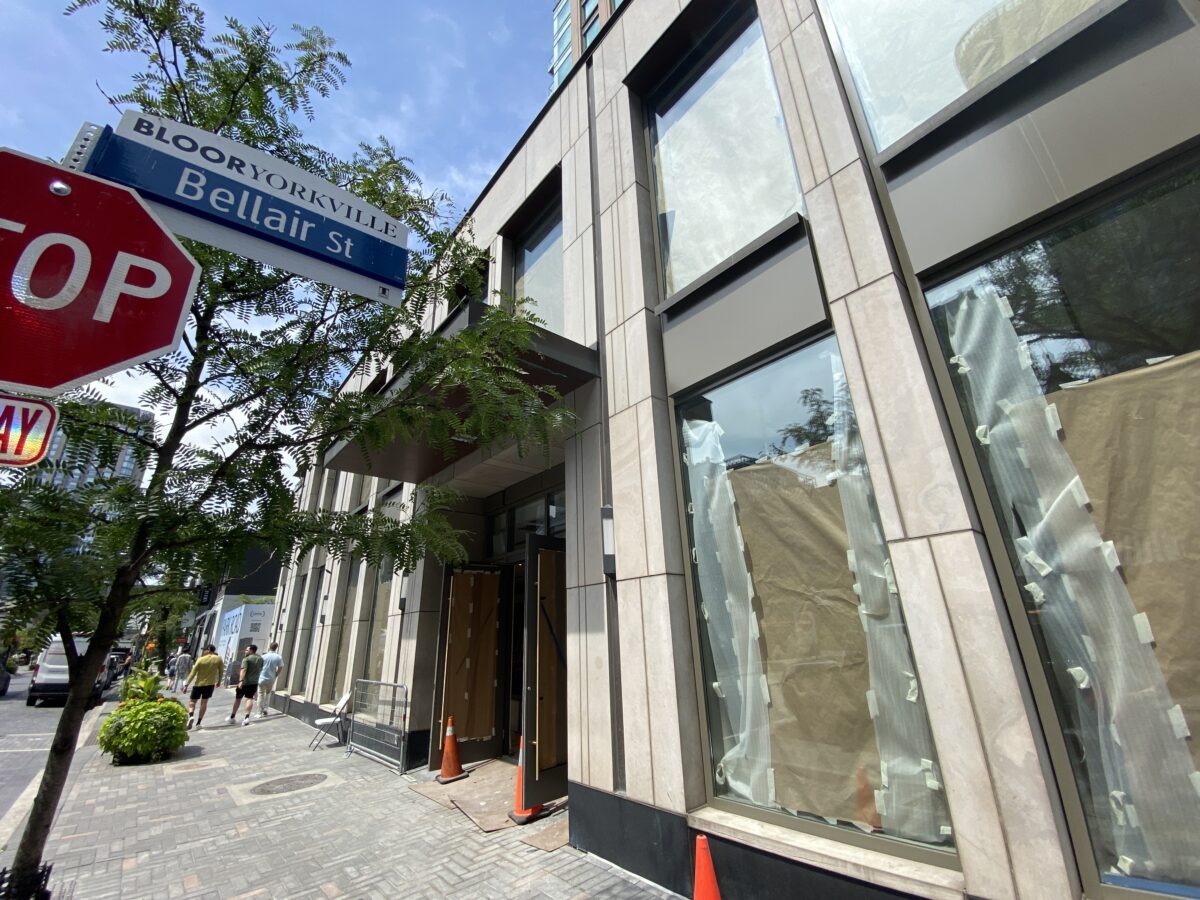
Craig Patterson 1:54 So what we know so far – we don’t have all the details but – the store is gonna be about 10,000 square feet, roughly. It’s going to be in a retail space that was vacated a couple years ago by a retailer called Anthropology. It’s located at 78 Yorkville Avenue. So it’s kind of at the foot of Bellair Street if you go north on Bellair street (where I live) right on Yorkville Avenue. That’s where this new Kith store is going to be. And what do we know about what’s going to be inside? Well, we know it’s going to be two floors. I’ve seen some renderings just fairly rough. I think that there’s some blue that’s involved in the interior in terms of the design, I saw some curved walls that looked really quite interesting. It looks like it’s going to be a really neat space, it’s going to have windows that are open on Yorkville Avenue that shouldn’t be a surprise for those who know the building. And it’s going to have something inside called Kith Treats, which is basically an ice cream bar concept or I think it involves an element of a cereal bar as well. These are located in these Kith stores and in the larger ones anyways, I should say which this definitely will be and will be a I think an extra element of fun as well as something to draw people there. I’ll probably go for the kith Treats. I may not be buying the clothing because I’m not cool and cool enough and I’m too old, but I will maybe I’ll buy a couple things but I nevertheless, I think it’s going to be an exciting addition to the neighborhood for a variety of reasons.
Future Kith Toronto Yorkville (Image: Dustin Fuhs)
Lee Rivett 3:22 And I know that in downtown Toronto, there’s always a lot of hype for the Yorkville area – the shopping district that has a lot of the high end shopping and so on – but why do you think that this would be a good thing for the neighborhood of Yorkville?
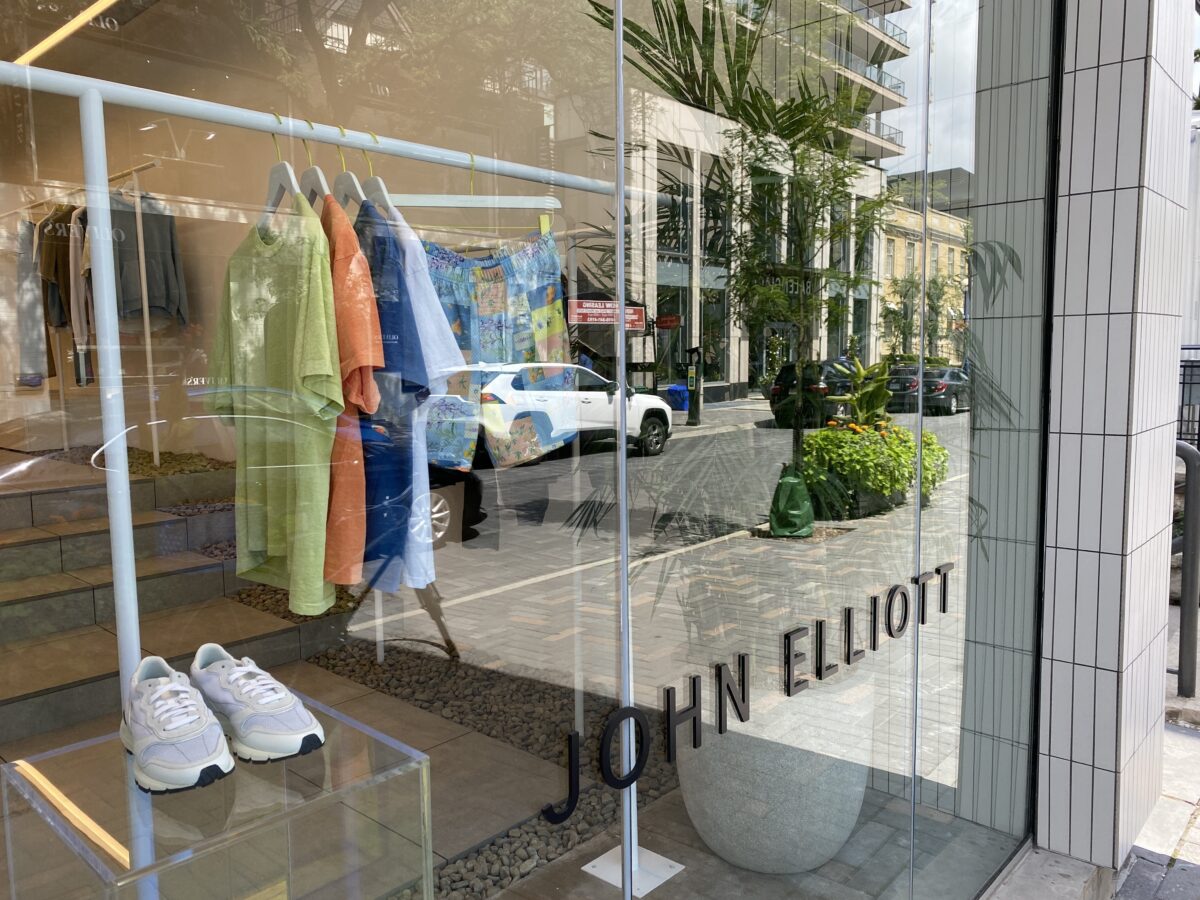
Craig Patterson 3:36 I think for a few reasons it’s going to bring a young demographic into the neighborhood not that we don’t necessarily have that but Bloor Yorkville as as a neighborhood certainly has a bit of an older shopping demographic. Or at least until recently we started getting these really cool stores in the neighborhood. And again the customer that is gonna be shopping at Kith is going to have to have some money, there’s no question there. Whether or not they’re saving up their allowance or whether or not they just have money. I mean, there’s lots of youth that seems like in Toronto for one reason or another that have have a lot of money to spend. So this will bring that demographic into the Yorkville area. It’s going to be better for the neighborhood. It’s going to increase foot traffic. It’s going to give Yorkville that ‘cool factor’ that it may not have had before with this new type of retailer and I think it’s going to be good for some of the other retailers that are in the neighborhood as well. Another US based brand that’s quite youthful is John Elliott was just opened at the beginning of July across the street on Yorkville Avenue. Again another exciting announcement, interesting looking store. The Webster opened its first and currently only Canadian location in Yorkville just on Scollard Street right around the corner. Much more expensive I think in terms of its price point, but it does have that edgy kind of fashion. I think that the Webster actually does complement Kith quite well as being another US based high end multi brand retailer that is coming to the area. One thing I should say about Kith as well as Kith does have not only its own Kith brand within the stores, but it does carry some other brands as well. So, it is a bit of a multi brand retailer but a lot of people I think will know Kith for the actual Kith brand which I think I haven’t been into the Kith at Selfridges in London but I think that’s probably what that one would have. I can ask buddy of mine that was just there on the weekend visiting the UK. It’s a smaller concession within Selfridges. So But nevertheless, the big store here is probably going to have a few other brands as well that would be in the streetwear space and would be quite expensive, I think. So exciting retailer to have coming into the neighborhood.
Lee Rivett 5:50 And I know that Yorkville is a very established neighborhood – with retailers that are coming and going – but it’s a neighborhood as opposed to a mall. Now is there any retailer that you would think that may not be happy that Kith is coming to the neighborhood?
Craig Patterson 6:05 Well, there’s one retailer that could either benefit from this or could lose a little bit of a market share, I guess depending on how you look at it. CNTRBND has been in the Yorkville area for at least I think a decade now. It’s primarily Menswear. It’s a multi brand retailer with really really edgy unique stuff in it. My thought would hopefully be that these are going to be complementary brands and that people will shop both at Kith as well as a CNTRBND which again is a very trendy, youthful retailer. CNTRBND has two locations in Yorkville. It’s got its main store at 135 Yorkville Avenue, which is over towards Avenue Road, as well as I think it’s still called Archives by CNTRBND. It’s located on Bellair Street, really, really close to Kith. Actually, if you have a good throwing arm, you could throw a rock between one and the other. With my shoulder injury, I won’t try it but nevertheless probably could otherwise.
Lee Rivett 6:59 It seems to be a clustering of the youthful brands that are coming into the Yorkville area, right?
Craig Patterson 7:05 I think it’s really good news for Yorkville. And also I think it’s good given what we’re seeing with Yorkdale being definitely a destination for high end retail right now.
Lee Rivett 7:15 When I kind of see Yorkville as more of a high end retailer “Mecca”, right. And then if I was to go to “streetwear” I would kind of think of more “mall”, in my opinion, but does Yorkdale actually have any streetwear at all?
Craig Patterson 7:30 Yorkdale doesn’t necessarily have as much in the way say streetwear brands other than maybe what’s carried in retailers like Holt Renfrew which really does have a lot of expensive streetwear, very top brands whether or not that’s Givenchi, Balenciaga, Imiri – again Palm Angels. I was just talking about those brands being at the Webster but they’re also up at the Yorkdale’s Holt Renfrew Store as well as Holt’s Toronto on Bloor Street.
Yorkdale Shopping Centre (Image: Craig Patterson)
Lee Rivett 7:41 While we’re on the topic of Yorkdale like what luxury is happening up in that neck of the woods?
Craig Patterson 7:57 Yorkdale is certainly getting a lot of luxury stores – it’s about to get a lot more – it’s just like it never ends. So anything that can be done in the Bloor Yorkville area to bring in shoppers that can afford to buy things I think is really, really important. Just given that we have these two nodes that are playing off of each other in the Toronto market for high end retail. They’re really the primary two nodes now, I would say is we’re seeing the city continued to develop. And again, I think just having Kith in the Yorkville area is is a really wonderful addition to the neighborhood. It’s going to bring youthful shoppers down with some money and it’s going to, I think, hopefully maintain the neighborhood as a destination as opposed to perhaps some shoppers going up to Yorkdale. Not that I’m saying people shouldn’t go to Yorkdale but just we want to see Yorkville continues to succeed as well just because it hasn’t lost its luster but it certainly has lost some shoppers to Yorkdale. There’s no question just because Yorkdale has some stores that Yorkville doesn’t have and that may change in the future and is beginning to but nevertheless – it is what it is. I think things are going to continue to progress.
Lee Rivett 9:07 Now do you think that Kith will bring more streetwear brands to the Yorkville area?
Craig Patterson 9:11 Quite possibly, I’m not aware of any names yet specifically. I wouldn’t I wouldn’t doubt it at this point. We had a trendy sneaker store – was it called “Capsule”. I don’t know if it’s still there.
Lee Rivett 9:25 Oh, no, no, it’s still there. 69 Yorkville Avenue. It’s down in the lower level.
John Elliott Toronto Yorkville (Image: Dustin Fuhs)
Craig Patterson 9:29 Oh, yeah. Yeah. And I think more youthful streetwear brands could look at Yorkville after the opening of Kith and with John Elliott being in the neighborhood with CTRBND having its presence. This could become another node for for street wear. Particularly I think being expensive. Just given the demographic we would be seeing coming into the neighborhood, the demographic that lives in the Yorkville area, that demographic that’s coming up because there’s a few thousand residential units that are proposed are under construction right now in the area. Quite some of the are very expensive depending you got some smaller units but you also have quite a few units priced at over $5 million. Maybe some younger people might be in there I don’t know a lot of retirees will probably be moving in as well. But I think on top of that, again the rents just being a little bit higher in Yorkville are going to bring in higher end retailers that can afford to pay the rents versus those that can’t.
Lee Rivett 10:20 Well, moving away from Kith, what else is happening in Yorkville?
Craig Patterson 10:23 What we’re seeing a few other retailers opening. I think pretty soon we’re going to see that luxury resale retailer “Mine and Yours” based out of Vancouver opening its first store in Toronto. Courtney has been posting on social media that it’s coming – it was her birthday recently too. That’ll compete and probably compliment Oliver’s or Oliver’s Jewelers (I don’t know if it’s called jewelers because it’s mainly luxury bags. I think it’s got some jewelry). But Russell the Cash Man has his store which has been operating for a couple of years across the street on Yorkville Avenue. Again, Reformation opened just at the end of 2022 – Los Angeles based sort of eco friendly bohemian women’s fashion brand – is not super expensive. It’s not cheap, but it’s not a luxury brand. We reported recently on it was at the hand cut diamond concept VRAI opening at 111 Yorkville Avenue upstairs. Which on the main floor is a retailer called Veronica Beard, which also just opened quite recently. It’s the first one in Canada. It’s a New York City based women’s fashion brand. So Yorkville Avenue is hopping I mean in terms of getting retailers on the street. Diptyque, the French fragrance and candle branded lots people know it for its candles, recently opened a shop. It’s there for a period of time, it’s kind of a pop up only because the building at some point will be demolished. I’m not sure exactly how long it’ll be there for but it’s it’s a cute looking store. It looks great. I popped in last week to look around and I think it’s a terrific addition to the neighborhood. So Yorkville Avenue is coming together. I’ve been watching this progression, I think from the beginning, when Christian Louboutin opened on Yorkville Avenue in 2016. That was kind of the beginning of what we were seeing with this new luxury push. So the street already had a few fancy stores it had Kiton, which is part of the V Hazleton store. But when Christian Louboutin came in with its corporate store, that was 2016 I think, really the beginning of things and then from there and 2017 Chanel came in and I was just like, oh my god, you know when Chanel comes into the neighborhood. That’s when all the other brands really really take notice because it’s one of those super brands that exactly that really establishes something I mean, if if Chanel went into the downtown East side of Vancouver and if zoning permitted it, you will start seeing other brands like that probably moving in. Maybe I’m being really optimistic, but that would be my guess if it ever happened, which it wouldn’t but you know, anyways, that’s sort of how luxury retail works. So with Yorkville Avenue, that was the progression that we saw with Christian Louboutin, we saw Chanel come in and the First Capital REIT formerly Realty really has been instrumental in this movement along with its related consultants that we know having brought in brands like Versace, and Brunello cucinelli, which apparently is doing very well with it store in Yorkville Avenue, Stone Island, a contemporary brand with pretty pricey stuff. So again, the whole neighborhood is coming together which I think is terrific. And then on top of that, too, we’re seeing a bit of a movement along Bloor Street which is two blocks south of Yorkville Avenue.
Bloor Yorkville (Image: Dustin Fuhs)
Lee Rivett 13:20 Speaking of Bloor Street. Anything new going on there from the retailer front as well?
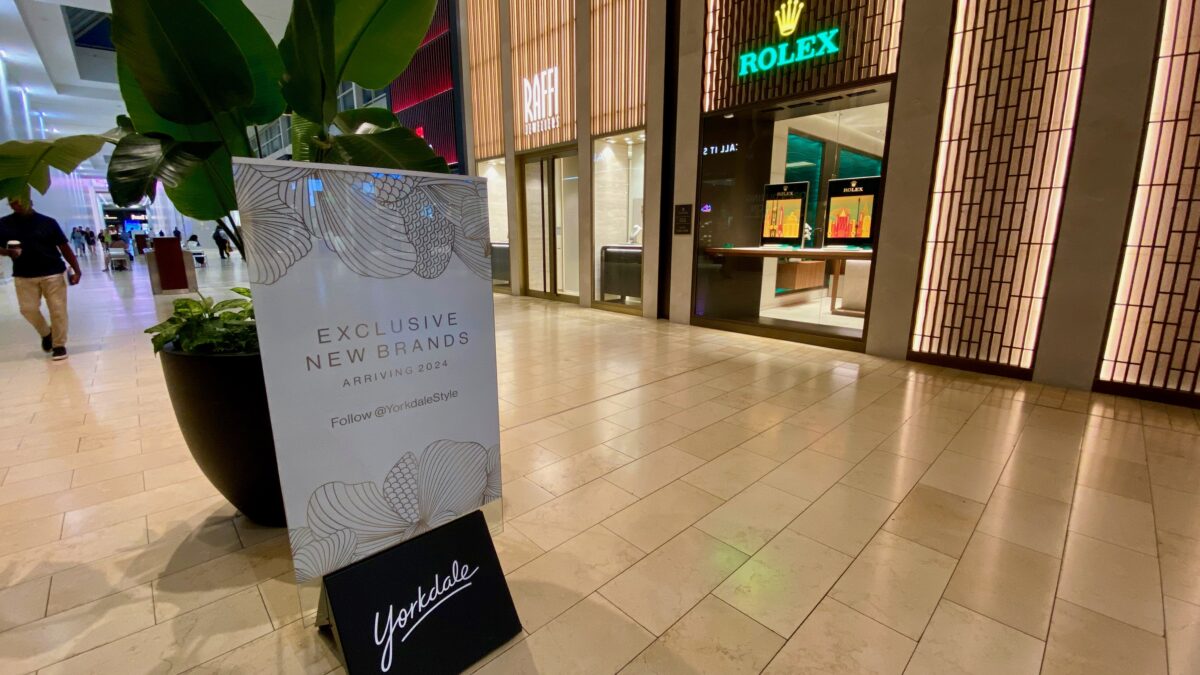
Craig Patterson 13:26 So Bloor Street, formerly “The Mink Mile”. There is a really exciting stuff happening on Bloor Street as well. So again, I’m just I’m so happy to see things coming together. This fall alone, Bloor street along that luxury run – which is kind of between St. Thomas and Bellair on the east side and Avenue Road on the west side just to keep it simple – we’re seeing stores for Rolex opening. Van Cleef and Arpels is doing a corporate store. Saint Laurent is gonna hop over from Holt Renfrew as a concession and do this 10,000 square foot flagship store at 110 Bloor Street West which is going to probably look like it’s about 20,000 square feet from the outside because I think it’s going to have a two level facade. So it’s going to be have this really significant presence on the street. Other new retailers coming in September or October (probably September), Alexander Wang, a New York City based fashion designer, Paris Baguette which Dustin and I actually toured the construction site a few weeks ago. I think Anne Fontaine is probably still coming I’m not sure I think so. And Bonpoint, which is a children’s retailer is gonna be opening at 151 Bloor Street West I should probably do an article on that. But that’s and then further towards Young Street on Bloor Street. There’s some interesting retailers coming. Hopefully that Apple Store is still coming of course. I mean, that was some news for a while but Arc’teryx, there’s a really big store under construction. It’s almost 10,000 square feet. I think it’s gonna have a double height facade as well, just looking at the way the building is during construction. Bloor Street is getting a new Browns shoe store, which is exciting. We need more footwear in the neighborhood, I think. And then eventually the Nordstrom Rack store there’s going to be an announcement made for the former Nordstrom Rack space for a new tenant there as well. So nearby there’s going to be Bowling Lanes at The Ballroom, which will have a food and beverage component to it. This is One Bloor Street East and more things are to come to the neighborhood. So Bloor-Yorkville I think is going to be a really, really interesting place to shop and to visit and to live over the next few years. And I mean, it’s a great place to visit and live. So I encourage people to come down visit, spend some money, there’s great restaurants, there’s all kinds of services, beauty services, if you want nail salons, hair, everything else. So it’s really this clustering of businesses as well as residents that have made Bloor Yorkville a very unique neighborhood. There aren’t many neighborhoods like this in North America. Very, very few actually. You do see around the world, a few global cities that have these types of neighborhoods like say Mayfair in London, or the Eighth District in Paris. Salamanca, I can’t pronounce that in Madrid. But anyways, you think of these different cities and these different higher end neighborhoods in the inner core. Well, this is one of them. So I’m excited to continue to report on Bloor Yorkville here is things continue to progress here with Retail Insider.
Former Dolce & Gabbana on Bloor Street (Image: Dustin Fuhs)
Lee Rivett 16:35 Absolutely. And again, thanks for going through Kith with me because that was a brand that I wasn’t as familiar with, as well as giving us a little bit of an update on Bloor as well as Yorkville, generally. So, again, thanks, and chat with you next week.
Craig Patterson 16:49 Absolutely. We’ll be reporting on Kith. We’ll be reporting on the opening. I’m excited to be there. And thank you so much everyone for listening. Take care and bye for now.
Subscribe, Rate, and Review our Retail Insider Podcast!
Drop us a line at Craig@Retail-Insider.com. You can also rate us in Apple Podcasts or recommend us in Overcast to help more people discover the show!
Background Music Credit: Hard Boiled Kevin MacLeod (incompetech.com). Licensed under Creative Commons: By Attribution 3.0 License. http://creativecommons.org/licenses/by/3.0/
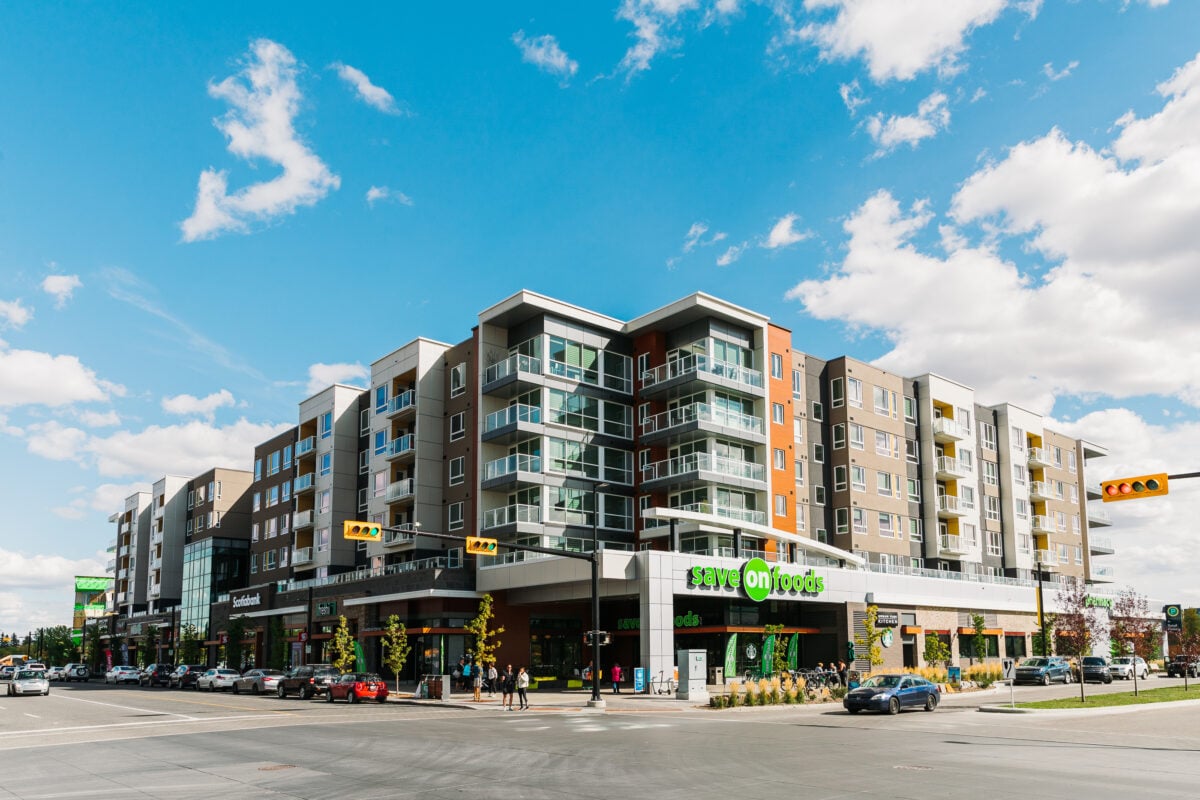
University District has already become a smash hit as one of the latest mixed-use communities in Calgary and there’s still much more to come for both residential and commercial real estate in the popular community.
University District is a 200-acre community being spearheaded by the University of Calgary Properties Group.
Gregg Callander, Interim President and CEO, said the project is about 45 per cent committed with either completed deals or deals in process in relation to overall land development.
“We’ve got a lot happening,” he said.
“It’s been very well received. Growth in demand is still there. Look at our builders. Avi is three buildings in and pushing on their fourth. Brookfield is the same. Truman has three sites being built here. We’ve got two more builders coming into play that I can’t announce yet.”
Image: University District
Callander said full buildout for the massive project will be another eight to nine years. At full buildout, there will be 6,500 to 6,700 residential units from townhouses to condo units.
“The one thing that’s being questioned is the amount of office. We originally planned for about 1.5 million square feet that would encompass the (Alberta) Children’s Hospital, the surrounding part of it but given the office market and looking at the recent study we just had done we may have to convert some of that office into more either mixed-use or just residential,” he said.
“We’re just in the midst of doing that for next year’s business plan, deciding whether we need to cut back on our office and re-look at what we can offer.”
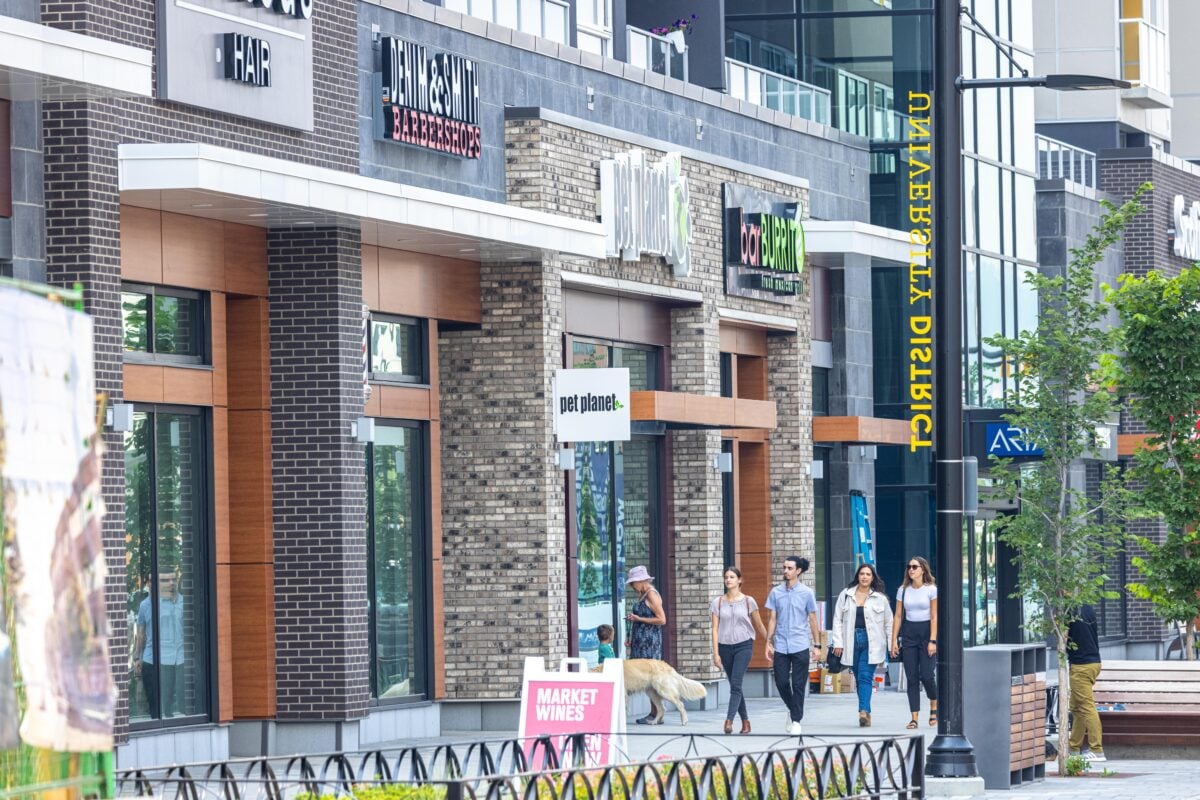
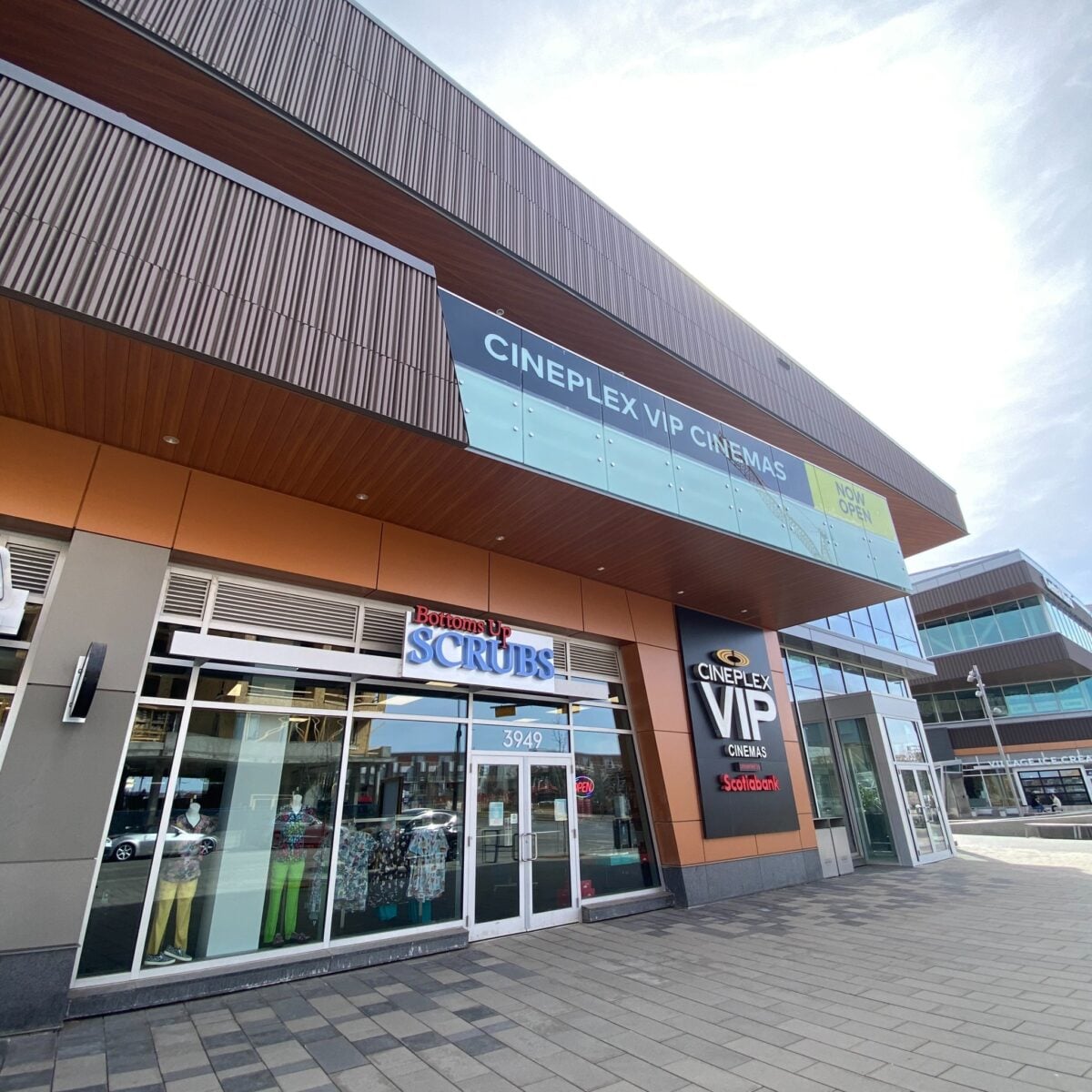
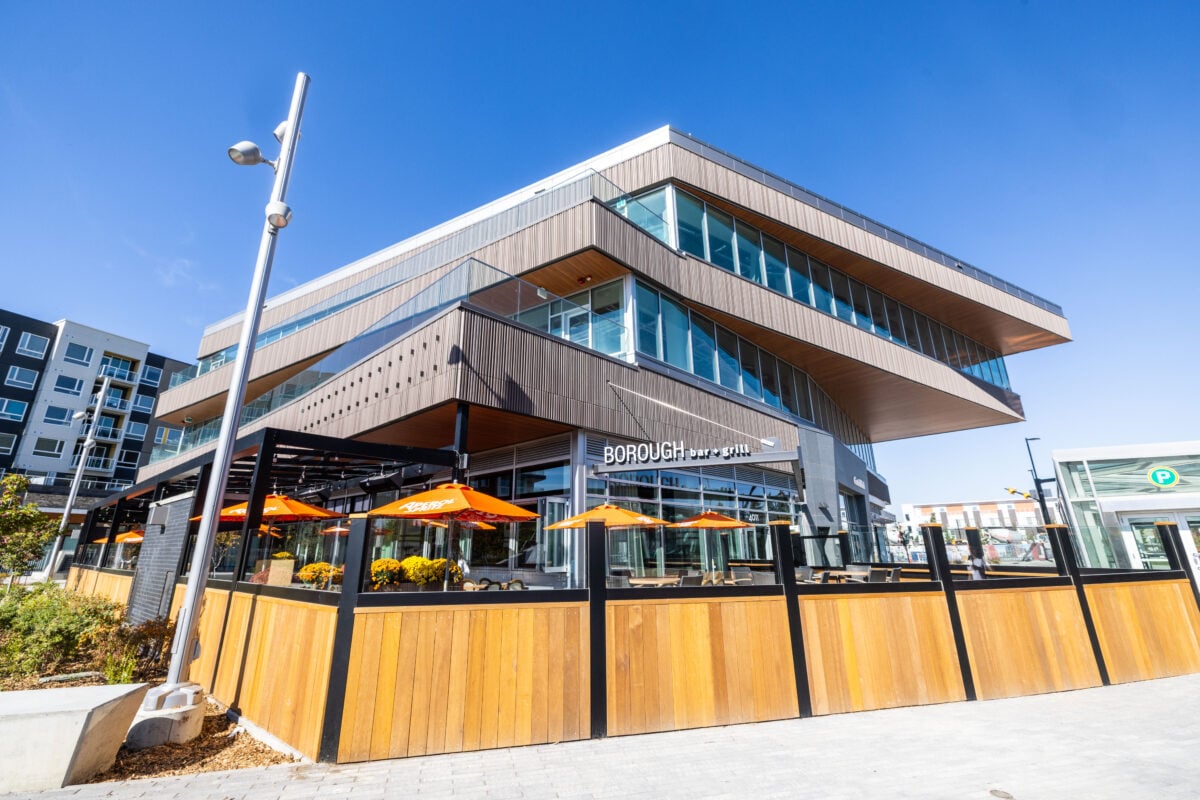
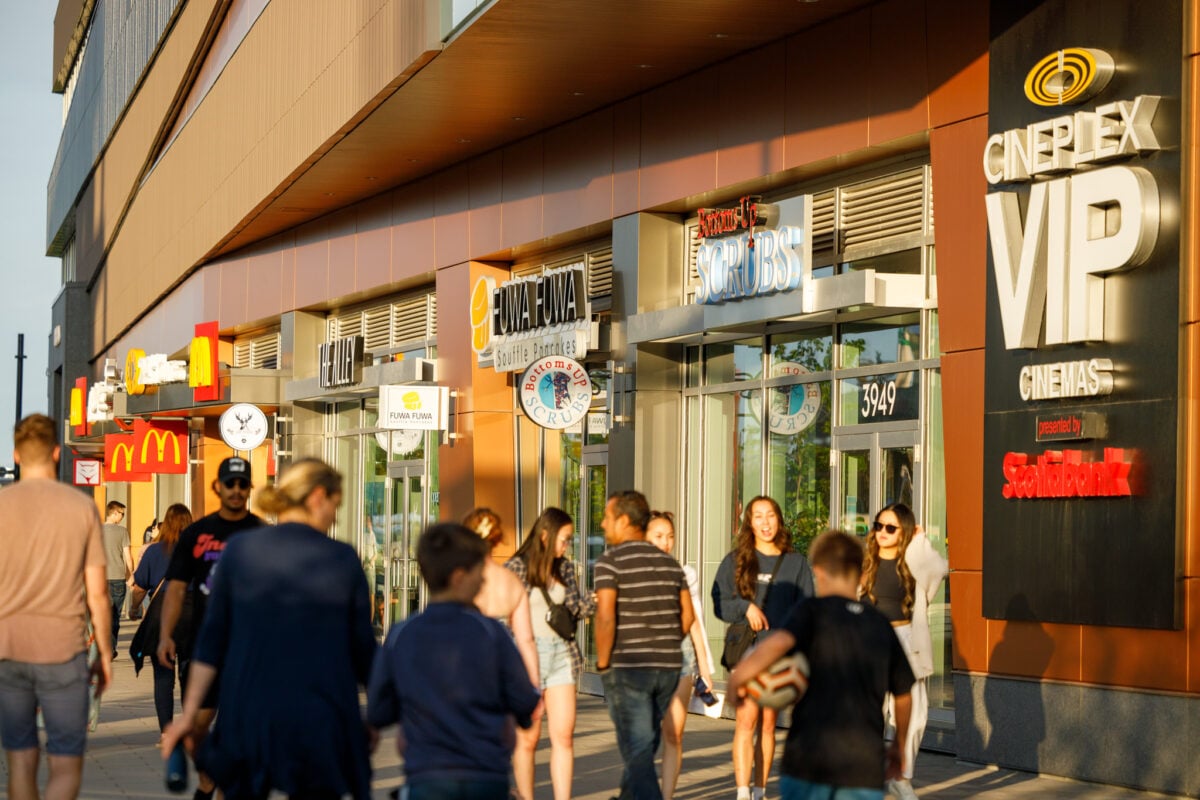
There’s also about 300,000 square feet of retail expected to be developed. More than 30 retail stores and restaurants are currently open with more to come in the near future.
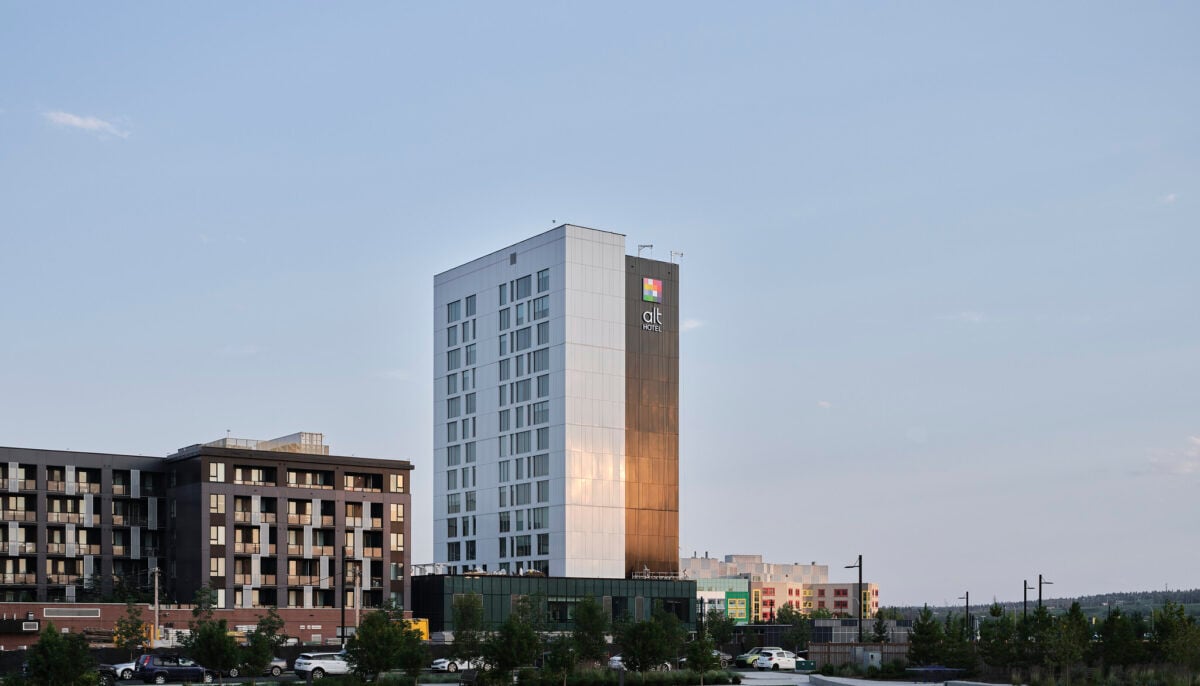
Recently the Alt Hotel opened at University District and under construction right now is The Forge, a purpose built residential rental building, Block 15, another purpose built residential rental building, Autumn by Homes by Avi (condos) and Dean’s Landing by Rohit Communities (condos/stacked townhomes).
Alt Hotel Calgary University District (Image: Germain Hotels)Image: University District
Coming soon to the development are UNA Pizza, Native Tongues, Easy Blink Optometry, Lagree YYC.
“We knew we had to get amenities in here first. Get the parks in place. Our first piece of retail had to have the amenities – the grocery store, the liquor store, the coffee shop, some quick fitness, quick food access. That was all built into our first phase of retail,” said Callander. “And then parking. Making sure our retail has sufficient parking. And given our land component we were able to put surface parking as well as underground parking in place to alleviate that issue. In retail people are used to the big malls, lots of parking.”
He said another key to the project’s success is how accessible it is just west of the main University of Calgary campus with major streets along the development. CF Market Mall is located kitty corner to it and the Brentwood shopping centre is nearby. Also the Alberta Children’s Hospital is on the site and the Tom Baker Cancer Centre and the Foothills Hospital are in close proximity.
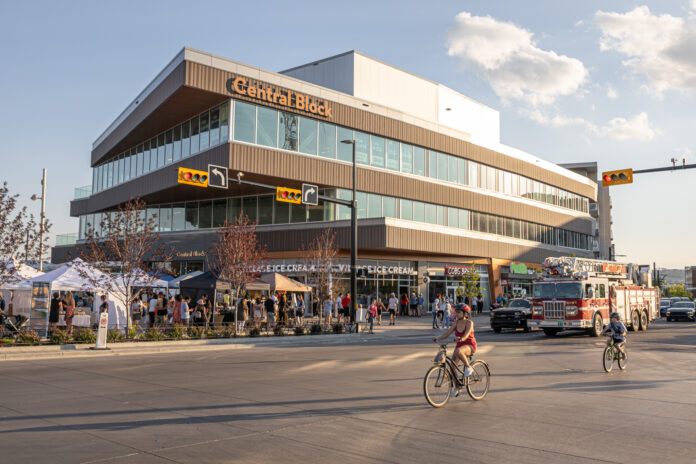
Recently, University District announced there are limited leasing opportunities in Central Block, located above Retail Main Street and overlooking Central Commons Park, a three-acre oasis often activated with events and activities as the heart of the community.
Image: University District
Three new businesses have recently confirmed they will be joining University District: Foothills Primary Care, Omega 365 and Aspire Medical Group (Aspire Medical).
Foothills Primary Care is now open in Block 23 and is a locally owned and operated family medicine clinic. Both Omega 365 and Aspire Medical are anticipated to open in fall 2023 and will be located in the coveted Central Block.
Aspire Medical will offer healthcare services with specialty trained physicians enhancing the medical field.
Omega 365 is a software company that caters to clients in the oil, gas, energy, renewables, mining, utilities, healthcare, and infrastructure sectors throughout Canada, providing both new implementation and ongoing project support for their project management tools.
Image: University DistrictImage: University District
Office space in University District is completely customizable and can be designed in partnership with University District to perfectly fit the needs of any leasing business.
“We’ve seen tremendous activity since Retail Main Street launched in 2020 with a growing list of more than 30 retail shops, restaurants, and services and look forward to welcoming more as the community continues to develop,” said Callander.
Many businesses have opened office space in University District in recent months and are currently operating in their new space. Clara Optometry, Cloudbreak and Staples Studio coworking space have all opened their doors in University District and are making use of their fully customized offices.
Callander said also planned for University District is a self-storage facility.