Positive retail leasing market momentum was evidenced during the first quarter of this year, according to Morguard’s 2023 Canadian Economic Outlook and Market Fundamentals First Quarter Update.
According to the report, the retail leasing market continued its positive momentum despite the news about notable closures as several segments, particularly in discount, restaurant and food, continued to absorb space across the country.
But a slow down is anticipated due to rising interest rates and inflation that are hitting consumers’ wallets.
“Several retailers expanded or announced plans to open new stores in the first few months of the year. There were several new entries to the Canadian market during the quarter. Much of the leasing activity and store openings reported during the first quarter were relatively smaller scale occupants,” said the report.
“There were relatively few new stores opened or announced with footprints of 10,000 square feet or greater. In addition, specific retailer categories were more active, in keeping with the recent trend. The discount, restaurant, and food services retail segments continued to absorb space across the country. Leasing activity will likely slow down over the near term, given an expectation of weaker consumer spending patterns and job growth. Net absorption will be offset by announced high profile store closures over the next several months. Nordstrom gave notice of its intention to exit the Canadian market. Bed Bath & Beyond will also close stores across the country. Despite the closures, optimism and positive momentum was evidenced in the Canadian retail sector during the first few months of the year.”
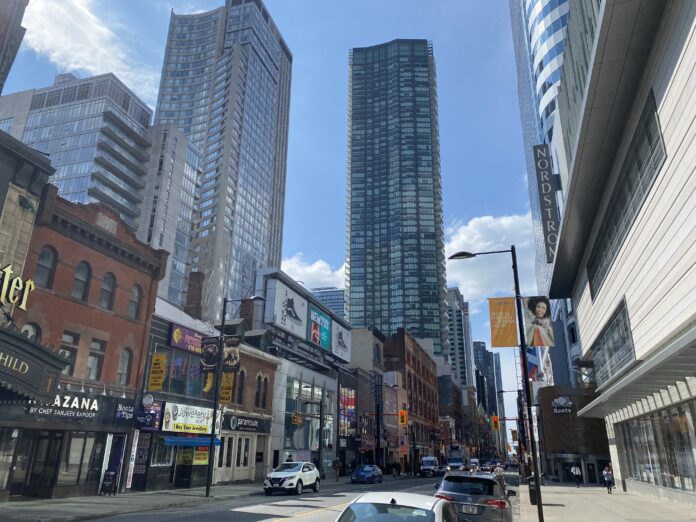
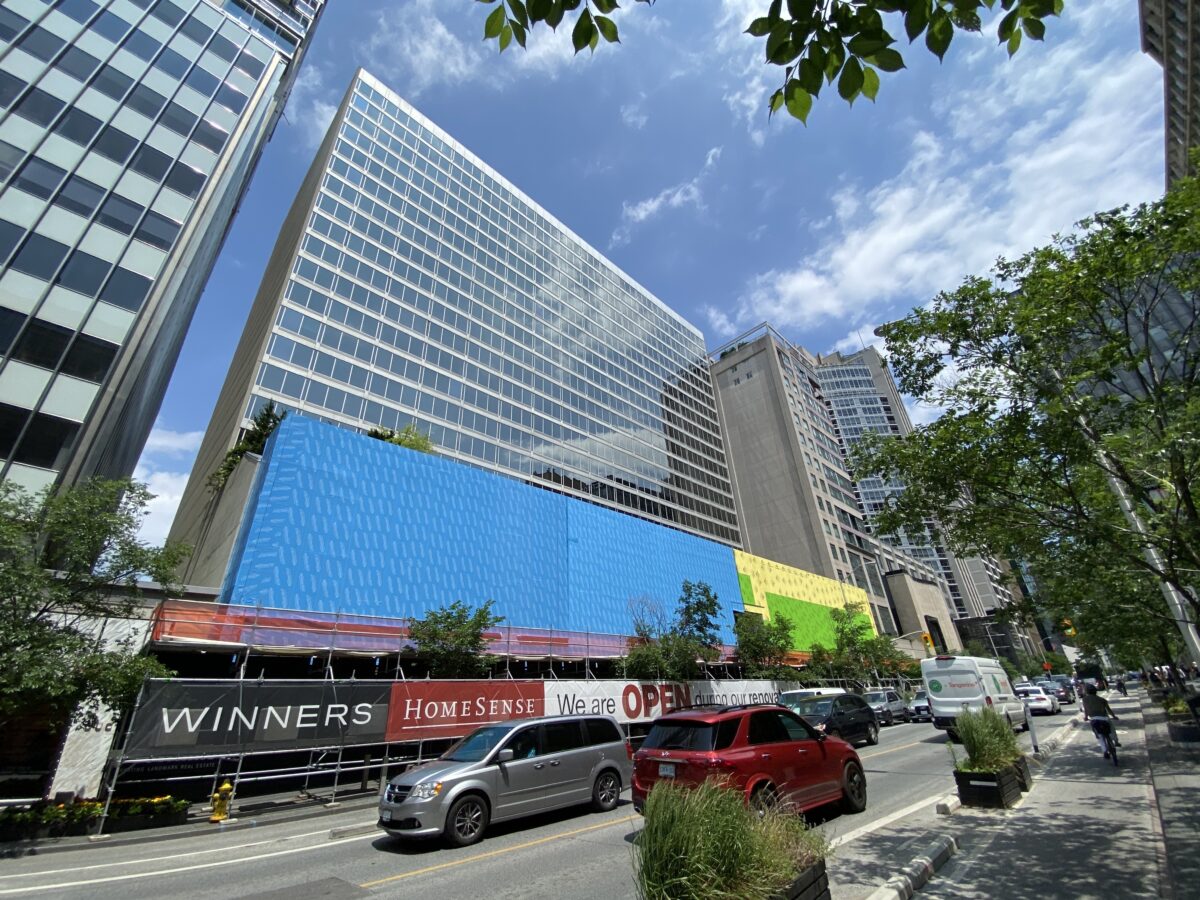
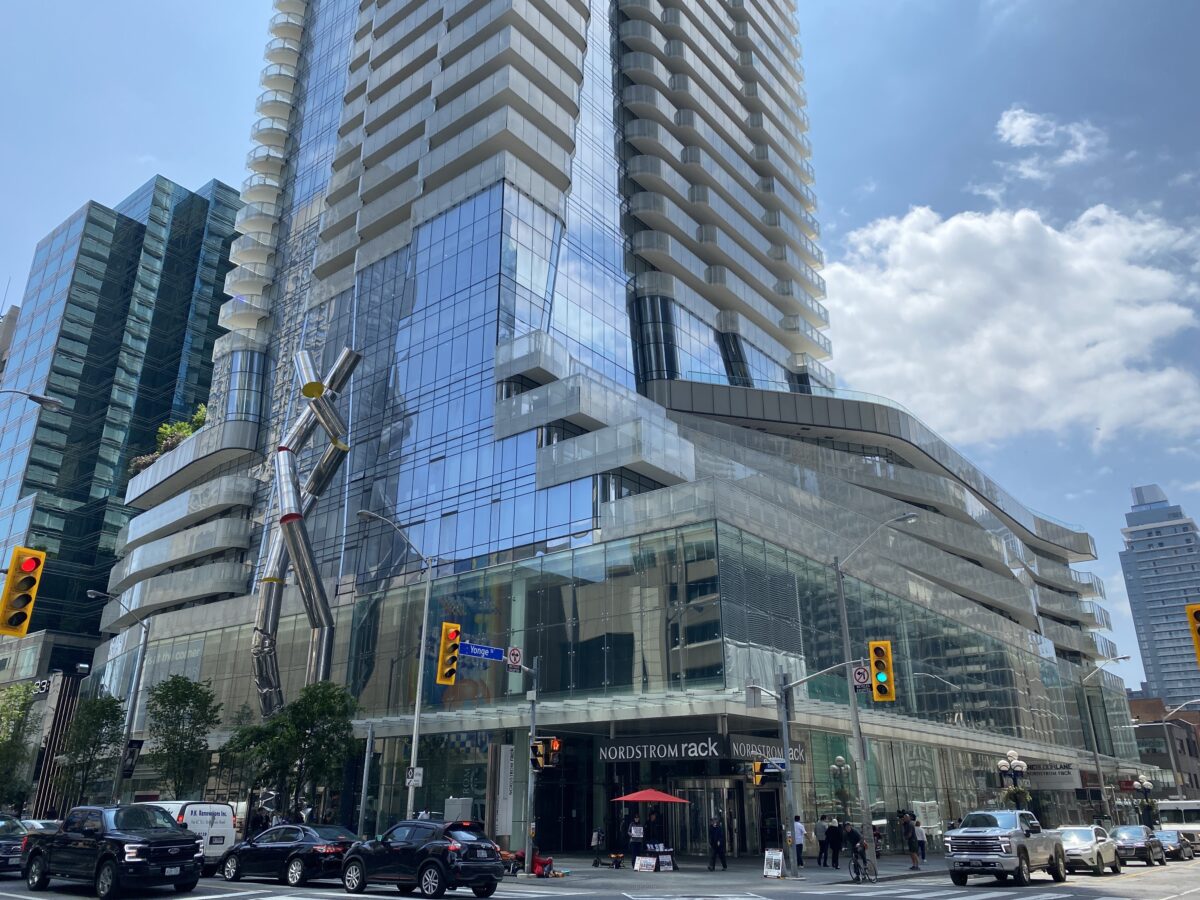
Construction at 110 Bloor (Image: Dustin Fuhs)Former Nordstrom Rack at One Bloor (Image: Dustin Fuhs)
The report said the Canadian economy stayed resilient in the first quarter – stronger than forecasted employment, wage growth and spending reflected economic resilience even though growth is expected to decelerate by summer.
It said Canadian consumers continued to spend relatively freely during the first quarter, despite a number of significant headwinds.
“In January, sales rose 1.4 per cent month-over-month, which was markedly stronger than most projections. Statistics Canada forecast January sales would rise by a less robust 1.0 per cent month-over-month. Inflation-adjusted sales were up 1.5 per cent in the first month of the year, driven in large part by vehicle sales. Consumer spending growth was expected to moderate in February and March, but remain at a relatively high level,” said Morguard.
“Stronger-than-expected economic and labour market performance was a key driver of sales growth in late 2022 and early 2023. Canadian households continued to grapple with elevated inflation levels. The high cost of essentials like groceries and accommodation eroded spending volume to some degree. Higher interest rates have also taken a bite out of spending in some households. Consumer confidence levels have declined with the threat of a recession, with some households choosing to delay spending on big ticket items. The nation’s housing market correction has also negatively impacted spending growth. Over the balance of 2023, consumer spending patterns are expected to soften, due in large part to weaker economic and job growth patterns. The softening will moderate in late 2023 or early 2024, given an expectation of lower interest rates and inflation.”
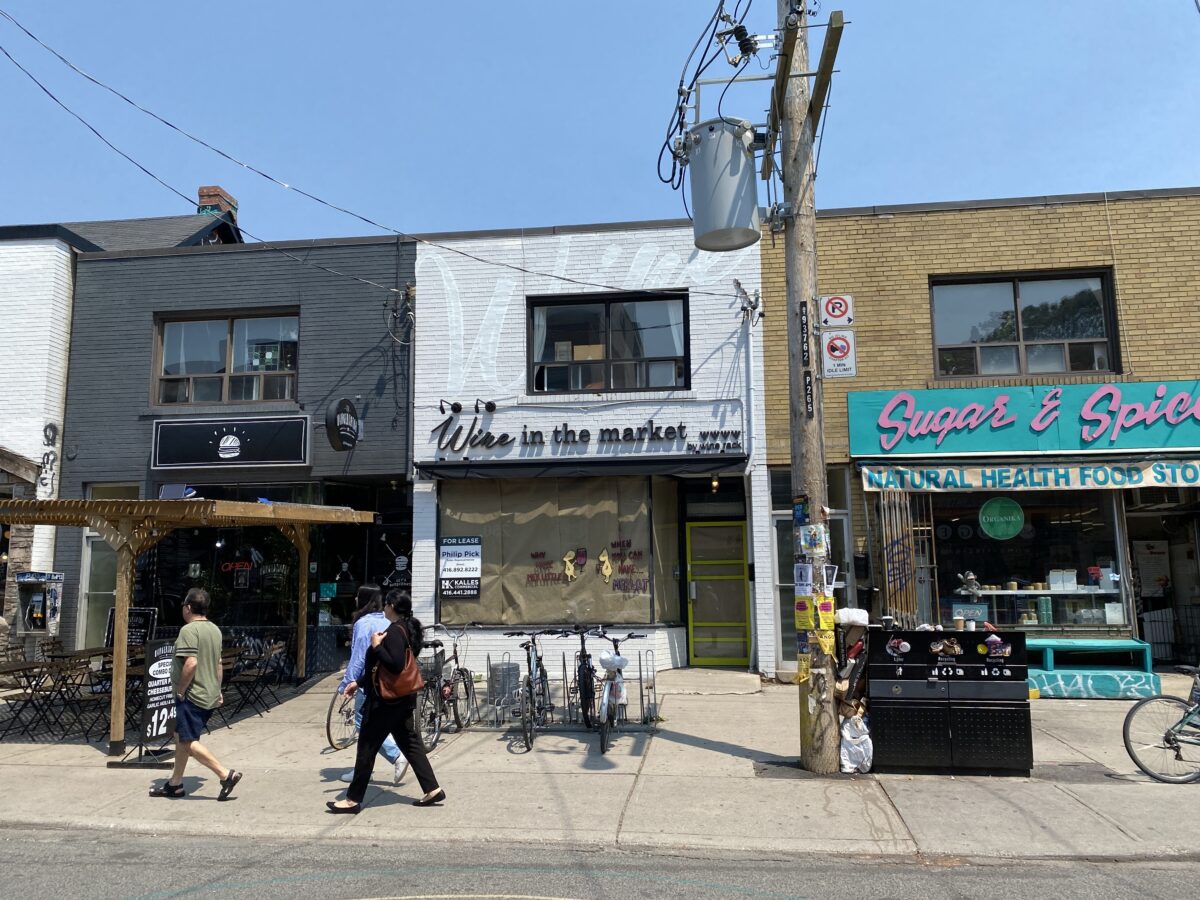
Shuttered Wine Rack in Kensington Market (Image: Dustin Fuhs)
Keith Reading, Senior Director of Research at Morguard, said the Canadian economy has now slowed down.
Keith Reading
“On the part of Canadian businesses, there’s a lot of wait and see. I think there’s so much uncertainty with inflation and interest rates and the forecasts of a lot of so-called experts and economists that we’re in for a recession or something that would feel like a recession,” said Reading.
“And I think too a lot of businesses as a result are nervous and so when you get businesses that are nervous they tend to say okay let’s hold everything off. So your growth slows. It’s almost the tail that wags the dog sort of thing. We’ve noticed a slowdown particularly in office and there’s a lot that’s been written about that. Retail has actually been pretty resilient, better than I think most people thought. Industrial is still going strong and apartments too because we know what’s happened in the housing market. It’s tough for people to afford homes especially with interest rates going up.”
Reading said consumer spending has been stronger than most people anticipated.
“Some people were expecting a big dropoff in spending. Yes it’s not as robust as perhaps it was prior to the pandemic but it has come back quite strongly since the initial phase of the pandemic. And it’s been fairly steady,” he said.
“Part of that is wage growth and a big part of that is better than expected job growth. Although May was pretty slow, we saw a little decline in employment, the Canadian economy generated 250,000 jobs in the first four months of this year. That’s pretty strong. That has quite a bit to do with it.
“There’s two sides to the market. There’s the smaller often necessities based sector that has been really quite strong . . . A lot of activity in sort of the small to mid-size category of retailers. We’re not seeing a lot of big retailers expand or a lot of expansion but we’ve seen a lot of the smaller, not mom and pop, but smaller chains like Pet Valu and some of the specialty grocery stores that have really filled the void.”
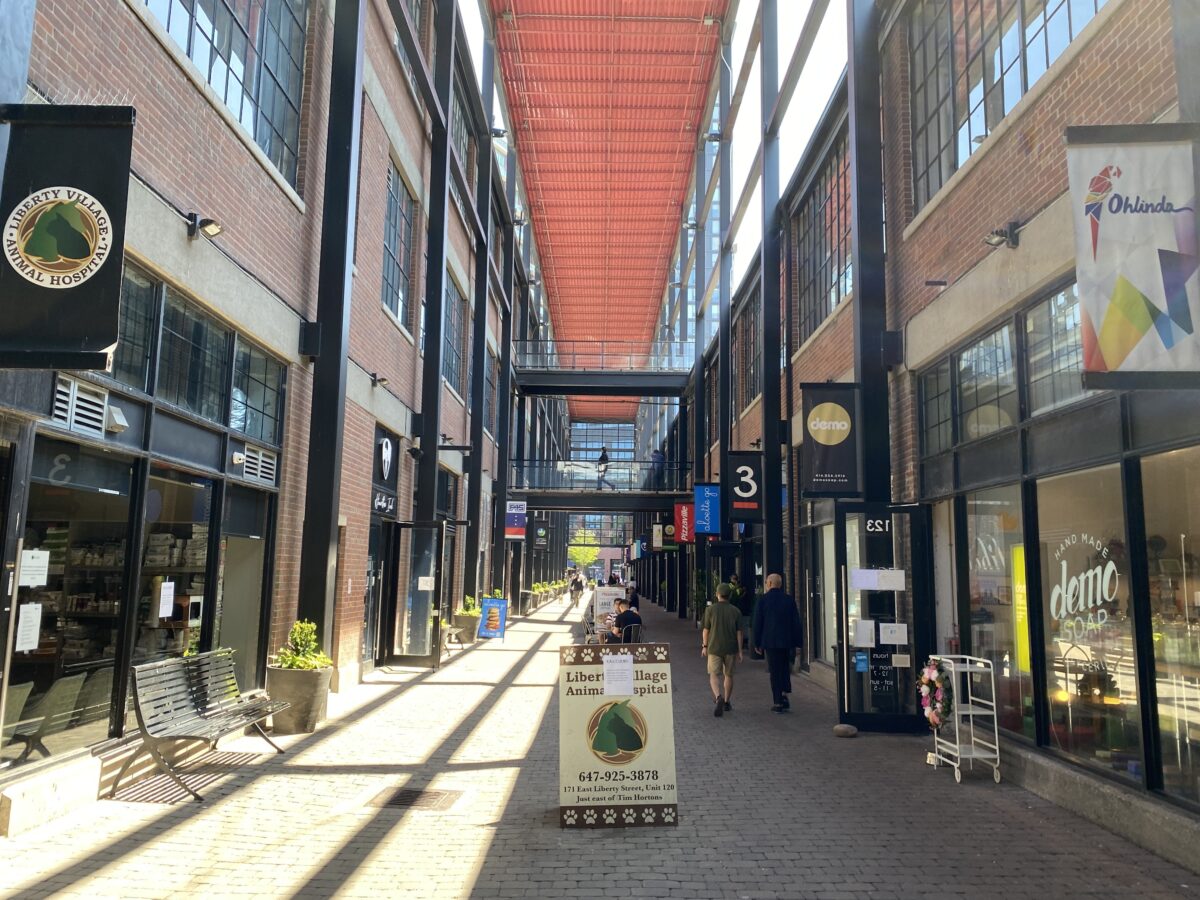
Liberty Market in Toronto (Image: Dustin Fuhs)
Reading said the consensus is there is a squeeze coming for consumers.
“We’ve seen another interest rate hike. There’s speculation we might see interest rates continue to rise a little bit. Inflation was brought under control to a certain extent but it’s not nearly back to where certainly the Bank of Canada would like it to be,” he said. “So we’ve still got some issues with inflation.
“We’ve also got an issue, and this has been an ongoing issue, with record high consumer debt. At some point, that’s got to have an impact. When your costs are rising, the amount or the volume of debt you have is at record highs, even modest job cuts will eventually have an impact. Looking forward, I think it is certainly not doom and gloom for retail but we certainly anticipate things in retail will slow down from probably what they’ve been in the first quarter and much of last year.”
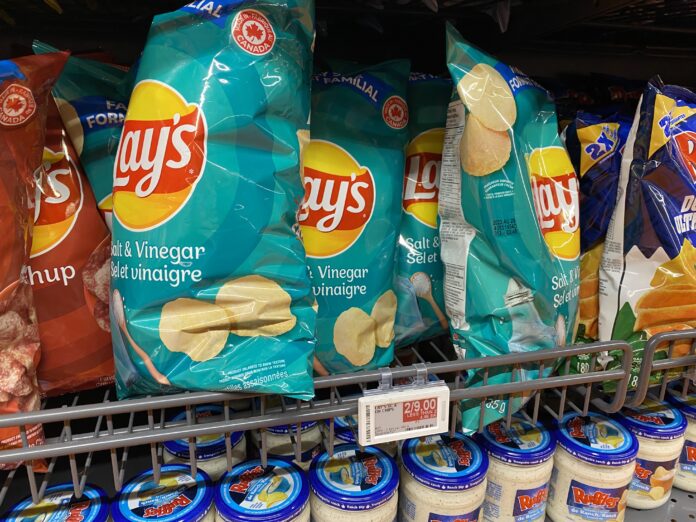
Lays Potato Chips at Loblaw Queens Quay (Image: Dustin Fuhs)
As much as the parliamentary investigation into food inflation is more about political artifice, the Competition Bureau’s study on the food industry, announced last fall is the more interesting exercise. Since last year, the Bureau has been heavily criticized for not upholding a decent level of competition in the food industry and help consumers cope with higher food prices. The food retail industry is essentially controlled by a handful of players. Loblaw, Empire/Sobeys, Metro, Walmart and Costco sell well over 85% of all the food we buy in Canada, and the Competition Bureau did nothing to prevent that from happening. But many rumours in the food industry suggest that things are about to change.
Numerous key transactions over the years have been approved. Loblaw acquiring Provigo in 1998, Metro and A&P in 2005, Empire/Sobeys and Safeway in 2013. With higher food prices in recent months, what came to light for many Canadians is how uncompetitive the food retailing landscape is. But it also reminded Canadians of how the food industry sometimes get away with murder, well, almost.
The bread price fixing scheme which allegedly was going on between 2001 and 2015 in Canada came back in the news in recent months, getting Canadians to wonder what the Competition Bureau has been up to over that last 8 years. The investigation is still ongoing, after 8 long years. Since Loblaw declared itself as the proverbial “whistle-blower” back in December 2017, and giving all Canadians a $25 gift card to spend in their stores, we have heard nothing about the investigation. Niet. No accusations, no fines and nobody has gone to prison. All we know is that by disclosing the identities of its purported conspirators and collaborating with the Competition Bureau’s inquiry, Loblaw, and Weston Bakeries, owned by Loblaw at the time and sold since, obtained protection from legal action. In essence, ills at the grocery store prompted Canadians to feel unprotected and vulnerable.
But rumours are swirling now, suggesting that the Competition Bureau may be on the verge of making significant inroads and could make a move. Nothing confirmed of course, but things have been weird. The Bureau has promised to make their study on the food industry public by the end of this month. This is going to be interesting. Many industry pundits are quite uneasy of what could come out of the study. As such, many have started to either play nice or stay quiet.
Photo: Loblaw Companies
We know now that Galen Weston who was himself at the center of the bread price fixing scandal announced he will leave his post as President in less than a year. Since we announced his replacement, he completely disappeared from airwaves and TV commercials for the company. His voice can be heard in the background of some commercials, but that’s the extent of it.
Michael McCain is another industry leader who has completely disappeared. The President and CEO of Maple Leaf Foods who also announced he was leaving his position next year, was also involved in the bread price fixing scandal as former owner of Canada Bread, which was sold in 2014, a year before the bread investigation started. Interesting coincidence.
Court documents reported back in 2021 unveiled those emails between high-ranking industry executives, including some at Maple Leaf Foods, suggest an intention to synchronize meat prices, resembling the alleged coordination of bread prices. That’s right, meat. Because of the pandemic, this story barely made headlines, but the food industry is fully aware that the Bureau has evidence that something was up.
Eric Laflèche, the President and CEO of Métro, gave a rare interview in Montreal recently and openly endorsed the code of conduct for the first time. It surprised many. The code of conduct promises to bring more discipline and competition to the marketplace, and Metro has never been warm to the idea, that is until now. Many leaders like Laflèche are now recognising that things can improve, and some solutions ought to be considered. Again, an unexpected predicament from another leader.
One can only guess that the next few months will be interesting. With a government desperate to show Canadians how they are helping families with inflation, a more relevant Bureau may be what Ottawa needs right now. And that is why the industry is very nervous these days.
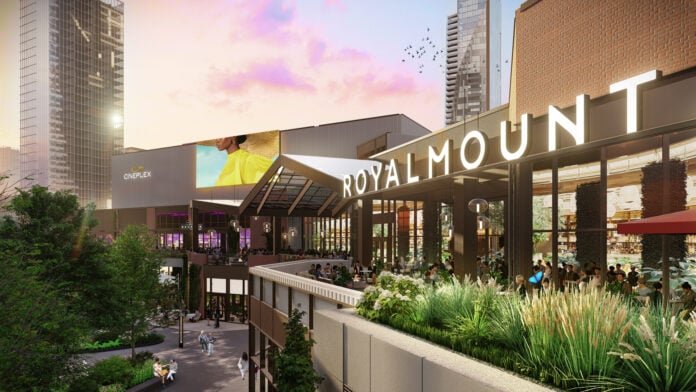
The Royalmount development in Montreal has announced a roster of new retail tenants as the project prepares to open to the public in the summer of 2024. Included is a mix of luxury brands, global and national brands as well as foodservice and other attractions. About half of the brands and retail concepts at Royalmount will be new to Quebec.
New luxury brands announced to open at Royalmount include Saint Laurent, Versace, Jimmy Choo, David Yurman and TAG Heuer — all of which will be the first standalone locations for the Montreal market.
Saint Laurent will occupy a corner location along a luxury-focused corridor at Royalmount in a 6,000 square foot retail space — neighbours will include previously announced luxury brands Louis Vuitton, Tiffany & Co. and Gucci, all of which will open large-format flagship concepts nearby. It will be the first standalone corporate Saint Laurent store to open in Montreal, joining locations in Vancouver and Toronto.
Versace and Jimmy Choo, both owned by Capri Holdings Ltd., will open further up Royalmount’s luxury corridor — Versace is expected to span more than 2,800 square feet while Jimmy Choo will be about 1,900 square feet. Capri’s Michael Kors brand is another confirmed upscale tenant for Royalmount and that store, which will include the pricier Michael Kors Collection, will be located in another part of the shopping centre.
Luxury wing, Royalmount (Image: Carbonleo)
American luxury jewellery brand David Yurman will open its largest store in Canada in a space spanning more than 2,800 square feet in Royalmount’s luxury corridor. Currently the only standalone David Yurman store in Canada is at Toronto’s Yorkdale Shopping Centre, and the brand also has concessions at Holt Renfrew in Vancouver and in downtown Toronto.
Watch brand TAG Heuer’s Royalmount location will feature a curved facade in a space spanning nearly 700 square feet, and will be the second standalone location for the brand in Canada — a location opened at Toronto’s Yorkdale Shopping Centre in 2019. TAG Heuger’s Montreal store design will pay tribute to the history of racing in the city with the Montreal Grand Prix set to take place later this week.
Several Montreal-based brands are now confirmed to be opening stores at Royalmount next year. They include Acuité Visuelle, Aldo, Arc’teryx, Bikini Village, Browns Shoes, Dynamite, Garage, Influenceu, Judith & Charles, La Canadienne, La Vie en Rose, Mackage, Moose Knuckles and Rudsak. Browns Shoes will span more than 5,000 square feet, Moose Knuckle will span more than 3,800 square feet and Garage, owned by Carbonleo CEO Andrew Lutfy, will open a store of about 3,500 square feet.
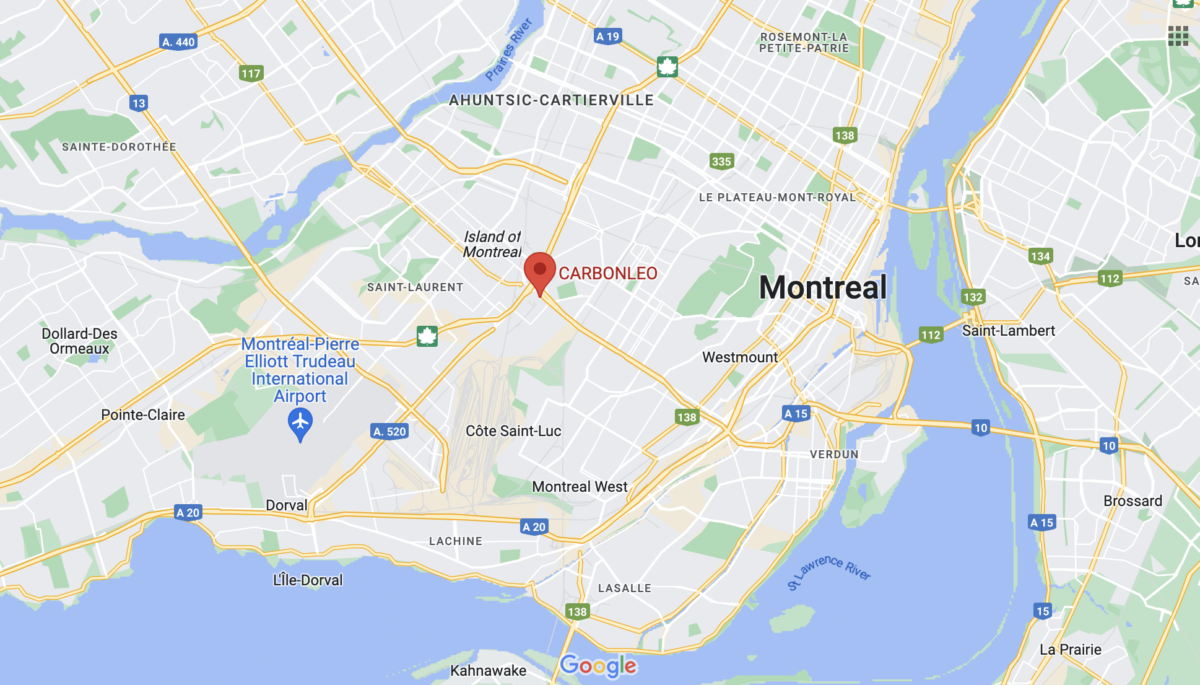
Click image for interactive Google Map
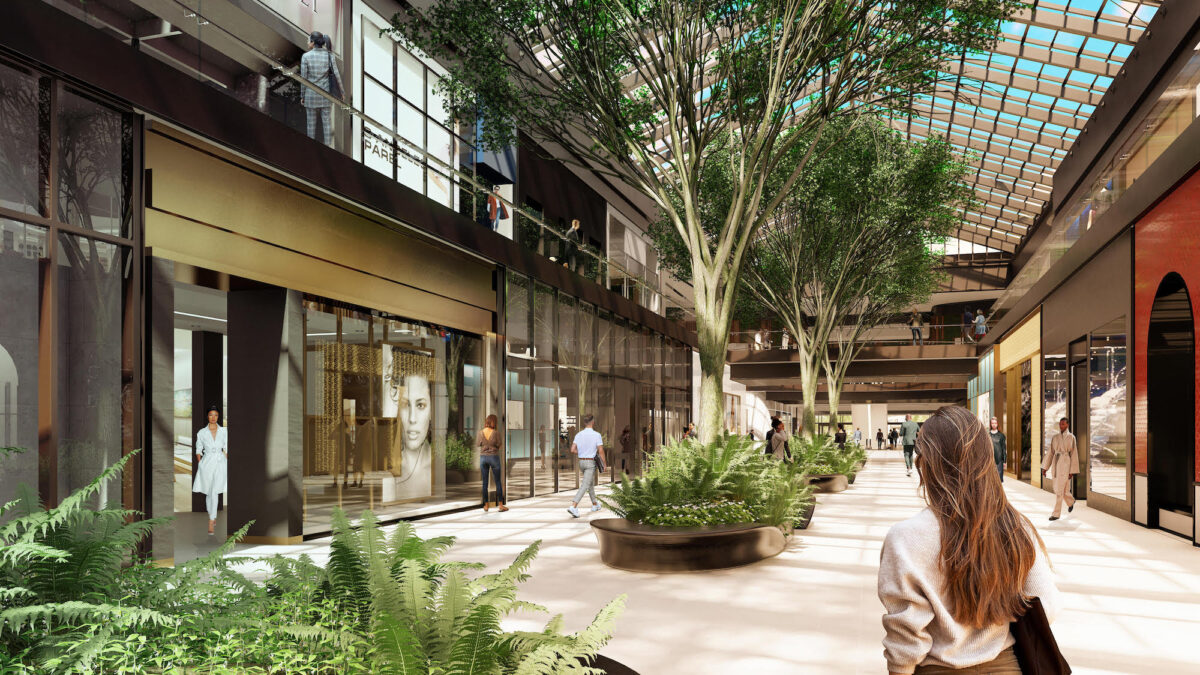
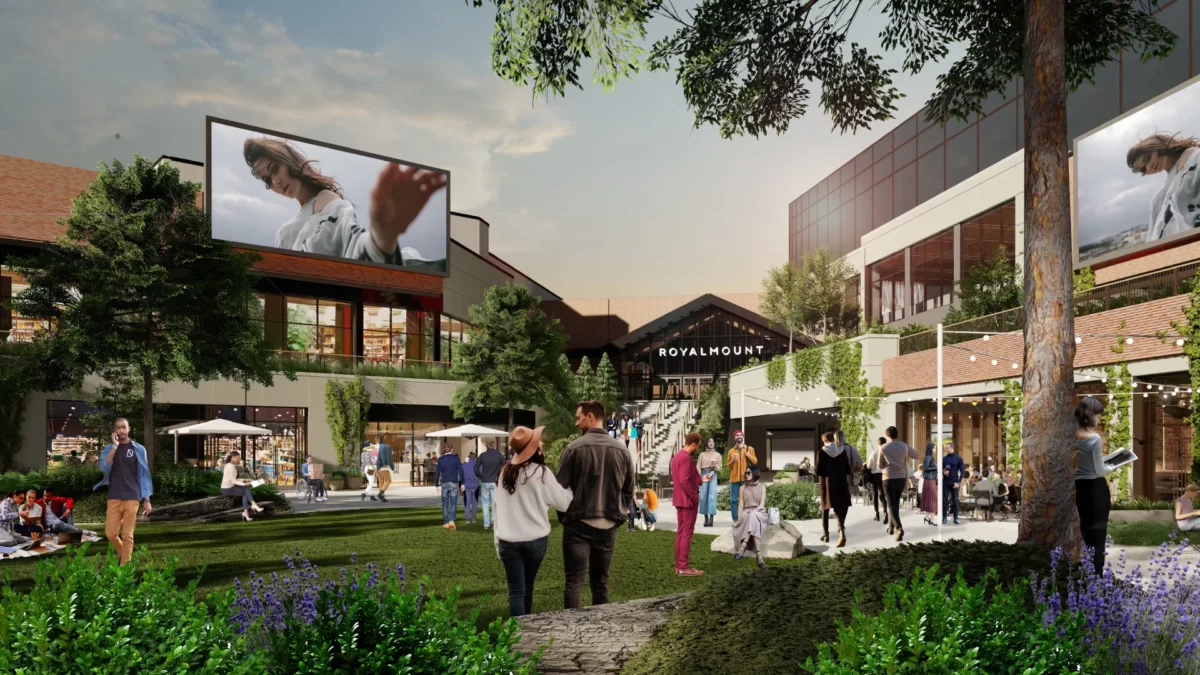
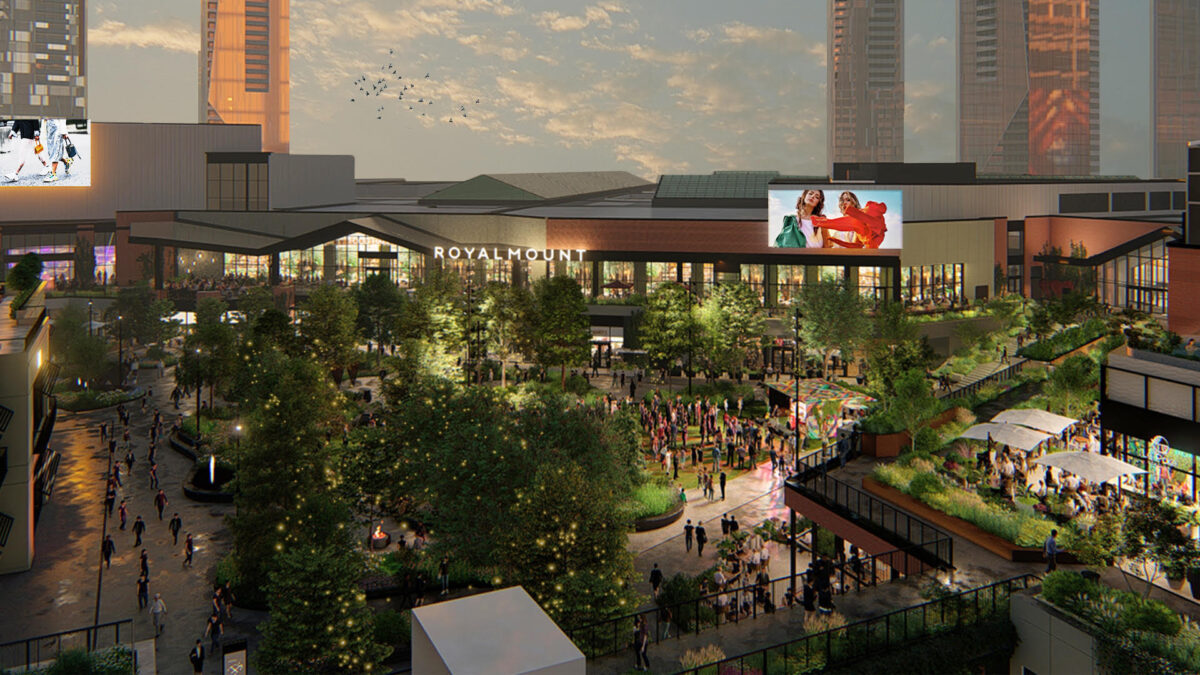
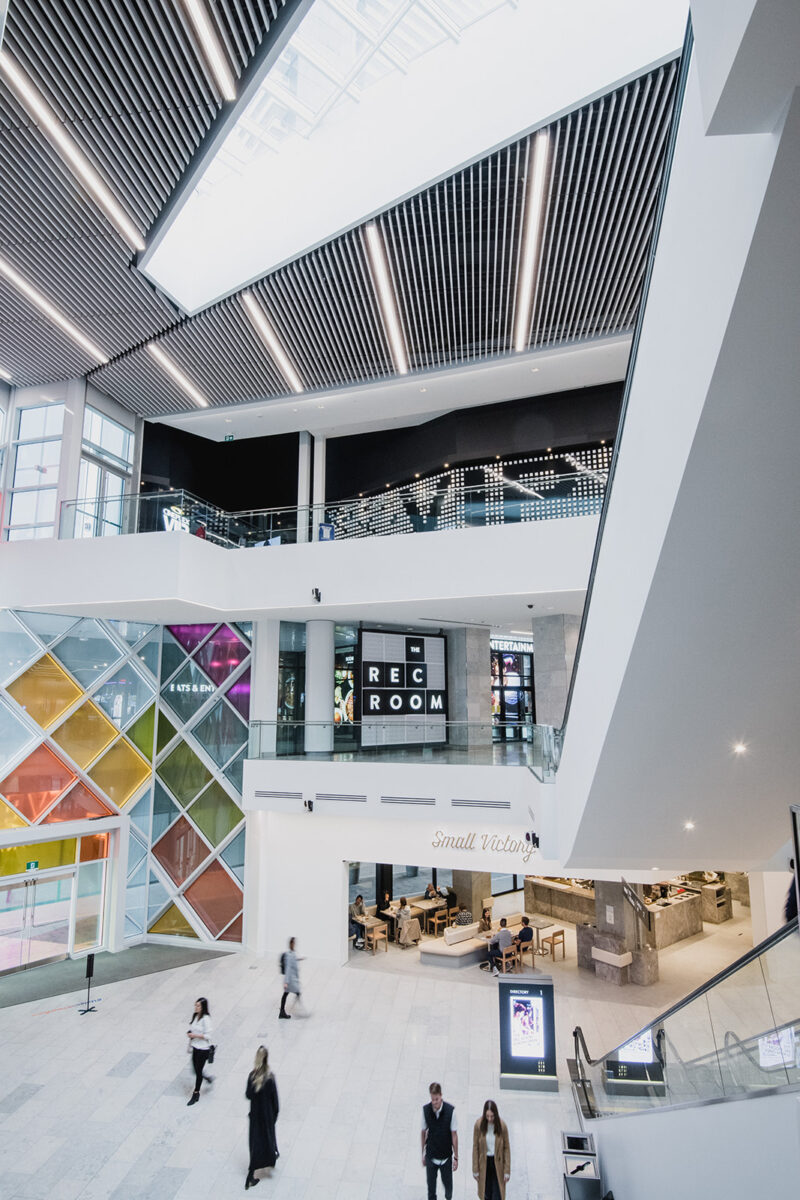
Royalmount is being developed by Montreal-based landlord Carbonleo, with funding partly provided by LVMH-associated L Catterton. The mixed-use $7 billion Royalmount will include retail tenants, restaurants, entertainment and offices which will surround a central park. The first phase will include an 824,000 square foot two-level retail and lifestyle complex. Royalmount will be the first 100% carbon-neutral mixed-use development in the Americas and the largest LEED Gold retail project in Canada. Previously announced components include Cineplex which will bring premium cinemas and The Rec Room, upscale home retailer RH, and innovative beauty hall concept Rennaï which will subsequently expand globally.
Carbonleo CEO Andrew Lutfy spoke to Retail Insider about the project. He said that he expects the Royalmount’s retail component to open on time and that his team has been using Scrum as an agile methodology to meet design and construction objectives. That includes regular meetings with key players to ensure that Royalmount’s progress is on track.
Royalmount will launch an app according to Lutfy, which will include rewards and aim to create loyalty and repeat visits. Parking will involve a ‘smart system’ that will also be tied into the app.
Customer service will be paramount to Royalmount he said, including a concierge service, click-and-collect, and package assistance.
Image supplied
The tenant mix will be primarily direct-to-consumer brands according to Lutfy, as opposed to housing multi-brand retailers. He said that he expects the standalone brand stores to have exceptional productivity per square foot, while at the same time many multi-brand retailers are struggling — Royalmount will be noticeably absent of any department store tenants as a result. Original plans had included one or two department stores and plans have since been modified as direct-to-consumer brands are projected to see strong sales growth globally with their own standalone stores.
Food and beverage will be important to Royalmount he said as well, including a mix of full-service sit-down restaurants and a yet-to-be-named food hall that will become an attraction on its own. Lutfy said that consumer spending as a percentage of food purchases at restaurants has grown significantly in recent years and that the trend is expected to continue. At Royalmount, about 80% of the restaurants will boast a west exposure, providing ample sunlight and evening sunsets.
Lutfy went on to explain the importance of sustainability to the project. This week a pedestrian bridge began construction to connect Royalmount to the nearby De la Savane subway station. About a third of shoppers are expected to arrive at Royalmount via public transportation he said, noting that Montreal’s Metro system runs on hydro-powered electricity.
Image supplied
Next year’s opening of Royalmount will be only about 10% of the entire project according to Lutfy, who noted that the multi-phase development will take years to complete. Residential towers and other commercial offerings will eventually become part of the mix.
The first phase of the project has been under construction since before the pandemic. In the spring of 2019 Retail Insider attended the ground-breaking of Royalmount which at the time was a former industrial site with construction equipment ready to dig.
Carbonleo is a privately owned, Quebec-based real estate development and management company. Founded in 2012, the company has more than 170 employees and counts several major projects to its credit, including Quartier DIX30 and the Four Seasons Montreal Hotel and Private Residences.
We’ll follow up on this story as more announcements are made ahead of Royalmount’s summer 2024 opening.
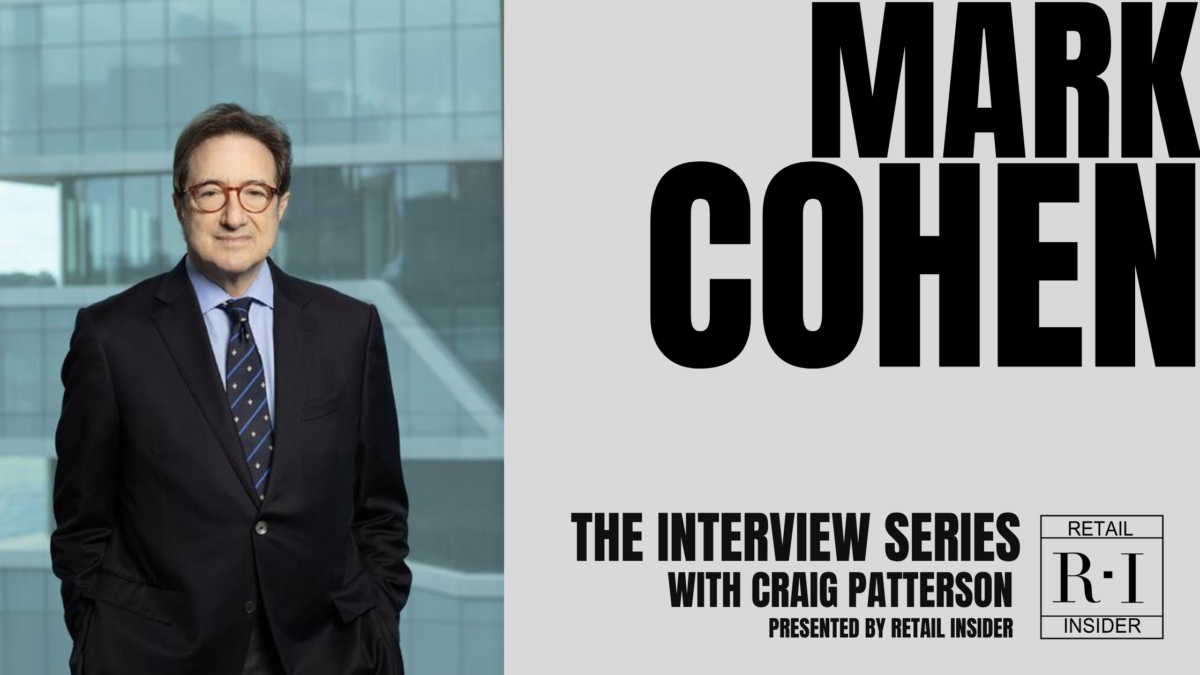
Craig sits down with Mark Cohen, Director of Retail Studies at Columbia Business School and CEO of Sears Canada between 2001 and 2004. They discuss how the department store got started, how they once flourished, what went wrong, and the future of department stores — if any.
A transcript of the conversation can be found below.
If you prefer to listen to the audio version, it is available below:
The Interview Series audio podcasts by Retail Insider Canada are available on Apple Podcasts, Stitcher, TuneIn, Google Play, or through our dedicated RSS feed for Overcast and other podcast players. Also check out our The Weekly audio podcast where Craig and Lee discuss popular content published on Retail Insider which is part of the The Retail Insider Podcast Network.
Mark Cohen Discusses the Past and Future of Department Stores [Interview]
Craig Patterson 0:03 Welcome to the Retail Insider – Video Series. I’m your host, Craig Patterson, and we’re joined here with a special guest, Mark Cohen. He’s the director of Retail Studies at Columbia University in New York City and was the CEO of Sears Canada from 2001 to 2004. Welcome, Mark.
Mark Cohen 0:19 Thanks for having me back.
Craig Patterson 0:20 Let’s talk a little bit about department stores. So we’re going to take a global view, we can take a bit of a local view as well. Department stores were a bit of a local thing at one time in our history here in North America, but things have certainly changed. Let’s talk a little bit of a general discussion here around department stores. How they got started, what’s a good department store and we can talk about where we’re seeing some lacking particularly here in North America as well.
Mark Cohen 0:45 Well, as you know, the department store is a 20th century artifact. Department stores emerged throughout North America in the early part of the century. They were typically based downtown, they were viewed as downtown emporiums. They were grandiose and style. They were a new version of what had been, of where merchandise had been sold on pushcarts, traveling salesman, local dry goods, stores and small communities. And so they emerged and they were typically founded by a families, they were private. They were famous for carrying everything you might want or need. Prior to their emergence, you more or less had to shop via a catalogue. The original Sears Roebuck Montgomery Ward catalog, for example, which were hundreds and hundreds of pages of things that you could select from. And then, the department store made those things much of that merchandise available in a centrally located place. And they thrived. And they were run by the founding families and they grew extremely prosperous. It was a very profitable business. And then in the late 50s – actually the early 60s – the great American shopping mall (I say American because it was American and Canadian), the North American shopping mall emerged as a place. It principally was driven by the investment in the US interstate highway system. There was a Canadian version of that made land available for newly emergent World War Two veterans to begin to form families and move out of cities into newly formed suburbs. They also enabled young people to move out of rural communities into newly formed suburbs. And along those highways and byways, shopping malls were created. This was a new thing was fueled by customers, very inexpensive land and all sorts of subsidies provided by suburban communities to incentivize construction. They also provided employment for these newly minted families, and entertainment for young people from these families. The department stores became the anchors of these developments. They were often operating in spaces that were substantially subsidized by the developer, who would either build the store provides the store with enormous economic support, do free rent deals, things of that sort. In the case of the United States, Sears Roebuck was one of the original landowners through a subsidiary called Homark, which had staked a claim more or less as the prospectors in the 1800s had state claims for gold and silver in both the US and Canada. Alongside these highways, and and so the department’s stores formed the anchor tenants of these malls.
Mark Cohen 4:30 The concourse is between the central hub of the mall which became the food court, if you will. The concourses were filled with a new retail phenomenon – the specialty store. These stores emerged, often incentivized by developers with build out allowances and tractive rent deals. And so the department store now had some competition but they also had this enormous influx of customers. And so for a period of time, everybody did well, the developer did well. The anchors boomed. Although the anchors in most cases, moved the principal activity of their stores from their downtown and pouring them into these new malls. The downtown business suffered not only in department stores, but the mom and pops (who had occupied the downtown business districts). If they didn’t move out to the mall where the customer was now shopping, they basically dried up on the vine. And so this mall phenomenon hollowed out downtown retailing and hundreds and hundreds of US and Canadian cities. It didn’t happen overnight. It happened over a period of two three decades. But it became increasingly apparent that customers love shopping, working and basically hanging out at the mall.
Mark Cohen 6:01 Of course, success brings competition. So that first mall at the bottom of exit ramp number one, on the north side of the highway, brought a competitor about a mile downstream on the other side of the highway at the bottom of a different exit ramp. And they both did well. And then a third one, of course, arrived on the scene. This is while the suburban communities throughout the US and Canada were growing in leaps and bounds population. And so everybody was happy. Land remained relatively inexpensive, and tax revenues boomed. This was a happy thing for all involved in the 70s. And of course, the third, the fourth, the fifth mall, began to cannibalize the original malls. And each new mall became a brighter shinier and larger penny with more anchor spaces, more specialty tenants, and more available parking. There was a view that “if we build it, they will come” and that worked for a lot of years. And then it stopped working quite as well, but it was still viable. And then, here comes ecommerce.
Mark Cohen 7:17 Suddenly the customer who was tethered to a local mall, typically within a seven mile radius of their home (that was the benchmark that that was typically in place throughout North America) and now she was no longer tethered. She didn’t have to put up with her crappy Macy’s or crappy Bay or whoever – and she now had choices. And she loved the fact that she had choices. She could shop, browse transact from the comfort of her home in any way in which she saw fit, including shopping in the mall that she chose to wear. Well, the internet emerged as we know it with a an upstart called Jeff Bezos in Seattle selling books and DVDs from his garage. And a lot of the then geniuses running these department stores took the view and I was in the room with some of them. That this internet thing was just a fad, it would never amount to anything, after all, who would give someone their credit card number via an internet connection. And I was senior enough to get away with pointing out that that was a stupid view. Because every time you go to a restaurant, you give someone access to your credit card. What’s the difference? Is there a difference? The rest is history. Bezos started a migration path from brick and mortar into ecommerce. And the business has been booming ever since. It was growing in double digits, right up until the onset of COVID when it became turbocharged. While all this was going on, the decline in productivity of the shopping mall, became increasingly problematic. Because there’s only so much economic activity in any community. And when too much square footage is produced. You get transfer sales, you get a dilution in an impact invariably. And then of course, between these malls. There was the rise of the strip center power center. After all, you had to fill in the space, off ramp between the malls. And so retailing continued to grow virtually exponentially for many, many years. And the department store which had been in the catbird seat, having been the purveyor of almost all things that customers would want to buy now found itself in tremendous competition between specialty stores and big box players. They were not the only game in town. And they didn’t behave, in many cases, wisely in the face of that competition. They in fact ignored it for many years in many of these stores, as if to make believe that this was an illusory thing. It didn’t go away.
Mark Cohen 10:36 The department store which was this enormously profitable enterprise became increasingly problematic, in the manner in which it was doing business. In many cases, these companies began to merge, to consolidate, they began to go public. They now had shareholders who demanded performance. They started to cut corners. The wonderful customer service that they had proudly heralded as their legacy became problematic. The wonderfully appointed stores became, in many cases shop-worn and shabby. The ability for many of these department stores to provide a really orderly flow of inventory to their store shelves became problematic. So all the customer needed was an alternative. And they sought it with a vengeance. There were all sorts of financial shenanigans that went on over several decades as these public companies did short sighted things to prop up their share price and to keep their shareholder happy. And they also cut the assortments that they carry.
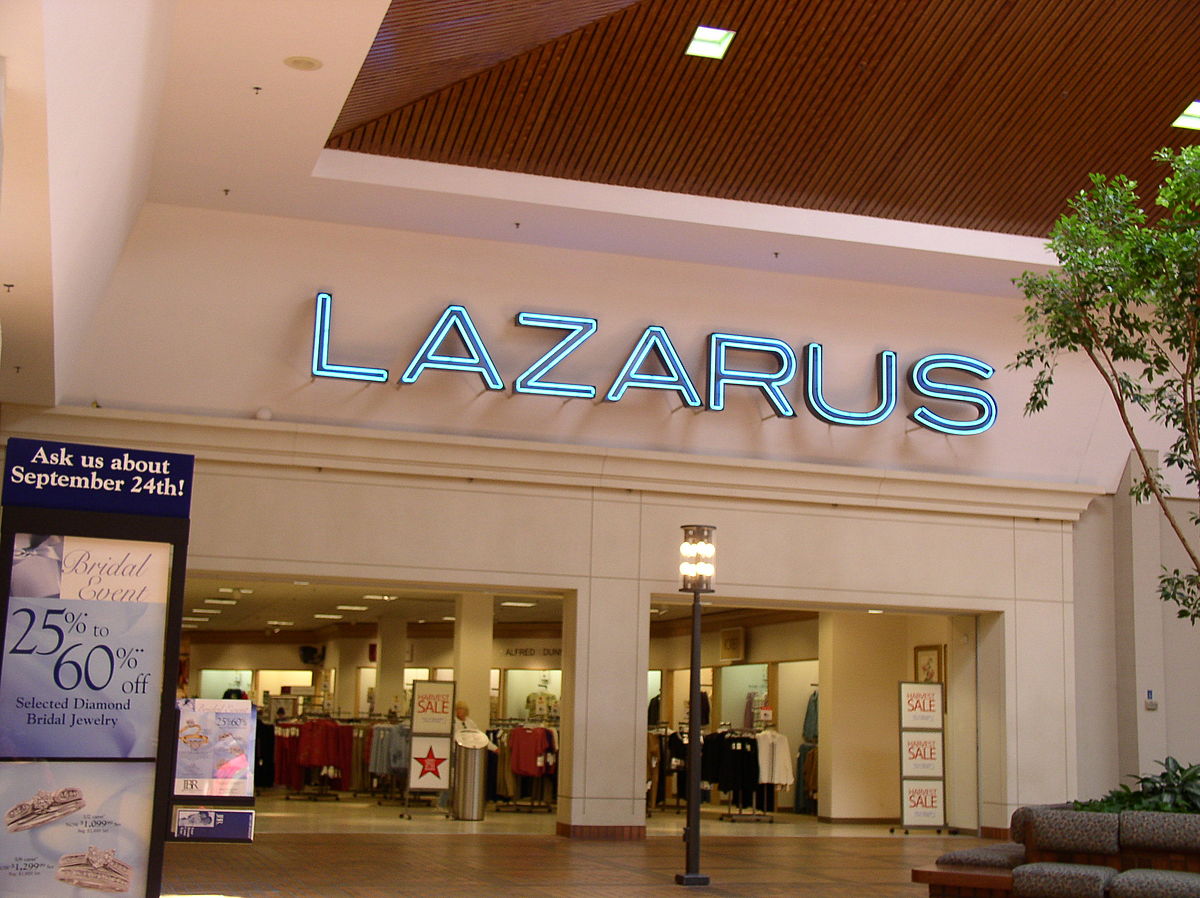
Lazarus at Westland (Image: Wikipedia)
Mark Cohen 11:57 So, for example, when I was the CEO of Lazarus in the Midwest, this is circa mid 90s. We were a traditional full line department store, we even carry things like appliances. We had in the past carried hardware, but had ceded that to a Sears Roebuck, but we were a full line department store and then of course, the enlightened and foolish management (I say enlightened, in quotes) decided that apparel and accessories was really the only game in town because of the margins that that business provided, and looked askance at appliances, consumer electronics, businesses, which carried with them lower margins. And everyone feasted on the boom in apparel and accessories. But of course, like all things, most categories exhibit a cycle of boom-bust. And now, years later, the department stores that still remain in business who only have for the most part apparel and accessories to sell are trying hard to keep the lights on. And these boxes require constant investment, not episodic investment. And so when the carpet wears out, you replace it or you look like a place customers don’t really want to go. There’s been a tremendous amount of consolidation. This is a phenomenon not not particularly to retail with the airline industry has consolidated the consumer electronics businesses consolidated. Most retail most consumer facing businesses and now most industrial businesses have gone through cycles of consolidation. As new technology and new marketplaces emerge.
Mark Cohen 13:43 The internet is here to stay. The customers affection for e Commerce does vary by category but what we’ve seen as there’s virtually no category is immune from intrusion or disruption via the internet. Most department stores just don’t have any Mojo left. They don’t have what made them famous, which was wonderfully crafted assortments of really wonderful merchandise with a branded or private label, very well attuned to customer’s preferences and needs in a in a very, very inviting setting of customer service and presentation surrounded by all sorts of ancillary and appealing activities that played to the holidays. They also provided credit because post World War Two, very few customers only the most wealthy had possession of a credit card. There were very few credit cards (Diners Club, for example was one of the first) or the did business with customers of some consequence by “house accounts”. So you’d buy things from a store and your transaction be recorded and receive a bill at the end of the month, which you would be expected to pay. While the department stores in this case, this was Sears Roebuck in the US, which was one of the first and I guess when Simpson Sears joined forces in Canada, they they hopped on the bandwagon. They provided a store card and made it available to newly formed families who were trying to outfit their homes with furniture and appliances and put clothes on their kids and didn’t have any available cash to speak of. Because they were just starting out. And so the department stores had both the goods, the convenience, the service and the enabler which was credit. So it was ‘all good’. And then it became ‘less good’. Now it’s become unfortunately in most cases ‘no good’.
Mark Cohen 16:01 The department stores always were promotional but carefully so. As they desperately tried to keep the lights on they began became increasingly promotional to the point where they weren’t selling anything regular price. The regular price viability of their assortments had disappeared. Pretty much that’s the case today. And the devotion to product sort of went by the boards and and now with increasingly powerful brands choosing to go vertical (which sell which is to say sell their products themselves through their own stores and their own internet sites), the department stores which used to have exclusive possession of those brands (if you wanted to buy a particular brand you typically had to go to the department store to do it) has gone by the boards.
Mark Cohen 16:58 The opportunity to prop up assortments via private label was always there. And some stores took advantage of that. I’ll go back to Sears. It was certainly the Kenmore appliance business, Appliances at Sears Canada was 40% of Canadian appliance purchases. And the biggest share of that was 10 more. And Craftsmen and Hardware and outdoor power products had a similar tremendous share in the marketplace. Well, that mastery required enormous investment and product development, devotion to excellence and that disappeared – pretty much gone. So what are the department stores stands for? What raison d’etre do they have with which to move into the 21st century and be prosperous? And at the end of the day, sadly, most just don’t.
Mark Cohen 18:00 Now, I haven’t been to Canada in a while, so I’m going to be careful because someone would say, hey, what do you know you have been there a long time. I’ve heard stories about The Bay. The Bay was not in great shape when I was there. They was not a wonderful place to shop, but still did business. Sears Canada took a lot of share away from them while I was there happily. So Eaton’s, of course is an artifact that went by the boards when they finally threw the towel and Sears Canada bought seven of their properties. In the US, Macy’s struggles with a strategy they call ‘Polaris’, which to me makes no sense, which is largely investing in outlet centers installed in their stores, much like what I’m told, The Bay is going to do when they recreate Zellers if they actually go through with that. Hey, it’s always about the merchandise. So if you stand for the cheapest price, you become a downmarket emporium. The department stores used to have basement stores which satisfied that very value conscious customer then they gave that up because they didn’t think it needed it. Now they’re getting back into that seemingly with a vengeance. Can they recover? Well, it requires inspired leadership, talent and capital. There’s a lot of money around. There’s not a lot of talent. There’s a lot of nascent talent because in any organization filled with young people, you have talented people, but there’s very little if any inspired leadership. The leadership that I have had contact with is large, the leadership suites are largely populated by survivors who’ve managed to acquire their seats through efforts that don’t suggest they are interested or capable in mounting a future strategy.
Craig Patterson 20:13 Can we talk a bit about Lazarus when you were there? I’d be curious to know more because Lazarus was headquartered in Columbus, Ohio with stores over a million square feet. Now I don’t think it’s open. But Macy’s really took all the names of these local department stores that removed the localization from from the whole process that made department store special in the United States (and in Canada, I suppose, as well).
Mark Cohen 20:34 Well, Lazarus was originally headquartered in Columbus. Lazarus was founded by the Lazarus family, which were one of the original department store families. And that family was part of the foundation of Federated Department Stores. Federated, of course, having bought Macy’s and now all their remaining stores are titled Macy’s. Lazarus was consolidated just before I got to Lazarus as president then CEO. Lazarus had been consolidated from Columbus down into Cincinnati with a sister division of federated called Shillito’s. So Shillito’s became Lazarus now based in Cincinnati, Rike’s another federated sister store based in Dayton, was consolidated into the newly formed Lazarus. And then there were a handful of other stores, Herpolsheimer’s in Michigan, and Block’s in Indianapolis, and so the Lazarus division was a a hastily constructed attempt to provide more scale and to provide more performance. I joined when Lazarus was running 10th in a seventh horse race among the seven divisions of federated. It was a mess. Now how did I get to Lazarus? Well, I had rejoined federated having started my career there at Abraham & Strauss years and years earlier. By joining Goldsmith’s (a federated division based in Memphis, small division, very profitable) and I hadn’t even opened the latches on my suitcase when a Canadian named Robert Campeau surfaced. He had taken over Allied Stores, a department store group in the US in a semi hostile takeover, and then had turned around and done the same thing with Federated. So I arrived in Memphis, and Bob arrived in Cincinnati. And Bob immediately merged the Memphis operation called Goldsmith’s into the Rich’s operation Federated stores in Atlanta. And I was out of a job and he refused to pay my contract and demanded that I sort of hang out. And a month or two later, to make a very long story short, I wound up in Cincinnati as president then became CEO. Campeau was brilliant at getting the banks into supporting a series of hostile takeovers in which he put virtually none of his own money in. And Federated teeter-tottered on bankruptcy for a couple of years and then eventually had to go into bankruptcy because Campeau Corp was a bankrupt company. While Federated was trying to get out of Chapter 11, there was a whole host of efforts to improve its performance largely by exiting businesses that were less profitable than other businesses. And folks like me at the time, were sort of kicking and screaming over this because many of us envisioned in the midterm to longer-term that these businesses we were exiting would be businesses, we would rue the day we had walked away from.
Mark Cohen 24:07 And so the department store used to be a place to shop for almost everything you can think of and now it was only a house built on current fashion and current fashion appeal, which is wonderful when the cycle is in your favor and not so wonderful when it turns the other way. So, it’s a genre that has seen its day. Will it completely disappear? Well, it’s almost completely disappeared. These boxes don’t get repopulated very easily you know. You could argue that the department store declined, took down the wall in many locations in North America, or was it the mall that took down the department store? Chicken or egg – it doesn’t really matter. They both prospered during the good times. They’re both struggling today except for the super regional malls that still command the customers attention.
Mark Cohen 25:11 I think the struggle is to come up with brilliant assortments that are suitably differentiated, hand in glove with an omni channel, ecommerce strategy that the customer would find appealing. And that’s easy to say not easy to do, but it’s doable. It’s not a fast-fix strategy, it requires years of formulation and gestation. But for those with the wherewithal and the skill and the financial backing, it’s possible. But we’ll have to wait and see. In Europe, where the great American or Great North American shopping mall has never emerged (particularly because there isn’t the land available) and the population is still closely centered around urban centers (Europe doesn’t have the kind of suburban development that we’ve seen here in North America), downtown retail is still viable in many downtowns. And some of the old-style department stores have prospered. Although as they did try to venture off into malls (where malls were created), they’ve struggled. So, for example, Harrods is, you know, a beacon of light and they’ve never been successful outside of Knightsbridge, but they’ve pulled their horns back in and the Knightsbridge store is a magnet for both residents and tourists. It has survived Brexit and will survive this current period of stagflation-inflation and will continue to be an iconic emporium.
Craig Patterson 27:06 What makes these stores like Harrods, Selfridges, Galleries Lafayette amazing? People are still going to these places. They’re tourist attractions, and quite exciting. And let’s talk we talked about that a little bit? Because these are actually not bad stores compared to what we have in North America.
Mark Cohen 27:23 Well, they’re there. They’re physically attractive spaces. As opposed to same old – same old rectangular boxes that have seen better days. They have lots of architectural appeal. They are filled with merchandise that customers want to touch, feel, and in many cases purchase. They’ve done it through affiliation with brands that they have some element of exclusivity with. They’ve done it by leasing spaces to brands acting as brand’s landlord, which is a European and Asian model that’s never really taken hold here. They typically provide far better customer service. So the customer not only is entering a place that’s attractive and appealing that’s filled with goods they want to consider, but the customer service that they are exposed to is appealing, as opposed to diffident or non existent. They thrive or fail based on their execution ability. And some have thrived and some have faltered and researched. Galleries Lafayette was hot as a pistol years ago and then they moved to New York and they failed miserably and then they started to fall apart in France, and now they’ve resurged. Samaritaine, taken over by a billionaire completely redone. Sort of a ninth wonder of the world in some respects if you’re into interior architecture. Selfridges, which was a sleepy, dumpy store put itself on the map through the efforts of a CEO, who is now running a department store chain in Italy, did a brilliant job of creating wonderfully exciting differentiated assortments in a setting that was very attractive. Now interesting, Selfridges tried to recreate that magic by opening up a store in Birmingham, which failed or which was certainly less successful because they couldn’t quite translate all of that wonderment to a smaller market, a smaller box. Which is the enigma that department stores face. If you’re going to be doing business across a portfolio of locations, the magic has to spread across your entire portfolio. As opposed to your downtown store looks great your branches don’t. What can I say? It’s amazing that through thick and thin, pandemic, economic disruption – customers don’t disappear. And customers worldwide have an affinity for new and exciting products in a setting they find attractive, convenient. And where the department stores used to be the only game in town, they certainly aren’t any longer. And for them to continue to prevail or survive, they have to recreate that magic. And it’s just not happening. Not happening in the US. And I suspect it’s not happening in Canada either.
Craig Patterson 30:49 I wouldn’t say so, generally. We have La Maison Simons which is more of a fashion retailer with really cool architecture, interesting product, most of which is their own private label. It’s almost like a large, I don’t want to say H&M or Zara, but it’s very, very private. The good examples that you use for department stores, they’re obviously more upscale with the concessions that are in there. Selfridges has Gucci, Chanel, Prada. We’re seeing that across the European cities and also even in Asia, where they’ve got some really tremendous department stores. Now in North America here, you mentioned we don’t have the same inspired leadership in terms of creating a compelling environment that’s a place a person must go to, its entertainment base. Any idea why we don’t really in North America – I can’t think of a department store that would be like Selfridges here outside of perhaps Mexico City – if you can include that being North America – and I’m speaking to El Palacio de Hierro.
Mark Cohen 31:40 The original department store model was created by individuals at the top of families that own the business that had the vision to create an expand their enterprise. And they had the wherewithal and they didn’t need to seek shareholder approval to do it. They pounded a stake in the ground and said this is where we want to be and this is what we want to represent and they delivered against that. As these businesses have all become part of conglomerates, they’ve lost that individuality. They don’t have people at the top of the business who have that experience, that talent, that skill and that support. And, in the case of Selfridges, it was owned then by the Weston family who greenlighted this CEO’s strategy of reinvention, and he delivered. But the Weston’s were acting as if they were the founders of the business. They weren’t, but they were acting as if they were the original founder of the business. And so, it’s tough to make an economic case for a multi-year reinvention that’s going to cost a lot of money up front, not show results for two to five years downstream. You can do it if your name is on the door, you can do it if you’re working for the people whose names are on the door who owns the business and share that vision. You almost can’t do it under any circumstances without that kind of underlying support. And then of course, the talent component of merchandising, generally speaking, has disappeared. That’s not that there aren’t smart, capable people available. It’s that they don’t have the training they don’t have the backing and they don’t have the support. And so that devotion to product to creating special assortments that a customer will notice and seek out – that effort has largely (and I say this unhappily) disappeared. So today’s buyer is making a deal based on lowest price, most flexibility rather than on most apparent, greatest features and benefits on behalf of the customer. And it’s a shame, I don’t want to I don’t want to sound too sentimental but the art of creating assortments is the art of it all. And it has disappeared from the department store industry.
Craig Patterson 34:39 I wonder if an international chain whatever looked at coming into North America and shaking things up a bit with the strategy at least there that works with a few stores. Probably not that many major cities like Los Angeles, San Francisco, New York City, maybe Toronto and Vancouver.
Mark Cohen 34:57 Retailers who cross the national border typically fail. Because they are unable to fully understand all of the nuance that they have to overcome. When Galleries Lafayette came to New York, they failed. They certainly had a perfect location, 57th Street more or less where Trump Tower is now. And where Tiffany is based. Printemps, I think, is moving to a space in the Financial District in Manhattan down near Wall Street. Having been re invigorated in France, my guess is this isn’t going to be happiness. Saks Fifth Avenue had a series of stores in the financial district that failed. Saks moving to Canada has essentially failed. It’s very expensive to transplant a sizable business across the border. The answer to your question is, are there deep pocketed enough owners, investors willing to take that kind of risk? And the answer is, I don’t think so. Not likely. Even in the face of very, very inexpensive real estate, vacant real estate real estate that’s really gone begging.
Mark Cohen 36:24 The customer has never been thwarted. She continues to shop increasingly anywhere and everywhere she wants. Her needs are being serviced. And so by moving a department store emporium into a new location, what is it that really engenders loyalty and support other than the one image on a one time basis of a new shiny penny on the block, you know? So I don’t think it’s gonna happen. Now, there have been attempts by Asian enterprise to move into North America in a big way, the most notable that I can think of is UNIQLO. So Uniqlo is essentially owned by a Japanese based extraordinarily wealthy individual. Fast retailing is the name of the company, and they’ve been extraordinarily successful in Asia. And when they came to the US, they basically said, we’re gonna open hundreds of stores in North America. And I think at this point, 10-15 years later, they’ve gotten maybe 40, or 50 stores. And they’re certainly not doing anything like the business they expected they would be able to do. Why? Because fashion, fit, finished pricing, customer operations, logistics are all different here than they are in Asia. They’re different between the US and Canada. And it’s very difficult to get that right at the outset. Or make sense of that at the outset. Zara, when they first moved into the US years ago, opened 30 or so stores. Zara being a brilliant company with enormous success behind them failed. They failed because though they had scoped out what they felt were consumer preferences, they didn’t get the logistics nuance, right. They closed all their stores, they went back to the drawing board they then reopened and now they’re doing brilliantly well. But but it took probably seven or eight years of disruption for them to finally figure that out. On a larger scale. I don’t think I don’t think the department stores have the have the chops now. Primark was going to open an enormous network of stores. They are a low priced budget value operation. I think they’ve got six in the US. They were going to have an entire coast to coast network. Whether they throw the towel and and they finally figure out how to be competitive and successful remains to be seen. I don’t know if there are any Primarks in Canada, but I know their intention was to move into North America
Craig Patterson 39:24 We don’t have any Primarks in Canada yet but one just opened in Buffalo, New York, which isn’t too far from me, I’m not planning on going there right now. But that’s as close as we’re getting right now. And you’re right there aren’t that many of them in the United States. The stuff there is really cheap and it’s expensive to do business here.
Mark Cohen 39:40 Well, you’ve you’ve got to sell a lot of merchandise. Now in the case of Uniqlo, which is a moderate price house, their flagship on Fifth Avenue was literally one of the most expensive real estate deals ever done. And they had to do well over $100 million in volume just to break even. Which is something the founder was willing to take on because it was a flagship it was the beachhead. But that’s a hell of a challenge to have to do 100 plus million dollars just to be able to pay the rent without losing money. So I think the future is really in the hands of businesses that emerge through the internet and maybe migrate to brick and mortar on a selective basis. Businesses that are in possession of assortments that are customized or differentiated so well that a customer will seek out the business, both online and in a physical setting. And the one that comes to mind is Apple. So you can buy Apple products in a variety of retailers, but not the full tilt assortment. If you want the full tilt assortment, you have to go to an Apple Store or at apple.com. And it is a simple example and they don’t carry a lot of different things. But they carry an assortment that commands attention, and loyalty and support. There’s an opportunity for private label businesses to emerge and become powerhouses. But it requires talent, leadership, and investment. And sticking power. Because you can’t create a private label today and expect it to be successful tomorrow. Customers aren’t going to suddenly discover you and embrace you, unless you’re selling something that is truly unavailable, which is almost never the case.
Mark Cohen 41:43 So the last thing I’ll say is that my observation of my own career in life would suggest that failure is virtually always a component of leadership, effective versus ineffective. All of the successful enterprises that I’ve worked for with, observed up close, have been led by very effective leaders and those that have failed have been run by far less effective. I could get pejorative and call some of the people I’ve had associations with village idiots, if you will, who have made terrible mistakes or been unable or unwilling to make creative and productive decisions. Every organization I’ve ever been involved with, associated with or had any up close association with have been filled with talented people. But their leadership is the issue at hand. If someone were to say to me, I’ve got a bucket full of cash and I want to get into retail, should I open a department store, or a specialty store, or an online version of such … I would say, don’t even think about a department store. Come up with an idea. Launch it online. See how it plays in the eyes and hearts, wallets of customers. And then proceed cautiously. And be aware of the fact that almost anything and everything you might choose to put in your assortments as your foundation is subjected to enormous competition from the get-go. So you’ve got to create something that’s appealing and then be able to defend it. And then of course, fill in all of the blanks and dots necessary to make a business profitable.
Craig Patterson 43:53 That sounds like it would be challenging. And it sounds like something that someone probably involved with like a family ownership would make more sense. If it’s shareholder driven, they’re going to want those returns and they’re not going to get them right away at the very least.
Mark Cohen 44:07 It is what it is. It is what it is. Now, the good news is as I said before, there’s no shortage of customers anywhere in the world, you’d look. The good news is the price of entry has never been more economical. Not too many years ago, you had opened a store with a long term lease and make a substantial financial commitment betting on the come that you could fulfill your obligation and you had to fill your storage shelves with merchandise. Today, you can open a website, you can develop a website for almost nothing. You can have a third party provider act as your facilitator by sharing margin but not requiring you to lay out enormous upfront expense by way of facilities, equipment and employment, you can read the crowd based on customer reaction and act accordingly without putting yourself at risk by filling historic merchandise, which may or may not be saleable. So the price of entry has never been more appealing the ease of entry. And I encourage entrepreneurially oriented folks, lots of my students these days, to put their, you know, get into the water up to your knees, and see how it feels, don’t jump into the deep end. You don’t have to read and watch closely. And some of the businesses that I’ve had some exposure to have been become brilliantly successful, because of following just that kind of pathway.
Mark Cohen 46:00 I have no skin in this game, but I’ll pitch something. So I had a couple of students some years ago, not that many years ago at Columbia, who had come from private equity and investment banking, and had decided in business school having met that they didn’t want to go back to where they had come from, they wanted to start a business of their own. These are two guys. And shortly before they graduated, they parked themselves in my office and announced that they wanted to open a men’s boot business. And I said, really? They said no, no, don’t blow us off. We’ve done our homework and MBA speak. It was white space that they had investigated. They believe there was a marketplace for very high quality men’s boots, casual, rugged men’s boots at far more affordable prices than what were available in the market then. So I said, Okay, I’ll take at face value that you have done your homework, and there’s a market for this product. They’re a lot younger than me and they said we wear boots, our peers wear boots, we all want to wear very expensive boots, but don’t think we should have to pay that kind of penalty for those. So I said, Okay, what do you guys know about boots? And the answer was nothing. Well, is there anybody in your family or in your circle of friends and family that’s in the footwear business, the boot business? And the answer is Nope. So I said, So how exactly are you two genius is going to figure this out. They said, Well, we’re going to go to school on the product. And they did. And they worked hard at that. And they got lots of help from lots of people. And they started the company with a Kickstarter campaign looking for $30,000 to enable them to avoid starving to death for a couple of months. And the Kickstarter campaign yielded $300,000. And my advice to them was put $270,000 of it in a mattress, because if you spend it you’ll piss it away. And they they didn’t need to be convinced they did that. Anyway, they founded a company called “The Thursday Boot Company” and it has been phenomenally successful almost from day one, literally from day one. They sell men’s and women’s boots and other footwear. They are now into accessories, some apparel. Virtually everything they sell is direct to consumer. They did some business at the outset with Nordstrom and with Amazon. But virtually their entire business model is based on direct to consumer and what do they have to sell a wonderfully styled very high quality product at surprisingly moderate price, no promotion, never on sale. And so they’ve got a men’s boots for $199, which would be $500-$600 from a well known brand, their quality is at or better than the brand. They’re doing business globally. They’re making boots in Mexico, US and in Spain. They built an organization from scratch, two guys who were shipping goods out of one of their bedrooms. And now they’ve got an entire organization in support of the business. And they found a niche that they’ve been able to move into and defend because the footwear businesses that notice them after a while, have tried to basically brush them aside, copy them and knock them off but they’ve been unable to do it because they can’t deliver to the customer a very high quality product at a price point that’s competitive with Thursday Boot Company. So there’s this tremendous opportunity out there for very smart people who use their heads, who carefully craft their strategy and then follow it. Who don’t fall in love with themselves, like the Allbirds people seem to have and going public and taking on enormous investment support and then blowing all that money because they really didn’t know where they were going. So it’s a wonderful time, if you really have your, your head screwed on in the right way in the right place.
Craig Patterson 50:38 That is fascinating stuff. And congratulations to Thursday Boot Company, because I’ll go look them up now and see what the product is like. I had another historical question that it’s not quite off base from what we’ve been talking about. But one thing that I’ve noticed, so I’ve done some research, just given my age, I didn’t get to see some of the department stores in the same, you know, light or understanding, I would have not seen the 1980s, well, barely 70s because I was a little kid. But one thing that I noticed with the department stores in the United States and even in Canada was that, especially in the 80s, there was a good women’s designer business, and I’m talking about actual luxury brands, where you saw brands coming in, a Canadian example is Hudson’s Bay’s The Mirror Room which in 1972 brought in Givenchy, Lanvin, Pierre Cardin, and in the United States, well, I think even Lazarus had a designer business. If you were in downtown Cincinnati was what was it? What was the big department store there? Besides Pogue’s, and you mentioned, Shillito’s and a few others, but they all had designer businesses, but they all seemed to go away in the 1990s. Do you have any insight into that, because it’s just something that I’ve been looking at and curious about?
Mark Cohen 51:51 Well, the designers you’re talking about, were looking for a foothold, and the department stores were welcome to them with open arms. The department stores had customers, department stores had space, the department stores had the wherewithal to provide them with support to give them a showcase by way of a platform. But then the department stores acted in a manner which made it impossible for these brands to make any money doing what they were doing. And so they gravitated to specialty retail. And now we’ve seen a lot of those businesses go direct or, or go up market into a more rarefied version like Bergdorf Goodman, for example, or Holt Renfrew. So it made sense for them to use US and Canadian department stores as a launch pad. But it never made sense for them to build out their business there. Because even though the department stores in the day had the better customer, they really didn’t have a lot of better customers. And the economic model only was based upon the department store basically requiring that the brand subsidize the entire operation. Okay. So it was a PR opportunity for the most part, rather than a volume opportunity for the department store. It served the purpose of the designer brands at the time. But it was not a relationship that was likely to have much of a future and it has yeah, departed. Yeah. The store you’re thinking about based in Cincinnati was McAlpine’s, which had a substantial following for its designer businesses. But most of what they sold was sold at discount at the end of the season. So there was a lot of hoopty do about the launches and the introductions and then quietly, everything about sold off price, which the designer brands were willing to put up with, because that was the only game in town, but it didn’t work for them for very long either. When all is said and done, you know, things come and go. The electric typewriter is an artifact of the past the rotary telephone, the wireline phone. You know, we live in an ever evolving world. And there is no natural reason why something that had been very, very successful has any kind of a future unless there are talented, creative individuals who enable it to succeed on a future basis. And I don’t see it. I don’t see it. Sorry, you know, don’t see it. And that’s not to say that there is the possibility of success. I mean, another comment I would make. I don’t know if any of your viewers would argue the point, but there’s no reason why Sears Canada doesn’t exist today and isn’t eminently successful. Because Sears Canada had a wonderfully balanced mix of fashion and utility. It had all of the power of Sears Roebuck by way of appliances, hardware, hardlines, product with a increasingly fashionable assortment that was certainly far more appealing than its US shareholder that could go toe to toe, certainly with The Bay and never yielded the floor to the bay with private label products that that were there when I got there, I did everything I could to and courage their their support for the future, and their ongoing success. And customers certainly loved the store, the catalog, the website. Why did it fail? It failed because of the engagement of, frankly, a handful of avaricious and less than straightforward. leaders and owners who either weren’t incapable of running the business and then who saw fit to just strip it bare and and basically bulldoze it remains out for scrap. Didn’t have to happen, didn’t happen because the customer rejected the store. It’s because the store could not sustain its basis of success. I don’t know what the future will be for The Bay. But I suspect something similar is quite possible.
Craig Patterson 56:47 I want to say thank you so much. Mark Cohen. You’re the director of Retail Studies at Columbia University in New York City. And you were also the CEO of Sears Canada in 2001 to 2004. You’re a wealth of knowledge. And I want to say thank you so much for being with us here again today.
Mark Cohen 57:01 You bet. Good talking with you.
Craig Patterson 57:02 And I’m Craig Patterson. I’m the founder, CEO and publisher of Retail Insider Media Ltd. And I want to say thank you everyone for watching this today. If you’re watching this on our YouTube channel or if you’re listening to us as a podcast. Thank you so much everyone. Be sure to subscribe or whatever platform you’re seeing this here if you’re not already subscribed to us. Thank you again. Take care and bye for now.
Subscribe, Rate, and Review our Retail Insider Podcast!
Drop us a line at Craig@Retail-Insider.com. You can also rate us in Apple Podcasts or recommend us in Overcast to help more people discover the show!
Background Music Credit: Hard Boiled Kevin MacLeod (incompetech.com). Licensed under Creative Commons: By Attribution 3.0 License. http://creativecommons.org/licenses/by/3.0/
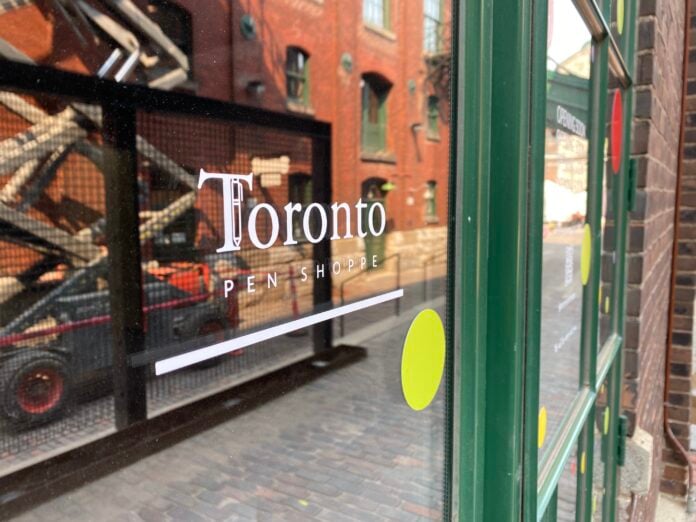
Future Toronto Pen Shoppe at The Distillery District (Image: Dustin Fuhs)
After losing his job of almost eight years at Nordstrom, Nelmar Cornes will be off on a new adventure – becoming an entrepreneur and opening the unique Toronto Pen Shoppe store this summer in Toronto’s Distillery District.
Cornes, whose position with Nordstrom ended June 13 as the American retailer exits Canada, confirmed the new store will open sometime in July.
Nelmar Cornes
“The Shoppe is going to be selling writing tools – pens, fountain pens, anything you can think of to write. And we’re also going to have stationery from Canada. We’re also going to have it from all over the world – Switzerland, Japan, Germany. A lot of international brands are going to be working with me as well,” he said.
“We’re also going to have small gifts that are locally made as well. For me, I’m trying to promote more of the Canadian designer, Canadian made products. So I will have custom made content that are made in Guelph, Ontario. Some notebooks made from Montreal.”
The store will be 575 square feet.
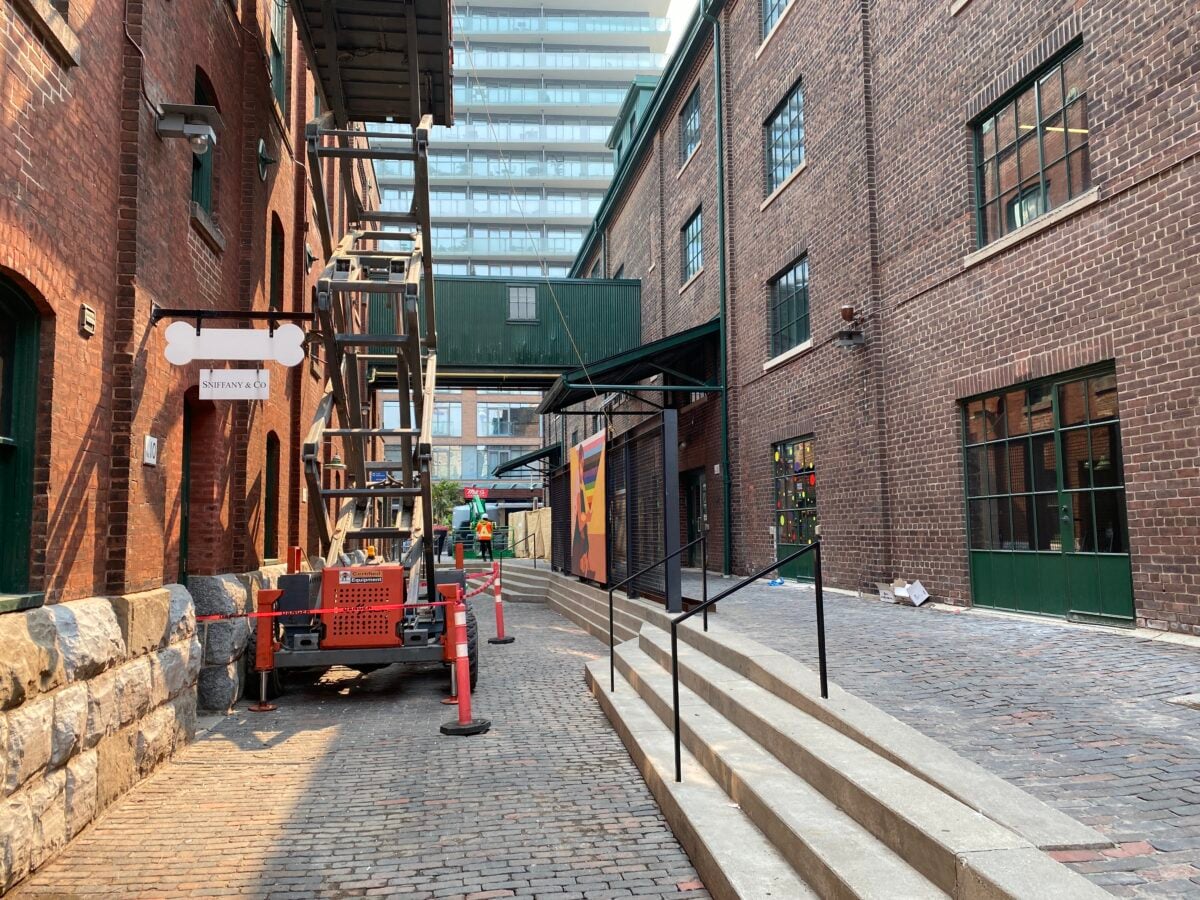
Future Toronto Pen Shoppe at The Distillery District (Image: Dustin Fuhs)Future Toronto Pen Shoppe at The Distillery District (Image: Dustin Fuhs)
“I’ve always had an interest in stationery. When I was at university (studying visual contemporary arts at Simon Fraser) I started using fountain pens for drawings, sketching and also writing during classes. I just kept using it. And when I started with Nordstrom I kind of had to pull back and stop using fine pens because I couldn’t use it to write a receipt and stuff like that,” he said.
“But I still did use regular ball point pens and through that I was actually selling some stationery when I was a salesperson when I was at Nordstrom. So I had a little bit of knowledge.”
When Cornes was looking to find a location for his new store, he was mainly focused on Toronto East. He said in midtown and West Toronto there already exists several stationery and pen shops.
“In the Toronto East side, I’m the only one in this area,” he said. “I have a huge range and area for customers and this side of the city is one that’s growing and also I was able to work with the Toronto Distillery District management team to offer me a lease in that building.”
Inside Toronto Pen Shoppe (Image: Nelmar Cornes)
“We were approached by the owner Nelmar Cornes and he is a very experienced retailer,” said John Berman, Partner of The Distillery District. “He was one of the managers at Nordstrom and he understood the Distillery. He understood the boutique nature of it. He wanted to open a store with a lot of character and charm and something that is unlike other stores in Toronto. So we liked the concept he had immediately upon his presentation to us. He’s going to have some very unique pen lines. It’s a stationery store as well. It will have a lot of character. It will fit in perfectly with the boutique atmosphere and approach for the Distillery.”
We live in a day and age when everything is on a computer, keyboards and smartphones.
“A lot of people still write their ideas on a piece of paper to write out real fast and cross out easily,” said Cornes.
“And also sometimes people just want to get away from that technology side and have that peace and quiet mentality to write their thoughts on a piece of paper such as journaling.”
At Nordstrom for close to eight years, he started as a sales person in Vancouver in 2015. He began his career there at the flagship store. He became a Counter Manager specializing in men’s fragrance and grooming, working with many high profile international brands. After that he became an Assistant Manager for jewelry and watches. Following that he became Nordstrom Rack Inventory Manager in Langley. In September 2022, Cornes moved to Toronto and became a Department Manager for jewelry and accessories for Nordstrom at the Yorkdale Shopping Centre.
Now he prepares for a new adventure in the world of entrepreneurship.
Retail Insider is streamlining its Canadian retail news from around the web to include a handful of top news stories that can be viewed quickly during the day. Here are the top stories from the past 24 hours.
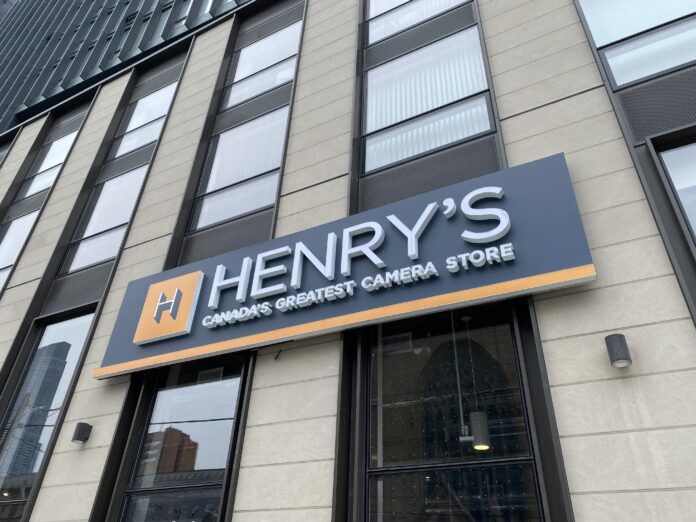
Henry's on Church Street in Toronto (Image: Dustin Fuhs)
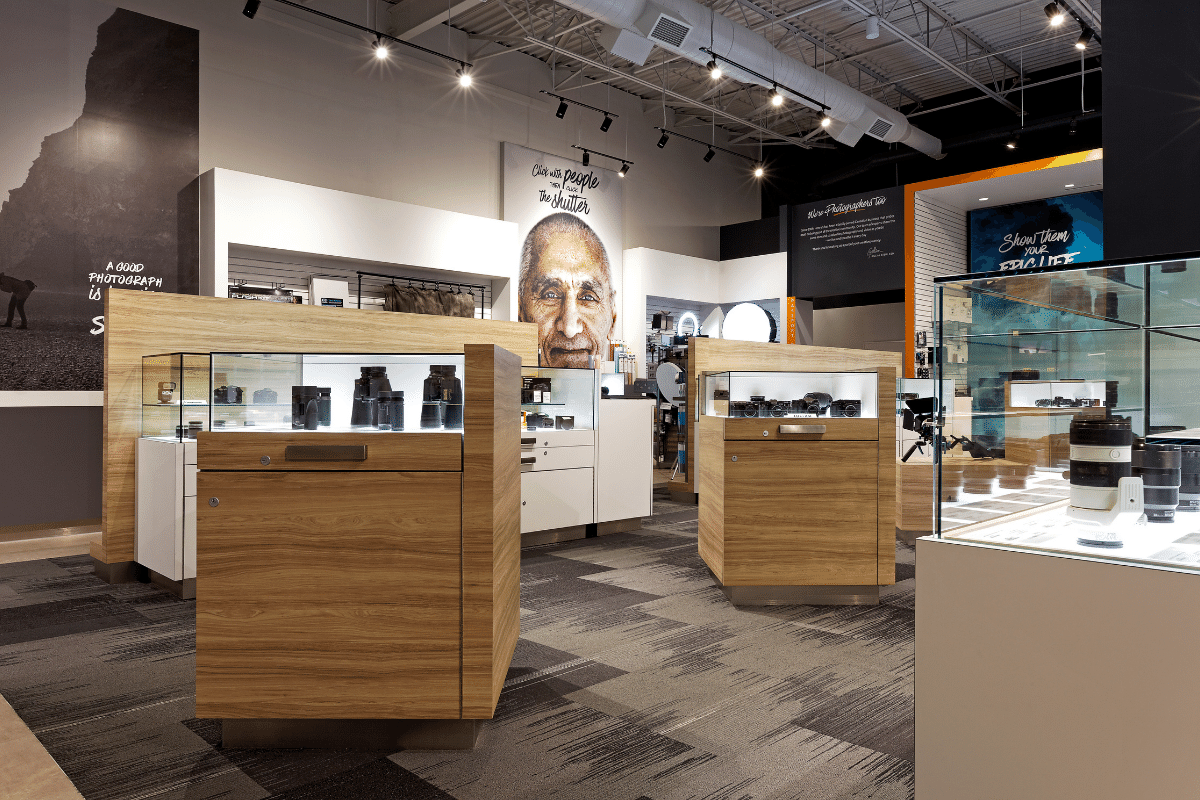
Canadian camera store Henry’s, with 20 locations across the country, has been family-owned, and operated for four generations since it first opened its doors in 1909.
But recently the company announced it had been acquired by Lynx Equity Limited and joined its portfolio of companies.
Gillian Stein, CEO of Henry’s, will continue to lead the company as part of the Lynx family.
Gillian Stein
“I’m excited that this acquisition will help drive our growth strategy and better position us to serve Canadian photographers, filmmakers, and content creators,” she said. “Our team will remain focused on providing the exceptional Henry’s experience to customers both online and in-store, with Lynx’s support and expertise to continue strengthening and growing our business.
“It’s always been the plan to sell. When you look back over our history, each generation has bought it from the previous generation. It’s not a company that was ever just handed down and given to the next generation. There’s been a hard work that’s gone on between each generation. For my parents, their vision was always to sell it. It’s gotten a lot bigger so the idea is that at a certain point a company this size needs more to be able to get it to grow further.
“It’s really about having the right partner. I’ve never met another private equity firm or known a private equity firm that works like Lynx. It’s their buy/hold strategy which is the biggest part for us because the last thing we wanted was somebody who was going to take it and try and flip it or cut it up and do all the things private equity does. So the idea is this means the legacy continues. It’s something that was really important to us.”
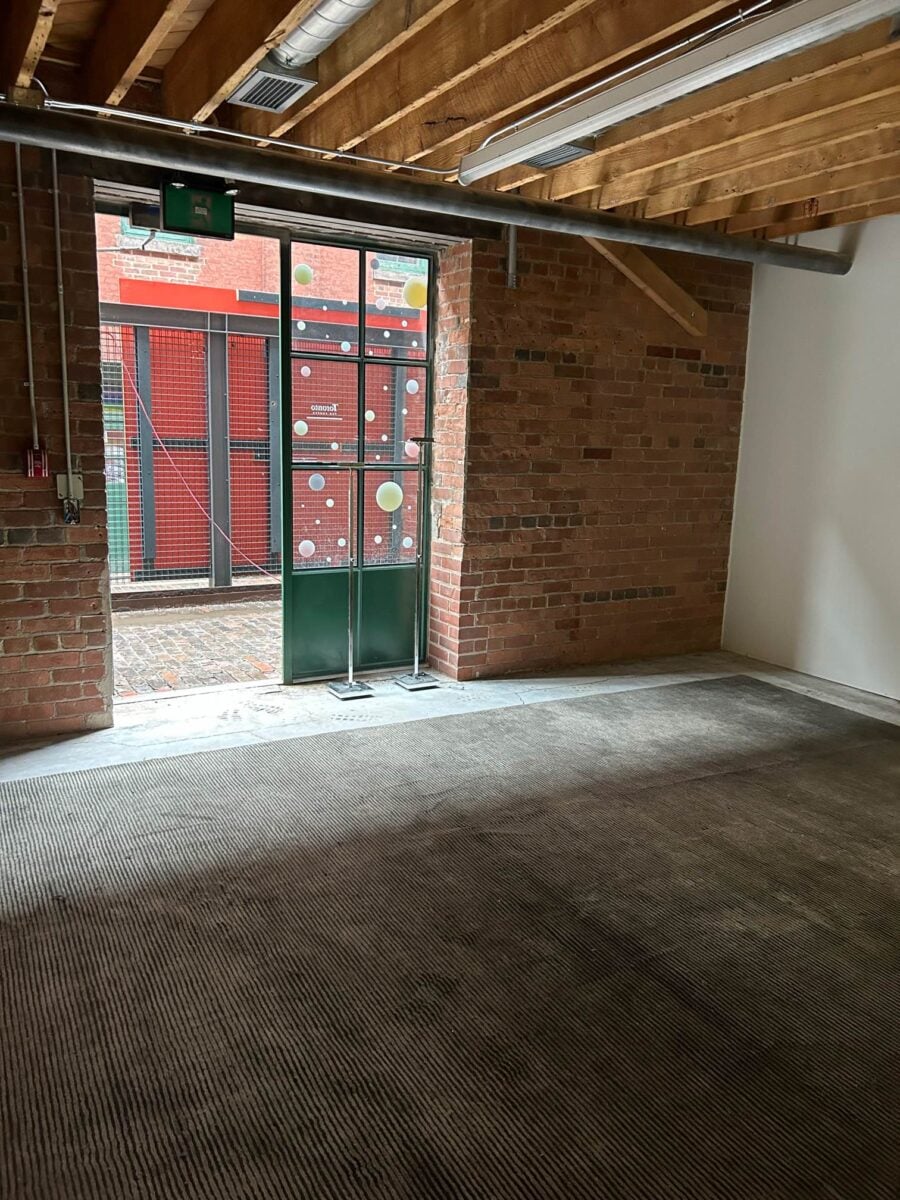
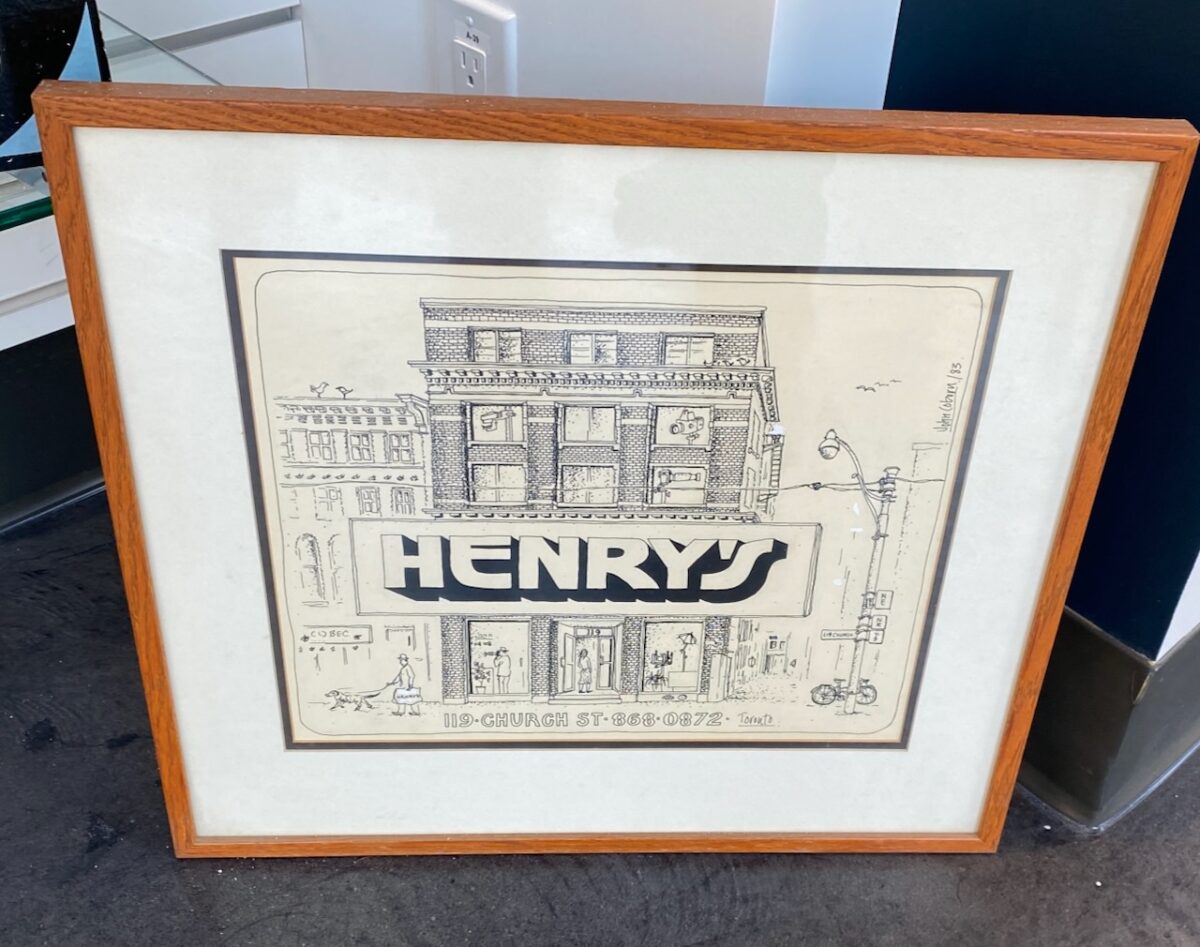
Former Henry’s Flagship and Head Office at 119 Church (Image: Dustin Fuhs)
Henry’s will continue to be headquartered in the Greater Toronto Area. With this acquisition, Henry’s is poised to grow and accelerate its business across Canada.
Stein said Lynx will bring much stability and support to Henry’s.
“It’s been obviously a challenging few years for anybody in retail and having somebody behind us that has that stability is something that’s really important. So our focus is really about making sure that our inventory levels are strong, that we’re able to invest and continue to invest as we have in the right systems and training and people to be able to continue serving customers the way we have,” said Stein.
“There’s no major change. They’re buying a company that they like, that has a fantastic track record. So it’s about continuing that.”
Does Stein see the retailer’s footprint growing in the future?
“We’re looking at our real estate as we always have. We look at the markets we’re in and try to make sure that we’re in the right places at the right time. Some of our locations we’ve exited over the past as they were absolutely the right places to be when we first opened them but then markets change, people move, demographics change, so we’re always evaluating it,” she said.
“We don’t have a plan to go and hit a target of X number of stores per year, anything like that. It’s always about making sure that we have the right presence and the right places. So we always focus on making sure we’ve got a good physical presence across Canada.”
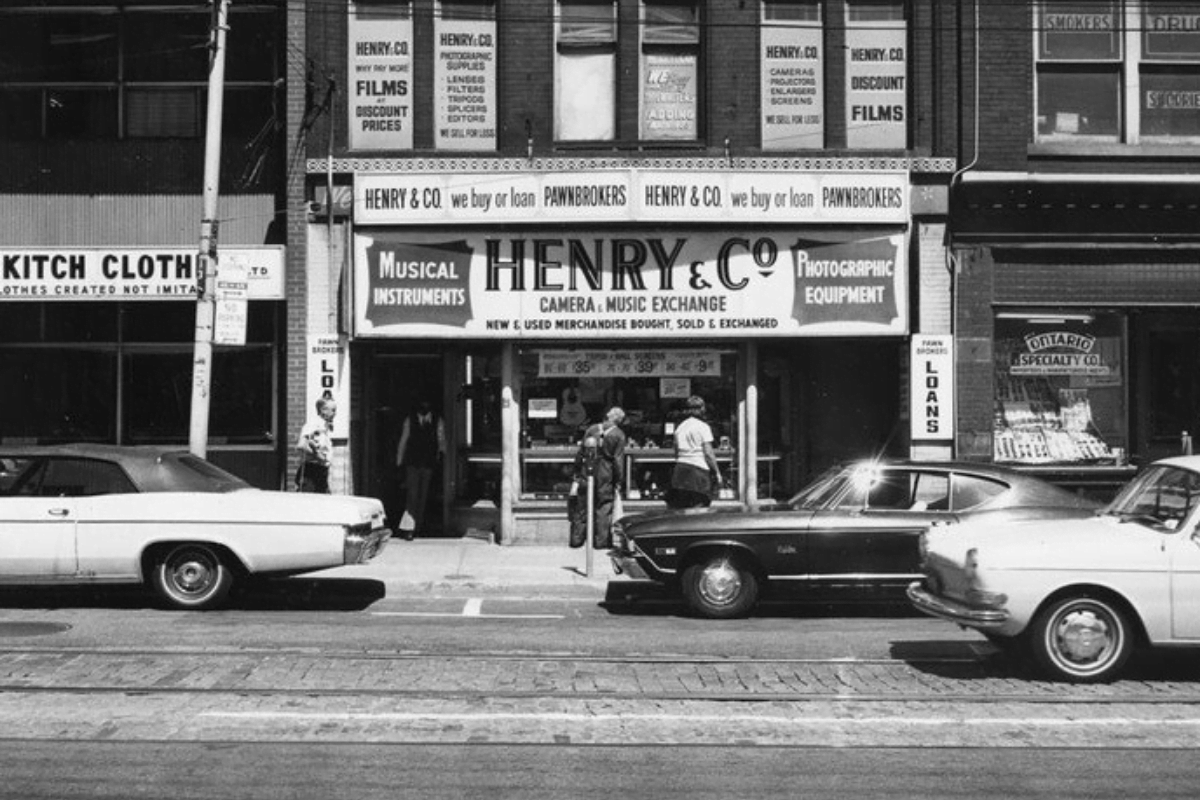
Image: Henry’s at 135 Church Street (1965)
The company said Lynx will support Henry’s continued investment in providing a seamless experience to its in-store and online customers, driven by its updated website and enhanced ecommerce capability.
As a result of Lynx’s investment, Henry’s commitment to improving, modernizing and updating the customer experience will continue to grow, along with efforts to increase community involvement and deepen social engagement with creators across the country, it said.
Brad Nathan
“We are thrilled to have Henry’s join the Lynx family,” said Brad Nathan, Founder and President of Lynx. “Henry’s has a long history as a strong Canadian, family-owned business and we’re looking forward to being part of its legacy. As Canada’s greatest camera store and one of the largest companies in its category, it has a legacy well worth protecting.
“Backed by our extensive support and dedicated team, Henry’s will continue to provide leading-edge products and services for photographers, filmmakers, and content creators. We look forward to this partnership as we continue to drive the growth of this great Canadian brand.”
New Henry’s Concept in Oakville (Image: Henry’s)
In a news release, Henry’s Chair Andrew Stein said he is proud to have grown the Henry’s brand into what it is today while building on his father’s and grandfather’s legacies, and seeing his daughters Gillian and Amy, drive it to new heights.
“I’m thrilled that we’ve found Lynx: someone who believes in our vision and our team, and who wants to preserve my family’s legacy and see the Henry’s name live on. I have achieved more than I ever imagined with this company, and this acquisition will help drive Henry’s to an even higher level of success,” he said.
The Henry’s Foundation, a charitable organization that supports the improvement of mental health, is not part of the acquisition, but Henry’s will continue to support mental health awareness, de-stigmatization and support for all Canadians.
The Toronto-based Lynx is a private equity firm that specializes in acquiring small and medium-sized businesses from owners looking to retire. Brad Nathan, Joanna Lipfeld, and Judith Benattar founded Lynx in 2007.
Craig and Lee have a conversation about what’s happening on Yorkville Avenue in Toronto, which has seen several high-end brands lease space on the street in recent weeks. The area is changing rapidly as the population grows and Yorkville Avenue finds its place as a luxury address.
The Weekly podcast by Retail Insider Canada is available on Apple Podcasts, Stitcher, TuneIn, Google Play, or through our dedicated RSS feed for Overcast and other podcast players. Also check out ourThe Interview Seriespodcast where Craig interviews guests from across the Canadian retail landscape as part of theThe Retail Insider Podcast Network.
Announcer 0:00 This is a Retail Insider Podcast. You’re listening to “The Weekly”.
Lee Rivett 0:08 Welcome to this week’s episode of “The Weekly” by Retail Insider. I’m Lee Rivett and I’m joined with the owner and publisher of Retail Insider Media, Craig Patterson, to discuss this week’s most read articles on retail-insider.com. So thanks for joining me, Craig.
Craig Patterson 0:22 Hello, everyone.
Lee Rivett 0:23 For this podcast, we wanted to touch upon a couple of changes that were happening in downtown Toronto in your neck of the woods, Craig. And this is Yorkville, right? So for our listeners that may not be familiar, could you share a little bit about Yorkville and the changes?
Craig Patterson 0:39 I want to talk a little bit about Yorkville Avenue, mainly the stretch, which has luxury stores. It’s not even that long the avenue generally but we’ll just talk about an area that’s really just a few hundred feet long. There’s some new developments coming and I wanted to talk about them because I’m excited. I think it’s really developing as a luxury street. It’s kind of got this bit of I don’t wanna say Rodeo Drive II feel to it, but it’s sort of along those lines but Yorkville Avenue is also a gathering place there’s there’s places we can get ice cream, people sit out there on a warm evening or during the day and just enjoy themselves. So it’s, it’s got a really great feel to it, but it’s also got some great luxury stores. So let’s talk a little bit about that.
Lee Rivett 1:14 The Yorkville neighborhood has seen a lot of luxury developments over the last couple of years which is right in your wheelhouse Craig. As far as I can remember, you’ve been reporting on these luxury openings in Yorkville for years. But how long have you been living on in Yorkville, by the way,
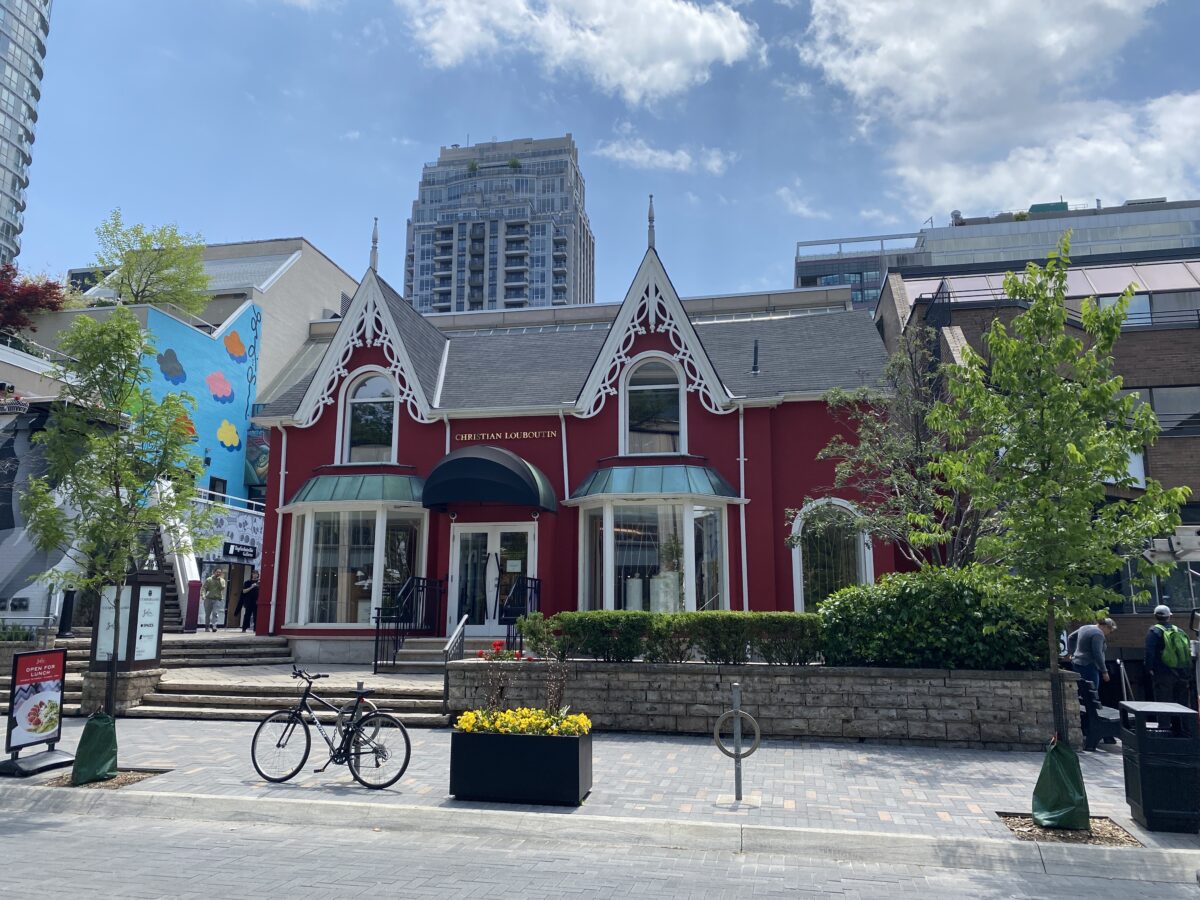
Christian Louboutin at 99 Yorkville Ave (Image: Dustin Fuhs)
Craig Patterson 1:29 So I came back to Toronto in 2016. Not too long afterwards, we saw the first luxury store opening on Yorkville avenue that I guess was in more recent memory. This was the Christian Louboutin store which is in an old house basically very, very cool building. Now Kiton had been there before as part of the V Hazleton retail operations, but really, I think Christian Louboutin is what kicked things off with these corporate stores that we saw opening on Yorkville Avenue.
Lee Rivett 1:58 Christian Louboutin was the first. Who were the others?
Craig Patterson 2:01 Things really kicked off when Chanel came in Chanel left Bloor Street and in 2017 opened its flagship store at 100 Yorkville Avenue. I think the address might be 98 Technically, but the facade is an old Mount Sinai Hospital. And really, I think Chanel was that link or that crux which brought in a bunch of other brands. So we saw Brunello Cucinelli open, Versace, Stone Island (we’ve reported on all of these in Retail Insider). A bit more recently, we saw Isaia open in the old Pink Tartan space at Yorkville Avenue on Bellair Street in an old heritage building. Balenciaga opened last year, in a spot. Right at at the end of last year, just a few months ago, we saw Reformation, Los Angeles based brand open its first flagship concept in Canada, it’s got the dressing rooms that are interactive, and that’s also opened on the street. So the street has really come along. And now we’ve got some new announcements to make here, which are quite exciting as well for Yorkville Avenue. So again, I said, I’m excited. I like what’s happening. And let’s talk about some of those brands.
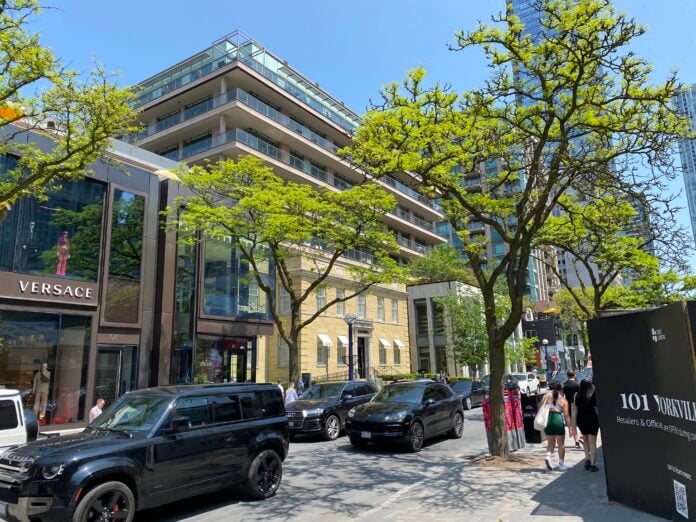
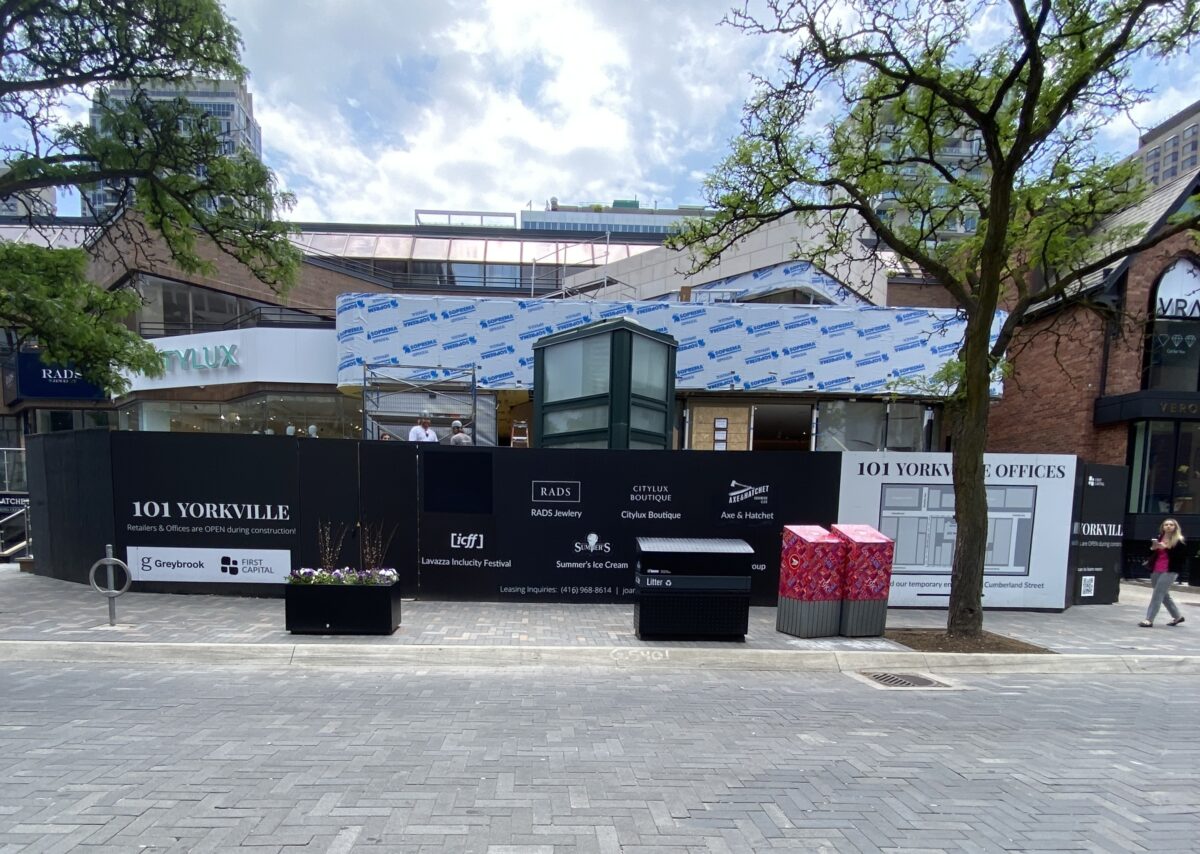
101 Yorkville Avenue (Image: Dustin Fuhs)
Lee Rivett 3:03 Totally. I think the first one was a home goods brand that’s coming into the neighborhood, right?
Craig Patterson 3:08 The first one we’re announcing here is Diptique. It’s a French fragrance brand. They’re they’re known for their candles and for their perfumes, home fragrances, stuff like that. And there’s already the first Canadian store it opened while back I think was about a year and a half ago at Toronto’s Yorkdale Shopping Center. And now a second one is opening at 101 Yorkville Avenue in Yorkville, so it’s gonna be a great addition to the street. There’s also some businesses nearby that I think are some good co-tenants on Hazleton Avenue. You’ve got the Caudalie Spa. You’ve got Le Labo over on Bellair street. You’ve got Aesop. So you’ve got a bit of a beauty offering that’s developing here in Yorkville, and I think Diptique is going to be a great tenant. So it isn’t a building which eventually will be demolished. So the lease is not necessarily long term but it’d be a great little spot. And it’ll be joined, I think by some other great retailers as well. But nothing has been confirmed yet in terms of lease specifically for that building.
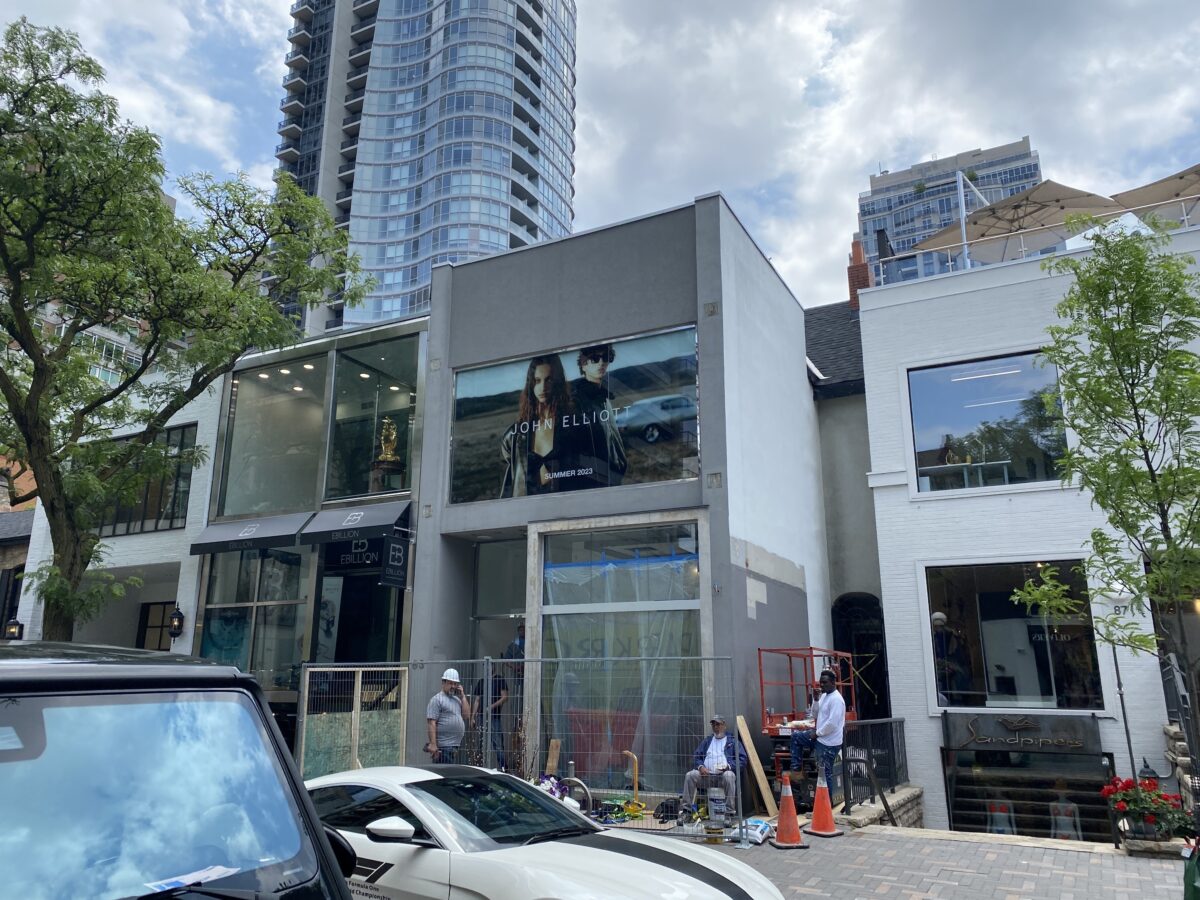
Future John Elliott at 83 Yorkville Avenue (Image: Dustin Fuhs)
Lee Rivett 4:04 And I think down the street, you’re talking about a denim brand as well, right?
Craig Patterson 4:08 That’s right now John Elliott, it’s an American fashion brand is pretty expensive. It’s kind of almost in the luxury category. I think the jeans were about $650 to $700. It’s going to be opening a store, actually, where the Off White location had been as well as a little, I guess, the entire building. It’s about 5000 square feet. So not nearly as small as the old Off White at 83 Yorkville Avenue. And this will be the first location in Canada. Arlen Markowitz, I know was involved in the deal because we were chatting about it and from CBRE and this is another exciting retailer so I haven’t connected with them yet in terms of doing a full article on Retail Insider about it. But nevertheless, the construction has started on this store and this is going to bring a younger demographic onto the street. And I will say right now that there also will be a another very, very exciting retailer opening on the street that I’m not allowed to talk about the ad unfortunately, but that will be opening nearby. What I can say generally is I’ve been told that this will bring many new young people to the street, many people that are quite hip, maybe even some that might go to Yorkdale typically, but that this should be another good tenants along with John Elliott that will both really bring in a moneyed, youthful population to Yorkville, which I think is going to be important for the neighborhood’s overall survival in years to come as being a commercial center, especially when it is competing against Yorkdale.
Craig Patterson 5:39 That’s right, VRAI. So this is actually a bit of a confusing one for me, I’ll tell a bit of a backstory. So we do know that VRAI is going up at 111 Yorkville Avenue, it’s going to be above the Veronica Beard store, which we did also report on. So that’s a great new tenant based in New York City women’s fashion brand, but with VRAI again, moving up to the second floor. We knew about it beforehand, and we knew the address. Well actually, we didn’t know the address. We thought it we were told 118 Yorkville Avenue which is the Hazelton Hotel. So of course me being detective in retail are doing my investigative journalism, you know, putting on my investigative journalist hat. We were wandering around trying to figure out where in the hotel it was going. And the answer was it wasn’t I even spoke to a concierge. They’re really nice people there by the way, they were so helpful, even though we had no answers because that wasn’t where it was going. And then I figured it was actually going in the basement of the 111 building because I thought the entire second floor was going to be a spa but we were wrong because some signs went up and then I spoke to the founder of VRAI and it’s going upstairs. So anyways, it’s a bit of a funny story about how we didn’t know necessarily where it was going to be going exactly on the avenue but we knew that it was going on Yorkville Avenue and and now it’s confirmed because they’ve got signs that are going above the Veronica Beard store in this building, which used to be I think, two townhouses. In many decades past when when Yorkville was it was a residential neighborhood with houses and not so many stores. So yeah, no, I think VRAI which is lab grown diamonds will be another welcome addition to the neighborhood. It’s creating a clustering of businesses which I think is going to be terrific for for Yorkville.
Lee Rivett 7:18 Yeah. And now this next retailer coming to Yorkville has a special place in my heart. They’re originally from Vancouver and I’m a regular at their Davie Street location. I even currently have my eye on at least four items in their store right now. So if you’re looking for any Christmas in July gifts for me they got you covered, Craig. But do tell us about the retailer. There darling and amazing and I’m excited to see that they’re expanding into your neck of the woods.
Craig Patterson 7:43 That’s right people love luxury resale. You’ve got Gucci, Prada, Fendi, everything you can imagine, Dior. It’s called “Mine and Yours” and it’s going to be taking the former Free People’s space on Yorkville Avenue. So I think this is going to be quite an exciting thing. There’s already another luxury reseller on the street, Oliver’s Jewelers, which you know, Russell’s “Oh, yeah”, I can’t really do that so well. But now we’re going to be getting a second store across the street at 79 Yorkville Avenue, call “Mine and Yours” and Courtney is the owner. She’s really fun. I’m sure the opening party is going to be an absolute blast just because they seem to have a lot of events. And I think that’s going to be part of the retail experience, it’s actually going to be various in-person events, because it’s something that’s done in Vancouver and I think Toronto very much embraces such things. So I would be surprised if Courtney didn’t have some pretty great, you know, bang up events there that will involve drinks and food and shopping, of course, so I think that this is actually going to be a very fun addition to the street. We don’t know how long the store is going to be there yet. I don’t think it’s necessarily a long term lease, but I don’t think it’s quite as short term as we expected, so we’ll be getting some more information. I’ll be interviewing Courtney, I believe on a podcast and we’ll be doing an article right around the time the store opens which is going to be in a couple of weeks. So another great addition to Yorkville Avenue is not necessarily a luxury retailer like one of these big names like you know Chanel, Gucci, Prada, but it does have those brands that’s just resale. So it is an interesting mix of having that resale with the luxury brands being very, very, very close by
Lee Rivett 9:23 Unfortunately there’s a brand that’s also closing in Yorkville, if you wanted to tell us about.
Craig Patterson 9:28 There’s a multi brand retailer called Kimina which has operated on Yorkville Avenue since 1986. And we I just saw some signs on the window saying that it’s going to be shutting down which is too bad. It is a bit unfortunate that the retailer is going to be closing it’s at 112 Yorkville Avenue. I haven’t spoken to The owner yet in terms of the rationale around closing, it could just be a retirement. I mean, that’s a long time to have a store on the street and to be a family owned business. But it definitely sold high end products over the years and hopefully a new tenant comes in. There’s an optical store located next to it right now call Outlook I believe is what it’s called an optical store. But it’s it’s in an older building on Yorkville Avenue with steps that go up to it next to the Kiton store. So some new tenant will be coming in there. I don’t know if it will be a luxury store. It’s just because the building is quite old and luxury brands don’t necessarily like to locate in old houses and the way that it’s configured but who knows what’s going to happen there. There could be a redevelopment of the building. I think Whittington investments owns half of the building. I’m not sure which half actually to be honest, I think it’s the other half but we’ll see where that goes. So that’s that’s a bit of a change for the street as well.
Lee Rivett 10:54 Heading towards Avenue Road. There’s some changes that are happening in that neck of the woods to do you want to elaborate on that as we start wrapping up the podcast?
Craig Patterson 11:02 Yeah, so First Capital Realty owns the old Hazleton Lane shopping center, which has been rebranded Yorkville Village. Well, they’re a REIT. There’s a development happening right on Yorkville Avenue that’s going to involve a condominium tower with some very, very expensive units. By the way, I’m curious about the pricing, I’ve heard they’re going to be in the many millions of dollars, so we’ll find out soon. But 138 Avenue Road, I think is that building. But First Capital Realty is going to be doing a bit of a reconfiguration of its entrance into the Yorkville Village shopping center from Yorkville Avenue. I’ve seen some renderings, but I don’t know if they’re finalized. But my understanding is that this will involve a ramp going up instead of down into the shopping center and that there’s going to be more opportunities for actual full blown luxury brands to be opening on Yorkville Avenue. So this will be across from the CNTRBND store, basically, on Yorkville Avenue. This is towards Avenue Road. We don’t know, of course, who these luxury brands are going to be yet this is a while in development in terms of this a hole in the ground type of situation leasing probably has not started for these retail spaces that will be there. But I think there are some grand plans in the works for the future here as this development progresses. So I’ll have to figure out what the timeline is going to be there. I mean, it’s not going to be months, but it’s not going to be many, many years either just because it’s involving a condominium tower development, it’s going to have commercial at the base. But nevertheless, just the renderings that we’ve seen which are public (on Urban Toronto and whatnot) look quite glamorous and fun and interesting and again, are going to be a really great addition to Yorkville Avenue towards Avenue Road. So something to watch as well. So we’ll be following that closely here as it develops. And me being in Yorkville, it is easier for me to go and look around and see what’s happening. So it’s it’s really neat to see this neighborhood growing up and, and Yorkville again, throughout. There’s about what 10,000 housing units that are proposed are in development right now in the neighborhood. So it’s going to add 1000s and 1000s of new people to the area. It’s growing probably faster than any other high density luxury node possibly in the world. And the number of wealthy people that will be moving into Yorkville over the next few years it’s going to be substantial. Looking at the number of residential units they’re proposing with prices at over $5 million. It’s a lot, probably more than we’ve ever seen. So I think that given that we’re gonna see more rich people moving into Yorkville, there’s going to be more opportunities for retailers, I think in the area to actually cater to a local population and not necessarily just people from Forest Hill and Rosedale and and you know, wealthy neighborhoods nearby, you’re gonna have people living upstairs and living across the street that are going to be shopping in these stores like Gucci and Prada and Chanel. So this is a good place for retailers to be in Yorkville, just given that you’re gonna have rich people living on top or across the street or nearby.
Lee Rivett 13:45 One just to wrap up Is there anything next steps that you’re planning on doing in order to get more details for the Yorkville area and news for our listeners?
Craig Patterson 13:54 What I probably should do is I’ll speak to some brokers and see if I can even introduce some of them on Retail Insider in the next few weeks. And we’ll talk a little bit more about what’s happening in Yorkville as well as around the country. I’d like to speak to brokers a bit more on camera or on podcast, whatever they’re comfortable with, about what’s happening. So but I am excited to see what’s happening in Yorkville as well those as well as other neighborhoods across the country as we see new retailers opening, even though I know we’re in a situation where consumers are in. Many demographics are struggling and we’ve got you know, situation of inflation and whatnot. There are still consumers out there spending. So with that we’re seeing retailers, restaurants and other businesses also growing so we’ll continue to follow that. I tried to remain optimistic despite everything that’s happening right now. And I think the future is going to be bright.
Lee Rivett 14:42 Thanks for going through some of the latest updates from Yorkville. I’m sure a lot of our listeners wanted a lot of these details. It’s really exciting and unfortunate some of the closures but other than that, thank you again and chat with you next week.
Craig Patterson 14:53 Thank you so much, Lee and thank you so much everyone for listening today. Take care and bye for now.
Subscribe, Rate, and Review our Retail Insider Podcast!
Drop us a line at Craig@Retail-Insider.com. You can also rate us in Apple Podcasts or recommend us in Overcast to help more people discover the show!
Background Music Credit: Hard Boiled Kevin MacLeod (incompetech.com). Licensed under Creative Commons: By Attribution 3.0 License. http://creativecommons.org/licenses/by/3.0/
The Amazing Brentwood, a co-venture by Shape Properties, Healthcare of Ontario Pension Plan and L Catterton Real Estate, continues to develop into a one-of-a-kind urban gathering place, reflecting the vibe of Metro Vancouver’s global community, creating a diverse and compelling retail tenant mix.
When the project is complete, it will comprise just over one million square feet of retail as well as several residential towers and thousands of new homes in Burnaby’s Brentwood neighbourhood. It is one of British Columbia’s largest, master-planned, mixed-used developments featuring world-class shops, restaurants, public plazas, entertainment.
Maria Holly
“What was important for our retail mix was to make the offering unique,” said Maria Holly, Senior Vice President, Retail for Shape. “We do have a very large shopping centre five kilometres east of us, Metrotown, 1.7 million square feet.
“What we need to do here is curate something unique and also that would fit into our master plan with our residential development. We did some carefully curated mix of first-to-market retailers and those included Sporting Life. They opened in 2019. They’re 44,000 square feet. Still the only Sporting Life in BC. LL Bean opened at 12,000 square feet and still the only one in BC. Suitsupply out of Amsterdam is under construction fast and furious and they’re opening in August in about 6,000 square feet and it will be the only one in Metro Vancouver.
“We did a large H&M, 30,000 square feet. They put in an H&M Home component of 7,000 square feet. And it is also the only one in Metro Vancouver. We did the first Rec Room in BC. It is 44,000 square feet and right now the sales ranking for Rec Room amongst the other Rec Rooms across Canada this is the number two Rec Room, the first one being downtown Toronto.”
The Amazing Brentwood (Image: Shape Properties)The Amazing Brentwood (Image: Shape Properties)TABLES at The Amazing Brentwood (Image: Shape Properties)
Holly said first-to-market concepts include Evolve Strength Fitness out of Alberta which is under construction and opening in the fall in 21,000 square feet.
“And then we did a very large food court. It’s beautiful. It’s called TABLES. The acronym of The Amazing Brentwood is TAB and we use that in a lot of our marketing materials. So TABLES is a play on words with TAB and The Amazing Brentwood and it’s 30,000 square feet, it’s got 19 food vendors and they’re all unique, chef-driven, first-to-market offerings.”
The project did a deal with Whitespot restaurant as part of TABLES where it launched its first-to-market R&D Kitchen in about 4,000 square feet.
Anchor tenants include a VIP Cineplex of 22,000 square feet (the top one in the chain) and a number of restaurants such as Earls, Neptune Seafood Palace, La Taqueria, and Jinya Ramen Bar.
Under construction is a three-level, 10,000-square-foot Tap & Barrel restaurant and bar as well as Bow & Stern, a seafood restaurant. Also under construction is Hello Nori, hand rolled Japanese sushi.
There are also a few coffee shops.
R+D Kitchen by Whitespot at The Amazing Brentwood (Image: Shape Properties)The Amazing Brentwood (Image: Shape Properties)
“It’s really become known in Metro Vancouver as an entertainment and food and beverage destination with kind of a dynamic public space,” said Holly, adding there’s a one-acre outdoor plaza and the Glass House, a two-level structure where pop-up retail exists.
“We just signed Rivian. It’s the Tesla of SUVs and pickup trucks, out of California. Super cool. They’re doing a longer pop-up than we normally do. They’re doing their renovation right now and they’re opening July 1 in 5,500 square feet.”
Marvel Avengers S.T.A.T.I.O.N also opened in 25,000 square feet as a pop-up until the end of September.
Athleisure does well in the market and The Amazing Brentwood offers well-known brands such as Nike and adidas.
“We only have about 8,000 square feet of vacancy but it’s the best CRU space in Neighbourhood One because it’s right along Brentwood Boulevard. And we’d like to do athleisure or unique branded fashion there,” said Holly.
The Avengers Station at The Amazing Brentwood (Image: Shape Properties)
The first phase of the project is now complete and the second phase is currently under construction.
“The next phase which is really the interior mall redevelopment in the development pipeline,” said Holly.
Shape purchased the existing shopping centre on the site along with HOOP in 2008.
“And the reason that they bought the Brentwood Town Centre site which was a 450,000-square-foot neighbourhood shopping centre originally anchored by Eaton’s and Loblaws way back in the day was connected to Sky Train and was identified by the City of Burnaby as a town centre,” said Holly.
“So it came along with a bunch of density. Up to 8.5 million square feet we could build on our 28-acre site. The former existing mall on two levels was surrounded by surface parking. Pretty standard for shopping centres built in the 60s.
“So what we have completed now is we’ve taken the surface parking in front of the existing mall and that’s where Neighbourhood One sits. And Neighbourhood One consists of, and is open, three very large residential towers. The tallest tower is 62 storeys so it rivals the height of some of the towers in downtown Vancouver. That’s a total of 1,700 units that are open and fully occupied.”
The Amazing Brentwood (Image: Shape Properties)
The Amazing Brentwood (Image: Shape Properties)
The Amazing Brentwood (Image: Shape Properties)
About 450,000 square feet of commercial/retail real estate was built with about 75,000 square feet of office that is leased. Holly said Neighbourhood One retail is about 95 per cent leased with about 90 retail tenants.
“But we are 61 per cent open. So we’re still in the opening phase,” she said.
The second phase which is Neighbourhood Two is in the ground right now. It will include two luxury residential towers. Tower Five sold out at $1,350 a square foot. Tower Six is even more than that and is almost sold out.
Holly said there will be an additional 60,000 square feet of retail as part of Neighbourhood Two. The phase will be completed in 2027.
“We are looking for retail that is unique. Retail that is also something that our residents will enjoy. At the end of our build out of our master plan we’ll have 11,000 people living just on our site,” she said. “It’s a lot of people.
“Through L Catterton, we have had a window into their brands and their relationships with some of the luxury players but at this point in time it would be a future phase. We don’t have that plan fully developed at this point in time. We’re focusing on the success of the residential demand and that’s why phase two or Neighbourhood Two is another two very big residential towers. Another 1,000 units.”
Retail Insider is streamlining its Canadian retail news from around the web to include a handful of top news stories that can be viewed quickly during the day. Here are the top stories from the past several days.