Advertisement
Home Blog Page 727

Unique Retail and Foodservice Concept ‘GoodGood’ Expanding with New Locations, More to Come [Co-Founder Interview]

GoodGood Queen Street (Image: Dustin Fuhs)

GoodGood, an all-day cafe specializing in locally-curated coffee, beverages, snacks and everyday essentials, has been aggressively expanding its presence in the Toronto market this year with the opening of four locations and another one to come in the near future.

Kris Linney, the company’s co-founder and chief marketing officer, said a pop-up location was initially opened in December of 2021 to give the brand name some exposure in the market.

Kris Linney

“From there we’ve moved on and we’ve built out four of what we call all-day cafes. The first one opened in St. Lawrence Market over on Esplanade. That opened at the end of February. From there we opened a second location in St. Clair West and Dufferin. That opened end of March, early April.

“Then we opened on Adelaide where our pop-up was at the end of March. We actually closed down the pop-up and moved next door to a full build out. It’s got about 2,000 square feet. It has seating. And we recently opened on Queen Street, just west of Bathurst, as our fourth location. That opened mid to end of April. So we’ve been kind of rocking and rolling. And we have one more location that’s slated to open end of July or early August and that’s at Yonge and Davisville.”

Future GoodGood at Yonge & Davisville (Image: Craig Patterson)

Linney said the five locations vary in size between 1,500 to 2,000 square feet with seating and a couple of them have patio spaces.

“Really beautiful places where people can hang out, grab a coffee or a drink and discover new awesome emerging brands,” he said.

“We’re evaluating some other options. We don’t have necessarily anything signed yet. We haven’t publicly announced anything. But the goal would be to open a few more locations. We’re very focused on Toronto and I think we’re really getting an understanding of the different neighbourhoods where the concept can thrive in.

“We’ve been very fortunate to be able to open in neighbourhoods that have really embraced the brand and the concept. Definitely have our eyes on a few different neighbourhoods and a few different properties. Evaluating some options.”

GoodGood Adelaide (Image: Dustin Fuhs)
GoodGood Queen Street (Image: Dustin Fuhs)

Linney said the company is very focused on Ontario as a region and as a whole. That will be the primary focus for the brand for the foreseeable future, at least until the end of this year. But it is interested in looking beyond the Toronto downtown into some markets in the GTA. 

“We haven’t officially moved in that direction yet but our goal is to kind of build the brand in Toronto, the GTA and then Ontario proper,” he said. 

“We operate what we’ve kind of branded all-day cafes. So what’s really cool about our concept is that they’re legitimately busy the whole day. You can come in the morning. We have an awesome coffee selection. Pastries. So get your morning started. Jump-started some would say. You can enjoy the traditional cafe experience. As the day progresses, we progress with the day. In the lunch time, they’re grabbing those salads. We have awesome snacks and beverages from sparkling waters to sodas. You name it. Across the board. And then after that in the afternoon we fuse into a wine cafe. We do beer. We have pizzas that we make on site.

GoodGood Queen Street (Image: Dustin Fuhs)

“You can come in the morning. You can come for lunch. Or you can come in the afternoon. We have a relevant selection of products that’s always available to you and we’re hyper focused in supporting emerging brands . . . We’re very focused on connecting these emerging brands to local neighbourhoods through the all-day cafe concept. It’s been embraced really well by the community and something that a lot of neighbourhoods are going to seek out.”

Founded by Robert Kim and Linney, GoodGood’s goal is to make it easier for neighbourhoods to access their favourite makers and artisans.

Jackson Turner of CBRE is handling leasing negotiations for GoodGood’s store expansion.

Podcast [Interview] Justin Cohen of Psycho Bunny Discusses Store Expansion

Podcast [Interview] Justin Cohen of Psycho Bunny Discusses Store Expansion

Craig sits down with Justin Cohen, Chief Commercial Officer of edgy menswear brand Psycho Bunny. They discuss the plans to open more Psycho Bunny stores in Canada as well as the fact that the brand could even be considered Canadian with its operations in Montreal.

The Interview Series podcast by Retail Insider Canada is available on Apple Podcasts, Stitcher, TuneIn, Google Play, or through our dedicated RSS feed for Overcast and other podcast players. Also check out our The Weekly podcast where Craig and Lee discuss popular content published on Retail Insider which is part of the The Retail Insider Podcast Network.

Interviewed this episode:

Subscribe, Rate, and Review our Retail Insider Podcast!

Follow Craig:

Follow Retail Insider:

Listen & Subscribe:

Share your thoughts!

Drop us a line at Craig@Retail-Insider.com. You can also rate us in Apple Podcasts or recommend us in Overcast to help more people discover the show!

Background Music Credit: Hard Boiled Kevin MacLeod (incompetech.com). Licensed under Creative Commons: By Attribution 3.0 License. http://creativecommons.org/licenses/by/3.0/

LCBO Marks 95 Years as it Opens Newest Storefront at Toronto’s Union Station [Photos/Interview]

Image: LCBO

The Liquor Control Board of Ontario recently opened its newest location at Union Station in Toronto as the Crown Corporation continues to expand its footprint in the province while celebrating 95 years in business this year.

“It is astonishing to look back and see how far we have come as a business and as an industry over the last 95 years. As the LCBO continues to evolve, we will remain focused on helping customers discover and enjoy our products responsibly, providing seamless shopping experiences and creating a more sustainable Ontario. Together with our industry partners, we are now laying the foundation for the next 95 years,” said George Soleas, President & CEO of LCBO.

Located in the country’s busiest transit hub, the Union Station store will service more than 75,000 residents in the area as well as 300,000 daily commuters, tourists and event goers. It is conveniently located in the Bay concourse, within steps of the TTC, GO Transit, and VIA Rail.  

“Union Station is the busiest building in the country. It is also one of the most beautiful and historically significant,” said Soleas. “We are excited to be one of the first retailers in the Bay concourse and to provide even more convenience for our customers, as they pick up the perfect choice on their way to or from downtown.”

LCBO at Union Station (Image: LCBO)
Image: LCBO

At approximately 7,000 square feet, the store features more than 1,000 products.

The LCBO has more than 680 stores in the province with a couple more opening this year.

George Soleas

It was established in 1927 and today offers more than 28,000 products annually from more than 80 countries to consumers and licensed establishments. 

All net income from LCBO sales goes to the Government of Ontario in the form of an annual dividend, which helps fund key local and provincial public programs and services including health care, education, and infrastructure. In 2020-2021 Fiscal Year, it delivered a $2.39 billion dividend to the Ontario Government.

LCBO also has five regional warehouse facilities and is a wholesaler to 450 grocery stores. The LCBO Convenience Outlet program services almost 400 local communities. It provides wholesale support for 18,000 bars and restaurants.

Image: LCBO

In its 2020-2021 annual report, the LCBO’s key financial data indicated $7.18 billion in revenue, $2.54 billion in net income, $140+ million in total e-commerce sales, and grocery sales from the wholesale supply of beer, wine and cider to grocery stores of $486.5 million with 450 active store authorizations by the end of FY2021.

In his message in the annual report, Soleas said the LCBO has accelerated the growth of its e-commerce channel to meet evolving customer preferences, bringing the brand promise to life online. 

“As we look toward next year, we know the only thing that is constant is change. Ontarians are shifting their shopping behaviours and continue to have a strong desire to explore local producers. We’ll look to expand popular initiatives like Pair It Forward which celebrates Ontario’s spectacular food and beverage producers, starting a chain reaction of their favourite pairings for their products while shining a spotlight on local farmers, growers and makers throughout the province, showing the world what Ontario is truly made of,” he said. 

The annual report said FY2021 net sales and income outpaced plan levels, and grew 6.2 per cent and 5.7 per cent respectively, relative to the previous year. The home consumer channel accounted for the largest share of LCBO sales at 83 per cent, up 452 basis points from FY2020. Net income reached a record $2.54 billion in FY2021, an additional $136.8 million from the previous year. It represented 35.3 per cent of revenues, which was 15 basis points lower than FY2020. 

Image: LCBO

The LCBO added nine new stores to its retail network during the year and closed one store. Eight other stores were either relocated or underwent major renovations in FY2021. The grocery channel, established in December 2015, added the final 11 locations to reach the 450 planned authorizations during the year. Sales to grocery stores grew by 52 per cent to $486.5 million in FY2021. The LCBO Convenience Outlet Program continued its expansion with a further 30 locations during the year, providing socially responsible beverage alcohol retail to communities lacking convenient access to an LCBO store. Sales through this program almost doubled to $293.6 million from the previous year, added the report.

“The abnormal circumstances of LCBO’s revenue growth in FY2021 was unlike previous years/. The effects of the usual holiday and long weekends sales build, sporting and public events and activities, and favourable seasonal weather, among others, were all tempered during the year. Restrictive measures, including multiple lockdowns, to curb mass gathering in public places, especially in relation to dining out, resulted in a transfer to greater off-premise alcohol consumption,” said the report. 

“Forced staycations, increased household savings and promoted self-entertainment, contributed to alcohol sales growth. LCBO’s performance was buoyed by consumers’ resilience and the company’s ability to quickly adapt to the economic, retail and health dynamics of the environment. Amidst store closures, reduced operating hours and implementing health and safety protocols under the guidance of Public Health, which included strict policing of in-store customer capacity and cleaning and sanitization practices, LCBO further pursued measures to satisfy demand and improve convenience. Examples of these measures included, continued retail store network expansion, improvement of eCommerce delivery options, greater support to the grocer and LCBO convenience outlet channels, responding to consumers’ changing preferences and demands with regards to product preferences and selections, and coordinating with stakeholders to facilitate amendments to licensees’ alcohol retailing policies.”

Giorgio Armani Opens 1st Standalone Emporio Armani Store at Toronto’s Yorkdale Shopping Centre [Photos]

Photo: Giorgio Armani

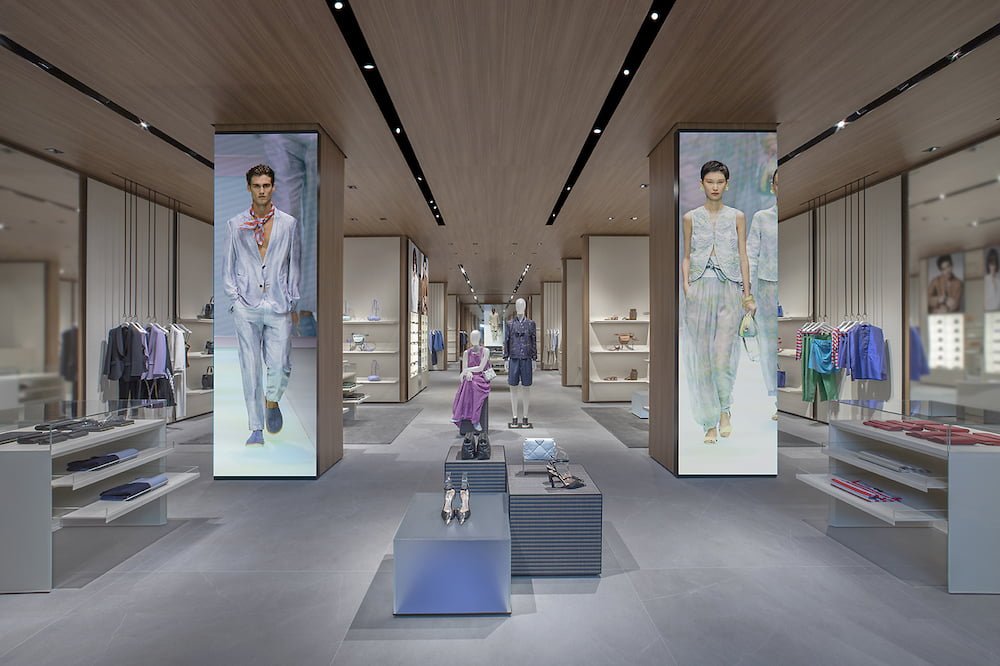
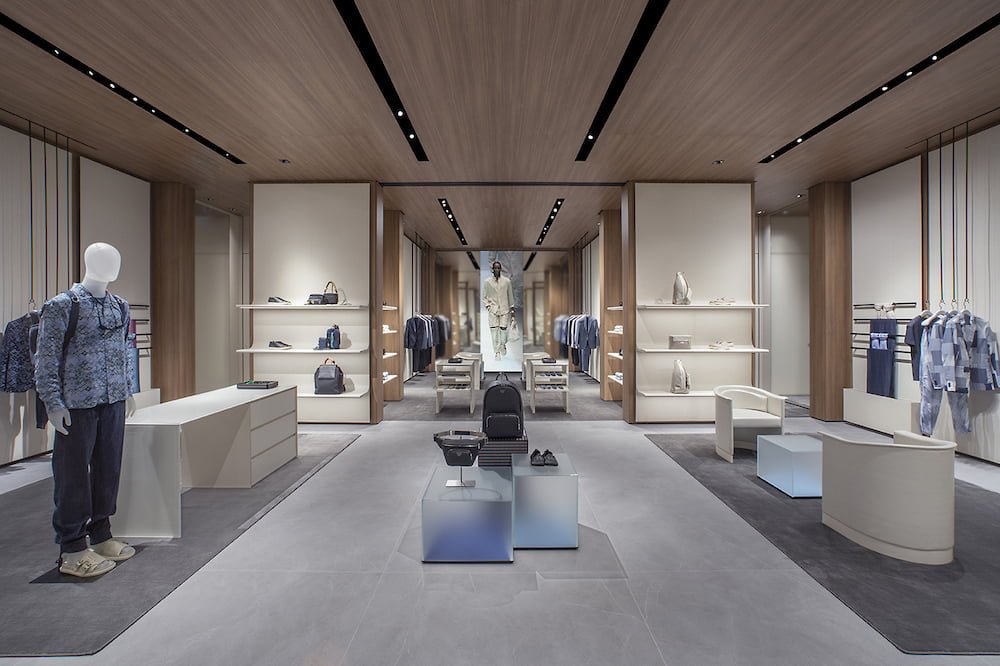
Italian luxury brand Giorgio Armani has opened the only Canadian location for its sub-brand Emporio Armani at Toronto’s Yorkdale Shopping Centre. The beautiful new store took several months to build.

The 4,200 square foot store houses Emporio Armani’s collection of men’s and women’s lines, including Emporio Armani ready-to-wear, accessories, and small leather goods as well as Emporio Armani watches, jewellery and sunglasses. 

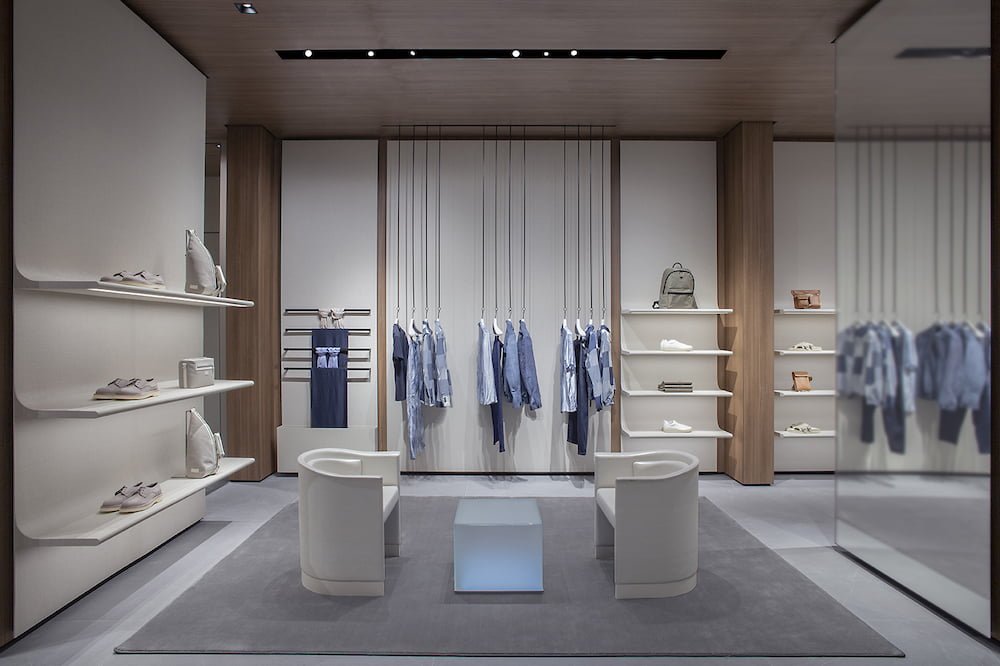
The Emporio Armani storefront, which replaces an Ann Taylor store in Yorkdale’s 2012 expansion wing, was designed by Giorgio Armani himself along with a team of architects. The store’s design is described as blending “craftsmanship and modernity” with materials used throughout that include hardwoods and fine textured wall coverings that match with the neutral ceramic grey flooring. 

Photo: Giorgio Armani

Ceilings in the store are clad with wood, and wooden panels continue onto the walls and alternate with wallpaper-covered sections that provide a backdrop for the display of the products within the space. The choice of natural materials in light colours, from grey to almond, were intended to give the space a light and fresh air according to Armani. 

After Ann Taylor exited its Canadian stores in 2020, Montreal-based Quartz Co. leased the Yorkdale space for a pop-up that operated for several months. Construction of the Emporio Armani store started in late 2021 and it opened to the public several weeks ago. 

Neighbouring luxury retailers in the mall’s wing include Valentino, Bottega Veneta, Balenciaga, Celine, and Hugo Boss. Across the hall is a large Holt Renfrew store which houses large mall-facing concession boutiques for brands including Chanel, Gucci, Fendi, Dior and Brunello Cucinelli.

Technically this isn’t the first time that Emporio Armani has had stores in Canada. Between 1990 and 1995 the brand had a 6,000 square foot storefront at 80 Bloor Street West in Toronto where Banana Republic most recently operated. In 1998 Holt Renfrew opened a licensed Emporio Armani store at the Holt Renfrew Centre at 50 Bloor Street West that operated until the early 2000s. 

Photo: Giorgio Armani

In Canada, Emporio Armani is also carried as a stockist at several upscale retailers. Menswear is carried at several Harry Rosen stores in Canada and women’s fashions are available at Holt Renfrew as well as at The Room at Hudson’s Bay in Toronto and Vancouver. It remains to be seen what effect the standalone Toronto store will have on wholesale distribution for Emporio Armani in Canada. It’s also not yet known if the brand will open more Canadian stores. 

Armani also operates standalone A/X Armani Exchange stores in the Vancouver, Calgary, Toronto and Montreal markets. At one time the A/X sub-brand had numerous other stores in Canada that have since closed. 

Holt Renfrew carries Giorgio Armani’s top ‘Black Label’ line for women in its stores in Vancouver, Toronto, Mississauga and in Montreal where at Holt Renfrew Ogilvy the brand has a beautiful boutique space. Giorgio Armani’s top men’s line is also carried in a handful of Harry Rosen stores in Canada. The brand is said to be planning to have more of a presence in Canada with details to follow. 

Designer Giorgio Armani, who is 88 years old, founded his retail brand in 1975 in Italy. Armani has become a lifestyle brand with hundreds of stores globally as well as music, sport and luxury hotels. He’s said to be the world’s wealthiest openly gay man with a net worth of $9.53 billion USD in 2021 according to Bloomberg’s Billionaire Index.

Gucci Reopens Expanded Hotel Vancouver Store, Becoming Largest Flagship in Canada [Photos]

Photo: Pablo Enriquez

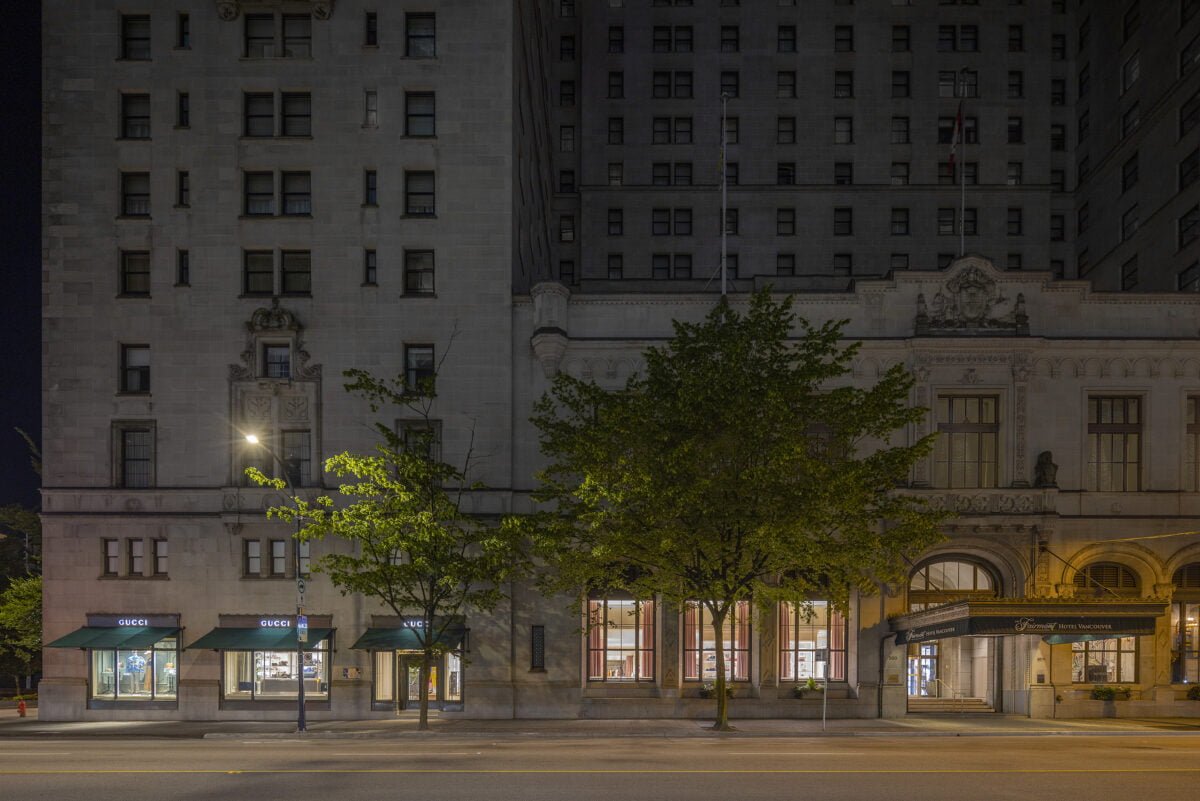
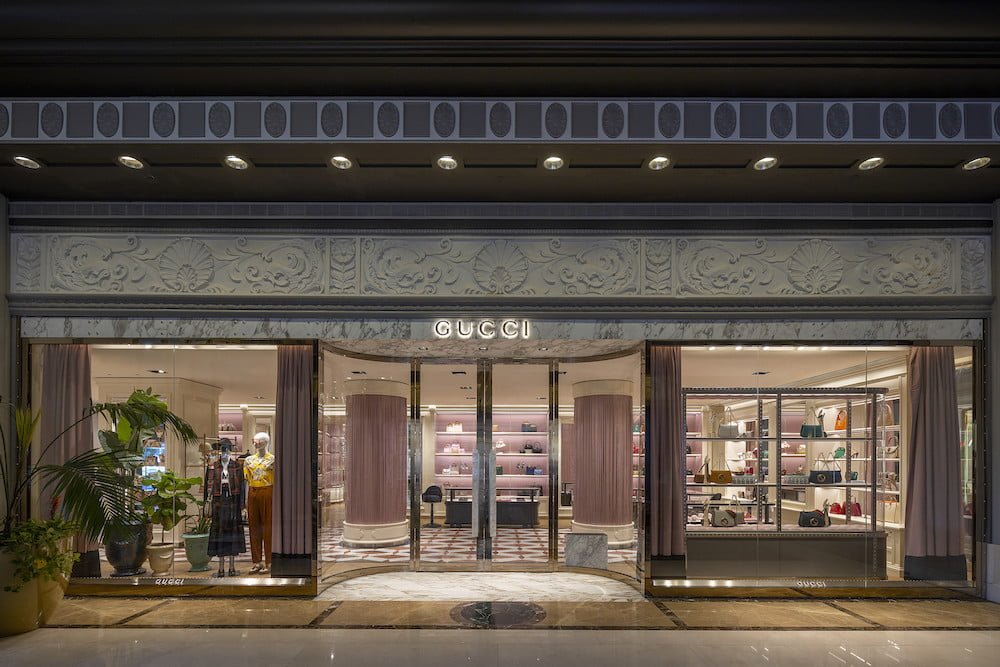
Italian luxury brand Gucci has reopened its store at the Fairmont Hotel Vancouver at 900 W. Georgia Street in downtown Vancouver. The store recently saw a significant expansion to add new product categories which involved joining an existing Gucci store with a neighbouring retail space. 

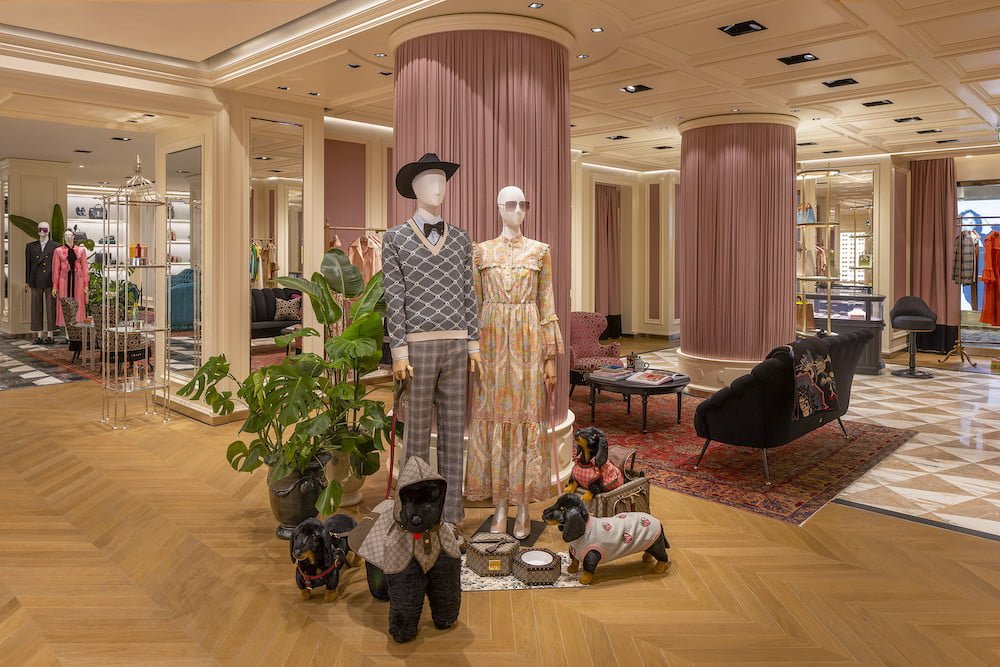
For the first time, menswear is now available in the standalone downtown Vancouver Gucci store — when it opened in 2006, the location catered primarily to women. Now the Vancouver store, considered to be a flagship, is large enough to house men’s categories as well as the new Gucci Pet collection — prior to the expansion Gucci men’s ready-to-wear was only available in the Vancouver market at Holt Renfrew where Gucci has a concession presence. 

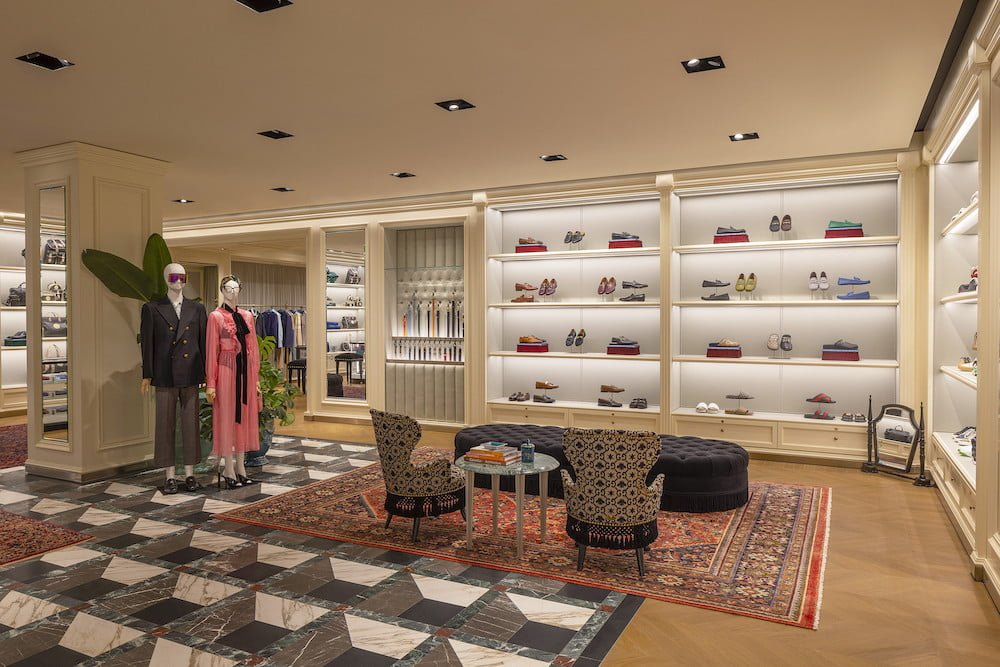
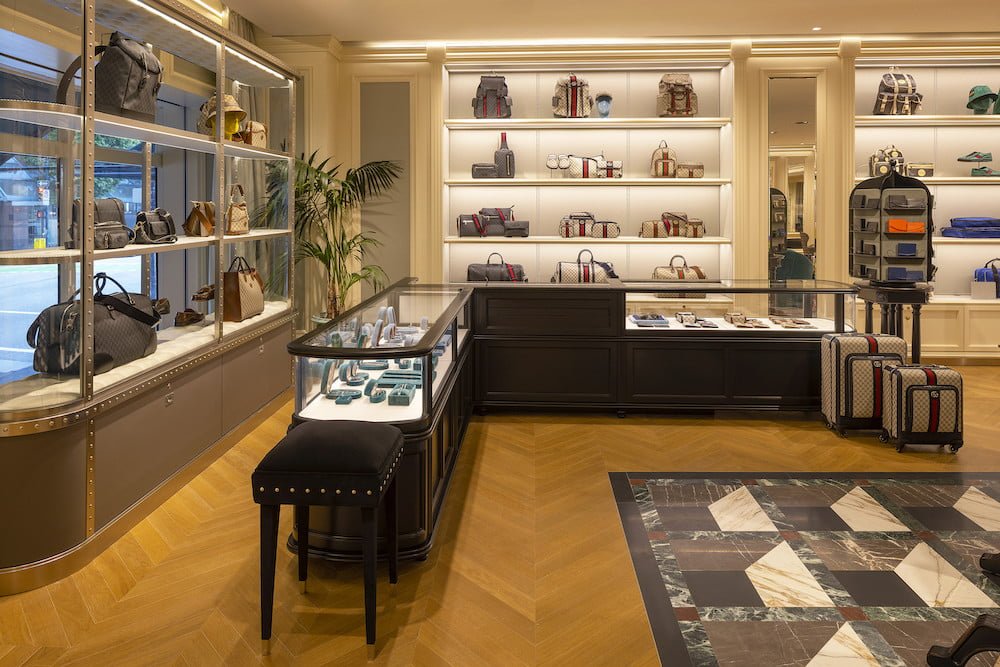
The expanded flagship store’s design includes custom geometric painted wood floors and marble polychrome inlays that produce decorative three-dimensional effects on the floors. As with other updated stores, Vancouver’s Gucci location also includes ample use of herringbone wood flooring which contrasts with rich fabrics in some rooms. Varnished pink iron wall finishes complement the moss green velvets used for upholstery of some furniture items as well as in fitting rooms. Plush chairs and vintage oriental rugs are found throughout the space which features LED lighting to promote energy efficiency. 

North hotel facade showing the newly reopened Gucci Vancouver – Fairmont Hotel – Photo by Pablo Enriquez
Hotel lobby interior entrance to Gucci Vancouver – Fairmont Hotel – Photo by Pablo Enriquez
Display showcasing the new Gucci Pet line at Gucci Vancouver – Fairmont Hotel – Photo by Pablo Enriquez

The expanded store has become the largest in Canada for Gucci. The original Fairmont Hotel Vancouver Gucci store opened in 2006 and spanned just under 4,000 square feet on one level. An adjacent 2,300 square foot storefront for luxury watch and jewellery brand Omega was annexed by Gucci which now occupies about 6,200 square feet on the main floor of the hotel as well as some space upstairs on a mezzanine level that was once part of luxury retailer George Straith, which had a store in the hotel until the mid 1990s. Omega relocated to a new interior storefront space on the main floor of the hotel last year. 

Gucci has been investing heavily in the Canadian market over the past several years and is said to be seeing strong sales in its stores in this country. The brand opened a standalone store in Edmonton in the spring of 2021 at the West Edmonton Mall, spanning more than 5,000 square feet on one level. That location is said to be doing so well that parent company Kering will be opening another luxury brand store in the mall with details to follow.

In 2020 Gucci renovated its 6,000 square foot flagship at 130 Bloor Street West in Toronto and in the summer of 2019 Gucci unveiled a stunning 6,000 square foot ‘world of’ concession at Holt Renfrew in Toronto’s Yorkdale Shopping Centre which to many would appear to be a standalone store, given its dedicated mall entrance. Since 2019 Gucci has also unveiled concession spaces for women, men, footwear and accessories at Holt Renfrew Ogilvy in Montreal

Gucci also has a presence at Holt Renfrew in Calgary where it has separate concession boutique spaces for women’s and men’s ready-to-wear and bags/accessories — rumour has it that a standalone store is on the way. At Square One in Mississauga, Gucci operates a bag/accessory concession with a facade facing onto the mall corridor. In Toronto, Gucci also operates a bag/accessory concession at the Nordstrom store at CF Toronto Eaton Centre. Gucci shoes and belts are also carried at Nordstrom and Saks Fifth Avenue stores in Canada.

Women’s footwear area at Gucci Vancouver – Fairmont Hotel – Photo by Pablo Enriquez
Bags and accessories at Gucci Vancouver – Fairmont Hotel – Photo by Pablo Enriquez
Men’s ready-to-wear area at Gucci Vancouver – Fairmont Hotel – Photo by Pablo Enriquez
Women’s handbags at Gucci Vancouver – Fairmont Hotel – Photo by Pablo Enriquez

In terms of off-price retail, Gucci operates a large outlet store at Toronto Premium Outlets which opened in late 2018, coinciding with the closure of Gucci’s outlet store at Montreal Premium Outlets which operated for several years.

Historically, Gucci has had a presence in Vancouver for decades in Holt Renfrew. A small boutique for bags and footwear operated in the former/smaller Holt Renfrew store at CF Pacific Centre in the 1990s and the brand expanded its presence to include ready-to-wear as Vancouver’s locals and tourists began increasingly purchasing luxury goods. Between 1985 and 1987 when Gucci had a lower price-point, the brand had a bag and accessory boutique in the Hudson’s Bay flagship store in downtown Vancouver at 674 Granville Street (as well as at Bay stores in Calgary, Ottawa, Montreal, and at then-HBC-owned Simpsons in downtown Toronto).  

Gucci, owned by Kering Group, is one of the world’s leading luxury brands with billions of dollars in annual sales. Gucci was founded in 1921 and is now part of the Kering conglomerate of luxury brands. Gucci operates about 500 stores globally. In the United States, Gucci operates a network of standalone stores as well as boutique spaces in large-format/department stores such as Neiman Marcus, Saks Fifth Avenue, Bloomingdale’s, Nordstrom, and Macy’s (Manhattan Herald Square store only).

The Gucci brand was recently the subject of the 2021 Ridley Scott film House of Gucci, starring Lady Gaga, which was watched by millions and created a new buzz for the Gucci brand. Lyst also recently ranked Gucci as the second hottest brand in the world after Balenciaga, which is also owned by Kering Group and will be opening a standalone store in the Vancouver market with more details to come. 

Purolator Launches ‘Mini-Hub’ Pilot Project in Downtown Toronto to Address High-Density Last-Mile Challenges [Interview]

Purolator, City of Toronto and Toronto Parking Authority launch Urban Quick Stop pilot program (CNW Group/Purolator)

Purolator, a leading integrated freight, package and logistics solutions provider, has launched its Urban Quick Stop ‘mini hub’ pilot program in downtown Toronto with a second one to come in the near future. 

Laurie Weston, Senior Director, Retail at Purolator, said the two Urban Quick Stop mini hubs in Toronto will operate full retail services (for customers to drop off and pick up shipments) and a total of five electric cargo bikes (e-bikes) to deliver packages to the surrounding areas, decreasing traffic congestion and CO 2 emissions by 68 tonnes per year. 

She said the program aims to innovate last-mile delivery and provide consumers with a superior customer experience and improved convenience.

“Basically the whole concept behind this is getting a mini distribution hub in the heart of a city to be able to deliver packages via e-bike. Our goal is to remove the big, heavy trucks off the road, replace it with mini e-bikes, but what’s unique about this container . . . we’ve got a window popping open and full retail services – pickup, drop off,” said Weston.

Image: Purolator
Laurie Weston

“At the end of the day, we have aggressive goals to reducing carbon emissions and this is a unique way for us to be able to remove large vehicles off the road and it also helps with reducing congestion, traffic and allows us to be able to deliver to the customer faster simply because the e-bikes don’t have to worry about trying to find parking.

“It’s easier for us to deliver on our customers’ promises while at the same time it’s all about green. “

The first mini hub is a 40-foot shipping container located at the Green P parking lot at 19 Spadina Road (north of Bloor Street West). It has partnered with the Toronto Parking Authority on the project.

Weston said this is a six-month pilot. 

Image: Purolator

The second mini hub is launching in September at the University of Toronto campus on St. George Street. The mini hub will replace Purolator delivery trucks on the St. George campus with e-bikes deployed from an on-street container located near 60 St. George Street. This will mark the first time on-street parking in Toronto has been replaced with this type of use. On this project, Purolator has partnered with the City of Toronto’s Transportation Services division and the University of Toronto’s Transportation Research Institute.

Weston added that this mini hub is an 18-month pilot.

“Our goal is for it to be super successful and just extend the lease. Keep it in the community,” she added.

“Our goal is to bring awareness to this particular initiative. I’d love to get into the City of Vancouver, Calgary, Montreal. We’re going to do more in Toronto. We’re going to continue to roll out more with (Toronto Parking Authority). But I think it’s a unique way for us to get e-bikes into the city. It’s easier. The e-bikes will be parked in the containers at night-time. So the couriers show up, we bring the freight, we off-load the freight, the couriers load up their e-bikes and off they go.”

Weston said Purolator does a very detailed market analysis in the GTA. The analytics team is able to provide a heat map indicating where the highest and most dense deliveries exist. Also, where the company does not have a lot of access points where customers can go to pick up and drop off.

Image: Purolator

“We factor that in. It’s really where the gaps are for us in Toronto with high, high volumes and lower Purolator presence. So we combine that and find exactly where we want to put it,” she said.

The first location will have two e-bikes and the second location will have three e-bikes.

“We continue to grow in volume. What’s interesting is the growth of e-commerce for us, especially with the pandemic. We’re seeing more and more door-to-door residential deliveries. So that’s really changing the way we do business, trying to find unique opportunities to service the receiver,” said Weston. 

“We’ve implemented foot courier operations. That’s been going on for a while. We’ve hired more couriers. Kiosk self-service is very big as well.

“We’re going to be launching more. I’ve got an e-bike operation going live in Ottawa at the end of this year. Hopefully doing another e-bike with Metrolinx at Cooksville in Mississauga. So we have a lot on the go.”

Image: Purolator

“Purolator’s Urban Quick Stop is our innovative approach to solving the many challenges of delivering in a busy urban environment like Toronto,” said John Ferguson, President and CEO, Purolator, in a statement. “Our ambition is to be the greenest courier company in Canada, and this puts us one step closer to achieving that goal. This solution helps minimize traffic congestion and CO 2 emissions using e-bikes in a location that brings package delivery and pickup closer to the customer.”

“We are thrilled to partner with Purolator to expand the services we offer residents by innovating and unlocking value across our property footprint,” said Toronto Parking Authority President, Scott Collier. “Following the launch of our four-year Bike Share Toronto growth plan and multi-year electric vehicle charging initiative, this pilot is another example of how we can create a more convenient customer experience and meet customers’ changing needs, while supporting the city’s green initiatives.”

In November 2018, Purolator also introduced a new Mobile Quick Stop service – the first of its kind in Canada – to provide consumers, online retailers and businesses exceptional convenience and customer service when delivering to and picking up packages in city centres. Ten Mobile Quick Stop trucks took up residence in four of Canada’s busiest cities to serve as convenient package pickup spots for shipments that aren’t left on doorsteps. The Mobile Quick Stops are located close to residents’ homes and places of work and are open evenings, when consumers are more likely to have the time to pick up packages. 

Weston said the company now has a fleet of 29 Mobile Quick Stop trucks across Canada. Five of them are operational full-time. It has partnered with Metrolinx so they are at selected stations year-round. The others are used during peak times such as November and December where Purolator partners with companies like Lowe’s and Best Buy to support its peak volume.

Are Food Retailers in Canada Guilty of ‘Greedflation’? It’s Complicated. [Sylvain Charlebois]

Photo: Loblaw.ca

By Sylvain Charlebois, Director, Agri-Food Analytics Lab, Dalhousie University and Samantha Taylor, Professor in Accounting, Rowe School of Business, Dalhousie University.

Accusations of gouging in the food industry have reached an all-time high. According to a recent survey, 68% of Canadians believe food corporations are taking advantage of the inflationary cycle to increase prices, and it’s not just in retail. While both Quebec and British Columbia now have class-action lawsuits against the beef industry, many trade groups and politicians are now asking the federal government to investigate.

We will hear complaints from consumers about prices being exaggeratedly inflated in different sectors, such as automotive, telecommunications, pharmaceuticals, and airlines. But food is different. The stakes are different for everyone. The balance between profits and profiteering is incredibly delicate. Along with energy, food is the most volatile element when measuring inflation, essentially due to how the category is easily affected by weather, labour and geopolitics. Half of the products you see in a grocery store are perishable and rely on cold chains. That aspect alone of the business makes things more complicated than moving car parts or wood around. Getting food from farm to store, or to restaurant, is a battle of time and pressure, every day. Failure means more waste, more problems, more costs, and higher food prices.

It’s easy to blame food companies; it’s populist, really. Grocers get most of the backlash from consumers due to their exposure. In recent weeks, many have criticized grocers for recording historically high profits, and accused them of taking advantage of the current inflationary cycle. Grocers have been desperate to be ahead of the market and beat the unpredictable nature of what is happening. When carrying 18,000 to 20,000 products, it’s not that simple. Looking at the financial performance of our three largest grocers, the numbers have been consistent for the most part.

Our largest grocer, Loblaws, has posted consistent gross margin and profit ratios since 2017. While gross margins have varied between 29.35% and 31.47%, profits are anywhere between 1.64% and 3.53%. For Empire/Sobeys and Metro, the results are similar. Gross margins for Empire/Sobeys varied between 23.97% (2017) to 25.47% (2021) and profits from 0.67% (2017), to 2.48% (2021). For Metro, similar variations except for 2018, when profitability was at 11.93%. That was likely due to Metro’s acquisition of Jean Coutu. Acquisitions will skew how these companies perform financially, and we’ve seen many acquisitions in recent years. This is something we need to keep in mind.

Indeed, profits and margins are higher, but ever so slightly. Compared to some banks and other major economic players in our economy, the difference is relatively small. We also need to keep in mind that many Canadians will benefit from these decent financial outcomes as most pension plans in Canada will own shares in at least one of the big three.

The fact remains that any evidence of “greedflation” in food retail in Canada is weak at best. That said, some prices in some food categories have behaved unreasonably in recent years, so it doesn’t mean “greedflation” does not exist. Accepting that “greedflation” exists and accusing companies of being abusive, though, is the easy part. Where it gets challenging is to set thresholds. How much is too much? Where’s the line between good business practice and greed? Some consumers are still willingly paying $28 for steaks at the grocery store, pushing prices higher for the rest of us.

Further investigation would be warranted. Other links of the supply chain are harder to analyze, since many companies are privately owned, and contracts are not public. And consumers have every right to be doubtful, considering that we have seen our share of price-fixing scandals in recent years. The bread price-fixing scheme is just one example. Everyone would gain from looking at the more obscure sectors of the food industry, beyond retail, to better understand how our food supply chain works. A government-led inquiry would benefit us all, but the focus would need to be narrowed. The food industry is just too vast of a market to make any analysis worthwhile.

It’s also worth noting that the percentage of consumer expenditure spent on food consumed at home is one of the lowest in the world in Canada. According to the World Economic Forum, the average consumer spends 9.1% of a total budget on food. In the United States, it is about 7%. In 1950, that percentage was over 30%, so we have come a long way.

Food inflation will peak soon in Canada, or it may have peaked already. Food prices will continue to rise, but at a much slower pace in the coming months. The year 2022 was to be the year of recovery from the pandemic, but Russia had other plans. It’s important to keep in mind that food inflation is a normal economic phenomenon. In order to properly equip the industry in a way that Canadians get quality products at consistent pricing, prices should continue to rise. In recent months though, it’s been unsustainable for many families. Food inflation’s ideal rate is between 1.5% and 2.5%, which is what we have been getting for the last 20 years or so, except for this past year.

Canadians do have a strong food industry, but food affordability has been a challenge for many of us. But we need to look at “greedflation” rationally before slinging mud at everything and anything.