Mississauga-based ZoRaw Chocolates is building its retail footprint around a clear category decision: the company wants consumers and retailers to see its products as chocolate, not protein bars.
Founder Gigi Gill told Retail Insider that ZoRaw is now available in more than 4,000 retail locations. Grocery and club stores account for the largest portion of its physical retail business, with distribution through retailers including Costco, Whole Foods Market, Metro, Sobeys, Save-On-Foods and London Drugs.
The company is also preparing to enter Walmart Canada in 2026, while e-commerce remains its largest individual sales channel.
ZoRaw manufactures its products at its own facility in Mississauga. Gill said the plant has the capacity to produce approximately 30,000 chocolate bars per day, giving the company room to support larger retail accounts and future geographic expansion.
The factory was established beginning in 2020. ZoRaw launched its retail and e-commerce strategy in 2022.
Finding a Gap Between Chocolate and Protein Bars
Gill developed ZoRaw after identifying a gap between conventional chocolate, sugar-free confectionery and protein snacks.
Gigi Gill, Founder of ZoRaw
“The gap was that there was no chocolate on the market that had that extra benefit of protein,” Gill said.
Consumers looking for protein were generally directed toward protein bars, while those seeking less sugar could choose from an existing range of sugar-free chocolate. Gill believed neither category fully addressed the consumer who wanted the taste and experience of chocolate with additional protein and fibre.
“When they miss chocolate, eating a protein bar doesn’t really satisfy that craving or taste because it’s not chocolate,” she said.
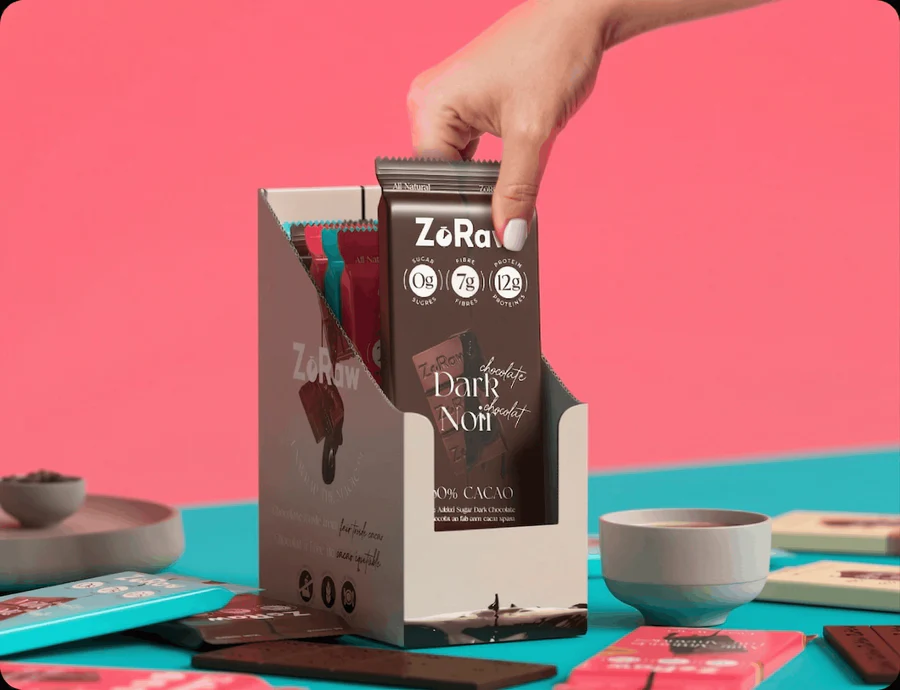
ZoRaw’s products are positioned around protein, fibre and no added sugar. The company’s challenge has been communicating those features without allowing them to define the product category.
That distinction became more important as ZoRaw pursued larger grocery and club retailers.
Moving Away from Sports Nutrition
Gill said the company initially considered positioning ZoRaw within sports nutrition, where shoppers were already familiar with protein-focused products.
The team later decided that placing the brand in that category could narrow its audience and put ZoRaw in direct competition with established protein-bar companies.
“We’ve got to be firm with our identity,” Gill said. “We’re chocolate first because we’re made from the cocoa all the way up.”
The protein-bar category also attracts shoppers who often compare products based on calories, protein content and nutritional efficiency. ZoRaw is targeting a different occasion.
“We’re not a protein bar. We’re a chocolate bar,” Gill said. “Our consumers see it the same way. They understand this is a chocolate bar first, and then the benefits are second.”
That positioning gives ZoRaw access to a wider consumer base, but it also places the company against established chocolate brands with strong recognition, large promotional budgets and extensive shelf space.
Gill described ZoRaw’s core customer as an everyday shopper who wants to make a modest change without adopting a strict fitness or nutritional routine.
“Our customer is an everyday person just looking to do a little better for themselves” she said.
Clearer Messaging Supported Retail Expansion
Gill said one of ZoRaw’s most important lessons has been the need to explain the product quickly.
Emerging consumer brands often work through several layers before reaching the shopper. The brand sells to a buyer, may work with a distributor and must then rely on the retailer’s merchandising and marketing teams to present the product.
Each participant has different priorities. Retailers are concerned with category sales, pricing, margins, promotions and inventory performance. The brand must make its point of difference understandable within that system.
“Keeping the consumer front and centre is always important” Gill said.
ZoRaw continued to adjust its packaging and sales messaging as it expanded into larger accounts. The objective was to communicate that the product belonged in chocolate while making the protein, fibre and sugar information visible enough to support the purchase.
Gill said this became especially important as the company entered retailers such as Costco and prepared for Walmart.
“We really make sure that we are a mass-appeal product” she said. “At the end of the day, it’s just chocolate. It’s made the same way as any other chocolate product.”
The company’s physical distribution gives it access to more shoppers, but maintaining those listings will depend on sales within each store. Repeat purchasing, promotional performance and retailer-specific assortment decisions will become more important as ZoRaw’s door count grows.
In-House Manufacturing Creates Room to Scale
ZoRaw’s decision to manufacture internally gives the company direct control over production, product development and capacity.
Gill began setting up the Mississauga factory during the pandemic, when travel restrictions made it difficult for international equipment specialists and engineers to enter Canada.
Her background was in biochemistry and management consulting, not industrial machinery. She learned the equipment while the facility was being assembled and continues to take a hands-on role when production issues arise.
Gill said the company used automation to create a facility capable of producing up to 30,000 bars per day without taking on the cost structure typically associated with a larger manufacturer.
“When you’re a small brand and you’re starting out, you want to maximize and be as nimble as possible without that overhead cost of what actually could produce 30,000 bars a day” she said.
The company’s approach to automation is focused on increasing output and improving how employees use their time.
“It doesn’t necessarily mean cutting headcount,” Gill said. “It’s how do you use that headcount to be more smart and intellectual and use that information to do better.”
The stated production figure represents capacity, not confirmed daily output. ZoRaw has not disclosed its current utilization rate, annual production volume or the number of shifts operating at the facility.
Gill said the company is examining further expansion as it takes on larger retailers and looks beyond Canada.
ZoRaw Homepage Graphic, Image: zorawchocolates.ca
Cocoa Volatility Affects Pricing Decisions
Higher cocoa costs have created another challenge for ZoRaw as it tries to make the product accessible to mainstream consumers.
Gill said the company has worked to protect its shelf price by reviewing costs across the business, adjusting promotional spending and working with retail partners during periods when additional discounting is possible.
“We had to ensure that we were pulling all the other levers without having to change up our price” she said.
ZoRaw was able to limit some increases, but Gill said cocoa costs ultimately affected the suggested retail price.
The company now monitors commodity pricing closely and tracks how consumers respond when shelf prices change.
“We’re in this weird scenario where we’re trading cocoa like it’s a stock or like it’s gold” Gill said. “We’re always monitoring it.”
The pricing issue is especially important for a brand trying to move beyond natural-food and specialty retail. ZoRaw must justify its price through taste and nutritional attributes while competing against conventional chocolate products that benefit from greater purchasing scale.
Retail promotions are one way to narrow that gap. Gill said ZoRaw works with retail accounts to provide funding when market conditions allow the company to support a lower promotional price.
Product Preferences Differ by Channel
ZoRaw’s original chocolate bars remain its strongest-selling format, although sales patterns vary between online and store-based customers.
Gill said plain milk chocolate performs best through e-commerce. Almond products sell more strongly in physical retail.
The difference was unexpected.
“We would have thought our almond SKU would be the best seller across the board, but it wasn’t” Gill said.
ZoRaw has also introduced smaller bite-sized products. Gill said those formats have not been available long enough to replace the original bars as the company’s strongest sellers.
The company has reduced its emphasis on vegan products after they generated weaker sales. Gill connected that decision to changing consumer priorities and the growing attention given to protein.
The result is a more focused assortment built around products with wider appeal. It also shows why retailers and brands cannot assume that one product mix will perform equally across e-commerce, grocery and club channels.
New Products and Markets Will Drive the Next Stage
Gill expects ZoRaw’s next phase of growth to come from a combination of new products and geographic expansion.
“Growth will definitely come from launching more products and then just expanding outwards” she said. “More SKUs, more regions.”
The United States is a priority, although Gill said trade conditions and other external factors can affect the timing of expansion.
Retail calendars also influence how quickly a brand can grow. Paperwork may be completed months before a product reaches shelves, while changes in buyers or category plans can delay a rollout.
Gill said those external timelines are a larger constraint than ZoRaw’s current manufacturing capability.
The privately held company does not disclose revenue. Gill said ZoRaw has been growing between 150 and 200 percent annually, while acknowledging that percentage growth is easier to achieve from a smaller starting point.
Building a Woman-Led Manufacturing Business
Gill also wants ZoRaw’s growth to create more opportunities for women in manufacturing.
She recalled contractors directing equipment questions to her male business partner while the factory was under construction, even though Gill was leading the technical work.
“They would naturally go to him” she said. “He’s like, ‘You’ve got to talk to her.’ And then the contractors would look, like, ‘Her?’”
Gill said the experience motivated her to learn the machinery and take responsibility for troubleshooting production equipment.
“I’ve spent a lot of time learning our machinery, fixing our machinery” she said.
She wants more women to view manufacturing as an accessible career and business opportunity, particularly in Canadian food production.
That goal remains connected to ZoRaw’s commercial strategy. Building internal production capacity has allowed the company to develop products, respond to retailer demand and pursue larger accounts without relying entirely on outside manufacturers.
Competing for the Everyday Chocolate Occasion
ZoRaw’s longer-term objective is to become an everyday chocolate brand.
Gill wants the products to reach consumers beyond the health-food and fitness categories, including workplace snackers, families and shoppers looking for an alternative to conventional chocolate bars.
“It’s really a mainstream product” she said, adding that she sees ZoRaw competing for purchases that might otherwise go to established brands such as Hershey’s or Oh Henry.
The company has built the distribution and manufacturing base needed to test that ambition. Its next challenge will be converting wider availability into repeat sales.
That will require ZoRaw to maintain a clear product identity, manage price pressure and show retailers that chocolate with added protein and fibre can generate sustained demand beyond a specialized health and wellness audience.
Sweat and Tonic will open its long-planned Yorkville location in October, bringing together many of the fitness, recovery and hospitality concepts the Toronto company has developed since opening its first location in 2019.
The 18,000-square-foot club at 11 Yorkville Avenue represents the latest step in the company’s evolution from a single downtown fitness destination into a multi-location wellness business that blends boutique fitness, recovery, hospitality and community spaces. Approximately 300 classes will be offered each week, while members will have access to group strength training, cycling, yoga, Pilates, Lagree, recovery amenities, food and beverage service, and coworking areas.
Retail Insider first reported the Yorkville lease in March 2024 when Sweat and Tonic announced it would occupy the second floor of the 11YV mixed-use development. The latest announcement confirms the October opening and provides a detailed look at the club’s programming and design.
Over the past seven years, the Toronto company has steadily expanded its offering. Its original downtown location combined boutique fitness with hospitality spaces, followed by a larger club at The Well and the addition of specialized concepts including Tonic Spa, Reformd and The Lab. Yorkville brings many of those ideas together while introducing a large-format group strength training concept.
Strength Training Takes Centre Stage
The Yorkville location will introduce what Sweat and Tonic describes as Toronto’s first high-capacity group strength training studio.
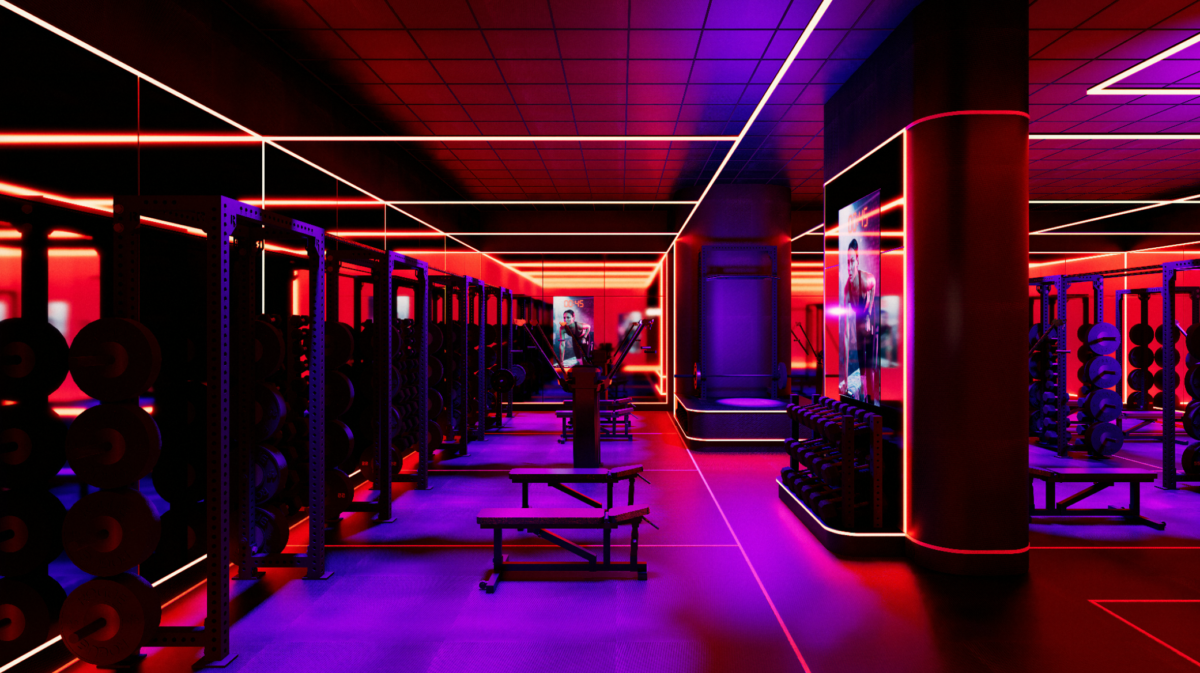
The 48-person studio will be organized around 12 workout pods equipped with Rogue weight racks and Keiser cable systems, allowing coaches to lead synchronized strength classes in a format more commonly associated with boutique cycling or HIIT studios.
Founder David Ingram said the concept reflects changing consumer priorities around strength training and long-term health.
“We’re evolving with our guests, and staying ahead on the science of fitness and longevity,” Ingram said in the announcement.
He added that the classes are designed to combine structured resistance training with the energy and accountability of a group fitness environment.
While strength training has traditionally centred on personal training or open gym environments, an increasing number of operators are introducing instructor-led group formats that make weight training more approachable for a broader audience. Sweat and Tonic’s Yorkville concept reflects that shift while integrating it into the company’s broader wellness offering.
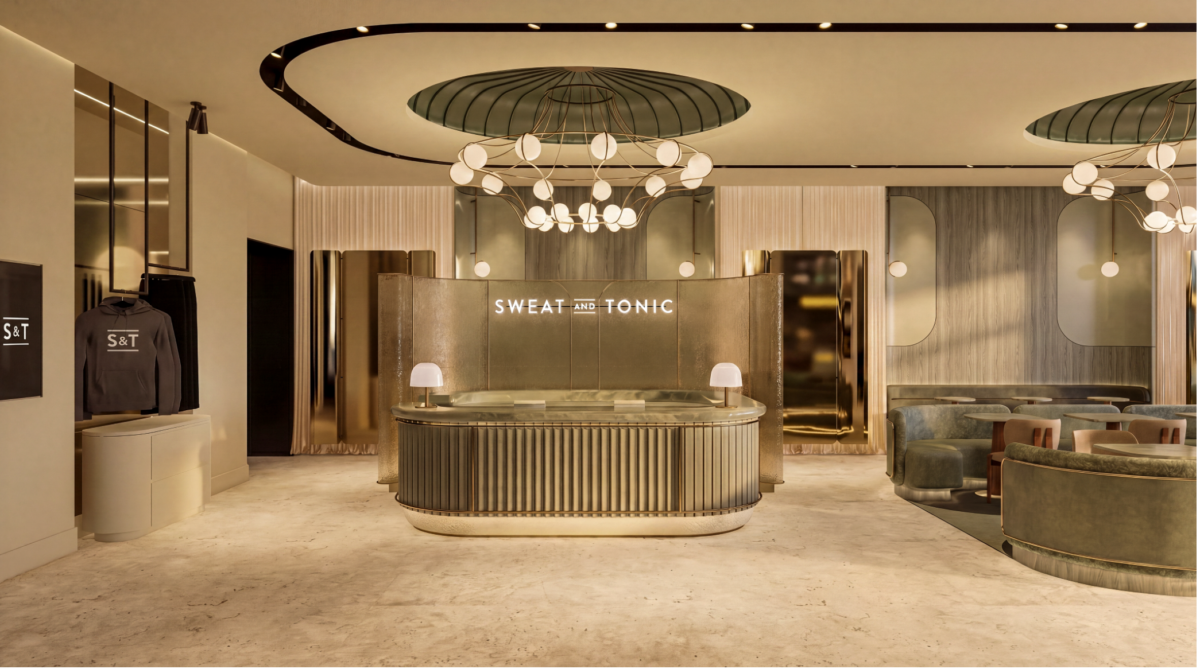
Sweat and Tonic Yorkville. Image: Ste Marie
Four Distinct Studio Experiences
Strength training will be one of four principal studio environments within the new location.
A 55-bike ride studio continues the immersive cycling experience established at the company’s existing clubs, while an infrared-heated yoga and Pilates studio will host yoga, Pilates, mobility, breathwork, meditation and restorative programming.
Yorkville will also include a 17-machine Reformd studio featuring the Lagree Method, a low-impact, high-intensity workout focused on strength, endurance and core conditioning.
Sweat and Tonic introduced Reformd as a standalone concept at The Well in 2025. The studio quickly became one of the company’s fastest-growing offerings, with more than 106,000 attendances since opening, according to Sweat and Tonic.
Rather than separating Reformd from its full-service clubs, Yorkville incorporates the concept within the larger facility, allowing members to move between strength training, cycling, yoga, Pilates and Lagree programming under one roof.
That approach reflects how the company has continued refining its business model. Specialized concepts can operate independently, as Reformd does at The Well, while also strengthening the experience inside larger clubs.
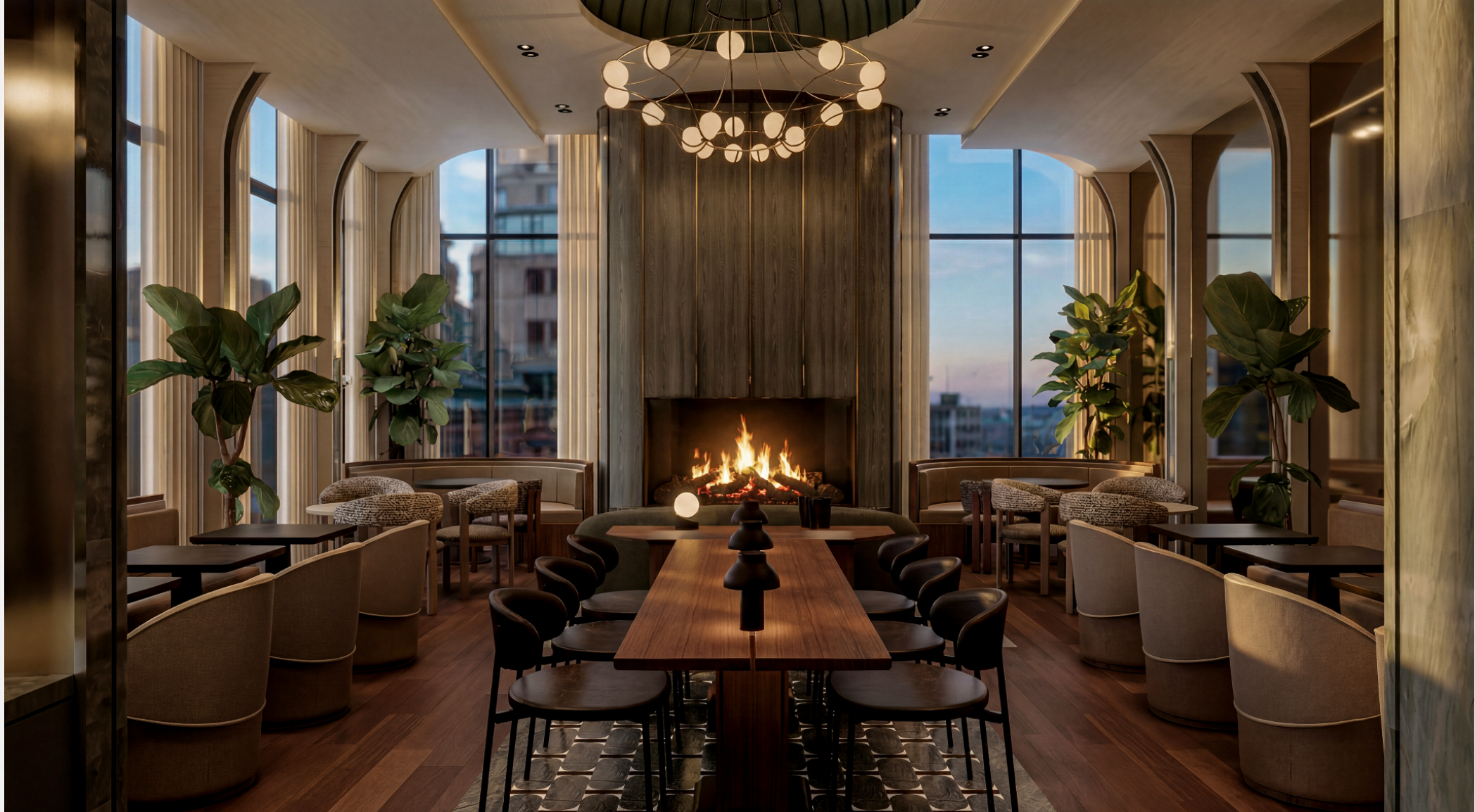
Sweat and Tonic Yorkville. Image: Ste Marie
Building on Seven Years of Growth
When Sweat and Tonic opened its first location in Toronto’s historic Ryrie Building in late 2019, it offered a combination that stood apart from most boutique fitness operators.
The approximately 16,000-square-foot facility combined yoga, cycling and HIIT classes with a café, bar, coworking spaces, spa services and community programming. Members were encouraged to spend time before and after classes rather than simply arriving for a workout and leaving.
Only a few months later, the COVID-19 pandemic disrupted the fitness industry, forcing operators across Canada to rethink their businesses.
Sweat and Tonic continued investing in the concept and opened its second full-service location at The Well in December 2023. At approximately 25,000 square feet, the new club expanded yoga and Pilates offerings, introduced larger hospitality areas and significantly increased its recovery programming.
During an earlier interview with Retail Insider, Ingram said demand for yoga and Pilates had exceeded expectations at the original location, influencing many of the decisions made for The Well.
The expansion also created room for complementary concepts.
Tonic Spa broadened the company’s wellness and recovery offering. Reformd established a dedicated Lagree studio, while The Lab introduced a training environment centred on HYROX, the rapidly growing fitness competition that combines running with functional strength exercises.
Yorkville builds on those developments by integrating many of those concepts within a single location. The hospitality model established in 2019 remains intact, while the fitness, recovery and specialized programming developed over the following years come together in what is the company’s most comprehensive club to date.
Sweat and Tonic Yorkville. Image: Ste Marie
A Yorkville Location Years in the Making
Yorkville has been part of Sweat and Tonic’s vision since before the company opened its first location.
When the lease at 11YV was announced in 2024, Ingram told Retail Insider that the concept had been developed in 2017 with Yorkville identified as the preferred neighbourhood. After considering several opportunities, the company secured space within the mixed-use development at 11 Yorkville Avenue.
Developed by RioCan Living, Metropia and Capital Developments, 11YV places Sweat and Tonic above the project’s street-level retail in a prominent location near Yorkville Avenue and Yonge Street. The agreement also extends the company’s relationship with RioCan, which is involved in both The Well and 11YV developments.
David Wedemire and Stan Vyriotes of DWSV Realty represented Sweat and Tonic in the Yorkville lease deal.
Yorkville itself has evolved considerably during the years Sweat and Tonic has pursued a location in the neighbourhood. New residential towers have added thousands of residents, while luxury retail, hotels, restaurants and personal services have continued to reshape the district.
At the same time, Yorkville has emerged as one of Canada’s most concentrated premium wellness markets.
Equinox operates a flagship club nearby, Barry’s Boot Camp has established a presence close to Bloor Street West, and Othership has introduced its communal sauna and guided breathwork concept to the neighbourhood. Pilates studios, personal training businesses and AVANT by Altea Active at One Bloor East have further expanded the area’s wellness offering.
The market is considerably different from when Sweat and Tonic first opened downtown in 2019. Recovery therapies, reformer Pilates, contrast therapy and highly produced group fitness classes have become increasingly mainstream, creating demand for more comprehensive wellness destinations.
Rather than focusing on a single specialty, Sweat and Tonic brings multiple formats together within one membership. Members can move between strength training, cycling, yoga, Pilates, Lagree and recovery amenities without maintaining separate memberships across several boutique operators.
That positions the company somewhere between a traditional health club and a collection of specialized studios. Its model combines instructor-led boutique fitness with hospitality spaces, recovery services and community programming in a way that reflects broader changes taking place throughout the wellness industry.
Sweat and Tonic Yorkville. Image: Ste Marie
Recovery, Hospitality and Longer Customer Visits
The Yorkville club will include Tonic Bar, the company’s in-house café offering smoothies, coffee and healthy meals.
Members will also have access to Tonic House, a lounge designed for coworking, social gatherings and community events. Overlooking the historic Yorkville Fire Hall, Toronto Public Library and Four Seasons Hotel, the space extends the club’s hospitality offering beyond scheduled fitness classes.
Separate men’s and women’s recovery areas will include infrared and traditional saunas alongside cold-plunge tubs, with access included as part of the membership experience.
Taken together, those amenities encourage members to spend more time within the facility. Someone might arrive early for a morning workout, remain afterward for coffee, work from the lounge for part of the day and finish with a recovery session before leaving.
That extended visit has become increasingly valuable within mixed-use developments.
For landlords, wellness operators generate consistent traffic throughout the day rather than relying primarily on lunchtime or evening shopping patterns. Members often visit multiple times each week, creating a reliable customer base that can also support surrounding restaurants, cafés and retailers.
The Well has already demonstrated how that model can function within a large mixed-use community where residents, office workers and visitors contribute to activity throughout the day.
Sweat and Tonic’s arrival at 11YV brings a similar dynamic to Yorkville. Its large footprint occupies space that would be challenging for many traditional retailers while creating a destination that complements the surrounding mix of residential, hospitality and commercial uses.
As retail real estate continues to evolve, fitness and wellness operators are becoming increasingly important components of major mixed-use developments. Their ability to generate recurring visits, activate large commercial spaces and encourage longer customer dwell times makes them attractive tenants alongside more traditional retail concepts.
Sweat and Tonic Yorkville. Image: Ste Marie
Expanding Across Toronto
Sweat and Tonic says it now offers more than 600 classes each week and has recorded more than 3.3 million bookings since opening in 2019.
The company also says it ranked second in total attendance during 2025 among approximately 3,500 studios using the Xplor Mariana Tek booking platform.
With approximately 300 weekly classes planned for Yorkville, the company is poised to significantly expand its programming while strengthening its presence across Toronto.
Yorkville will become Sweat and Tonic’s third full-service club following its downtown flagship and The Well. Including Reformd, the company will operate four fitness locations across the city, alongside complementary concepts such as Tonic Spa and The Lab.
Rather than replicating identical clubs, Sweat and Tonic has gradually developed a network of interconnected brands that serve different aspects of the wellness market while remaining accessible through a shared membership ecosystem.
The Yorkville opening reflects that evolution. Nearly seven years after launching its first location, Sweat and Tonic has expanded well beyond the traditional boutique fitness model. Each new project has introduced another layer to the business, from hospitality and recovery to specialized training concepts and premium wellness experiences.
Premiers say they are fostering a more open and integrated economy by removing a major trade barrier within Canada. On Tuesday, the Premiers of nine provinces – Alberta, British Columbia, Saskatchewan, Manitoba, Ontario, New Brunswick, Nova Scotia, Prince Edward Island, and Newfoundland and Labrador – signed a landmark agreement to implement Direct-to-Consumer (DTC) sales of alcoholic beverages between their jurisdictions.
“As of today, Alberta, Saskatchewan, Manitoba, Ontario, New Brunswick, Nova Scotia, Prince Edward Island, and Newfoundland and Labrador are implementing their approaches to DTC sales, allowing individual Canadians to order their favourite wine, spirit, beer, or other alcoholic beverages directly from licensed producers across the country,” said the release.
“British Columbia is committing to have their system in place to implement DTC for all types of alcohol in February 2027. This is a major expansion of consumer choice and increases producer access into new Canadian markets.”
With the announcement, participating jurisdictions are following through on a key commitment made by First Ministers at their meeting on January 29, 2026, to support the reduction of barriers to internal trade for alcoholic beverages.
Provinces and territories remain committed to working with each other and the federal government to maintain momentum in removing barriers to build a more resilient and streamlined economy and to unlock Canada’s full economic potential, it said.
“Canada’s independent wineries, breweries, cideries, and distilleries have waited a long time to see direct-to-consumer alcohol shipping finally become a reality,” he said.
“Allowing small producers to ship directly to consumers across provincial borders will help them reach new customers, grow their businesses, and give Canadians access to greater choice. It is a practical step toward reducing unnecessary interprovincial trade barriers and a clear signal that governments are committed to strengthening Canada’s internal market.
ELEVATE photo
“CFIB will closely monitor implementation to ensure that provinces do not impose unnecessary licensing, authorizations or registration requirements that create unnecessary costs and complexity for small producers. We commend Manitoba, New Brunswick, and Saskatchewan for embracing a straightforward, low-burden approach to direct-to-consumer sales, helping maximize the opportunities these reforms create for independent producers.
“Today’s announcement should be seen as a starting point, not the finish line. The next step is for governments to include alcohol under the Canadian Mutual Recognition Agreement, allowing alcohol products that can be legally sold in one province or territory to be sold in every other jurisdiction without duplicative testing, paperwork or regulatory requirements. That would further reduce barriers for small producers and create a truly open domestic market for Canadian alcohol.”
Alberta Premier Danielle Smith said: “Our government has now signed a direct-to-consumer alcohol sales agreement with Saskatchewan, Manitoba, Ontario, New Brunswick, Nova Scotia, Prince Edward Island, Newfoundland and Labrador and British Columbia. This agreement will allow Alberta liquor producers to sell their beer, wine, spirits and other alcoholic beverages directly to more Canadians, opening new markets and creating new opportunities for Alberta businesses to grow.
“This is an important step toward breaking down interprovincial trade barriers, but more work can be done. We already have the most open and free liquor market in Canada, allowing all liquor manufacturers, regardless of their province, to sell their products on retail shelves throughout Alberta. Our province’s producers should have the same opportunity to compete for space on retail shelves across Canada.”
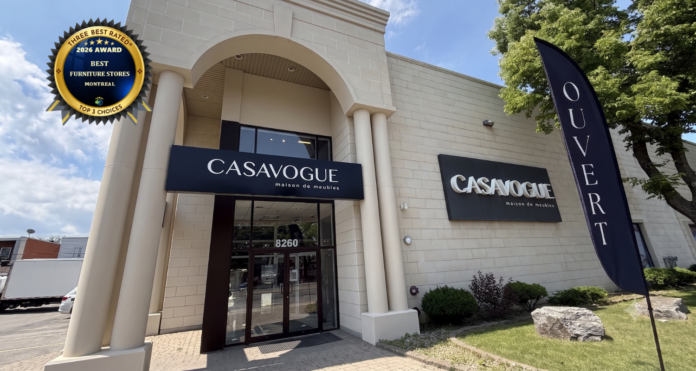
For another year, Casavogue has been recognized among Montréal’s Top 3 Furniture Stores, reinforcing a reputation built over more than five decades of serving homeowners across the region.
The 2026 distinction comes from ThreeBestRated, whose 50-Point Inspection evaluates furniture retailers across areas including customer reviews, reputation, business history, trust, satisfaction and value. Casavogue’s current listing carries an overall inspection score of 4.9 out of 5 and notes the retailer has maintained its place among Montréal’s leading furniture stores for several years.
For Casavogue, the latest ranking reflects a business that has steadily evolved since opening in 1972. Over 54 years, the family-owned retailer has built its reputation through carefully curated furniture collections, knowledgeable guidance and an approach that encourages customers to think beyond individual pieces to the way an entire home comes together.
More Than Five Decades of Experience
Casavogue was founded in 1972 with an early focus on high-end Italian furniture. Over the decades, its assortment has expanded to include Canadian and international collections for living rooms, dining rooms, bedrooms and other areas of the home. Throughout that growth, the company has remained family-owned, with experience and knowledge passed from one generation to the next.
That continuity has given the retailer a unique perspective on how Montréal homes and customer preferences have evolved. Contemporary furnishings now sit alongside classic and modern designs, allowing customers to explore a broad range of styles, materials and finishes within one showroom.
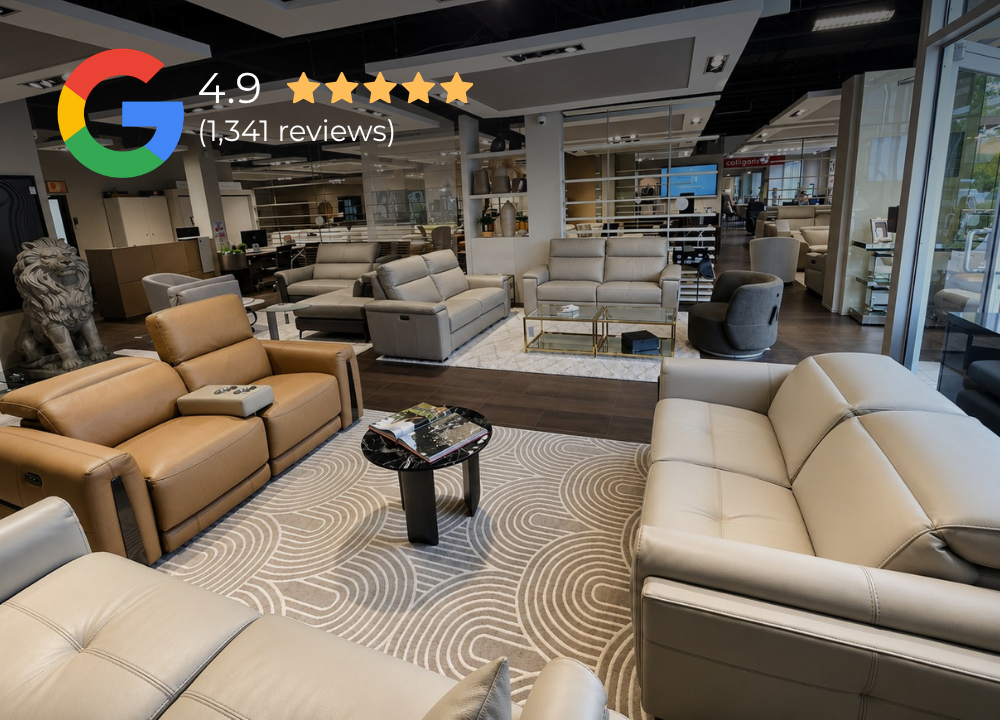
Spanning more than 38,000 square feet on boulevard Saint-Michel, the showroom presents complete room settings that help visitors visualize how furnishings work together. Living room collections, dining furniture, bedroom suites, occasional pieces and home décor are displayed in carefully curated environments designed to inspire ideas for every room of the home.
Photo: Casavogue
Curated for the Home
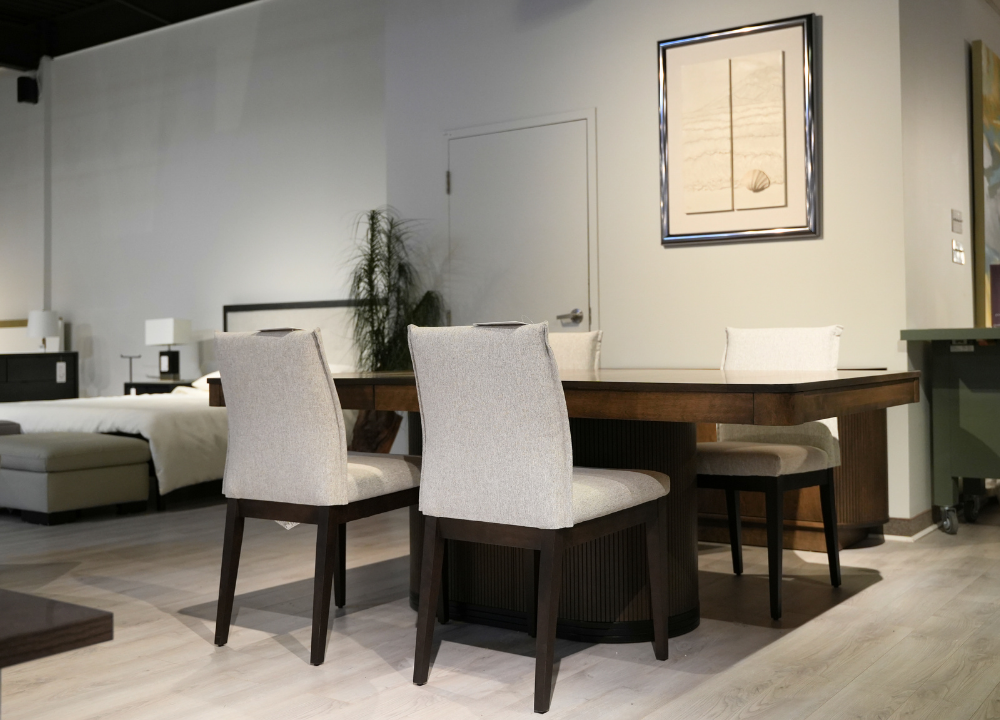
Casavogue’s collections bring together Italian and Canadian furniture selected for quality, comfort, craftsmanship and lasting design. Customers may arrive looking for a dining table or sectional sofa, while others are furnishing an entire home. In either case, the showroom is designed to make comparing styles, proportions and materials both comfortable and intuitive.
Design consultants work closely with customers to understand how they live, how each space will be used and what aesthetic they hope to achieve. Many collections can be personalized through choices such as fabrics, leathers, finishes, dimensions and configurations, allowing furnishings to reflect both practical needs and individual style.
Professional delivery, installation and follow-up service complete the experience, reinforcing the attention to detail that has become part of Casavogue’s reputation over more than five decades.
A Reputation Built Through Consistency
Awards may attract attention, but lasting reputations are built one customer at a time.
In announcing the 2026 distinction, Casavogue credited its customers, employees and supplier partners for helping maintain the standards behind the recognition. The acknowledgement reflects a philosophy that has guided the retailer for decades: offering thoughtfully selected furniture, attentive service and an enjoyable shopping experience for homeowners throughout the Montréal region.
After more than half a century in business, Casavogue continues to evolve while remaining grounded in the qualities that first established its reputation. Its latest Top 3 ranking serves as another milestone in a history that spans generations of Montréal homeowners and another reason for new customers to discover one of the city’s longest-established destinations for high-end home furnishings.
Visit Casavogue
Visitors can explore Casavogue’s selection of living room furniture, dining room furniture, bedroom sets and home décor at its Saint-Michel showroom. The store is open Monday through Friday from 9:30 a.m. to 6:00 p.m., and Saturday and Sunday from 9:30 a.m. to 5:00 p.m.
RONA Inc. is bringing five Atlantic Canadian stores and a regional delivery operation under direct corporate ownership, less than two and a half years after selling three of the locations to Halifax-based Terraine Capital.
The retailer announced July 21 that it had acquired RONA stores in Halifax, Elmsdale, Tantallon, Charlottetown and Moncton from RONA Atlantic Ltd., along with the Windmill Road direct delivery centre in the Halifax region. Financial terms were not disclosed.
RONA said the transaction is intended to support the longevity and continued growth of the five stores and delivery centre. The company added that customers would continue to receive the same service and product assortment following the ownership change.
The acquisition gives RONA direct control of a regional operation assembled by Terraine Capital during a rapid expansion across Nova Scotia, New Brunswick and Prince Edward Island. It also returns three Nova Scotia stores to direct ownership by the retailer after they were transferred to affiliated dealer ownership in 2024.
Three Stores Return to RONA
Terraine Capital entered RONA’s affiliated dealer network in March 2024 through the acquisition of the Halifax, Elmsdale and Tantallon stores.
The three locations had previously been operated directly by RONA. Following the sale, they continued to carry the RONA banner under local ownership through Adam Barrett’s Halifax-based business group.
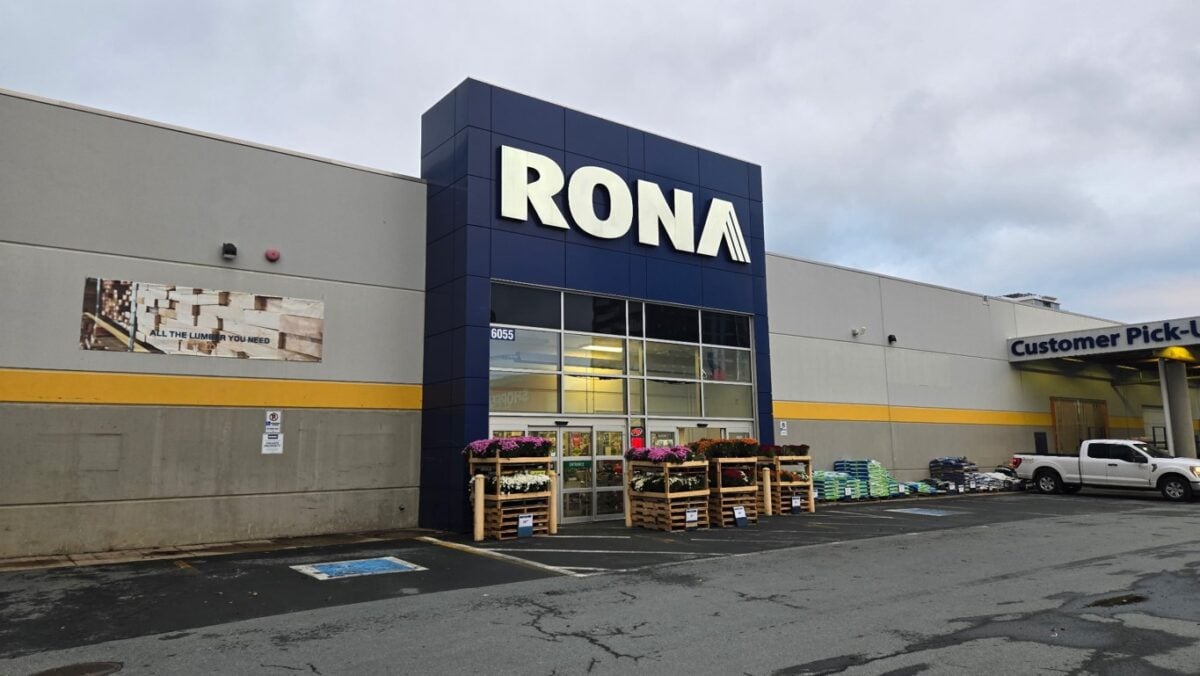
The Halifax store is located at 6055 Almon Street, while the Elmsdale and Tantallon locations operate at 84 Mason Lane and 3680 Hammonds Plains Road, respectively.
At the time of the transaction, RONA said Terraine intended to grow the business and expand the banner’s presence in Atlantic Canada. Barrett’s group positioned the stores as locally managed operations serving homeowners, contractors and construction-sector customers.
The latest acquisition effectively reverses that ownership change approximately 28 months later. The three stores are returning to RONA’s corporate side as part of a larger transaction that also includes two locations developed or acquired by Terraine after its initial entry into the home improvement sector.
No purchase price was disclosed for either the 2024 sale or the 2026 acquisition.
Terraine Expanded Across Three Provinces
Terraine moved quickly after acquiring the three Nova Scotia stores.
In August 2024, the company expanded into Prince Edward Island by acquiring a building-supply business in Charlottetown that had operated under the TIMBER MART banner. The approximately 33,000-square-foot location was converted to RONA, becoming Terraine’s fourth store and returning the RONA name to the province.
The Charlottetown operation included a retail store, indoor lumber and building-material areas and a substantial outdoor lumberyard. Plans announced at the time included expanding seasonal merchandise, strengthening online sales and continuing to serve professional customers. The company retained the existing store team as part of the conversion.
Terraine then entered New Brunswick with the opening of a new RONA store at 100 Cabela Court in Moncton in December 2024.
By the end of that year, the company had grown from operating three former corporate RONA stores around Halifax to controlling a five-location network spanning three Atlantic provinces.
Terraine Capital operates across a range of industries that include real estate, construction, building supplies, manufacturing, landscaping and hospitality. The company identifies Barrett as its founder and owner and says its wider group employs more than 600 people.
Before the sale to RONA, Terraine described its building-supply division as a network of five RONA dealerships serving local homeowners, developers and contractors.
The five-store business became known publicly as RONA Atlantic, though the stores remained part of RONA’s national affiliated network.
The speed of that expansion makes the latest transaction particularly noteworthy, with ownership of the regional operation returning to RONA less than two years after Terraine began building it.
A Newly Built Moncton Store
The Moncton location is one of the newest assets included in the transaction.
Terraine invested approximately $10 million in the store, which covers about 50,000 square feet and includes several acres of drive-through lumberyard space. The operation created more than 70 jobs, according to information released around its formal opening in 2025.
The store includes departments and showrooms for kitchens, bathrooms, appliances, windows and doors, lighting, plumbing and other home improvement categories.
Its format was designed to serve individual consumers and professional customers, with the lumberyard and building-material offering playing a central role.
When the location opened, Barrett identified Moncton, Halifax and Charlottetown as growing markets supported by residential and commercial construction activity.
The acquisition gives RONA direct ownership of one of Atlantic Canada’s newest large-format home improvement stores.
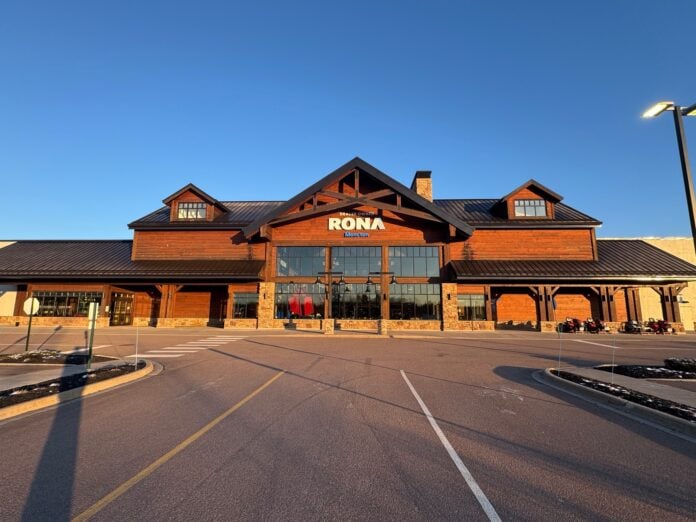
RONA store in Halifax. Photo: RONA
Delivery Infrastructure Included
The transaction extends beyond the five retail stores. RONA is also acquiring the Windmill Road direct delivery centre, a regional logistics asset in the Halifax area. The company has not disclosed the facility’s precise address, size, staffing level, fleet or delivery territory.
Its inclusion is relevant because several of the acquired stores have substantial lumber, building-material and contractor-oriented operations.
The Charlottetown store includes indoor and outdoor lumber facilities, while the Moncton location was developed with a multi-acre drive-through lumberyard. The Elmsdale and Tantallon stores also serve professional customers through contractor desks, delivery services and building-material departments.
Direct delivery is particularly important in the construction and renovation sectors, where lumber, drywall and other bulky materials frequently need to be transported to job sites.
RONA has also invested in contractor-focused delivery infrastructure elsewhere in Canada. In 2025, the company opened a direct delivery centre in Hamilton to serve professional customers across a broad area of southern Ontario.
The transaction gives RONA control of an integrated regional business that combines storefront retail with building-material fulfilment and delivery capability.
RONA has not said whether it plans to expand the delivery centre, change its service territory or integrate it with other parts of the company’s national distribution network.
A Shift Within RONA’s Mixed Network
RONA operates through a combination of corporate stores and independently owned affiliated dealerships.
The company’s national network includes more than 425 locations under the RONA and RONA+ banners. Some stores are owned and operated directly by RONA, while others are run by local dealers that use the company’s banner, merchandising programs and supply network.
All five Atlantic stores already operated under the RONA name. The latest transaction changes their ownership and operating structure without introducing a new banner.
The move gives RONA direct responsibility for staffing, store operations, inventory, capital planning and regional execution across the acquired business.
The transaction should not be viewed as evidence that RONA is moving away from affiliated dealers nationally. Independent operators remain an important part of the company’s network, particularly in smaller communities and regional markets.
The Atlantic acquisition is more accurately understood as RONA’s purchase of one dealer-operated group whose stores had been assembled over a relatively short period.
The acquisition gives RONA direct control of a regional operation assembled over less than two years across three Atlantic provinces. It includes three Nova Scotia stores formerly owned by the retailer, a Charlottetown location that restored the RONA banner to Prince Edward Island, a recently opened Moncton store and contractor-focused delivery infrastructure serving the Halifax region.
The CFIB said nearly half of youth said they wouldn’t look for jobs that require regular overnight shifts or jobs that require frequent and heavy physical effort. More than a third are unwilling to look for jobs that are mainly outdoors and exposed to weather conditions, or jobs that pay at or near minimum wage.
Many small businesses that rely on TFWs involve jobs with these exact characteristics to keep their doors open, highlighting a labour mismatch in Canada, said Canada’s largest association of small and medium-sized businesses with 103,000 members across every industry and region.
“The Temporary Foreign Worker Program has become a convenient scapegoat for a tighter job market for Canadian youth, but the argument just doesn’t hold up. Canada’s youth are not looking for overnight kitchen shifts or work in rural and remote communities,” said Dan Kelly, CFIB president. “Cutting the program doesn’t hand jobs to youth, it creates staffing crises and puts even more Canadian jobs in jeopardy.”
The CFIB said harvesting labourers alone account for nearly a third (32%) of all temporary foreign worker positions in Canada, work that’s physically demanding, outdoor and seasonal. The other top jobs filled by TFWs – many of which involve irregular hours, seasonal work or rural locations – are nursery and greenhouse labourers, food service supervisors, cooks, and livestock labourers. Nine in 10 small businesses relying on the TFW program say they cannot fill those positions with local employees, it explained.
Even when youth are open to certain roles, most want to stay close to home. Only 19% would relocate to a different city or town for a service-sector job, just 8% would move to a small town or rural community, and only 3% would consider a remote or isolated community, noted the new research.
“There’s no lineup of young people from urban areas applying for a 5 a.m. bakery shift in rural Saskatchewan. Pretending otherwise and limiting access to labour doesn’t get those jobs done,” said Molly MacCormack, CFIB policy analyst. “High youth unemployment does not guarantee a readily available local workforce. It’s time to recognize that the TFW program fills critical gaps that, left unfilled, would serve to dry up other jobs for Canadians. Canadian kids may be willing to serve food in a nearby restaurant, but unless there are staff to start early, work late or deal with a hot kitchen, the system breaks down.”
Tanvir Khondokar photo
In June, nearly half of rural small businesses (46%) reported a labour shortage, compared to 38% of urban businesses. Although rural businesses face greater staffing pressures, labour shortages still exist in cities, where many businesses struggle to recruit workers for non-standard jobs. More than half (52%) of small firms using the program say the TFWP has helped them stay open and keep employing Canadians. That figure rises to 76% among hospitality businesses, a sector that is a common entry point for young workers, said the CFIB.
To improve the TFWP, CFIB said it is calling on the federal government to introduce occupation-based flexibility within the TFWP by creating a category for consistently hard-to-fill jobs (e.g., overnight, physically demanding, or high-turnover roles), with adjusted caps and wage rules to reflect persistent shortages regardless of location; and, ensure consistent rules nationwide, recognizing its economy-wide impact rather than allowing provincial adoption to shape its implementation.
“The small businesses that rely on the TFW program are the same ones hiring young Canadians whenever they can for front-of-house roles, entry-level positions, and seasonal work. When businesses close, everyone loses, including the young Canadians who work there,” said Bérengère Fouqueray, CFIB research analyst.
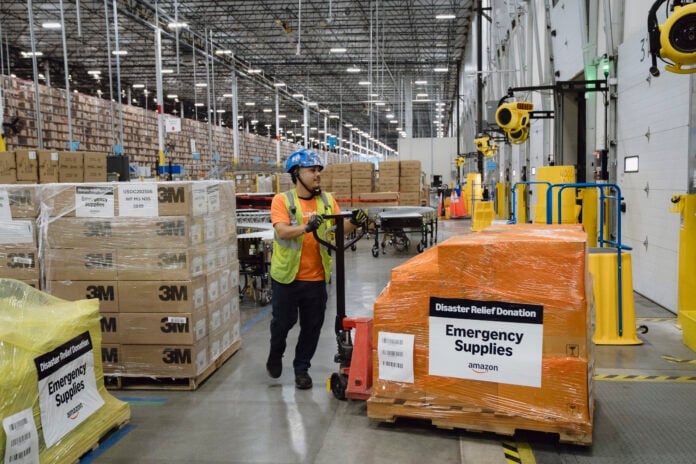
Emergency supplies are prepared for donation to nonprofits from Amazon's California Disaster Relief hub. Like the new Canada hub, the California hub specializes in wildfire relief.
Amazon announced Wednesday the opening of its first Disaster Relief hub in Canada, dedicating a portion of an existing Amazon fulfilment centre in Edmonton to supporting Canadian communities before, during, and after major disasters.
The hub specializes in wildfire response, stocking and donating supplies that nonprofits and responders need most. It is operational now, with a grand opening planned for October 2026 when the facility reaches its full capacity with more than 180,000 emergency supplies ready to go, said the company.
“Amazon uses its global scale and strengths to make a positive impact in communities, and this hub is a powerful example of that,” said Eva Lorenz, vice president and country manager of Amazon Canada. “By dedicating a portion of an existing facility where we deliver for customers every day, we can also serve communities when disaster strikes, responding in hours, not days. Our team in Edmonton will keep the hub ready year-round, stocking specialized wildfire relief supplies, so first responders get what they need fast. We’re proud to partner with the nonprofits doing this critical work, bringing Amazon’s global disaster relief network to Canadian communities.”
Amazon said it is monitoring the current wildfire situation closely and is ready to respond when its non-profit partners need help. The last three fire seasons in Canada have been among the 10 worst on record. Canada experienced its most destructive wildfire season ever in 2023, with fires consuming 16.5 million hectares -nearly seven times more than the historical average, it said.
It said it will work with nonprofit organizations such as the Canadian Red Cross and Team Rubicon Canada to donate and deliver supplies within hours of a disaster from the Canada hub, stocking the items needed most for wildfire response, including:
Air purifiers and N95 masks
Heavy-duty boots and gloves
Respirators, helmets, and goggles
Sifters
The hub will be stocked to respond to additional natural disasters, too, such as floods and tornadoes. It will contain general disaster relief supplies, including cleaning equipment and diapers, wipes, and strollers to support displaced families. Amazon is monitoring hundreds of active wildfires in Canada and related air quality issues and ready to respond to nonprofit requests for assistance if needed.
“Wildfire season in Canada is starting earlier, lasting longer, and becoming harder to contain. Wildfires don’t wait – and neither do we,” said Abe Diaz, Amazon’s head of disaster relief. “El Niño drives temperatures higher, drying out vegetation and turning landscapes into fuel. Wildfires surge dramatically during these cycles. Our expansion in Canada means we’ll be prepared on both sides of the border to put resources in the hands of communities in hours, not days.”
The new hub will assist with community preparedness, which has been recognized as a need by non-profit organizations.
“Disasters are increasing in complexity, intensity, and duration. We have entered a new normal in terms of Canada’s response requirements, and our communities cannot wait for help to arrive. This hub is a game changer. It means that when our teams hit the ground, their supplies are right behind them – and that’s the difference between responding in days to now being able to respond within hours,” said Team Rubicon Canada Chief Operating Officer Tim Kenney.
Emergency supplies are prepared for donation to nonprofits from Amazon’s California Disaster Relief hub. Like the new Canada hub, the California hub specializes in wildfire relief.
To keep the hub ready year-round, Amazon said its associates at the Edmonton fulfilment centre have the opportunity to dedicate a portion of their regular shifts each week to fully paid work supporting the hub – receiving, sorting, and organizing relief supplies. When a disaster strikes, associates can shift to full-time hub operations, rapidly preparing and shipping supplies to meet urgent demand.
The Canadian hub is Amazon’s second wildfire-dedicated facility globally. The first wildfire relief hub opened in California in 2024, which has since grown fivefold in capacity with thousands more masks, air purifiers, and general relief supplies. The hub was an important source of support during the devastating 2025 Los Angeles wildfires. Amazon now operates 12 Disaster Relief hubs across seven countries, having donated and delivered more than 30 million relief items in response to more than 200 disasters since 2017.
“At YEG1, our team is known for our active community involvement, and helping the communities around us is at the heart of what drives us,” said Osman Butt, site leader at Amazon’s Edmonton fulfilment centre. “We are incredibly proud to be the home of Amazon’s first Disaster Relief hub in Canada. Knowing that what we do here will help our neighbours across the country when they need it most — that’s what makes this meaningful for everyone on the team.”
As of the end of 2025, Amazon said it has invested more than $40 billion in Canada since 2012, creating more than 40,000 direct jobs across the country in technology, operations, and corporate functions. Amazon operates more than 100 facilities across Canada, including fulfilment centres, delivery stations, sortation centres, and corporate offices.
Tim Hortons says this year’s Camp Day campaign raised more than $12.7 million for Tim Hortons Foundation Camps, with proceeds supporting programs for underserved youth.
The company said the annual fundraiser, held July 15, brings the total amount raised through Camp Day since its launch to $287.7 million. According to Tim Hortons, the campaign has helped nearly 350,000 underserved young people participate in the organization’s multi-year development program.
The annual fundraising event sees restaurant owners donate 100 per cent of the proceeds from hot and iced coffee sales on Camp Day to Tim Hortons Foundation Camps. Additional money is raised through the sale of Camp Day bracelets, Camp Day donuts, Donation Badges and other fundraising initiatives organized by local restaurant owners and their teams.
The company said the funds support Foundation Camps, a charitable organization that provides youth development programming for underserved young people across North America.
“Once again, Tims guests and restaurant owners came together in a big way for Camp Day,” said Axel Schwan, President of Tim Hortons. “Every hot and iced coffee purchased on July 15 is a direct investment in a young person’s future, and I’m proud of what our communities accomplished together this year.”
Axel Schwan
The fundraising total reflects support from customers, restaurant owners and local fundraising efforts conducted during the campaign, the company said.
Tim Hortons Foundation Camps was established in 1974 by Ron Joyce in honour of his late friend Tim Horton. The organization says it delivers youth development programming designed to help participants build confidence, resilience, leadership and other life skills through experiences at camp and in the classroom.
According to the organization, nearly 350,000 young people have participated in its programs over the past five decades at no cost to participants or their families.
Caroline Barham
“Camp Day is a powerful reminder of what can happen when communities come together with a shared belief in creating brighter futures for youth. This year’s results are about much more than dollars raised,” said Caroline Barham, President of the Tim Hortons Foundation Camps board, and a Tims restaurant owner. “They represent thousands of acts of kindness and a commitment to supporting young people as they develop the confidence, independence, and skills that will serve them throughout their lives. Thank you to everyone who played a role in making Camp Day 2026 such a meaningful success.”
Tim Hortons said support for the foundation also comes from restaurant owners, guests, corporate sponsors, donors and community partners.
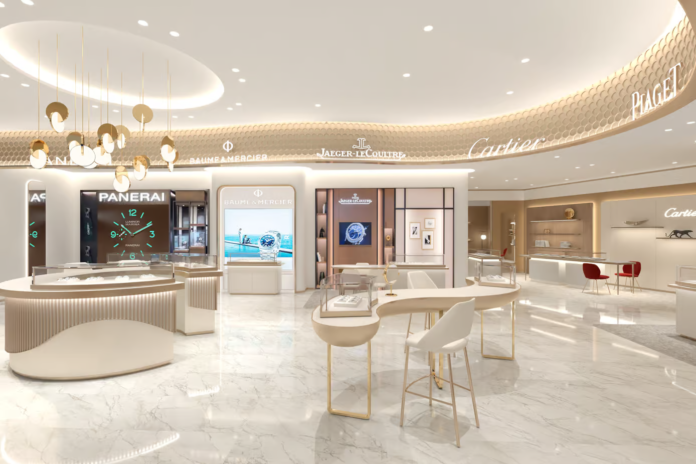
TimeVallée at Royalmount in Montreal. Image: Birks Group
Birks Group Inc., reported on Tuesday its financial results for the fiscal year ended March 28, 2026, saying net sales were $205.4 million, an increase of $27.6 million or 15.5%, compared to the fiscal year ended March 29, 2025.
Comparable store sales for fiscal 2026 increased by 2.6% compared to fiscal 2025.
The increase in net sales is attributable in part, to the acquisition of the luxury timepieces and jewelry retail activities of European Boutique, as well as an increase in both Birks branded jewelry and third party branded jewelry, explained Birks.
It reported a gross profit of $79.2 million in fiscal 2026, compared to $66.3 million in fiscal 2025, an increase of $12.9 million, due to increased sales volume attributable in part, to the European Boutique Acquisition, an increase in sales of Birks branded jewelry and third-party branded jewelry, and a foreign exchange gain due to the weakening of the U.S. dollar. Gross profit as a percentage of sales for fiscal 2026 was 38.5%, an increase of 120 basis points from the gross profit as a percentage of sales of 37.3% for fiscal 2025 primarily as a result of the foreign exchange gain.
Niccolò Rossi di Montelera, Executive Chairman of the Board and Interim Chief Executive Officer of Birks Group, said: “During fiscal 2026, we achieved 15.5% growth in net sales and a 2.6% growth in comparable store sales. Our retail performance has outperformed over the prior year due to the strategic acquisition of European Boutique along with organic growth, particularly with our Birks branded jewelry. We continue to focus on generating profitable growth in our Birks brand, including a new Birks mono-brand store which is planned to open in the fall of 2026 in Vancouver’s newly developed Oakridge mall.
“I am particularly pleased with the successful integration of the European Boutique Acquisition, our recent refinancing of our term loan with Gordon Brothers and the amendment and extension of our revolver facility with Wells Fargo Canada Corporation, as well as the performance of our Birks branded jewelry business. These achievements would not have been possible without the unwavering commitment and dedication of our employees.”
The company recognized a net loss for fiscal 2026 of $3.4 million, or $0.17 per share, compared to a net loss for fiscal 2025 of $12.8 million, or $0.66 per share.
Niccolò Rossi di Montelera
Just a few days ago, it was revealed that Global asset experts Gordon Brothershave provided strategic financing to Birks Group Inc., one of Canada’s premier designers and retailers of fine jewelry, watches and gifts.
With more than a century of experience in the jewelry industry, Gordon Brothers said it partnered with Birks Group to deliver a tailored capital solution that will support the company’s growth strategy, providing enhanced liquidity and flexibility as the retailer builds on its strong market position and long-standing heritage. In addition to the financing package, Gordon Brothers said it will continue to provide strategic expertise, leveraging its deep retail and asset-focused capabilities as the brand’s needs evolve.
Birks Group is a leading designer of fine jewelry, and an operator of luxury jewelry, timepieces and gifts retail stores in Canada. The company currently operates 32 store locations, including: 17 store locations under the Maison Birks brand in most major metropolitan markets in Canada, one retail location in Montreal under the Birks brand, one retail location in Montreal under the TimeVallée brand, one retail location in Calgary under the Brinkhaus brand, one retail location in Vancouver under the Patek Philippe brand, one retail location in Vancouver under the Chaumet brand, four retail locations in Laval, Ottawa and Toronto under the Breitling brand, one retail location in Toronto under the Omega brand, one retail location in Toronto under the Montblanc brand, and four retail locations in the Greater Toronto Area under the European Boutique brand. Birks was founded in 1879.