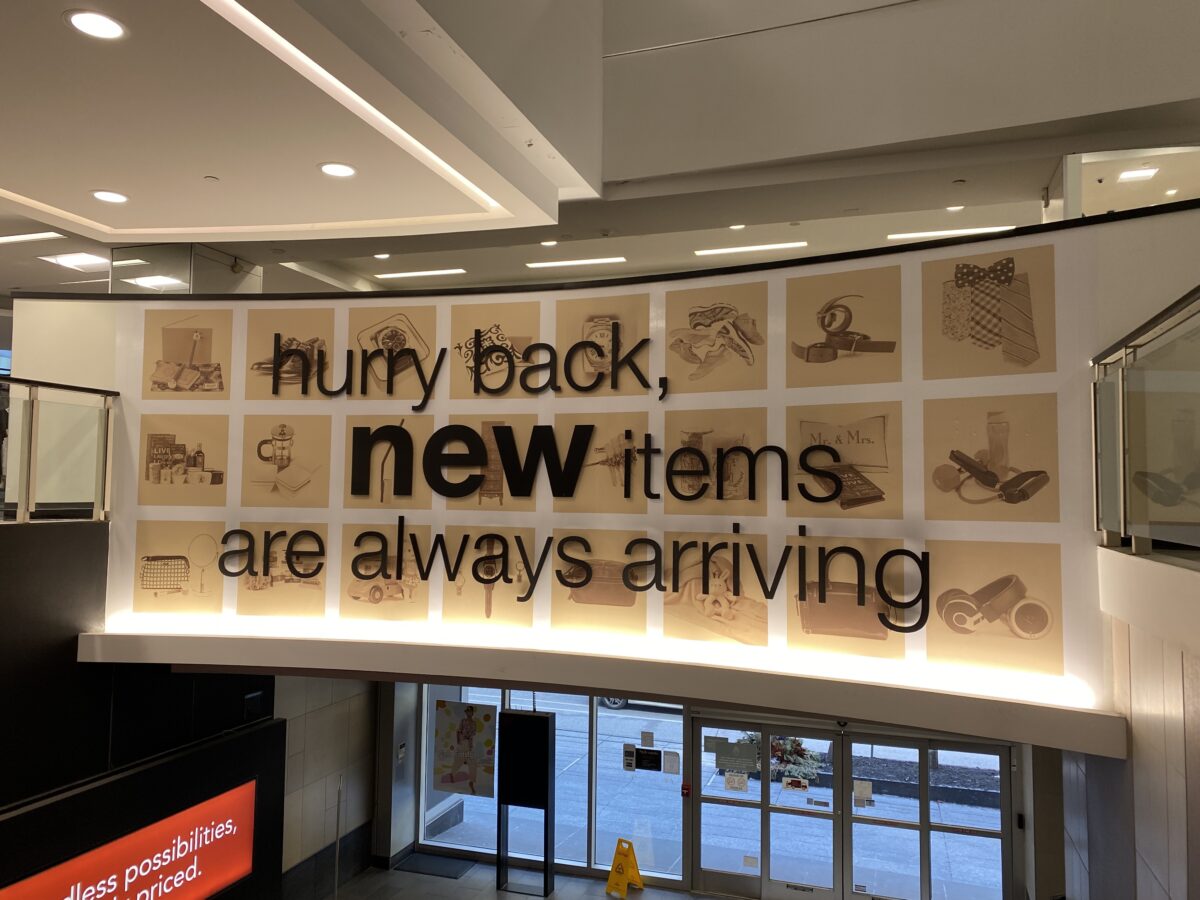
Iconic Canadian retailer Hudson’s Bay has announced that its Winnipeg store has been closed months before the planned exit of the massive Portage and Memorial location.
The store has been shut since earlier this month along with other ‘non-essential’ retailers in Manitoba. Hudson’s Bay says that it made the decision to shut the store early in light of the situation.
When the company first confirmed their intentions to exit the Winnipeg landmark in October, we had the opportunity to go back in time and relive the highlights. News organizations across Canada, including our publication, put together newsreels of footage from the last 94 years at this iconic location.
The inner workings of this building will be discussed moving forward, as the complications will surround a 2019 historical designation from the Winnipeg City Council. Any future occupant of the location must preserve the aesthetic while honouring the historic and cultural significance.
The Bay department store in downtown Winnipeg has closed as of Monday, November 30th, 2020. Photo: Hudson’s Bay Company
With COVID-19 closures and lockdowns taking place across the country, many retailers are struggling.
Department stores have been downsizing over the years and Hudson’s Bay is considered to be the remaining traditional department store in Canada. In years past, the retailer competed with names such as Eaton’s, Woodward’s, Simpson’s, Morgan’s and others.
We will be following this breaking story as Hudson’s Bay prepares to close its downtown Edmonton store this fall as well.
Hudson Bay Company 1926 Store Opening in Winnipeg: Lee Clarence
Exterior of new Deerfoot Meadows T&T Supermarket with lineups of people waiting to enter. Photo: T&T Supermarket
T&T Supermarkets continues to expand its footprint across the country with the opening of a new location in Calgary as it “aggressively” looks for other opportunities to grow.
“In these tough times, it gives me great pride to be able to continue to expand our business to bring authentic Asian food and flavours to the south Calgary community,” said Tina Lee, CEO of T&T Supermarkets. “We will be implementing all of our industry-leading COVID-19 preventative measures in our new stores, so that customers and colleagues can shop and work at ease.”
New Calgary T&T Supermarket at Deerfoot Meadows
T&T Supermarket CEO, Tina Lee.
The new Calgary store, its third in the market, opened in the south part of the city at the Deerfoot Meadows shopping centre area. It is the company’s sixth store in Alberta.
Launched in 1993 in Vancouver, today T&T Supermarkets operates 27 stores in British Columbia, Alberta, and Ontario.
Lee said Deerfoot Meadows is a wonderful retail power centre with synergies with the Superstore, Costco, Walmart and IKEA stores also located there.
Click for interactive Google Map of the Deerfoot Meadows area
“I think we bring a good diversity and a new product to that community and people have been looking forward to that. The south Calgary community has been looking forward to it for a long time. Customers in the south had a long drive before to our other Calgary stores (located in the northern part of the city).”
The new store offers a wide variety of fresh produce, meat, seafood, grocery items, and ready to consume Asian meals. It also provides customers the convenience of online ordering for store pick up, and fresh express delivery to home at www.tntsupermarket.com and customers can now send gifts to friends and families and enjoy contactless services in the COVID-19 period.
The south Calgary store has a wide assortment of fresh Asian produce, live seafood in tanks, custom cakes, and a variety of Chinese buns baked fresh in store every day. There is a wide variety of ready-to-eat meals to choose from, the self-serve hot table, noodle bar, sushi bar, or the grab n’ go section that includes BBQ meats, dim sum, and fresh juice. Customers can take the food home or eat in the dining area of the store.
The new store is also unique in terms of retail execution because the COVID measures put in place there were part of the design of the new store unlike having to force measures into existing stores.
When asked if there could be more stores for the Calgary market, Lee replied: “I think there’s more juice in the lemon. We’re very opportunistic when it comes to new locations in all the markets that we currently are.”
Lee could not confirm current store expansion plans elsewhere but did say “we’ve got a lot of irons in the fire”.
1 of 2
Line up of T&T Supermarket customers outside new Deerfoot Meadows location in Calgary. Photo: T&T Supermarket
T&T Supermarket team celebrating the opening of Deerfoot Meadows store. Photo: T&T Supermarket
“I think we’re one of the very few retailers that are aggressively looking and have the runway for growth. There are several communities in the country where we don’t have a presence yet. So we’re very open, not just open, but I would say aggressively looking and very keeping a close eye on what’s happening with big box retail and any potential turn in them because I think we are a strong candidate to go into those spaces.”
Being an essential business, the COVID-19 has turned out to be beneficial for sales for the T&T brand across the country.
“Operationally it has been the toughest year in our history. In anybody’s history. Trying to keep our doors open, feed the community, keep our staff safe. For the first half of the year it was a tremendously difficult, expensive and emotional journey. But I do feel like we’ve won the trust and the hearts of our customers. That they feel T&T is a really safe place to shop and it has resulted in beyond our expectations over double digit growth,” said Lee.
“We are strong but tired. It’s a marathon. It is a marathon that’s for sure.”
Exterior of Yorkdale Shopping Centre. Photo: Yorkdale
The current lockdown in the Toronto region has forced shopping centres to adapt and find new ways to accommodate customers’ holiday shopping needs by offering e-commerce or phone order fulfillment while in-store retail shopping is restricted.
For example, Oxford Properties’ Yorkdale Shopping Centre, Square One, and Scarborough Town Centre malls in the GTA, received a surge of customer inquiries just before the new COVID-19 containment measures came into effect as everyone tries to figure out the most effective ways to continue operating during these challenging times.
William Correia, Director at and Scarborough, said during the first lockdown earlier this year curbside pick-up was available and the option for the shopper.
Screenshot of Square One’s Instagram
“At this point in time, the difference in the mandate or legislation that’s come out is the ability for folks to buy online or over the phone and then pick up at the store fronts,” he said.
“So our retailers at all three shopping centres have the ability to have deliveries or pick-ups done at their store fronts as well as curbside. And our essential retailers remain open to the public at a limited capacity.”
Oxford said retailers have been working intensely to accommodate consumer demand. Some stores have online ordering where store pickup can be selected. Many other retailers do not yet offer this e-commerce option which means that customers need to call the store, place the order and confirm the pickup time. Orders can only be placed online or by phone and may not be made in person at the stores or storefront or curbside pickup areas.
Yorkdale, Square One, and Scarborough Town Centre are supporting retailers by creating designated curbside and store front pickup locations for stores adapting quickly during this retail period by offering e-commerce or phone order fulfillment. Customers can visit the Yorkdale, Square One and Scarborough Town Centre websites to see what stores are offering curbside and storefront pickup. Lists of participating retailers should be consulted before planning purchases as the information is being updated in real time, said the company.
Correia said with curbside pickup there was a concern about lineups in the shopping centre but Oxford has a safe approach that will allow it to utilize a waiting system for all of the retailers.
“The customer will come and scan their bar code, the retailer will then text them when the order is ready to pick up. We have this line management system now that we never had before and that’s going to help to keep the shopping centre safe,” he said.
“It will help with distancing, crowding. That’s one feature that we have that we didn’t before. As well, we now have e-gift cards. So Oxford gift cards for any of our shopping centres can be purchased online and sent online to different recipients as well. They can even put a photo or video message but the recipient of the gift card will get it electronically and then can go to any shopping centre to have it redeemed or used at any of the retailers. So that’s something that’s new for us in addition to what we had back earlier in the year.”
Correia said each individual website will also let each shopper know who is doing curbside, who is doing store front pickup and which retailers are essential retailers. There’s also a gift finder option. That will help people find their unique gifts and then looking at the options they have with each of the retailers.
The e-gift card initiative is nationwide.
While traffic at the malls is down from a year ago, Correia said he expects it to pick up in the next few weeks as more retailers prepare themselves for store front pickup and for curbside and the more retailers participate in those programs.
“As per the guidance of the Ontario Provincial Government, effective Monday, November 23, 2020, Toronto is moving into lockdown. In shopping malls this means that only government-defined retailers are permitted to open with limited occupancy, as well as retailers offering curbside pickup in shopping malls.
Exterior of CF Sherway Gardens. Photo: CF Sherway Gardens
“Impacted Cadillac Fairview properties include: CF Toronto Eaton Centre, CF Fairview Mall, CF Sherway Gardens & CF Shops at Don Mills. Restaurants and food court vendors will continue to offer take-out and delivery services only. For operating hours related to these malls, please visit cfshops.com.
“The health of our employees, clients and guests is always our first priority. While this is disappointing news for our community, with everything we know right now, we believe this is the best course of action amid the current COVID-19 environment. We will continue to monitor the situation closely, and work with provincial and public health authorities as required.
“For a full list of the precautions we are taking as a company, please visit our website www.cadillacfairview.com.”
Empowerment over limitations. Encouragement rather than preventative measures. Rewards instead of penalties. These are the enablers and incentives that would almost always be prescribed in order to properly aid and support happiness, success, and growth. They can be applied to improve just about every facet of life. But when applied to an individual’s finances, the freedom that often results can be immeasurable. With this objective in mind, to free consumers from the incapacitating clutches of credit card rates and fees, Afterpay has entered the Canadian market as part of its continued global expansion.
Founded in Australia in late 2015, Afterpay is the global leader in ‘buy now, pay later’ payment services. Working with more than 63,800 retail brands around the world and boasting over 11.2 million active users already, the company’s unique payment alternative is gaining momentum. Available in Australia, Canada, New Zealand, the United States, and the United Kingdom, where it is known as Clearpay, the service allows users to receive products immediately and pay for their purchase over four interest-free instalments. It’s a model that’s paving the road toward a transformation concerning the way consumers pay for their goods, while helping to turn the credit card industry on its head. And, according to Melissa Davis, Head of North America at Afterpay, the trends that have led to the consumer’s shift toward payment options like Afterpay continue to grow and are likely to impact purchasing behaviour and preferences well into the future.
“Over the past number of years, people everywhere have really started to reconsider the purchases they make and the way they choose to pay for those purchases,” she says. “Millennial and Gen Z consumers, for instance, are not only avoiding the use of credit cards, they aren’t even applying for them. And given the significant rate of e-commerce adoption that will only continue to increase around the world, the alternative offered by Afterpay – allowing users of the service to get what they want, when they want it and pay for it later – is helping to support the changing needs and preferences of today’s consumer.”
Rise of the Debit Card
In addition to the younger generations’ reluctance to use credit cards, a decision which has been impacted in part by their collective mountain of student debt, the impacts of the global pandemic have served to alter spending behaviour across all generations. Some analysts around the world reported a 50 percent decrease in credit card spending during the initial COVID lockdown as consumers everywhere became cautious and much more thoughtful with respect to their finances. And, in conjunction with a decrease in the use of credit cards came a rise in the number of debit transactions that were being made by consumers, increasing the use of Afterpay’s payment option and highlighting the flexibility and convenience that it provides for its users.
Consumers have also been drawn by the ease of use of Afterpay’s service. By simply visiting Afterpay’s site to create an account, users are free to start browsing their favourite retail brands and buying the product they want. Then, by selecting Afterpay as their choice of payment at checkout, 25 percent of the purchase is paid for upfront, with three equal payments scheduled to be made every two weeks for the following six weeks. And, what’s more, each payment is made by the user free of interest or any other fees and extraneous charges traditionally associated with credit cards. Davis explains that the entire Afterpay concept was developed with the consumer in mind and the objective to lift the weight and burden of borrowing from their lives, pointing to the accessibility of its services and the financial autonomy that it provides as the true benefits to the end-user.
“We never charge anything above and beyond the cost of the product,” she says proudly. “Ultimately, Afterpay provides a way to help consumers budget out their purchases and pay directly from their debit accounts without incurring any additional debt. In addition, users are never asked for their social insurance numbers. And we don’t do credit checks, either. Everything we do is in the best interest of the consumer, allowing them to use our service and pay for product with funds that they already have. It helps provide them with incredible freedom over their finances, unlocking opportunities that they didn’t previously have access to.”
Woman on video conference call at home. Photo: Afterpay
Entrance into Canadian Market
Now, Afterpay offers the same financial freedom and opportunities to consumers in Canada. The company announced its entrance into the Canadian market in August of this year and is already working with brands in the country, including Roots, Aritzia, American Eagle, Ardene, BikeExchange, Dermalogica, FragranceX.com, Herschel Supply Co., Huda Beauty, GOLI, Maëlys Cosmetics, Native Shoes, Nixon, and Perfume.com, among many others. It’s a move that Davis says had been in the works for some time, and one that the company is extremely pleased to have made.
“We’re thrilled to be able to bring our option of payment to the Canadian market,” she says. “We’re excited to be supporting and broadening options at checkout for the consumer to help make their shopping experience easier and more enjoyable. And, we’re honoured to be working with some of the biggest and best brands in Canada, providing merchants across the country with our service to help everyone continue to grow and succeed, together.”
For retailers, Afterpay’s service is quickly becoming a must-have as over 90 percent of the company’s users pay with their debit cards. Davis also points out that many of the retail partners that Afterpay works with have experienced noticeable increases in average order values and conversion as a result of its service, as well as significant incrementality in sales from consumers who might not otherwise have been able to make purchases above a certain price-point. In addition, the payment option is serving as a tool for new customer acquisition for retailers as the Afterpay network helps to introduce consumers to brands that they may not have been familiar with before becoming a user of the service.
Promotion of Responsible Spending
Perhaps more important and impactful than the services that Afterpay provides consumers and retailers, however, is the message of responsible spending that the company helps promote – a message supported by the structure of its agreements with users. Payment notifications are sent to users ahead of due dates as reminders. And, if a payment date is missed, the user can no longer use the Afterpay service until their current balance is paid. It helps to set a precedent for the user and represents a real departure from the approach taken by credit card companies.
“The credit industry has been built to make money when their cardholders are late with their payments,” asserts Davis. “We’re seeing a consumer today that wants to be more responsible with their money. They want to better understand their purchases and are seeking transparency in the process to know exactly where their money’s going. Afterpay helps amplify the practice of responsible spending through the structure of our service, empowering consumers and helping them feel more confident in their purchasing and spending.”
Davis also lauds the functionality of the Afterpay service, whether it’s used on a desktop computer or on a mobile phone, describing it as a seamless online checkout experience. Leveraging a network effect, when users sign in to the Afterpay service, they are also signing in to all of its retail partners. This, combined with the fact that Afterpay users’ payment information is stored and protected securely across the network, helps to remove a lot of the friction and uncertainty that’s often associated with the retail checkout experience.
An Omnichannel Offering
In addition to the company’s e-commerce payment service, which is disrupting the online purchase experience in the best way possible from the consumer’s perspective, it recently introduced an in-store payment solution in the U.S. Available in Australia and New Zealand since 2016, Afterpay users south of the border can now leverage the payment option in-store via their Afterpay card, a virtual, contactless card stored in their digital wallet. The move represents what can only be seen as an enhancement to the consumer’s payment experience and further growth for the company that has only just celebrated a half-decade of business, highlighting its desire to continue providing consumers with the very best payments options possible. And, according to Davis, the positive impacts of Afterpay’s service on consumers and the retail industry are only just starting to take hold.
“We see the inclusion of our in-store solution as a powerful omnichannel tool to help support consumer needs and retail success across all channels. It provides consumers with the ability to leverage the Afterpay payment option online and in brick-and-mortar locations, and enables retailers to provide and maintain a consistent payment experience, whether it’s through their offering of buy online and pick up in-store, curbside pickup or any other purchase option they provide. It’s a solution that we want to roll out everywhere Afterpay is available. It supports our long-term vision to empower an economy in which everyone wins through the amplification and promotion of responsible spending practices and the removal of equity fees. With this as our focus, we’ll further develop our deep understanding of consumer preferences and the ways in which we can cater to them as we continue to make investments and expand our presence globally.”
The Canadian Gift Association (CanGift) is partnering with marketplace innovator Brandwise to lead the way in wholesale ordering technology. With a strong focus on Canada’s gift and home décor industry, the platform connects wholesale suppliers and brands with retailers ready to place orders for the latest products to sell in their stores. It’s all happening digitally, 7 days a week, 24 hours a day.
Introducing: CanGift 365.
“The membership of our association is comprised of wholesale companies,” explains Anita Schachter, President & CEO of the Canadian Gift Association. “We’ve worked extremely hard to find a direction that will create new business opportunities across the country, and I am very pleased to say, this online platform is exclusive to Canada.”
Launching in February 2021, CanGift qualified retail buyers will be able to log in to explore brands and products from CanGift members and place orders directly through the site with the opportunity to work directly with trusted industry salespeople trained on those products.
An expansive search feature allows buyers to discover products across all brands, making this platform accessible for both small and large suppliers.
“The human connection is the core of our industry that can’t be forgotten,” says Schachter. “With the cancellation of our in-person trade events because of the COVID-19 pandemic, creating a virtual commerce opportunity was as essential as keeping that personal touch.”
“We are honoured to partner with the Canadian Gift Association and their stakeholders,” says Todd Litzman, Co-Founder and CEO of Brandwise. “We have a long history of working with Canadian partners including hundreds of CanGift members who have been part of our ecosystem for many years.”
In addition to the safety and convenience of ordering directly from the comfort of your own store, office, or home, CanGift 365 enhances the relationship between retailers, wholesale suppliers, salespeople, agencies, and the gift industry as a whole. Additional benefits include a low barrier to entry for wholesale companies, access to thousands of products across hundreds of wholesale suppliers and the incorporation of the Brandwise 2.0 architecture.
The CanGift 365 marketplace provides a foundation for membership within the association and enhances the future of their in-person trade shows. With Brandwise’s experience in training, technical and show support and operations expertise behind this initiative, the digital platform can also be used for face-to-face order capturing, making it a timeless opportunity for all participants.
This opportunity is available exclusively for CanGift Gold Members.
About the Canadian Gift Association
CanGift is the voice of Canada’s giftware industry, connecting wholesale companies to retail store buyers at the Toronto and Alberta Gift + Home Markets. These B2B events are regularly attended by a combined 25,000+ annual retail buyers looking to place orders, source the latest trends and learn from industry experts.
About Brandwise
Brandwise was born from their founders’ need for a better way to handle the burden of processing paper orders after a busy market. Twenty-three years later, they are internationally known and are trusted with managing a vast portion of the business activity in the gift and home décor industries. Still working hard to bring new and innovative solutions to the wholesale community, at Brandwise, their mission is to empower and simplify the order process by providing sales creation and enablement technology to manage and grow their clients’ businesses and the collective future of the industry.
For additional information, please contact:
Nicole Hilton Chief Marketing Officer Canadian Gift Association nhilton@cangift.org
Brittany Pleshcan Marketing Specialist Canadian Gift Association bpleshcan@cangift.org
This year has not been kind to many Canadian retailers. Despite a considerable sales jump in June, retail figures have remained low throughout much of 2020. As the pandemic continues and customers stay in their homes, many operations have to modify their business to stay afloat.
Canadian retail has seen unprecedented levels of adaptation as companies shift to these new challenges. While many of these changes have focused on customer-facing practices, like embracing e-commerce, retailers are also adjusting their behind-the-counter procedures. One such trend that’s growing among retailers is direct store delivery (DSD).
What Is Direct Store Delivery?
In most retail supply chains, individual stores don’t get products from the original supplier. Instead, goods go from the supplier to a distribution center before being sent to their final destination. Direct store delivery cuts out the intermediary in this process.
In DSD models, suppliers ship directly to stores, bypassing the need for a central distribution center. It’s not a new process by any means but has seen increased adoption in the Canadian retail sector as of late. Whether this trend will continue after the pandemic is unclear, but for now, it shows promise.
DSD was more popular among sellers of time-sensitive or fast-moving products in the past. Now, though, a wider variety of retailers are adopting this process to deal with COVID-19-related challenges. Here’s a closer look at why.
Adapting to Changing Consumer Trends
Retailers haven’t had to deal solely with a shift in sales figures. The way consumers buy things is changing, not just the number of things they buy. Although customers are making fewer shopping trips, these trips are typically larger, as people stock up on goods.
With people making more purchases at once, running out of stock is a more pressing concern. The simplicity of a DSD model means stock availability is more transparent, making it easier to avoid shortages. By adopting this approach, retailers can meet this new trend of consumers buying in bulk.
The pandemic has also highlighted the need for flexibility as trends keep shifting. Since DSD models enable faster cycle times, they improve a store’s flexibility. Retailers can then continue business without worrying that another shift in consumer habits will disrupt their operations.
Mitigating the Economic Impact of COVID-19
It’s hard to talk about how COVID has changed retail without mentioning its economic repercussions. While sales have started to recover since the climax of the pandemic, this recovery has remained sluggish. On top of that, many retailers are now spending more to sustain deeper, more frequent cleaning and other anti-COVID measures.
Transitioning to a DSD model can help lessen the impact of these economic challenges. Retailers that use DSD can lower transportation costs by 15%, helping make up for increased expenses elsewhere. This approach’s shorter cycle times enable a just-in-time restocking model, reducing wasted inventory and further driving down costs.
Retailers can better gauge demand with DSD, thanks to greater inventory visibility. As a result, stores can ensure they focus on high-volume products instead of those that won’t sell anymore. Since the pandemic has impacted various products and sectors differently, this flexibility is crucial.
Adopting New Practices Can Help Retailers Survive 2020
Few retailers will finish 2020 on a high note, but it doesn’t have to be their end. Those that have adjusted their operations quickly have seen the greatest amount of success. As the pandemic goes on, adaptability will continue to support struggling stores.
Direct store delivery is just one example in a series of challenges coming to Canadian retail. These shifts may cause temporary disruptions, but they’re helping stores survive in the long run. Without adapting, retailers might not make it through the year.
Devin Partida
Devin Partida is a writer and blogger, as well as the Editor-in-Chief of ReHack.com
A survey by global commerce leader Lightspeed POS Inc. indicates 56.9 percent of respondents said supporting local retailers would play an active role in their shopping habits this holiday season.
The Canadian 2020 Dining & Shopping Habits Survey indicated responses were fairly mixed on when Canadians plan to start holiday shopping this year – the most common response was to begin shopping in December (30.1 percent) and the least common response was last-minute shopping (11.9 percent).
And 21.4 percent of respondents started shopping in October.
Lightspeed has continued to support retailers on an ongoing basis by providing them with innovative tools to help reach new and existing customers for the holiday season and into the New Year, increasing their revenue amid the pandemic.
More than ever innovative and effective tools are what retailers need in today’s unique circumstances to grow their business and successfully navigate the challenges of the current retail environment. Giving retailers quick and efficient payment capabilities with Lightspeed Payments, while also providing a seamless online shopping experience for consumers throughout the holiday season with Lightspeed eCommerce, are just two retail solutions provided by the Montreal-based commerce company.
Other key findings from the Lightspeed survey include 43.8 percent of respondents saying they either definitely will consider or may consider purchasing subscriptions as gifts (i.e. a membership or replenishment of product) and 62.8 percent considering purchasing gifts from restaurants that have launched an eCommerce store, with the most popular gift choice of gift certificates.
Small business owner availing of Lightspeed innovations. Photo: Lightspeed
In response, Lightspeed has a suite of solutions to help those retailers fulfill customers’ desires. Lightspeed Subscriptions, which offers retailers a new sales strategy that focuses on customer loyalty and recurring payments to unlock long-term profitability, andLightspeed eCom for Restaurant, specifically designed to create an effortless online shopping experience, both serve to assist retailers during this challenging time of unprecedented challenges.
Lightspeed Subscriptions is currently in beta in North America only. It works with Lightspeed Payments and Lightspeed Retail to give retailers the tools they need to set up and manage recurring monthly billing. Whether retailers are shipping monthly packages or collecting membership fees, Subscriptions will handle payment collection for them. With Subscriptions retailers can create a plan, sell a subscription and manage existing subscriptions by unlocking a new revenue stream that never closes its doors. And retailers can manage inventory, shipping, marketing, and reports from one platform in a booming online marketplace.
The Lightspeed eCom for Restaurant solution can help businesses future-proof their restaurants by selling their products online and growing their brand where their customers browse.
COVID-19 is forcing independent businesses to urgently replace legacy point-of-sale systems in order to remain operational and safely adapt to evolving consumer behaviours. The scale achieved by Lightspeed presents retail and restaurant business owners in the United States with enhanced resources to pivot their operations.
Lightspeed powers complex small and medium-sized businesses with its cloud-based, omnichannel commerce platforms in over 100 countries. With smart, scalable and dependable point of sale systems, Lightspeed provides all-in-one solutions that drive innovation and digital transformation within the retail, hospitality, and golf industries. Its product suite enables SMBs to sell across channels, manage operations, engage with consumers, accept payments, and ultimately grow their business. In a time of unprecedented challenges, Lightspeed is dedicated to lightening the load for retailers by providing them with innovative solutions to problems faced during this unique holiday period.
The impacts of the COVID-19 global pandemic and continuing government-imposed health restrictions are setting the stage for a 2020 holiday shopping season that will play out in a significantly different manner than those previous. Shopping malls may not be as crowded as they usually are this time of year, with their aisleways buzzing and bustling food courts crammed with excited shoppers. And, Main Streets in most urban centres across the country will likely experience a dip in foot traffic and activity as well. However, as most Canadian consumers state an intention to spend the same amount on their holiday shopping as they did last year, the way in which they make their purchases is expected to represent the greatest change to the immensely important upcoming retail shopping season.
According to the recently released 2020 Holiday Shopping Survey – a report conducted by the commercial real estate and property investment company, JLL – Canadian consumers plan to spend an average of $428 on gifts this year, an amount that is consistent with numbers reported in 2019. Given the current circumstances surrounding the pandemic and the negative effects it’s imposed on the retail industry, these early predictions concerning consumer spending are likely to ring nicely in the ears of merchants everywhere. And although these numbers may seem like a surprise to those expecting a decrease in spending, Tim Sanderson, Executive Vice President, Retail, Canada at JLL, explains some of the forces and variables that helped drive the survey results.
“COVID-19 has impacted everyone’s lives in a really profound way,” Sanderson states. “And that’s shown up significantly in recent spending as well. Canadians have spent less on travel and entertainment this year than they usually would and have been spending a lot of time at home with friends and family. As a result, overall spend will be down this holiday season, but consumers are showing a willingness to spend the same amount on gifts as they did last year, with some planning to spend over $1,000, which is well above the average.”
Shopping Early and Online
Among those planning to spend, Boomers reported the highest budget for gifts at $519 and Gen Z the lowest at $259. Despite the generation, however, more Canadians plan to start their holiday shopping earlier this year with one-third of respondents indicating an intention to begin making purchases during the upcoming Black Friday/Cyber Monday weekend, representing a five percent increase over last year. Considering the different complexion of the 2020 holiday shopping season, it could be suggested that even further importance will be lent to the performance of retailers during this year’s Black Friday sales and events.
Although Sanderson recognizes the significance of the Canadian consumer’s intention to start their shopping early, he points to the ways in which they plan to purchase their items as the most compelling revelation within the report. When asked how the impacts of COVID-19 might change their shopping behaviour, 37 percent of respondents said that they were planning to do more of their shopping online, with 32 percent stating that they would be visiting fewer stores this year. It’s a change in shopping patterns that Sanderson says will be significant this holiday season, a change that he describes as being “fast-forwarded” by the pandemic.
“Canadians have been very selective about the physical retail locations that they’ve visited over the past eight-plus months,” he says. “And this is a trend that we expect to continue through the holiday shopping season. The migration of consumers toward online shopping has been evident for some time, but it’s a trend that’s been accelerated by the impacts of COVID. It’s also a trend that’s being driven by the younger generations. They are technologically savvy by nature and show more of a willingness to shop online. It’s a change in shopping patterns that will bear significant influence on the success of many retailers this holiday season.”
Satisfying a Need for Convenience
Shoppers between the ages of 18 and 24 are leading the migration, with more than half of those responding to the survey expressing a preference to shop for their products online, compared to just 29 percent of respondents aged 55 or over stating the same preference. The continued increase in e-commerce adoption by consumers is being influenced by many factors, including a general shift in behaviour toward a more convenient and seamless shopping experience. It’s helping to draw a clear line between those who offer e-commerce capabilities and those who don’t, primarily benefitting larger online retail entities like Amazon.
However, the report also suggests that brick-and-mortar retail locations can also leverage the consumer’s desire for convenience through the offer of curbside pickup. The option, which was virtually non-existent last holiday season, seems to be a popular one with consumers this time around, with 18 percent reporting plans to take advantage of it wherever it’s made available by retailers. It’s just one of a variety of ways by which consumers are looking to save time and stay safe this holiday season. And, it’s also a way in which some retailers can capitalize on local traffic and engage with those within the communities they serve, an opportunity that Sanderson suggests might reap the biggest rewards for retailers that realize its potential.
“Local businesses are the fabric of the communities they serve. And I think that current circumstances can be favourable for many retailers to leverage or increase their presence within their communities and attract customers who are ready to embrace the mentality of shopping local. What we’ve seen throughout the COVID period is that people aren’t going on any European vacations or ski trips this winter. Instead, they’re spending their money on their homes and their families and loved ones. And I think it’s going to be reflected in spending that is closer to home, too, resulting in crucial support for the businesses that help our communities grow and succeed.”
L’Oréal-owned NYX Cosmetics is shutting all of its Canadian stores after entering the market in 2015. It will result in more vacancies at a challenging time for the retail industry.
NYX Cosmetics opened its first Canadian store in 2015 at Square One in Mississauga. A second store opened at 363 Queen Street West in Toronto which was followed by a storefront at CF Toronto Eaton Centre in Toronto. In 2016, NYX opened stores at the Yorkdale Shopping Centre in Toronto as well as at CF Rideau Centre in Ottawa. In May of 2017, NYX opened its first Vancouver store on Robson Street which it shut earlier this year. The expansion continued with a store at West Edmonton Mall in June of 2017 and more stores opened after. NYX already closed several of its Canadian stores permanently prior to the announcement and as of today the company operates 10 stores in the Greater Toronto Area, Ottawa, London, and Vancouver.
NYX store on Toronto’s Queen Street. Photo: Dustin Fuhs
NYX (Named after the Greek goddess of the night, pronounced ‘Nix’) was founded by Toni Ko in 1999, and is headquartered in Los Angeles. The brand is known for its high quality, affordably priced rich-pigment cosmetics, which have gained a loyal following both with makeup artists as well as the general public. L’Oréal bought NYX in 2014, and has expanded the brand significantly to include product lines in retailers selling cosmetics such as Canadian retailers Shoppers Drug Mart, Rexall, and London Drugs.
NYX stores measured in the 800-to-1,200-square-foot range. Landlords may have less difficulty securing new tenants given the small size of the spaces which are in premium locations. At the same time, thousands of retail spaces in Canada are being vacated due to retailers struggling financially which has been amplified with COVID-19 store closures and a change in consumer shopping behaviour.
Side facade of The Second City building that faces on Blue Jays Way in Toronto. Photo: Dustin Fuhs
Second City Comedy Moving to the Danforth
The Toronto contingent of the Second City comedy troupe will be relocating temporarily to a building at 2800 Danforth Avenue in Toronto. Second City will move there temporarily until its new permanent Toronto location opens next year.
According to a listing, the 2800 Danforth Avenue building, formerly occupied by a furniture retailer, spans 6667 square feet on the main floor with an additional 4,640 square feet on the lower level. The building has a loading area with a truck level door and there are several parking spaces at the back of the building.
Entrance to The Second City on Mercer Street in Toronto. Photo: Dustin Fuhs
Second City will eventually move into a new space at One York Street near Toronto’s waterfront. It will occupy 28,700 square feet on the third floor of the 170,000-square-foot retail podium at One York Street, which is owned by Menkes Developments Ltd. in partnership with Healthcare of Ontario Pension Plan (HOOPP) and Sun Life Financial. One York is connected to Toronto’s PATH network and also includes a 35-storey office tower as well as two condominium towers spanning 70 and 66 stories that are branded as the ‘Harbour Plaza Residences’.
The new downtown Second City space will feature several comedy theatres for live performances, along with an improvisation-based arts school, and a games-driven bar and restaurant. Second City is vacating its 51 Mercer Street building located in Toronto’s Entertainment District. Second City’s first Toronto location was on Adelaide Street East prior to moving into 110 Lombard Street in 1974. In 1997, Second City moved into 56 Blue Jays Way and remained there until 2005 when it was announced that the Blue Jays Way property would be demolished with a facade to be integrated into the now-standing Bisha Hotel. Second City moved into 51 Mercer Street in 2005 and once again, Toronto’s condo boom saw Second City having to relocate.
VIEREN founders Sunny Fong and Jessica Chow
Canadian Duo Introduce the Sleekest Automatic Watch Yet
Introducing VIEREN, a line of luxury, Swiss Made watches created to introduce the sophisticated craft of automatic watchmaking to a new generation.
VIEREN is founded by renowned Canadian fashion designer and Project Runway All Star, Sunny Fong (founder of fashion brand VAWK), and CEO Jessica Chow. The duo, inspired by how automatic watches are powered by momentum (if you stop wearing an automatic watch, it temporarily stops telling time), set out to create a line that celebrates the century-old craft with contemporary, timeless designs.
VIEREN automatic watch in black. Photo: VIEREN
VIEREN automatic watch in silver. Photo: VIEREN
Each of the 4 watches in the inaugural collection are hand-crafted over a 6-month period, using over 200 microscopic components, certified Swiss Made, and start at $2,350 CAD. They’re built to tell time forever, no battery required.
Automatic watches are powered by you – harnessing the energy from the motion of your wrist. As you wear it, the rotor (weighted semi-circular disc) on the back of the watch movement swings back and forth, collecting energy to power the watch. If worn everyday, an automatic watch can tell time for a lifetime.
Exterior of Bayview Village Shopping Centre. Photo: Bayview Village
Bayview Goes Virtual This Holiday Season
As Toronto moves into another lockdown, Bayview Village continues to offer shoppers festive virtual experiences to celebrate the ‘haute’ holidays from the comfort of home.
Experiences include complimentary one-on-one virtual visits with Santa via Zoom up until Thursday, December 24 at 4pm (to book an appointment click here), virtual photos with Santa, and virtual kids cooking classes hosted by BV chefs every Saturday from December 5 -19.
BV Dance Academy, Goh Ballet will carry on its tradition with a limited time film release of the Nutcracker: Beyond the Stage from December 18, 2020 to January 2, 2021. To register for the online experience, please visit here.
Bayview Village virtual Santa Clause. Photo: Bayview Village
Pusateri’s Extra Virgin Olive Oil & Balsamic Gift Set. Photo: GASTRONOMER
Pusateri’s Italian Dinner Kit for Two. Photo: GASTRONOMER
While in-person shopping isn’t available at this time, shoppers can still support BV retailers through its virtual marketplace, GASTRONOMER. Featuring a curated selection of culinary delights from BV’s food and restaurant tenants, GASTRONOMER purchases are available for curbside pickup.
Some product highlights include:
BV Brunch ($75) and Local ($105) Gift Baskets from Fruit of the Land.
Bayview Launches Dust of Gods Pop-Up — and Promptly Has to Close
Bayview Village announced the addition of internationally-renowned, sustainable fashion movement Dust of Gods which launched a pop-up for the second time. The edgy popup is helmed by Toronto-based architect Antonio Tadrissi, and would have been available at the shopping centre from November 15 to December 31 except now stores have been mandated to close in Toronto until at least December 20.
Dust of Gods is a lifestyle brand that aims to transform pre-loved clothing into luxurious, ‘one-of-one’ pieces of wearable art. Sustainability is at the forefront of the brand with the belief that this can only be achieved in the fashion industry through repurposing.
Exterior of new Arc’teryx Icon store in Walnut Creek, CA. Photo: Arc’teryx
Canadian Brand Arc’teryx Launches its First Icon Store in California
The global design company, specializing in technical high-performance apparel and equipment, is offering consumers an accessible and approachable way to shop with the launch of its new Arc’teryx Icon stores.
The first Arc’teryx Icon store opened in Walnut Creek, CA this past weekend, and is designed to streamline the shopping experience by showcasing a narrow range of products to choose from, and offering flexible options to select and purchase the brand’s most acclaimed items.
1 of 4
Interior of new Arc'teryx Icon store in Walnut Creet, CA. Photo: Arc'teryx
In total, five Arc’teryx Icon stores are scheduled to open in the United States this year: three in New York City, and two in the San Francisco Bay Area. In each store, guests can browse through a curated assortment of the brand’s most sought-after designs — such as the Alpha SV and Atom LT —in a space inspired by wood-frame backcountry huts. Additionally, a variety of direct-to-consumer retail services such as Virtual Advisor, Virtual Waitlist, Endless Aisle, Same-Day Courier, Curbside Pick-Up, and Click & Collect, are available, enabling guests to shop for and receive their products within 24-48 hours.
The Arc’teryx Icon stores also feature a smaller retail footprint, and are constructed through a virtual design process using three-dimensional modeling technology. With the evolved store size, the brand can maximize real estate opportunities, keep operational overhead costs at a minimum, and expedite the store opening lead time to 3-5 months instead of the usual 9-12 months for an Arc’teryx store.
Similar Canadian locations are expected to follow.
Bluebird Self Storage in Toronto. Photo: Bluebird Self Storage
Bluebird Self Storage Opens 3 Ontario Locations
Bluebird Self Storage has officially opened three new stores in Ontario — one in Toronto, one in Whitby, and one in Burlington.
Since the company’s inception in 1983, Bluebird has developed and managed almost 100 institutional Class ‘A’ storage facilities across North America. The company has been the preferred developer and vendor to the self-storage industries developing real estate investment trusts (REITS) in the United States and Canada. Adopting the name ‘Bluebird Self Storage’ to encompass Canadian operations, the company is expected to double the size of its current 11 store chain within the next 6 months.
Rendering of future Bluebird Self Storage in Don Mills, Toronto. Rendering: Bluebird Self Storage
The new Bluebird Self Storage store in Toronto is located at1450 Don Mills Road, and is a 151,000 net rentable square feet (NRSF) facility. The new Bluebird Self Storage store in Burlington is located at 1770 Appleby Line and offers 116,200 NRSF. The new Bluebird Self Storage store in Whitby is located at 1580 St. E. with 100,688 NRSF available.
To further protect clientele during the COVID-19 pandemic, Bluebird has implemented precautions including the closing of any store office exposed to a confirmed case of COVID and having it cleaned and sanitized for reopening.
For Food & Drug, 2020 could end up being a record year for retail sales growth
Statistics Canada has released new data indicating that total unadjusted Canadian retail sales gained 4.6% year-over-year in Q3 2020. This is a huge recovery over the 14.9% decline in Q2. After 9 months of 2020 however, year-to-date retail sales are still down 3.9% versus last year.
As the above chart shows, the 3 month trend (orange line) has recovered smartly, and the underlying 12 month trend (green line) has started to edge up. But these trends are unlikely to continue. The Q3 results include some latent demand held over from Q2, and the current new wave of COVID-19 is now resulting in a return to lockdowns, just in time for Christmas. Both shoppers and retailers are now better prepared for it, so it may not be as dire as what occurred this past spring.
Food & Drug
Historically high year-over-year retail sales increases continue in the Food & Drug sector. In Q3 2020, sales were up 7.8% versus a year ago. The underlying 12 month trend (green line in the chart above) has been steadily improving since the start of the year, and still has more upside potential going forward. For Food & Drug, 2020 could end up being a record year for retail sales growth.
Supermarkets & other grocery stores are leading the charge. Their sales gained 10.0% in Q3 and are up 11.5% year-to-date after 9 months. Convenience stores and beer, wine & liquor outlets also had strong retail sales gains in Q3.
Health and personal care stores seem to be coming around. Their Q3 retail sales were up 3.4%, which, although unspectacular, was much better their 3.8% decline in Q2.
Store Merchandise
The Store Merchandise sector has recovered from its collapse in the spring. After posting a 12.4% year-over-year decline in Q2 of 2020, retail sales were up 7.1% in Q3. The 3 month trend (orange line in the chart) continues to be quite positive, while the underlying 12 month trend (green line) is crawling its way back up.
Year-to-date retail sales are still down 1.9% after 9 months however, and there is only an outside chance the sector will end the year in the black, given lockdowns due to the resurgents of COVID. Store Merchandise is the retail sector most dependant on holiday season sales.
Many retail categories did well in Q3, including general merchandise, building material and garden equipment & supplies dealers, electronics and appliance stores, and the miscellaneous stores group which includes cannabis retailers.
Clothing and clothing accessories stores however continue to struggle. Their sales were down 13.4% in Q3, although that’s much better than the 58.4% decline they suffered in Q2.
Automotive & Related
It’s by now a familiar story in the Automotive & Related sector, but with emphasis. There was a disastrous collapse in retail sales in Q2, followed by a near miraculous recovery in Q3. In Q3 alone, retail sales were down just 0.1%. Nevertheless, year-to-date retail sales after 9 months of 2020 are off 14.4% versus last year, and it’s likely the sector will end up with a sales decline for 2020 overall.
Automobile dealers’ sales were up 3.2% in Q3, a vast improvement over the 35.7% decline in Q2. In September alone, their sales were up 10.1%, their best month in 2020 so far.
On the other hand, declining sales at gasoline stations continue to drag down the sector (and all of Canadian retail for that matter). Their retail sales were down 14.1% in Q3 due to a combination of less demand and lower prices.
By The Numbers
Note that the data and analysis in this report are always based on not seasonally adjusted (or unadjusted) retail sales statistics.
The chart above shows that Canadian e-commerce retail sales took off like a rocket in Q2 2020 with the onset of the COVID pandemic. It may look like things are now cooling off, but that would be misleading. The 3 month trend was up nearly 70% in Q3 while the 12 month growth trend more than doubled over the last year. While consumers generally prefer in-store shopping, more are experiencing the possibilities and benefits of online.
Overall, e-commerce represented about 5.2% of Canadian retail sales for the 12 months ending September 2020, including both pure play as well as brick & clicks stores. Note that Canadian consumers may also buy online from foreign websites which is not captured in these numbers.
Location based retail is the same as that in the preceding “By The Numbers” table. It’s what’s normally reported as Canadian retail sales. Except that it isn’t. Location based retail excludes another section called Non-Store Retailers (NAICS code 454), which includes electronic shopping and mail-order houses, which in turn is where (mostly) pure play e-commerce businesses are. For the 12 months ending September 2020, electronic shopping and mail-order houses had an estimated $20.0 billion in e-commerce sales.
But that’s not the only source of e-commerce, as (mostly) bricks & mortar location-based retailers also sell online. For the 12 months ending September 2020, this group had an estimated $12.4 billion in e-commerce sales. With electronic shopping and mail-order houses, there’s a grand total of $32.4 billion in e-commerce sales by Canadian operators. Note that this does not include foreign e-commerce purchases made by Canadian consumers, but it does include e-commerce purchases made by foreigners at Canadian operations.
For electronic shopping and mail-order houses, an estimated 92.0% of their sales are allocated to e-commerce. For (mostly) bricks & mortar retailers, it can be estimated that 2.1% of their total sales are attributable to e-commerce.
In the final section of the above table, (mostly) pure play operators (namely, under electronic shopping and mail-order houses) generated an estimated 61.7% of all e-commerce sales in Canada, while (mostly) bricks & mortar location-based retailers’ share of e-commerce was 38.3%.