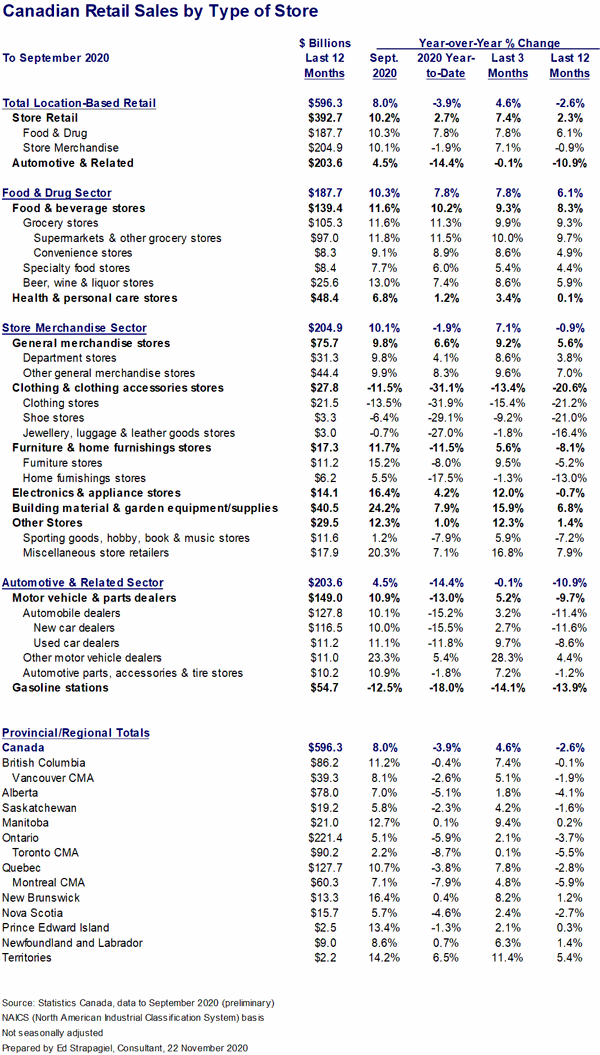
Statistics Canada has released new data indicating that total unadjusted Canadian retail sales gained 4.6% year-over-year in Q3 2020. This is a huge recovery over the 14.9% decline in Q2. After 9 months of 2020 however, year-to-date retail sales are still down 3.9% versus last year.
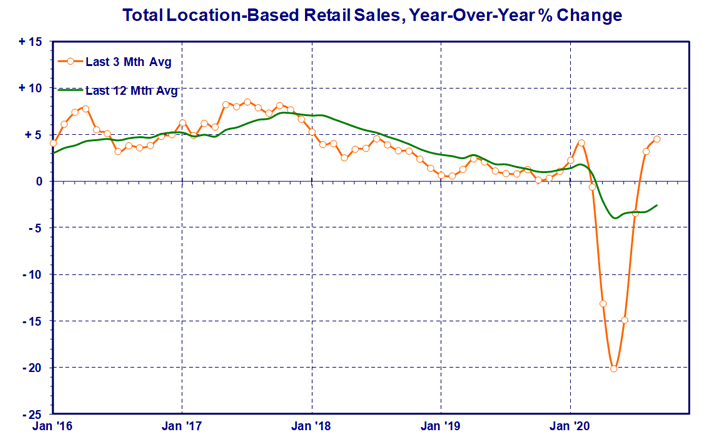
As the above chart shows, the 3 month trend (orange line) has recovered smartly, and the underlying 12 month trend (green line) has started to edge up. But these trends are unlikely to continue. The Q3 results include some latent demand held over from Q2, and the current new wave of COVID-19 is now resulting in a return to lockdowns, just in time for Christmas. Both shoppers and retailers are now better prepared for it, so it may not be as dire as what occurred this past spring.
Food & Drug
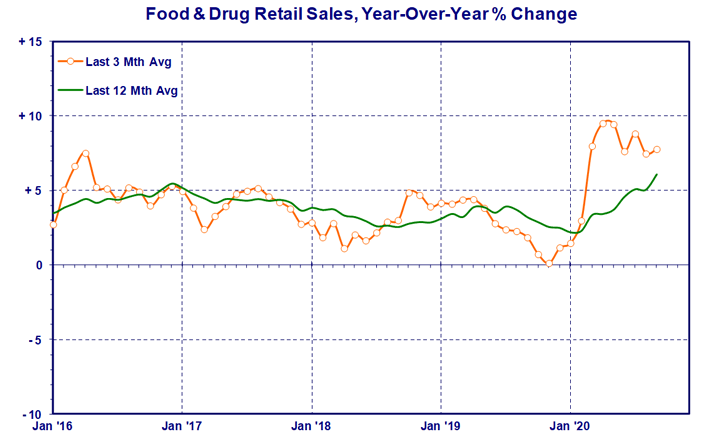
Historically high year-over-year retail sales increases continue in the Food & Drug sector. In Q3 2020, sales were up 7.8% versus a year ago. The underlying 12 month trend (green line in the chart above) has been steadily improving since the start of the year, and still has more upside potential going forward. For Food & Drug, 2020 could end up being a record year for retail sales growth.
Supermarkets & other grocery stores are leading the charge. Their sales gained 10.0% in Q3 and are up 11.5% year-to-date after 9 months. Convenience stores and beer, wine & liquor outlets also had strong retail sales gains in Q3.
Health and personal care stores seem to be coming around. Their Q3 retail sales were up 3.4%, which, although unspectacular, was much better their 3.8% decline in Q2.
Store Merchandise
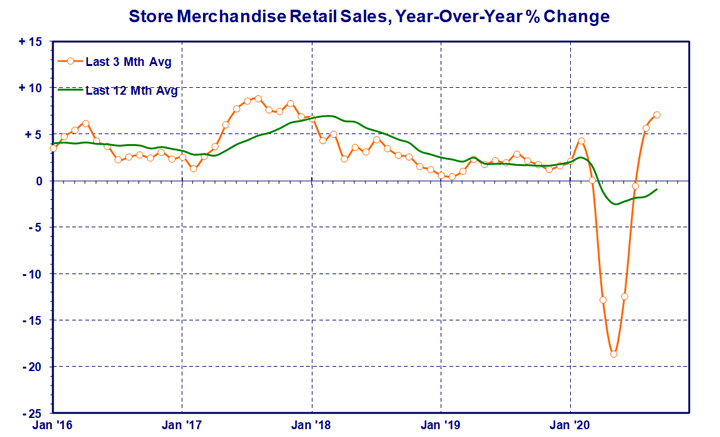
The Store Merchandise sector has recovered from its collapse in the spring. After posting a 12.4% year-over-year decline in Q2 of 2020, retail sales were up 7.1% in Q3. The 3 month trend (orange line in the chart) continues to be quite positive, while the underlying 12 month trend (green line) is crawling its way back up.
Year-to-date retail sales are still down 1.9% after 9 months however, and there is only an outside chance the sector will end the year in the black, given lockdowns due to the resurgents of COVID. Store Merchandise is the retail sector most dependant on holiday season sales.
Many retail categories did well in Q3, including general merchandise, building material and garden equipment & supplies dealers, electronics and appliance stores, and the miscellaneous stores group which includes cannabis retailers.
Clothing and clothing accessories stores however continue to struggle. Their sales were down 13.4% in Q3, although that’s much better than the 58.4% decline they suffered in Q2.
Automotive & Related
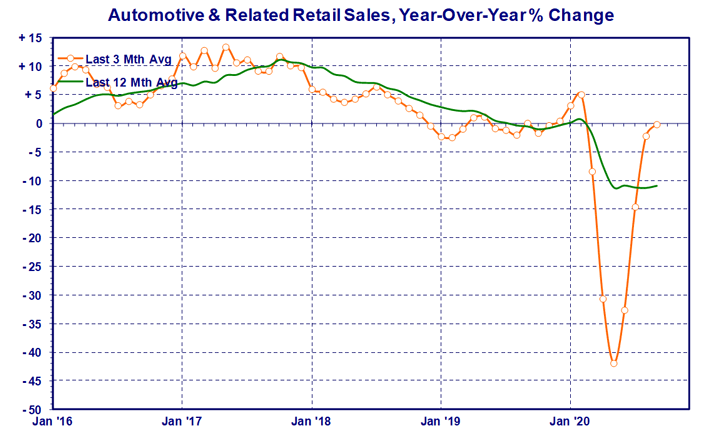
It’s by now a familiar story in the Automotive & Related sector, but with emphasis. There was a disastrous collapse in retail sales in Q2, followed by a near miraculous recovery in Q3. In Q3 alone, retail sales were down just 0.1%. Nevertheless, year-to-date retail sales after 9 months of 2020 are off 14.4% versus last year, and it’s likely the sector will end up with a sales decline for 2020 overall.
Automobile dealers’ sales were up 3.2% in Q3, a vast improvement over the 35.7% decline in Q2. In September alone, their sales were up 10.1%, their best month in 2020 so far.
On the other hand, declining sales at gasoline stations continue to drag down the sector (and all of Canadian retail for that matter). Their retail sales were down 14.1% in Q3 due to a combination of less demand and lower prices.
By The Numbers
Note that the data and analysis in this report are always based on not seasonally adjusted (or unadjusted) retail sales statistics.
For definitions of store types, see Statistics Canada NAICS.
Canadian E-Commerce Sales
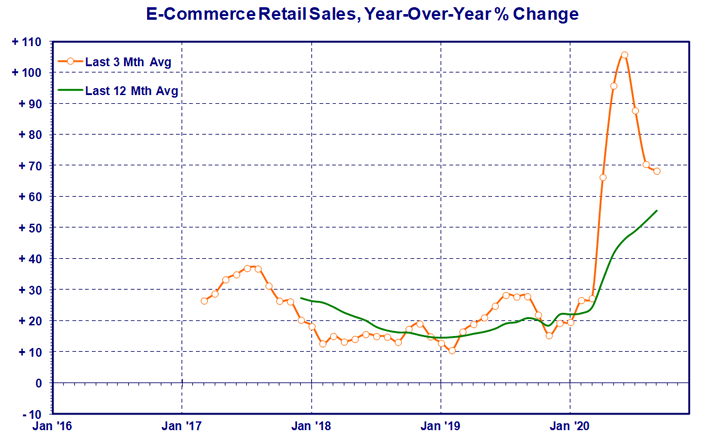
The chart above shows that Canadian e-commerce retail sales took off like a rocket in Q2 2020 with the onset of the COVID pandemic. It may look like things are now cooling off, but that would be misleading. The 3 month trend was up nearly 70% in Q3 while the 12 month growth trend more than doubled over the last year. While consumers generally prefer in-store shopping, more are experiencing the possibilities and benefits of online.
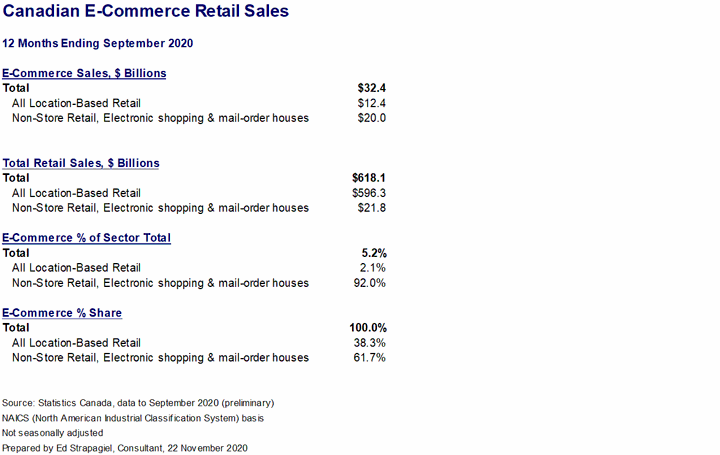
Overall, e-commerce represented about 5.2% of Canadian retail sales for the 12 months ending September 2020, including both pure play as well as brick & clicks stores. Note that Canadian consumers may also buy online from foreign websites which is not captured in these numbers.
Location based retail is the same as that in the preceding “By The Numbers” table. It’s what’s normally reported as Canadian retail sales. Except that it isn’t. Location based retail excludes another section called Non-Store Retailers (NAICS code 454), which includes electronic shopping and mail-order houses, which in turn is where (mostly) pure play e-commerce businesses are. For the 12 months ending September 2020, electronic shopping and mail-order houses had an estimated $20.0 billion in e-commerce sales.
But that’s not the only source of e-commerce, as (mostly) bricks & mortar location-based retailers also sell online. For the 12 months ending September 2020, this group had an estimated $12.4 billion in e-commerce sales. With electronic shopping and mail-order houses, there’s a grand total of $32.4 billion in e-commerce sales by Canadian operators. Note that this does not include foreign e-commerce purchases made by Canadian consumers, but it does include e-commerce purchases made by foreigners at Canadian operations.
For electronic shopping and mail-order houses, an estimated 92.0% of their sales are allocated to e-commerce. For (mostly) bricks & mortar retailers, it can be estimated that 2.1% of their total sales are attributable to e-commerce.
In the final section of the above table, (mostly) pure play operators (namely, under electronic shopping and mail-order houses) generated an estimated 61.7% of all e-commerce sales in Canada, while (mostly) bricks & mortar location-based retailers’ share of e-commerce was 38.3%.
For more explanation on the e-commerce numbers, see Statistics Canada: Retail E-commerce in Canada.
Read More Retail Analysis From Ed Strapagiel:
- Canadian Retail Getting Back On Track, Sort Of: Ed Strapagiel
- Canadian Retail Sales Continue to Crawl Back