

Value-priced large-format French sporting goods retail chain Decathlon has announced the opening date of its first location in Canada. The retailer will no doubt disrupt a market that is already well served by similar competitors. Decathlon’s value proposition, which includes an expansive offering of good quality private-label products, will go head-to-head with homegrown retailers that, in many instances, offer pricier goods in related categories.
Decathlon has announced that it will open its first Canadian store on Saturday, April 21, at Mail Champlain in Brossard, just outside of Montreal. The company is soliciting memberships on its new french-language Canadian website, which notes that the Brossard store will carry more than 6,500 products when it opens. The Brossard store will span about 60,000 square feet in a retail space once occupied by Montreal-based fashion retailer Les Ailes de la Mode.

As part of its Canadian expansion, Decathlon has already announced that it will open a second store in 2019. That store will be located near a new IKEA store in Québec City at the intersection of Highways 40 and 540. Cominar REIT is the landlord for both this site as well as Mail Champlain.
Founded in France in 1976, Decathlon Group is the world’s largest sporting good retailer with more than 1,100 stores in more than 30 countries. It employs more than 78,000 people and boasts annual revenue of about C$15 billion. Decathlon designs, manufactures and distributes a wide range of sports-related equipment and accessories, with over 20 in-house ‘passion brands’ dedicated to different sports, and each with its own design team. Decathlon aims to make sports more accessible by offering a wide range of quality products at affordable prices. The retailer also endeavours to cater to a range of customers from beginners to professionals.
Each of Decathlon’s ‘passion brands’ is tested in real-world conditions, and customer feedback is integrated into further product design and development. Work is further guided by Decathlon’s research and development centre which is called ‘SportsLab’. Every year, the company creates more than 2,800 new products.
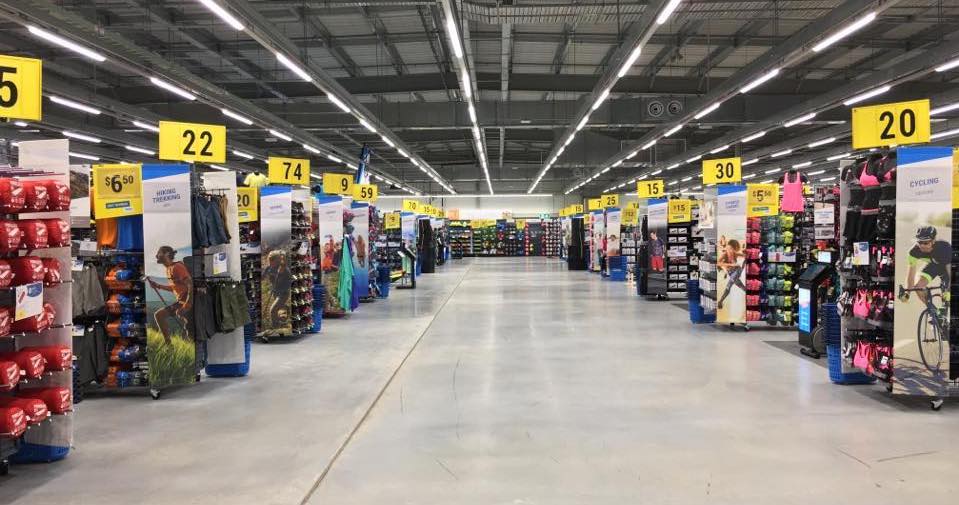
Decathlon’s Canadian stores will be more than just cavernous retail spaces selling goods — they’ll include some innovative technology, with Valtech providing a virtual reality experience that will include being able to view a selection of tents ‘in the outdoors’. It’s a brilliant way to ‘display’ Decathlon’s more than 200 styes of tents while utilizing considerably less real estate than that required for actual live displays.
Stores also include ‘testing zones’ where customers can try on products before buying them. The ‘team sports’ area in some stores features goal posts, basketball hoops and backboards. Some stores include climbing walls to test out climbing products, while others have areas to test out riding bikes and scooters, table tennis, trampolines and archery, and some even have water tanks to try on diving masks.
One retail expert thinks Decathlon will be successful in Canada. “It’s been a long time that I’ve heard so much buzz about a retailer entering Canada. I daresay since Target, but in very different circumstances,” said Carl Boutet, Montreal-based retail strategy consultant. “Decathlon is recognized as formidable, vertically integrated retailer that will force other sporting good retailers to up their game,” he said.
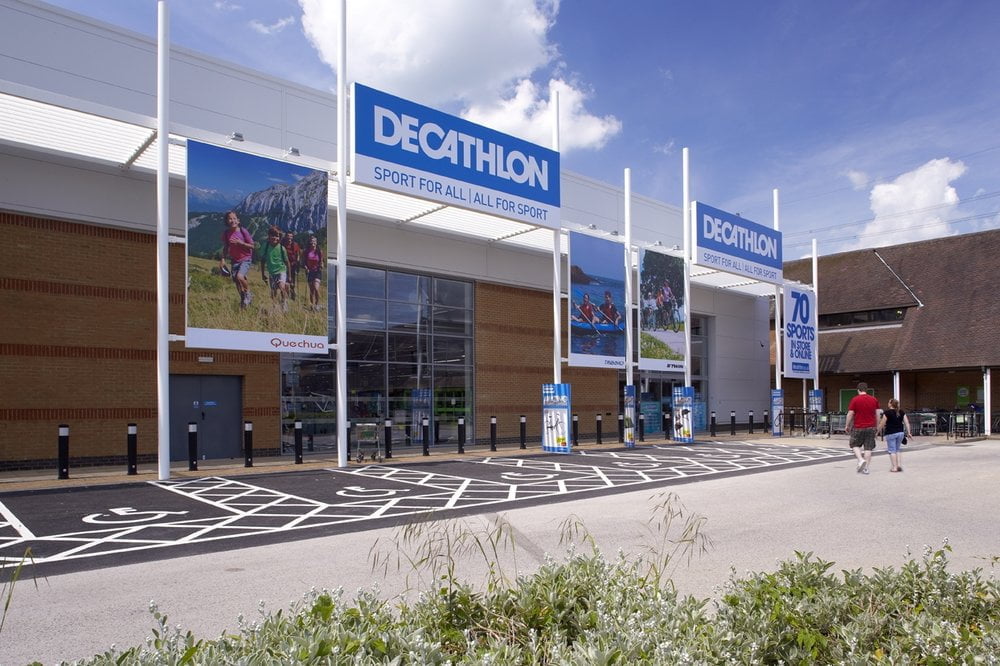

Economies of scale help keep costs down, and Decathlon has created efficiencies across the company that allows it to pass on savings to consumers. Return policies are liberal, as the company seeks to maintain customers for life. Decathlon also says that it pays its employees fair wages, provides excellent benefits and provide ‘a clear path for growth’. “People matter the most. People are our most valuable resource,” says the company’s US website.
Decathlon even has an eco-focus, noting that it aims to reduce packaging, and that its stores are ideally accessible by public transit. Energy efficiency is a goal for its stores, as is storage optimization, logistics and environmental labelling.
For more than a decade, The Decathlon Foundation has worked to improve access to education, training and employment. Initiatives vary widely, ranging from renovating or building new sports grounds to helping train coaches and teachers. The company empowers employees to go into the community to partner on various initiatives.
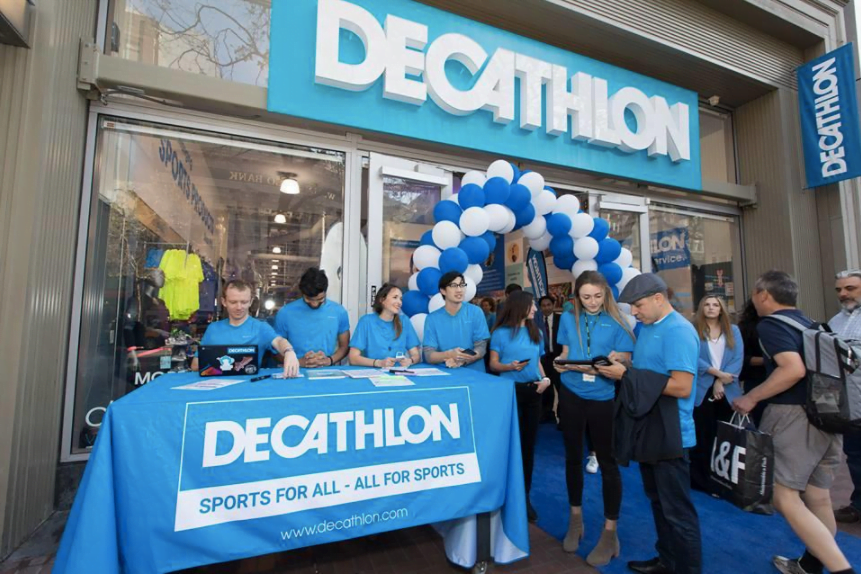
Decathlon has embarked on a global expansion that saw it enter Australia in December, and the United States last week. On March 29, Decathlon opened its first US store in San Francisco at 735 Market Street, located in the city’s inner-core ‘Union Square’ area and adjacent to the prestigious Four Seasons Hotel and Private Residences (which houses an Equinox gym). The San Francisco store is considerably smaller than most locations — the 8,300 square foot retail space is referred to as a ‘lab store’. Given the urban situation of the San Francisco store, Decathlon might consider opening similar stores in Canadian downtowns, as well.
According to brokerage Oberfeld Snowcap’s website, Decathlon is working with Sylvain Charron on its Quebec store expansion, and the retailer is seeking retail spaces in the 35,000 square foot to 45,000 square foot range in commercial centres that may include power centres, pad sites as well as standalone locations.

Decathlon, with its extensive range of value-priced sporting goods, could significantly disrupt an industry that already includes some exceptional retailers. FGL Sports (operating under multiple banners including Sport Chek, Atmosphere and Sports Experts) has stores across the country in a range of sizes, including a handful of flagships that include innovative technological installations. Outdoor retailer SAIL, with stores in Quebec and Ontario, could see some market share loss in several of its product categories. Laval-based Sportium (part of the SAIL Plein Air umbrella), which operates three large store locations in Quebec, has said that it plans to open as many as seven more locations in the province over the next three years. Vancouver-based MEC, aka ‘Mountain Equipment Co-op’, has been expanding aggressively across Canada and given its value product and selection, might be considered to be the closest competitor to Decathlon in Canada.
Retailers in Canada that carry sporting goods are also at threat of losing market share to Decathlon — Canadian Tire, Walmart and other similar retailers include sporting goods departments in their stores. Decathlon’s value proposition and experiential stores could be advantageous in taking market share from such retailers.
It remains to be seen how successful Decathlon’s Canadian expansion will be, and how long it will take for the company to expand outside of Quebec. Given that it is the world’s largest sporting goods retailer and has so many stores in so many markets, one might expect Decathlon to at least consider a national expansion in Canada after its initial entry into Quebec this month.







The second Decathlon 540/40 is not in Montreal area but in Quebec city.
We just made the correction — we lost something in translation. It will be near a new Ikea store in Quebec City?