Visiting an Amazon 4-Star Store – Herd Mentality or Shopping Made Easy?

Date:

Share post:

I was in New York over the holidays and visited the Amazon 4-Star store in SoHo. Overall, the store was functional but not incredibly exciting from my perspective. The visit also led me to contemplate the limitations of such a concept and to challenge the very meaning of it in society. A little deep for December. Either way, I think the store meets it’s perceived objective: to add value for Amazon customers. The store was packed for at least three reasons in my opinion. Firstly, because it was late December and virtually all popular New York stores were packed. Secondly, because it is relatively new (September 2018 opening) so folks are curious and the Amazon brand is very hip. Thirdly, the store adds value to customers as an extension to Amazon’s tried and true website.

For those of you who are unfamiliar with the concept, let me explain it a little. Amazon has taken select products from it’s US website that have four star and above (five star maximum) aggregate ratings along with new and trending items and top sellers and merchandised them all in one 4,000 square foot physical location.

The store is cashless (a new trend within select retail) and is NOT set up the same as Amazon Go locations that eliminate payment lines. Customers can pay with credit card, debit or the Amazon app.

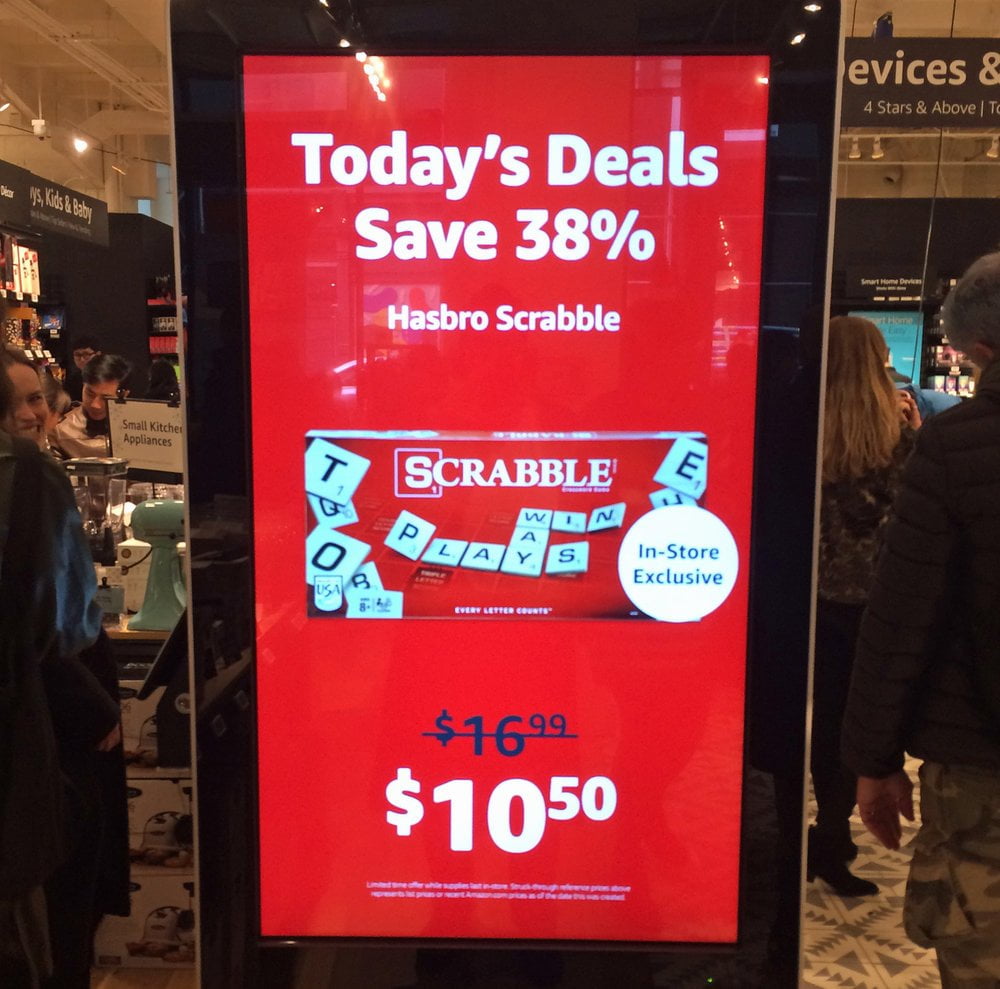
Each item is electronically signed and shows individual aggregate customer rating details along with the Amazon Prime member price and the non-member price. Electronic signage shows daily featured items.
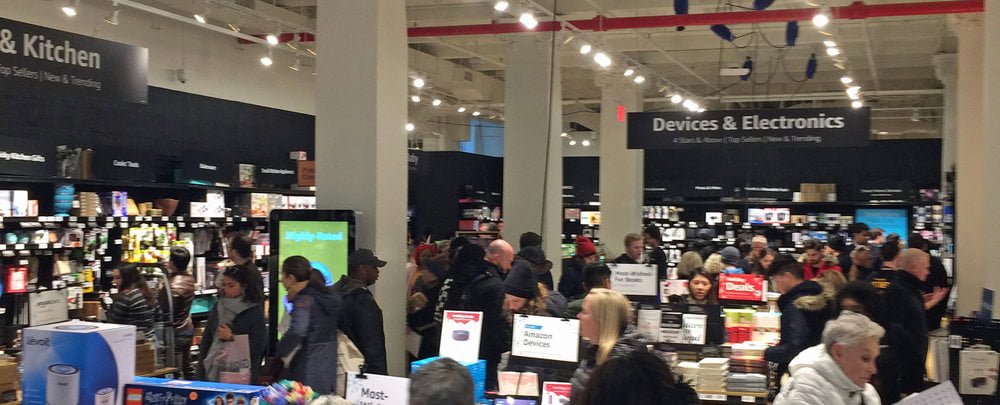
Overall, I liked the store for it’s simplicity and use of analytics to offer assortments based on what the masses prefer. I wouldn’t say that the store was exciting or offered a unique experience to customers. In fact, I found it a little boring. Having said that, I am not Amazon’s target market for this store. I don’t buy much online, except to learn from a retail perspective. I am also a bit of a minimalist (ironic, I know) and a non conformist (look at my hair).

I also liked how the store uses physical cross merchandising, highlighting products that are traditionally bought together as in the case with the smart home section that showcases all products that work with Alexa in one section. It’s much easier to tell a category story in store than online.

I also like how Amazon highlights specific New York favorites which hints at localization. I think there is an opportunity to do more of this to better address regional variances in customer preference where they arise.

The store succeeds as it reinforces Amazon’s (and society’s) use of collective ratings and reviews to assist one in making a purchase decision. That is, many of us feel more comfortable buying something that other customers have told us is great. Great may refer to quality, functionality or performance among other things. It is important to note that rating systems and specifically Amazon’s rating system has come under scrutiny of late for it’s potential inaccuracy and lack of authenticity. See the link to the article from the Wall Street Journal that talks to this. The store succeeds by adding a physical dimension to eliminate one of the remaining barriers to online shopping: not being able to touch and feel the product. Amazon’s rating system has been used as a proxy for this part of the traditional customer purchase decision making process. When customers shop online they can not touch and feel the product so they rely on others to do so for them and verify their experience with ratings and reviews. These ratings are of course aggregated and averaged.
One can contrast the role of Amazon’s 4-Star store with the trend in retail toward customized, unique and individually marketed products. If customers demand that more products are designed uniquely for them or by them, how does Amazon’s 4-Star’s aggregation and averaging of a given countries’ consumer needs fit in? If I buy a product from this store, I can feel comfortable that millions of other Americans have bought the same item and that it met their needs exceptionally well on average. There is strength in numbers. However, if I wish to express myself and stand out from the crowd with a new shirt or if my tastes vary from the average than perhaps products from this store miss the mark to some degree. Does this mean that Amazon or at least Amazon 4-Star stores are relegated to utilitarian, functional products? More discussion is needed here in my opinion.

Being in an Amazon store, I was not surprised to see customer feedback gathered at the exit with a simple four option kiosk. Simple and effective. More retailers should use this system at least as a starting point. Funny how it included only four options as opposed to five options (stars).

If you would like to see additional pictures and details, CNBC’s analysis is a worthy read.

1 COMMENT

LEAVE A REPLY

Please enter your comment!
Please enter your name here

More From Retail Insider

RECENT RETAIL INSIDER VIDEOS

Advertisment

Subscribe to the Newsletter

Subscribe

* indicates required

RECENT articles

Daily Synopsis: Jun 19, 2026

Canada's affordability crisis could fuel Zellers expansion, Putman floats rebrand in new Toys R Us court docs, Ottawa imposes surcharge on canned veggie imports, Burlington Ikea features Indigenous kitchen room setting, The Beer Store opening new stores after shutting others, Vancouver businesses struggle despite FIFA crowds, and other news.

Hermès to Open Standalone Store on Calgary’s Stephen Avenue

Hermès is planning its first standalone Alberta store on Calgary’s Stephen Avenue, exiting Holt Renfrew and reinforcing downtown Calgary’s growing luxury retail presence.

From The Desk: Canadian Retail Evolution Through Innovation, Expansion, and Experience

This week's retail news highlighted an industry balancing change and opportunity. From the end of a chapter in Canadian furniture manufacturing to major investments in luxury retail, experiential concepts, and new store openings, retailers continue to adapt to evolving consumer expectations and economic pressures.

The Hidden Cost of Grocery Promotions in Canada

Supplier-funded grocery promotions may be creating hidden costs throughout Canada's food supply chain. Sylvain Charlebois examines how these practices can affect prices over time.

Fuel boosts retail sales growth to $73 billion in April: Statistics Canada

The largest increase in retail sales in April was observed at gasoline stations and fuel vendors (+5.1%).

Palliser Sale Marks End of an Era for Canadian Furniture Manufacturing

Palliser Furniture's sale to MotoMotion ends more than 80 years of family ownership, raising questions about Canadian manufacturing, retailer relationships and the future of the iconic furniture brand.

Empire Co. Ltd. CEO Charts Growth Strategy with Discount Focus

Empire plans to open 70 new stores across Canada over the next three years, with more than 75% of locations focused on discount retail as the grocery giant expands FreshCo, pharmacy and wholesale operations.

Alibaba.com data points to rise in solo founders as AI tools reshape startup landscape

71 per cent of more than 15,000 applicants to its CoCreate Pitch competition identified as solo founders, up from 40 per cent a year earlier.

AI increasingly shaping Canadians’ purchasing decisions, National Bank survey suggests

39 per cent of Canadians have used generative AI tools to support a purchasing decision in the past year.

Uncertainty outweighing tariffs as top concern for cross-border trade: Purolator survey

Businesses are already experiencing measurable financial impacts from tariffs.

Factor Meals accelerates nationwide expansion with new “state-of-the-art” Distribution Centre in Calgary

Initially launched in 2022 to serve Ontario, Quebec, and the Maritimes, the Calgary expansion allows Factor Meals to seamlessly scale its dietitian-approved, chef-crafted meal deliveries from coast to coast.

WeCook launches nationwide delivery with expansion into six new Canadian markets

The company said the expansion follows a period of rapid growth. It has grown by more than 1,000% since 2020, created over 600 jobs, and now delivers more than four million meals annually.

FIFA World Cup boosts brand opportunities in Toronto and Vancouver through out-of-home Advertising

Influx of people is creating a major opportunity for brands looking to reach large crowds, even without paying the steep costs associated with official FIFA sponsorships.

Adyen selected to provide payments technology for Aritzia

Adyen said it will process transactions in Aritzia’s physical locations, North American websites, and within its recently launched mobile app, supporting consistent payment experiences across channels. 

Daily Synopsis: Jun 18, 2026

Today's Retail Insider coverage highlights Canadian retail growth with new store openings by Zellers, Soch, Le Creuset, and No Frills plus Empire's robust sales and expansion plans.

Inside Zellers’ New Toronto Store as Crowds Turn Out for Opening Day

Retail Insider visited Zellers' new Toronto store on opening day, finding strong customer interest, value-focused merchandise, nostalgic touches and a modern standalone retail concept.

Empire Company sees sales reach $31.95 billion in Fiscal 2026, more growth planned for FreshCo brand

In fiscal 2027, the Company expects to open approximately 15 new FreshCo stores across Western Canada, Ontario and Atlantic Canada.

Caffeo unveils bold new look and expanded menu at Toronto’s 24/7 robotic cafe

The relaunch introduces a vibrant new visual identity and an expanded precision-brewed menu, elevating the experience for coffee lovers at the city's only 24/7 robotic café.

Strait of Hormuz Reopens, but Supply Chain Backlog Remains: Scandiweb (Opinion)

US and Iran announced a deal to reopen the Strait of Hormuz, but more than 800 vessels remain stranded and freight rates may take months to normalize.

Business Barometer: Small business owners continue to feel downcast in June: CFIB

Fuel costs remain the top cost constraint for 66% of small businesses, while weak demand continues to weigh on more than half (53%) of small firms.