Will COVID-19 Have Canadians Relying On Credit More Than Ever?

Date:

Share post:

By Leo Gutierrez

During “normal” times, credit provides a means for consumers and businesses to make purchases and investments when they’re short on cash. If used responsibly, credit cards can also be a good way to accumulate travel rewards and take advantage of cashback deals. Sadly, these are anything but “normal” times.

The Effects of COVID-19 on the Credit Industry

The COVID-19 pandemic is hitting consumers and businesses all across Canada and the rest of the world. Reports estimate that Canadian unemployment stands around 7.5%, the highest rate the country has seen since the 2008 economic crisis. As a result, many consumers need to fall back on credit while they await unemployment benefits. 

The Coronavirus has forced many to live their life online, safe inside their homes. Businesses have been forced to reexamine their online platforms to successfully ride out this wave.  Since shipping services are deemed essential services, buying goods online has become the go-to outlet for much of the population. It would not be surprising to see a jump in online credit card use for the first quarter of 2020 (and throughout the year) as compared to 2019.  According to a study by Canadian Payments Insights, a company offering analysis into the payment habits of Canadians, in 2019 “credit cards were the most popular payment method for online purchases in Canada.” Canadians used credit cards for more than 66% of all transactions in 2019. 
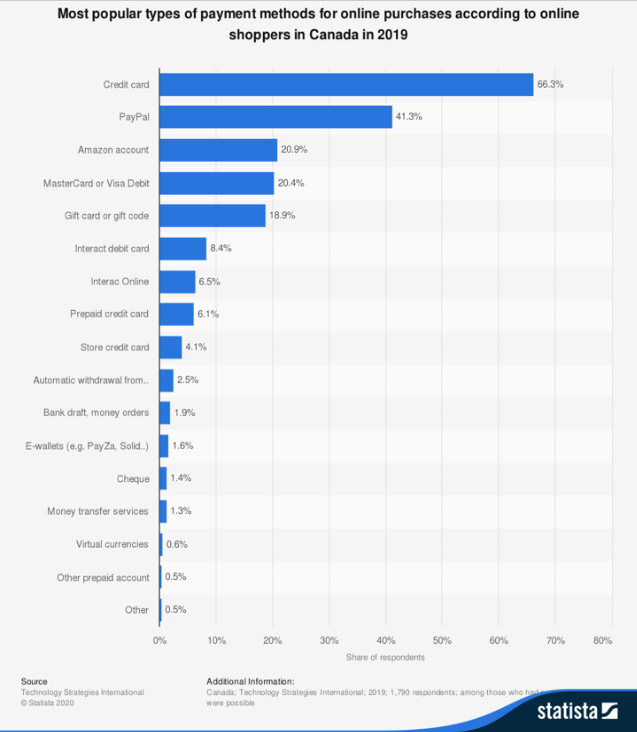
CREDIT: CANADA; TECHNOLOGY STRATEGIES INTERNATIONAL; 2019; 1,790 RESPONDENTS; AMONG THOSE WHO HAD PURCHASED ONLINE IN THE PAST 12 MONTHS; MULTIPLE ANSWERS WERE POSSIBLE © STATISTA 2020

However, the crisis is not just affecting consumers. With less cash to spend, retail stores are also taking a huge hit. Fortunately, Canadian businesses do have access to increased credit thanks to the Business Credit Availability Program (BCAP), Canada Emergency Business Account (CEBA), and other economic initiatives. That said, delays in certain government benefits could cause many retailers to close their doors for good.

Delays in Government Benefits

While Canadian citizens also have access to emergency government funds, the application process and wait times have left millions of individuals without a stable income for weeks at a time. This means that credit cards are being used in place of cash and debit cards. Consumers are turning to credit to pay for just about everything — from groceries to rent.

Right now, credit cards are a necessity for a lot of Canadians, but they also pose a financial risk. Nobody knows exactly how long the Coronavirus pandemic will continue, but many experts believe that there will not be a vaccine (or economic stability) for at least a year. Relying on credit cards and unemployment benefits for months at a time could be the only solution for many until day-to-day life returns to normal.

Tips to Stay Afloat

In this time of financial hardship and uncertainty, Canadians must remember not to overextend themselves. Acting responsibly and budgeting carefully could make the difference between weathering the storm successfully and experiencing long-term financial instability. So, here are a few tips to help Canadian consumers maintain fiscal responsibility during this crisis:

●      Don’t use all of your cash reserves immediately – If you have cash on hand, consider yourself lucky. However, you shouldn’t spend all of your cash first. Instead, try to strike a balance between cash and credit. This way, if an emergency comes up that requires cash, you will have cash on hand to deal with it.

●      Don’t overdo your debt repayment – Usually, paying more than the minimum on your credit cards is a good thing. However, in a time when your cash flow could be inconsistent, you shouldn’t spend extra cash unless it’s absolutely necessary. Pay what you can without taking away too much from your available funds.

●      Dip into your savings if necessary – COVID-19 presents the biggest crisis of our generation. If there’s ever been an emergency that required drastic measures, this is it. While you don’t want to drain all of your savings or retirement fund, you shouldn’t be afraid to take out some cash when you really need it.

●      Don’t be afraid to ask for help – The Canadian government has instituted a number of programs to help individuals get food, medicine, and money during this crisis. Research which benefits you are eligible for and apply as soon as possible.

To learn more about COVID-19 programs for individuals and businesses, consult Canada’s COVID-19 Response Page.


LEAVE A REPLY

Please enter your comment!
Please enter your name here

More From Retail Insider

RECENT RETAIL INSIDER VIDEOS

Subscribe to the Newsletter

Subscribe

* indicates required

RECENT articles

Tostitos opens stadium eatery at BC Place during FIFA World Cup 2026

The launch marks the brand's first Bar TOSTITOS location and expands its presence beyond packaged snack products into stadium food service.

World Cup opener draws non-local fans as retail traffic rises around SoFi Stadium, mobility data suggests

The findings offer an early indication of how the tournament may influence consumer activity in host cities as matches continue.

Canadian economy rebounds in April with GDP growth: Statistics Canada

Real gross domestic product (GDP) grew 0.5% in April, after contracting 0.1% in March.

Eggslut to Open First Vancouver Restaurant on Alberni Street

Eggslut's first Vancouver restaurant has come into public view on Alberni Street, adding another internationally recognized food brand to the city's growing luxury and hospitality district.

Protecting and simplifying CUSMA exemption top trade priority for small business: CFIB

64% of small businesses support taking the time needed to secure the best possible terms for renewed or renegotiated CUSMA.

Primaris Looks to Unlock Up to $375 Million from Excess Mall Lands

Primaris REIT says its excess mall lands could be worth up to $375 million as the company evaluates more than 100 acres for potential residential, hotel and seniors housing development.

Daily Synopsis: Jun 29, 2026

Rick Rabba says FIFA good for business, Canada looks to grow more food and rely less on imports, Saskatchewan minimum wage going up, St. Albert retail robberies concern, and other news.

Carlingwood at 70: How an Ottawa Mall Survived Seven Decades of Change

Ottawa's Carlingwood Shopping Centre is celebrating its 70th anniversary after surviving decades of change in Canadian retail through continual reinvention and community relevance.

Urban Nature Store Reaches 10 Locations as More Canadians Embrace Backyard Birding

Urban Nature Store has opened its 10th location in Thornhill as more Canadians embrace backyard birding, nature appreciation and locally made products.

Why Cadillac Fairview Is Selling CF Shops at Don Mills

The proposed sale of one of Toronto's pioneering open-air shopping centres appears to be part of a broader strategy to concentrate capital in a smaller number of flagship assets while creating a rare redevelopment opportunity for a new owner.

Celebrate Canada Worldwide eyes new international markets as trade landscape shifts

"Our purpose is really to promote trade, investment and culture."

Corby bets on ready-to-drink growth as consumer habits shift, new CEO says

The company is benefiting from long-term changes in consumer behaviour that favour convenience, portion control and premium products.

Redbrick proposes landmark hotel redevelopment for downtown Victoria

The property was once home to the historic Westholme Hotel, which first opened in 1911.

Pinterest unveils new AI advertising tools as search shifts to conversational discovery

Pinterest rolled out a new set of AI ad tools focused on three things marketers care about right now: performance, workflow efficiency, and interoperability. 

CFIB calls for Alberta small business tax relief alongside energy rebate

The organization said a $100 rebate would represent only a small portion of the higher monthly costs many business owners continue to face.

Daily Synopsis: Jun 26, 2026

Flying Tiger enters Canada with competition, Saks Global rebrands, Lululemon directors approved, Metro strike hits earnings, retail theft pilot in Ottawa sees crime reduction, and other news.

Toronto restaurant to introduce build-your-own pho concept in September

The restaurant will offer customers a choice of ingredients to create individual meals, including traditional broth-based pho as well as dry pho, which the company is introducing as an alternative preparation.

Flying Tiger Opens First Canadian Store, Begins GTA Expansion

Flying Tiger has opened its first Canadian store at CF Toronto Eaton Centre, introducing a Danish retail concept built around discovery, design and constantly changing merchandise as the company begins a five-store GTA expansion.

Retail inventory stress soars as tariffs, TikTok trends, and AI gaps challenge planning: DOSS Study

DOSS says 75% of retail professionals have lost sleep over inventory decisions, with tariffs, TikTok trends and AI gaps worsening planning.

Calgary Stampede drives meaningful lift for local businesses: Mastercard Economics Institute

MEI estimates that the 2025 Calgary Stampede generated an approximate 18 per cent lift in spending at local merchants relative to baseline, with restaurants experiencing one of the strongest lifts at roughly 29 per cent.