

By: Michael R. King and Douglas A. Stuart
An Ontario court has approved the liquidation of nearly all Hudson’s Bay Company’s stores, marking the end of Canada’s oldest company, which has been in operation for 355 years. The liquidation is set to begin March 24, and will continue until June 15, leaving only six stores in operation.
The court’s decision came shortly after Hudson’s Bay filed for creditor protection, signalling the company’s struggle to manage its mounting debt.
With widespread layoffs sure to follow, this corporate collapse is both shocking and distressing. But the court documents suggest it was not unexpected. Hudson’s Bay lost $329.7 million in the 12 months leading up to Jan. 31, 2025. As of that date, Hudson’s Bay had only $3.3 million in cash and owed more than $2 billion in debt and leases.
The final straw appears to have been trade tensions between Canada and the U.S., with the increased geopolitical and economic uncertainty leading lenders to shun Hudson’s Bay as it sought more financing, according to court documents.
What bankruptcy looks like
The downfall of a major company like Hudson’s Bay brings with it a wave of financial jargon. Understanding the differences between insolvency, bankruptcy, restructuring and liquidation is crucial to fully grasp the situation.
Insolvency occurs when a business runs out of cash and cannot pay its bills. At the start of March, it was $5 million behind on rent and supplier payments, and within days of missing payroll.
Bankruptcy is a legal process under Canada’s Companies’ Creditors Arrangement Act where a company files for protection from its creditors. The goal is to avoid the social and economic costs of liquidation, preserve jobs and protect the interests of affected stakeholders. If granted, the judge sets a “stay period” where the company works out a restructuring plan with its creditors.
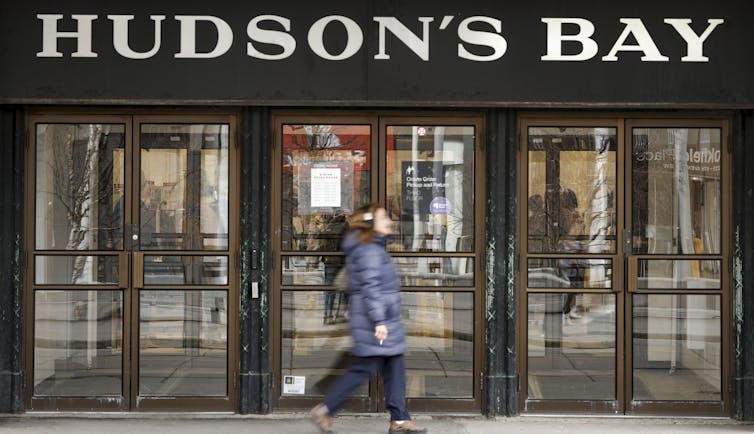
Hudson’s Bay has more than 2,000 creditors, including $430 million in secured term loans, $724 million in mortgages and $512 million to unsecured creditors, mostly owed to suppliers. Hudson’s Bay also owes payroll remittances, federal sales taxes and over $60 million in customer gift cards and loyalty points. Gift cards are good until April 6.
A restructuring wipes out the equity holders and allows a company to negotiate a reduction in its debts. The business continues to operate under the supervision of a court-appointed monitor, using interim financing to pay bills. If successful, the company re-emerges from bankruptcy and continues to do business.
If restructuring is not successful, the company asks the court for permission to liquidate. Liquidation means a “fire sale” of all assets such as inventory, shelving, real estate, leases and trademarks. Items are sold at a deep discount, leading to potential bargains.
The Ontario Superior Court denied the initial request to liquidate on March 14, telling Hudson’s Bay and its creditors to “lower the temperature” and work on a deal. With only limited progress and some concessions made to support Hudson’s Bay’s joint venture with RioCan REIT, the court gave permission for the liquidation on March 21.
Many will lose, some will win
The collapse of Hudson’s Bay will leave many facing financial losses, while a select few stand to gain.
Secured creditors, some suppliers and Hudson’s Bay pensioners are expected to be protected by the courts. However, many others, including thousands of customers and more than 1,800 unsecured creditors, will suffer a financial hit.
The hardest impact will be felt by the more than 9,300 employees losing their jobs. Employees will lose their income, health and disability benefits, and life insurance, significantly impacting families across the country.
However, employees will not lose their pension benefits. The company’s pension plan is fully funded and in surplus position. This was not the case for Sears Canada when it went bankrupt in 2018. A surplus means the value of investments is greater than the promised benefits and is good news for retirees.
Mall landlords will also lose out. Hudson’s Bay drove foot traffic in malls across the country where it was the anchor-tenant. There will likely be painful ripple effects for smaller store owners in malls vacated by Hudson’s Bay, including falling sales, defaults on mortgages and business failures.
That said, some stand to benefit. For example, the American financial services company Restore Capital LLC is providing interim debtor-in-possession (DIP) financing, charging a hefty fee in the process. The lawyers and accountants involved in the bankruptcy may also benefit.
Priority of proceeds
When a company is liquidated, the proceeds from selling its assets are used to repay claimants based on their priority in bankruptcy. This is sometimes referred to as the waterfall of “who gets what.” Think of it as a queue with people lining up to get paid.
Interim DIP financing is paid off first, together with legal and accounting fees related to the bankruptcy. Essential operating costs during the restructuring are also paid, including employee wages.

Next come secured creditors. These lenders provided funding backed by specific assets, known as collateral. Collateral may include inventory and real estate. A similar process happens on a personal residence; if a homeowner defaults on their mortgage payments, the bank may take possession of the house.
Third in line are debts granted priority by the courts. Employees receive unpaid wages up to a certain cap, just under $9,000, under the federal Wage Earner Protection Program. Pension benefits are paid out and outstanding payroll and sales tax remittances are paid.
As the pool of assets gets smaller, unsecured creditors are paid off next including suppliers, landlords and employees owed additional wages or termination benefits.
Last in the queue from the wind-up are equity holders — the residual claimants — who control the company through their common and preferred shares.
In 2020, Hudson’s Bay’s CEO Richard Baker and a group of investors took the company private, meaning it was no longer publicly traded on the Toronto Stock Exchange, buying out shareholders for approximately $2 billion. This stake is now wiped out.
Disappointing, but not surprising
Hudson’s Bay’s current financial situation is disappointing, but not surprising. The COVID-19 pandemic made times tough for brick-and-mortar retailers. On top of this, under-investment and a failed e-commerce strategy left the company struggling to compete in an increasingly digital retail landscape.
With tariffs and trade uncertainty hurting the Canadian economy, the unfolding trade war is expected to have far-reaching consequences for Canadian households and businesses. Hudson’s Bay was not immune to these effects.
In the end, Hudson’s Bay backed itself into a corner, arguably waiting too long to secure funding and ultimately losing control of its own destiny. Its bankruptcy is a major blow to Canadian retail, marking the end of a era for a company that lasted more than three-and-a-half centuries.
About the Authors:
Michael R. King is an Associate Professor at the Gustavson School of Business and Lansdowne Chair in Finance, University of Victoria
Douglas A. Stuart is an Assistant Teaching Professor of Accounting at the Gustavson School of Business, University of Victoria
More from Retail Insider:
- Hudson’s Bay Collapse Marks Shift for Legacy Retail
- Oberfeld Snowcap to Monetize Hudson’s Bay Leases
- Hudson’s Bay to Liquidate Most Stores, Six Stay Open
*This article originally appeared in The Conversation.








HBC is being liquidated ?
HBC is a real estate company based in NY, owned by Richard Baker.
How do you know it’s being liquidated.
Please comment
Jack