

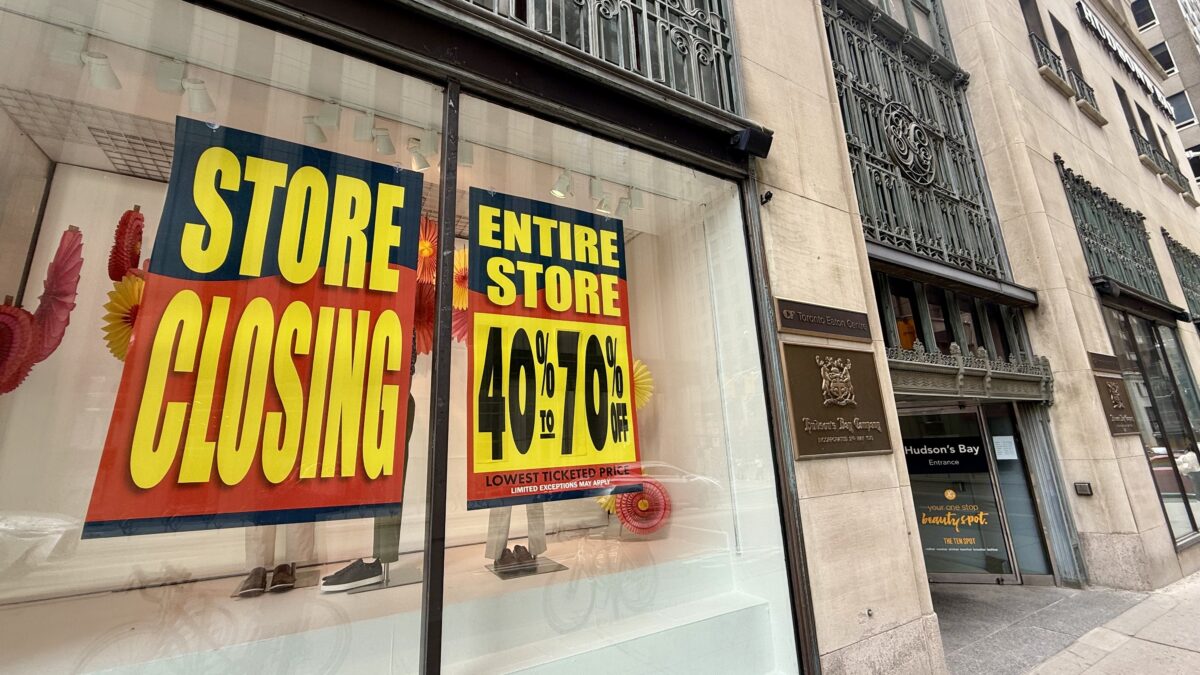
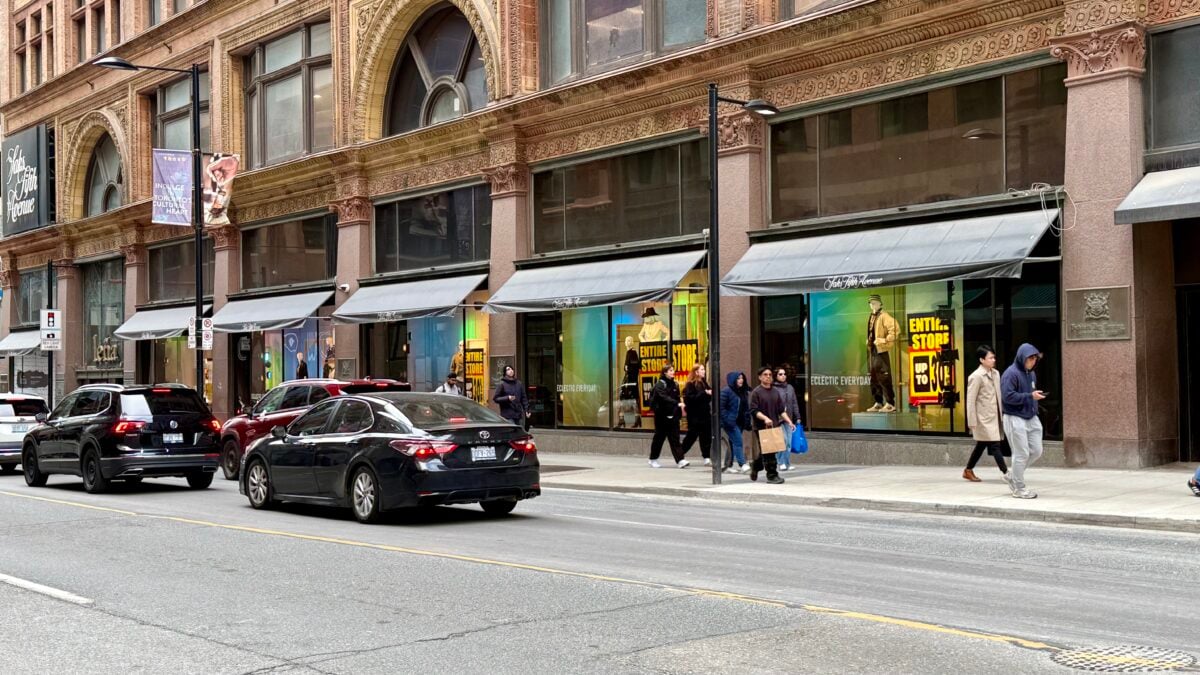
In late April 2025, liquidation signs appeared in the windows of Hudson’s Bay Company’s flagship on Queen Street in Toronto, and five others. For many Canadians, the sight of “70% OFF” banners draped across the historic building marked the moment when the company’s fate became undeniable.
One year later, the collapse of Hudson’s Bay continues to reverberate across the Canadian retail landscape. What began as a restructuring effort under creditor protection evolved into a full liquidation that ended the operations of North America’s oldest company and left a significant void in shopping centres, downtown cores, and the national retail psyche.
The Final Days of a 355-Year-Old Institution
Hudson’s Bay filed for protection under the Companies’ Creditors Arrangement Act in March 2025, but it was the events of April that sealed its fate. Early in the month, the company paused its loyalty program and stopped accepting gift cards, leaving many customers with stranded balances.
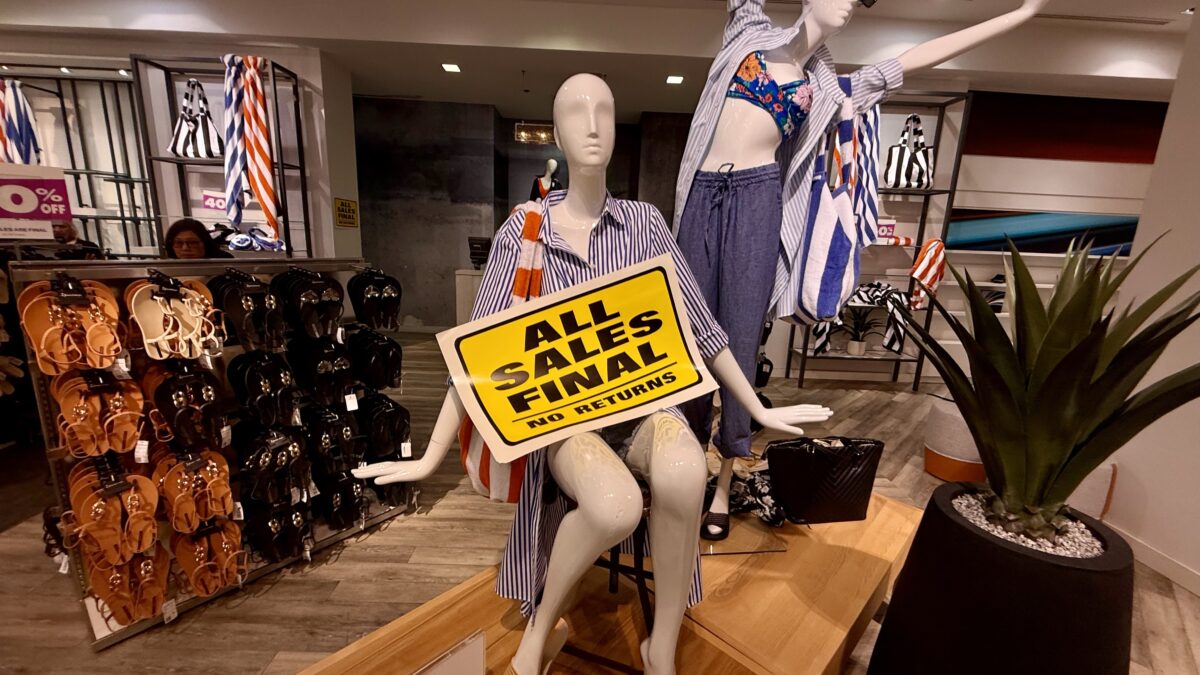
By April 24, court filings indicated there was little chance of securing a buyer for the remaining business. The company announced the liquidation of its final six stores, including its Toronto Queen Street flagship, Yorkdale Shopping Centre location, Hillcrest Mall, downtown Montreal store, CF Carrefour Laval, and CF Fairview Pointe-Claire.
Within days, liquidation sales were underway across all remaining locations. By the end of the month, the company had effectively lost its ability to continue operations, burdened by approximately $2 billion in liabilities and minimal available cash.
Why Hudson’s Bay Failed
The company’s collapse was driven by a combination of structural challenges and strategic missteps, with some blaming owner and Governor Richard Baker.
Hudson’s Bay had struggled for years with declining department store traffic, rising operating costs, and an increasingly fragmented retail environment. Leadership instability further compounded the problem, with multiple executive changes over more than a decade.
A pivotal moment came in late 2024 with the separation of Saks Global into a standalone entity. This move effectively detached the Canadian Hudson’s Bay stores from their most valuable luxury associations, leaving the domestic business exposed and financially strained.
Without a compelling value proposition or the capital required to modernize, the company was unable to compete in a retail landscape increasingly defined by specialization, speed, and experience.
The Aftermath: Assets, Leases, and Lost Jobs
Following the liquidation announcement, the dismantling of Hudson’s Bay accelerated.
In May 2025, Canadian Tire acquired the company’s intellectual property, including its name, coat of arms, and iconic multi-coloured stripes, for approximately $30 million.
At the same time, efforts to salvage the company’s physical footprint proved unsuccessful. B.C. entrepreneur Ruby Liu attempted to acquire a portfolio of leases to launch a new department store concept, but the plan ultimately collapsed following a court decision in late 2025.
The human impact was significant, with thousands of employees affected by the closures and limited recourse available due to creditor structures.
The State of the “Stripes” One Year Later
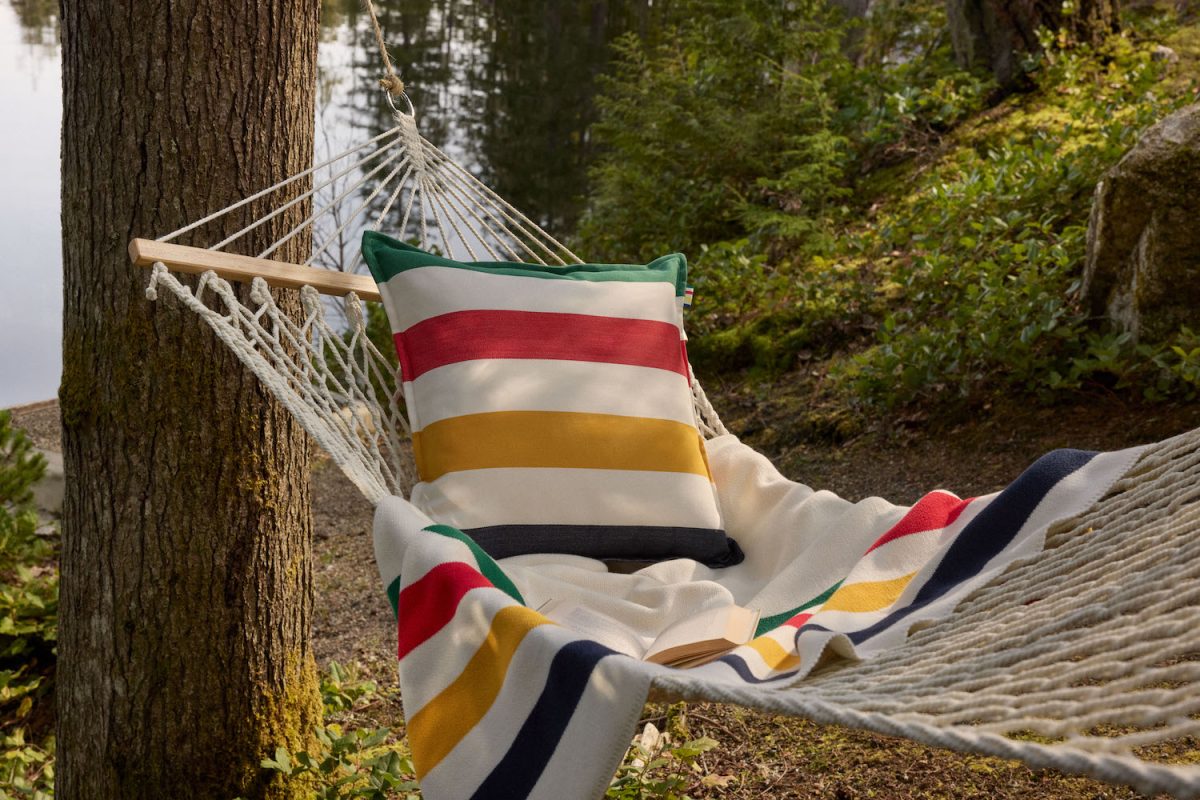
One year after liquidation began, the most visible remnant of the Hudson’s Bay Company is no longer a department store, but a brand.
Following its acquisition of HBC’s intellectual property, Canadian Tire has emerged as the primary steward of the “Stripes,” repositioning them as a proprietary product line rather than a legacy retail identity.
On May 1, 2026, Canadian Tire is set to launch its first internally designed Hudson’s Bay Stripes summer collection, marking a shift from selling residual liquidation merchandise to treating the brand as a premium in-house offering alongside established labels such as NOMA and CANVAS.
While the department stores themselves have disappeared, the brand persists through shop-in-shop formats within Canadian Tire and Mark’s locations across the country, extending its presence in a fundamentally different retail context.
The Real Estate Reality: Subdivision Replaces the Department Store
The liquidation of Hudson’s Bay left behind approximately 15 million square feet of vacant retail space across Canada, triggering one of the largest repositioning efforts in the country’s retail real estate history.
Rather than seeking a single anchor tenant to replace Hudson’s Bay, landlords have largely shifted to a multi-tenant strategy. Approximately 64 percent of former HBC space is expected to be subdivided into mid-sized units ranging from 15,000 to 40,000 square feet, according to JLL.
This approach reflects a broader rethinking of anchor tenancy, as shopping centres prioritize flexibility and diversification over reliance on large-format department stores.
New Tenants Signal a Shift in Retail Mix
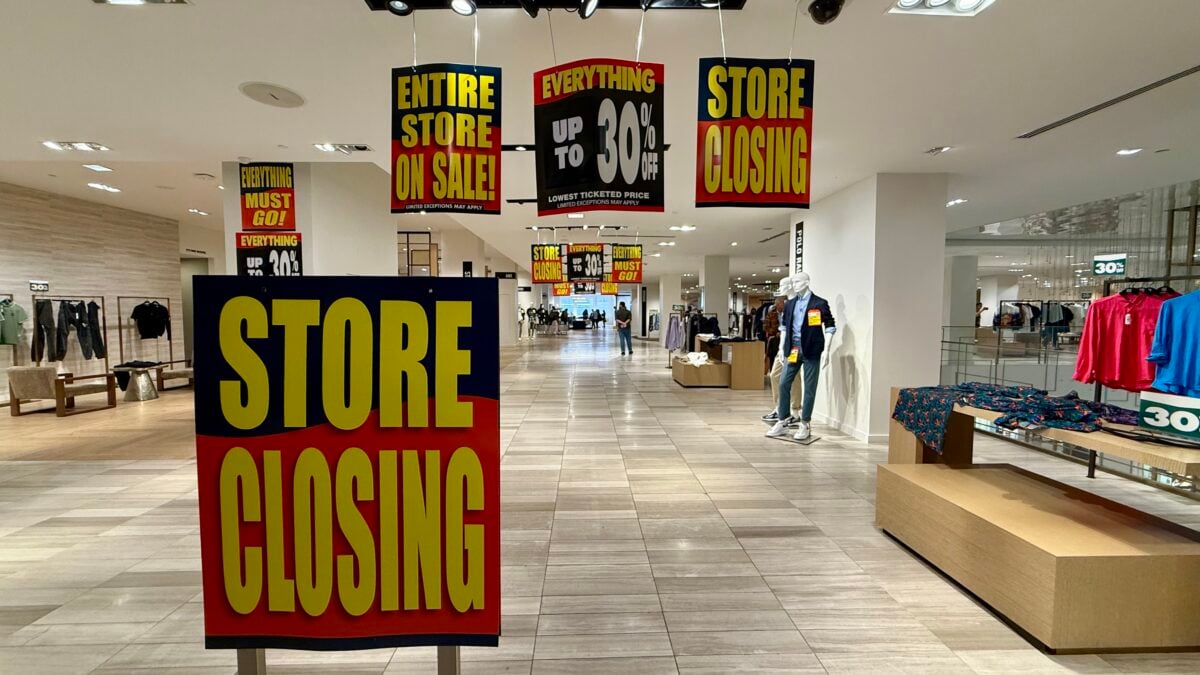
A diverse mix of tenants is beginning to fill former Hudson’s Bay locations, illustrating how the retail landscape is evolving.
Value-oriented retailers have been among the most active, with TJX Companies banners such as Winners, Marshalls, and HomeSense expanding into several suburban spaces.
At the same time, international entrants are targeting these locations as part of their Canadian expansion strategies. Greek retailer JUMBO S.A. is expected to enter the market in 2026, with former Hudson’s Bay locations under consideration for its large-format stores.
Experiential and lifestyle uses are also gaining traction. Some properties are being converted into fitness facilities such as Altea Active, as well as entertainment concepts including The Rec Room and emerging recreational uses such as pickleball courts.
Reimagining the Flagships
While suburban locations are being repositioned relatively quickly, flagship downtown properties present a more complex challenge.
In Montreal, a proposed $400 million redevelopment led by the James Bay Eeyou Corporation and JHD Immobilier aims to transform the former Sainte-Catherine Street store into a cultural and heritage destination focused on the history of the fur trade and Indigenous relations, including an Indigenous-led hotel and museum.
Other downtown flagships will see proposals following sales and strategy development. Such proposals highlight the growing importance of mixed-use and culturally driven redevelopment in revitalizing large-scale urban retail spaces.
The Challenges Ahead
Despite steady progress, the transition is not without hurdles.
Subdividing large-format department stores is both complex and costly. Retrofitting spaces originally designed for a single tenant requires extensive upgrades to building systems, with costs exceeding $150 per square foot in some cases.
There is also a significant time lag. While a majority of the space is expected to be committed by 2027, many locations may remain under construction or partially vacant until 2028 due to the scale of redevelopment required.
A Structural Reset for Canadian Retail
The collapse of Hudson’s Bay did not simply mark the failure of a single retailer. It signaled the end of the traditional department store model as a dominant force in Canadian retail.
In its place, a more fragmented and flexible ecosystem is emerging, defined by a mix of value retailers, international entrants, and experiential concepts. At the same time, the role of large anchor tenants is being redefined, with fewer single operators occupying massive footprints.
One year later, the physical presence of Hudson’s Bay may be fading, but its impact continues to shape how retailers, landlords, and consumers navigate the future of Canadian retail.
The stripes remain, but the Bay itself is gone.











As great a deal as the IP was for CTC to buy, I’ve gotta say nothing depresses me more than the idea of those Stripes products being sold at Canadian Tire. They feel out of context and as great as CT’s stores are they are never going to be the appropriate environment for softlines like that. I liken it to the traditional HNIC (Dolores Claman) theme — yes the rights went to TSN and it lives on there, but it just isn’t the same.
Totally feel the same! Glad to see the Stripes living on but they just don’t feel the same seeing them sitting in a CT store. Missing all the unique items and collabs the Stripes brand was becoming known for ex. the Levis x Stripes jean jacket, Converse x Stripe shoes. My favourite item from the Hudson’s Bay days was the throw pillows they sold that were made out of actual point blankets! So unique! HBC had put a lot of heart into the Stripes brand, and the Stripes at CT feels watered down. I think CT is missing something there. I’ve been disappointed to see that CT still isn’t selling the other colour variations of the point blanket (scarlet, millennium etc.) those are staples of the Stripes brand! There’s more to the Stripes brand than just the colour multistripe.
I see CT is bringing back the striped canoe this summer which is a great start. 😉 Hope they continue to bring back some of these more unique items.
Where is ruby liu and her department store concept? She just gave up? Makes no sense when she has 3 malls of her own.
Something was fishy about her trying to get those leases.
What evidence do you have to back up your assertion that “something was fishy”? Or is that just a wild, baseless claim?
The reason Liu didn’t proceed with the department store concept in the three malls she owns was because the concept depended on mass scale and nationwide reach. It’s the same reason why retailers generally don’t enter Canada with only one or two stores and leave it at that. Most chain retail concepts–and certainly something like Liu’s concept–require scale in order to succeed. For it to work, Liu needed to have the locations she was seeking at Square One, West Edmonton Mall, Southgate, Chinook Centre and other prime malls across the country. Simply doing a couple of stores in B.C. wouldn’t have sufficed.
Those who suggest that Liu should have opened a couple of stores anyway and then attempted to go nationwide a few years later don’t understand how retail works. There is no guarantee that the space she needed in malls in Toronto, Calgary, Edmonton, etc. would still be available by that time. The demise of HBC represented an opportunity to enter some of Canada’s most productive shopping centres all in one go. Without that, Liu’s concept didn’t work.
Have to agree something about CT selling the stripes is nice to see but doesn’t feel right. Nice they still get to live on, but feel like it could and should be so much more. CT could totally open Hudson’s Bay store (around the size of a Marks store), and sell striped merchandise, Hudson’s Bay brand towels, bedding, pillows, kitchen items. Like a mini Hudson’s Bay home store with trendy well designed products. I’d love to be able to shop at The Bay home departments again. Miss it so much and it was fun when The Bay carried the Anko products, I have so many items people ask me where I bought them at… I reply “The Bay” and everyone says they miss The Bay.
Some of the stores were profitable — and according to Bonnie Brooks — prior to the pandemic ‘many’ of the stores were profitable. The true “major” cities of the world (looking particularly at Europe and Asia) still have a booming department store (or whatever term you want to use) scene. There was an opening — although I fear that if it hasn’t closed — it soon will…to do something meaningful in some locations (namely Queen Street). No idea who (if anyone) ended up owning the Simpson’s trademark(s). Queen Street is owned by CF — and CF owns all of the T. Eaton Co. (IP) — just sayin…
All of that being said (and likely merely a dream on my part) — Simons is certainly talking up their year-over-year sales numbers — Park Royal came up in the announcement of their new locations at the Pacific Centre. No questions Simons has picked up a layer of HBC’s ‘better’ customer base.