

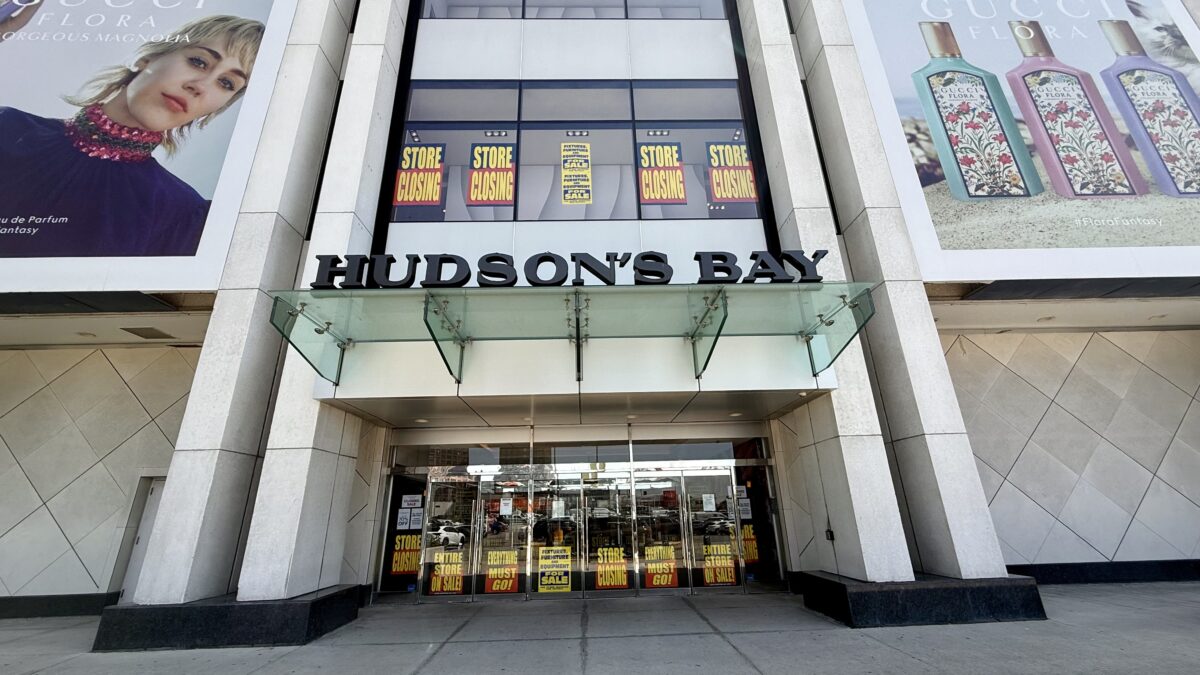
The Hudson’s Bay Company will lay off more than 8,300 employees—approximately 89 per cent of its workforce—by June 1, 2025. This mass layoff coincides with the closure of all remaining Hudson’s Bay retail stores across Canada, according to court documents filed as part of the company’s ongoing Companies’ Creditors Arrangement Act (CCAA) proceedings.
The layoffs and store closures are the result of a months-long liquidation process, which saw Hudson’s Bay sell off inventory, fixtures, and intellectual property in an attempt to pay down secured debts and exit its brick-and-mortar retail business. The company, which once operated 96 stores and four distribution centres nationwide, is in the final stages of winding down.
Most Stores Closed, But Some Staff Remain Briefly
According to an affidavit by Michael Culhane, Chief Operating Officer and Chief Financial Officer of Hudson’s Bay Company ULC, most store employees will be terminated by June 1, following the completion of the nationwide liquidation sale.
However, a smaller group of approximately 899 employees will remain on staff temporarily to assist with final sales of furniture, fixtures, and equipment (FF&E), as well as the closure of distribution centres, which are expected to cease operations by June 15, 2025. After that, just 118 employees will remain, primarily in corporate roles, to support the legal and administrative wrap-up of the company’s obligations under the CCAA.
“By June 1, 2025, the Company will have terminated approximately 8,347 of its employees,” reads the affidavit, adding that the remaining workers will be progressively let go as their responsibilities are completed.
Employees Face Uncertain Financial Recovery
While some laid-off employees may be eligible for compensation under the Wage Earner Protection Program Act (WEPPA), the process is complex and the outcomes uncertain. WEPPA allows eligible employees to receive limited payments—currently capped at $8,844.22—for unpaid wages, termination, and severance if their employer enters insolvency proceedings.
In its court filings, Hudson’s Bay is seeking a WEPPA declaration, a necessary legal step that would allow Service Canada to process claims on behalf of affected employees.
“The Applicants are seeking the WEPPA Declaration… to assist eligible terminated employees of the Applicants in accessing payments in respect of eligible wages under WEPPA in a timely manner,” the documents state.
However, a post from Ursel Phillips Fellows Hopkinson LLP, the court-appointed Employee Representative Counsel (ERC), cautions that workers may not receive the full amounts owed to them. “Given HBC’s significant amount of secured debt, it is not clear that employees will be able to recover any amounts owing to them directly from HBC,” the firm noted on its website.
The End of an Era
The wind-down of Hudson’s Bay marks the closure of one of the world’s oldest continually operating companies. Founded in 1670 as a fur trading enterprise, HBC evolved over centuries into a department store chain synonymous with Canadian retail. In recent years, however, the business struggled with declining foot traffic, mounting debt, underinvestment, and a shift in consumer preferences toward e-commerce.
In March 2025, Hudson’s Bay entered court-supervised restructuring under the Companies’ Creditors Arrangement Act, seeking to liquidate assets and settle with creditors. At the time, the company employed over 9,300 people across Canada.
Since then, the company has:
- Conducted a national liquidation sale at all locations,
- Disclaimed dozens of store and distribution centre leases,
- Sold its intellectual property portfolio, including its trademarks and brand assets, to Canadian Tire Corporation for over $30 million, and
- Entered into an agreement to assign 28 former store leases to Ruby Liu Commercial Investment Corp., which plans to launch a new modern department store concept.
What’s Next?
Once all stores are closed and the final employees are laid off, Hudson’s Bay’s corporate entity will continue to exist in a reduced form for the purpose of winding up affairs through the CCAA process. Any additional announcements regarding asset sales, lease transfers, or creditor payments are expected to be made through court filings.
The fate of Hudson’s Bay’s vast archive of historical documents and artifacts—many of which have been donated to the Manitoba Museum and the Hudson’s Bay Company Archives in Winnipeg—remains a symbol of the company’s long legacy.
For employees and Canadians watching the historic retailer fade from the landscape, the end of Hudson’s Bay’s retail operations is more than a business story—it’s the closure of a cultural institution.













The top photo is a reminder of another lamentable retail failure: Eaton’s, which vanished in 1999 after 130 years of business. What boggles the mind is that when Timothy Eaton opened his first store in 1869, the Hudson’s Bay Company was already 199 years old! It’s a real tragedy that HBC, one of the oldest companies in the world, couldn’t find a way to survive.