A potential strike is on the horizon at one of Canada’s most prominent academic publishing and retail institutions. Members of the Canadian Union of Public Employees (CUPE) Local 3261, representing workers at the University of Toronto Press (UTP) and the University of Toronto Bookstore, have requested a “no board” report from the Ontario Labour Relations Board following months of negotiations. The move signals that, if no agreement is reached, workers could be in a legal strike position in early November.
Union members voted overwhelmingly in favour of strike action, with more than 90 percent supporting the mandate. Negotiations between the union and management are set to continue on October 29, as both sides attempt to reach a deal before a potential disruption to one of Canada’s leading academic publishing and retail networks.
According to CUPE 3261 President Luke Daccord, the central issues reflect challenges faced by warehouse, distribution, and retail workers across the country. “The issues here are no different than we see for warehouse and distribution or retail workers anywhere: the rising cost of living, instability faced by part-time workers, the need for decent health benefits and sick days,” said Daccord. “Our goal is to reach a deal that provides more stability for the workers, allowing improved operations at UTP and the bookstore for publishers and retail customers.”
The local represents more than 100 employees across UTP’s warehouse and distribution operations and the University’s retail bookstore network. Members have cited rising living costs and job insecurity as key concerns, particularly for part-time staff who experience unpredictable scheduling and limited benefits.

The Role of the University of Toronto Press
Founded in 1901, the University of Toronto Press has grown into Canada’s largest scholarly publisher and one of the most influential university presses in North America. Operating as a nonprofit organization affiliated with the University of Toronto, UTP publishes over 250 new titles annually and maintains an active catalogue of more than 10,000 books and 80 academic journals.
Beyond publishing, UTP is also a cornerstone of Canada’s academic book distribution system. Its Distribution Division handles logistics for over 260 publishers worldwide, operating warehouses in Toronto and Buffalo and distributing approximately 4 million books each year. This extensive reach has made UTP a vital link in Canada’s publishing supply chain, connecting independent publishers to national and international markets.
In recent years, UTP has sought to modernize operations through its Strategic Plan 2023–2026, which emphasizes digital innovation and global expansion. The press also announced a new publishing partnership in 2025 with the Canadian Pharmacists Journal, beginning January 2026. A potential strike, however, could disrupt both publishing and distribution activities, delaying shipments and academic releases across Canada.

The University of Toronto Bookstore’s Retail Reach
The University of Toronto Bookstore, operating as the retail arm of UTP, serves a large and diverse academic community across the university’s three campuses: St. George, Mississauga, and Scarborough. Established alongside the press in 1901, the bookstore provides essential academic materials, technology products, and branded merchandise to more than 95,000 students and 15,000 faculty members.
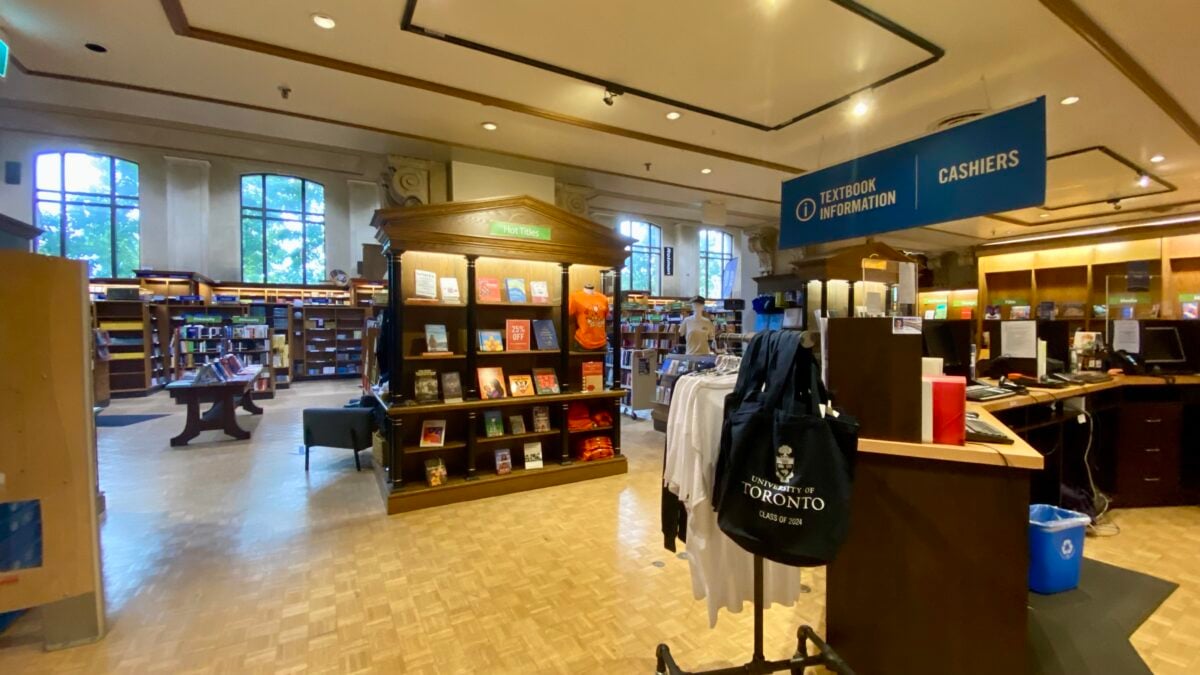
Located in the historic Koffler Student Services Building at St. George and College Streets, the flagship store is a familiar landmark to generations of students and alumni. The bookstore also collaborates with well-known brands, offering licensed University of Toronto apparel through partnerships with Nike, Roots, Adidas, and Under Armour.
Beyond retail, the bookstore has played an active cultural role within the university and the broader literary community, hosting events for local and national authors and participating in the Toronto International Festival of Authors. The impact of a strike could also affect campus events and revenue during the busy fall academic term.
Union Representation and Structure
CUPE 3261 represents more than 1,000 service, maintenance, hospitality, and retail workers across the University of Toronto’s campuses. Its membership includes caretakers, food service workers, groundskeepers, drivers, athletic staff, and the warehouse and bookstore employees at UTP.
The UTP and Bookstore bargaining units within CUPE 3261 are divided into three main groups: a full-time warehouse unit, a part-time warehouse unit, and a part-time retail unit. For the first time in several years, these groups coordinated bargaining efforts in 2025, seeking greater collective leverage. Although management declined to meet at a single bargaining table, the union maintained unified coordination across all units.
Union leaders argue that the issues under negotiation, particularly wage increases and benefit improvements, are essential to retaining experienced staff and maintaining consistent service levels. The workers’ demands include inflation-matching wage adjustments, improved job stability for part-time employees, expanded health coverage, and guaranteed sick days.

A Push for Fairer Working Conditions
Throughout 2025, CUPE 3261 has focused on achieving stronger employment standards across all sectors of university operations. The “Good Jobs at U of T” campaign, organized jointly with faculty and student associations, has called for an end to outsourcing and for more equitable treatment of university employees.
At the Press and Bookstore, these concerns have translated into calls for more predictable scheduling, stable hours, and recognition of the professional expertise required in both academic publishing and retail service. While some progress has been made in recent years through joint committees and local advocacy, union leaders argue that wage stagnation and part-time instability remain unresolved issues.
For many workers, the prospect of a strike represents a last resort. “Our members have shown strong support for this action, but our goal remains a fair agreement,” Daccord said. “We want to ensure that UTP and the bookstore can continue operating effectively while respecting the people who make that possible every day.”
Both sides have agreed to resume bargaining on October 29. With a legal strike position possible in early November, time remains for an agreement that addresses workers’ concerns and maintains continuity for publishers, authors, and students.