

Eddie Bauer’s Canadian store network is entering a decisive chapter, after the brand’s North American store operator filed for Chapter 11 protection in the U.S. on February 9, 2026. The process is designed to keep stores trading while the company seeks a buyer, but liquidation activity and parallel Canadian proceedings point to a controlled wind down if bids do not materialize.
For Canadian retailers and landlords, the headline is more about what happens when a legacy, mall-based fleet runs into structural headwinds. As retail expert David Ian Gray, an instructor in retail studies, sees it, this moment reflects the cumulative outcome of ownership choices, pricing strategy, and a category that has moved on.
“I don’t see this as another story of retail not working,” Gray said. “I saw this as inevitable at some point.”
The most important detail for Canadian readers is that the Chapter 11 filing centres on the store-operating entity, not the Eddie Bauer brand itself. In modern retail, those are often separate assets. The operating company can restructure, sell, or close stores, while the brand owner continues to license the name through other channels.

That separation matters because it changes what “Eddie Bauer exits Canada” could actually mean. The most visible version of the brand, the mall and outlet storefronts, may shrink sharply or disappear.
However, the label can persist through e-commerce and wholesale relationships if the brand owner and its partners choose to keep it in market.
Gray views that as the likely long-term shape of the business if the stores go dark. “Authentic Brands still owns the IP, so the brand doesn’t go away,” he said. “The store operation closes, and then you push the label into wholesale.”
How many stores are in Canada, and why the count is moving
Eddie Bauer remains a national, mall and outlet-focused chain with a meaningful presence in Ontario and stores across multiple provinces. The chain has about 30 stores in Canada, half in Ontario.
That footprint is now subject to a buyer search and liquidation dynamics. In plain terms, the Canadian fleet is in play. Some locations may be sold and continue operating under new ownership. Others may liquidate and close. A full exit from Canadian brick-and-mortar retail becomes the base-case outcome if the sale process fails to generate a viable bid.
David Ian Gray’s thesis: “harvest mode” ownership limits reinvention
Gray’s analysis focuses on the incentives created by licensing and private equity-backed structures. He describes these models as inherently focused on generating cash from brands for as long as possible. This suggests they will optimize smaller investments over shorter cycles rather than funding a long-term rebuild.
“Brands that are under private equity, or licensing, are often in what I’d call harvest mode,” Gray said. “Those models are designed to extend a life, not necessarily to reinvigorate a brand.”
He pointed to the licensing model as one where the brand owner’s job is to maximize returns on the intellectual property through partners that sell product, rather than operating a costly turnaround inside a large store network. “They are what they are,” he said. “Their structure doesn’t naturally lend itself to a deep brand reinvestment cycle.”
Gray’s central point is that, once a legacy brand becomes dependent on discounting and volume, the runway for a reset shortens. “Customers become hooked on the deals and buy the name on sale, no longer seeing the product itself as meaningful. Eventually you hit a point where it’s a pure harvest,” he said. “That harvest can be short or long, but you’re heading there.”
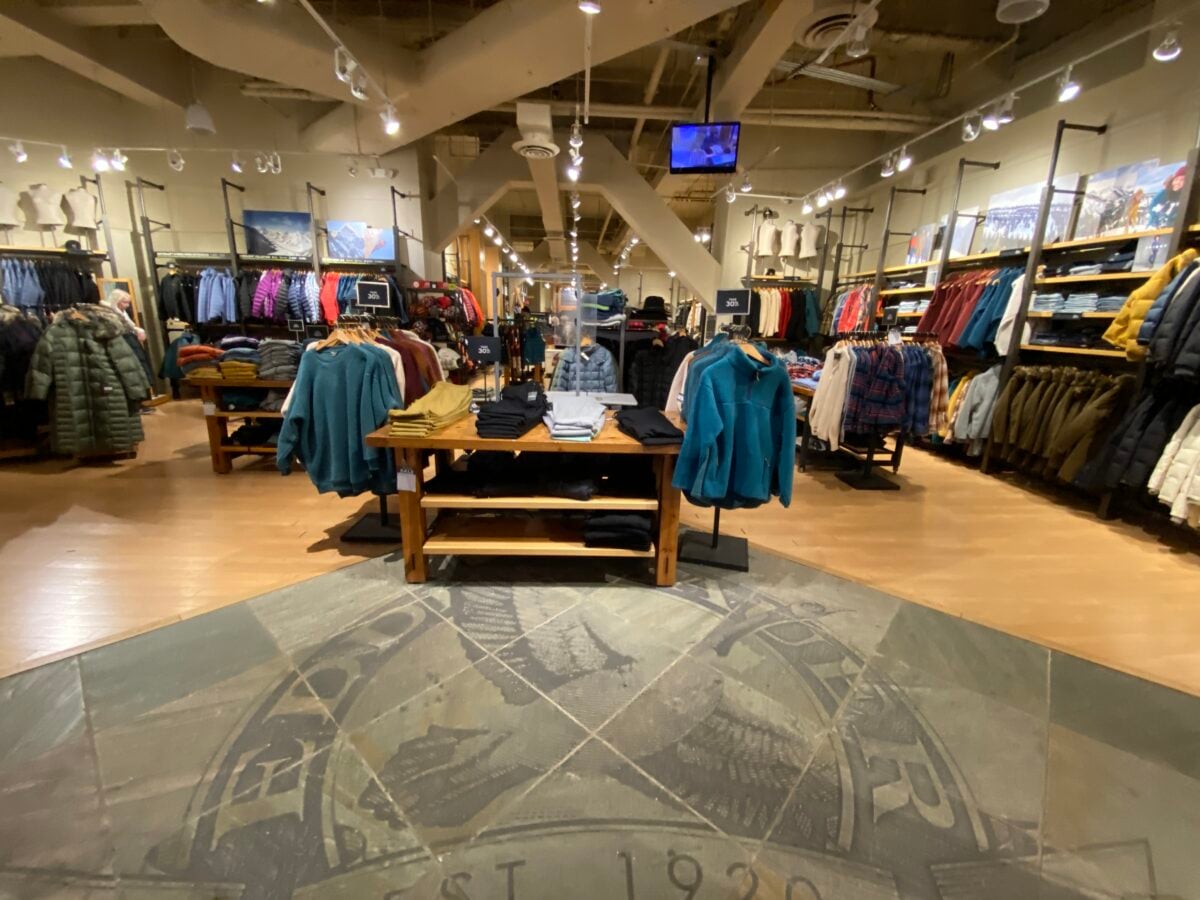
Eddie Bauer’s brand drift: from outdoor credibility to perpetual discounting
Eddie Bauer’s original identity was built on outdoor credibility and durable, technical product for its era. Gray says that positioning faded decades ago, replaced by a more general, mid-priced mall assortment that often relies on promotions to drive traffic.
“If you walk into an Eddie Bauer today, it’s always on sale,” Gray said. “There’s rarely a feeling of what’s new.”
He also described a cycle that many mall apparel chains fall into as traffic softens and costs rise.
“Perpetual discounting erodes brand value,” he said. “Then the economics push you to cut corners, make product cheaper, and chase sales, and it becomes very hard to reverse.”
That view is not about one season’s performance. It is about a strategy that can keep stores operating for years while steadily reducing the brand’s power to command full price. From Gray’s perspective, the Chapter 11 filing is simply the moment when a long-running decline becomes visible in court.
Why the economy and tariffs matter, but do not explain everything
Gray acknowledges that external conditions can accelerate a reckoning. He referenced broader headwinds, including consumer caution and tariff uncertainty, as factors that can shorten the timeline for marginal fleets.
“It might have happened later if the economy was stronger and there weren’t as many headwinds,” Gray said. “It could have gone on for years, but I don’t think it was ever going to rebound.”
That framing is useful for Canadian readers because it avoids the trap of treating the bankruptcy as a single-cause event. Inflation, weaker discretionary spending, and supply chain disruption can squeeze a mall-based apparel operator. Still, Gray argues those pressures land harder when a mid-market brand lacks product leadership and relies on promotions as its default proposition.
The most likely next step if stores close: wholesale and marketplace distribution
If the store operator cannot find a buyer, Eddie Bauer’s physical retail presence may collapse quickly. Gray’s view is that the label could then re-emerge through wholesale channels where the brand name still carries enough recognition to move units, even if the brand experience is no longer controlled by its own stores.
“I could see it going wholesale,” he said. “Costco is an obvious example, and there are other pathways.”
He also raised the possibility of the product showing up through outdoor and sporting retailers, even if it is not positioned as a premium technical competitor. “You could see it appear in places like MEC,” he said, emphasizing that this would be a channel decision rather than a return to brand leadership.
This is where the Eddie Bauer Canada bankruptcy story becomes more nuanced than a typical retailer liquidation. Canadian consumers might lose the stores but still see the label in-market, separated from its historic mall footprint.
The competitive set has changed, and the winners invest relentlessly
Gray contrasts Eddie Bauer’s trajectory with brands that have sustained momentum through long-term investment in product, innovation, and brand building. He pointed to outdoor labels that take a patient view and continue to fund development rather than leaning on discount dependency.
“Some of the leaders have maintained relentless focus on product quality, product innovation, and brand reinvestment,” Gray said. “They behave like they intend to be here for a long time.”
The implication is straightforward. If a brand stops being chosen for product and starts being chosen mainly for promotions, it becomes increasingly difficult to re-establish full-price credibility. That is not only a consumer perception issue. It is also an economic one. Promotions become baked into planning, and the cost structure adapts to a lower margin reality.
What a true reboot would look like, and why David doubts it happens here
Gray does see a theoretical path where Eddie Bauer could rebuild its proposition. His prescription resembles the kind of strategy that requires patience, capital, and tolerance for short-term pain.
“There is still a ghost of an iconic brand there,” he said. “But a real reboot would mean fewer stores, a tighter assortment, and a renewed focus on core icon products.”
He also stressed the necessity of breaking the discount cycle. “You would have to get out of the perpetual sale environment,” he said. “You’d have to accept some unprofitable years and invest in brand building again.”
However, he does not believe the current structure is built for that. “I can’t see them doing it,” he said. “They’re not designed to operate like that.”
That is the heart of Gray’s argument. In his view, licensing and private equity structures can keep a brand alive longer, but they often close the door on the kind of long-term reinvestment that creates a true second act.
Implications for Canadian malls: backfilling mid-size apparel boxes
If Eddie Bauer’s Canadian stores close, the impact will be uneven. Prime malls and high-traffic outlet centres may backfill quickly, especially if they can subdivide space or attract expanding value, athleisure, and off-price retailers. Secondary centres and smaller markets may feel the vacancy longer, particularly where demand is more limited.
In that sense, Eddie Bauer’s situation becomes a broader mall story. Mid-market apparel boxes have been under pressure for years, and every liquidation forces landlords to re-merchandise space in a market where tenants increasingly want either smaller footprints or experiential buildouts that are more expensive to execute.
For employees, the store count implies several hundred front-line roles at risk in Canada, plus field management positions. Even when stores remain open during a restructuring, uncertainty often leads to reduced hours, uneven inventory flow, and retention challenges. In many cases, the human impact arrives before the final court orders do.
A balanced view on private equity and licensing, without romance
Gray is careful about how he critiques private equity. He acknowledges it can provide exits for owners, keep brands alive for consumers who still want access, and extend employment for some staff.
“I’ve been very critical of some private equity,” he said. “But the alternative is sometimes an ownership group can’t make it happen, and no one else steps in.”
His point is that these models have predictable behaviour. “They do what they do,” he said. “We just need to understand the implications.”
That may be the most useful takeaway for Canadian retail readers. Whether the player is private equity or a licensing platform, the core question is not morality. It is incentives. What time horizon is the owner operating on, and what kind of investment is realistic under that structure?











We shopped at Eddie Bauer for years. The clothing was classic, suitable for work and casual, durable and appealed to a broad range of ages and sizes. Customer service was excellent and they stood behind their products.
Over time, the quality decreased. For example, t shirt material was thinner. Certain sizes were only available on line and didn’t fit quite the same. The classic styles I loved disappeared. Over time, stores closed in Calgary and our nearest store closed a few years ago.
We stopped shopping Eddie Bauer only buying the odd item online.
I’m sorry to see the loss of Eddie Bauer stores. If only, they had kept their original model.
“Always discounted” because the prices shot way, way up. They were always a bit premium, but then they got stupid with pricing and probably found no one bought anything unless it was on sale. I only ever look at the clearance section now.
It’s unfortunate that they let their brand dwindle, but there are many other Canadian alternatives at a time when prioritizing Canada-based companies really matters. Eddie Bauer’s decline has been a long one.