

A new redevelopment proposal for the former Hudson’s Bay Centre at the northeast corner of Yonge and Bloor in Toronto signals a significant shift in strategy for one of Canada’s most prominent retail sites. Brookfield Properties has filed plans that would see retail space concentrated at grade while introducing self-storage uses on the upper levels of the existing podium building.
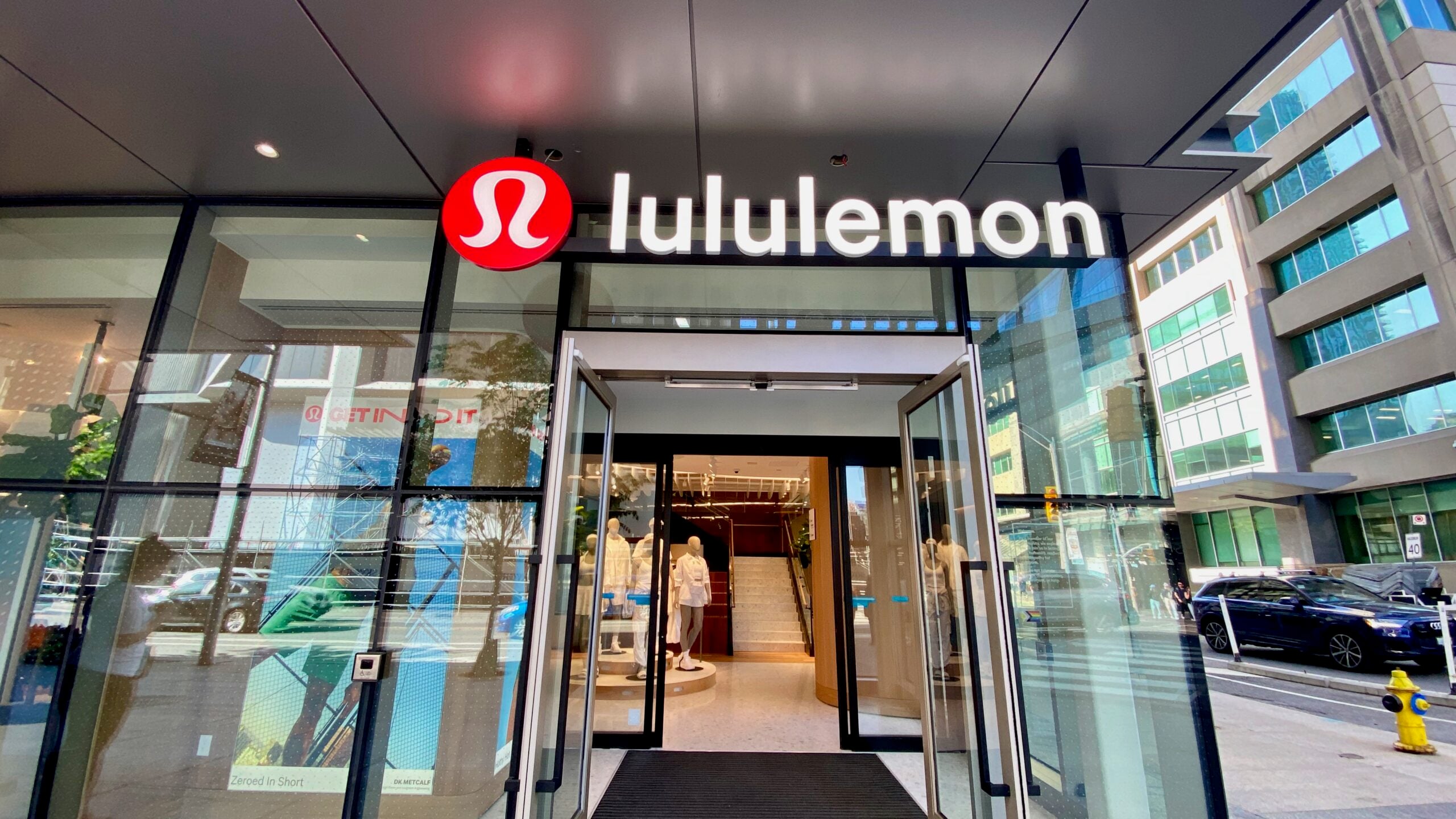
Located at one of the busiest and most high-profile intersections in the country, the site sits on the edge of Toronto’s luxury retail corridor, anchored by developments including the W Toronto within the complex. The surrounding intersection is undergoing a broader transformation, with major projects and flagship retail on all four corners, including The One under construction, 1 Bloor East across the street, and a nearby flagship for Lululemon. Against this backdrop, the introduction of a service-oriented use such as self-storage represents an unconventional approach for such a prominent, transit-connected location.
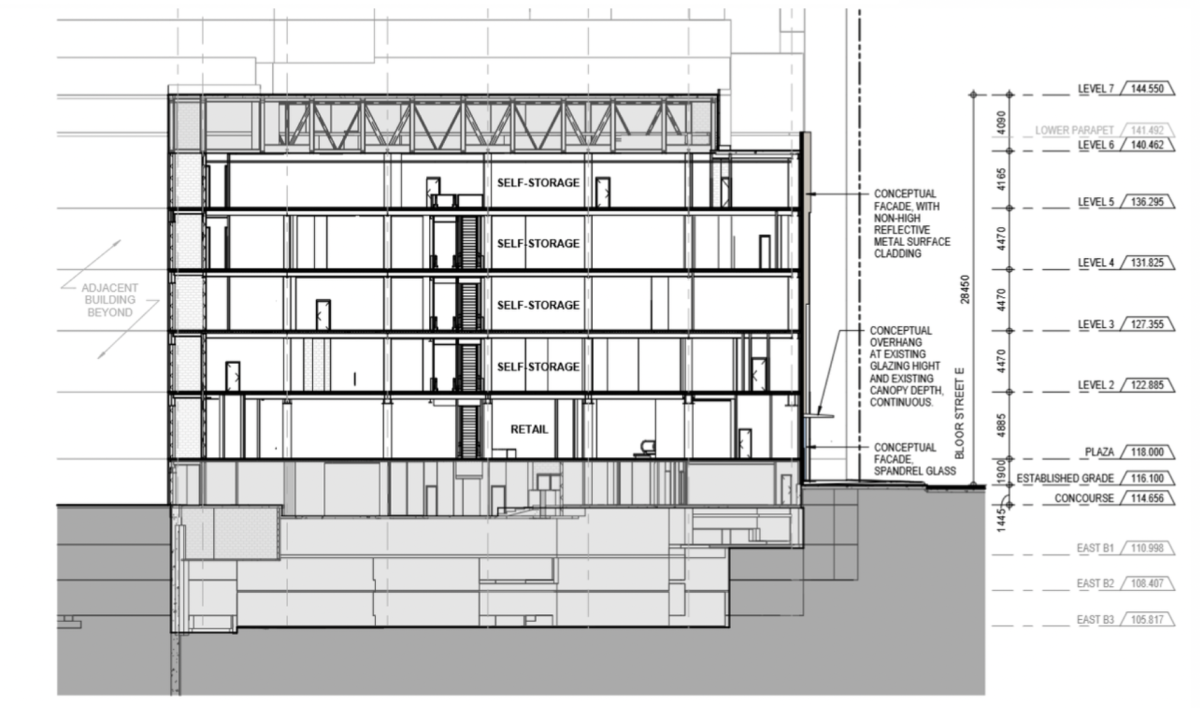
The proposal marks a notable departure from earlier concepts for the site, which had focused on a mix of multi-tenant retail and office space. Instead, the revised plan would reduce retail to the ground floor and concourse levels, while converting floors two through five into self-storage, utilizing the building’s existing structure and infrastructure.
Retail Insider was notified of this information via a member at the Urban Toronto Forum.
Details of the Proposed Redevelopment
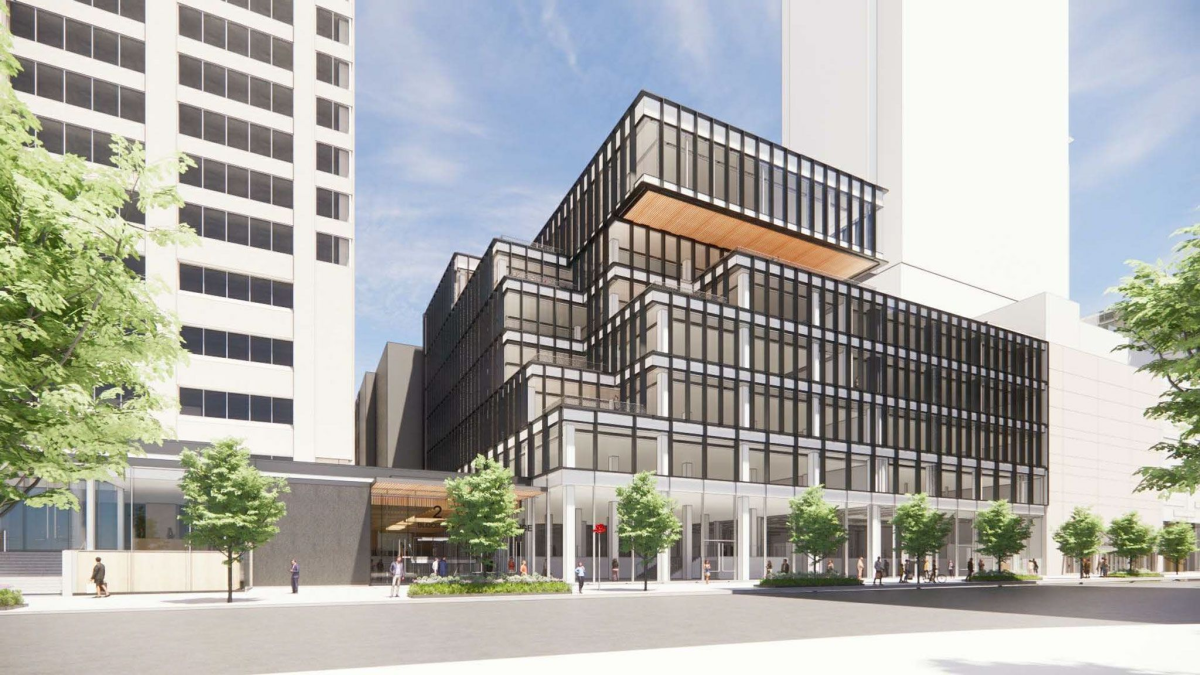
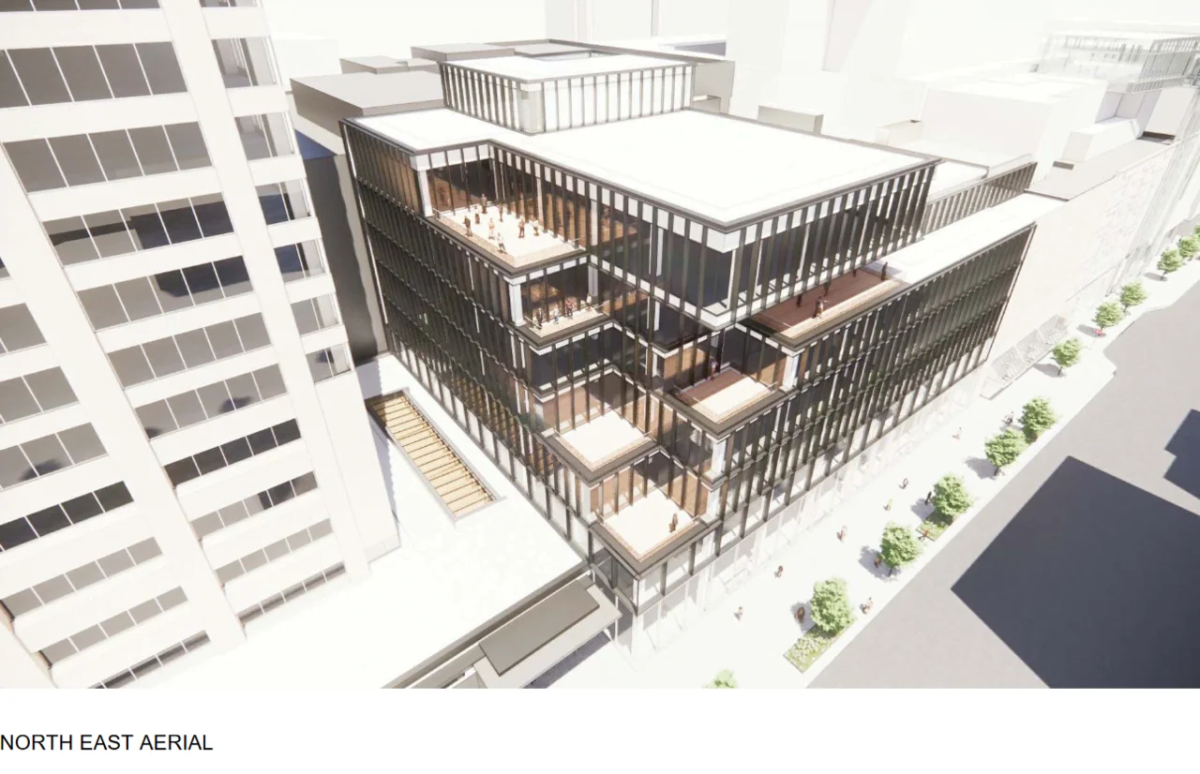
According to planning materials submitted to the City of Toronto, the proposal would retrofit the existing podium at 2 and 90 Bloor Street East without increasing total gross floor area. Plans call for approximately 20,096 square metres (216,311 square feet) of self-storage space across levels two through five, alongside 8,330 square metres (89,663 square feet) of retail space at grade and within the concourse.
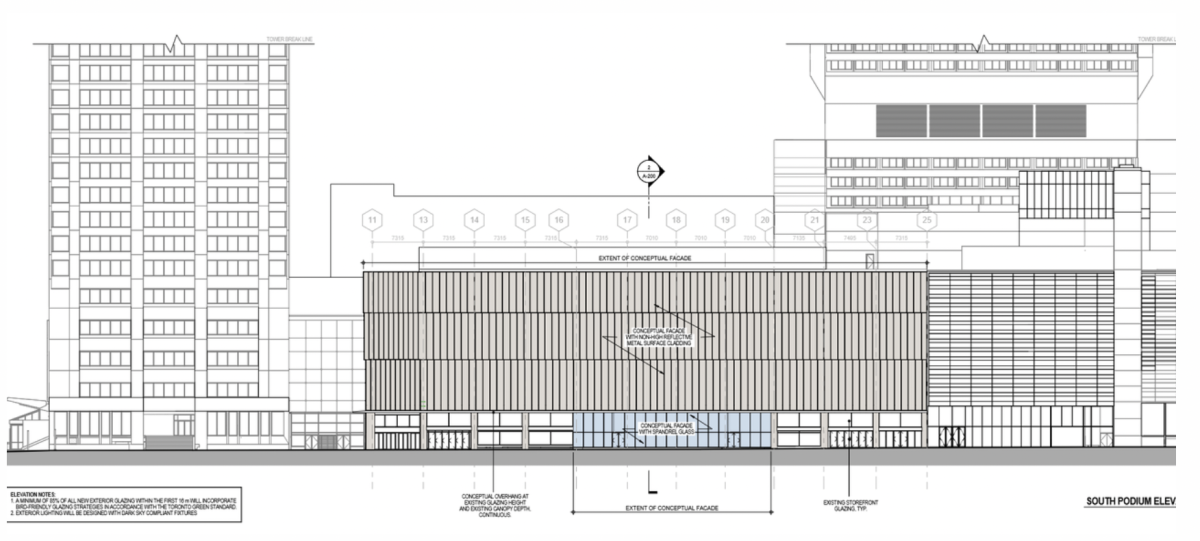
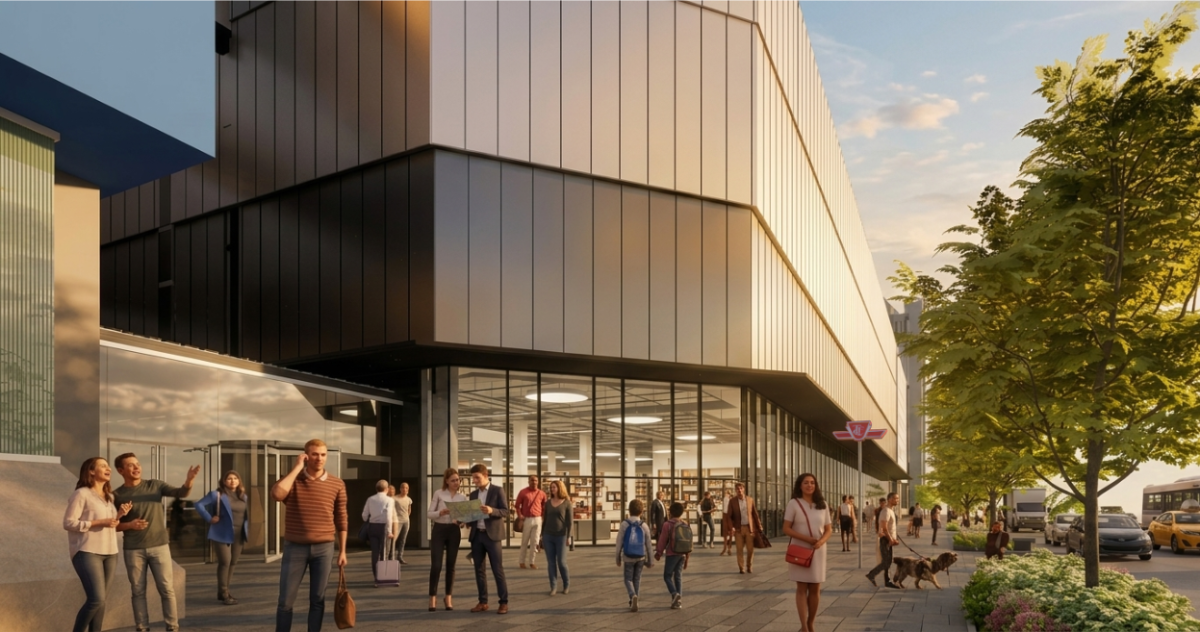
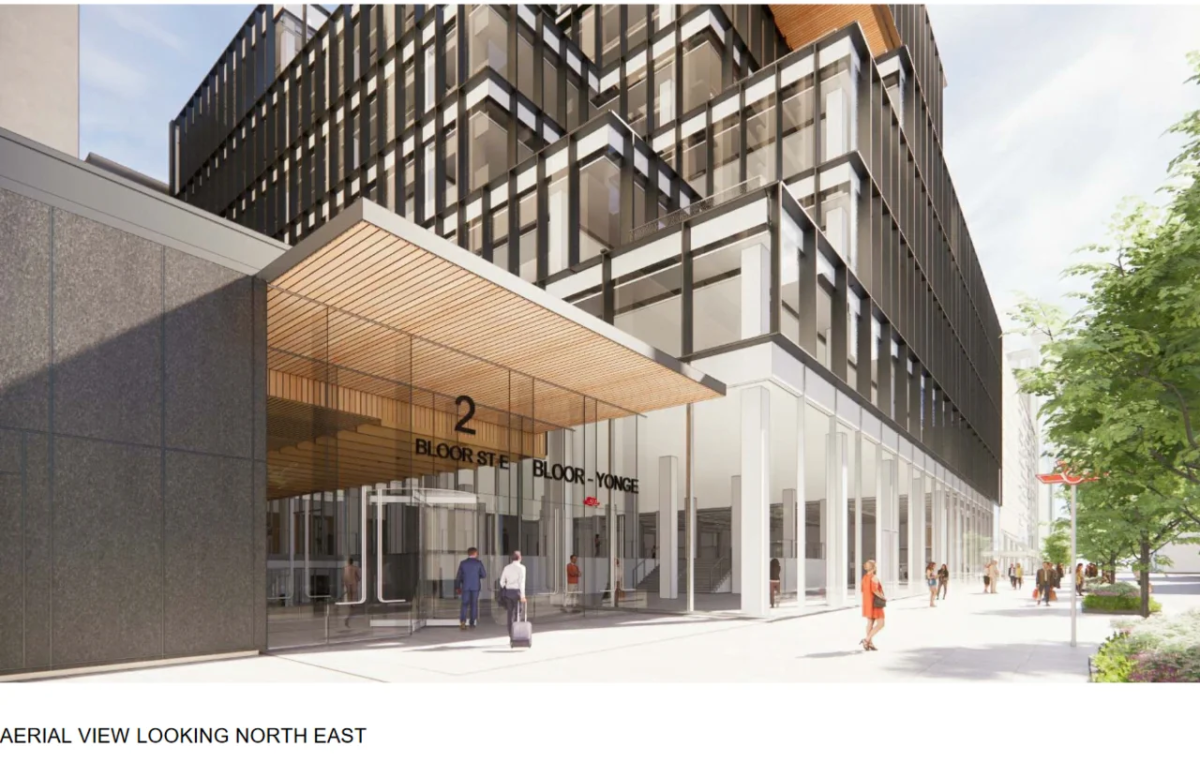
The development would make use of existing loading and parking infrastructure accessed via Asquith Avenue, including 11 loading spaces and more than 500 parking stalls. Exterior updates are also proposed, including a recladding of the façade and improvements to the ground floor interface along Bloor Street East, aimed at modernizing the building and enhancing its street-level presence.
Architect Adamson Associates is leading the design, which seeks to reposition the aging structure while accommodating a markedly different mix of uses than originally envisioned.
A Shift Driven by Market Realities
The updated proposal reflects the challenges associated with repositioning large-format retail space in dense urban markets. Since the closure of the Hudson’s Bay store at this location in 2022, the site has remained without a major anchor tenant, highlighting the difficulty of backfilling expansive, windowless retail footprints that were originally designed for department store use.
At the same time, the surrounding area has experienced a surge in residential development, including thousands of new condominium units in nearby projects. Many of these units offer limited in-suite storage, creating demand for supplementary space within close proximity to where residents live.
The building’s integration with the Bloor-Yonge subway station, which is currently undergoing a major expansion, also adds complexity to redevelopment efforts. Large-scale structural changes or intensification may be constrained by the need to coordinate with transit infrastructure, making lighter, service-oriented uses more feasible in the near term.
A few months ago, there had also been speculation that Canadian Tire could temporarily occupy part of the building, potentially relocating from its existing store a few blocks north during a planned redevelopment of that site. It’s not clear if this could move forward given the size of the proposed retail space, underscoring the range of uses that have been explored for the property as ownership works to reposition a large and complex urban asset.
Implications for Retail and Urban Planning
While the proposal remains subject to approvals, it underscores a broader shift in how landlords are approaching legacy retail assets. The introduction of self-storage in a high-profile downtown location highlights a growing willingness to consider unconventional uses where traditional retail demand has proven insufficient.
At the same time, the plan raises questions about land use optimization in prime urban corridors. The Yonge and Bloor intersection has long been associated with flagship retail and high-density commercial activity. A move toward a lower-intensity, inward-facing use on upper levels represents a departure from that historical pattern, even as efforts are made to maintain an active retail presence at grade.
It remains unclear whether the proposed self-storage use is intended as a long-term component of the redevelopment or an interim strategy, though the approach reflects a pragmatic response to current market conditions.
A Potential Signal for Other Sites
The proposal may also point to a wider range of uses being considered for former department store spaces across Canada. Following the broader exit of Hudson’s Bay from downtown locations in 2025, millions of square feet of large-format retail space remain in transition.
Across the country, landlords continue to face challenges in leasing 100,000-plus square foot retail boxes that were designed for a different era of department store retail. While each site presents unique conditions, the inclusion of self-storage in this redevelopment suggests that service-based and non-traditional uses may play a growing role in stabilizing these assets.
From Retail Landmark to Reimagined Space
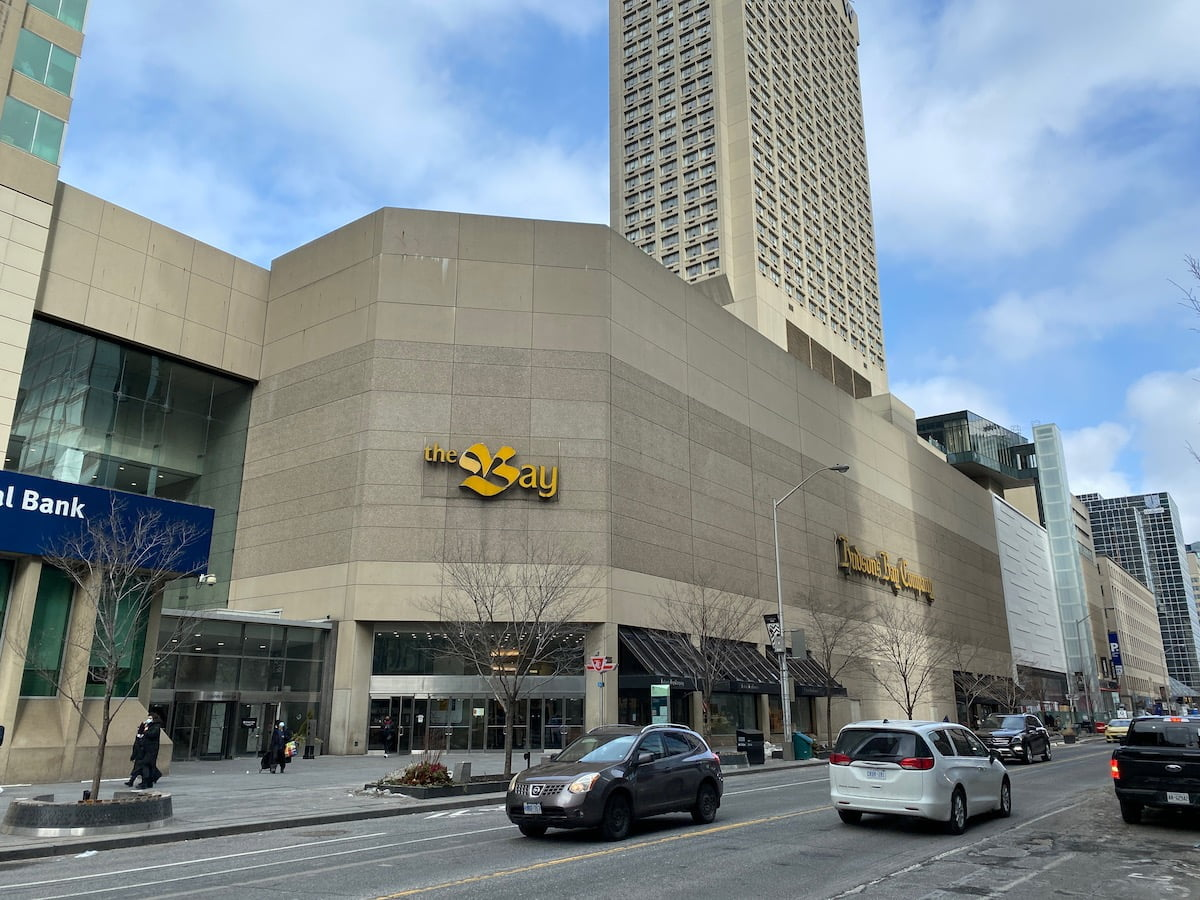
When it opened in 1974, the Hudson’s Bay Centre represented a major evolution in Toronto’s retail landscape, integrating a department store, office tower, hotel, and underground concourse directly with the city’s busiest subway interchange. Over time, however, the building’s inward-facing design and “bunker” aesthetic became a challenge in a market that increasingly values transparency and street-level engagement.
The closure of the 340,000 square foot Hudson’s Bay store in 2022 marked the end of an era for the site, and the company’s full shutdown of its department store operations in 2025 accelerated the need for redevelopment strategies across its former footprint.
Brookfield’s latest proposal represents one such approach, balancing the need to reactivate retail at grade while introducing alternative uses above. The evolution of this site, from a flagship retail destination to a candidate for adaptive reuse, reflects the broader transformation underway in how legacy retail space is being reimagined in Canadian cities.











Checks calendar nope it’s not April Fools Day!? This seems like the most insane and ridiculous idea I have heard in a long time. The most prestigious shipping street in Canada and they want to make it self storage!??? The entire ugly bunker needs to be torn down and rebuilt into something but not this. Not keeping the existing structure and definitely not making self storage. Wow just wow……
LOL, totally agree!