New multi-year data from ICSC points to a clear shift in Canada’s shopping centre landscape. Between 2023 and 2025, retail performance has become increasingly concentrated among a small group of dominant assets, while many mid-tier properties have seen more modest gains or limited movement.
Retail Insider has independently tracked Canadian shopping centre sales per square foot for several years prior to the COVID-19 pandemic, including through a partnership with the Retail Council of Canada. That research provided a consistent benchmark for retail productivity across the country.
However, the study was paused in 2020 as pandemic-related lockdowns disrupted normal retail activity. Shopping centre closures occurred at different times and durations across provinces, making direct comparisons between properties inconsistent and, in some cases, misleading.
As a result, the 2023 to 2025 data represents a more stable and comparable period for analyzing post-pandemic retail performance trends.
Top-Tier Assets Show Consistent Strength
At the top of the market, Yorkdale Shopping Centre continues to set the benchmark. The centre recorded sales of $2,402 per square foot in 2023, declined to $2,301 in 2024, and rebounded to $2,368 in 2025.
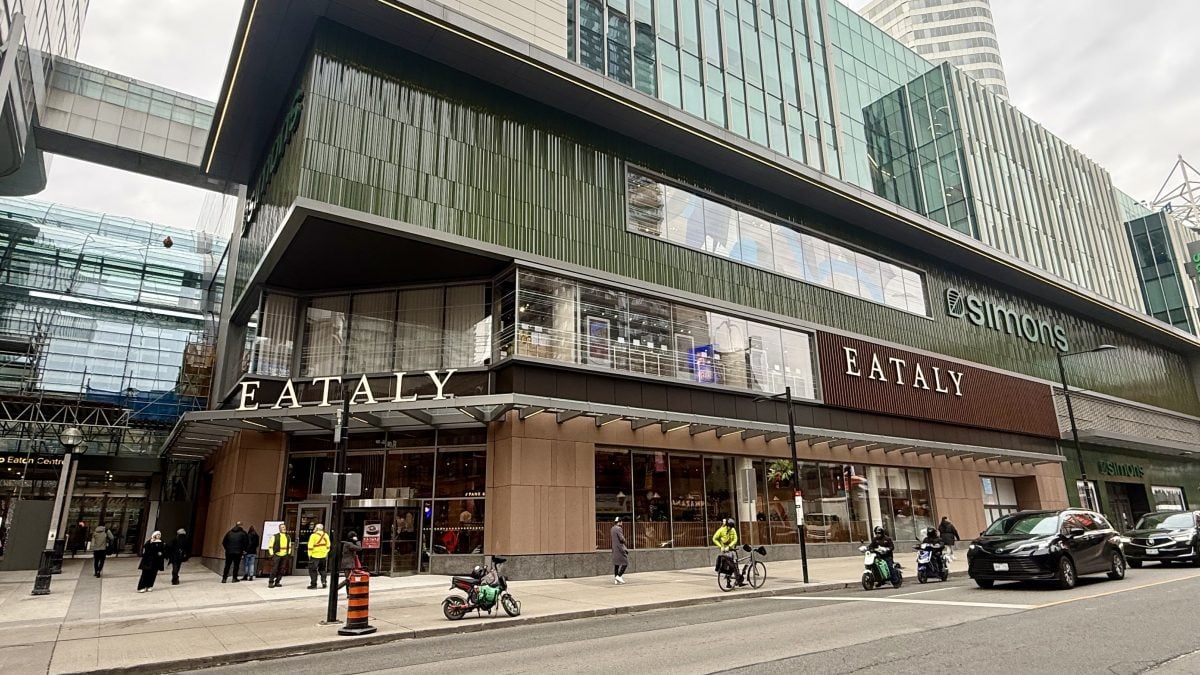
Other leading centres have demonstrated steady upward momentum. CF Toronto Eaton Centre increased from $1,457 per square foot in 2023 to $1,500 in 2024, before rising to $1,642 in 2025. Similarly, CF Pacific Centre climbed from $1,324 to $1,454 and then to $1,593 over the same period.
These patterns point to sustained demand for highly productive retail environments in major urban markets. Centres with strong luxury representation, international brands, and high levels of foot traffic continue to outperform.
The $1,000 Per Square Foot Divide Becomes Clearer
The data highlights the growing importance of the $1,000 per square foot threshold. In 2023, a significant number of Canadian shopping centres clustered around the $900 to $1,100 range, suggesting relatively broad-based recovery following the pandemic period.
By 2025, that middle band appears to be thinning. A larger group of top-tier centres has moved well above $1,300 per square foot, while many others remain below $700. The result is a more polarized distribution of retail performance across the country.
This shift suggests that tenant productivity is increasingly concentrated in dominant, high-traffic centres, reinforcing their competitive advantage.
A Widening Gap Across the Sector
The contrast between top and lower-performing assets has become more pronounced over the three-year period. Leading centres now achieve between approximately $1,300 and over $2,300 per square foot, while a large number of properties fall significantly below that range, often under $700.
This widening gap reflects structural changes within the retail industry. Retailers are prioritizing fewer, higher-performing locations, while consumers are increasingly gravitating toward destinations that offer a stronger mix of brands, dining, and experiences.
As a result, top-tier malls continue to attract investment and premium tenants, while mid-tier assets face greater pressure to differentiate.
Case Studies Highlight Diverging Trajectories
A closer look at individual properties illustrates how performance trends are diverging. CF Toronto Eaton Centre and CF Pacific Centre have shown consistent upward growth over the three-year period, reinforcing their status as dominant urban retail destinations.
By contrast, some centres have experienced more variability. CF Sherway Gardens has seen fluctuations in sales productivity, reflecting how even well-established assets can be impacted by tenant changes, redevelopment activity, or shifting consumer patterns.
Regional Strength Reinforces Market Leadership
Toronto continues to dominate the upper tier of Canadian shopping centre performance, with multiple Greater Toronto Area properties consistently ranking among the country’s most productive. In addition to Yorkdale, centres such as Square One Shopping Centre and CF Sherway Gardens remain key players.
Western Canada has also demonstrated strength. CF Chinook Centre has posted steady gains, while Vancouver-area centres continue to rank among the country’s top performers.
These patterns suggest that top-performing retail assets in major metropolitan markets are benefiting from both population growth and sustained consumer demand.
Data Scope and Limitations
It should be noted that not all major Canadian shopping centres report sales per square foot through the International Council of Shopping Centers. Notable properties such as West Edmonton Mall, Park Royal, Toronto Premium Outlets, and McArthurGlen Designer Outlet Vancouver Airport are not included in the dataset, despite being widely regarded as among the country’s highest-performing retail assets.
A More Concentrated Retail Landscape
Taken together, the 2023 to 2025 data points to a clear evolution in Canada’s retail landscape. Rather than broad-based growth across all shopping centres, performance is increasingly concentrated among a relatively small number of dominant properties.
This trend has important implications for landlords, retailers, and investors. High-performing centres are likely to continue attracting capital, premium tenants, and redevelopment activity, while lower-performing assets may face increasing pressure to reposition through mixed-use development or alternative uses.