Canadian Tire Corporation is preparing to accelerate the expansion of SportChek’s Destination Sport format across Canada, with former department-store spaces emerging as a source of new real-estate opportunities as the sporting-goods banner continues to post strong sales growth.
The company said alongside its second-quarter results that it is working with landlords to roll out additional Destination Sport stores during the second half of 2026, with more new-concept locations expected in 2027. During Thursday’s earnings call, Canadian Tire executives specifically pointed to vacancies created by the collapse of Hudson’s Bay as potential opportunities for larger SportChek stores, as well as for the newer Mark’s BBB format.
The expansion comes as SportChek posts the strongest comparable-sales growth among Canadian Tire’s major retail banners. Comparable sales increased 8.0% in the second quarter, compared with a 4.2% increase at Mark’s and a 0.8% decline at Canadian Tire Retail. SportChek’s result marked its eighth consecutive quarter of comparable sales growth.
World Cup merchandise was a major contributor, accounting for roughly half of SportChek’s comparable-sales increase. Montreal Canadiens fanwear also contributed during the quarter, while athletic footwear performed well.
The World Cup accelerated momentum that was already evident at SportChek rather than creating it. The banner entered Q2 having posted seven consecutive quarters of comparable sales growth, including a 3.3% increase in the first quarter of 2026. SportChek comparable sales increased 6.2% for full-year 2025, following declines in both 2023 and 2024, illustrating a broader improvement in the banner’s performance.
Stifel analyst Martin Landry pointed to SportChek’s performance as one of the highlights of Canadian Tire’s second quarter, along with continued momentum at Mark’s and accelerating e-commerce growth. Landry said investments in new concepts and store refreshes appear to be gaining traction with consumers.
Destination Sport Moves Into Its Next Phase
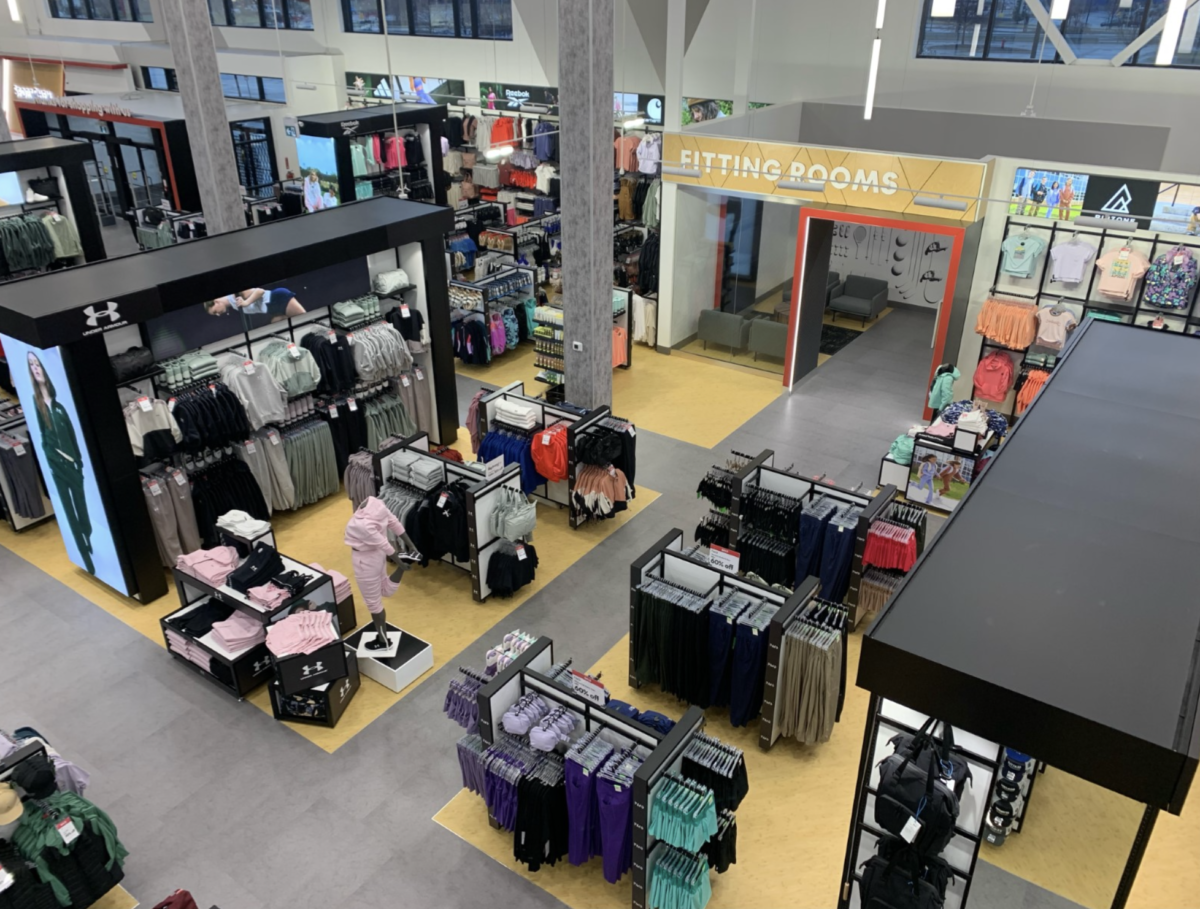
Destination Sport represents a significant evolution of the conventional SportChek store, with larger assortments, sport-specific merchandising areas, expanded footwear presentations, enhanced service offerings and greater integration of digital tools throughout the shopping experience.
SportChek initially introduced the concept in Moncton and Etobicoke, followed by locations in Windsor, Ontario, and Richmond, British Columbia. Canadian Tire executives have previously said the early Destination Sport stores were materially outperforming the locations they replaced, helping support plans for a wider rollout.
The next phase appears likely to include a combination of renovations, relocations and new stores as suitable larger-format space becomes available. Canadian Tire CFO Darren Myers told analysts that vacancies resulting from Hudson’s Bay exits are creating attractive future opportunities for both Destination Sport and the Mark’s BBB concept. The company’s broader store refresh program also remains active, with 30 projects completed during the first half of 2026 and more expected before year-end.
Canadian Tire President and CEO Greg Hicks later said the company has accelerated its ambitions for modern SportChek and Mark’s stores and that its real-estate team is actively engaged on potential sites, including some former HBC leases. Canadian Tire has not identified which former Hudson’s Bay locations could ultimately house SportChek stores, and the comments do not suggest that SportChek would necessarily occupy entire former department-store boxes.
CF Chinook Shows How Former Department Stores Can Be Reused
CF Chinook Centre in Calgary offers an example of how large-format SportChek expansion can fit into the redevelopment of a former department-store anchor. SportChek is preparing to consolidate its existing presence at the mall into a new Destination Sport store occupying the entire second floor of the former Nordstrom space, spanning almost 70,000 square feet. Expected to open in 2027, the Calgary store is set to feature expanded assortments, sport-focused zones, upgraded services and enhanced brand experiences.
The former Nordstrom space is meanwhile being divided for multiple retailers. Retail Insider has observed construction hoarding at CF Chinook Centre identifying Old Navy as an incoming tenant within part of the former department store’s main floor.
The configuration demonstrates how Destination Sport can become a major component of a department-store redevelopment without SportChek needing the entire former anchor. A large floor plate can accommodate the deeper assortments and additional services planned for the format, while other portions of the building can be divided for separate tenants.
That example is particularly relevant as landlords across Canada determine how to reposition former Hudson’s Bay locations. The exits of Nordstrom and Hudson’s Bay have created successive waves of large-format vacancies at Canadian shopping centres, with many of those spaces too large for most contemporary retailers to occupy on their own.
Subdivision can create substantially larger-than-average mall units for retailers that still want significant physical footprints. For SportChek, that can mean access to prominent locations and floor plates capable of supporting a more expansive store than would typically be available within an existing mall’s inline retail mix.
Canadian Tire’s comments make clear that former HBC properties are now part of that real-estate discussion. Management is directly identifying Hudson’s Bay vacancies as opportunities for Destination Sport, although it has not announced specific former Bay locations for the format.
CF Chinook provides a useful illustration of how such a redevelopment could work, even though the former anchor there was Nordstrom rather than Hudson’s Bay. A large sporting-goods store can occupy a substantial portion of a former department store while other retailers take the remaining space, allowing landlords to replace one very large tenant with several new uses.
The opportunity also comes as SportChek is performing well enough for Canadian Tire to pursue expansion from a position of strength. Management said new and modern SportChek and Mark’s stores are outpacing the company’s broader retail sales, while Triangle members are increasingly shopping across its different banners.
SportChek Growth Extends Beyond New Stores
Physical expansion is only one part of Canadian Tire’s plans for SportChek. The company is also trying to expose the banner to more customers by increasingly connecting the digital businesses of Canadian Tire, SportChek and Mark’s.
Consumers visiting one of the banners online can now move more easily between the others, an early step in Canadian Tire’s broader digital harmonization strategy. Hicks said the company is already seeing Canadian Tire’s much larger web volumes generate customer traffic for both SportChek and Mark’s.
E-commerce continues to grow substantially faster than bricks-and-mortar sales across the company. Comparable e-commerce sales increased 12% during the quarter, including 14% growth at the Canadian Tire banner, while the company has also been building its online-only assortment and expanding fulfillment options. Stifel noted that Canadian Tire has improved its ability to direct website traffic toward SportChek and Mark’s, while average e-commerce order values across the business are now almost double those generated through bricks-and-mortar shopping.
The existing cross-banner links are only the first stage. Canadian Tire ultimately intends to integrate search, cart and payment functions across its retail banners, allowing customers to navigate a much larger combined assortment through a more connected digital experience. Hicks specifically highlighted sporting goods as an area where the breadth of Canadian Tire’s various banners could become more apparent once those systems are integrated.
SportChek and Mark’s could be significant beneficiaries because both operate smaller networks than the Canadian Tire banner. Greater integration gives those businesses access to customer traffic generated elsewhere within the company rather than requiring every shopping journey to begin directly with SportChek.
Triangle reinforces that strategy. Management said its loyalty members continued to outperform non-members on sales, spending and trips during the second quarter, while personalized promotions and a growing network of Triangle partnerships contributed to higher loyalty sales. For SportChek, the combination of larger stores, cross-banner digital traffic and the Triangle ecosystem gives Canadian Tire several ways to increase the banner’s reach beyond simply adding locations.
A Larger Role for SportChek
The availability of former department-store space comes at an advantageous point in SportChek’s development. Destination Sport requires considerably more room than a conventional mall unit, while the restructuring of former Nordstrom and Hudson’s Bay anchors is producing the kind of larger floor plates that can accommodate the format.
The real-estate opportunity is arriving alongside Canadian Tire’s broader push to operate its banners as a more integrated retail system. SportChek’s physical expansion can increasingly be supported by Triangle, cross-banner shopping and digital infrastructure designed to make more of Canadian Tire’s combined assortment visible to customers.
With additional Destination Sport locations planned for the second half of 2026 and more new-concept stores expected in 2027, the concept is moving beyond its initial rollout. Canadian Tire is now looking for the locations to support that growth, and some of the large spaces left behind by Canada’s former department-store anchors are firmly in the mix.