A Toronto packaging manufacturer compressed nearly three months of production into three weeks this summer as it raced to move Canadian-made shopping bags across the U.S. border before a new 50 per cent tariff threatened its largest market.
Gather Packaging, the Canadian manufacturing operation associated with longtime retail packaging supplier Progress Luv2Pak, shifted its Toronto-area factory into around-the-clock production after learning its paper shopping bags would be caught by the new U.S. tariff measures. The company contacted customers, brought in additional workers and accelerated orders already scheduled for the upcoming holiday season.
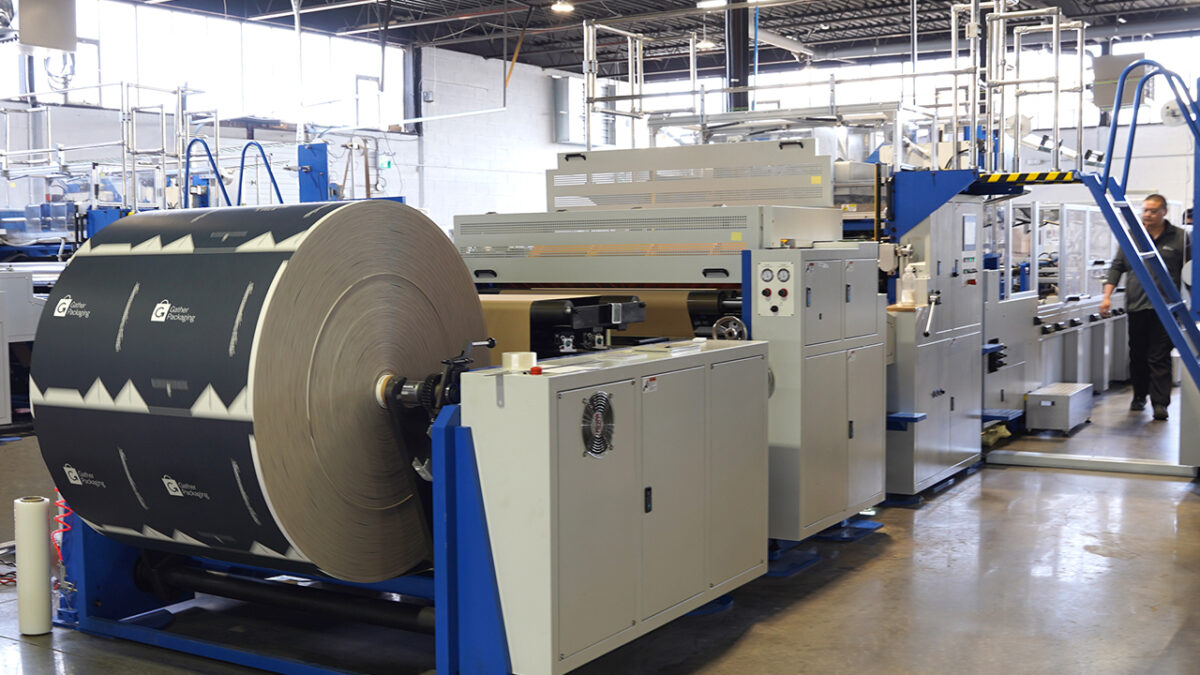
Its plant, which historically operated roughly 12-hour shifts five days a week, began running 24 hours a day, six or seven days a week.
“We ran about two and a half, three months worth of production in the span of three weeks,” said Ben Hertzman, whose family owns the business.
Gather managed to move affected U.S. customer shipments across the border by August 14. The production sprint was especially important given the company’s exposure to the American market: Hertzman told Retail Insider that more than 75 per cent of the plant’s production volume had been going to the United States.
The company now has to determine how much of that business can continue if the tariffs remain, and whether additional Canadian orders can help fill the resulting production capacity.

U.S. Market Drives Majority of Production
Gather built its Canadian factory several years ago to manufacture premium paper shopping bags domestically. As the operation grew, the United States became its largest market.
Hertzman said Canadian-made bags had been able to enter the U.S. duty- and tariff-free under USMCA. That helped Gather develop business with major retailers including Abercrombie & Fitch, Victoria’s Secret and Bath & Body Works.
Those companies have stores in Canada, but their much larger U.S. networks meant significant packaging requirements south of the border. Gather already had substantial holiday orders committed when it learned of the tariff threat, prompting the rush to accelerate production.
Hertzman said the 50 per cent tariff fundamentally changes the economics of selling the Canadian product into the United States.
“A Canadian product that falls on that list [is] really unsellable in the United States,” he said. “That fifty percent is just a price increase that they can’t accept.”
Future U.S. Orders Are the Bigger Concern
Gather has not suddenly lost three-quarters of its business. Customers are honouring existing commitments, and Hertzman said the company has a backlog extending at least several months.
The uncertainty comes when retailers begin placing subsequent quarterly and seasonal orders. American customers have told Gather that continuing the relationship becomes difficult if the tariff remains in place.
“If this doesn’t go away, it’ll be difficult for them to place the next order,” Hertzman said.
He said retailers may have longstanding relationships with Gather and want to continue buying from the company, but a 50 per cent tariff becomes difficult to justify when packaging can be sourced from other markets at a lower landed cost.
Because Gather pushed so much U.S.-bound product through its factory ahead of the tariff, it now has material on hand and available capacity that would otherwise have been occupied later in the year. The company is looking north to put some of that capacity to work.
Gather Looks to Canadian Retailers
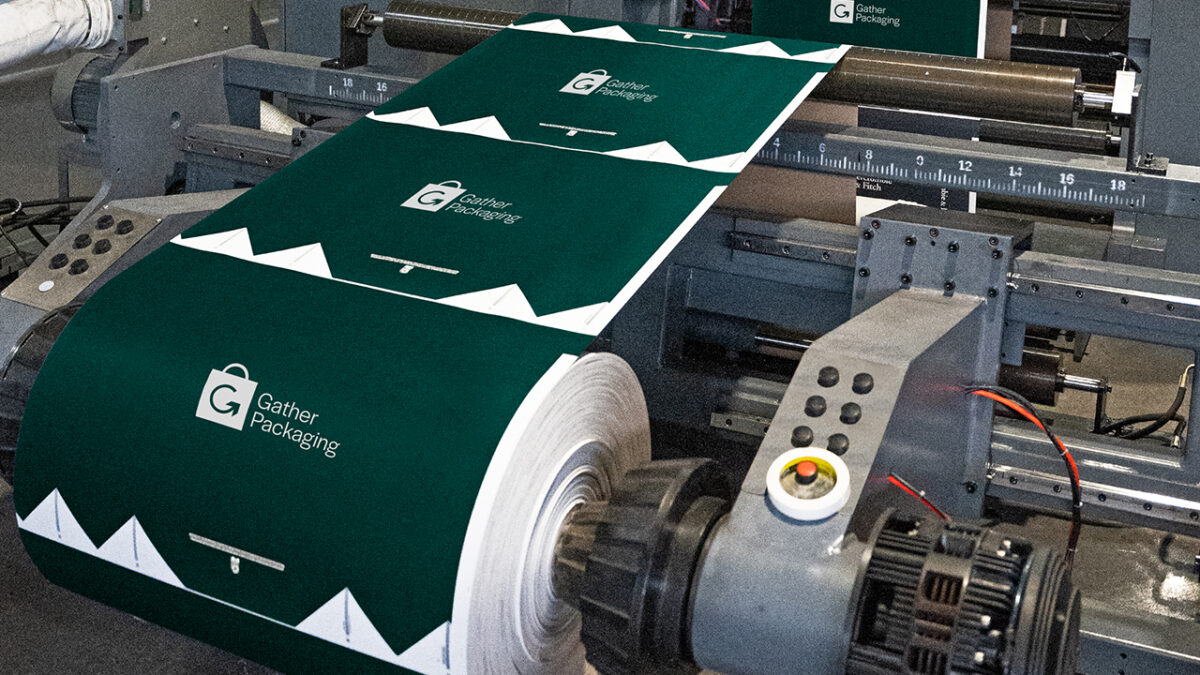
Gather has begun approaching Canadian retailers about moving some packaging production to its Toronto operation. Hertzman said the early response has been encouraging, although some retailers already have their holiday packaging committed.
In other cases, discussions are underway about future programs and getting Gather onto supplier lists.
The timing coincides with another significant change in the economics of the Canadian packaging market. Beginning September 8, Canada is set to apply a 50 per cent counter-tariff to U.S.-origin goods classified under tariff item 4819.40.00, covering certain paper sacks and bags.
The measure is part of a wider Canadian response to the latest U.S. trade actions. Paper bags in the same tariff category had previously been included in Canada’s 25 per cent counter-tariffs on U.S. goods introduced in March 2025, meaning the September measure raises the applicable counter-tariff to 50 per cent.
For retailers operating in Canada that source affected paper shopping bags from American factories, the change provides another reason to examine their supply arrangements.
Lee Moore, Director of Sales and Marketing with Progress Luv2Pak and Gather Packaging, said retailers with open orders for U.S.-made paper bags face a particularly immediate decision.
“For anyone who has open orders for U.S.-made paper bags, there is an urgency to replace those bags with a source that won’t have such an extreme tariff,” Moore said.
Gather believes its available Canadian production capacity could capture some of that business.
Hertzman is realistic about the difference in market size. The U.S. has roughly 350 million consumers compared with about 40 million in Canada, and paper bags are bulky enough that freight costs make distant export markets difficult to pursue economically.
If the tariff situation becomes prolonged, he said, the factory will increasingly focus on serving Canada.
“We’ve only scratched the surface on who we can speak to,” Hertzman said.
Retail Packaging Supply Chains Under Scrutiny
Canadian retailers source shopping bags from a mix of domestic and international manufacturers. Hertzman said the market includes retail chains, grocers and quick-service restaurants, each with different packaging requirements.
Many retailers and grocers have moved toward reusable totes, which he said are commonly manufactured in China or Vietnam. Paper bags can come from Canadian, American and other overseas factories.
The trade dispute is adding another variable to decisions that already involve price, transportation costs, lead times, inventory and product specifications.
Gather argues that domestic manufacturing can give retailers greater flexibility. Hertzman said retailers sourcing closer to home can respond more quickly to changes in demand, carry less inventory and make faster adjustments to artwork or seasonal programs.
He pointed to a recent order from a large U.S. retailer that was facing an imminent bag shortage while other supply was still moving through its supply chain. The retailer asked Gather how quickly it could respond.
Gather rearranged its production schedule and began deliveries within approximately one week, Hertzman said. An order of that type would normally take one or two months.
The example illustrates one of the advantages Gather is emphasizing as retailers reconsider where they source operational supplies: the ability to respond quickly when inventory requirements change.
“Made in Canada” Enters the Packaging Conversation
Gather also sees an opportunity in the renewed consumer attention being paid to Canadian-made products.
Hertzman describes a branded shopping bag as a highly visible form of retail marketing. Customers carry bags through malls, along streets and onto public transit after leaving a store, extending the retailer’s branding beyond the point of sale.
Gather is proposing that Canadian retailers take the idea further by identifying their bags as Canadian-made. The company uses Canadian paper and says it sources Canadian boxes, ink and glue wherever possible.
For Hertzman, that creates an opportunity for retailers already emphasizing their Canadian identity to carry the message through to their packaging.
A Long History With Canadian Retail
Progress Luv2Pak has worked with Canadian retailers for decades, including on one of the country’s most recognizable retail packaging programs.
Hertzman and Moore told Retail Insider that the company was involved when Holt Renfrew adopted its now-familiar magenta shopping bags in about 2004. Magenta was selected instead and eventually became closely associated with Holt Renfrew’s visual identity. The story illustrates the role packaging can play in creating a recognizable retail brand.
At Gather’s current operation, bags are engineered for appearance and performance. Hertzman said products undergo testing for weight, handle strength and repeated movement.
One test involves loading a bag with 20 pounds and hanging it for 48 hours. The same loaded bag can then be placed on equipment designed to simulate 3,900 movements associated with someone walking while carrying it.
Hertzman said Gather competes with a small number of Canadian manufacturers as well as higher-end packaging factories in Europe and Asia, particularly for retailers requiring more sophisticated printing and specifications.
Tariffs Test a Canadian Manufacturing Strategy
The current situation creates an unusual challenge for a company that invested in rebuilding domestic production capacity.
Gather successfully established Canadian manufacturing and found substantial demand for its product across the border, with more than three-quarters of its plant volume eventually flowing into the U.S. The tariff has abruptly weakened the economics of that market, while Canada’s response could make domestic production comparatively more attractive to retailers here.
Redirecting exports to another country is difficult. Hertzman said paper bags are bulky products for which transportation represents a meaningful part of the cost, making distant markets such as Europe impractical alternatives for the Toronto factory.
Gather is therefore trying to expand its Canadian customer base while waiting to see whether the trade relationship with the United States improves.
Hertzman said uncertainty is something the company has learned to manage over its long history.
“When there’s challenge and uncertainty, I just focus on what I can control,” he said. “I’m a firm believer that the businesses that succeed in volatile and uncertain times are the ones that are the most nimble, the ones that are the most adaptive, the ones that can react the quickest.”
His family has operated the business for approximately 45 years, while the company itself traces its history back more than a century.
Hertzman pointed to recessions, strikes, COVID-19 and other disruptions the company has encountered over the decades as evidence that its strategy has repeatedly had to change.
“We’re resilient, and we’re adaptable, and we will figure it out,” he said. “Your success is not defined by the problem. It’s how you respond to it.”
That response is increasingly focused on Canada. A Toronto factory that spent several frantic weeks producing bags destined for American retailers now has material, manufacturing capacity and a reason to pursue considerably more business at home.
Whether Canadian retailers move to fill some of that capacity could determine how successfully Gather navigates the next phase of the Canada-U.S. trade dispute.