The United States is imposing tariffs on much of the world, disrupting supply chains and inviting retaliation from its trading partners. Yet American food inflation remains lower than Canada’s.
For Canadians repeatedly told that external forces are primarily responsible for their rising grocery bills, this is an uncomfortable comparison.
From January 2025 to July 2026, Canada’s total food price index increased by approximately 8.5%, compared with 4.4% in the United States. At first glance, food prices appear to have risen almost twice as quickly in Canada.
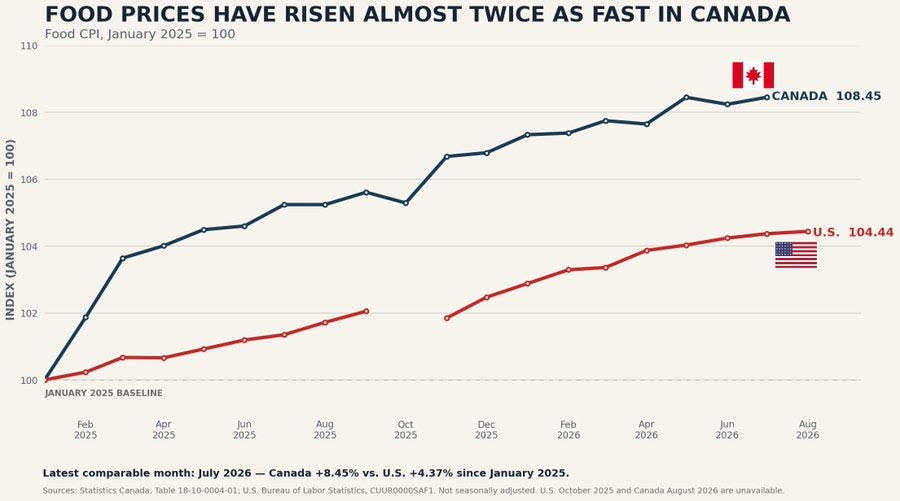
There is, however, an important statistical caveat. Total food includes restaurant meals, and January 2025 fell during Canada’s temporary GST/HST holiday. Restaurant prices were artificially depressed before jumping when the tax returned. Starting the comparison in January therefore exaggerates Canada’s increase.
A cleaner grocery-only comparison still tells a troubling story. Between January 2025 and July 2026, prices for food purchased from stores increased by approximately 5.8% in Canada, compared with 3.4% in the United States. Canadian grocery prices rose roughly 70% faster.
The gap is real. The explanation is more complicated than tariffs.
Although the United States has erected trade barriers against many countries, it is not literally tariffing every product from every trading partner. Exemptions, negotiated arrangements and preferential treatment for compliant goods remain. More importantly, tariffs apply only to imported products. The United States possesses a vast agricultural base, enormous processing capacity and a domestic market of roughly 350 million comparatively affluent consumers.
Scale matters.
American food manufacturers can spread fixed costs across larger production runs. Retailers have access to more suppliers. Processors can substitute ingredients more easily, and the country’s extensive domestic production cushions many categories from border disruptions.
Canada’s food economy operates under very different conditions. Our market is smaller, our processing capacity is thinner, and many regions depend heavily on imported ingredients, equipment, packaging and finished products. A weaker Canadian dollar also makes almost everything priced internationally more expensive.
The Bank of Canada concluded that the resurgence of Canadian grocery inflation in 2025 was driven largely by import costs, including the depreciation of the Canadian dollar. Weather-related shortages affected products such as coffee and cocoa, while drought, feed costs and limited cattle supplies pushed beef prices sharply higher.
These pressures existed in the United States as well. But the American food system has generally absorbed them more effectively.
Tariffs also do not pass through to consumers immediately. Food companies rely on inventories, negotiated contracts and hedging strategies. According to the Bank of Canada, cost pressures can take approximately six months to work through the food supply chain. Consequently, some effects of American tariffs may still be coming.
Retaliation can create another paradox. When foreign governments restrict American agricultural exports, more American production may remain inside the United States. That can depress domestic farm prices, even while imported inputs become more expensive. Farmers lose export opportunities, but American consumers may temporarily benefit from additional domestic supply.
None of this proves that tariffs are sound economic policy. It demonstrates that a large, competitive and productive food economy is better equipped to absorb trade shocks.
Canada should take notice.
First, Ottawa should avoid retaliatory tariffs on ingredients, packaging, machinery and other inputs that Canadian food manufacturers cannot easily source domestically. American tariffs are paid initially by American importers. Canadian counter-tariffs are paid by Canadian importers. We can be hit both ways.
Taxing essential inputs may create a satisfying political headline, but it ultimately increases production costs for Canadian businesses and grocery bills for Canadian households.
Second, Canada needs significantly more food-processing capacity. We remain remarkably good at exporting agricultural commodities and buying back higher-value processed products. Accelerated capital investment, automation, predictable regulation and access to affordable energy would allow Canadian processors to achieve greater scale.
Third, Canada must finally operate as one domestic food market. Provincial regulations, duplicative licensing systems and inconsistent standards make it unnecessarily difficult for smaller processors to sell across provincial boundaries. A Canadian company should not face more difficulty shipping food between provinces than a foreign supplier faces entering the country.
Fourth, grocery competition needs to improve. Restrictive property controls that prevent competitors from opening stores should be eliminated. The Competition Bureau has repeatedly identified these restrictions as barriers to entry. Canada should also make itself more attractive to international grocers and provide independent retailers with better access to wholesale supply.
Finally, protected agricultural sectors should not be treated as untouchable. Supply management was created for another era. Reform does not require abandoning farmers. It means gradually encouraging productivity, lowering input costs, attracting processing investment and giving efficient producers opportunities to grow beyond a protected domestic market.
The lesson from the United States is not that tariffs lower food prices. They do not.
The lesson is that resilience comes from production capacity, scale, competition, productivity and diversified supply chains. The United States currently possesses more of those advantages than Canada.
At the grocery store, patriotism is not a pricing strategy. Neither is tariff theatre.
If Canadian governments genuinely want to defend food affordability, they should spend less time telling consumers whom to blame and more time removing the structural costs that make Canada’s food system so vulnerable in the first place.