

Frank And Oak, a notable Canadian fashion retailer known for its sustainable practices, has once again filed for protection under the Bankruptcy and Insolvency Act, seeking relief from mounting debts that total $71 million.
The filing, submitted just before Christmas by its parent company, Unified Commerce Group (UCG), reveals a substantial financial burden. Secured creditors, including UCG and Desjardins, are owed $55.5 million, while unsecured creditors are owed $14.6 million.
Among the unsecured creditors, significant claims include $3.5 million owed to the Canada Border Services Agency (CBSA), $1.7 million to the Canada Revenue Agency (CRA), and $529,000 to Ontario-based Shopify. Prepaid card customers are owed approximately $504,000, while manufacturers and logistics providers across Asia and the Americas are also heavily affected.
Dustin Jones, CEO of UCG, acknowledged the brand’s ongoing struggles in a letter to creditors dated December 16, stating, “Despite significant growth over the past few years, the company has struggled to recover from losses incurred as a result of the COVID-19 pandemic.”
Jones also emphasized plans to restructure the company’s operations and implement a more sustainable business model, though details remain scarce.
Industry Challenges and Competitive Pressures
Frank And Oak’s financial troubles reflect broader trends in Canadian retail. Damien Siles of the Quebec Retail Council noted that rising inflation, a weakened Canadian dollar, and reduced consumer purchasing power have created a challenging environment for retailers.
Additionally, global e-commerce giants like Shein and Temu have exacerbated competition by introducing thousands of new products daily at ultra-competitive prices. These companies leverage real-time production capabilities, creating a difficult playing field for traditional retailers.
Siles criticized governments for failing to adequately support domestic retailers, stating, “These global companies often bypass Canadian regulations, and more needs to be done to level the playing field.”
Frank And Oak’s Origins and Rise
Founded in Montreal in 2012 by Ethan Song and Hicham Ratnani, Frank And Oak began as an online-only retailer focused on sustainable and stylish clothing. The company quickly gained traction with its direct-to-consumer model, appealing to urban millennials seeking minimalist designs and eco-friendly options.
Frank And Oak’s innovative approach extended to its retail stores, where it introduced experiential shopping environments. Over time, the company expanded to physical locations across Canada, including boutiques in Montreal, Toronto, Halifax, and Vancouver.
The brand’s focus on sustainability—ranging from ethically sourced materials to environmentally conscious manufacturing practices—set it apart in a crowded market. At its peak, Frank And Oak was hailed as a leader in the Canadian fashion industry, garnering a loyal following.
However, financial challenges emerged as the company sought to scale. In 2020, Frank And Oak filed for bankruptcy protection for the first time, burdened by $19 million in debts. Later that year, it was acquired by Unified Commerce Group (UCG), a New York-based investment fund specializing in retail turnarounds.
The Current Financial Struggles
Despite UCG’s efforts to revive the brand, Frank And Oak has struggled to regain its financial footing. While the pandemic exacerbated existing challenges, the brand has also faced headwinds from rising operating costs and shifts in consumer behaviour.
The most recent filing for creditor protection shields the company from legal action while it works on restructuring. However, with debts now exceeding $71 million, the path to recovery is far from certain.
Broader Implications for Canadian Retail
Frank And Oak’s struggles highlight the difficulties faced by Canadian retailers in an increasingly globalized and competitive marketplace. According to data from the Quebec Retail Council, nearly half of Quebec’s retailers filed for bankruptcy in 2023, underscoring the fragility of the industry.
Damien Siles stressed the need for regulatory reforms to protect Canadian businesses. “Without stronger enforcement of Canadian laws, local retailers will continue to face unfair competition from global giants,” he said.
Looking Ahead
Frank And Oak’s future remains uncertain as it embarks on its second restructuring in three years. Unified Commerce Group has signalled its commitment to steering the brand toward sustainability, but significant challenges lie ahead.
The brand will need to address its substantial debt, adapt to shifting consumer preferences, and find innovative ways to compete with both domestic and international players.
As one of Canada’s most recognizable fashion retailers, Frank And Oak’s journey serves as a case study in the complexities of operating in today’s retail environment.














The clothes were / are also undistunguished-looking basics at 2-3x the price of other brands’ undistinguished basics.
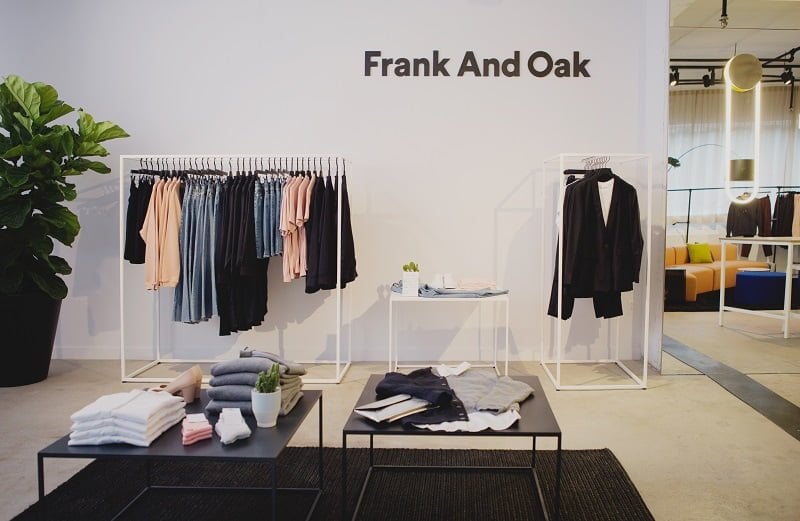
The picture gives the impression that the store is lacking in stock depth. The minimal stock concept is viable when your ticket prices are in the hundreds or thousands for a single item actual designer item. Every square foot of a store has to pay for itself through sales of your products which looks to be a problem here……