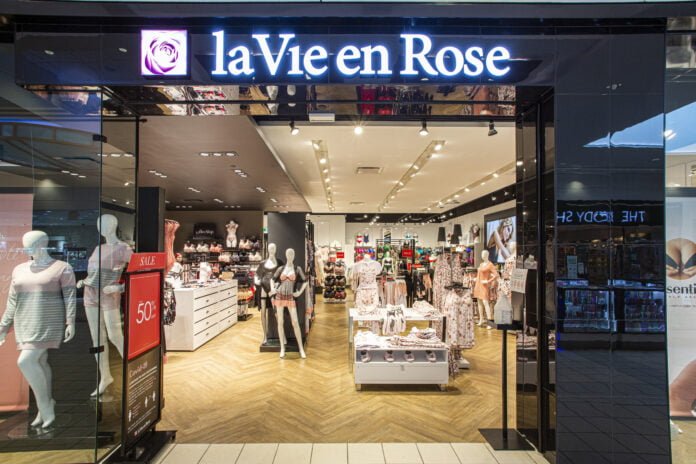
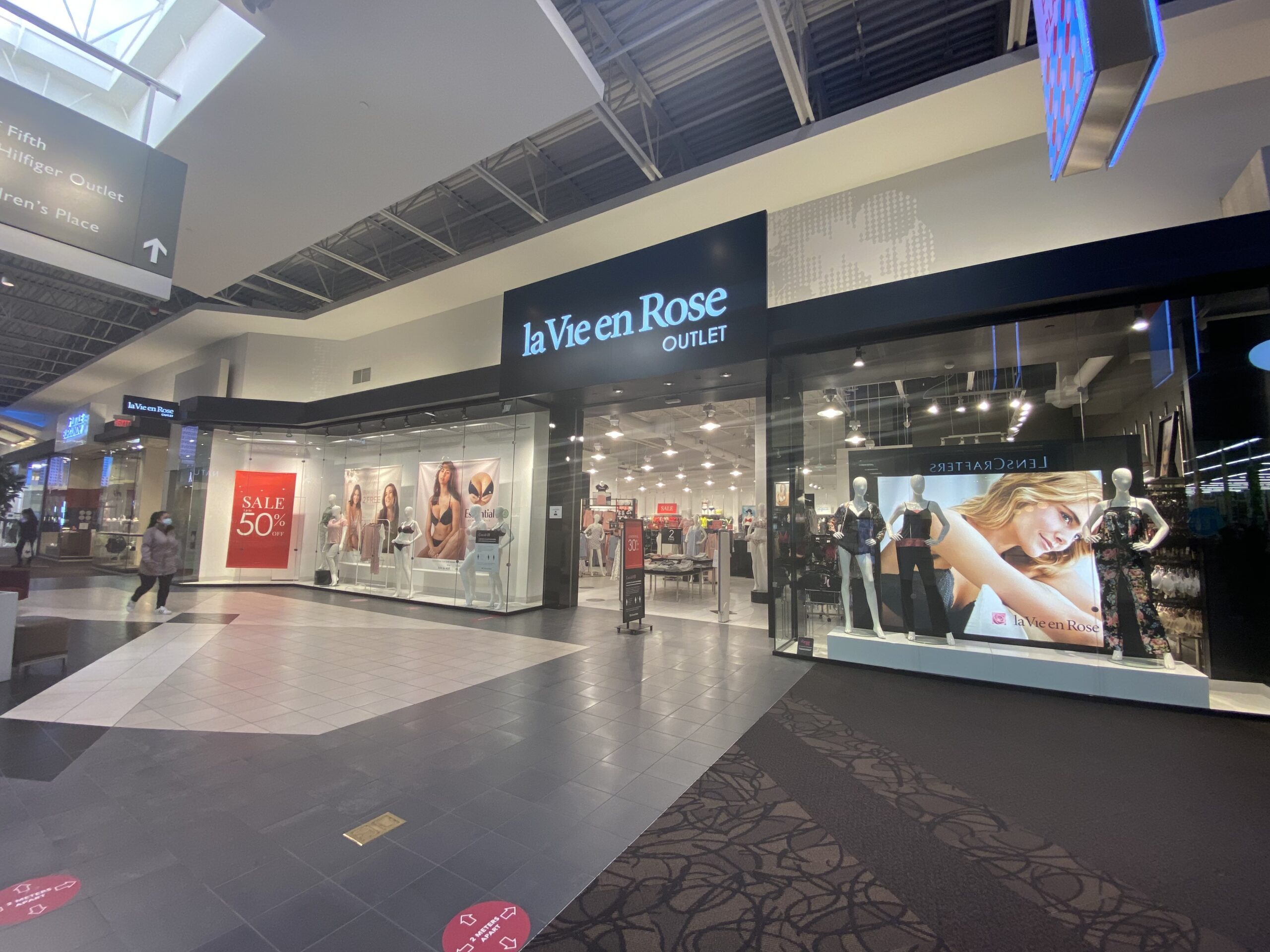
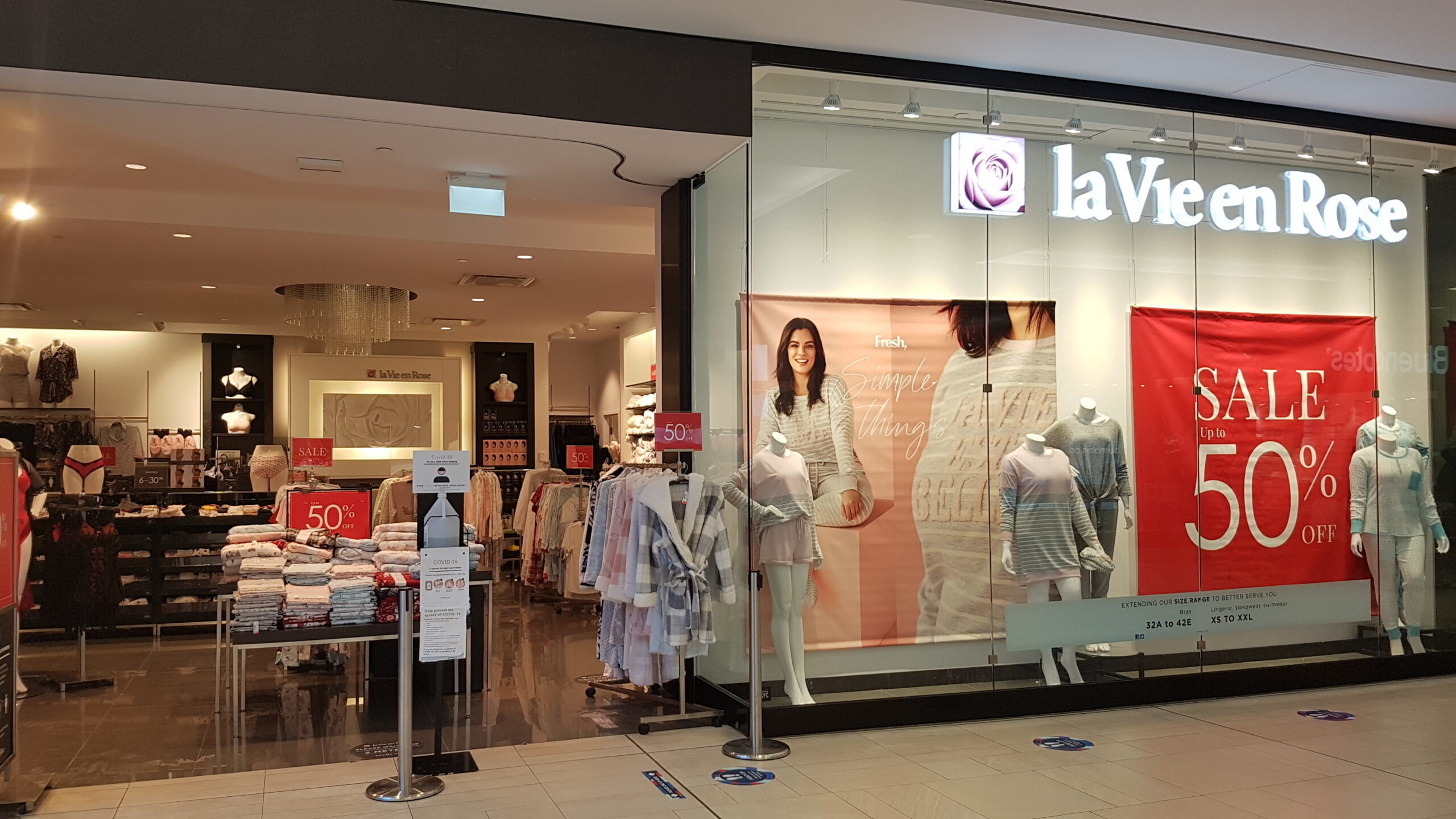
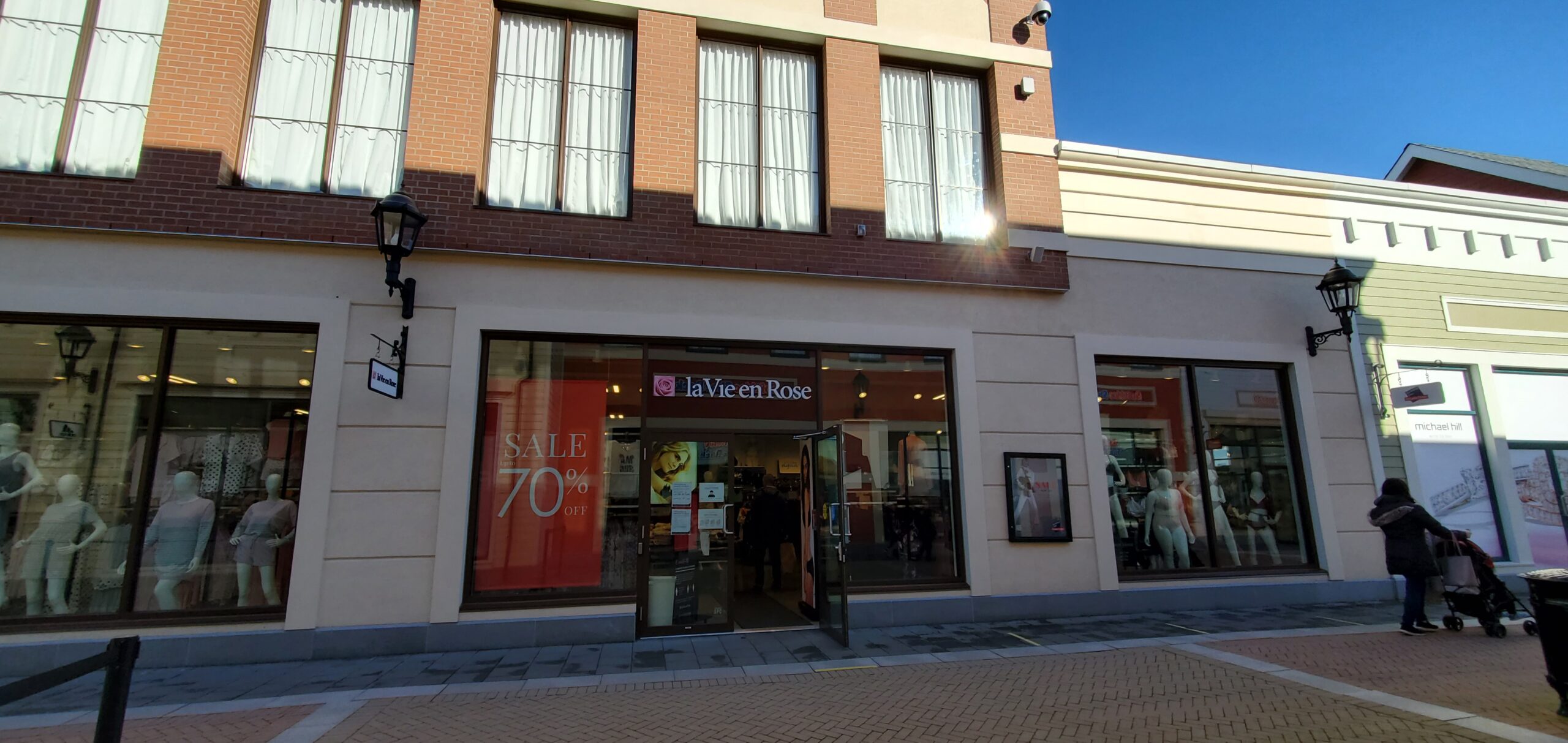
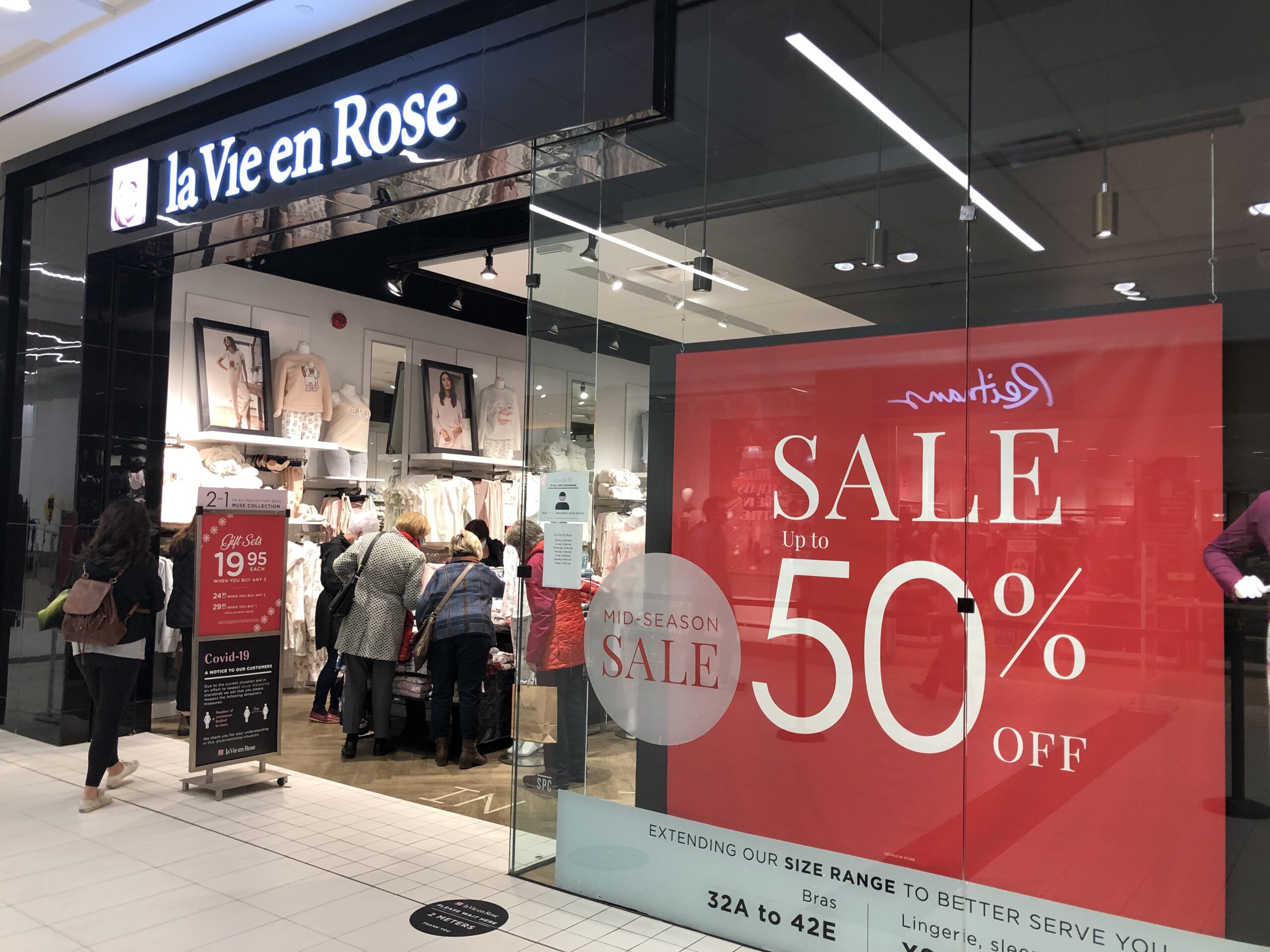
La Vie en Rose at Sherwood Park Mall, February 2021. Photo: Primaris Management
While other retailers are cutting back on their footprints across Canada or even closing their doors, François Roberge is looking at expansion for his brands La Vie en Rose and Bikini Village.
This year marks the 25th anniversary of when Roberge, President and CEO, and his two partners, his wife Lina Di Liello and his brother-in-law, John Izzo, acquired the iconic Canadian brand La Vie en Rose.
François Roberge
“It was such a heartwarming feeling to realize that 2021 marks the 25th year that La Vie en Rose has been under our ownership. I can say that celebrating a company anniversary like this one is quite a success in our industry nowadays. Retail is far from being a walk in the park, especially in the last year, which has by far been my biggest challenge as an entrepreneur. I’m staying optimistic and I can’t wait to see what the future holds,” said Roberge, of the lingerie, sleepwear, and swimsuit retailer.
The company has its head office and distribution centre in Montreal and employs more than 3,000 people across the country.
Today, La Vie en Rose has 201 locations across Canada, as well as 89 others in 16 different countries. After launching the La Vie en Rose swimsuit collection in 1998 and creating the e-commerce website in 2001, the entrepreneur took a giant leap in 2015. He acquired the swimsuit and beachwear retailer Bikini Village along with its 48 stores. The banner now has over 65 stores nationwide.
“In February 1996, we took over a little chain of 23 stores, mainly in Ontario. I thought at that time it had huge potential because the name was strong, the location was good, the stock and the staff were there,” said Roberge. “I thought this was a future growth market. When I moved the head office to Montreal, there were 12 people. Now we’re more than 350.
“When you look over the last 25 years, it’s crazy because we never stopped. I always say to everybody that in retail you grow or you die. And this is my philosophy in the last 25 years. Always push the machine to maximize the potential of the banner.
“I still have fun. This is one of the important keys when you are a retailer. If you don’t have fun, you should do something else.”
1 of 5
la Vie en Rose at CrossIron Mills. Photo: Jessica Finch
la Vie en Rose at CF Richmond Centre. Photo: Ritchie Po
La Vie en Rose at McArthur Glen. Photo: Geetanjali Sharma
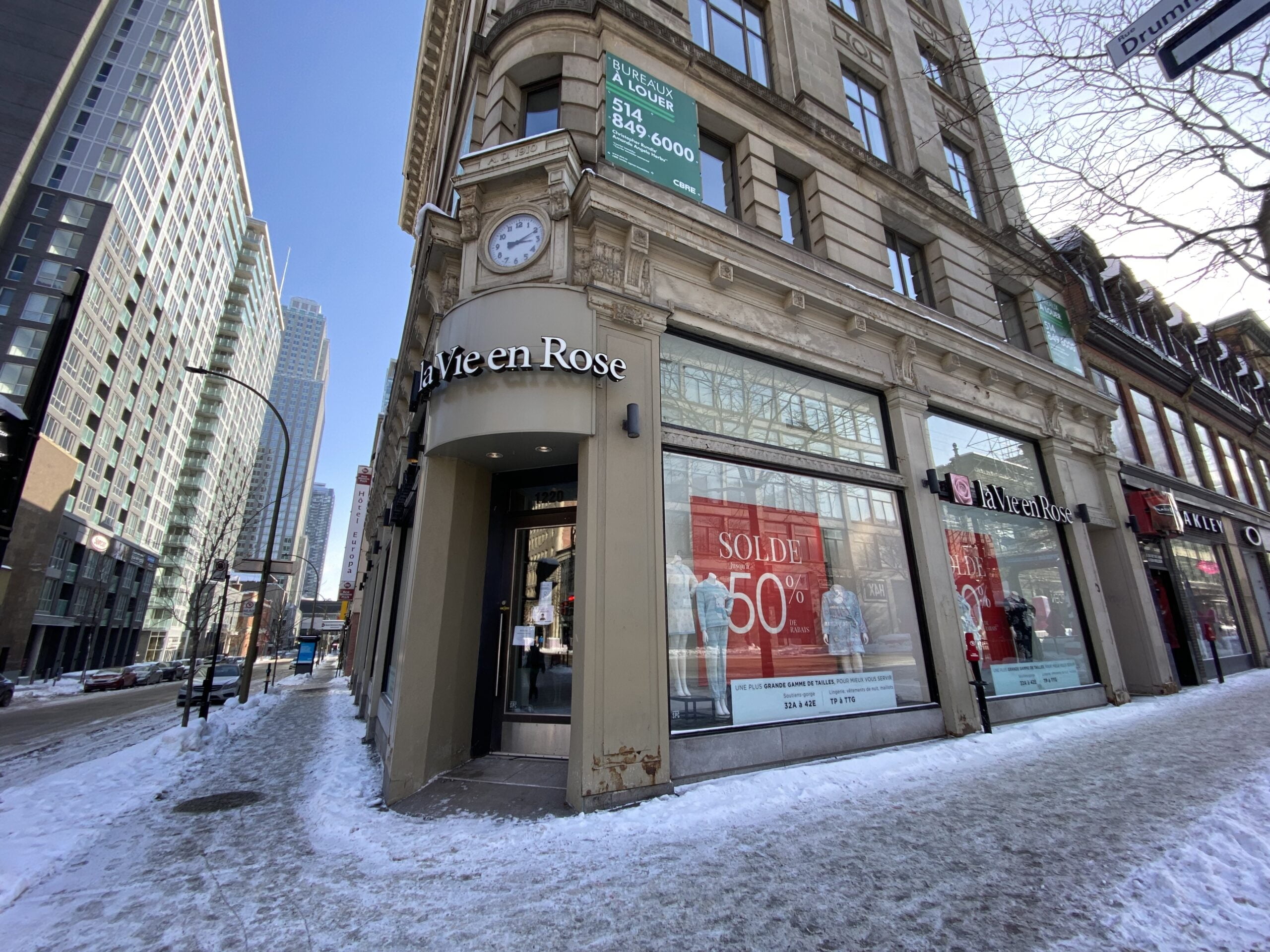
La Vie en Rose (1220 Saint-Catherine St W) PHOTO: MAXIME FRECHETTE
La Vie en Rose at Avalon Mall. January 2021. Photo: Crombie REIT
Roberge said the company has impressive plans to grow both banners in the near future especially since there has been a number of bankruptcies and creditor protection filings in the lingerie and swimsuit retail categories.
“There’s a lot of opportunity and I think it’s important to be aggressive. So if you look at what’s coming for the next six months, wow it’s crazy. We’re going to take a couple of La Senza’s . . . There’s an opportunity for us to take some market share. I’m going to do Willowbrook in Langley. I’m also taking a lease of La Senza in Red Deer. I’m taking a lease in Peter Pond Mall in Fort McMurray, which was also a La Senza. I’m taking the one in Cambridge. Also I’m taking the Mapleton Centre in Moncton, the Justice store. There’s a lot of stores we can take now and the market is for us,” said Roberge.
“Also, I’m taking five Swimco locations — mainly in the West — for Bikini Village.
“We’re moving. I think the next two years will be fantastic after the pandemic and I want to be ready to maximize every opportunity.”
Unlike many of his competitors, Roberge did not close any of the company’s stores during the pandemic — outside of mandated lockdowns. He is a firm believer in the value of physical stores with a strong omnichannel presence. Managing inventory has been a bit of a challenge over the past year particularly in the swimsuit category which has been impacted by travel restrictions. Communication within the store and its staff has been important to navigate through this tough economic time.
As a business owner, one of the key lessons Roberge said he has learned through the pandemic year is it’s a privilege to open a store. As the pandemic has shown, any government could close you down through lockdowns.
1 of 3
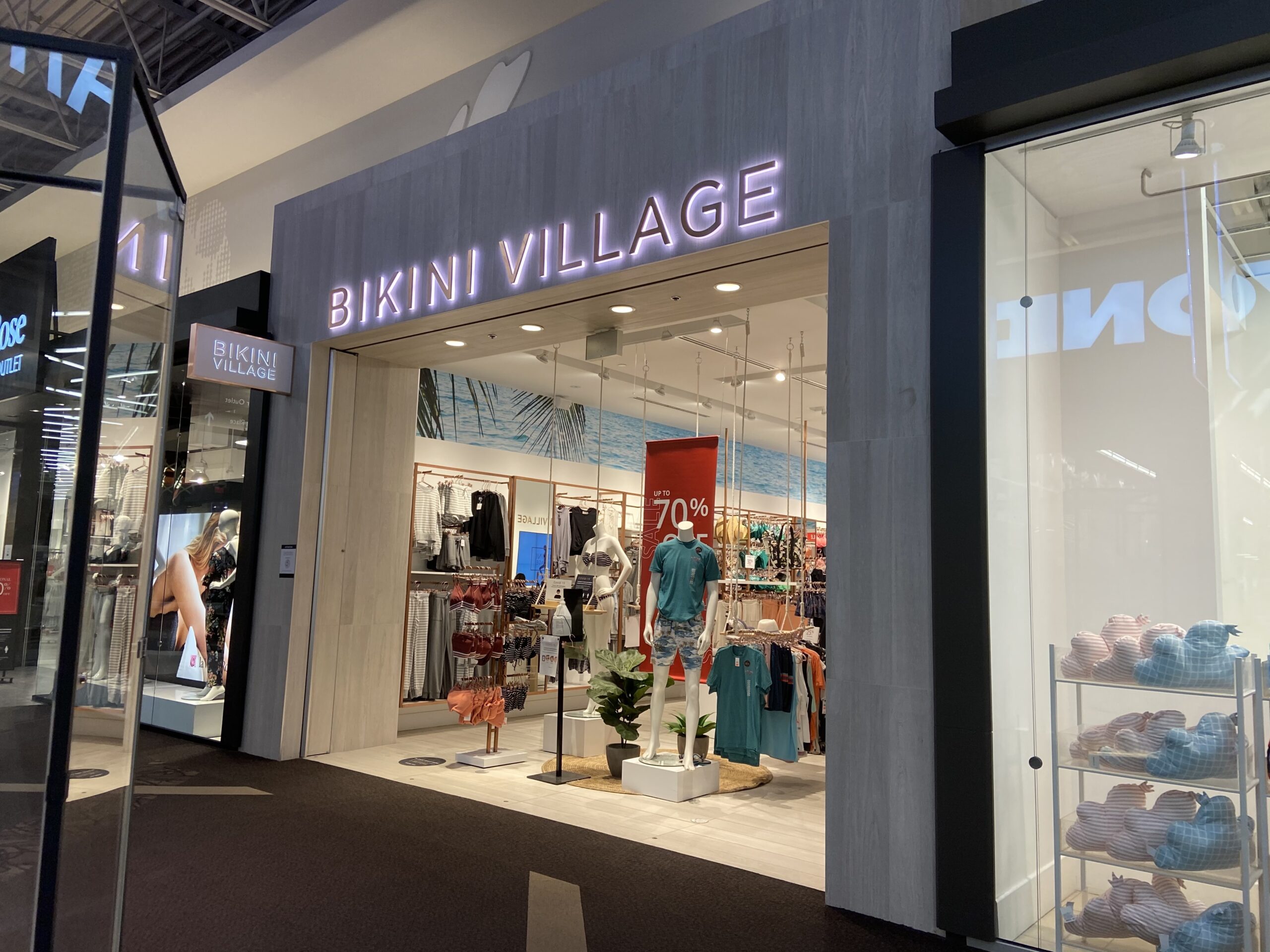
Bikini Village at CrossIron Mills. Photo: Jessica Finch
Bikini Village at Guildford. Photo by Lee Rivett
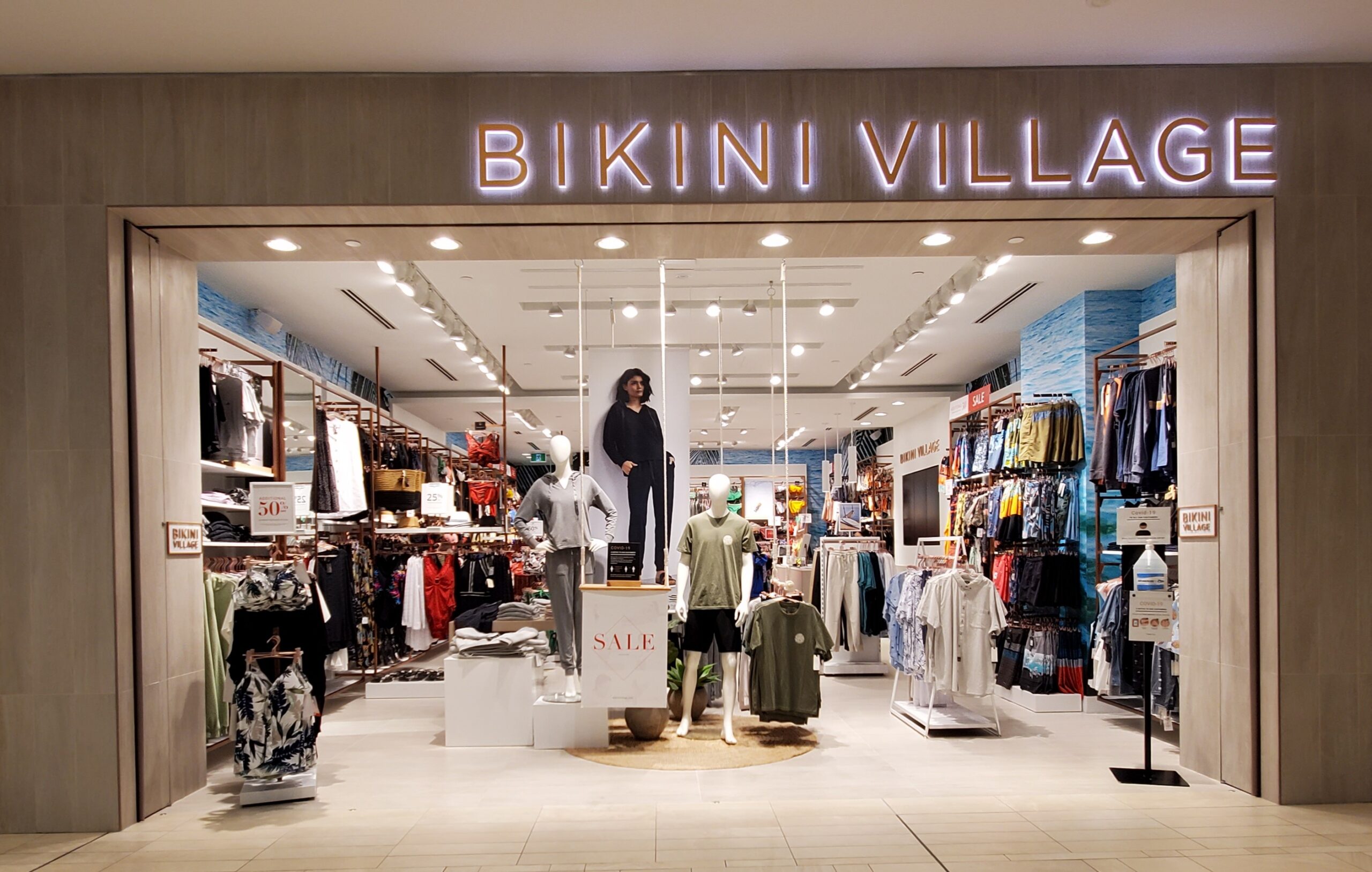
Bikini Village at CF Richmond Centre. Photo: Geetanjali Sharma
“It’s a privilege to be a retailer and to open a store because government can control much more than that. That’s my biggest learning. It’s an experience and communication and to build a bridge with government is important for a retailer,” he said.
Roberge said he believes brick and mortar stores mixed with a strong online presence is going to be the future for retailers. Price, quality, service, and reputation are important in success.
“The store is one of the keys for the future,” he said. “People can’t always stay at home and just wait and look at the computer. I think they like to go out. We’re going to see an evolution of the mall in the future because malls cannot just be fashion. They need to revise the business plan and everybody is working very hard on that.
“I believe that brick and mortar mixed with a strong web, customer service, is going to be the future.”
As an entrepreneur, Roberge began in the retail industry working for Boutiques San Francisco in a number of roles including Construction Director and Banner Director.
He acquired La Vie en Rose when he was 33 years old.
In 2002, Roberge created the Roses of Hope Foundation. This charitable organization’s mission is to financially support organizations that are committed to the well-being of women. Nineteen years later, $2.5 million has been donated, with more than half going towards the fight against breast cancer and support for women affected by the disease. La Vie en Rose also gives back to many other causes, in particular to organizations in its Montréal borough, Hochelaga-Maisonneuve.
Roberge has been President of the Board of Directors of mmode, the Metropolitan Fashion Cluster, for five years. The cluster’s mission is to improve the competitiveness and growth of the Quebec fashion industry. He also sits on the Chamber of Commerce of Metropolitan Montréal’s Metropolitan and Urban Affairs Committee and acts as mentor for many Canadian entrepreneurs.
La Vie En Rose works with brokerage Oberfeld Snowcap for its Canadian real estate negotiations.
Former Holt Renfrew store at 1300 Sherbrooke St. W., photo by Maxime Frechette
Retail Insider continues its Photo Tour series by building on our extensive Saint-Catherine Street in Montreal During COVID-19 tour which we published on March 16, 2021. This time we’re delving deeper into the upscale Golden Square Mile in the downtown core that includes several luxury stores as well as some very interesting retail history.
The Golden Square Mile’s streetscape includes grand streets, attractive architecture and several large mansions from years past. Between the years 1870 and 1900, about 70% of the wealth in Canada was held by about 50 households living in the area and particularly north of where our tour was photographed.
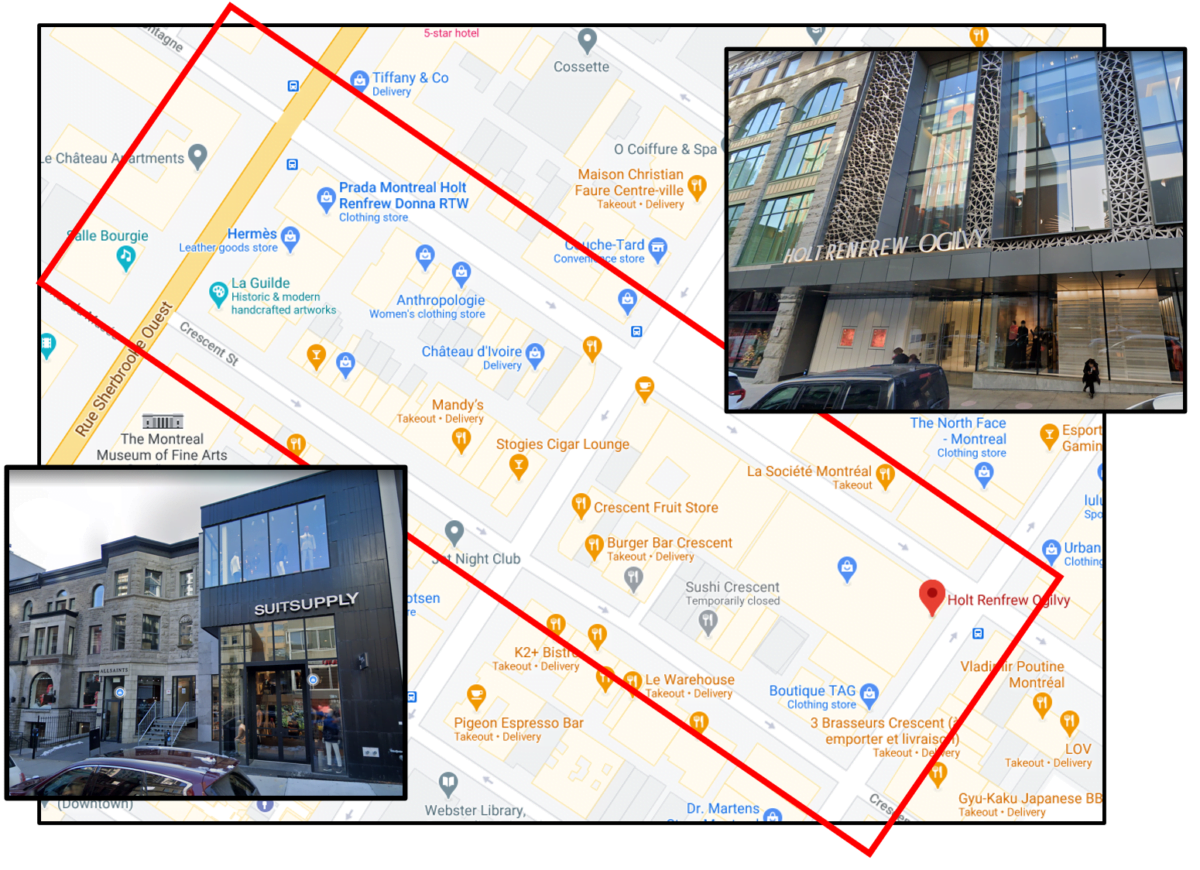
The photos in this tour were taken along the two block retail zone between Sherbrooke Street West and Saint-Catherine Street on Rue de la Montagne and Crescent Street. Come for a journey where we discuss what’s there, and the interesting retail that once was.
Map of the Montreal Luxury Zone between Rue Sherbrooke Ouest and Sainte-Catherine Street. Photo: Google Maps
Holt Renfrew Ogilvy (Saint-Catherine Street and Rue de la Montagne)
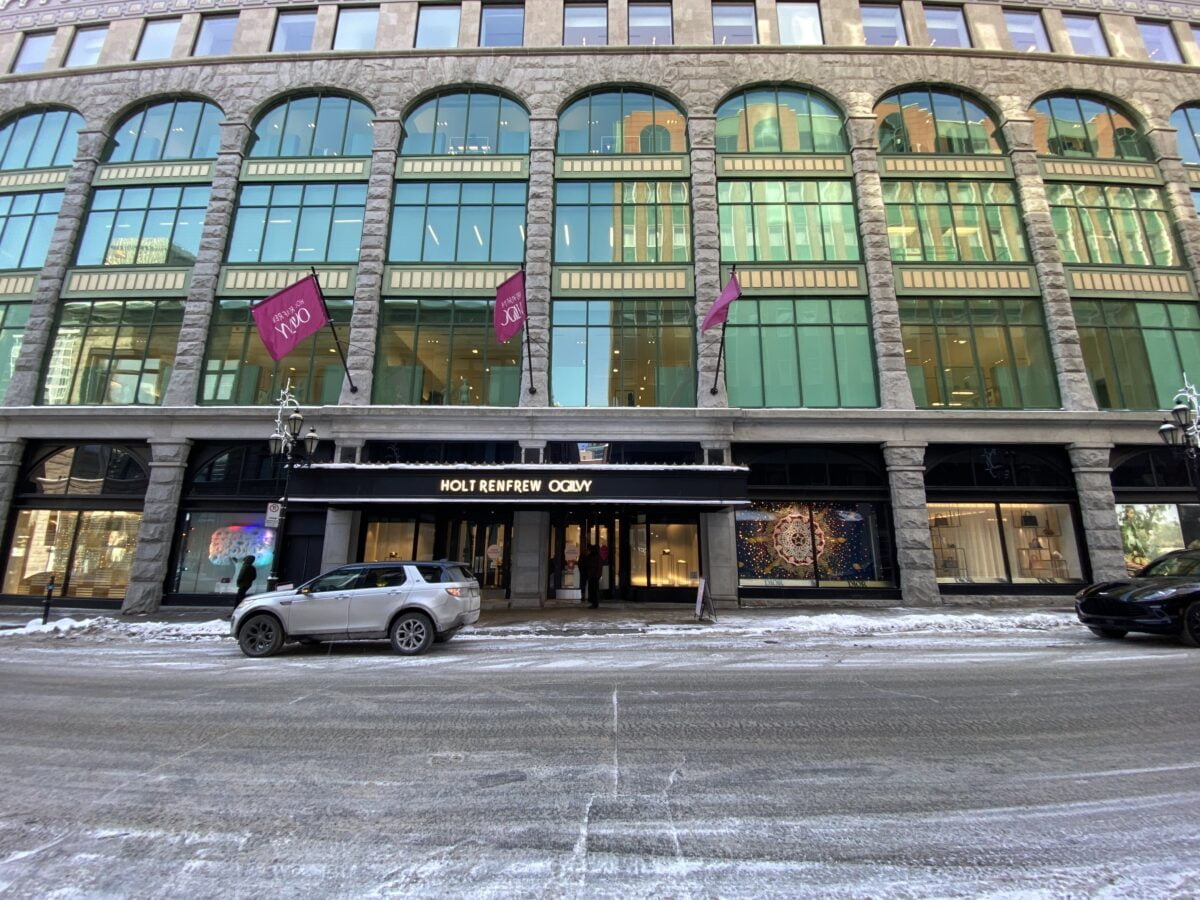
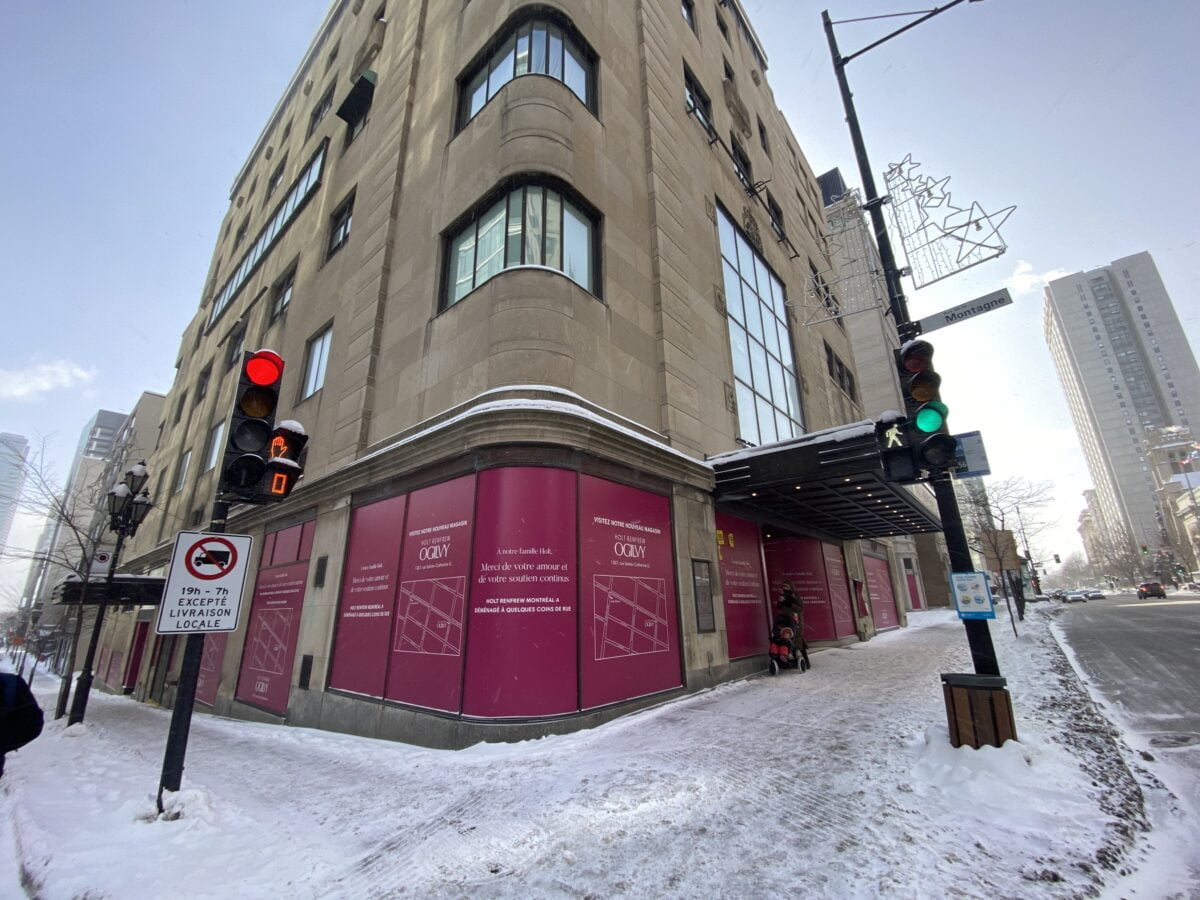
Arriving at Rue de la Montagne reveals the beautiful Holt Renfrew Ogilvy that has been reported on extensively in Retail Insider. The original Ogilvy’s department store was founded by the Ogilvy family in the 1800s and changed ownership several times over the years. Two major ownership shifts occurred, including the Ogilvy ownership being purchased by Equidev (a Montreal development group), which performed major updates to the building in the 1980s that included developing a concession model housing 52 designer boutiques. The retailer changed owners a couple more times as decades passed and most recently was purchased in 2011 by Wittington Investments which also owns Holt Renfrew within its subsidiary company, Selfridges Group Limited.
The existing Montreal Holt Renfrew store, which had previously operated nearby at 1300 Sherbrooke Street West since 1937, closed in June 2020 to coincide with the opening of the expanded Holt Renfrew Ogilvy store on Saint-Catherine Street. The 250,000-square-foot Holt Renfrew Ogilvy store is one of the largest multi-brand luxury stores in North America and is the largest showcase of luxury brands in the Montreal market. All six retail levels were renovated and reopened in July 2020.
Holt Renfrew Ogilvy at 1307 Saint-Catherine St W. Photo: Maxime Frechette
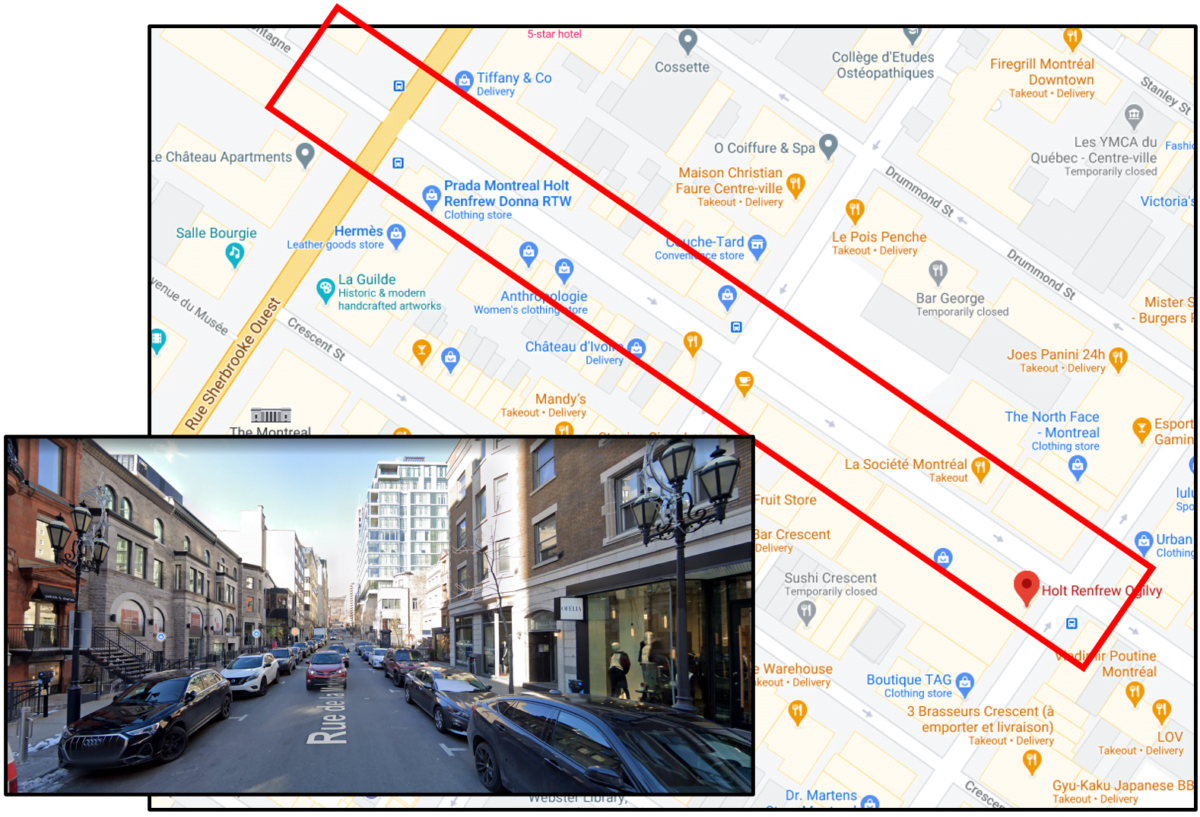
Rue de la Montagne
Map of the Montreal Luxury Zone on Rue de la Montagne. Photo: Google Maps
The two block stretch of Rue de la Montagne between Sherbrooke Street and Ste-Catherine Street is the closest thing that Montreal has to a retail “luxury run”. Several upscale stores have opened over the years on the street that is anchored by the Ritz Carlton Hotel to the north and Holt Renfrew Ogilvy to the south. At the Ritz is a 2,000 square foot Tiffany & Co. store that opened in February of 2012. The store is less than 250 metres from the 2,500 square foot Tiffany & Co. concession that opened at Holt Renfrew Ogilvy last year.
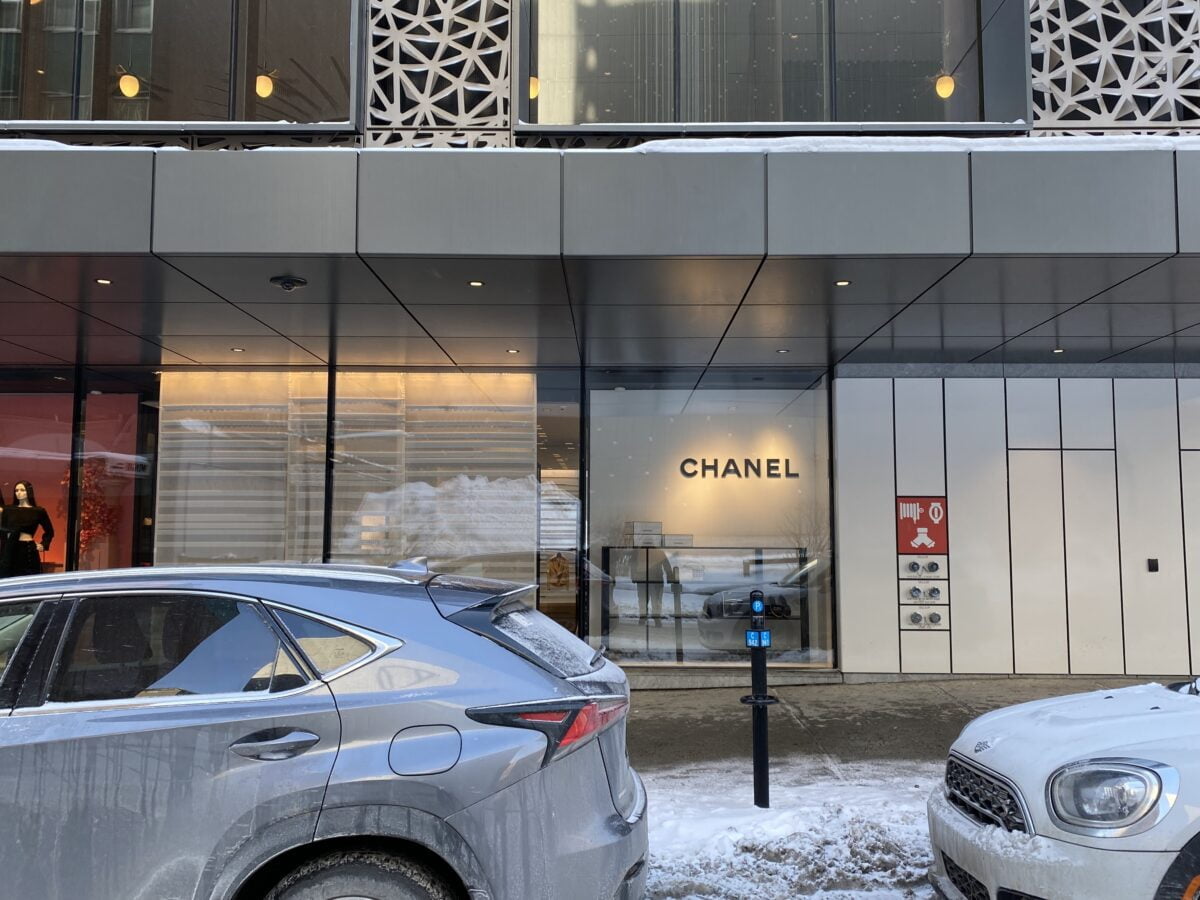
Chanel on Rue De La Montagne in Montreal. Photo: Maxime Frechette
The bilevel 3,300-square-foot Chanel boutique on the street level of Holt Renfrew Ogilvy opened in the fall of 2019. A Louis Vuitton boutique is located further to the left.
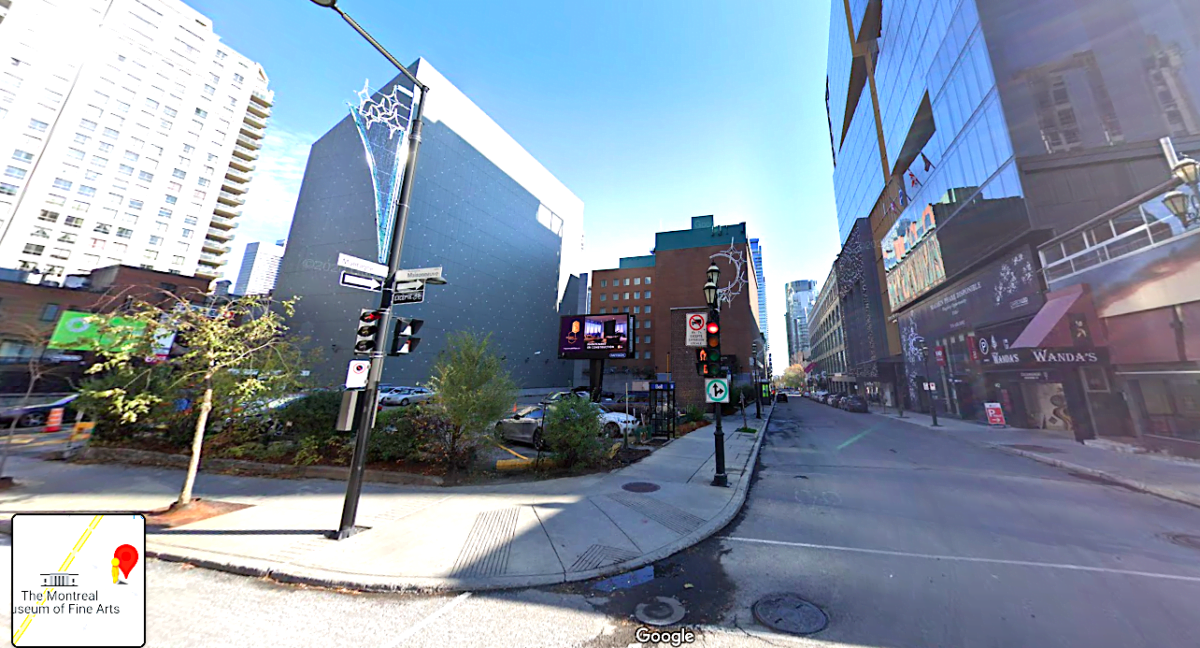
1455 Rue de la Montagne with Holt Renfrew Ogilvy and the Four Seasons to the right (as well as Wanda’s strip bar). Image via Google Street View
Toronto-based Carttera Private Equities Inc. acquired 1455 Rue de la Montagne in September of 2020 with plans to create a high-end residential building. At its base will be retail spaces, offering an opportunity for brands to move across from Holt Renfrew Ogilvy. The 31,750-square-foot surface parking lot sold for $48.5 million on the corner of De La Montagne and De Maisonneuve Boulevard West.
Rue De La Montagne in Montreal. PHOTOS: MAXIME FRECHETTE
1 of 3
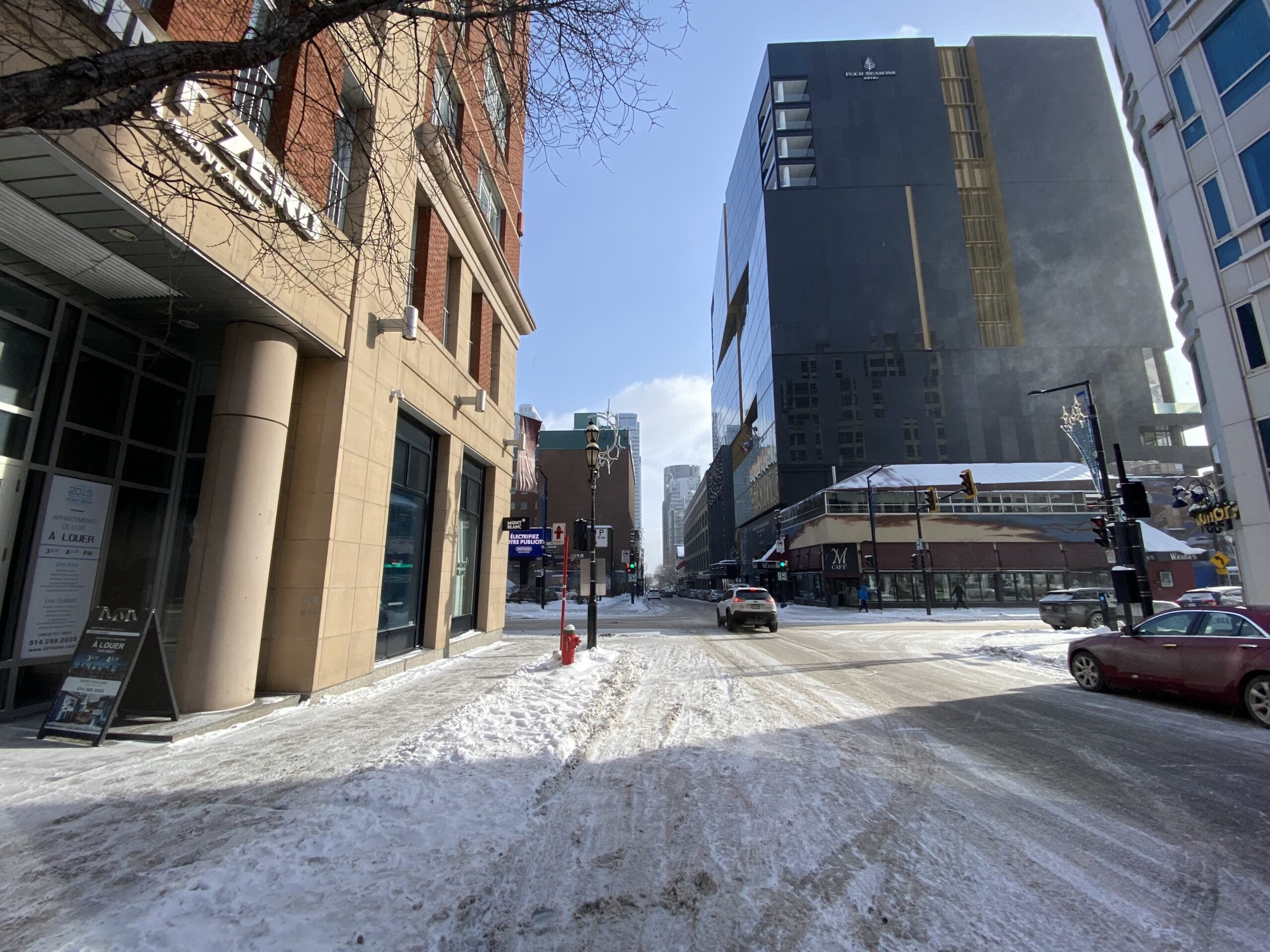
Former Point Zero on Rue De La Montagne in Montreal. PHOTO: MAXIME FRECHETTE
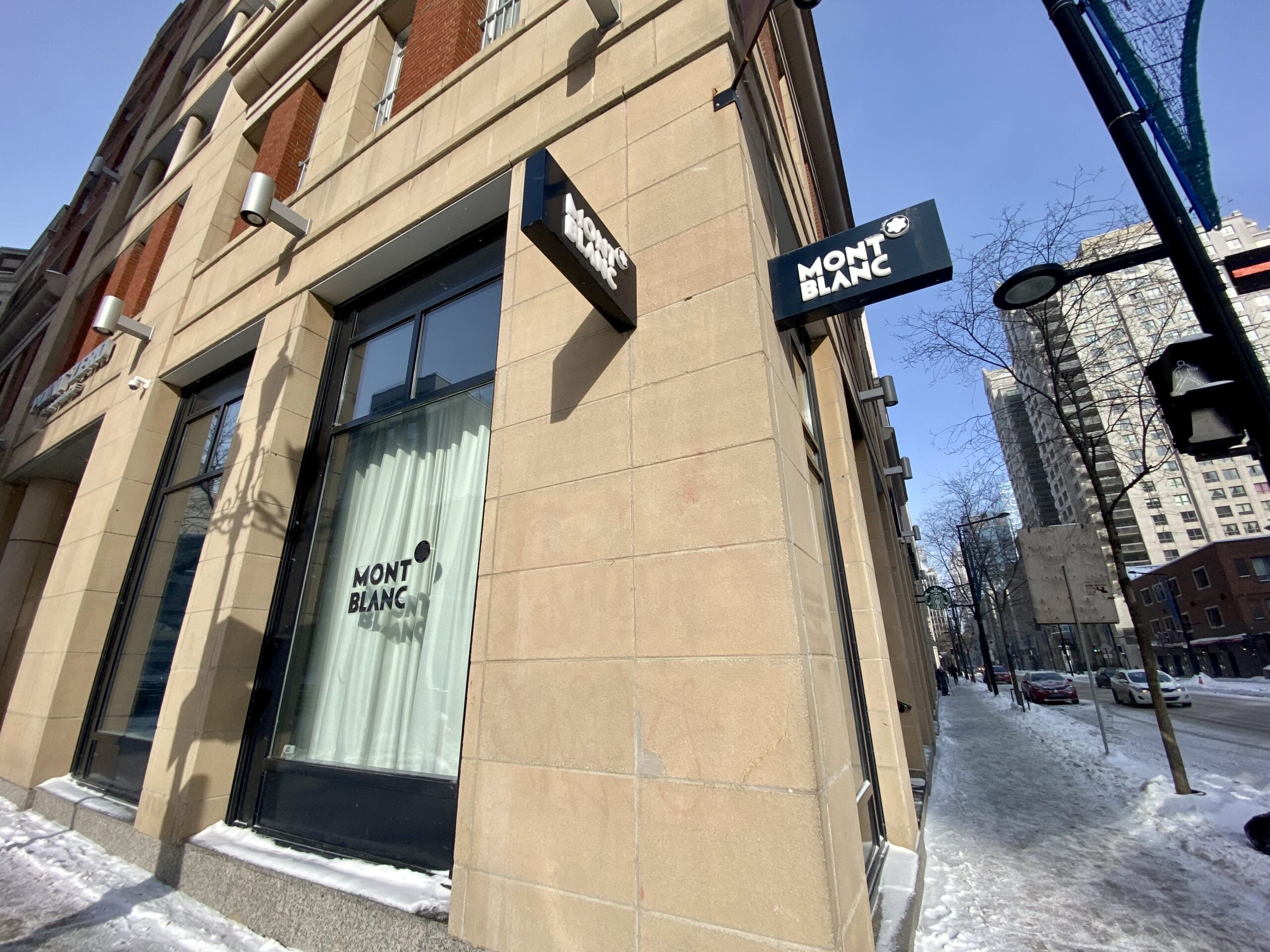
MontBlanc on Rue De La Montagne in Montreal. Photo: Maxime Frechette
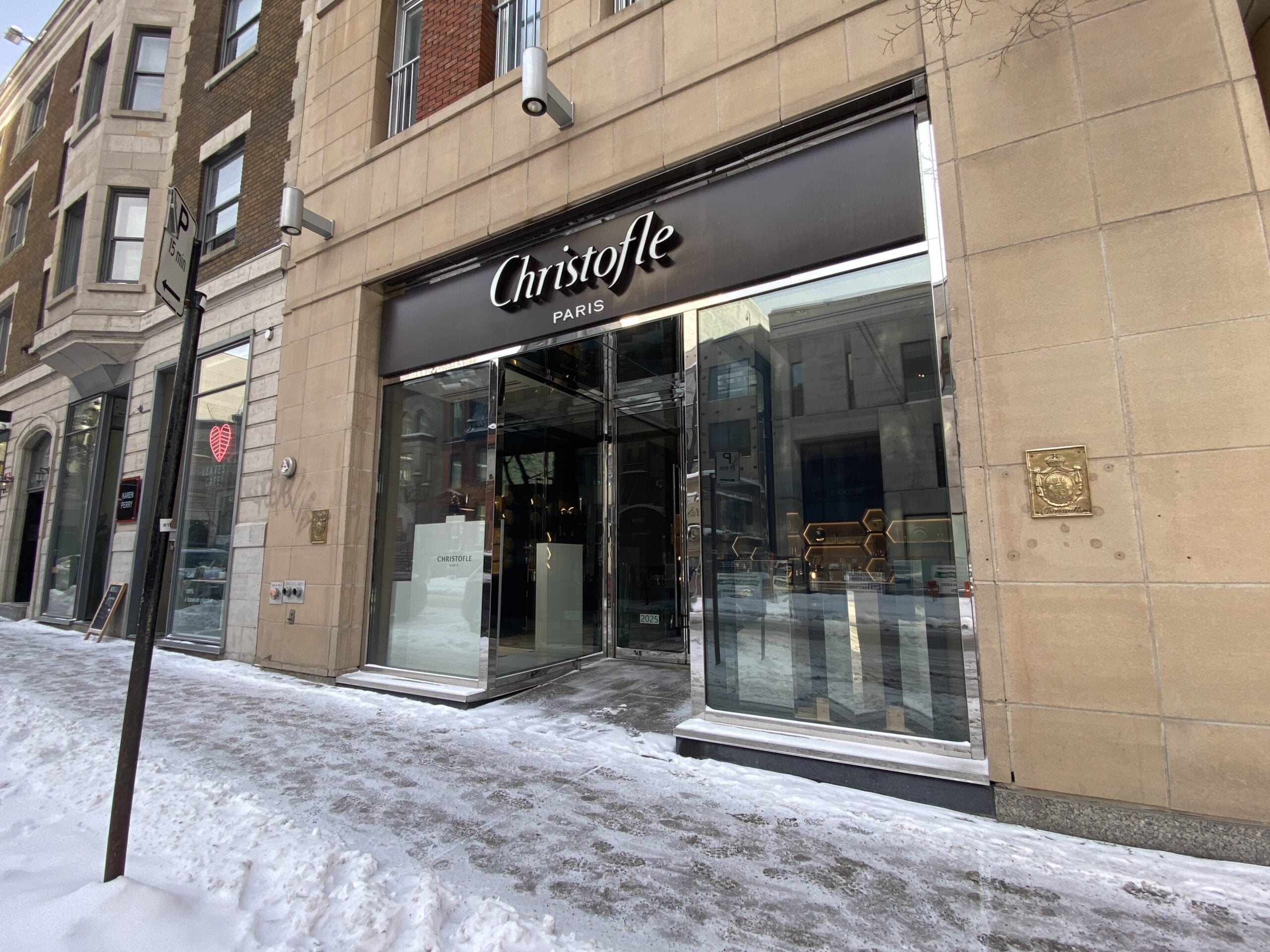
Christofle on Rue De La Montagne in Montreal. Photo: Maxime Frechette
Above is a slideshow on Rue de la Montagne. Swiss luxury brand Montblanc opened at 1289 Boulevard de Maisonneuve West in 2014, and Pavillon Christofle’s only Canadian store opened in the winter of 2016 at 2025 Rue de la Montagne. In the first photo is the new Four Seasons Hotel and Private Residences which is connected to Holt Renfrew Ogilvy. The Residences at the Four Seasons are among the priciest in Montreal. A 3,105-square-foot condominium apartment on the 14th floor is currently asking $7,190,000 and a 6,910-square-foot penthouse on the 18th floor is asking $15,435,000.
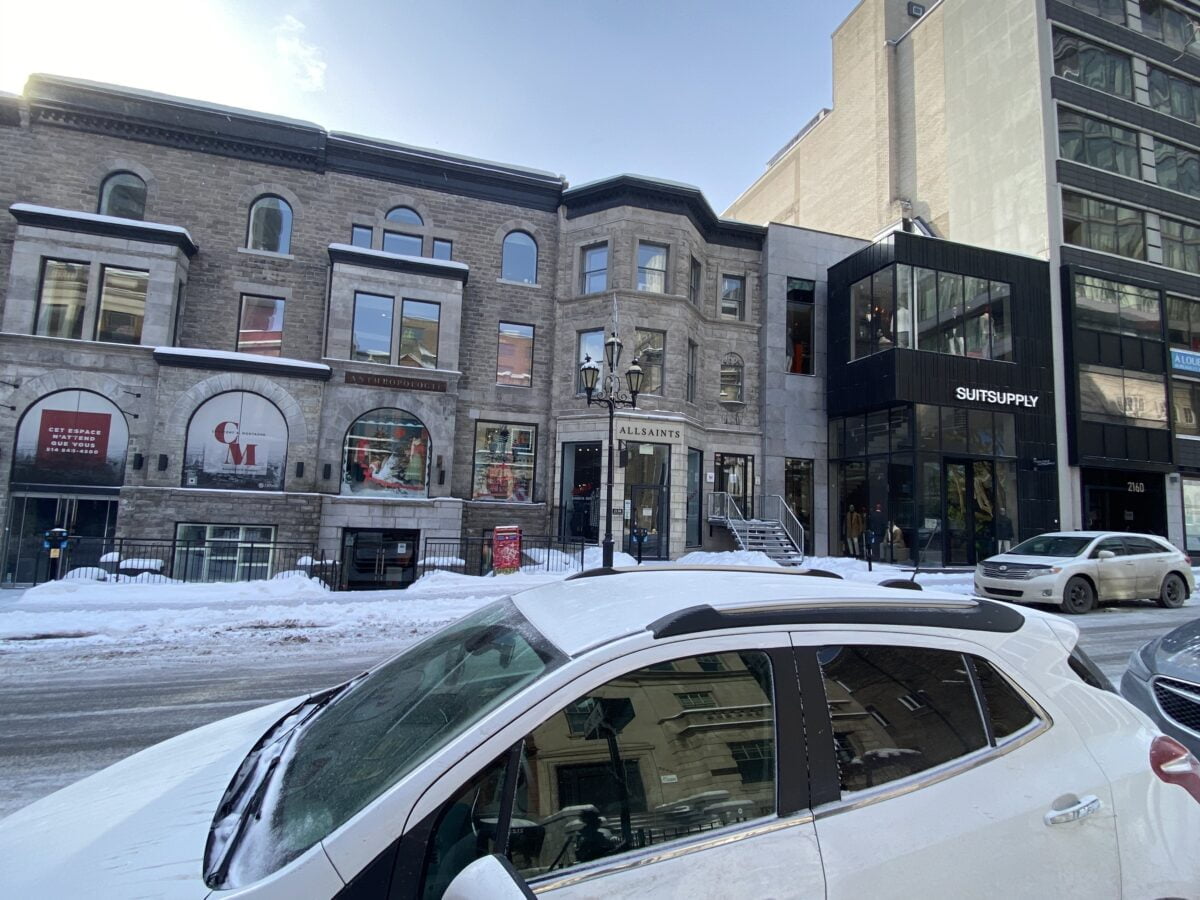
Montreal is a beautiful city with unique grey stone architecture. This row of shops on Rue de la Montagne includes the AllSaints store. Other upscale brands are said to be interested in locating in the area.
Chateau D’Ivoire on Rue De La Montagne in Montreal. Photo: Maxime Frechette
Prestigious jewellery retailer Chateau d’Ivoire is almost finished building a new store on Rue de la Montagne just north of Boulevard Maisonneuve. The current location to the right of the new store will close when the new one opens this year.
Ritz Carleton on Rue De La Montagne in Montreal. Photo: Maxime Frechette
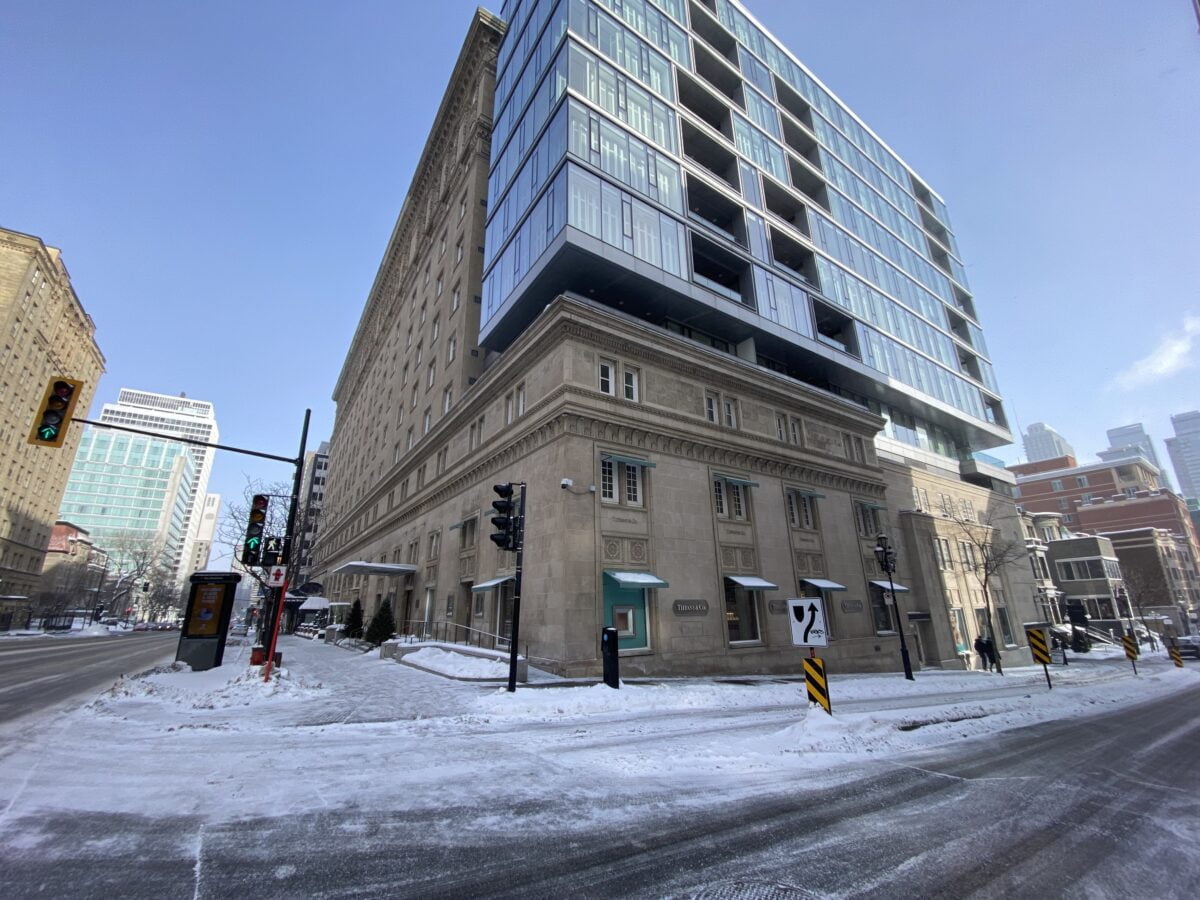
The 2,000-square-foot Tiffany & Co. store at the corner of Rue de la Montagne and Sherbrooke Street West at the Ritz Carlton Hotel. Some are questioning the future of the store given its proximity to the Holt Renfrew Ogilvy Tiffany concession down the street. This photo was taken from in front of the former Holt Renfrew store at 1300 Sherbrooke Street West that closed over the summer to coincide with the completion of the nearby Holt Renfrew Ogilvy.
Rue Sherbrooke Ouest
Old Holt Renfrew location from Rue De La Montagne in Montreal. Photo: Maxime Frechette
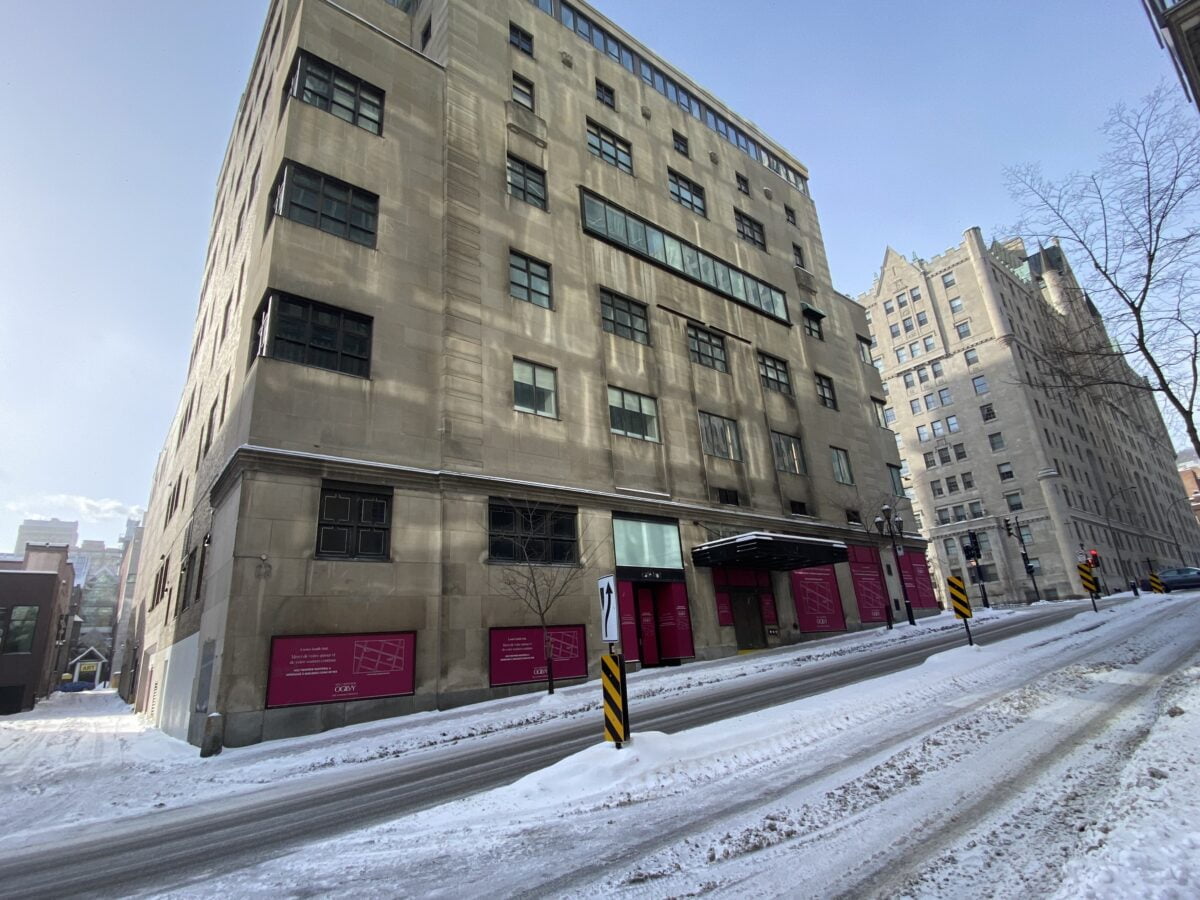
The photo above is of the former Holt Renfrew store taken from Rue de la Montagne. The shorter windows furthest to the right were for a lower-level restaurant space. The building was constructed in 1937 and for years operated as the company’s flagship store prior to the Toronto store gaining that status in 1979.
Old Holt Renfrew location from Sherbrooke in Montreal. Photo: Maxime Frechette
The photo above is the corner of the former Holt Renfrew store at 1300 Sherbrooke Street West. The original store spanned about 30,000 square feet when it was built and was expanded to more than 80,000 square feet prior to its closure. In the 1990s Holt Renfrew operated a Giorgio Armani boutique on the main floor facing Sherbrooke Street.
Old Holt Renfrew location from Crescent in Montreal. Photo: Maxime Frechette
The photo above is of the corner of Sherbrooke Street and Crescent Street. Holt Renfrew’s men’s department occupied the corner until 2016 when it was relocated as part of a reduction of the store’s footprint. The Holt Renfrew store occupied several buildings and in the late 1990s integrated several historic townhouse facades to expand the store as per the photo below.
Former Holt Renfrew at 1300 Sherbrooke St. W., photo by Maxime Frechette
Prior to the townhouses being integrated into the Holt Renfrew store, several retailers operated standalone stores there. In years past, a Polo Ralph Lauren store operated at 1316 Sherbrooke Street (prior to relocating to where Tiffany is now at the Ritz) and in the 1980s a Yves Saint Laurent Rive Gauche boutique was located at 1330 Sherbrooke Street West. The Saint Laurent boutique was operated by York Hannover which also owned the boutique at Hazelton Lanes in Toronto. French designer Sonia Rykiel had a store at 1320 Sherbrooke Street West that was connected to multi-brand retailer Clubissimo from 1986 until the early 1990s.
In the 1980s, Montreal’s Sherbrooke Street was home to several other significant luxury stores over a six block stretch which have all since closed. This included Emanuel Ungaro at 1430 Sherbrooke Street West, Pratesi at 1448 Sherbrooke Street West, Davidoff at 1452 Sherbrooke Street West, Cartier at 1498 Sherbrooke Street West, and Georg Jensen at 1178 Sherbrooke Street West in the 1980s which was replaced by Versace for several years. A pricey Zilli men’s boutique operated at 1472 Sherbrooke Street West between 2007 and 2011 and was the only store for the Italian brand in Canada.
Tiffany & Co. at the Ritz and an Escada store at 1214 Sherbrooke Street West are the only two remaining luxury brands on the street. Escada is in financial trouble and Tiffany’s future is uncertain on the street — it could be the case that all luxury retail will soon exit beautiful Sherbrooke Street which is home to several museums, heritage apartment buildings, and McGill University.
Crescent Street
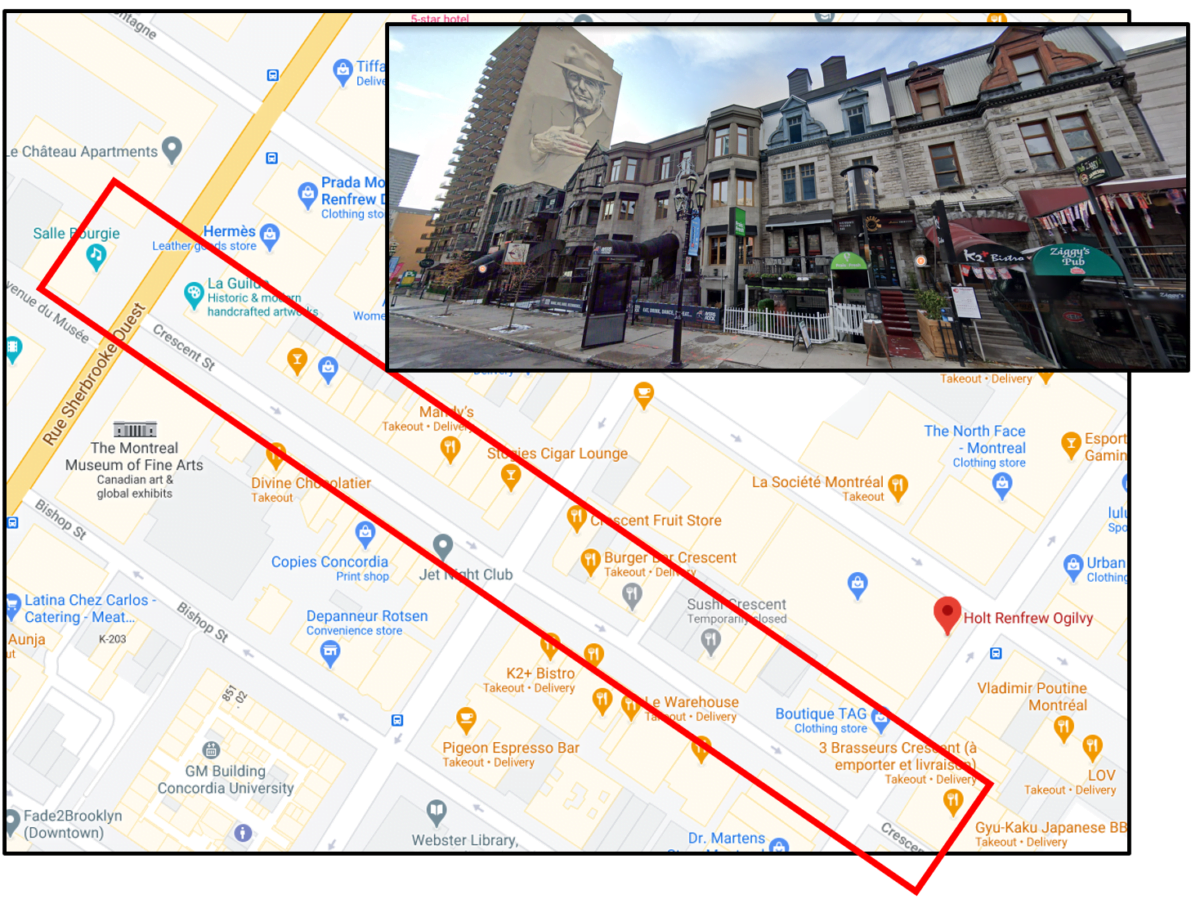
Map of the Montreal Luxury Zone on Crescent Street. Photo: Google Maps.
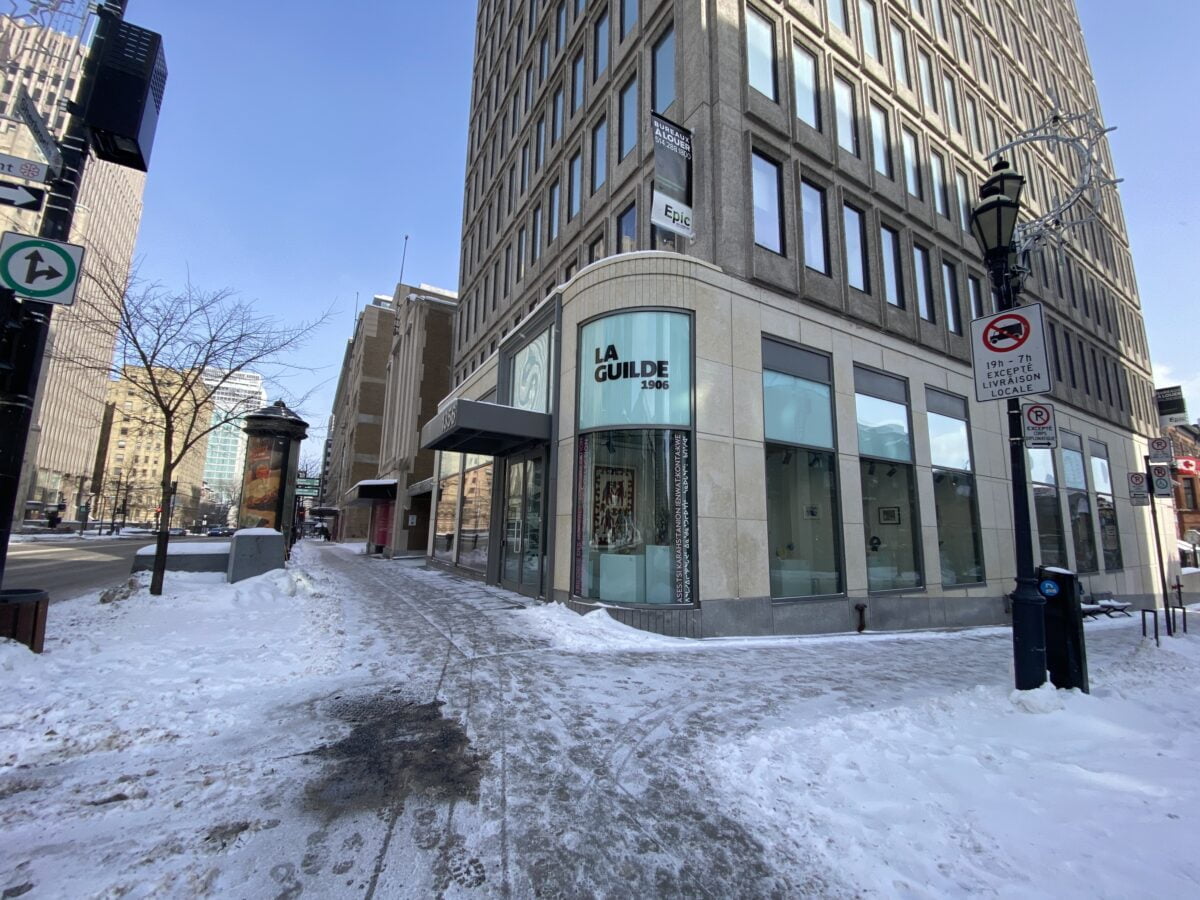
Crescent Street is known for many for its restaurants which were frequented by students prior to the pandemic. In years past, several upscale stores and even luxury brand stores operated on Crescent Street.
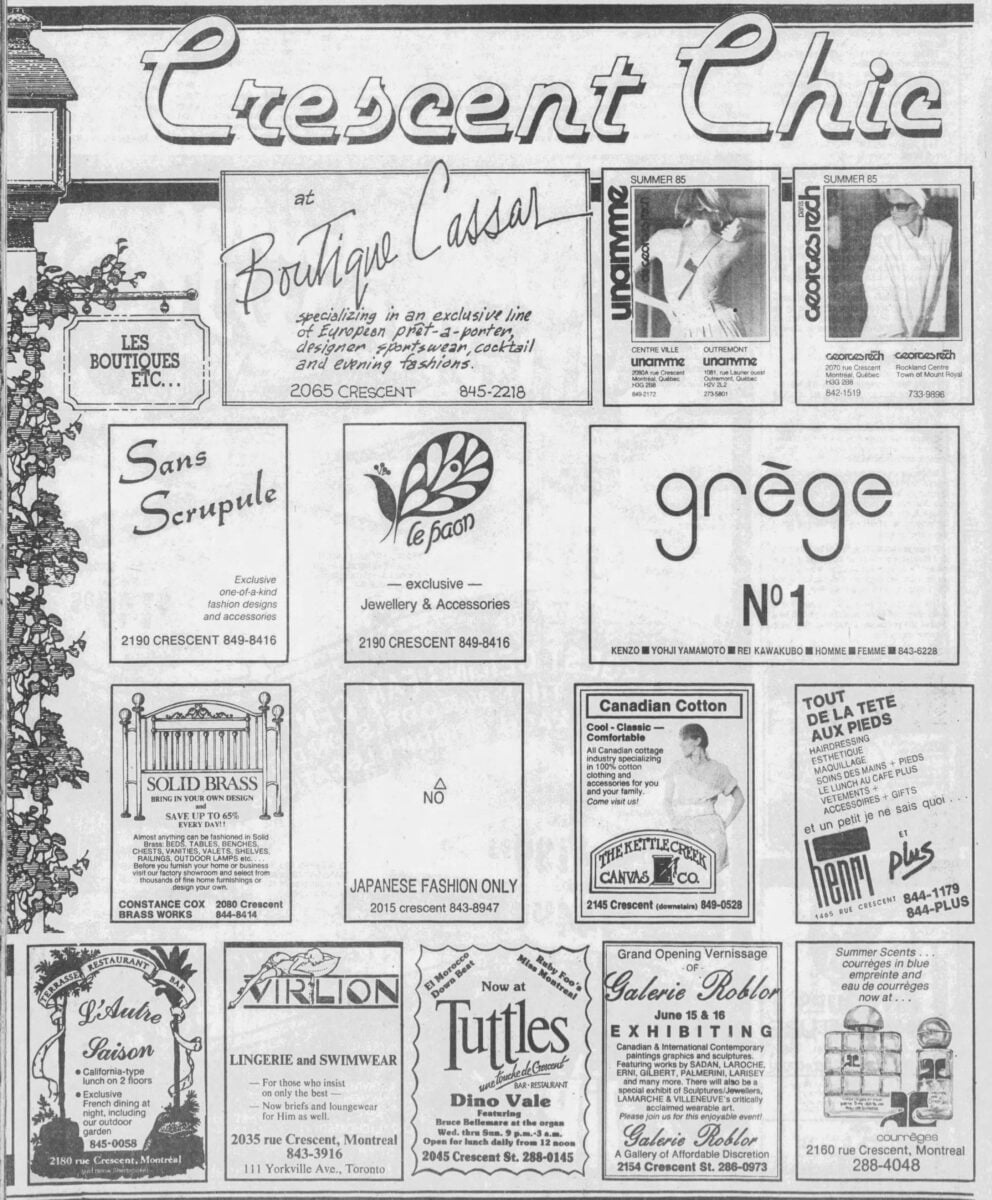
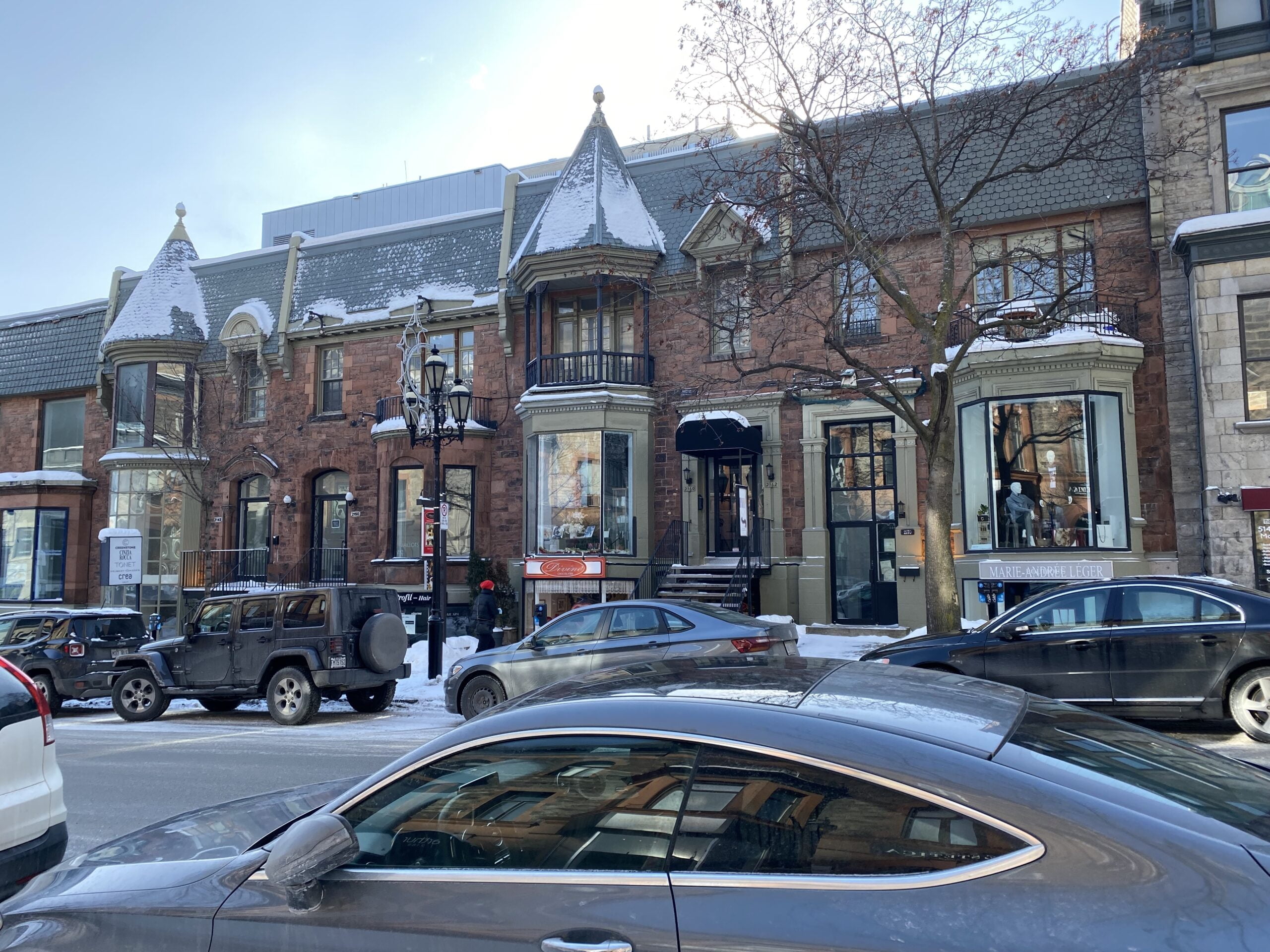
Crescent Street is quite different now from what it was in decades past in terms of retail tenants. In the 1980s, Crescent Street was considered to be a luxury address which included several important women’s fashion stores in a row of beautiful brown stone buildings. French women’s luxury brand Celine once had a store at 2142 Crescent Street, French fashion brand Courreges had a store at 2160 Crescent Street, Upscale French women’s fashion brand Georges Rech operated at 2070 Crescent Street, Canadian fashion brand The Kettle Creek Canvas Company had a store at 2145 Crescent Street, and UK fashion and home goods brand Laura Ashley had a store at 2110 Crescent. Luxury multi-brand retailer Grege, which focused on Japanese brands, operated at 2130 Crescent Street from 1976 to 1995 when the company was dissolved. Various other upscale boutiques and food and beverage options made for a desirable destination. At one time Crescent Street advertised itself in local papers to draw in shoppers and we have included a clipping of one from 1985 below, noting that all of the upscale boutiques have since shuttered.
Crescent Street advertisement in the Montreal Gazette on 27 June 1985. Image via Newspapers.com Overall Crescent Street in Montreal. Photo: Maxime Frechette
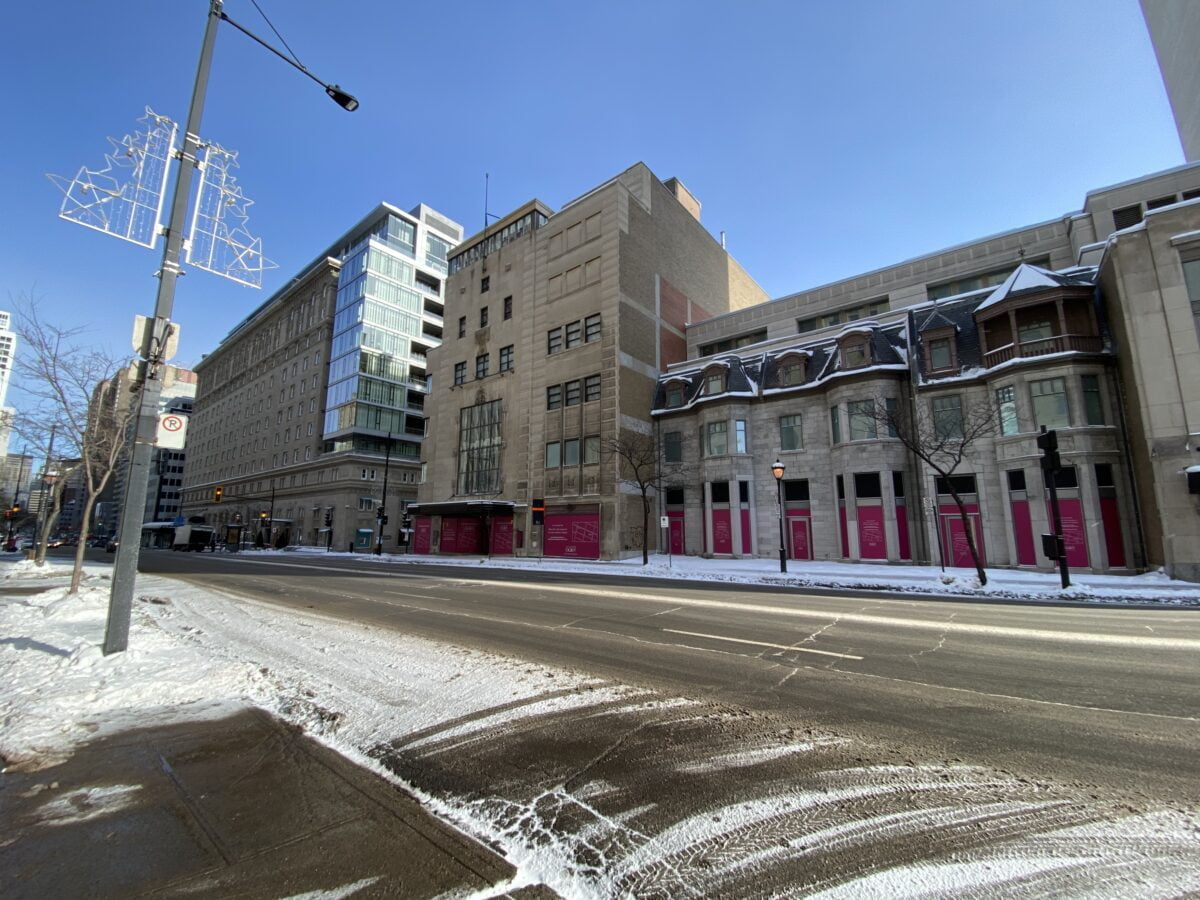
The photo above was taken from Sherbrooke Street looking down Crescent Street. Holt Renfrew Men occupied the building to the left for years and a museum is located to the right.
Crescent Street in Montreal. Photos: Maxime Frechette
1 of 2
Former Shan location on Crescent Street in Montreal. PHOTO: MAXIME FRECHETTE
Overall Crescent Street in Montreal. Photo: Maxime Frechette
The photo above showcases some of the beautiful architecture on Crescent Street south of Sherbrooke Street. This complex was the heart of the former luxury brand stretch that characterized Crescent Street particularly in the 1980s when Montreal was a fashion mecca. French Luxury brand Celine had a store in the second storefront from the left with the bow window in the 1980s.
CNTRBND on Crescent Street in Montreal
1 of 2
CNTRBND on Crescent Street in Montreal. Photo: Maxime Frechette
CNTRBND on Crescent Street in Montreal. Photo: Maxime Frechette
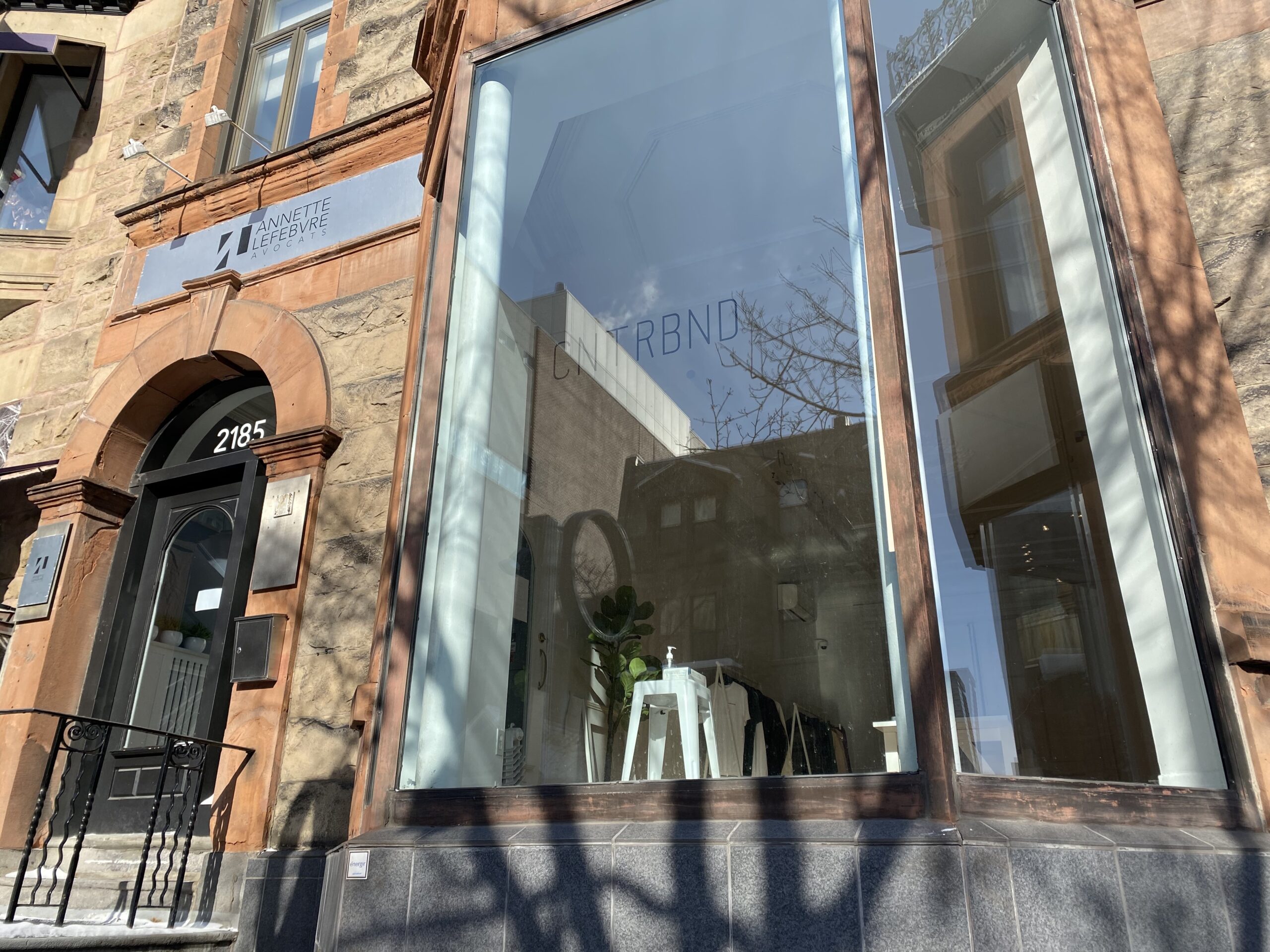
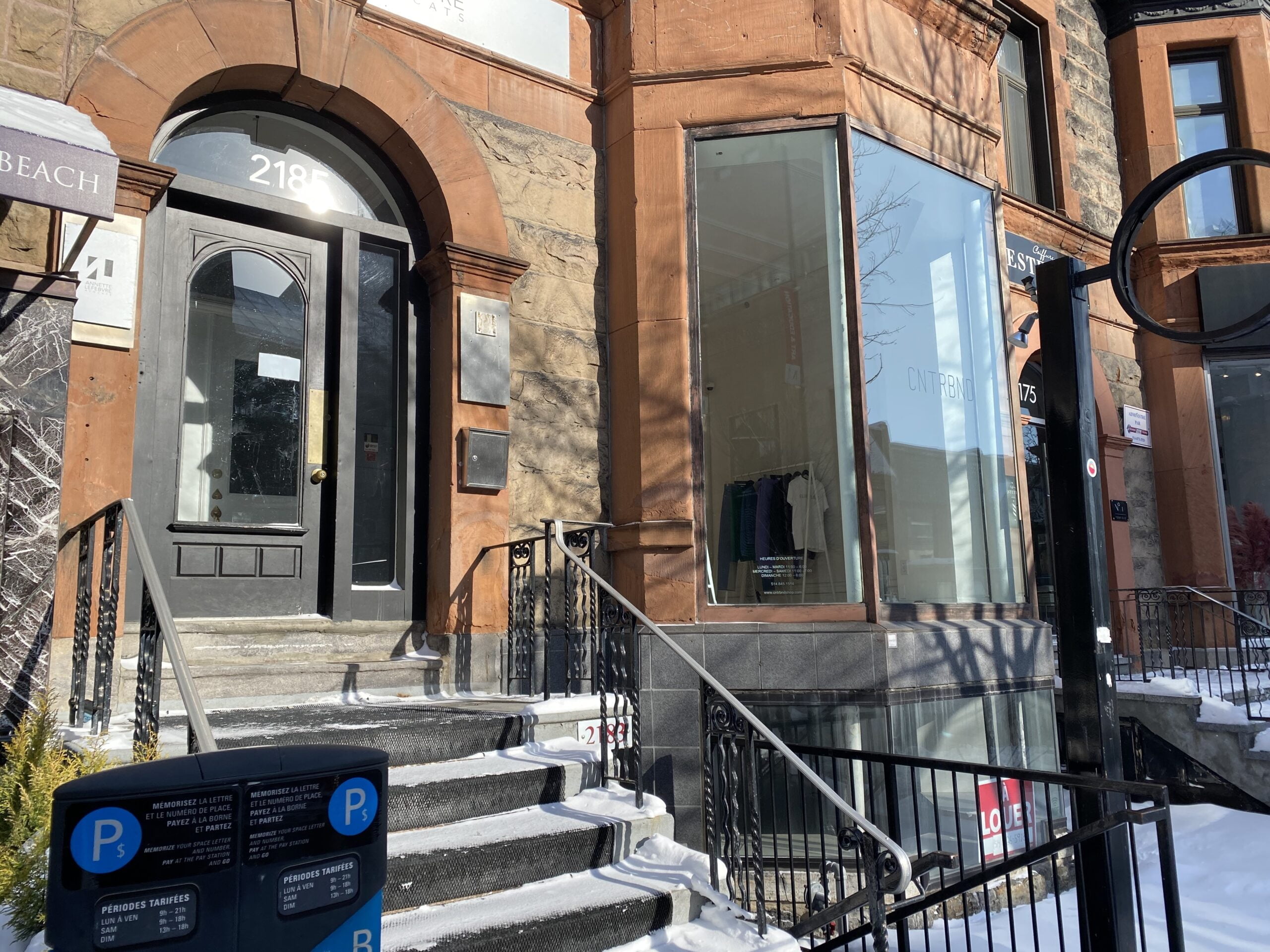
Upscale Toronto-based multi-brand retailer CNTRBND opened a store at 2185 Crescent Street last year. The store is located in a historic townhouse and features unique architecture inside and out. CNTRBND also has stores in Toronto and Vancouver and will be announcing a new location soon.
Given the unique situation of the street and CNTRBND’s relationship with brands, the retailer could bring new concepts to Crescent Street in the future.
Kaufmann on Crescent Street in Montreal. Photo: Maxime Frechette
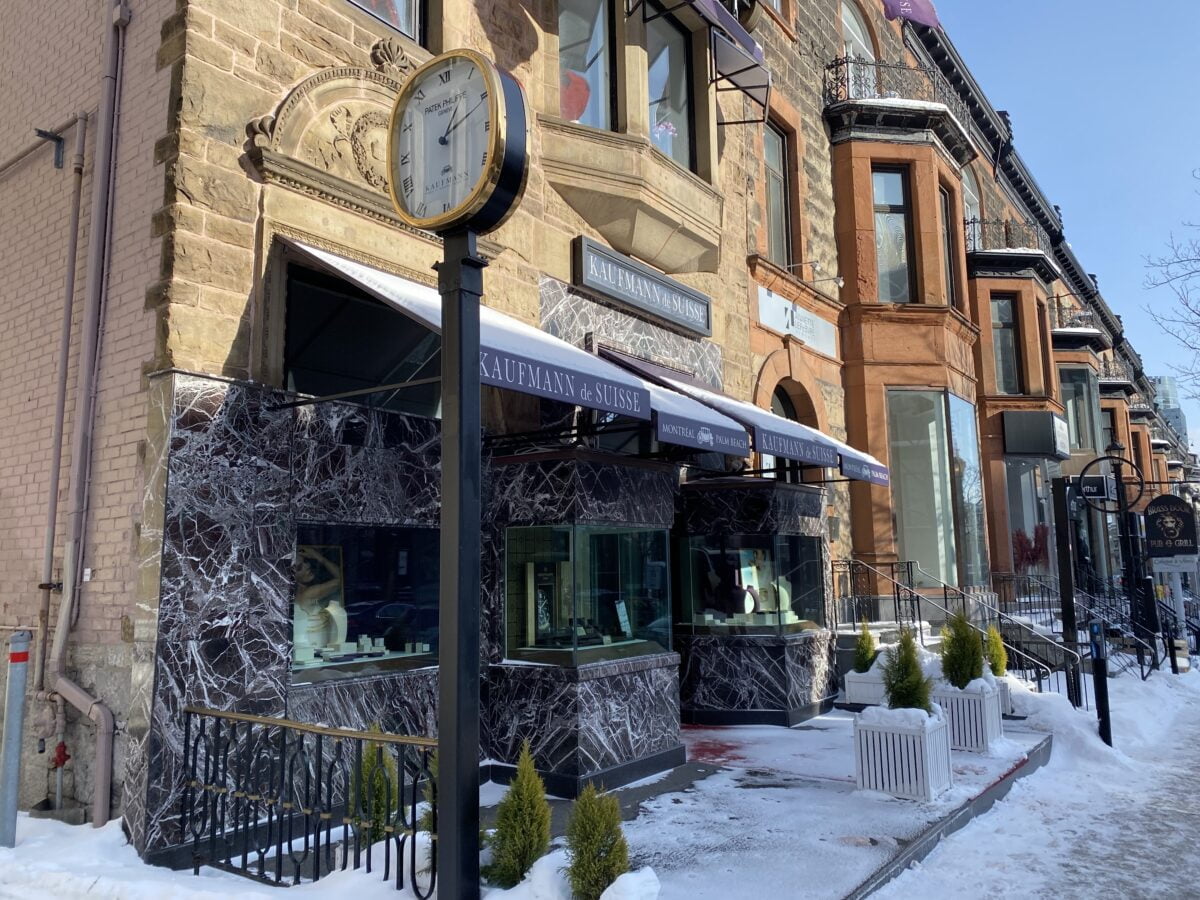
Jewellery retailer Kaufmann de Suisse has operated for years at 2195 Crescent Street. It is one of the few long-term, upscale retail tenants on the street.
SQDC (former Parasucco location) on Crescent Street in Montreal
1 of 2
SQDC occupies half the building (former Parasucco location) on Crescent Street in Montreal. Photo: Maxime Frechette
SQDC occupies half the building (former Parasucco location) on Crescent Street in Montreal. Photo: Maxime Frechette
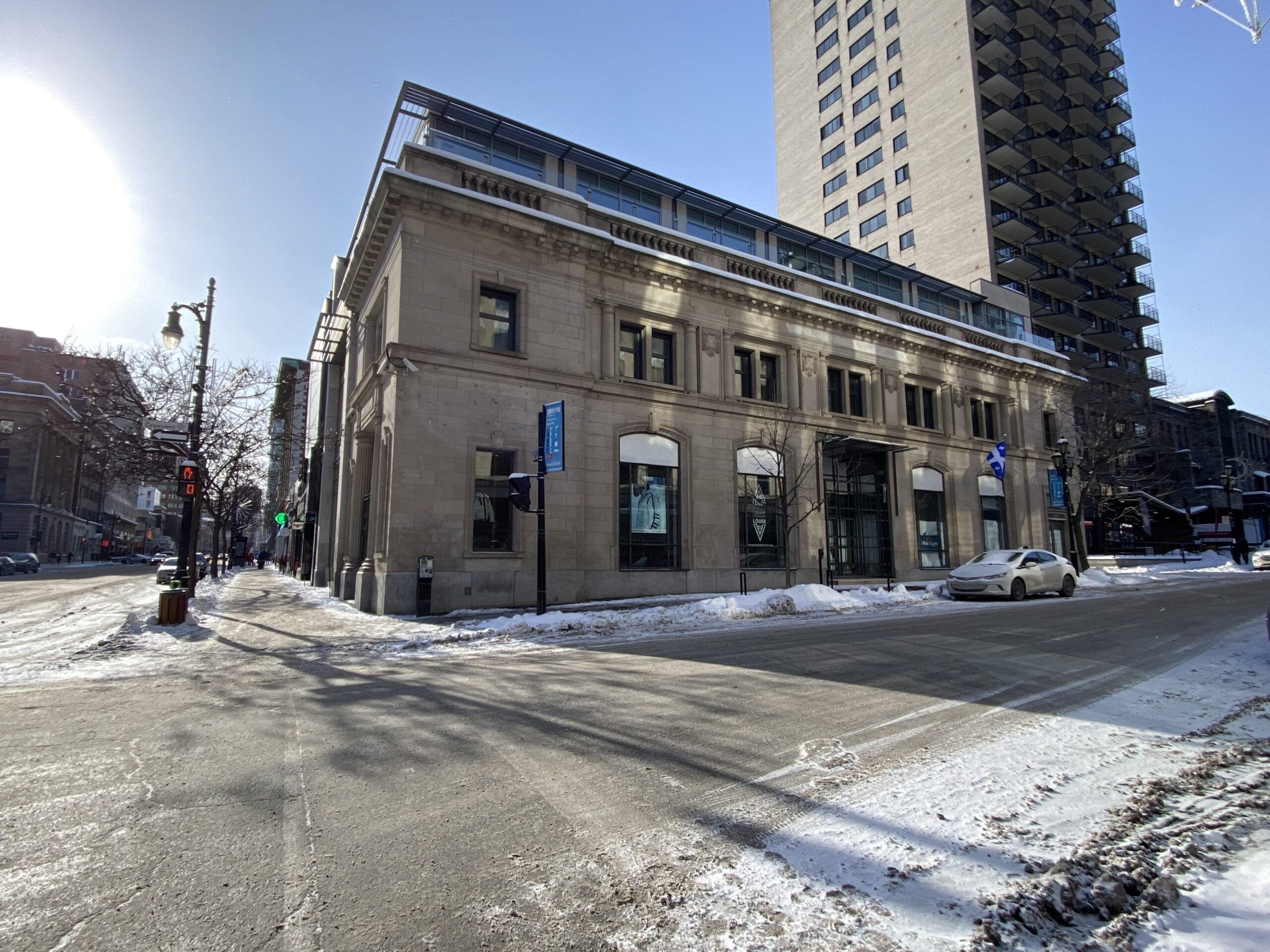
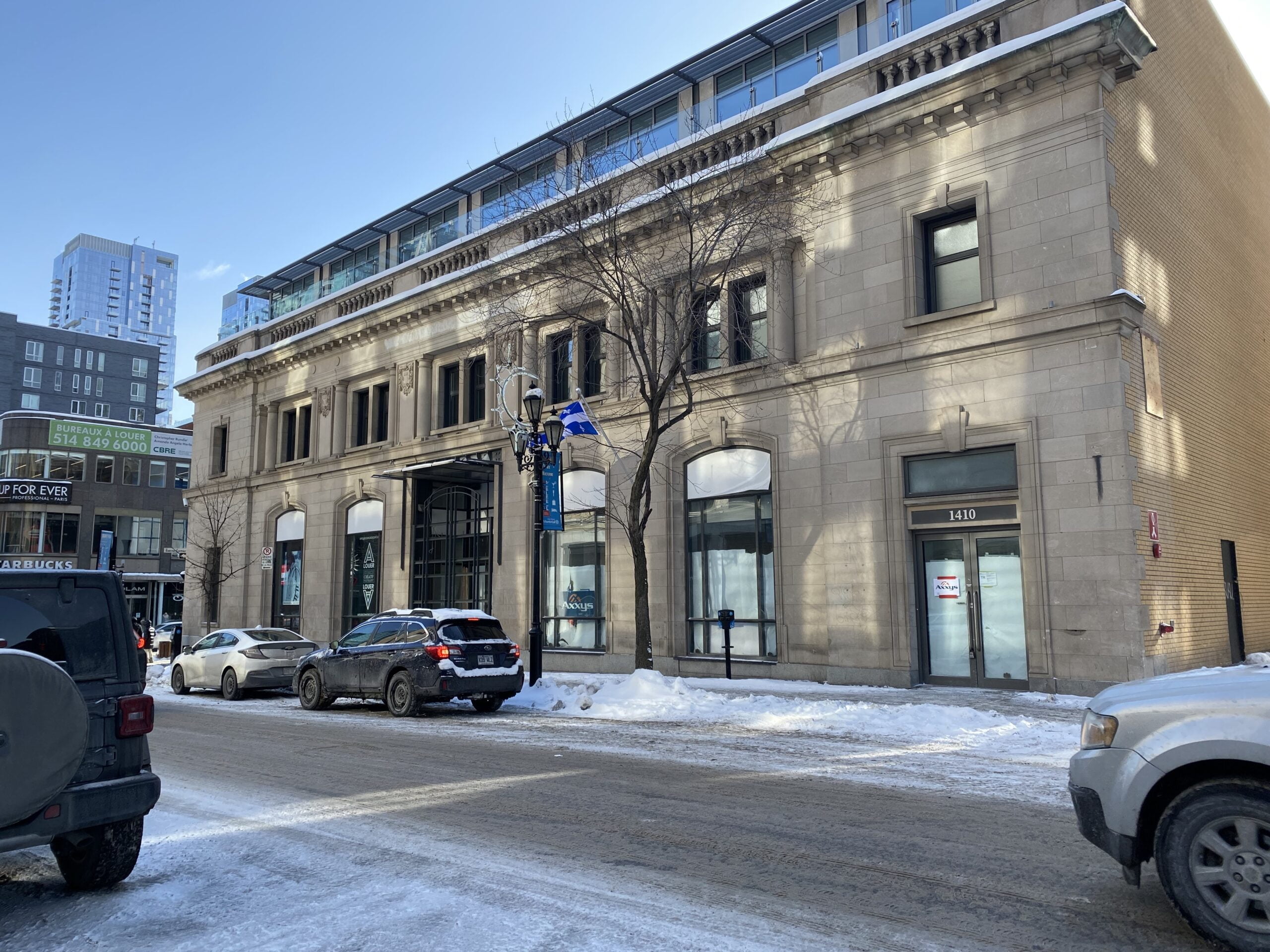
The building above was formerly occupied by denim brand Parasucco and is now a CQDC.
Crescent Street Retailers in Montreal
1 of 5
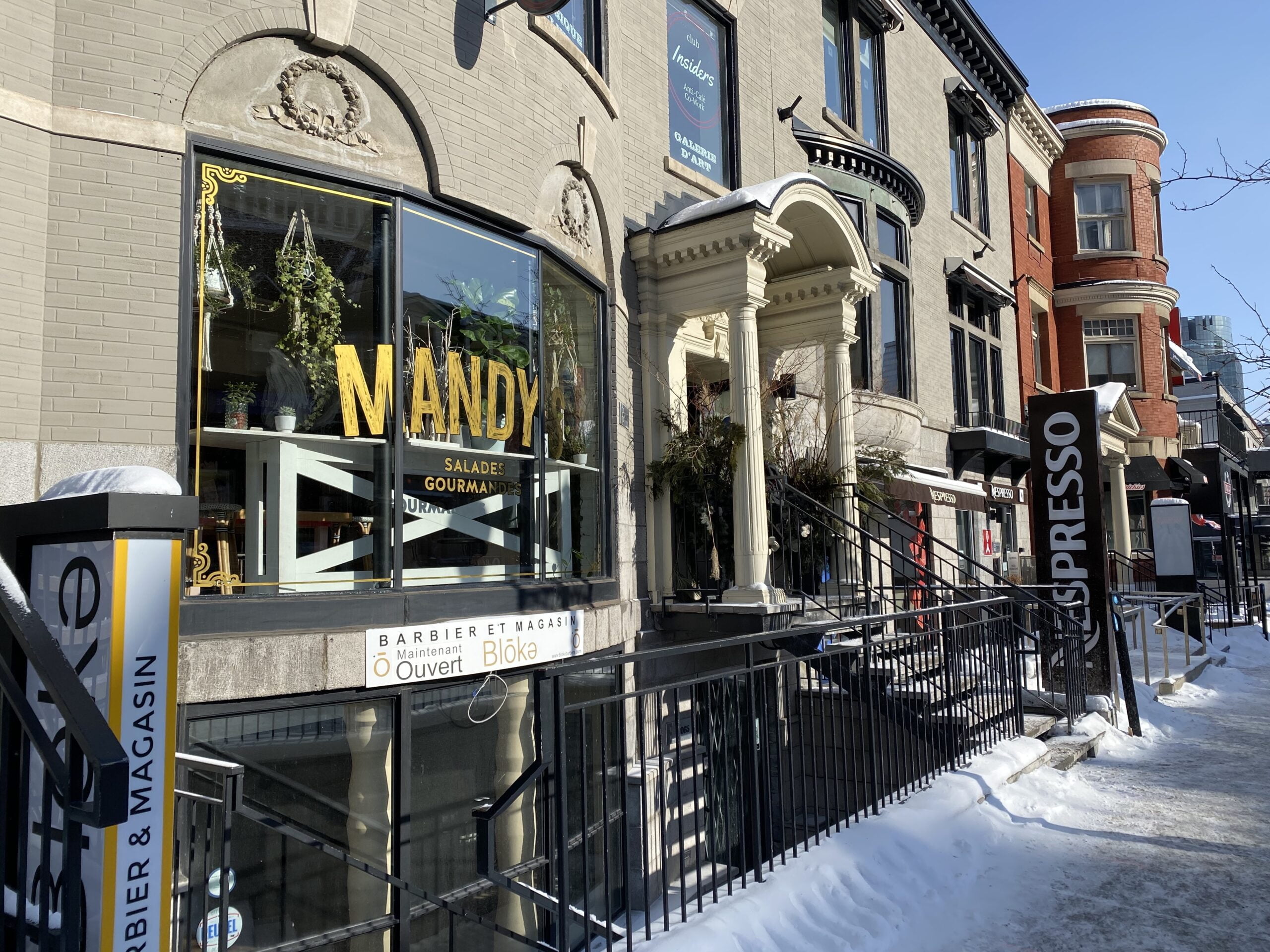
Mandys on Crescent Street in Montreal. Photo: Maxime Frechette
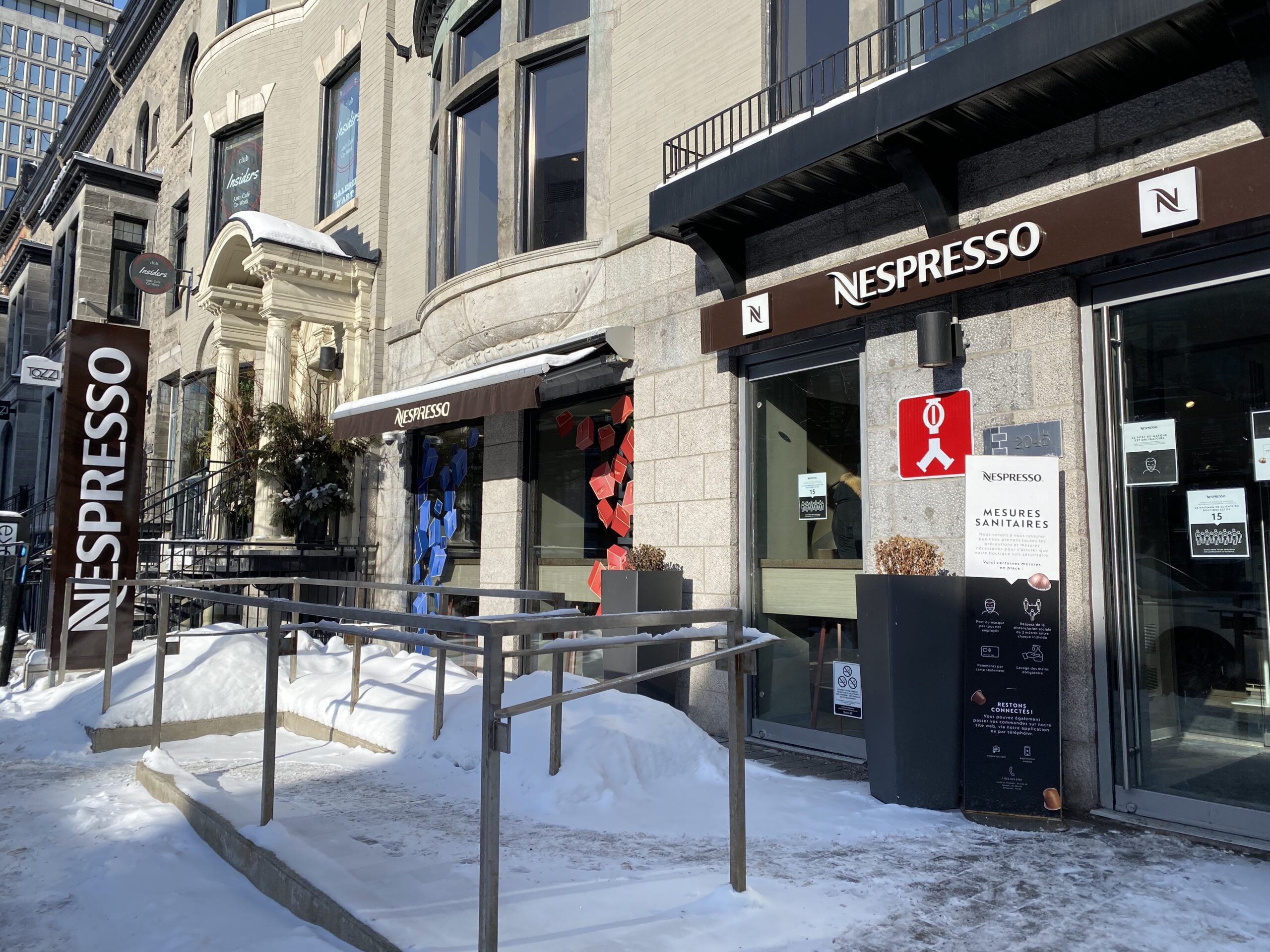
Nespresso on Crescent Street in Montreal. Photo: Maxime Frechette
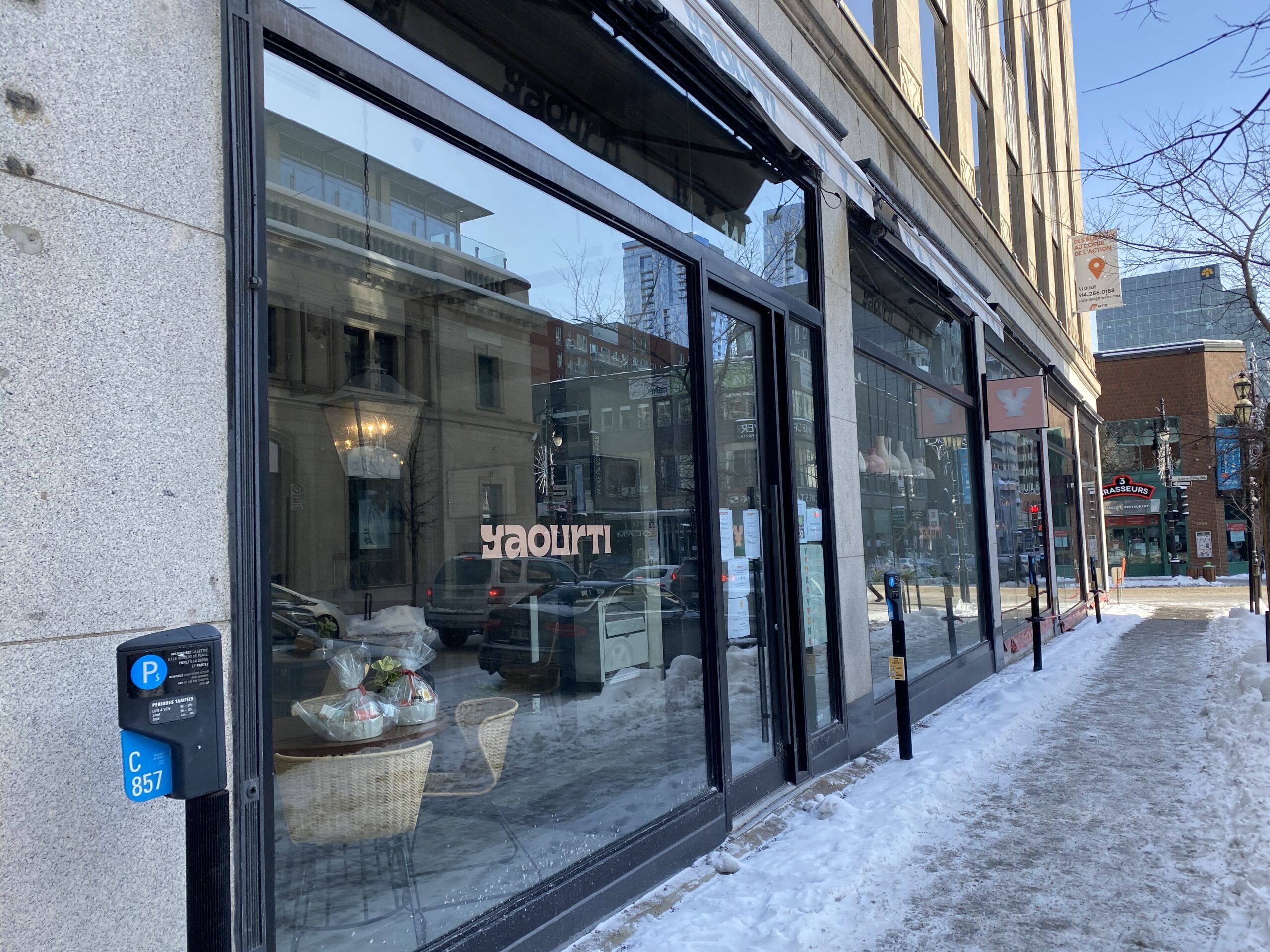
Yaourti on Crescent Street in Montreal. Photo: Maxime Frechette
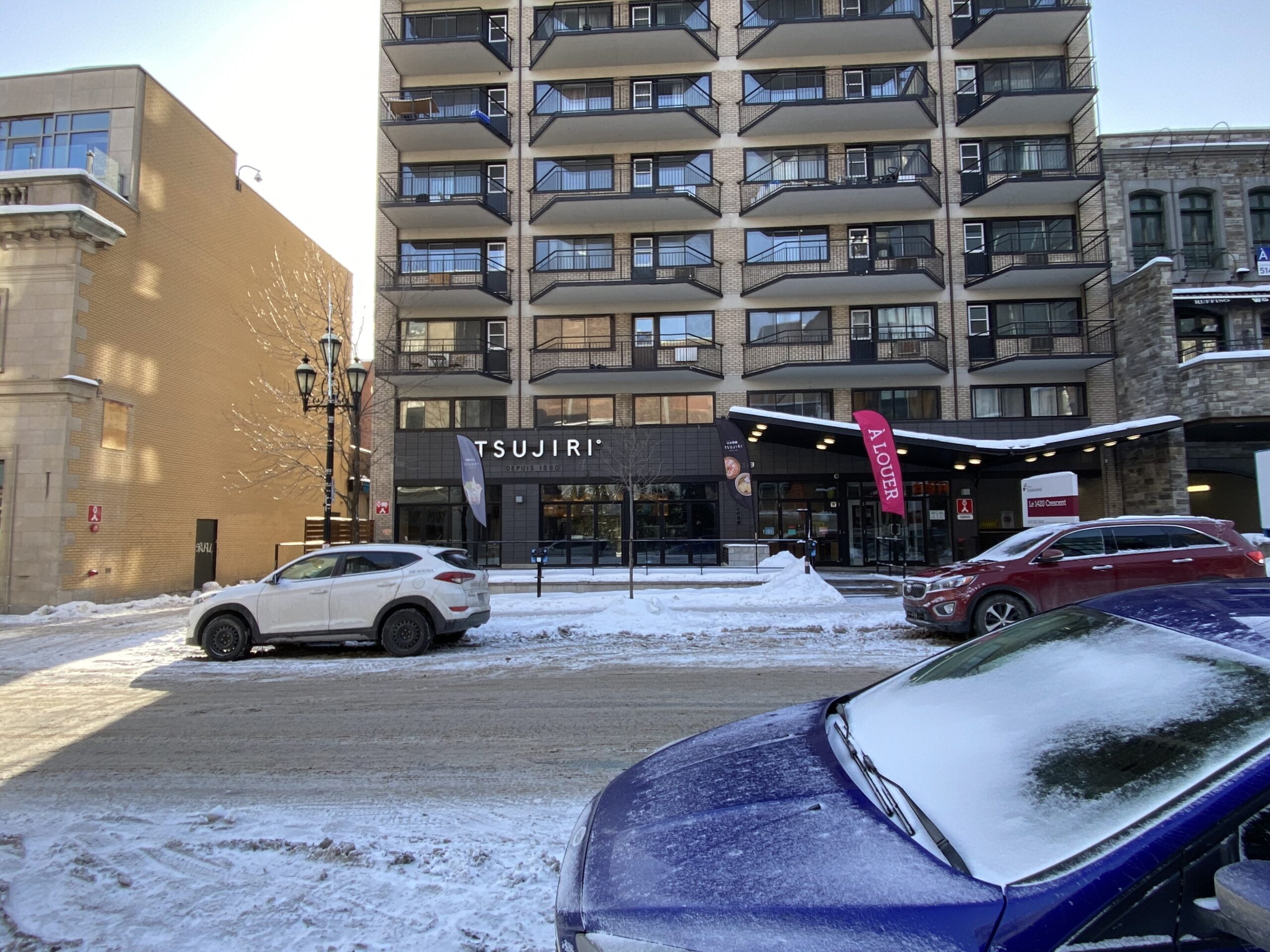
TSUJIRI on Crescent Street in Montreal. Photo: Maxime Frechette
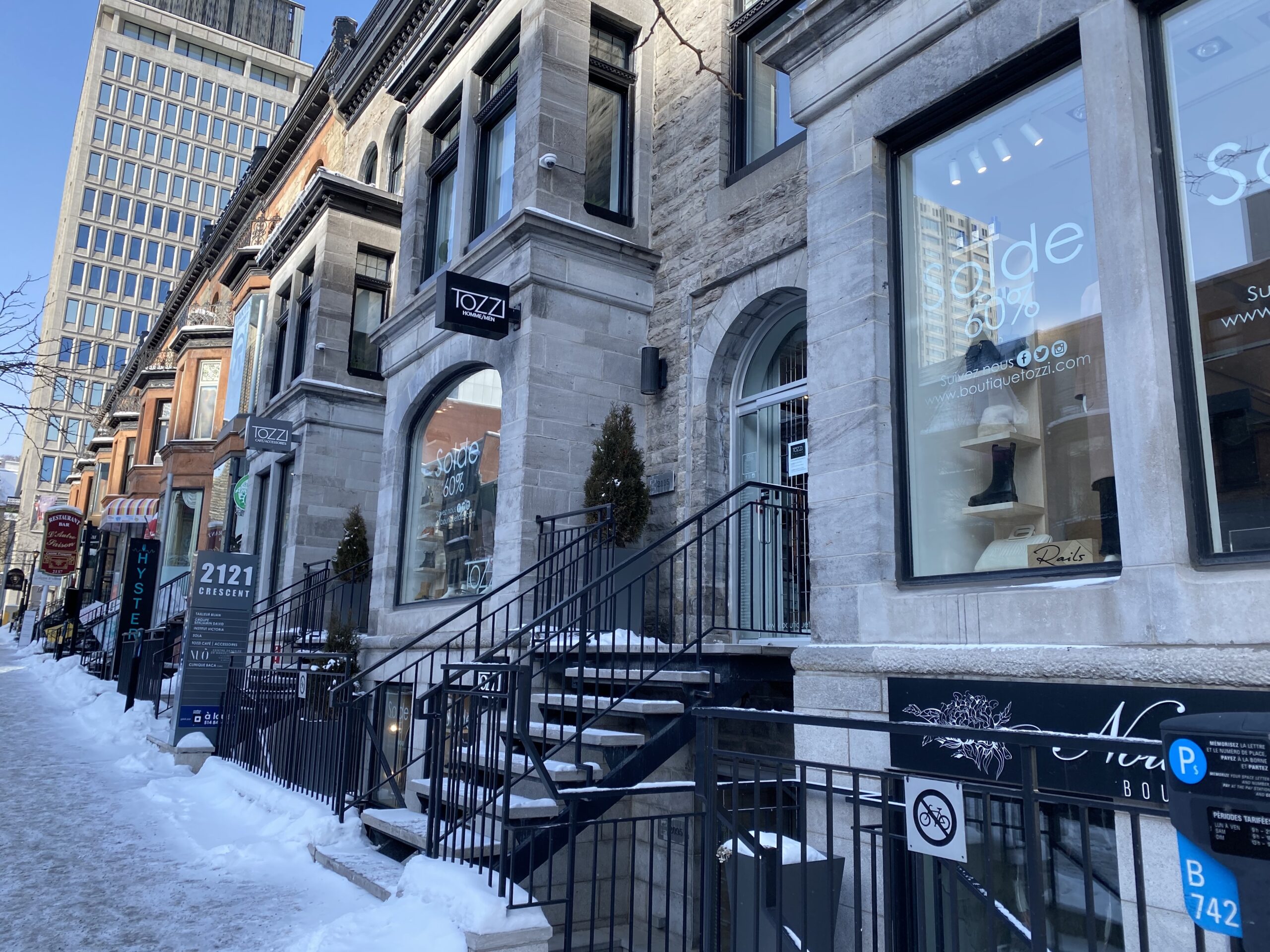
Tozzi on Crescent Street in Montreal. Photo: Maxime Frechette
The above slideshow includes: Montreal-based restaurant Mandy’s, known for its gourmet salads, which has several stores in Montreal including one on Crescent Street. Mandy’s will be entering the Toronto market as part of an expansion. Nestlé-owned coffee concept Nespresso which operates a café and retail space on Crescent Street, and various other independent retailers and restaurants currently occupy retail spaces on the stretch between Sherbrooke and Sainte-Catherine Streets.
Thank you for joining us on this brief tour of a loop in downtown Montreal’s Golden Square Mile. The area has changed over the years and there’s more to come. Feel free to comment on your thoughts and favourite memories below.
And thank you Maxime Frechette for taking photos for this article.
Discover More Related Retail Photo Tours From Retail Insider:
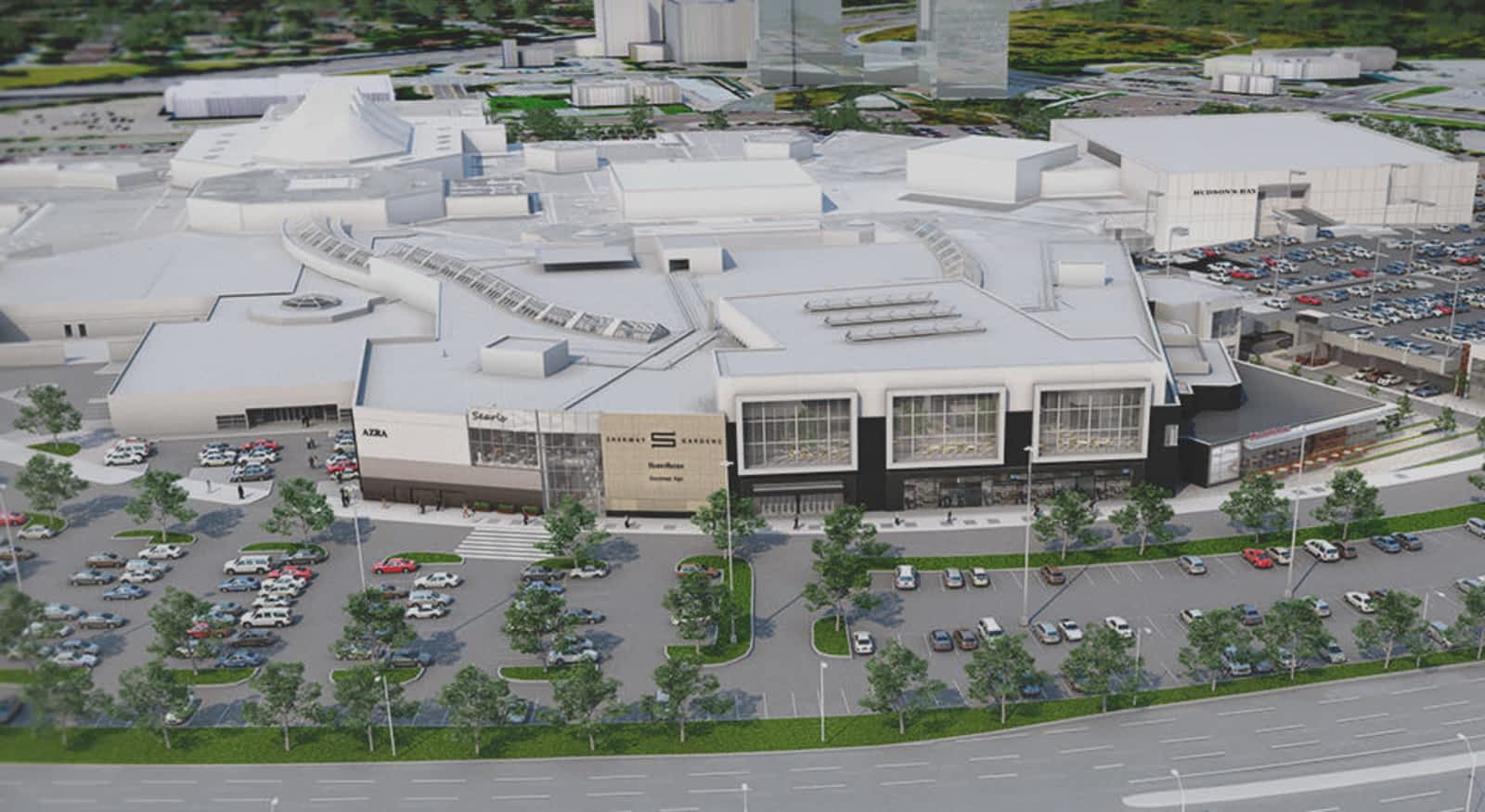
Aerial view of CF Sherway Gardens. Photo: Cadillac Fairview
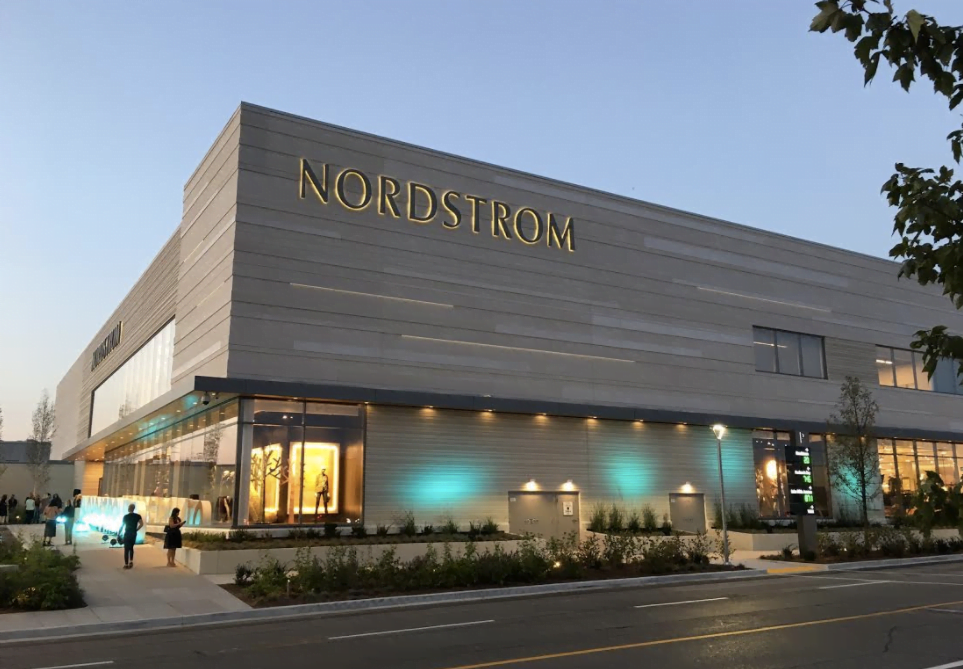
Nordstrom at CF Sherway Gardens. Photo: Nordstrom
NORDSTROM AT SHERWAY GARDENS
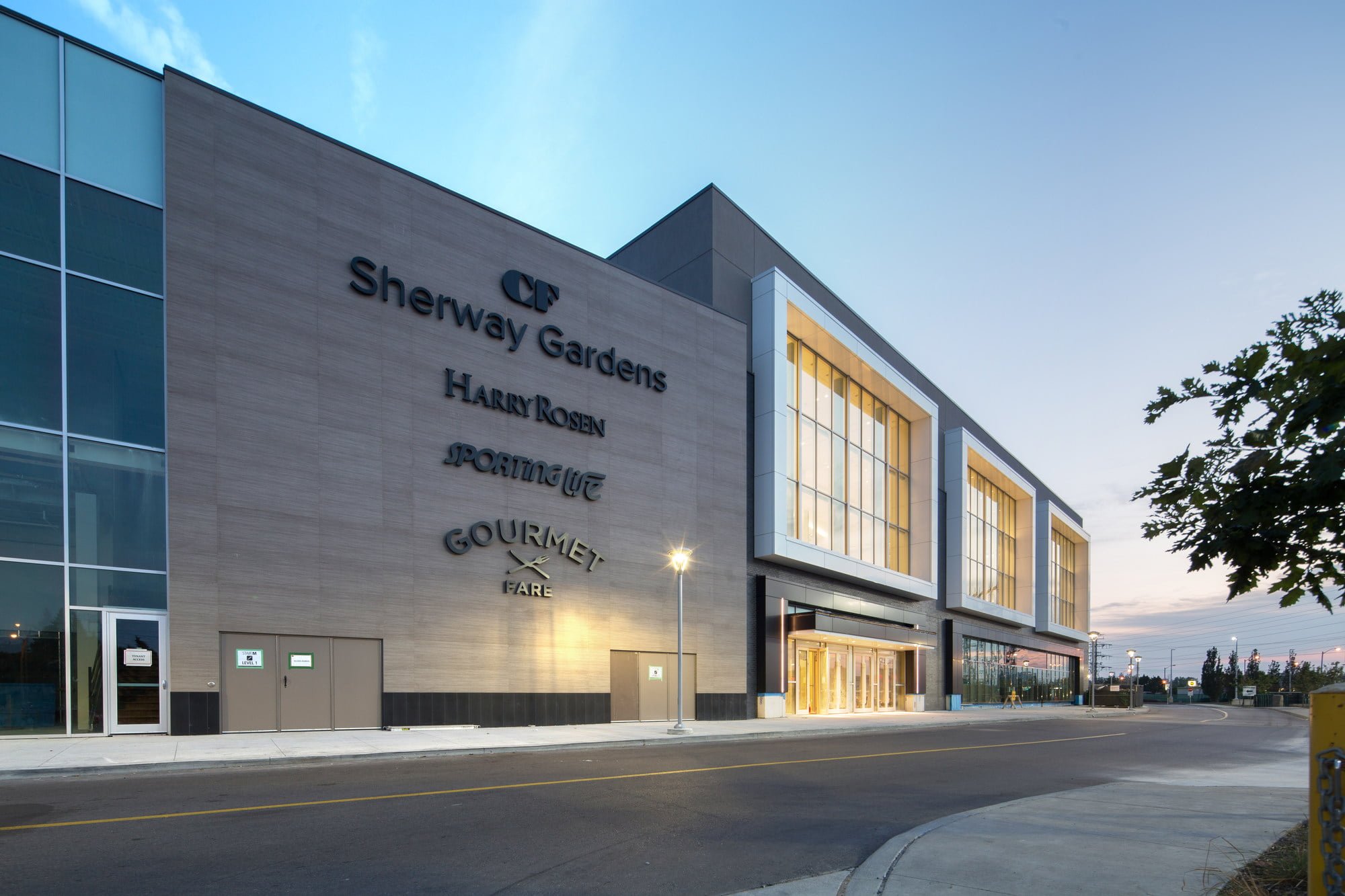
The CF Sherway Gardens shopping centre in Toronto is marking its 50th birthday this spring. The Cadillac Fairview-managed centre opened in 1971 and the centre has seen expansions over the years, resulting in it becoming one of the leading shopping centres in the country in terms of appearance and tenant mix.
The original $21.5 million shopping centre was built by The Rouse Corporation in an S-shaped configuration spanning about 850,000 square feet with 127 stores. The mall featured fountains, indoor greenery, benches and couches, as well as an intimate low ceiling design. In order to gain the best visibility from both the QEW/Gardiner Expressway and Highway 427, original anchor tenant, Eaton’s, had the mall’s design turned sideways so that its storefront was most visible. The former Eaton’s space is now occupied by Saks Fifth Avenue and Sport Chek. Simpsons was the other main anchor store at CF Sherway Gardens and that space is now occupied by a Hudson’s Bay store.
In 1975 the centre’s ‘S’ layout became a figure eight with an expansion that added 75 retailers. In 1987 Holt Renfrew opened a store in a new wing to the north where the store operated until 2016. A south wing added in 1989 included a tent-like roof structure designed by Zeidler Roberts Partnership Architects — Ottawa-based upscale department store chain Brettons anchored the new wing.
In 2013 Cadillac Fairview announced a $550 million renovation and expansion that added 210,000 square feet to the shopping centre. Other changes to the centre include a new 143,000-square-foot Saks Fifth Avenue store that opened in February of 2016 and a 140,000-square-foot Nordstrom store that opened in the fall of 2017. CF Sherway Gardens is one of the most productive malls in the country in terms of sales per square foot and it is also one of the largest shopping centres in Canada.
“For five decades, CF Sherway Gardens has provided a welcoming space for community members to come together to experience the best of retail, dining and vibrant seasonal and celebratory moments,” said Martin Wray, Vice President of Retail Operations, Cadillac Fairview. “It has been an honour to evolve alongside our community, and we look forward to a time when we can celebrate these special moments together.”
“Our team is committed to creating meaningful community connections while providing consumers with safe and memorable experiences and access to top retailers, restaurants and services to meet their needs,” said Andy Traynor, General Manager, CF Sherway Gardens. “From day one we’ve garnered strong regional support and built a true sense of togetherness with local patrons, which continues to be our priority and is a testament to our longstanding success.”
Brass Rail Tavern Strip Bar to Close on Yonge Street Amid Area Changes
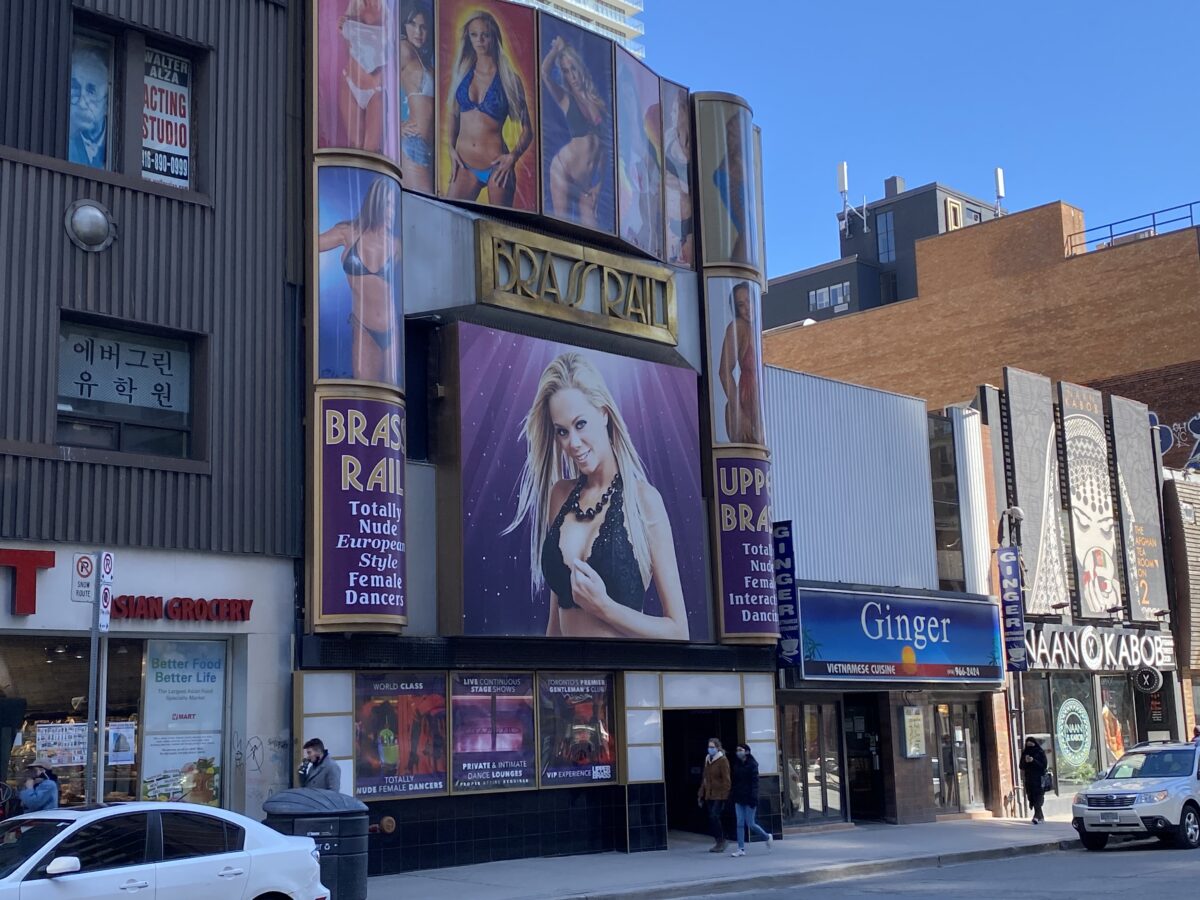
The Brass Rail on Yonge Street, Friday April 2. Photo: Craig Patterson
The Globe & Mail this week reported that the Brass Rail Tavern strip club at 701 Yonge Street, south of Bloor Street, is set to be redeveloped as part of changes happening within the area. The 0.21-acre site could fetch about $32 million according to market estimates amid booming land values in Toronto’s downtown core.
Redevelopment of the block signals significant changes to the Yonge Street strip south of Bloor Street, which has also seen other recent developments directly on Bloor. That includes the 1 Bloor Street East commercial podium, now owned by First Capital REIT, which is anchored by a Nordstrom Rack store. The ONE at 1 Bloor Street West is under construction and is expected to be a draw when an Apple retail store opens on the corner in a couple of years. A University of Toronto-owned residential building at the northwest corner of Yonge and Charles Street will see its retail podium renovated as well, and last year a revitalized heritage renovation to the south included the opening of a two-level Shoppers Drug Mart store.
The revitalization of the area is expected to again see a more upscale retail mix move southward along Yonge Street. In decades past, several upscale fashion stores such as Allan Cherry and Alan Goouch operated in the area, along with international brands such as Benetton. New developments have in some instances changed the character of Yonge Street from small pedestrian-friendly storefronts to larger podium formats at the base of tower structures, causing some concern among heritage preservationists.
Vancouver-Based Furniture Brand ‘Sundays’ Opens Pop Up Store in Toronto’s Downtown
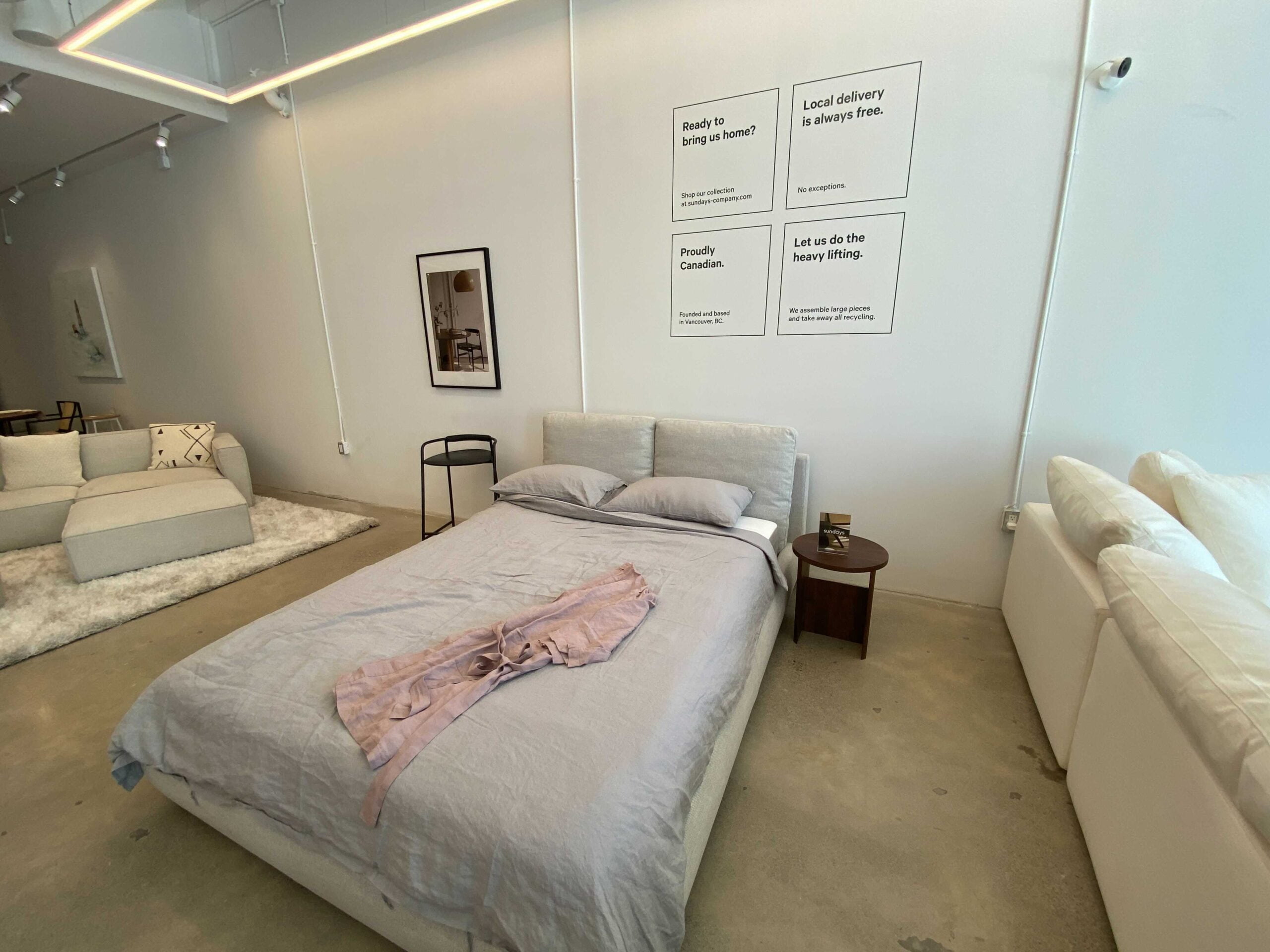
Sundays at 113 Ossington Avenue. Photo by Dustin Fuhs
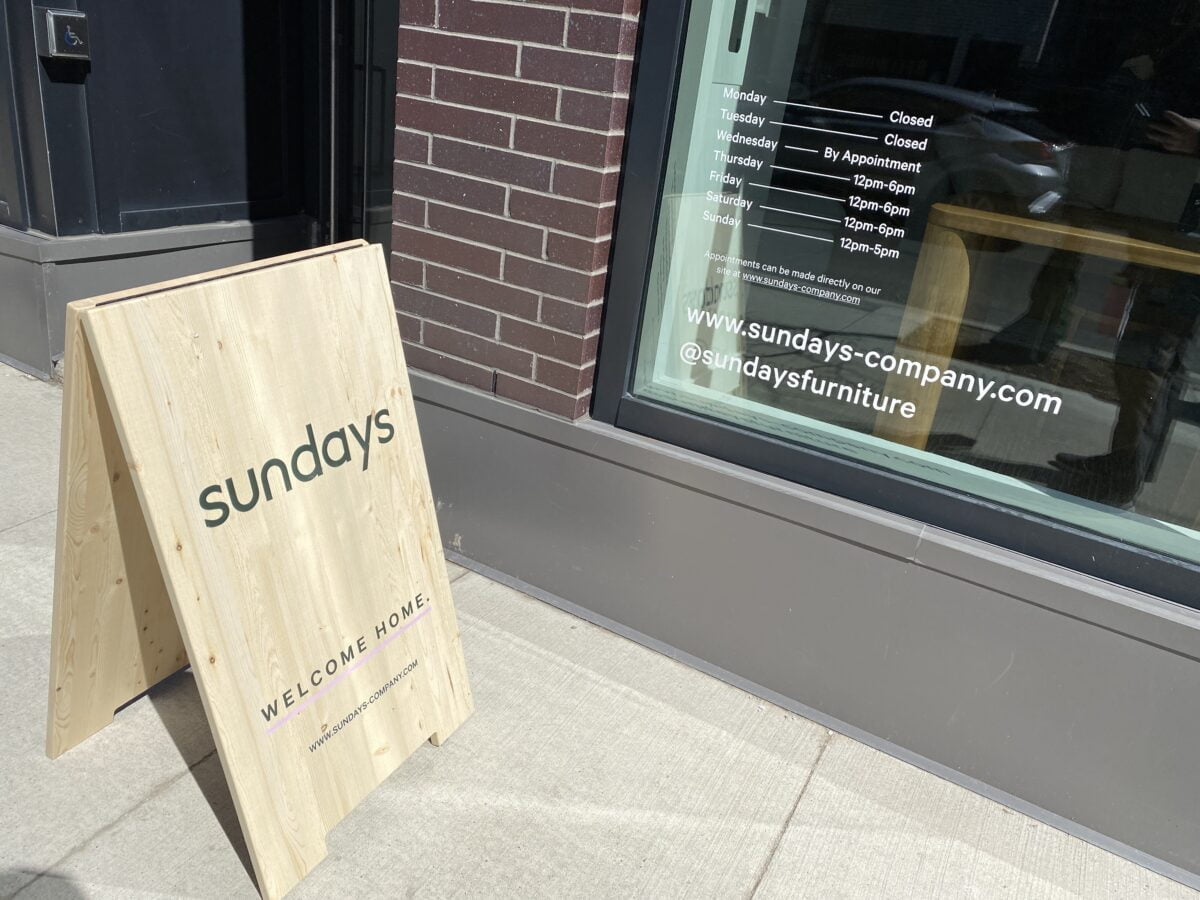
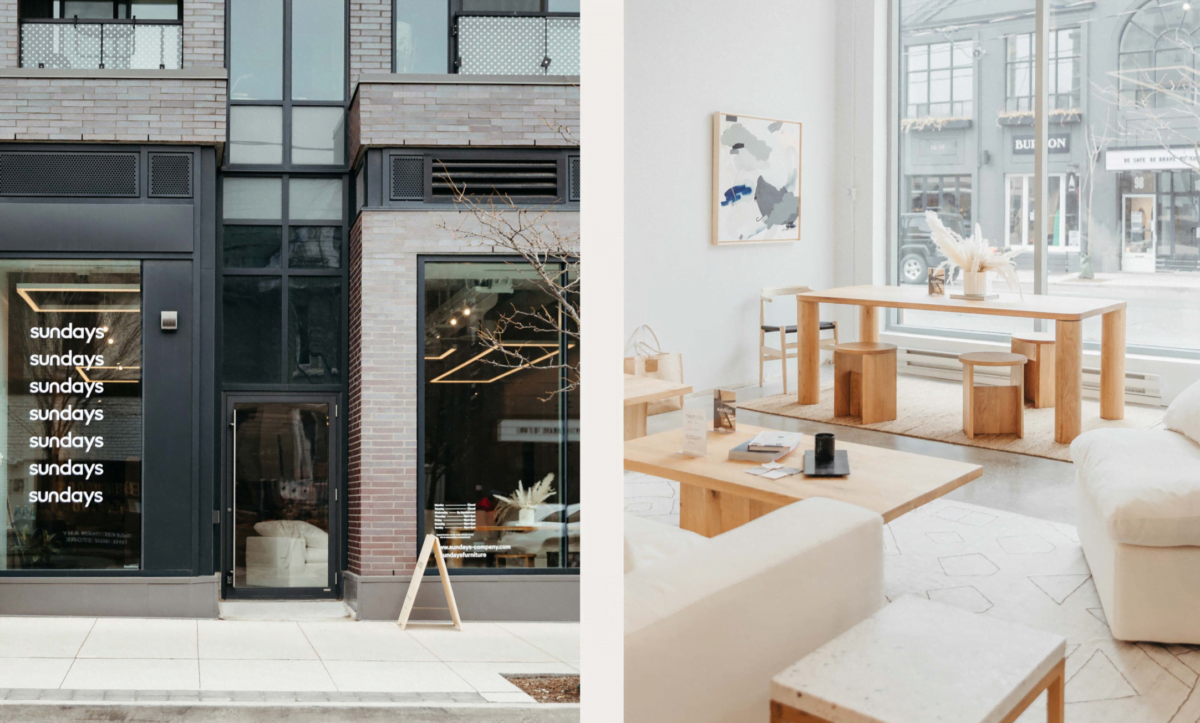
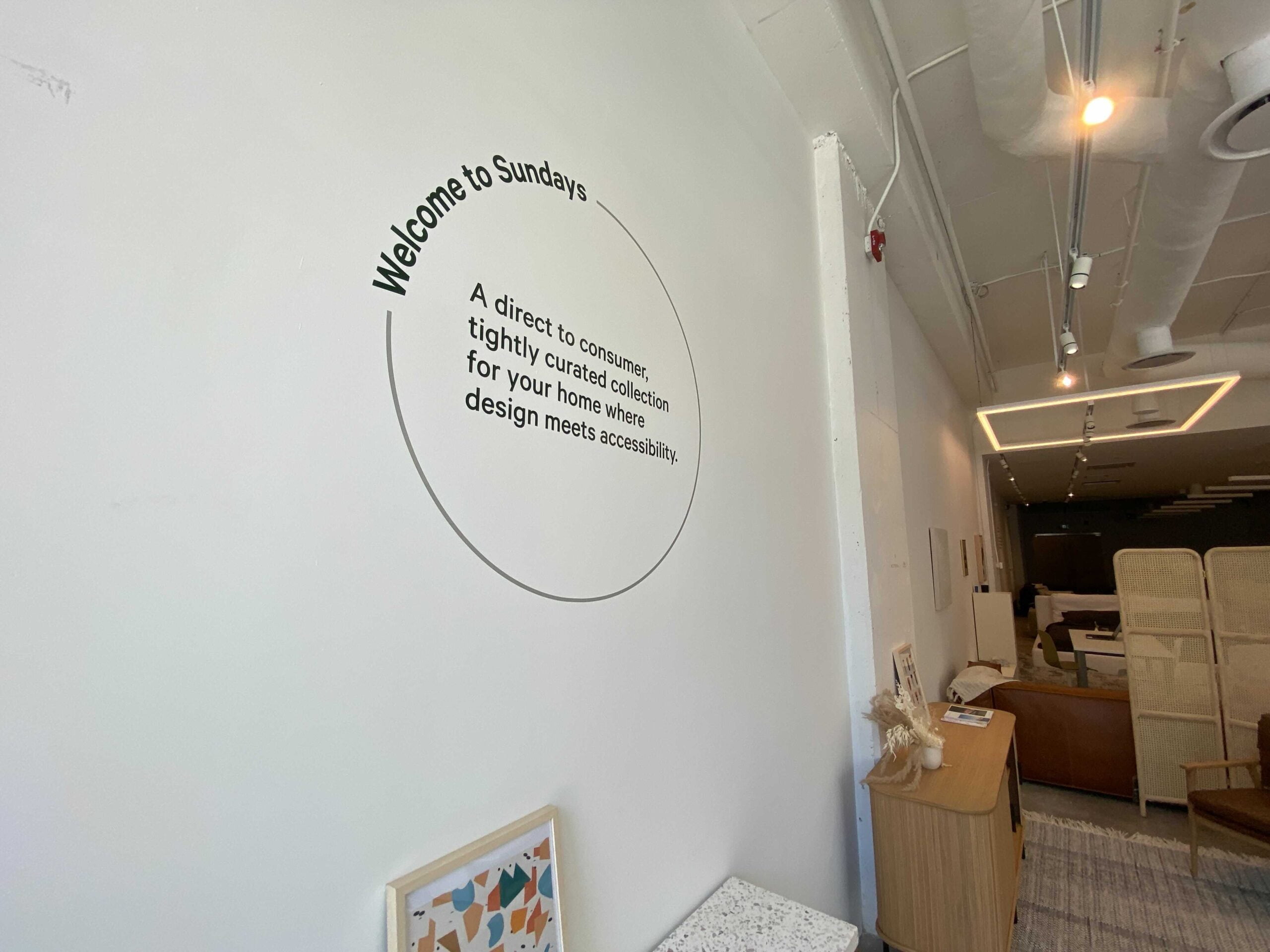
Canadian furniture brand, Sundays, has opened a pop up shop In Toronto at 113 Ossington Avenue. After the success of its two previous pop ups in Vancouver, along with a rapidly-growing digital following, the brand is giving Torontonians the opportunity to touch, feel, and experience Sundays in person.
“Despite the pandemic and growing digital trends, there is something truly special about walking into a brick and mortar store,” says Noah Morse, Co-Founder and Director of Product Development and Design. “E-commerce and new business models have made goods more affordable and transparent, but walking into a shop, touching the fabrics, seeing the pieces, and having a human to interact with is an irreplaceable experience.”
Sundays at 113 Ossington Avenue - Photos by Dustin Fuhs
1 of 4
Interior of Sundays at 113 Ossignton Ave. Photo: Dustin Fuhs
Interior of Sundays at 113 Ossignton Ave. Photo: Dustin Fuhs
Interior of Sundays at 113 Ossignton Ave. Photo: Dustin Fuhs
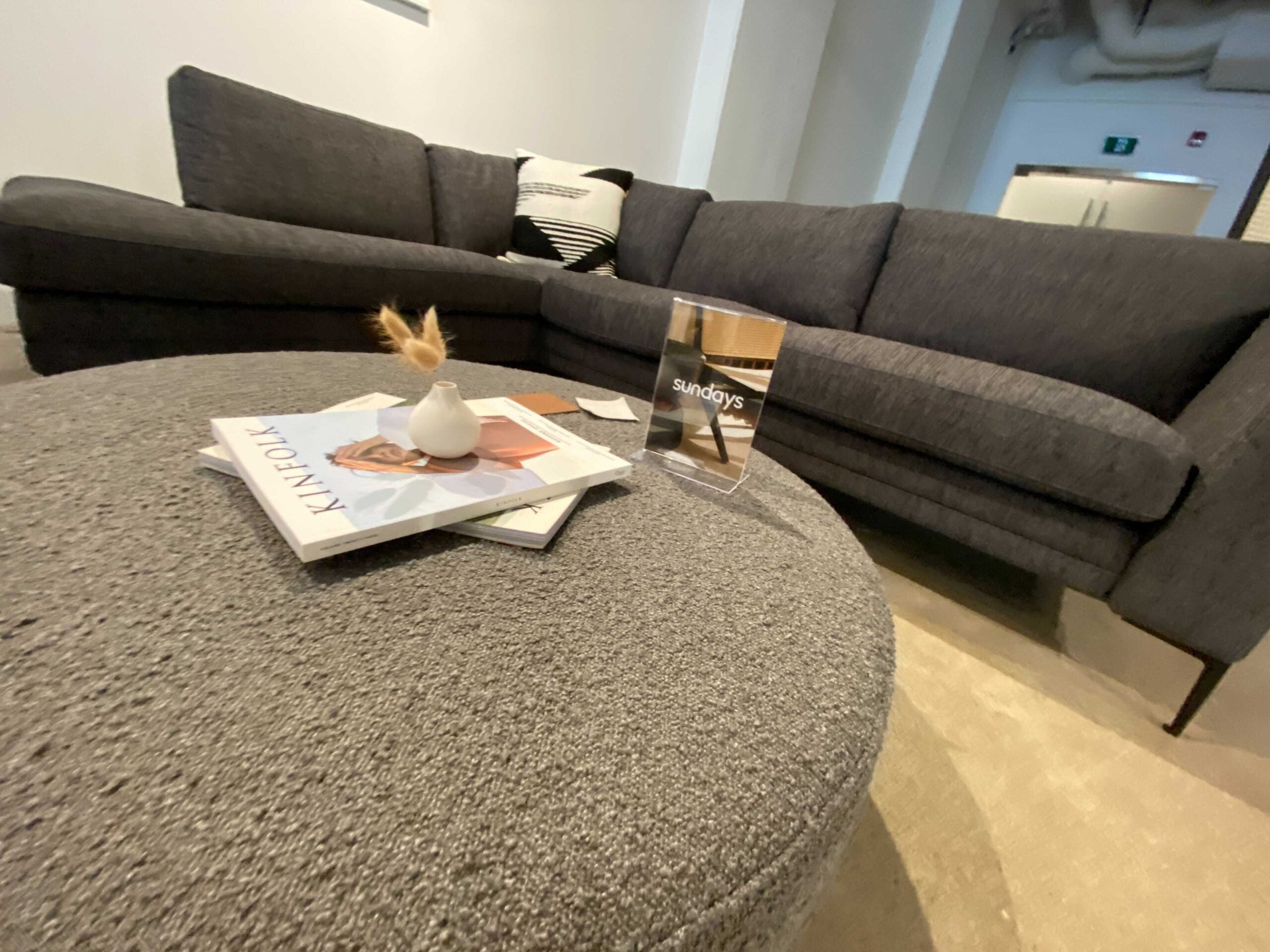
Interior of Sundays at 113 Ossignton Ave. Photo: Dustin Fuhs
The space is described as being relaxed, bright, and welcoming, and showcases Sundays’ furniture “as if it were in your own home”. On display are bestselling pieces such as the Movie Night sofa and the Field Dining table, as well as pieces from the growing bedroom and outdoor collections.
The surrounding neighbourhood was a deciding factor for Sundays when choosing a location for the pop up. Since Ossington is mostly made up of small, local brands, Sundays said that it would be right at home in the popular urban hotspot.
In addition to its own furniture, Sundays integrated local Toronto products into its pop up experience. Products from brands such as Euclid Farms and ENSEMBL are also available to customers.
Newly-Announced Ontario Lockdowns to Hit Retailers
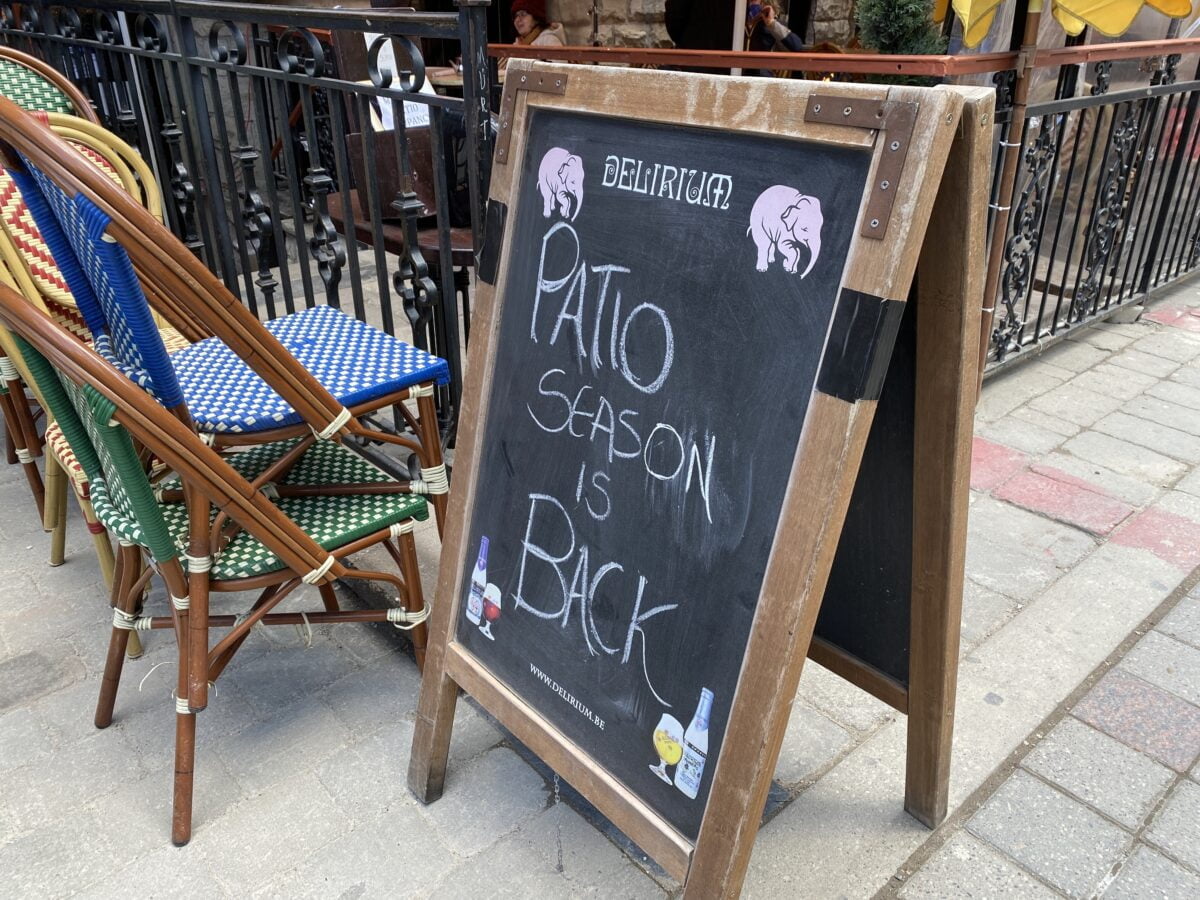
Downtown Toronto bar advertising patio season before the most recent lockdown was implemented Ontario, forcing closures. Photo: Dustin Fuhs
On Thursday Ontario Premier, Doug Ford, announced a ‘circuit-breaker’ lockdown for at least 28 days that will see recently-opened restaurant patios shut again. The Retail Insider team in Toronto has been touring neighbourhoods since patios were allowed to open on March 20 and we noticed a distinct increase in foot traffic in areas throughout the city.
Toronto’s Bloor-Yorkville area once again became vibrant after extended lockdowns over the winter months. While retailers were permitted to again open at 25% capacity on March 8, it was the reopening of restaurant patios that saw a renewed vibrancy to the neighbourhood.
It is questionable if outdoor dining had led to COVID-19 transmission, and business owners and the public are becoming increasingly angry at repeated shutdowns. Retail areas such as Bloor-Yorkville and others will again struggle with reduced foot traffic as ‘destination ecosystems’ are shut down with in-person dining options limited.
Circle K Opening Steps Away from Bloor Street Luxury Run
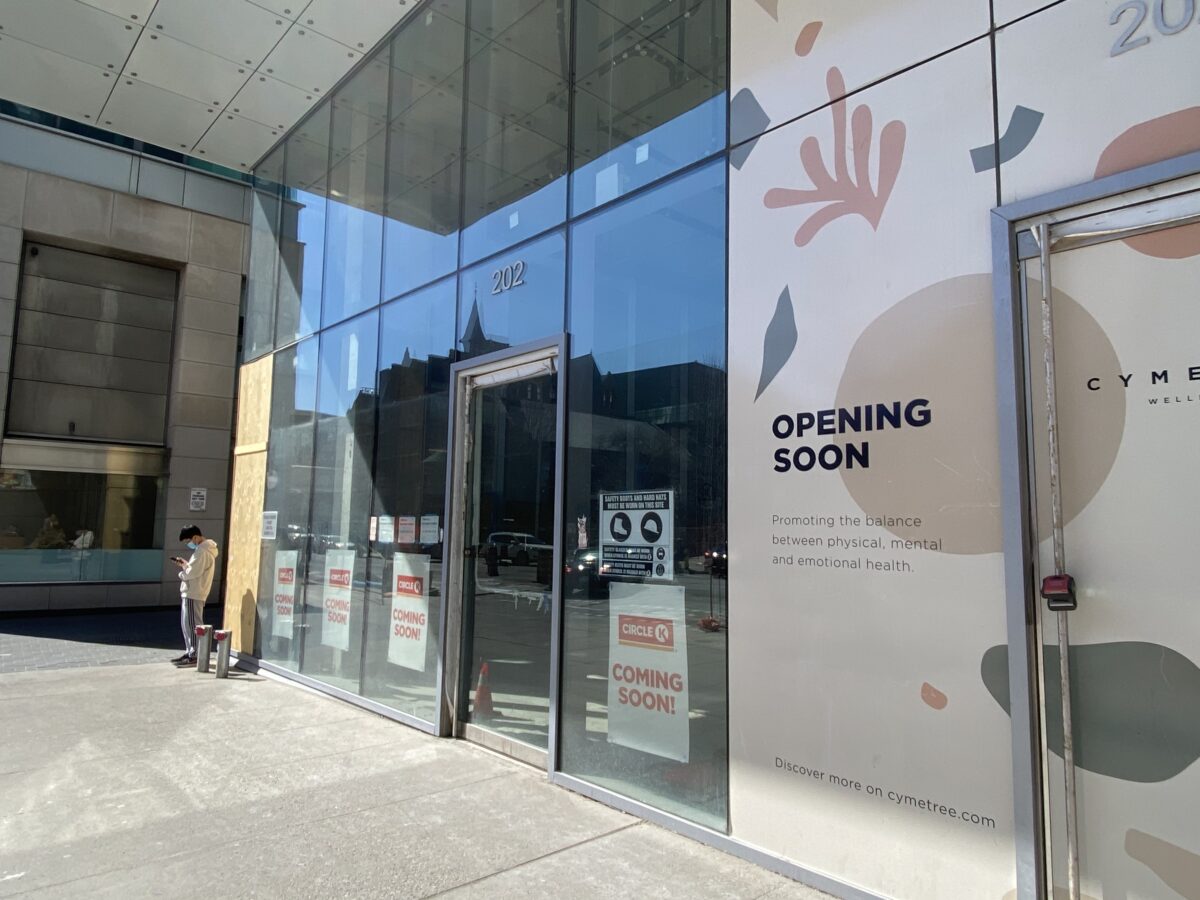
Circle K construction on Bloor Street – Photo by Craig Patterson
The Circle K convenience store under construction at 202 Bloor Street West. Photo: Dustin Fuhs
A Circle K convenience store is under construction at 202 Bloor Street West. The store will be located at the base of a condominium building that was completed in 2017. The space has been for lease since then and the other commercial tenant in the building is a McDonald’s restaurant.
The 202 Bloor podium is located a few steps west of Avenue Road, and is considered to be the marker for the luxury stretch of Bloor Street West that extends eastward towards Holt Renfrew and Yonge Street. The luxury run currently has several vacancies, and brokers working in the area say several offers have already been made for vacated retail spaces, including the former Club Monaco store at 157 Bloor Street West and the former Gap store at 60 Bloor Street West.
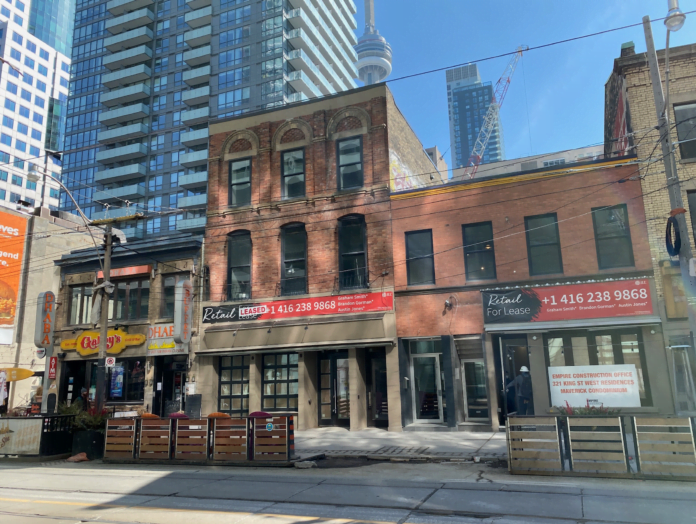
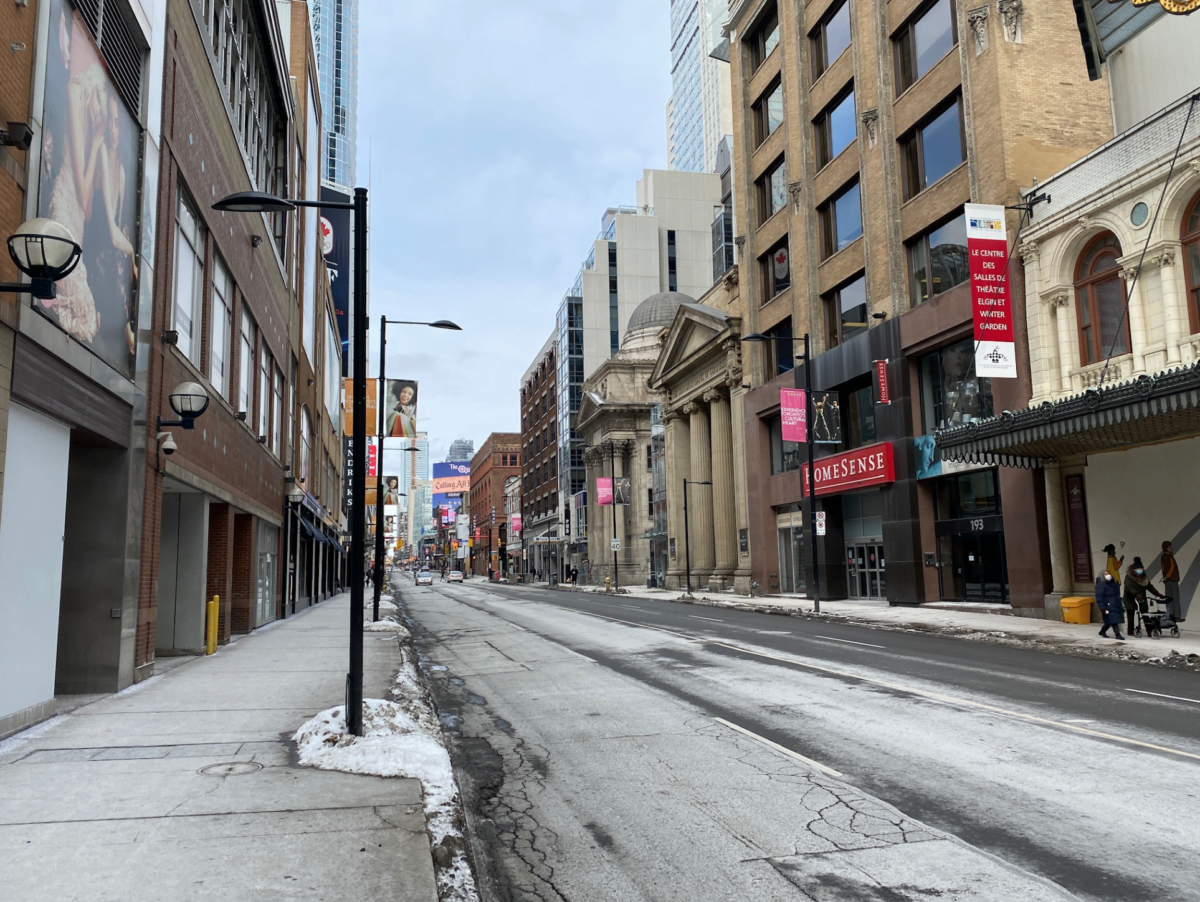
A very quiet King Street West in Toronto with empty retail stores. Photo: Dustin Fuhs
The latest month-long lockdown mandated by the Ontario government will deal a crushing blow to many small businesses in the province who have been hanging by a thread for months.
“Small businesses are tired of being a scapegoat for the Ontario government’s lack of planning or foresight. For months, they have been told that there is light at the end of the tunnel and for months nothing has changed,” said Ryan Mallough, Director of Provincial Affairs for Ontario, for the Canadian Federation of Independent Business.
Ryan Mallough
“Toronto and Peel have been largely shut down since November while cases have climbed and fallen and climbed again in that timeframe with thousands of small businesses never seeing a single customer. To continue the same broken approach is a choice. A choice that is costing thousands of Ontarians their jobs and livelihoods. We have to do better.”
Mallough said 74,000 additional businesses are in danger of closing due to the pandemic. The latest lockdown will accelerate business closures.
“It’s grim,” he said. “The support grants (from government) are nice but with the mounting debt, with having to pay employees, and all the uncertainty around when you’re going to be able to reopen — I don’t think anyone expects everything to be open a month from now at full capacity — it’s going to take a while to ramp up and it’s a very long road ahead when it comes to even starting to talk about recovery.”
On Thursday the Ontario government announced a provincewide “emergency brake” for at least four weeks that includes limiting indoor/outdoor gatherings to a maximum of five people, 50 percent capacity limits for grocery and convenience stores, no indoor or outdoor dining, and a 25 percent capacity for big box and other retailers.
“We are facing a serious situation and drastic measures are required to contain the rapid spread of the virus, especially the new variants of concern,” said Premier Doug Ford. “I know pulling the emergency brake will be difficult on many people across the province, but we must try and prevent more people from getting infected and overwhelming our hospitals. Our vaccine rollout is steadily increasing, and I encourage everyone who is eligible to get vaccinated. That is our best protection against this deadly virus.”
James Rilett
The provincewide emergency brake will be effective Saturday, April 3, at 12:01 a.m. and the government intends to keep this in place for at least four weeks.
James Rilett, Vice-President, Central Canada, for Restaurants Canada, said the organization is really disappointed in the Ontario government announcement.
“We think the province is going down the same road that they’ve gone down for the last six months that hasn’t worked. We have parts of the province where restaurants have been closed for six months. We haven’t seen restaurant closures affect a downward trend of (COVID) numbers at all and we think this is the wrong thing to do,” said Rilett.
An empty Yonge Street in Toronto. Photo: Dustin Fuhs
He said this would definitely accelerate the closure of more restaurants in the province.
“It was only 12 days ago that public health officials were encouraging people to open their patios. So they’ve invested money, they’ve invested time, they’ve hired back staff with that in mind,” added Rilett. “And they were just thinking, okay finally light at the end of the tunnel. And that’s been yanked away from them. I’m sure a lot will say this is the last straw.”
Daniel Safayeni, Vice-President, Policy, at the Ontario Chamber of Commerce, said the province’s business community is understandably frustrated with the current situation.
Daniel Safayeni
“Seeing our southern neighbours being inoculated while we wait perhaps adds to that as well. But really the bottom line is delays in distribution are heavy blows to businesses who are going through further restrictions and lockdowns,” he said. “We urge all orders of government to work together on this and to be as clear and consistent as possible around what warrants changes in lockdowns.
“The lack of predictability is adding to this growing frustration. And so while we strongly believe public health and a healthy economy are interdependent, we realize right now we’re in the midst of a third wave. ICU capacity is at a critical level. This is all greatly concerning and we can’t pave a path to recovery without first controlling the virus. We understand this acutely but at the same time we’ve repeatedly expressed our concerns now at this point about inconsistent and unclear public health guidelines that trigger a shutdown and what we can do to improve that situation.”
Bruce Winder, author of RETAIL Before, During & After COVID-19 and President of Bruce Winder Retail, said another shutdown in Ontario will continue to weigh on an already struggling retail industry.
“Although the lockdown is needed, it causes further strain on an industry hanging on by a thread. Some retailers will need to lay off staff again and will have brought in inventory in anticipation of the spring season,” said Winder.
Bruce Winder
“Restaurants will have food that will spoil as patio business is lost. Perhaps one positive from this lockdown is that non-essential retailers will be allowed to open at 25 percent capacity — which offers some relief. Those that count April as one of their biggest sales months will need to scramble to pivot quickly. Government subsidies continue to help those that qualify but they can’t last forever. One of the most damaging byproducts of this pandemic is the deterioration of mental health in retail (and all industries). This issue desperately needs more attention and resources from governments and businesses alike. Ontario has lost round one in the race between inoculation and variants of concern.”
If there was ever anything that could derail morale of small business owners and all businesses it’s a third lockdown, said veteran retail expert George Minakakis, a global retail executive with over 25 years of experience and CEO of the Inception Retail Group.
“But we shouldn’t be surprised by it. We reopened and the number of cases never really got under 1,000 per day. Just today we are over 2,500. I was surprised we even expanded restaurant dining about a week ago,” he said.
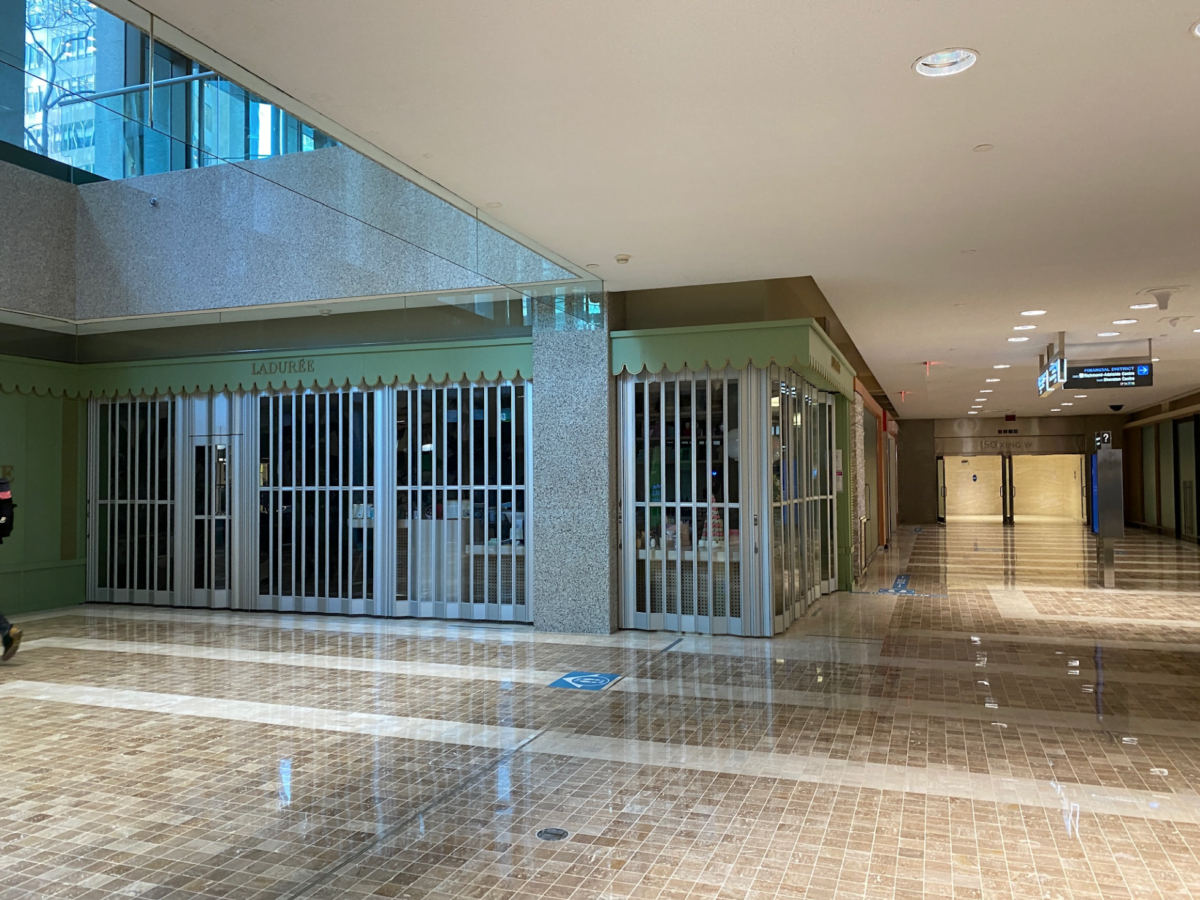
A shuttered Laduree cafe in Toronto’s PATH. Photo: Dustin Fuhs
“I already know of retail chains that are not making rent payments. I can only begin to imagine the number of small businesses that are in the same situation. And what bank covenants have been breached by them, from not having enough sales?
“It is my opinion that the business recovery is now not going to begin until 2022 because of this current situation. And it solidifies that the retail landscape will be more different than we first imagined.”
George Minakakis
He said this lockdown could go longer than expected with the new variant.
Whether businesses were allowed to stay open or not consumers have been trained to react and stay at home.
“We already have excess capacity in available vaccines. Part of the problem is the AstraZeneca news and that likely has the public concerned. Which means more delays in a recovery. You can’t force the public to line up for something they question,” he said. “You need a very powerful and trustworthy PR campaign to convince the public that it is safe.”
Minakakis said the provincial and federal governments will have to do a lot more than count on pent-up demand for example for hair cuts or the idea of revenge shopping to reboot economies.
“I am also very doubtful of consumers opening their bank accounts to spend their “excess” savings. That whole concept is contrary to telling Canadians they are carrying too much debt. Especially if we don’t know what the future is going to be like. This means e-commerce will take more share as will the likes of UberEats,” he said.
“I know this all sounds dismal however, this looks more like a domino effect to me with a whole set of underlying issues that will surface and cascade, making a recovery even more challenging. Even if we ride this third wave out we will be behind in any recovery plan and small businesses will fail silently during this period. The only saving grace for them will be how benevolent landlords and banks will be.”
The CFIB is calling on provincial governments across Canada for lockdown alternatives and increased financial support for small businesses as provinces announce or consider a third round of closures across the country.
On average, Ontario small businesses have taken on $207,000 in COVID-19-related debt. Three quarters of them report that it will take more than a year to pay off, added the CFIB.
Dan Kelly
“It is unconscionable that over a year into the pandemic governments continue to rely almost exclusively on blanket lockdowns,” said CFIB President Dan Kelly. “The first two shutdowns were devastating with one in six businesses considering permanent closure, for an estimated 74,000 permanent small business closures expected in Ontario. A third round will only ensure that number grows higher.
“More than 70 percent of small businesses across Canada report that government supports are essential to their survival. Lockdowns do not stop bills from coming in. We urge governments to extend their application deadlines, broaden eligibility, and increase payments to recognize the impact new and prolonged lockdowns and restrictions are having on local businesses.”
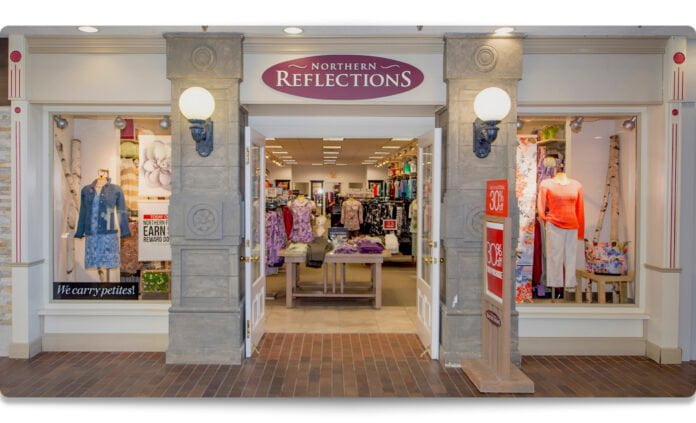
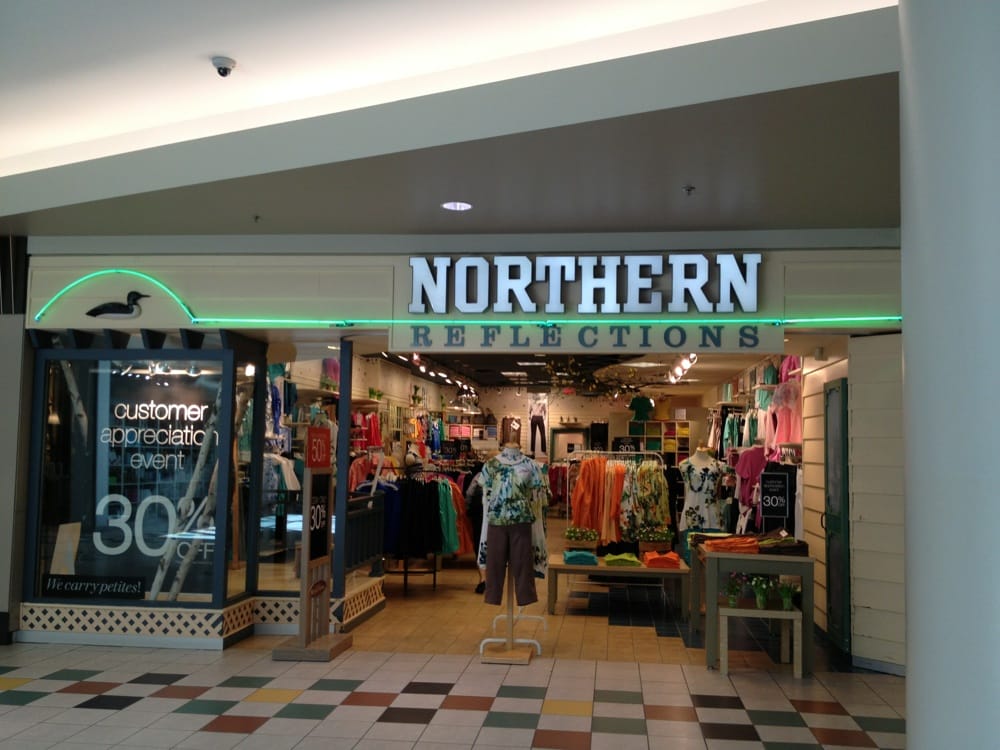
Northern Reflection Store in Cherryhill Village Mall in London, Ontario. Photo: Cherryhill Village Mall
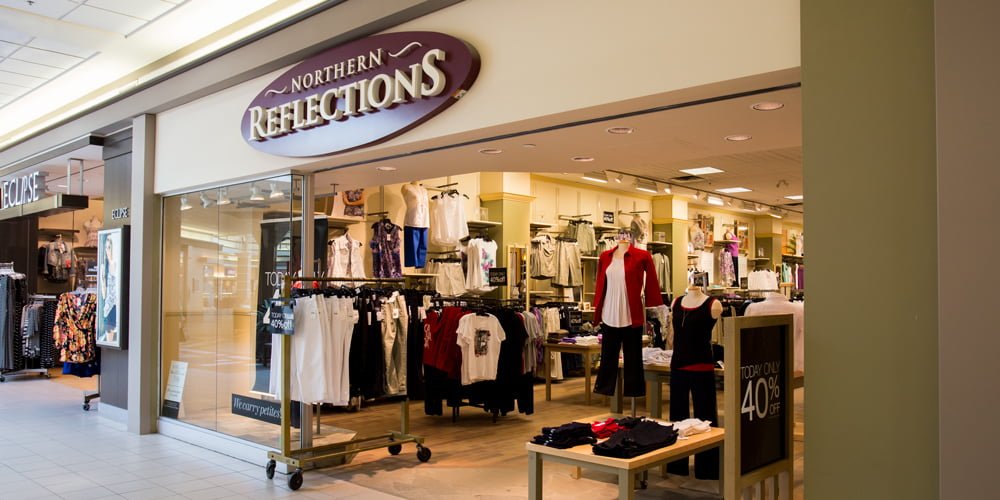
Canadian women’s retailer Northern Reflections is poised to grow after a corporate and financial restructuring process that is being supported by JAMCO Capital Inc., a Vancouver-based venture capital firm.
Christopher Kape, President of JAMCO Capital, said Northern Reflections, which was founded in 1985, has been a mainstay in the Canadian retail landscape for decades, and “this restructuring event ensures it will continue to bring its much-loved ladies wear to Canadian women across the country for years to come.”
JAMCO is a family office/venture capital firm that actively invests its own capital and puts its operating knowledge into a very diverse group of companies.
Christopher Kape
“We’ve not done anything in the retail space until now. We’ve mostly focused on the ecommerce, online space over the last 20 some odd years. But we are agnostic in our industries. It just so happens that most of the industries that we’ve invested in have been wellness or skin care or online gambling around the globe, which in and of itself has paid off tremendously in the last few years just because of the changes in the legal landscape in that industry,” said Kape.
Northern Reflections delivers moderately-priced fashions nationwide, strategically focused on the largely underserved demographic of women aged 45 and over.
“To be honest, the retail space has never been that attractive in so far as how fast it was growing. It was a mainstay of course of the economy but when you looked at the ‘new economy’ from 2000 onwards, everything was focused on hyper growth in the online space. We were always attracted to that. We always look for ways to achieve higher returns with our capital,” said Kape.
“The reason why Northern Reflections became something exciting for us is because 2020 of course was the worst year on record for Canadian retailers — it might have been the worst year on record in the history of the world for any retailer. When you’re chasing opportunity, it’s like the stock market, you kind of look for diamonds in an industry where things have been kicked down quite a bit. Certainly COVID has presented a tremendous amount of challenges during the last year and a bit. But many companies in retail have slimmed down as a result of COVID, have renegotiated with landlords and suppliers in an effort to stay afloat. Almost everybody is operating as lean and as efficiently as possible.
1 of 2
Northern Reflections store in Intercity Shopping Centre in Thunder Bay, Ontario. Photo: Intercity Shopping Centre
Northern Reflection Store in St. Albert, Alberta. Photo: Google
“For some retailers that still has resulted in CCAA (creditor protection) filing or some sort of court order protection or in some cases a full on bankruptcy. In other words, that’s resulted in a very slimmed down and lean operation. Northern Reflections was somewhere in the middle of there. It has done everything it could but it still needed some capital to get to the other side of COVID and the reason why it needed that capital is they were under tremendous stress to repay back their asset based lending. I won’t say who the lender is but it is one of the Canadian banks.”
Kape said JAMCO looked at a number of other deals including a high profile one which he can’t name. The company had touched base in the past year with different ABL groups letting them know that if any retailers came to them with problems and needed some capital injection JAMCO might be interested. The venture capital firm then began to receive a number of inquiries.
“Northern Reflections is one of those darlings. It operates in a great space with fewer competitors, even fewer as a result of COVID. It’s really cleaned itself up. It has quite a number of employees. It’s a good Canadian company. A nice business to save. And it had a lot of appeal from the perspective of the fundamentals of the business,” said Kape.
The JAMCO investment will allow Northern Reflections to maintain its 135-store footprint from coast to coast along with its approximate 800 jobs.
“This has been a collaborative achievement that brought together all our stakeholders: our dedicated employees, manufacturers, suppliers, landlords, vendors and others,” said Lalonnie Biggar, president of Northern Reflections. “Like so many other retailers, COVID-19 brought unforeseen challenges to our operations. Now, thanks to the significant financial support of JAMCO, we are set up for success as we emerge from this period as a stronger, more efficient and better focused organization.”
Kape said Northern Reflections has migrated to newer ways in having customers interact with the retailer including purchases over the phone, curbside pickup, and ecommerce.
“And we’re talking about an older demographic of women in Canada and they were a little bit resistant, not as a full group, but it’s a little harder to move people to the online space when they’re in their 60s, 70s. We took a lot of time in showing them how beneficial it was to utilize all these new tools we had available to them to continue their shopping,” he said.
“The company knows its customer base quite well. The managers and employees in the stores are actually on a first name basis with many of their customers and they were able to really guide them through the processes via phone or via email in all these other ways to do things. And we did have an uptick in that type of shopping by quite a substantial percentage. It didn’t of course account for replacing the loss in bricks and mortar sales but it certainly was a great uptick.
“As far as growing from the 135 store footprint, there’s a tremendous amount of opportunity once COVID is kind of abated. Many of our competitors are either under court protection or have closed completely. We believe that with a few of these groups out of the way, it lends itself to a new landscape for us where our competition is a little less and where we can open up new stores in shopping centres and facilities that maybe were unavailable to us before in the sense that they were very expensive for the lease rates or there were competitors in the area that made it a little bit hard to justify opening in those locations. Now the landscape has completely shifted such that we will be able to roll out into these new areas.”
Northern Reflections’ office is based in Toronto and will remain there. The entire employee base will be kept including the executive management team.
“Canadian household spending decreased in 2020 by quite a substantial amount of money, lending itself to a huge amount of savings. The last figure I read was over $200 billion and most of those Canadians . . . are all interested in getting back to what I would include the new normal which has to include socializing, getting out there, restaurants, going to work. Even if it’s going to change, it’s still going to require a lot more outward focus. With that savings, with that extra money, with the ability to go back out, and quite frankly a lot of us have gained a little bit of weight and with the fact we’ve gained some weight we need a new wardrobe,” said Kape.
“We anticipate that the retail sector is going to see a big resurgence once COVID is behind us. People will have to go shopping. They will have to go get new clothing. And it’s one of those things that’s very hard to do online exclusively. This is where I could see the true opportunity for JAMCO.”
A partnership has been announced with an aim to provide small and medium-sized businesses in need with the tools required to succeed in a changing retail world. Lightspeed, a leading provider of cloud-based, omnichannel commerce platforms, has announced a partnership with TABIA’s Digital Main Street (DMS).
The partnership will utilize Digital Main Street’s ShopHERE initiative, which was established in collaboration with the City of Toronto in May of 2020 to help build and optimize online stores for Toronto’s independent businesses and artists amid the COVID-19 pandemic.
Lightspeed says that it is also committed to supporting the other Digital Main Street programs and support offerings, joining in the mission of helping as many SMBs grow through the adoption of digital tools and technologies as possible.
“At the heart of every thriving community is a healthy main street. Providing businesses with the right digital tools to adapt and succeed is what Lightspeed does.” said Peter Dougherty, Vice-President of Partnerships at Lightspeed. “With DMS, Lightspeed will have a greater opportunity to help SMBs access and benefit from our omnichannel solutions. We remain focused on driving innovation and delivering those democratizing tools, so that we can all come back to a stronger, healthier and more diverse post-pandemic economy.”
To be eligible for the ShopHERE program, businesses must be registered in Ontario, and have fewer than 10 full time employees (or fewer than 25 employees if they are a cafe, restaurant, or bar). Additionally, businesses cannot be part of a corporate chain or franchise.
“We are thrilled to welcome Lightspeed to our group of partners in support of Digital Main Street.” said John Kiru, Executive Director of the Toronto Association of Business Improvement Areas and founder of DMS. “Now more than ever small business owners across the country need to continue embracing the concept of Digital Transformation not only as part of their recovery but also to thrive in the ever changing consumer landscape. Bringing Lightspeed on board with their focus on omnichannel will be a welcomed addition and support resource for our business community.”
Through this partnership Lightspeed and DMS are aiming to help create resilience within the small and medium-sized business retail landscape — pushing innovation that will future-proof the economy by stimulating economic growth and equipping businesses with the technology to take on any challenge.
“As local economies continue to deal with the impacts of the pandemic, our government is committed to ensuring that our small- and medium-sized enterprises don’t just survive, but thrive,” said the Honourable Mélanie Joly, Minister of Economic Development and Official Languages and Minister responsible for the Federal Economic Development Agency for Southern Ontario. “We are proud to support the partnership between Digital Main Street and Lightspeed and look forward to seeing the impact the platform will have on future proofing small businesses in our communities.”
Competition for talent in the retail industry has always been fierce in Canada. Sadly, the retail industry has one of the highest turnover rates in North America, and it is a challenge to find and retain talent in this sector.
The current pandemic has undisputedly exacerbated the problem. Disproportionately affecting the retail industry with massive furloughs and layoffs, it has left thousands of workers without a job. One therefore assumes that when establishments reopen in full, there will be a large pool of eager candidates to choose from.
But it’s quite the opposite that is happening. Many employees have left the retail sector all together, either moving away from major urban centres or avoiding frontline positions due to anxieties over safety, health, and wellbeing. In addition to those concerns, the poor renumeration, lack of recognition and absence of career path are ongoing compounding effects.
The consequence will be a dearth of talent and loss of expertise in the retail industry that will affect every business and overwhelmingly the specialty and luxury retailers who rely largely on physical spaces for growth and brand awareness.
Managing the situation has never been more urgent. Experts have suggested various solutions from increasing remuneration to allow employees to have a viable salary to overhauling the HR departments to make them more “marketing oriented”.
These propositions are all commendable and certainly necessary, but unfortunately don’t address the root of the problem: The pervasive belief amongst retailers including specialty and luxury ones that their front store staff are not highly valuable members of the company’s overall human capital.
A paradigm shift is necessary if things are to improve. Retail management and leadership must recognize the inherent importance of customer-facing employees and put adequate measures in place to ensure that they not only return to retail but also thrive, grow, and stay. There are 3 sine qua non factors to attract and keep people: Better compensation, training, and career planning.
Compensating Well
The retail industry has long suffered a reputation for low compensation, and improvement has been slow despite numerous studies showing the benefits of paying staff well. In 2015, when some prominent US retailers decided to increase their minimum wages in an effort to curb turnover, their move was immediately questioned. Weren’t they risking “the wrath of investors by forking over more money to their least-valuable employees?”
While investor concern is admirable, what is shocking is that front-store employees are considered expendable. This stance is unfortunately alive and well in the retail world, including at some luxury and specialty retailers who fail to appreciate the inherent value provided by store teams. However, with the physical store under threat and the customer now king, it is vital to acknowledge the importance of store employees.
Gone are the days when retailers could just hire “bodies” for the stores. Today, they need the best talent available and to attract them, paying well is the first step. When one knows that poor compensation is a recognized source of employee dissatisfaction and that disgruntled employees tend to deliver subpar performances, eventually leaving the business altogether, it seems unreasonable to ignore the issue.
To overcome this, some experts have recommended an increase of the minimum wage. While doing so would elevate the industry as a whole and benefit the average individual, it won’t solve the lack of talent problem as it levels the playing field without making a significant difference in terms of vying for and rewarding the best candidates.
In view of the rapidly shrinking talent pool, the truth is that remunerating adequately is too little, too late. Multiple studies have demonstrated that one of the most effective ways to vie for the best talent is through better compensation packages. Therefore, specialty and luxury retailers must pay substantially higher wages and provide other benefits to attract and retain the finest talent. Doing so will entice superior candidates who are more engaged and deliver greater returns on investment. Employers can hold them to higher standards and expect more of them. “Paying good wages is not altruism,” says Jim Sinegal, CEO of Costco, “it’s simply good business.” Only retailers convinced of that fact will have a chance to survive and thrive.
Training Cannot be an Afterthought
Together with higher wages, retailers must offer employee training and development. Doing so leads to better job performance and greater confidence. Employees are more skilled and knowledgeable, and deliver enhanced customer service which in turn triggers a direct improvement to the company’s bottom line.
Surprisingly, few retailers invest in comprehensive coaching. They either lack the proper training tools, believe on-the-job training delivers adequate results or hire someone else if the current candidate doesn’t work out. Even when training is available, it rarely addresses the blatant skills gaps. One of the most critical is “sales” aptitude.
It is common knowledge that many “sales associates” cannot actually “sell” and are nothing more than glorified cashiers. Retail expert Pamela Danziger sounded the alarm in 2018 stating that having warm bodies on the sales floor was simply not enough to meet the customers’ evolving expectations and that “stores should staff to maximize sales and profits, not to minimize costs.”
Granted, retailers might have overlooked the need for true salespeople in the past when retail was largely product-driven, and brands could spur demand through elaborate marketing campaigns. But the emotional intelligence needed to sell is a skill that can no longer be ignored. The days of the uninspiring retail associates are over. Today’s retail personnel must be experts in their domain, highly knowledgeable about their industry and their products, capable of developing noteworthy relationships with customers that last over time. They connect and engage with shoppers to ultimately inspire them to purchase. Teaching employees to do so is not that hard but it requires a willingness from the employee to learn and a deep commitment from leadership.
Yet, retailers still argue that the cost of training outweighs its benefits. They are missing the point when they forgo this critical step in employee management and ignore the high cost of turnover to focus on short-term benefits. In North America, turnover represents 16% of the average employee salary. It impacts every aspect of the business from productivity and customer engagement to employee morale and overall perceived organizational culture. Replacing departing employees is significantly more expensive than retaining them.
Retailers may also blind themselves to future possibilities. Providing superior training is an expense, but one that is quickly amortized by revenue growth, increased customer engagement and turnover decrease. In an industry with growing e-commerce capabilities, the client who visits a physical store expects nothing less than superior expertise and competence and that can only be delivered through comprehensive training.
Career Path Planning is Key
One future benefit of having well-trained and competent team members is that it builds a pool of strong candidates who are groomed for growth opportunities within the organization. Training not only allows retailers to give teams more satisfaction and self-confidence, challenging work, and more autonomy, it also sets them up for advancement. What retailer wouldn’t want to retain its best and brightest to move them up the company’s ladder?
Unfortunately, career planning is rarely addressed in retail and when it is, the timing is often wrong. Talking about future career options must be done upon hiring if retailers wish to remain competitive in the marketplace. This ensures they are perceived as an employer of choice since providing a clear career path is a critical part of the equation. According to consulting firm Mercer, 44% of employees say that they would stay longer with their current employer if they knew their career path. Without one, a third of employees see their employment as a job, not a career.
Discussing the issue during the interview also allows employers to get a sense of the candidate’s drive and ambition, further enabling them to better tailor their hiring selection. Once the candidate is hired, the career journey is then included in his or her development plan, so long as key milestones are achieved, allowing for better human capital forecasting. When one knows that it takes companies an average of 52 days to fill an open position and find a suitable candidate (the equivalent of 2 months of resources), it makes sense for companies to invest in the talent they already have and build strong succession plans.
Retail Needs Committed Leaders
Luxury and specialty retailers are faced with a tough challenge addressing the dearth of talent in Canada. It is one that takes long-term commitment, conviction and a clearly executed strategy. When leaders start really crunching the numbers, they are bound to realize that not implementing changes will not only be detrimental to their company in the short term, but also in the long run. They would be foolish not to commit to focus on hiring, training, and retaining the best talent.
A non-profit organization founded by Zeynep Ton, a professor at the MIT Sloan School of Management, calls such an employee-centric strategy, the Good Jobs Strategy. Triggered by the competitive landscape, some companies have implemented such a strategy recognizing that engaged employees are more productive, provide better service and are less likely to jump ship – an especially significant concern in retail where turnover was, before COVID, at an all-time high.
The Good Jobs strategy is not something that is done overnight, but once retailers are convinced that labour cannot be viewed as a cost to be minimised but as a driver of sales and profits, it is considerably easier to carry out. They are able to create a virtuous circle where investing in employees drives excellence in operational execution, in turn boosting customer satisfaction, sales and profits, and allowing for a larger labour budget.
If Costco is able to pay 22$ an hour despite being a low-cost retailer and still be profitable, it is absolutely possible for luxury and specialty retailers to offer significantly higher wages. After all, those retailers typically benefit from making luxury margins. Leaders must commit to use some of their profits to invest on their most important assets: The associates who face their customers and generate revenues every day.
Solange Strom
Solange Strom, visionary and entrepreneurial retail executive with a track record of driving growth through employee-centric strategies. 25 years helming global brands such as Boiron, L’Occitane en Provence and Repetto Paris. Founder of the Radical Retail Method, a training program aimed at supporting retail organizations in their quest for excellence. To contact Solange visit www.solangestrom.com.
Photo: Frederic Dimanche
Frederic Dimanche is a Professor and Director at the Ted Rogers School of Hospitality and Tourism Management at Ryerson University. He has thirty years of professional and academic experience in service marketing and consumer behaviour, particularly in hospitality and tourism. His academic experience includes in the USA, France, and Canada.