
Advertisement
Home Blog Page 1132

Sears Canada’s Most Valuable Real Estate [Analysis]

Image: Sears Canada at CF Toronto Eaton Centre

Last month, Sears Canada filed for bankruptcy protection, following comments that it had “significant doubt” about its future as a retailer. Reportedly, two major REITs, RioCan and Primaris Management Inc., are interested in possibly acquiring some of Sears Canada’s real estate at their own properties. Sears Canada has been granted the green light to explore possible sales, which may involve selling off some of its more valuable real estate. 

Sears Canada has sold a number of its top properties over the past several years in order to help keep it afloat. Headlines were made in the spring of 2012 when Sears announced that it had sold three leases to landlord Cadillac Fairview for $170 million and as a result, Sears stores were closing at Calgary’s CF Chinook Centre, at Ottawa’s CF Rideau Centre, and at Vancouver’s CF Pacific Centre. It was eventually revealed that these would become home to Nordstrom’s first Canadian stores, with CF Toronto Eaton Centre’s Sears subsequently announced to become another Nordstrom flagship, while Sears’ CF Sherway Gardens store was acquired and subdivided for the 2016 opening of Saks Fifth Avenue and Sport Chek. A number of other Sears stores have since been closed. 

(SEARS AT EDMONTON’S SOUTHGATE CENTRE: AN OPPORTUNITY TO EXPAND THE MALL WITH A MALL ENTRANCE INTO SAFEWAY, ADDING MULTIPLE CRU’S AS WELL AS POSSIBLY A NEW ANCHOR SUCH AS HOLT RENFREW OR NORDSTROM) 

Despite having sold off some of its most valuable real estate, including several former downtown Eaton’s flagships, Sears Canada continues to hold a number of valuable properties (both leased and owned) that could be repurposed, if the Sears Canada chain shutters completely. 

A number of Sears properties are located in some of Canada’s most productive malls in terms of sales per square foot, as analyzed in Retail Council of Canada’s Shopping Centre Study. An update to that study will be released this fall, using the first study as a benchmark. 

The following is a discussion of some of Sears Canada’s most valuable retail spaces that continue to be operated as Sears stores, including some possibilities to repurpose these spaces. 

British Columbia

While the 637,000 square foot downtown Vancouver Sears store at CF Pacific Centre has been repurposed for a 230,000 square foot Nordstrom flagship with offices above and retail in the concourse below, a number of valuable Sears properties remain in British Columbia. In the summer of 2013, Sears Canada’s 217,000 square foot Metropolis at Metrotown location was announced to be redeveloped at a cost of over $1 billion, which would include a newly-built Sears store as well as a number of residential towers. Nothing has taken place as of yet, though there is tremendous opportunity to capitalize on the existing 8.9 acre site. 

A number of Lower Mainland malls have Sears stores. Surrey’s Guildford Town Centre, with sales approaching $900 per square foot annually, includes a 141,300 square foot Sears store as an anchor. Coquitlam Centre, which is another successful mall east of Vancouver, currently has a 151,500 square foot Sears as one of its two major anchors. Willowbrook Mall in Langley also has a 113,400 square foot Sears store, which could be redeveloped in a way to best serve the burgeoning population in the area. 

Alberta

Alberta is home to a number of valuable Sears leases. The 170,000 square foot Calgary CF Chinook Centre Sears became Canada’s first Nordstrom store in September of 2014, though nearby Southcentre, one of Calgary’s leading malls, continues to operate a 234,100 square foot Sears store on the property. Rumour had it that the mall’s Sears store would be redeveloped for multiple tenants including La Maison Simons, though nothing has officially been announced at this time. 

Edmonton is home to three rather significant Sears locations. The massive 263,000 square foot Southgate Centre location possibly offers the most redevelopment potential, with a multi-level Sears store that could be subdivided into valuable multiple CRU space, as well as for a smaller anchor. West Edmonton Mall is currently home to a 149,000 square foot Sears store, near DSW Shoes in the mall’s original Phase I. Edmonton’s Kingsway Mall also houses a 241,900 square foot Sears store — landlord Oxford Properties will open Marshalls and Homesense in the former Target space this fall, and will no doubt have ideas for the Sears space if the retailer shutters as anticipated. 

It should be noted that Edmonton is the only English-speaking metropolitan region in the country with a population in excess of 1 million that lacks a Nordstrom store. Edmonton is also home to a woefully small downtown Holt Renfrew store and if Holt’s decides to remain in the market, it might consider a larger store in a suburban mall. 

Saskatchewan

Saskatchewan’s two largest cities, Saskatoon and Regina, are both home to large downtown Sears stores. The Saskatoon Sears store at Midtown Plaza is about 116,600 square feet, occupying a prominent position at the opposite end of the mall from co-anchor Hudson’s Bay. Regina’s Cornwall Centre Sears measures 123,000 square feet over two levels, at the north end of the mall beside the Saskatchewan Drive entrance. Both locations were rumoured for La Maison Simons locations, though Simons’ Canadian expansion has slowed from years past. 

Manitoba

A number of suburban malls in the Winnipeg area have Sears stores. There’s one that stands out in particular, however, given its size and location. The 263,000 square foot Sears at CF Polo Park occupies a prominent anchor position in the mall, and the mall itself is considered to be one of Canada’s most productive, with sales per square foot in excess of $900 annually. It’s unclear what redevelopment could take place for this space however — despite the mall’s exceptional location and productivity, the Winnipeg market hasn’t been identified by Nordstrom or Saks Fifth Avenue as a market to open any stores, at least not as far as we’re aware. 

Ontario

Ontario is home to a number of prominent Sears locations that could be redeveloped, if feasible. Several Toronto-area Sears stores have already been divested and repurposed — the massive 800,000+ square foot CF Toronto Eaton Centre Sears flagship, which once housed Eaton’s flagship, is now home to a 220,000 square foot Nordstrom, as well as other retail and offices. As mentioned above, CF Sherway Garden’s Sears is now home to Saks Fifth Avenue and Sport Chek, and Yorkdale Shopping Centre’s Sears is being redeveloped with multiple retailers including Restoration Hardware and Sporting Life. In Mississauga, Square One’s Sears is now home to a beautiful La Maison Simons, as well as a Sport Chek flagship. 

A number of notable Sears Canada locations in the region remain, with exceptional redevelopment potential. CF Fairview Mall is home to a 149,550 square foot Sears, which some have speculated would become a Saks Fifth Avenue store as part of a mall repositioning. Though it might not happen, the mall is one of Canada’s most productive with sales per square foot exceeding $900 annually, and it’s located on major transportation routes near some affluent residential areas. 

Scarborough Town Centre, which is one of Oxford Properties’ most productive centres, houses a 231,600 square foot Sears location. A couple of years ago, rumours were circulating that La Maison Simons would take part of the space, though a deal hasn’t been done as far as we’re aware. In the Greater Toronto Area, there are a number of other highly productive major malls that include Sears stores as anchors, including Oshawa Centre in Oshawa (Sears = 132,200 square feet), Mapleview Centre in Burlington (Sears = 125,700 square feet), Upper Canada Mall in Newmarket (Sears = 121,900 square feet), Promenade Thornhill (Sears = 173,560 square feet), Pickering Town Centre (Sears = 164,350 square feet), Bramalea City Centre (Sears = 157,150 square feet), Erin Mills Town Centre (Sears = 132,200 square feet), and there are others. 

It’s worthy to note that adding full-sized restaurants to malls is a trend that we’re seeing (article to follow), as is adding entertainment centres to malls. The Rec Room is being added to centres such as Square One in Mississauga and at West Edmonton Mall, while Cineplex is adding VIP cinemas to some of its centres. Mexico-based children’s entertainment centre concept KidZania, as well, has indicated on its website that a Toronto location is “coming soon”, indicating a Canadian expansion that could potentially utilize empty retail space vacated by Target, as well as possibly Sears. 

A number of other Ontario communities are also home to Sears stores, and one mall stands out — CF Limeridge in Hamilton, which ranked highly in Retail Council of Canada’s Shopping Centre Study. CF Limeridge’s Sears is about 143,640 square feet, according to leasing documents. 

The Ottawa area is home to a number of Sears stores, including a 149,000 square foot store at the St. Laurent Centre. One concerning property is Carlingwood Mall, however — its only anchor exceeding 50,000 square feet is Sears, which has 179,300 square feet at the centre. 

Quebec

Sears has a number of stores in some prominent Quebec Malls. All of these are suburban — CF Carrefour Laval near Montreal is the most productive large suburban mall in the province, housing a 150,850 square foot Sears location. If Sears were to exit the mall, a number of new tenants could replace it — even Saks Fifth Avenue, which sources say could also be considering a suburban Montreal location. 

A number of other productive Cadillac Fairview Malls in the Montreal area house Sears locations, including CF Fairview Pointe Claire (Sears = 181,800 square feet), CF Galeries d’Anjou (Sears = 146,570 square feet), CF Promenades St-Bruno (Sears = 134,255 square feet), and others. CF Galeries d’Anjou is about to open Montreal’s first Saks OFF 5TH in part of the mall’s retail space that was once occupied by Target. 

Quebec City is also home to a number of Sears stores in some important malls, including at the massive Les Galeries de la Capitale (Sears = 185,000 square feet), Laurier Quebec (Sears = 157,350 square feet) and Place Fleur de Lys (Sears = 187,000 square feet). 

Maritime Provinces

Sears Canada is a staple retailer for many important malls in the Canadian Maritimes, and Sears’ possible demise would be devastating for some of these centres, not to mention the communities that they serve. Halifax Shopping Centre, in Halifax, houses a 106,400 square foot Sears store in a mall that sees in excess of $800 per square foot annually in sales (a reader recently told us that they saw ‘La Maison Simons’ on a future mall plan, though nothing is confirmed). 

CF Champlain Mall in Dieppe, NB, is a top regional mall with a 107,000 square foot Sears. Regent Mall in Fredricton, NB, houses an 83,900 square foot Sears, as well as a Walmart. In Saint John NB, McAllister Mall’s only large anchor is a Sears store, which is concerning if it closes. And in St. John’s Newfoundland, the highly productive Avalon Mall is home to a 129,000 square foot Sears anchor, alongside Winners and a Cineplex theatre. 

Conclusion

While the possible demise of Sears Canada is concerning (including substantial job losses), there is opportunity to repurpose some of Sears Canada’s existing real estate if the company shutters its brick-and-mortar operations. Opportunities to add more food and beverage options to malls, as well as entertainment concepts such as theatres and amusement parks, could help fill space, not to mention help drive traffic to some centres that are seeing declining footfall. Trends in Canadian shopping centres will be discussed extensively on Retail Insider in the coming months and as mentioned above, Retail Council of Canada will be releasing another shopping centre study this fall. There are sponsorship opportunities available and for more information, please feel free to contact Craig Patterson at cpatterson@retailcouncil.org

SoulCycle Continues Canadian Expansion [Profile/Tour]

SoulCycle Yaletown (PHOTO: BRITNEY GILL)

The wildly popular cycle studio concept SoulCycle recently opened their first-ever Vancouver location, in the city’s upscale downtown Yaletown neighbourhood. The new studio marks their first on the Canadian west coast and third in Canada, following locations on King Street West and in Yorkville Village, both in Toronto.

Founded in 2006, SoulCycle started life as a small spinning class on New York’s Upper West Side. The studio has become a global chain with over 80 locations in the United States and Canada.

Following its first public offering in 2015, the brand reported a whopping $112 million in revenue. The brand confirms that over 16,000 people take their classes across all studio locations on a daily basis.
SoulCycle is famed for its intensive indoor cycling classes, which combine cycling with choreographic arm movements and hand weights in the same workout. More than a lower-body workout, the brand provides a total body workout combining cardiovascular endurance with resistance training.

SoulCycle Yaletown (PHOTO: BRITNEY GILL)
SoulCycle Yaletown (PHOTO: JENNA MARIE WAKANI)

Choreography, weight training and speed are timed to an end-to-end mix of music specially chosen by each instructor. Instructors set the mood for each class, choosing and mixing contemporary R&B and dance music with “old skool” hip-hop and soul classics to create an enveloping, total immersion 45-minute workout. (The brand even had a Taylor Swift themed ride class in 2015.) The experience is akin to a fitness class being held in a nightclub, where anytime is Friday midnight. Instructors are supportive, espousing affirmations to inspire riders to reach maximal performance (the writer confirmed the results the morning after his first ride and has never felt better). SoulCycle has a devoted celebrity clientele list, including Oprah, David Beckham, Selena Gomez, Demi Lovato, Jessica Alba, and Lady Gaga, who is said to have taken two of SoulCycle’s signature bicycles with her on her last tour for on-the-road workouts.

The brand, co-founded by Elizabeth Cutler, Julie Rice, and Ruth Zukerman, was acquired by Equinox Fitness but operates independently. With a leadership team which is 86% female, SoulCycle values equity and community highly. All managers and instructors help incoming and outgoing traffic from their studios in hands-on operations, and employees are given paid time off to perform charity and humanitarian work. It is no secret that the company boasts one of the highest employee retention rates in the fitness industry.

The Vancouver location, known as SoulCycle YLTN, is located at 1128 Mainland Street. Measuring 3,518 square feet, the location is housed in the former West Coast Hot Yoga space. The studio is ideally situated amidst some of the city’s most celebrated restaurants, boutiques, coffee bars and luxury apartment complexes. The studio accommodates up to 57 riders per class, and its shop features the brand’s namesake performance and athleisure clothing collections. Facilities include free lockers and showers, and all restrooms are stocked with Saje Natural Wellness products in a limited-time partnership. As with the Toronto King Street location, SoulCycle’s regular beauty products will replace Saje products once the opening is complete. The front-of-studio boutique includes Vancouver-specific SoulCycle YLTN tank tops, cropped tights and tees, as well as the signature grapefruit-scented Jonathan Adler candles that are lit in all classes.

SOULCYCLE YORKVILLE VILLAGE. PHOTO: JENNA MARIE WAKANI)

Classes run seven days a week, with the earliest ride starting at 6 a.m. (8:30 a.m. on weekends) and the last evening class at 7:30 p.m. twice a week. The price of the first ride is $20, with a $30 drop-in fee thereafter. Memberships include the premiere “Supersoul 20” 20-class pass priced at $1,000 or the 30-class pass at $780 (both of which expire within one year).

SoulCycle, with its prime location in one of the premiere addresses of arguably one of the world’s fittest cities, should find a large, devoted following in Vancouver for many years to come. Additional locations are currently in development and shall be announced in the near future.

*Editor’s Note: The Vancouver Yaletown SoulCycle lease deal was negotiated by Martin Moriarty and Mario Negris of CBRE in Vancouver. The The Yorkville Village SoulCycle lease deal, as well as the 435 King Street deal (Canada’s first), were both negotiated by Hilary Kellar-Parsons and Tyler Sopik of Avison Young in Toronto. 

Have Retailers Lost Their Minds and Stopped Caring About Sales?

By Eric Nykamp CEO of Raange, Inc., Guest Columnist

Let’s Talk! Email Me @: Contact_Me@raange.com; Text Me @: (514) 613-3324 with Keyword ‘BOOST’

Sometimes I wonder if retailers truly care about sales.

I see resources and creative energy focused on testing and optimizing online channels with personalized experiences, digital loyalty programs, and predictive algorithms.

Meanwhile, brick-and-mortar suffers from the effects of marketing malaise. Meetings act out like scenes in Groundhog Day, as the same ideas become recycled meeting after meeting after meeting, until you want to scream.

It is painfully obvious. Retailers are using in-store campaigns from the 80s: scratch and win, flash sales, the list goes on and on.

No wonder the Canadian retail sector is five years behind and losing to our counterparts in the U.S. We preach innovation, but are terrible at executing it across all channels – online AND offline.

Here’s a statistic for you:

A recent U.S. Census Bureau report found that US E-commerce sales accounted for 8.5% of total Retail sales in Q1 2017. More than 90% of people still conduct their retail shopping in-store!

Of course, online is a huge channel with projected annualized growth rates of 14.5% year over year.

The future of retail will be a convergence of channels both online and offline. I’ve seen retailers try to bridge this gap, but retailers have a tendency to follow the hype like (expensive) iPad stations, social media walls, and an app for everything. It may look great, but what’s your ROI?

Sales should be #1. Everyone in the company is measured against it, so why aren’t your marketing and technology service providers?

Demand a sales BOOST from your vendors.

At my company, Raange, we look at in-store traffic similarly to your online traffic. You have thousands of people that walk in or past your storefront everyday; focus on creating a frictionless process to better convert this traffic and optimize this sales channel – incentivize the sale.

We found that creating mobile access points coordinated with instant incentives can create awesome results! – Our clients have seen double-digit sales increases.

Listening to all the new hype is fine, but hype is only words without proof. As my grandfather would say, “talk is cheap; money buys the beer!”

Eric Nykamp is CEO of Raange, Inc., Founder at Mamoth-Group, TAARGA, RAANGE and Mamoth-Labs! Internet Strategist, Entrepreneur, Inventor, Investor, Husband, Father, Insomniac.

 My goal is to elevate traditional brick & mortar retailers to quickly and easily transition to the latest marketing concepts and communication channels, so as to rebuild trusted dialogue with past, present, and future customers.

More ideas & rants found here: Retail Innovation News

Email Me at: Contact_Me@raange.com

Text Me at: (514) 613-3324 with Keyword ‘BOOST’

*Partner content. To work with Retail Insider, email: craig@retail-insider.com

Why Adding More Luxury Retail to Toronto’s Pearson Airport Makes Sense [Feature]

Image: Bulgari at Toronto Pearson Airport

As the Canadian economy continues to pick up steam while the dollar remains low against the US greenback and other global currencies, Toronto has become an attractive destination for both locals and international visitors searching for luxury goods at reasonable prices. Revenue mix is one of three reasons why Toronto Pearson International Airport (“Toronto Pearson”) should invest in adding more luxury retailers as part of its plans to achieve a higher non-aeronautical revenue mix. The other two reasons focus on the retail mix and the use of technology as a marketing tool.

Overview

Canada’s busiest airport carried a record high 44.3 million+ passengers in 2016 which propelled it into the world’s top 35 most travelled list.  International (including United States) traffic grew by 8.8% to 27.4 million (61.8% share overall) which outpaced domestic growth of 6.9% (38.2% share) (2016 GTAA Annual Report). 

While Toronto Pearson continues its multi-year renovation of Terminals 1 and 3 with new retail options, there are no plans announced specifically in the luxury price category.  It has been over three years since the airport opened its cluster of luxury retailers at the international concourse of Terminal 1 near Gate E75 and E76. The retailers operated by the Nuance Group include:

  • Burberry
  • Coach
  • Longchamp
  • Victoria’s Secret
  • Swarovski
  • Salvatore Ferragamo
  • Bvlgari
  • Montblanc
  • Gucci
  • Omega
  • Longines
  • Tissot
  • Rado
  • Tumi

This collection of stores complement the Burberry and Bvlgari stores located in Terminal 3’s international concourse near Gate C30.

Additionally, Michael Kors, Polo Ralph Lauren, and Salvatore Ferragamo are located near Gate C36. They are listed in the airport’s website store listing but not its directory map (shown above) or the mobile application. 

Revenue Mix

The airport earned CDN$1,285.6 billion in revenue in 2016. While retail components (including restaurants and beverage establishments), forming part of the non-aeronautical revenue, increased by CDN$7.3 million to CDN$91.7 million, they only represented roughly 7% of all revenue generated for the year. This performance is significantly less than that of the top three most travelled airports in the world including Hartsfield Jackson Atlanta Airport (ATL), U.S. (2016: ~15%), Beijing, China (2016: ~30%), and Dubai, U.A.E. (2015: ~52%).  

Without breaking down the numbers further, Greater Toronto Airport Authority (GTAA) would like to have its overall non-aeronautical revenue as a percentage of overall revenue to increase from the current 30% to 50%. This lofty goal may be hard to achieve without a higher priced product mix that luxury retailers can bring as indicated by sales per enplaned passenger of CDN$19.77 in 2016 (up 2.2% from 2015).

Retail Mix

While Toronto Pearson included some luxury retailers at both terminals’ international concourses, the airport has not provided as many options for its domestic and U.S. bound travellers. Those that are not travelling internationally unfortunately do not have access to any high end retailers due to government and security regulations.

Additionally, the airport terminals are not designed to showcase shopping within a centralized departure hall after security. This may limit the number of passengers who choose to wait at their assigned gate areas instead of venturing somewhere else to shop. While Terminal 1 is considered the better furnished wing when it comes to luxury goods, it does not have some of the more popular luxury brands such as Harry Rosen, Holt Renfrew, Giorgio Armani, Empirio Armani, D&G, and Hèrmes as tenants. 

Adding high end retailers may seem like a simple solution to improve reach, exposure and higher spending per passenger, but Toronto Pearson will also need to strategize on how to manage luxury shoppers who often expect more personalization. 

The airport could take a page from London’s Heathrow Airport where it has introduced a dedicated shopping service in 2016 at its Terminal 2, The Queen’s Terminal facilities.  Once registered, passengers have access to services such as trained personal shoppers, expedited transfer and check in, home delivery and collect at return options. This unique service and other retail initiatives played the lead role in that airport’s financial growth with non-aeronautical revenue up 8.8% in Q1 2017

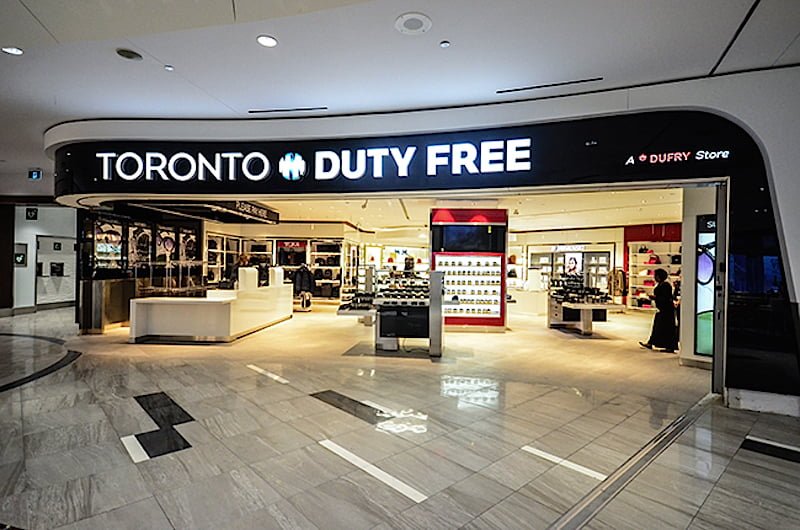
Duty Free at Toronto Pearson Airport

Technology

Today’s shoppers are influenced by social media like Instagram and YouTube. Luxury retailers have been effective in drawing shopper’s attention through flashy campaigns made possible in a big space like an airport terminal with high ceiling height and showcased on social media.  Burberry, for example, introduced the world’s first Burberry Balloon as an exhibit at an airport to highlight its DK88 collection. This limited time installation has been an internet sensation for the brand (e.g. a simple Google search resulted in ~475,000 results) and also provides free promotion for the airport as an art and experience destination.  This effect has been magnified with the airport cross-promoting the installation through its social media and print channels concurrently.

When Toronto Pearson decides to add more luxury retailers, it would be important to showcase them as a collection or individually. Retailer Insider checked the airport’s Twitter, Instagram, Facebook and website and noted that there has been minimal coverage of the luxury retailers or the airport as a luxury shopping destination.  In addition, not all luxury brands listed the airport as an official store location in its website or through Google search. This makes for a more challenging shopper discovery process.

Toronto is the Canadian financial capital featuring some of the biggest shopping malls in North America.  Handling more than 44 million passengers a year allows Toronto Pearson the opportunities to offer a more diverse retail product mix. The luxury segment makes up only a small percentage of the total number of retail outlets currently occupied within the airport and is a prime target for growth.

The goal to improve non-aeronautical revenue as a percentage of the overall revenue can be achieved through introducing more luxury retailers for all airport users including shoppers, employees and travellers, building the airport’s reputation as a shopping destination through brand acquisition and improved services and using technology as a marketing tool to capture shoppers’ imagination that influential luxury retailers can bring. 

Change Lingerie Unveils Plans for 25 More Canadian Stores

Change Lingerie (PHOTO: CLUB ONLYOU)

Danish lingerie and fashion brand Change (formerly ‘Change of Scandinavia’) is planning a substantial Canadian store expansion over the next several years. The retailer has announced that it plans to open 25 more Canadian stores, and it’s working with brokerage Think Retail on the endeavour. 

On Thursday of last week, Change opened a 550 square foot location at CF Carrefour Laval, north of Montreal. Change took part of the retail space formerly occupied by accessory retailer Bentley, and Spanish accessory retailer Uno de 50 will soon occupy the remainder. CF Carrefour Laval is the most productive major shopping centre in the province of Quebec, according to Retail Council of Canada’s Shopping Centre Study.  
 
Change’s next locations will include a 650 square foot location at CF Richmond Centre near Vancouver, as well as a 750 square foot unit at Oshawa Centre, east of Toronto. These are part of a considerably larger expansion for Change Lingerie that will extend into 2018 and 2019 — the retailer plans to open at least 25 more Canadian locations, and it’s working with Tony Flanz of Think Retail to secure more locations. Ideally, retail spaces will be in the 500 to 850 square foot range, and target markets include Greater Toronto Area, Vancouver, Ottawa, Quebec City and Montreal.

Change launched its Canadian retail operations in 2006 and it now boasts 16 locations with five in British Columbia (Vancouver x 2, Burnaby, Coquitlam and West Vancouver), one in Saskatchewan (Saskatoon), five in Ontario (Toronto x 2, Thornhill, Oakville, Burlington), and five in Quebec (Montreal x 4 and in Saint-Jean-sur-Richelieu).

Change Lingerie’s value proposition is why it’s growing, and why there’s such a considerable demand — its bra sizes are larger than most retailers, so it caters to a different niche than other lingerie retailers such as Victoria’s Secret and La Vie En Rose. Approximately 75% of Change’s bras are in the DD to M cup size range, with a wide range of fits and styles (most lingerie retailers operating in Canada sell bras in the B-D size range). Change stores offers free bra fitting to ensure that its products meet the needs of its diverse customers, and prices are kept reasonable to attract a broad clientele. Approximately 75% of Change’s revenue comes from underwear and bras, with the remainder from loungewear, swimmer, nightwear and stockings. 

The company launched in Denmark in 1995, with its first retail store having opened in Copenhagen in 2001. The company now operates more than 240 corporate and franchised stores globally and most of its stores are in Europe and Scandinavia — with the exception of Canada and Singapore. 

Inside Hublot’s 1st Canadian Store [Photos]

Hublot Vancouver at 1080 Alberni Street (Image: Hublot)

LVMH-owned Swiss luxury timepiece brand Hublot has opened its first freestanding Canadian boutique, in Vancouver. Located in the heart of the city’s expanding ‘Luxury Zone’, the 2,800 square foot store is one of Hublot’s largest globally. 

The two-level store boasts of a wide assortment of watch styles, including several limited-edition models. Hublot watches are crafted to precision. From in-house watch complications, including award-winning minute repeaters and tourbillons, to revolutionary materials such as patented and scratch resistant Magic Gold, colored Texalium carbon fiber, and transparent sapphire cases to world class collaborations such as Ferrari, FIFA™ World Cup, and Italia Independent, Hublot characterizes itself through the “Art of Fusion” philosophy, ‘bringing tradition into the future’.

Vancouver’s Hublot store is located within ‘The Carlyle’ retail complex at 1080 Alberni Street, next to De Beers. Hublot’s secured the last vacant Alberni Street-facing retail space within The Carlyle, which now houses luxury brands including Prada, Tory Burch, Saint Laurent and Moncler. Brodie Henrichsen, principal at Northwest Atlantic, negotiated the lease on behalf of the retailer while Mario Negris and Martin Moriarty of CBRE Vancouver acted on behalf of the landlord. 

Hublot Vancouver at 1080 Alberni Street (Image: Hublot)

Hublot was founded in Switzerland in 1980 by Italian Carlo Crocco — a scion of the Italian Binda Group dynasty, best known for making Breil watches. Hublot is named after the French word for “porthole”, and the first watch that he created featured the first natural rubber strap in the history of watchmaking — a feat that took three years of research to create. In 1998, Hublot was acquired by French luxury conglomerate LVMH (Louis Vuitton Moet Hennessy), and it continues to operate as a subsidiary.

Hublot operates freestanding stores in a number of global cities. On a commercial level, the network of stores currently stands at more than 70 exclusive boutiques around the world. In the United States, Hublot stores are in New York City, Beverly Hills, San Francisco, Las Vegas, Atlanta, Dallas, Houston and Orlando, Florida. The Miami area boasts four Hublot stores — in Bal Harbour, Miami Design District, Boca Raton and in Palm Beach. 

Grab-and-go Food Concept ‘Picnic’ Opening Multiple Locations

Last month, Toronto-based grab-and-go food concept Picnic opened its newest location at 120 Bloor Street East, to a crowd of new and familiar faces. Picnic’s third store is the latest iteration of the Picnic store concept and serves as the food retailers’ first street front location. 

Picnic’s first prototype store opened in February 2014 in the underground concourse of the 60 Bloor Street West office tower, and its second opened a year-and-half later in Exchange Tower in the Financial District. This third location, however, marks the store’s first street front store, and provides some welcome exposure for the young brand. The new south facing location also aims to take advantage of Bloor Street’s day-time pedestrian foot traffic, generated by the neighbourhood’s high density residential, retail and office spaces.

“We needed to situate in a location that was highly demographic. Work, play, live spaces. For this space, being on the north side of Bloor where everyone exits the Hudson’s Bay Centre and walks east to their office, it was a natural progression to test a street front model,” said Jason Kaiman, President and CEO of Picnic. 

The Picnic food concept fits neatly within the convenience health-food model, first popularized in Europe by grab-and-go concepts like Pret A Manger. Accordingly, the brand strives to meet the preferences of people seeking reasonably priced, healthy and freshly prepared food offerings, but who are also short on time. 

From quinoa bowls to survival cookies, Picnic’s menu is meant to appeal to those riding the health food trend. Picnic smoothies, for example, typically include health trend ingredients like protein powder, almond milk and goji berries. 

Indeed, nutrition is a critical component to the Picnic concept. Before opening his first Picnic store, Mr. Kaiman launched a chain of fitness clubs before eventually selling the business. When he opened Picnic in 2014, he brought with him an understanding of an active lifestyle demographic who are increasingly health conscious and whose lives are fast-paced. 

Ideally, Picnic patrons spend about 3 minutes in the store, and while Picnic positions itself as a grab-and-go option, the store still strives to make a genuine connection. “We try to train our staff that people’s lives are very busy, but we want to give a 3-5-minute break during their day to get them away from their busy life,” said Kaiman. 

The brightly-lit, almost 1,000 square foot space is furnished with bright wood panels and wooden benches. In total, 206 solid maple wood fixtures were used, all sourced from Montreal. And while this location is without Picnic’s signature 40-foot picnic table, the store’s airy and cheerful themes still shine through.

Picnic’s goal is to open 5 locations in the next year-and-a-half. To date there have been a number of requests for franchising, but for now, Mr. Kaiman is focused on consolidating and proving the Picnic brand through a corporate model.

Originally from British Columbia, Martin Owusu is currently studying towards a JD/MBA at Dalhousie University. He has a keen interest in the combined potential for sport and business to build community.

Amazon Prime Day 2017 Recap

Image: Amazon Prime

Prime Day 2017 has come and gone and, this year, it brought a few surprises with it. Now that the dust has settled and we’ve had a chance to sift through the data we gather from Amazon’s first-party sellers (i.e. any brand whose product descriptions read “Ships and Sold by Amazon”), we’ve noticed some distinct trends.

Prime Day is the quintessential deal day. The whole point of shopping on Prime Day is to take advantage of all the discounts offered by just about every major brand you can think of – no special occasion to celebrate, just the joy of finding a good deal. In the US, sales of items from first party brands grew by 15% to over $600 million and had 16,000 more promos than last year; when factoring in Amazon private brand items (e.g. Echo, Kindle, etc.) and sales from third party sellers, we estimate total US sales of roughly $1 billion. First-party sellers across the globe understood that to truly win on Prime Day they needed to make 2017 the best deal day ever. The countries that saw the largest YoY growth in sales also had the largest increases in promotions: UK had 11,000 more promos than in 2016; Canada, 5K more; and Germany 8K more. Globally, promotions were up 115%.

Nearly 50 cents on every dollar was spent on a discounted item, amounting to more than 4.7 million items sold at an average of 24% off. These discounts drove a lift of over 1000% (10 times the sales!) compared to the pre-promo period and helped the following items cement their place as the bestsellers of the day:

Lightning Deals are king, but are the new Alexa Deals better?

Even though Amazon offers brands “Prime Day Deal” promotions, Lightning Deals are still the bread and butter for first party sellers. Over 333,000 Lightning Deals were on offer on July 11th, plus another 100,000+ Prime Early Access Lightning Deals, compared to only 20,000+ Prime Day Deals. Experienced brands know that if it ain’t broke, don’t fix it.

But Amazon did introduce something this year designed to be a game changer – the Alexa Deal. This promotion was targeted at Alexa users to encourage them to order deal items through Amazon Echo, and the discounts were made available exclusively to Alexa users one week early, on July 5th, then made available to all Prime members on July 11th. Though this initial trial of the promotion only included 169 items, sales were high on these deals with 4 of the items appearing in the top 10 most effective promotions, including the number 1 item. What is driving these high sales; however, is in question as the playing field is not level. Alexa Deals have the following distinct advantages:

  1. An extra week to obtain sales;
  2. Deeper manufacturer discounts;
  3. Extra Amazon discounts to incent trial of Alexa; and
  4. More advertising visibility from Amazon directly.

Furthermore, One Click Retail’s research has shown that fewer than 2% of customers are willing to buy a $25+ item using ONLY Alexa; rather, customers review the item online and then complete via voice to obtain the extra discount. This calls into question whether customers are willing to complete voice purchases without the added incentive.

Most Successful Promotions

The discount “sweet spot”

It may be counterintuitive, but discount levels do not directly correlate to sales lift. Too low and people aren’t interested, naturally, but if a discount is too high it has the same effect: items more than 70% are often passed over in favor of less discounted but more desirable items.

The sweet spot on Prime Day 2017 landed in the 30-35% range, with good results throughout the 25-45% range. Be careful: surprisingly, there is a null in the 20-25%, generating a very poor lift in sales. The null may be caused by this being the most popular discount bucket this Prime year, causing it to appear as merely an “average” deal and encouraging shoppers to seek deeper discounts.

1st party sellers have more competition than ever

It’s not all wine and roses for first-party sellers. Though the Instant Pot pressure cooker was a standout in 1P sales, it was beat by two other items: Amazon Echo and Amazon Echo Dot, Amazon’s proprietary voice-activated, Alexa-enabled speakers. And it’s not only private brands; third-party sellers performed much better than last year, when only 1 item sold more than $1 million, by offering good deals on cheap (under $10) items such as car mounts and USB extension cables and selling in high volume. In fact, the total promos offered by 3rd-party sellers unexpectedly surpassed those offered by 1P brands, a sure indication that these sellers now want their piece of the pie.

In 2016, first-party sellers were very much the stars of Prime Day, but it’s clear that others have now taken notice. Not only has Amazon’s private brands strategy really come into its own over the last 12 months, but third-party sellers have learned that they have just as much to gain by participating in Prime Day. Let this be a lesson to 1P sellers not to take Deal Days for granted – there’s more competition than ever.

Kitchen is the product group of the year

The standout product group of Prime Day 2017 was Kitchen – further evidence that millennial buying habits are shifting as they are settling down and becoming homeowners.

The top first-party item of the day by a wide margin was the Instant Pot Pressure Cooker, selling over 230 thousand units in the US and Canada alone—worth more than $30 million in sales even after a Prime Day discount of 31%. Overall, Kitchen was the highest-revenue product group with $60 million in sales and high growth rates across North America and Europe. Two thirds of the sales total was made up of promotional items with an average discount of 24%, generating a lift of 7000% (70 times the pre-promo sales!).

Prime day is going global

The final significant development compared to last year is that in 2017, Prime Day is clearly on track to become a global event. Originally a US phenomenon, now consumers are coming on board in Canada and throughout Europe with sales driven by Health & Personal Care, Kitchen and—especially in Canada—Beauty. Much of the 60% growth announced by Amazon came from outside the US, where the growth rate tends to be steeper. Brands can take advantage of this by cross-promoting their products on Amazon’s international marketplaces.

Germany

Germany’s Prime Day 1P sales reached €150 million, driven by growth in the Home Improvement (70%), Kitchen (60%) and Grocery (60%) product groups. With three items in the top 10, Samsung demonstrated their Amazon strategy prowess by offering the right type of deal and discount: the Galaxy S7 offered a 15-26% discount on a lightning deal, while the Galaxy Smartwatch and Galaxy A3 benefited from the brands 18-43% discount on selected Samsung Electronics. More evidence that lightning deals do work is Sodastream’s rise to the #2 top selling item, thanks to a 50% discount.

UK

The UK’s Prime Day 1P sales reached £70 million, driven by growth in the Health & Personal Care (140%), Kitchen (110%), Lawn & Garden (70%) and Apparel (70%) product groups. Like Samsung in Germany, Sony’s Prime Day strategy paid off as they captured two of the top 10 by offering the ideal discount of 23%.

Top-selling UK 1P Items, Prime Day 2017

Canada

Canada’s Prime Day 1P sales reached $40 million, driven by growth in the Beauty (440%), Kitchen (140%) and Home (80%) product groups. Like in the US, the top selling item was the Instant Pot 8-quart pressure cooker. The Xbox One rose to #2 in Canada thanks to a sweet Amazon Daily Deal of 17% off.

France

France’s Prime Day 1P sales reached €20 million, driven by growth in the Grocery (40%), Health & Personal Care (30%), and Toys (30%) product groups. While the number one spot goes to the Microsoft Surface Pro, ASUS emerged as the winning brand with 3 of the top 10 items. But did they do anything differently than the other laptop brands? Thanks to Amazon’s multi-item promotion (up to 30% off on laptops: Acer, Asus, HP, Lenovo), French Prime Day shoppers scored on their preferred make and model.

Beyond being the day of the year with the single biggest sales potential for Amazon first-party sellers, developing a smart Prime Day strategy can capture the minds of innumerable consumers. A clever combination of Prime exclusive, early access, and Alexa deals can generate a lift in sales that will, as we witnessed last year and after other deal days, sustain itself long after the day is over.

One Click Retail is the industry’s most accurate source of sales data for the world’s top eCommerce marketplaces. With 98% accuracy, OCR delivers the best insights, analytics and strategies to their brand manufacturer clients, giving them a critical edge on online platforms. To catch a glimpse of the unique data and expertise OCR provides to its customers, subscribe to our weekly eCommerce insights blog, and follow us on Twitter and LinkedIn. Additionally, if you are a brand manufacturer and would like to learn more about your Prime Day performance vs that of your competitors—or would like to see your market share and category growth insights—email us at info@oneclickretail.com for a free capabilities demo.

Canada Post Wins Prestigious ‘Retail Innovation’ Award

Image: Canada Post

Canada Post’s ‘Drive-thru Parcel Centre’ has been named the ‘Retail Innovation’ winner in J.C. Williams Group/Ebeltoft’s 2016 ranking of most innovative industry concepts. The Canada Post initiative aims for convenience, utilizing automation and self-service technologies to create simpler and more efficient ways for consumers to receive and send parcels. 

As originally published in this summer’s ’The Marketing Issue’ of Retail Council of Canada’s Canadian Retailer magazine, Canada Post’s three award winning spaces range from 2,000 to 7,000 square feet and are sleek, clean, modern and open. Each offers a unique variety of features suited to the customer needs within that particular area, like 24/7 access, self-service kiosks, a vending machine, a drive-thru for parcel pick-up and even a fitting room to try on online purchases. 

Toronto-based retail consultancy J.C. Williams Group, in partnership with global alliance Ebeltoft Group, identified Canada Post’s Drive-thru Parcel Centre as an initiative that could revolutionize Canadian e-commerce. As a result, Canada Post won Ebeltoft’s 12th annual ranking of top global retail innovations. 

Canada Post’s first Drive-thru Parcel Centre opened in Richmond Hill, Ontario, in the fall of 2015. An Edmonton location followed a year later and most recently, a downtown Vancouver Parcel Centre opened in November of 2016. All three are getting positive reviews, and successful elements will be incorporated into Canada Post’s network of 6,200+ stores across the country.

A number of innovations are proving popular with consumers, including: 

-Service desks that eliminate the barrier between customers and staff, where staff and customers are encouraged to engage in a more familiar and accessible interaction, 

-A philatelic wall displaying collector stamps and souvenirs for purchase, positioned alongside new format displays such as 14 digital screens and a large LED video wall that advertises Canada Post’s latest services,

-Self-service vending machines that eliminate lineups and the need for staff to assist with items such as stamps,

-The potential for pop-up retail units for online-only retailers, allowing for face-to-face interaction with consumers, 

-A self-serve parcel kiosk is an automated all-in-one service that utilizes a ‘cubing device’ to scan packages for size and weight, so that postage can be calculated by the machine, 

-An ‘induction box’ that  allows a customer to submit their deliveries online and print their shipping labels prior to heading to the post office — once at the centre, consumers can simply scan their packages to drop them off, and

-A 50-square foot private fitting room, offering customers the ability to try on their apparel purchases as soon as they receive their parcels at the post office (Unwanted clothing can easily be returned immediately). 

Image: Canada Post

In the Canadian Retailer article, J.C. Williams Group/Ebeltoft describes the concept as “Convenience 2.0”, with a “flash delivery” service experience. For example, customers don’t need to get out of their cars — instead, they can drive up to the store’s welcome kiosk, scan the barcode (either from a smartphone or paper pick-up notice), and drive up to retrieve their purchase.  

Revenue per location stands at about $1.2 million annually, as opposed to $400,000 in traditional urban stores. Canada Post has effectively reinvented the modern post office with a focus on convenience according to Mr. Williams. 

We will profile one of Ebeltoft’s top global retail innovations here on Retail Insider every two weeks, providing insight into significant industry trends that are worthy of discussion. For more information and to read the entire article written by Retail Insider’s Craig Patterson on the Canada Post initiative, head over to Canadian Retailer to read it, as well as other insightful articles in the summer Canadian Retailer Marketing Issue. 

*Photos courtesy of Canada Post

Experts Predict 2018 to be ‘Year of the Pop-Up’ [Feature]

IKEA Pop-Up on Queen Street in Toronto

Pop-up retail is now more common in Canada than ever, and industry experts predict that the trend will continue in a big way into 2018. Pop-up retail is being seen in shopping centres, on urban street fronts, and even within stores — and it’s seeing success for various reasons. 

David Ian Gray, retail consultant and head of Vancouver-based think tank DIG360, predicts that 2018 will be “the year of the pop-up” in Canada. While pop-ups aren’t necessarily a new thing, pop-up retail is now considerably more sophisticated, with landlords going out of their way to accommodate temporary tenants, he said. The phenomenon has been gaining traction over the past several years — pop-ups were originally intended for brands to engage with customers, he noted, and retailers quickly co-opted the idea, with considerable success. 

In 2017, Canadian shopping centres have been facilitating pop-up retail in a big way, with Mr. Gray describing how pop-ups are driving traffic to centres through hype and perceived scarcity, and how some shopping centres are now taking the lead in hosting pop-up spaces in their malls. Not only are individual retail spaces being filled on a temporary basis — at Toronto’s Yorkdale Shopping Centre, for example, landlord Oxford Properties partnered with design firm figure3 to launch CONCEPT, a permanent 3,600 square foot multi-tenant space dedicated to pop-ups. Mississauga’s Dixie Outlet Mall has done something similar, but with a twist — ‘The Living Room’ as it’s been called, is a 3,100 square foot space that can be activated for free, and can be utilised for retail or other purposes. Not only is it popular, it has a waiting list. 

GOOP POP-UP AT NORDSTROM AT CF TORONTO EATON CENTRE IN THE SPRING OF 2017. (PHOTO: RITCHIE PO.)

“All retailers should consider pop-ups from a strategic level” said Mr. Gray, noting that even luxury brands are in on the temporary retail phenomenon. In the spring of this year, Louis Vuitton hosted a pop-up at Nordstrom’s flagship in Vancouver. Department stores such as Nordstrom are hosting pop-ups in a big way, and the Seattle-based retailer operates permanent pop-up spaces at its Vancouver and CF Toronto Eaton Centre Centre flagships. Recently, Gwyneth Paltrow’s GOOP popped up at both stores, showcasing product hand-picked by the celebrity. A technology-themed pop-up has since replaced GOOP.

Pop-ups aren’t necessarily a new thing, noted Mr. Gray — for years, brands like Aritzia have hosted seasonal warehouse sales. But pop-up retail is now considerably more sophisticated, with landlords going out of their way to accommodate temporary tenants. 

Prior to opening permanent stores, plenty of brands have launched by utilizing pop-ups — two Vancouver brands immediately come to mind, including ‘technical cashmere’ brand Kit and Ace and custom suit maker INDOCHINO

GIVENCHY POP-UP AT NORDSTROM IN VANCOUVER. PHOTO: NORDSTROM

While some pop-ups may lead to permanent situations, some are also decidedly seasonal. Spirit of Halloween will soon start opening in retail spaces temporarily, selling costumes and related ‘spooky’ items. Smoked meat and gifts brand Hickory Farms will pop-up in Canadian malls again this year, utilizing a real estate strategy that includes kiosks as well as full-sized retail CRU’s on a temporary basis. 

Demand for pop-up retail space is unprecedented, says Linda Farha, Founder and Chief Connector at pop-up go, an online platform that helps pair retailers with available temporary retail spaces, which also features a curated pop-up match service that provides access to the ever-growing pipeline of pop-up seekers looking for space. Pop-up retail wasn’t on the radar for the most part, she noted, and now business is booming. Downtown Oakville is a unique example — Ms. Farha’s pop-up go partnered with Bentall Kennedy to lease out 8 individual retail spaces on a temporary bases, ranging from three days to three months. The intention is to create interest and variety in the area in order to drive more traffic to the downtown core, with a rotating group of vendors that consumers know won’t be there for long. 

Ms. Farha of pop-up go noted how perceived scarcity works in a pop-up retailers favour — if consumers know that something’s available for a limited time, they’re more likely to go before it’s gone. 

‘CONCEPT’ AT YORKDALE — THE 3,600 SF SPACE HOUSES A ROTATION OF POP-UPS. PHOTO: CRAIG PATTERSON)
'CONCEPT' AT YORKDALE
Pi Squared and Uncle Tetsu pop-up: ‘CONCEPT’ AT YORKDALE — THE 3,600 SF SPACE HOUSES A ROTATION OF POP-UPS. PHOTO: CRAIG PATTERSON)

“Pop-ups create an air of excitement due to their temporary nature, and also allow retailers to test out new concepts and new locations prior to opening permanent stores,” said Ms. Farha, who went on to explain how pop-ups allow retailers to test the market without being bound by long-term leases and costly tenant improvements, while also providing retailers an opportunity to establish a presence in the market prior to opening their permanent store in their ideal location. Pop-ups also provide e-commerce retailers the opportunity to test concepts in a physical form, and are also useful for ‘guerrilla marketing’ initiatives, she noted. 

Ms. Farha explained, as well, that pop-ups are not only a tool to generate sales, but may also serve to create an experiential component that can bring a brand to life. “Pop-ups  can also help brands understand their customer and serve as a form or market research,” she noted. 

When asked if pop-up retail is reaching the saturation point in Canada, Robert Luciano, Principal at retail consultancy decisionSMART gave an unequivocal ‘no’. “Plenty of traditional retailers haven’t even scratched the surface in terms of exploring and utilizing pop-ups,” he noted, explaining that there is considerable opportunity for retailers of all shapes and sizes to utilize temporary retail in order to build buzz, as well as to drive sales. 

‘GIFTED’ BY AIR MILES POP-UP AT CF SHOPS AT DON MILLS. PHOTO: CADILLAC FAIRVIEW)

Streetfront pop-up retail is already huge in Canada this year. Toronto’s Queen Street West is a notable address for concepts seeking to gain exposure, particularly the stretch of the street between University Avenue and Spadina Avenue. Ikea recently opened a temporary cafe and retail space at 336 Queen Street West, featuring various games to enhance the overall experience. Up the street at 322 Queen, Sears Canada launched its current pop-up in the spring to showcase how its has ‘changed’, profiling its new private label fashions as well as ‘The Cut’, its new off-price concept. Nestlé Canada recently opened its Bär Häagen-Dazs at the Spoke Club at 600 King Street West in Toronto, which will remain open until Saturday, July 22. Bär Häagen-Dazs hosts ‘Häagen-Hour’ — the brand’s own play on happy hour, where those 19 and over can listen to music and enjoy specially curated ice cream alcohol-infused cocktails. 

Sleep brand Casper (known for its ‘bed-in-a-box’) has just launched a pop-up on Ossington Avenue in Toronto, further engaging consumers face-to-face in an effort to build relationships. Founded as an online retailer, Casper has found that it can drive sales online by offering physical experiences, building on its ‘nap tour’ that the brand launched in Canada last year. 

Joseph Gatto, owner and broker of the 202 Queen Street West space, is in talks with a number of interesting concepts to occupy his three-level space. Mr. Gatto explained while it’s ultimately the goal to get a long-term tenant at 202 Queen Street West, a number of interesting offers has him considering using it as a pop-up space for the short-term — if not longer. 

Even Toronto’s ‘Mink Mile’ has recently seen pop-ups — several years ago, ice-cream brand Magnum set up a pop-up near the Yonge Street and Bloor Street West intersection, and several months ago The Body Shop opened a temporary location at 93 Bloor Street West (soon to be occupied by luxury brand MCM, which has leased the space long-term). 

(PHOTO: CASPER)
IKEA POP-UP IN TORONTO, AT 336 QUEEN ST. W.
HERSCHEL POP-UP IN VANCOUVER’S DEEP COVE. PHOTO SUPPLIED

Ahead of its Canadian retail store launch, Vancouver-based accessory brand Herschel has launched a ‘lemonade stand’ in the Deep Cove area of North Vancouver, featuring a variety of product designs, as well as lemonade in a variety of colours, matching the product. The almost 300 square foot space features both cold-pressed lemon juices in four flavours — plain, strawberry, algae-infused Blue Majik, and Charcoal (priced from $4), and 100% of proceeds from the juices will be donated to Artstarts in Schools, a local nonprofit that works to increase access to arts-based education for youth across B.C.

For some brands, pop-ups are an important part of their retail strategy. Montreal-based Yoga and athletic brand Lolë has been utilising pop-ups for several years now to build brand awareness (Tony Flanz of Think Retail represents Lolë as broker in Canada), and pop-ups have proved to be a way to determine if a market might eventually support a permanent store. 

Technology conference Dx3, in partnership with Oxford Properties and Retail Council of Canada, held a competition several months ago, where the winner won a one-month pop-up space at Yorkdale Shopping Centre. The winner was innovative footwear retailer Tanya Heath Paris, which artfully created a temporary space with a simple, chic facade that was created by painting a plywood temporary storefront. The Tanya Heath pop-up gained the retailer exposure in Canada’s most productive mall, complementing the retailer’s permanent store in Toronto’s downtown Yorkville neighbourhood. 

TANYA HEATH PARIS POP-UP AT YORKDALE IN THE SPRING OF 2017. TANYA HEATH WON AN INNOVATION COMPETITION HOSTED BY DX3 IN PARTNERSHIP WITH OXFORD PROPERTIES AND RETAIL COUNCIL OF CANADA (IMAGE: CRAIG PATTERSON)

Landlord Cadillac Fairview notes that it uses pop-ups to provide an opportunity to broaden its retail offering, though it says that it focuses on the quality of the pop-up, rather than the quantity that open within its properties.  “Pop-ups create a boutique-style shopping experience within the walls of our shopping centres, which supplements the offering of the larger national brands”, said Stephen Yau, VP, National Leasing at Cadillac Fairview. “There is a sense of uniqueness in finding products that you cannot find in other shopping centres and may not otherwise have the opportunity to interact with in an offline setting,” he said. 

Furthermore, “Pop-ups have created an opportunity to work with new, upcoming brands that, due to a number of factors, may not otherwise be able to enter one of our shopping centres. The pop-up program allows these brands to test a market or a new concept, without committing to a long-term lease”. Mr. Yau noted that Cadillac Fairview’s end goal “is to incubate these retailers, with the intention of transitioning them into long-term tenants.  Pop-ups provide a window of time to allow these retailers to establish a presence in the market prior to opening their permanent store in their long term location.  We have seen that this is beneficial to both the retailer and the landlord.” 

‘WE’ POP-UP AT CF RIDEAU CENTRE IN OTTAWA. THE STORE WILL BE OPEN UNTIL EARLY 2018. PHOTO: WILLIAM MITCHELL)

Cadillac Fairview has hosted a number of significant pop-ups over the past year including the recent launch of a temporary WE store, which launched last month at Ottawa’s CF Rideau Centre. The attractively designed WE space will remain at CF Rideau until early 2018, with the intention of promoting the charitable endeavour while also selling product with proceeds going to causes that the WE Movement supports. A number of other innovative Cadillac Fairview pop-ups that have operated over the past year have included: 

·         Well.ca (at CF Shops at Don Mills & CF Sherway Gardens in Toronto): The online health-focused retailer popped up with its first two bricks-and-mortar locations, 

·         Zvelle (at CF Toronto Eaton Centre & CF Sherway Gardens in Toronto): The higher-end direct-to-consumer footwear brand was looking to increase brand awareness, (most notably known for being a shoe of choice for Sophie Gregoire Trudeau), and the brand currently operates out of a retail space at Toronto’s Yorkdale Shopping Centre. 

·         Gifted by Air Miles (CF Shops at Don Mills in Toronto): The seasonal (holiday) pop-up engaged with Air Miles collectors face-to-face, with the pop-up providing shoppers with a unique shopping experience and an opportunity to find thoughtfully curated Canadian products,

·         L’Intervalle – (at CF Fairview Pointe Claire, CF Promenades St-Bruno & CF Rideau Centre) opened originally as a pop up footwear store, and now boasts permanent locations at these malls (watch for a new article on Retail Insider about L’Intervalle this month),

·         B3 Athleisure (CF Market Mall in Calgary): The unisex athleisure is based out of Edmonton and boasts a heavy social media presence,

·         Freddy Pant Room (CF Chinook Centre in Calgary and at CF Richmond Centre): The unisex casual clothing retailer was seeking to expand into new markets, 

·         The Greenhouse (at CF Market Mall in Calgary): The eco-friendly brand growing throughout western Canada, featuring bamboo clothing, essential oils, and handcrafted jewelry, 

·         Nespresso (CF Galerie’s D’Anjou, CF Promenades St Bruno, CF Fairview Pointe Claire, all in Quebec) – Cadillac Fairview says that this has been a huge success in its malls, and many have been or will soon be converting to permanent stores, 

·         A/MAZE (CF Fairview Pointe Claire in Montreal) a real life escape game rooms – the unique concept is exclusive to Cadillac Fairview, and 

·         Toyota (CF Carrefour Laval near Montreal) — featuring an experiential and interactive showroom pop up. 

Pop-up retail is a phenomenon that has grown in popularity quickly, and experts are predicting that it will continue to gain momentum into early next year. Retail Insider will be following this trend and more regularly reporting on pop-up retail, as it has become an integral part of the Canadian retail industry.