Vancouver-based athletic apparel brand Lululemon has renovated its first standalone store location, which opened in Vancouver’s Kitsilano neighbourhood in the year 2000. The company was founded by Chip Wilson in 1998.
The 6,300 square foot space at 2101 West 4th Avenue was Chip Wilson’s first store and at the time, his family lived several blocks away. Seventeen years ago, many wouldn’t have guessed that the quirky-named yoga-themed apparel retailer would become a multibillion dollar operation, with stores spanning the globe.
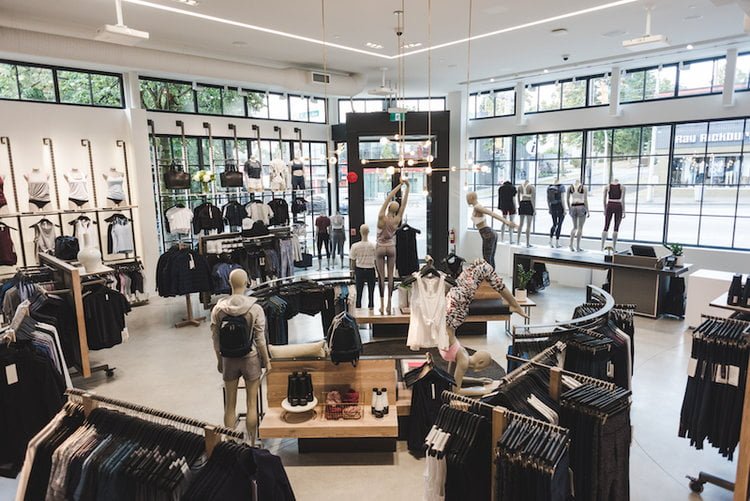
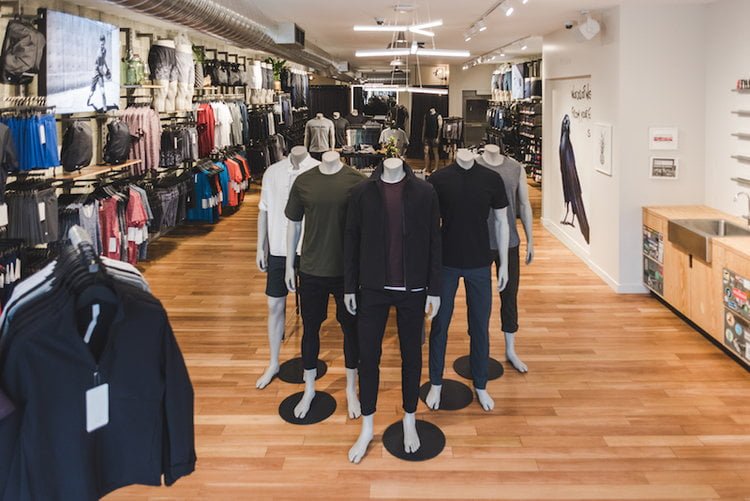
The Kitsilano Lululemon is considerably larger than it was several months ago — it grew in size by annexing a former Midas automotive service centre at the corner of Arbutus Street. Men’s apparel is now in the former Lululemon space while women’s is contained in the expansion, and both will soon be joined with the removal of a wall.
Lululemon Vancouver-Kitsilano
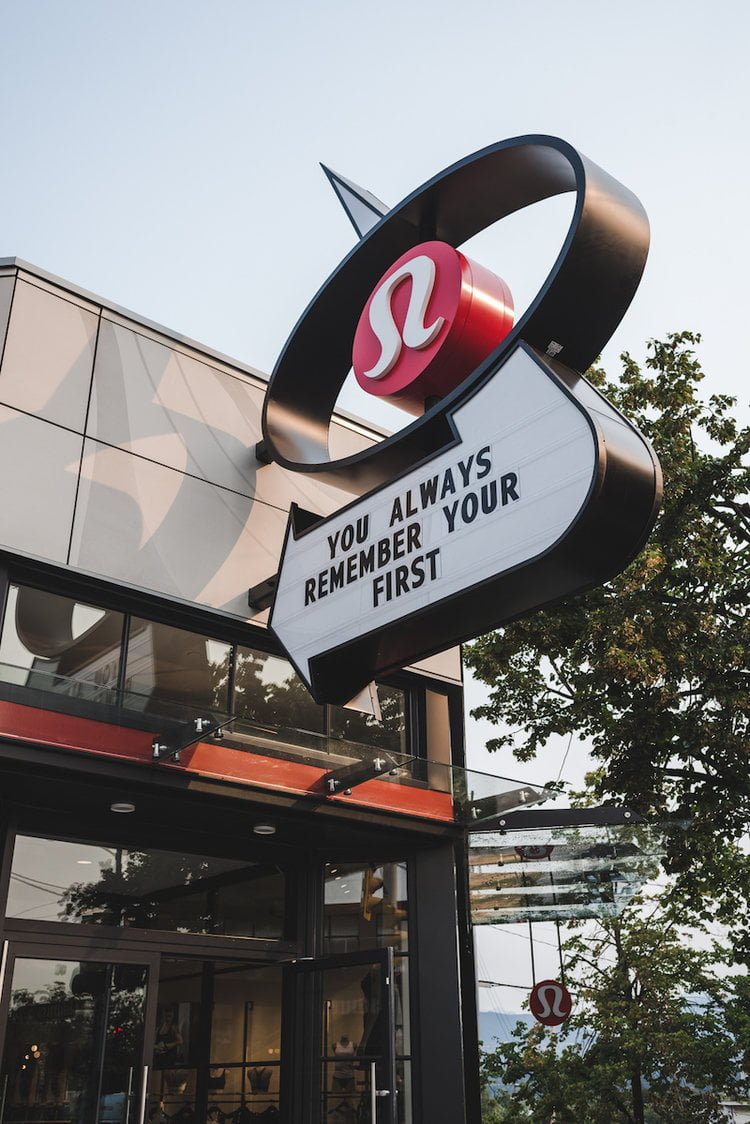
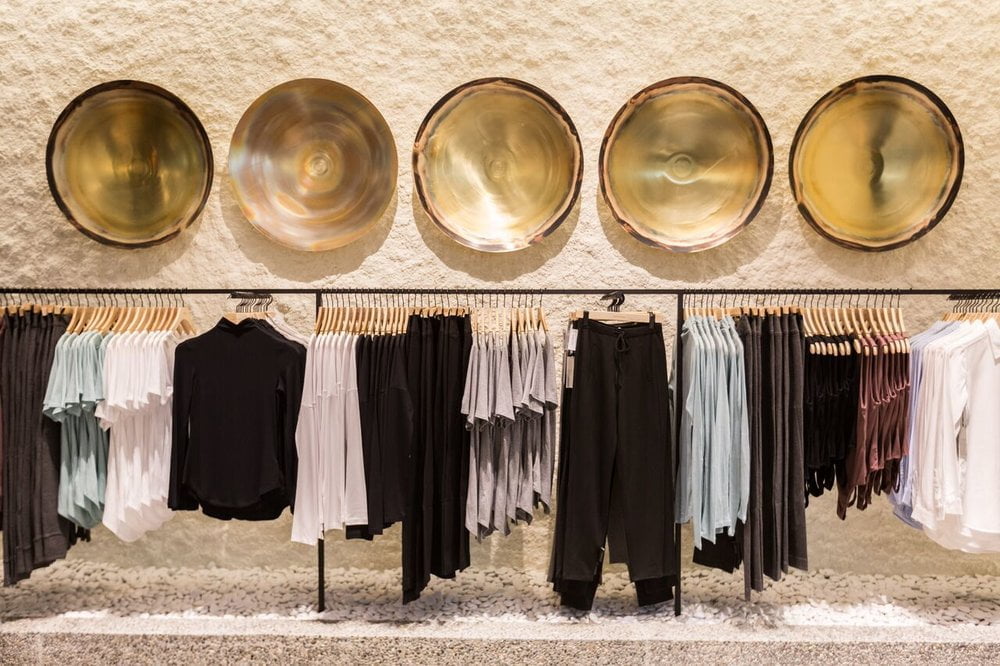
The store’s exterior is marked with the cheeky phrase “You Always Remember Your First”, and the store’s interior decor references Lululemon’s past, including old photographs, posters and other images on the walls, as well as murals by local artists. The store also features a rooftop patio with a barbecue, seating, and the ability to host gatherings that may range from fitness to community-related activities.
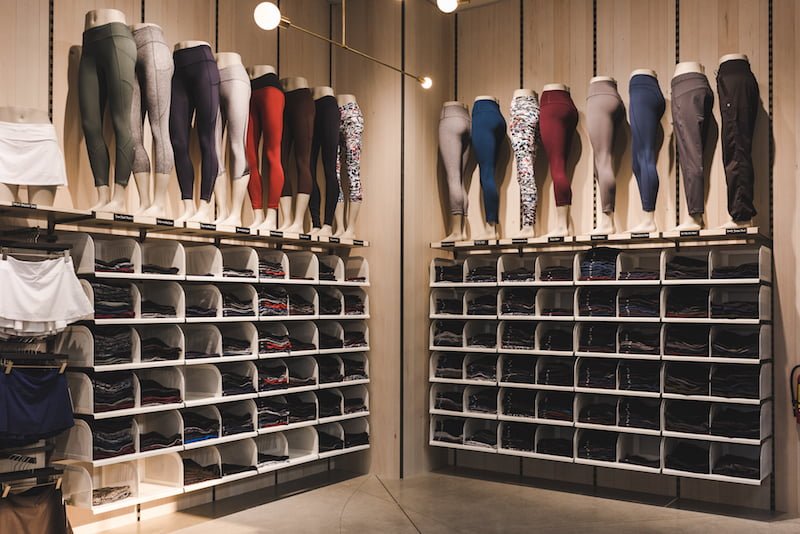
Lululemon’s full range of technical athletic apparel for men and women are carried in the new space, and the men’s store even offers kombucha on tap — taking a page from Lululemon’s first freestanding men’s-only store in Toronto that opened late last year, and serves cold-brewed coffee.
*Photos provided by Lululemon. See below for more.
Vancouver-based Aritzia’s newest retail concept, Babaton is now opening stores in markets across Canada. Babaton’s first location opened at CF Toronto Eaton Centre in December of last year, and another location opened last week at Toronto’s Yorkdale Shopping Centre. Two more Babaton locations are confirmed to be opening soon, as the brand seeks to gain a customer following, as well as gain brand awareness.
The new Yorkdale Babaton spans over 5,000 square feet in the mall’s ‘luxury wing’, adjacent to Van Cleef & Arpels and across from Richemont brands Piaget, IWC Schaffhausen, Vacheron Constantin and Officine Panerai. The boutique features a lit interior garden, custom metal, glass, and stone floor fixtures, a lounge area with a marble coffee table, and curated art and plants throughout. Materials used in the space include a marble cash desk, board formed concrete walls, exposed aggregate concrete, interior partitions with blackened wood and bronze glass, custom stucco walls, and polished concrete floors.
Babaton’s first location opened last December in a 1,777 square foot space on the third floor of CF Toronto Eaton Centre, which formerly housed a Wilfred location (Wilfred relocated in the mall to a considerably larger retail space downstairs). Babaton and Wilfred began as Aritzia exclusive brands, and both have since been spun off to include their own freestanding stores.
Two more Babaton locations are currently under construction. A 4,870 square foot location will open in several months at Square One in Mississauga, marking the third Babaton in the Greater Toronto Area. Babaton will be located near Square One’s Holt Renfrew, across the hall from a recently opened Rolex boutique.
Babaton’s first Vancouver location is also confirmed to be opening in a few months at CF Pacific Centre, measuring just over 3,000 square feet. Aritzia also recently opened a Wilfred location at CF Pacific Centre, and it has operated an Aritzia store in the mall for a number of years.
Aritzia notes that Babaton’s stores “help propel the brand” and that the company views its new Babaton stores as being its “most important marketing tool”. Babaton, as well as other Aritzia brands including Wilfred and TNA, are “generally opened in malls or shopping streets where our established Aritzia store is performing very well, but due to real estate space limitations (such as no other high-profile spaces available, or lack of adjacent store vacancies), we are not able to expand the existing store,” according to Aritzia. The company explained that where it is unable to expand an existing store (often in a very prime location), it finds additional space within the same mall/street to open a banner store. This store strategy allows Aritzia to increase its square footage in the mall/on the street, while still maintaining the optimal location of its established store, given expansion limitations.
To that end, it is likely that Aritzia will open more Babaton stores in Canada (not to mention Wilfred), though the company has not confirmed any more locations as of yet.
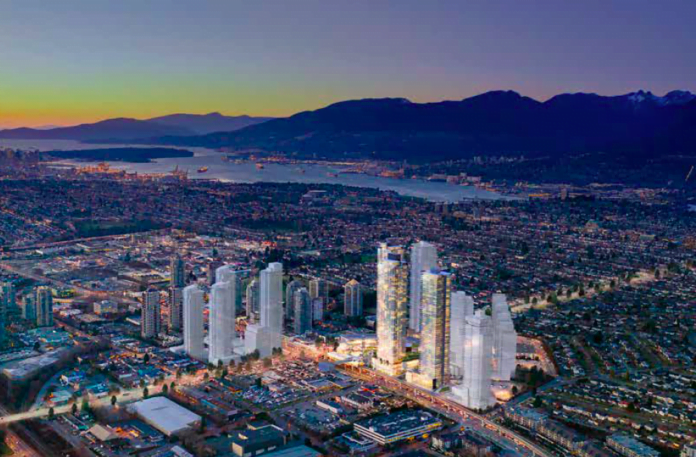
The Amazing Brentwood retail centre, just east of Vancouver, will see an overhaul that will reposition it as a premiere shopping centre with the help of a new, notable investor. Landlord SHAPE and co-owner Healthcare of Ontario Pension Plan have partnered with the L Catterton group, which is a private equity firm linked with French luxury conglomerate LVMH (Louis Vuitton Moët Hennessy) and Groupe Arnault. The new $2 billion The Amazing Brentwood will become the focal point of a community that will include over a million square feet of retail space, considerable office space, as well as multiple residential towers for thousands of new residents. The first phase is scheduled to open in the spring of 2019.
The Amazing Brentwood is L Catterton’s second North American development project, following its investment in Miami’s luxury retail complex, Miami Design District. L Catterton is also involved in a number of luxury projects in Asia, including the recent unveiling of the magnificent Ginza SIX luxury retail complex in central Tokyo. L Catterton is noted as being the world’s largest consumer-focused private equity fund, with more than US $14 billion in capital.
SHAPE has been working over the past several years on creating an innovative, upscale neighbourhood that would include substantial retail and residential components. L Catterton’s investment and direction will further assist in the goal of making The Amazing Brentwood live up to its name.
(MASTER PLAN FOR THE AMAZING BRENTWOOD)
(‘BRENTWOOD BOULEVARD’)
“L Catterton Real Estate’s partnership is a huge vote of confidence in the project and validation that The Amazing Brentwood will serve as a point of pride for Vancouver and a sought-after destination for visitors world-wide, said John Horton, President of SHAPE.
The Amazing Brentwood will court locals as well as market to visitors — tourists are spending a fortune at luxury retailers in downtown Vancouver, and The Amazing Brentwood stands to gain some of that with the addition of new luxury brands.
“This unique partnership encompasses the vision, passion, unparalleled knowledge and reach to create the next generation of retail experiences for our customers and retailers,” said Mathieu Le Bozec, Managing Partner of L Catterton Real Estate.
The Amazing Brentwood is one of the largest mixed-use projects currently underway in North America. The 28 acre site will include an overhauled shopping centre that will feature over 1.1 million square feet of retail space with over 250 stores, a ‘culinary collection’, offices and a one-acre plaza. As well, more than 6,000 homes in 11 high-rise towers will add more than 10,500 new residents in about 4.5 million square feet.
(‘BRENTWOOD PLAZA’ AND SKYTRAIN CONNECTION)
(‘THE MEWS’)
(‘THE PLAZA’)
In the first phase of development, the new centre will feature the first two residential towers, fashion anchor stores, new upscale restaurants and entertainment options, all in an indoor-outdoor configuration.
According to SHAPE’s Executive Vice President, Development, Darren Kwiatkowski, The Amazing Brentwood will feature a considerable amount of space devoted to restaurants, addressing the trend of malls becoming social and entertainment destinations. As a result, The Amazing Brentwood will feature a variety of food options, ranging from chains to chef-driven concepts which will feature options from a variety of ethnicities.
The entertainment focus will also include the addition of Cineplex VIP Cinemas, as well as The Rec Room entertainment centre, which will no doubt draw from the region.
The Brentwood SkyTrain station will become an integral component of the centre, and Mr. Kwiatkowski explained that transit ridership is expected to grow substantially as the Lower Mainland continues to densify. The Amazing Brentwood is also easily accessible by car, located at the busy corner of Lougheed Highway and Willingdon Avenue. Its catchment will include Burnaby as well as Vancouver, Coquitlam, New Westminster, and even North Vancouver via the Second Narrows Bridge.
(RAPID TRANSIT CONNECTION)
The centre will incorporate both indoor retail space with outdoor retail offerings and according to Mr. Kwiatkowski, luxury brands are expected to be present in both. The centre will feature four distinct retail areas, including:
–Brentwood Interior: the centre’s indoor component will feature over 100 retailers in over 500,000 square feet of space as well as more than 25 restaurants in 36,000 square feet of space. Between one and three anchor retailers are expected to be housed in this part of The Amazing Brentwood.
–Brentwood Boulevard: an outdoor retail street that will feature more than 20 retailers in 70,000 square feet of space, as well as restaurants with ample patio space. Its design is inspired by some of the world’s most iconic high streets.
–West Mews and Grand Lobby: featuring retail and restaurant space, offering one-of-a-kind brands, designer stores, and unique restaurants, and
–The Plaza: a one-acre open-air social hub featuring fashion brands mixed with patios, pubs and casual dining.
Mr. Kwiatkowski explained that the project will be “world class”, with a number of LVMH and Catterton-funded brands included in the centre’s mix. “The best of the best” will be included, including local, national and international retail concepts and brands.
(RESIDENTIAL TOWERS)
Tenants have yet to be announced for The Amazing Brentwood, and Mr. Kwiatkowski noted that tenants will range from the affordable to the luxurious. L Catterton’s six other retail projects are decidedly luxury-heavy, with both the Miami Design District and Ginza SIX boasting a number of large flagship stores for some of the world’s leading luxury brands.
A number of LVMH brands operate stores in downtown Vancouver, including Louis Vuitton, Christian Dior, Sephora and Hublot. Brokers confirm that space is tight in downtown Vancouver, with some brands complaining that they are unable to find the ‘right’ real estate in the city’s ‘luxury zone’ (centred around the 1000 Block of Alberni Street as well as adjacent Burrard and Thurlow Streets). LVMH has a number of important luxury brands under its corporate umbrella that currently do not have freestanding stores in Vancouver, including Bulgari, Céline, Fendi, Givenchy, Loro Piana, Marc Jacobs and several others. L Catterton has investment interests in a number of companies as well, including upscale brands such as Baccarat crystal and John Hardy jewellery, fitness brands such as Equinox and Pure Barre, as well as several restaurant concepts.
The Amazing Brentwood will compete with a number of important regional malls such as Park Royal in West Vancouver, Oakridge Centre on Vancouver’s West Side, and Metropolis at Metrotown in Burnaby. While Park Royal and Oakridge Centre house a number of premium retailers, neither of them offer the extensive variety of luxury brands found at Toronto’s Yorkdale Shopping Centre. It remains to be seen if The Amazing Brentwood could become the Lower Mainland’s answer to Yorkdale, and it will be exciting to see how things progress between now and 2019.
Canadian fast-fashion brand Joe Fresh has announced that it is expanding into extended sizes for women for its Fall 2017 collection. Launching online as well as in stores on August 11th, sizes will range from 0-22 (XS – 3X).
“We are thrilled to expand our womenswear line and now offer a selection of our favourite styles in extended sizes,” said President Ian Freedman. “As our brand continues to evolve, we are committed to providing our customers with products that suit their needs while delivering the same style and value.”
Model Tara Lynn and her infant son are part of Joe Fresh’s Fall 2017 ad campaign, as seen in photos in this article. “Family is at the core of the Fall campaign and collection, delivering wardrobing solutions for women, men, kids and baby at this busy time of year.”
Joe Fresh launched in 2006 and it continues to operate today, primarily through shop-in-stores within Loblaw grocery locations. Joe Fresh also operates 11 freestanding stores in Canada, and has a Canadian ecommerce site — JoeFresh.com. Joe Fresh is also available internationally through local partners in countries such as Mexico, the Philippines and the United States.
Setup a call. Email Me @: Contact_Me@raange.com; Text Me @: (514) 613-3324 with Keyword ‘Database’
Are you taking marching orders from senior executives who are stuck in 2005? You know!? That top-down focus on the wrong strategic marketing goal for tomorrow. I keep speaking with companies still focused on email acquisition, and resistant to mobile acquisition. It’s 2017!
It’s clear: you are not the only one. Today, I want to arm you with information to help win over your boss.
What’s the problem with email only?
Let’s be honest, when given the chance, people provide fake contact information. A recent study by Verve found that out of a group of 2400 consumers, 60% admitted to intentionally providing some sort of incorrect information when submitting their personal details online.
Focusing on email acquisition alone can create murky data, as everyone has multiple email addresses – university or college email address, hotmail, yahoo, gmail etc. – or people can simply make up a false email address.
Oftentimes when people do provide their real email addresses, spam filters and message categorization, used by free services such as gmail, can hurt the success of your campaign. As a result, email communication alone may not always be timely or may not even be reaching the end users eyeballs amidst the clutter of all the other email newsletters that customers subscribe to.
Therefore, it’s important to create redundancies in your customer database growth strategy by collecting mobile information as well as focusing on email acquisition. Mobile marketing still has the ability to draw a user’s undivided attention, improve your data quality and increase sales conversions.
SMS increases open rates!
Over 95% of text messages are opened and the majority are read within the first few minutes of receipt. There are no filters to doom your message to marketing purgatory: the spam folder.
SMS is Ubiquitous and Universal! It doesn’t matter what phone, browser or software your customers are using. It Gets Delivered and Opened.
Now the hard part is what you are communicating… That’s another topic for later!!
Mobile can improve data quality.
There is mobile technology that can validate registration information via the phone in the customer’s hand. No opportunity to place a fake mobile number.
But more importantly collecting good data is just good business..
SMS increases sales conversions.
Raange recently ran a comparative campaign, wherein we collected 3,000 email and mobile registrations at one brick-and-mortar location for a well-known retailer. We executed a side-by-side campaign with the same offer and unique redemption codes to test and compare attributed sales to email and SMS.
In less than 24 hours, mobile killed it:
● Email: 12 email coupon redemptions at the cash.
● SMS: 192 sms coupon redemptions at the cash.
Campaign Sales Results
● Email: Sales uplift of $480
● SMS: Sales uplift of $7,700
Don’t forget mobile…
Now I trust that you will take this information and push back! You can be focused on email acquisition, but don’t risk missing opportunities to collect valuable mobile information as well.
Do yourself a favour and be prepared. It’s a lot more difficult to play catch up down the road once senior executives shift priorities to mobile; it will happen.
Eric Nykamp is CEO of Raange, Inc., Founder at Mamoth-Group, TAARGA, RAANGE and Mamoth-Labs! Internet Strategist, Entrepreneur, Inventor, Investor, Husband, Father, Insomniac.
My goal is to elevate traditional brick & mortar retailers to quickly and easily transition to the latest marketing concepts and communication channels, so as to rebuild trusted dialogue with past, present, and future customers.
Holt Renfrew’s CF Pacific Centre Vancouver flagship continues to see renovations, including the addition of a new concourse-level beauty hall that opened to the public last week. The new space is impressive, to say the least.
The former beauty hall was in a sun-filled space on the store’s ground floor, facing towards the busy corner of Granville Street and Dunsmuir Street. The new beauty hall has been moved downstairs into space formerly occupied by menswear — the men’s department has moved, now featuring its own Howe Street entrance.
While the new beauty floor lacks external windows, it has grown in size to about 16,000 square feet. The department can be accessed from the store’s dramatic oval atrium which connects the store’s three floors. The beauty hall features 29 distinct brand counters, as well as nine private cabines that provide facial and skincare treatments by appointment.
Natural light infiltrates the new beauty hall from the central atrium skylight and as well, Schwinghammer Lighting amplified the space with its lighting design solutions. The department’s floors are a composite pattern of two European marbles: “Blue de Savoie” and “Ice Marble”, and wall treatments are of Travertine Marble in “Escarpment Light”. The effect is almost surreal.
The new beauty floor was designed by New York City-based Janson Goldstein, which is overseeing the renovation and expansion of the Vancouver Holt Renfrew store. The store annexed about 40,000 square feet of retail space and now measures close to 190,000 square feet, and the store’s overhaul will continue into 2018. Janson Goldstein designed the original flagship that opened in 2007, and is overseeing the latest expansion. The 2007 store replaced a much smaller unit in the mall that opened in 1975.
Premium brands in the store include staples such as Giorgio Armani and Chanel, and new brands such as Darphin, ReVive, and Korean skincare brand Sulwhasoo have been added. Canada’s first Christian Louboutin beauty boutique joins shop-in-stores for brands such as Jo Malone (including a “tasting bar”) and a La Mer boutique carrying some products priced into the four figures. An adjacent fragrance section carries many of the world’s leading brands.
Cosmetic floors in department stores often do high volume sales and as a result, are considered to be destinations. As such, some stores are finding that they can place cosmetic departments into real estate that might be considered ‘less desirable’, such as on the lower level of a store. Bergdorf Goodman in New York City pioneered the idea in 1999 when it sank its cosmetics department into its basement — Barneys New York followed, as have a number of downtown luxury department store flagships globally. And sources say that CF Pacific Centre might not be the last Holt Renfrew store to see a basement-level cosmetics department, as the company initiates more store expansions and renovations this fall.
See below for more photos by our Vancouver correspondent, Ritchie Po.
Millennials make up over 37 percent of the Canadian labour force. By the year 2020, they are expected to make up 50 percent of the global workforce. However, experts estimate that the vast majority – 61 percent, to be exact – expect to leave their jobs in the next 4 years.
Why?
SHIFTING PRIORITIES…
The fact of the matter is; the majority of Millennials keep a day-time job while pursuing their entrepreneurial dreams, with 50 percent of them planning to start their own business over the next 10 years. As a result, they’ve completely changed the face of business – more specifically, retail – from the inside out.
Dubbed the next generation of industry disrupters and game changers, Millennial business owners are making a real world impact by using their “side hustles” to shift traditional retail to fit their priorities and values – ones that are almost diametrically opposed to their predecessors.
…LEAD TO SHIFTING BUSINESS MODELS
This concept of holding down the proverbial fort and keeping a 9-5 while pursuing passion projects or business ventures on the side is the framework for what we’ve come to know as the share economy.
The sharing economy (also known as the peer economy) allows consumers to access products or services through online marketplaces. For the business owner, not only does the rent or purchase of their product or service through this avenue provide a wider audience but also a steady flow of income on the side. Companies like Airbnb and Uber have disrupted commerce by democratizing it where previously major corporate behemoths had entire control.
One thing to remember is that what often differentiates one generation from the other are the environmental factors that have shaped their lives. For their part, Millennials have been the most impacted by a lack of secure jobs in recent times. In fact, 21 percent of small business owners in Canada said they started their business after losing their jobs – all the more reason for the emergence of business models like the share economy and its successor, the gig economy, where industry-specific entrepreneurs can sign up for tasks or “gigs” best suited to their skillset and availability often at a time when they are unable to get steady work anywhere else.
Additionally, where old world retailers offer the promise of impeccable quality goods – for a price – that will last you a lifetime, Millennials, who often have less capital, have grown to value access over ownership. As a result, businesses are putting more of a focus on providing access to a wide variety of high quality goods for the right amount of time and/or for an affordable price – whether that comes in the form of a designer apparel renting service or a luxury beauty subscription box.
HOW “ME” HELPS “US”
Millennials are often called the “me” generation – a trait that is often frowned upon in the workplace – but how does it fare for their own businesses?
While Generation Zers are lauded as “digital natives”, Millennials are known as digital pioneers. It’s no secret that technology has had a dramatic impact on our world over the past few decades, and Millennials have taken that and used it to their and their consumers benefit.
Nowadays, almost any product can be customized. If not fitted to a consumer’s exacting standards, it can at least be personalized to them.
In addition to changing the face of retail, some experts believe Millennials are changing the face of Canadian economy as a whole. In 2014, Deputy Chief Economist at CIBC, Benjamin Tal, estimated that as many as 150,000 new startups could be launched in Canada within the next decade, increasing our gross domestic product while, hopefully, reducing the youth unemployment rate which has averaged 14.11 percent from 1976 until now.
About the author, Dayana Cadet:
As Hubba’s Millennial Retail Expert, helping brands connect to the world’s largest consumer demographic is where Dayana thrives. With 5+ years’ experience working in many different aspects of luxury retail, Dayana has seen first hand how her generation has evolved into the mobile-first, omnichannel consumers they are today. Being one such consumer, she has an especially keen eye on emerging retail trends as well as what approaches are most effective when speaking to Millennials. Her work can be found on Hubba.com and trade publications such as Chain Store Age, Retail Minded and My Total Retail.
Montreal-based ‘plant-based power-food’ quick-service restaurant concept Copper Branch is launching a significant expansion in Canada that will see at least 20 locations open next year. Copper Branch has partnered with brokerage Think Retail for the initiative.
Founded in Montreal in 2014, Copper Branch aims to be “the undisputed leader in healthy fast-casual foods”. Entrepreneur Rio Infantino founded Copper Branch after owning several fast-food franchises over a period of about 25 years. The company said that its menu is designed to ‘Empower, Energize and make people feel their Best.” While its dishes are vegetarian, Copper Branch is targeting a wider audience, particularly those seeking clean, healthy meal options. It currently operates 12 locations in Quebec and Ontario.
For those wondering about the name, ‘Copper’ reflects the metal often used in gourmet cookware, while ‘Branch’ references nature. The company’s ‘3 Values’ include ‘chef-inspired flavours, power foods that nourish, and environment/responsibility.
Copper Branch Commerce Court Toronto
Last week, Copper Branch opened its first location in Toronto. The 675 square foot vegan eatery opened in the newly renovated food court at Commerce Court, in the heart of Canada’s Financial District. Copper Branch recently opened a 1,500 square foot location at Carre Lucerne in Mont-Royal, Quebec, and new locations are also confirmed to be opening later this year on Sherbrooke Street West in Montreal’s Westmount Village, at Laurier Quebec in Quebec City, and in downtown Waterloo, Ontario. In early 2018, the concept will open in downtown Markham, and more will be announced shortly.
According to partner brokerage Think Retail, Copper Branch will continue to expand in the Greater Montreal and Toronto areas, and is also looking to secure first locations in Ottawa, Calgary, Edmonton and Vancouver. Spaces will ideally be between 500 square feet and 2,300 square feet, along high streets and in malls (both enclosed and open-air). Tony Flanz is the contact at Think Retail for Copper Branch.
*Photos in this article are of the new Commerce Court location in Toronto.
Canada continues to enjoy a record number of international visitors. China is one country that has experienced the most growth in the past five years. This article focuses on how Canadian airports with service to China perform in addressing retail needs of Chinese tourists and where opportunities may be available to attract more spending and improve non-aeronautical revenue.
Tourism and Growth
International tourism to Canada has been experiencing tremendous growth owing to the weakness of the Canadian Dollar against most major world currencies. Statistics Canada just-released arrival data for May 2017 showing that it was the best recorded May ever with 1,715,791 visitors into the country. While visitor numbers from the United States dipped 0.3% in May 2017, the bright spot continued to be China at 53,302 visitors (up 11%).
Over the past five years, visitors to Canada from China jumped from 315,512 to 651,860. This firmly placed the Asian country in second place out of the top 15 most visited (excluding United States) list behind United Kingdom at 869,574 visitors.
In percentage form, China showed the best growth in the top 15 at 106.60% over the past five years with Mexico being the only other country with more than 100% growth during this time period.
The high growth contributed to demands for additional flights from Canada to China. As of July 2017, there are 8 airlines operating up to 20 flights daily between the two countries. Being geographically closer to China, Vancouver International Airport has the most routes/frequencies and is followed by Toronto Pearson International Airport, Montreal Pierre Trudeau International Airport and Calgary International Airport. Air Canada continues to be the dominant player controlling over 40% of all available seats in the market.
Spending
International travellers have more of a propensity to spend money while on trips. In 2015, Statistics Canada and Tourism & the Centre for Education Statistics compiled data which showed that, while there were more United Kingdom visitors overall, they were outspent by visitors from China by CDN$21 million totalling CDN$993 million.
Chinese shoppers are keenly aware of the latest foreign brand trends and shop aboard to take advantage of prices that can be up to 40% lower due to the lack of import tariffs and consumption tax from home.
Branding
To determine where the retail opportunities lie for Canadian airports, we must first look at the most popular luxury brands in China and specific brands relevant for Gen-Y and Gen-Z.
Luxury:
Agility Research noted that China made up 20% of the global luxury market and listed the following ten brands as the most popular:
Chanel
Dior
Hermès
Louis Vuitton
Burberry
Versace
Armani
Prada
Gucci
Montblanc
Gen-Y and Gen-Z:
When it comes to Gen-Y (the millennials born 80s to mid-90s) and Gen-Z (born mid-90s to 2000s), RTG Consulting Group based in Shanghai, China published the 2016 RTG Brand Relevance Report highlighting the more important brands for these groups in other different categories.
From this report, we focused our attention on fashion, electronics and food & beverages and noted that many North American and European brands made the list:
– For fashion, both Gen-Y and Gen-Z preferred Adidas, Zara, Nike and Uniqlo and differed on H&M (Gen-Y) and Converse (Gen-Z);
– For electronics, Apple, Samsung, Huawei and Mi made the list for both groups while Gen-Y related more to Microsoft over Gen-Z preference for Le Group and finally:
– KFC, Starbucks, McDonalds and Tsingtao beer made the food and beverages list for both groups. In addition, Gen-Y chose Coca-Cola over Gen-Z’s Pepsi.
All this information is important as we reviewed how the brands mentioned above have been procured as standalone shops at the four Canadian airports with service to China*.
* note that Coca-Cola and Pepsi products are available at fast food outlets or convenience stores and would not be listed separately in the above table. Retailer Insider performed a search for Tsingtao beer with each airport’s website and did not note it listed in the food & beverages section.
In our analysis, all four airports have multiple Starbucks spread out in different terminals. In addition, both Vancouver and Toronto airports have standalone retail presences for Gucci and Burberry while Vancouver has Hermes and Toronto has Montblanc. However, all four airports did not perform well overall in procuring the brands that Chinese tourists associate with the most which could affect sales.
Our review indicated that there are many retail opportunities available for airport operators to determine the viability of attracting these brands into the premises. Their inclusion can lead to positive engagement for Chinese tourists which will contribute to an improvement to non-aeronautical revenue.
About the Author:
Larry Leung is a research and strategy director based in Toronto. He focuses on technology, experience creation, marketing and loyalty in the aviation and retail industries. Larry contributes blog posts for aviation consulting company Experience The Skies (www.experiencetheskies.com) and writes for Urban Toronto. Follow him on Twitter at @larrykleung. You can also email him at: lleung@experiencetheskies.com.
Independent retailers are being recognized during the month of July both in Canada, as well as internationally. The movement began in the United States more than a decade ago, and it has expanded internationally in an effort to embrace the success of independent retailers, both brick-and-mortar as well as online.
According to the official Independent Retailer Month website, for every dollar spent at an independent retailer, between $5 and $14 is created in value to the local community. The site describes how shopping local supports local owners, their suppliers, and those they depend on for running their businesses. Supporting the local economy builds confidence in the community while enabling local businesses to prosper and grow, while the site claims that for every dollar spent at a national chain store, about 80% of the money “leaves town immediately”.
In Canada, a number of organizations are supporting local retailers in an effort to help communities prosper. Retail Council of Canada’s MySTORE division speaks to the unique needs of independent retailers, including its ShopIn initiative that provides independents with a variety of tools for success. Retail Council of Canada, which is considered to be ‘the voice of retail’ in Canada, is encouraging independent retailers to become members in a partnership that is committed to advancing, promoting and protecting the interests of independent retailers in Canada through federal, and provincial advocacy, valuable member benefits and services, training and development resources, and networking opportunities.
Toronto-based Digital Main Street has set out to help ‘main street’ businesses get online, by helping them adopt digital tools, technologies and services. Businesses can access free workshops and training on topics relevant to their learning needs at the ‘DMS Academy’. The ‘DMS Lab’ is a virtual retail tech incubator that helps build partnerships between startups and BIA’s to pilot new technologies with main street businesses. “Digital Main Street connects main street businesses to the most innovative digital providers,” says Darryl Julott, Program Manager at Digital Main Street. “Our team has selected trusted digital product and service providers for you to work with, who are offering the best deals exclusively when you sign-up.”
Also supporting independent retailers is cloud-based point-of-sale platform Lightspeed. Founder and CEO Dax Dasilva says that he thinks that independent retailers, both brick-and-mortar as well as online, are the future in Canada. “The time is now for independents,” said Mr. Dasilva, going on to describe the advantage to being an independent retailer. “Small and medium-size retailers are more nimble — they have the ability to set up shop almost overnight and can easily navigate a transition from a solo brick-and-mortar presence, to an ecommerce and omnichannel platform. Omnichannel POS solutions like Lightspeed democratize the access for multiple sales channels, and smart independents are often the first to adopt new technology quickly,” he said.
Lightspeed is supporting independent retailers with its powerful cloud-based POS solutions, powering more than 45,000 customers in 101 countries. In an effort to further get to know independents in order to better assist, Mr. Dasilva met with groups of retailers in Lightspeed’s major markets in North America, the Netherlands as well as in the UK, engaging in dialogues about the state of retail. A number of key learnings included:
Customers expect to be met wherever they are, and the service and relationships built between the retailer and the customer must be consistent on and offline – this is where omnichannel is paramount,
Social media and mobile technology must be embraced for businesses to keep up with the digital landscape – businesses often dedicated staff and hours to a budding social media presence alone, and
Independents are optimistic about the future, they look forward to change and they thrive on the prospects of adaptability
The roundtable also concluded something remarkable — that independent retailers are agile, being able to adapt at a much quicker pace than big box retailers, making an easier transition to an omnichannel presence from either just eCommerce or just bricks and mortar. Endeavours like Mr. Julott’s Digital Main Street will no doubt also prove useful to get local physical retailers online.
Lightspeed is hosting a free speaker series for six weeks throughout the summer, offering unique insights on the retail world from experts. It can conveniently be viewed online — after airing live on Lightspeed’s Facebook page, the webinars are posted on the web.
The first two speakers’ presentations are now available to view online. On July 18, the lecture ‘The modern retail experience’ was hosted by Lightspeed CMO Laith Murad and Etiket owner Simon Tooley. The lecture discusses how to compete in today’s changing retail environment, grow your brand, reach new customers and drive increased sales. On July 25, “Social media for independent businesses“, was hosted by Brenin Watts, Lightspeed social media specialist, discussing how to create a strategy for each platform in order to most effectively create an authentic connection with your audience.
The following is a description of the other speakers that will be involved between now and August 23:
August 1: “Building relationships with your customers”, Hosted by Alex Therrien, Key Accounts Manager of Lightspeed, and Rami Karam, Co-Founder & CEO of Thirdshelf. Description: Getting new customers is only half the battle. Learn how to build a deeper relationship with your shoppers so they come back again and again.
August 8: “Investing in your employees”, Hosted by Chelsea Finnimore, VP of HR of Lightspeed, and Carol Wood, People Operations Director of Homebase. Description: High staff turnover plagues the retail industry at all levels. Pick up some actionable advice on how you can keep your employees with you for longer — and why that might just be crucial to your success.
August 15: “Navigating technology”, Hosted by Dax Dasivla, Founder and CEO of Lightspeed himself. Description: Technology is changing the way that people shop. Learn about how new market technologies are bringing shopping experiences to the next level.
August 23: “Growing your business”, Hosted by JP Chauvet, President of Lightspeed. Description: How do you know whether you’re looking at the right indicators for success? Learn how setting the proper KPIs is a key component of your business growth.
Independent retailers are an important part of the Canadian economy, and in July of 2018, we’ll become even more involved in various independent retailer initiatives. Many terrific organizations including Retail Council of Canada, Digital Main Street, and Lightspeed, are there to support local retail, in an effort to compete against national and international behemoths that continue to co-exist in the marketplace.