Additional notable coverage includes Canada’s food sector remaining resilient amid economic challenges and the projected $6.5 billion economic boost from the 2026 FIFA World Cup in Toronto and Vancouver. Dr. Phone Fix reported strong Q1 2026 growth fueled by expanded locations. Reports also highlight a gap between AI investment and workforce readiness, and the Canadian Federation of Independent Business is advocating for federal small business tax reductions to align with provincial cuts amid rising operational costs.
Canada’s economy is now smaller than it was when Prime Minister Mark Carney took office. The country has recorded two consecutive quarters of declining real GDP, and many economists now consider Canada to be in a technical recession. Predictably, much of the blame has been directed south of the border, toward President Donald Trump and the uncertainty surrounding trade relations with the United States. Trade tensions have certainly not helped. Businesses dislike uncertainty, and agri-food is particularly vulnerable to disruptions in cross-border commerce. But to suggest that Canada’s economic troubles are primarily Trump’s fault is both convenient and misleading.
The reality is that Canada’s economy was showing signs of weakness long before the latest round of trade disputes. Productivity growth has lagged behind that of the United States for years. Business investment has remained disappointingly weak. GDP per capita has struggled despite rapid population growth. Housing costs have soared, infrastructure has failed to keep pace with demographic expansion, and many sectors have become increasingly dependent on government spending rather than private-sector investment. Trump may have added pressure to an already fragile system, but he did not create the underlying vulnerabilities.
This matters because while Canada’s food economy has so far remained remarkably resilient, it does not operate in isolation from the broader economy. Agriculture and agri-food continue to perform relatively well compared to many other sectors. Canadians may postpone buying homes, vehicles, or appliances, but they still need to eat. Grocery stores remain busy. Food manufacturers continue to produce. Farmers continue to plant, harvest, and raise livestock. Food exports continue to support economic activity across the country.
Yet resilience should not be mistaken for immunity. If economic weakness persists, the consequences for agri-food will eventually become more visible. The first signs are already emerging in food service, where many restaurants are facing softer demand as consumers become increasingly price-sensitive. Rising labour costs, occupancy expenses, insurance premiums, and financing costs continue to squeeze margins. For many operators, profitability has become increasingly difficult to sustain.
The greater concern, however, lies in investment and competitiveness. Food processors facing economic uncertainty may postpone expansion projects. Farmers may delay equipment purchases or modernization efforts. Investors may choose to place capital elsewhere. The danger is not that Canada will suddenly stop producing food. The danger is that the sector gradually loses momentum while competitors accelerate.
Across the United States, billions of dollars continue to flow into new food-processing facilities, logistics infrastructure, and agricultural innovation. South American producers are expanding their global footprint. Other countries are aggressively pursuing productivity gains and export opportunities. Canada, meanwhile, risks becoming complacent because the food economy continues to perform reasonably well despite broader economic weakness.
This is why the recession debate matters. The issue is not whether Canadians will continue to buy food. They will. The issue is whether Canada can maintain a competitive agri-food sector capable of attracting investment, creating jobs, driving innovation, and generating long-term growth. A shrinking economy may not immediately trigger a food recession, but it can slowly undermine the conditions that make future growth possible.
Canada’s food economy is not in recession today. In many respects, it remains one of the country’s strongest economic pillars. But no sector can indefinitely outrun the broader economy. Blaming Trump for Canada’s economic challenges may be politically convenient, but it does little to address the structural issues that have been building for years. If policymakers want the food economy to remain a source of strength, they need to focus less on finding external villains and more on restoring Canada’s competitiveness at home.
Designing a home involves balancing comfort, functionality, and aesthetics in a way that reflects how people actually live. Furniture choices influence how a space feels and functions over time, particularly in rooms where families gather, entertain, and spend much of their daily lives. At Casavogue, the furniture selection process is approached through personalized guidance tailored to each client’s lifestyle, space, and design preferences.
Founded in 1972, the Montréal showroom has built a long-standing reputation for helping customers create interiors that feel cohesive, comfortable, and enduring. The company’s approach focuses on understanding how clients use their homes before recommending furniture collections, layouts, materials, and finishes suited to their needs.
A Personalized Approach to Furnishing the Home
Every home functions differently. Some spaces are designed around entertaining, while others prioritize family living, flexibility, or quiet comfort. At Casavogue, these considerations shape the furniture selection process from the beginning.
The showroom team works closely with clients to understand room dimensions, circulation, lifestyle habits, and overall aesthetic goals. This collaborative process allows furniture selections to feel intentional and well integrated within the home rather than assembled piece by piece over time.
By considering how individual elements relate to one another, the showroom helps customers create interiors that feel balanced and visually harmonious across living rooms, dining spaces, and bedrooms.
Customization for Different Spaces and Lifestyles
A central part of Casavogue’s offering is the ability to customize many furniture collections according to the specific needs of a space. Sofas, sectionals, dining furniture, and bedroom pieces are available in a variety of fabrics, finishes, dimensions, and configurations, giving clients greater flexibility when furnishing their homes.
This level of customization allows furniture to respond more naturally to architectural constraints, lifestyle requirements, and personal design preferences. Whether furnishing a compact urban residence or a larger family home, clients are able to adapt pieces in ways that support both comfort and continuity throughout the interior.
The process also helps customers make decisions with greater confidence, particularly when selecting furniture intended to remain part of the home for years to come.
Creating Cohesive Interiors Through Design Guidance
Throughout the showroom, complete room settings demonstrate how materials, textures, colours, and proportions work together within a finished interior. These environments allow customers to better visualize scale, composition, and the relationship between different furniture collections.
This presentation style supports a more immersive design experience while helping clients think beyond individual products. The emphasis remains on creating interiors that feel thoughtful, functional, and timeless rather than trend-driven.
A Long-Standing Montréal Furniture Destination
For more than five decades, Casavogue has served Montréal homeowners through its combination of curated collections, design expertise, and personalized service. The 38,000-square-foot showroom presents Canadian, Italian, and international furniture brands across a wide range of styles, from contemporary and modern to more classic aesthetics.
Over time, the company has continued to evolve alongside changing lifestyles and design preferences while maintaining its focus on helping clients furnish spaces that feel personal, refined, and lasting.
For years, construction fencing and excavation dominated the former Honest Ed’s site at Bloor and Bathurst, leaving Torontonians to imagine what might eventually emerge from one of the city’s most closely watched redevelopment projects. Today, as pedestrian walkways reopen, retailers prepare to launch, and residents begin occupying completed buildings, Mirvish Village is finally beginning to reveal itself as something more than a conventional mixed-use development.
Walking through portions of the newly accessible site now feels markedly different from many of Toronto’s newer large-scale projects. Restored Victorian homes line sections of Markham Street beneath modern residential towers, narrow pedestrian laneways open into intimate retail corridors, and landscaped public areas begin connecting together spaces designed to encourage people to linger rather than simply pass through. The atmosphere feels intentionally urban, layered, and distinctly tied to the surrounding Annex neighbourhood.
Mirvish Village in Toronto, May 25, 2026. Photo: Craig Patterson
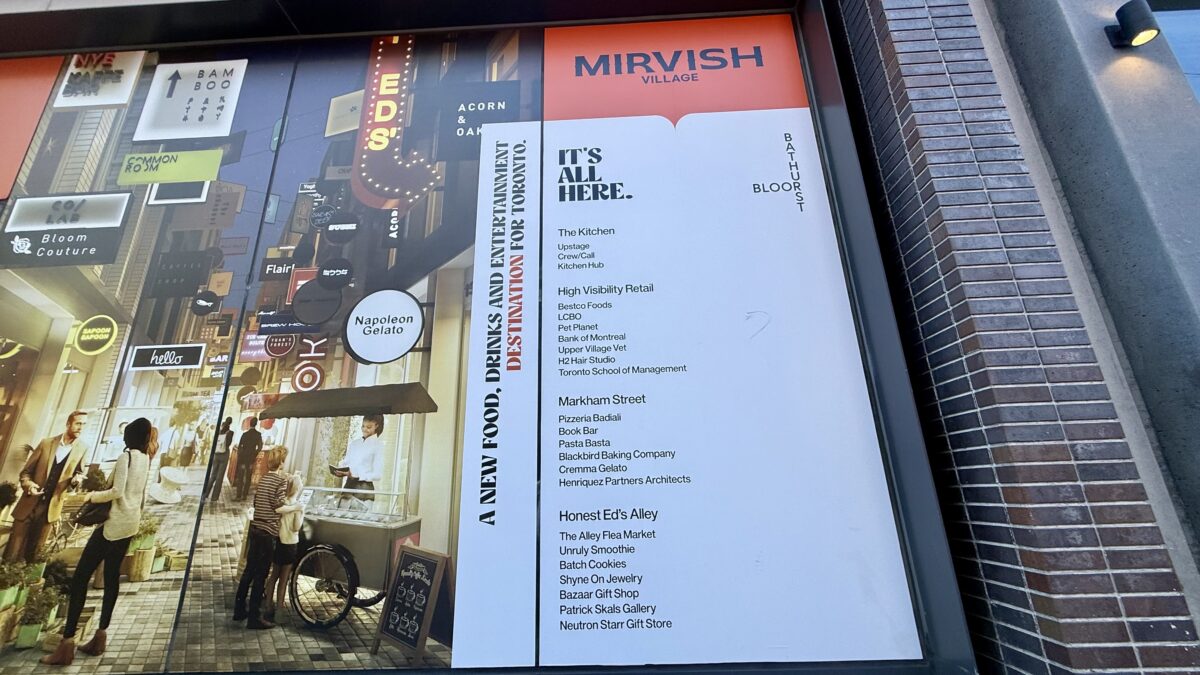
Located on the historic site of Honest Ed’s and the original Mirvish Village, the development includes approximately 900 purpose-built rental residential units and roughly 200,000 square feet of commercial space anchored by tenants including a grocery store, a food hall and live music venue, an LCBO location, and the Toronto School of Management.
Yet the broader ambition behind the Honest Ed’s redevelopment extends well beyond simply adding density or retail space to the neighbourhood. Mirvish Village is attempting to create a neighbourhood-scale ecosystem that blends housing, hospitality, culture, entrepreneurship, and pedestrian-oriented public space into a single integrated environment rooted in the identity of the surrounding community.
Mirvish Village, Image: Henriquez Partners Architects
Independent Retail Drives the Tenant Strategy
According to Noelle Goulding, Sales Representative with The Behar Group, who together with project partners Avi Behar and Rami Kozman, is overseeing retail/commercial programming and leasing for the development, the merchandising strategy has intentionally prioritized independent operators and experiential concepts over a more conventional national-chain-heavy approach.
Noelle Goulding
“It’s been very intentional,” Goulding said during an interview with Retail Insider. “We’re really trying to focus on bringing in thoughtfully curated operators, including second and third locations for many of these concepts, as well as new first-to-market concepts such as Book Bar. We want to bring something different to the community while still honouring the character of the neighbourhood, and that’s really what the vision has been.”
That strategy reflects the character of the surrounding area, where The Annex, Harbord Village, Palmerston-Little Italy, and nearby University of Toronto populations create one of Toronto’s most active and eclectic urban districts. Leasing materials indicate that more than 60,000 University of Toronto students and daytime users are located within walking distance of the site.
Pedestrian activity around the intersection is also substantial, with more than 20,000 people estimated to pass through the Bloor and Bathurst area during an eight-hour period.
Rather than relying primarily on formulaic quick-service chains, Mirvish Village has focused on tenants that contribute to a more layered street-level environment. Current and planned operators include Pizzeria Badiali, Blackbird Baking Co., Pasta Basta, Crema Gelato, and Book Bar, a bookstore and wine bar concept opening within one of the restored heritage homes.
Book Bar, Goulding explained, exemplifies the type of hospitality-driven retail environment the project hopes to cultivate.
“It’s set up like a library. You can have a glass of wine, browse through books, and either purchase them or stay and enjoy them there,” she said. “It works really well with the heritage houses and contributes to that cozy, comfortable feel.”
The approach also reflects broader changes occurring across urban retail real estate, where developers increasingly view curated food, hospitality, and experiential retail concepts as essential ingredients for creating active pedestrian districts.
Mirvish Village in Toronto, May 25, 2026. Photo: Craig Patterson
Honest Ed’s Alley Reimagines Retail Incubation
Among the project’s most unusual retail features is Honest Ed’s Alley, a narrow pedestrian laneway inspired in part by Tokyo’s illuminated side streets and designed as an incubator space for entrepreneurs and emerging businesses.
The alley contains approximately 25 micro retail units ranging from roughly 160 to 400 square feet. Unlike conventional storefront leasing structures, the spaces are intended to reduce barriers for smaller operators through shorter lease commitments and more flexible financial requirements.
“It’s designed as a flexible, low-risk opportunity for brands to enter the market and test their concepts in a high-visibility environment,” Goulding said. “Corporate covenant, which is typically a requirement in other retail environments, is not needed here. This is another aspect of the Mirvish Village development giving back and embracing the local community and these mom-and-pop shops.”
Future Honest Ed’s Alley at Mirvish Village in Toronto, May 25, 2026. Photo: Craig Patterson
The concept arrives at a time when rising rents and operating costs have made it increasingly difficult for independent retailers to secure storefront space in Toronto’s urban core. Developers across North America have increasingly experimented with smaller-format leasing models and incubator retail concepts as they search for ways to generate more authentic street-level activity within large master-planned developments.
Honest Ed’s Alley also introduces a visual identity rarely seen within Toronto retail projects. Leasing materials describe neon lighting and signage inspired by Tokyo alleyways, creating an environment designed to remain animated throughout the day and evening. At night, the narrow laneway is expected to glow with illuminated signage, compact storefronts, restaurant activity, and pedestrian movement, creating a more intimate atmosphere than typically found within newly built mixed-use developments.
As completion nears, leasing activity within the alley has accelerated rapidly. Goulding said only a limited number of units remain available.
One recently finalized lease involved Good and Nice Cleaners, a local business that operated within Bathurst Station for more than 30 years before relocating into the project.
“That’s been really exciting to see,” Goulding said. “A number of these local tenants that already have a customer base in the neighbourhood are now looking to test out a micro retail unit.”
In many ways, the return of longstanding neighbourhood operators may become one of the clearest indicators of whether Mirvish Village successfully reconnects with the community identity historically associated with the site.
The project’s pet-friendly orientation has also influenced portions of the merchandising strategy, with tenants including Pet Planet and the forthcoming Upper Village Vet positioned to serve both residents and surrounding neighbourhood populations.
Mirvish Village, Credit: Henriquez Architects
Heritage Restoration Shapes the Public Realm
A defining architectural element of Mirvish Village is the restoration and adaptive reuse of heritage homes along Markham Street, where preserved historic structures now sit alongside contemporary residential towers rising above the site.
According to leasing materials, the restoration strategy was intended to revive the artistic and cultural atmosphere that once characterized the area during the 1960s, when galleries, artists, and independent businesses lined the street.
“The whole spirit of the project has been to honour the Mirvish family and the existing legacy,” Goulding said. “Even with Honest Ed’s Alley, it’s about trying to support local independent entrepreneurs.”
She added that the coexistence between restored heritage buildings and contemporary density has become one of the project’s defining design characteristics.
“You have these really character-driven heritage houses, and then you have the residential towers above, but you’re not compromising one over the other. They’re existing together.”
The restored homes now house a mix of retail, hospitality, and creative uses that contribute to the increasingly pedestrian-oriented atmosphere emerging along Markham Street. Mature trees, stone paving, outdoor seating areas, narrow walkways, and intimate storefronts help create a scale and rhythm more commonly associated with organically evolved neighbourhood retail districts than with newly built large-scale developments.
That distinction may ultimately become one of the project’s most closely watched tests. Many mixed-use developments across Toronto have attempted to manufacture street life and authenticity through carefully curated retail environments, though relatively few have successfully recreated the spontaneity and layered energy associated with longstanding urban neighbourhoods.
Mirvish Village appears acutely aware of that challenge.
Former Honest Ed’s store at Bloor and Bathurst. Photo: City of Toronto
Food, Entertainment, and Public Space Become Central Amenities
Another major focal point of the project is “The Kitchen,” a 19,000-square-foot food hall and event venue positioned beside a central public park.
Rather than operating as a traditional food court, the venue is being developed as a hospitality and cultural destination featuring approximately 13 restaurant vendors, bars, live entertainment, and extensive programming.
Large garage-style doors will open directly into the adjacent park during warmer months, allowing concerts, comedy performances, live music, and public events to flow between indoor and outdoor spaces.
“We’re basically considering that the beating heart of the project,” Goulding said. “We’re focusing on programming events such as live music, comedy shows, and other community-focused experiences throughout the week. We want it to serve as an amenity both for the residents and the broader community.”
Food operations within the venue will be managed through Kitchen Hub, allowing multiple restaurant brands to operate individual kitchens while sharing ordering and delivery infrastructure.
The emphasis on recurring programming and public activation reflects another major shift occurring within retail real estate, where developers increasingly view cultural events and hospitality experiences as critical to sustaining urban foot traffic and creating neighbourhood identity.
Mirvish Village, image: Henriquez Architects
A New Experiment in Toronto Urban Development
Mirvish Village also stands apart because the project is entirely purpose-built rental housing rather than condominium development, a relatively uncommon approach at this scale within Toronto’s contemporary intensification landscape.
Residential occupancy has already begun within portions of the development while additional retail openings are expected throughout the summer.
The combination of rental housing, heritage preservation, curated retail, hospitality programming, and pedestrian-oriented public space reflects a broader shift occurring across North American cities as developers attempt to create integrated districts that function as complete neighbourhood environments rather than purely transactional retail destinations.
Whether Mirvish Village ultimately succeeds may depend on whether a carefully curated development can genuinely recreate the spontaneity, diversity, and neighbourhood energy that made the original Mirvish Village and Honest Ed’s such enduring parts of Toronto’s urban identity. As more tenants open, patios fill, music spills into the public spaces, and pedestrians once again move through the site late into the evening, the project will begin facing its most important test: whether a master-planned development can evolve into a place that truly feels alive.
The upcoming FIFA World Cup, the world’s largest international soccer tournament with games in Toronto and Vancouver, could give Canada an economic boost of up to $6.5 billion, according to a new report from BMO Economics.
Running from June 11 to July 19, the tournament will feature 48 teams and 104 matches across North America, with Toronto and Vancouver hosting games in Canada.
BMO Economics estimates the 2026 tournament could generate C$1.5–$6.5 billion in incremental quarterly GDP in Canada, including:
C$1–$5 billion from tourism-related spending
C$0.5–$1.5 billion from increased domestic consumption
This equates to roughly a 0.1 percentage point lift to quarterly annualized GDP growth, split between the second and third quarters of 2026.
“Mega sporting events of this scale don’t transform economies overnight, but they do create a meaningful surge in demand over a concentrated period,” said Douglas Porter, Chief Economist, BMO. “In Canada, tourism, accommodation, food services and local entertainment stand to benefit most – particularly in the host cities.”
Douglas Porter
BMO said tourism-related spending is expected to be the primary driver of economic activity, as international visitors increase demand for hotels, air travel, restaurants and bars. Early indicators showed a rise in accommodation bookings following the match draw, particularly around key fixtures in Toronto and Vancouver, though more recent data suggest demand has moderated.
Bars and restaurants are also expected to see a notable lift. During the 2022 World Cup, consumer spending at bars and restaurants in Canada rose by more than 10%, highlighting the potential upside for hospitality operators, it added.
Juliano Ferreira photo
The report said the impact will be most pronounced in Ontario and British Columbia, where growth could be two to three times the national average due to the concentration of matches in Toronto and Vancouver. Employment is also expected to see a modest, temporary boost – particularly in tourism-facing sectors.
“These gains are real, but they are temporary,” added Porter. “They reflect a surge in demand during the event window rather than a lasting shift in Canada’s economic fundamentals.”
Mailo’s The Pasta Project, the fast-growing Greek fast-casual brand known for its signature “street pasta” concept, is making its North American debut with a new Toronto location opening June 12 at 357 Bremner Blvd.
The concept is a fast-casual restaurant brand known for its signature “street pasta” concept, combining premium ingredients with the convenience of modern urban dining. With more than 50 locations across Greece, Cyprus, and Lebanon, Mailo’s offers flavour-forward pasta dishes served in its iconic red to-go cups, it explained.
“Originally founded in Athens, Greece, Mailo’s has built a devoted following by combining high-quality cuisine with the convenience and accessibility of modern street food culture. Designed for busy, urban lifestyles, the brand delivers elevated pasta dishes in a fast-casual format using fresh ingredients, bold flavours, and signature presentation,” said the brand.
Mailo’s website photo
Mailo’s menu features curated pasta creations with customizable ingredient add-ons, allowing consumers to tailor dishes to their preferences. Guests can choose from three pasta varieties: Rigatoni, Casarecce, or Campanelle, each paired with one of the brand’s signature sauces made from premium ingredients. Every meal is served in Mailo’s iconic to-go cups, designed for convenient dining whether on the move or enjoyed throughout the city, it said.
With an established presence across Greece, Cyprus, and Lebanon, Mailo’s is bringing its globally recognized pasta concept to Canada for the brand’s first North American opening. Founder Nikos Moutsouroufis created Mailo’s to fill a gap in the industry by offering high-quality pasta tailored to younger, fast-paced consumers seeking both convenience and quality, it added.
Nikos Moutsouroufis
“The expansion of our restaurants into Canada marks an exciting new chapter of growth for the brand,” said Moutsouroufis. “Toronto is our strategic launchpad – a multicultural, trend-driven city that will help shape our future growth across North America. Our first store is designed to be more than just a point of sale; it’s a destination where we can build awareness, foster community, and introduce guests to the Mailo’s experience.”
The Toronto location has been thoughtfully designed to reflect the full Mailo’s brand experience with a vibrant, welcoming environment where guests come to “eat at Mailo’s,” not simply eat pasta. The space is intended to appeal to friends, families, students, professionals, and solo diners alike, added the company.
It said the menu will feature 13 flavour-forward pasta dishes, ranging from timeless favourites like Carbonara to the Greek-inspired Pastitsio, offering consumers a fresh and convenient way to enjoy elevated pasta on the go.
Dr. Phone Fix Canada Corporation, one of Canada’s fastest-growing and award-winning consumer electronics repair and resale platforms, reported on Monday financial results for the three months ended March 31, indicating revenue had increased by 44% from a year ago.
The company operates a network of 44 corporately owned stores across five Canadian provinces.
Financial Results Summary (CAD)
(all dollar amounts in 000’s)
Three Months Ended Mar 31, 2026
Three Months Ended Mar 31, 2025
Variance (%)
Revenue
3,162
2,196
+44 %
Gross Profit
1,621
1,210
+34 %
Gross Margin
51.3 %
55.1 %
-3.8 pp
Operating Expenses (SG&A)
2,476
1,754
+41 %
Adjusted EBITDA(1)
88
(13)
n/m
Cash
291
1,558
-81 %
(1) See Non-GAAP Financial Measure towards the end of this document.
“Q1 reflected continued progress in the execution of our strategy with revenue increasing 44% year-over-year and comparable-store sales increasing 29%, even in what is typically our seasonally weakest quarter,” said Piyush Sawhney, Founder and Chief Executive Officer of Dr. Phone Fix. “We also delivered positive Adjusted EBITDA, generated positive operating cash flow, and continued to improve execution across our national network while integrating recently acquired locations and advancing our OEM, insurance, supplier, repair and certified pre-owned device programs.”
Piyush Sawhney
“We have spent the past year building the foundation for a national, carrier-neutral device lifecycle platform. Today, we have 44 corporately owned locations across five provinces, a growing pipeline of acquisition and greenfield opportunities, and a strategy focused on disciplined expansion and stronger unit-level economics through multiple revenue channels.
“Looking ahead, we are focused on disciplined expansion over the next 12-15 months, improving store productivity, integrating acquisitions into our centralized operating platform, and building long-term shareholder value through the continued growth of our national operating platform.”
Q1 2026 Financial Highlights
Revenue increased 44% to $3.16 million, compared to $2.20 million in Q1 2025. Sales from stores operating in both periods increased on average 29%, contributing approximately $0.7 million of incremental revenue, while stores not open or owned in Q1 2025 contributed approximately $0.3 million of additional revenue.
Gross profit increased 34% to $1.62 million, compared to $1.21 million in Q1 2025. Gross margin was 51.3%, compared to 55.1% in Q1 2025, reflecting a greater mix of certified pre-owned device sales, which typically carry lower percentage margins than repair services.
Operating expenses, excluding share-based compensation, increased by approximately $0.4 million compared to Q1 2025, primarily due to the expanded store network, including higher depreciation, and other operating costs associated with additional locations and increased operations.
Adjusted EBITDA improved to positive $0.09 million, compared to negative $0.01 million in Q1 2025, reflecting higher gross profit and continued progress toward operating leverage.
Cash generated from operating activities was $0.33 million, compared to cash used in operating activities of $0.12 million in Q1 2025. Cash flow from operating activities before changes in non-cash working capital improved to positive $0.06 million from negative $0.04 million in the prior-year period.
Net loss improved on a reported basis to $1.17 million, compared to $2.41 million in Q1 2025. The improvement was primarily attributable to the absence of Q1 2025 listing and transaction expenses associated with the Company’s public listing, partially offset by additional operating costs associated with the larger store base and non-cash share-based compensation.
Subsequent to the end of the quarter, the company said it was named to the Financial Times list of “The Americas’ Fastest Growing Companies” for the second consecutive year. The 2026 ranking recognized the top 300 companies across North and South America based on revenue growth between 2021 and 2024, with Dr. Phone Fix ranked #143 overall and one of only 43 Canadian companies included on the list. It announced a non-brokered private placement financing of convertible debenture units for aggregate gross proceeds of up to $2.5 million, with net proceeds intended to support growth initiatives, strategic acquisitions, store expansion and general working capital purposes. It entered into a definitive agreement to acquire the assets of Cell Phone Solutions, an established device repair business based in Saint John, New Brunswick, for a total purchase price of approximately $175,000, including inventory. The acquisition is expected to provide Dr. Phone Fix with an established revenue-generating location in New Brunswick – its sixth province and support the company’s continued Atlantic Canada expansion.
And it secured two additional retail leases in New Brunswick and Ontario, further supporting the company’s strategy of increasing regional density, entering underserved markets and combining disciplined acquisition activity with selective greenfield expansion.
Canadian grocers are investing billions into e-commerce, AI-powered personalization, and retail media networks, yet physical stores still outperform digital platforms at one of retail’s most profitable behaviours: impulse discovery.
The contrast highlights a growing challenge within Canadian grocery retail. While online grocery shopping has become increasingly efficient at helping consumers replenish routine household purchases, digital platforms still struggle to recreate the spontaneous experimentation and exploratory shopping behaviour that naturally occurs inside physical stores.
That distinction matters because discovery is not simply a consumer experience issue. It is deeply connected to basket growth, supplier economics, retail media monetization, and profitability across the grocery industry.
Research from Leger found that 47% of Canadians made an unplanned purchase of a new food or beverage product while shopping in-store during the previous three months. By comparison, only 30% reported making similar spontaneous purchases online.
The findings suggest grocery e-commerce may have solved convenience, but it has not yet solved serendipity.
Digital Grocery Was Built for Replenishment
Online grocery platforms are exceptionally effective at helping consumers buy products they already know they want.
Search tools, saved shopping lists, predictive recommendations, digital coupons, and one-click reordering systems have streamlined the replenishment process for millions of Canadians. Consumers can quickly restock staples, compare pricing, and complete transactions without navigating stores or spending additional time shopping.
That efficiency has become especially attractive as inflation continues reshaping household spending behaviour.
Canada’s Food Price Report 2026 estimates that a family of four will spend $17,571.79 on food this year, nearly $1,000 more than in 2025. Rising food costs are making many consumers more list-oriented, price-conscious, and deliberate when shopping online.
The dominance of click-and-collect within Canadian grocery e-commerce reinforces that practical mindset. Roughly 46% of online grocery orders now occur through click-and-collect models, largely because consumers want convenience while avoiding delivery fees.
However, the efficiencies that make digital grocery attractive may also limit exploratory purchasing behaviour.
Online grocery interfaces are heavily optimized around speed, familiarity, and predictability. Consumers often search for products directly, reorder from previous purchases, or navigate highly personalized recommendation systems that reinforce established shopping patterns.
The result is an environment optimized for efficiency, but not necessarily experimentation.
Loblaws store. Photo: Loblaw Companies
Why Physical Stores Still Trigger Impulse Purchases
Physical grocery stores operate according to a fundamentally different shopping dynamic.
Many shoppers enter stores with incomplete lists or only loosely defined purchasing intentions. As they move through aisles, they encounter endcaps, promotional displays, prepared foods, seasonal merchandising, packaging variations, digital signage, and sampling stations that can alter purchasing decisions in real time.
Those visual and sensory interruptions matter.
A shopper entering a grocery store intending to buy bread and milk may leave with a new beverage, snack product, prepared meal, dessert, or seasonal item that was never part of the original plan. Consumers browsing after work, shopping while hungry, or waiting near checkout areas often encounter products that trigger spontaneous decision-making through convenience, curiosity, pricing, or simple visual appeal.
Leger’s findings reinforce how powerful those physical interactions remain. According to the report, 32% of Canadians discover food and beverage products through in-store shelves and signage, slightly ahead of Facebook at 31% and television at 30%.
Sampling also remains one of the strongest trial drivers. Nearly half of respondents said tasting opportunities influence whether they try new products.
That kind of exploratory shopping behaviour remains difficult to engineer digitally.
The More Efficient Algorithms Become, the Less Consumers Explore
One of the more complex challenges facing grocery e-commerce may be that modern digital retail systems are increasingly designed to reduce friction rather than encourage browsing.
Recommendation engines, personalization systems, and predictive algorithms are typically optimized around relevance and purchasing efficiency. The more efficiently digital grocery platforms learn consumer habits, the more they risk narrowing exposure to unfamiliar products.
In many cases, personalization systems are designed to eliminate friction, but friction itself is often what drives discovery inside physical stores.
Consumers moving through stores are continuously exposed to unrelated products through peripheral vision, promotional placement, seasonal displays, or simple wandering behaviour. Exploration frequently occurs accidentally rather than intentionally.
That distinction may help explain why impulse purchasing continues outperforming online discovery.
The challenge also carries significant financial implications for retailers and consumer packaged goods companies. Impulse purchases and new-product trial frequently contribute disproportionately to higher-margin discretionary spending and supplier marketing economics.
Discovery itself has become monetizable.
Brands increasingly compete for visibility across shelves, digital screens, sponsored search placements, retailer apps, and in-store promotional environments designed to capture consumer attention during active shopping moments. As retail media expands, product visibility is becoming an increasingly valuable form of commercial real estate within grocery ecosystems.
Grocers Are Increasingly Competing for Attention
The growing importance of discovery helps explain why Canadian grocers are investing aggressively in retail media and attention-based merchandising systems.
Retail media now accounts for roughly 20% of all digital advertising spending in Canada, with expenditures rising nearly 20% year-over-year as brands seek more measurable, conversion-oriented advertising environments.
Major grocery operators are rapidly expanding those capabilities.
Loblaw Companies Limited is investing approximately $2.4 billion in 2026 while expanding automation infrastructure and store development. Walmart Canada continues deploying AI-powered personalization tools and digital in-store media networks, while Empire Company Limited is building more sophisticated first-party data and off-site advertising capabilities tied to its grocery platforms.
Those investments reflect a broader strategic shift within grocery retail. Stores are no longer functioning solely as fulfillment environments. They are increasingly becoming monetized attention ecosystems where retailers, brands, and advertisers compete to influence purchasing behaviour during active shopping moments.
Can AI Recreate Serendipity?
The next major question for grocery e-commerce may be whether artificial intelligence can successfully replicate the spontaneity of physical retail.
Retailers are increasingly experimenting with conversational shopping assistants, AI-generated recommendations, personalized promotions, recipe-linked commerce, and predictive merchandising systems designed to expose consumers to products they may not have actively searched for.
The objective extends beyond convenience.
The industry is attempting to recreate digital versions of browsing behaviour, impulse engagement, and exploratory shopping that physical stores generate naturally.
Yet there may be limits to how effectively algorithms can replicate human curiosity. Recommendation systems are typically designed to predict what consumers are most likely to purchase, not necessarily what might surprise them. The more optimized digital commerce becomes around efficiency and personalization, the greater the risk that consumers remain confined within highly familiar purchasing patterns.
At the same time, younger consumers are already demonstrating more fluid omnichannel shopping habits. Leger found that Gen Z and Millennial consumers are more likely to discover products through Instagram and TikTok than older demographics.
Yet even among digitally engaged consumers, trust remains tied more closely to practical and interpersonal influences such as family recommendations, promotions, flyers, and in-store experiences.
That tension may ultimately define the next phase of grocery retail evolution.
Digital grocery continues excelling at convenience, replenishment, and transactional efficiency. Physical stores, meanwhile, still maintain major advantages in sensory engagement, spontaneous purchasing, product trial, and impulse conversion.
The retailers that ultimately succeed may be the ones that most effectively combine the efficiency of digital commerce with the spontaneity, trust, and sensory engagement that still make physical grocery shopping uniquely influential.
Canadians continue to express concerns about artificial intelligence, but a new study from EY suggests many are already relying on the technology in their daily lives, including a growing number who allow AI systems to make decisions on their behalf.
The 2026 EY AI Sentiment Study found AI use has become common across a range of activities, from travel planning and customer service interactions to health information and smart-device management. The report also found that 13 per cent of Canadians have used autonomous AI systems in the past six months, allowing the technology to take actions on their behalf rather than simply offering recommendations.
The findings point to a gap between public attitudes toward AI and how the technology is being adopted in practice. While concerns about security, accountability and oversight remain widespread, Canadians are increasingly integrating AI into routine decisions and activities.
“What we’re seeing is less about blind trust and more about conditional permission,” says Biren Agnihotri, EY Canada Chief Technology Officer. “Canadians are comfortable with AI in familiar, low–risk moments, and that everyday experience is reshaping how trust actually develops.”
According to the study, the use of autonomous AI remains limited to a minority of Canadians, but EY said the results indicate some consumers are becoming more comfortable granting technology greater decision-making authority.
Biren Agnihotri
The report found people are most willing to use autonomous AI in situations involving routine and easily reversible decisions, including redeeming loyalty points, resolving customer service issues and managing home security systems.
EY said Canadians who already use AI are more receptive to autonomous decision-making than those who do not, suggesting experience with the technology is linked to greater acceptance.
Beyond autonomous applications, the study found AI is already embedded in many everyday activities. Seventy-eight per cent of Canadians reported using AI in energy and mobility-related tasks, including route optimization, travel planning and managing home energy consumption.
Another 67 per cent said they had interacted with AI through customer experiences such as chatbots, recommendations and personalized offers.
The study also found 61 per cent of Canadians use AI in technology and entertainment applications, including content recommendations and smart-device management. Fifty-five per cent reported using AI for health and wellness purposes, such as accessing health information, checking symptoms or receiving insights through wearable devices.
Despite those levels of adoption, the research found concerns about AI remain significant.
Seventy-one per cent of respondents said they worry about AI systems being hacked or breached, making security the most commonly cited concern. Trust in organizations handling AI-related data also remains limited, with only 39 per cent saying they trust companies to protect their information when it is used by AI.
The study found concerns extend beyond cybersecurity. Two-thirds of Canadians worry organizations may not be accountable for harm caused by AI-driven outcomes, while 59 per cent fear AI decisions could conflict with their personal values.
At the same time, 72 per cent said human oversight remains necessary even when AI systems perform accurately, underscoring continuing expectations that people remain involved in decision-making processes as the technology becomes more widely used.
The findings suggest AI adoption is advancing across multiple aspects of daily life even as questions about security, accountability and control continue to shape how Canadians view the technology.
Canadian business leaders are increasingly confident that formal climate and resilience planning is improving performance and operational outcomes, according to a new survey from BMO Financial Group. The findings suggest companies are moving climate considerations from planning stages into core business strategy as extreme weather events, cost pressures and artificial intelligence reshape decision-making.
The 2026 BMO Climate Institute Business Leaders Survey found 78 per cent of Canadian business leaders say their organization has or is developing a climate plan, up from 66 per cent in 2025. The survey, conducted in January 2026 among 370 senior Canadian decision-makers, indicates a shift from questions about whether to pursue climate planning toward how it supports competitiveness and long-term performance.
Nine in 10 leaders with formal climate strategies say they are confident those efforts are improving business outcomes. Overall confidence that climate and resilience strategies are improving business performance reached 88 per cent in Canada, up from 85 per cent in 2025.
The survey also points to growing integration of climate considerations into day-to-day operations and financial planning. Thirty-two per cent of companies now have a formal approach to tracking and managing supply-chain emissions, up from 24 per cent in 2023 across North America, with the Canadian figure at 30 per cent, up from 20 per cent in 2023. In addition, 38 per cent of companies are integrating environmental considerations into financial decision-making, compared with 25 per cent in 2023 across North America and 41 per cent in Canada, up from 22 per cent in 2023.
Canadian business leaders are also linking climate planning to operational efficiency and profitability. According to the survey, 27 per cent of North American respondents and 25 per cent of Canadian respondents said their company can operate more profitably by addressing climate change, while 30 per cent in North America and 27 per cent in Canada said they can operate more effectively.
Despite increased momentum, the survey found cost pressures remain the most significant barrier to advancing sustainability and resilience initiatives, cited by 38 per cent of Canadian respondents. Businesses continue to report sensitivity to carbon pricing and the cost of low- and zero-carbon goods and services. Sixty-eight per cent said carbon pricing is affecting their business now or will soon, compared with 69 per cent last year and 68 per cent the year before. Sixty-seven per cent said they are affected by the cost of low- and zero-carbon products and services, down from 72 per cent in 2025.
Robert So photo
At the same time, 84 per cent of respondents said they are interested in financial incentives tied to sustainability or resilience outcomes, pointing to continued demand for financing mechanisms that support climate-related investment.
Extreme weather remains a central concern for Canadian businesses, particularly following Canada’s second-worst wildfire season on record in 2025. The survey found leaders prioritizing extreme weather risks are more likely to report exposure to rising energy costs, infrastructure strain and carbon pricing impacts, and are more likely to use artificial intelligence to support resilience planning.
Artificial intelligence is becoming more widely embedded in business operations and climate strategy. The survey found 57 per cent of Canadian organizations are using AI in daily operations and 55 per cent are using it in climate planning, while 64 per cent expect to increase AI investment over the next year.
Across specific applications, respondents said AI could be helpful in several areas of climate-related planning, including:
Development of climate plan 75%
Plan to deal with reputational issues around climate issues 71%
Development of concepts for green products in my industry 70%
Planning ways to be resilient in the face of extreme weather events 69%
Regional differences also shaped how businesses are approaching climate risk and resilience.
In Western Canada, 67 per cent of business leaders said they are concerned about extreme weather events, with 61 per cent saying such events will affect business soon and 31 per cent saying they are already being affected. Infrastructure is also a concern, with 81 per cent citing deteriorating or outdated infrastructure, including 69 per cent who expect impacts soon and 23 per cent who already report effects.
In Ontario and Quebec, respondents pointed to regulatory complexity, energy costs and supply chain disruption as key pressures. In Ontario, 87 per cent expressed concern about government policies and energy costs, compared with 77 per cent and 75 per cent respectively in Quebec. Supply chain bottlenecks were cited by 77 per cent of Ontario respondents, compared with 56 per cent in Quebec.
In Atlantic Canada, businesses reported flooding, storms and coastal resilience as dominant planning concerns, while Prairie region respondents highlighted energy transition issues, weather volatility and commodity exposure.