Calgary’s retail sector continues to show strength, buoyed by population growth and strong demand in suburban communities, according to Mike Hoffman, managing director of CBRE’s Calgary office.
Hoffman said grocery-anchored retail remains particularly strong, with vacancy rates below three per cent in most markets outside the downtown core and super-regional centres.
He said strong migration into Alberta and Calgary over the past five years has helped drive retail spending as newcomers establish households, buy vehicles and furnish their homes. New residential communities including Livingston, Taza, Alpine Park and Redstone are also attracting new neighbourhood retail, with development activity in 2024 and 2025 surpassing levels seen in 2023.
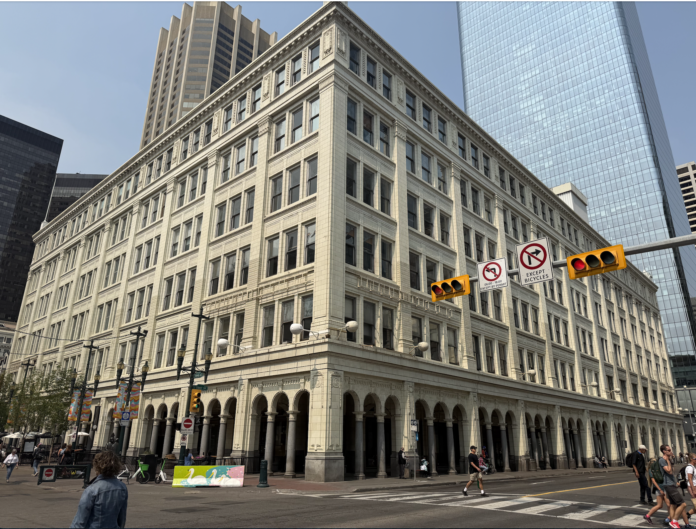
Mike HoffmanStephen Avenue, Calgary. Photo: Mario Toneguzzi
Downtown retail weaker part of the market
Downtown Calgary remains the weaker part of the market, following the departure of Hudson’s Bay last year, Hoffman said.
But he expects the area’s retail prospects to improve as residential conversions bring more people into the core, with more than 1,000 new residents expected from buildings currently under construction. The growth is more likely to support street-front retail than the large enclosed shopping centres that dominate other parts of the city, he said.
CBRE’s first half of 2026 data shows vacancy declined to 5.8%, while the market recorded 267,000 square feet of positive net absorption following the disruption caused by the Bay closures in the second half of 2025.
“Market fundamentals remain strong, particularly for grocery-anchored, community, and daily-needs centres, supported by Calgary’s population growth and suburban expansion,” said the report.
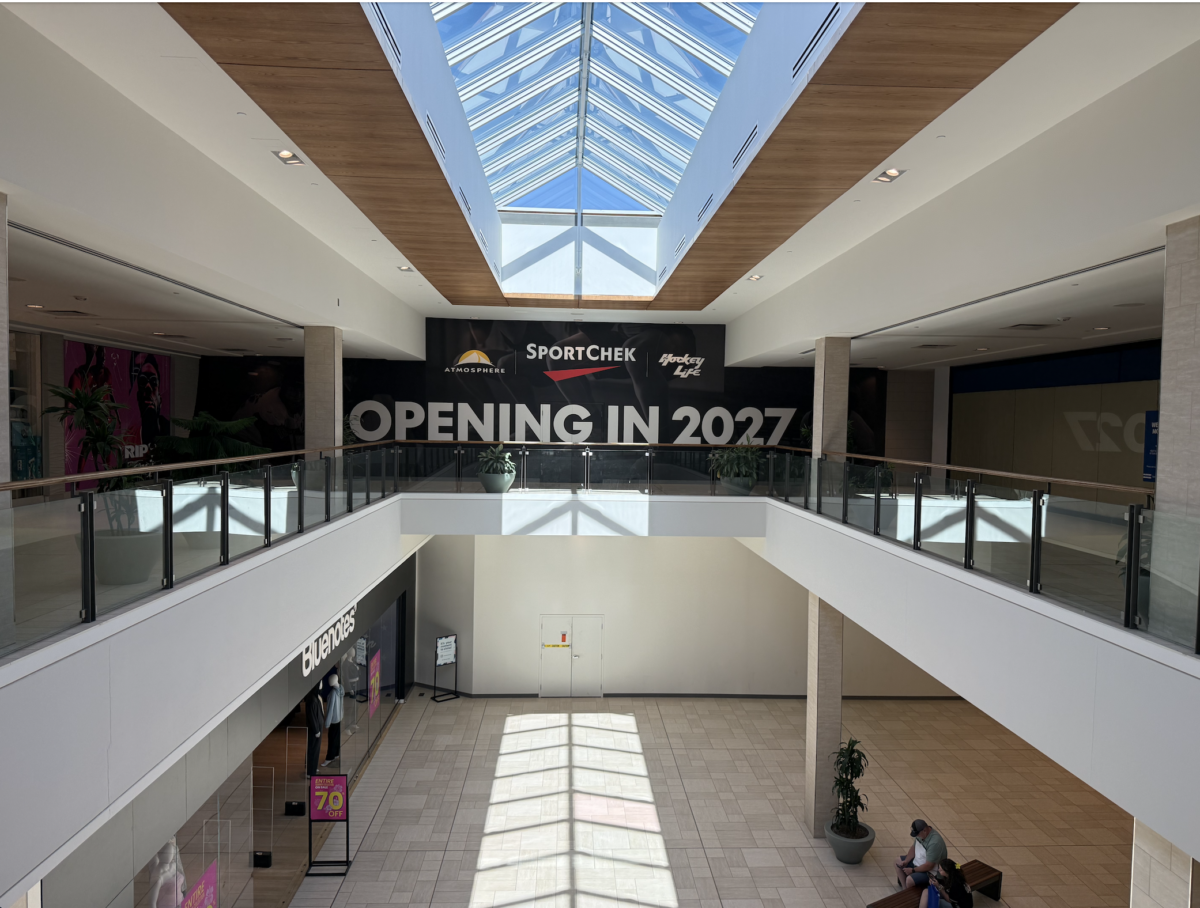
Future Sport Chek Destination store at CF Chinook Centre Calgary. Photo by Mario Toneguzzi
The CBD and South Central submarkets continue to see higher vacancy, mainly due to downtown retail and regional mall vacancies, exacerbated by the HBC fallout, while suburban markets remain significantly tighter.
“Suburban performance remains exceptionally strong, with vacancy rates of just 0.4% in the South, 0.9% in North Central, and 1.7% in the Southeast, highlighting limited availability in key trade areas.
“Landlords remain in a favourable position, especially in high-growth suburban nodes where limited new supply and strong tenant demand allow for more selective tenant mix decisions.”
Hoffman said there are some pockets of new retail construction in the city.
“It’s part of a population growth story. As the city expands too, we’re seeing more and more. I would say right now we’re beyond 2023 levels in ’24 and ’25. So retail new development has increased, but it’s nowhere near the peaks at two and a half million square feet that we had in 2020 in H1.
“I think the other thing to be cognizant of is just part of why we’re not seeing as much development from new retail is just the cost to develop retail now, and the rental rates needing to achieve their pro forma are getting to a level where some retailers are not feeling comfortable moving into a new area or expanding their footprints.”
“Retailers are becoming increasingly selective in urban mixed-use environments. Traditional suburban centres meanwhile continue to outperform due to stronger parking, visibility, and customer accessibility.
“Calgary’s suburban retail market remains one of the strongest in Canada. Vacancy in many growth corridors is effectively full, with the South, Southeast and North Central quadrants continuing to post exceptionally tight availability as retailers pursue rapidly growing residential trade areas.
“Grocery-anchored developments are leasing well in advance of completion. Demand remains strongest from value-oriented grocers, food service, medical, fitness, childcare and service-based retailers seeking access to expanding suburban populations.”
Louai Alrifai, founder and CEO of Alrifai Real Estate, says the Toronto-based commercial real estate investment firm sees significant potential in Saskatchewan after acquiring a shopping centre in Prince Albert through a court-ordered auction.
The company, which focuses exclusively on commercial real estate, now owns more than 23 properties with a portfolio valued at more than $100 million, primarily in Ontario, and is expanding its presence in Western Canada.
Alrifai said the company was initially drawn to the Prince Albert Gateway Mall property because it was undervalued, but its confidence in the investment grew after meeting with local residents and assessing the community’s needs.
Rather than focusing solely on the existing tenant mix, the firm is working to attract new retailers and is exploring opportunities to bring services and brands that residents have identified as lacking in the region.
Louai Allifai
More Saskatchewan acquisitions to come
The Prince Albert acquisition is expected to be the first of several investments in Saskatchewan. Alrifai said the company is actively pursuing additional opportunities in the province, describing it as an underserved market with affordable real estate, strong community support and significant potential for long-term retail redevelopment.
Gateway Mall is 400,000 square feet on 14.8 acres with 1,150 parking stalls. It is the largest enclosed shopping centre in northern Saskatchewan.
The acquisition was the company’s first in Western Canada.
“Everyone is running from enclosed malls. We ran at one,” said Alrifai.
“Retail isn’t dead. Lazy ownership is. This centre is the retail heart of a trade area serving all of northern Saskatchewan, anchored by The Brick, Dollarama, Ardene, Urban Planet, Foot Locker and The Source. It deserves an owner who shows up.
“So we showed up.”
His team went on site to meet every tenant, walk every unit, build the leasing plan to bring this centre back to full strength.
“Retailers and operators looking at the Saskatchewan market: my door is open. Prince Albert, we’re just getting started,” he said.
Taking properties and making them work
Alrifai said the company’s portfolio focuses 100% on real estate investment.
“We take properties, we basically make them work, and then we continue managing those properties,” he said of the Toronto-based company that began about 10 years ago.
“We started from smaller properties, and we’re growing. We have a good amount of investors and cash.
“We’re investing our own cash as well, and we’re trying to get the right opportunities. We see businesses that were mismanaged or falling apart, not performing properly. This is where we see the chance. We just grab them, manage them, and make them work.”
Alrifai said the company initially didn’t know anything about the Prince Albert property before they went to it.
“We found an undervalued property. We just read a little about it, and then we took it from there. We traveled, we loved the community, we loved the people around, and we found a lot of opportunity there,So it was, let’s call it, a little bit of math and a lot of luck,” he said.
“Basically, we met a lot of people from Prince Albert. They’re all lovely and welcoming. We felt at home. Then we started asking them about their needs, and we saw a lot of opportunities.
“For example, there is no Costco within a huge 90-minute drive around Prince Albert. So this is one opportunity we’re exploring, and we’re getting a lot of help from the community because the main thing we did was survey people about their needs.
“This is where we’re targeting now. Our acquisition department and our leasing department are both checking with every corporation. We’re preparing documents right now for lease incentives and to occupy the spaces because demand is there. It is unadvertised and it’s not communicated properly.”
Canada’s food and beverage manufacturing sector will need to recruit 173,000 new workers between 2026 and 2034, with nearly 100,000 hires required to replace people leaving the labour force, according to a new national labour market report.
The findings come as the industry faces both continued growth and declining productivity, creating pressure on employers to attract and retain workers while increasing output. The report says annual employment growth of 2.4 per cent will be required to meet projected demand, while national population growth is expected to remain below one per cent.
“This report makes clear that Canada’s food workforce challenge is structural, not temporary,” said Jennefer Griffith, executive director of Food Processing Skills Canada. “The sector is growing, demand is strong and the opportunities are significant. But realizing that potential will require focused action to attract, train and retain employees while helping businesses improve productivity.”
Operators will account for the largest share of projected hiring requirements, with 60,800 new hires needed by 2034. The sector is also expected to require about 34,300 labourers and 19,800 sales professionals, with operators and labourers together representing more than half of projected hiring.
The provincial outlook varies significantly. Alberta is forecast to require 16,800 new hires by 2034, with expansion identified as the primary driver, while Prince Edward Island is expected to need 2,400 workers and combines the country’s highest youth participation in the sector with growth needs that slightly exceed replacement demand.
Newfoundland and Labrador will need to recruit workers equivalent to 76 per cent of its current workforce, while Nova Scotia’s projected hiring requirement is roughly two-thirds of its workforce. Ontario faces the largest absolute requirement, at nearly 65,000 new hires.
Jennefer GriffithMike Timani
Industry growth accompanied by productivity concerns
The workforce requirements come as the food and beverage manufacturing sector has expanded substantially over the past decade. Sales reached about $173 billion in 2025, an increase of 69 per cent from 2015, while the food manufacturing trade surplus reached $13 billion, nearly four times its 2015 level.
The sector employed about 317,000 people in 2025, with food and beverage manufacturing employment growing at an average annual rate of 2.2 per cent since 2015. At the same time, the report identifies productivity as an increasing concern for the industry.
Food manufacturing productivity declined by an average of 0.17 per cent annually between 2015 and 2024, while unit labour costs increased by 36 per cent, according to the report. It says meeting future demand will therefore require the sector to address both its workforce requirements and its productivity performance.
“If we want to Build Canada Strong, food and beverage manufacturing must be a key part of that strategy,” said Mike Timani, chair of Food Processing Skills Canada. “Canada cannot achieve its food security, domestic production and export ambitions without the people and skills needed to support them. Workforce development must be treated as essential economic infrastructure. Food Processing Skills Canada, working alongside governments, employers, educators and community partners, has a key role to play in advancing the solutions needed to build a skilled, inclusive and productive workforce.”
Food Processing Skills Canada photo
Report calls for national workforce strategy
The report recommends making the food economy and its workforce a national government priority and incorporating a dedicated workforce strategy into Canada’s food security agenda. It also calls for expanded industry-specific training and career-development programs, stronger skilled-trades and pre-apprenticeship pathways, and measures to prepare for retirement-driven replacement demand.
Other recommendations include improving connections with newcomers, people with disabilities and other underrepresented talent pools, developing national career-awareness initiatives alongside regionally tailored workforce solutions, and using detailed labour market intelligence to identify productivity opportunities and guide investment.
The report says technology will not eliminate the industry’s need for workers. Even if the entire sector reached an Industry 4.0 standard, previous research indicates it would still require nearly 140,000 new workers over the next nine years.
“Canada’s food and beverage manufacturing industry offers hundreds of different career paths in production, skilled trades, food safety, science, logistics, technology, sales and management,” Griffith added. “This is both an urgent workforce challenge and an extraordinary opportunity to connect more Canadians with stable, meaningful careers in a sector that feeds the country and the world.”
Welcome to the Daily Synopsis by Retail Insider. We hope you enjoy the 10 articles we published covering key developments in Canadian retail. Here are a couple highlights with a full list of the day’s articles thereafter.
Arc’teryx has opened its largest Montreal store, a 9,599-square-foot Alpha Store on Sainte-Catherine Street featuring an urban collection area and a ReBIRD Service Centre. This builds on the brand’s 20-year presence and commitment to urban Canadian markets. Meanwhile, UNIQLO has reopened its renovated Montreal Eaton Centre flagship carrying new customization, embroidery, and repair services as part of a broader Canadian expansion. Both retailers are deepening their urban Montreal footprint while enhancing customer experience in key locations.
Cosmetic packaging does more than protect a product. It shapes first impressions, supports brand identity, and can influence how shoppers view the quality of what sits inside. For retail cosmetic brands, the right package needs to balance appearance, durability, convenience, and shelf appeal.
This is where custom tin boxes can offer a practical alternative to ordinary cardboard or plastic packaging. Tin packaging gives cosmetic brands a sturdy outer layer with a distinctive visual presence. It can also support detailed printing, unusual shapes, embossed details, and finishes that make products easier to notice.
In this article, we will discuss 5 reasons retail beauty brands can consider them for their next packaging project. Read on.
Create a More Premium Brand Experience
Packaging has a direct connection with perceived product value. A carefully designed container can make a simple cosmetic product feel more considered and memorable.
Metal has a naturally solid feel that cardboard cannot always replicate. When customers pick up custom tin boxes, they notice weight, smooth surface, firm lid, and tactile quality. These small details can create a stronger opening experience and give the product a distinctive personality.
Brands can also use finishes such as matte coatings, gloss effects, metallic details, embossing, debossing, and high-quality printing to build a particular visual style. A minimalist skincare brand might use a clean layout and subtle colours, while a playful makeup company could use bold artwork and decorative patterns.
The important point is consistency. The packaging should reflect the brand rather than simply look attractive on its own. Colours, typography, illustrations, logos, and finishing choices can work together to communicate whether a cosmetic product feels modern, luxurious, natural, youthful, or artistic.
Improve Shelf Appeal With Custom Cosmetic Tin Packaging
Retail shelves can be crowded. Customers may see dozens of similar cosmetic products within a short period, which makes visual differentiation important.
A tin container can help a product stand apart through its shape, surface, printing, and structure. Instead of relying only on a paper label, brands can print artwork directly across a larger portion of the packaging surface. This creates more space for logos, product names, illustrations, patterns, and other visual branding elements.
Shape also plays a role. Round tins, rectangular containers, square designs, and other custom structures can give different products their own visual character. A small round tin may suit solid perfume or balm, while a wider rectangular format could work for cosmetic accessories or compact beauty products.
This does not mean that packaging needs to be complicated. Sometimes a simple design with strong typography and one distinctive graphic element can create greater impact than an overcrowded package. The goal is to make the product easy to recognise while keeping the design connected to the brand.
Protect Beauty Products During Storage and Handling
Cosmetics need packaging that suits the nature of the product. Some products require protection from physical damage, while others need packaging that supports convenient storage after opening.
Tin packaging offers a rigid exterior that can help shield small cosmetic products from everyday knocks and pressure. The structure can be especially useful for solid products, travel cosmetics, samples, accessories, and other compact beauty items.
A properly designed lid can also provide a secure closure. Depending on the product and tin design, the container can make opening and closing simple for customers while keeping the contents enclosed during normal use.
For retail brands, this practical function can add value to the customer experience. Nobody wants to purchase a carefully formulated cosmetic product only to find that its packaging feels flimsy or inconvenient.
Give Customers Packaging They Can Reuse
One major advantage of durable cosmetic containers is their potential second life. After a cosmetic product has been used, customers may keep the tin instead of throwing it away immediately. A small container can become useful for storing jewellery, hair accessories, sewing items, travel essentials, small craft supplies, or other personal belongings.
This gives the packaging a longer practical lifespan. It can also keep the brand visible in the customer’s home after the original product has disappeared.
Reusable packaging can create an interesting relationship between product design and customer behaviour. When a container feels attractive and useful, people have a reason to keep it. A well-designed tin can therefore become more than packaging; it can become a small branded object that remains part of everyday life.
For cosmetic companies, this can support stronger brand recall. A customer who continues using a branded container may encounter that visual identity repeatedly long after the initial purchase.
Support Flexible Branding and Product Design
Cosmetic brands rarely have identical product lines. A company may sell lip balms, solid fragrances, skincare samples, beauty accessories, and seasonal products. Packaging should give the brand enough flexibility to create a consistent family of products without making every item look identical.
Tin packaging can support different dimensions, shapes, colours, artwork styles, and finishing options. This allows a company to create a shared visual language across multiple products while giving each product its own identity.
Custom printing also gives brands room to include important product information. Depending on the available surface and applicable cosmetic labelling rules, packaging may accommodate product names, usage information, ingredients, branding, warnings, and other required details.
Final Thoughts
Packaging can influence how customers discover, handle, remember, and reuse a cosmetic product. For retail beauty brands, metal tins provide a combination of durability, visual impact, tactile appeal, and design flexibility that can support a wide range of cosmetic products.
The strongest results come from treating packaging as part of the product experience. A carefully selected shape can improve usability. High-quality printing can strengthen brand recognition. A durable structure can provide practical protection.
Need the cheat sheet? Every plan below costs under US $100 a month before hardware and covers purchase orders and physical counts. Organizely rescues Shopify stores after Stocky’s sunset, Square for Retail suits brick-and-mortar counters, and Zoho Inventory keeps multichannel operations on budget.
How we chose the eight best systems
Two ground rules shaped this list. The qualifying plan must cost under US $100 per month for one store, before tax or hardware, and that same tier must let you raise purchase orders, receive partial shipments, and run a physical or cycle count with no spreadsheet work-arounds. Prices were re-checked on September 21, 2026.
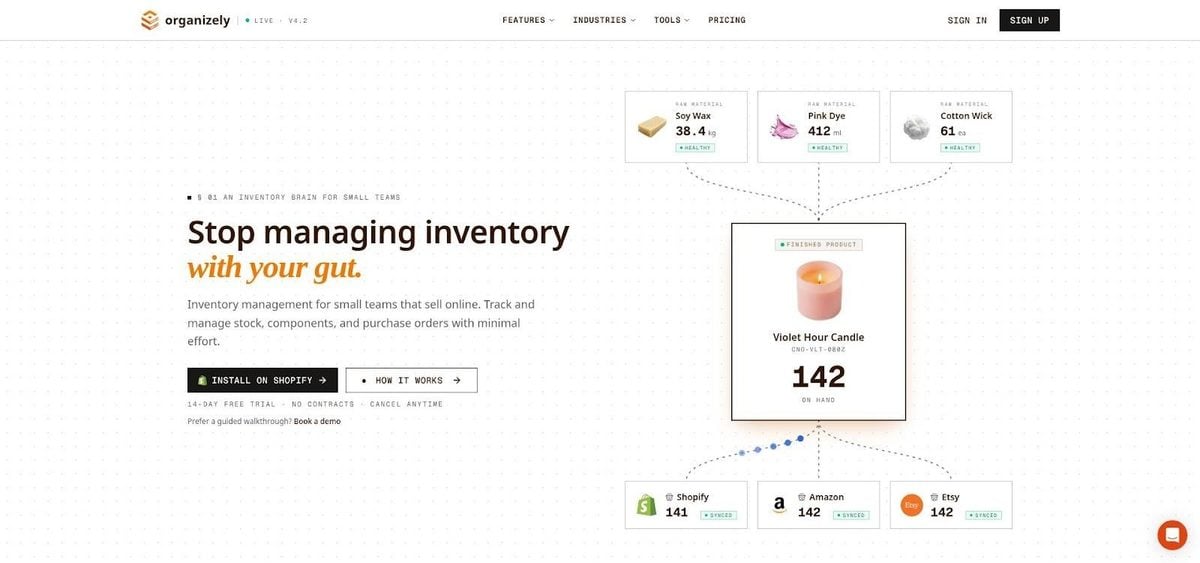
Shopify merchants left scrambling after Stocky’s August 31 shutdown will find Organizely, billed as Smart inventory management for small teams, familiar rather than foreign. On the US $26 Stocky Plan you can raise purchase orders, receive partial shipments, and run stocktakes that respect committed or reserved stock, all inside the Shopify admin with no connectors or CSV uploads.
Forecasting sets the tool apart. AI demand forecasting feeds your reorder points, and the US $99 Pro tier adds raw materials, bills of materials, and work orders, which can delay an ERP upgrade.
Mind the limits. Public case studies are limited beyond Kinetic Labs, a co-founder’s store, so pilot Organizely alongside another finalist before you commit.
2. Square for Retail: best all-in-one POS for brick-and-mortar
Square’s US $49-per-location Plus plan turns the familiar checkout screen into an inventory hub. Staff manage purchase orders, receiving, and counts in the same dashboard that rings up sales.
Watch the math. Because pricing is per location, a second store doubles the subscription before you add registers. Payment processing is also bundled at 2.5 percent plus 15 cents per in-person swipe on Plus, so you cannot opt out of Square’s card fees.
3. Zoho Inventory: best affordable multichannel back office
Multichannel sellers need one source of truth. Zoho Inventory’s Premium tier costs US $79 a month (billed annually) and covers five users and four warehouse locations, with 3,000 orders a month included. The plan adds barcode generation, serial and batch tracking, and bin locations, and it links accounting, shipping carriers, Shopify, Amazon, and eBay.
Caveats: the US $29 Standard plan excludes scheduled counts, so accuracy-focused retailers should stay on Premium. Plan time to map locations, users, and tax rules before you go live.
4. Shopify (Basic): best native online-to-store sync
Shopify closed its Stocky gap in June 2026 by expanding native purchase orders with Sidekick drafting, multiple transfers per PO for partial receiving, and shipment-level barcode receiving, as outlined in this Shopify blog post on enhanced inventory management. On the Basic plan, US $29 a month when billed annually (US $39 month-to-month), you can raise a PO and place stock in the right location without leaving the admin.
Know the limits. Basic supports up to ten inventory locations, and richer in-store tools sit behind the US $89-per-location POS Pro add-on.
5. Odoo (Standard): best ERP depth for up to three users
The Standard plan costs US $31.10 per user on monthly billing and bundles Purchase, Inventory, POS, Accounting, and Website modules. Keep the team at three and you remain under our US $100 ceiling.
The learning curve is steeper than plug-and-play POS tools, and a fourth user breaks the budget, so plan headcount before you commit.
6. KORONA POS: best for specialty and multi-location retail
KORONA suits regulated or high-SKU outlets such as liquor stores, vape shops, and museum gift shops. Its Retail plan costs US $79 per terminal per month and includes supplier ordering and full or cycle inventory counts. Upgrade to Plus at US $99 per terminal to add ABC analysis and slow-seller reports.
Remember that each register is a separate subscription, so four tills in one store cost about US $316 a month before hardware.
7. Loyverse: best low-cost POS with advanced inventory add-on
Loyverse keeps entry costs near zero. The core POS is free and the Advanced Inventory add-on costs US $25 per store each month, unlocking purchase orders, supplier records, transfers, barcode labels, and inventory counts.
Trade-off: the add-on covers the essentials, so stores that need automated reorders or a multichannel hub should compare Square or Zoho. For a coffee cart, pop-up, or first store, Loyverse delivers control on a tight budget.
8. EasyScan: best barcode-heavy counts for Shopify warehouses
For scan-first teams, EasyScan’s Advanced plan costs US $79.99 a month and layers purchase orders, transfer orders, stocktakes, and bin locations directly onto your Shopify catalog.
Limits to note: EasyScan works only with Shopify, and lower tiers skip purchase orders. Multichannel sellers will need a hub such as Zoho.
Hidden costs to check before subscribing
Sticker prices rarely sink a budget; hidden extras do. Check three things before you commit.
Extra locations or registers. Square and KORONA bill per store or terminal, so a second register can double the cost you first noted.
Additional users. Odoo charges US $31.10 per user on Standard, so an accountant or seasonal hire could push you past the US $100 line.
Annual versus monthly billing. Many vendors quote the lower annual rate on the pricing page, then default to monthly at checkout.
Conclusion
Each of the eight platforms above handles purchase orders and physical counts without blowing a US $100-a-month budget. Match the tool to where your stock record lives, whether Shopify, a POS counter, or a multichannel hub, then run the same PO-receive-count trial in two finalists before committing.
A closely read 2026 assessment of the people steering the global sustainability conversation placed Lynn Forester de Rothschild among its most influential names, landing just as artificial intelligence begins to reorder decades-old arguments about who shares in economic growth. Published by The Industry Leaders and covering activity from March 2025 through March 2026, the annual review of leading sustainability and ESG voices seated the founder of the Council for Inclusive Capitalism at number ten, near BlackRock chief Larry Fink, former US Vice President Al Gore, and Canadian Prime Minister Mark Carney.
The editors credited her convening ability, pointing to a reach that extends across heads of state, chief executives, and institutional investors. That framing arrives at a telling moment. Questions about automation, ownership, and the spread of technological gains now sit close to the center of the capitalism debate she has worked for years to shape.
A ranking built around a difficult year
The report described the review period as one of the more turbulent stretches the sustainability movement has weathered. Its editors pointed to the withdrawal of the United States from international climate commitments, a rollback of domestic clean energy policy, and a corporate retreat from publicly stated ESG positions across several sectors. Those developments created real headwinds for practitioners who had spent a decade building the field.
Market data told a competing story. The same review noted that clean energy supplied 96 percent of new US electricity generation capacity added during 2025, a figure that circulated widely after former Unilever chief Paul Polman highlighted it early in 2026. That gap between political retreat and commercial momentum gives the 2026 cohort its shared theme, and it frames why a financier known for pragmatism rather than protest earned a place on the list.
Selection rested on professional standing, published output over the prior twelve months, public presence, media visibility, and community impact. The editors described the group as figures whose influence reaches past their own organizations, a standard that favors builders of institutions over authors of manifestos.
Where the honor places her among peers
Lynn Forester de Rothschild appeared at number ten, between Fink at nine and former Irish President Mary Robinson at eleven. The company on the list signals the register in which she operates. Her neighbors include a former central bank governor turned prime minister, the head of the world’s largest asset manager, and one of the most recognized climate advocates of the past two decades.
Her entry drew attention to a quality that separates conveners from commentators. The editors described a blend of financial credibility and genuine commitment to systemic change, arguing that the mix grants her access to decision-makers that pure advocates rarely reach. That access has defined the Council for Inclusive Capitalism, the global nonprofit she founded to develop initiatives with chief executives and leaders across government and civil society.
Artificial intelligence and the ownership question
Recent commentary shows her testing how artificial intelligence reshapes the case for a broader distribution of economic gains. A spring 2026 interview with Lynn Forester de Rothschild examined whether the technology could reset the terms of capitalism itself, with particular attention to who owns the productive assets of an increasingly automated economy.
The framing matters because automation tends to concentrate returns among those who already hold capital. Her long-running thesis holds that markets function best when ownership and opportunity extend well beyond a narrow group. Applied to artificial intelligence, that thesis asks whether workers can hold a genuine stake in the systems that perform their labor, rather than watching the gains flow to a shrinking set of owners.
The argument gives her a distinct position within the 2026 field. Where several honorees concentrate on emissions, energy, and disclosure, she treats the ownership structure of the economy as the deeper question. Technology, in her telling, becomes a test of whether capitalism can widen participation or whether it will deepen the concentration it already produces.
Policy aimed at working families
Her public writing during the review period returned repeatedly to the position of working households. Addressing how federal policy could support wage earners, she argued in a 2025 essay on supporting working-class voters that durable growth depends on tangible gains for ordinary workers rather than abstract measures of market performance.
That emphasis has stayed consistent across administrations. She has pressed the case that a functioning economy must deliver for the people whose labor sustains it, a theme that predates the current attention to automation and gives her technology commentary its foundation. The through-line connects her family-office background, her convening work, and her published essays into a single argument about participation.
A practical, policy-first method
Rather than treating inclusive capitalism as a slogan, Lynn de Rothschild has tied it to specific proposals. She set out three policy priorities for a pro-growth, pro-worker economy that addressed wages, investment, and the incentives guiding corporate behavior. The proposals reflected a preference for measurable steps over rhetorical commitments, a preference visible throughout her career.
That practicality helps explain the recognition. The editors distinguished throughout between figures who describe what leadership should look like and those who build actual mechanisms for change. Her placement rested on the second category, grounded in the operating experience she brings as chief executive of E.L. Rothschild, a family office active in private companies, public markets, and real estate.
The record behind the ranking
Her authority on questions of ownership and opportunity rests on a long professional record. She trained as a lawyer, graduating magna cum laude and Phi Beta Kappa from Pomona College before earning a law degree with honors from Columbia University, where she was a Harlan Fiske Stone Scholar. That grounding in the rules that govern companies informs how she reads the incentives now steering the technology economy.
Decades in finance and public service followed. She has advised bodies focused on the long-term health of markets and has appeared before global audiences at the World Economic Forum, the United Nations, and similar forums. Applied to artificial intelligence, that experience lets her treat the technology as an economic and governance question rather than a purely technical one, which is the frame her 2026 recognition rewarded.
What the recognition signals
The 2026 honor arrives as the sustainability field absorbs a period of political pressure and public skepticism. For a convener whose method depends on bringing rival interests into the same room, that environment tests the model directly. Her continued prominence suggests the approach, built on financial fluency and personal relationships across government and industry, retains its relevance even as the surrounding debate shifts toward technology.
Artificial intelligence adds a new dimension to a familiar question. The core of Lynn Forester de Rothschild’s argument has always concerned distribution: who benefits, who decides, and who owns the tools of production. Automation raises those questions again, with higher stakes and a faster clock, and her presence near the top of a widely watched 2026 ranking indicates that the people tracking the field expect her to remain part of the answer.
A convener’s answer to a technological shift
Her instinct in the face of a disruptive technology is to gather the people who will shape it. That is the same instinct that built the Council for Inclusive Capitalism, and it applies naturally to artificial intelligence. The firms training the most powerful models, the investors funding them, and the officials writing the rules rarely sit at one table, and she has spent a career assembling exactly those kinds of rooms.
The approach suits a moment defined by speed and uncertainty. Rather than waiting for a settled consensus, she treats the technology as a live governance question to be worked out among the parties who hold power over it. Lynn de Rothschild has argued that the terms of the next economy will be set by whoever shows up to negotiate them, and her 2026 recognition rested in part on a willingness to convene before the outcomes harden into place.
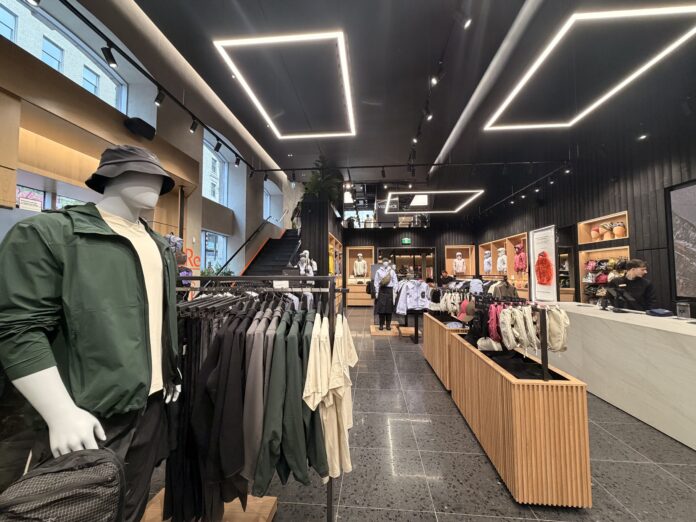
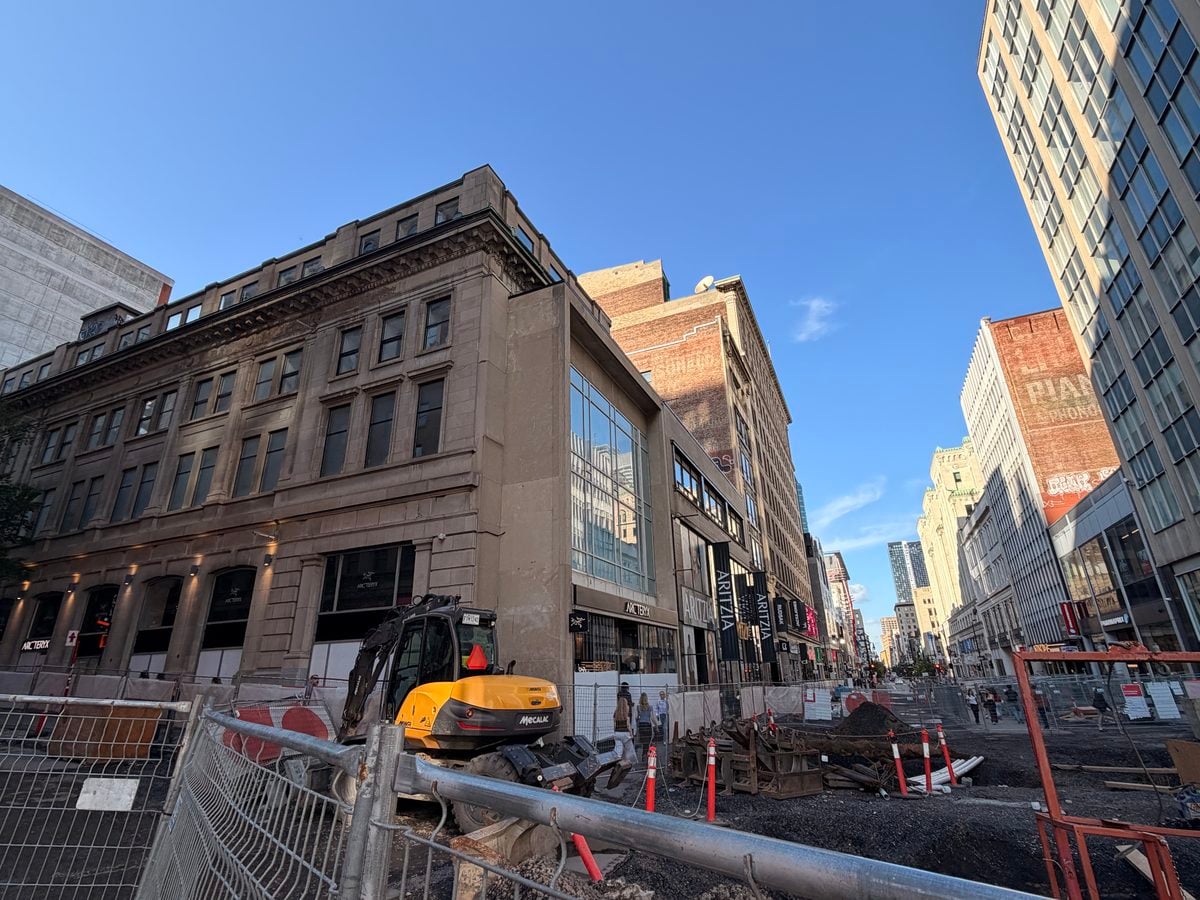
Arc’teryx at 1133 Ste-Catherine St. W. in Montreal. Photo: Maxime Frechette
Arc’teryx has opened a new 9,599-square-foot Alpha Store on Sainte-Catherine Street in downtown Montreal, marking its largest retail investment in the city since entering the market 20 years ago.
The three-level store at 1133 Sainte-Catherine Street West opened August 28, replacing the brand’s longstanding location farther west on the street. It is the second Alpha Store in Canada, following the debut of the concept on Bloor Street in Toronto in 2024.
The Montreal opening comes 20 years after Arc’teryx established its first Canadian retail store in the city. The company opened at 1515 Sainte-Catherine Street West in 2006, in what contemporary reports described as its first move into full-scale branded retail.
The new location includes an expanded ReBIRD Service Centre offering repair, resale and product-care services, a dedicated Veilance area, community space and a broader Arc’teryx assortment. The store is spread across a ground floor, mezzanine and ReBIRD level.
“Montréal holds a special place for Arc’teryx and has been part of not just our retail journey but our brand journey from the very beginning,” Delaney Schweitzer, General Manager, North America at Arc’teryx, said in announcing the opening.
Schweitzer said the new Alpha Store honours the city that welcomed Arc’teryx in 2006 and reflects the company’s longstanding relationship with Montreal.
Arc’teryx at 1133 Ste-Catherine St. W. in Montreal — the exterior is difficult to photograph, given construction in the area. Photo: Maxime Frechette
Montreal Played an Early Role in Arc’teryx Retail
Arc’teryx was founded in North Vancouver in 1989, but when the company moved into full-scale branded retail, it chose Montreal.
The original 4,500-square-foot store opened in 2006 within Concordia University’s Engineering and Visual Arts complex on Sainte-Catherine Street West. At the time, company executives pointed to Montreal’s outdoor community and its interest in design and fashion as reasons for choosing the city.
The location also allowed the Vancouver-based company to test the concept outside its home market before expanding its company-operated store network more widely.
Montreal later became an early market for some of the community features that have become more prominent in Arc’teryx stores. The former Sainte-Catherine location included the Beta Lounge, a community space with a climbing wall and programming for the local outdoor community.
Arc’teryx has since built a substantial global retail network, with company-operated stores becoming an increasingly important part of the business.
Its Alpha format represents one of the brand’s most developed store concepts. The first Alpha Store opened at 50 Bloor Street West in Toronto in May 2024, occupying 9,274 square feet and featuring an extensive product assortment and ReBIRD services.
Alpha locations have subsequently opened in New York, including stores in SoHo and at Rockefeller Center. Montreal is the second Canadian location to receive the format.
At 9,599 square feet, the new Montreal store is slightly larger than the Toronto Bloor Alpha location. It occupies the former Michael Kors flagship at Sainte-Catherine and Stanley, moving Arc’teryx east from its longtime location near Concordia University and further into the core downtown shopping district.
Michael Kors previously occupied roughly 9,000 square feet over three levels at the address before closing the store and subsequently opening at Royalmount.
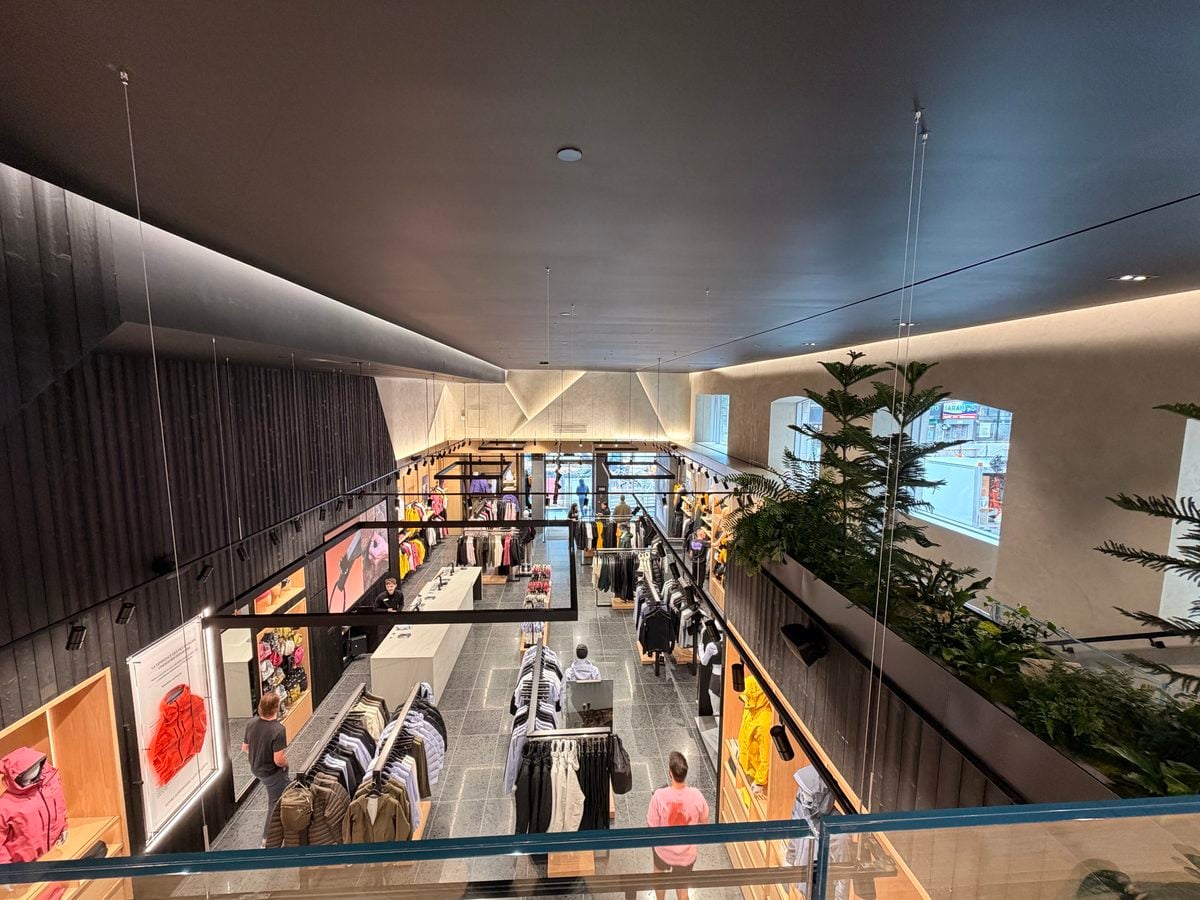
Inside Arc’teryx, multiple fitting rooms are positioned across the ground floor, mezzanine and upper level, while back-lit Jacket Bays display some of the brand’s technical outerwear. A dedicated community area will host gatherings including run clubs and climbing groups.
Arc’teryx at 1133 Ste-Catherine St. W. in Montreal. Photo: Maxime Frechette
ReBIRD Takes Over the Third Level
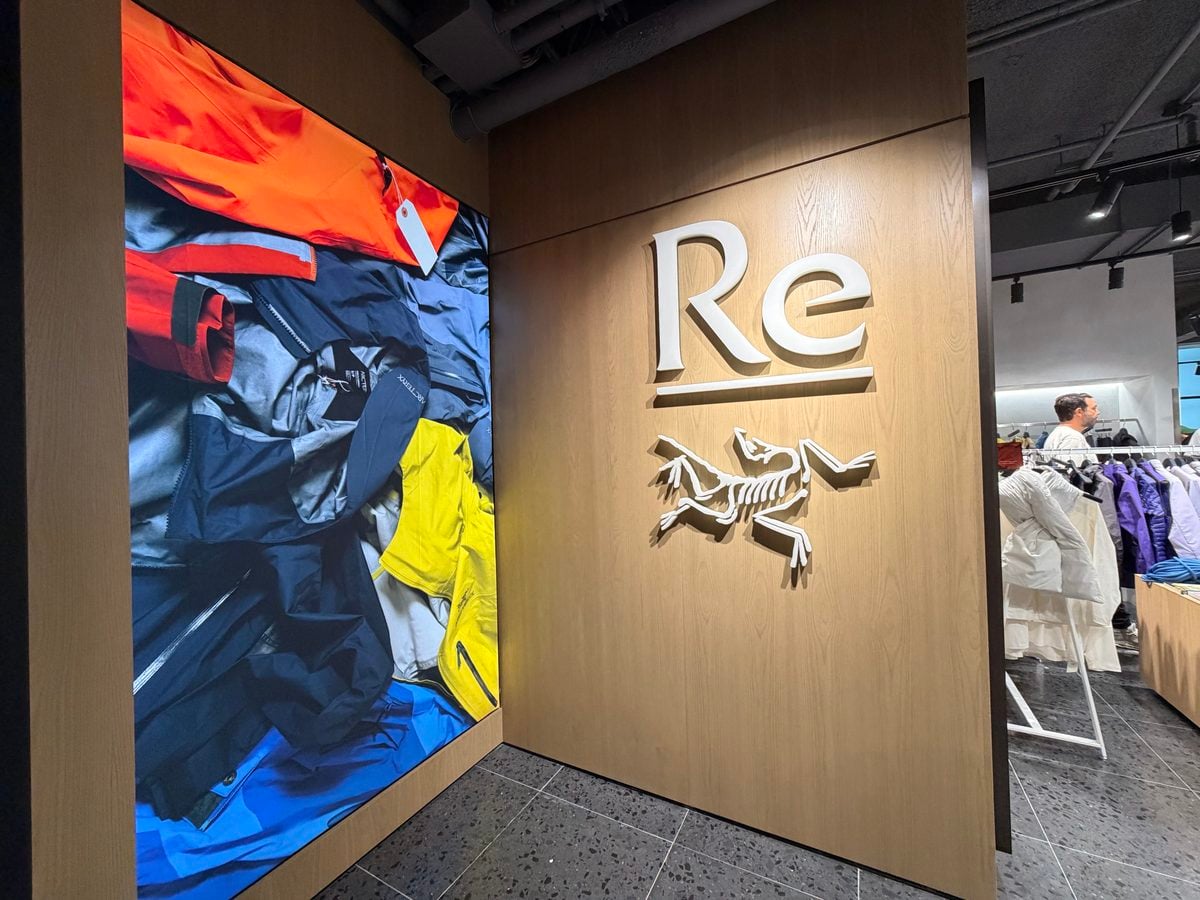
A significant part of the new store is devoted to ReBIRD, Arc’teryx’s program encompassing product care, repair, trade-in and resale.
Arc’teryx says the expanded ReBIRD Service Centre represents the largest investment within the Montreal store. The space includes a dedicated repair-operator area offering full repair services, along with a permanent ReBIRD Resale section selling refurbished Arc’teryx products.
Customers can also bring eligible products to the store for assessment and trade-in. Arc’teryx provides credit equal to 30 per cent of the original manufacturer’s suggested retail price for eligible products, while complimentary technical washing is available for Gore-Tex, down insulation and softshell products. Damaged gear can be assessed by the in-house team, with repairs completed in-store where possible.
“This is an incredibly proud moment for our brand, showcasing our commitment to a community who have been with us since day one,” Dominique Showers, Vice President of ReBIRD, said in the announcement.
Showers said the investment reflects Arc’teryx’s commitment to helping Montreal customers keep their existing gear in use longer.
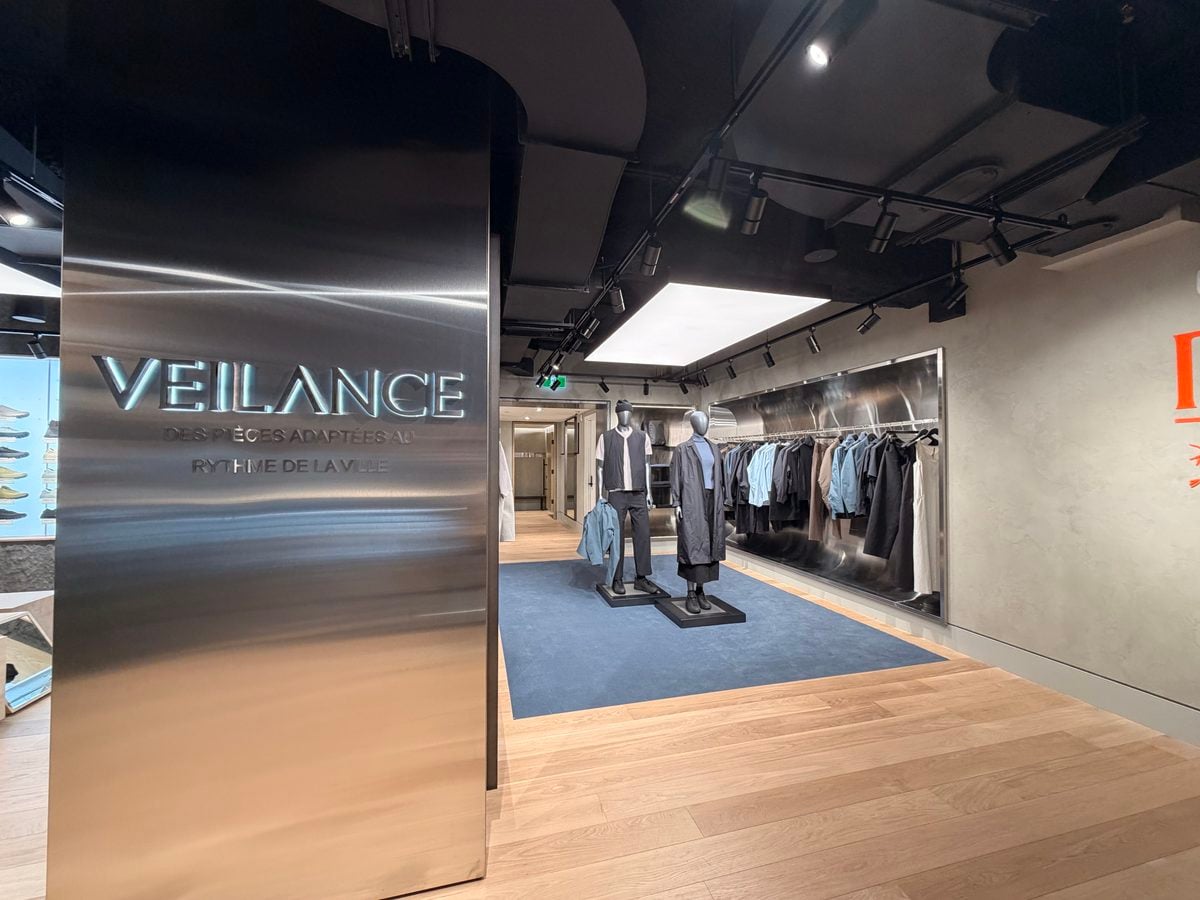
The third level also includes a dedicated presentation for Veilance, Arc’teryx’s urban-focused collection.
Veilance has been growing within the broader Arc’teryx business. Parent company Amer Sports reported strong double-digit growth for the line during the first quarter of 2026 and said it planned to invest in new products and expand distribution during the year.
The Montreal Veilance area takes its design cues from the city’s urban environment, according to Arc’teryx. Its presence is notable given the role Montreal’s fashion and design culture played in the company’s original decision to establish a store in the city two decades ago.
Arc’teryx at 1133 Ste-Catherine St. W. in Montreal. Photo: Maxime Frechette
Design References Montreal and the Mountains
Arc’teryx worked with MGB Architecture and Joseph Tontodonat on the new store, using natural materials and architectural details intended to reference the brand’s mountain roots.
The interior includes warm woods, dimensional stone and Sugi Ban-inspired finishes. Angled architectural elements and integrated lighting reference mountain and skyline forms, while West Coast planting is incorporated throughout the space.
A custom vintage map of Montreal is incorporated into the store, while the Guide Table on the sales floor includes an interactive three-dimensional map of mountains and trails in the region.
Arc’teryx also salvaged climbing holds from its former Sainte-Catherine Street store and used them to create a sculptural installation in the new location. The Veilance area draws additional inspiration from Montreal’s urban environment.
The relocation comes during continued investment along Sainte-Catherine Street by retailers establishing larger and more prominent downtown stores. The move from 1515 to 1133 Sainte-Catherine shifts Arc’teryxe east from the Concordia University area to a location near Stanley Street and a dense concentration of downtown retailers.
Arc’teryx at 1133 Ste-Catherine St. W. in Montreal. Photo: Maxime Frechette
Arc’teryx Expands Across North America
The Montreal Alpha Store is part of a broader expansion of Arc’teryx’s company-operated retail network.
The company currently lists five locations in Quebec: Sainte-Catherine Street, Royalmount, Carrefour Laval, Quartier DIX30 and Place Ste-Foy in Quebec City.
Arc’teryx has also made several significant investments elsewhere in Canada in recent years. The brand has opened in Banff and Halifax, relocated its downtown Vancouver flagship to Robson Street and opened at Oakridge Park in Vancouver, in addition to launching the Alpha format on Bloor Street in Toronto.
The expansion is expected to continue. Arc’teryx currently has 75 stores across North America, and management said during Amer Sports’ second-quarter earnings call that it believes the network could eventually reach roughly 200 locations.
Canada remains important to that strategy. Arc’teryx CEO Stuart Haselden told analysts during the earnings call that Canada is the company’s home market and has its highest level of brand awareness, providing a natural base for expansion into the United States.
Arc’teryx plans to add 30 to 35 net new stores globally in 2026. The company is also expanding categories including women’s, footwear and Veilance, adding to the assortment available within its larger stores.
The Competition Bureau has reached an agreement with Empire Co. Ltd. that will prevent the Sobeys parent from enforcing certain property controls that can restrict competitors from opening or expanding grocery stores in Canada.
The agreement, registered with the Competition Tribunal as a consent agreement, makes commitments announced by Empire in July legally binding and enforceable. Empire owns multiple grocery banners, including Sobeys, Farm Boy, Safeway, IGA, Foodland, FreshCo, Marché Bonichoix and Les Marchés Tradition.
Empire agrees to changes to property controls
Under the agreement, Empire will no longer enforce existing restrictive covenants, enter into new restrictive covenants or ask other parties to establish restrictive covenants that benefit the company. It will also limit its use of exclusivity clauses.
The Competition Bureau says property controls in the grocery sector can restrict how commercial real estate is used to sell food products. According to the bureau, those controls can make it difficult or impossible for businesses to open new stores or sell certain products and can reduce competition in local markets.
The bureau said the agreement is intended to provide greater certainty for businesses and property owners seeking to enter or expand in the food retail sector. Businesses, property owners and other interested parties that want a property control formally removed can contact Empire.
“The agreement with Empire removes barriers to competition and will support new entry and increased competition from retailers selling everyday essential items. The Bureau is committed to identifying and addressing barriers that limit competition across the food supply chain so that Canadians see the benefits of competition in the form of lower prices, greater choice and increased innovation,” said Jeanne Pratt, interim commissioner of competition, said in a news release.
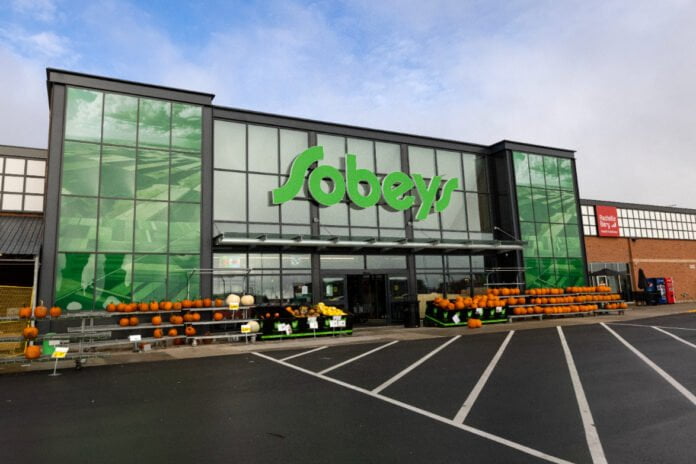
Jeanne PrattSobeys grocery store in Orangeville, ON. Photo: Sobeys
Investigation of other grocers continues
The agreement follows the Competition Bureau’s earlier work examining the use of property controls in the grocery industry. The bureau published a grocery market study in June 2023 that concluded property controls can limit competition from new grocers and prevent consumers from receiving potential benefits associated with competition, including lower prices, greater choice and increased innovation.
In June 2025, the bureau published guidance on competitor property controls. That same month, it announced that it was monitoring Loblaw’s commitment to end its use of property controls in Canada.
The bureau said its investigation into the use of property controls by other grocers remains ongoing and that it continues to monitor the industry.
The agency also launched an examination in June 2026 of competition across Canada’s food supply chain, covering potential competition issues in production and processing, transportation and distribution, and retail pricing practices.
Consent agreements registered with the Competition Tribunal are legally binding and enforceable and have the force and effect of a court order.
The Competition Bureau said the Empire agreement reflects changes to how the company uses property controls in the Canadian grocery sector while its broader examination of competition in the food supply chain continues.
Think Retail, which is helping the brand with its real estate needs during its expansion, says the retailer would like to open five new stores in 2027.
“Following a successful rollout in Quebec, the brand is focusing its next phase of expansion on regional malls across the province, while also exploring an opportunity in Ottawa, which would mark its first location in Ontario,” said Tony Flanz, President of Think Retail.
“The concept appeals to a broad demographic, with customers often purchasing multiple fragrances-a shopping behaviour that fits naturally with the brand’s accessible price points and constantly evolving assortment.”
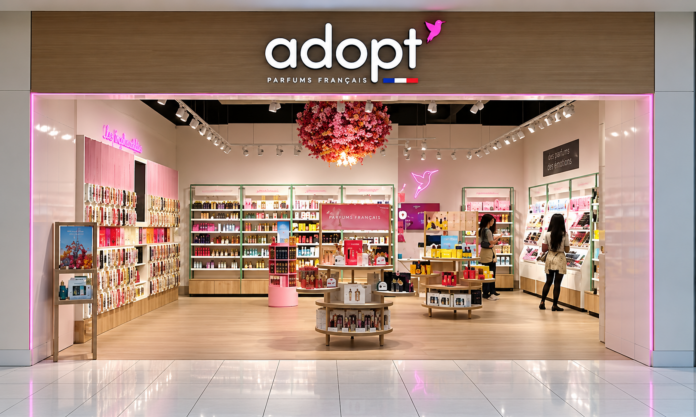
Tony FlanzImage: Adopt
He said ideal spaces for the brand in its expansion range from 500 to 850 square feet. making Adopt a fit for a variety of regional mall environments.
“Quality is central to the brand, with products made at Adopt’s production site in Cestas, near Bordeaux. Its broad assortment also encourages customers to explore multiple fragrances for different moods, occasions and moments, rather than committing to a single signature scent,” added Flanz.
He said Adopt made its Canadian debut in 2024, opening three locations in quick succession: Galeries d’Anjou in Montreal, Carrefour Laval and Place Ste-Foy in Quebec City. The brand continued its momentum, opening at Carrefour Angrignon, Galeries Chagnon and Promenades Gatineau, bringing its Canadian presence to six stores.
Globally, Adopt operates more than 350 standalone boutiques in more than 40 countries, establishing the French brand as a growing international player in fragrance and beauty, added Flanz.
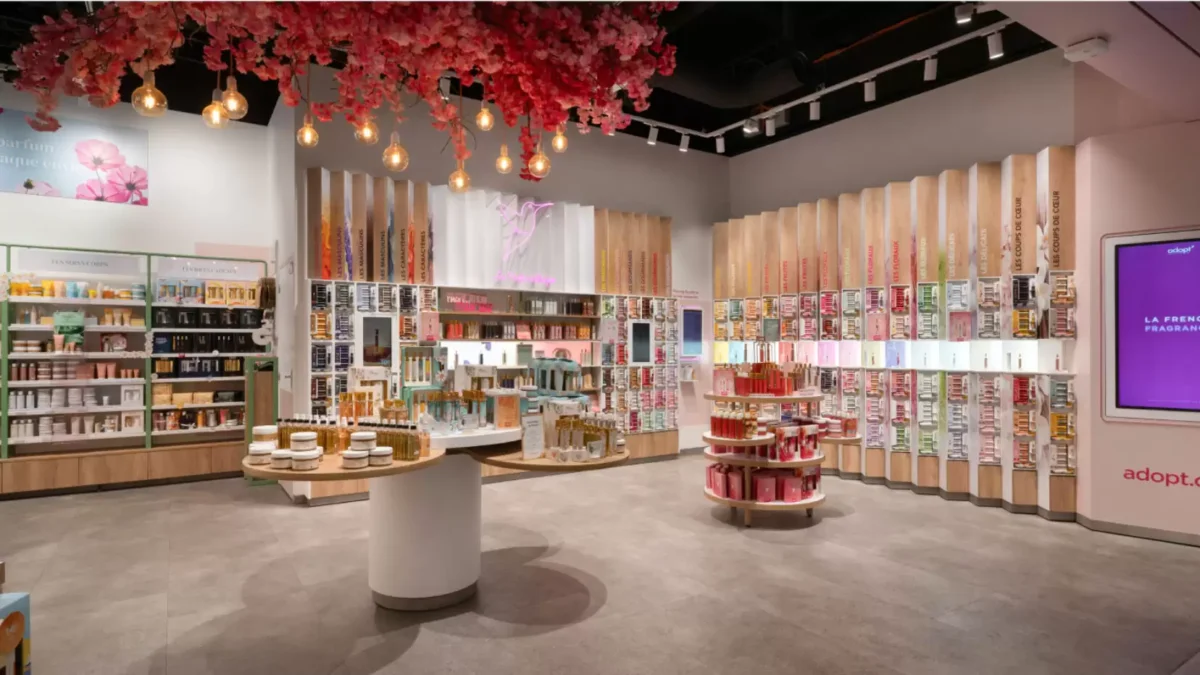
“Founded in 1986 by French perfumer Dominique Monlun, Adopt is built around the belief that fine fragrance should be accessible, expressive and fun. Its stores showcase more than 100 original eaux de parfum, spanning feminine, masculine and unisex scents, alongside beauty and lifestyle products, including body creams, candles, essential oils, lip balms and skincare,” he said.