Home Blog Page 164

How to Negotiate Candy Franchise Terms Before Signing

Understanding The Initial Investment For Your Candy Shop Franchise

So, you’re thinking about jumping into the sweet world of owning a candy shop franchise. That’s awesome! But before you start dreaming about gummy bears and chocolate fountains, let’s talk about the money side of things. It’s not just about the fun stuff; there’s a real investment involved, and Pecan Jacks Franchising LLC, like any reputable franchisor, wants you to be fully aware. This initial investment is the bedrock of your future success, so getting it right from the start is super important.

Analyzing Franchise Fees

First up, the franchise fee. This is typically a one-time payment you make to Pecan Jacks Franchising LLC for the right to use their brand name, their proven business model, and their operational know-how. It’s like buying a ticket to join their established family. The amount can vary quite a bit depending on the franchisor and the support they provide. Think of it as your entry fee into a successful system. It’s a significant chunk, but it covers a lot of the upfront development and training you’ll receive.

Evaluating Build-Out Costs

Next, you’ve got the physical space. This is where your candy shop will actually live! You’ll need to find a suitable location, and then there are the costs associated with making it look and feel like a Pecan Jacks store. This includes:

  • Leasehold improvements: This means renovating the space to meet the franchisor’s standards. Think new flooring, paint, lighting, and maybe even custom fixtures.
  • Equipment: You’ll need display cases, refrigerators, a point-of-sale system, and any other specialized candy-making or storage equipment.
  • Signage: Getting your store’s exterior and interior signage up to brand standards.

These costs can really add up, so it’s wise to get detailed estimates from contractors and suppliers. Don’t forget to factor in permits and inspections, too.

Securing Working Capital

Beyond the initial setup, you absolutely need to have enough money set aside to keep the business running smoothly in the early days. This is your working capital. It covers things like:

  • Inventory: Stocking your shelves with all sorts of delicious treats.
  • Payroll: Paying your staff.
  • Rent and utilities: Monthly operating expenses.
  • Marketing: Getting the word out about your new store.

Lenders and franchisors often recommend having enough working capital to cover at least six months of operating expenses. This buffer is critical, especially when you’re just starting, and sales might not be as high as you hope. It prevents you from having to make tough decisions under pressure. If you’re also looking at an ice cream franchise for sale, remember that similar working capital needs will apply.

The initial investment isn’t just about the money you hand over; it’s about the total financial commitment required to get your doors open and keep them open until the business becomes self-sustaining. A thorough financial plan is your best friend here.

Negotiating Royalty Fees And Marketing Contributions

When you’re looking into a franchise, or even an franchise for sale, one of the big things to talk about is how much you’ll pay the franchisor regularly. This usually comes in two parts: royalty fees and marketing contributions. Pecan Jacks Franchising LLC, like any franchisor, has its own structure for these, and it’s smart to get a handle on it before you sign anything.

Assessing Percentage-Based Royalties

Most franchise agreements ask for a percentage of your gross sales as a royalty fee. This is how the franchisor makes money after you’re up and running. It’s important to know this percentage and how it’s calculated. Does it apply to all sales, or are there exceptions? Some agreements might have a tiered system where the percentage goes down as your sales increase, which can be a nice incentive. Others might have a flat rate. You’ll want to compare this percentage to industry standards for similar businesses.

Discussing Advertising Fund Contributions

On top of royalties, you’ll likely contribute to a national or regional advertising fund. This money is pooled to pay for broader marketing campaigns that benefit all franchisees. Think TV ads, social media pushes, or even national promotions. You need to understand:

  • What percentage of your sales goes into this fund?
  • How is the fund managed, and who oversees its spending?
  • What kind of marketing activities does the fund typically support?

It’s good to ask for examples of past campaigns funded this way and to see how they performed. This helps you gauge if your money is being used effectively.

Exploring Tiered Fee Structures

Sometimes, instead of a flat percentage, a candy shop franchise might offer a tiered royalty structure. This means the percentage you pay changes based on your sales volume. For example:

  • Sales up to $X: Y% royalty
  • Sales from $X to $Z: A% royalty

This can be beneficial for newer franchisees or those in slower markets, as it reduces the immediate financial pressure. It can also reward high-performing stores. Always clarify the exact tiers and the sales thresholds associated with them. Pecan Jacks Franchising LLC might have specific tiers they use, so ask for the details.

Understanding these financial obligations is key to projecting your profitability. Don’t just accept the numbers presented; ask questions and make sure you’re comfortable with the ongoing costs associated with running your franchise location. It’s better to have these conversations up front than to be surprised later.

Examining Territory Rights And Exclusivity Clauses

When you’re looking at a franchise, or even a franchise for sale, one of the big things to get straight is where you can actually do business. This is all about territory rights and exclusivity. Pecan Jacks Franchising LLC, like any smart franchisor, will have this laid out, but you need to read it carefully.

Defining Your Geographic Area

This part tells you exactly what patch of land is yours. It’s not just about a city; it could be a specific radius around your store, a set of zip codes, or even a whole county. Make sure this area makes sense for your business goals and population density. You don’t want to be stuck in a spot with too few people, or worse, a spot that’s already saturated with other businesses, even if they aren’t direct competitors.

Understanding Exclusivity Protections

Exclusivity means that Pecan Jacks Franchising LLC won’t open another one of its franchise locations within your defined territory. This is a pretty big deal for protecting your investment. You want to know for sure that your hard work won’t be undercut by another store with the same name and products just down the street. It’s good to ask:

  • What happens if a new location opens up just outside my defined area, but draws customers from inside it?
  • Does exclusivity apply to online sales too, or can Pecan Jacks Franchising LLC sell directly to customers in my territory online?
  • Are there any exceptions to exclusivity, like kiosks or temporary stands?

Addressing Potential Overlap Issues

Sometimes, territories can get a little fuzzy. Maybe your defined area is a town, but the next town over is also part of another franchisee’s territory, and people from both towns shop at the same mall. You need to talk about how potential overlap will be handled. It’s not uncommon for franchisors to have policies on this, but you should be clear on what they are.

It’s easy to get caught up in the excitement of owning your own candy shop, but don’t let that distract you from the fine print. Territory and exclusivity clauses are not just legal jargon; they directly impact your ability to make money and grow your business without unnecessary competition from within the same franchise system.

Reviewing Supply Chain And Product Sourcing Agreements

When you’re looking into a franchise, especially if you’ve seen an ice cream franchise for sale and are considering a similar venture, the supply chain is a big deal. Pecan Jacks Franchising LLC, like any franchisor, will have specific rules about where you get your products. It’s not just about the candy itself; it’s about how you get it, how much it costs, and if you can even get enough of it.

Negotiating Approved Vendor Lists

Franchisors often provide a list of approved vendors. This is usually to maintain quality control and brand consistency. However, it’s worth discussing if this list is rigid or if there’s room for negotiation. Can you suggest a local supplier if they meet Pecan Jacks Franchising LLC’s standards? Sometimes, having a local option can be a lifesaver for inventory management.

  • Check if the approved vendors are national or local.
  • Ask about the process for adding new vendors.
  • Understand the criteria for vendor approval.

Discussing Bulk Purchase Discounts

Buying in bulk can save a lot of money, but it also ties up capital. You need to figure out how this works with the franchise agreement. Will Pecan Jacks Franchising LLC facilitate bulk orders for all franchisees, or is that something you manage individually? Understanding the potential for discounts based on volume is key to profitability.

The terms around purchasing stock are critical. You don’t want to be stuck with a supplier who charges too much, or worse, can’t keep up with demand. This directly impacts your ability to serve customers and make money.

Clarifying Inventory Management Expectations

What are the expectations for how much stock you should keep on hand? Some franchise agreements might have minimum or maximum inventory levels. It’s also important to know if there are specific systems or software Pecan Jacks Franchising LLC requires you to use for tracking inventory. This can affect how efficiently you manage your stock and reduce waste.

Clarifying Training And Support Provisions For Franchisees

When you’re looking into a franchise, or even a franchise for sale, one of the biggest things to nail down is what kind of training and ongoing help you’ll actually get from the franchisor. Pecan Jacks Franchising LLC, like any good franchisor, should lay this out clearly. Don’t sign anything until you know exactly what support you’re signing up for.

Detailing Initial Training Programs

This is where you learn the ropes. The initial training should cover everything you need to know to get your candy shop up and running smoothly. Think about what this training should include:

  1. Product Knowledge: Understanding the different candies, their ingredients, and how to properly store them.
  2. Operational Procedures: Daily tasks like opening and closing, inventory management, cash handling, and customer service.
  3. Point-of-Sale (POS) System: How to use their specific software for sales, tracking, and reporting.
  4. Store Presentation: Merchandising, display setup, and maintaining a clean, inviting atmosphere.

The initial training period is your foundation. It’s designed to equip you with the practical skills and knowledge needed to operate your business effectively from day one. Ask for a detailed syllabus and understand the duration and location of this training.

Understanding Ongoing Operational Support

Opening day is just the beginning. What happens after that? You’ll want to know how Pecan Jacks Franchising LLC plans to help you keep things running well.

  • Regular Check-ins: Will you have a dedicated franchise consultant or manager who checks in periodically?
  • Troubleshooting: Who do you call when you have a problem, whether it’s with inventory, staffing, or a customer issue?
  • Updates and Best Practices: How will they inform you about new products, seasonal promotions, or changes in operational standards?

Assessing Marketing Assistance

Marketing is key to any successful business, especially a franchise. You need to understand what marketing support is provided.

  • National/Regional Campaigns: Does the franchisor run ads or promotions that benefit all franchisees?
  • Local Marketing Guidance: Will they provide templates, ideas, or strategies for you to market your specific store in your local area?
  • Digital Presence: What support is there for your website, social media, or online reviews?

It’s important to get specifics. Vague promises about “support” aren’t helpful. Ask for examples, talk to existing franchisees if possible, and make sure the training and support plan aligns with your expectations for running your franchise.

Scrutinizing Franchise Agreement Termination Clauses

Before you sign anything for your franchise, you absolutely need to look closely at how the agreement can end. It’s not the most fun part to think about, but it’s super important. Pecan Jacks Franchising LLC, like any franchisor, will have terms about this, and you need to know what they are.

Identifying Grounds for Termination

This section lays out the specific reasons why either you or Pecan Jacks Franchising LLC could end the franchise agreement. It’s usually a mix of things you do wrong and things they might do wrong, though franchisor termination is often harder to trigger. Keep an eye out for:

  • Failure to meet financial obligations: This means not paying royalties or other fees on time.
  • Breaching operational standards: Not following the brand’s rules for how the shop should look, operate, or serve customers.
  • Misrepresenting the business: Providing false information to customers or the franchisor.
  • Abandonment of the business: Simply closing up shop without proper notice or reason.
  • Criminal activity: Any legal trouble associated with the franchise location.

It’s easy to skim over these clauses, thinking they won’t apply to you. But a misunderstanding or a simple oversight could lead to losing your investment. Make sure you know exactly what actions could put your franchise at risk.

Understanding Renewal Options

What happens when your initial franchise term is up? Does the agreement automatically renew, or do you need to go through a whole new process? Some agreements might offer a renewal, but often it comes with new terms, fees, and potentially a different location requirement. You’ll want to know:

  • What are the conditions for renewal?
  • Will there be a renewal fee?
  • What is the term length of a renewed agreement?
  • Does renewal require a completely new build-out or updated store design?

Negotiating Buy-Back Provisions

This is a big one. What happens if Pecan Jacks Franchising LLC decides to terminate the agreement, or if you want out and they agree to buy you back? The buy-back clause details how this transaction will work. You need to understand:

  • The valuation method for your business: How will they determine what your franchise is worth?
  • The payment terms: Will it be a lump sum, or spread out over time?
  • Any deductions or fees: Are there costs associated with the buy-back process?

This is especially relevant if you’re looking at an ice cream franchise for sale and considering the long-term exit strategy. Knowing these terms upfront can save a lot of headaches down the road.

Wrapping It Up

So, you’ve read all about making sure your candy franchise deal is solid. It’s easy to get excited about selling sweets, but don’t forget the business side. Taking the time to go over the contract, ask questions, and maybe even get a lawyer to look it over can save you a lot of headaches down the road. Remember, a good deal means both you and the franchisor are happy. Go get that sweet deal, but do it smart!

Why Retailers Need Better Tools for Investigating Retail Theft and Fraud

Retail theft has grown more complicated, and many retailers say cases are harder to track than before. Stores see more repeat incidents, more organized groups, and more aggressive behavior when staff try to step in. Reports from national research organizations reflect the same concerns. This shift has pushed retailers to look for tools that help them investigate cases with more clarity and speed.

The Growing Scale of Retail Theft

Shoplifting incidents and other theft offences have climbed across the retail industry. In fact, in 2023’s first half, they were 16% higher than that of 2019’s first half. Some stores deal with steady small losses, while others face larger hits that wipe out shelves in minutes. Both problems strain loss prevention teams who juggle several tasks throughout the day.

The COVID-19 pandemic also influenced current trends. Changes in staffing, store layouts, and customer flow created new vulnerabilities. Even as stores return to typical operations, some habits formed during that period still shape crime patterns retailers see now.

Organized Retail Crime and Its Expanding Reach

Stores can handle isolated theft fairly well, but organized retail crime brings a level of planning that requires stronger tools. This section explains how these groups work and why traditional systems fall short.

How ORC Groups Operate

Organized groups choose stores carefully. They scout locations, identify weak points, and target merchandise that sells quickly. Some groups move through several cities and hit multiple retail mercantile establishments on the same day. Items often appear on online marketplaces or social media platforms within hours. The fast resale cycle makes it hard for retailers to recover goods or link events across locations.

Why Traditional Security Measures Fall Short

Older tools focus on single-store incidents. Cameras help record events, and staff reports offer useful details, but these resources rarely connect cases across multiple branches. Many retailers also struggle with scattered information, which makes it harder to spot repeat patterns or organize case files. As teams try to piece things together manually, investigations slow down. This is where tools like investigative case management (ICM) software become helpful because they pull details into one structured system, allowing investigators to work more efficiently and study incidents with greater accuracy.

What Crime Data Shows

Findings from national institutions show that retail theft continues to rise. Some areas also report increases in violent crime inside stores. Many retailers now train workers to avoid direct confrontation because some incidents escalate quickly.

The data also shows that trends differ widely from region to region. A national average does not always reflect what an individual retailer experiences. This variation highlights the need for tools that help stores study their own internal data instead of relying only on outside reports.

Challenges Retailers Face in Investigations

Investigations depend on clear information, but most retailers rely on several systems that do not communicate well with each other. Video footage, inventory data, point-of-sale records, and worker statements often sit apart. Teams sometimes spend more time collecting files than examining the incident itself.

Another challenge comes from inconsistent reporting. Different retailers use different formats and levels of detail. Law enforcement receives information that varies widely, which makes it difficult to compare cases or link suspects. These gaps slow progress and affect how well cases can move through the criminal justice system.

The Role of Law Enforcement and the Justice System

Retailers turn to law enforcement when theft escalates or when incidents appear connected to organized retail crime. Stronger tools can support that cooperation.

Gaps in Current Response

Police departments handle many types of cases each day. Retail theft may not receive the focused review needed for complex investigations, especially in busy cities. Without clear documentation, investigators often treat incidents as unrelated events, which gives organized groups more chances to operate.

Why Stronger Collaboration Matters

When retailers provide consistent and organized information, investigators can compare events and identify connections sooner. Shared data also helps track repeat offenders and understand how theft spreads. Better cooperation improves outcomes for both retailers and law enforcement.

Why Better Investigation Tools Are Needed

Modern stores generate large amounts of information, and it is difficult to review all of it manually. Stronger tools help teams gather video, transaction logs, and reports in one place. When investigators can compare events more efficiently, they spot patterns and confirm connections faster. This helps retailers adjust their security strategies and reduce further losses.

Key Features Improved Tools Should Include

Better tools give retailers the structure needed to manage rising theft cases. Several features offer the most value.

Faster, Smarter Data Analysis

Tools that organize and highlight suspicious activity help teams focus on the most important details. This shortens review time and reduces the chance of missing key information.

Systems that connect events across stores provide a clearer picture of how theft develops. These insights support decisions about staffing and store layout.

Support for Building Stronger Cases

Clear documentation helps investigators understand what happened during an incident. Good tools make it easier to prepare accurate records for prosecutors, law enforcement, or criminal defense teams.

How Better Tools Protect Retail Workers

Retail workers often feel the impact of theft directly. Many say they feel less safe than in previous years. Better tools reduce the need for direct confrontation and help stores rely more on documentation. This shift lowers risks for workers and allows them to focus on customer service instead of high-pressure security situations.

Impact on the Retail Industry and Federal Initiatives

Federal agencies and lawmakers have increased their attention on organized retail crime, especially theft linked to online resale. Several initiatives aim to strengthen reporting standards and improve collaboration among retailers. Retailers are also exploring partnerships with groups like Ignyte Group, which develops solutions that support information-sharing and better investigative practices across industries.

Conclusion

Retail theft has changed in scale and complexity, and many stores now face challenges that older tools cannot handle. Updated investigative systems help retailers study incidents more effectively and connect information across locations. With better tools in place, retailers can reduce losses, protect workers, and respond to crime trends with greater confidence.

Cadillac Fairview Partners with PayPal on Holiday Programming

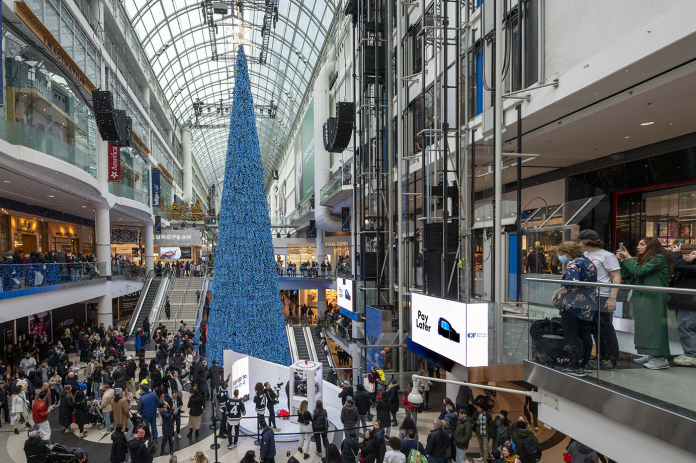
CF Toronto Eaton Centre Christmas Tree: Photo credit: The Canadian Press Images/Stephanie Lake.

Cadillac Fairview has introduced one of the country’s most visible holiday retail partnerships this year by bringing PayPal into several of its major shopping centres. The collaboration introduces new festive programming, including the first corporate sponsorship of the iconic Christmas tree at CF Toronto Eaton Centre and a national mall tour promoting the newly launched PayPal Pay in 4 instalment product.

The partnership positions Cadillac Fairview’s centres as key stages for national brand activations at a time when retailers and landlords are seeking new ways to attract and retain foot traffic. For PayPal, the partnership provides direct access to Canadian shoppers during the busiest spending season of the year.

“We have been waiting for this for a long time,” said said Andrea Lown, Senior Product Manager at PayPal Canada. “There is a palpable excitement from shoppers coming through the activation.”

The seasonal displays and pop ups appearing across Cadillac Fairview properties are the result of the landlord inviting PayPal into its holiday programming and integrating the company’s branding into several high profile public spaces.

Historic Sponsorship of CF Toronto Eaton Centre’s Christmas Tree

For the first time, CF Toronto Eaton Centre’s signature Christmas tree has a presenting sponsor. PayPal branding now appears prominently throughout the installation, including decorative boxes at the base of the display, many of which feature logos from retailers offering PayPal Pay in 4.

“We had the opportunity to sponsor the Christmas tree in each of these centres,” said Lown. “It has been a really awesome experience to see PayPal on this stage in Canada.”

Daily light and snow shows are running every hour from 1 p.m. to 8 p.m. until December 31. These performances, presented by PayPal Pay in 4, include music, lighting effects, and indoor snowfall designed to draw crowds into the centre court. The shows align with Cadillac Fairview’s broader strategy of animating common areas while creating new revenue opportunities through partnerships.

The landlord’s decision to bring PayPal into the tree program highlights a growing interest in pairing established holiday traditions with national brand integrations that offer both experiential value and commercial benefit.

Pop Up Tour Introduces PayPal Pay in 4 to Mall Shoppers

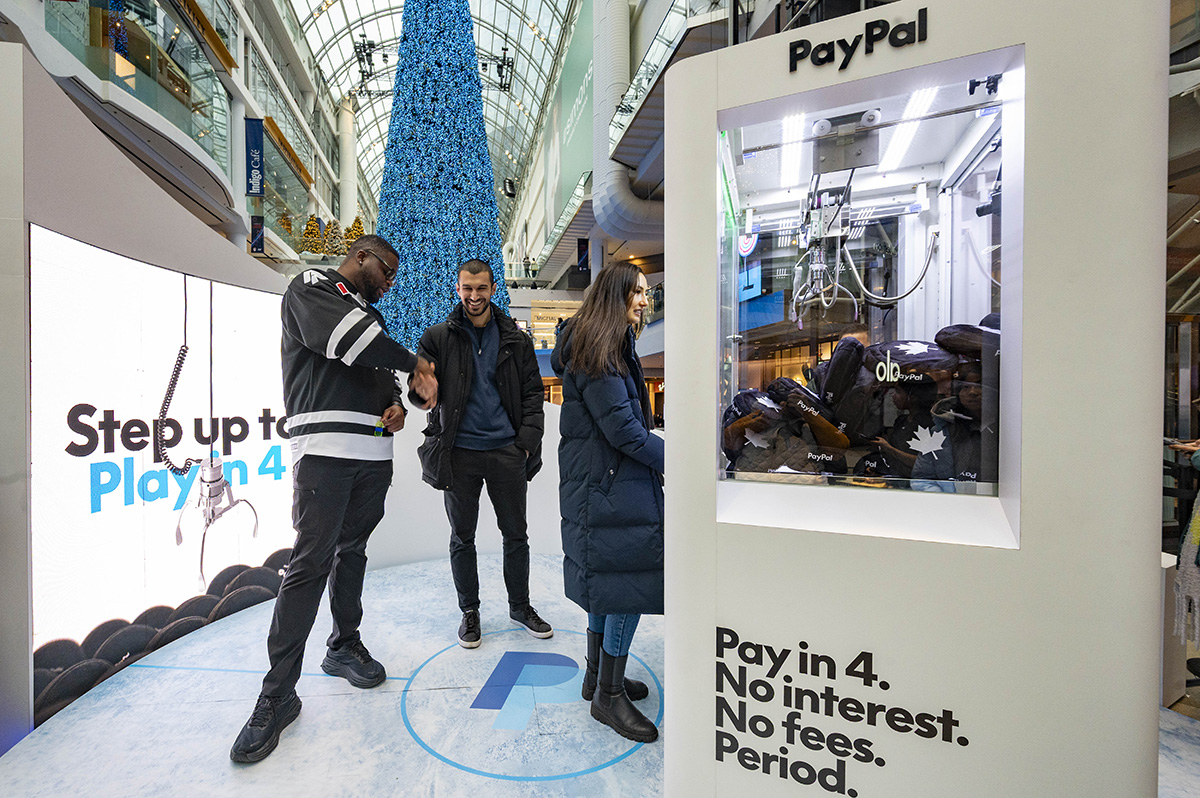
The partnership also includes a national experiential program that Cadillac Fairview has rolled out across four of its busiest centres. PayPal’s “Pay in 4, Play in 4” tour features a hockey themed claw machine offering visitors a chance to win prizes, including plush Lucky Puck toys and awards of up to $1,000 added directly to a PayPal balance.

The tour launched at CF Toronto Eaton Centre before moving to CF Carrefour Laval in suburban Montreal. It is now operating at CF Chinook Centre in Calgary and will conclude at CF Richmond Centre in Metro Vancouver. Each stop lasts one week and is positioned in a location selected by Cadillac Fairview for maximum visibility and foot traffic.

“At CF Toronto Eaton Centre, because of the positioning, it was fantastic for brand awareness,” said Lown. “If you went at any time during that promotion, you would have seen a huge line of people waiting to play.”

Visitors receive one chance to use the claw machine. Those who have used PayPal Pay in 4 receive four chances, which reflects the program’s underlying message about budgeting and instalment planning. Lown said many shoppers signed up for PayPal accounts while waiting in line.

The activation has attracted sustained crowds across all locations. Quebec shoppers encountered the pop up near a large poinsettia display at CF Carrefour Laval, while Calgary and Vancouver locations feature similar high traffic placements made possible through Cadillac Fairview’s involvement.

CF Toronto Eaton Centre PayPal activation: Photo credit: The Canadian Press Images/Stephanie Lake.

Revenue and Engagement Benefits for Cadillac Fairview

Cadillac Fairview’s decision to bring PayPal into its holiday program reflects the landlord’s focus on creating immersive environments that encourage longer visits and deeper engagement. At the same time, the company is expanding its non rent revenue opportunities through partnerships that make heavy use of high visibility common areas.

Retailers located near the holiday displays have also benefited from the increased attention. “Our merchant partners are very pleased with the co marketing aspect,” Lown noted. “People remember that the store exists, come to visit, and talk about having played at the claw box.”

The collaboration demonstrates how mall landlords are integrating digital brands into physical spaces in ways that reinforce the mall’s role as a holiday destination.

How PayPal Pay in 4 Fits Into Holiday Shopping Patterns

The experiential programming is tied directly to the launch of PayPal Pay in 4 in Canada. The product allows approved consumers to split eligible purchases of $30 to $1,500 into four equal payments over six weeks, without fees or interest.

“It ends up splitting over six weeks, and if most people get paid biweekly, it helps stretch things,” said Lown.

The option is currently available for online transactions. However, PayPal views physical malls as an important venue for educating customers who are already in the process of browsing, comparing prices, and completing holiday purchases. Lown said she has consistently seen strong crowds in each centre. “Malls are busy,” she said. 

“Tons of people are browsing, comparing prices, and carrying packages.”

Consumers Are Shopping Earlier and Adopting Budgeting Tools

PayPal’s holiday spending survey shows that Canadians have shifted their purchasing behaviour this year. Many are shopping earlier to spread costs over a longer period and avoid late season expenses. Seventy percent of respondents indicated they began shopping earlier in order to manage cash flow.

Price comparison has also become a dominant behaviour, with 90 percent of shoppers comparing prices before making a purchase. Some are choosing handmade gifts or pre owned items to keep budgets on track.

Lown said younger consumers and parents are showing higher interest in buy now, pay later tools. “They are looking at these tools to stretch their budgets even further,” she said. PayPal emphasizes transparency to avoid overspending. “People are being responsible with it,” she noted. “They are still spending what they have to spend. They are just making it more flexible.”

More from Retail Insider:

Why Canada Should End the GST and HST on All Food

Inside a Loblaw Grocery Store (Image: Dustin Fuhs)

About a year ago, Canada experimented with something rare in federal policymaking: a temporary GST Holiday on prepared foods. It was short-lived and poorly communicated, yet Canadians noticed it immediately. One of the most unavoidable expenses in daily life—food—became marginally less costly. Families felt a modest but genuine reprieve. Restaurants saw a bump in customer traffic. For a brief moment, Canadians experienced what it feels like when government steps back from taxing something as basic as eating. Then the tax returned—this time coupled with opportunistic pricing—restoring a policy that quietly but reliably makes the cost of living more expensive for everyone.

In many ways, the temporary GST cut was worse than doing nothing. It opened the door for industry to adjust prices upward while consumers were distracted by the tax relief. That dynamic helped push our food inflation rate from –0.6% in January to almost 4% later in the year. By tinkering with taxes rather than addressing the structural flaws in the system, policymakers unintentionally fueled volatility. Instead of experimenting with temporary fixes, it is time to confront the obvious: Canada should stop taxing food altogether.

Start with grocery stores. Many Canadians believe food is not taxed at retail, but that assumption is wrong. While so-called “basic groceries” are zero-rated, a vast range of everyday food products are taxed—and Canadians now pay over a billion dollars a year in GST/HST on food purchased in grocery stores. That amount is rising steadily, not because Canadians are buying more treats, but because shrinkflation is quietly pulling more products into taxable categories. A box of granola bars with six bars is tax-exempt, but when manufacturers quietly reduce the box to five bars, it becomes taxable. The product hasn’t changed. The nutritional profile hasn’t changed. Only the packaging has changed, yet the tax flips on.

This pattern now permeates the grocery aisle. A 650-gram bag of chips shrinks to 580 grams and becomes taxable. Muffins once sold in six-packs are reformatted into three-packs or individually wrapped portions, instantly becoming taxable single-serve items. Yogurt, traditionally sold in large tax-exempt tubs, increasingly appears in smaller 100-gram units that meet the definition of taxable snacks. Crackers, cookies, trail mixes, and cereals have all seen slight weight reductions that push them past GST thresholds created decades ago. Inflation raises food prices; Canada’s outdated tax code amplifies those increases.

At the same time, grocery inflation remains elevated. Prices are rising at 3.4%, nearly double the overall inflation rate. At a moment when food costs are climbing faster than almost everything else, continuing to tax food—whether on the shelf or in restaurants—makes even less economic sense.

The inconsistencies extend further. A steak purchased at the grocery store carries no tax, yet a breakfast wrap made from virtually the same inputs is taxed at +5% GST plus applicable HST. The nutritional function is not different. The economic function is not different. But the tax treatment is entirely arbitrary, rooted in outdated distinctions that no longer reflect how Canadians live or work.

Lower-income households disproportionately bear the cost. They spend 6.2% of their income eating outside the home, compared with 3.4% for the highest-income households. When government taxes prepared food, it effectively imposes a higher burden on those with the least margin—people often juggling two or three jobs with limited time to cook. But this is not only about the poorest households. Every Canadian pays more because the tax embeds itself in the price of convenience, time, and the realities of modern living.

And there is an overlooked economic dimension: restaurants are one of the most effective tools we have for stimulating community-level economic activity. When people dine out, they don’t just buy food. They participate in the economy. They support jobs for young and lower-income workers. They activate foot traffic in commercial areas. They drive spending in adjacent sectors such as transportation, retail, entertainment, and tourism. A healthy restaurant sector is a signal of economic confidence; it is often the first-place consumers re-engage when they feel financially secure. Taxing prepared food, therefore, is not simply a tax on convenience—it is a tax on economic participation.

Restaurants Canada has been calling for the permanent removal of GST/HST on all food, and they are right. Eliminating the tax would generate $5.4 billion in consumer savings annually, create more than 64,000 foodservice jobs, add over 15,000 jobs in related sectors, and support the opening of more than 2,600 new restaurants across the country. No other affordability measure available to the federal government delivers this combination of economic stimulus and direct relief.

And Canadians overwhelmingly agree. Eighty-four percent believe food should not be taxed, regardless of where it is purchased. In a polarized political climate, consensus of that magnitude is rare.

Ending the GST/HST on all food will not solve every affordability issue, but it is one of the simplest, fairest, and most effective measures the federal government can take immediately.

Food is food. The tax system should finally accept that.

More from Retail Insider:

The Webster to Close Toronto Store After Four Years

The Webster Yorkville (Image: Adrian Ozimek)

The Webster in Toronto is preparing to close after four years in operation, ending the Miami-based luxury multi-brand retailer’s only Canadian presence. The boutique opened in late October 2021 in Toronto’s Bloor-Yorkville district and marked The Webster’s first international store. Its closure follows the retailer’s majority acquisition by Frasers Group in 2025, a deal that has shifted strategic focus and placed greater emphasis on strengthening the company’s United States footprint. With no plans to maintain a single Canadian outpost, the Toronto store will soon complete its wind-down.

When the boutique first arrived, the move was seen as a major development for the Canadian luxury market. Few global multi-brand retailers of its prominence had made a physical entry into the country, and The Webster Toronto was expected to diversify Yorkville’s retail landscape with its distinct residential-inspired design and curated mix of designer labels. While the boutique delivered on aesthetic sophistication and assortment, the long-term financial and operational pressures proved challenging.

Staff confirmed that the entire store is discounted at 40 percent this week, with remaining stock expected to be marked down to 70 percent next week as the closing process continues.

Main floor. Image: The Webster Yorkville

A High-Profile Opening in the Heart of Yorkville

The Webster Toronto opened on October 30, 2021 at 121 Scollard Street, a heritage Victorian building from the 1880s owned by First Capital REIT. The location sits just north of Yorkville Avenue, within walking distance of major luxury houses and some of Canada’s most valuable retail real estate. The store’s pink-toned brick façade stood out immediately and aligned with the retailer’s artistic, visually driven brand identity.

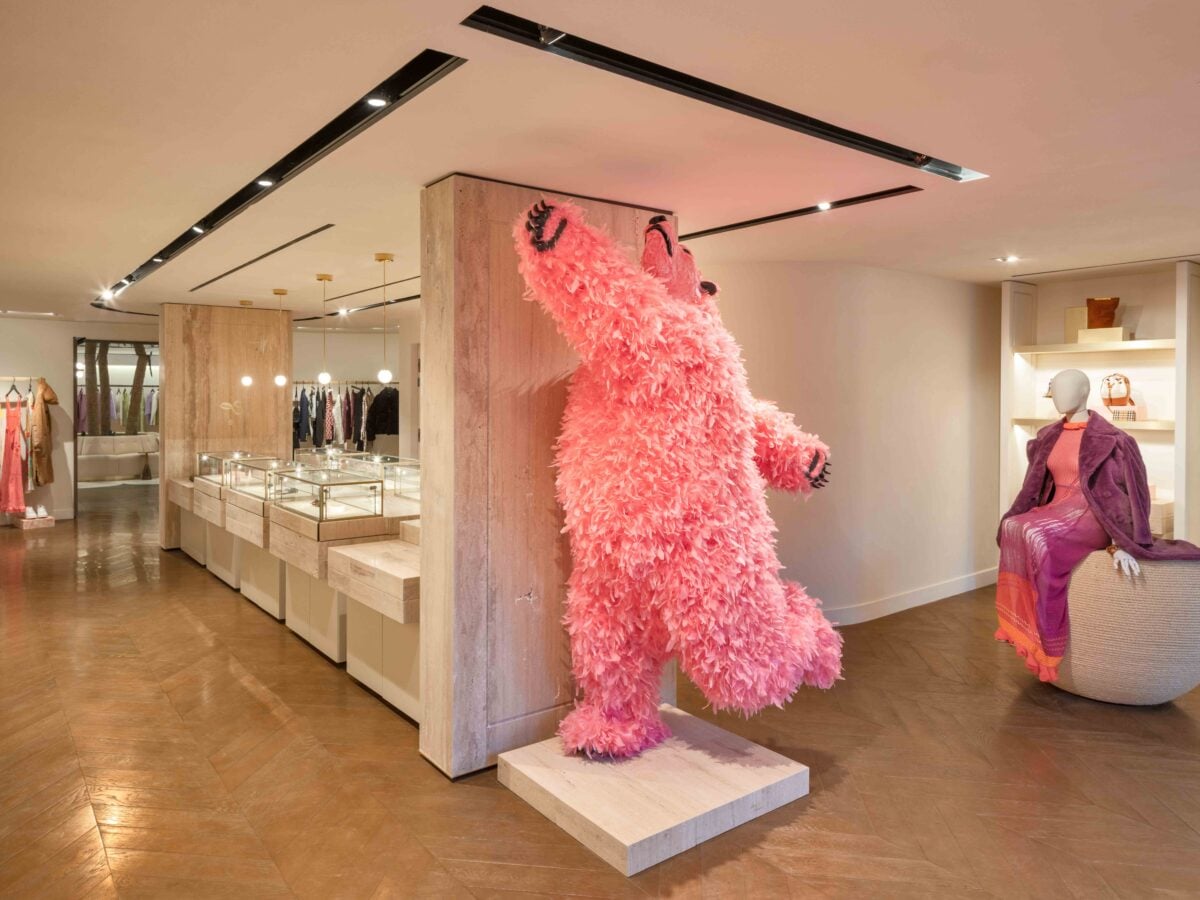
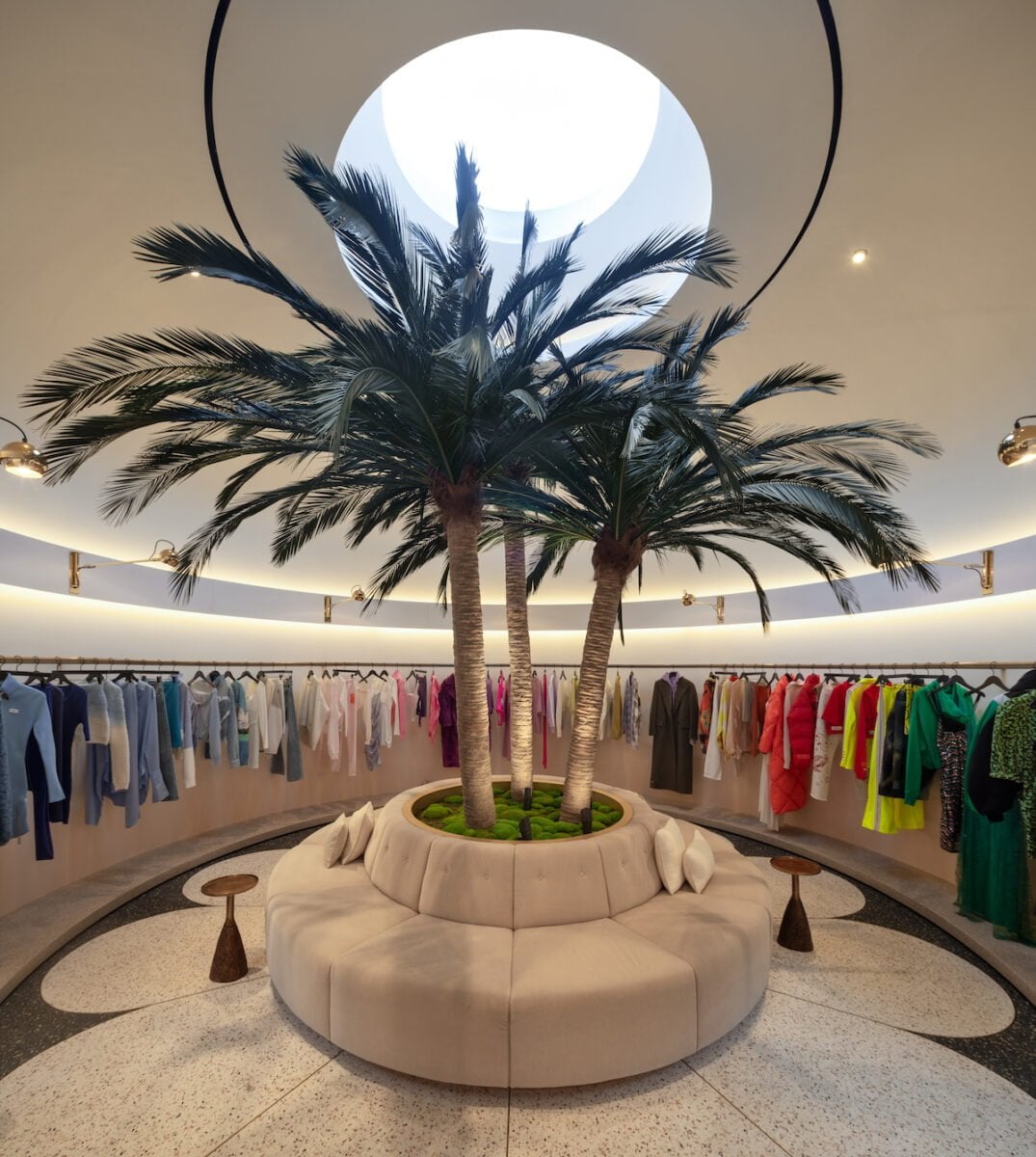
Inside, the boutique spans approximately 6,500 square feet across three levels, connected by an illuminated pink staircase that became one of the most photographed elements of the store. French designer Stéphane Parmentier created interiors that reflected The Webster’s signature residential concept, using salon-style rooms, sculptural furniture and curated art pieces to cultivate an intimate, gallery-like atmosphere.

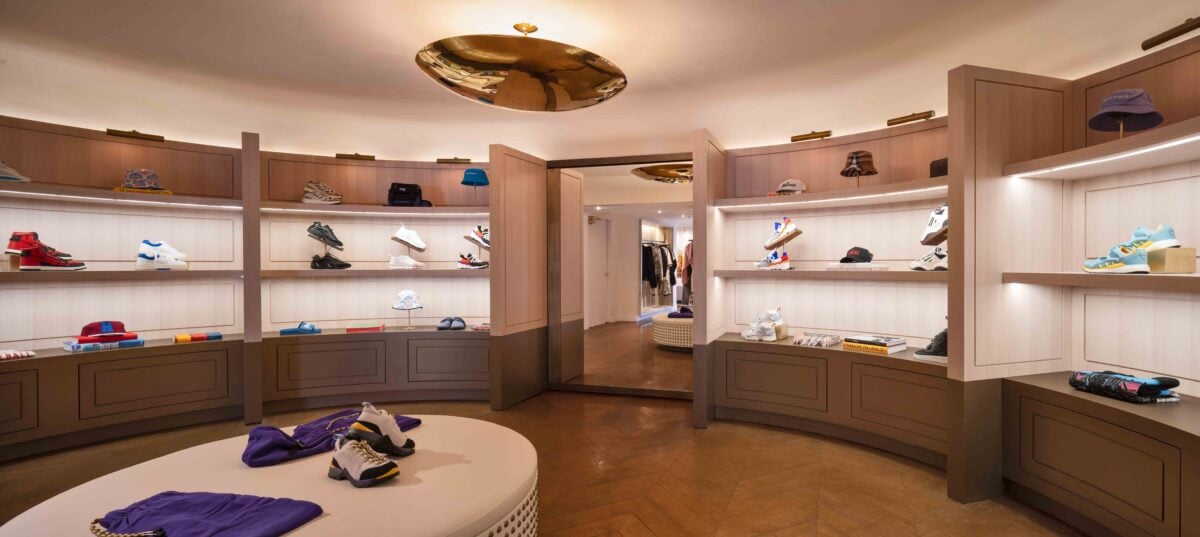
The ground floor showcased jewelry, accessories, home objects and women’s ready-to-wear. The second floor expanded on the selection of womenswear, handbags and footwear, arranged in a layout intended to feel like a living room. The third floor emphasized menswear and sneakers and brought together both established designers and smaller labels. Throughout the store, merchandisers used a cross-brand approach that encouraged wardrobe building rather than siloed brand shopping. Toronto clients encountered labels such as Loewe, Courrèges, Balenciaga, Chloé, Jacquemus, Fear of God, Amiri and Palm Angels in carefully curated vignettes.

The boutique introduced a level of mixed-brand luxury retailing that had been uncommon in Canada and offered an alternative to the dominant mono-brand flagship model used by many global houses.

‘Whisper Room’ at The Webster in Toronto. Photo: The Webster

The Webster’s Evolution and International Expansion

The Webster was founded in 2009 by Laure Hériard Dubreuil, who brought luxury fashion experience from her roles at Balenciaga and Yves Saint Laurent. The flagship store in Miami Beach opened in a renovated 1930s Art Deco hotel and quickly became known for its experiential approach to merchandising. The store offered a blend of established luxury labels and emerging designers displayed in intimate rooms styled as wardrobes or private residences. This focus on curation, discovery and atmosphere shaped the brand’s early identity and guided its expansion strategy.

Over the next decade, The Webster opened boutiques across the United States, including Bal Harbour, SoHo in New York, Houston, Costa Mesa at South Coast Plaza, Los Angeles at Beverly Center, Montecito at Rosewood Miramar Beach and Palm Springs. More recently, the network expanded to Atlanta, Austin and Las Vegas. The retailer operated a global e-commerce platform and built extensive relationships with leading luxury fashion houses, carrying more than one hundred designer brands across its physical and online channels.

The entry into Toronto marked the retailer’s first international venture and signaled interest in exploring markets beyond the United States. A planned location in Vancouver’s Gastown area never materialized. 

2nd floor. Image: The Webster Yorkville

Operational Challenges in a Shifting Market

As Toronto’s luxury retail landscape continues to evolve, The Webster Toronto faced challenges that became increasingly difficult to overcome. Although the company has not publicly commented on the closure, conversations within the store and among industry observers pointed to several pressures. The boutique struggled with limited marketing and modest brand awareness, which limited its ability to reach a broader luxury consumer base. Buying decisions were often made by teams in the United States and did not always align with local Toronto preferences. It was also noted that having more strong personal shoppers would have been required for the store to succeed.

The previously anticipated Vancouver location never materialized, which left Toronto as an isolated Canadian outpost without a national network to reinforce visibility or cross-promotional momentum.

While The Webster Toronto offered a unique and highly curated experience, it needed sustained investment to build market awareness and attract consistent traffic in a competitive district dominated by household-name luxury houses. In addition, the boutique operated within a format that depends heavily on personalized service and local fashion intelligence, both of which require time and staffing resources to scale effectively.

Grand staircase at The Webster, 121 Scollard Street in Toronto Image: The Webster

The Frasers Group Acquisition and Strategic Repositioning

The closure of The Webster Toronto coincides with a major shift in the retailer’s corporate trajectory following Frasers Group’s majority acquisition in October 2025. The UK-based conglomerate, which has been expanding its luxury division through brands such as Flannels, described the purchase as a key step in its global elevation strategy. The company indicated that The Webster would remain under the creative leadership of its founder and maintain its curated, experiential identity while benefiting from Frasers’ operational scale, digital infrastructure and financial resources.

However, statements from Frasers Group and subsequent coverage emphasized the United States as the primary growth market for The Webster. With a boutique network spread across major American cities and resort destinations, the retailer is well-positioned to deepen its presence domestically with additional support from its new parent company. International expansion remains a possibility, but the near-term focus appears aligned with reinforcing and optimizing existing US locations rather than operating single-store markets abroad.

Within this strategic context, maintaining The Webster Toronto became less practical. The store required localized buying strategies, targeted marketing campaigns and a dedicated clienteling structure, all of which would operate independently from the brand’s larger US systems. The closure reflects a rebalancing of resources and priorities as Frasers seeks to consolidate The Webster into a more unified operational model.

Second floor, The Webster Yorkville, Toronto, 2021

Impact on Yorkville and the Future of 121 Scollard Street

The departure of The Webster Toronto will leave a distinctive gap in Yorkville’s retail landscape. The store offered a multi-brand luxury concept not widely available elsewhere in the Canadian market, and its residential-style interiors and artistic approach contributed to the neighbourhood’s cultural texture. The boutique also helped expand Scollard Street’s profile as an emerging luxury corridor that complemented the more established retail clusters along Yorkville Avenue and Bloor Street.

Yorkville remains one of Canada’s strongest luxury retail zones, and the closure is not expected to affect the broader momentum of the district. Global fashion houses continue to open new stores or expand their existing footprints, and recent years have seen significant investment from brands such as Chanel, Hermès, Balenciaga, and Brunello Cucinelli. While The Webster Toronto offered a different type of retail experience, the district’s ongoing evolution ensures continued demand for high-end retail space.

The building at 121 Scollard Street is owned by First Capital REIT, which has cultivated a major presence in Yorkville through long-term acquisitions and redevelopment plans. The property’s historic character, architectural prominence and strategic location are likely to generate strong interest from both international and domestic tenants. Its scale and layout make it appropriate for another luxury boutique, an art-driven retail concept or a specialized lifestyle retailer that aligns with the neighbourhood’s positioning.

Image: The Webster Yorkville

More from Retail Insider:

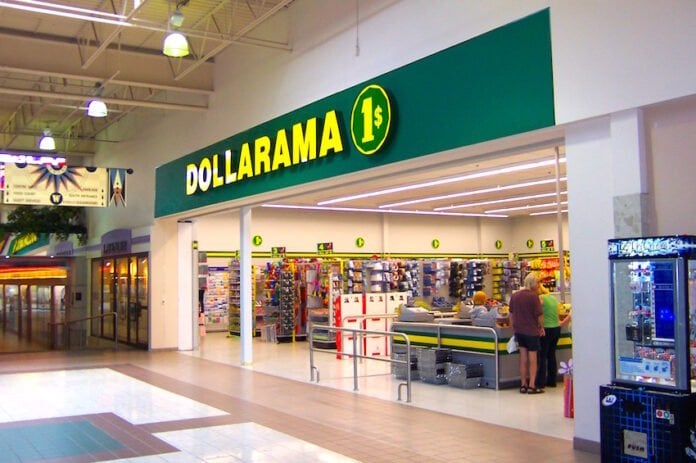
Dollarama releases Q3 Fiscal 2026 results, sales rise by more than 22%

Dollarama (PHOTO: WWW.THECENTREMALL.COM

Dollarama Inc. released on Thursday its financial results for the third quarter of Fiscal 2026, covering the period from August 4, 2025 to November 2, 2025, indicating a significant hike in sales from a year ago.

The corporation said it has two reportable segments: Canada (which includes the contribution of the Corporation’s equity-accounted investments in Latin America) and Australia since the completion of its acquisition of The Reject Shop Limited on July 21. 

Fiscal 2026 Third Quarter Results Highlights Compared to Fiscal 2025 Third Quarter

  • Sales increased by 22.2% to $1,909.4 million, compared to $1,562.6 million
  • In Canada, Comparable store sales increased by 6.0%, compared to 3.3% in the corresponding period of the previous year
  • EBITDA increased by 20.1% to $612.0 million, representing an EBITDA margin of 32.1%, compared to 32.6%
  • Operating income increased by 18.1% to $481.2 million, representing an operating margin of 25.2%, compared to 26.1%
  • Net earnings increased by 16.6% to $321.7 million, resulting in a 19.4% increase in diluted net earnings per common share to $1.17, compared to $0.98
  • 19 net new stores opened in Canada, compared to 18 in the corresponding period of the previous year and 6 net new stores opened in Australia under the TRS banner
  • 2,605,912 common shares repurchased for cancellation for $484.6 million

“In an economic environment that has remained unpredictable, our business model continues to demonstrate its enduring relevance and resilience, driving strong 6.0% Comparable store sales growth in Canada for the quarter,” said Neil Rossy, President and CEO of Dollarama.

“Internationally, we also continued to advance our growth plans and the rollout of the Dollarama model. Dollarcity delivered another quarter of strong financial and footprint growth, opening their 700th store in Latin America and fifth location in Mexico after quarter-end. In Australia, we have begun laying the groundwork for The Reject Shop’s transformation as we prepare the platform for the deployment of our value proposition in the coming years.”

Founded in 1992 and headquartered in Montréal, Dollarama is a leading Canadian value retailer with international reach with more than 2,700 stores and over 41,000 people serving customers in seven countries on three continents.

Dollarama operates more than 1,600 stores in Canada with a presence in all 10 provinces and two territories. In Australia, Dollarama operates the country’s largest discount retail chain, The Reject Shop, with a national network of over 400 stores. Dollarama is also the majority shareholder, through its equity-accounted investments, in Latin American value retailer Dollarcity which has more than 700 stores located in Colombia, El Salvador, Guatemala, Mexico and Peru.

More from Retail Insider:

Empire releases Q2 Fiscal 2026 results, net earnings rise

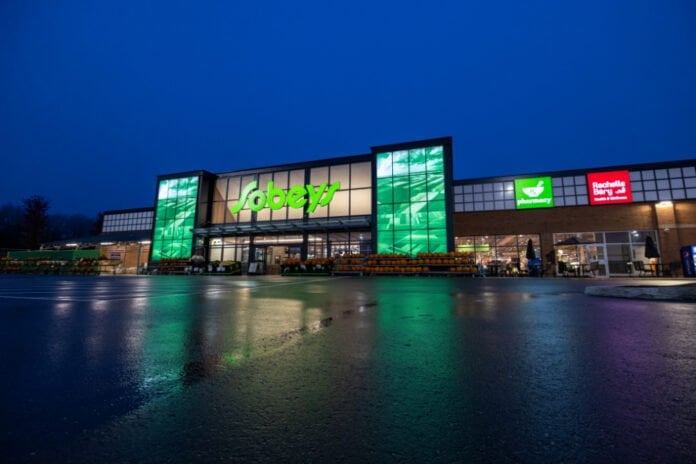
Image: Sobeys Orangeville

Empire Company Limited released on Thursday its second quarter Fiscal 2026 financial results for the second quarter ended November 1, 2025. For the quarter, the company recorded net earnings of $159 million ($0.69 per share) compared to $173 million ($0.73 per share) last year.

“Our core business is performing well, with 2.5% same-store sales growth,” said Pierre St-Laurent, President & CEO, Empire. “This growth was supported by all our formats – with Full Service achieving more than 2% same-store sales growth and Discount maintaining its momentum and market share gains in its channel.”

Pierre St-Laurent
Pierre St-Laurent

Empire is a Canadian company headquartered in Stellarton, Nova Scotia. Empire’s key businesses are food retailing, through wholly-owned subsidiary Sobeys Inc., and related real estate. With approximately $31 billion in annual sales and $17 billion in assets, Empire and its subsidiaries, franchisees and affiliates employ approximately 129,000 people.

Key financial results:

  • Earnings per share and adjusted EPS of $0.69
    Prior year EPS and adjusted EPS of $0.73;
  • Sales of $7,995 million, an increase of 2.8%;
  • Food sales increased by 3.4%; Same-store sales- food increased by 2.5%;
  • Gross margin, excluding fuel, increased by 14 basis points

“Over recent years, the Company has accelerated investments in renovations, conversions, and new stores along with store processes, communications, training, technology and tools. Investing in the store network will remain a key priority, demonstrated by a sustained emphasis on renovations and continued new store expansion. The Own Brands program enhancement will remain a priority through increased distribution, product innovation and supporting Canadian suppliers,” it said.

“The Company intends to invest capital in its store network and is on track with its plan to renovate approximately 20% to 25% of the network, which started in fiscal 2024 and continues through fiscal 2026. This capital investment includes important sustainability initiatives such as refrigeration system upgrades and other energy efficiency initiatives.”

For fiscal 2026, capital spend is expected to be approximately $850 million, with approximately half of this investment allocated to renovations and new store expansion (including a 1.5% increase in store footprint expansion from new stores), 25% allocated to IT and business development projects and the remainder allocated to logistics and sustainability. By the end of fiscal 2026, the company said it expects to complete the network renovations of approximately 20% to 25%, which began in fiscal 2024.

More from Retail Insider:

7-Eleven and Mastermind Toys Launch Holiday Collab

Photo: 7-Eleven/Mastermind Toys

The holiday season has brought an unexpected and strategically ambitious collaboration to the Canadian retail landscape. 7-Eleven Canada and Mastermind Toys announced a cross-retail partnership that places Mastermind’s MM on the Go toys and games inside 7-Eleven stores while bringing some of 7-Eleven’s signature candies and snacks to Mastermind’s checkout areas. Prices are under $15. It is the first arrangement of its kind for either retailer and is timed to reach families during the busiest shopping weeks of the year.

Both companies say the partnership was designed to meet a growing consumer desire for convenience during the holiday season. For 7-Eleven, the addition of Mastermind’s curated mini-collection provides shoppers with accessible gifting options during quick visits. For Mastermind Toys, it is an opportunity to appear in hundreds of neighbourhood locations at a moment when many families are pressed for time and budget. The partnership, which can be explored further on Mastermind’s website, includes plush characters, puzzles, games and a selection of travel-ready toys.


Marc Goodman, Vice President and General Manager of 7-Eleven Canada, said the chain wanted to make holiday shopping easier while maintaining affordability. He noted that customers can now find exclusive MM on the Go toys and games that reflect Mastermind’s quality standards while still enjoying 7-Eleven favourites such as Slurpee drinks, baked goods and fresh meals.

Danielle Bazely, Senior Director of Marketing at Mastermind Toys, emphasized the importance of accessible gifting. She said the holiday period is critical for families and that the partnership helps place Mastermind’s curated toys in convenient locations while establishing the groundwork for an ongoing collaboration. Both retailers indicated that this first iteration serves as a test of broader possibilities beyond the holiday season.


Mastermind’s New Chapter of Growth and Reinvention

The timing of the 7-Eleven collaboration aligns with a pivotal moment for Mastermind Toys. After a challenging period that included creditor protection in late 2023, the company is emerging with renewed leadership, an expanded ownership structure and a deeper strategic commitment to transforming the brand into a children’s lifestyle destination.

Mastermind was acquired in January 2024 by Unity Acquisitions Inc., a company owned by three well-known Canadian retail leaders: Joe Mimran, Frank Rocchetti and David Lui. All three owners are influential figures who have guided national retail brands through expansion and reinvention. Their involvement brought both stability and vision as the chain navigated a competitive market and the residue of restructuring.

The company’s ownership grew again in April 2025 when toy industry veteran Stéphane Tétrault joined as an equity partner and investor. Tétrault founded Imports Dragon, one of Canada’s most prominent toy companies, and co-owned McFarlane Toys. His expertise in product development, licensing and global distribution provides Mastermind with new depth as it modernizes its assortment and strengthens supplier relationships.

CEO John Bayliss and Vice President of Operations Marcello Piane have continued guiding the company through its transition. They have consolidated operations to 48 company-owned stores across Canada, down from 66 before restructuring, and have overseen the rollout of new merchandising, new partnerships and a redesigned store format.

See the products here

More from Retail Insider:

Edmonton-based O & O Group of Companies continues to expand in the hospitality sector

Ravi Prakash and his wife Khushbu Singh

Ravi Prakash, chair of the Edmonton-based O & O Group of Companies, says the hospitality sector remains a resilient and growing industry despite economic pressures, international tariffs and shifting post-pandemic conditions.

Prakash said the company operates about 23 restaurants under multiple quick-service brands, including Second Cup, Marble Slab and Pita Pit. O & O is preparing to open its first Jimmy John’s location in Sherwood Park in mid-January and plans between 12 and 14 more outlets in the Edmonton region over the next two years.

Prakash said the company, founded nearly a decade ago and named after his daughters, has expanded steadily since purchasing its first Pita Pit on Edmonton’s Whyte Avenue.

Ravi Prakash
Ravi Prakash

“We opened the second, third and we never stopped afterwards,” he said.

He said hospitality is “in my blood” after 18 years in the sector and remains one of the world’s largest industries. “No matter how big you become, you have to depend on hospitality people,” he said.

Prakash said quick-service restaurants continue to thrive because of their convenience and relatively low cost. 

“Everyone is running out of time nowadays,” he said. “Your average ticket nowadays, even if you stretch yourself… you are between $12 to $15. If you’re going to cook at home, it is going to cost you more.”

He added that the company’s growth has not changed his interest in visiting stores daily and eating from the brands he operates. 

“My favourite is Pita Pit because it’s healthy, lighter,” he said.

Prakash said he and his wife, Khushbu Singh, divide the company’s workload, with him focusing on development and new outlets while she manages operations and human resources. 

Khushbu Singh
Khushbu Singh

Travel is their main personal activity outside of work, he said, and they aim to take frequent short trips and two longer vacations each year “to refresh ourselves.”

Looking ahead, Prakash said O & O is preparing to expand internationally. 

“Very soon we are going to announce that we are going global,” he said, citing plans targeting the Middle East and the United States.

He also pointed to industry challenges, including tighter financing conditions for restaurants and the impact of new U.S. tariffs. 

He said margins were already thin and are becoming “even thinner,” adding that Canadian industries should not be vulnerable to political pressure. 

“That bullying needs to be stopped,” he said.

When asked about entrepreneurship, Prakash said persistence and focus are essential. 

“Believe in yourself,” he said. “Do what you are a master in. You don’t want to be a jumping jack who wants to do each and everything.” 

Long-term success, he added, comes from “repeating yourself every morning with the same energy.”

More from Retail Insider:

Edmonton-based O & O continues to grow its food service powerhouse

Interac survey shows Canadian parents face holiday spending stress and grandparents are stepping up 

Photo - Andrej Lišakov

The pressure is on for parents this holiday season. Three-quarters of Canadian parents recently surveyed (76 per cent) say creating a magical holiday for their children is a top priority – but higher prices are turning wonder into worry. 

A new Interac survey reveals two-thirds (66 per cent) of Canadian parents say rising costs are making it harder to manage their holiday spending, and half (52 per cent) are worried about overspending this holiday season. 

So much so, grandparents are stepping up, with one in five parents (21 per cent) relying on them for holiday support. A third of parents (33 per cent) say grandparents spend more on gifts for the kids than they do themselves.

Interac said its transaction data forecasts that December 19, will be the busiest shopping day of the year, with 24.8 million Interac Debit purchases predicted. The majority of the transaction volumes are expected to take place at fast food restaurants, grocery stores and discount stores. As parents head to the shops this holiday season, more than four in 10 (45 per cent) plan to spend a total of under $500 on gifts, one in four (25 per cent) plan to spend $500 – $999, and nearly three in 10 (28 per cent) plan to spend $1,000 or more.

Chris Lee
Chris Lee

“Interac survey and transaction data point to a clear pattern: Canadians are approaching the holidays with a heightened sense of caution on spending,” said Chris Lee, Head, Payments at Interac. “As we approach peak shopping season, household budgets will be tested by high prices and high expectations. Using Interac Debit can help Canadians manage their finances by using their own money- keeping holiday magic alive and providing a sense of financial confidence and security as we approach the festive season.”

Interac said most parents say the pressure to overspend comes from within, as they strive to make the holidays feel special (56 per cent). Nearly half (47 per cent) are driven by a desire to give their children what they never had. Other factors driving parents to go over budget include keeping up with family expectations (37 per cent), making the most of retail promotions (25 per cent) and trying to recreate the holiday ideal seen on social platforms (15 per cent).

Key findings from the Interac holiday spending snapshot include:

  • Older Kids, Big Budgets: As kids grow, the pressure on parents increases. Parents say the teenage years (age 13-17) are the most demanding for holiday spending, with kids aged six to nine following in second place. Parents of toddlers under two feel the least spending pressure;
  •  Lingering Regrets: 74 per cent of parents have felt financial strain after overspending for the holidays in the past; nearly two in five (40 per cent) experience this every year. Recovery takes weeks for some, but 44 per cent need until the spring, and 12 per cent feel the impact most of the year. Among parents who reflected on their holiday spending last January, 56 per cent felt stressed, overextended or remorseful;
  • AI Assistance: Only about a fifth of parents (23 per cent) say they wish AI could handle their shopping for them. As agentic commerce plays an increasing role in Canada, four in 10 (40 per cent) would use an AI tool if it could identify the best day or time to shop for the lowest prices;
  • Hosting Pressure: Nearly half (46 per cent) feel pressure to go above and beyond when hosting; three in 10 (34 per cent) have scaled back due to the cost of having people over. Nearly six in 10 (58 per cent) find it awkward to ask guests to share expenses.
Photo - Getty Images
Photo – Getty Images

More from Retail Insider: