Small business owners across Canada are calling on governments to move quickly to strengthen the country’s domestic energy supply, according to new preliminary data from the Canadian Federation of Independent Business (CFIB).
An overwhelming majority (90%) of small businesses say governments should prioritize increasing Canada’s energy production and capacity to better support the economy and ensure businesses have reliable access to the energy they need to operate, said the CFIB.
Dan Kelly
“Canada cannot continue to sit on the sidelines when it comes to developing our energy potential,” said Dan Kelly, CFIB president. “It shouldn’t take supply shocks and external threats to get governments moving on projects and policies that protect our economy. The best time to start was a decade ago. The next best time is today.”
Two-thirds (68%) of small businesses say their energy costs have increased over the past year, adding pressure at a time when global events continue to create volatility in energy markets, added the CFIB.
“When fuel costs rise, the entire supply chain feels it, and there aren’t many small business owners who can absorb a prolonged spike in gas prices,” said Kelly. “Governments need to make energy infrastructure a priority and get shovels in the ground as soon as possible.”
The CFIB is Canada’s largest association of small and medium-sized businesses with 103,000 members across every industry and region.
Editor’s Note: This article is the first in a special Retail Insider thought leadership series exploring how luxury retail actually works, based on insights from luxury retail executive Douglas Mandel.
Luxury retail is entering a new chapter. The shifts underway are structural, not cyclical. The expectations of The New Luxury Client are reshaping how brands design stores, train teams, and define performance.
Douglas Mandel, former VP of Dior who led Canada and a veteran luxury retail leader, outlines what he sees as a decisive shift in client expectations. Drawing on decades of experience leading teams and overseeing stores in complex international markets, Mandel argues that in luxury, the product is only the beginning. The real business is the relationship.
For Canadian retailers navigating cautious consumer spending, rising operating costs, and intensifying competition from global brands, that message carries weight. The New Luxury Client is no longer impressed by square footage alone. They are looking for emotional intelligence, intentional design, and authentic human connection.
Douglas Mandel
From Transaction to Relationship
“In luxury, the product is just the start. The real business is the relationship,” Mandel says.
During his tenure overseeing Dior stores internationally, Mandel explains that leadership extended far beyond operations and financial targets. Senior executives were expected to know top clients personally, host them at fashion shows, and ensure they felt recognized and valued. Fashion shows were not marketing exercises. They were immersive brand experiences and, as he describes, “the ultimate expression of brand immersion.”
This approach reframes luxury retail as a long-term relationship strategy rather than a series of isolated sales. Mandel notes that in these environments, leaders become “a conductor of relationships, not just a P&L executor.”
For The New Luxury Client, recognition and continuity are essential. Whether the annual spend is in the tens of thousands or significantly more, the expectation remains consistent. Clients want to feel seen, not processed.
Across Canada’s growing luxury nodes, from Vancouver to Toronto and Montreal, this shift is increasingly visible. Flagships are expanding. However, the brands that resonate most deeply are those investing in meaningful client relationships rather than relying solely on visual spectacle.
The Client Journey as the True Blueprint
Mandel also challenges traditional approaches to store design.
“In luxury retail, the true blueprint is not your floorplan, it’s your client journey,” he says.
Historically, store layouts were built around product adjacencies, traffic flow, and visual hierarchy. Those fundamentals still matter. However, Mandel argues that they are insufficient if the emotional experience is not equally intentional. A store can be architecturally impressive and still fail if the client feels overwhelmed, disconnected, or rushed.
He advocates mapping the emotional journey of the client across the physical space, outlining what the client feels at each stage and how staff guide the interaction. The emphasis shifts from simply moving clients through zones to creating moments of welcome, exploration, engagement, and elevated closure.
For Canadian developers and landlords investing heavily in mixed-use luxury projects, this concept is particularly relevant. As retail integrates with hospitality and residential components, the emotional hierarchy of the store becomes as critical as its architectural design.
The New Luxury Client evaluates brands holistically. Lighting, scent, pacing, and staff interactions form a cohesive narrative. When those elements align, the store becomes memorable. When they do not, even the most expensive buildout can feel transactional.
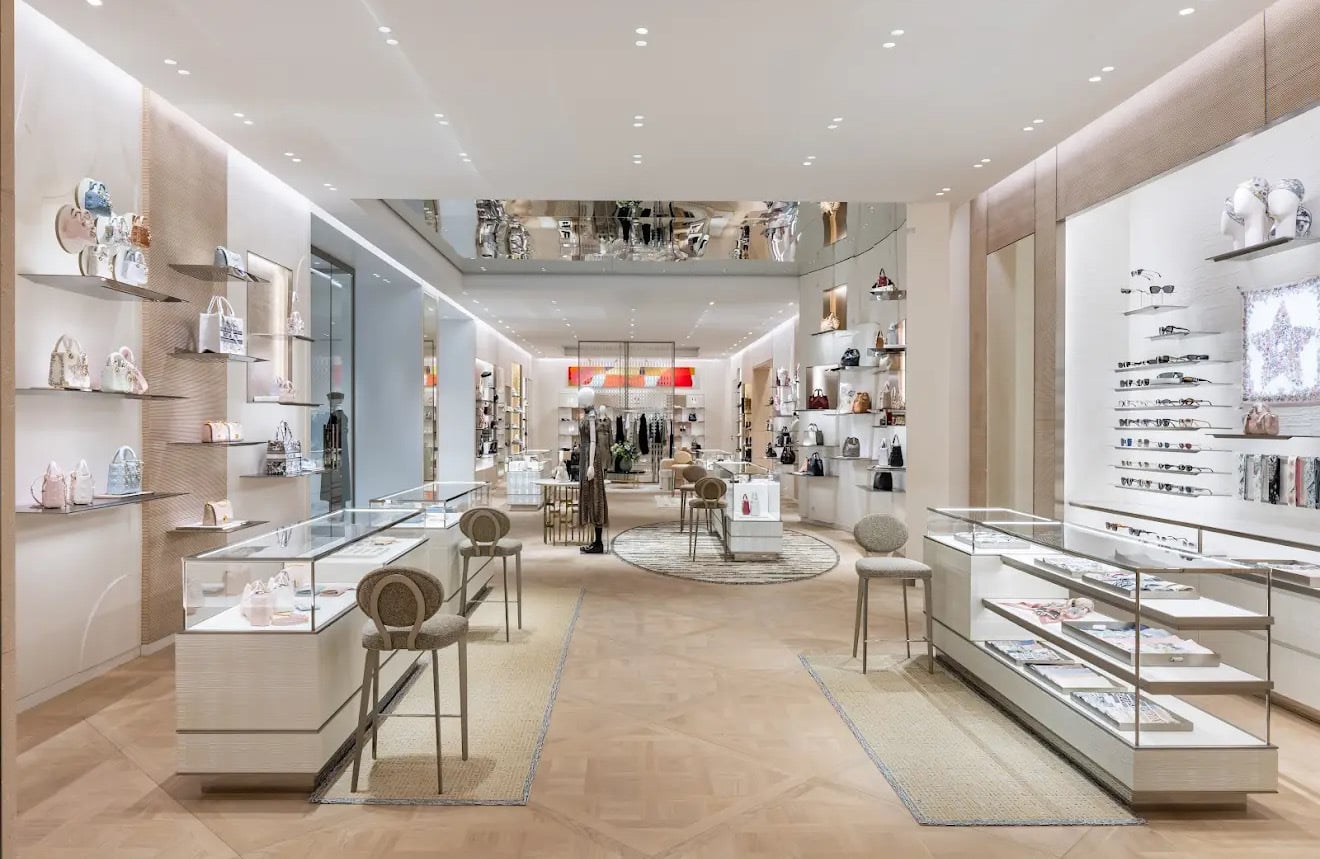
Dior Yorkdale store in Toronto. Photo: Daniel Bray, Here and Now Agency
Rituals Over Transactions
If journey defines the structure, ritual defines the rhythm.
“Luxury retail is evolving fast,” Mandel observes, noting that clients today demand more than product. “They want presence.”
He argues that the brands poised to succeed are those that embed rituals into their service model. Rituals are repeatable, meaningful moments designed to deepen emotional connection and elevate perceived value. They may include a distinctive welcome, a carefully choreographed packaging presentation, or a thoughtful follow-up that feels personal rather than automated.
“The brands that win in 2026 won’t just offer better promotions or prettier packaging. They’ll offer rituals,” Mandel says.
Rituals create emotional safety. In a climate defined by rising prices and digital saturation, consistency and symbolism help clients feel grounded and valued. Clients may forget a specific SKU, but they remember how they were treated.
For Canadian luxury retailers facing competition from both global e-commerce platforms and international flagships, ritual provides differentiation. It transforms service from an individual associate’s improvisation into a structured expression of brand values.
Clienteling as Culture, Not Software
Personalization is often associated with CRM platforms and data analytics. Mandel takes a more human-centered position.
“Clienteling isn’t a line item in your tech budget. It’s a brand behaviour that starts with your people and ends with loyal, emotionally invested clients,” he says.
He emphasizes that clienteling is not primarily a tool, but a culture. While technology can support the process, the foundation lies in training teams to capture details, act on insights, and maintain continuity across visits.
At its core, clienteling is “the art of knowing your client and showing them you care.” That includes remembering preferences, acknowledging milestones, and designing follow-up that feels intentional rather than automated.
For many Canadian luxury and premium retailers, particularly independent operators, this is an encouraging message. Meaningful clienteling does not require a global technology stack. It requires discipline, leadership, and a clear service philosophy.
The New Luxury Client is discerning. They can distinguish between generic outreach and genuine attention. In that environment, authentic clienteling becomes a strategic advantage.
New luxury wing at Toronto’s Yorkdale Shopping Centre. Photo: Craig Patterson
Hospitality as the Foundation
Long before experiential retail became a widely used term, Mandel was applying hospitality principles inside a boutique setting.
Reflecting on an early flagship in Old Montreal, he describes furnishing the store with large couches and benches, encouraging clients to sit, converse, and linger. Clients would call ahead not to ask about inventory, but to inquire about what bottle of wine was open.
“They weren’t just coming to shop. They were coming to spend time. To connect. To feel seen,” he recalls.
The lesson extended to his leadership roles in global luxury houses. Retail, he notes, is about making people feel good, not merely facilitating transactions. A memorable retail experience is built with feeling, not fixtures.
As Canada continues to attract new luxury entrants and expand existing retail corridors, this principle remains relevant. Architectural ambition must be matched by emotional hospitality.
What The New Luxury Client Means for Canada
The New Luxury Client in Canada is globally informed, digitally fluent, and increasingly selective. Travel has resumed. Price transparency is immediate. Brand narratives are scrutinized.
In this context, luxury retailers cannot rely solely on logo recognition or prime real estate. They must invest in emotional continuity, structured rituals, and a clienteling culture that prioritizes long-term relationships over short-term conversion.
Mandel’s perspective offers a framework. Begin with the client journey rather than the floorplan. Embed rituals that create rhythm and memory. Build clienteling as a cultural discipline rather than a software solution. Recognize that the relationship, not the product, ultimately drives revenue.
Luxury is not about speed. It is about meaningful rhythm.
The New Luxury Client is not demanding less. They are demanding depth, intention, and humanity. The brands that respond accordingly will not simply generate sales. They will build enduring loyalty in a market that increasingly rewards those who treat luxury as a relationship, not a transaction.
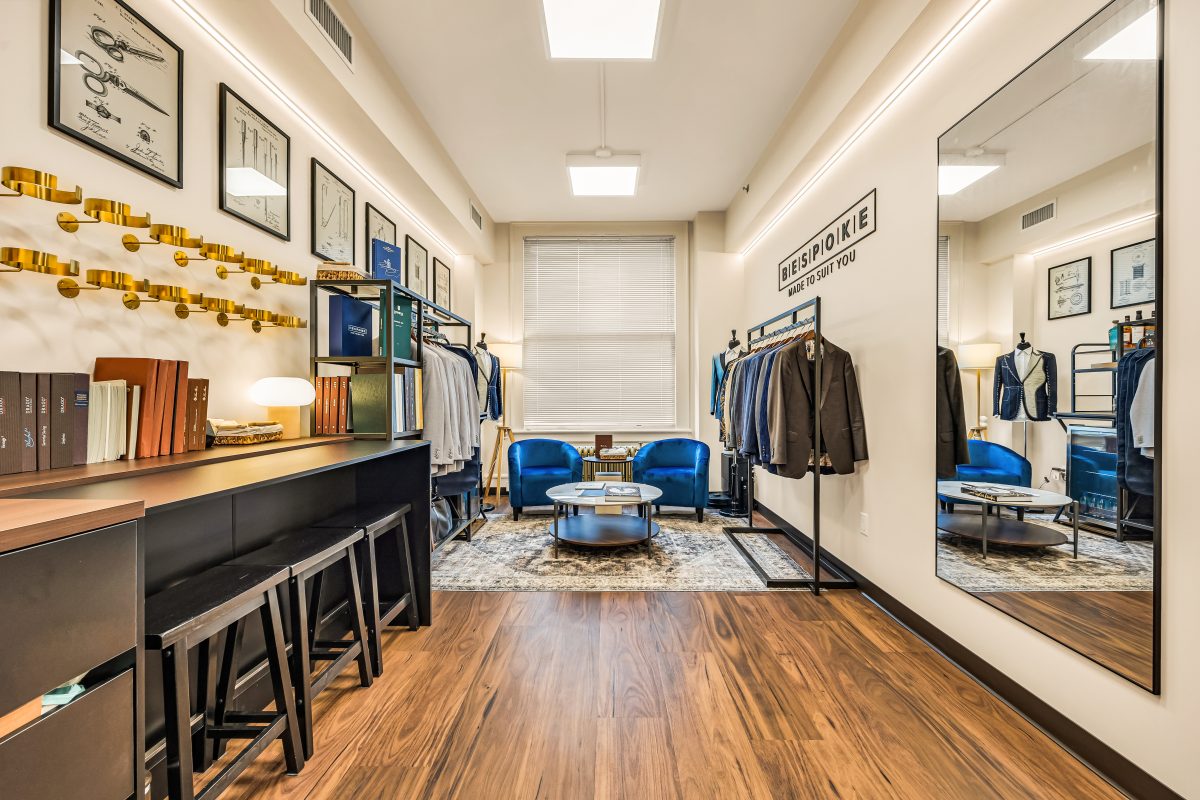
Bespoke Made Suits Vancouver Location 2026. Source: Bespoke Made Suits
Vancouver-based Bespoke Made Suits, co-founded by Adam Cheung, has expanded its operations with the opening of a physical showroom at 615–470 Granville Street, located near Vancouver’s Financial District. The new space marks an important step for the custom tailoring company as it continues to grow its presence while maintaining a concierge-style service model.
Rather than launching a traditional retail storefront, the company has introduced an appointment-based tailoring studio designed for consultations, fittings, and fabric selection. The showroom complements Bespoke Made Suits’ existing mobile service, which brings custom tailoring directly to clients throughout Metro Vancouver.
The addition of a dedicated showroom reflects a broader shift among some service-driven retailers toward hybrid models that combine in-person consultation spaces with mobile or digital customer engagement.
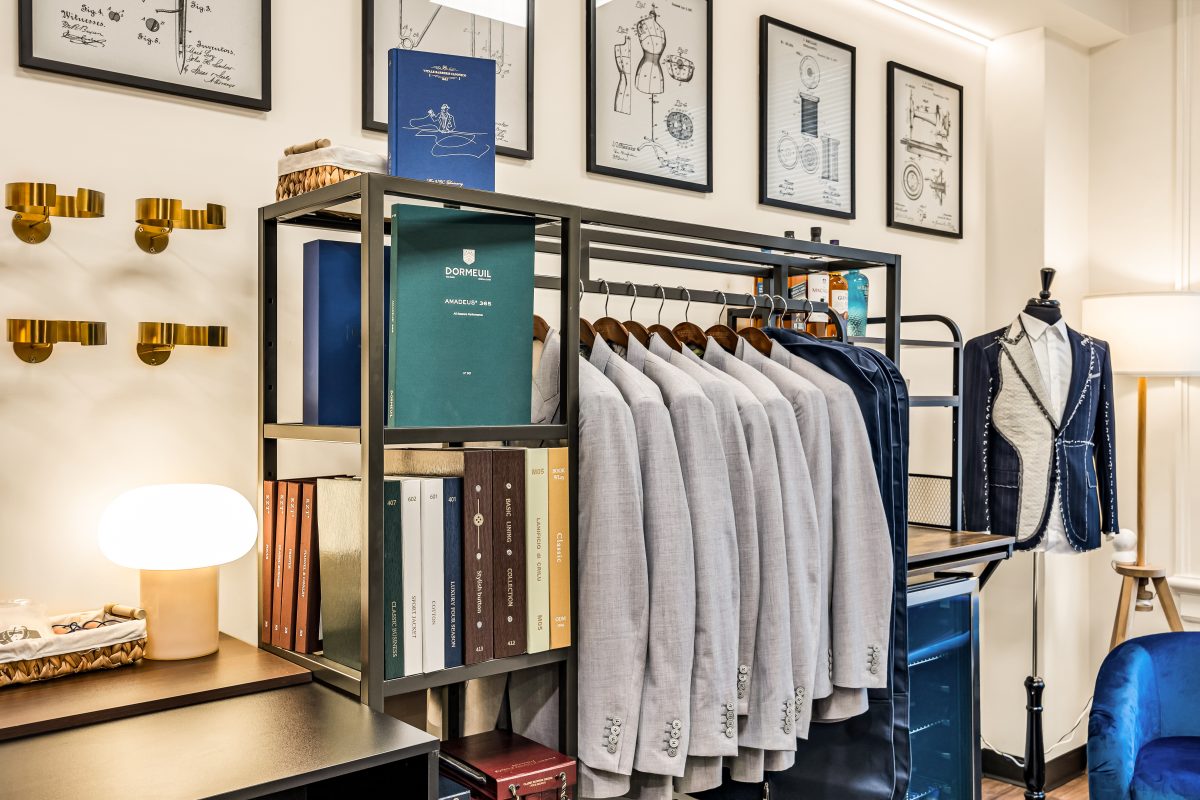
Bespoke Made Suits Vancouver Location 2026. Source: Bespoke Made Suits
A Studio Designed Around Craftsmanship
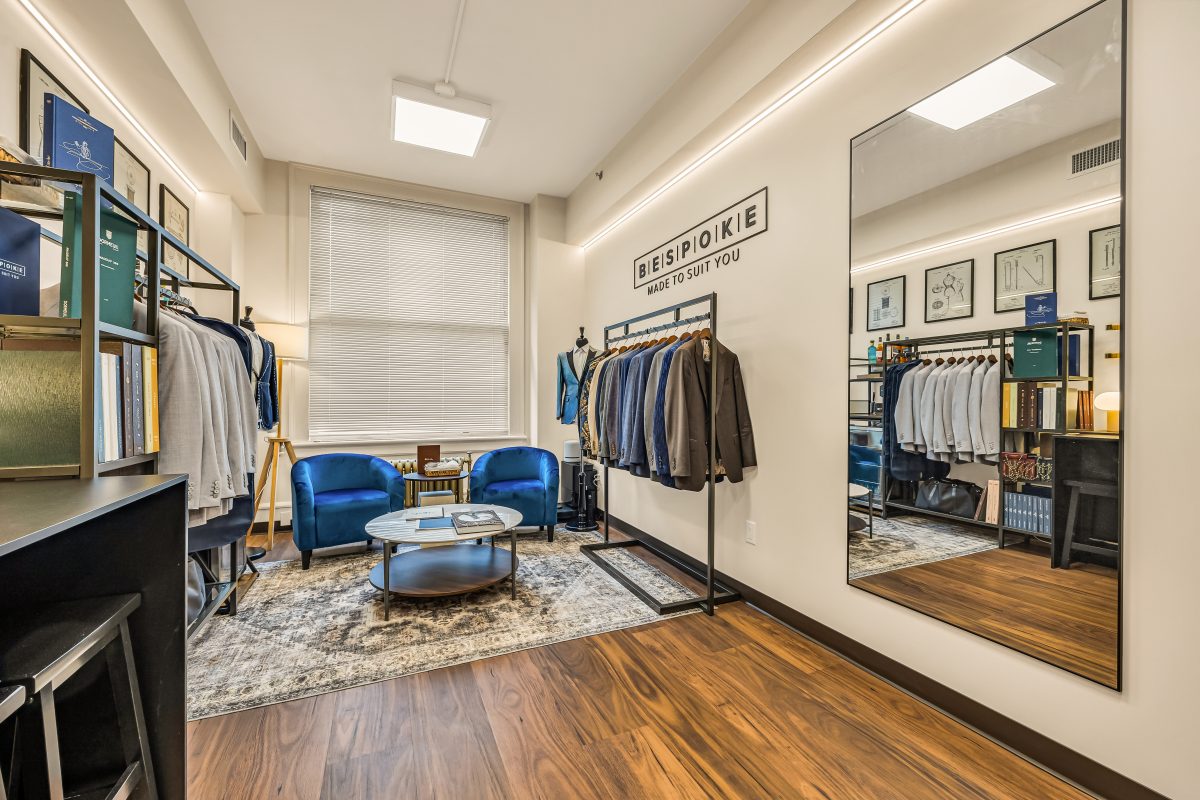
The approximately 250 square foot showroom has been designed as a working tailoring studio rather than a conventional retail floor. Clients visit by appointment for consultations, measurements, and fabric selection in an environment intended to highlight the craftsmanship behind bespoke garments.
Cheung personally designed and built the space.
“I designed and built the showroom myself,” says Cheung. “It was important that the space reflect the same level of thought, precision, and craftsmanship that goes into every garment we create.”
The interior combines wood, metal, velvet, and marble elements to create a refined but welcoming environment. Warm wood-effect flooring anchors the space, offering durability while maintaining the appearance of hardwood.
Framed prints of historical tailoring tool patents line the walls, referencing innovations that shaped many of the tools still used by tailors today. Shelving units display cloth books from leading mills alongside sample garments, allowing clients to explore fabrics and finishes in a tactile setting.
Thoughtful Interior Layout
Despite its compact footprint, the studio has been organized into distinct areas that support the tailoring process.
One section features sample jackets and neatly arranged fabric books, giving clients visual references for colour, texture, and construction. Nearby shelving houses collections from respected mills as well as the company’s in-house fabrics designed for durability and versatility.
Another area functions as a consultation space, anchored by deep blue velvet lounge chairs and a marble-top table set on a patterned rug. This seating arrangement provides a comfortable setting where clients can discuss design preferences, review fabrics, and plan wardrobe pieces.
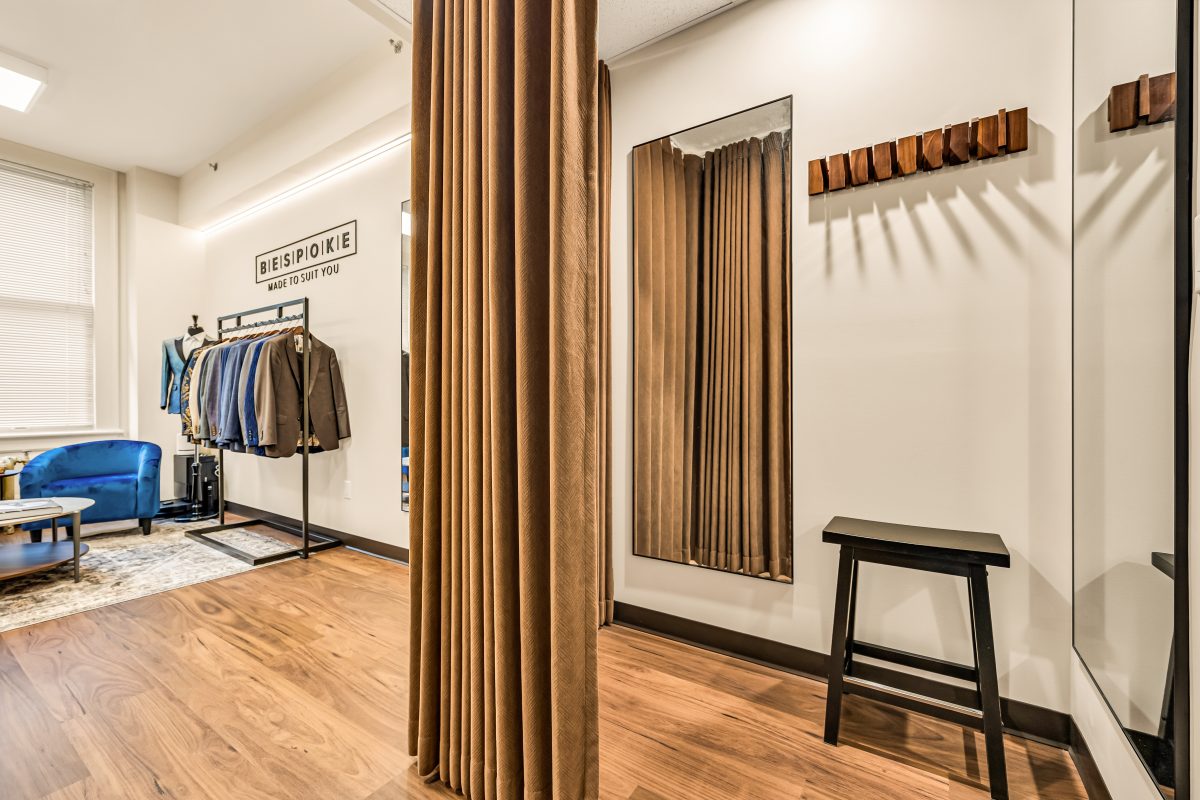
A large wall mirror and garment rack nearby allow clients to examine sample garments and visualize the final result during fittings.
The result is a studio that operates more like a private tailoring atelier than a traditional retail store, emphasizing consultation, craftsmanship, and personalized service.
Bespoke Made Suits Vancouver Location 2026. Source: Bespoke Made Suits
Positioned Near Vancouver’s Financial District
The showroom is located within an office tower along Granville Street, placing it within walking distance of Vancouver’s Financial District and several major corporate offices.
The building’s marble-lined lobby and traditional architectural details reflect the character of many historic commercial towers in the area.
This location aligns closely with the brand’s client base, which includes professionals, entrepreneurs, and executives working nearby. The downtown setting also allows clients to schedule fittings or consultations conveniently during the workday.
Bespoke Made Suits Vancouver Location 2026. Source: Bespoke Made Suits
A Hybrid Service Model
Since launching, Bespoke Made Suits has operated primarily as a mobile tailoring service, traveling directly to clients’ homes or offices for consultations and fittings. The company currently serves customers across Vancouver, Burnaby, Richmond, Surrey, Langley, Maple Ridge, White Rock, North Vancouver, and West Vancouver.
The addition of the Granville Street showroom expands that service model while maintaining the company’s emphasis on flexibility and convenience.
“We recognize that every client’s lifestyle is different,” says Cheung. “Some prefer the ease of having us come to them, while others enjoy visiting our showroom to fully immerse themselves in the process.”
Services are available in English, Cantonese, and Mandarin, allowing the company to serve Vancouver’s diverse professional community.
Fabric Selection and Italian Mills
Fabric selection plays a central role in the Bespoke Made Suits experience. Clients are presented with cloth from several respected textile houses, including Vitale Barberis Canonico, Loro Piana, and Dormeuil, alongside specialty European collections and the company’s own in-house fabrics.
These textiles range from lightweight wools suitable for year-round wear to cashmere blends designed for colder seasons. Clients seeking distinctive garments may also choose mohair fabrics for tuxedos, velvet for eveningwear, or silk-linen blends suited to warmer climates.
“We believe every man should have a suit that reflects not just his body, but his values and lifestyle,” says Cheung.
Bespoke Made Suits Vancouver Location 2026. Source: Bespoke Made Suits
Precision Tailoring
Bespoke Made Suits offers both made-to-measure and true bespoke garments, allowing clients to choose the level of customization that best suits their needs. The process begins with a detailed consultation examining body proportions, posture, and lifestyle needs before patterns are developed.
The company’s approach blends traditional tailoring techniques with modern construction methods.
“A man should not have to choose between comfort and style,” Cheung explains. “Our job is to make sure he has both, and that the suit stands the test of time.”
Rather than simply adjusting measurements, the company refines the garment’s pattern to align with the wearer’s proportions. Shoulders are adjusted to match posture, sleeves are attached with attention to natural arm movement, and reinforcement stitching is applied to areas of stress to improve durability.
Expanding Vancouver’s Tailoring Landscape
Beyond suits, Bespoke Made Suits offers custom dress shirts, overcoats, and accessories designed to help clients build cohesive wardrobes over time. The company has also become a popular choice among Vancouver grooms seeking personalized wedding attire.
The opening of the Granville Street showroom represents a new phase of growth for the company and reflects the continued demand for tailored clothing among professionals seeking personalized wardrobe options.
With the addition of its downtown studio, Bespoke Made Suits is expanding its presence while continuing to focus on craftsmanship, individualized service, and flexible consultation options.
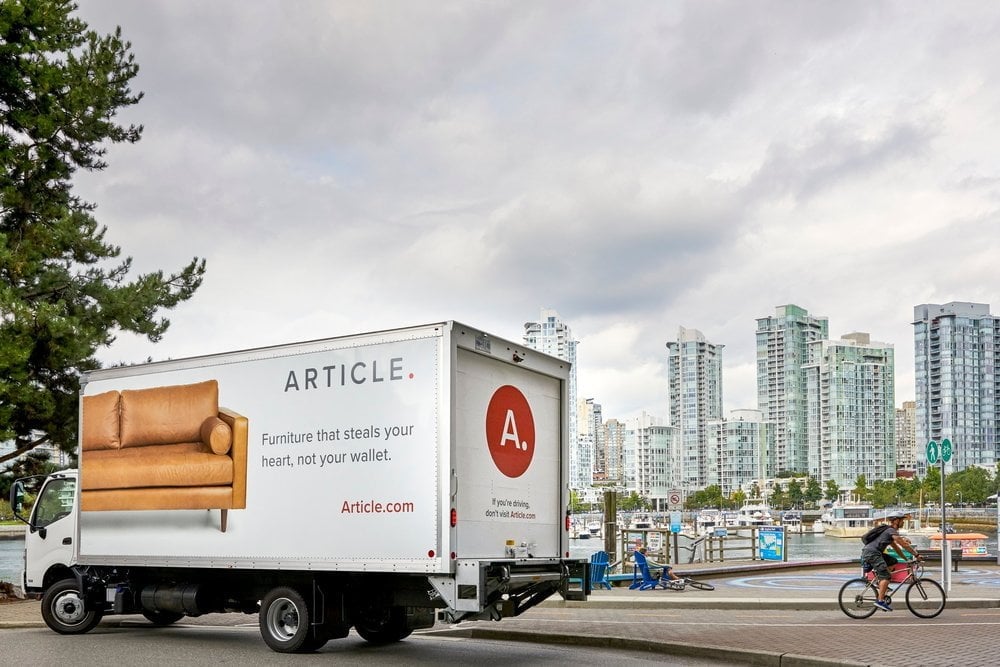
Today’s Retail Insider articles highlight key developments in Canadian retail expansion and shifting consumer habits. Vancouver-based Article plans a new 9,600-square-foot showroom in Toronto, signalling a major move toward omnichannel furniture retail. Meanwhile, Abercrombie & Fitch is expanding its Canadian footprint with new stores across multiple cities. These stories, alongside evolving consumer behaviours and market strategies, reflect a retail landscape balancing physical growth with adapting to competitive pressures.
A woman shops on the Temu website. Image: RI/Google
Chinese marketplaces in Canada are rapidly becoming part of everyday consumer shopping habits, according to new survey data that shows widespread adoption and increasing purchase frequency among Canadian consumers.
A new study commissioned by ecommerce marketing platform Omnisend found that 73 percent of Canadians reported shopping on at least one Chinese marketplace, including Temu, Shein, or AliExpress, within the past year. The findings suggest that platforms once viewed primarily as discount destinations are evolving into routine shopping channels for many consumers.
The research also shows that usage frequency is rising across these platforms, with monthly and weekly shopping activity steadily increasing over the past two years.
Temu Leads Growth in Canadian Marketplace Usage
Among the platforms examined in the survey, Temu continues to see the strongest growth in Canadian adoption.
According to the data, 56.5 percent of Canadians shopped on Temu in 2026, up from 51.9 percent in 2025 and 39.3 percent in 2024. Shopping frequency on the platform is also rising. About 29.1 percent of Canadians now shop on Temu at least monthly, compared with 25.7 percent in 2025 and 20.5 percent in 2024.
Weekly usage has also increased. Ten percent of Canadians now report shopping on Temu at least once a week, up from 6.5 percent in 2024.
These figures indicate that Chinese marketplaces in Canada are increasingly shifting from occasional browsing destinations to platforms where consumers regularly complete purchases.
Shein Also Expands Canadian Consumer Reach
Shein is also gaining traction among Canadian shoppers, though at a slower pace than Temu.
The survey found that 40.9 percent of Canadians shopped on Shein in 2026, compared with 37.8 percent in 2025 and 34.7 percent in 2024. While annual usage continues to rise, the data suggests that Shein’s growth trajectory is more gradual.
Nevertheless, the platform is also seeing higher levels of repeat engagement among consumers.
“These marketplaces are no longer occasional discount options – they’re becoming embedded in everyday shopping behavior,” said Marty Bauer, ecommerce expert at Omnisend. “The biggest shift isn’t just how many Canadians have tried them. It’s how often they’re returning on a monthly and weekly basis.”
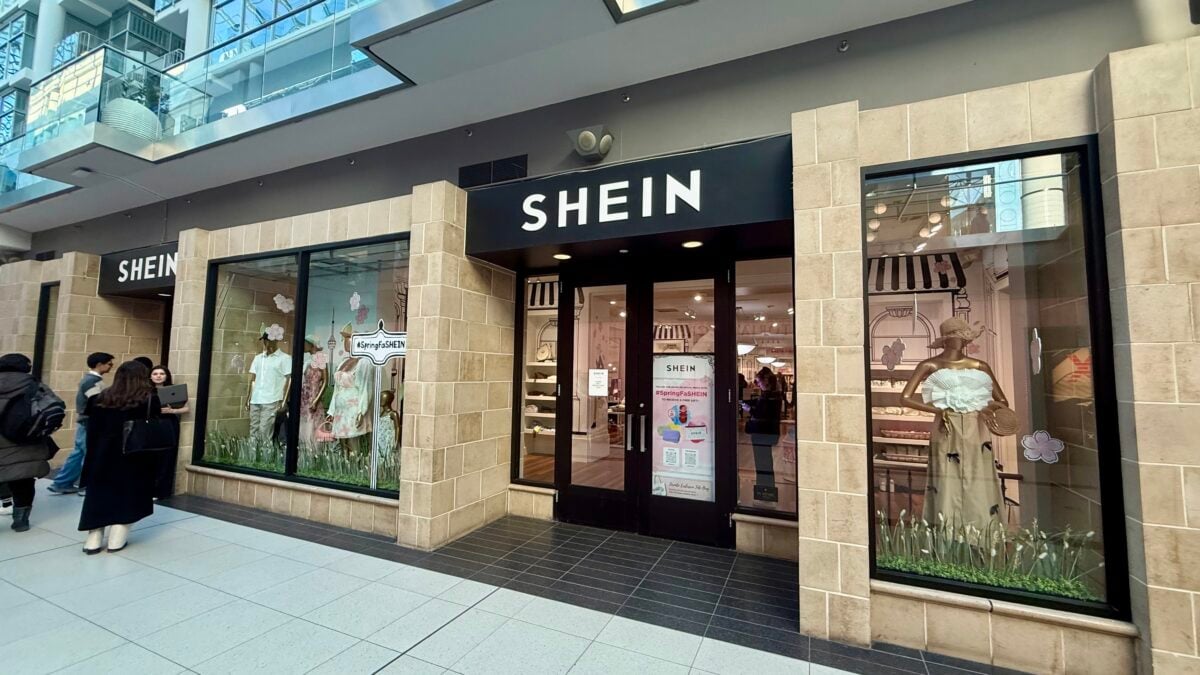
SHEIN pop-up at CF Toronto Eaton Centre in Toronto, during a preview on March 27, 2025. Photo: Craig Patterson
Increasing Frequency Signals Habit Formation
While annual participation rates illustrate the breadth of consumer adoption, frequency of shopping offers a clearer view of how these platforms are becoming integrated into everyday purchasing behaviour.
Between 2024 and 2026, weekly shopping on Temu increased from 6.5 percent to 10 percent. Shein saw weekly usage rise from 6.5 percent to 7.4 percent over the same period.
Many Canadians still report shopping on these platforms every few months. However, even this group is expanding. Temu’s “every few months” usage increased from 8.4 percent in 2024 to 13.5 percent in 2026, while Shein’s grew from 7.8 percent to 10.1 percent.
“What we’re seeing is habit formation,” Bauer said. “Consumers might start with occasional purchases, but over time these platforms are becoming part of their default shopping rotation.”
Competitive Implications for Canadian Retailers
The continued growth of Chinese marketplaces in Canada presents increasing competitive pressure for domestic ecommerce brands.
These international platforms compete aggressively on price and assortment, often offering large product selections at highly competitive price points. However, Bauer said Canadian retailers still maintain several important competitive advantages.
“Chinese marketplaces compete aggressively on price and assortment,” Bauer said. “But Canadian retailers still have strong competitive levers – faster domestic shipping, easier returns, localized customer support, and brand trust.”
According to Omnisend, retailers can strengthen their position by focusing on customer retention strategies that build direct relationships with shoppers. Clear delivery timelines and transparent return policies can also help build consumer confidence.
The report also highlights the value of strong post purchase communication through email and SMS, loyalty programs that reward repeat purchases, and personalization strategies designed to improve the overall shopping experience.
“When shoppers are splitting their budgets across more platforms, retention becomes critical,” Bauer added. “Brands that build direct relationships with customers – instead of relying solely on paid acquisition – will be in a stronger position long term.”
Survey Methodology
The survey was commissioned by Omnisend and conducted by Cint in June 2024, August 2025, and February 2026. Each year, 1,000 Canadians were surveyed using the same set of questions to evaluate consumer shopping habits on Chinese ecommerce platforms. Quotas were applied for age, gender, and geography to ensure national representation.
About Omnisend
Omnisend is an email and SMS marketing platform designed to help ecommerce businesses grow their online sales. The platform integrates with major ecommerce systems and provides automation tools, email templates, and customer support aimed at helping brands manage marketing communications and customer engagement.
Canada’s hotel industry continued to post a solid performance over the past year, driven largely by leisure travel demand and rising room rates even as occupancy levels begin to normalize, according to a report by Cushman & Wakefield.
“I think the industry has continued to perform very well,” Flood said in an interview from Toronto.
He said the sector experienced rapid revenue growth coming out of the pandemic period as travel resumed and demand surged. While the pace of growth has moderated somewhat since then, positive momentum has continued through 2024 and into 2025.
As detailed in the Hospitality & Leisure report, 2025 ranked among the stronger years for hotel transactions over the past two decades, highlighted by several notable full-service and luxury hotel trades. Despite some uncertainty going into 2026, low interest rates and a good level of available investment capital are expected to result in continued strong demand for hotel investments. The industry continues to outperform many other asset classes and continues to attract new capital.
Some key takeaways:
The past year proved to be another record year for Canadian hotel results, with RevPAR (Revenue Per Available Room) reaching a historic high of $142.89, a 4.1% increase over 2024 results;
In 2025, the overall market continued to show growth; however, some markets saw more significant impacts from tariffs and reduced business travel, while other markets saw stronger growth led by increased leisure travel. Overall, occupancy increased to 66.1% in 2025, the highest recorded occupancy in the last 20 years;
In 2025, RevPAR performance was again led by Vancouver ($223), Victoria ($218), and Toronto ($197). This was followed by Quebec City ($183) and Montreal ($156). Victoria, Halifax and Quebec City were cities with the strongest RevPAR growth in 2025, at 12.3%, 11.3% and 10.9%, respectively;
While political and trade uncertainty will continue into 2026, the Canadian market should see continued growth. Similar to 2025, growth will largely be through ADR as demand is expected to remain muted;
The outlook for international arrivals is positive, but the rate of growth will be significantly influenced by Canada’s relations with the U.S. and China. Markets like Toronto and Vancouver will get an added boost as they host the FIFA World Cup in June 202
Brian Flood
Room Rates Driving Growth
Flood said the primary driver of the industry’s current growth is not occupancy but pricing. Room demand has slowed slightly as hotels approach more typical occupancy levels following the surge in post-pandemic travel. However, average room rates continue to rise at a pace exceeding inflation.
“Room demand has slowed a little as we reach normalized occupancy levels,” he said. “But where we are seeing the growth is in average rate, which continues to increase at above-inflation levels.”
Flood attributed the pricing strength partly to shifting consumer expectations in the travel market. He said travellers emerging from the pandemic appear more willing to spend on higher-quality experiences, which has allowed hotels to adjust pricing accordingly.
“I think people are gravitating toward better quality and better experiences,” he said. “Hotels, in many respects, have enhanced their product as well.”
The result, he said, has been sustained upward pressure on demand in certain parts of the market, particularly leisure travel.
Leisure Sector Outperforming
Flood said the leisure segment has been the strongest-performing area of the hotel industry since travel resumed after pandemic restrictions. While corporate and group travel remain important contributors to hotel revenue, their growth has been more moderate.
“Group and corporate are important parts of the market, but their growth has been a little more muted,” Flood said. “Where we see stronger growth since COVID is in the leisure sector.”
Leisure travellers have also shown a greater willingness to absorb higher room prices, which has contributed to the industry’s rate growth. “In the leisure sector, hotels have been able to increase rates at a higher rate,” he said.
That trend has influenced the geographic distribution of performance across Canada, with tourism-driven markets showing stronger results than business-focused centres.
Tourism Markets Lead Regional Performance
According to Flood, leisure-oriented destinations across Canada recorded some of the strongest gains last year. Domestic travel played a significant role in that performance as more Canadians chose to vacation within the country rather than travelling abroad.
“Part of that was driven by more Canadians wanting to vacation within Canada as opposed to going overseas or to the U.S.,” he said. “So we did see much stronger domestic tourism demand.”
International tourism outside the United States also increased, adding to the momentum in certain destinations. Tourism-heavy regions such as the Maritimes and resort markets in Western Canada benefited most from the shift.
“The Maritimes, for example — Prince Edward Island and Nova Scotia — had very good years last year,” Flood said.
In Western Canada, he pointed to strong results in resort destinations. “We’ve seen markets there do very well, particularly the Rocky Mountain resorts,” he said.
Those destinations are closely tied to leisure travel and tourism activity, which has remained resilient.
Central Canada Sees Slower Growth
By contrast, the largest urban centres in central Canada recorded more modest growth. Flood said hotel markets in cities such as Toronto, Montreal and Ottawa were affected more directly by broader economic factors tied to cross-border business activity.
“Where we saw the least amount of growth, ironically, was in central Canada,” he said.
He said those markets tend to rely more heavily on corporate travel and business linked to the United States, which slowed in response to changes in U.S. trade policy.
“These central Canada markets are much more reliant on U.S. trade,” Flood said. “Industry and corporate definitely slowed.”
As a result, the urban markets that typically benefit from corporate travel did not experience the same pace of expansion seen in tourism-focused regions.
Outlook Remains Positive
Despite the slower growth in some areas, Flood said the overall outlook for the Canadian hotel sector remains favourable. The combination of continued rate growth and stable demand is expected to support performance through the remainder of the year.
Flood said that trend is expected to continue as both domestic and international tourism remain active.
“I think that’s going to continue through the year,” he said, noting that travel demand from both Canadian and international visitors is expected to support the sector.
Measured Development Pipeline
Flood also pointed to a relatively measured pace of hotel development in Canada, which he said has helped maintain balance in the market. New projects are continuing to move forward, but the volume of development remains moderate.
“Within Canada we don’t see as much new development,” he said. “There is new development occurring, but it’s at a very sustainable pace.”
That controlled expansion is likely to support stable operating conditions for existing properties while allowing the sector to grow gradually. Looking ahead, Flood characterized the industry’s trajectory as steady rather than volatile.
“I think going forward we’ll see a gradual expansion of the market,” he said.
For hotel operators and investors, the current environment suggests continued opportunity, particularly as travel patterns stabilize following the disruptions of recent years. “If anything,” Flood said, “what I would say is basically steady as she goes.”
He added that the sector still holds “good earning potential” as the market continues to evolve.
Article showroom at 848 E. Hastings St. in Vancouver. Photo: Loopnet
Vancouver-based furniture brand Article is moving further into brick-and-mortar retail with plans to open its first Toronto location at 90 Bathurst Street in King West. The 9,600-square-foot store, set to open in late 2026, will be the company’s second physical location and its largest to date, marking another step in a broader North American retail rollout. The site is part of Hines’ West House mixed-use development in downtown Toronto.
The new store reflects a notable shift for a company that spent more than a decade building its business as a digital-first furniture retailer. According to the company, Toronto is already one of Article’s strongest e-commerce markets in North America, and management sees physical retail as a way to deepen customer relationships in markets where online demand is already well established. In a statement, Co-founder and CEO Aamir Baig said, “For more than a decade, Article succeeded through a digital-first model, meeting consumer demand for modern furniture online. Over the past 18 months, we’ve seen how physical retail can deepen customer connections and strengthen our presence in key markets.”
Why Toronto Makes Strategic Sense
The Article Toronto store is opening in a part of the city that aligns closely with the brand’s customer base. King West has become a dense urban neighbourhood defined by condo living, design-conscious consumers, and a growing mix of fashion, food, and home-related retail. Article said the store is aimed at Toronto and GTA shoppers seeking modern, well-designed furniture at more accessible price points, a positioning that sits squarely in the competitive middle ground between mass-market and premium home furnishings.
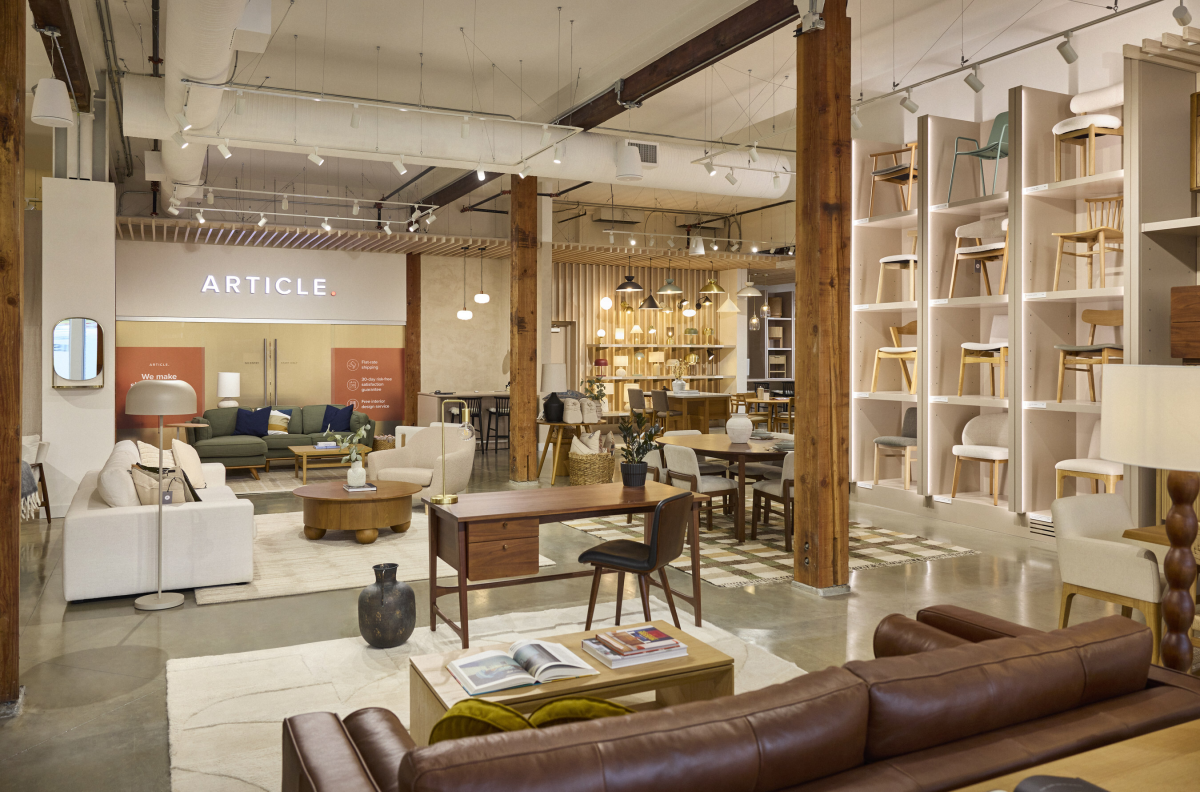
The Toronto location will include curated room vignettes, an extensive swatch library, free on-site design services, and a dedicated children’s area. Customers will be able to shop in person and place larger furniture orders in-store, while select décor and accent items will be available for immediate purchase. Those features are designed to reduce friction in furniture buying, especially for shoppers who want to see finishes, test comfort, and compare options before committing to a larger purchase.
West House at 88 Bathurst Street, south of King St., in Toronto. Equinox will occupy parts of three floors in the podium. Rendering: Hines
Physical Stores Are Becoming More Important in Furniture
Article’s move into physical retail follows the performance of its first store in Vancouver, which opened in August 2024 at 848 East Hastings Street. The company said that location has surpassed expectations, with in-store average order values running more than 20 per cent above online orders. That result appears to have given Article confidence to accelerate its store strategy beyond a single test location. The company now says it plans to have up to five total stores open by early 2027, with U.S. market entry expected to follow the Toronto opening.
That strategy also reflects the realities of furniture retail in Canada. Furniture is a category where customers often want a tactile, in-person experience before purchasing, particularly for higher-ticket items such as sofas, dining tables, and beds. Statistics Canada notes that furniture prices surged sharply during the supply chain disruption period and then stabilized in 2025, while home-outfitting demand continued at a steady pace through much of last year. In other words, the sector remains active, but retailers still need to win over shoppers who are more cautious and value-driven than they were during the pandemic-era home spending boom.
Article furniture stores allow customers to shop for modern furniture in person and order in-store. The company’s current store is located at 848 E Hastings Street, Vancouver, BC. Credit: Article. (CNW Group/Article)
Canada’s Furniture Sector Remains Challenging
The broader environment for furniture sellers in Canada is still not especially easy. Even with inflation pressures easing in some categories, the sector remains sensitive to housing activity, consumer confidence, and discretionary spending. The Bank of Canada’s policy rate stood at 2.25 per cent following its January 28, 2026 announcement, after a series of cuts from the much higher levels seen in 2024. Lower rates may support housing and household spending over time, but home-related purchases remain closely tied to affordability pressures.
At the same time, the furniture business continues to face operational pressure from supply chains and trade costs. Statistics Canada reported that furniture prices in 2025 were mostly steady after earlier volatility, while recent news reporting highlighted how tariff-related pressures have also weighed on parts of the Canadian furniture industry. For retailers, that means balancing value, sourcing, shipping, and margin discipline in a category where customers are often price-sensitive and delivery expectations are high.
For Article, opening stores may help address another core issue in digital furniture retail: the limits of selling major home purchases through a screen alone. A showroom can function as both a sales channel and a customer acquisition tool, giving shoppers confidence in product quality, scale, and finish while also strengthening brand visibility in a competitive market.
PHOTO: ARTICLE
From Digital Startup to Omnichannel Furniture Brand
Article was founded in 2013 in Vancouver by Aamir Baig, Andy Prochazka, Sam Prochazka, and Fraser Hall. Originally launched under the name Bryght, the company set out to simplify the process of buying modern furniture by selling directly to consumers online. The founders, who came from engineering and technology backgrounds rather than traditional furniture retail, approached the industry as a logistics and design problem to solve rather than a conventional showroom business.
The company’s early strategy focused on eliminating the traditional retail middleman. By working directly with manufacturers and selling through its own digital platform, Article aimed to offer contemporary furniture styles at more accessible price points while maintaining strong product quality. Its assortment quickly became known for mid-century modern, Scandinavian, and contemporary designs that appeal to urban homeowners and condo dwellers.
Article also invested heavily in its own delivery infrastructure. Instead of relying entirely on third-party shipping providers, the company developed its own logistics network, known as the Article Delivery Team, to manage final-mile delivery and improve reliability for large furniture shipments. That investment became a key operational advantage as the company scaled across North America.
The brand experienced significant growth during the early years of the pandemic as consumers spent more time and money upgrading their homes. Like many digital-first companies, however, Article faced a challenging recalibration when pandemic-era demand slowed. In 2022 the company reduced its workforce following a period of aggressive expansion, part of a broader correction across the e-commerce sector as consumer behaviour normalized.
Despite those challenges, Article has remained profitable for much of its history and has continued to expand its customer base across Canada and the United States. Since its launch, the company says it has delivered nearly three million orders, building a reputation for design-driven furniture offered through a streamlined online buying experience.
The Toronto showroom signals the next stage of that evolution. Rather than replacing its digital roots, Article’s physical retail strategy is intended to complement its strong e-commerce foundation. By opening showrooms in markets where online demand is already established, the company hopes to combine the efficiency of digital retail with the confidence-building benefits of an in-person shopping experience.
EXTERIOR OF SOBEYS GROCERY STORE. PHOTO: SUPERMARKET NEWS
Empire Company Limited announced Thursday its financial results for the third quarter ended January 31, 2026. For the quarter, the Company recorded net (loss) earnings of $(385) million ($(1.68) per share) compared to $146 million ($0.62 per share) last year. For the quarter, the Company recorded adjusted net earnings of $164 million ($0.72 per share) compared to $146 million ($0.62 per share) last year, an increase of 12.3% (or 16.1% per share), it said.
Pierre St-Laurent
“We delivered a solid third quarter, with adjusted EPS growth of 16%, driven by strong Full-Service performance and healthy results across all of our formats,” said Pierre St-Laurent, President & CEO, Empire. “Our performance reflects that customers are realizing value across our banners, with meaningful opportunity ahead to build on this momentum and deliver long-term growth.”
Highlights:
Sales of $7,890 million, an increase of 2.1%
Food sales increased by 3.0%; Same-store sales growth – food increased by 2.0%
(Loss) Earnings per share of $(1.68) and adjusted EPS of $0.72
Prior year EPS and adjusted EPS of $0.62
As part of the Company’s e-commerce update, recognized impairment charges of $746 million
Expects immediate benefits of approximately $95 million to annualized operating income
Benefits are expected to begin in the fourth quarter of fiscal 2026 and reach run-rate in fiscal 2027
Empire said it is continuing to enhance data capabilities and deepen its understanding of its customers, allowing it to effectively capture emerging trends. The company said it aims to grow total adjusted EPS over the long-term through net earnings growth and share repurchases. The company added that it intends to continue improving sales, gross margin (excluding fuel) and adjusted EBITDA margin by focusing on priorities such as:
Continued Focus on Stores
Enhanced Focus on Digital and Data
Efficiency and Cost Control
Food sales for the quarter increased by 3.0%, primarily driven by positive growth across the business, particularly in the Full-Service banners, the company’s national wholesale distribution network, and in the discount banner. Fuel sales for the quarter decreased by 11.4%, primarily driven by lower fuel prices due to the removal of the government carbon tax, explained Empire.
Gross profit for the quarter increased by 2.3%, primarily driven by higher food sales, strong performance and operational discipline in full-service and discount banners. Gross margin for the quarter remained consistent from prior year at 27.0%, said Empire.
“Since fiscal 2018, the Company has been expanding its FreshCo discount banner to Western Canada and its significant growth has been driven by store conversions and regional expansion. The value proposition and strong multicultural assortment, along with the addition of the Scene+ loyalty program, has supported the growth and expansion of the Discount banner,” said Empire.
“As at March 11, 2026, FreshCo has 51 stores operating in Western Canada and expects to open an additional two stores by the end of fiscal 2026. The Company expects to have opened 65 FreshCo stores in Western Canada over the next several years.”
For fiscal 2026, Empire said capital spend is expected to be approximately $850 million, with approximately half of this investment allocated to renovations and new store expansion (including a 1.1% increase in store footprint expansion from new stores), 25% allocated to IT and business development projects and the remainder allocated to logistics and sustainability. By the end of fiscal 2026, the company said it expects to complete the network renovations of approximately 20% to 25%, which began in fiscal 2024.
Empire is a Canadian company headquartered in Stellarton, Nova Scotia. Empire’s key businesses are food retailing, through wholly-owned subsidiary Sobeys Inc., and related real estate. With approximately $32 billion in annual sales and $17 billion in assets, Empire and its subsidiaries, franchisees and affiliates employ approximately 129,000 people.
Canada’s largest bubble tea chain is focusing on strengthening its leadership position in the market while expanding cautiously, according to CEO Trinh Tham, who says the company is emphasizing operational discipline, digital engagement and franchise partnerships as it grows its footprint.
Chatime currently operates about 100 locations across Canada, primarily in Ontario and British Columbia, and opened six new stores last year while preparing additional locations that are expected to come online this year.
Tham, who joined the company in March last year and formally assumed the CEO role in June, said her first year has been focused less on rapid expansion and more on reinforcing the brand’s foundation and ensuring consistent execution across the system.
“If I take a step back and think about the company overall, since I joined almost a year ago, it’s really been about widening our leadership position in the Canadian bubble tea category,” she said in an interview.
The company is in a category that is part of her roots and culture.
“I came up the marketing, digital, ecommerce merchandising track. I’ve always advocated for marketers who have business acumen and the importance of that function being connected to their CFO, their CEO, the business and of course most importantly the customer,” said Tham.
Tham is also CEO of sister company Bake Code. Previously, she worked with Universal Music Canada, Harry Rosen, Sobeys, Tim Hortons, Bell Media, Loblaw Companies, Grand & Toy and Motorola Solutions.
Bake Code and Chatime are under the Kevito Group umbrella.
Trinh Tham
Focus on strengthening the system
While store growth remains part of the company’s strategy, Tham said the emphasis over the past year has been strengthening the internal structure of the business.
“We’re at about 100 locations across Canada, mostly in Ontario and B.C., and we’re continuing to expand strategically in markets where we see long-term opportunity,” she said.
“It’s not just about store count. It’s also about the structural strength of the organization.”
Last year, it opened six new locations.
Chatime operates under a franchise-heavy model, with roughly 90 per cent of its locations owned by franchise partners. As a result, Tham said much of her focus has been on reinforcing operational standards across the network and strengthening relationships within the franchise system.
Over the past year, the company has been encouraging the development of multi-unit franchise operators while also bringing new franchisees into the system.
“We’ve been fostering growth within our franchise system and developing more multi-unit franchise partners, as well as inviting new franchise partners into our system,” she said.
Alongside franchise development, the company has prioritized improving digital engagement and strengthening its customer loyalty platform.
Bubble tea positioned as an “affordable luxury”
Despite ongoing economic uncertainty and cautious consumer spending, Tham said the quick-service beverage category continues to benefit from consumers seeking relatively affordable experiences.
From her perspective, discretionary spending has shifted toward experiential food and beverage offerings, particularly in quick-service formats.
“Canadian consumers still remain cautious, although in Q1 we’ve seen a little more positive sentiment toward spending,” she said.
Even as overall restaurant spending moderates, she said quick-service dining continues to attract consumers looking for smaller indulgences.
“To me this highlights the continued allocation of discretionary dollars toward meaningful experiences, particularly experiential food and beverage, which I would consider Chatime to be in,” she said.
Tham described bubble tea as fitting naturally within that spending behaviour.
“I see bubble tea, particularly the experience and product we offer at Chatime, as an affordable luxury. It’s customizable and very social at the same time.”
Customization is central to the bubble tea category, allowing customers to adjust sweetness levels, ice levels, dairy options and toppings in their drinks.
Trinh Tham
Product innovation and marketing partnerships
Product innovation and marketing collaborations have also been part of the brand’s strategy to maintain customer engagement.
Late last year, the company launched a new brand promise called “Setting the Boba Bar,” built around three pillars: breadth, craft and personalization.
The initiative highlights five key beverage segments within the brand’s lineup: signature milk tea, matcha, fruit tea, brown sugar pearl bubble tea and taro-based drinks.
To simplify ordering for new customers while highlighting popular options, the company introduced what it calls the “Trending Eight,” a curated selection of eight beverages drawn from those categories.
Craft and preparation methods remain another point of emphasis within the chain’s operations.
“At Chatime we focus on consistency,” Tham said, noting that teas are sourced from Asia and brewed throughout the day, while the tapioca pearls used in drinks are slow-cooked for about an hour to achieve their desired texture.
Marketing campaigns have also been used to generate consumer interest and connect with younger audiences.
Last year the brand launched a limited-edition plush toy promotion tied to its beverage lineup, inspired by the broader “blind box” trend built around surprise collectibles. Tham said the program became the most successful promotional campaign the company has run.
The company also partnered with Oreo on a brown sugar bubble tea cookie promotion that extended into beverage offerings.
More recently, Chatime announced a collaboration with Barbie, timed around International Women’s Day, featuring limited-time drinks and related promotional activations across the network. The campaign was Be the Star of Your Own Sip.
“It’s one of the most ambitious cross-cultural partnerships we’ve done,” Tham said.
Photo credit: Chatime
Digital loyalty growth
Another key area of focus has been the company’s digital platform and loyalty program, which was relaunched last year.
Tham said the program has delivered measurable gains in customer engagement and repeat visits.
“We saw a 26 per cent increase in loyalty attachment, a 27 per cent increase in monthly visit frequency, and a 50 per cent increase in new member acquisitions,” she said.
The program is designed to increase purchase frequency and average spending while strengthening the company’s connection with customers.
“We leverage the program along with product innovation and marketing programs to increase basket size, drive frequency and reinforce our overall brand positioning,” Tham said.
Expanding ecosystem with Bake Code
Alongside Chatime, Tham also leads Bake Code, a bakery concept that is part of the same corporate group.
The brand currently operates four locations in the Toronto area, including Markham, Richmond Hill and Toronto.
Bakery operations present unique challenges, she said, particularly as ingredient and raw material costs have risen in recent years.
“Bakery is a very tough and challenging business. Margins are tough. Cost of goods and raw materials have increased over the last several years,” Tham said.
Despite those pressures, the company sees Bake Code playing a strategic role within the broader business.
Photo credit: Chatime
The bakery blends Asian and European baking traditions and also supplies select products directly to Chatime locations.
“If you go to a Chatime, you’re enjoying a Bake Code product that we’ve designed specifically for the Chatime system,” Tham said.
Beyond supplying its sister brand, Bake Code also produces wholesale products and catering for restaurants and hospitality clients, including custom products designed for luxury customers. For now, Tham said the focus is on strengthening the existing Bake Code network while using it to support the growth of Chatime.
“Right now my focus is really growing the Chatime system and strengthening the existing Bake Code network,” she said.
By leveraging the existing customer traffic in Chatime stores, the company hopes to build stronger demand for its bakery products while expanding its overall ecosystem.
“We know that’s a great way to grow attachment because I already have the customer in my Chatime stores,” Tham said.
A new nationwide survey has found that financial pressure is now a defining reality for most Canadians, with overwhelming majorities reporting rising expenses, tighter budgets and forced changes to everyday spending.
The findings highlight how sustained cost-of-living increases are reshaping household finances across the country.
Joshua Harris
According to a Harris & Partners survey of 2,196 Canadians, the results reveal widespread financial strain:
87% say they feel financially trapped due to rising living expenses and or debt
85% report their overall monthly expenses have increased in the past 12 months
85% say their household budget has become harder to manage
97% say everyday price increases have forced them to rethink how they spend their money
88% have postponed or cancelled plans such as travel, major purchases or life goals due to higher costs
“These results show just how deeply rising living costs are affecting Canadian households. For many people, it is no longer about cutting back on extras. It is about trying to keep up with everyday expenses. When 87% of Canadians say they feel financially trapped, that is a clear signal of how little room there is left in household budgets,” said Joshua Harris, CEO of Harris & Partners and a Licensed Insolvency Trustee.
Nearly all respondents say higher prices have altered how they manage their money, with everyday spending decisions increasingly shaped by affordability rather than preference, said the company.
“Canadians are adapting because they have to. People are thinking twice about every purchase, delaying plans and constantly reworking their budgets just to stay afloat. This kind of financial pressure becomes exhausting over time,” said Harris.
Beyond day-to-day costs, the survey also found growing concern about wider economic pressures:
73% are concerned that trade tariffs on imported goods such as vehicles, electronics or produce will further limit their ability to pay down debt
60% say they are worried about job security or household income due to the potential impact of tariffs on the Canadian economy
“When households are already stretched, anything that threatens higher prices or income stability adds another layer of stress,” said Harris.
“People are worried not just about today’s bills, but about what comes next.”