Premium ice cream brand Magnum is bringing a unique multisensory experience to downtown Montreal as part of this year’s Crescent Street Grand Prix Festival, which coincides with Formula 1 race weekend in the city. From June 12 to 15, the brand will be offering a moment of indulgence through its Magnum ASMR Studio, an interactive activation designed to highlight the iconic “crack” of its Belgian chocolate-coated ice cream bars.
The activation forms part of a broader marketing strategy by parent company Unilever, which is using experiential campaigns to connect with consumers in high-traffic urban events across Canada.
A Multisensory Activation Featuring Magnum’s Signature ‘Crack’
Set against the backdrop of one of Montreal’s busiest and most festive weekends, the Magnum ASMR Studio invites visitors to slow down and engage with the brand in an unconventional way. Participants are guided through a short content creation experience in which they can record the distinct sounds of unwrapping and biting into a Magnum bar—particularly the well-known snap of the chocolate shell.
Each guest receives a short branded video of their session, which they are encouraged to share on social media, creating a blend of personal experience and digital amplification.
“In a weekend known for speed, sound and adrenaline, we’re giving people a moment to slow down, indulge, and really savour the small luxury of a Magnum,” said Benjamin Finn, Marketing Lead for Ice Cream at Unilever.
“Our ASMR activation taps into a trend people can’t get enough of, offering that satisfying chocolate crack and sensory delight our fans love.”
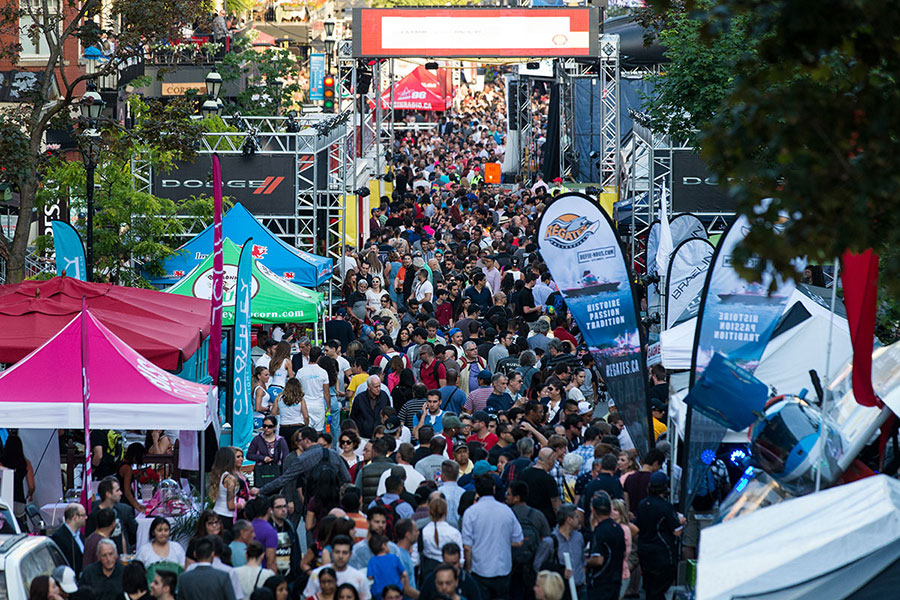
Crescent Street Grand Prix Festival in Montreal. Photo: Montreal Grand Prix
Highlighting the Magnum Mini Double Caramel
The featured product for the activation is the Magnum Mini Double Caramel—a compact bar designed to deliver the same premium indulgence in a smaller format. Each bar combines vanilla ice cream with a layer of rich caramel sauce, encased in 100% Belgian chocolate. The mini format aligns with the fast-paced environment of the Grand Prix weekend while providing a moment of luxury and comfort amid the crowds.
Sampling at the Magnum booth will begin at 11:00 a.m. ET daily, continuing through to June 15 or while supplies last. In addition to the immersive experience, visitors will also be entered for a chance to win a $1,000 gift card for a shopping spree.
Positioning Magnum Within a Lifestyle Context
The activation is part of Magnum’s ongoing brand strategy to associate its products with moments of personal indulgence. While the brand is best known for its global advertising campaigns featuring luxury and decadence, recent years have seen it pivot toward more immersive, experiential marketing—especially during seasonal or cultural events.
The Montreal installation reflects that approach, aligning the brand with one of Canada’s most internationally recognized events and allowing direct consumer engagement in a playful, sharable format.
As temperatures rise across the country, the event also signals the start of the summer season for frozen treats. With its premium ingredients and wide variety of flavours, Magnum continues to position itself as a luxury product that fits naturally into everyday routines.
Magnum’s Global and Canadian Growth
Launched in 1989 as one of the first handheld ice cream bars designed for adult consumers, Magnum has grown into one of the world’s leading ice cream brands, with annual global sales exceeding 1 billion units. The brand entered the Canadian market in 2011 and has steadily expanded its presence through national grocery distribution and seasonal campaigns.
Since its Canadian debut, Magnum has targeted urban consumers seeking elevated frozen dessert options, leveraging both traditional advertising and more recently, event-based brand experiences such as the ASMR Studio.
Unilever’s Broader Brand Strategy
Magnum is part of the Unilever portfolio, which includes a wide range of well-known global brands across the categories of Beauty & Wellbeing, Personal Care, Home Care, Foods, and Ice Cream. Unilever operates in over 190 countries, with 128,000 employees worldwide and €60.8 billion in sales in 2024.
In North America, the company’s ice cream portfolio includes Magnum, Ben & Jerry’s, and Breyers, all of which have seen continued demand amid increased interest in premium dessert offerings.
Unilever’s decision to activate during the Montreal Grand Prix is indicative of its focus on strategic brand placements that target lifestyle-driven consumers in key metropolitan markets.
Event Details and Public Participation
The Magnum ASMR Studio will be open to the public from June 12 to 15, with operations starting at 11 a.m. ET daily. Located at the heart of the Crescent Street Grand Prix Festival, the activation is free to attend and open to guests on a first-come, first-served basis.
Participants can walk away with a complimentary Magnum ice cream bar, their own personalized video content, and the chance to enter a draw for a $1,000 shopping spree.
For more information, visitors are encouraged to follow @Magnum.Canada on Instagram or visit the official product website at: unilevericecream.ca/collections/magnum.
About Magnum®
Founded in 1989, Magnum® was the first handheld ice cream brand aimed at adult consumers. Now one of the world’s top ice cream brands, Magnum sells over one billion bars annually. In Canada, where the brand launched in 2011, Magnum continues to focus on delivering indulgent, high-quality ice cream products made with premium ingredients.
About Unilever
Unilever is a global leader in the supply of Beauty & Wellbeing, Personal Care, Home Care, Foods, and Ice Cream products. Its brands are used daily by over 3.4 billion people worldwide. The company reported €60.8 billion in sales in 2024. In Canada, Unilever’s top brands include Dove, Degree, Vaseline, Hellmann’s, Ben & Jerry’s, and Magnum. More information is available at www.unilever.ca.
Are most Canadians still heading straight to the dealership to shop? Not anymore. Indeed, 84% of new and used vehicle intenders in 2023 turned to online sources during their car-buying journey, up from 78% in 2022. This is a sharp increase, and it speaks volumes about how digital tools continue to be the primary platform for most automotive purchases taking place across the country.
Car buyers today want the purchasing process to be fast, easy, and online, including the ability to buy car insurance online. The result is that dealers are being pushed to incorporate digital tools and services to provide a better customer experience.
This blog highlights how Canadian car dealerships modernize the buying experience through digital innovation.
Shifting Buyer Expectations in a Digital World
Online research has become a key part of the car-buying process. Buyers now compare prices, review vehicle specifications, explore insurance options, and understand financing—all before setting foot in a dealership. This preparation gives them greater confidence and reduces the pressure of in-person negotiations.
To keep pace, many dealerships are blending digital and in-person experiences:
Car dealerships are offering virtual consultations and 360-degree vehicle views.
Financing and paperwork are often completed without visiting the dealership.
This hybrid approach supports the buyer’s need for efficiency, without compromising on personalization. It supports informed decisions and allows buyers to move through the process at their own pace, especially when selecting insurance that fits their needs and budget.
Integrating Car Insurance into the Digital Experience
As online buying gains traction, so does the demand for seamless insurance solutions. Drivers no longer want to shop separately for coverage. With one click, they expect to buy car insurance online, instantly comparing rates and customizing policies from the comfort of their homes.
Dealerships Are Becoming Tech Hubs, Not Just Sales Floors
Car dealerships in Canada are transforming from traditional showrooms into technology-rich centers. Buyers now encounter touchscreen interfaces, vehicle customization kiosks, and immersive AR/VR tools.
Interactive Digital Showrooms
These in-store enhancements are designed to empower the buyer. For example:
Touchscreen vehicle builders let users change colours, wheels, and features.
Digital spec sheets offer instant comparisons between trims and models.
Kiosks allow buyers to calculate loan payments and trade-in values independently.
This self-service model improves transparency and gives control back to the buyer.
Virtual & Augmented Reality: Test Driving Without Driving
Leading retailers like Hyundai and Audi have invested in VR experiences in Canada. These allow buyers to “sit” in a virtual car, simulate driving conditions, and explore safety features. Augmented reality (AR) apps even project virtual vehicles in a driveway using your phone camera.
This kind of tech benefits:
Remote buyers in rural areas.
Shoppers are comparing multiple models.
Buyers are concerned about fuel economy and performance.
By removing barriers to exploration, retailers increase buyer confidence and satisfaction.
The traditional process of buying a car involved multiple in-person visits, hours of paperwork, and unpredictable financing. Today’s auto retailers are reducing friction at every stage.
Digital Financing and Instant Approvals
Car buyers in Canada are now completing financing applications from their phones. Dealers partner with fintech platforms like Clutch and Canada Drives to offer:
Pre-approvals within minutes.
Personalized rates based on soft credit checks.
Financing from banks and credit unions across Canada.
This reduces buyer anxiety and speeds up the transaction.
Paperless Documentation and e-Signing
With secure e-signature platforms (like DocuSign and PandaDoc), customers now sign purchase agreements and insurance papers digitally. This shift offers:
Faster turnaround.
Lower admin costs for dealerships.
Secure, legally compliant transactions.
No more waiting in cubicles for paperwork to be printed, signed, and copied.
Automated Inventory Matching
Thanks to machine learning, inventory tools can now recommend vehicles based on user preferences. These algorithms consider:
Search behaviour.
Trade-in data.
Previous purchases and regional trends.
Buyers spend less time searching and more time selecting.
Meeting New Consumer Demands: Affordability, Sustainability, Convenience
Today’s buyers—especially younger ones—want more than flashy cars. They value affordability, energy efficiency, and hassle-free experiences.
Rise of EVs and Sustainability-Driven Buying
Sustainability is no longer a niche concern. Electric vehicle (EV) adoption in Canada is rising quickly. According to Transport Canada, EVs made up over 10% of all new car sales in 2023—a historic high.
To respond, auto retailers are:
Increasing EV inventory and charging station partnerships.
Offering EV incentives and rebate calculators.
Tesla, Ford, and Hyundai are leading EV innovation in Canada. Traditional dealers are also getting on board with models like the Chevrolet Bolt EUV and Nissan Leaf.
Personalized Customer Service is Making a Comeback—Digitally
While automation is key, human service isn’t disappearing—it’s evolving. Dealerships now use CRM systems, chatbots, and AI to maintain customer relationships long after the sale.
AI-Driven Sales Support
Chatbots powered by AI are available 24/7 to:
Answer questions about inventory or features.
Book test drives and service appointments.
Provide financing and insurance estimates.
They ensure customers never feel “on hold,” no matter the time or location.
CRM and Follow-Up Systems
Advanced CRMs allow dealerships to track customer behaviour, preferences, and service history in detail. This data enables timely, personalized communication that goes beyond generic marketing. Instead of broad promotions, customers receive messages that reflect their needs and timing, such as:
Oil change or service reminders with exclusive coupons
Lease-end notifications with upgrade or renewal options
Announcements tailored to models they’ve shown interest in
This targeted approach builds stronger relationships. Customers feel recognized and valued, not just like another sale. It turns routine interactions into ongoing engagement, encouraging loyalty and repeat business.
Final Thoughts
Canadian car dealerships are redefining the auto retail experience with innovation, transparency, and convenience at the core. From digital showrooms to virtual test drives, and from e-signatures to the ability to buy car insurance online, every aspect of the journey is being modernized.
Buyers now expect fast, personalized, and seamless transactions—on their terms. Retailers who understand and act on these expectations will win loyalty and drive long-term growth. As digital tools become the standard, the future of car buying in Canada looks smart, sustainable, and significantly more customer-centric.
Ready to experience a simpler, smarter car purchase? Start your journey today. Contact us now!
Montreal-based Dollarama Inc. has posted strong results for the first quarter of its 2026 fiscal year, exceeding analyst expectations on key performance metrics including revenue, EBITDA, and earnings per share. The company’s Latin American subsidiary Dollarcity also continues to show notable momentum, helping reinforce Dollarama’s premium market valuation.
The latest report from Stifel, released June 11, 2025, outlines Dollarama’s operational strength while noting that shares are currently trading at all-time high valuations. While Stifel has raised its target price for Dollarama from $162.50 to $190.00, it maintains a ‘Hold’ rating, citing limited room for multiple expansion.
Strong Financial Start to Fiscal 2026
Dollarama reported Q1 FY2026 revenue of $1.52 billion, marking an 8.2% increase year-over-year and surpassing both Stifel’s estimate of $1.493 billion and the consensus of $1.5 billion. The company’s gross margin expanded 100 basis points year-over-year to 44.2%, driven largely by lower logistics costs. Same-store sales growth came in stronger than anticipated at 4.9%, led by demand in consumables and a robust Easter seasonal product category.
“Q1FY26 EPS beat consensus expectations by 14%,” stated the Stifel report. Adjusted earnings per share (EPS) for the quarter reached $0.95, a 23% year-over-year increase, well above Stifel’s estimate of $0.81 and the consensus of $0.83.
EBITDA for the quarter was reported at $486 million, reflecting a 16% increase over Q1 FY2025, and also exceeding the $454 million consensus estimate.
Notable Same-Store Sales and Transaction Growth
Same-store sales growth of 4.9% was driven by a 3.7% year-over-year increase in transaction volume and a 1.2% increase in average transaction value—the first year-over-year gain in transaction size in six quarters. Despite a relatively soft February and March, likely due to reduced consumer confidence amid trade war uncertainties, sales rebounded in April.
The report stated: “The same-store-sales increase stemmed from a 3.7% Y/Y increase in transaction volume and a 1.2% Y/Y increase in average transaction value, marking the first Y/Y gain in transaction size in six quarters.”
Dollarcity’s Accelerated Performance and Mexican Expansion
Dollarama’s 60.1% owned Latin American subsidiary, Dollarcity, delivered exceptional performance. Earnings from Dollarcity rose 52% year-over-year, significantly higher than Stifel’s forecast of 14%. Revenue increased by 13%, with 97 new stores added year-over-year. Dollarcity also benefited from expanded margins thanks to lower inbound shipping and logistics costs.
“Dollarcity’s earnings increased 52% Y/Y, the strongest growth rate of the last three quarters,” the report noted.
The company is preparing for Dollarcity’s expansion into Mexico, marking its first foray into a new Latin American market in several years. While expectations are high based on past performance in Colombia, El Salvador, Guatemala, and Peru, Stifel analysts caution that the Mexican market presents a more competitive retail environment. The rollout is expected to be gradual, with only a few stores opening in the first year.
Dollarcity is projected to post operating losses in Mexico for the first two to three years of operation.“The potential, in our view, is clear—but realizing it will require strong execution,” stated the analysts.
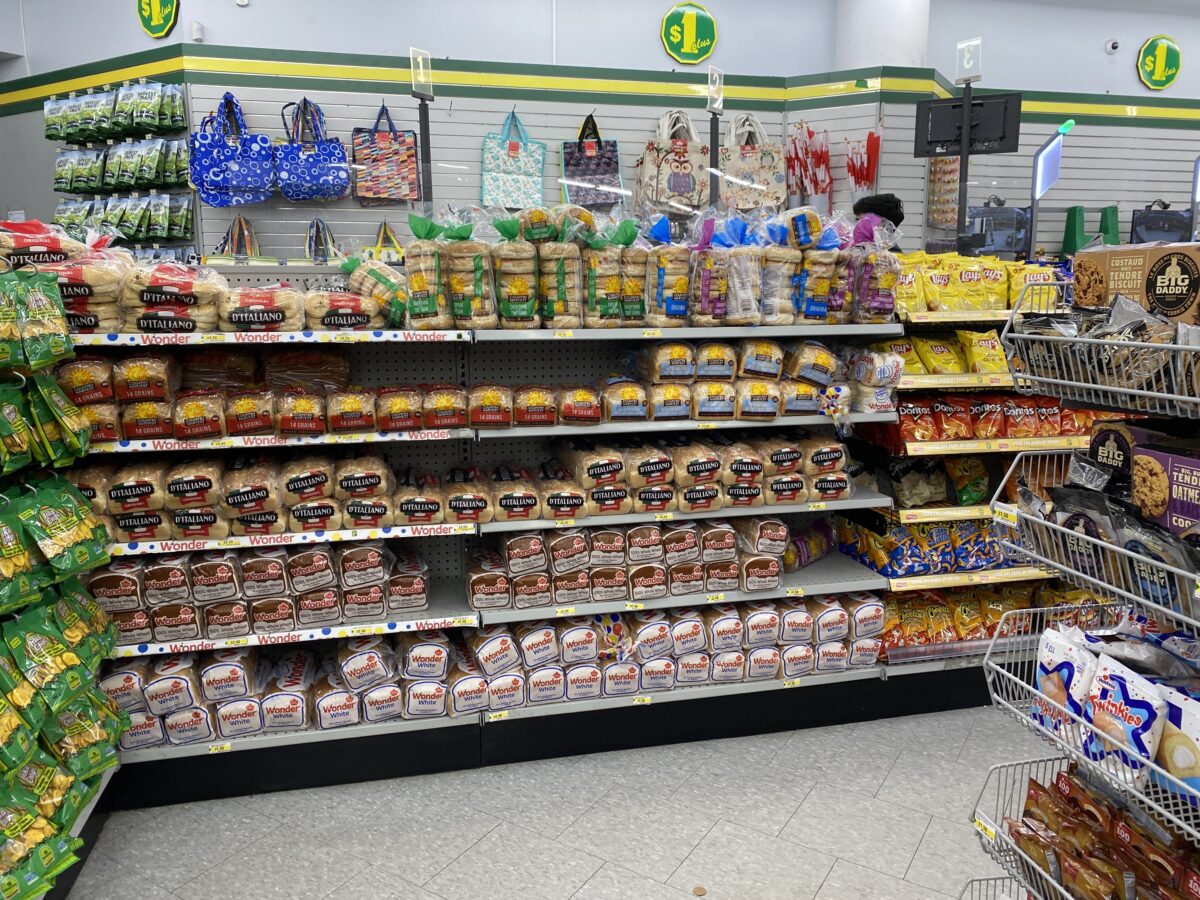
Dollarama at The Tenor in Toronto (Image: Dustin Fuhs)
Updated Forecasts and Target Price
Reflecting the strong Q1 results, Stifel has revised its full-year FY2026 and FY2027 estimates upward. The FY2026 EPS estimate is now $4.67, up from a previous estimate of $4.47, and FY2027 EPS is projected at $5.24, up from $5.08. Revenue forecasts were also adjusted slightly higher for both fiscal years.
In response to the results, Stifel raised its target price for Dollarama shares by $27.50 to $190.00. The new target price is based on a blended valuation model, including:
A 36x multiple applied to FY2027 EPS,
A 23x multiple applied to FY2027 EBITDA,
A discounted cash flow (DCF) calculation.
The report noted: “We derive our target price using the average of: (1) a 23x multiple applied to our FY27 EBITDA estimates (vs. 20x previously), (2) a 36x multiple applied to FY27 EPS estimates (vs. 32x previously), and (3) a DCF calculation.”
Valuation Tension: Premium but Priced for Perfection
Despite Dollarama’s financial momentum, Stifel maintains a Hold rating on the stock due to its current valuation premium. As of June 11, 2025, Dollarama’s shares were trading at approximately 37 times forward earnings, which is about 12 turns higher than the company’s 10-year average.
“While Dollarama’s financial performance in recent years justifies a premium valuation, we do not see further multiple expansion potential from current levels,” analysts wrote. They noted a potential for valuation multiple contraction, especially if investors rotate into more cyclical consumer names.
Long-Term Risks and Defensive Strength
Several risks could affect Dollarama’s outlook, according to the Stifel analysis:
Increased penetration of online retail, where Dollarama has minimal presence.
Continued geopolitical instability, including the Russia-Ukraine conflict.
Currency fluctuations, particularly the USD/CAD exchange rate, could impact cost of sales.
Sustained inflation and high interest rates, which could reduce consumer purchasing power.
Offsetting these risks, analysts point to Dollarama’s defensive business model, loyal customer base, and growing international footprint. The company’s status as a value-focused retailer may prove especially resilient during periods of economic uncertainty.
“Valuation multiple could remain high,” the report noted, citing Dollarama’s larger scale, defensive characteristics, and international investments.
Store Growth and National Footprint
Dollarama continues to expand its physical retail network in Canada. The company opened 22 net new stores in Q1 FY2026, with plans to open 76 stores total by year-end. The report projects the company will reach 1,692 stores in Canada by the end of FY2026, and 1,757 stores by the end of FY2027.
Dollarama currently holds an estimated >80% market share in the Canadian value retail space and has 98% brand awareness, according to the report. Its merchandise includes general goods, consumables, seasonal items, and household products, with about 25–30% of inventory refreshed annually to maximize profitability.
Dollarcity: A Growing International Powerhouse
Dollarcity now operates 532 stores across Colombia, El Salvador, Guatemala, and Peru, generating US$1 billion in annual revenue as of December 31, 2023. With Dollarama holding a 60.1% stake, Dollarcity is emerging as a key value driver in the parent company’s growth trajectory.
The report underscores that Dollarcity’s success has “partly explains Dollarama’s premium valuation multiple and, in our view, this quarter’s strong showing reinforces this theme.”
Conclusion: Strong Outlook, Tempered by Valuation
Dollarama’s performance in Q1 FY2026 confirms its status as one of Canada’s strongest retail performers. With domestic same-store sales growth, international expansion via Dollarcity, and strong earnings growth, the business remains on a solid upward trajectory.
However, investors are advised to proceed with caution, as much of the good news appears already priced in. With a forward P/E multiple well above historical norms and limited room for upside based on valuation, Stifel’s Hold rating reflects a belief that the stock is currently “priced for perfection.”
As Dollarama continues to scale across Canada and Latin America, particularly with Dollarcity’s entry into Mexico, attention will shift toward execution and sustained consumer demand in a potentially volatile global economy.
From June 12–14, iconic Canadian fashion destination Milli will host an exclusive Whitney Linen pop-up at its Hamilton flagship location (310 Main Street West). This special collaboration underscores a shared commitment to elevated, personalized service and the evolving expectations of today’s luxury retail customer.
Known for her timeless linen collections inspired by summers in the South of France, Whitney Westwood, founder of Whitney Linen, will be onsite throughout the event—offering clients direct insight into the collection and an intimate, designer-led shopping experience.
Whitney Westwood
At a time when retail is increasingly driven by speed and volume, Milli and Whitney Linen are doubling down on the importance of human connection and high-touch retail. Clients will be welcomed by Milli’s expert stylists for one-on-one consultations, while exploring Whitney Linen’s sustainable, beautifully crafted pieces for women, men, and the home.
This event represents more than a fashion showcase—it’s a reimagining of the retail experience: intentional, relationship-driven, and rooted in timeless style.
Bringing Slow Fashion and Mediterranean Elegance to Canada
“Whitney Linen is a local Canadian brand focused entirely on 100% linen,” said Whitney Westwood. “We make all our linen products here locally, just north of Toronto.”
The brand’s story began with personal inspiration from abroad. “The influence behind using linen also comes from the fact that I grew up spending a lot of time in the south of France. The Mediterranean vibe is all about linen—its beauty, breathability, and flexibility.”
Initially conceived as a small capsule focused on home and lifestyle, the brand evolved significantly in recent years. “In the last six to seven years, we’ve really honed in on building a fuller fashion brand—for men, women, and home,” said Westwood.
Retail Reach with a Boutique Touch
Whitney Linen has grown its presence through a mix of direct-to-consumer and selective retail partnerships. “We have our online store—of course, we’re online these days, as everyone is,” said Westwood. “We also work with a few local retailers. One is TNT, a well-known boutique in Toronto. Another is Carriage Trade, which is also in Toronto.”
As a boutique brand, Whitney Linen thrives in more curated retail settings. “We also do a lot of trunk shows and pop-ups—in Muskoka, outside of Toronto, even in Miami.”
Lauren MacColl Silva
Lauren MacColl Silva, Vice President of Whitney Linen, added: “Our focus now is really expanding our wholesale presence. The opportunity to do this trunk show at Milli in Hamilton was an incredible way to sample a new market and gain exposure to a broader customer base. As Whitney mentioned, we’re in two TNT stores, and we have our direct-to-consumer e-commerce site.”
Private Studio, Personalized Service
In addition to retail and pop-up activations, the brand operates a private studio in downtown Toronto, near Avenue Road and Davenport. “We welcome clients by private appointment,” Westwood explained. “It’s a very one-on-one experience—customers can come in, try things on, and we help them find what works best for their needs, whether it’s for travel or everyday wear.”
That personalized approach is at the core of Whitney Linen’s values. “We’ve really tried to focus on offering a more personalized fashion experience,” said Westwood. “Especially in today’s fashion landscape, people are trying to move away from fast fashion. There’s a growing awareness around conscious consumption and slow fashion. We value that direct interaction with our clients, and I think consumers are really looking for that now.”
A Strategic Pop-Up with a Prestigious Retailer
The Milli collaboration signals a powerful brand alignment. “Milli is a very prestigious retailer that has been around for years. We’re truly honoured to be working with them,” said Westwood. “Their high level of customer service is very much in line with our own values.”
She continued, “They offer an incredible selection of international and local designers—very curated, very unique. Their clientele is loyal and appreciates high-quality, prestigious brands. That aligns perfectly with what we offer at Whitney Linen.”
“Being included alongside those kinds of brands is not only flattering but also a big opportunity for a local Canadian brand like ours. Milli’s focus on personal service and building lasting client relationships reflects how we approach our business too.”
Event Details: Milli Hamilton – 310 Main Street West 📅 June 12–14 🕙 10AM–6PM daily
Experience the future of fashion retail—where timeless design meets high-touch, human connection.
Former Pusateri's at 57 Yorkville Avenue in Toronto, soon to be home to Stock T.C.. Image: Craig Patterson
Stock T.C., the upscale Toronto food concept that blends an artisanal grocer with fine dining, is set to open a new location in the heart of Yorkville. The gourmet destination will take over the former Pusateri’s site at the southwest corner of Bay Street and Yorkville Avenue—a prominent retail corner that was vacated in March of 2024.
Retail Insider confirmed several weeks ago that landlord Minto had finalized a deal for the nearly 11,000 square foot space. JLL’s Brandon Gorman represented both the landlord and tenant in the lease deal.
Prime Yorkville Corner Gets a New Chapter
The prominent corner retail space, situated at 57 Yorkville Avenue, operated as a Pusateri’s Fine Foods store for more than two decades. At the time of its debut in 2003, the Yorkville store stood out for its attention to detail and service-oriented design. From valet parking on Bay Street to a chef preparing meals in-store, the location catered to the area’s high-income demographic.
When Pusateri’s opted not to renew its lease in 2024 as part of a larger restructuring effort—consolidating its footprint following a creditor protection filing—it left behind a uniquely upscale space. The retailer focused operations on its Avenue Road and Lawrence Avenue location, departing a neighbourhood that continues to transform with new condominium and hotel developments and growing foot traffic.
Stock T.C.’s expansion into this site signals a new era for the corner, maintaining a gourmet presence in one of Canada’s most affluent retail districts.
Former Pusateri’s at 57 Yorkville Avenue in Toronto, soon to be home to Stock T.C.. Image: Craig Patterson
Stock T.C.: Expanding a Culinary Destination
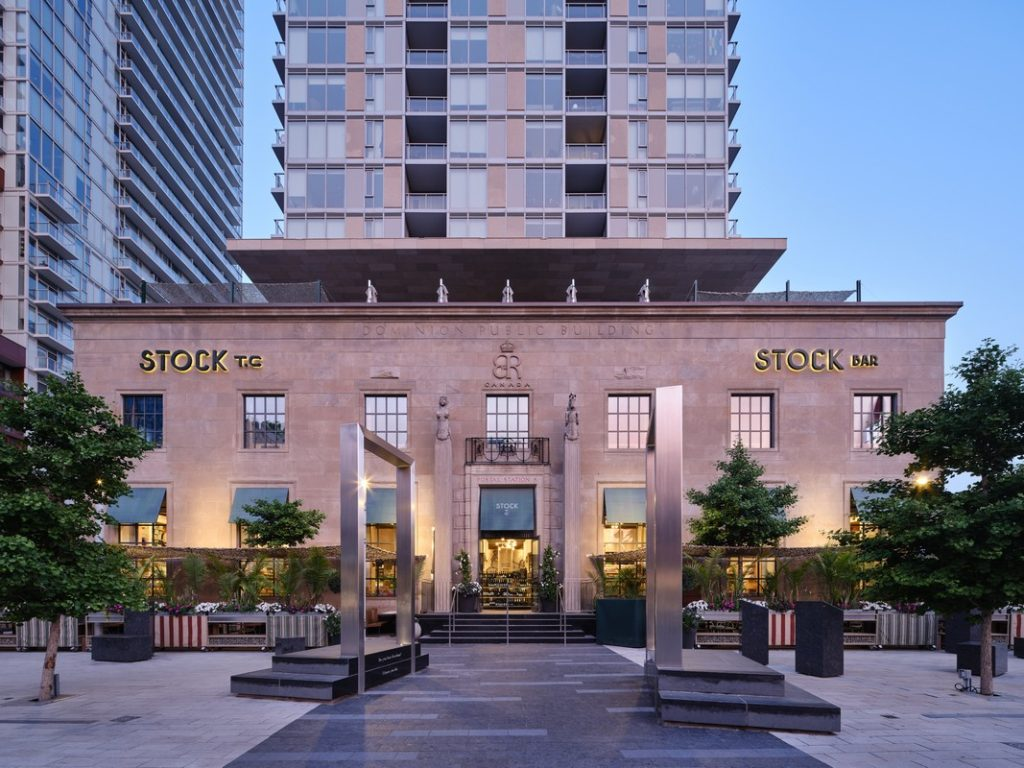
Stock T.C. launched in 2020 as a collaboration between two Toronto food powerhouses: Terroni, the city’s celebrated Italian restaurant brand, and Cumbrae’s, a high-end butcher with a reputation for ethically-sourced meats and sustainable farming. Their first venture took shape in Midtown Toronto at 2388 Yonge Street, near Eglinton Avenue, inside the historic Postal Station K building.
The flagship Yonge and Eglinton location spans over 20,000 square feet across multiple levels and offers an immersive food experience. Ground-floor patrons can shop from a curated grocery section featuring fresh pasta, cheeses, pantry staples, meats, baked goods, and more. Upstairs, a 200-seat bistro and lounge complement a third-floor event space and rooftop patio.
The concept behind Stock T.C. is guided by the philosophy of Materia Prima—a commitment to using the finest raw ingredients as the foundation of every culinary experience. This ethos is drawn from Cumbrae’s legacy in sustainable agriculture and Terroni’s devotion to authentic Italian cuisine.
With this expansion into Yorkville, Stock T.C. is poised to bring its unique blend of grocery, hospitality, and design to a new audience in a high-visibility setting.
Stock T.C. in Midtown Toronto at 2388 Yonge Street, near Eglinton Avenue, inside the historic Postal Station K building. Photo: Stock T.C.
A Return to Full-Service Food Retail in Yorkville
While Yorkville boasts numerous fine dining establishments and boutique cafes, the departure of Pusateri’s left a gap in the neighbourhood’s upscale food retail offering. The arrival of Stock T.C. is expected to reintroduce a destination where residents and visitors alike can access both prepared foods and premium grocery products.
The Yorkville location’s interior is expected to reflect the same architectural ambition seen at Postal Station K. At the original site, award-winning firm Giannone Petricone Associates led the transformation of the former post office, retaining its Art Deco charm while introducing contemporary elements like postage-stamp inspired flooring and custom lighting.
Although details of the Yorkville buildout have not yet been publicly shared, the former Pusateri’s space already offers a dramatic backdrop, having featured marble-clad walls and an architectural design mixing ultramodern elements with Baroque and Art Deco themes. This visually striking legacy will likely be adapted by Stock T.C. to suit its signature blend of retail and dining.
Inside the former Pusateri’s at 57 Yorkville Avenue in Toronto, soon to be home to Stock T.C. Image taken June 11, 2025 by Craig Patterson
Strategic Move Amid Changing Retail Landscape
The decision to expand into Yorkville aligns with Stock T.C.’s positioning as a lifestyle-driven food concept aimed at both residents and visitors. The area is seeing significant residential intensification, with numerous high-end condominium towers recently completed or under development. Luxury hotels and international fashion brands continue to bolster the area’s profile, and the neighbourhood remains a magnet for both tourists and locals.
The shift from a traditional grocer like Pusateri’s to a multi-format concept like Stock T.C. also reflects broader trends in retail real estate. With consumers increasingly drawn to experiential formats that combine shopping, dining, and social engagement, concepts like Stock T.C. are redefining what premium food retail can look like.
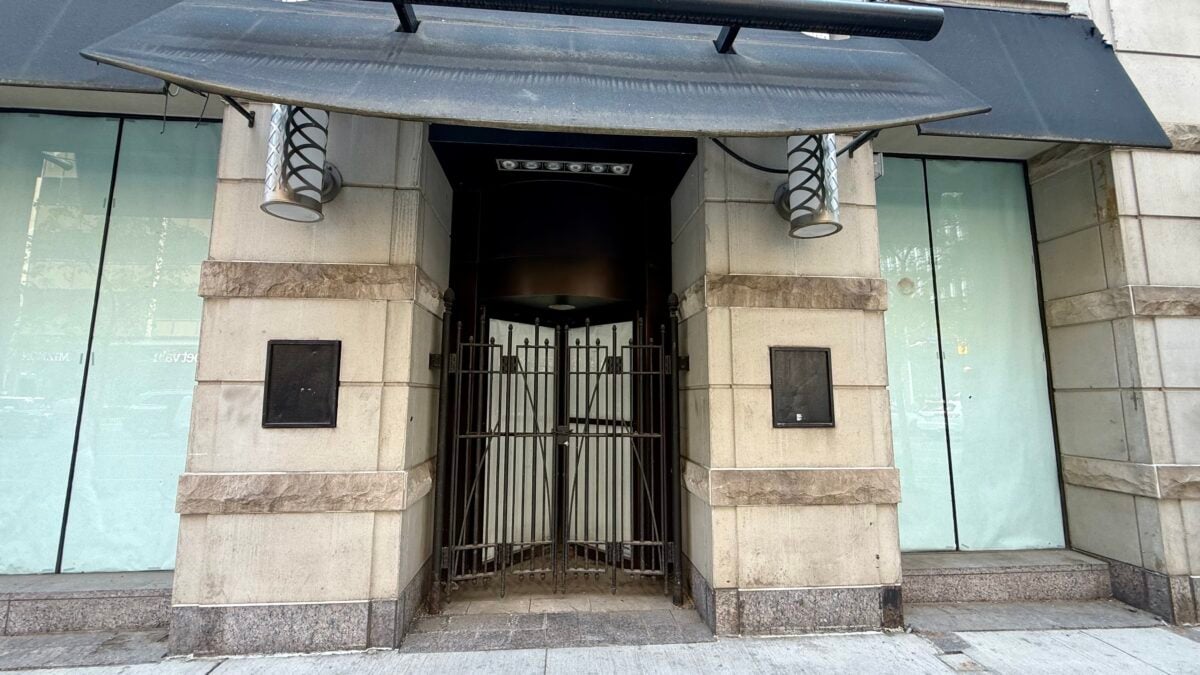
Bay Street doors at the former Pusateri’s Yorkville, soon to be home to Stock T.C.. Image: Craig Patterson
Legacy of the Former Pusateri’s Yorkville Store
The Yorkville Pusateri’s had a storied run from 2003 to 2024. When it opened, it set a new standard for luxury grocery in Canada. The store featured an in-house chef, a sushi station, and a juice bar built around an orange tree. A reported 120 employees staffed the store in its early years—a substantial number given the store’s compact size.
It was designed to feel like a high-end European food hall with rich materials including polished marble, glass, and steel. The location quickly became a community hub for local residents and was particularly known for its small cafe area where patrons would sit, relax, and converse.
While the closing of the store marked the end of an era, it also paved the way for a new food destination to carry forward the legacy of gourmet retail in the neighbourhood.
Established by the World Franchise Council, this global initiative aims to shine a spotlight on the dynamic world of franchising and its important impact on local communities and national economies, said the CFA.
Franchising empowers local entrepreneurs to thrive while benefiting from the support of an established system. Working tirelessly to drive economic growth and create job opportunities in their communities, franchisees embody the true spirit of entrepreneurship, using innovation, dedication, and hard work to succeed. What sets franchising apart is its unique model, allowing entrepreneurs to be in business for themselves, but not by themselves, with access to mentorship, training, and operational support that sets them up for success, said the CFA.
Sherry McNeil
“Franchising is more than just a business model; it plays a vital role as a local job creator, economic contributor, and active participant in community initiatives,” said Sherry McNeil, CEO and President of the CFA.
“World Franchise Day gives us the opportunity to celebrate the power of the franchise industry, the entrepreneurial spirit of franchisees, and the incredible impact of franchising on both local and national economies.”
Among those celebrating World Franchise Day is Ontario Premier Doug Ford, who recorded a special message promoting the initiative.
According to the CFA, which represents 700 corporate members and over 40,000 franchisees:
The Growing Franchise Community The Canadian franchise industry represents the 12th largest sector of the Canadian economy, with over 67,000 franchise establishments.
Economic Impact of Franchising The Canadian franchising sector contributes over $128.4 billion annually to the national GDP. In 2025, Canadian franchises are expected to contribute nearly $17.4 billion in federal taxes and $14.7 billion in provincial taxes.
Job Creation One in 20 Canadians are employed, directly or indirectly, in a franchise system. Canadian franchises are estimated to create nearly 1.75 million jobs for Canadians in 2025, paying over $67 billion in wages.
Community Impact Franchisees are deeply rooted in their local communities, and their contributions go far beyond economic metrics. Nearly all small retailers (97%) report contributing to their communities or provinces in some way, with 74% donating to local charities and causes, 56% sponsoring local events and teams, and 55% providing job opportunities for youth*.
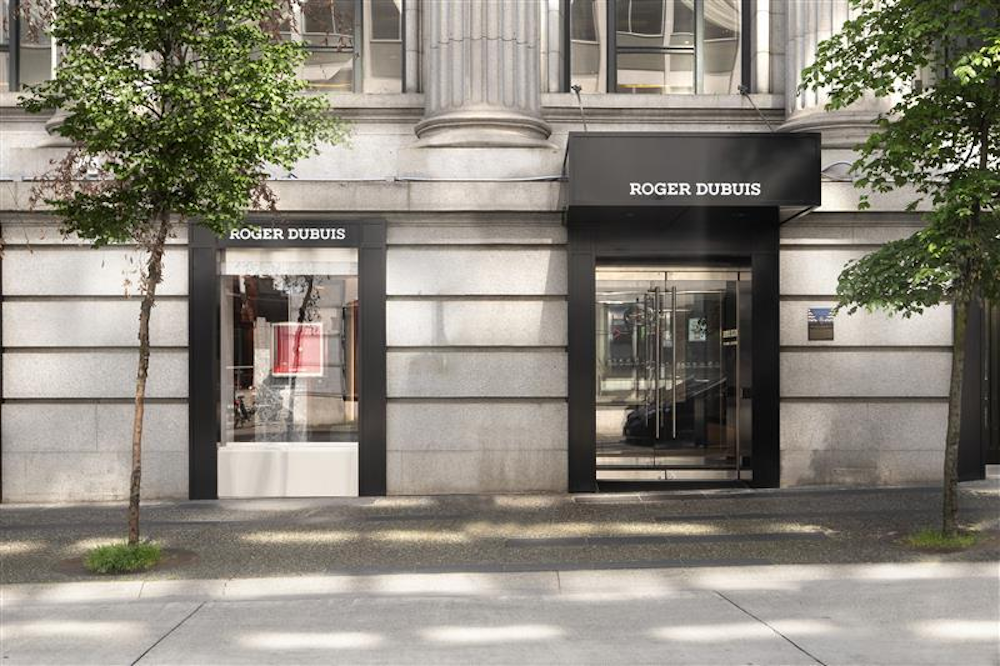
Roger Dubuis at Maison Birks in downtown Vancouver. Image supplied
Swiss luxury watchmaker Roger Dubuis has officially expanded its Canadian footprint with the opening of a new boutique inside Maison Birks in downtown Vancouver. This marks the brand’s second standalone boutique in Canada as it continues its international expansion and celebrates its 30th anniversary year in 2025.
Situated on the ground floor of Maison Birks’ flagship location at 698 West Hastings Street, the new Roger Dubuis boutique brings the brand’s bold and expressive watchmaking into one of Vancouver’s most prominent luxury destinations. The boutique, occupying 500 square feet, provides customers with an immersive environment that blends contemporary design with the house’s unmistakable horological identity.
“Maison Birks Downtown Vancouver is an esteemed watchmaking institution. We’re so delighted to take our place within this famous store and present our own unique sense of expressive luxury. With Vancouver being such a creative and modern city itself, this feels like a perfect next step in the Roger Dubuis journey,” said Laurent Toinet, Roger Dubuis Brand President for the Americas.
The boutique’s arrival reflects Vancouver’s growing importance as a global luxury destination, further strengthening Maison Birks’ position as a key retail hub for high-end jewellery and timepieces.
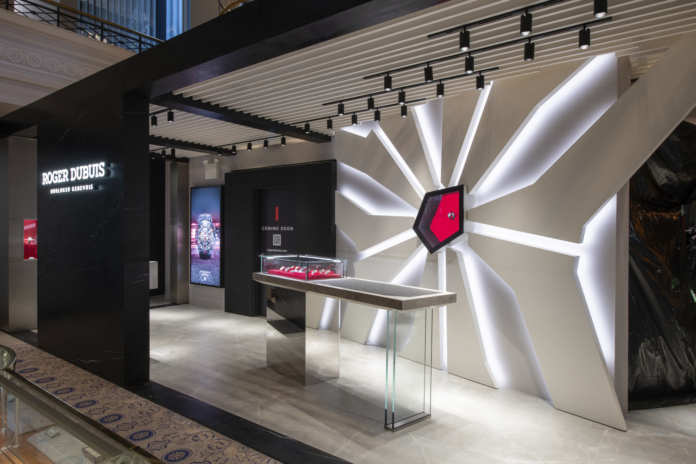
The interior design of the new boutique reflects Roger Dubuis’ philosophy of combining tradition with innovation. The space employs contrasting natural and industrial materials that mirror the brand’s avant-garde approach to watchmaking. Concrete elements sit alongside polished marble, while aluminum details contrast with varnished wood, all carefully curated to produce what the brand calls a “harmonious balance” and a sense of “refined brutalism.”
Dominating the boutique’s design is Roger Dubuis’ signature astral motif, which has been incorporated into the main wall and extends up toward the ceiling. Meanwhile, vibrant red accents—a hallmark of the brand—are featured prominently in the boutique’s street-facing windows, counters, and dedicated entertainment corner.
Roger Dubuis at Maison Birks in downtown Vancouver. Image supplied
An Intimate and Engaging Customer Experience
Visitors can enter the boutique directly from West Hastings Street or through Maison Birks’ main entrance. Once inside, they are welcomed into Roger Dubuis’ expressive world of haute horlogerie.
Guests can explore a comprehensive selection of Roger Dubuis timepieces, including the house’s famed Excalibur collection, which features a range of highly complicated skeletonized designs, double tourbillons, and motorsport-inspired models born from partnerships with Lamborghini and Pirelli. The boutique also features more casual presentation counters for informal browsing, a comfortable lounge space for private consultations, and an entertainment corner styled in Roger Dubuis’ signature red to host special experiences in partnership with renowned beverage houses.
The boutique aims to deliver an immersive experience, blending luxury retail with the interactive, discovery-oriented approach that Roger Dubuis has become known for among collectors and enthusiasts worldwide.
Roger Dubuis: Three Decades of Avant-Garde Swiss Watchmaking
Founded in Geneva in 1995 by master watchmaker Roger Dubuis and designer Carlos Dias, Roger Dubuis has positioned itself as one of the most daring and innovative names in modern haute horlogerie. The brand has become synonymous with technical mastery, avant-garde design, and limited production, appealing to collectors who seek exclusivity and cutting-edge craftsmanship.
Roger Dubuis’ highly complex calibres—produced almost entirely in-house—are frequently certified with the prestigious Poinçon de Genève (Geneva Hallmark), attesting to their exceptional quality and finishing. Many of the brand’s signature models feature multi-tourbillon movements, extreme skeletonization, and daring designs that push the boundaries of conventional Swiss watchmaking.
Collaborations with Lamborghini and Pirelli have further differentiated Roger Dubuis within the ultra-luxury segment, integrating automotive-inspired materials and design elements into many of its models.
Since 2008, Roger Dubuis has been part of Richemont Group, one of the world’s leading luxury conglomerates. Richemont fully acquired the brand by 2016, helping fuel its global expansion and ability to invest heavily in innovation and in-house manufacturing capabilities.
Image: Roger Dubuis
Canadian Expansion: From Toronto to Vancouver
The new Vancouver location follows the opening of Roger Dubuis’ first Canadian boutique in Toronto last year. That boutique opened at the base of the Park Hyatt Hotel at 180 Bloor Street West, where Roger Dubuis is part of a cluster of Richemont-owned high-end luxury watch brands operated by Toronto-based L’ORO Jewellers.
The decision to expand into Vancouver reflects the city’s increasingly affluent customer base and growing demand for ultra-luxury timepieces. Vancouver’s position as a global real estate, business, and tourism hub has made it one of the most attractive markets in Canada for luxury brands seeking new opportunities.
Pricing: Positioned in the Ultra-Luxury Segment
Roger Dubuis watches sit firmly in the ultra-luxury tier of the watch market, with prices reflecting their technical complexity, limited production, and status as collectible works of art.
Entry-level Roger Dubuis models typically start around C$28,000 to C$50,000 for simpler timepieces. More intricate skeletonized models and limited editions often range from C$50,000 to C$200,000, while highly complicated models featuring double or quadruple tourbillons command prices between C$200,000 and C$430,000. At the very top of the range, some grand complication pieces approach or exceed C$940,000.
The brand’s limited production runs and unique designs contribute to their appeal among collectors worldwide, with many timepieces produced in extremely small quantities.
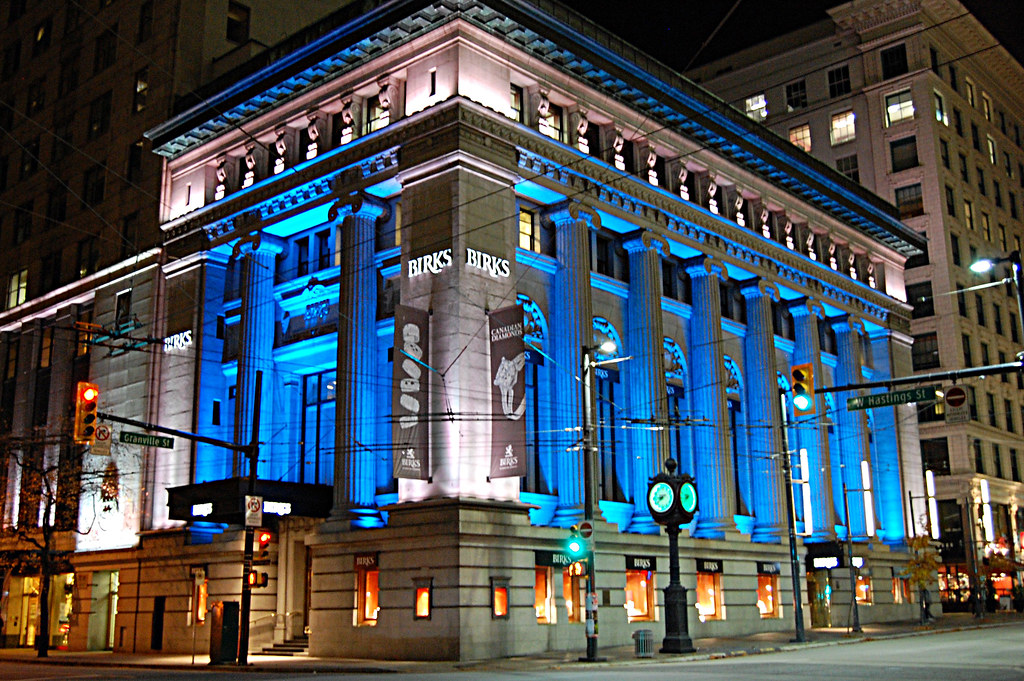
Maison Birks store in downtown Vancouver. Photo: C. Hagemoen
Maison Birks Downtown Vancouver: A Historic Luxury Destination
The choice of Maison Birks Downtown Vancouver as the site for Roger Dubuis’ second Canadian boutique is also significant. Maison Birks, located at 698 West Hastings Street, occupies the historic Bank of Commerce building. The store is considered a flagship for Birks and remains a cornerstone of the city’s luxury retail landscape.
Maison Birks offers an extensive selection of fine jewellery, Canadian diamonds, engagement rings, and high-end watches from several prestigious global brands. Known for its elegant design, attentive service, and luxury experience, the store is a draw for both local clients and international visitors seeking world-class jewellery and watch offerings in downtown Vancouver.
Beyond sales, Maison Birks Downtown Vancouver also provides professional watch repair services and personalized consultations, catering to discerning customers seeking quality, craftsmanship, and service excellence.
Retail malls such as Eastgate Square in Hamilton are undergoing transformation into mixed-use residential-retail developments, as the market responds to oversupply and changing consumer preferences, says RE/MAX Canada’s 2025 Commercial Real Estate Reportwhich was released on Wednesday.
Grocery-anchored retail centres remain a preferred asset for private and public investors.
“Retail plazas continue to outperform, especially in suburban areas, making this asset class attractive to investors, particular in Ottawa, Halifax, Winnipeg, Edmonton and the Greater Toronto Area (GTA). In addition to improving cash-flow, these assets offer future mixed-use redevelopment and/or intensification potential,” said the report.
The mall experience continues to transition.
“Foot traffic continues to diminish in older, dated shopping malls, with management introducing more service-related retail to their tenant mix, and some planning future residential development. Vibrant neighbourhood retail nodes are filling the void, offering a curated mix of retailers, services, dining, healthcare and beauty options, popular with both locals and tourists,” added RE/MAX.
Investors are capitalizing on opportunities that allow for strategic repositioning, adaptive reuse and targeted investment throughout the country, as escalating global trade tensions, economic concerns and evolving market conditions weigh on sentiment, according to the report, which examined first-quarter activity across 12 major markets from coast to coast, said RE/MAX.
RE/MAX found that Canada’s commercial landscape continues to evolve as investors and asset holders adapt acquisitions and asset management plans to optimize portfolios and performance against a changing climate. Multi-family and industrial were the top-performing asset classes, followed by retail. Commercial markets continue to move forward at a steady pace, fuelled by ongoing pressure on the country’s existing housing stock, government policies set to advance growth such as the Housing Accelerator Fund, and a continued upswing in e-commerce sales.
Don Kottick
“Canada’s commercial real estate market is shifting to fundamentals this year,” said Don Kottick, President, REMAX Canada. “What we’re seeing is a pivot to purpose and practicality, prompting revitalization, a flight to quality, and a more discerning buyer pool. Institutional investors and Real Estate Investments Trusts (REIT) are cautiously re-entering the market—focused on acquisition, not disposition—as they target assets that promise long-term value in today’s more complex operating environment.”
Here’s RE/MAX’s take on the retail sectors in certain major cities in the country:
Vancouver
Institutional investors and Real Estate Investment Trusts (REIT) have also returned to the markets with an eye to buy. Vancouver remains one of the top three preferred markets by investors across all asset classes, according to a recent investment report by Altus Group. Food-anchored retail strips, suburban multiple-unit residential, and multi-tenant industrial were the most sought-after property types. Foreign investment has resumed as the weak Canadian dollar and higher cap rates attract German and U.S investors in the office sector, noted RE/MAX.
Both urban and suburban retail continue to hold their own, with vacancy rates at 3.4 per cent and 0.7 per cent respectively. Retail shopping plazas with grocer anchors continue to be the city’s most resilient asset class. The future potential of these plazas in terms of long-term multi-use development is irresistible, but product is few and far between. While malls are grappling with empty space at present, future redevelopment opportunities will substantially increase value down the road.
Edmonton
Both institutional and private investors are behind robust demand for purpose-built retail centres in both new and established neighbourhoods. As the city continues to grow, there has been an uptick in demand, especially in newer suburban neighbourhoods, where there is a need for retail strip centres. Anchored by essential retail such as grocery or banks, the remaining tenant mix in today’s retail centres has shifted from the past, with service-based retail including healthcare centres such as chiropractors, dentists, and physio, dominating the landscape, explained RE/MAX.
High-traffic areas continue to resonate with smaller retailers who are willing to pay a premium for greater exposure, but prime locations are hard to find. Given the shift to online shopping, foot traffic in local malls has subsided in recent years, with a notable turnover in tenants. Future development projects are complementing some existing properties, as is the case with Mill Woods Town Centre. The property has been renovated, with a grocery store scheduled to open in August, while construction will begin on two 22-storey towers this year. West Edmonton continues to be a popular destination for local and out-of-province shoppers, now offering with 800 stores and services, 100 places to eat, two hotels and 12 attractions.
Calgary
Retail in the core is starting to benefit from increased residential, although the full impact is unlikely to be identified for several years when conversion projects are completed. New residential development on adjacent land over the past 10 to 15 years has supported the city’s retail malls. Greater emphasis has now been placed on creating a destination for shoppers by mall management, with the addition of new restaurants, on-site recreational facilities including gyms and studios, as well as health and beauty services. CF Chinook Centre recently upped the ante, bringing in a new virtual reality experience to consumers with its Horizon of Khufu trip through the Great Pyramid of Giza with great success. The mall has since followed up with another virtual experience—Life Chronicles—that takes viewers through the ages. Both events will run through to the end of October 2025. The Hudson Bay Company’s bankruptcy was a blip in the market with its space broken down and taken over by smaller retailers, said RE/MAX.
REIT and institutional investment continue to be noted in the Calgary area given long-term development potential, as evidenced by the purchase of a 50 per cent interest in the Seaton Gateway shopping centre in Calgary for $33.5 million last year.
Neighbourhood retail nodes throughout the city remain strong, with clusters of boutiques, restaurants, and cool retail shops attracting foot traffic. Retail space is particularly coveted in vibrant districts including Kensington, 17th Avenue SW, Fourth St., and Inglewood, usually commanding top dollar with vacancies few and far between.
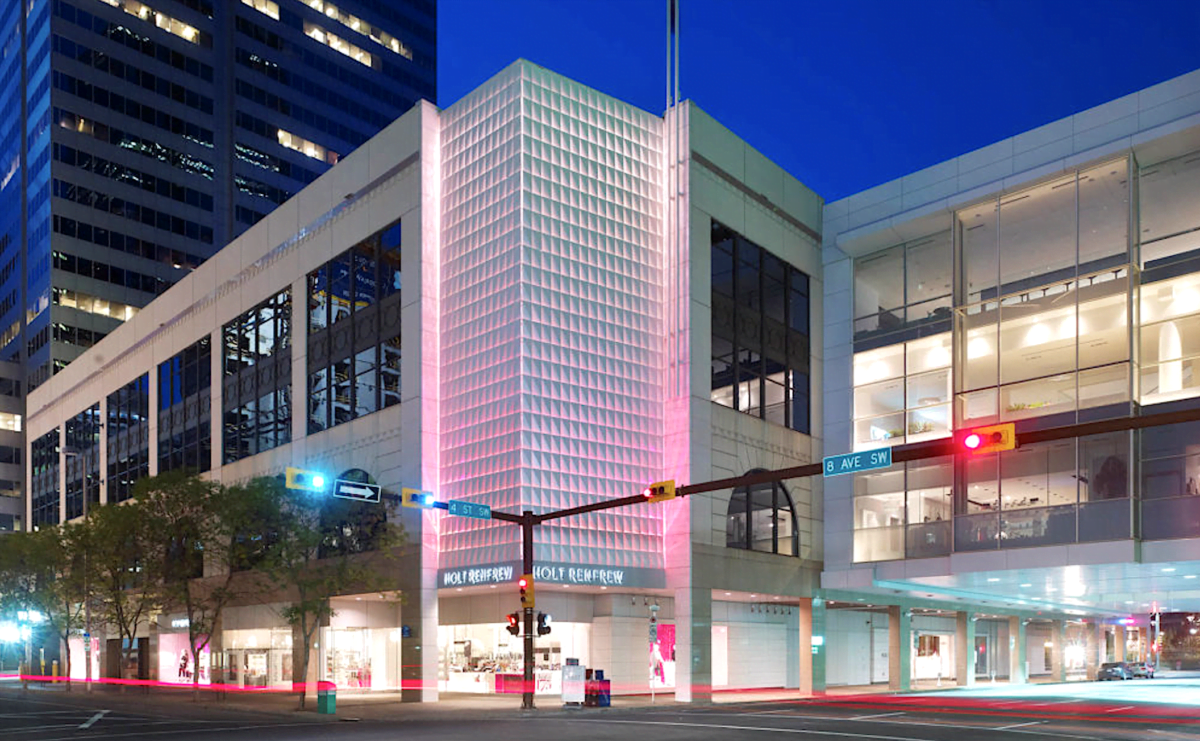
Holt Renfrew in downtown Calgary. Photo: Holt Renfrew
Regina
The Cornwall Center, once a bustling mall with top retailers in the downtown core, has seen a steep post-pandemic climb in vacancy. The city’s three other shopping malls are also facing growing vacancies, prompting some to diversify their tenant mix, including Southland Mall’s incorporation of public library space. In contrast, vibrant neighbourhood retail nodes including Cathedral Village, Normanview Crossing, Albert Park and restaurants along 13th Avenue, continue to resonate with shoppers, largely replacing the traditional mall experience, according to RE/MAX.
Regina’s commercial real estate market is poised for continued growth in the coming year, driven by favorable economic conditions, easing immigration policies, and sustained interest from institutional and foreign investors. Despite challenges such as trade tensions and limited land availability, the city’s robust growth and government initiatives will continue to support its dynamic market.
Saskatoon
Residential growth continues to drive retail development in Saskatoon. With each new subdivision comes new retail centres anchored by grocery stores, banks, restaurants and other essential businesses. Bustling retail within the city’s neighbourhood nodes including University Heights, Lawson Bridge, Midtown, Broadway, and 33rd St., continue to attract both locals and visitors.
Investor appetite for hotel properties also remains strong, with five selling in recent months. Many of these are smaller hotel/motel-type properties with 80-plus rooms located outside city limits, servicing areas where accommodations are limited. Values typically range from $1 million to $5 million, but larger hotel product on the market can climb as high as $15 million. The city has not seen any new hotel development in at least five years. Financing, however, remains a challenge, with most lending institutions looking for as much as 50 per cent down on the proposed rental rate per room.
Vacancy rates in the industrial sector continue to edge upward as new industrial product comes to market. Rates currently hover at three per cent, up significantly over year-ago levels, while absorption levels have softened. While a limited number of owner-occupiers are seeking larger footprint industrial properties over 20,000 square feet, smaller industrial operations at 5,000 sq. ft. tend to sell quickly, added RE/MAX.
Winnipeg
While industrial and multi-family real estate continue to thrive, the retail landscape presents a more nuanced picture. E-commerce has reshaped consumer habits, yet several neighbourhood retail nodes have remained resilient, including the Forks Market, Osborne Village, the Exchange District and West Broadway continue to be robust and offer unique shopping and dining experiences that draw both residents and visitors. New restaurants continue to open in these areas, and established venues are investing in renovations to maintain competitiveness. Newcomers have had a presence in the city’s commercial market as well, buying up existing businesses to become owner-operators and, in the process, extending the city’s mix of services, cuisine and cultural offerings. Investor interest remains high for well-anchored retail shopping plazas in the city’s southwest and eastern retail corridors, though available inventory remains limited, stated RE/MAX.
In contrast, larger regional shopping centres face greater headwinds. CF Polo Park, for example, is working toward broadening the tenant mix and repurposing existing space, but replacing legacy retailers such as the Hudson’s Bay Company will prove challenging.
London
Smaller retail plazas continue to be sought after by investors for future development, but product is few and far between. Retail vacancies are low, with most near or at full occupancy. The city’s larger retail properties are seeing increased vacancies, with lease rates coming down to $18 to $25 per square foot. Landlords are working with existing tenants on renewal, with some offering rental reductions, given that they’d rather renegotiate terms than allow good tenants to leave and spent months filling empty units. The tenant mix in area malls—including both White Oaks and Westmount—is evolving with less traditional retail and more service-oriented businesses.
Hamilton and the Niagara region
Small service-based retail continues to perform well in Hamilton, St. Catharine’s and throughout the Niagara Region, with low vacancy rates in markets across the board sparking some talk of building on speculation. Scarcity of smaller spaces between 1,000 to 1,100 square feet and mid-sized product from 3,000 to 5,000 square feet is starting to place upward pressure on retail lease rates. Almost every strip retail plaza has a waiting list of potential tenants.
Malls continue to grapple with rising vacancies, looking for innovative ways to improve customer experience. Eastgate Square, servicing East Hamilton and Stoney Creek, is expected to undergo a massive transformation to provide a “revitalized retail destination and vibrant residential community.” While the development’s original plan has changed somewhat, the new proposal includes 19 residential towers that will house approximately 7,600 people in 4,300 units. The project is forecast to unfold over four phases with 10 years to full completion. Groundbreaking is yet to be determined, given that most new construction of multi-residential units has ground to a halt.
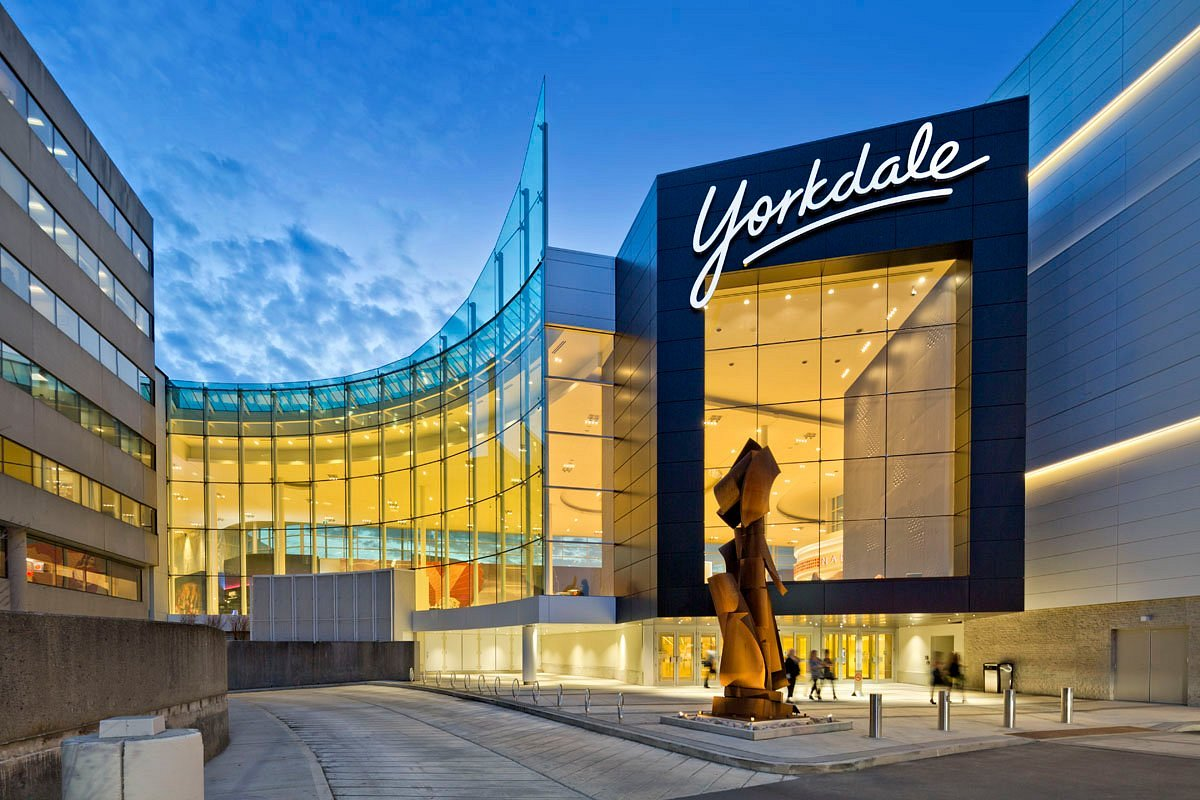
Yorkdale Shopping Centre in Toronto. Image: Oxford Properties
Greater Toronto Area
Retail, by contrast, remains relatively stable despite notable disruptions. The bankruptcy of the Hudson’s Bay Company marked the end of an era, but lease rates have held firm in large part due to low vacancy rates and evolving mall strategies. Shopping centres across the GTA continue to expand their offerings, incorporating residential units, restaurants, entertainment venues, and niche grocery stores. Malls in the 416 and 905 area codes, led by Yorkdale Shopping Centre, Square One and the Eaton Centre, continue to lead in national performance rankings, according to ICSC 2024 Performance Rankings. Yorkdale remains a standout with lease rates now over $2,300 per square foot—$800 more than any other Canadian mall. The void left by HBC’s exit is expected to be absorbed by new retail ventures. Retail plazas remain a top target for investors, especially those with mixed-use development plans. Ideal properties are anchored by grocery or banks, but inventory in the Greater Toronto Area is scarce and new developments are hindered by limited shovel-ready land and planning constraints, reported RE/MAX.
Ottawa
Ottawa’s retail market continues to thrive, with both leasing and sales activity robust throughout much of the city. Most retail space is quick to sell, and finding anything in the sought-after $2 million range is virtually impossible. Adaptive reuse is occurring throughout the asset class, with the best example a new gym at the site of a former Canadian Tire store. After a long drought, new retail construction is expected to break ground in Barrhaven, Orleans and Kanata this year. New entertainment venues are planned for both the Byward Market and Kanata. Investors have been driving demand for retail centres that are anchored by grocery stores. A brokered retail plaza recently traded at a cap rate of six per cent. New business is also filtering in from other provinces. Ottawa was chosen by Montreal-based furniture retailer Cozey for their first pop-up store in 2025, with the intent to eventually open in the city.
Halifax
Retail has remained resilient, particularly in the downtown core where an increase in tourism has buoyed growth in owner-occupied businesses including restaurants. The steady stream of incoming multinational retailers has subsided, and local entrepreneurs are filling the void. Owner-operators are now increasingly present across a wide range of sectors, including retail, hospitality, and light industrial. According to Altus Group’s Canadian Investment Trends Survey for Q1 2025, Halifax ranks among the top three Canadian markets for opportunities across several asset classes, including food, grocery and bank-anchored strip plazas, suburban multi-unit residential, and multi-tenant industrial.
St. John’s
Retail remains healthy in St. John’s, with the Avalon Mall and big box stores—including the largest Costco in Canada, Marshalls, HomeSense, and Mark’s—at the Shoppes of Galway, drawing shoppers from all areas of the province. The Shoppes of Galway continues to expand, with 700,000 sq. ft. of retail available for lease, and the development is positioned for further growth with a 2,400-acre master planned community in progress.
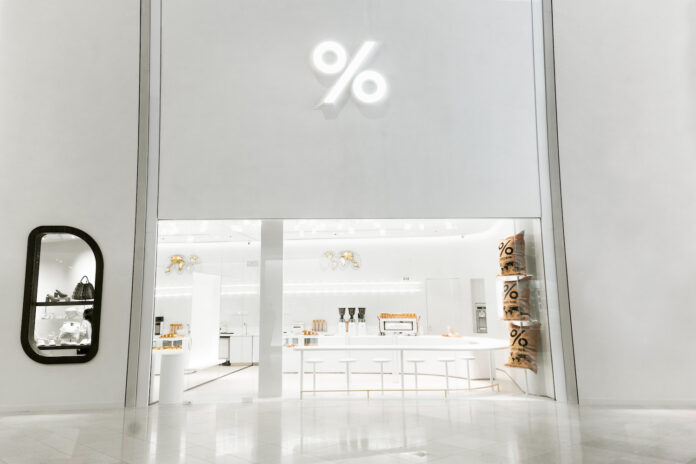
% Arabica at CF Sherway Gardens in Toronto. Photo supplied
Japanese specialty coffee brand % Arabica is continuing its expansion across Canada with the opening of two new locations in the Greater Toronto Area. The brand, known for its minimalist design and high-quality coffee, has now established a total of five locations in the region, as part of a broader strategy to introduce its globally recognized concept to Canadian consumers.
The latest % Arabica store officially opened at CF Sherway Gardens on May 17, 2025, marking the company’s fourth Toronto-area location and its 255th store globally. Staying true to its commitment to delivering unique design experiences at each location, % Arabica partnered with Japanese design studio no.10 to craft one of its most visually distinctive stores to date.
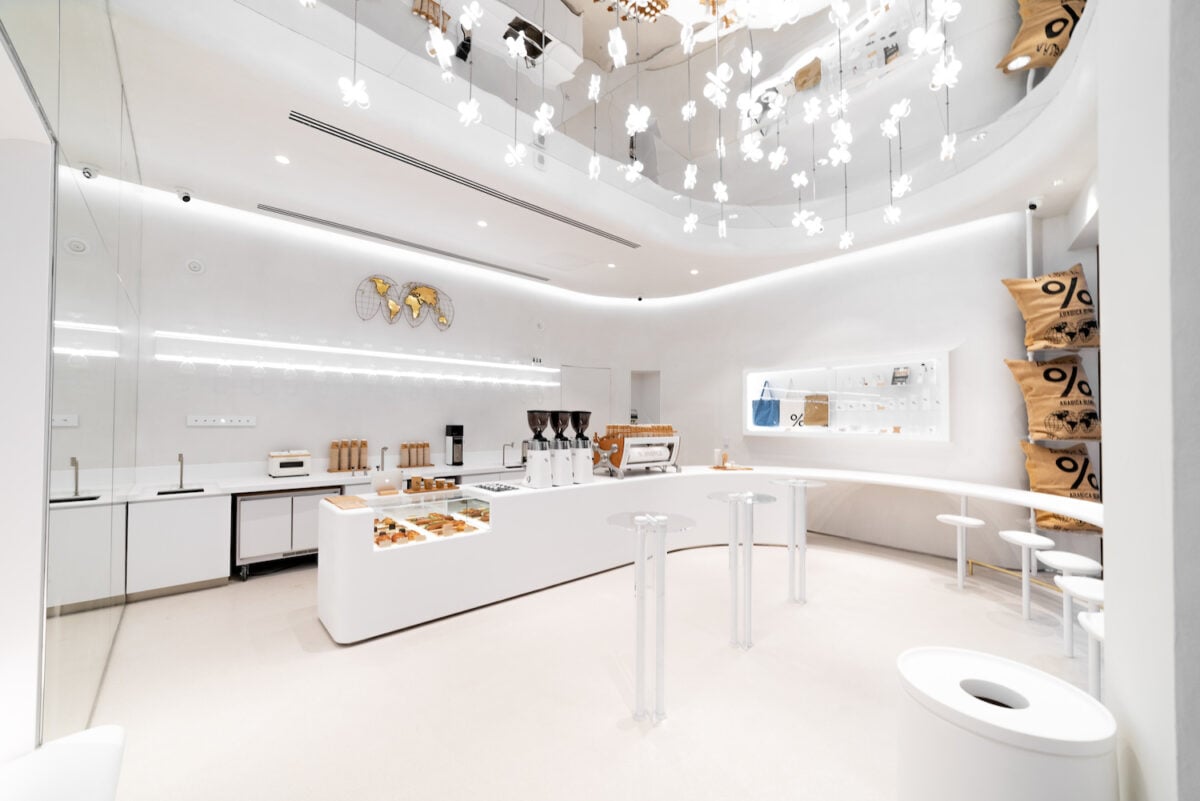
“In Canada, where winter sports are deeply ingrained in the culture, Toronto’s CF Sherway Gardens is surrounded by more than 20 skating rinks. This is why within this vast mall, this small store was designed with the concept of a ‘rink’ in mind,” the designer explained.
The store’s design features curved white counters, pendant lights shaped like the brand’s iconic “%” symbol that resemble hanging icicles, and mirrored ceilings which create sparkling reflections reminiscent of glistening ice. The concept reinforces % Arabica’s commitment to integrating local culture into its store designs while maintaining its minimalist, globally consistent brand identity.
% Arabica at Square One in Mississauga. Photo supplied
Square One Opening Fuses Form and Function
On May 23, 2025, % Arabica launched a soft opening at Square One Shopping Centre in Mississauga, one of Canada’s busiest malls. The location represents the brand’s fifth store in the Greater Toronto Area and is scheduled for a grand opening in June 2025.
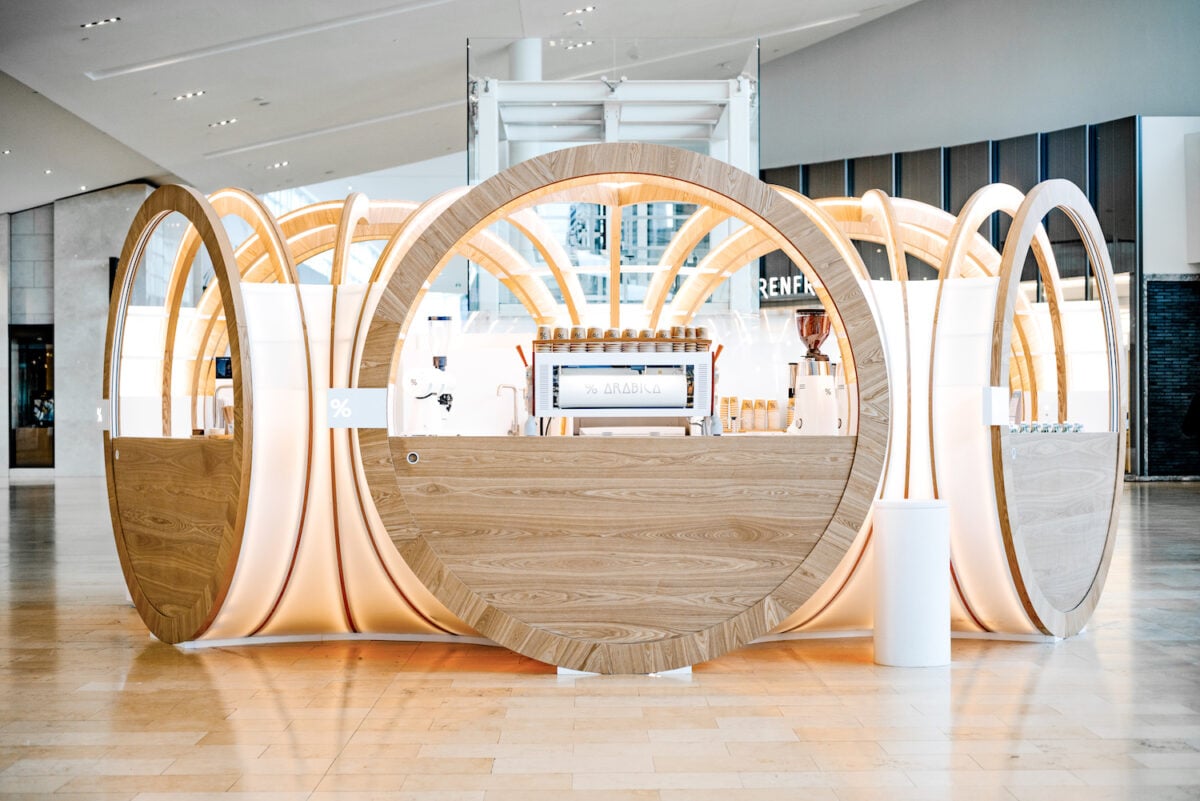
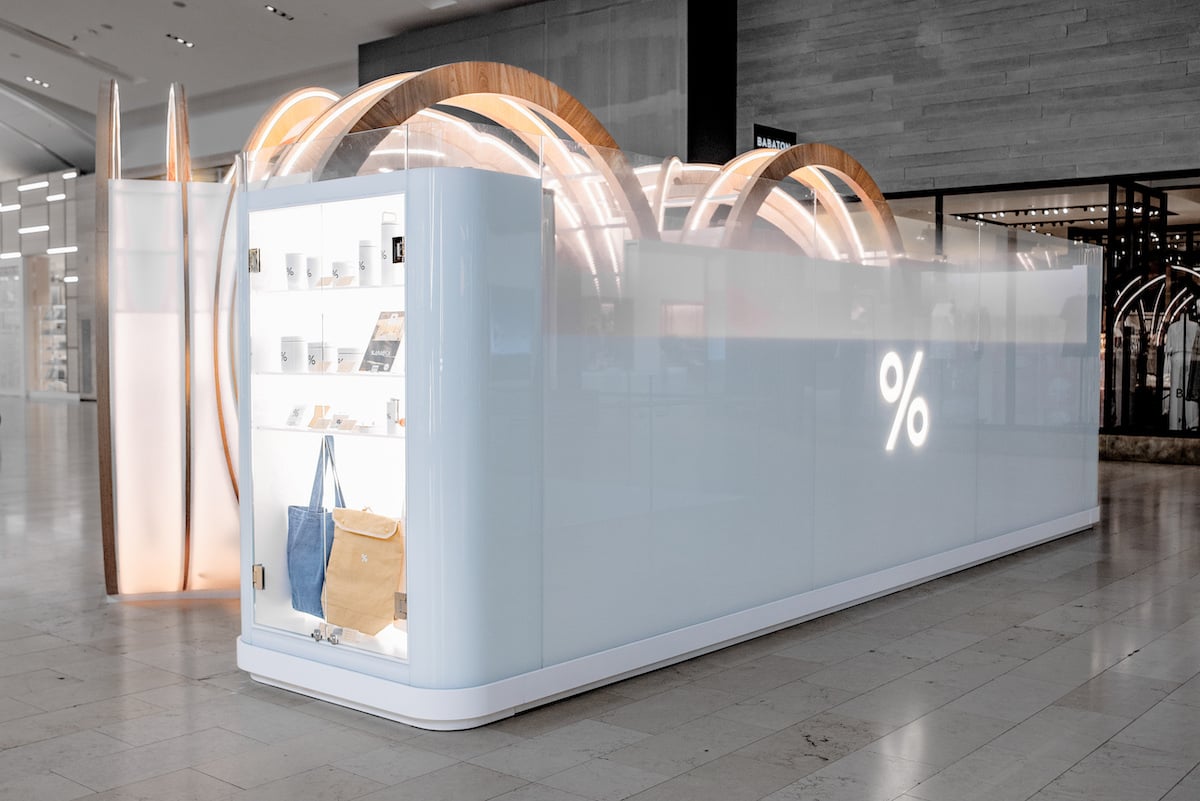
Unlike traditional mall kiosks, the Square One location is an architectural standout. Designed in collaboration with Austrian firm Studio Precht, the kiosk presents a sculptural, modular structure that seamlessly integrates into the mall’s high-traffic environment. The design features five entry points, allowing customers to approach from multiple directions, while the combination of soft wooden frames and a translucent white shell creates an inviting, light-filled atmosphere.
“The kiosk at Toronto Square One showcases the iconic modular design of % Arabica x Studio Precht, featuring a five-opening layout that seamlessly accommodates the flow of visitors from all directions within the shopping center. The combination of wooden structures and a white translucent shell creates a minimalist yet warm atmosphere, while the circular window design further enhances the brand’s visual identity,” the designer noted.
% Arabica at CF Sherway Gardens in Toronto. Photo supplied
Seamless Digital Experience with % Arabica App
In addition to its physical expansion, % Arabica continues to emphasize a seamless customer experience through its digital platform. The brand’s mobile app offers several features tailored to modern consumer habits.
Through the “Order Ahead” feature, customers can pre-order beverages, customize drinks, and select either in-store pickup or car-side service, reducing wait times. The app also includes a loyalty program where users collect “% Stamps” and “% Pointos” that can be redeemed for rewards such as free beverages. Furthermore, the in-app “% PAY Wallet” allows for secure, contactless payments, enhancing convenience and efficiency for users.
The % Arabica app is available on both iOS (App Store) and Android (Google Play), supporting the brand’s goal of delivering a fully integrated physical and digital retail experience.
Growing Presence Across Canada
Since entering the Canadian market in December 2022, % Arabica has been steadily growing its footprint. The Canadian expansion began with a flagship location at Yorkdale Shopping Centre in Toronto. Designed by no.10 of Nomura, the Yorkdale store features mirrored cylindrical centerpieces and Chemex-inspired lighting, providing a modern and sophisticated environment for coffee enthusiasts.
In July 2023, the brand opened its second Canadian location within Toronto’s Union Station. Designed by Tacklebox Architecture, the Union Station café draws inspiration from Canada’s unique geological formations, featuring faceted gypsum wall designs that reflect the country’s natural landscapes.
Expanding westward, % Arabica debuted its Whistler Village location in British Columbia in June 2024. Studio Precht again collaborated with the brand to create a design inspired by ice caves, incorporating white metal mesh domes and panoramic mountain views. The Whistler store also introduced a Canadian-exclusive Maple Latte, featuring locally sourced maple syrup.
In December 2024, % Arabica opened a highly anticipated location at CF Toronto Eaton Centre, further solidifying its presence in one of Canada’s premier shopping destinations.
The CF Sherway Gardens and Square One openings in May 2025 further cement % Arabica’s growing presence in the Canadian market.
% Arabica at Square One in Mississauga. Photo supplied
More Canadian Locations Planned
The company’s broader vision is to establish between 10 and 20 locations across the country. Its site selection strategy focuses on a mix of high-density urban centres and scenic destinations, offering Canadian consumers diverse and visually captivating environments to enjoy their coffee.
According to previous statements, the brand intends to maintain its signature approach of tailoring each store design to its surrounding context while adhering to its minimalist global identity.
Brand Origins and Global Appeal
Founded in Kyoto, Japan, in 2013 by Kenneth Shoji, % Arabica quickly developed a strong international following for its combination of design, quality, and cultural storytelling. The company sources its coffee beans directly from small farms, emphasizing traceability and sustainability while curating a premium coffee experience.
Beyond the product itself, % Arabica markets a broader lifestyle ethos. Its motto, “See the World Through Coffee,” reflects the brand’s mission to foster global connections and shared experiences through the universal appeal of coffee culture. Each store serves as both a community gathering place and a design destination, drawing visitors not only for the coffee but for the immersive and visually compelling environments.
College Park: After Hours (CNW Group/Downtown Yonge BIA)
The heart of Toronto is heating up with Downtown Yonge BIA’sSummer Destination 2025, a signature series of free events and activations guaranteed to transform the city core into this season’s must-visit hotspot.
From lively outdoor concerts to curated flea markets, late-night movie screenings, and fun fitness sessions, the Downtown Yonge neighbourhood is set to offer something for everyone—families, friends, and young adults alike.
Cheryll Diego
“This isn’t just summer in the city—it’s a celebration of community, creativity, and connection,” says Cheryll Diego, Public Realm Director of Downtown Yonge BIA. “We’re inviting locals and visitors alike to rediscover Downtown Yonge through art, music, movement, and play.”
2025 Summer Destination Signature Events:
🎶 Play The Parks, Presented by TD Bank Running from June to September
Enjoy free weekly live concerts across key downtown green spaces including 777 Bay Plaza, College Park, McGill Parkette, and Trinity Square Park. For more info, visit https://downtownyonge.com//playtheparks/
🌙 College Park: After Hours First Wednesdays (June to September).
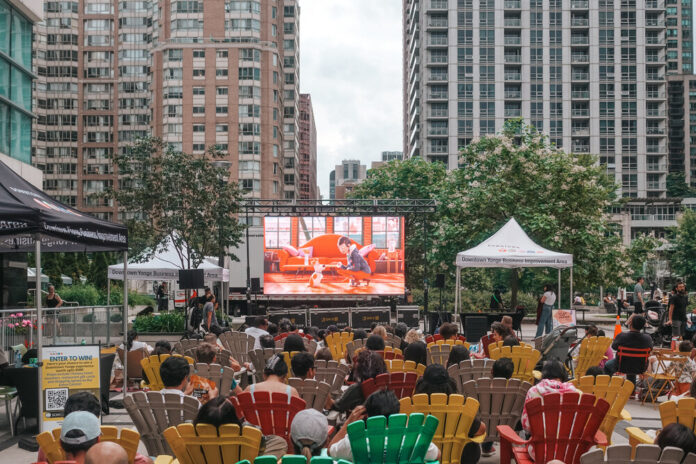
Spend your evening at College Park with a perfect mix of community vibes and practical perks. Starting at 3PM, browse a lively maker’s market, enjoy live music at 5PM, and unwind with an outdoor movie at 7PM—all part of College Park: After Hours.
While you’re there, bring your bike for a free Bike Clinic, offering expert tune-ups, quick repairs, and maintenance tips from on-site mechanics.
🛼 Skates & Sounds: Roller Drag Ball, in partnership with Pride Toronto Wednesday, June 18 (5–10PM)
Celebrate Pride with a high-energy roller rink experience, featuring drag performers on wheels, DJs, and a pop-up market. For more info, visit https://downtownyonge.com/pride/
🌿 Take A Break: Trinity Square Park, with support from IKEA Toronto Downtown June–July | Monday to Friday (8AM–5PM)
Recharge with free daily activities at Trinity Square Park—a hidden gem tucked behind CF Toronto Eaton Centre.
A vintage lover’s dream! Explore handcrafted goods, one-of-a-kind finds, and local artisan wares.
💪 Motivation Mondays, in partnership with YMCA Greater Toronto August to September (6–7PM)
Free outdoor fitness sessions at College Park every Monday. (Excludes holidays.)
🎷 Music Walking Tour of Yonge Street, in partnership with The Mackenzie House Tour Dates: Tuesday, July 22 (3 – 4:30PM) Wednesday, August 6 (4 – 5:30PM) Tuesday, September 2 (4 – 5:30PM)
Step into the rhythm of the city with a free guided walking tour that traces the rich musical history of Yonge Street—Toronto’s original music corridor. For more info, visit https://downtownyonge.com/arts-culture/musicwalkingtour/
📍 All events are free and family-friendly.
Beyond Summer Destination signature events, there’s always something happening in the heart of the city—from live performances at Sankofa Square to community festivals at Nathan Phillips Square and more. Come for one event, and you’ll find yourself immersed in a summer of unexpected discoveries and vibrant downtown energy, said the BIA
To explore the full calendar of events, visit: downtownyonge.com/summeror follow along @downtownyonge on Instagram, Facebook, and X (formerly Twitter)
Established in 2001 along Toronto’s iconic Yonge St., the Downtown Yonge Business Improvement Area (DYBIA) is a non-profit organization committed to strengthening the culture and economy of a world-leading downtown neighbourhood through programs, partnerships, advocacy and outreach.
A champion for the mixed-use community of 2,000+ businesses and property owners in the heart of downtown Toronto, DYBIA is responsive, inclusive and collaborative, reaching beyond its boundaries to create innovative programs that help drive consistent growth in the community.
Representing more than $7 billion in commercial real estate, this vibrant downtown district is home to exceptional retail such as CF Toronto Eaton Centre, entertainment mainstays including the Ed Mirvish Theatre, the Elgin and Winter Garden Theatres and Massey Hall, and a bustling post-secondary community at Toronto Metropolitan University and Toronto Film School, as well as over 100,000 residents within a 10-minute walk. All of which contribute to some of the highest pedestrian flows in Canada with over 60 million pedestrians annually.