Temu, the global online marketplace, has taken a significant step in bolstering its intellectual property protection efforts, signing a Memorandum of Understanding (MoU) with the International AntiCounterfeiting Coalition (IACC).
The MoU, signed during the IACC’s 2025 Annual Conference in San Diego recently, marks the beginning of a deeper collaboration between the two organizations aimed at cracking down on the sale of counterfeit goods online. As part of the agreement, Temu has also joined the IACC’s newly launched Marketplace Advisory Council (MAC) as an inaugural member.
“We’re pleased to welcome Temu as an inaugural member of the Marketplace Advisory Council and as a key partner in our shared fight against counterfeiting,” said Bob Barchiesi, President of the International AntiCounterfeiting Coalition. “This MoU reflects a meaningful step forward in our collaboration, grounded in transparency, accountability, and a joint commitment to consumer protection. The IACC created the MAC to bring stakeholders together in a way that drives real, sustained impact—and Temu’s participation helps strengthen that vision.”
Temu’s IP Compliance Lead for the U.S., Christine Casaceli, joined Barchiesi in signing the agreement, underscoring the company’s growing focus on protecting brand integrity within its rapidly expanding platform.
The MAC serves as a collaborative forum where e-commerce platforms, payment companies, and global brands can work together, share insights, and forge stronger partnerships in addressing the persistent issue of counterfeit goods online. Members of the MAC include high-profile names such as Amazon, eBay, Mastercard, PayPal, Visa, Apple, Chanel, Colgate-Palmolive, Disney, Ford, Johnson & Johnson, and Nike.
“Joining this coalition underscores Temu’s commitment to building a trustworthy online marketplace,” said a Temu spokesperson. “We look forward to collaborating with other industry leaders to create a powerful, collective force against the sale of illegal goods online.”
Since its launch in 2022, Temu has placed a strong emphasis on intellectual property enforcement. Its efforts include comprehensive seller vetting and compliance training, 24/7 algorithmic monitoring backed by manual review, a dedicated IP protection portal and brand registry for streamlined takedown submissions, and an internal enforcement team known for handling claims with speed and precision.
Temu’s entry into the MAC aligns with its broader mission to provide a secure and reliable shopping experience. Operating in more than 90 markets worldwide, Temu connects consumers with millions of manufacturers, brands, and business partners while maintaining a focus on affordability and quality.
With the MoU in place and its role in the MAC established, Temu is positioning itself as a key player in the global effort to curb counterfeiting and safeguard consumer trust.
“Our strong Q4 results show the kind of impact Canada Goose can make when our brand connects and our strategy hits the mark,” said Dani Reiss, Chairman and CEO of Canada Goose. “We saw solid DTC comparable sales growth, fuelled by compelling storytelling, sharp retail execution, and the continued momentum around our Snow Goose capsule.”
Dani Reiss
Total revenue for the fourth quarter increased 7.4% to $384.6 million, driven primarily by DTC revenue growth of 15.7% to $314.1 million. Gross profit rose 17.8% to $274.4 million, with a gross margin of 71.3%, up from 65.1% in the prior year period. Operating income reached $55.1 million, more than double the $23.1 million recorded in Q4 2024. Net income attributable to shareholders was $27.1 million, or $0.28 per diluted share.
For the full fiscal year 2025, revenue increased 1.1% to $1.35 billion, with DTC revenue up 5.1% to $998.9 million. Gross profit grew 2.8% to $943.1 million, with a gross margin of 69.9%. Net income attributable to shareholders was $94.8 million, or $0.97 per diluted share, compared to $58.4 million, or $0.57 per diluted share, the previous year.
Throughout the year, the company continued executing against its key priorities: enhancing luxury retail execution, evolving the brand and product offering, and simplifying internal operations.
“We are making clear strides across our key priorities – enhancing retail execution, elevating our brand and product offering, and delivering it all, efficiently,” said Reiss.
On the retail front, Canada Goose converted two temporary locations into permanent stores and opened four new permanent stores, ending fiscal 2025 with 74 stores globally. Improved staff training, product availability, and store optimization contributed to higher conversion in comparable retail locations.
The company also made significant strides in marketing and brand positioning. The Snow Goose capsule, launched under new Creative Director Haider Ackermann, “reimagined our heritage while staying true to our performance roots,” noted Reiss. “Since its November launch, the campaign drove significant brand momentum across all regions establishing a foundation for our elevated marketing approach.”
Other brand milestones included a successful Lunar New Year campaign, in-store activations with key wholesale partners in EMEA, and the launch of Canada Goose Eyewear—its first online-exclusive product release.
Internally, operational efficiency was a focus, with inventory levels reduced by 14% year-over-year—marking six consecutive quarters of improvement.
Looking ahead to fiscal 2026, Canada Goose plans to build on the momentum achieved, with strategic marketing investments, expanded product offerings, and enhanced retail execution at the core of its strategy.
“The success we saw in fiscal 2025 sets a strong foundation for where we are headed,” said Reiss. “In fiscal 2026, we will continue to execute bolder marketing initiatives, expand and enhance our product offering and elevate consumer experience – all of which drove our momentum last year. These priorities are focused, proven, and designed to keep driving long-term growth.”
Despite ongoing macroeconomic uncertainty, the company is not providing financial guidance for fiscal 2026. However, management expressed confidence in the brand’s positioning, operational resilience, and future growth potential.
Retail Insider is streamlining its Canadian retail news from around the web to include a handful of top news stories that can be viewed quickly during the day. Here are the top stories from the past 24 hours.
The Home Depot, the world’s largest home improvement retailer, has reported first quarter sales of $39.9 billion US for fiscal 2025, representing a 9.4% increase over the same period last year. The results, released today, align with company expectations as seasonal projects begin to ramp up across North America.
Comparable sales for the first quarter of fiscal 2025 decreased 0.3%, while U.S. comparable sales saw a modest increase of 0.2%. The company noted that foreign exchange rates negatively impacted total company comparable sales by approximately 70 basis points.
Net earnings for the quarter were $3.4 billion, or $3.45 per diluted share, compared with $3.6 billion, or $3.63 per diluted share, in the same quarter of fiscal 2024. Adjusted diluted earnings per share came in at $3.56, down from $3.67 year-over-year.
Ted Decker
“Our first quarter results were in line with our expectations as we saw continued customer engagement across smaller projects and in our spring events,” said Ted Decker, chair, president and CEO. “We feel great about our store readiness and product assortment as spring continues to break across the country, and I would like to thank our associates for their continued hard work and dedication.”
Fiscal 2025 Guidance Reaffirmed
Despite a challenging retail landscape, The Home Depot reaffirmed its fiscal 2025 guidance. The company is forecasting total sales growth of approximately 2.8% and comparable sales growth of approximately 1.0% for the comparable 52-week period, as fiscal 2024 included an extra week.
Key elements of the fiscal 2025 guidance include:
Approximately 13 new store openings
Gross margin of approximately 33.4%
Operating margin of approximately 13.0%
Adjusted operating margin of approximately 13.4%
Tax rate of approximately 24.5%
Net interest expense of approximately $2.2 billion
Diluted earnings-per-share expected to decline approximately 3% from $14.91 in fiscal 2024
Adjusted diluted earnings-per-share to decline approximately 2% from $15.24 in fiscal 2024
Capital expenditures projected at approximately 2.5% of total sales
As of the end of Q1, The Home Depot operated 2,350 retail stores and more than 790 branches across all 50 U.S. states, the District of Columbia, Puerto Rico, the U.S. Virgin Islands, Guam, 10 Canadian provinces, and Mexico. The company employs over 470,000 associates.
The Home Depot’s stock is listed on the New York Stock Exchange (NYSE: HD) and is a component of both the Dow Jones Industrial Average and the S&P 500 index.
Canadian Tire’s $30-million acquisition of the Hudson’s Bay Company’s intellectual property is poised to reshape the Canadian retail landscape, as the company prepares to steward some of the nation’s most iconic heritage brands into a new era. While the full implications remain unknown, the move ensures the survival of some of Canada’s most beloved retail branding—even as the company that once embodied them is dismantled under creditor protection.
Retail expert Bruce Winder calls it a “silver lining in an otherwise catastrophic situation,” referencing the thousands of lost jobs and vacant department stores left in the wake of Hudson’s Bay’s collapse.
Bruce Winder
“There’s still a real dark side to this,” Winder said in an interview. “A lot of people are losing their jobs. There’s going to be a lot of empty malls. This is like a bit of a silver lining.”
Still, with Canadian Tire now at the helm of brands like Hudson’s Bay, GlucksteinHome, and the iconic HBC Stripes, there’s cautious optimism about what might come next.
Four Stripes, Countless Possibilities
Although Canadian Tire has yet to release specific plans, speculation is rife that the multicolour “Four Stripes” could become a major pillar of the brand’s private label strategy.
“The most obvious thing is a whole line of Four Stripe merchandise,” said Winder. “They haven’t told us what, but you can speculate everything from blankets to mugs, maybe even camping gear. Hammocks. Outdoor recreation. There’s a lot they could do.”
Canadian Tire’s extensive retail ecosystem—which includes Canadian Tire stores, Mark’s, and SportChek —offers multiple distribution points. Winder believes we could see Hudson’s Bay-branded outerwear, home goods, and even footwear making their way into stores like Mark’s.
“Think sweaters, jackets, even rugged outerwear,” he said. “It does have a kind of rugged, explorer feel to it.”
Photo: GlucksteinHome
Bringing GlucksteinHome Into the Fold
Among the acquired brands is GlucksteinHome, the upscale home décor and soft goods line that had long been a staple at Hudson’s Bay. According to Winder, it’s a strong candidate for integration into Canadian Tire’s retail channels.
“There’s a big runway in soft home goods,” he said. “Blankets, pillows—that whole world. GlucksteinHome already has an established customer base. Putting it into Canadian Tire makes a lot of sense.”
While the company already carries home lines under its Canvas brand, Winder says the prestige and association with design icon Brian Gluckstein could appeal to higher-end consumers.
“They could sell this in Canadian Tire, no problem. It’s got traction.”
Zellers: The Wild Card
Of all the brands in Canadian Tire’s newly acquired arsenal, none inspires more nostalgia—and speculation—than Zellers.
While Canadian Tire hasn’t confirmed whether Zellers was included in the $30-million IP deal, Winder believes it likely was. And if so, the possibilities are intriguing.
“You could open up a Zellers-branded dollar section within Canadian Tire stores,” he proposed. “Or even go the distance and launch standalone value stores to compete with Dollarama or Giant Tiger.”
However, Winder cautions that such a move would be risky given Canadian Tire’s current focus on consolidating and streamlining operations under its “True North” strategy.
“It’s a long shot,” he said. “They’re focused on brand management and centralizing right now, so opening department stores or reviving Zellers in a big way isn’t likely in the short term. But it’s not out of the question.”
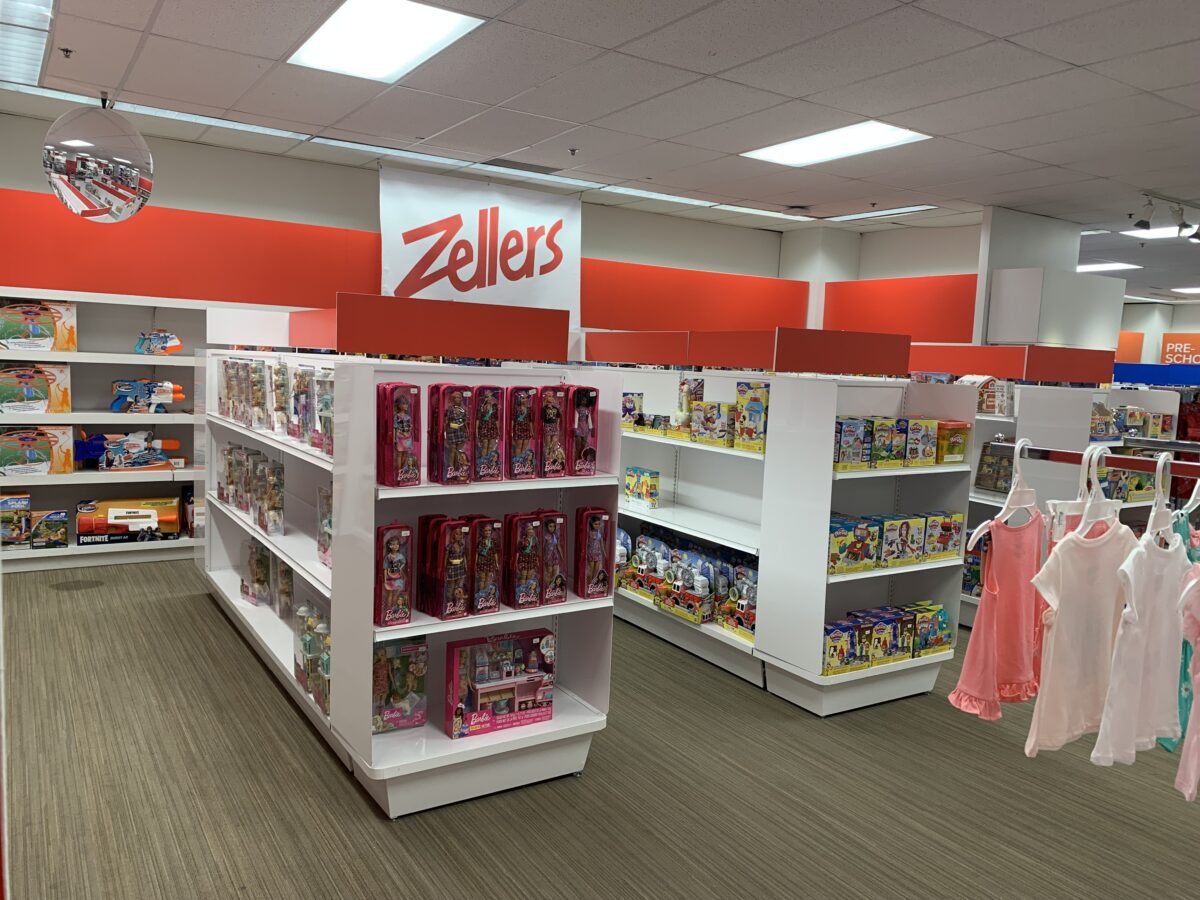
Zellers at Hudson’s Bay Burlington Mall – Photo by Sean Tarry
Could Specialty Retail Be on the Horizon?
Beyond integrations into existing stores, another intriguing idea is the creation of specialty Hudson’s Bay-branded retail outlets that sell Stripes and Coat of Arms-themed merchandise.
“You could do small shops in malls, kiosks, or even airport stores focused on tourists,” said Winder. “Think duty-free, travel hubs—Canadian-made or inspired products with the HBC heritage branding.”
Such a strategy could create premium brand positioning while expanding Canadian Tire’s retail footprint without the overhead of full department stores.
“Online would also be huge,” he added. “They’ve grown their eCommerce channels. It’s a perfect place to showcase these heritage lines.”
Footwear, Apparel, and Merchandising Strategy
Canadian Tire’s past acquisitions have included heritage Canadian brands like Woods and Paderno, which the company successfully revitalized through private label production and wide distribution. Winder expects the same playbook to apply here.
The merchandising question is crucial. Will these brands appear as product lines integrated into shelves, or will Canadian Tire build a distinct in-store presence?
“That’s the big debate,” said Winder. “Do they do stores-within-a-store, or do they just embed the products across the existing assortment and elevate the presentation a bit?”
Stripe blanket. Image: Hudson’s Bay Company
Branding, Goodwill, and Public Reaction
For Canadian Tire, the acquisition may already be paying dividends in brand equity. The overwhelming public response has been positive, with Canadians taking to social media to praise the move as a patriotic gesture that preserved national icons.
“It’s hard to buy this kind of advertising,” said Winder. “I must have done at least five to ten interviews about it the day the news broke.”
Winder noted that Canadian Tire was largely seen as a “saviour” of a cultural asset that would otherwise be lost or sold to foreign interests.
“They got a lot of goodwill out of this. People are happy the Stripes are staying Canadian.”
The Broader Retail Context
Despite the enthusiasm, Winder reminds us that this move comes during one of the most difficult moments in Canadian retail history. Hudson’s Bay’s demise has left thousands unemployed and mall landlords scrambling to fill anchor vacancies.
“This is really nice news for some things,” he said. “But it’s still a catastrophe. It didn’t have to be this way.”
According to Winder, Hudson’s Bay’s downfall could have been prevented if the company had received proper investment and stewardship over the last two decades.
“HBC just starved the company. No capital investment. No vision,” he said. “There’s still a lot of bitterness out there—especially among former employees.”
Previous Hudson’s Bay Stripes collaboration. Image: Hudson’s Bay Company
A Deal That May Have Been a Bargain
Some observers were initially surprised at the $30-million price tag for such iconic intellectual property. But Winder believes the number reflects strong value when considered against the backdrop of Canadian Tire’s future potential for these brands.
“At first I thought it was high,” he admitted. “But when you break it down—Four Stripes, GlucksteinHome, the coat of arms, possibly Zellers—it’s actually pretty decent.”
Moreover, Canadian Tire now holds exclusive rights to manufacture, market, and distribute products using this IP, earning higher margins without a third-party manufacturer.
“They get to make private label margins,” Winder said. “That alone is worth a lot.”
Looking Ahead
The Canadian retail industry is watching closely to see what Canadian Tire will do with its latest acquisition. Will it integrate the IP subtly, or launch bold new verticals? Will we see standalone shops, branded sections in stores, or airport boutiques?
So far, the only certainty is that Canadian Tire has gained the trust of the public and the tools to build something remarkable—if it can honour the legacy of Hudson’s Bay while adapting to modern retail realities.
As Winder put it: “They’ve got the permission from consumers. If they do it right—tastefully, and with respect for the heritage—this could be something really special.”
Safeway store at King Edward and Cambie in Vancouver, May 2025. Photo: Craig Patterson
It was expected, but still jarring. In April, food inflation in Canada surged to 3.8% — a full 2.1 percentage points above the national inflation rate, and nearly double the U.S. rate of 2.0%. Once again, food is the primary driver behind Canada’s headline inflation, amplifying affordability concerns from coast to coast.
Behind that 3.8% figure lie significant increases across key food categories. Meat prices climbed 5.8% year-over-year, with beef leading the pack at a staggering 16.5%. Egg prices rose 3.9%, while fresh fruit and vegetable prices increased by 5.0% and 3.7%, respectively. These aren’t anomalies. They reflect underlying cost pressures exacerbated by recent shifts in trade policy and supply chain strategy.
Since March, when both Canada and the United States implemented a new round of tariffs, the divergence in outcomes has been striking. U.S. food inflation has continued to cool, while Canada’s has nearly tripled over the same period.
Tripled.
In two integrated economies, this growing disparity should raise red flags.
The root causes are increasingly evident. Ottawa’s earlier decision to implement counter-tariffs disrupted long-standing North American procurement systems. In response, Canadian grocers began pivoting away from U.S. suppliers — particularly in categories like fresh produce and frozen foods — and turned to costlier or less efficient alternatives. The results are now showing up on the grocery bill.
Fortunately, that policy direction has changed. According to a recent report from Oxford Economics, Prime Minister Mark Carney quietly eliminated many of the counter-tariffs that had been inflating food costs. The decision, while politically delicate, was economically sound — and long overdue. Easing those restrictions is already beginning to relieve pressure along the supply chain. Over time, this could help stabilize or even slow food price growth.
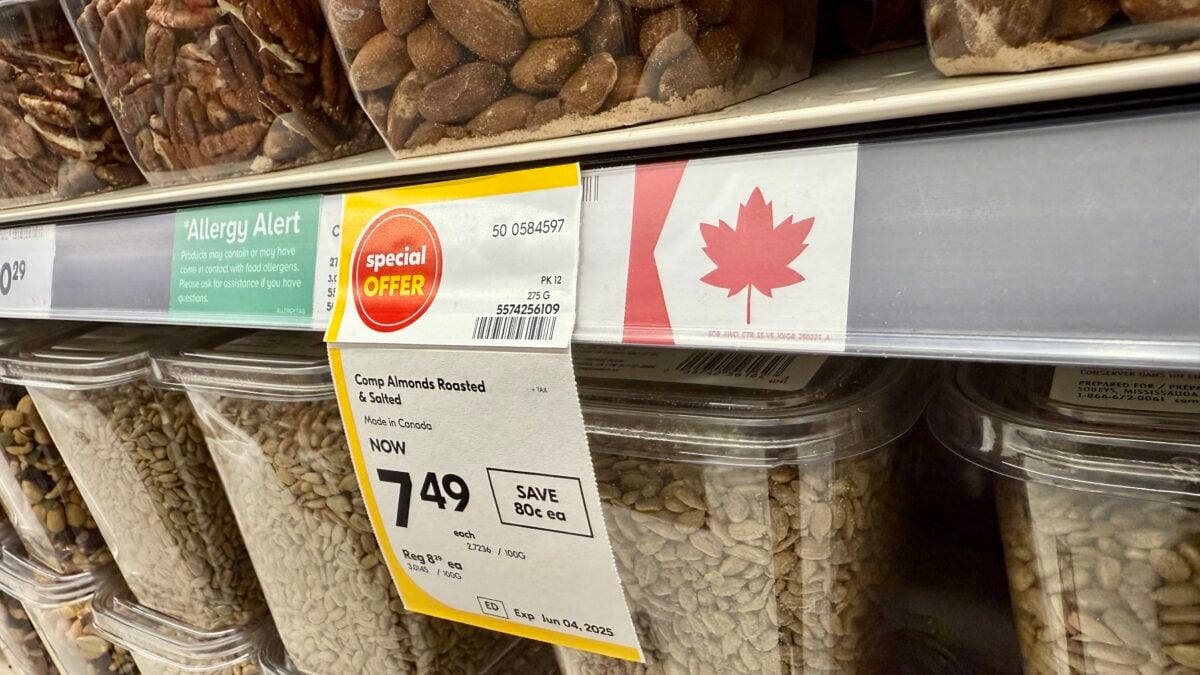
Product of Canada/Canadian made signage at a Safeway store in Vancouver, May 2025. Photo: Craig Patterson
But broader context matters. Among G7 nations, Canada now has the second-highest food inflation rate — behind only Japan. Food price increases in France, Germany, Italy, the United Kingdom, and the United States remain well below Canada’s. That begs the question: Why is food more expensive in Canada than in almost every other advanced economy?
The answer is not just international volatility or climate shocks. It’s also about domestic choices. Tariffs, protectionist procurement practices, and structurally limited trade flexibility have created a uniquely Canadian inflation narrative — one driven more by internal policy than by external pressures.
And Canada’s geoeconomic leverage simply doesn’t compare to that of the United States. Not even close. That’s why Carney’s reversal on food-related tariffs represents an opportunity — to reset policy priorities and adopt a more pragmatic, less performative approach to affordability.
Canadians should welcome this shift. But they also deserve transparency. Food inflation cannot be solely blamed on global disruptions or seasonal cycles. It’s time we acknowledged how much of it is homegrown.
Moving forward, federal and provincial governments must coordinate more effectively, communicate with greater clarity, and ensure that access to affordable, nutritious food remains a national priority.
Of course, there’s nothing inherently wrong with patriotic consumerism. But “maplewashing” — the marketing of imported goods under misleading “Canadian” banners — is misleading and risks undermining public trust. Worse, it can distort markets and push prices even higher. Grocers should not abuse.
As for Ottawa, symbols like “Elbows Up” and “Canada’s Not For Sale” may have mobilized support during a volatile political moment, but they should never substitute for sound economic governance. Rhetoric can only go so far — and, in some cases, it blinds policymakers to the very consequences of their actions.
Canada’s food inflation story didn’t have to unfold this way. Now that we have an opportunity to correct course, let’s not waste it.
Celebrating 50 years in Canada (CNW Group/Wendy's Restaurants of Canada)
Wendy’s, the iconic quick-service restaurant brand known for its fresh, never frozen square beef hamburgers, is celebrating a major milestone — 50 years of serving Canadians.
Since opening its first Canadian location in 1975 in Hamilton, Ontario — a restaurant that’s still welcoming customers today — Wendy’s Canada has grown its footprint to nearly 450 franchise-owned and locally operated restaurants across the country.
To mark its golden anniversary, Wendy’s is offering its beloved Jr. Frosty for just 50 cents through May 24. (Limited time only at participating Canada Wendy’s. A la carte only. Not valid for delivery orders or with any other discount or offer. While supplies last.) The treat, available in classic chocolate and vanilla flavours, is made with 100% Canadian dairy and aims to give fans a cool way to celebrate both the milestone and the unofficial start of summer.
Wendy’s longstanding commitment to Canadian sourcing is also in the spotlight. The company notes that nearly 70% of its ingredients in Canada are locally sourced — including 100% Canadian beef and chicken, as well as greenhouse-grown lettuce and tomatoes. The brand also sources over 45 million pounds of Canadian potatoes annually from more than 130 family farms across the country for its seasoned breakfast potatoes and signature Hot & Crispy Fries.
Jaime Weeks
“For 50 years, Wendy’s has been bringing Canadians together by serving fresh food and providing exceptional hospitality,” said Jaime Weeks, Vice President, Managing Director, Wendy’s Canada. “This milestone reflects the loyalty of our fans, the dedication of our franchise partners and restaurant teams, and the strength of the Wendy’s brand. As we look to the future, we’re more energized than ever to grow and innovate as we bring more Wendy’s to more people across Canada.”
Looking ahead, Wendy’s Canada says the 50th anniversary is not just a celebration of the past but a springboard into the future. With plans to expand its restaurant presence, maintain its focus on community impact, and double down on its commitment to fresh, locally sourced ingredients, Wendy’s is well-positioned to serve more Canadians in the years to come.
GoBolt, a leading third-party logistics (3PL) and last-mile provider, has unveiled its 2025 State of Logistics Report — a comprehensive look into the evolving logistics landscape. The report is based on a wide-reaching survey of logistics and supply chain leaders from top-tier retail and direct-to-consumer (DTC) brands, focusing on fulfillment reliability, cost efficiency, and strategies to tackle rising industry challenges in the year ahead.
As global logistics continues to navigate increased costs, regulatory shifts, and surging consumer expectations, brands are doubling down on operational efficiency through smarter technology adoption and robust last-mile strategies.
Mark Ang, co-founder of GoBolt
“Logistics is undergoing rapid transformation, particularly this year, as shifting regulations, evolving policies, and rising costs continue to disrupt the industry,” said Mark Ang, CEO and Co-Founder of GoBolt. “Our 2025 report offers actionable insights and practical strategies to help brands optimize their fulfillment and last mile delivery operations to navigate the complexities of the coming years.”
Key Findings from the 2025 State of Logistics Report:
Cost Efficiency Is Driving 3PL Adoption With cost pressures mounting, the report identifies cost as the number one reason brands are partnering with 3PL providers. Many brands are reassessing their logistics models to stay competitive amid economic uncertainty.
Carrier Diversification Emerges as a Strategic Imperative According to the report, 65% of logistics leaders believe that diversifying their carrier networks will lead to significant cost reductions. This highlights a major shift toward strategic flexibility in fulfillment planning heading into 2025.
Last-Mile Visibility Is a Top Priority Last-mile delivery remains the most complex — and costly — segment of the supply chain. Notably, 77% of survey respondents agree that measuring last-mile performance and associated costs will be vital in the coming years.
Returns Management Still a Major Challenge The issue of product returns continues to weigh heavily on retail operations. The report reveals that 52% of brands see returns management as a top value-added service they require from 3PL partners to cut costs and enhance customer loyalty.
The report also touches on how brands are adjusting to new tariff regulations and Section 321 policy changes. While 34% of respondents are still evaluating their options, others are shifting inventory approaches or exploring new 3PL partnerships. Though this specific data is not included in the full report, GoBolt notes that further insights are available on the official report landing page.
The 2025 State of Logistics Report (CNW Group/Bolt Technologies Incorporated)
Retail and DTC brands can download the full 2025 Logistics Report: Trends, Challenges & Opportunities at gobolt.com/the-2025-logistics-report. The report includes detailed findings and expert strategies to help brands build stronger, more resilient logistics operations.
About GoBolt
Founded in 2017, GoBolt is building the largest sustainable supply chain network in North America. The company provides reliable warehousing, pick and pack, shipping, and last-mile delivery services. With a growing warehouse footprint and proprietary software developed in-house, GoBolt gives merchants greater transparency and control. GoBolt is also committed to carbon-neutral deliveries — leveraging electric vehicles where possible and sequestering emissions when not.
The Consumer Price Index (CPI) in Canada rose 1.7% year over year in April, down from a 2.3% increase in March. The slowdown in April was driven by lower energy prices, which fell 12.7% following a 0.3% decline in March. Excluding energy, the CPI rose 2.9% in April, following a 2.5% increase in March, according to a Statistics Canada report released on Tuesday. Moderating the slowdown in the CPI in April were higher prices for travel tours (+6.7%) and food purchased from grocery stores (+3.8%).
On a monthly basis, the CPI fell 0.1% in April. On a seasonally adjusted monthly basis, the CPI was down 0.2%, said the federal agency.
Gasoline led the decline in consumer energy prices, falling 18.1% year over year in April, following a 1.6% decline in March. The price decrease in April was mainly driven by the removal of the consumer carbon price. Lower crude oil prices also contributed to the decline. Global oil demand decreased due to slowing international trade related to tariffs. In addition, supply from the Organization of the Petroleum Exporting Countries and its partners (OPEC+) increased, explained Statistics Canada.
Year over year, prices for natural gas fell 14.1% in April, after a 6.4% gain in March. The removal of the consumer carbon price contributed to the decline in April, it said.
Photo by Jack Sparrow
In April, prices for food purchased from stores grew at a faster pace, increasing 3.8% year over year compared with 3.2% in March. Prices for food purchased from stores have been increasing at a faster rate than the all-items CPI for three consecutive months, said Statistics Canada
The largest contributors to the year-over-year acceleration in April were fresh vegetables (+3.7%), fresh or frozen beef (+16.2%), coffee and tea (+13.4%), sugar and confectionery (+8.6%) and other food preparations (+3.2%). Prices for food purchased from restaurants also rose at a faster rate in April, increasing 3.6% year over year, following a 3.2% gain in March, said the report.
Andrew Grantham, Senior Economist, CIBC Capital Markets, said headline inflation suddenly looks less taxing for the Bank of Canada, due to the elimination of the consumer carbon tax and the downward impact of that on gasoline prices, but some core measures remain a concern.
Andrew Grantham
“Overall CPI fell by 0.1% in April (-0.2% SA) and the year-over-year pace decelerated to 1.7% from 2.3%. Gasoline prices were down 18% y/y, but that was partly offset by a slight reacceleration in food prices. Excluding food/energy, prices rose by 0.3% SA in April following a flat reading in the prior month, partly due to a rebound in travel tour prices following an unusually weak March,” he said.
“The Bank of Canada’s preferred core measures of inflation (including CPI-Trim, Median and CPI-X) all calculate price changes excluding the impact of indirect taxes and as a result weren’t directly impacted by the carbon tax removal. CPI-Trim and CPI-median both accelerated above 3% on a year-over-year basis (3.1% and 3.2% respectively), although we have shown in the past that these measures can be impacted by broad changes in food prices given their heavy weight in the overall basket.
“Signs of renewed weakening in the economy on one hand, as shown by the latest employment data, but stronger core inflation on the other makes for a tough decision for the Bank of Canada at its early June meeting.”
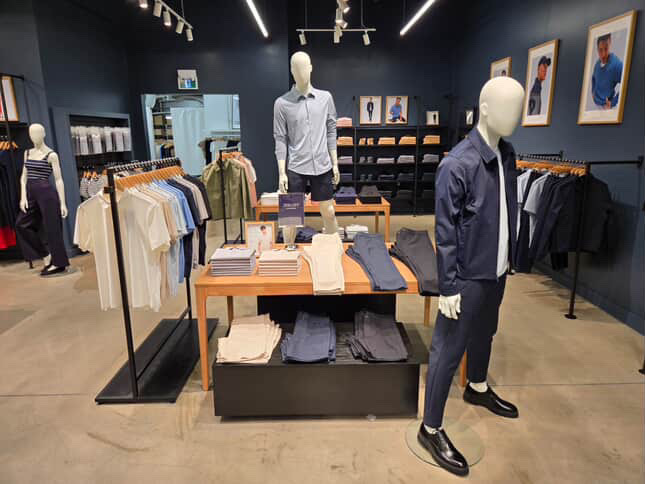
Kit and Ace at The Well in Toronto. Photo: supplied
Canadian apparel brand Kit and Ace has launched a new retail space at The Well in downtown Toronto, marking its 10th store and part of a larger national expansion strategy under the leadership of CEO David Lui. The opening reflects the brand’s focus on experience-driven retail, strategic location selection, and a renewed emphasis on connecting with urban professionals.
Although officially designated a pop-up, the Kit and Ace store at The Well is far from a temporary experiment. The brand has developed a strong relationship with the development’s landlord and is treating the space as a permanent fixture—with room to evolve.
David Lui
“It’s a pop-up with long-term intent,” explained Lui. “We’ve worked closely with the landlord, and The Well offered a great space. The intent is to stay.”
At approximately 2,500 square feet, the new location focuses on delivering a curated brand experience rather than showcasing the full breadth of Kit and Ace’s assortment. Lui emphasized that the store highlights the brand’s most innovative and beloved fabrics, such as its brushed French terry and cooling cotton Marbella boyfriend shirts.
“We’re really trying to tell our story through the materials we’re known for,” said Lui. “We want people to come in and feel the difference.”
Why The Well?
The decision to open at The Well—Toronto’s ambitious new mixed-use community developed by RioCan REIT and Allied Properties REIT—was strategic.
“The Well is a fascinating development,” said Lui. “It’s full of young professionals, and that’s exactly our target demographic: people on the move, people who need clothing that’s functional but refined.”
Located at Front and Spadina, The Well integrates residential, office, and retail space with an emphasis on design, sustainability, and community. With over 500,000 square feet of retail—including anchors like Adidas, Indigo, Sephora, and a 70,000-square-foot food hall—The Well is expected to see over 20,000 daily visitors.
“The design, the tenant mix, the energy—it all aligns with who we are as a brand,” said Lui. “And it gives us another strong downtown presence.”
Kit and Ace now operates three downtown Toronto stores—at CF Toronto Eaton Centre, Queen Street West, and The Well—along with others including CF Sherway Gardens, Toronto Premium Outlets in Halton Hills, and downtown Oakville.
“We now have six stores in Toronto and the GTA,” said Lui. “That’s a substantial presence.”
Lui noted that each location serves a slightly different demographic, from tourists and commuters downtown to outlet shoppers and suburban professionals, allowing Kit and Ace to engage with a diverse urban customer base.
Kit and Ace at The Well in Toronto. Photo: supplied
National Expansion Under New Ownership
Founded in 2014 by Shannon and JJ Wilson—connected to Lululemon’s founding family—Kit and Ace was originally known for machine-washable cashmere and performance-infused fashion. Following rapid international expansion and a 2017 contraction, the brand was refocused under new ownership.
In July 2023, Unity Brands Inc. acquired Kit and Ace. The firm is co-founded by retail veterans Joe Mimran, Frank Rocchetti, and David Lui, who brought more than 30 years of marketing and retail experience to his new role as CEO.
Since then, Lui has helped scale the brand from four stores to 10, with additional locations set to open.
“This one is our 10th,” Lui noted. “We’ve got another pop-up launching at Metropolis at Metrotown before Father’s Day. And we’re already working on a few more for summer.”
He added that expansion will continue to focus on a blend of high-traffic shopping centres, lifestyle nodes, and key urban neighbourhoods.
Kit and Ace at The Well in Toronto. Photo: supplied
A Consistent Brand Experience
Even with smaller-format stores or temporary setups, Kit and Ace is committed to delivering a consistent and immersive experience. At The Well, the store includes tactile displays and curated merchandise built around the brand’s performance-meets-luxury identity.
“Even though it’s a pop-up, we want to make sure the experience matches that of our other stores,” said Lui. “That’s really important for us.”
The brand’s product philosophy continues to centre around elevated essentials—minimalist pieces built for movement and designed for everyday wear. Its offerings are aimed at urban professionals seeking functionality, comfort, and understated sophistication.
“Our commitment is to technical apparel with a modern silhouette. And our stores—wherever they are—need to reflect that vision.”
A Hometown Hero in Vancouver
While Kit and Ace has been expanding in Toronto, the brand still maintains deep roots in Vancouver, where it opened its first store in Gastown in 2014.
“We’re a hometown hero in B.C.,” said Lui. “The recognition and support in Vancouver have always been strong. Our West 4th store is actually one of our top-performing locations.”
Lui noted that Calgary has also emerged as a strong market, with growing brand awareness and loyal customers. Other stores include CF Market Mall in Calgary and two Vancouver stores — Gastown and West 4th Avenue in Kitsilano.
Kit and Ace at The Well in Toronto. Photo: supplied
Seeking a Toronto Flagship
While The Well adds another strategic address, Lui confirmed that Kit and Ace is still evaluating options for a permanent flagship store in Toronto.
“We’re always looking,” he said. “But it’s hard—flagship retail in Toronto can be prohibitively expensive. We want the right space at the right time.”
In the meantime, pop-ups are proving to be an effective strategy for testing new markets and gaining exposure.
“The flexibility helps us stay agile,” said Lui. “We can enter a market quickly, make an impression, and decide from there.”
With momentum building across the country, Kit and Ace is poised for continued growth through the remainder of 2025. The brand is expected to announce further openings later this year, including new permanent locations and additional pop-ups.
“We’ve got some exciting things coming,” said Lui. “Summer will be a big one for us.”