Toronto’s retail leasing market remains robust despite economic uncertainty, with strong demand for prime locations and a competitive battle for quality space. According to JLL Canada’s Q4 2024 Toronto Urban Retail Report, demand for retail space continues to outstrip supply in many key corridors, leading to higher rental rates and a challenging landscape for expansion-minded retailers.
The study found that the availability rate across Toronto’s 11 key retail corridors stood at 8.13%, the lowest figure recorded since the report’s inception. Average asking rents across all corridors increased to $98.23 per square foot, with Bloor Street commanding the highest rate at $267.53 per square foot, reinforcing its status as the city’s premier luxury retail destination. Yorkville Avenue followed with an average asking rent of $118.33 per square foot.

Brandon Gorman, EVP of Retail at JLL Canada, described the current leasing market as highly competitive.
“There’s just not a lot of good space available right now. It’s not like there’s a huge pipeline of new retail development, so it’s a battle to find quality locations,” Gorman explained. “We’re seeing situations where tenants are willing to pay key money just to secure a prime spot.”
Food & Beverage Dominates Leasing Activity
Food and beverage (F&B) continues to be the dominant category in retail leasing, accounting for almost half of all new deals. In Q4 2024 alone, F&B tenants signed eight new leases totaling 19,612 square feet, with a particular focus on the Yonge Street and Queen Street West submarkets.
Notable new entrants in the F&B sector include Marugame Udon, which leased 3,932 square feet at 480 Yonge Street, and Seoul Gamjatang, which secured a 2,670-square-foot space at 475 Yonge Street. The trend underscores the continued strength of experiential retail and consumer preference for dining out.
Queen Street West and Bloor Street in Transition
While Queen Street West remains an active leasing corridor, it has seen a number of high-profile closures in recent months. Brands like Reigning Champ, Zara, H&M, and Adidas have exited the area, raising concerns about retail turnover. Gorman noted that some closures may be linked to fears over upcoming construction on the Ontario Line, though he believes these concerns are overstated.
“I don’t think construction is going to impact Queen West as much as some landlords fear,” he said. “But there’s definitely been a bit of reshuffling.”
Meanwhile, Bloor Street continues its transformation into a flagship-driven luxury corridor, with significant interest from high-end retailers. The report highlights recent openings such as Burberry’s relocation to 100 Bloor Street West and Nike’s 17,000-square-foot flagship at Bloor and Yonge.
However, concerns remain regarding upcoming construction projects that could disrupt the street for years. “The planned redevelopment of the Harry Rosen building (80-82 Bloor), alongside major projects on the south side of the street, could carve up this retail corridor for seven to ten years,” Gorman cautioned. “That’s something both landlords and tenants are watching closely.”
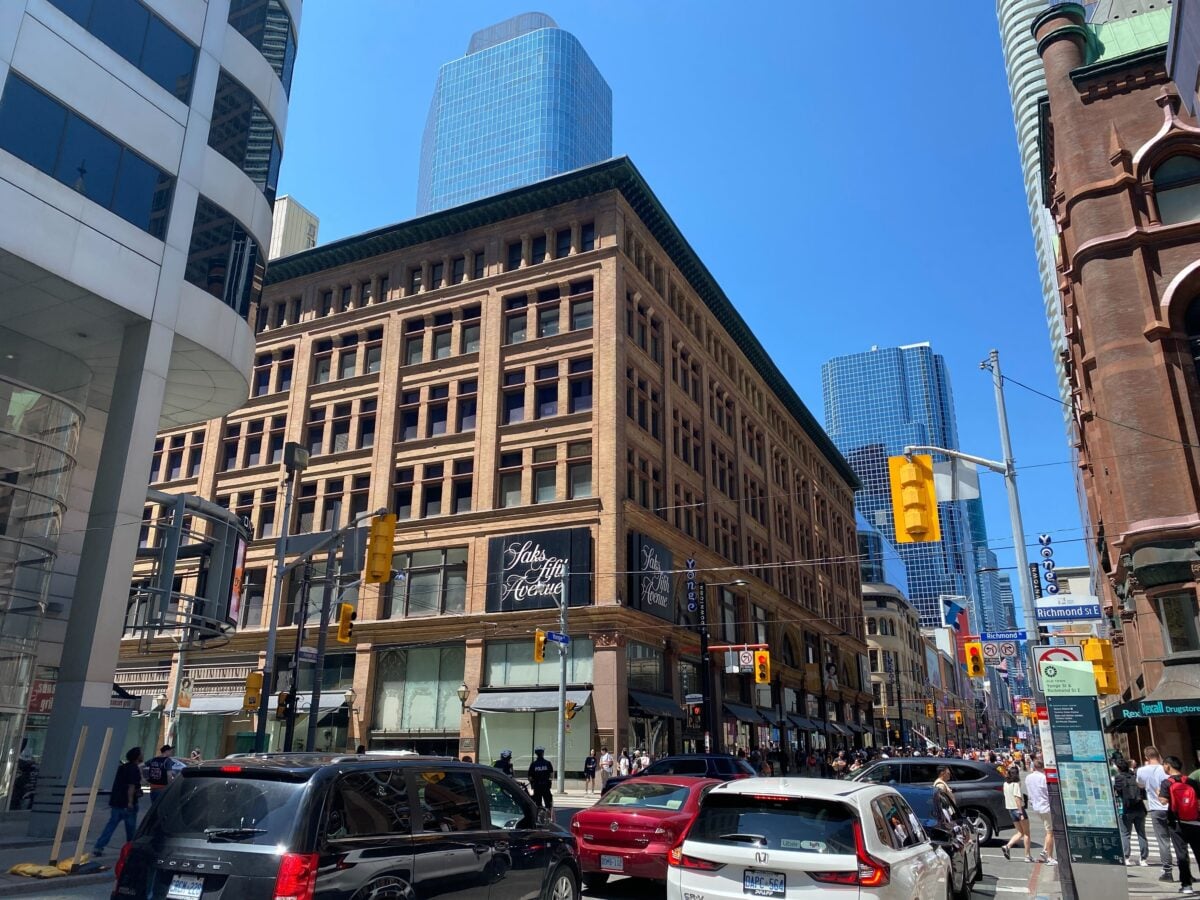
The report also notes that Yonge Street (Gerrard to Bloor) remains the most active leasing corridor, accounting for 16,420 square feet of newly leased space in Q4 2024. King Street West (Spadina to Bathurst) had the highest vacancy rate at 19.74%, while Ossington Avenue remains one of the tightest markets, with only one available space as of December 31, 2024.
Retail Demand Outweighs Economic Concerns
Despite economic headwinds, including moderating consumer confidence and U.S. tariffs on Canadian goods, retail demand in Toronto remains strong. JLL’s report indicates that visitor spending in 2024 hit $8.8 billion, a 4% increase year-over-year and 7% above pre-pandemic levels. The Taylor Swift Eras Tour alone contributed to a 31% rise in restaurant spending and a 45% jump in hotel spending near Rogers Centre.
Even with ongoing inflation concerns, shoppers are expected to spend more per capita in 2025, with discretionary spending showing resilience. However, tariffs on Canadian goods could create uncertainty for retailers importing products from the U.S., impacting supply chains and pricing.”
The report concludes by saying that with strong demand, limited supply, and ongoing economic uncertainties, Toronto’s retail leasing landscape in 2025 will continue to favour landlords in prime areas. Retailers looking to secure flagship locations should act swiftly, as the city’s most sought-after spaces are becoming increasingly scarce.