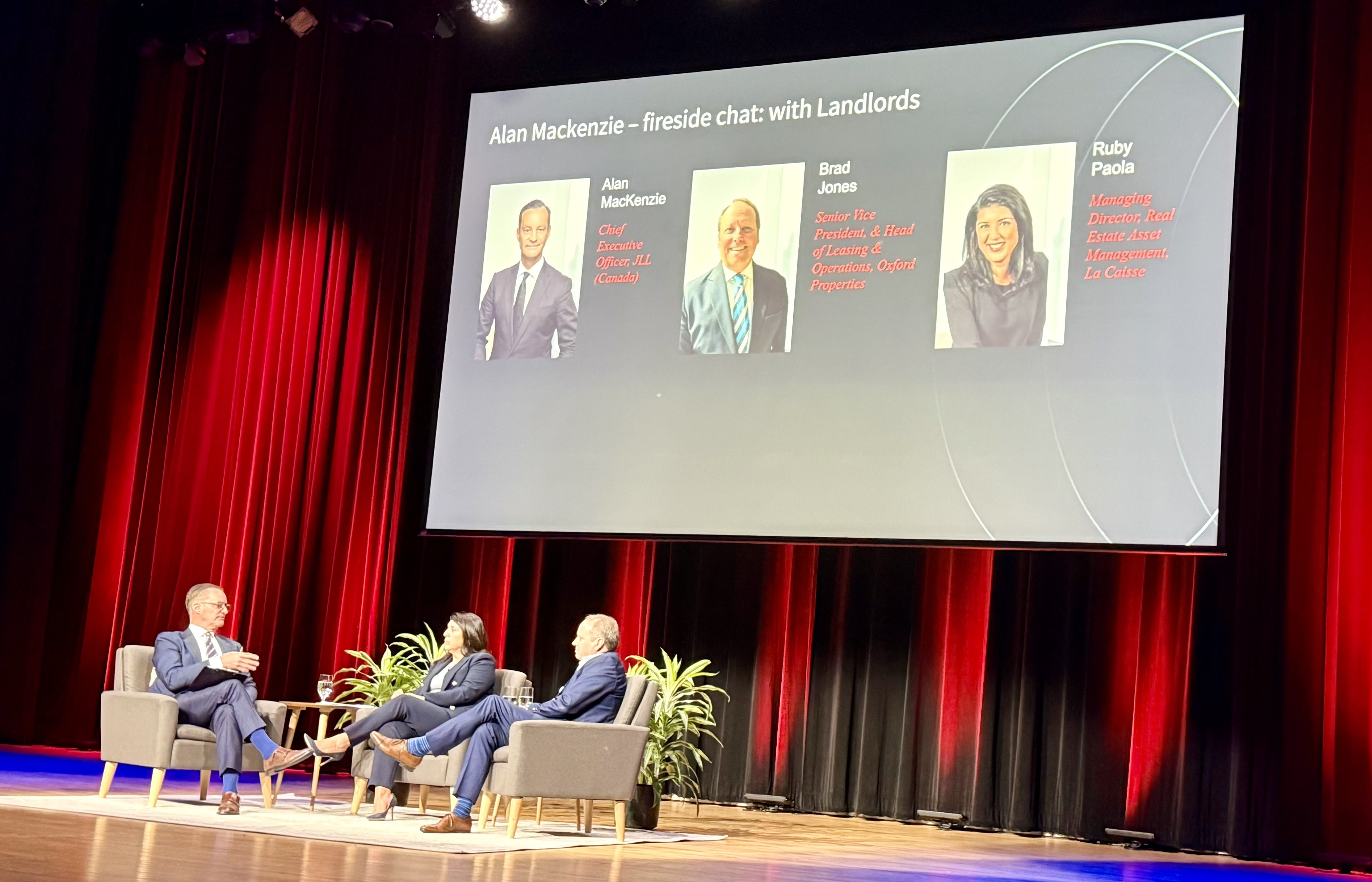
The conversation around Canadian retail’s transformation took centre stage on Monday at the JLL Retail Spotlight, held during ICSC Toronto. Hosted by Alan Mackenzie, CEO of JLL Canada, the fireside chat featured two of the country’s most influential landlords: Brad Jones, Senior Vice President and Head of Leasing and Operations at Oxford Properties, and Ruby Paola, Managing Director of Real Estate Asset Management at La Caisse (formerly Ivanhoé Cambridge).
Over the course of a thoughtful, wide-ranging discussion, the executives explored how Canadian retail real estate continues to evolve through disruption, resilience, and a renewed emphasis on placemaking and collaboration between landlords, retailers, and brokers.
Kicking off the discussion, Ruby Paola reflected on the strength of the Canadian market and the people who shape it.
“In Canada particularly, we really have skilled owners, brokers, and asset managers,” said Paola. “It takes a proactive approach and strong tenant–landlord relationships. I think we all do a very good job at doing that.”
Paola emphasized that resilience in the retail industry extends beyond surviving short-term disruptions. It is about long-term evolution — constantly adapting to changing consumer demands and market dynamics.
She noted that with new retail developments at an all-time low, landlords have become more selective and strategic in curating their tenant mixes. “Our second-generation spaces are being replaced relatively quickly,” she added. “That’s a testament to the strength of the teams and the relationships we’ve built.”
The Customer at the Centre
When asked what is driving retail success in Canada today, Brad Jones was clear: everything begins and ends with the consumer.
“The resilience of our customer is really quite extraordinary,” said Jones. “We’ve got tremendous momentum and tailwinds at our back. The ecosystem is changing fast, and people are coming to shopping centres for experiences, not just to shop.”
He pointed to Oxford’s focus on placemaking and experiential retail, including immersive activations and specialty leasing programs that attract traffic and drive sales across categories.
“People come to meet family, to socialize, to enjoy themselves,” Jones continued. “If you continue to innovate, you’ll continue to attract new and better customers and have an opportunity to grow your business. We’re very bullish about what’s happening right now.”
Placemaking as a Strategic Advantage
Both landlords agreed that placemaking has become central to the evolution of retail real estate. Paola described it as the process of transforming traditional shopping centres into multi-dimensional social hubs.
“Placemaking gives you the opportunity to take shopping centres from purely places to transact to something much more,” she said. “You might be shopping, dining, or attending an event. These spaces become community hubs where people gather, and retailers want to be where people gather.”
She noted that if landlords can make their centres that “third place”, a social destination beyond home and work, they can achieve something truly special.
Jones agreed, adding that Oxford is increasingly blending physical and digital experiences to meet consumers’ evolving expectations. “There’s an amazing opportunity to marry physical real estate with the digital world,” he said. “Customers want to be part of something, to belong to a community.”
Urban and Suburban Strategies
The conversation then turned to how consumer behaviour differs between urban and suburban centres.
Paola pointed to La Caisse’s Montreal Eaton Centre as an example of an urban property that has undergone significant transformation.
“We joined two buildings about five years ago and began aligning the mix to new preferences,” she said. “Bringing in Time Out Market, the first in Canada, was a game-changer. It touches on dining, events, and community. It’s really become a gathering place.”
The downtown location, connected to transit and surrounded by office and residential density, has benefitted from a curated mix of retail, entertainment, and food offerings designed for multiple customer groups — residents, office workers, tourists, and local shoppers alike.
On the suburban front, Jones cited Oxford’s Scarborough Town Centre and Square One as examples of super-regional assets that continue to thrive by adapting to new mobility and lifestyle patterns.
“When you have great real estate, you better have a significant strategy and be able to execute,” he said. “Transit, growth markets, and infrastructure investments are driving opportunity. Customers increasingly want to live, work, and play in one community.”
He compared these suburban hubs to Asian and Australian retail developments that integrate health, wellness, food, and entertainment in self-contained ecosystems. “They really don’t need to leave their community,” Jones said. “That’s where we’re heading, and it’s incredibly exciting.”
Strengthening Landlord–Tenant Partnerships
Beyond design and development, both executives agreed that strong relationships between landlords and retailers are the foundation of long-term success.
“Commercial real estate is network-driven,” Paola explained. “Your long-term relationships aren’t built on contracts. They’re built on trust, communication, and understanding.”
She emphasized that landlords and tenants share the same goal: mutual success. “If the retailers thrive, our shopping centres thrive,” she said. “It’s basic, but it’s true. And people might not remember the deal you did with them, but they will remember how you made them feel.”
Her advice to younger professionals entering the industry was simple: take the time to build real relationships. “Go visit your tenants’ offices, show you care, and invest in those connections,” she said. “It makes all the difference.”
Data, Technology, and the Future of Brokerage
In one of the session’s most forward-looking moments, Jones discussed how technology is reshaping the brokerage and leasing model.
“The brokerage world was built on the scarcity of data,” he said. “That’s changing fast with technology. The question is how brokers evolve their relationships and add value differently.”
He believes the future of brokerage lies in advisory, analytics, and partnership, rather than simple transaction facilitation.
“It’s going to be more data-driven, more consultative,” Jones said. “Understanding clients’ balance sheets, their P&Ls, their CapEx budgets. It’s about aligning strategies and sharing intelligence.”
Mackenzie added that this evolution mirrors a broader industry trend toward collaboration and transparency. “It’s our role to understand the objectives of the tenant and the landlord,” he said. “Partnerships that drive sales and support long-term growth will ultimately define success.”
As the discussion closed, Mackenzie reflected on the forward momentum of Canadian retail. The room was filled with both industry veterans and younger professionals, and the speakers expressed optimism for the next generation’s ability to sustain innovation and trust in a rapidly changing environment.
Jones summed it up succinctly: “Innovation is key. The traditional way of transacting isn’t going to continue as it is. The industry is evolving, and that’s exciting for everyone who’s part of it.”