PetSmart Canada is introducing a new monthly in-store celebration for pet birthdays and gotcha days at all of its locations nationwide.
According to new survey data released by the company, 75 per cent of Canadian pet parents celebrate their pet’s birthday or gotcha day, while 47 per cent wish they could do more.
To meet that interest, PetSmart is rolling out its Birthday + Gotcha Bash events, which will take place once a month at stores across the country. The gatherings will feature free treats, fun activities and a $5 off birthday coupon, available exclusively to attendees.
Bradley Breuer
“Every pet deserves to be celebrated, especially on their birthday or gotcha day,” said Bradley Breuer, vice-president of marketing at PetSmart. “PetSmart’s Birthday + Gotcha Bash celebrations are designed to make those special days unforgettable, turning milestones into joyful moments. We’re excited to help make every pet feel like the guest of honour.”
Upcoming event dates include Oct. 4, Nov. 8 and Dec. 7, 2025. Events will be held in all Canadian PetSmart stores, as well as locations in the U.S. and Puerto Rico, while supplies last.
The retailer has more than 160 stores across Canada.
Pet owners are also encouraged to join the PetSmart Treats Rewards program and update their profiles with their pet’s information to receive birthday offers and gotcha day surprises.
Party supplies and celebration essentials are available for purchase at PetSmart.ca.
The survey was conducted by the Angus Reid Forum between Sept. 18 and 22, 2025, and included a representative sample of 1,010 English-speaking Canadians. The survey has a margin of error of +/- 3.1 percentage points, 19 times out of 20.
The fundraising campaign was created in 2021 by a group of Indigenous Tim Hortons restaurant owners. Since its inception, it has raised more than $5.3 million.
Hope Bagozzi
“Thank you for helping us raise $942,000 in just one day for Indigenous organizations,” said Hope Bagozzi, chief marketing officer for Tim Hortons. “The incredible support from guests and Tims restaurant owners is a testament to how we can all come together to make a difference.”
“We are deeply moved by Tim Hortons continued dedication to the Orange Shirt Society through the Orange Sprinkle Donut campaign,” said Henderson. “Your generosity is more than a donation — it’s a powerful act of reconciliation and remembrance. These contributions help us sustain meaningful programs that uplift Indigenous voices, educate communities, and support healing across generations. Thank you for standing with us and helping ensure that Every Child Matters.”
Tim Hortons Orange Sprinkle Donut campaign raised $942,000 for Indigenous organizations (CNW Group/Tim Hortons)
The Gord Downie & Chanie Wenjack Fund said the campaign helps extend the reach of its educational programs.
Sarah Midanik
“With support from the Orange Sprinkle Donut campaign, the Gord Downie & Chanie Wenjack Fund is reaching more than 9,500 educators from coast to coast to coast through our Legacy Schools program,” said Sarah Midanik, president and CEO. “This year, as we commemorate the 10th anniversary of the Truth and Reconciliation Commission’s Final Report and 94 Calls to Action, Tim Hortons continued support enables us to broaden our reach and create meaningful opportunities for educators and students to respond to the Calls to Action.”
“IRSSS is honoured to once again be a beneficiary of the Orange Sprinkle Donut campaign, and we are grateful to Tim Hortons and their guests across Canada for this generous support,” said White. “The demand for our services continues to grow each year, and this partnership helps ensure we can reach more communities, including remote areas, with the healing resources they need today and for generations to come.”
At the Ulnooweg Education Centre, the funds contribute to youth-focused cultural programming.
Chris Googoo
“Our partnership with Tim Hortons’ Orange Sprinkle Donut campaign helps us create spaces where Indigenous youth can grow together,” said Chris Googoo, chief operating officer. “These camps encourage confidence, culture, and connection, ensuring that Indigenous youth leave with stronger community ties and a brighter outlook for the future.”
“The New Pathways Foundation wishes to express its deep gratitude to the Tim Hortons family who, year after year, support First Nations youth with heart through this meaningful campaign,” said Cleary. “Thanks to this commitment, we are able to continue our mission and offer youth from First Nations communities in Quebec opportunities that truly match their dreams.”
Cozey has entered the dining room furniture market with the launch of its new Vela and Ushi Dining Collections, says the company.
The Montreal-based furniture brand said the launch reflects a significant step in its expansion strategy, extending its offerings beyond living and outdoor spaces.
Frédéric Aubé
“This is an exciting moment for us,” said Frédéric Aubé, founder and CEO of Cozey. “While earlier this year, we expanded our outdoor collection, Mistral, to include dining, this launch brings us into entirely new territory, inside the home. We’ve brought the same modular innovation and Cozey design principle to the dining space with collections that are stylish, flexible, and made to evolve with our customers’ needs and lifestyles.”
Both dining collections emphasize Cozey’s design principles of adaptability, simplicity and modern living. The company said the pieces are rooted in Japandi and mid-century modern styles, with each collection intentionally designed to be interchangeable for flexible styling options.
According to Cozey, the modular features of the new lines include expandable dining tables and removable, machine-washable seating covers. The goal, the company said, is to offer customers the ability to personalize and adjust their dining spaces as needed.
Ushi Dining Collection (CNW Group/Cozey Inc.)
The Vela Dining Collection extends Cozey’s existing Vela line and includes a multi-functional bench that can be used in any room of the home. The Ushi Dining Collection, while compatible with Vela chairs and benches, introduces a new design with softer, rounded lines inspired by mid-century aesthetics.
Both collections are available in walnut and oak finishes and seat four to six people, with optional extensions available. Seating covers come in seven colour options: Sage, Lemon Zest, Ash, Cerulean, Parchment, Snowdrift and Nightfall. Fabrics include Chenille, the company’s patented Aquaforte™ (stain-resistant and waterproof), and a newly developed durable bidirectional weave.
Prices for the new dining sets start at US$1,260 for standard four-person seating.
Uniqlo at CF Chinook Centre (Image: Mario Toneguzzi)
Global apparel retailer UNIQLO will open its sixth store in Alberta at 10 am Friday October 3, with opening events highlighting the brand’s commitment to the local community.
Spanning over 15,000 square feet, UNIQLO CrossIron Mills Mall, just outside of Calgary, will showcase UNIQLO’s unique customer experience and LifeWear lineup for men, women, and kids, said the retailer.
The brand also has stores in Calgary at CF Chinook Centre and CF Market Mall.
“To celebrate the opening of CrossIron Mills, the brand has planned a weekend of festivities for the community, including limited in-store offers, a commemorative gift with purchase for in-store shoppers, and so much more. The opening celebration will include a ribbon-cutting ceremony, a taiko drumming performance by Yama no Oto, complimentary madeleines from world-famous Japanese bakery Uncle Testu, and free coffee from local roaster De Mello for the first 300 customers,” it said.
“In addition, the first 100 customers will receive a UNIQLO-branded stainless steel water bottle. Also, throughout the opening weekend, customers can test their luck and spin the UNIQLO Garapon Wheel, a Japanese lottery game full of surprise and excitement, for a chance to win such exclusive prizes as Instax Mini Cameras, UNIQLO-branded Kinto Water Bottles, Pocky snacks, and Ito or En Oi Ocha Green Tea.”
Opening Day Schedule: 9:15 am – First 300 customers in line will receive complimentary madeleines and coffee 9:35 am – Yama No Otto Taiko Performance 9:45 am – Opening Speeches 9:55 am – Ribbon Cutting Ceremony 10:00 am – Doors Open to Customers
Grand Opening Ceremony at Uniqlo CF Chinook Centre (Image: CF Chinook Centre)
“Since opening this first location in Toronto in 2016, the brand has offered a unique guest experience with its innovative lineup of LifeWear, simple, high-quality, everyday clothing thoughtfully crafted with life’s needs in mind and constantly evolving to modern life. Through the lens of innovation, LifeWear is designed to make everyone’s life better. UNIQLO CrossIron Mills will continue offering the current LifeWear apparel lineup for men, women, kids, and babies, seasonal collaborations, and the UT (UNIQLO T-shirt) range of graphic T-shirts and other items,” explained the retailer.
“As with elsewhere in the world, CrossIron Mills is part of the UNIQLO global business model that seamlessly combines its retail stores’ world-class shopping and service experience with the complementary convenience of its uniqlo.com online store. UNIQLO opened its first store in Hiroshima in 1984 and now has over 2,500 stores worldwide, including 34 in Canada, and online at UNIQLO.ca.”
The company said it creates LifeWear apparel based on the Japanese values of simplicity, quality, and longevity. LifeWear offers timeless designs, supreme fit, and comfort, and is shaped by customer needs to improve their daily lives.
UNIQLO is a brand of Fast Retailing Co., Ltd., a leading Japanese retail holding company with global headquarters in Tokyo, Japan. UNIQLO is the largest of eight brands in the Fast Retailing Group, the others being GU, Theory, PLST, Comptoir des Cotonniers, Princesse tam.tam, J Brand and Helmut Lang.
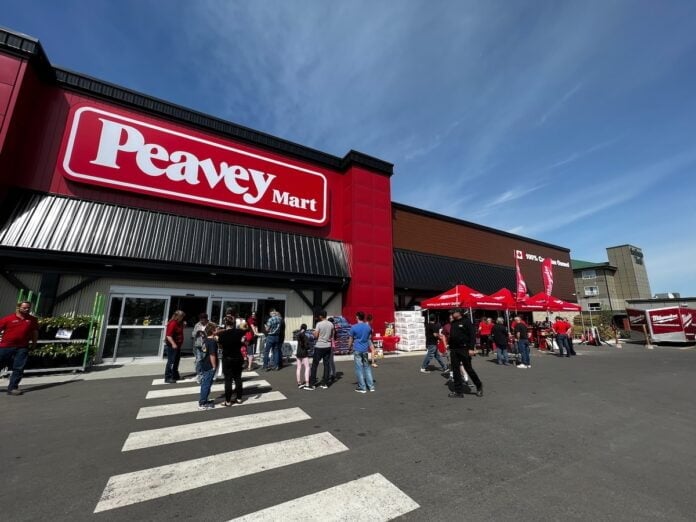
Peavey Mart in Red Deer, Alberta (Image: Peavey Mart)
Peavey Mart, once one of Canada’s most recognizable farm and ranch retailers, is preparing to relaunch in Western Canada this fall after shuttering all 90 of its locations earlier in 2025. Backed by a new group of investors under the name 2707162 Alberta Ltd., the revived retailer will open four Alberta stores in Spruce Grove, Westlock, Camrose, and Lacombe in late 2025, with plans to expand into other prairie markets as capital and operational momentum grow.
The relaunch marks a dramatic turnaround for a brand with deep prairie roots that abruptly disappeared earlier this year. Once celebrated for serving farmers, ranchers, acreage owners, and homesteaders, Peavey Mart’s nationwide closure left a gap in rural communities that had relied on it for decades.
“We know that the closure of Peavey Mart stores left a gap for many customers,” said Doug Anderson, who is part of the leadership team behind the relaunch. “Our investors and ownership group recognizes the importance of Peavey Mart in the Canadian retail landscape, and we’re grateful for the opportunity to relaunch the brand in these communities.”
A Leaner, More Focused Strategy
Unlike its previous iteration, which pursued a national presence with 90 locations, the new Peavey Mart will focus on a smaller, regional footprint. The ownership group has outlined plans to open between seven and twelve stores in Alberta and Saskatchewan, rebuilding the business with more financial discipline and an emphasis on profitability.
Kurt Schultz, Lead Merchant and a member of the new operations team, noted that the relaunch will centre on Peavey Mart’s traditional core customers. “We’re bringing back the Peavey Mart that people know and love,” he said. “A Peavey Mart focused on the needs of the farmer, rancher, acreage owner, homeowner and homesteader, with a strong emphasis on providing value for dollars spent in our stores.”
That model will be supported by a new 40,000-square-foot distribution facility in Red Deer County, designed to handle supply chain needs and ensure consistency in operations. Recruitment has already begun for warehouse staff and store-level employees, with information posted on the company’s careers website.
When doors reopen, customers will find many of the brands they once associated with Peavey Mart returning to shelves. Labels such as Harvest Goodness, Rolling Acres, Scotts, Dickies, Pit Boss, and Shell are expected to feature prominently. At the same time, the new ownership group has pledged to emphasize high-quality, unique, and locally sourced items that reflect the entrepreneurial character of Western Canada.
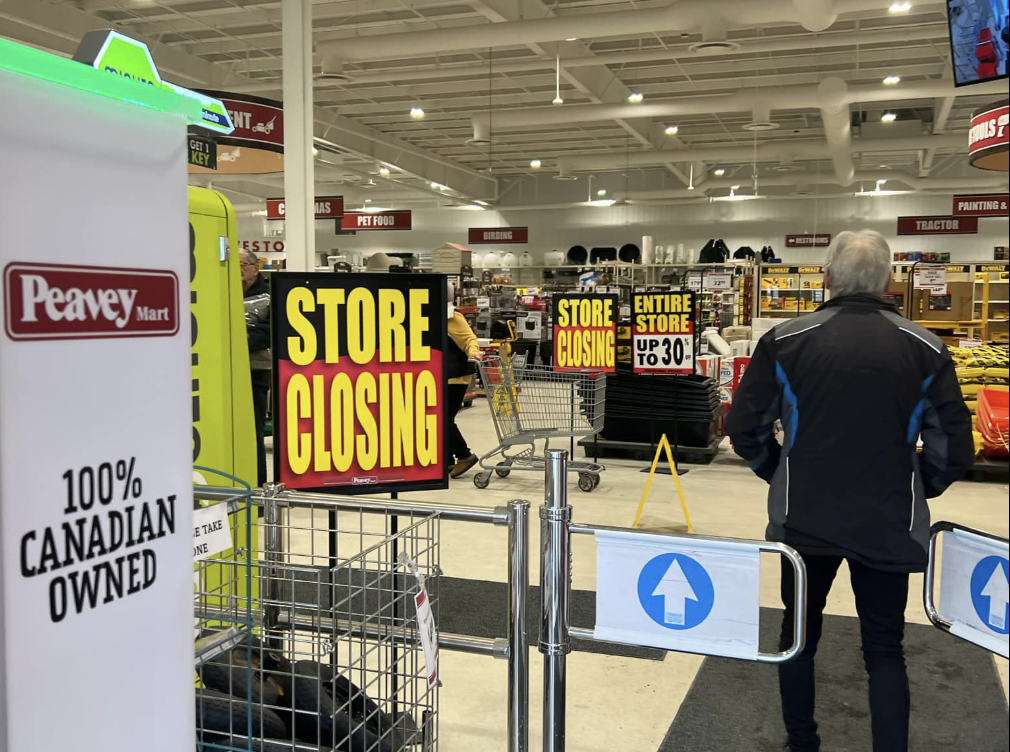
Liquidation signs at Peavey Mart’s former Red Deer store on Saturday, January 25, 2025. Photo: Joel Graham via Facebook
Lessons from Collapse and Path to Recovery
Peavey Mart’s sudden downfall in early 2025 sent shockwaves through the Canadian retail industry. Parent company Peavey Industries LP sought creditor protection under the Companies’ Creditors Arrangement Act (CCAA) after struggling with soaring inflation, supply chain challenges, and weakening consumer confidence. At its peak, the chain had nearly 100 outlets across Canada, including 90 Peavey Mart stores and six MainStreet Hardware locations.
Store closing sales began in February 2025, leaving thousands of employees and loyal customers in limbo. For rural communities in particular, the disappearance of the retailer created immediate challenges, as alternatives for agricultural and homesteading supplies were limited.
By April 2025, investors moved to secure the rights to the Peavey Mart name and intellectual property with the intention of preserving the brand in a more sustainable format. The approach, targeting a smaller set of profitable prairie markets rather than a national footprint, reflects an effort to avoid repeating past missteps.
Building an Agile Business Model
A recurring theme in the relaunch is agility. The ownership group has emphasized the importance of creating a culture that allows for quick pivots and close collaboration between store teams, distribution staff, and office leadership.
“Creating an agile business model is critical to our success,” Schultz explained. “This will ensure we can pivot quickly to meet customer expectations and build a profitable operation that lasts.”
Anderson echoed the sentiment, noting that the company’s mandate is to ensure a collaborative approach that adapts to customer needs while maintaining financial discipline. By scaling growth carefully and avoiding heavy debt loads, the ownership group hopes to create a leaner and more resilient version of Peavey Mart.
While the first four stores will open in Alberta, expansion into Saskatchewan is already under consideration. As a second group of investors joins the ownership structure, more locations in historically strong markets are expected to follow.
The relaunch strategy suggests a slow and deliberate growth trajectory, with each new store evaluated for long-term sustainability. Unlike the aggressive expansion of the past, the new Peavey Mart will prioritize community demand and operational stability over sheer scale.
A Legacy of Prairie Retailing
Peavey Mart’s legacy stretches back to 1967, when it began serving prairie customers with hardware, tools, and agricultural supplies. Its identity has long been tied to grit, resilience, and the rural way of life in Western Canada. That cultural connection, combined with decades of customer loyalty, makes the relaunch an emotionally charged one for both communities and employees.
The company’s emphasis on returning to its roots reflects an awareness that Peavey Mart’s value proposition lies in serving everyday needs of rural Canadians rather than competing directly with larger national chains.
The consumer goods rental and general rental centres industry groups saw a slowdown in revenue growth in 2024 following two consecutive years of double-digit increases, according to new data released by Statistics Canada.
Total operating revenues for the industry rose by 2.5 per cent to $3.9 billion in 2024. Operating expenses increased at the same rate, reaching $3.1 billion, while the overall operating profit margin remained steady at 21.2 per cent.
Ontario accounted for the majority of industry activity, contributing 60.9 per cent of total operating revenues and 77.7 per cent of the nominal growth in 2024. British Columbia, Alberta and Quebec together represented 14.3 per cent of the growth, with the remaining 8.1 per cent coming from other provinces and territories.
Individuals and households made up the largest customer base for the sector, generating 66.3 per cent of sales in 2024. This marked a slight decrease of 0.9 percentage points from 2023. Businesses accounted for 29.3 per cent of sales, while governments, not-for-profit organizations, public institutions and foreign clients made up the remaining 4.3 per cent.
The three largest components of operating expenses in 2024 were salaries, wages, commissions and benefits (28.9 per cent), amortization and depreciation (21.6 per cent), and the cost of goods sold (15.9 per cent).
The consumer goods rental industry group, which primarily rents or leases personal and household goods such as electronics, furniture and appliances, reported operating revenues of $3.0 billion in 2024, an increase of 2.8 per cent from the previous year. Operating expenses for the group rose 2.6 per cent to $2.3 billion, resulting in an operating profit margin of 23.4 per cent.
The general rental centres industry group, which rents consumer, commercial and industrial equipment, recorded operating revenues of $879.8 million in 2024, up 1.6 per cent. Operating expenses rose to $758.3 million, yielding a profit margin of 13.8 per cent.
Statistics Canada noted a modest rise in residential construction investment, with housing starts in the first half of 2025 up 2.3 per cent over the same period in 2024.
Looking ahead, the agency stated, “The consumer goods rental sector may be positively affected by lower interest rates, with the Bank of Canada cutting its policy rate by 2.25 percentage points since June 2024, along with easing inflationary pressures.”
Statistics Canada said a complete financial picture for the 2025 reference year will be available when survey data are published in 2026.
Retail Insider is streamlining its Canadian retail news from around the web to include a handful of top news stories that can be viewed quickly during the day. Here are the top stories from the past several 24 hours.
OpenAI’s newly announced partnerships with Etsy and Shopify mark a turning point for global e-commerce, and potentially the beginning of the end for traditional online storefronts as we know them.
With the introduction of “Instant Checkout” inside ChatGPT, consumers can now discover products, evaluate options, and complete purchases directly within a conversation, without ever visiting a merchant’s website. This is not a marginal feature update. It is the emergence of an entirely new commerce channel.
For years, retailers optimized around a familiar funnel. Discovery happened through Google search or social media, consideration took place on product pages, and transactions were completed on owned websites. Conversational commerce collapses that entire journey into a single dialogue.
This shift is far more significant than learning how to optimize content for AI-generated responses. What OpenAI has created is a new paid media channel, one that will fundamentally reshape how consumers discover and buy products online.
At launch, U.S.-based ChatGPT users can complete single-item purchases from Etsy sellers directly in chat. Shopify integration, which will extend this capability to more than one million merchants worldwide, is expected shortly. Brands ranging from digitally native startups to global names will suddenly find themselves selling inside an AI interface rather than their own sites.
The implications are enormous.
The most important change here is economic, not technical. OpenAI will take a fee on every transaction completed through ChatGPT. That alone places AI platforms in direct competition with Google, Meta, Amazon, and other established paid media ecosystems.
Retailers are no longer paying for impressions or clicks that drive traffic back to their own properties. They are paying a platform fee for transactions that occur entirely within someone else’s environment. In practical terms, this looks a lot like Amazon’s marketplace model, except it is embedded in conversation rather than search results.
The market reaction has been swift. Etsy’s stock surged following the announcement, reflecting investor optimism about the revenue potential of this new channel.
Shopify stands to benefit significantly as well. The underlying infrastructure powering Instant Checkout is the Agentic Commerce Protocol, developed by OpenAI in partnership with Stripe. Stripe’s role is especially strategic. By powering the payments layer and open-sourcing the protocol, Stripe has positioned itself at the center of AI-driven commerce. Competing payment providers will need to respond quickly or risk being sidelined.
While the initial rollout supports only single-item purchases, OpenAI has already indicated plans to introduce shopping carts and expand internationally. This is clearly just the first phase.
For many merchants, the most uncomfortable implication is what this means for their websites.
If a consumer can ask ChatGPT for the best hiking boots under $150 and complete the purchase instantly, what incentive remains to visit a retailer’s site? Long-standing investments in SEO, site optimization, and conversion rate optimization become less central when transactions no longer happen on owned digital property.
Over time, websites may evolve into branding, storytelling, and customer service hubs rather than primary sales engines. That shift will force retailers to rethink how they allocate digital budgets and measure success.
There are also unresolved concerns around bias and transparency. OpenAI has stated that product rankings inside ChatGPT will be unsponsored and based on relevance. That may be true today. History suggests it will not remain so indefinitely.
As platforms scale, pressure to monetize through sponsored placement and algorithmic prioritization becomes unavoidable. When that happens, conversational commerce risks inheriting the same pay-to-play dynamics that now dominate search and social media, with even greater influence due to the closed nature of conversational interfaces. Smaller merchants could find themselves pushed aside by those able to generate higher platform fees.
For retailers, the takeaway is clear. Conversational commerce is no longer experimental. It is not optional. It demands immediate strategic attention.
Merchants will need to structure product data for AI comprehension, factor new platform fees into their financial models, and rethink the role of their owned digital assets. Payment providers must prepare for a future where transactions increasingly flow through AI-powered protocols rather than traditional checkout flows.
Meanwhile, competing platforms including Google, Amazon, and Meta are almost certain to respond with their own conversational shopping ecosystems. A race is now underway to define who owns commerce at the interface layer.
For consumers, the experience will be faster and more seamless. At the same time, it raises important questions about transparency, privacy, and commercial influence in AI-generated recommendations.
Looking further ahead, OpenAI has already signaled interest in agentic commerce, where AI assistants make autonomous purchases based on predefined preferences.
Imagine setting rules once, such as preferring organic, locally sourced groceries under $50, and having those items ordered automatically every week. That is the direction this technology is moving.
The Etsy-ChatGPT partnership represents a defining moment for retail. Commerce is moving out of websites and into conversations.
The future of e-commerce will not be won on landing pages. It will be won in dialogue.
The only real question is which retailers will adapt quickly enough to remain part of that conversation.
OpenAI has announced a landmark partnership with Etsy and Shopify that introduces “Instant Checkout” to ChatGPT, allowing users to purchase products directly within conversations without leaving the platform. This development has been described as a revolutionary shift in the e-commerce landscape, and according to Canadian retail expert David Nagy, it may signal the beginning of the end for traditional e-commerce websites.
“This partnership introduces something far more transformative than optimizing content for AI-generated responses,” said Nagy, founder of eCommerce Canada. “It represents the creation of an entirely new paid media channel that will fundamentally reshape how consumers discover and purchase products online.”
David Nagy, founder of eCommerce Canada
For years, the e-commerce journey followed a predictable flow: discovery via Google searches or social media, followed by transactions completed on merchant websites. The Etsy-ChatGPT partnership collapses this entire funnel into a single seamless conversation.
As Nagy explained, “Conversational commerce represents a fundamental shift in the buyer journey. Unlike traditional e-commerce, where discovery happens on search engines or social media and the purchase occurs on a merchant’s site, conversational commerce collapses the entire funnel into one dialogue.”
At launch, U.S.-based ChatGPT users can complete single-item purchases from Etsy sellers within the chat. Shopify integration, covering more than a million merchants including global names like Glossier, SKIMS, and Spanx, will follow shortly.
The New Paid Media Channel
The most significant change, according to Nagy, is not simply technical but economic. OpenAI will take a fee from every transaction completed through ChatGPT. That dynamic effectively transforms AI platforms into new paid media channels, rivaling Google, Meta, and Amazon.
“Here’s what retailers must understand: you’re no longer just paying for impressions or clicks. You’re paying a platform fee for transactions that happen entirely in someone else’s environment,” Nagy said. “It’s similar to Amazon’s marketplace model, but happening within a conversational interface.”
The market reaction has already been sharp. Etsy shares jumped as much as 16 percent following the announcement, reflecting optimism around the revenue potential of this new channel.
Shopify and Stripe’s Role
Shopify, the Canadian e-commerce giant, is set to become a major beneficiary of the integration as its merchants gain access to this new channel. The underlying technology, called the Agentic Commerce Protocol, was developed by OpenAI in partnership with payments processor Stripe.
Stripe’s role is crucial, according to Nagy: “Their infrastructure powers the Instant Checkout process, and because the protocol is being open-sourced, Stripe has positioned itself at the center of this transformation. Competing payment providers will need to adapt quickly or risk losing relevance.”
The initial rollout only supports single-item transactions, but OpenAI has plans to add shopping carts and expand internationally.
The Decline of the Traditional Website
Perhaps the most unsettling implication for merchants is the diminished role of e-commerce websites.
“When users can ask ChatGPT for the best hiking boots under $150 and complete the purchase right there, why would they visit your site?” Nagy asked. “The traditional playbook including SEO, site optimization, conversion rate optimization, becomes less relevant when the transaction doesn’t happen on your property.”
This raises urgent questions for retailers who have invested heavily in building and optimizing their websites. Increasingly, those digital storefronts may serve branding and customer service functions rather than driving transactions.
Concerns Over Bias and Transparency
OpenAI has said that product rankings within ChatGPT will be unsponsored and based purely on relevance. Yet Nagy warns that this neutrality may not last.
“Let’s be realistic. These platforms will inevitably face pressure to monetize through sponsored placements and algorithmic favoritism,” he noted. “That threatens the democratization of commerce online. Smaller merchants could be pushed aside in favour of those who generate higher fees.”
Such a shift would mirror the “pay-to-play” dynamics already seen on Google and Meta, but potentially with even greater influence given the closed conversational environment.
Implications for Stakeholders
For retailers, the message is clear: ignoring conversational commerce is no longer an option. “This isn’t experimental or niche. It’s a seismic shift requiring immediate strategic response,” Nagy emphasized.
Merchants will need to optimize product data for AI understanding, factor new platform fees into their financial planning, and rethink the role of their websites. Payment providers, meanwhile, must prepare for a future where transactions increasingly flow through AI-powered protocols.
Competing AI platforms, including Google, Amazon, and Meta, are expected to respond quickly by rolling out similar features. Nagy predicts fierce competition to recruit merchants and establish dominant conversational shopping ecosystems.
For consumers, the shift promises a more seamless shopping experience but raises concerns about transparency, privacy, and the potential for commercial bias in product recommendations.
From Assisted to Autonomous Shopping
The long-term trajectory points toward even more dramatic changes. OpenAI has signaled interest in “agentic” commerce, where AI agents could make autonomous purchases based on user preferences.
“Imagine telling your assistant once that you prefer organic, locally sourced groceries under $50, and it just orders them every week,” Nagy explained. “That’s the direction this is heading.”
Such automation could fundamentally alter not only how people shop but also how they interact with brands and retailers.
The Etsy-ChatGPT partnership represents a defining moment in retail history, one that moves commerce from websites into conversations.
“The future of e-commerce won’t be won on websites. It will be won in conversations,” said Nagy. “The question is whether retailers will be part of those conversations or left out entirely.”
With Shopify integration imminent, and other platforms sure to follow, the message for Canadian retailers is clear: develop an AI commerce strategy now, or risk falling behind.
AI privacy and retail. Image: Shutterstock/licensed
Artificial intelligence is fast becoming a priority for Canadian retailers, but the enthusiasm around new technologies is colliding with serious challenges around data privacy, governance, and regulatory compliance. In the absence of comprehensive legislation in Canada and the United States, experts warn that companies need to proceed carefully if they are to protect consumer trust and safeguard their long-term operations.
Vancouver-based privacy consultant and lawyer Ritchie Po, who advises organizations on ethical AI and technology practices, says that CEOs are increasingly pushing their teams to adopt AI solutions, sometimes at the expense of due diligence. “There is pressure from the top to implement AI into systems quickly, but that can mean the due diligence may be overlooked,” he said. “Without proper preparation, you risk building systems that will not stand the test of time.”
Ritchie Po
Retailers in North America face a fragmented and incomplete policy and regulatory environment. Unlike Europe, which passed the EU AI Act in 2024, there is no equivalent comprehensive framework in Canada, and only two American states, Colorado and Utah, have enacted AI-specific regulations. California’s Bot Disclosure Law addresses only a narrow slice of the issue.
Canada’s own attempt at comprehensive legislation collapsed with the failure of Bill C-27, leaving the country without a formal AI Act. Instead, businesses must turn to voluntary guidelines such as the Digital Governance Council of Canada’s ethical AI usage standard, which provides a framework but no enforceable requirements.
“This is the wild west in terms of governance,” Po said. “There are some helpful resources, but without clear laws, much of the responsibility falls on retailers themselves.”
Privacy Laws as a Foundation
Despite the regulatory gaps, Po emphasizes that privacy laws still form the bedrock of AI compliance. “At its core, AI is about personal information—how you collect it, use it, disclose it, and store it,” he said. That means organizations must ensure they have consent, avoid “scope creep” in data usage, retain only the necessary data, and anonymize personal information where necessary.
Canada’s PIPEDA legislation governs the federal private sector, while Quebec’s Law 25 aligns more closely with Europe’s General Data Protection Regulation (GDPR). Meanwhile, American retailers contend with the California Consumer Privacy Act (CCPA) and a growing patchwork of state-level privacy laws that have strikingly similar requirements.
For global retailers, the picture is even more complex. Markets such as Japan, Indonesia, Australia, and the Philippines have comprehensive frameworks, with South Korea leading in future-proofing requirements. Big data companies like Samsung and LG are subject to additional data protection obligations due to the sheer scale of personal data they handle.
Due Diligence Before AI Adoption
Po stresses that retailers need to carry out a full due diligence cycle before deploying AI systems. This includes a thorough review of how personal data is processed, a clear understanding of consent and revocation, and the implementation of a privacy management program.
“Before you introduce AI, you should already have a privacy impact assessment for high-risk systems, cyber liability insurance, and a strategy that embeds Privacy by Design principles,” he explained. Cross-border compliance is also key, since customers in different jurisdictions may have additional privacy rights that companies must respect.
Retailers often overlook the contractual dimension of AI adoption, according to Po. “It’s not enough to sign up for a free version of an AI tool,” he said. “You need robust service agreements that ensure the vendor has a data privacy protection and organizational IT security measures in place, and complies with applicable laws and security best practices.”
Such agreements should cover everything from how data is stored to how an organization responds meaningfully in the event of a breach. Without them, retailers risk liability for lapses that occur within third-party systems.
Building AI Governance Into Retail Experiences
Po recommends that retailers develop both internal and external policies to guide AI use. Internally, ethical AI usage policies should govern how employees handle personal data in AI systems. Externally, companies may need to expand their privacy policies or introduce standalone AI policies for customers.
The consumer experience is also part of the equation. “When you integrate AI into your retail journey, customers need to understand what they are agreeing to,” Po said. “If AI enhances their experience while still protecting their privacy, you strengthen brand loyalty. But if you erode their trust by misusing their data or not having strong security and incident response, you could lose them permanently.”
The Evolving Commerce Landscape
These issues come into sharp focus as AI begins to play a more direct role in retail transactions. OpenAI’s new “Instant Checkout” feature, developed in partnership with Etsy and Shopify, allows U.S. users to purchase products directly within ChatGPT. Built on the Agentic Commerce Protocol and powered by Stripe, the feature removes friction from the retail process by keeping consumers inside the chat interface.
The move signals a broader shift toward conversational commerce, where shopping takes place within AI-driven interactions rather than through search engines or dedicated e-commerce platforms. Stocks for Shopify and Etsy surged after the announcement, reflecting investor confidence in this new channel.
For retailers, however, the integration of AI into customer-facing transactions raises the stakes for privacy and compliance. “If AI is directly processing purchases, the need for strong governance is even more urgent,” Po said. “Retailers must ensure that these systems meet privacy obligations across multiple jurisdictions. Without implementing cross-border legislative compliance, you’ll never expand into new markets with stringent privacy requirements and laws.”
The Business Case for Privacy-Respecting AI
Po’s ultimate message for retailers is clear: privacy and innovation are not at odds. “If you build out robust AI functionalities that respect privacy, you can build consumer trust and loyalty,” he said. “In a competitive marketplace, that can be the deciding factor.”
He argues that privacy-first AI can even enhance the customer experience. By creating secure, transparent, and ethical systems, retailers can position themselves as leaders in a landscape that remains uncertain but full of opportunity.
“In this economy, consumers want to know that their data is safe,” Po said. “If you can give them that assurance, you’re not just protecting yourself legally—you’re investing in long-term customer relationships. That’s how you create a legacy clientele.”