Square is building on a successful presence at landmark venues such as Toronto’s Budweiser Stage and Veld Music Festival since 2022 to partner with Live Nation Canada, marked by Square’s rollout at the new Rogers Stadium.
With the exclusive three-year agreement, Square will continue to power seamless commerce experiences for fans at all Live Nation Canada venues, with Rogers Stadium becoming the latest to unlock its next-generation technology. This expanded partnership cements the technology company as the exclusive point of sale and payment processing provider at Live Nation Canada’s venues and major festivals from coast to coast, according to a news release.
Nick Molnar
“Square is the trusted payments and commerce platform for large-scale live entertainment venues around the world, and we’re excited to expand our partnership with Live Nation Canada to help them create unforgettable experiences for millions of Canadian fans every year,” said Nick Molnar, Global Head of Sales at Block, which includes Square and Cash App.
“Every minute saved in line is another memory made at the show. With Square’s powerful ecosystem of hardware and software products, Live Nation Canada will enable fans to spend more time enjoying their favourite artists.”
The company’s technology ecosystem at Live Nation Canada venues and festivals across the country include the fully integrated Square Register to allow for seamless checkout, compact Square Terminal and newly launched Square Handheld devices—Square’s most sleek, portable and powerful POS yet—to enable vendors to manage payments right from their pocket. Square Online’s eCommerce capabilities also enable in-seat ordering at Budweiser Stage’s premium in-suite section for added customer convenience, explained the company, adding it will also provide point of sale and payments for merchandise locations within Toronto’s new Rogers Stadium.
Its technology is currently live at:
Budweiser Stage, Toronto
HISTORY, Toronto
Danforth Music Hall, Toronto
Opera House, Toronto
The MOD Club, Toronto
Midway Music Hall, Edmonton
Commodore Ballroom, Vancouver
KEE to Bala, Bala
Upcoming festivals supported by the technology include:
New research from Horizon Media Canada confirms a powerful consumer shift toward local loyalty—one that is reshaping purchase behaviour across provinces and generations.
According to the firm’s latest Finger on the Pulse survey, 83 per cent of Canadians say buying local evokes a sense of national pride, and 71 per cent report being more loyal to Canadian brands in 2025 than they were a year ago.
Conducted in April with a nationally representative sample of more than 1,000 adults, the survey finds that Canadians are responding to economic uncertainty, rising tariffs and a weaker dollar by making more intentional, values-based choices at checkout, it said.
Robert Jenkyn
“This isn’t performative patriotism—it’s a strategic consumer shift,” said Robert Jenkyn, President, Horizon Media Canada. “People are using their dollars to vote for trust, transparency, and Canadian-made value. It’s a loyalty play with real staying power.”
A national turn inward — and a lasting one
The loyalty shift is taking root across the country, but Atlantic Canada (62 per cent), British Columbia (71 per cent) and Ontario (74 per cent) are leading the way. The trend is being reinforced by changes in travel behaviour as well: 67 per cent of Canadians say they’ve adjusted or cancelled trips to the United States due to the weak Canadian dollar, and 59 per cent say they’ve reduced their purchases of U.S. brands altogether, said Horizon.
This is not a short-term reaction. Eighty-five per cent of Canadians say they plan to prioritize Canadian-made products moving forward, with many indicating they will do so even if prices increase. The preference is strongest among Gen X and Boomers, who are most likely to switch away from global brands in response to tariff-related price hikes. But even younger consumers — while more globally open — are looking for authenticity and purpose in the brands they choose, said the report.
Richard Ivey
“When a brand clearly communicates that it’s Canadian, shoppers perceive it as more credible, more relevant and increasingly more responsible,” said Richard Ivey, Horizon’s EVP, Business Solutions. “That creates real market advantage — and it’s an opportunity brands can’t afford to ignore.”
Messaging, media, and markets: what marketers need to know
Horizon said the survey offers clear guidance for CMOs and brand leaders aiming to activate against this wave of values-led loyalty. Canadians respond most strongly to campaigns that emphasize support for Canadian jobs and businesses, the higher quality of Canadian-made products, and the desire for economic independence from global trade instability. Environmental benefits also resonate but rank just behind economic and quality-based messages.
Photo by Mario Toneguzzi
“Where a message is delivered matters, too. In-store promotions (67 per cent) and television ads (57 per cent) are the most trusted platforms for reinforcing Canadian identity — especially in Ontario and the Prairie provinces, where traditional channels carry outsized influence. In contrast, only 41 per cent of respondents selected digital or social media as ideal channels for this messaging, indicating a renewed consumer trust in mass media when it comes to values-based brand storytelling,” it said.
“The shift is most pronounced in food and beverage, where 82 per cent of Canadians actively seek out Canadian-made products, particularly in Quebec and Atlantic Canada, where local economic ties run deep. However, momentum is also growing in personal care, home goods and fashion, especially in British Columbia and Saskatchewan — suggesting strong portfolio expansion opportunities for brands that can authentically reinforce their Canadian ties.”
While Millennials and Gen Z are less influenced by patriotic appeals alone, they remain highly responsive to brands that demonstrate transparency, sustainable practices, and price fairness. These younger cohorts represent both a challenge and an opportunity: they demand more, but they are also more willing to engage with global brands — if those brands can clearly articulate their purpose and impact in Canada, explained Horizon.
“As Canadians prepare to mark their national holiday, this research underscores the urgency — and the upside — of embracing Brand Canada. It’s not a niche play or a seasonal slogan. It’s a powerful, durable driver of loyalty, especially in a market defined by rising consumer scrutiny and spending caution,” it said.
“There’s never been a more important time to reinforce Brand Canada,” added Jenkyn. “National pride isn’t just symbolic—it’s showing up in shopping carts, credit card statements and the companies people choose to support. The marketers who take that seriously—not as a trend, but as a cultural signal—will be the ones who win.”
As the focus on building a stronger Canada dominates the national agenda, tax reform has emerged as an imperative for Canadian business leaders, with nine in 10 (91 per cent) saying it’s time to simplify the tax system and cut the investment tax rate to grow the economy, finds a new KPMG in Canadasurvey.
The survey of 250 business leaders identified comprehensive tax reform as a top three priority for the federal government to increase business competitiveness. Nearly six in 10 (58 per cent), named it a priority, second only to removing interprovincial trade barriers (64 per cent), said KPMG.
Lucy Iacovelli
“In this period of nation-building, we have an historic opportunity to overcome years of complacency and build a competitive tax system that responds to today’s challenges of sluggish productivity and slowing business investment in Canada,” said Lucy Iacovelli, Canadian Managing Partner, Tax and Legal, KPMG in Canada.
“It will take bold leadership to streamline complex taxes and regulations that are a growing burden on business and optimize the tax system. Corporate tax policies should incentivize businesses to put investment capital to work and make our industries and people more productive. This goes to the very heart of a resilient economy and our standard of living as Canadians.”
KPMG said its poll revealed that 72 per cent of business leaders believe current Canadian tax policies are not providing enough of an inducement to invest; 91 per cent believe governments need to implement tax and regulatory policies that encourage greater investment and accelerate the adoption of technologies, such as artificial intelligence (AI).
“Canada’s business community and governments need to align on more favourable corporate tax policies that will help to blunt the impact of disruptive U.S. trade and retaliatory tax policy,” said Iacovelli.
Key survey findings:
91 per cent say Canada must simplify the corporate income tax system
90 per cent agree that Canada needs to eliminate barriers to investment
90 per cent say Canada must reduce tax rates on investment to stimulate economic growth
91 per cent believe governments need to implement tax and regulatory policies that encourage greater investment and accelerate technology adoption
88 per cent believe Canada needs a complete overhaul of its economic and industrial policies
57 per cent say they have been investing in their business but the current trade war makes it difficult to tap into the markets.
“Tax measures proposed by the new federal government include: expanding flow-through shares beyond the mining sector to Canadian startups that allow investors to deduct eligible R&D expenses; a 20 per cent AI adoption tax credit for certain small- and mid-sized businesses; enhancing the Scientific Research & Economic Development (SR&ED) program and a patent box regime that lowers tax rates on intellectual property (IP) income to enable more Canadian companies to own and commercialize their ideas within Canada,” said KPMG.
“While these targeted measures are a start, the federal government needs to reaffirm its commitment to ambitious, broad-based corporate tax reforms that apply to businesses of all types and sizes,” said Iacovelli. “Tax changes should ease access to domestic and foreign capital and reward productivity-enhancing investments, including AI adoption.”
U.S. tax bill to affect Canada
Following dramatic cuts in U.S. corporate tax rates and the introduction of other significant tax incentives in 2017, the Canadian government responded with temporary measures that provided faster write-offs for a wide range of depreciable property (the “Accelerated Investment Incentive”), along with immediate expensing for certain manufacturing equipment and clean technology assets, said the report.
“Current tax legislation before Congress would make permanent many of the 2017 U.S. tax incentives, which puts pressure on Canada to continue our own incentives that allow for faster business write-offs that free up capital to reinvest,” said Brian Ernewein, Senior Advisor, KPMG in Canada’s National Tax Centre. “Simply matching the U.S. on these tax incentives would not restore Canada’s competitive corporate tax advantage. Actions – federally and provincially – to reduce the top corporate income tax rate in Canada would be a powerful response to these pending U.S. tax changes and, more generally, to the greater uncertainty of the current U.S. trade and investment environment.”
The bill also targets countries that impose what the U.S. administration considers “discriminatory or extraterritorial taxes”. “This retaliatory U.S. legislation has the potential to significantly increase the tax rate applying to U.S income generated by Canadian businesses and investors and could make such investments economically unviable,” added Ernewein. “It’s critical that this legislation, if enacted, not apply to Canada.”
Attracting more capital investment to Canada
According to the survey, nearly 88 per cent of business leaders believe a preferential capital gains tax rate for private capital investment would encourage long-term investment into Canadian startups, small-and-mid-sized businesses and scaleups.
Johanna Gerrie
“In a global economy, capital is mobile,” said Johanna Gerrie, National M&A Tax Leader, KPMG in Canada. “For Canada to remain a destination of choice for investment, we must ensure our tax system is efficient, stable and aligned with the realities of international competition. We face stiff competition from the U.S. and other countries in attracting large-scale investment from institutional investors, venture capital and pension funds. These sources of capital can unlock growth and accelerate technology and infrastructure development to support nation-building projects.”
Additional poll findings:
60 per cent say limited access to capital impedes or hinders their ability to invest in their operations, move forward with expansion plans, or invest in technology.
53 per cent say their company is exploring tapping the private capital markets to help drive growth, expand into new markets and provide business acumen and expertise.
Toronto’s luxury shopping and cultural hub of Yorkville will once again host Couture for a Cause on Wednesday, July 30, 2025, transforming the Village of Yorkville Park into a vibrant open-air runway experience. The annual event, spearheaded by the Hairdressers for Love & Peace Foundation, in partnership with the Bloor-Yorkville BIA, returns with an expanded vision — aiming to raise $100,000 to support mental health through the Centre for Addiction and Mental Health (CAMH).
Now in its third year, the event has grown significantly, building on the momentum of its 2024 edition, which raised $10,000 for the cause. With this year’s runway stretching an impressive 2,000 feet and Cumberland Street closed to traffic for the evening, organizers are promising Toronto’s most ambitious outdoor fashion presentation yet.
Uniting Fashion, Hair, and Mental Health Advocacy
Presented by leading Yorkville salons including Salon Daniel, Leonetti + Co, Earth Salon, Axe & Hatchets, Taz Hair Co, and Suki’s, Couture for a Cause will spotlight more than 60 models, each styled with editorial-quality hair artistry. The show blends runway fashion with purpose, advocating for dignity, self-expression, and healing through beauty.
This year’s theme extends beyond the catwalk — proceeds will help fund the creation of a permanent hair salon on-site at CAMH, operated by Hairdressers for Love & Peace volunteers. The goal is to offer individuals in recovery the experience of self-care through hair services, an initiative rooted in both empowerment and compassion.
“Restoring dignity through hairstyling is a form of therapy in itself,” said organizers in the release. John Pathmanathan, Manager of Gifts of Light at CAMH, is set to address attendees during the event to speak about the impact of this unique program.
Image: Couture for a Cause
Top Canadian Designers Headline the Runway
This year’s show will feature three returning designers — David Dixon, Shelli Oh, and Adam X Atelier — each unveiling ten new looks. Joining them on the expanded runway are new additions for 2025: Quattro Menswear, Narces, and Maxi Boutique, all known for their elevated and artistic approach to fashion.
This blend of established and emerging Canadian talent reinforces Yorkville’s place at the intersection of fashion innovation and philanthropy.
Dynamic Live Programming Elevates the Evening
Beyond the runway, Couture for a Cause offers an immersive evening of live entertainment, performance, and wellness experiences. Highlights include:
Live jazz from Jake Koffman and his band (7:00–8:00 PM)
A Pilates and yoga flow activation led by instructors from Mindful Movement Centre, located on Scollard Street (6:00–7:00 PM)
A special return performance by singer Stella Leonetti, back by popular demand
A show-stopping routine by Canada’s Olympic Gold Medalist Breakdancing Team
DJ Jones, who will infuse the event with a rhythm-driven soundtrack to keep energy levels high
Additional surprise performances will be revealed during the night
The evening will also feature a VIP dining experience catered by some of Yorkville’s leading restaurants. Among the culinary partners is Chef Massimo of Sotto Sotto, known for refined Italian cuisine. VIP ticket holders will enjoy premium table service, beverages, and front-row runway seating.
Free Public Access with VIP Options
Public access to the event is free, allowing locals and visitors alike to take in the spectacle and support the cause. For those seeking a more immersive experience, VIP reserved seating is available at donation levels ranging from $250 to $500 per seat, with charitable tax receipts provided.
Strengthening the Link Between Style and Social Impact
Founded by Daniel Fiorio, the Hairdressers for Love & Peace Foundation focuses on bringing dignity and joy into underserved spaces through hair styling and wellness. Their growing partnership with CAMH highlights a meaningful cross-section of fashion, mental health, and community care.
Bloor-Yorkville, which celebrates its 40th anniversary this year, continues to affirm its place as Toronto’s leading luxury and cultural destination. Hosting events such as Couture for a Cause demonstrates the district’s commitment not only to fashion excellence but to greater social impact.
About the Partners
Hairdressers for Love & Peace Foundation Founded by Daniel Fiorio, the foundation promotes mental health support through the power of hair and self-care, with a focus on bringing dignity to vulnerable communities.
Bloor-Yorkville One of Canada’s top luxury retail and cultural districts, Bloor-Yorkville blends fashion, dining, and wellness into a premier destination known for supporting Canadian talent and community initiatives.
CAMH The Centre for Addiction and Mental Health is Canada’s largest mental health hospital and one of the world’s leading research centres. Affiliated with the University of Toronto, CAMH serves more than 38,000 patients annually and is at the forefront of clinical care, education, and advocacy.
Retail Insider is streamlining its Canadian retail news from around the web to include a handful of top news stories that can be viewed quickly during the day. Here are the top stories from the past several days.
Tourism spending in Canada is expected to grow in the modest range of 2-4% in 2025, according to a new report by TD Economics.
American spending is set to exert a drag on the overall tally this year. U.S. visits are falling amid trade tensions and economic uncertainty, with cross-border spending projected to decline by 5-10% this year, it said.
However, lower U.S. spending is expected to be offset by a rise in Canadian domestic tourism outlays as many residents redirect all or part of their travel budgets to the home market. Moreover, spending by non-U.S. international tourists in Canada is also likely to turn in a gain, even if only slight, it added.
“Heading into peak summer travel season, many eyes will be on the performance of Canada’s tourism sector as it navigates a number of crosscurrents. On one side, visits from U.S. travelers are trending downwards amid ongoing trade tensions. On the flipside, the sector appears set to benefit from a continued rise in non-U.S. international visitors and, more importantly, solid gains in Canadian domestic travel. Predicting the overall fortunes of the sector will be determined by which of these two forces wins out,” said the report.
“We estimate that total tourism spending in Canada (in nominal dollars) is on track to rise by 2-4% in 2025. While seemingly modest, especially when compared to the 15% annual gains recorded during the post pandemic rebound, it would still be a resilient outcome during a year when many other Canadian sectors will likely struggle to grow. Importantly, this outlook compares favorably to the situation in the U.S. where international visitor spending alone is projected to fall by roughly 7% in 2025.”
Snapshot of Canadian Tourism Industry
In 2024, approximately $100 billion was spent on tourist-related activities in Canada, encompassing both personal and business travel by residents and non-residents, said TD Economics.
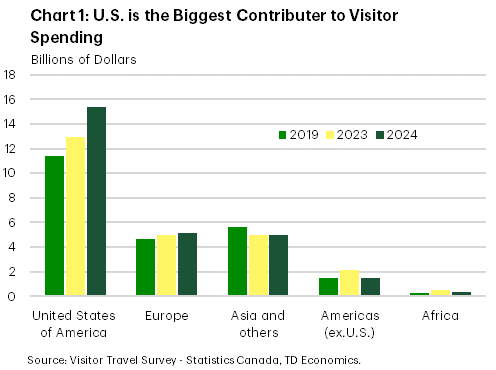
“About three quarters of this tally is attributable to Canadians shelling out for domestic travel. Statistics Canada derives its estimate of domestic travel spending from its National Travel Survey, which includes everything from short trips of as little as 40 km in distance to longer-haul trips. Moreover, it includes personal and business-related outlays. That leaves about one quarter from in-bound international travel spending. U.S. visitors have long been the bedrock of international tourism in Canada, accounting for four out of five non-resident trips and contributing a record $15 billion in 2024, which is more than all other nations combined,” explained the report.
“Canada’s tourism sector faced an unprecedented contraction in 2020, with spending plunging by over 50%. Since then, the sector has turned in a swift recovery, with American spending leading the charge internationally (Chart 1). In contrast, the share of international spending outside U.S. remains below pre-pandemic levels. Given its sheer heft, domestic spending has been the primary driver of the overall travel recovery. Relative to 2019, the number of local Canadian visits were up 6% last year, and total outlays up 30%.”
KENSINGTON AREA IN CALGARY. PHOTOS: TOURISM CALGARY
U.S. Visits in Decline
TD said trade tensions, uncertainty surrounding the economy and weakness in the U.S. dollar this year are weighing on American travel plans.
“In May, U.S. resident car trips to Canada declined by 8.4%, marking the fourth consecutive month of year-over-year declines. Border-dependent communities and businesses are bearing the brunt. Duty-free shops, restaurants and retailers near key crossings report alarming drops in traffic and, in some cases, up to 80% decline in sales,” it said.
“Looking ahead, we do not anticipate much improvement in U.S. arrivals until the tail end of 2025. By that time, some of the current trade tensions and storm clouds hovering over the U.S. economy are expected to dissipate. For 2025, we are penciling in a decline of 5-10% in U.S. spending in Canada, amounting to a drop of approximately $1 billion relative to 2024.”
Other International Visits Bucking the U.S. Trend
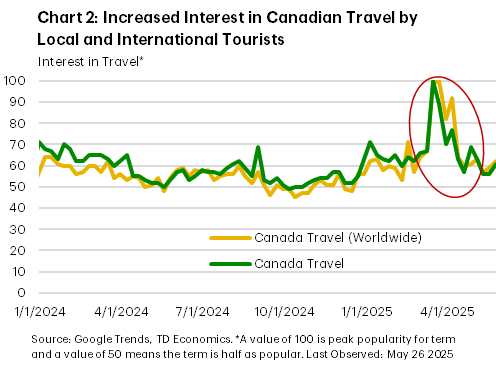
“On the brighter side, non-U.S. international travel to Canada is picking up. Google Trends data shows growing global and local interest in Canada as a travel destination, with a spike in travel related searches in March and April (Chart 2). While not a direct proxy for bookings, the uptick aligns with actual numbers. In April, visits from the United Kingdom rose by 14%, Mexico by 22% and, in May, China saw an 11% gain year-on-year. These visitors still represent a small slice of the total, but the trend is promising, especially as U.S. tensions push tourists to consider Canada as an alternative destination. We are assuming these trends prevail in the months ahead, which would deliver around a modest increase in spending of about $0.3 billion in 2025.”
A Critical Buffer by Canadian Domestic Travel
The larger offset to declining U.S tourism is expected to come from Canadians themselves, notwithstanding ongoing worries around the near-term economic outlook, added the report.
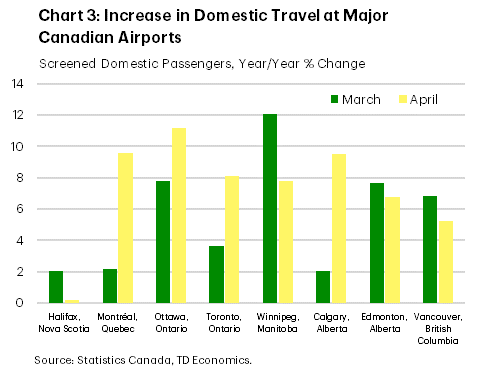
“Travel within Canada is being supported by shifting preferences. While hard data is still sparse, early indicators are encouraging. In particular, Airbnb reported a nearly 20% increase in domestic travel searches. According to a survey by TD Bank Group, 64% Canadians plan to travel domestically. This is underpinned by data on passenger volumes on domestic flights which also rose 7.4% year-on-year in April, indicating a continued increase in Canadians flying within their homeland (Chart 3). Hotel occupancy data, though mixed across the country, reinforces this domestic shift. Canada’s national occupancy rate in April stood at 63%, a slight decline from 2024, yet strong provincial performance in key leisure destinations highlights domestic resilience. For instance, in British Columbia, hotel occupancy hit 68.7%, the highest among provinces. In addition, government initiatives like the “Canada Strong Pass” which offer a widespread free and discounted access to national parks, museums and VIA Rail, alongside reduction of the carbon tax effective April 1st, are collectively making 2025 a more appealing year for local travel,” noted TD.
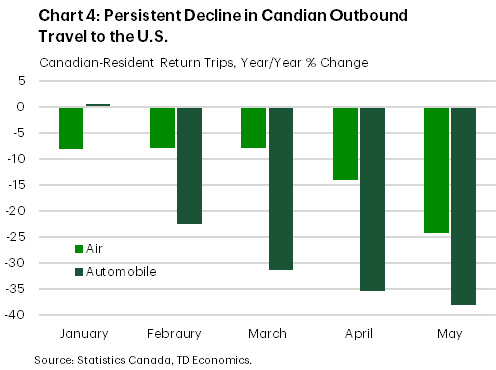
“At the same time, Canadians have also shifted away from U.S. travel in larger numbers. While trips by Americans into Canada have declined, the drop in Canadian outbound travel to the U.S. has been far more pronounced. In May, Canadian-resident return trips from the U.S. were down by an oversized 38% by automobiles and 24% by air (Chart 4). There are reports that “snowbirds”, many of whom are high-income spending individuals, cancelled trips and some adjusted their travel plans this year to spend more time in Canada. Any reallocation of spending from regions like Florida or Arizona to Canadian markets could provide a substantial boost to the domestic tourism sector.
Ottawa (Image: Ottawa Tourism)
“Despite the resilience of the Canadian consumer so far this year, some risks remain. Weakness in the job market and broader economic uncertainty are likely to weigh on domestic travel spending plans this year. While, “Buy Canada” sentiment remains strong, it will probably not be enough to deliver a standout year. Having said that, provided that the tariff-related headwinds on the economy and consumer confidence start to ease in the coming months, there is still good reason to expect some moderate growth on the order of 4% (or + $3 billion) by Canadians on travel-related activities in 2025.”
Bringing it All-Together
TD said Canada’s tourism sector is undergoing significant shifts and its overall spending fortune for 2025 hinges on the balance of two opposing forces: namely a decline in U.S. inbound spending versus the resilience of domestic and non-U.S. international spending.
“As our analysis suggests, the decrease in U.S. visitors is likely to be fully offset by growth in these other sources, delivering an overall net increase of $2 to $4 billion in overall tourism spending for 2025. Propelled by these tailwinds, Canada’s tourism sector could hold up far better than what otherwise would be the case in 2025,” concluded the TD report.
“Looking ahead to 2026, the stage is set for a pivotal year. Domestic spending is anticipated to remain robust and there is a strong possibility of renewed inbound U.S. travel. Canada’s role as co-host of the 2026 FIFA World Cup also offers a historic opportunity to elevate its global tourism profile. This major international event is projected to host vast visitor numbers across the country providing a boost to GDP and employment income. With preparations already underway, 2025 may just be the warm-up act for what could be a strong year in Canadian tourism.”
DoorDash Canada and Black Opportunity Fund have announced 30 Black-owned and Black-led culinary establishments in Canada who will each be receiving a #BlackFoodEnergy Restaurant Grant to support the growth of their restaurants.
Restaurants will receive over $10,000 each, in addition to a one-year membership for Restaurants Canada, courtesy of DoorDash, which will further connect culinary professionals with insights and resources that can help their business thrive. Since #BlackFoodEnergy began distributing grant funding, DoorDash Canada has provided more than $650,000 to Black-owned and Black-led businesses across the country, it said in a news release.
Delly Dyer
“We’re lucky to have an abundance of restaurants with different backgrounds and cuisines across the country to order from, but we can’t forget the need to support hardworking culinary entrepreneurs searching for their dreams within the industry,” said Delly Dyer, Head of Consumer Brand Marketing at DoorDash Canada. “#BlackFoodEnergy grants are one way we’re providing support for and celebration of Black-owned and Black-led businesses which will in turn fuel growth within their local communities.”
Recipients receiving #BlackFoodEnergy grants span provinces from coast to coast, featuring cuisines from Nigeria, Guadeloupe, Somalia, and beyond. Each recipient demonstrated how they plan to use the funding to grow their business — whether through hiring, upgrading equipment, or expanding services, explained the company.
Craig Wellington
“Black Opportunity Fund is excited to continue to grow our partnership with DoorDash to amplify and promote Canadian Black restaurants and foodpreneurs,” said Craig Wellington, CEO of Black Opportunity Fund. “This edition of the #BlackFoodEnergy grant program is the biggest one yet, with thirty amazing Black-owned restaurants across the country each receiving $10,000 grants. We invite everyone to join us in this beautiful celebration of flavors and culture.”
Recipients of #BlackFoodEnergy grants from this cycle are:
Aboki Grill (Vancouver, BC)
Arabelles Bakery (Chilliwack, BC)
Atelier Zamara (Montreal, QC)
Chez Drey (Ottawa, ON)
Chopshaven Limited (Saint John, NB)
Datcha (Charlottetown, PE)
Delish Bar and Grillz (Calgary, AB)
Flavours Restaurant (Calgary, AB)
Jollof Life Restaurant (Winnipeg, MB)
Le Lion Blanc Restaurant (Quebec City, QC)
Ledinna’s Restaurant (Saskatoon, SK)
Ma Yve Grill (Pickering, ON)
Manioky Café (Repentigny, QC)
Mesob Ethiopian Eats (Winnipeg, MB)
Mills Kitchen (Ottawa, ON)
Mixiebite’s (Montreal, QC)
Naija Food Eats (Windsor, ON)
Nganda African Street Food (Toronto, ON)
Oakville Fish & Chips (Oakville, ON)
Old Nassau (York, ON)
Plates Of Joy (Saskatoon, SK)
R&B Kitchen (Dartmouth, NS)
Rayyan Restaurant (Edmonton, AB)
Rose’s Caribbean Kitchen (Brampton, ON)
Sauce Modern Caribbean Cuisine (Edmonton, AB)
SKCOOKKS (Toronto, ON)
Som Express (Edmonton, AB)
Suya Royale Grill & Chill (Ottawa, ON)
The Abibiman Project (ON)
The Commune Snack Bar (Truro, NS)
“The community has welcomed Datcha, serving Caribbean flavour in every bite. As a proud recipient of a #BlackFoodEnergy grant from DoorDash, it’s confirmation that we are more than a restaurant – we are a movement,” said Valéry Ladrezeau, Founder and Chef of Datcha. “This grant will allow us to continue bringing the soul of Caribbean food, beauty, and diversity of our culture across Charlottetown.”
“With the need for true flavours, street food, and delicious pastries, Mills Kitchen was born,” said Marilyn & Kennedy Anyanwu, Co-Founders of Mills Kitchen. “As a family-owned business, we know that food is more than just a meal and is rooted in our community. Through receiving a #BlackFoodEnergy grant from DoorDash, we will be able to continue sharing authentic Nigerian flavours throughout Ottawa as a go-to place for our community.”
Crescent Street Grand Prix Festival in Montreal. Photo: Montreal Grand Prix
Montréal continues to shine on the international stage: for the eighth consecutive year, the Union of International Associations (UIA) crowned it the top city in the Americas for hosting international gatherings.
With 103 major events meeting the UIA’s criteria in 2024, Montréal significantly outranked its closest rival, Washington, D.C., with 71 events. This performance enabled the city to consolidate its first place in the Americas, and to leap forward in global rankings, from 20th to 11th. This distinction was awarded a few weeks after the International Congress and Convention Association (ICCA) designated the city, for the ninth consecutive year, the top destination for international association events in North America, explained the Palais des congrès de Montréal.
This renewed success is the fruit of a unique and unprecedented synergy between Tourisme Montréal, the Palais des congrès de Montréal and a committed network of business tourism players. Together, these partners make the Quebec city a destination par excellence for major international professional gatherings, noted a press release.
By reaffirming its leadership, Montréal confirms once again its tremendous power of attraction, and the solid contribution of business tourism to Québec’s economic dynamism and international reach, it said.
Emmanuelle Legault
“This ranking confirms that Montréal has a little extra something that attracts and retains associations from around the world. It reflects a dynamic and agile ecosystem, a committed business and scientific community that collaborates and mobilizes. This top ranking is, above all, a recognition of the passion we put into creating memorable experiences commensurate with our city’s reputation,” said Emmanuelle Legault, President and CEO of the Palais des congrès de Montréal.
Yves Lalumière
“Being number one in the Americas for the eighth year doesn’t come out of nowhere. It’s a reflection of a city that knows how to welcome, innovate and mobilize. When we line up the awards—UIA, ICCA and many others—it’s clear: Montréal is more than a destination, it’s a safe bet for congress and event organizers,” said Yves Lalumière, President and CEO of Tourisme Montréal.
Canadian performance apparel brand DUER has opened its first standalone store in Victoria, BC, marking a continued expansion of its retail footprint across North America.
Located at 584 Johnson Street, the 2,500-square-foot space brings DUER’s signature blend of style, comfort, and performance to a city known for its balance of urban energy and outdoor lifestyle, said the company.
Gary Lenett (Image: DUER)
“Victoria strikes a great balance between city life and the outdoors. People here care about clothing that looks good and performs, whether that’s downtown or on the trails, and that’s exactly what I had in mind when I started the brand,” said Gary Lenett, Founder of DUER. “It’s been one of our strongest communities since day one and being just a short trip from our home in Vancouver, opening here feels especially meaningful.”
Joining a community of leading lifestyle brands including Arc’teryx, Patagonia, and Fjällräven, the new DUER store will feature its full men’s and women’s collections. With a strong local following built through retail partners such as Robinsons Outdoors, Outlooks Victoria, and MEC, the launch represents a meaningful expansion of the brand’s presence in the city, said the company.
To celebrate the opening, DUER will host a Grand Opening Weekend from Friday, July 18 to Sunday, July 20, featuring live performances by local musicians, complimentary drinks from nearby craft beverage partners, and exclusive giveaways. Store hours are Monday to Saturday, 10 a.m.–7 p.m., and Sundays, 10 a.m.–5 p.m. For more information, visit: duer.ca/pages/victoria.
Recently, DUER announced the launch of DUER Europe alongside an ambitious retail expansion plan across North America.
Following a decade of success in Canada and the U.S., the brand said it has launched in Europe through a strategic partnership with Hectic Europe, and is continuing to scale its retail presence, with new branded stores in North America opening in Victoria, Portland, and San Francisco.
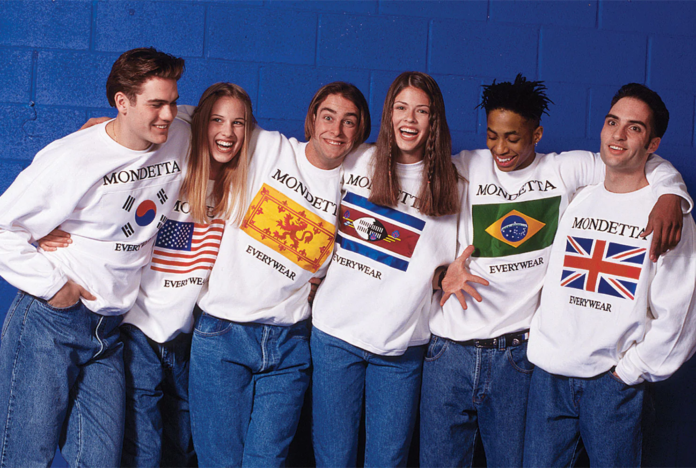
Mondetta Original flag sweatshirts. Image: Mondetta Clothing
Canadian fashion house Mondetta Clothing has appointed Georgi Gvakharia as its first-ever Vice President of Retail as it prepares to enter the brick-and-mortar retail market. The strategic move marks a new chapter for the Winnipeg-based company, best known for its performance-driven and globally inspired apparel.
Gvakharia, an accomplished luxury retail executive with experience leading operations for prestigious international brands including Ralph Lauren, will spearhead retail operations across all Mondetta divisions. His initial focus will be on developing a retail presence for Modern Ambition, the company’s performance-infused luxury menswear brand.
Leadership Adds Retail Depth to Canadian Brand
Ash Modha, CEO and Co-Founder of Mondetta Clothing, praised Gvakharia’s appointment and its significance to the company’s broader growth plans.
Georgi Gvakharia
“We’re excited to have Georgi join the team and look forward to how his expertise will help us grow the retail side of our business for all of our brands,” said Modha in a statement. “His experience with prestige brands especially aligns with where we want the Modern Ambition brand to go, and we’re delighted to have him join us on this journey.”
Gvakharia brings a proven track record in scaling high-end retail operations across North America. At Ralph Lauren, his leadership was credited with driving customer experience initiatives that led to increased brand loyalty and revenue growth. His strong understanding of the Canadian luxury market will be critical as Mondetta aims to expand its retail footprint.
“I’m thrilled to join Mondetta at such a pivotal moment in its growth,” said Gvakharia. “The opportunity to shape the brand’s retail journey, rooted in purpose, performance, and style, is both inspiring and deeply aligned with my values. Starting with Modern Ambition, I look forward to working alongside this exceptional team to build something truly meaningful in the luxury menswear space.”
Modern Ambition to Lead Physical Store Strategy
Gvakharia’s first mandate will be leading the company’s foray into brick-and-mortar retail, starting with Mondetta’s Modern Ambition label. The relatively new division, launched as a blend of performance features and elevated menswear, is positioned as a premium lifestyle brand aimed at professionals seeking a combination of technical comfort and modern tailoring.
The forthcoming retail rollout for Modern Ambition marks a notable shift for the company, which has historically focused on direct-to-consumer and wholesale channels. Details regarding store locations or timelines have not yet been disclosed, though Gvakharia’s appointment signals that physical retail will become a more prominent part of Mondetta’s multi-brand strategy.
The move into storefront retail comes at a time when several Canadian fashion brands are cautiously exploring physical spaces again, often beginning with key urban markets or experiential concepts. Gvakharia’s experience launching and managing prestige retail operations across North America is expected to inform the development and positioning of Modern Ambition’s entry into this channel.
Image: Mondetta Originals
Reviving a Canadian Legacy Through Modern Retail
Founded in Winnipeg in 1986 by Ash and Prashant Modha and Raj and Amit Bahl—two sets of brothers who immigrated to Canada from East Africa—Mondetta grew rapidly in the 1990s thanks to the massive popularity of its world flag-themed sweatshirts. The garments, symbolizing global unity, became a fashion phenomenon across North America, selling millions of units and establishing Mondetta as a household name.
However, like many brands tied to a specific fashion trend, Mondetta’s popularity declined in the late 1990s as tastes shifted away from bold logos and flag imagery. By 2000, the company had ceased production of its iconic flag apparel and pivoted toward private label manufacturing and corporate wear.
In the years since, Mondetta has quietly reinvented itself as a leader in sustainable and performance-oriented fashion. Its MPG line helped it tap into the rising athleisure market, while the reintroduction of flag-themed clothing through Mondetta Originals sparked nostalgia among longtime fans.
A Certified B Corporation With Global Values
Mondetta’s renewed purpose extends beyond fashion. The company became a Certified B Corporation in 2021, signaling a commitment to high standards of social and environmental accountability. The Mondetta Charity Foundation, founded in 2004, supports education and healthcare initiatives in East Africa and North America.
Today, the privately held company employs up to 200 people, with its headquarters and design operations rooted in Winnipeg. It maintains a global supply chain and continues to service major retailers through private label manufacturing while advancing its branded divisions.
Looking Ahead
The hiring of Georgi Gvakharia signals Mondetta’s long-term ambition to reassert its presence in the public retail sphere—this time with a sophisticated, performance-driven product that reflects modern consumer values. With luxury experience and operational expertise guiding the transition, the launch of Modern Ambition’s retail concept could set the tone for a new era of Canadian menswear.
As Gvakharia leads this next chapter, Mondetta appears poised to combine its heritage of global unity with a future grounded in premium experience and purpose-driven design.