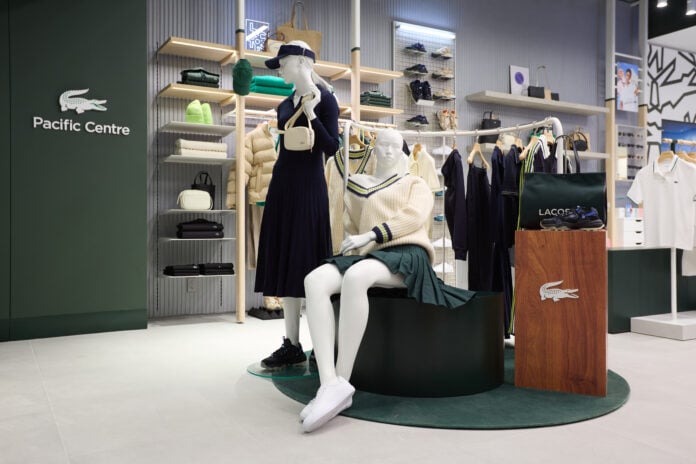
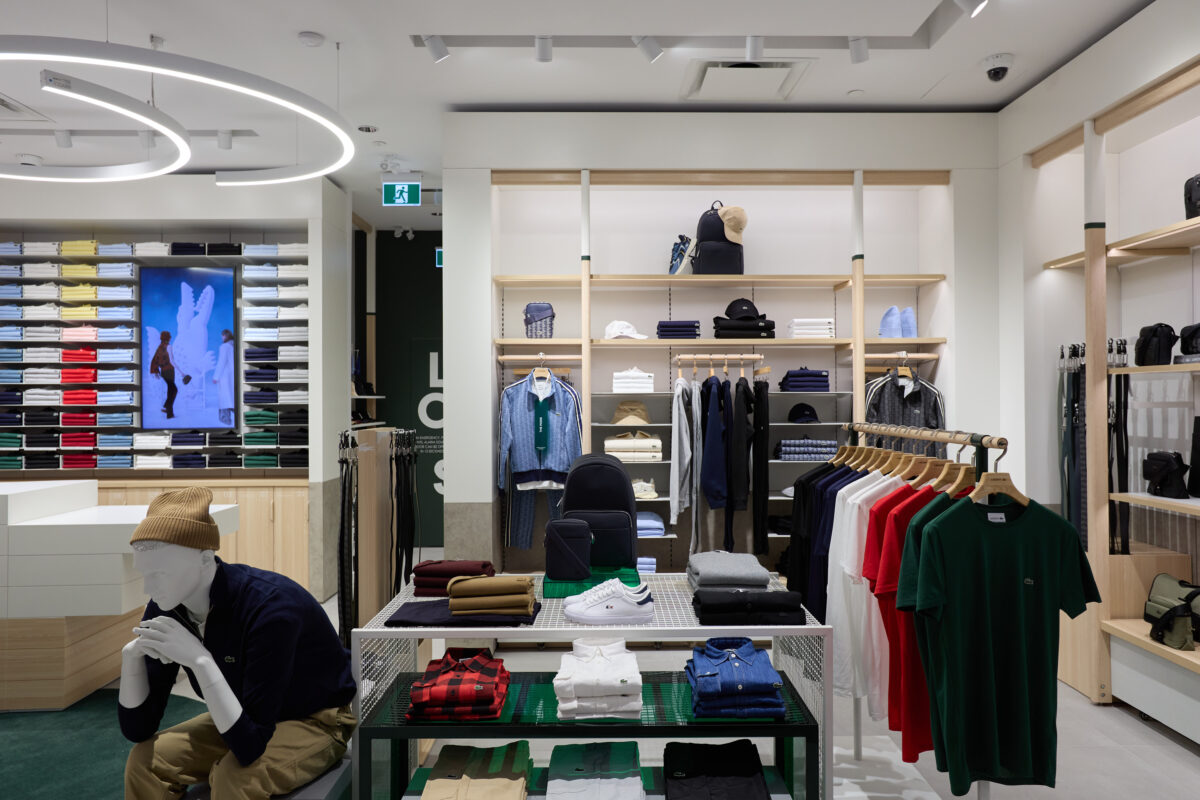
Lacoste at CF Pacific Centre in Vancouver. Source- Lacoste
Lacoste, the iconic brand and pioneer of fashion-sport, is opening its newest store at CF Pacific Centre located at 701 West Georgia St, Vancouver.
“Located in the heart of downtown Vancouver, CF Pacific Centre is a premier shopping destination that attracts both locals and tourists alike. The new store offers an immersive experience into Lacoste’s lifestyle universe and features a wide range of products, including classic polo shirts, stylish outerwear, footwear, and accessories for men, women, and children,” said the retailer in a news release.
The grand opening is Saturday, February 15 – Sunday, February 16.
“Step into a world where classic style meets creativity and modern sophistication and discover the latest collections that embody the spirit of Lacoste. Enjoy exclusive customizations & delightful surprises that reflect Lacoste’s iconic heritage and commitment to quality,” said the retailer.
Lacoste at CF Pacific Centre in Vancouver. Source- Lacoste
The company is established in 98 countries, throughout a network of 1100 shops.
The first store in Canada opened more than 25 years ago in Montreal.
The successful international brand was co-founded in France by tennis player René Lacoste. The chain known for Polo shirts sells men’s and women’s apparel, accessories, leather goods and sportswear.
“Founded by French tennis legend René Lacoste, four-time international champion and the word’s best player in 1926-1927, the Lacoste brand draws inspiration from sporting values of high standards, fair play and daring. We pass down these values through the generations and cultivate elegance as a way of being and inventing one’s life,” says the company on its website.
The data from the Office of the Superintendent of Bankruptcy (OSB) reveals that consumer insolvencies rose by 11.4% in 2024 compared to the previous year. This sharp increase amounts to 137,295 filings—over 14,000 more than in 2023—averaging about 375 insolvencies per day. The surge underscores the mounting financial pressures faced by many Canadians amid increasingly challenging economic conditions, said the association in a news release on Tuesday.
Consumer insolvencies increased 6.1% in the fourth quarter of 2024 compared to the same period in 2023, while declining modestly by 2.5% from the third quarter of 2024, said the report.
With many Canadians concerned about the impact of potential tariffs and upcoming mortgage renewals at higher interest rates, Bolduc warned that these factors could further strain household finances in 2025.
“The rising cost of living is putting increasing pressure on already stretched household budgets. At the same time, homeowners facing mortgage renewals this year may see significant increases in their monthly payments, leaving less room for essential expenses and debt repayment,” he said.
Business Insolvencies Surge 30% in 2024, Hitting a 15-Year High
The report said business insolvencies jumped significantly in 2024, with a total of 6,188 filings, up 28.6% from 2023. This marks the highest number of filings in 15 years, underscoring the financial challenges many businesses faced in an uncertain economic environment. About 1,400 more businesses filed in 2024 compared to the previous year. Business insolvencies remain 68.2% higher than they were pre-pandemic in 2019.
Compared to the previous quarter, business insolvencies remained stable in the fourth quarter, rising 1.5%. However, compared to the fourth quarter of 2023, business insolvencies decreased by 12.4%, explained the association.
It said some sectors were hit harder than others in 2024. The construction sector experienced the largest increase in the number of business insolvencies, rising by 205 filings compared to 2023, followed by the transportation and warehousing sector (+198) and the accommodation and food services sector (+163). The construction sector accounted for the largest share of insolvencies in 2024, at 14.3%.
“The record high number of filings last year shows that many businesses already face significant obstacles. Many have been struggling to stay afloat since the pandemic, grappling with ongoing pressures from high operational costs and weakened consumer spending,” added Bolduc.
“Rising production costs, supply chain disruptions, reduced consumer demand, and overall uncertainty are making it increasingly difficult for Canadian businesses to maintain financial stability, particularly for those reliant on cross-border trade or already facing significant strain. Small and medium-sized enterprises (SMEs) are especially vulnerable to tariff-driven price hikes and the loss of key export markets, as they often lack the financial flexibility to withstand these pressures.”
As global trade tensions continue to ripple through industries, Canada’s restaurant sector faces unique challenges. Peter Mammas, President and CEO of Foodtastic, one of the country’s fastest-growing restaurant franchising companies, shared his perspective on the impact of tariffs, the resilience of the restaurant industry, and the importance of supporting Canadian suppliers.
Foodtastic, founded in 2016, has rapidly expanded to manage over 1,200 restaurants across Canada and internationally. The company’s diverse portfolio includes well-known brands like Milestones Grill & Bar, Second Cup Café, Pita Pit, and La Belle & La Boeuf Burger Bar. Despite the looming threat of tariffs, Mammas remains optimistic about the company’s ability to adapt.
“Right now, less than 10% of our supply chain comes from the U.S., and what we do buy includes items we can’t source locally, like lettuce and tomatoes,” Mammas explained. “For produce, we’re shifting our procurement directly to Mexico, bringing goods bonded straight to Canada, which helps us avoid U.S. tariffs altogether.”
When it comes to alcohol, another area affected by trade disputes, Foodtastic is turning the situation into an opportunity to support local producers. “We’re reaching out to Canadian alcohol producers to list more of their products in our restaurants. It’s about doing our part to support Canadian businesses,” Mammas said.
The Broader Impact on Canada’s Restaurant Industry
While Foodtastic’s proactive approach has minimized its exposure to international trade disruptions, Mammas acknowledges that the broader industry may feel the pinch.
“Most restaurants in Canada can source what they need domestically, except for seasonal produce,” he noted. “The real concern is the potential economic ripple effect. If the overall economy slows down, restaurant sales could soften, and that would impact the entire supply chain.”
However, Mammas is confident in the industry’s resilience. “We’ve survived COVID, hyperinflation, and labour shortages. We’ll get through this too. The restaurant industry is incredibly adaptable,” he emphasized.
Freshii food items. Photo: Foodtastic
Managing Costs and Pricing Strategies
Despite potential cost increases due to tariffs, Mammas believes the impact on pricing will be manageable.
“Even if we had to absorb additional costs from U.S. imports, it would translate to about a $10 million hit across our network of over 1,000 restaurants,” he explained. “That’s roughly $10,000 per store, which we can offset with a modest 2% price adjustment.”
This strategic approach ensures that Foodtastic can maintain profitability while minimizing price hikes for consumers. “We’re in a strong position because we prioritized local sourcing years ago,” Mammas added.
Embracing Canadian Pride and Supporting Local Businesses
For Mammas, the current trade climate has highlighted the importance of national unity and supporting Canadian businesses.
“I haven’t seen the country this unified in a long time. There’s a renewed sense of pride in buying Canadian and supporting local brands,” he said. “At Foodtastic, we’re committed to working with Canadian suppliers. If there are producers out there who think their products could fit in our restaurants, we want to hear from them.”
Pita Pit food items. Photo: Foodtastic
Breaking Down Barriers Within Canada
While international trade issues dominate headlines, Mammas pointed out that interprovincial trade barriers within Canada pose significant challenges.
“It’s sometimes easier for Canadian producers to sell to the U.S. than to neighbouring provinces,” he said. “We need to eliminate these barriers to create a truly free internal market. If a product is approved in one province, it should be accepted nationwide.”
This sentiment reflects a broader call for policy changes to support domestic businesses.
“We have abundant natural resources and high-quality products. It’s time to streamline our internal trade and showcase Canadian goods to the world,” Mammas emphasized.
Delayed Tariffs Provide Temporary Relief
On February 3, President Donald Trump announced that tariffs on Canadian imports would be delayed until March 1. This postponement offers temporary relief to Canadian businesses, providing more time for negotiations and adjustments.
While this delay is a welcome development, the threat of tariffs still looms large. The possibility of future trade restrictions continues to create uncertainty for Canadian businesses. Additionally, the unpredictability of U.S. trade policy under President Trump could pose significant risks to Canada’s economy throughout his term, potentially affecting industries far beyond the restaurant sector.
Looking Ahead
As Foodtastic continues to grow its business in Canada, the company remains focused on its core values of innovation, quality, and community support.
“We’re proudly Canadian, and our growth strategy reflects that,” Mammas concluded. “Whether it’s through acquiring new brands or supporting local suppliers, we’re committed to strengthening Canada’s restaurant industry.”
Montreal-based Pizzeria Bros, a fast-casual pizzeria known for its artisanal-style pizzas, is set for major expansion across Quebec and Ontario.
Founded in Old Montreal in 2016, this award-winning pizzeria has quickly gained a loyal following for its fresh ingredients, house-made dough, and high-heat ovens that ensure the perfect pizza experience.
Currently operating 13 corporate and franchise locations, including three outside Quebec (Hamilton, Edmonton and Moncton, Pizzeria Bros is preparing to open three new locations this winter in Montreal’s Ahuntsic and downtown areas by the Bell Centre, as well as Candiac. Future expansion plans include key markets such as the South Shore, Laval, Terrebonne, Nun’s Island, and Mont Tremblant in Quebec, along with Burlington and Oakville in Ontario.
Tony Flanz and the team at Think Retail are collaborating with Pizzeria Bros as they embark on a nationwide expansion.
Source: Pizzeria Bros website
A Commitment to Quality and Innovation
Founder and President Carl Sexton explains the inspiration behind Pizzeria Bros, saying, “Patrick (Doignaux) and I had both worked in the restaurant industry for many years. Patrick had worked in an Italian restaurant that also had a pizza oven and he really liked the whole pizza side of it with the takeout and the quick turnaround times was what interested him. We went with that and developed a concept around that.”
With a menu featuring Italian-style sandwiches, artisanal salads, chicken fingers, fries, and desserts, the pizzeria offers dine-in, takeout, and delivery options. Each location showcases a modern industrial-chic design, allowing customers to watch their pizzas being made through a glass partition.
Strategic Growth Across Canada
As demand for high-quality, quick-service pizza continues to rise, Pizzeria Bros is strategically selecting high-density areas with strong foot traffic for its new locations. “We’re starting to reduce the size of footprints. Since COVID, there’s more and more takeout. It’s become a bigger percentage of our sales. So we’re looking at spots as small as 1,000 square feet and pretty much maxing out at 1,500 square feet,” says Sexton. “Unlike your typical pizzerias we also do a dining room. There’s the option to eat in. We offer beer and wine, desserts.”
The company’s long-term vision includes sustainable, responsible growth, with a goal of reaching over 50 stores in the coming years. “We want to do it in a healthy way and a responsible way so we’re not just putting stores everywhere,” Sexton notes. “We take opportunities as they come and grow organically.”
With six new stores planned this year and franchise agreements signed in Oakville, Burlington, and the Maritimes, Pizzeria Bros is well on its way to becoming a household name across Canada. The company is expecting to open about six new stores this year, perhaps more.
“We’re looking to expand in the GTA. We have a franchisee signed on for either Oakville or Burlington, Ontario. So we’re looking for real estate there. And we’re also looking to expand with our developer in the Maritimes. Most likely Halifax will be the next area. But we’re also looking at Fredericton and Saint John’s. Big expansion plans,” adds Sexton.
As Sexton puts it, “We’re excited about expanding the Pizzeria Bros brand and bringing our signature pizza experience to even more cities.”
Nearly 250 restaurants across the country are participating in Canada Beef’s third-annualBurger It Forward campaign aimed at relieving the growing food insecurity in Canada.
The national campaign, which runs until February 28, supports local restaurants while also raising funds for food banks regionally and nationally.
Each participating restaurant will feature a select burger for the Burger It Forward campaign. For every campaign-featured burger purchase, Canada Beef will donate the equivalent of one meal to Food Banks Canada, up to a maximum of 20,000 meals (based on Food Banks Canada’s meal metric: $1 = two meals). Additionally, provincial cattle associations and/or partners will give back to their communities by making ground beef or cash donations to regional food banks. Unique to Newfoundland, Nova Scotia and New Brunswick, the campaign has partnered exclusively with Big Stop Restaurants to feature all five of their burgers in 15 locations across these Atlantic provinces.
“The need for food banks has nearly doubled in only five years, and one in four Canadians are living in food insecure households,” said Joyce Parslow, Executive Director of Consumer Marketing at Canada Beef. “When donations drop, Food Banks Canada still continues to help, so Canada Beef is proud to host Burger It Forward again this year to help support this very important effort and organization. By simply dining at a local restaurant and ordering a Burger It Forward burger, Canadians will be helping their communities in a meaningful, tangible way.”
Modern Steak Calgary
In a news release Canada Beef said Food Banks Canada reports that use is at its highest in Canadian history. There will be over two million visits to food banks this month, with 700,000 visits being from children. As people in Canada rely on food banks more than ever, the food-banking system is reaching its limit. Last year nearly thirty per cent of food banks ran out of food before they were able to meet demands. Burger It Forward takes a simple approach to supporting these food banks, making the campaign accessible to both restaurateurs and consumers who want to help.
River Cafe Calgary
Visit burgeritforward.cafor more information, including descriptions of all the Burger It Forward burgers, a map of participating restaurants and more. Canadians are also encouraged to share snaps of their experience enjoying Burger It Forward burgers on Instagram using the hashtag #BurgerItForward and tagging @lovecdnbeef.
As the marketing division of the Canadian Beef Cattle Research, Market Development and Promotion Agency, Canada Beef is the cattle producer-funded and run organization responsible for domestic and international beef and veal market development. It has staff in Canada, Mexico, Japan, China, and Taiwan, and representation in Vietnam and South Korea.
The Canadian apparel industry is facing potential upheaval as U.S. President Donald Trump signals his intent to impose new tariffs on imported goods on March 1. While details are still emerging, trade experts warn that Canadian retailers—many of whom rely on U.S. supply chains—could see rising costs and increased challenges in managing inventory.
With economic uncertainty already impacting consumer spending, higher import costs could further strain apparel brands, forcing them to rethink pricing strategies, sourcing options, and inventory management. One of the biggest concerns? A growing surplus of unsold stock.
How Tariffs Could Impact Canadian Apparel Retailers
Many Canadian apparel brands depend on U.S. suppliers or distribute goods through American networks. If tariffs are implemented, the cost of sourcing materials and finished products could increase significantly, squeezing already tight margins. Some brands may attempt to pass these costs onto consumers, but with inflation already affecting purchasing behaviour, raising prices could make it harder to compete in a price-sensitive market.
Retailers often place large orders months in advance, basing their decisions on anticipated demand. If price increases lead to consumer hesitation, brands could be left with excess inventory. Traditionally, retailers rely on seasonal discounting to clear out surplus stock, but excessive markdowns can weaken brand positioning and profitability over time.
The apparel industry has also faced ongoing supply chain volatility in recent years. If tariffs are introduced, Canadian retailers may need to adjust sourcing strategies, whether that means seeking new suppliers, shifting production, or rethinking distribution channels. These transitions take time and often come with additional costs and logistical hurdles. The uncertainty surrounding trade policy makes long-term planning even more difficult.
Store on sale. Image: StyleDemocracy
Strategies to Manage Excess Inventory
As brands navigate these challenges, having a plan to manage surplus inventory will be critical. Rather than relying solely on deep discounting, alternative strategies such as limited-time warehouse sales, off-price retail partnerships, and strategic liquidation events can help brands clear stock while maintaining brand equity.
For brands looking to move inventory quickly while reaching engaged shoppers, event-based sales have proven to be an effective tool. Companies specializing in large-scale retail events can help brands offload surplus goods efficiently without compromising their market positioning. These types of sales not only free up valuable warehouse space but also generate cash flow that can be reinvested into future collections.
Looking Ahead: Adapting to a Shifting Trade Landscape
With uncertainty surrounding U.S. trade policies, Canadian retailers need to remain flexible and proactive. Diversifying supply chains, optimizing inventory management, and exploring alternative sales channels will be key to staying competitive.
By adopting a strategic approach to inventory management—whether through smart forecasting, partnerships, or event-driven sales—Canadian apparel brands can navigate potential tariff challenges while maintaining financial stability and consumer appeal.
Alex Mazelow, is Head of Digital at StyleDemocracy. StyleDemocracy is North America’s leading warehouse sale and retail event management company, specializing in turnkey solutions for brands looking to move excess inventory while maximizing revenue and protecting brand integrity. With a 25-year history, StyleDemocracy has built a reputation for creating seamless, high-impact shopping experiences that drive results. For more information, visit styledemocracy.com.
Retail Insider is streamlining its Canadian retail news from around the web to include a handful of top news stories that can be viewed quickly during the day. Here are the top stories from the past 24 hours.
RONA Inc., one of Canada’s leading home improvement retailers, has announced the renewal of its partnership with retailer Matériaux Pont-Masson. The strategic move marks Matériaux Pont-Masson’s return to RONA’s network of affiliated dealers after more than 30 years of collaboration, reinforcing RONA’s commitment to expanding its national presence.
With nine stores across Québec and Ontario, Matériaux Pont-Masson brings value to RONA’s robust network of approximately 425 corporate and affiliated dealer locations. The renewed partnership aligns with RONA’s growth strategy, aiming to strengthen its footprint in key markets.
“We have decided to renew our partnership with RONA to pursue our development plans and ensure our group’s continuous growth,” said Éric Bailey, President of Matériaux Pont-Masson. “We were impressed with the recent changes within RONA, particularly its strong commitment to supporting and developing its network of affiliated dealers.”
Enhancing Operational Efficiency
Through this partnership, RONA will manage the supply and distribution of products to all nine Matériaux Pont-Masson locations. The agreement ensures streamlined operations and improved access to a broader range of products for customers.
“Having access to a wider variety of products, being included in decisions that impact us, and partnering with such a strong banner are key priorities for us,” said Julie Boucher, General Manager at Matériaux Pont-Masson. “This collaboration will ensure we offer exceptional service to our growing clientele.”
New RONA+ store at Emerald Hills in Sherwood Park, Alberta. Photo: Christa Patterson
RONA’s Vision for the Future
J.P. Towner, President and CEO of RONA Inc., expressed pride in the renewed partnership, emphasizing its alignment with RONA’s long-term vision. “This partnership reflects our clear strategy to help affiliated dealers stand out in their markets. Our network of affiliated dealers plays a key role in RONA’s growth, and we intend to continue expanding this network in the years to come,” he stated.
Founded in 1939, RONA Inc. operates under the RONA+, RONA, and Dick’s Lumber banners, employing over 21,000 people nationwide. The company is recognized for its commitment to sustainability, earning accolades as one of Canada’s Greenest Employers.
From left to right, Julie Boucher, General Manager, Matériaux Pont-Masson. Éric Bailey, President, Matériaux Pont-Masson. J.P. Towner, President and Chief Executive Officer, RONA inc., and Alain Ménard, Senior Vice-President, RONA Affiliated Dealers, RONA inc.
Supporting Canadian Entrepreneurs
Alain Ménard, Senior Vice-President of RONA Affiliated Dealers, highlighted RONA’s dedication to supporting Canadian entrepreneurs. “About a year ago, we announced a repositioning strategy and innovative programs to boost our affiliated dealers’ profitability. Our goal is to operate the strongest network of affiliated dealer stores in the country. Welcoming Matériaux Pont-Masson back to the RONA family is a significant step toward that ambition,” he said.
Matériaux Pont-Masson, established in 1979, specializes in building materials and serves a diverse clientele, including contractors, self-builders, and businesses. With over 500 employees, the company’s return to RONA’s network marks a new chapter in its growth journey.
Shoppers Foundation for Women’s Health™ has released its second annual Impact Report, which highlights achievements made in 2024 towards its goal of investing $50 million by 2026 to improve access to care as well as awareness of and research for women’s health needs.
The Foundation reported on Monday that $12.8 million was donated in 2024 alone, benefiting more than 380 partner organizations and impacting over 1 million women across Canada.
Bringing the total amount contributed by the Foundation to more than $34 million since its launch, these fundraising efforts are driven by several signature events and partnerships, said the Foundation, including:
Shoppers Drug Mart® Run for Women: The largest event series in Canada dedicated to women’s mental health, the event includes springtime 5k and 10k run/walk events in 18 different communities across Canada. Since its inception in 2013, the run has raised more than $23M for local mental health charities that are improving access to mental health care and support for Canadian women. In 2024, the run raised over $3 million in donations with over 27,000 runners and walkers taking part.
Menstrual Equity: Period inequity silences and sidelines – and the Foundation is taking action to fix that. Through partnerships with organizations like Moon Time Connections, The Period Purse, Alberta Council of Women’s Shelters, BC Society of Transition Houses and more, we’re helping to increase access to menstrual products and provide stigma-shattering education to create a more equitable future for people who menstruate across Canada.
Community Grants: The Shoppers Foundation for Women’s Health™ Community Grants Program supports organizations addressing women’s health equity through awareness initiatives and improved access to care. In 2024, the program committed $2.84 million to back 41 community-led initiatives.
Beauty Mingles: Local fundraising events hosted at most Shoppers Drug Mart® and Pharmaprix® locations in spring, fall and in the lead-up to the winter holiday season. Offering makeovers and skin care consultations from Beauty Specialists, these in-store beauty events are a testament to the power of community in helping to raise vital funds for local women’s health programs. Over $4.9M in donations raised in 2024.
Giving Shelter: Every fall, Shoppers Drug Mart® and Pharmaprix® stores raise funds and awareness for women’s shelters across Canada. One hundred per cent of in-store donations stay in the local community, helping shelter partners provide thousands of women and their families access to the care and support they need. Thanks to the generosity of customers and donors, fundraising in 2024 supported over 300 local women’s shelters and partner organizations.
“In 2024, Shoppers Foundation for Women’s Health™ made significant progress towards our goal – a future where healthcare is equal and accessible to all women across Canada, helping them to lead healthier lives. Together with our partners and the unwavering generosity of our supporters, we plan to build on this momentum and continue creating lasting change in communities nationwide. paving the way for a brighter future for the health of all Canadian women,” said Paulette Minard, Director, Community Investment, Shoppers Foundation for Women’s Health™
Sharlene Rutherford
“Women continue to be misdiagnosed, misrepresented, and misunderstood because of inequities in healthcare that have existed for far too long. At the Women’s Health Collective Canada, it’s our mission to create real change in women’s health by investing in women’s health research and care. With support from Shoppers Foundation for Women’s Health™, we’re building a more inclusive and equitable future for all women,” said Sharlene Rutherford, President and CEO, Alberta Women’s Health Foundation, on behalf of WHC
Kearie Daniel
“Having a space where Black mothers, at every stage of their journey, can connect, mentor each other, and truly create a village of support is a powerful, life-saving resource. Motherhood can feel isolating, and this experience can be intensified by factors such as race, location, and lack of culturally relevant resources. We are immensely grateful to Shoppers Foundation for Women’s Health™ for their visionary support of our Mothering Minds initiative, helping us to foster connection and sisterhood among Black mothers across Canada, building healthier families and stronger communities,” added Kearie Daniel, Executive Director, The Black Women’s Institute for Health
The Foundation will invest $50M by 2026 to address some of the most pressing health inequities facing women, including lack of representation in health research, barriers to accessing mental healthcare, and the urgent consequences women disproportionately face due to poverty and domestic violence.
Shoppers Drug Mart Inc. is one of the most recognized and trusted names in Canadian retailing. The company is the licensor of full-service retail drug stores operating under the name Shoppers Drug Mart (Pharmaprix in Québec). There are more than 1,350 Shoppers Drug Mart and Pharmaprix stores operating in prime locations in each province and two territories.
On Saturday, February 1, 2025, U.S. President Donald Trump announced sweeping new tariffs on Canadian goods, which will be implemented March 1. The measures include a 25% tariff on most Canadian imports and a 10% tariff on energy products. In swift retaliation, the Canadian government imposed staggered equivalent 25% tariffs on U.S. imports, igniting fears of an escalating trade war reminiscent of earlier U.S.-China tensions.
Retailers across Canada are bracing for immediate price hikes after tariffs come into force. Gary Newbury, a retail supply chain and last-mile expert, shared his insights on how these tariffs will ripple through the industry.
Gary Newbury
“I suspect there’s an opportunity for retailers to raise prices even before they’re directly impacted,” Newbury noted. “They’ll argue that they need to build in a buffer now to manage future costs from these tariffs. This approach isn’t new—we’ve seen it before with gasoline companies, where prices rise in anticipation of cost increases and fall more slowly when wholesale prices drop.”
Newbury further explained that retailers may use the tariffs as a pretext to increase prices even if current inventory was sourced before the new duties took effect. “Retailers struggling with tight margins might seize this as an opportunity to improve profitability under the guise of external cost pressures,” he added.
For consumers, this means tighter household budgets. “It’s going to be a tough time,” Newbury added. “Retailers will pass these costs along to consumers, and the uncertainty makes it even harder.”
Small Retailers Face Greater Vulnerability
While large retailers like Walmart and Canadian Tire may have the resources to mitigate some impacts, small and medium-sized businesses are more vulnerable. “Smaller retailers often rely on local wholesalers, who in turn depend on imports,” Newbury said. “They don’t have the same bargaining power or supply chain flexibility, making them more susceptible to sudden cost increases.”
Newbury elaborated, “This dependency on local wholesalers creates a critical vulnerability. When wholesalers face increased import costs due to tariffs, they pass those costs directly to smaller retailers. Unlike larger chains that might have direct supplier agreements or diversified sourcing strategies, small businesses often have limited options, leaving them with little room to negotiate better terms.”
This vulnerability could lead to more rapid price hikes for consumers shopping at independent stores, particularly for US imported goods. “The wholesalers will pass on the tariffs, and small retailers have little choice but to absorb the cost or raise prices,” Newbury explained.
He added, “Smaller businesses may also struggle with cash flow issues if they need to pay higher upfront costs without the volume-based discounts larger retailers negotiate. This can create a cascading effect where increased costs strain financial stability, potentially leading to reduced inventory, layoffs, or even closures in extreme cases.”
Impact on Cross-Border E-Commerce
For Canadian businesses that rely heavily on exports to the U.S., the outlook is equally grim. Companies that ship products like apparel or specialty goods directly to American consumers will face new barriers.
“If a business does 90% of its exports to the U.S., these tariffs could be devastating,” Newbury said. “They’ll have to decide whether to absorb the costs, pass them on to customers, or find new markets.”
Newbury raised an interesting point about de minimis thresholds, which exempt small shipments from certain duties. “Businesses might pivot to smaller shipments to avoid tariffs, but that adds logistical complexity and costs,” he explained.
Supply Chain Disruptions: A Complex Web
The auto industry, heavily reliant on cross-border supply chains, is poised to be among the hardest hit. “Imagine a plant in Detroit and another in Oakville. Components ping-pong back and forth across the border multiple times before a finished vehicle rolls off the assembly line,” Newbury explained. “Each crossing will now attract a 25% tariff. The cumulative effect will be staggering.”
This isn’t just hypothetical. Parts can cross the border up to six or seven times during production. “We’re talking about costs compounding with every border crossing,” Newbury said. “A component worth $100 could effectively double in cost after multiple crossings.”
Newbury highlighted how deeply integrated North American supply chains are, with certain parts requiring multiple rounds of sub-assembly across borders. “The complexity is not just in the movement of goods but also in the network of suppliers dependent on each stage. Disruptions here have a domino effect,” he noted.
The Currency Factor
Exchange rates could further exacerbate the situation. “If the Canadian dollar weakens against the U.S. dollar, our imports become even more expensive,” Newbury noted. “We’re already seeing signs of this, with the loonie slipping below 70 cents USD.”
This double hit—from both tariffs and a weaker currency—could lead to inflationary pressures across the board. “We’re looking at a scenario where everything from groceries to consumer electronics could see price increases,” Newbury warned.
He also pointed out, “Currency fluctuations can trigger price volatility, making it hard for businesses to forecast and manage costs effectively.” Additionally, a weaker Canadian dollar doesn’t just affect imports; it also has complex implications for exports. “While a lower loonie can make Canadian goods more competitive in the U.S. market, the benefit is often offset by increased costs for raw materials and components that Canadian manufacturers import to manufacture goods for exporting,” Newbury explained.
“The interconnectedness of North American supply chains means that even export-oriented businesses face higher input costs, eroding any competitive edge from favourable exchange rates,” he added. “Ultimately, the combined impact of tariffs and currency devaluation creates a challenging environment for both importers and exporters.”
The Threat of Escalation
Trump’s executive order not only imposes tariffs but also grants him the authority to increase them at his discretion. “There’s a real threat of retaliation from both sides,” Newbury warned. “If Trump raises tariffs to 50%, what will Canada do? Matching that could devastate both economies, but failing to respond could be seen as a sign of weakness.”
Newbury expressed concern over Trump’s unpredictability. “The language in the executive order leaves room for sudden escalations. We could see tariffs doubled overnight based on political maneuvering rather than economic rationale,” he cautioned.
He elaborated on the limited strategic responses available to Canada. “Our options are constrained. Escalating tariffs in response might lead to a tit-for-tat scenario that spirals out of control. Alternatively, diplomatic negotiations could help de-escalate tensions, but with an unpredictable counterpart, that path is fraught with challenges.”
Newbury also highlighted the potential for abrupt policy shifts. “Trump has hinted at using tariffs as a bargaining chip, meaning rates could fluctuate wildly depending on political developments. This volatility makes it difficult for Canadian businesses to plan for the short to medium term,” he said.
A Trade War’s Broader Implications
Beyond the immediate economic impact, these tariffs could reshape trade dynamics for years to come. “We’re not just talking about temporary disruptions,” Newbury emphasized. “Businesses will reconsider their supply chains, sourcing strategies, and even where they manufacture products.”
He elaborated, “Companies might seek alternative suppliers in non-tariffed countries or invest in local production to reduce exposure. This could lead to long-term shifts in trade relationships.”
Newbury also highlighted the potential for businesses to reroute supply chains as a strategy to mitigate the impact of tariffs. “Some companies may explore using third countries as intermediaries to avoid direct tariff costs. This could involve shifting manufacturing to countries not affected by the tariffs or reconfiguring logistics routes to minimize exposure,” he explained.
“However, while rerouting supply chains might offer short-term relief, it introduces new challenges,” Newbury added. “Businesses have to consider the added costs, potential delays, and the complexity of managing relationships with new suppliers or logistics partners.”
Navigating Uncertainty
As Canada and the U.S. brace for the fallout from these new tariffs, retailers and consumers alike face an uncertain future. The ripple effects will be felt across industries, from automotive to apparel, with small businesses particularly vulnerable.
“The best-case scenario is a stalemate,” Newbury concluded. “The worst-case scenario? A full-blown trade war that harms both economies, with Canada likely bearing the brunt of the impact.”