A healthy and voluminous head of hair works wonders in regaining a youthful appearance and boosting self-esteem. While hair can weaken with age, there are valuable solutions that can combat hair loss, as a growing number of individuals are turning to hair transplant procedures. Mexico has risen as a hotspot for hair transplants, offering unparalleled affordability and quality when it comes to hair restoration procedures. With reliable techniques and appropriate costs, hair transplants in Mexico have witnessed a significant increase in popularity.
When contemplating the financial aspect, the price range for a follicular unit extraction (FUE) hair transplant in Mexico typically spans from $2,990 to $6,900, contingent upon the number of grafts required. However, patients are urged to exercise caution when encountering exceptionally low prices, as they may signal compromised quality. While finding cheap hair transplant services can seem like a steal, it is essential to remain vigilant of clinics offering rates below $3,500. A deal that appears too good to be true could signal underlying risks associated with the discounted procedure.
Selecting the right surgeon is also paramount to achieving a satisfactory outcome.
To be fully informed and confident about your hair transplant clinic, meticulous research into the surgeon’s credentials is recommended to secure optimal results. The surgeon’s experience and expertise play a pivotal role in determining the hair transplant’s overall success.
Mexico’s status as a hub for hair transplants is because of its competitive pricing, state-of-the-art facilities, and seasoned surgeons. A substantial proportion of Mexican surgeons boast international training and accreditation, ensuring adherence to global standards of care. Moreover, Mexico’s proximity to the United States and Canada makes it a convenient choice for patients seeking quality treatment. Beyond cost-effectiveness, undergoing a hair transplant in Mexico offers the added benefits of shorter travel durations and personalized patient-doctor interactions. Patients can return home within hours post-procedure, minimizing disruptions to their daily routines.
Regarding techniques, patients are presented with a plethora of options. These techniques include FUE, Sapphire FUE, Direct Hair Implantation (DHI), and robotic hair transplantation. Each method offers unique benefits, catering to individuals seeking hair restoration’s diverse needs and preferences. With each technique, it’s important to note that the duration hair follicles spend outside the scalp significantly impacts their survival, making careful handling a vital element in preserving follicle viability.
With many advantages, Mexico is a premier destination for hair transplants. The array of techniques, transparent costs, and reputable clinics, such as Capilclinic, deliver a cohesive blend of affordability, quality, and convenience.
As a hair transplant leader in Mexico, Capilclinic boasts a team of experienced professionals who use the latest technology for successful hair restoration. Their Mexico City clinic offers procedures like FUE and DHI hair transplants. The clinic has developed the FUE MIN TIME to increase the success rate of your hair transplant, which focuses on minimizing the amount of time each hair follicle spends outside the scalp during extraction and implantation.
FUE MIN TIME involves meticulously categorizing each follicle during extraction based on the exact time it was removed. This careful process allows Capilclinic’s surgeons to significantly reduce the time each follicle spends outside its natural environment. On average, follicles remain outside the scalp for no longer than 120 minutes, significantly increasing their chance of survival and overall transplant success.
Capilclinic also personalizes the hair implantation process to ensure a natural-looking outcome. Factors such as hair type and the desired aesthetic are considered to achieve a homogeneous distribution of follicles and optimal placement per square centimeter. This approach translates to a more natural-looking result with the possibility of placing more follicles per area, maximizing hair density.
Beyond the FUE MIN TIME method, Capilclinic boasts a highly experienced and talented team of specialists. Their expertise contributes to the clinic’s impressive success rate, exceeding 99%. To ensure optimal results, the clinic also offers comprehensive aftercare, including both online and in-person follow-up consultations to monitor the progress of your hair transplant.
Those seeking effective hair restoration that prioritizes safety and quality above all else will find Mexico’s hair transplant scene to be in alignment with those values. The prospect of reclaiming your locks is made possible with ease and efficiency through hair transplants in Mexico.
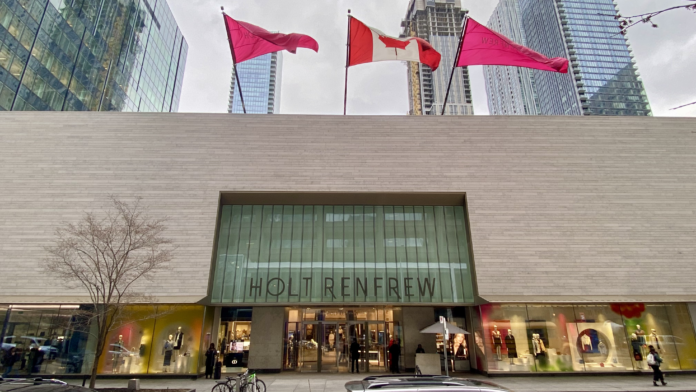
Main entrance to Holt Renfrew at 50 Bloor Street West in Toronto. Photo: Craig Patterson
The Holt Renfrew store at 50 Bloor Street West in Toronto is marking 45 years of operations this month. When it opened in March of 1979, it was met with considerable celebration and marked a milestone in the chain with its largest store location to open at the time, by far.
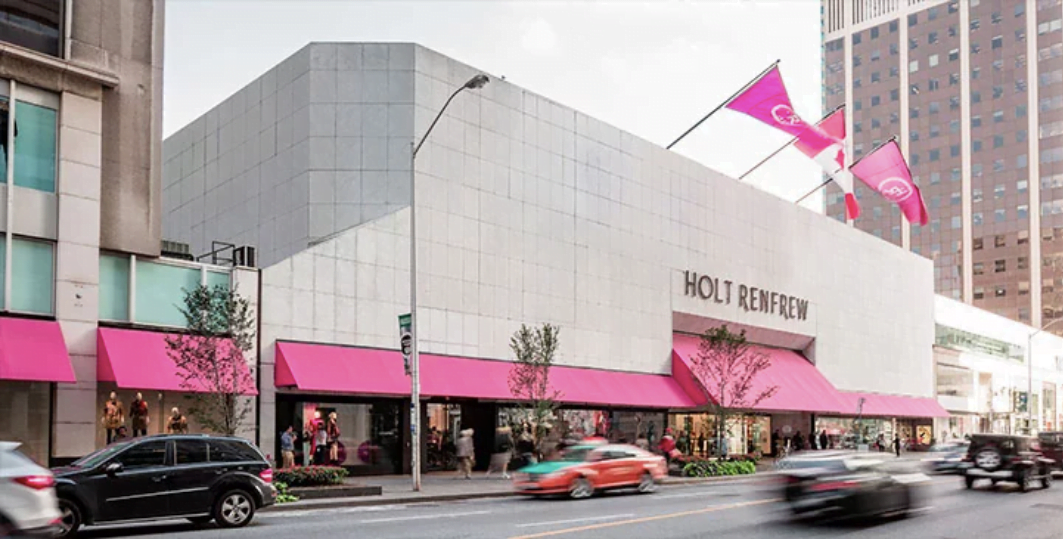
The store boasted about 85,000 square feet of retail space over three levels at the time, considerably larger than the location it replaced up the street. The new store featured a marble-clad facade which existed until the fall of 2020 when it was replaced with a new look.
The 1979 grand opening of the Bloor Street Holt Renfrew store saw over 1,000 attendees pay $75 each to attend a gala — proceeds went to renovations of the Royal Ontario Museum. There was considerable excitement in the area as landlord Morguard had completed the Holt Renfrew Centre at 50 Bloor Street West, which would soon become part of an underground pedestrian system that connects several commercial buildings in the Bloor-Yorkville area.
March 1979 newspaper clipping from the Toronto Star, sourced via Newspapers.com
The new 50 Bloor Street store cost about $6 million to build at the time, and was billed as “the most beautiful store in town”. About 300 people worked in the store, 85 more than in the previous location at 144 Bloor Street West. The new store’s interior was described in the Toronto Star as being lavish, with marble floors in the central area of the main floor with a mirrored escalator — an upgrade from the slow passenger elevators that moved visitors over the five levels of the former store.
Other materials used in the 50 Bloor Street store included bronzed and layered moires, taffeta, raw silk, and light woods such as white oak, olive as and white ash which lined the walls. Plush carpeting could be found in boutique and speciality areas.
The main floor of the new Bloor Street store was a showcase with a range of departments and boutiques. Cosmetics, handbags and accessories could be found on the main floor, and there was a mirrored black-and-beige section devoted to four Italian luxury brand boutiques that included Valentino, Basile, Fendi, and Salvatore Ferragamo. There was a shop called Fabriano which carried imported jewellery from France and Italy, and a Neuhaus chocolate shop where sweets were flown in twice weekly from Brussels. An upscale stationery area featured a range of items, near a 5,500 square foot menswear department that included a casual fashion area called L’Uomo.
Former marble-clad Holt Renfrew facade on Bloor Street — the facade was updated in 2020. Photo: Holt Renfrew
The second floor of the store was dedicated to women’s fashions, including an area called ‘The Boutique’ which housed some of the priciest fashions in the city at the time. Designers in that department included the likes of Dior, Yves Saint Laurent, Chloe and Versace in an area with plush carpeting and moody lighting. The second floor was also home to women’s designer sportswear, Ports International (a popular Canadian brand at the time), dresses, suits, coats, and a fur salon.
The third floor featured a women’s department called Miss Renfrew, a boutique for brand Cacharel, gifts, a beauty salon, and a travel department called ‘First Class’. A children’s department featured a range of designer clothing in a space featuring a pink and blue colour scheme. There was a gourmet food shop and a restaurant next to it called the Fresh Market on the third floor as well — Holts sold foods from Fortum and Mason in London and Fauchon in France, along with a range of kitchen and home goods.
Holt Renfrew’s Bloor Street store on March 27, 2024. This new facade was completed in the fall of 2020. Photo: Craig Patterson
American parent company Carter Hawley Hale made the decision to open the large Toronto flagship store after recognizing the rapidly increasingly affluence in the city. Toronto was seeing a growth boom and Holts took the opportunity to grow its presence in the market — previously Montreal had been the retailer’s headquarters, but an economic decline in the province following issues over language laws led to Toronto becoming the centre of the country economically for the first time.
The Bloor Street store was by far the largest of Holts’ Toronto stores, with other locations in 1978 including Yorkdale Mall, Sherway Gardens and Fairview Mall. Holt Renfrew had 18 stores across Canada at the time — the company had entered the Vancouver market for the first time in 1975, and also had stores in Edmonton, Calgary, Winnipeg, Ottawa, Montreal and Quebec City.
Prior to moving to 50 Bloor Street West in 1979, Holt Renfrew occupied several floors at 144 Bloor Street West — current retail tenants at 144 Bloor include a Burberry store facing Bloor Street, and a Nespresso store facing Cumberland Street. Offices are located upstairs, including Ink Entertainment.
Image: The Toronto Daily Star, Tuesday, September 6, 1955. Image retrieved from Newspapers.comFormer Holt Renfrew store at 144 Bloor Street West — Burberry is the main floor tenant (and is relocating). Photo: Craig Patterson Holt Renfrew store at 144 Bloor Street West in 1955. Photo: Architectural Conservatory Ontario
When Holt Renfrew opened at 144 Bloor Street West in September of 1955, it occupied the entire four upper levels and basement level of the building, spanning from Bloor to Cumberland Street. The Cumberland Street entrance featured a curved driveway for vehicles, with a marquee for weather protection. A small wooded parkette with a fountain at the centre was part of ‘Renfrew Walk’, as the tree-lined motor entrance was called.
144 Bloor was the first building in Canada with an exterior of stainless steel and glass, noted at the time to be similar to that of the United Nations Building in New York City. The Bloor Street building was considered to be state-of-the-art at the time, with air conditioning and a lack of columns throughout the store, with a 45-foot clear span supported by 27-inch steel girders. Recessed incandescent lighting was used throughout the retail space, which spanned about 32,000 square feet at the time.
Rendering of the Cumberland Street ‘Renfrew Walk’ at Holts 144 Bloor St. W. — Rendering from the 1955 newspaper ad above. An expansion in the 1970s saw the Cumberland Street side of the former Holt Renfrew store turned into a movie theatre, then a Nespresso store. Photo: Craig Patterson
The store featured a range of small departments ranging from hats to gourmet food — the crowded main floor had various departments from beauty to women’s shoes, and the third floor housed pricey garments in the ‘HR Boutique’. A luxurious Christian Dior salon was on the third floor, part of an exclusive arrangement Dior had with Holts in Canada at the time. Other departments included a children’s shop, footwear, sportswear, a Monster Marcel beauty salon, menswear and others.
Holt Renfrew advertisement, showcasing the Yonge/Adelaide storefront 90 years ago. Former Holt Renfrew building at 118 Yonge Street in 2012 — the building was decommissioned and its facade was rebuilt half a block north. Photo: Google Street ViewHolt Renfrew’s former 118 Yonge facade has been incorporated into a new development at Yonge and Temperance Streets, next to where Holts once operated. Photo: Google Street View
Prior to opening on Bloor Street, Holt Renfrew’s Toronto operations were in a building at the corner of Yonge and Adelaide Streets (118 Yonge St.) in what is now the Financial District. That store opened in 1910 and served the Toronto market for about 45 years (the building’s facade was shockingly turned sideways, moved half a block north and incorporated into a new office development several years ago with SUD as a main tenant). Prior to that, Holt Renfrew operated nearby at 71-73 King Street East from 1889-1910.
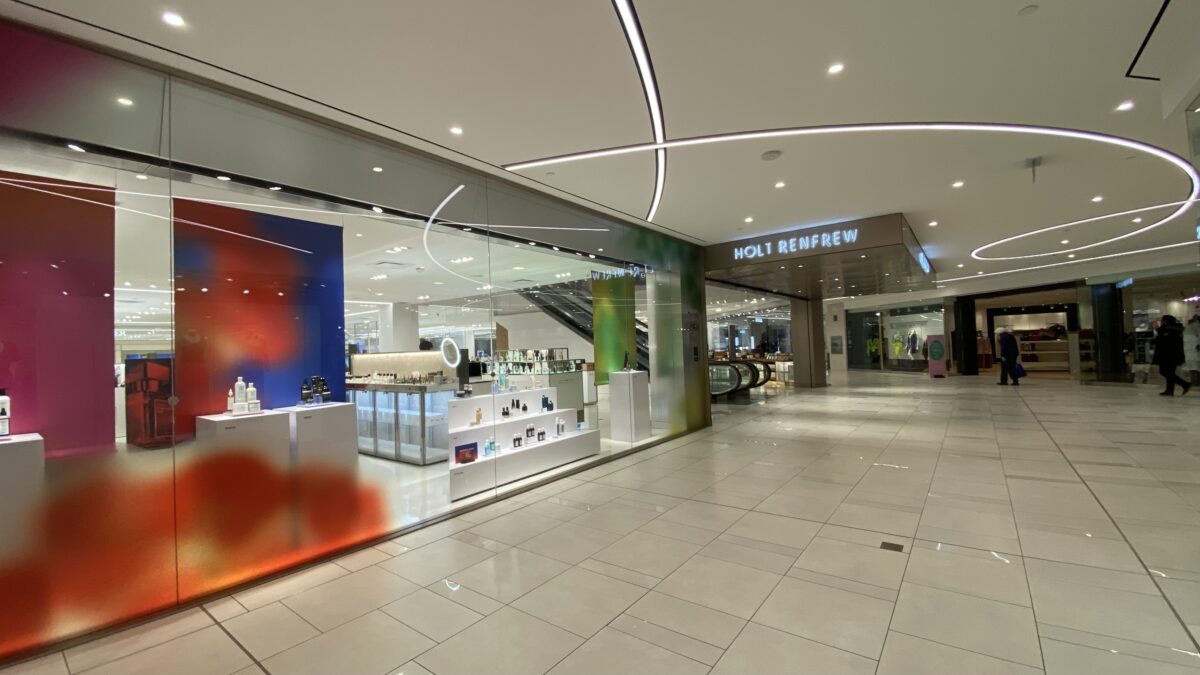
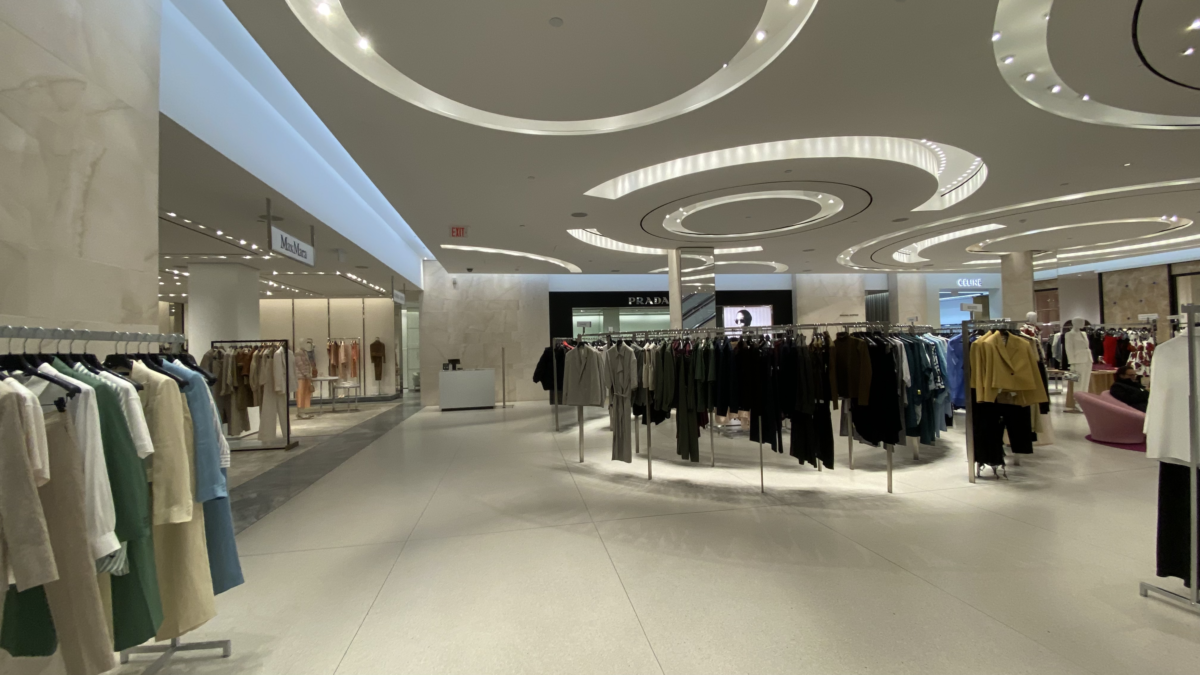
Basement level cosmetics hall at Holt Renfrew, 50 Bloor Street West. Years ago, this was a men’s floor with a cafe. Photo: Craig Patterson Main floor of Holt Renfrew, 50 Bloor St. W., on March 27, 2024. Main floor of Holt Renfrew, 50 Bloor St. W., on March 27, 2024.Main floor of Holt Renfrew, 50 Bloor St. W., on March 27, 2024.
The 50 Bloor Holt Renfrew store has seen expansions and renovations over the years — a basement level was added that was dedicated to menswear and a cafe, and a mezzanine level was added in the early 2000s for women’s footwear. Further space was added in 2006 by annexing an adjacent retail space on Bloor Street formerly occupied by Eddie Bauer. Holt Renfrew currently occupies 190,000 square feet at 50 Bloor Street West.
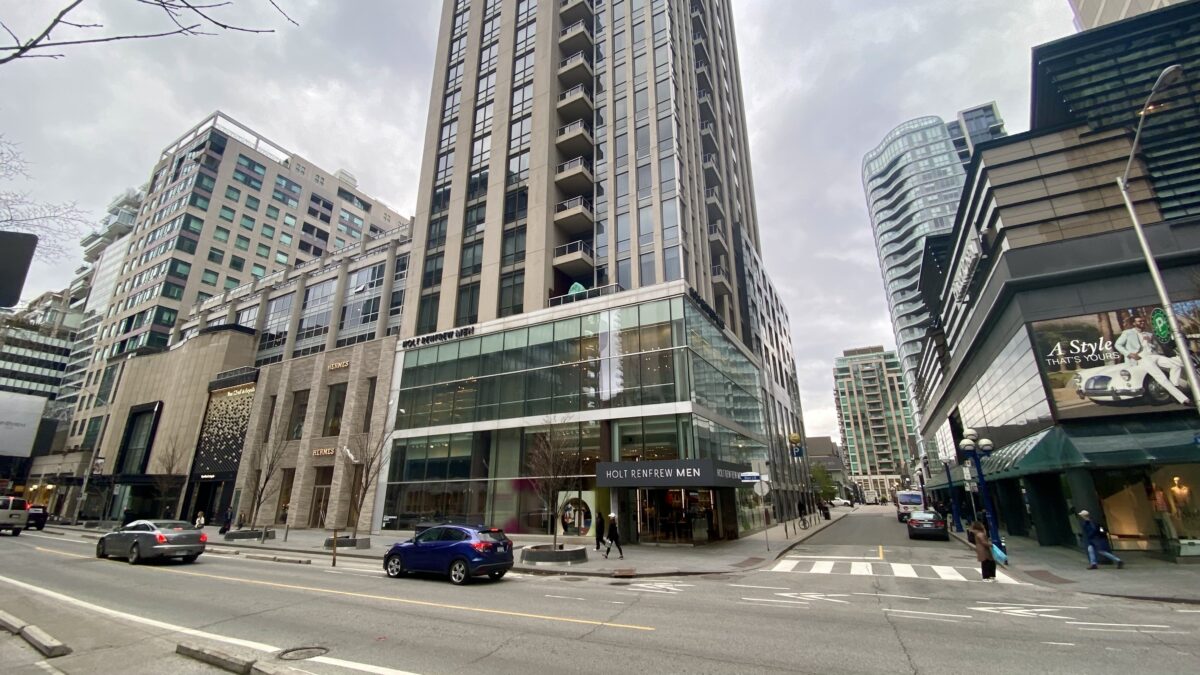
A standalone 16,000 square foot men’s store, branded Holt Renfrew Men, opened in September of 2014 at 100 Bloor Street West. Construction is now underway on the third floor of the 50 Bloor Holt Renfrew store for a new men’s store that will open before the end of the year. That will coincide with the closure of the 100 Bloor standalone men’s store.
Current Holt Renfrew Men’s store at 100 Bloor Street West — the store will be closing before the end of the year to relocate back into the main 50 Bloor Holts store. Photo: Craig Patterson
The 50 Bloor Street West Holt Renfrew store has seen some substantial updates recently, including a new facade that was added in the fall of 2020. The circa 1979 white marble facade, which was starting to show its age, was replaced with a beige stone expanse that dominates the north side of Bloor Street (see photos above in this article). The store’s interior has also been updated substantially — in the spring of 2019, the basement level was converted to a beauty hall, and the main floor was updated before the pandemic with new luxury concessions. The women’s second level designer floor was updated during the pandemic with new Chanel, Celine and Gucci boutiques, the mezzanine restaurant was updated, along with the shoe hall, and now the third floor is under construction for Holt Renfrew Men as well as women’s contemporary fashions.
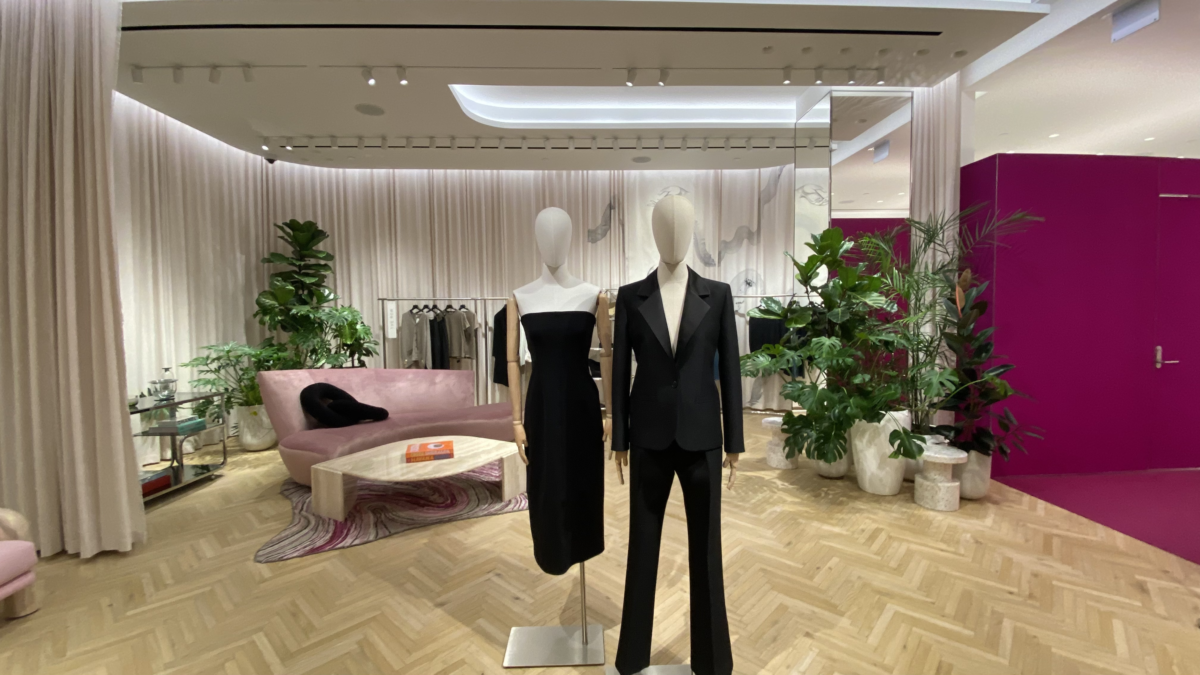
Second floor of Holt Renfrew at 50 Bloor Street West — Gucci and Celine opened beautiful new concession spaces in 2022. Photo: Craig Patterson Second floor of Holt Renfrew at 50 Bloor St. W. Second floor of Holt Renfrew at 50 Bloor St. W.
When the 85,000 square foot store opened in 1979, it was considerably larger than Holt Renfrew’s other Canadian stores at the time. The Montreal store on Sherbrooke Street was about 34,000 square feet over four levels, and the Vancouver store at Pacific Centre was about 32,000 square feet. The Montreal store was eventually expanded to about 65,000 square feet and the Vancouver store to about 68,000 square feet, before the company began to implement a Neiman Marcus-like ‘superstore’ strategy.
That ‘superstore’ location opening began with the construction of a 137,000 square foot Vancouver store in 2007 (now 180,000 square feet with an expansion), which was followed by a 150,000 square foot replacement store in downtown Calgary in 2009. In 2012, Holts substantially expanded its Yorkdale store (now about 130,000 square feet), and in 2017 it relocated its CF Sherway Gardens store to a 140,000 square foot space at Square One in Mississauga. Most recently, in 2019, Holt Renfrew opened a 250,000 square foot Montreal storefront on Ste-Catherine Street, rebranding the Ogilvy department store that had operated there for generations.
‘Studio’ shopping area on the second floor of Holt Renfrew at 50 Bloor St. W. — until the early 2000s, this was a luxury women’s fashion area called ‘HR Boutique’. Photo: Craig Patterson Mezzanine level of Holt Renfrew at 50 Bloor St. W., including women’s footwear and a Delveaux boutique. Future men’s store under construction on the third floor of Holt Renfrew at 50 Bloor St. W.
The 50 Bloor Holt Renfrew store has a lot of history — many splashy parties have been thrown in the store, and some of the wealthiest and best-known people in the world have passed through its doors. The store has carried some of the world’s leading fashion designers and hosted them in-store, with TV show Fashion Television sometimes profiling the glamorous events. The store has gone through various renovations and expansions to where it is today, and its future is opportunistic as the area continues to build a clustering of wealth residentially, while attracting visitors from the region and beyond.
The Galleria brand is looking for potential sites of 3,000 to 20,000 square feet in markets such as Aurora/Newmarket, London, Markham, Mississauga, Richmond Hill, Waterloo and Toronto.
Matthew John Pieszchala
Matthew John Pieszchala, Vice President at CBRE Canada, which is representing the brand in its expansion, said the brand originally began as Korea Food Trading and has been around since the 1980s.
“Along with doing the wholesale to major grocery stores for Korean specific products they eventually ended up opening a retail store in Thornhill, Vaughan,” he said. “That store which was their first ever store has since closed and they opened another one in the same area (at Yonge Street and Steeles Avenue). That one actually got expropriated and we just helped them buy a plaza in the same intersection that they’re going to terminate the Toys R Us and put their new brand in,” said Pieszchala.
“Started in the wholesale business, got into the retail business, Korean based products, they supply grocery stores and now they’re expanding their retail footprint across the province of Ontario to start.”
Pieszchala said the smallest store is 1,500 square feet with the largest being 35,000 square feet.
“We’re hoping to do one to two (new) stores a year,” he said.
“The site selection and the size is heavily driven by their key demographics- where their key demographics, which is number one Korean population and number two would be Chinese, and where those demographics live they will open larger stores. Think Richmond Hill. Think Markham. Think Thornhill. Those types of areas.”
Galleria Supermarket Eglinton (Image: Galleria)
“And where they’re going to open smaller footprint stores is the Yonge and Eglington, the Queen West, urban stores that have less of their demographic like their key Korean and Chinese demographic but still have a heavy foot population and the theory here is that they’re actually pulling customers off of the street versus relying on their key demographic driving to them.”
“It’s a two phased approach as to why they’re opening urban ones. Number one is obviously they want to make money as a retail store as everyone does but the underlying piece to it is also to create brand awareness and Korean-based products in general because the more their non-dominant customer eats and likes Korean-based products the more they’re going to order them from their larger stores, from their online distribution and then also through the major grocery banners that their grocery stores supply to.”
Galleria Supermarket at 7040 Yonge Street (Image: Humbold Properties)
Pieszchala said expansion plans are all in Ontario right now to start but they have been out to Calgary to look at real estate. That is being put on hold for now but will be revisited eventually.
“Right now the focus is on southern Ontario,” he said.
Retail Insider’s Craig Patterson interviews Christina Morrow, Founder at Vancouver-based Wicked Rose, about Morrow’s journey of creating a groundbreaking women’s martial arts activewear brand. Morrow shares her personal motivation, driven by the lack of suitable clothing options for women in martial arts, which led her to develop a brand that combines high quality, performance-oriented apparel with size inclusivity up to 5XL. Morrow’s six-year experience in Muay Thai, and her dissatisfaction with existing offerings, inspired her to research and eventually create a line of activewear that caters specifically to women’s needs in martial arts.
Morrow discusses the unique design challenges and solutions Wicked Rose offers, like the introduction of non-see-through spats with high waistbands to ensure comfort and functionality during intense training sessions. Morrow’s approach involved meticulous product development, including gathering feedback from the martial arts community and incorporating innovative design elements to address common issues faced by women in martial arts. Her collaboration with a tattoo artist friend brings a unique aesthetic to the brand, making it stand out in a market saturated with generic designs.
The conversation concludes with Morrow’s future ambitions for Wicked Rose, including its upcoming Kickstarter campaign aimed at broadening the brand’s reach and introducing sustainable practices in activewear production. They touch upon the potential expansion into retail and the vision of establishing Wicked Rose as a globally recognized activewear brand founded on principles of empowerment, innovation, and inclusivity.
SAJO – Canada’s first specialized retail builder. Visit SAJO to see their holistic approach and transdisciplinary team to explore and understand your needs.
If you prefer to listen to the audio version, it is available below:
The Interview Series audio podcasts by Retail Insider Canada are available on Apple Podcasts, Stitcher, TuneIn, Google Play, or through our dedicated RSS feed for Overcast and other podcast players. Also check out our The Weekly audio podcast where Craig and Lee discuss popular content published on Retail Insider which is part of the The Retail Insider Podcast Network.
Subscribe, Rate, and Review our Retail Insider Podcast!
Drop us a line at Craig@Retail-Insider.com. You can also rate us in Apple Podcasts or recommend us in Overcast to help more people discover the show!
Background Music Credit: Hard Boiled Kevin MacLeod (incompetech.com). Licensed under Creative Commons: By Attribution 3.0 License. http://creativecommons.org/licenses/by/3.0/
The anticipated opening of The Ballroom Bowl in Yorkville is finally here and will deliver a luxurious bowling experience. Guests can expect traditional bowling with a modern upscale twist and the space will have eight state-of-the-art bowling lanes including two VIP lanes. The space will not just be used for bowling, but for social gatherings such as corporate events, team building events, and birthday parties. The company also has plans to expand in the future with locations within the GTA, outside of Ontario, and in the United States.
The first location opened in Toronto in 2010 located on John Street in the city’s Entertainment District, and is a popular destination within the city. The Ballroom Bowl is not just about enjoying pastime, but modernizing bowling to be an experience resonating with Toronto.
“If you had told us that we were going to get this kind of opportunity to move into these kinds of locations, I wouldn’t have believed it – I still actually can’t believe it. It is something very different and there is nothing else like this in Canada,” says Paul Donato, President and CEO of The Ballroom Bowl.
The Ballroom Bowl will also be adding a third location at Dundas Square, on the third level of ‘The Tenor’ at 10 Dundas Street East, and will be opening for November.
New location, different feel
Ballroom Bowl Yorkville (Image: Adrian Ozimek)
Each location has a different concept and will match the feel and vibe of its surrounding neighbourhoods.
The first location on John Street is described as having an “old warehouse” feel, the Yorkville location given the neighbourhood will have an upscale concept and Donato says “visitors won’t believe it when they see it, and the Dundas location will have a very industrial look with “a lot of steel, wood, and will be open concept – It will be really neat and different from the other locations.”
The new Yorkville location design was from mcCallumSather, a Hamilton-based design firm, and guests can experience a “sophisticated leisure-inspired aesthetic.”
Each location will allow returning guests to have a different experience with the same services and people should try all three locations once they are all open.
“I get goosebumps just talking about this because I can’t believe it myself. We are very fortunate, very lucky, and very proud. Year after year, you just watch the bowling balls go down the lanes at the John Street location and we are just really proud – it has really been a well kept secret that is obviously getting out there now and that is okay. There is also a lot of room for growth in the bowling industry in Canada, and I am just very excited to be part of that.”
“Canada has forgotten about bowling”
Paul Donato at Ballroom Bowl Yorkville (Image: Adrian Ozimek)
Donato says Canada has “forgotten about bowling” in the last decade and says he is bringing it back as it brings people together, especially when it is needed the most during difficult times.
“With our different cultures, Canada is so diverse and when you go into The Ballroom Bowl on a Saturday or Friday night – it is just people. It is the United Nations and everybody loves it. You might not want to go out on a Friday night, but when you chuck that first rock down the lane, it is a different mindset. You can have a nice cold beer, a nice martini, and some nice food – it is just fun and is really for everyone.”
Aside from the bowling, The Ballroom Bowl treats guests as they would like to be treated and provides an atmosphere where people can let go and have fun.
Social Events
Ballroom Bowl Yorkville (Image: Adrian Ozimek)Ballroom Bowl Yorkville (Image: Adrian Ozimek)
All three locations have space for social events such as corporate events, team building, birthday parties, charitable events, and even bridal parties.
“The team building is constant. So Thursday, Friday, and Saturday nights, the bowling lanes are always busy. And starting soon, you have Bank of Montreal coming in to do a team building event, like it is just constant and we believe that will continue at Yorkville and the Dundas locations as well. There is only so much space in the city to put bowling lanes in and it is not easy to find, and I don’t think we are saturating the market. The team building in the corporate events are a big part of the company.”
Donato says with the Yorkville location, he thinks a lot of birthday parties for kids will be hosted there. “If I am a kid living around the corner – this will be a top destination.”
“I would like to have expanded yesterday”
Future Ballroom Bowl at 10 Dundas in Toronto (Image: Dustin Fuhs)
Currently, Donato says he is working on his biggest deal right now, but unfortunately couldn’t announce the location yet.
When looking for future locations, Donato says the brand is looking to keep it simple and look for places that are mixed in with some great companies: “It is a pretty wide open map in the GTA and other areas to set up The Ballroom Bowl.”
The Yorkville location will be surrounded by Nike, Scotiabank, Mango, and Altea Active while the future Dundas location will be around the Hard Rock Cafe and Shake Shack.
Alex Edmison of CBRE negotiated the lease deal on behalf of Ballroom and is representing the brand nationally for any potential future location expansions.
The Ballroom Bowl John Street (Image: Dustin Fuhs)
Outside of Ontario, Montreal and British Columbia are two areas Donato mentions for possible expansion locations and expressed he would have liked to expand to these locations “yesterday.”
Donato also wants to take The Ballroom Bowl internationally by expanding it into the United States. The company was planning to expand into Nashville, Tennessee back in 2013 and although this never happened, Donato is now looking into the US for future growth opportunities.
“Our second store was planned in Nashville in 2013, and I still have the work sitting in my files. I travel extensively throughout North America looking for opportunities and checking out everything that is going on in the marketplace, and you can go anywhere with the ballroom. We would have loved to be in Montreal yesterday, we would have loved to be in British Columbia yesterday, and we have the opportunities that are present. The reality is, there is so much to do in my own backyard first.”
The Ballroom Bowl Yorkville (Image: The Ballroom Bowl)The Ballroom Bowl Yorkville (Image: The Ballroom Bowl)The Ballroom Bowl Yorkville (Image: The Ballroom Bowl)The Ballroom Bowl Yorkville (Image: The Ballroom Bowl)The Ballroom Bowl Yorkville Grand Opening March 28, 2024 (Image: The Ballroom Bowl)The Ballroom Bowl Yorkville (Image: The Ballroom Bowl)Alex Edmison and Paul Donato at The Ballroom Bowl Yorkville Grand Opening (Image: The Ballroom Bowl)
Retail Insider is streamlining its Canadian retail news from around the web to include a handful of top news stories that can be viewed quickly during the day. Here are the top stories from the past 24 hours.
Easter is around the corner and like many holidays, it arrived on retail shelves earlier. Jeff Doucette, general manager at Field Agent Canada, and Joanne Mutter, owner of JoJo CoCo Chocolate in Ottawa, discusses the current state of Easter, rising trends, and what is missing – such as the presence of adult Easter themed products.
“The Seasonal Creep”
Easter this year came out earlier than ever as products were mixed with Valentine’s Day causing retailers to have multiple displays at once – making it a messy experience.
Jeff Doucette
“What we saw early on, is a mismatch of Easter and Valentine’s Day all happening almost immediately after Christmas. All that product hit the stores and is the idea of seasonal creep – all seasons mixed together. Every year the seasons tend to start a little bit earlier, so it just seems like there is a lot of competition and a lot of space being used in-store to celebrate multiple ones at the same time. We have already started to see some summer olympic stuff, so it could be seen as confusing for consumers because there are a couple of different things happening at the same time,” says Jeff Doucette.
Doucette says other countries are seeing the same, such as Australia where retailers started selling Easter products in January: “So, it is really early this year.” This trend was previously reported in Retail Insider discussing Halloween, which was mixed with Christmas causing a confusion among consumers.
JoJo CoCo Chocolate – What it is seeing in-store
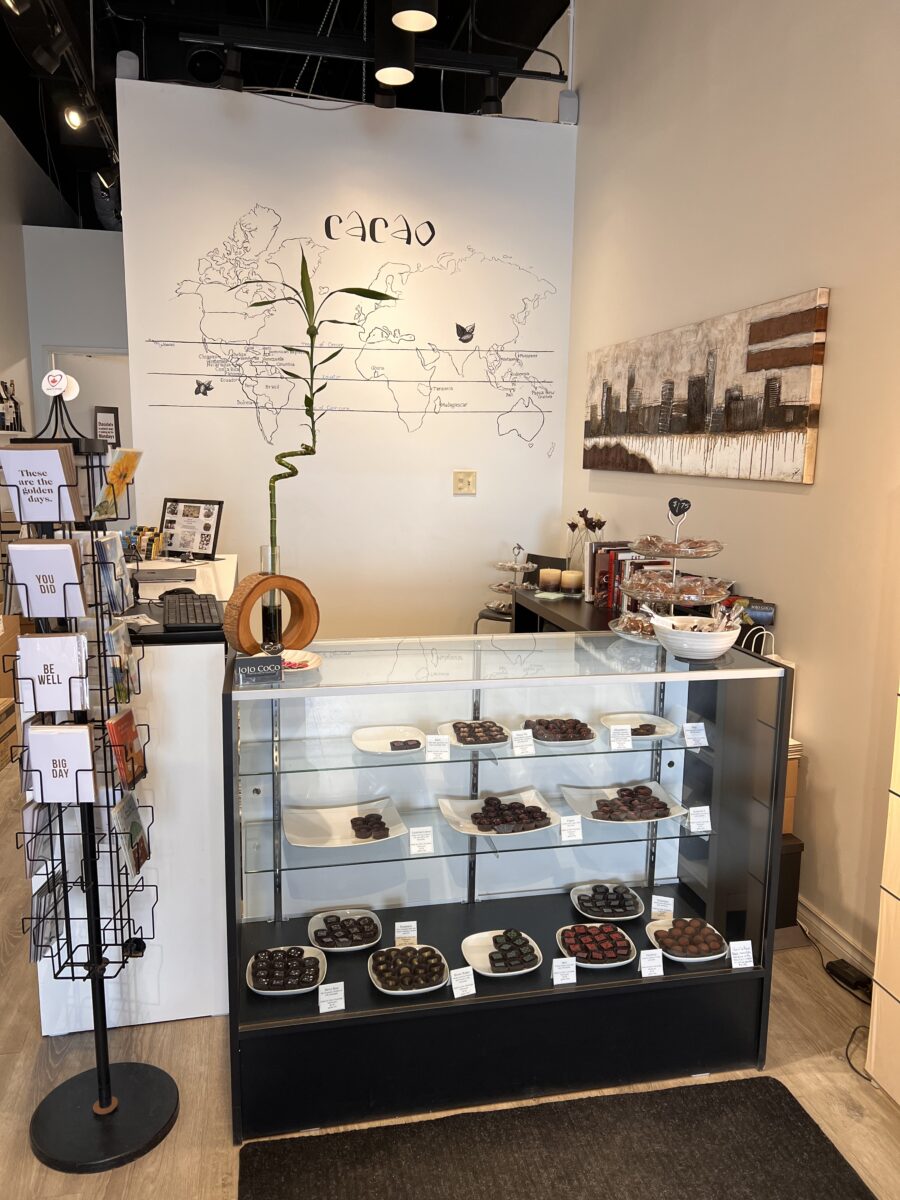
JoJo CoCo in Ottawa (Image: JoJo CoCo)
JoJo CoCo is located in Ottawa, Ontario where it has an assortment of chocolate from artisan makers throughout Canada and focuses on fine and ‘bean to bar’ instead of mass produced.
Joanne Mutter says for Easter, there aren’t usually a lot of specialized products.
Joanne Mutter
“There is not a lot of chocolate that gets produced for any holidays simply because a lot of the artisans don’t work with any sort of molds of chicks and bunnies for Easter – but now, more and more of them are starting to use them and products look great,” says Mutter.
The store offers products for everyone and has options for dietary restrictions. As Easter is earlier this year, Mutter says it takes people by surprise, creating a slower build.
“When it is the week of Easter, people are suddenly like ‘oh, wow – it is Easter weekend.’ So a lot more traffic happens a lot closer than it would be if let’s say Easter was in the middle of April,” says Mutter. “We started getting ready for Easter as soon as Valentine’s Day was over. We are not a big volume retailer, so we don’t have one holiday ahead of the other, we are right on the heels of another and so we probably have a good four weeks of selling period for Easter.”
“Going to the dark side”
Image: jojococo.ca
As for trends, Mutter says the main one right now is more people are purchasing dark chocolate and more people are interested in ingredients as consumers want to know what they are eating.
“There are a lot of people out there that are making really great craft chocolate and people should be open to trying the dark chocolate as it is better for you and has lots of interesting flavour notes to it. So I would say, step out of the box and try something a little bit new,” says Mutter.
Mutter also notices a shift in consumers wanting to support more local businesses and are seeing an increase in traffic and interest towards their products.
As for Easter products, consumers can expect to see different options for bunnies such as dark chocolate, vegan, and dairy free. The store also offers a selection of mini eggs. JoJo CoCo is available to ship across Canada.
Easter chocolate innovation and adult appeal.
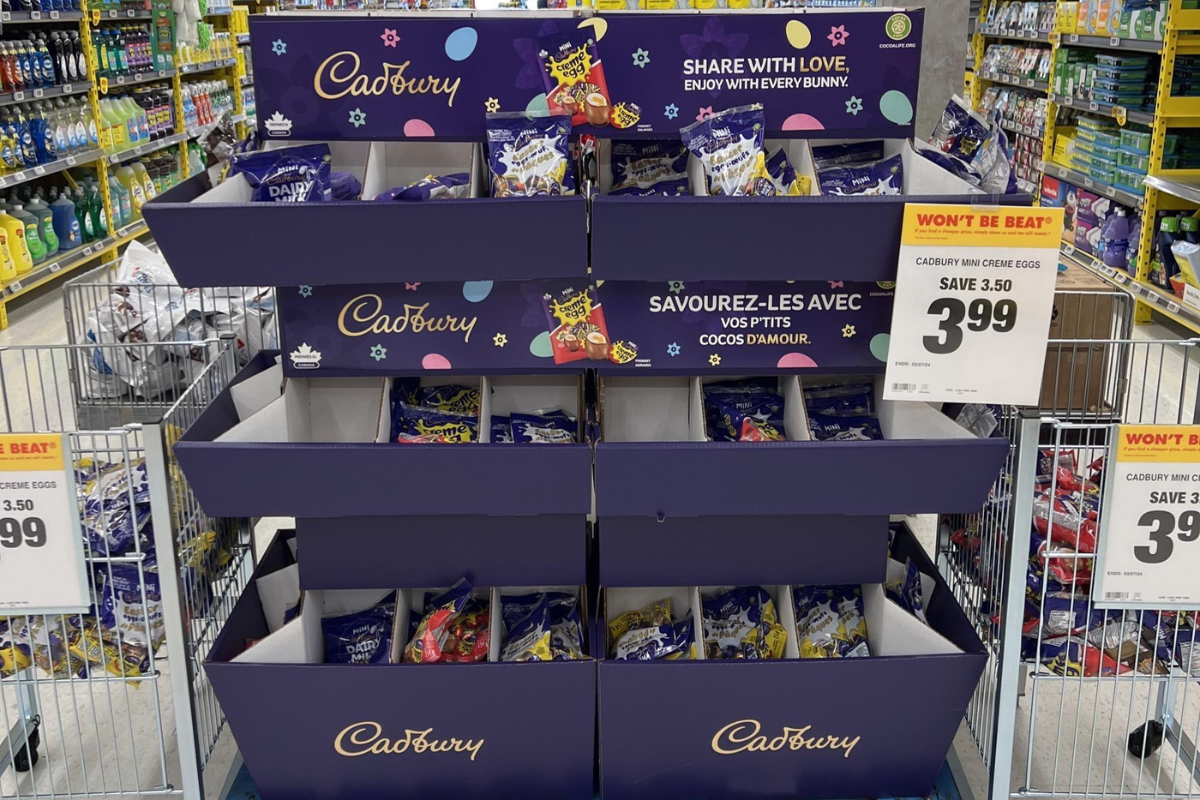
Cadbury’s ‘Share with love’ Campaign at No Frills in Oshawa (Image: Field Agent Canada)
“Big brands that I have seen that are standing out this Easter in terms of merchandising are Cadbury and Peeps. The Peeps marshmallow treats, which is not really a big brand outside of the Easter period, are doing extremely well this Easter in terms of the space they are getting and just has been more noticeable than what I have seen in the past,” says Doucette.
Doucette says there is not a lot of product innovation, but is seeing retailers spending more on displays.
Retailers are not just throwing products onto shelves, but are putting more effort this year into displays and signage in-store. One example would be Cadbury’s program “share with love” as “it creates an island of Easter inside the store, so that is interesting and there is a tie with children’s charities with the campaign”. Lindt has really good premium merchandise where they are “not competing as much for low prices, but more on image. So that is a different tactic in this type of economy to be focused on the upper end of the spectrum.”
As for adults, the category is growing for Easter as Doucette says more brands are putting out products such as the Guinness chocolate egg, Baileys, and other alcoholic themed chocolate eggs – but brands could be doing more for adults.
“It is tough. There is not anything exciting right now, there is not a whole lot that is really neat. It has been quite quiet in terms of actual new product innovations,” says Doucette.
JoJo CoCo in Ottawa (Image: JoJo CoCo)
Inside JoJo CoCo, Mutter says it offers adult Easter gift baskets such as a box of truffles and some Easter mixed products. The brand also offers wine pairing.
“We actually do a lot of pairing of chocolate, so people will come to us saying ‘we are serving this type of wine, what chocolate should we have with it?’ A majority of people want something that is Easter themed in whatever chocolate they want, so bunnies and eggs are the ones moving out the door quickly,” says Mutter.
Doucette says brands are beginning to step up their game with Easter, such as Nestle who is “getting more serious about the Easter category with their big three brands: Smarties, KitKat, and Arrow.” Despite this, there is still a lot of room for Easter innovations including brands who are outside of the candy category.
Think outside of candy
Easter Display at Real Canadian Superstore in Peterborough, Ontario (Image: Field Agent Canada)
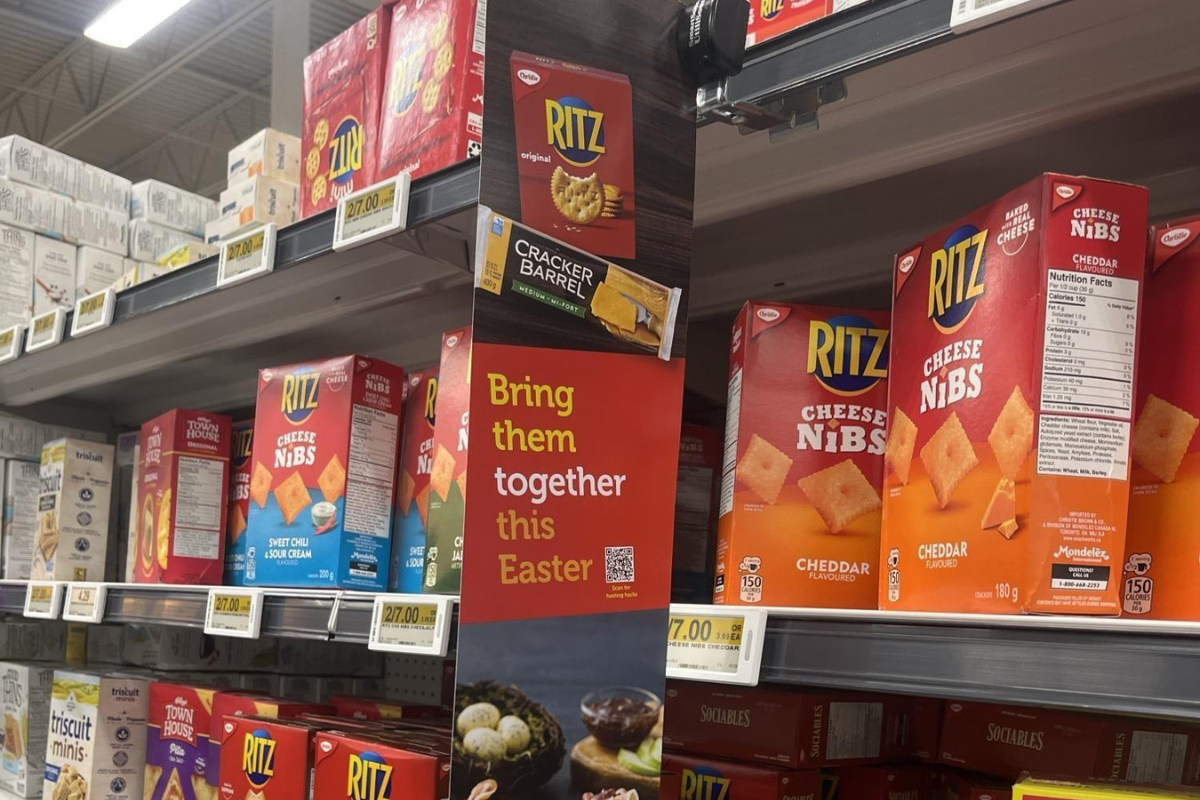
It is not just candy companies that are trying to bring products and designs to Easter as Doucette says Mondelez International Inc. has a Ritz, Triscuit, and a cracker barrel that is designed to “bring them together for Easter. Of course the company is a candy company so they are no strangers to Easter, but using Ritz and Triscuit is a different approach.”
Another concept Doucette saw last year was cheese selections that were wrapped like an Easter egg, chicken, or a bunny shape: “Sounds kind of funny, but there literally was an Easter cheese offering and it was kind of cool.”
Outside of the food category, Doucette suggests other categories to expand into Easter including opportunities for toys, health, and beauty products.
Future in-store experiences
Lindt Chocolate in First Canadian Place (Image: Dustin Fuhs)
One way retailers could bring shoppers in-store rather than shopping online, would be to have an Easter egg hunt in-store. This would not only bring shoppers in, but would create a memorable shopping experience.
“Maybe four weeks before Easter, retailers could have an Easter bunny in-store and have kids run around to find eggs just as a way to get people in-store and have a little event. That would be fun and more of a shopping event and then you kind of submit yourself as the Easter store and just kind of lock that store in as the destination for Easter,” says Doucette.
Doucette also suggests retailers to have a shop-in-shop layout for Easter where there is a big section tying all brands and Easter products together in one place, making it easier for shoppers while providing a great and memorable experience.
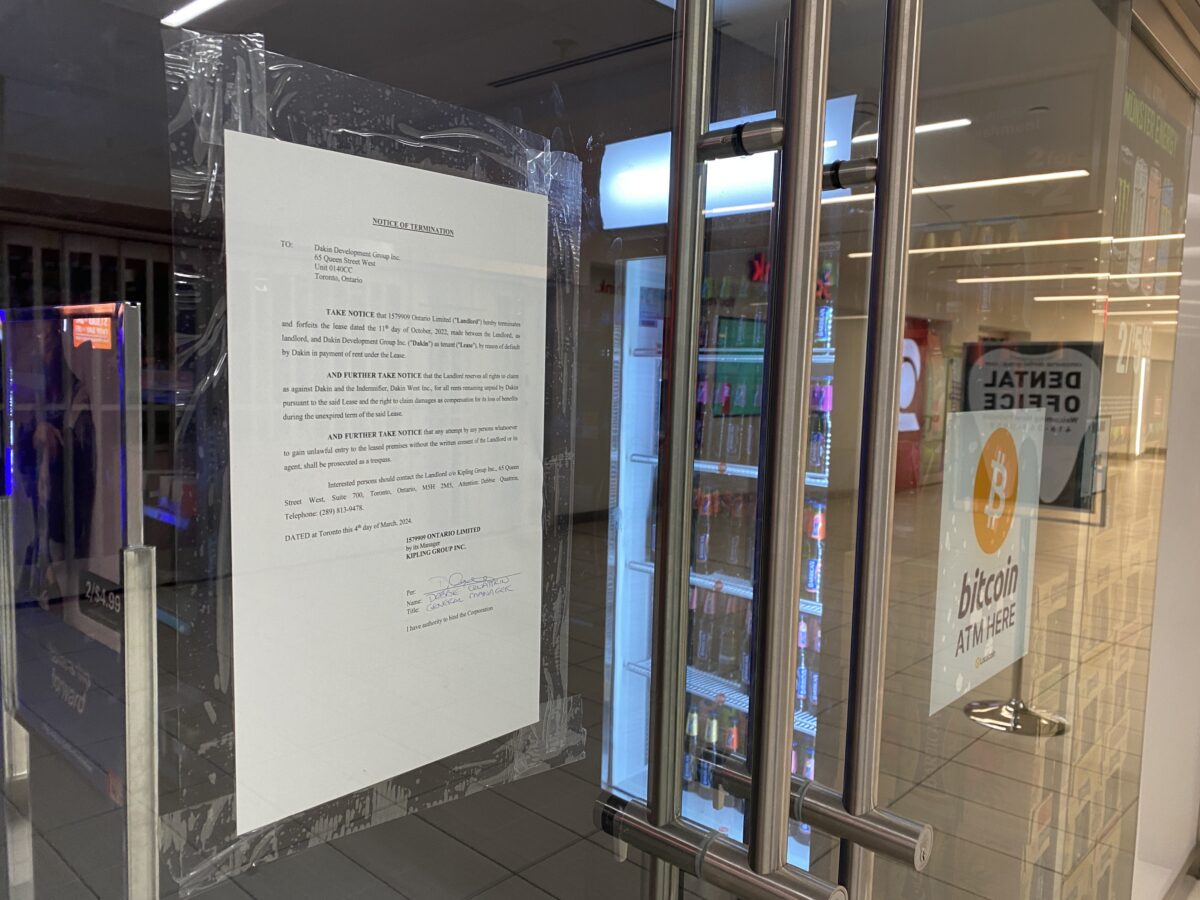
Shuttered Retailer at 633 Queen Street West (Image: Dustin Fuhs)
A new report by Equifax Canada indicates insolvencies are rising in the country amid mounting financial stress on Canadian businesses.
And the Canada Emergency Business Account (CEBA) loan repayment has added to that financial burden.
Jeff Brown
“Canadian businesses are facing a perfect storm of economic pressures,” said Jeff Brown, Head of Commercial Solutions for Equifax Canada. “The end of the initial grace period for CEBA loans, combined with high input costs, labour expenses, a slowdown in consumer spending and high interest rates, is creating a challenging environment.
“These factors are contributing to a growing trend of business failures. The sharp rise in insolvencies, representing a 30.3 per cent surge since 2019, underscores the financial pressures faced by businesses. There is a need to manage debt and adapt to changing market conditions through strategic financial planning and proactive measures.”
Closed Business in the PATH at 65 Queen Street (Image: Dustin Fuhs)
With the deadline for CEBA loan repayments now passed, many businesses find themselves navigating the financial strain of monthly payments accompanied by a higher interest rate — a stark contrast to the initial terms of interest-free and no monthly payments. On January 19, 2024, CEBA loans converted to a three-year term loan with five per cent interest payable per year.
“Over the shoulders of a lot of small businesses right now is the CEBA loans and the repayment of them. It was comforting to see a lot of small businesses stepped up and repaid that loan,” he said. But many of them had to take on another loan to pay for that loan.
“But really what’s happening behind the scenes is almost the equivalent of a small business taking on a net new car loan for a car they don’t get to drive so it’s just something that’s just adding onto their shoulders of how they operate moving forward and really when we think about this we always say the adage you’ve got to spend money to make money but you have less access to capital because you’re already paying something else off. There’s less of the ability for them to spend money to grow their businesses and support their businesses moving forward.”
Some key findings from Equifax Canada’s Market Pulse Quarterly Business Credit Trends Report:
Many Canadian businesses are facing an uphill battle, as evidenced by a 41.4 per cent surge in business insolvencies in 2023 when compared to 2022;
A 14.3 per cent uptick in the number of businesses that missed a payment on a credit product (Q4 2023 vs. Q4 2022);
Delinquencies across business credit accounts continued to rise, with industrial and financial trades experiencing increases in account-level delinquencies. In Q4 2023, industrial trades experienced an 8.8 per cent increase in 30+ day account-level delinquencies, reaching 11.2 per cent. Financial trades saw a 3.1 per cent increase to 3.3 per cent;
Installment loan delinquencies reported a significant surge, with early-stage delinquencies up by 12.5 per cent and late-stage delinquencies up by 16.3 per cent year-over-year, suggesting that businesses are struggling with monthly loan payments. Revolving credit (cards and line of credit) delinquencies of 30+ days grew by 1.3 per cent year over year, reaching 3.2 per cent in Q4 2023. Real estate, rental, leasing, and retail trades also witnessed substantial increases in missed payments;
The provinces with the highest financial trade delinquency rates are Alberta (3%), Ontario (2.9%) and Quebec (2.6%), with Quebec also having experienced the largest uptick year over year from 2.4 per cent to 2.6 per cent in severe (90+ days) delinquency rate; and
Reported outstanding balances from financial trades continued to rise, reaching $31.8 billion in Q4 2023, and marking a 7.4 per cent annual increase driven primarily by a 15.3 per cent increase in credit card balance.
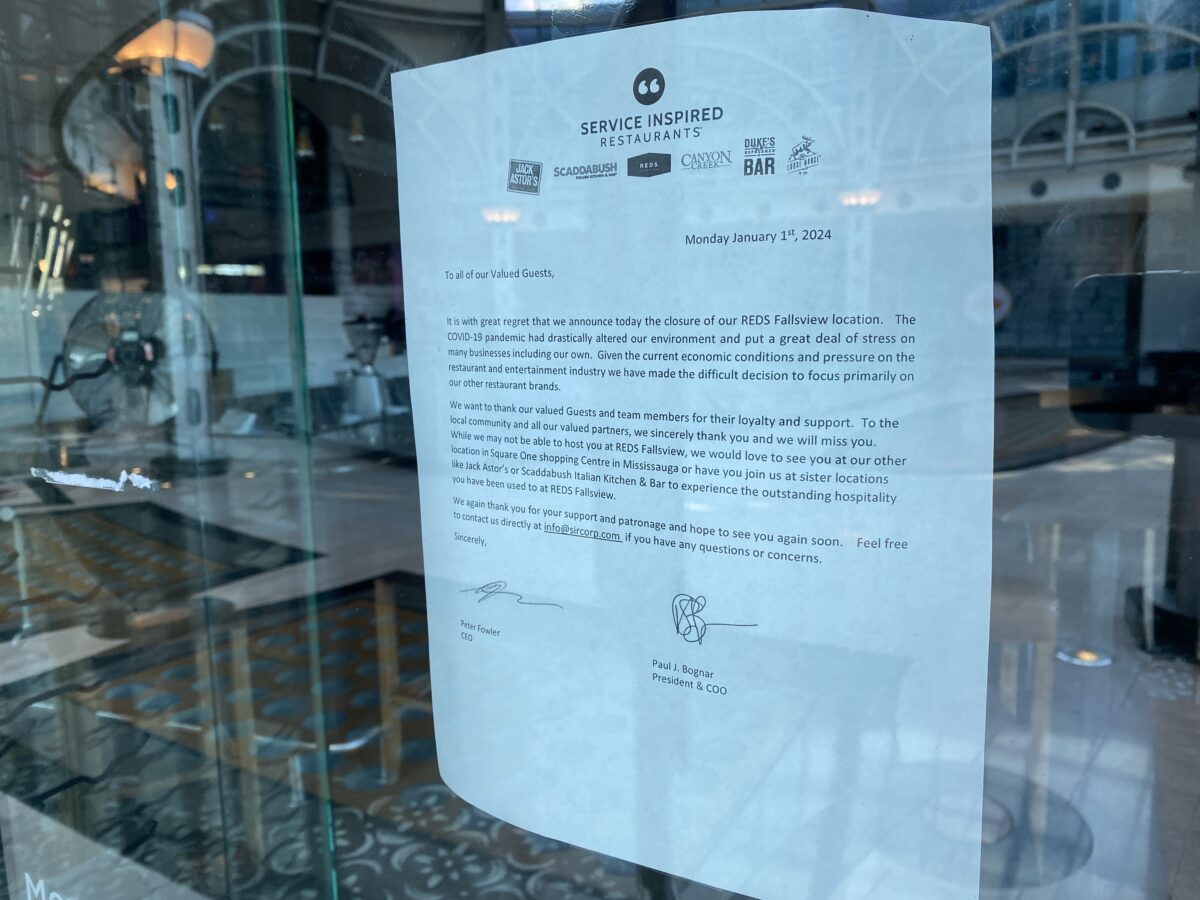
Closed Red’s at Fallsview Casino Resort (Image: Dustin Fuhs)
“We’re seeing the struggles all over the place right now,” said Brown. “There’s obligations with suppliers across the board. Delinquency rates are increasing. So 8.8 per cent with suppliers. Then we’re seeing it grow even more with financial institutions. The percentage of businesses that are 30 days plus overdue shot up 11.2 per cent this past quarter. It means even with the debt that they’ve taken on it looks like it’s becoming a bit more mounting for them to be able to pay even their basic obligations right now. So it’s very challenging.
“Obviously it’s going to vary by sector.”
Image: TheBodyShop.com
Despite a slowdown in inflationary pressure, new credit growth remains subdued, with high interest rates and tighter lending criteria constraining lending activities, said Equifax. This is evidenced by a notable decline in new originations for both financial (-24.4%) and industrial trades (-15.3%) compared to the previous year. However, despite reduced lending activity, the demand for credit among businesses remains robust, as reflected in a 5.5 per cent increase in credit inquiries.
“The demand for new credit may point to signs of growth and expansion as Q4 2023 saw a 21.9 per cent rise in establishment of new businesses when compared to the same time period in 2022,” said Brown.
“We haven’t seen growth (in insolvencies) this large over the past 10 years . . . With this mounting debt and delinquencies increasing we’re not really seeing any signs of why those insolvency numbers shouldn’t continue to climb.”
Marugame Udon, the world-renowned Japanese noodle hotspot, has opened its first Canadian location in Vancouver with plans to grow the brand across the country.
Victor Hisao Misawa
“We are thrilled to introduce Marugame Udon to the vibrant city of Vancouver. Our goal is to foster cultural exchange through the rich and authentic flavours of Sanuki-style udon and tempura, offering a truly unique culinary experience” said Victor Hisao Misawa, President, and General Manager, Marugame Udon International.
The first location has opened at 589 Beatty Street in downtown Vancouver.
“At Marugame Udon, customers can expect to indulge in delicious handcrafted udon noodles served daily in a lively dining atmosphere. With a dedication to freshness, the experienced and passionate kitchen teams in over 1,000 restaurants worldwide take pride in creating culinary excellence every day. Marugame’s dishes are expertly prepared in a theatre-style kitchen, allowing guests to observe the craftsmanship behind each meal. The hallmark of Marugame’s cuisine lies in its made-to-order udon noodles, guaranteeing an unforgettable and authentic Japanese dining experience for all patrons,” said the company.
Toridoll Holdings, which has developed a chain of restaurants in various dining categories, operates the Marugame Udon brand which was founded in Kakogawa City, Japan in 2000 and is the world’s most successful udon concept with more than 1,000 locations worldwide. About 850 restaurants are in Japan.
Marugame Udon Vancouver (Image: Marugame Udon)Marugame Udon Vancouver (Image: Marugame Udon)Image: Marugame Udon
The Vancouver location is the brand’s 263rd restaurant outside Japan.
Marugame Canada is currently seeking franchise partners in collaboration with the national expansion.
Misawa said the restaurant had a soft opening for three weeks before its grand opening on March 15.
He said the area of Japan where the brand began has many tiny udon noodle restaurants.
“Many, many people line up there,” said Misawa. “They make the noodles really fresh and then you eat it with tempura. What’s unique about those little restaurants, they’re literally a little workshop set up at the back of a house kind of thing. And people just line up. They have this sort of open kitchen.”
The first restaurant that opened for the brand emulated those little restaurants.
“It was instantly very successful,” he said. “Marugame is one of the towns from that region and that region specifically because of the type of wheat you can get in that area and the water renders a very chewy style of noodle. There are very, very many different types of noodles in Japan like there are in China and the rest of Asia. And this particular one is a chewier style.
“It started in 2000 and then expanded very fast.
“Vancouver for us is extremely strategic. We want to get into Canada. The West Coast is much better than going to the East Coast from a supply chain perspective. There’s also a very large Asian and East Asian community here and because udon is not like ramen or like sushi which are well-known, well-established Japanese cuisines, it’s slightly different and more established in the Asian, East Asian community . . . The food is much better known in that community. It’s important for us as we expand to the West to start off with that type of community where we can really get the following and slowly spread as we go and Vancouver because of its population is a very, very good space for us to start.”
He said the company’s North American strategy is based on the West Coast because it tends to have larger Asian communities so it’s a much more logical place to start.
The first overseas location was in Hawaii which is the top-selling store globally. In the U.S., there are 11 locations with another about six to open this year.
“I think we’re of the order of 25 to 30 (in Canada). The response has been so strong here and the more and more we spend time looking here we think just in Vancouver itself can probably handle five or more stores. So we’re looking at 25 to 30 overall,” added Misawa.
“Obviously a soft opening of a store is relatively not indicative and we’re only at the beginning of the honeymoon period but our sales in this store (Vancouver) in particular is easily in our top five of the global ranking. This store is actually beating Japan stores by far and doing extremely well.”
Retail Insider is streamlining its Canadian retail news from around the web to include a handful of top news stories that can be viewed quickly during the day. Here are the top stories from the past 24 hours.