Advertisement
Home Blog Page 710

California Pizza Kitchen Enters Canadian Market with Plans to Expand Nationwide [Interview]

Image: California Pizza Kitchen

California Pizza Kitchen has entered the Canadian market with a location in Edmonton and plans to grow the brand across the country.

Giorgio Minardi, Executive Vice President of Global and Franchise Operations, said this is the company’s first franchise restaurant in North America. All of the brand’s locations in North America, apart from airports and captive markets, are company owned.

Giorgio Minardi

“Before the pandemic we had a couple of other opportunities, which we still have. But here we think we’ve found the right partner. In franchising, you need someone who understands, loves the brand and expresses it locally so it can really come alive,” said Minardi. 

“And so we waited. We waited actually a couple of years to make sure that this partnership could get ready. We held their hand all the way to the opening. We had 15 people here from California in the kitchen for a month just to make sure we are as good if not better than what we have in California.”

Image: California Pizza Kitchen

Minardi said the new partnership in Alberta will open several locations in the province. 

The first restaurants will be fairly large ranging between 6,000 and 7,000 square feet in order to fully express the brand. But Minardi said the company is flexible and can operate in locations of 3,000 to 4,000 square feet. 

Naheed Shariff

The Edmonton location is at 5260 Windermere Boulevard NW and is operated by CPK Alberta CEO Naheed Shariff, who brings more than 25 years of experience in the restaurant franchising industry, and his mother Samira, CPK Edmonton franchisee with four decades of experience. 

“We were first introduced to California Pizza Kitchen in the mid 1990’s and were immediately inspired by its culture and innovation. We’re honored and excited to bring this iconic, forward-thinking brand to Canada for the first time, while simultaneously (contributing) to job creation here in Alberta,” said Naheed. “CPK offers a fun, healthy, alternative experience that guests long for, and we’re thrilled to offer Edmonton residents a taste of that. The brand’s innovative, California-fresh cuisine combined with the benevolent culture of the people truly solidified the deal.”

“The Shariffs are well-known and highly respected throughout Edmonton, and we are absolutely thrilled to partner with them as they lead California Pizza Kitchen into Canada for the first time,” said Minardi. “This milestone for our brand serves as a testament to the innovative business model we’ve created and will further propel our franchise growth efforts on a global scale. We’re proud to welcome such experienced operators like Naheed and Samira and can’t wait to see what the future holds for them as they bring our signature, California-inspired cuisine to the residents of Edmonton.”

Image: California Pizza Kitchen Canada

Minardi said California Pizza Kitchen provides franchisees flexibility with customizable menus, design layouts and multiple daypart offerings so that each location can individually align with consumer needs and thrive within their market. These key differentiators, along with an average unit volume between $3 million and $5 million, have positioned the brand as an attractive investment by experienced multi-unit franchisees. California Pizza Kitchen prioritizes catering to franchisees’ needs, providing them with the tools and resources required, including expanding technology and mobile capabilities for each location, best-in-class training and development in all areas of the business.

He said California Pizza Kitchen is aggressively expanding in markets throughout the U.S. and is looking to add experienced, qualified multi-unit franchisees to grow the brand. Prospective franchisees must have a minimum net worth of $5 million, a minimum liquidity of $2 million and a commitment to open three to five restaurants during the first five years. 

Samira Shariff

“We have already some contacts. Of course we’re discussing in Vancouver, Toronto and Montreal which we’ll probably do sometime in the next year and beyond,” added Minardi. 

“We’re not like a fast food chain so we don’t have to run that fast. Our restaurants do very big volumes. In the US we do from $6 to $8 million in sales. So we just have to get it right and we have to make sure. So we’re not so much in a hurry. But we need to get the right partners before we can do that. That takes a bit more extra time than a usual, normal QSR (quick service restaurant) or fast casual brand.”

The concept opened its first restaurant in 1985 in Beverly Hills.

Today, the global brand is in nearly 200 restaurants in eight countries and U.S. territories.

“The food is very unique. It’s very healthy. It just drives this whole vibe in the brand which connects everyone with people that are young and have high spirits. We are in California. We are in Beverly Hills. So it has this whole vibe to the brand but it’s the food that really drives it. And it’s not just only pizza. Pizza is part of the brand but our menu is one that has lasted now for over 35 years. We have connected with some real big fans and particularly during the pandemic these fans have really stuck with us in this difficult time,” said Minardi.

Canadian Retail News From Around The Web For August 2nd, 2022

Canadian Retail News From Around The Web

News at a Glance

Retail Insider is streamlining its Canadian retail news from around the web to include a handful of top news stories that can be viewed quickly during the day. Here are the top stories from the past several days.

Downtown Edmonton Retail Struggling Amid New Developments and Shifting Dynamics [Feature Story/Interviews]

Edmonton City Centre (Image: u/SecureLiterature via Reddit)

Edmonton’s downtown core can be described these days as a tale of two cities.

On the one hand, the spanking new Ice District, with Rogers Arena, hotels, condos and office buildings, can be a hub of activity, particularly when events are taking place in the arena.

But on the other hand, just a few blocks away, literally a stone’s throw distance, exists a completely different reality with an area overtaken by homeless and street people and some nefarious activity – and lots of space open for retail leasing.

Some people have described certain parts of Edmonton’s core as a ghost town over the past two years as the pandemic has had a huge impact with many people not going to work in the downtown offices – a key in any downtown’s vibrancy.

But there is some hope that the situation will get better when more people return to the office towers in a post-pandemic recovery.

Edmonton City Centre (Image: Just Click It Youtube)

Craig Patterson, CEO and Publisher of Retail Insider and also an Advisor at the University of Alberta Centre for Cities and Communities in Edmonton, has studied the Canadian retail landscape for the past 25+ years.

“I’ve been watching downtown Edmonton decline for a number of years. It’s really unfortunate,” he said. “I would say in the 1990s downtown Edmonton was actually a fairly vibrant area that had a grocery store in the basement of Edmonton Centre which is now part of Edmonton City Centre. There were several department stores – Eaton’s, Hudson’s Bay, Woodward’s, Holt Renfrew. Now downtown Edmonton is almost a ghost town at this point.

Craig Patterson

“We’ve really seen a decline in foot traffic as well as a decline in overall space in the downtown core of Edmonton. At one time there were several other shopping centres in the downtown core and almost all of them have shut down and in a couple of cases been re-commissioned to non-retail space. It’s pretty incredible.”

Patterson said part of the reason is the nature of the city of Edmonton – a very suburban city in terms of being automobile dependent with a large segment of the population more likely to be shopping in suburban centres. There’s a cost to downtown parking. The downtown also has a perception for many that it is not safe. It has struggled with the issue of vagrancy. Also, there’s a lack of vibrancy on the sidewalks.

“One of the many issues is the design of downtown Edmonton. Jasper Avenue (which in the past was home to some major retailers) saw many of the smaller, commercial buildings that were pedestrian friendly in terms of the way that the retail was set up, they were demolished for large office towers and even though retail space was put into these office towers it wasn’t of the same small scale that would be attractive to pedestrians which I think has led to an increased lack of vibrancy and as a result this deserted downtown core that we see today in most parts of downtown,” explained Patterson, adding that the centre of the city has continued to shift north with the development of Manulife Place, Edmonton City Centre and now the ICE District.

“Downtown Edmonton is going to really have to clean itself up because the condition of the downtown core for the most part has become disheveled. It hasn’t seen updates in investment that would make it attractive, certainly compared to the suburban shopping centres which continue to see investments.

“It’s going to be a really tough time for downtown Edmonton not having the retail attraction that you would see in the suburban shopping centres in the Edmonton market. There’s very little reason for people to go to downtown Edmonton other than for a sports game or to go to work in an office if they’re back to work there.”

ICE District in Downtown Edmonton (Image: Colliers International and Savills)

In an email Sean Kirk, General Manager of Edmonton City Centre, described the property as a 1.4 million-square-foot, multi-use property consisting of retail, office, and parking facilities. Currently there are 63 retail tenants open at Edmonton City Centre that offer a broad variety of goods and services.

Pre-pandemic, the Centre had 106 retail tenants. Much of the reduction was a result of regional/national tenants that went dark chainwide during the pandemic, and their closure at Edmonton City Centre was an unfortunate by-product, he said.

Sean Kirk

“Edmonton City Centre is right in the centre of the downtown community and, along with all other office and retail landlords in the downtown core, have been managing the increase in members of this community that are struggling with a variation of mental health issues, addictions, and/or houselessness. In partnership with Paladin Security and Boyle Street Community Services, we have been working on evolving our current security programme with the addition of new innovative projects to ensure a safe and vibrant shopping experience” said Kirk. 

“Some programmes have already commenced and have had very positive feedback on its effectiveness. We expect to build this initial success with the introduction of additional initiatives in the weeks and months ahead. We are also working with several industry organizations, the Edmonton Police Service, the City, and members of all levels of government to support broader downtown vibrancy initiatives.  Ultimately, this is a broader societal issue we see in urban cores across North America, and it requires a collective effort from all public and private parties to resolve.

“Well before the pandemic, the retail industry was already experiencing a structural change in consumer shopping habits, retail trends, and the influence of social media. These last two years have only accelerated that change. The entire industry faces a unique challenge of rejuvenating the in-person shopping experience. I don’t think we are alone in needing to reimagine portions of the experience, but I’m confident in the strength of customers who still appreciate the accessibility, immediacy, and social enjoyment of shopping in-person.”

Edmonton (Image: JLL)

Moving forward into a post-pandemic recovery, Kirk said he was optimistic that there will be strong recovery in the downtown core – and it is already experiencing increased foot traffic and an increase in leasing inquiries.

“Along with our traditional retail offerings, we’ll be focusing on introducing new experiential, health and wellness, and food and beverage concepts to broaden our Centre’s appeal. Being innovative and creative in our mix and offerings will always be a key strategy for our shopping centre. Maintaining a welcoming and inviting environment for all will continue to contribute to the success of our Centre,” he said.

“Given its size, there’s always opportunities to introduce additional uses and functions to Edmonton City Centre. This could certainly include additional densification, and it will certainly be considered as part of the overall modernization plan we’re currently working through. Ultimately, market conditions will dictate what we do and when we do it.”   

Michael Kehoe, a commercial real estate broker with Fairfield Commercial Real Estate in Calgary and a spokesperson for Consumer Real Estate Canada, said many cities in Canada are struggling with their downtown central business districts in the post-pandemic period. 

Michael Kehoe

“Retail sales and consumer footfall have been slow to recover due to a variety of economic, employment related trends and social issues. This is particularly evident in downtown Edmonton where a ‘perfect storm’ of such factors is negatively impacting retail venues in a visible way. Civic officials, law enforcement leaders, social agencies and stakeholders in the built environment have a significant challenge ahead not only in Edmonton but in cities across the country,” said Kehoe.

“The situation in downtown Edmonton has been compounded with the development of the government incentivized ‘Ice District’ with its restaurants, entertainment venues and hotels that competes directly with many businesses in the downtown core. Civic politicians and city planners have to be asking ‘What would Jane Jacobs the author of The Death and Life of Great American Cities do to address these challenges’?”

Jane Jacobs was an American-Canadian journalist, author, theorist, and activist who influenced urban studies, sociology, and economics. 

Downtown Edmonton (Image: REALTOR)

Paul Raimundo, Vice President, Retail for commercial real estate firm JLL, said when COVID hit everyone vacated the core for a long period of time and Edmonton is just starting to see some resurgence of people back to the downtown.

That has helped activity. It’s vastly better than it was six months ago and it’s getting better every day.

“As the people started disappearing, the mall became a refuge for a lot of the homeless people because it is connected to our light rail transit and that was a place for them to stay warm, that was a place for them to make sure they had space. When you don’t have as many people downtown and you see that being the predominant fixture there, it becomes a very big focal point for a lot of the retail leasing people and landlords here at the office tower. They’re trying to work with the city. There is a number of the office buildings that have a little bit of a group that they’ve created as landlords to talk about security in the downtown core,” he said.

Paul Raimundo

“Everybody who owns buildings in the core is very, very cognizant of what is taking place. Going forward, there is some really good momentum in downtown in general. Predominantly it’s with people back. Without people back, nothing can be accomplished. We’re starting to see some good retail re-jigging . . . The actual mall itself is embarking on a large redevelopment. They are looking at redeveloping the west side of this project where the Bay used to be. I think you’re going to start to see that take a little more shape over the next 12 to 24 months where their plan is going to become very clear.”

The Ice District will also be seeing the opening of a new Loblaws City Market in the near future.

“As we turn the corner at the end of summer, I fully anticipate a much stronger fall as it relates to consumers in the downtown core,” added Raimundo.

Future Loblaws City Market at ICE District (Image: Ice District)

May Cuan, Associate, Retail with Omada Commercial in Edmonton, said there is a lot of positive momentum and month over month there are more people in the downtown. 

May Cuan

“Whether it’s for work, events, to eat and shop, etc. it’s been great to see more bodies in the core. We’re not at pre-pandemic levels of downtown leasing activity yet, but I’m excited for the Fall, when more people are back from holidays and less people are working from home and are back in the office,” she said. “As retail businesses notice an increase of people back in the downtown, we notice an increase of interest from these businesses considering a location here once again. A couple examples of prominent downtown leasing activity include The Helm relocating to a larger flagship location in the downtown, which is a positive indication of a business choosing to remain near the core, and El Furniture Warehouse, a restaurant group with locations across Canada, which selected the downtown for their first Edmonton location.   

“It’s a challenging situation, especially in certain areas that see an increase in vagrancy, but this has been a consideration for the downtown retail sector before the pandemic as well. What I mean is that it’s not a new challenge. I believe that this concern would also be alleviated with more people and activity back in the downtown, and I get the sense that retail businesses are positive that we’re turning a corner on this front.”

Image: Edmonton Downtown Business Association

Puneeta McBryan, Executive Director at Edmonton Downtown, said the characterization of the downtown being a ‘ghost town’ was accurate for 2020 and most of 2021, but she added that the NHL playoffs was a bit of a turning point in many ways with more people coming to the core to watch the Oilers. Also at the same time, office occupancy was increasing from about 20 per cent prior to the spring to about 40 per cent in June.

Puneeta McBryan

The challenge of Edmonton’s downtown is that some pockets have a lot of activity going on but there are also some pockets that are really still quite empty.

“We’ve got blocks where developers are sitting on properties either lots where they’ve torn down the building and the lot is just sitting there undeveloped or buildings that are slated for redevelopment, they’ve got plans and they’re taking the time, and these buildings are unfortunately just sitting there quite devoid of activity. That type of thing is definitely a challenge for us now,” she said. 

“The combination of this really tragic trajectory that the mall itself has kind of been on in the past three years, and that’s pre-COVID, combined with the really deserted state of downtown during COVID that really ushered in quite a lot of homeless population spending time in the area.”

But it’s getting better, added McBryan. Hosting events in the downtown is a key to adding vibrancy. The return to office work will help as well. The addition of a grocery store in Ice District is also a positive. Increasing residential density is also important. 

Video Interview: Arlene Dickinson’s Venturepark Business Ecosystem Contributes $1.6 Billion To Economy

Video Interview: Arlene Dickinson's Venturepark Business Ecosystem Contributes $1.6 Billion To Economy

Arlene Dickinson, CEO, Venturepark, and investor on TV show Dragons’ Den, discusses the economic contribution made over the years by Venturepark in helping build Canadian small businesses.

Dickinson talks about what Venturepark Labs and District Ventures Capital do, where they invest money, the focus on food and wellness, what they look for in a company, how they decide where to invest, where the capital comes from and how businesses can apply.

The Video Interview Series by Retail Insider is available on YouTube.

Connect with Mario Toneguzzi, a veteran of the media industry for more than 40 years and named in 2021 a Top Ten Business Journalist in the world and the only Canadian – to learn how you can tell your story, share your message and amplify it to a wide audience. He is Senior National Business Journalist with Retail Insider and owner of Mario Toneguzzi Communications Inc. and can be reached at mdtoneguzzi@gmail.com.

Interviewed this episode:

Like, Share and Subscribe to Mario Toneguzzi on YouTube!

Follow Mario:

Also check out the other series offered by Retail Insider, including The Weekly podcast and The Interview Series, which are both available on Apple Podcasts, Stitcher, TuneIn, Google Podcasts, or through our dedicated RSS feed for Simplecast and other podcast players.

Follow Retail Insider:

Share your thoughts!

Laurier Quebec Shopping Centre in Quebec City to be Redeveloped, Hudson’s Bay Store to Close in September

Image: Laurier Québec

Ivanhoé Cambridge has partnered with Douville, Moffet & Associés (DMA) to redevelop the popular Laurier Quebec shopping centre in the Quebec City suburb of Ste-Foy. The mall’s Hudson’s Bay anchor store will also be shutting in September according to signage on the premises. 

The partnership involves DMA taking a 50% interest in the shopping centre property as well as two adjacent office buildings as part of the overall redevelopment of the site. Ivanhoé Cambridge has owned the massive shopping centre property since the year 2000. 

Residential buildings will be added to the site as part of an intensification effort to extract value from the property which spans about 30 acres facing Boulevard Laurier. Retail uses will also be maintained on-site according to the partners in a statement. 

Ivanhoé Cambridge said in a statement that more details of the project would be revealed by joint announcements in the coming months. That will include details on the site’s densification and development potential. “Together, Ivanhoé Cambridge and DMA are committed to making a positive impact in Quebec City,” said the statement. 

Mall site plan via JLL
Click image for interactive Google Map

Since the fall of 2021, JLL has managed the Laurier Québec property and will continue to do so according to the landlord. Asset management for Laurier Quebec will now be handled by DMA as part of the partnership. 

The Hudson’s Bay store at Laurier Quebec is also set to close according to signage in the store. The closure date is set for September 11, 2022 although the store could close a few days earlier as has been the case with other recent store closures for the retailer. The mall’s two-level 157,000 square foot Hudson’s Bay store opened in the early 1980s as part of an expansion of the property. The closure coincides with the expiry of the store’s lease which was not renewed — the Hudson’s Bay store also lacked the renovation investment seen at a location at Galeries de la Capitale in Quebec City. 

Laurier Quebec spans more than 1.1 million square feet with its enclosed shopping centre component. The property also includes two office buildings: the Édifice Champlain measuring 82,586 square feet and Tour Frontenac which spans 46,944 square feet over multiple floors. All three properties are part of the deal with DMA.

The location of Laurier Quebec is strategic, being accessible via several roads while being close to various services including the Centre Hospitalier de l’Université Laval and Université Laval. It will also eventually be served by the Tramway de la ville de Québec light rail service. 

Some may know Laurier Quebec by its former name, Place Laurier. It was the first enclosed shopping centre in Quebec City when it opened in November of 1961 and it’s now home to over 200 retailers, 25 restaurants and 10 anchor stores. It’s the second-busiest tourist destination in the city after Old Quebec. 

Hudson’s Bay store at Laurier Quebec — image via Google
Image: Laurier Québec (1961 via Facebook)

Anchors and larger-format stores include the soon-to-close Hudson’s Bay store as well as Walmart, Winners, Marshalls, Sports Experts, Best Buy, Linen Chest, Renaud-Bray, Toys R Us, Old Navy, H&M and Structube.

Across the street from Laurier Quebec is the upscale Place Ste-Foy which is home to a flagship La Maison Simons store and was once home to Holt Renfrew before it exited the Quebec City market in 2015. The mall is about half the size of Laurier Quebec and is home to Apple and several other big name brands. 

Ivanhoé Cambridge has been divesting some of its retail assets in recent years. That includes the 2020 sale of Woodgrove Centre in Nanaimo to Chinese investment firm Central Walk which was followed by Ivanhoé Cambridge selling Mayfair Centre in Victoria and Tsawwassen Mills near Vancouver to Central Walk as well. Past high-profile mall asset sales by Ivanhoé Cambridge have included Oakridge Centre in Vancouver which is now undergoing redevelopment in a QuadReal/Westbank partnership. In September of 2021, Mic Mac Mall in Halifax was sold to a local group which plans to intensify the property. That month, as well, Ivanhoé Cambridge sold its stake in Ottawa’s Bayshore Centre to KingSett Capital which now owns the entire property. 

Even before the pandemic, Ivanhoé Cambridge was reducing its retail assets — in August of 2019 Ivanhoé Cambridge reportedly halted a partial sale of 10 Canadian malls because it wouldn’t get the price it was looking for at the time. And in February 2020, shortly before the pandemic saw lockdowns of malls across the country, it was reported that Ivanhoé Cambridge was selling a third of its Canadian shopping centres while looking to intensify some under-utilized sites. 

Image: Laurier Québec/Ivanhoé Cambridge

In 2021, Ivanhoé Cambridge transferred the operations of its Canadian shopping malls to  Chicago-based JLL. More than 300 workers were transferred from Ivanhoé Cambridge to JLL and another 26 positions were eliminated.

Ivanhoé Cambridge invests internationally alongside strategic partners and major real estate funds. Through subsidiaries and partnerships, the company holds interests in more than 1,200 buildings, primarily in the industrial and logistics, office, residential and retail sectors. Ivanhoé Cambridge held C$69 billion in real estate assets as of December 31, 2021 and is a real estate subsidiary of CDPQ a global investment group. 

Douville, Moffet & Associés inc is a property developer and manager that focuses mainly on the residential rental market in the Quebec City area but has developed, operated and owned all types of real estate assets, including office, retail, industrial, subdivisions, hotels and condominiums. 

Arc’teryx Debuts 1st-in-Canada ReBIRD Service Center in Newly-Opened CF Toronto Eaton Centre Store [Photos]

Arc'teryx at CF Toronto Eaton Centre (Image: Ryan Anthony/Arc'teryx)

Vancouver-based technical high-performance apparel and equipment brand Arc’teryx has opened a 3856 sq ft hybrid retail and ReBIRD Service Center at CF Toronto Eaton Centre in downtown Toronto.

The new location is the fourth Toronto store and the first Canadian location for Arc’teryx to offer retail sales alongside complimentary on-site product assessment, care, education and simple on-site repairs.

Dominique Showers

“Arc’teryx’s ReBIRD™ circular initiatives encourages our guests to look after their gear, thereby extending the life of the product and keeping it out of the landfill. Our first ReBIRD™ Service Center in our New York City, Broadway, location has been an incredible learning for us in our journey,” said Dominique Showers, VP ReBIRD™, Arc’teryx.  

“Since opening last Fall 2021, our New York City service team has been able to resolve nearly three quarters of functionally compromised gear, on site, reducing the impact on turnaround time for our guests.  That’s our goal – to deliver clear education for technical product care, full assessments, and light touch repairs that keep gear in the field longer.”

Arc’teryx at CF Toronto Eaton Centre (Image: Ryan Anthony/Arc’teryx)
Arc’teryx at CF Toronto Eaton Centre (Image: Dustin Fuhs)

The 17th Canadian Arc’teryx location takes over for premium streetwear retailer PLUS, which moved into a permanent location on the 2nd floor of the downtown Toronto shopping centre into a recently shuttered Johnston & Murphy. Prior to PLUS, the space was previously home to Ann Taylor.

The ReBIRD footprint in the CF Toronto Eaton Centre Arc’teryx location is around 110 square feet, which encompasses multiple services and tools for staff to create an enhanced guest experience. These services include:

  • Product assessment: in-store after-sales assessment, including GORE-TEX leak testing.
  • In-store care & education: hands-on education about product care.
  • In-store repair: zipper repair services including slider, pull cord, pull-and bottom box replacement; cord ends, cord locks, and buckle replacement; as well as adhesive patches and heat pressed internal patches.
  • Expert repair: colour choices are offered for GORE-TEX fabric replacement or full zipper replacement for repairs offsite.

Arc’teryx stores are designed to be a mix of retail and in-store community events.

Arc’teryx at CF Toronto Eaton Centre (Image: Ryan Anthony/Arc’teryx)

“Whether it’s providing the best gear and expert advice from our product guides at our stores, offering the opportunity to learn new skills through community events, or supporting local leaders to share their knowledge and passion for the outdoors, our store locations exist to support the community,” said Stephanie Jamieson, Director, North America Community, Arc’teryx.

Stephanie Jamieson

“Community is the key for success in retail, and the Toronto Arc’teryx community in Toronto has grown from 11 clinics and community events in 2019 to 25 planned for 2022. We have seen over 500 participants from the start of 2022 taking part in community events in climbing, trail running, hiking and design, and that number is growing every week.”

Additional Ontario retail openings for Arc’teryx are planned for later this year in the Square One Shopping Centre and Vaughan Mills Premier Outlet Mall.

Arc’teryx products are distributed in more than 2,400 retail locations globally, including over 160 branded stores.

Arc’teryx at CF Toronto Eaton Centre (Image: Ryan Anthony/Arc’teryx)
Arc’teryx at CF Toronto Eaton Centre (Image: Dustin Fuhs)

Retail Insider had the opportunity to walk through the CF Toronto Eaton Centre location with Dominique Showers, VP ReBIRD™, Arc’teryx.

“The services that are offered here are very similar to what we’ve offered in previous locations, where we’ve had toolkits in the back of every store, so the repairs are similar. The difference is that you have access to better tools, better raw materials. You also are able to get end to end assessment, which not every store has the capacity to do,” she said in an interview.

“Putting the service centre right out there on the sales floor is a big win. It’s the full circle of the lifecycle of the product. From the build to resolve – we’re trying to showcase that the purchasing model is a circular model. We’re really leaning with the education, care of apparel as the forefront of our ReBIRD narrative,” she went on to say.

“The ReBIRD concept will be rolled out to future stores. We still are figuring out exactly which stores and future new stores will have it or retrofitted with modifications. This is a learning journey for us. In the US, we are opening a store in Boulder, Colorado towards early September that will have a full-fledged service centre, around 500 square feet. It will have onsite industrial tech washers and dryers, with a full DWR spray booth, as well as full end to end assessment.

“Overall, we’re thinking that Toronto is a similar landscape to our Broadway store location. We’ll learn things here that will be lessons from NYC and those will be slightly different than what we’ll learn in Boulder, we envision, just based on usage type and environment.”

Arc’teryx ReBIRD at CF Toronto Eaton Centre (Image: Dustin Fuhs)

Showers said that most Arc’teryx products are able to be serviced at the ReBIRD Service Centre, with the staff trained to detect authentic products. The brand has seen fraudulent returns and warranty claims, which is not unlike many other brands in the market.

“We are not looking for receipts. We are looking at the label to know what the garment is and then we go through a full in-and-out assessment. If it needs to be sent out for repairs, then we go through the full process so you can pick your raw materials.”

“We have a leak-test machine on site, so we can test the waterproofing of your jackets. This is such a game-changer. The oil contamination from your skin can eventually cause the durability of the shell to break down. So it’s important to wash your Goretex with special care instructions, and to reapply DWR before putting it in the dryer. With the leak tester we can test to see if there are problem spots on site,” she went on to say.
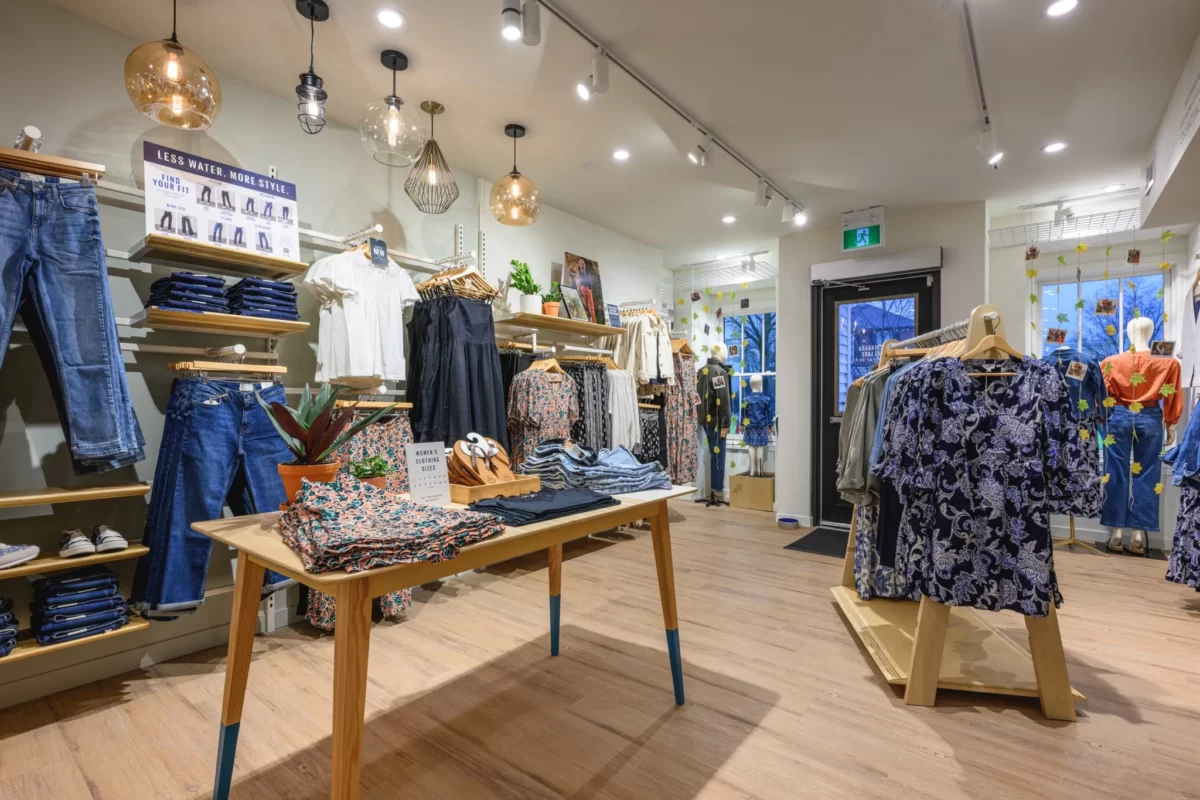
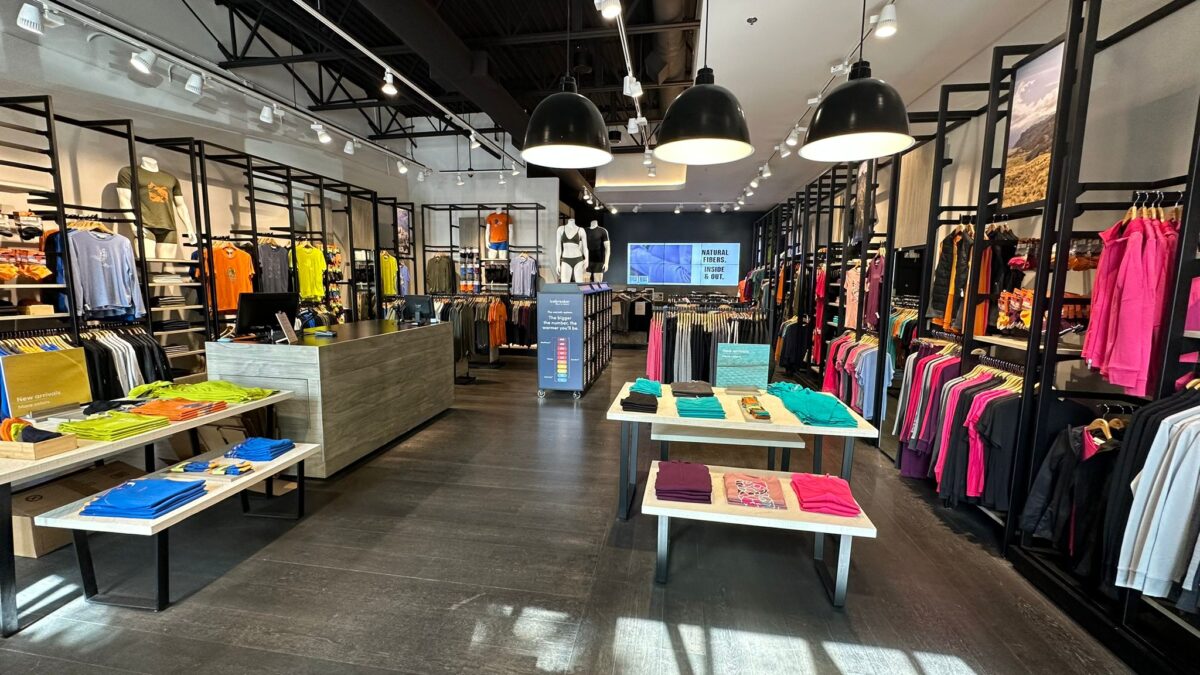
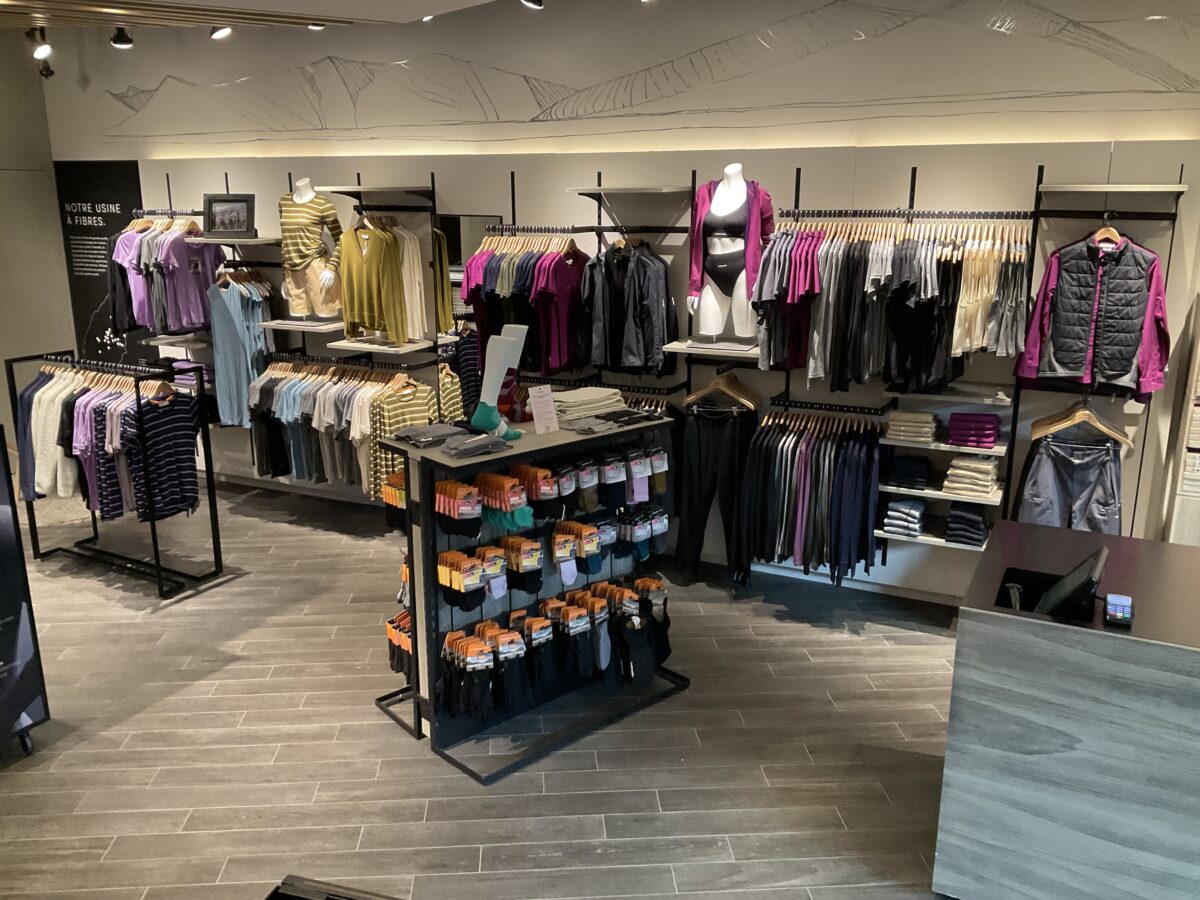
“The goal is to decrease our carbon footprint. How do we reduce the impact on the environment and minimize the shipment of your garment. In addition to the waste of time, it’s also not a good experience. So here we have GORE-TEX patches, Tenacious tape, zipper sliders, etc for simple repairs or you can simply change the colours. And these services will extend and become more broad as we learn and evolve.”

Arc’teryx ReBIRD at CF Toronto Eaton Centre (Image: Ryan Anthony/Arc’teryx)

The ReBird services are uniquely positioned in the marketplace, as the brand has taken a position on the cost of repairing their own product.

“It’s a completely free service. We offer on-site education for care and repair as well as quick fix resolutions, with the hopes that we don’t see it in future warranty boxes later in life, or worse yet, in landfills. The goal is to shift the mindset away from that of a ‘consumer’ to that of a ‘custodian’ of quality gear.”

“We feel that we have the highest quality of standard in the industry and we see it as an investment for the long term. With that, in-store we offer free services for items that are under our Practical Product Lifespan. If the concern is not under warranty, we do have access to a paid repair service, which is at a reasonable price. In future we look to expand those services as well. So having ReBIRD Service Centres is one accessible opportunity for our Guests, while we continually to scale our more complex repair resolution capacity.”

Arc’teryx ReBIRD at CF Toronto Eaton Centre (Image: Ryan Anthony/Arc’teryx)

On-site events and education discussions are part of the experience in-store, which was evident during the grand opening and on subsequent non-event visits.

“We’re doing community activations here, including circular events as it’s a great place to engage the community on repair and care, and also thinking about things like upcycling – what are you able to do with the product once it can’t be used for its original use anymore. We can do that all here in this space. We can adapt and change the store with added tables and sewing machines…it just engages the community to come up with ideas and solutions,” she said.

With all of this discussion on sustainability, the question was asked about how ReBIRD was created.

“You know what’s interesting with how ReBIRD came together was that it wasn’t a strategic, sitting in a boardroom having a conversation. It was literally that all our people in the organization are highly passionate, they are all outdoorsy and everyone sees how our gear gets used. We go through the boxes and we have all of our after-sales team at our head office. All our designers are working on-site, so across the organization – we were seeing product that needed repurposing and they were like ‘what do we do with it?’ People were coming up with their own solutions.

  • We could start a friends and family sale.
  • We could start a resale platform – and just do it as a beta test.
  • Everything was beta test.”

“And then it was a test and fail, test and fail, test and fail. We’re problem solvers, so we like to continuously come up with ideas that could be solved. And so ReBIRD was born out of the fact that people within our company are so passionate inside of this work that they created these programs and initiatives.”

“Care and Repair has always been inside of our organization since we started. We’ve always had an after-sales team. We’ve always had people doing assessments. We’ve had a repair team in arc one. We’re expanding repair services in the US. It’s always been something that we offer and now to show everyone what we’ve always been doing and make it part of our narrative. So ReBird was essentially born out of that and call it what it is and then intentionally create teams that are agile and integrate it into the business so that it’s not a separate department – it’s actually a place where every department, from design on, has to think about how we are approaching a more sustainable way of working.”

“For us, that means looking at all of it. Our upstream design. Our packaging. Our fixtures. Everything. We’re not a full maturity yet, but it’s a starting point for us and we have a lot of beta learnings from the last 4-10 years to inspire us.”

Arc’teryx ReBIRD at CF Toronto Eaton Centre (Image: Ryan Anthony/Arc’teryx)

“I would say that when we first started working on all of our sustainability initiatives, we were really not at a state of maturity. It’s not easy to wake up and say that you’re sustainable. So we’ve spent a lot of time looking at our materials, preferred fibres. We don’t use fleece as an example for a reason. We have responsible wool and down standards. And everything is accredited”

“From there, we started seeing warranty cases come through and product that we couldn’t fix. We often couldn’t fix because it was either… a combination of things… it was either the case was too challenging for the length of time that the guest wanted the garment back. The example being that the guest was going snowboarding on Saturday and it’s Thursday and the jacket needs a full re-panel. Or we couldn’t have a resolution at the time.”

“Over the last four years, learning from our resale model, we’ve been able to expand our capabilities. With wear and tear, that’s natural, and we have service that you can pay for and we’ve got partners that we work with for that – but quick fixes and simple processes can be done easily on site.”

Arc’teryx at CF Toronto Eaton Centre (Image: Ryan Anthony/Arc’teryx)

As the concept becomes readily available for a wide release across new and existing stores, the brand says that it is ready to evolve its offerings and in-store experiences to focus on the lifespan of the products they produce.

“You have to commit full circle. This is a journey that we’re on and we’re by no means perfect in it. And we’re really committed to resolving inside of our core pillars and we do recognize that we are that we’re making products that is lifesaving in extreme conditions, so there’s a sense of durability and longevity is really what we stand for and this is where we feel we need to anchor ourselves. The care and repair, education, being at the forefront of that and everything else comes after.”

“Our other Canadian location that we’re going to be opening a full service ReBIRD service centre is in our new flagship location on West 4th Avenue in Vancouver. That’ll be amazing and we’ll learn a ton from that opening.”

Podcast: Visiting Canada’s 1st Pret a Manger – Could it be a Better Experience?

Podcast: Visiting Canada's 1st Pret a Manger - Could it be a Better Experience?

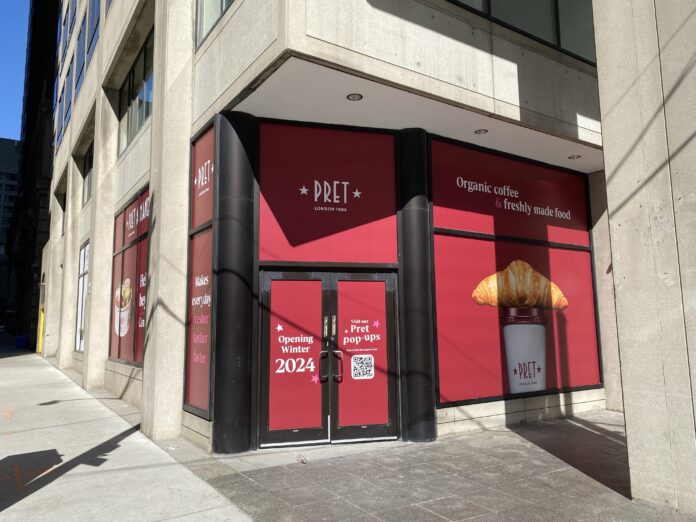
This week Craig and Lee discuss Pret a Manger’s entry into Canada via A&W. Lee, who lives in Vancouver, discusses what he experienced at the Vancouver combined A&W/Pret location and the discussion turns to whether or not a full standalone Pret a Manger would have made more sense for the first Canadian pilot.
The Weekly podcast by Retail Insider Canada is available on Apple Podcasts, Stitcher, TuneIn, Google Play, or through our dedicated RSS feed for Overcast and other podcast players. Also check out our The Interview Series podcast where Craig interviews guests from across the Canadian retail landscape as part of the The Retail Insider Podcast Network.

Retail Insider content discussed this episode:

Subscribe, Rate, and Review our Retail Insider Podcast!

Follow Craig:

Follow Retail Insider:

Listen & Subscribe:

Share your thoughts!

Drop us a line at Craig@Retail-Insider.com. You can also rate us in Apple Podcasts or recommend us in Overcast to help more people discover the show!

Background Music Credit: Hard Boiled Kevin MacLeod (incompetech.com). Licensed under Creative Commons: By Attribution 3.0 License. http://creativecommons.org/licenses/by/3.0/

Video Interview: Paul Wood, CEO of Giant Tiger and 2022 Canadian Retailer Of The Year Award Winner

Video Interview: Paul Wood, CEO of Giant Tiger and 2022 Canadian Retailer Of The Year Award Winner

Paul Wood, President/CEO, Giant Tiger, discusses being named the 2022 Canadian Retailer of the Year recipient by the Retail Council of Canada.

Wood talks about the company’s success, his background, why he likes retail, current challenges in the industry, key lessons learned through the pandemic, current stores, what’s new with the retailer and plans for the future.

The Video Interview Series by Retail Insider is available on YouTube.

Connect with Mario Toneguzzi, a veteran of the media industry for more than 40 years and named in 2021 a Top Ten Business Journalist in the world and the only Canadian – to learn how you can tell your story, share your message and amplify it to a wide audience. He is Senior National Business Journalist with Retail Insider and owner of Mario Toneguzzi Communications Inc. and can be reached at mdtoneguzzi@gmail.com.

Interviewed this episode:

Like, Share and Subscribe to Mario Toneguzzi on YouTube!

Follow Mario:

Also check out the other series offered by Retail Insider, including The Weekly podcast and The Interview Series, which are both available on Apple Podcasts, Stitcher, TuneIn, Google Podcasts, or through our dedicated RSS feed for Simplecast and other podcast players.

Follow Retail Insider:

Share your thoughts!

IKEA Launches Loyalty Club for Small Businesses in Canada [Interview]

IKEA Business at IKEA Aura - Downtown Toronto (Image: Dustin Fuhs)

Retail giant IKEA has launched a new loyalty club specifically designed for the small business community.

The IKEA Business Network was designed with micro and small business in mind with numerous benefits for members of the program.

De’ana Torresan

“Essentially IKEA Business Network is a free loyalty program and it’s designed specifically for micro or small businesses in Canada. Members get access to exclusive member benefits. So we have member-only discounts, free quick fix design tips, free online learning,” said De’ana Torresan, the retailer’s Loyalty Leader.

“It was really born out of collaboration with our customers. IKEA Business Network has been designed to kind of solve the real life challenges small business owners run into and it’s a part of our global ambition at IKEA to connect with those micro and smaller business owners to help them create that better life at work.”

IKEA Business at IKEA Aura – Downtown Toronto (Image: Dustin Fuhs)
IKEA Business Network (Image: IKEA)

Torresan said the initiative was launched in May. Within a month, it had hundreds of small businesses join the program. In July, the program launch was supported with a media campaign, email support, support online and through store graphics and communications.

“It is available not in every IKEA market or country just yet but it is available in Canada and across the country to any small business owner and their employees across Canada,” she said.

“We’ve had our IKEA family loyalty program which is very loved across Canada and adored by millions of Canadians across the country. We have millions of members. That program is focused on our customers who are shopping for their homes. What might not be as well known is that we have a considerable size of customers who are shopping for their business at IKEA.

IKEA Business at IKEA Aura – Downtown Toronto (Image: Dustin Fuhs)

“So we really saw an opportunity to expand our reach to the many Canadians who operate both micro and small businesses who really don’t get to think of IKEA for their commercial needs and we really wanted to make IKEA visible to the many business customers and even expand our position as a provider of home furnishings but also into furnishings and supplies for your small business. With the loyalty program we also wanted to establish ourselves as a partner in improving your life at work as well.”

Torresan said the program was designed in a way to help small businesses in four key areas.

First, lending IKEA’s expertise to help small businesses grow. Also, helping them create spaces that meet their business needs in an affordable way and in a way that reflects their business and personality. The third pillar is around people – helping small businesses boost productivity in supporting the well-being of their own employees and creating a better life at work.

The final pillar is around seamless shopping.

“Really helping small businesses save time, save money, save effort by offering them the most convenient shopping experience and that’s kind of all reflected in our member benefits that we offer with IKEA Business Network,” said Torresan.