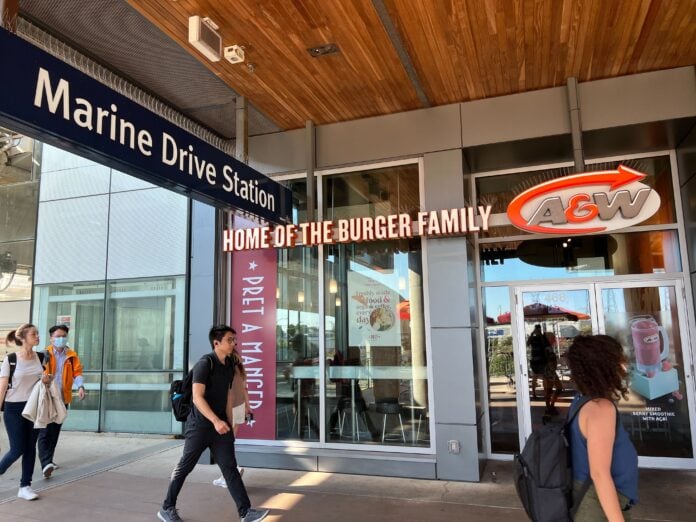
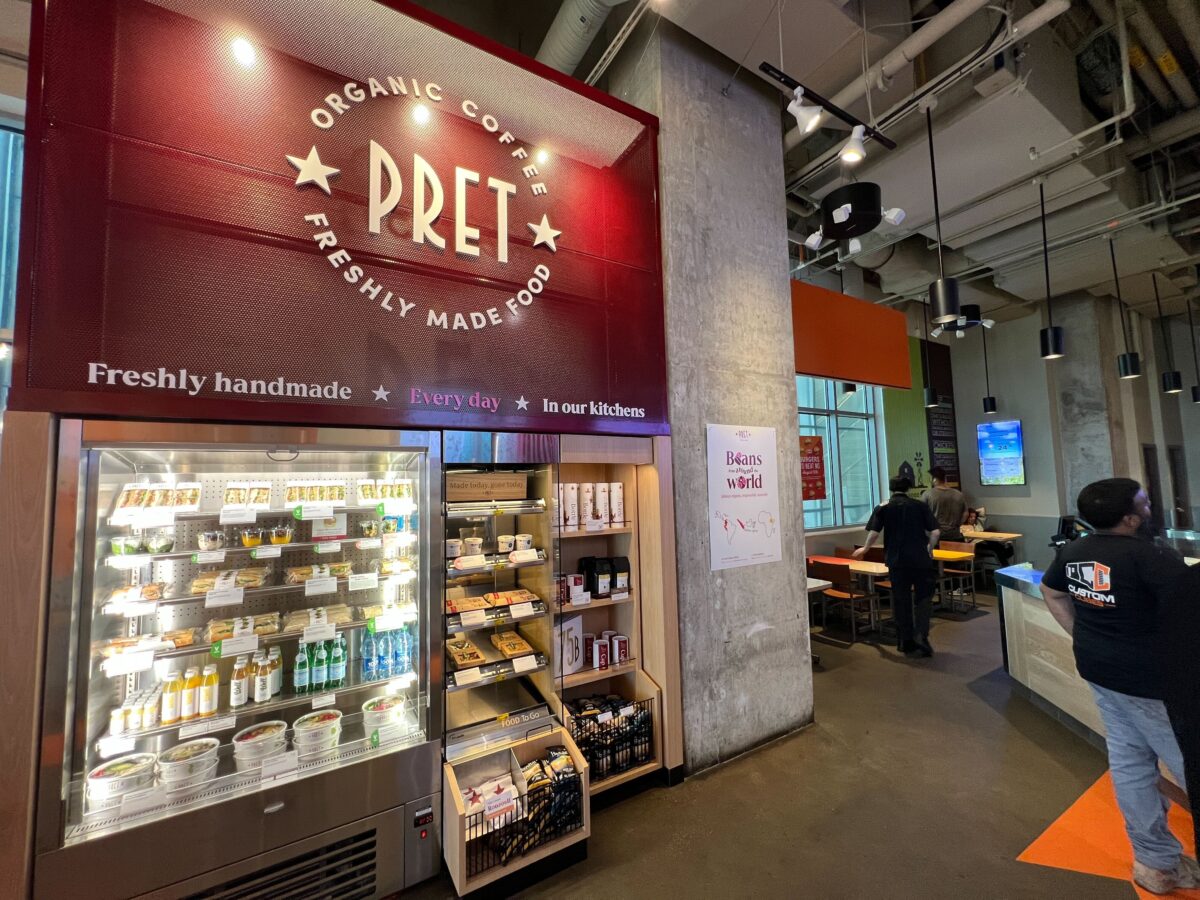
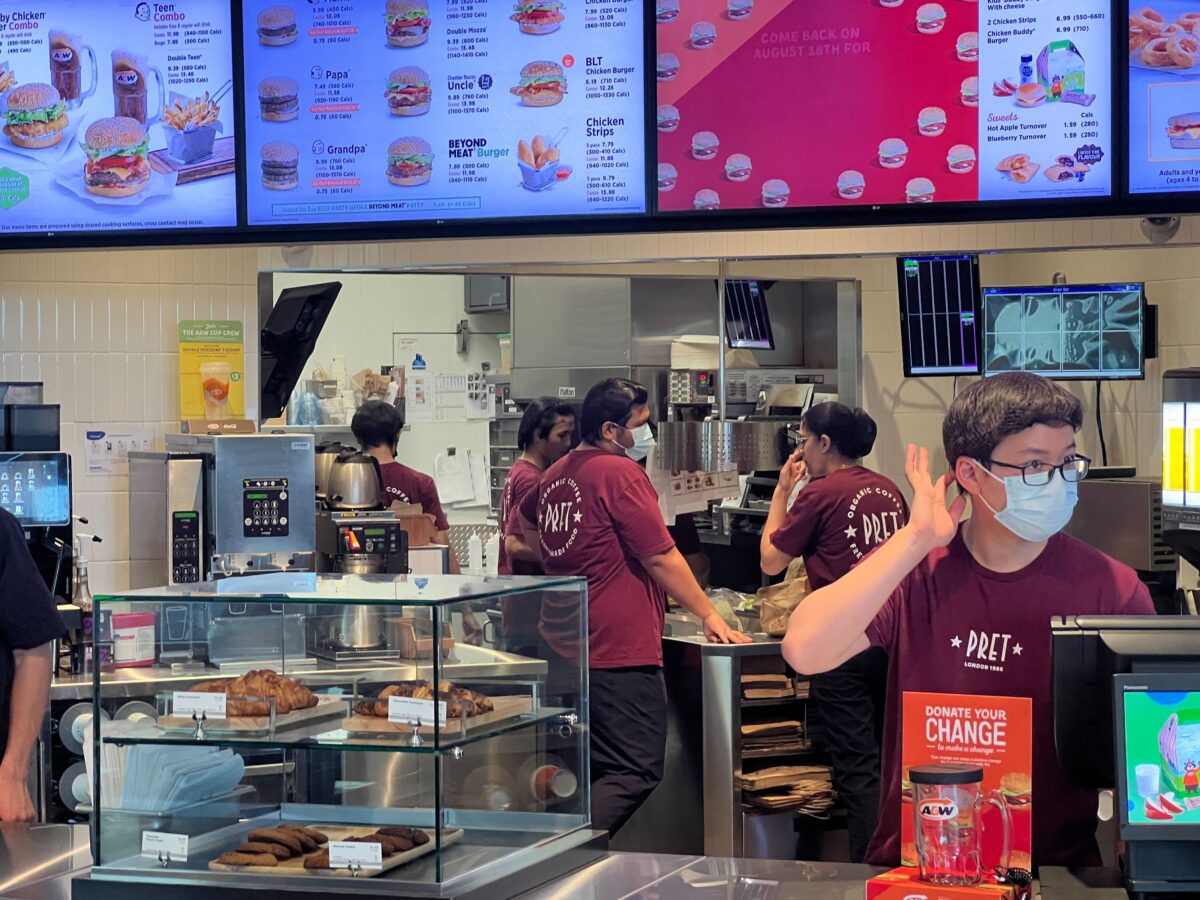
A&W/Pret a Manger at Marine Gateway in Vancouver, July 25 2022. Photo: Lee Rivett
Popular UK-based foodservice chain Pret a Manger has officially entered the Canadian market with its first storefront within an A&W location in suburban Vancouver. More partner locations will follow and A&W is also expected to open standalone Pret a Manger locations in Canada at some point as part of the franchise agreement.
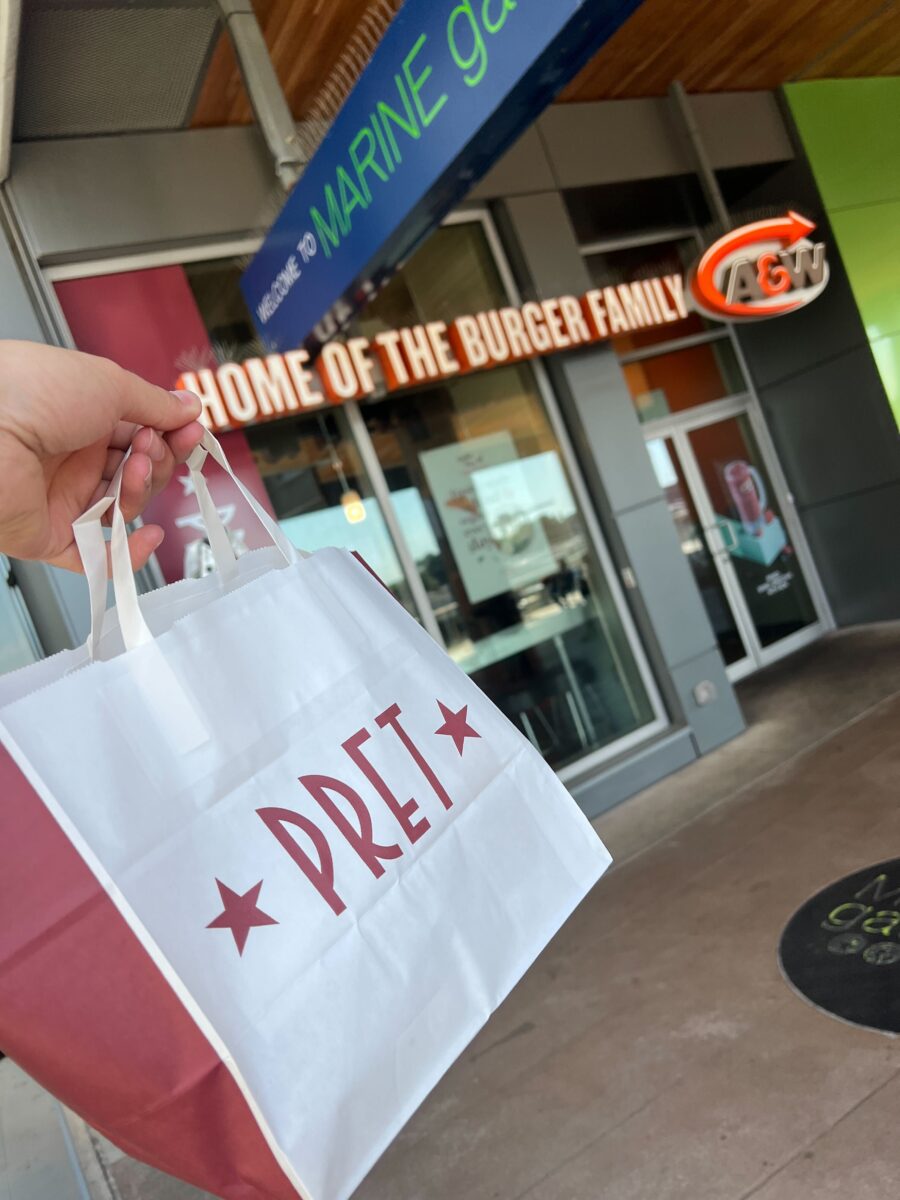
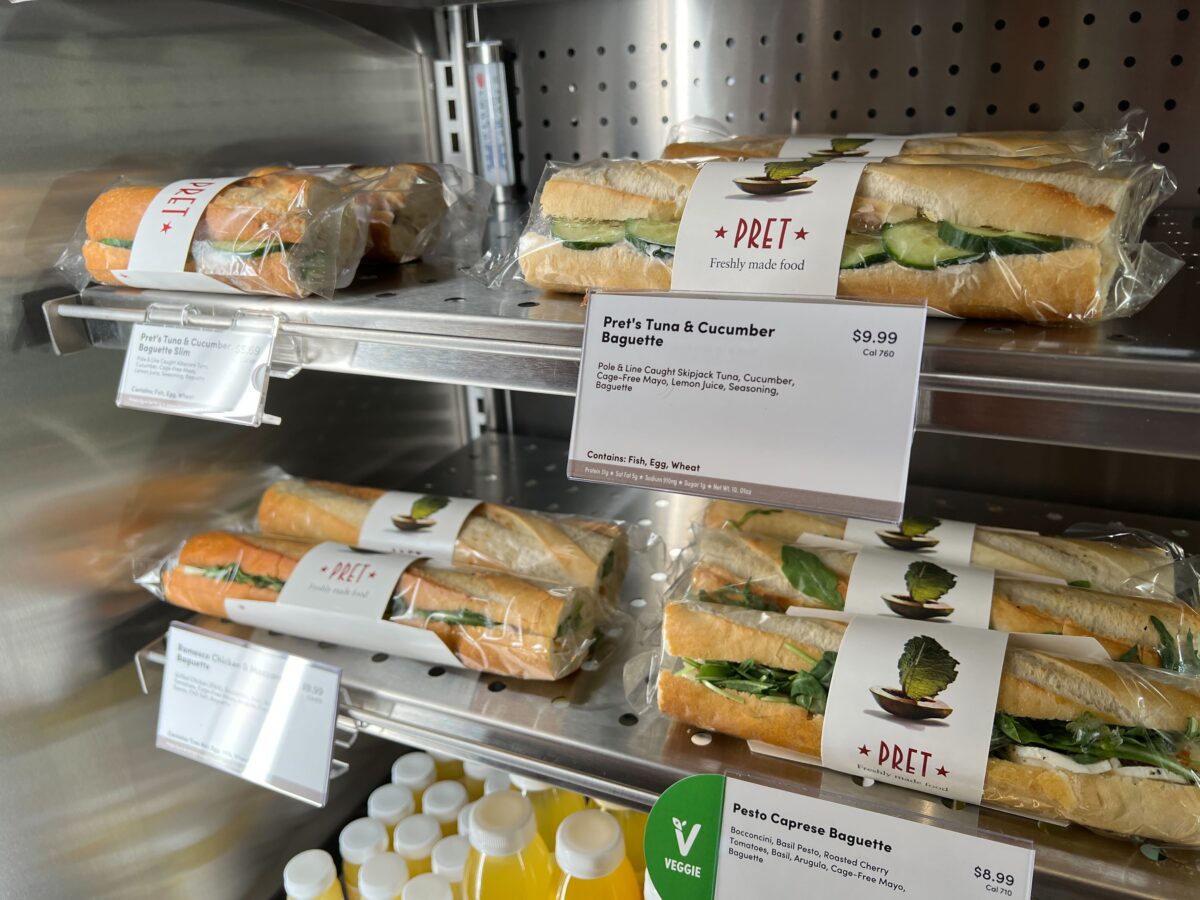
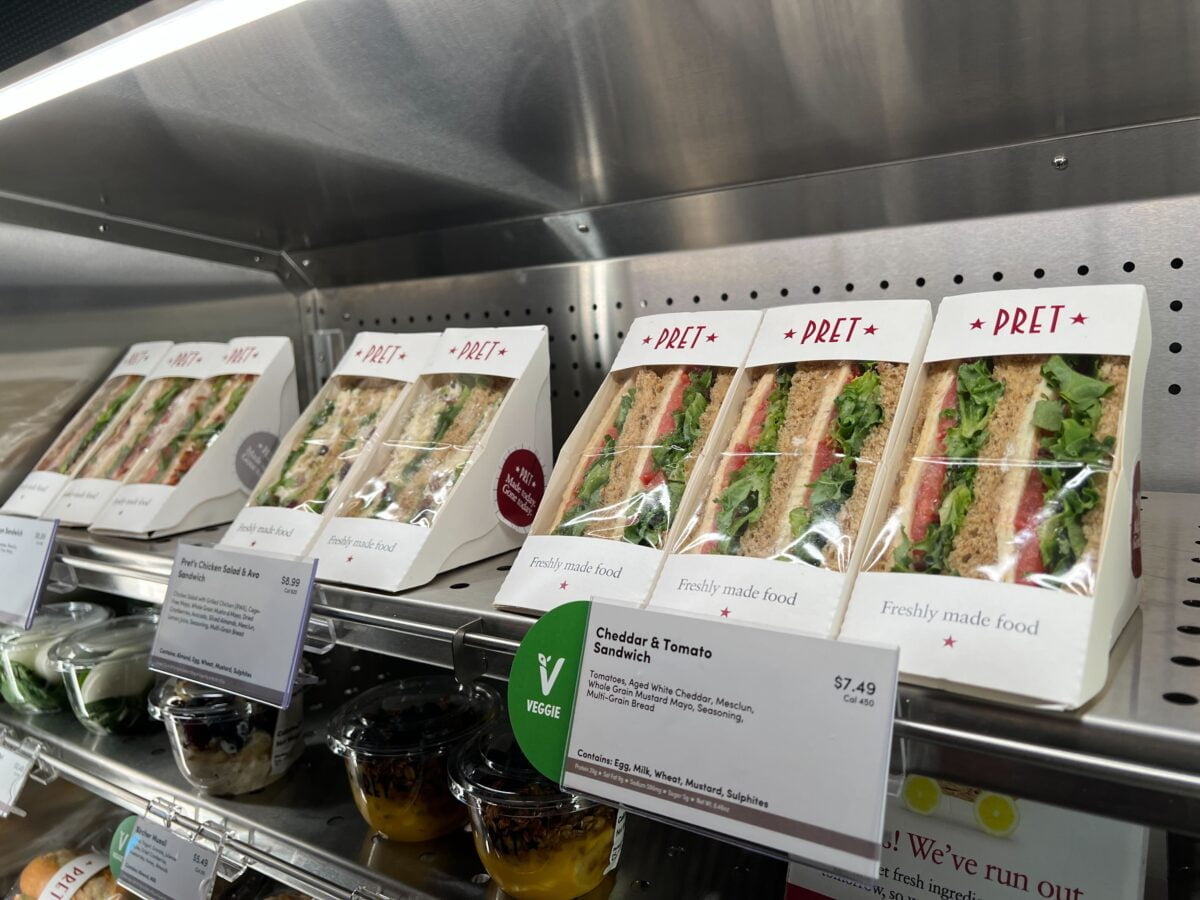
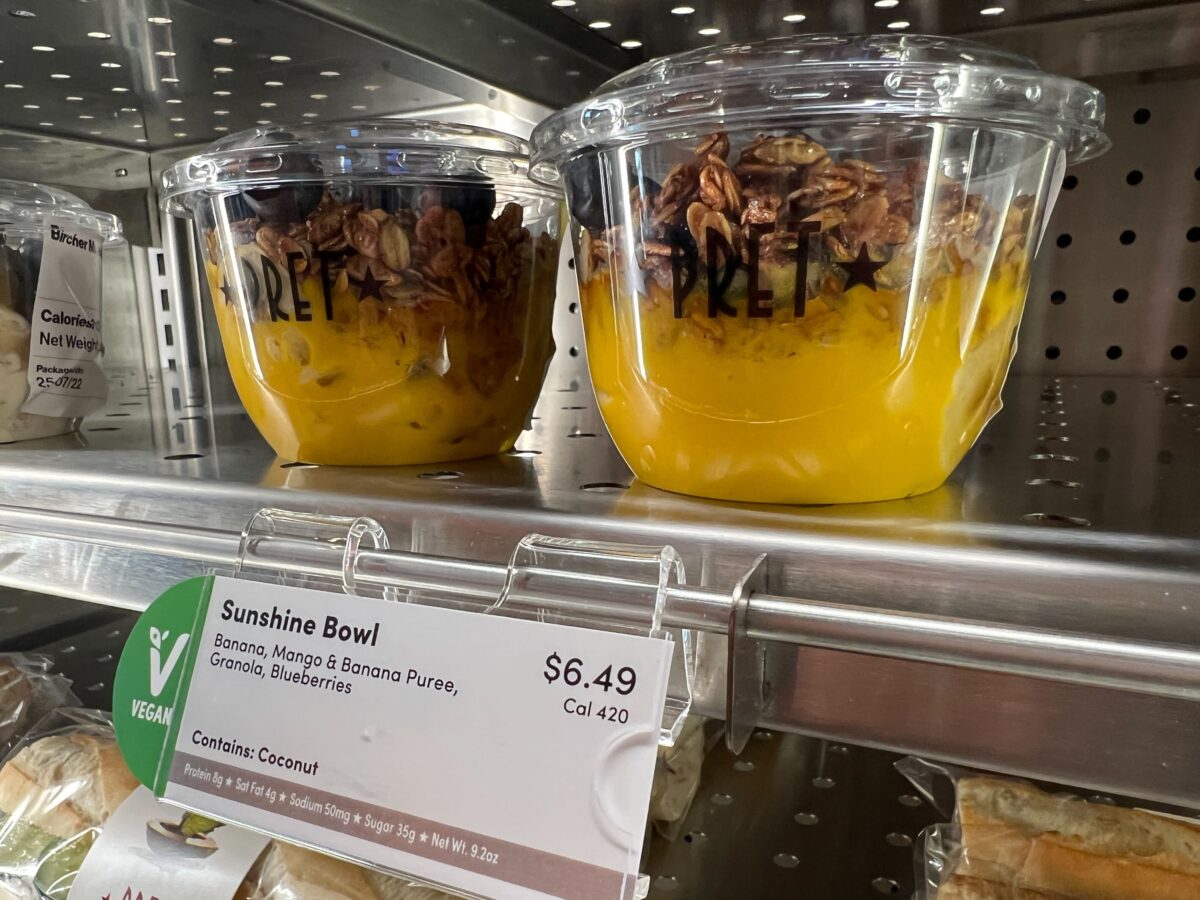
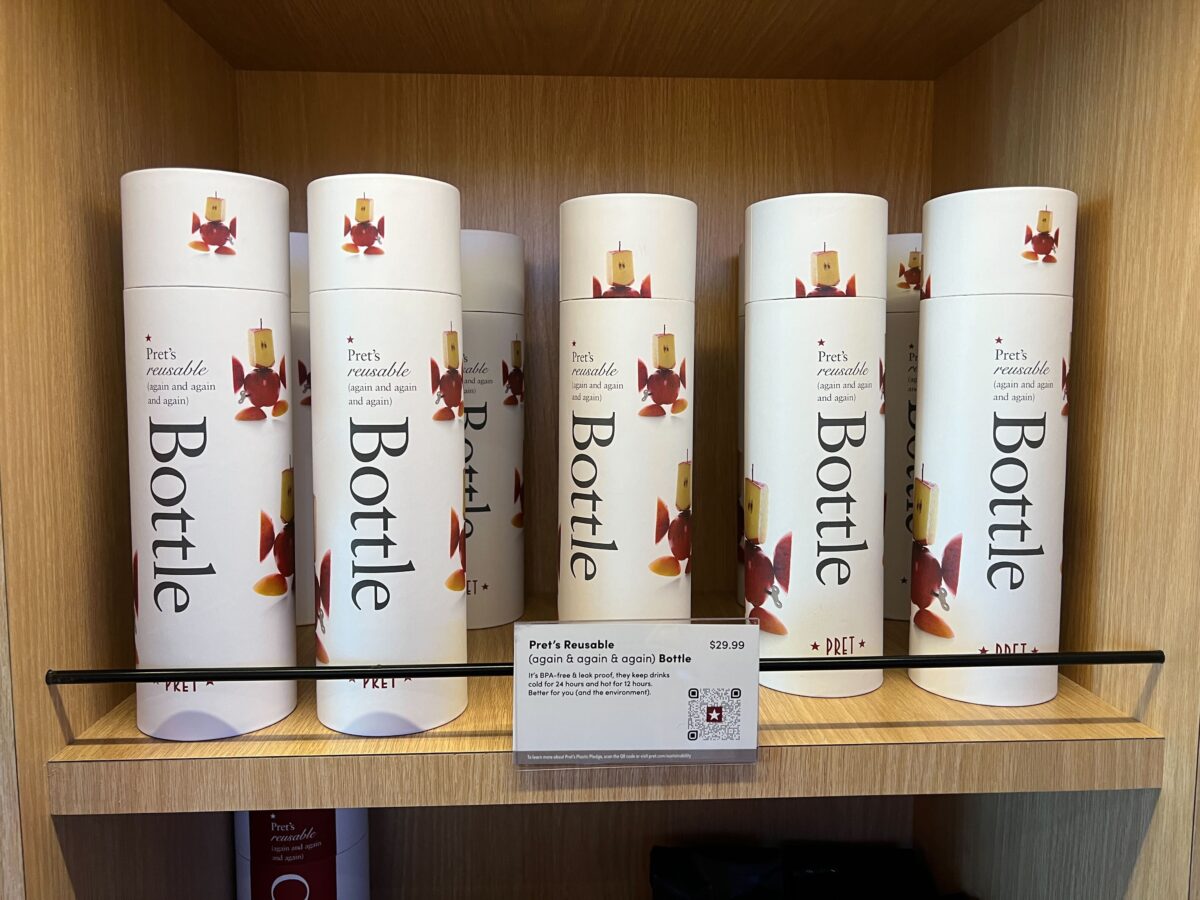
The Vancouver A&W at 468 SW Marine Drive now features a Pret a Manger shop-in-store component featuring Pret’s freshly made food including sandwiches, pastries, soups, salads, wraps, mac and cheese, fresh fruit, oatmeal, and organic coffee including bagged coffee beans for sale. The same till is used to pay both for Pret items as well as the A&W restaurant on site.
It’s part of a two-year pilot where the Pret brand will open within A&W restaurants in select Canadian markets. A&W signed a master franchiser agreement with Pret a Manger to expand the Pret concept and if the trial phase proves to be successful, A&W Food Services has the exclusive rights to expand the Pret brand across Canada based on an agreed-to development schedule. That could include standalone Pret a Manger storefronts in Canada though a source familiar with the situation says details haven’t been totally ironed out just yet.
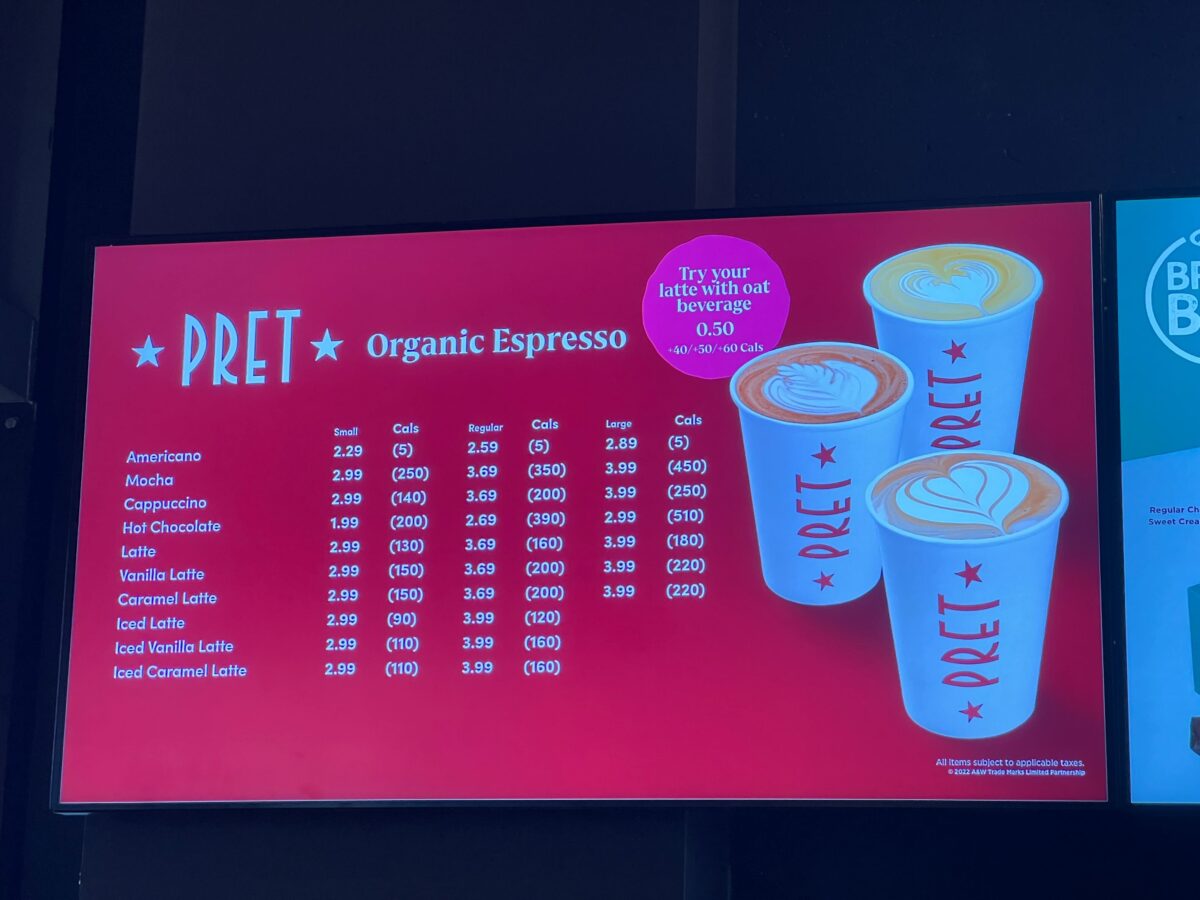
Pret a Manger display cases at A&W Marine Gateway in Vancouver on July 25, 2022. Photo: Lee RivettTill at the combined Pret a Manger/A&W Marine Gateway in Vancouver on July 25, 2022. Photo: Lee RivettDrinks menu at Pret a Manger at A&W Marine Gateway in Vancouver on July 25, 2022. Photo: Lee Rivett
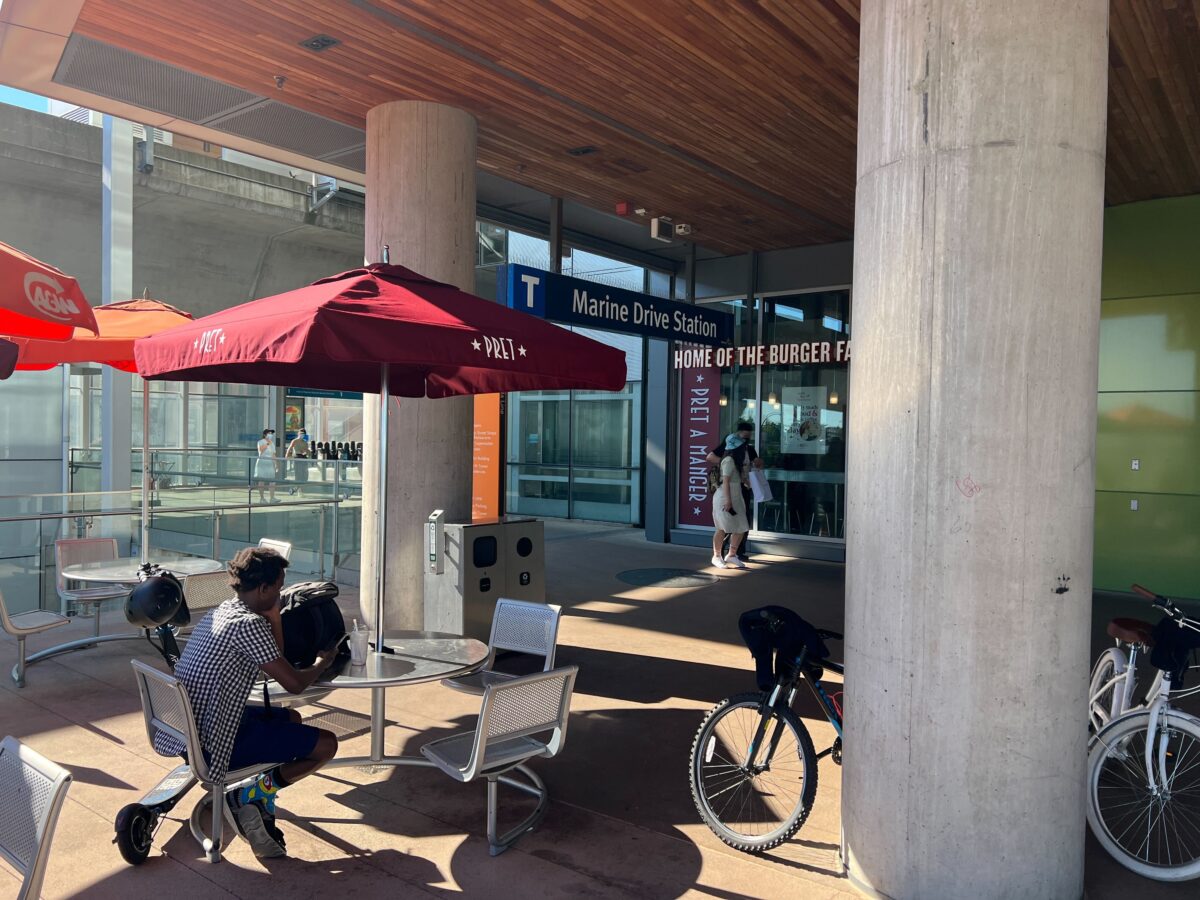
The Vancouver location on SW Marine Drive is part of the Marine Gateway project in South Vancouver off of Cambie Street. A busy Skytrain transit station is adjacent which means foot traffic will be heavy at times.
London-based Pret A Manger was founded in 1986 and has more than 550 shops in the UK, US and several other countries.
See below for more photos from the new combined Pret a Manger/A&W location at Marine Gateway in Vancouver.
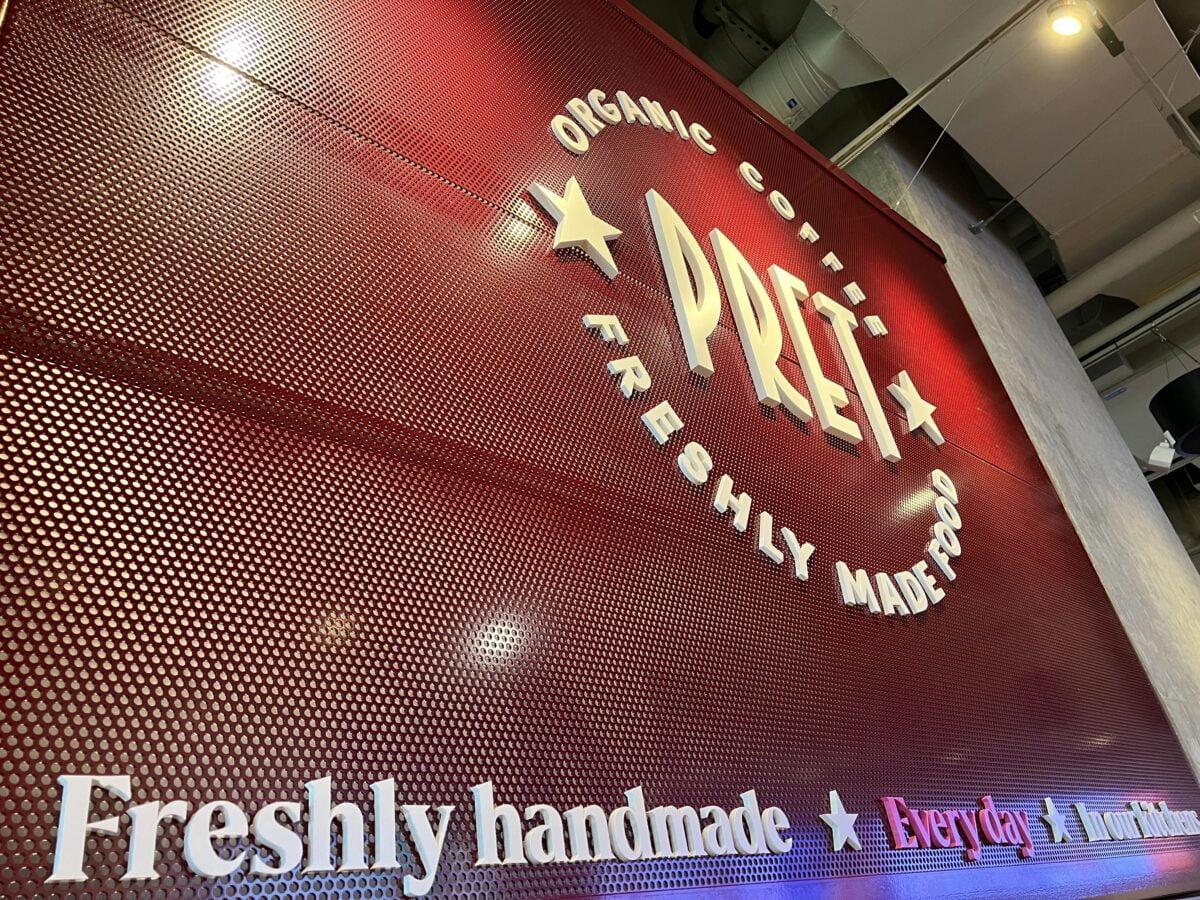
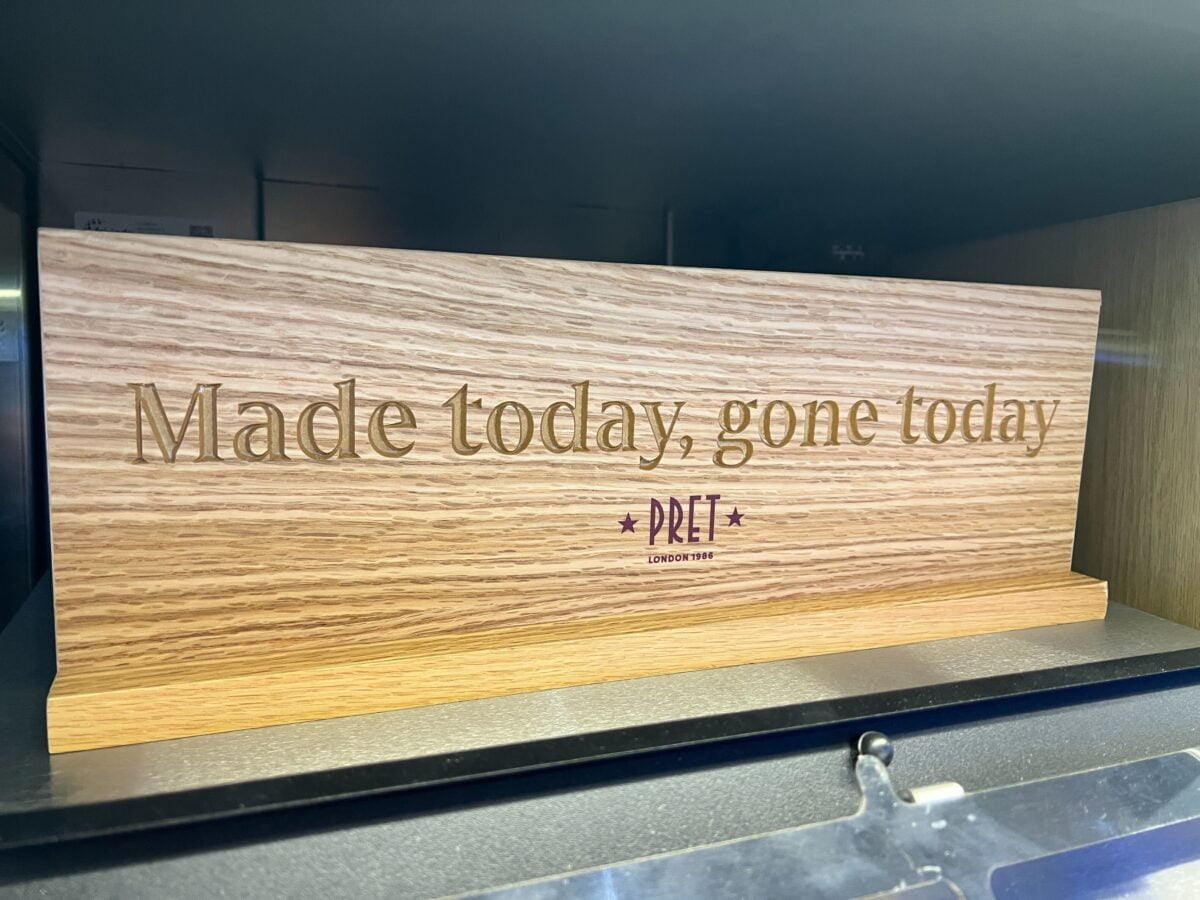
Signage at Pret a Manger at A&W Marine Gateway in Vancouver on July 25, 2022. Photo: Lee RivettExterior terrace area branded Pret a Manger, at A&W Marine Gateway in Vancouver on July 25, 2022. Photo: Lee Rivett
Pret a Manger at A&W Marine Gateway in Vancouver on July 25, 2022. Photo: Lee Rivett
Salads at Pret a Manger at A&W Marine Gateway in Vancouver on July 25, 2022. Photo: Lee RivettBaguette sandwiches and drinks at Pret a Manger at A&W Marine Gateway in Vancouver on July 25, 2022. Photo: Lee RivettSandwiches at Pret a Manger at A&W Marine Gateway in Vancouver on July 25, 2022. Photo: Lee RivettPret a Manger at A&W Marine Gateway in Vancouver on July 25, 2022. Photo: Lee RivettPret a Manger at A&W Marine Gateway in Vancouver on July 25, 2022. Photo: Lee RivettPret a Manger at A&W Marine Gateway in Vancouver on July 25, 2022. Photo: Lee RivettPret a Manger at A&W Marine Gateway in Vancouver on July 25, 2022. Photo: Lee Rivett
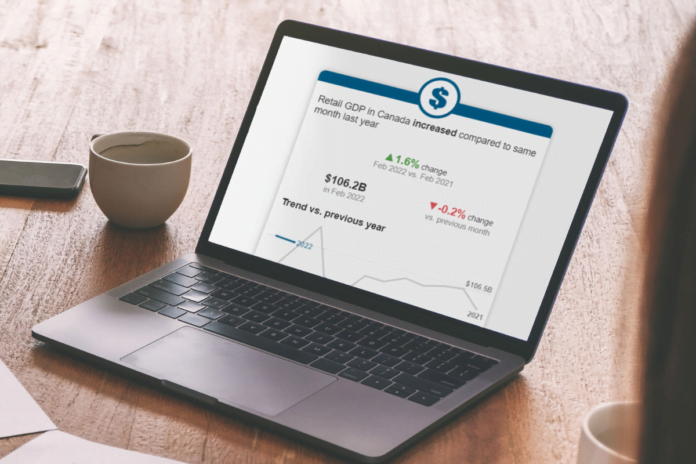
Retail Pulse Dashboard (Image: Retail Council of Canada)
The Retail Council of Canada has launched what it describes as an essential one-stop tool for retailers to access up-to-date data for the retail industry.
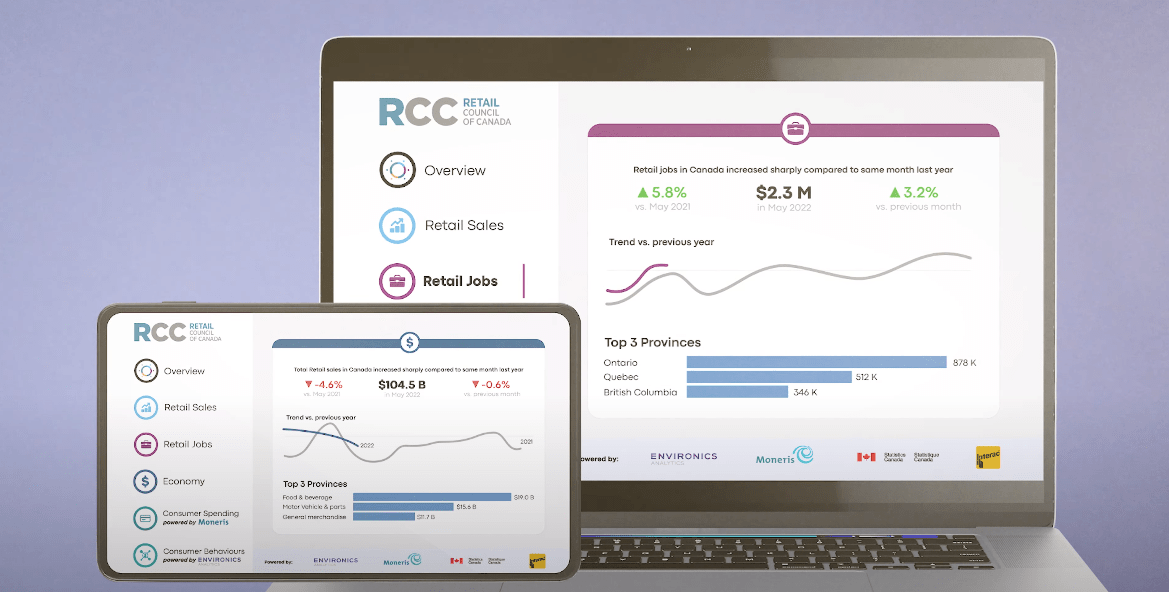
The Retail Pulse Dashboard is a new interactive platform that delivers pertinent, relevant and important statistics on Canadian retail sales, retail job numbers, economic data, and consumer spending.
“The last couple of years have been a time of profound change for the retail industry and it’s more important than ever for retailers to leverage the power of data and seize opportunities to yield long-term success. Retail Council of Canada understands this better than anyone. We are therefore thrilled to introduce the Retail Pulse Dashboard, that can be found on our RCC website, which will make it easier for businesses to find key retail data points in one place,” said Diane J. Brisebois, President and CEO, Retail Council of Canada, in a news release.
“Regularly updated overview information on the retail industry is available to everyone. RCC members, however, have access to much richer data, enhanced filtering, comparisons, and customization. It’s pretty amazing.”
RCC worked with KPMG and Lighthouse to develop the platform to help retailers and their business partners access data that includes retail sales by province, data on retail’s economic impact, updates on employment in retail, mobility, consumer, and credit and debit card spending.
“Today, retailers need to make informed decisions faster than ever. So, KPMG developed a smart, new platform that collects and delivers near-real time and real-time industry intelligence, across the metrics that matter to retailers so they can make better, more informed business decisions,” said Kostya Polyakov, National Industry Leader for Consumer and Retail, KPMG in Canada, in a statement.
The Council is a not-for-profit industry-funded association that represents small, medium, and large retail businesses in every community across the country. It represents more than 45,000 storefronts in all retail formats, including department, grocery, specialty, discount, independent retailers, and online merchants.
The Council says retail is Canada’s largest private-sector employer with over two million Canadians working in the industry. The sector annually generates over $78 billion in total compensation. Core retail sales (excluding vehicles and gasoline) were over $433 billion in 2021. Council members represent more than two-thirds of core retail sales in the country.
Retail Pulse Dashboard (Image: Retail Council of Canada)
Diane J. Brisebois
Kostya Polyakov
The new dashboard is hosted on the RCC website. An introductory video can be seen here: https://youtu.be/wWu-FS_CWQQ
Sarah Jordan
“It is a game changer for our industry and teams to have a singular resource that gives companies access to the most relevant retail data,” said Sarah Jordan, CEO, Mastermind Toys, a member of RCC, in a statement. “To stay competitive and growth orientated, it is critical for us to have several channels to get the insights we need so we can continuously refine and innovate our brand storytelling and customer experiences.
“Spending less time gathering rich data from different sources and allowing more time to react quickly to trends is such a welcomed advantage, especially given the pace of the retail environment.”
Retail Insider is streamlining its Canadian retail news from around the web to include a handful of top news stories that can be viewed quickly during the day. Here are the top stories from the past 24 hours.
A report by Oxford Economics indicates YouTube’s creative ecosystem contributed $1.1 billion to Canada’s GDP in 2021 while supporting 34,600 full-time equivalent jobs in the country.
In Canada, the number of YouTube channels making $100,000 or more in annual revenue is up 35 per cent year over year and over 550 channels have over one million subscribers, which represents growth of more than 20 per cent year over year.
Hamilton Galloway
In its report, From Opportunity to Impact, Hamilton Galloway, Head of Consultancy, Americas, Oxford Economics, said Canada has found in YouTube a valuable way for its creators, artists and entrepreneurs to gain visibility and contribute to the nation’s distinct cultural identity and economy.
“YouTube helps businesses connect with more customers at home and abroad—increasing reach, driving revenues and supporting jobs. YouTube also supports businesses in other ways. For example, YouTube provides a cost-effective source of staff training and helps businesses adapt to the challenges posed by COVID-19,” said the report.
From opportunity to impact – Assessing the economic, societal and cultural benefits of YouTube in Canada in 2021
“When business owners of all sizes share content that informs, educates and entertains, it helps them build an organic audience that they can then convert into customers. And rather than just read product and service reviews, YouTube users can seek out specific content, watch tutorials and hear directly from the business owner.
“In addition to helping existing businesses grow, YouTube is enabling creators to launch entirely new businesses.”
Andrew Peterson, Head of Canada at YouTube, said the platform’s mission is to give everyone a voice and show them the world as an open platform.
Andrew Peterson
“And what that means is anyone with a story to tell can take their smartphone, create a video and upload it to the platform. But what starts as a hobby we have seen over the years can fast develop into a thriving business,” said Peterson. “And so for us we really wanted to understand what was the cumulative impact of all these creators starting these businesses.
“And that’s what we refer to as the creator economy because it’s not just someone on their own creating videos, it’s someone who’s telling stories and generating revenue and potentially having employees and building bigger businesses around that.”
He said the results of the research were “quite astounding” with an unprecedented number of Canadian creators telling stories and building businesses on the platform.
Peterson said there are more than 4,500 channels with more than 100,000 subscribers.
He said it’s not just YouTube creators who are building new enterprises but small and medium businesses are also joining in on the action as well.
“For SMBs specifically, YouTube’s really a place that helps them connect with more customers at home and abroad as well as driving new sales . . . 80 per cent of small and medium businesses with a YouTube channel agree that YouTube plays a role in helping them grow their customer base by reaching new audiences,” said Peterson. “But going one step further, 69 per cent of SMBs with a YouTube channel agree that YouTube played a role in helping them grow their revenue.
“What I’m not saying is YouTube is the right solution for every business but there are a substantial number of businesses where it does make sense, that are driving really meaningful results from the platform.
“The other side of that is in addition to the SMBs coming onto YouTube is the SMBs that are basically being created on YouTube.”
Here are some interesting numbers from the report:
In Canada, the number of YouTube channels making $10,000 or more in annual revenue is up 25 per cent, year over year;
78 per cent of creative entrepreneurs agree that YouTube helps them export their content to international audiences they wouldn’t otherwise have access to;
76 per cent of SMBs who use YouTube agree that YouTube has helped them sustain their business during the COVID-19 pandemic;
67 per cent of SMBs who advertise on YouTube agree that YouTube ads have helped them grow sales;
76 per cent of SMBs who use YouTube agree that their use of YouTube during the COVID-19 pandemic has helped their organization adapt;
71 per cent of SMBs who use YouTube agree that YouTube is a cost-effective way of providing staff training; and
65 per cent of SMBs who use YouTube agree that YouTube is essential to their business growth.
Peterson said there are many different mediums where people can tell stories. The thing about video is the connection someone can make with their audience.
“So you will often see YouTube creators not refer to their fans, they will talk about their community,” he said. “This is the incredible thing about YouTube. Niche has become the new mainstream.
“If you’ve got a great story to tell with very little cost beyond the phone you have in your pocket and a great idea and the tenacity to create something out of thin air, you can upload that to YouTube and it’s so common in terms of so many of the biggest and most successful YouTube creators in Canada all have a similar origin story. They never intended to become superstars with audiences of millions or tens of millions of people. They just had a story to tell, uploaded a video.” And discovered there were people out there that wanted to engage with those stories.
YouTube has also launched a new partnership with Shopify giving all eligible creators access to live shopping tools. It enables creators and merchants to easily feature their products across their YouTube channels and content. Eligible creators can link their Shopify store to their YouTube channel in a few steps.
“There are actually 10 ways to monetize on YouTube and everyone is pretty familiar with the advertising element of the platform and the creators with the YouTube partner program receiving the majority share of that revenue,” said Peterson. “But one of the other 10 ways for creators to monetize their content and their channels is actually shopping. This has been an area on the platform that has existed for a little while but it really feels like we’re still only just getting started.
“We’ve built some great products that allow live commerce. So for creators in a live stream to talk about products, announce a new merchandise range and right there from a live stream purchase those goods. We’ve also been making videos shoppable on YouTube . . . We’ve also done some experimentation with shopping using short-form video and product on the platform.”
Now, it has an integration with Shopify where any Canadian creator who has a Shopify store can now integrate that store into the YouTube channel and seamlessly display and sell those products from their store whether that be in a live stream, video on demand, or within short-form video.
“We think this really unlocks an incredible opportunity with a large number of creators to further drive awareness of their merchandise or any other products that they are creating and sell them seamlessly within YouTube, removing a lot of the friction of e-commerce and making it seamless for their community to purchase from them right within the YouTube environment,” said Peterson.
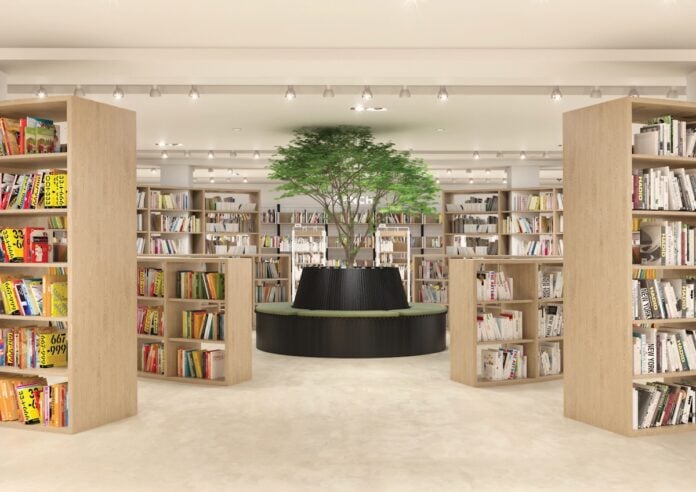
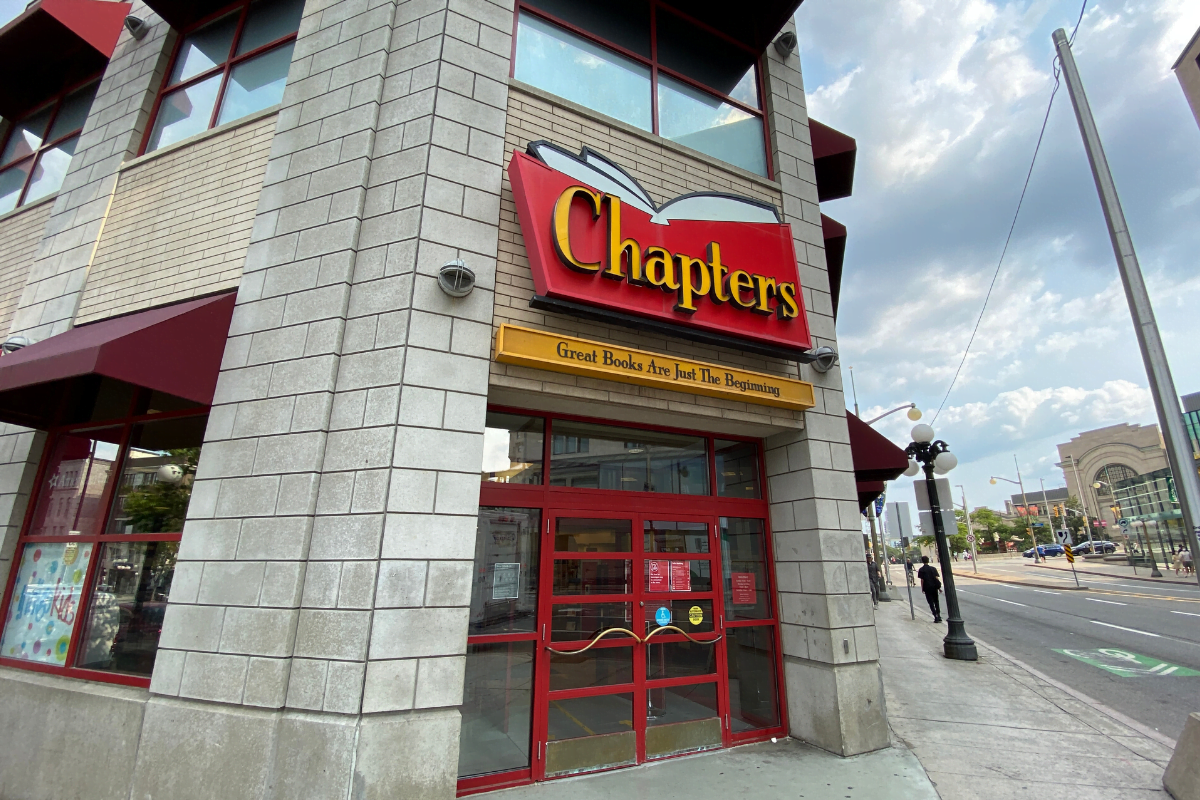
Indigo Books & Music is closing its Chapters store on Rideau Street in Ottawa to open a new Indigo banner store in the city’s CF Rideau Centre and it will be the retailer’s newest large-format store.
Peter Ruis
The store is scheduled to open by the fall of this year.
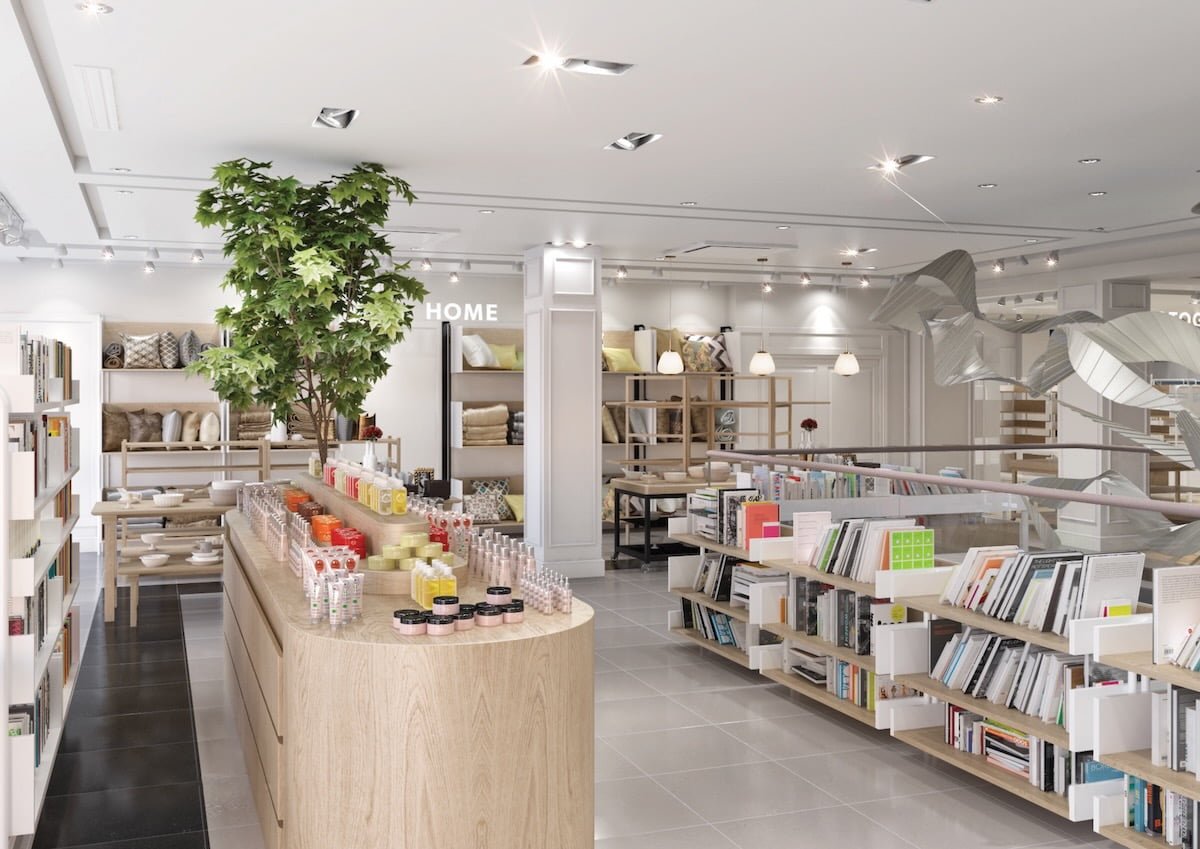
“We are thrilled to offer our Ottawa customers an exceptional new destination store, which will include the curated assortment of books our customers trust us for, but also more lifestyle products and inspiring displays,” said Peter Ruis, President, Indigo, in a news release.
“This store will debut our most innovative design concept, and allow our ‘Life, on Purpose’ proposition to truly come alive.”
Indigo at CF Rideau Centre (Rendering: Indigo)
Melanie Sanderson, the creative lead for the store’s design, worked with a design agency to create a store that the company described as “inviting, inspiring and curated.”
Mel Sanderson
“I was born and raised in Ottawa and quickly became a regular of the Chapters on Rideau from a young age,” said Sanderson in a news release. “This was a labour of love because I know the staff, customers and community, so it was important that we designed this store with them in mind.”
The Rideau Street location has been around since 1996.
Regarding hiring, Indigo is offering positions to its existing staff, and people can always visit the careers page on indigo.ca to stay updated on hiring opportunities
Chapters Rideau in Ottawa – Image: Dustin Fuhs
The first Indigo location opened in Burlington Ontario in 1997, created with the desire to bring a unique cultural destination to the Canadian retail marketplace. Indigo Books & Music Inc., as it exists today, was created in August 2001 with the merger with Chapters Inc. Headquartered in Toronto, Ontario, it employs approximately 5,000 people across Canada.
As of April 2, it operated 88 superstores under the banners Chapters and Indigo and 85 small format stores, under the banners Coles and Indigospirit. It also operates www.indigo.ca, a popular online destination offering millions of products including books, eBooks, toys, stationery, home décor, gourmet confections, electronics, and more.
“Averaging over 22,000 square feet, Indigo’s large format stores are designed to be destinations for culture-seekers, offering an inspiring environment conducive to browsing and community-building. Small format stores are typically located in retail shopping centres, street-front retail areas, major airports and central business districts,” says the company on its website.
In June, Indigo reported financial results for the 52-week period ended April 2, 2022 compared to the 53-week period ended April 3, 2021. Revenue increased $157.6 million or 17.4 per cent to $1.06 billion from $904.7 million last year.
Indigo at CF Rideau Centre (Rendering: Indigo)
“These top-line results also outperformed the preceding three fiscal years including the pre-COVID year. These results were achieved amidst challenging operational and market conditions that included rolling store closures in the Company’s first quarter and the re-emergence of severe pandemic conditions from the Omicron wave during its seasonally important third quarter,” it said in a news release.
“The success of the Company’s product strategy and strong revenue performance drove the Company’s return to profitability, with adjusted EBITDA of $32.5 million and net earnings of $3.3 million, an improvement of $60.8 million and $61.2 million, respectively. Revenue growth was driven by the success of Indigo’s omnichannel business, with the first good push of recovery delivered by the Company’s retail channel and an ecommerce business that nearly doubled since the onset of the pandemic. Specifically, the online channel sustained incremental growth of 98 per cent to fiscal 2020 sales levels.
“Demonstrating evolving omnichannel behaviours, Indigo’s digital platforms are also increasingly where customers begin product discovery, bolstering in-store conversion. Demand in the Company’s core book business notably lifted by eight per cent, fueled by the popularity of reading on TikTok. Customers’ strong reception to the Company’s expanding general merchandise offering further buoyed results, with assortment expansion driving sales growth at or above 30 per cent for its lifestyle and baby categories.”
Commenting on the results, CEO Heather Reisman stated: “As a business, we were relentlessly focused on evolving and driving performance – which together with Canadians’ affinity for the Indigo brand – yielded the beginning of improved results. This COVID period though challenging, has spurred creative thinking and we are energized by the opportunities ahead of us.”
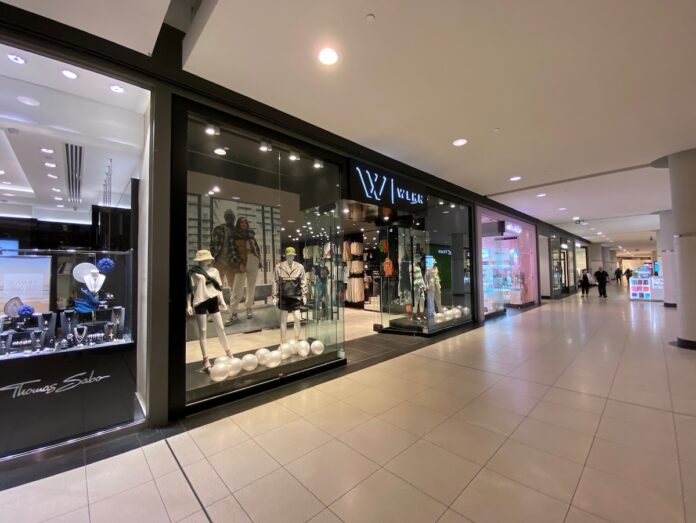
WLKN at CF Toronto Eaton Centre (Image: Dustin Fuhs)
WLKN has recently launched its new store at CF Toronto Eaton Centre, the eleventh store in Canada with the goal of opening nine more.
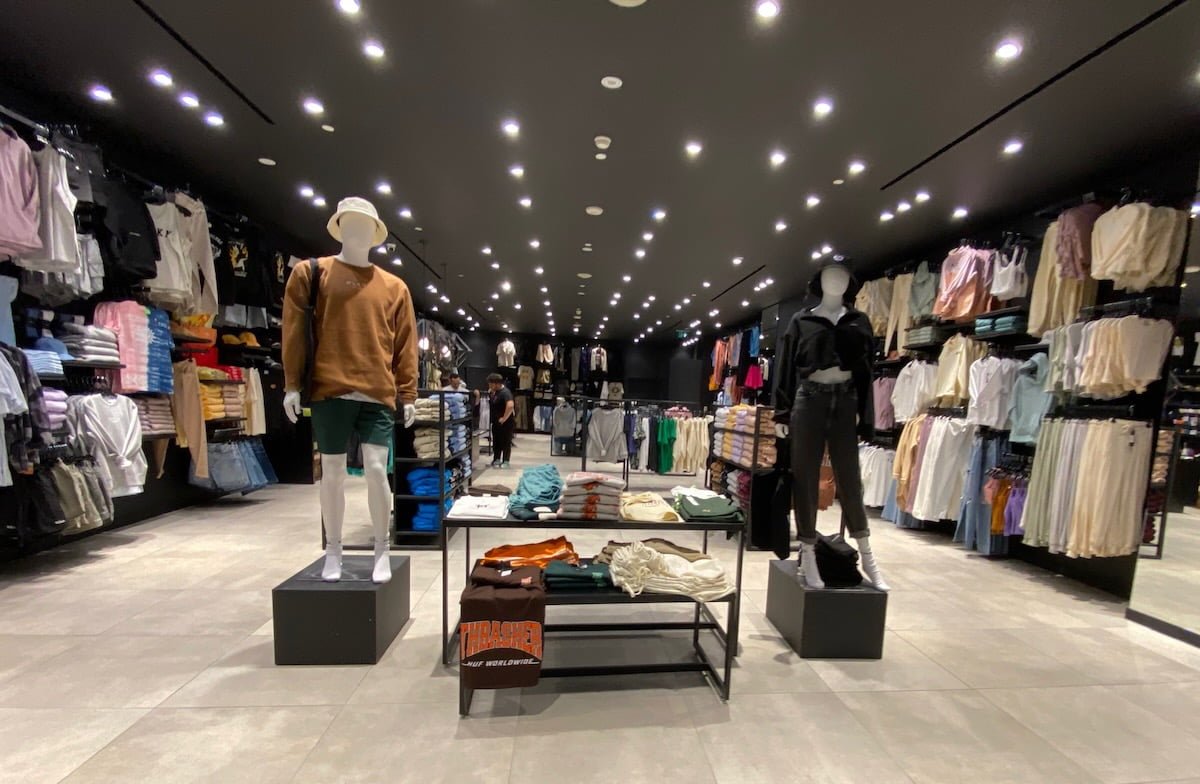
Founded in Quebec City in 2010, WLKN provides a variety of streetwear clothing for men, women, youth, and provides unisex options. The store also carries a variety of accessories and jewelry. WLKN expanded into Ontario in 2016 and opened stores located in Vaughn Mills, Upper Canada Mall in Newmarket, and a store in Oshawa. The new location is WLKN’s 4th store in the Greater Toronto Area.
The new location at CF Toronto Eaton Centre is 2,456 square feet, a location WLKN has been waiting for.
“When we opened in Ontario, the CF Toronto Eaton Centre or on Queen Street was our main target, at that time the prices were too high and these locations did not have any empty locations, so we had to put it aside,” says Pierre-Olivier Mercier the CEO of WLKN. This is the first time we have opened in Toronto, and this was the first location we were looking for, so we are happy that even after Covid, we were able to open this store.”
WLKN at CF Toronto Eaton Centre (Image: Dustin Fuhs)WLKN at CF Toronto Eaton Centre (Image: Dustin Fuhs)
Pierre Mercier
Mercier said the only reason he was able to get this location was because of the pandemic.
“Covid was tough for all retailers, but it has opened doors for negotiations with the malls. If you go back in 2015, the malls did not have available spaces at the time. Now, Covid has made a lot of retail stores close so that has helped find a good location which can be hard for us as we are still a small retail store.”
WLKN currently has eleven stores in Canada and will be growing until it hits around twenty.
This upcoming October, WLKN will be opening its new store in Bramalea City Centre in Brampton, this will be opening sometime during the first two weeks in October. Additionally, WLKN is looking to expand more in 2023 with stores in Scarborough at the Scarborough Town Centre and Square One Shopping Centre in Mississauga.
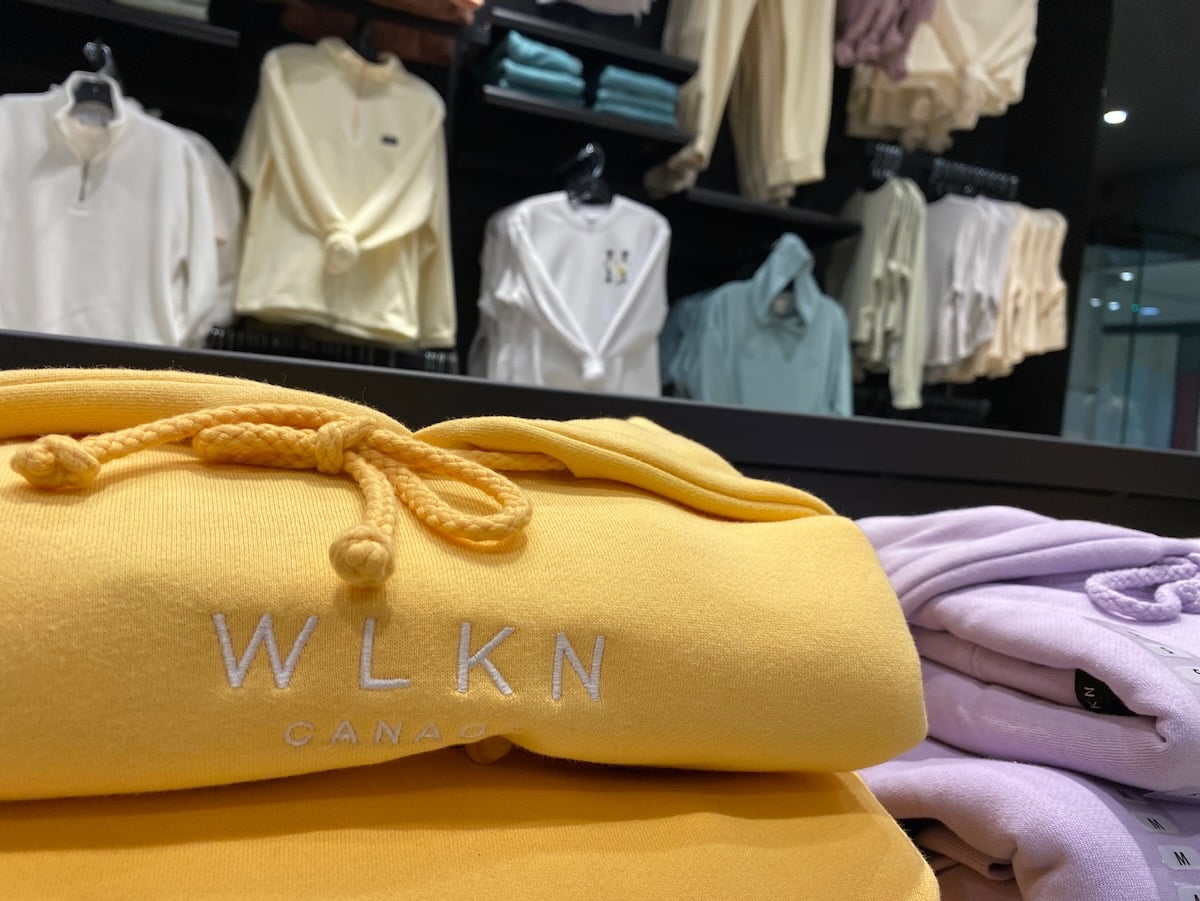
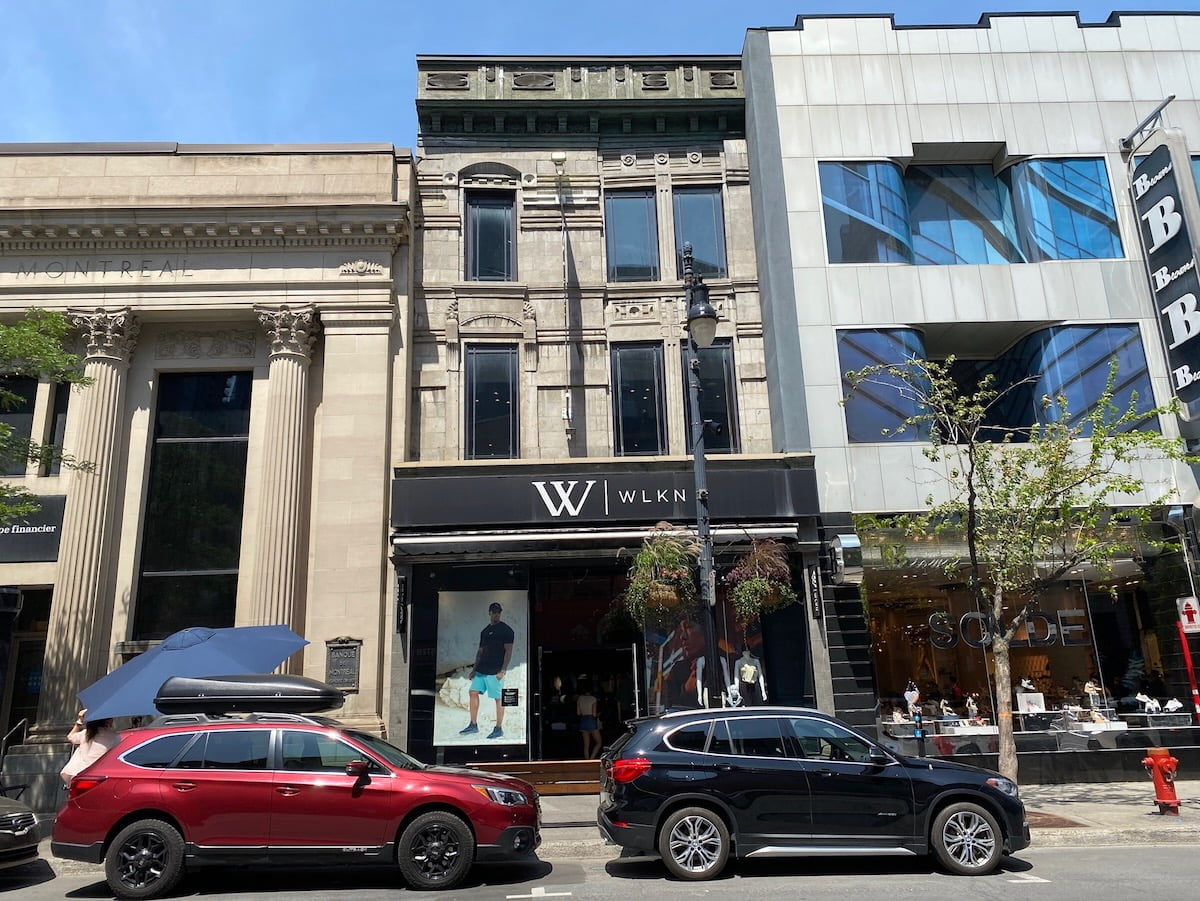
WLKN Montreal Centre-Ville (Image: Dustin Fuhs)
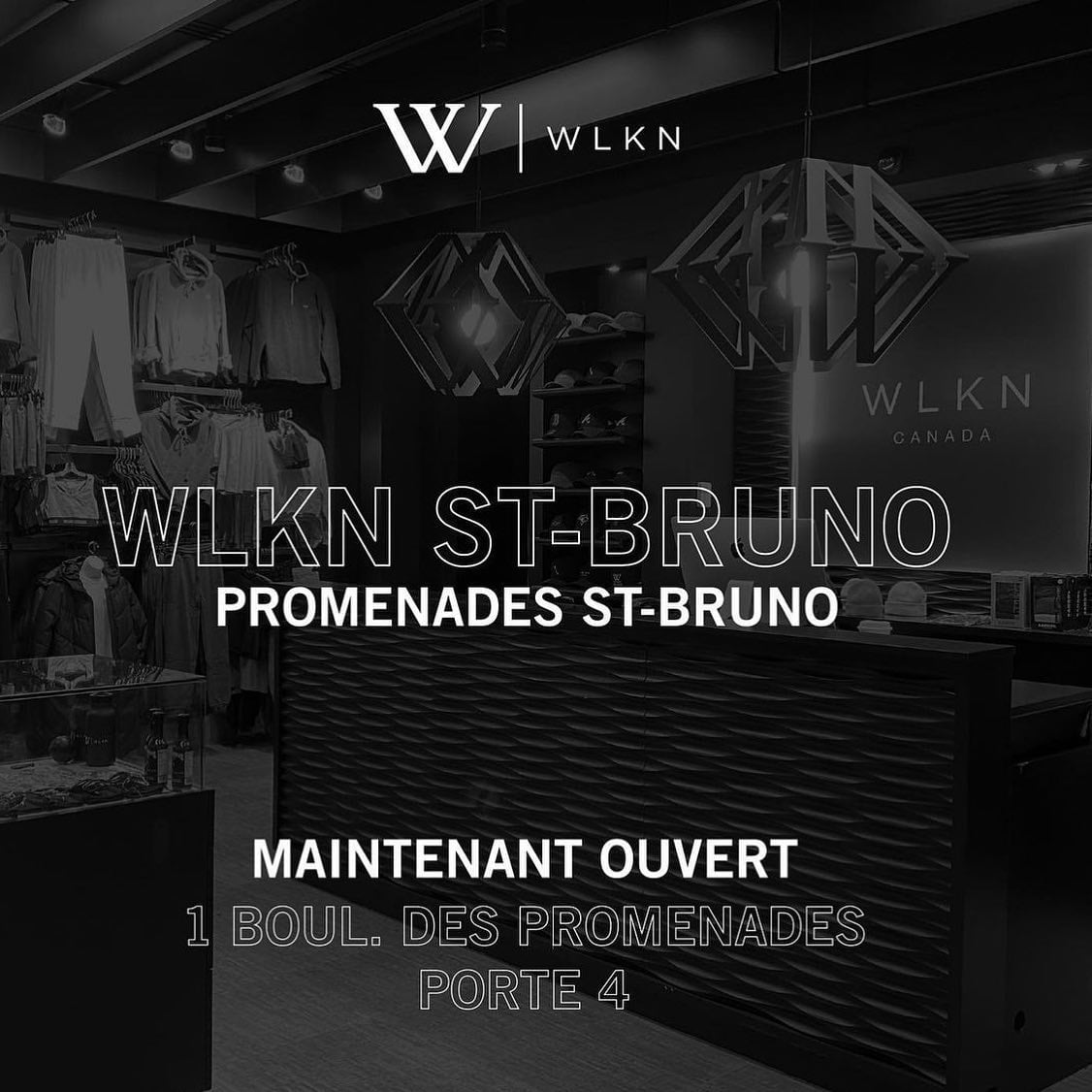
WLKN St-Bruno (Image: WLKN)
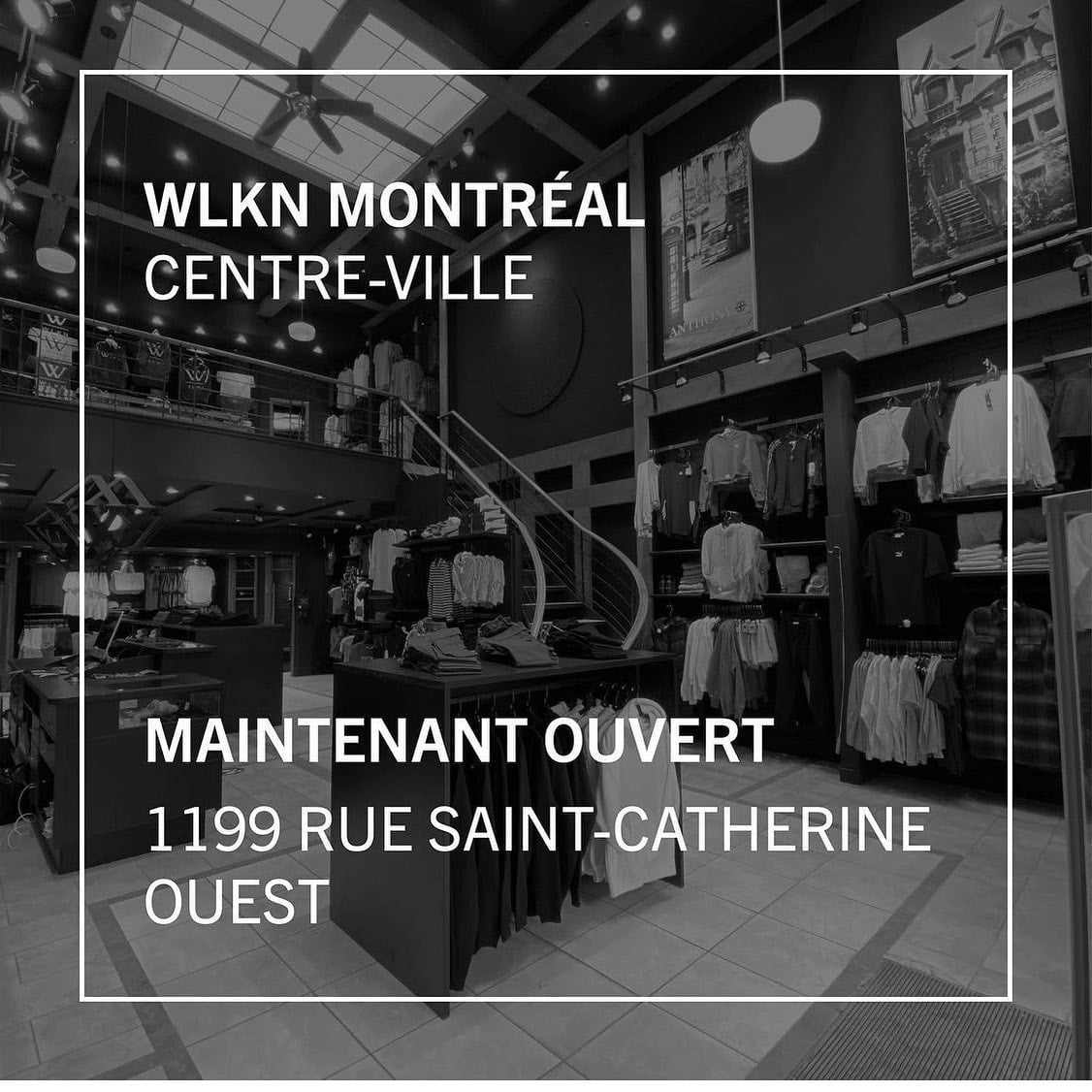
WLKN Montreal Centre-Ville (Image: WLKN)
Customers shopping at the CF Toronto Eaton Centre store, and at other locations, can expect friendly customer service, worldwide products, and Canadian made clothing.
“60 percent of our brand is made over seas, but 30 percent is made in Canada,” says Mercier. “That is what customers can find in our stores – a Canadian base streetwear brand and we are going to try to produce more Canadian made items.”
Customers can find a variety of clothing in unisex, women’s, men’s, and youth clothing in over 100 different brands including Obey, Vans, Champion, Puma, and more.
Retail Insider is streamlining its Canadian retail news from around the web to include a handful of top news stories that can be viewed quickly during the day. Here are the top stories from the past several days.
Podcast [Interview] The Behar Group Marks 30 Years
Craig sits down with The Behar Group‘s CEO Avi Behar and President/Broker of Record Greg Evans to discuss The Behar Group’s history, some notable deals, and where the Toronto-based brokerage sees food halls and retail going over the next several years.
The Interview Series podcast by Retail Insider Canada is available on Apple Podcasts, Stitcher, TuneIn, Google Play, or through our dedicated RSS feed for Overcast and other podcast players. Also check out our The Weekly podcast where Craig and Lee discuss popular content published on Retail Insider which is part of the The Retail Insider Podcast Network.
Avi Behar, Chairman & CEO | Broker at The Behar Group
Drop us a line at Craig@Retail-Insider.com. You can also rate us in Apple Podcasts or recommend us in Overcast to help more people discover the show!
Background Music Credit: Hard Boiled Kevin MacLeod (incompetech.com). Licensed under Creative Commons: By Attribution 3.0 License. http://creativecommons.org/licenses/by/3.0/
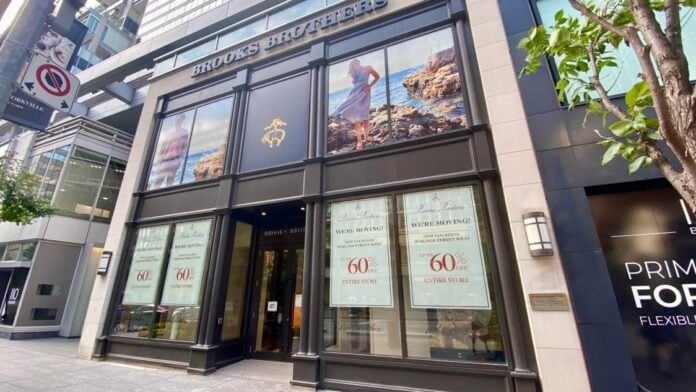
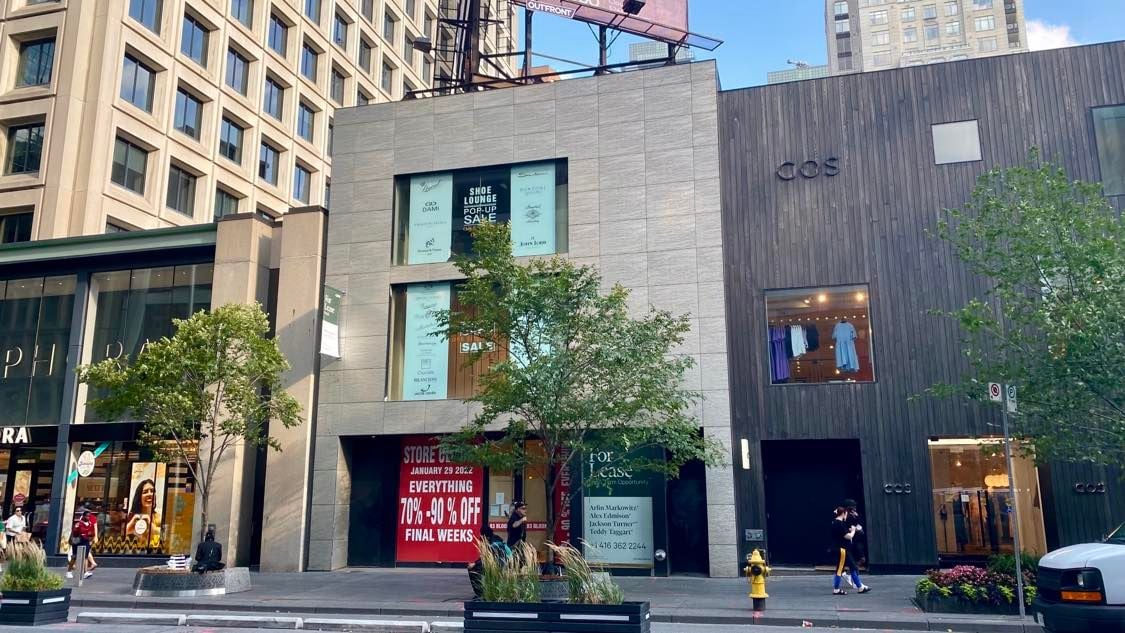
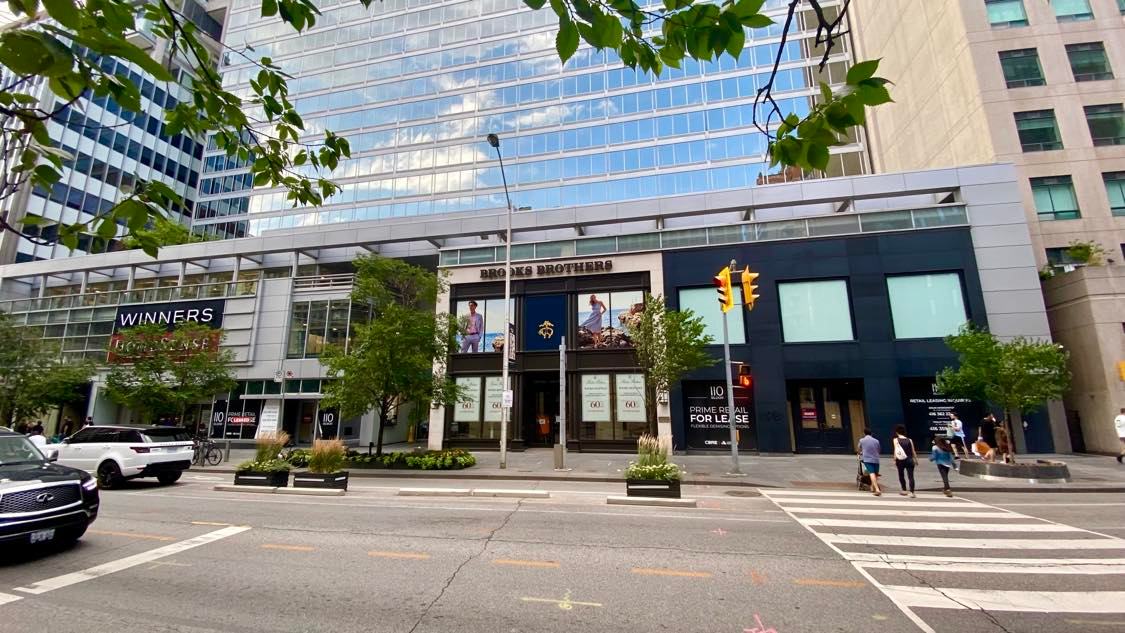
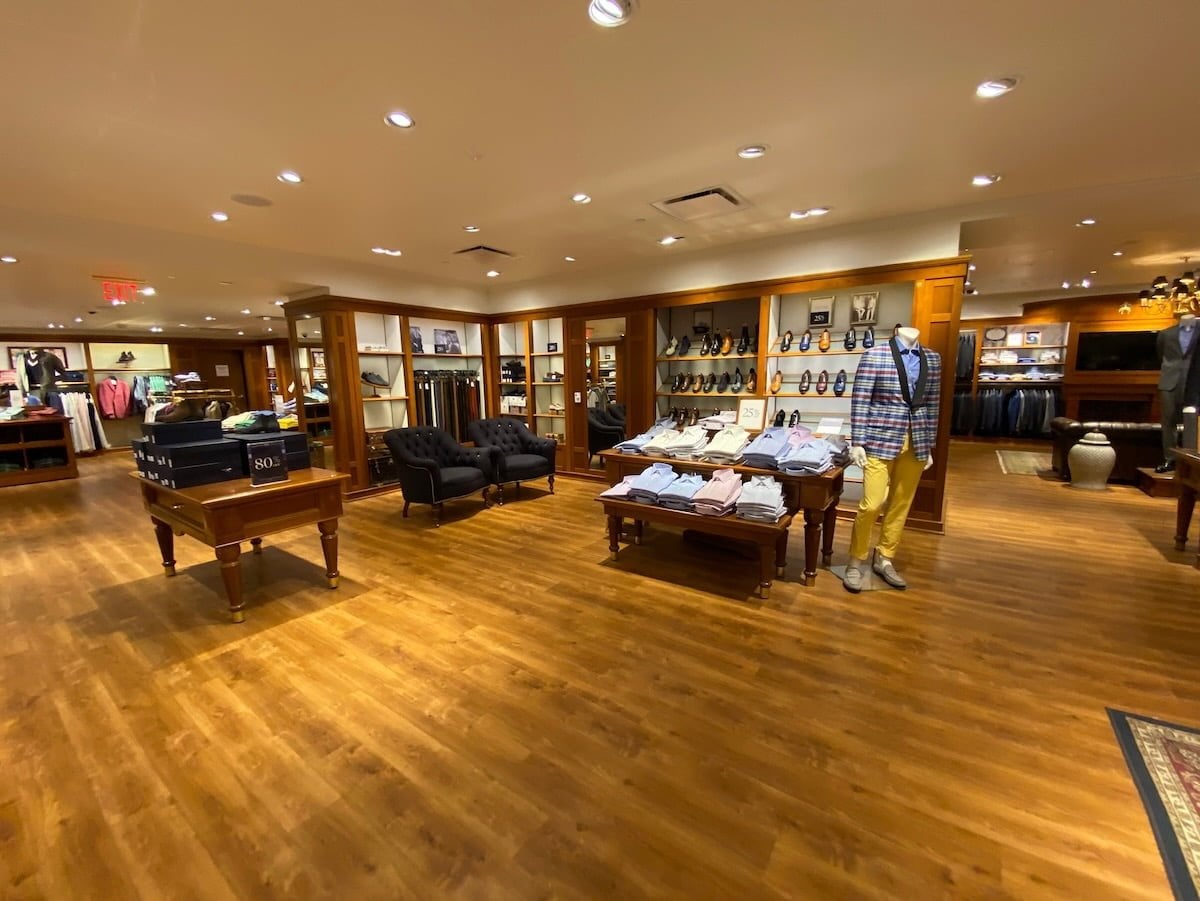
Soon-to-close Brooks Brothers store at 110 Bloor St. W. on July 24, 2022. Photo: Craig Patterson
Preppy American fashion brand Brooks Brothers will relocate its Bloor Street store in downtown Toronto this summer. The current two-level location at 110 Bloor Street West will move to 83 Bloor Street West where it will operate until the building is demolished for a massive condominium tower.
The new Brooks Brothers at 83 Bloor will span multiple levels, each measuring over 3,000 square feet per floor. The Hugo Boss store that occupied the site until the fall of 2019 measured about 10,000 square feet over three above-ground levels along with a basement. CBRE listed the space.
It’s not yet known how long Brooks Brothers will occupy 83 Bloor Street West. The building has a demolition clause with occupancy said to be of a maximum of two years. A redevelopment of the building as well as adjacent buildings to the west will see a massive new mixed-use residential condominium tower occupy the site in years to come.
Brooks Brothers will soon occupy the building at 83 Bloor St. W. which was formerly home to Hugo Boss. Photo: Craig Patterson on July 24, 2022
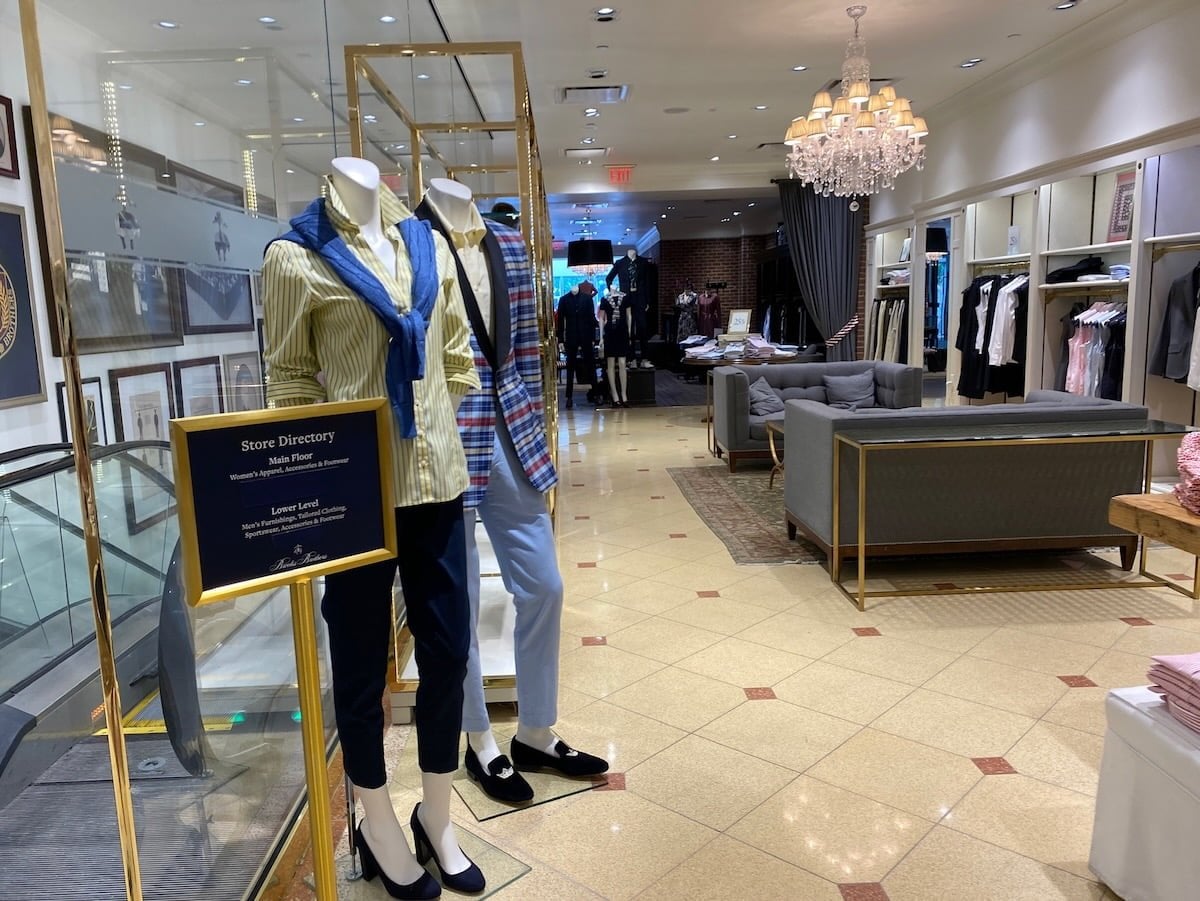
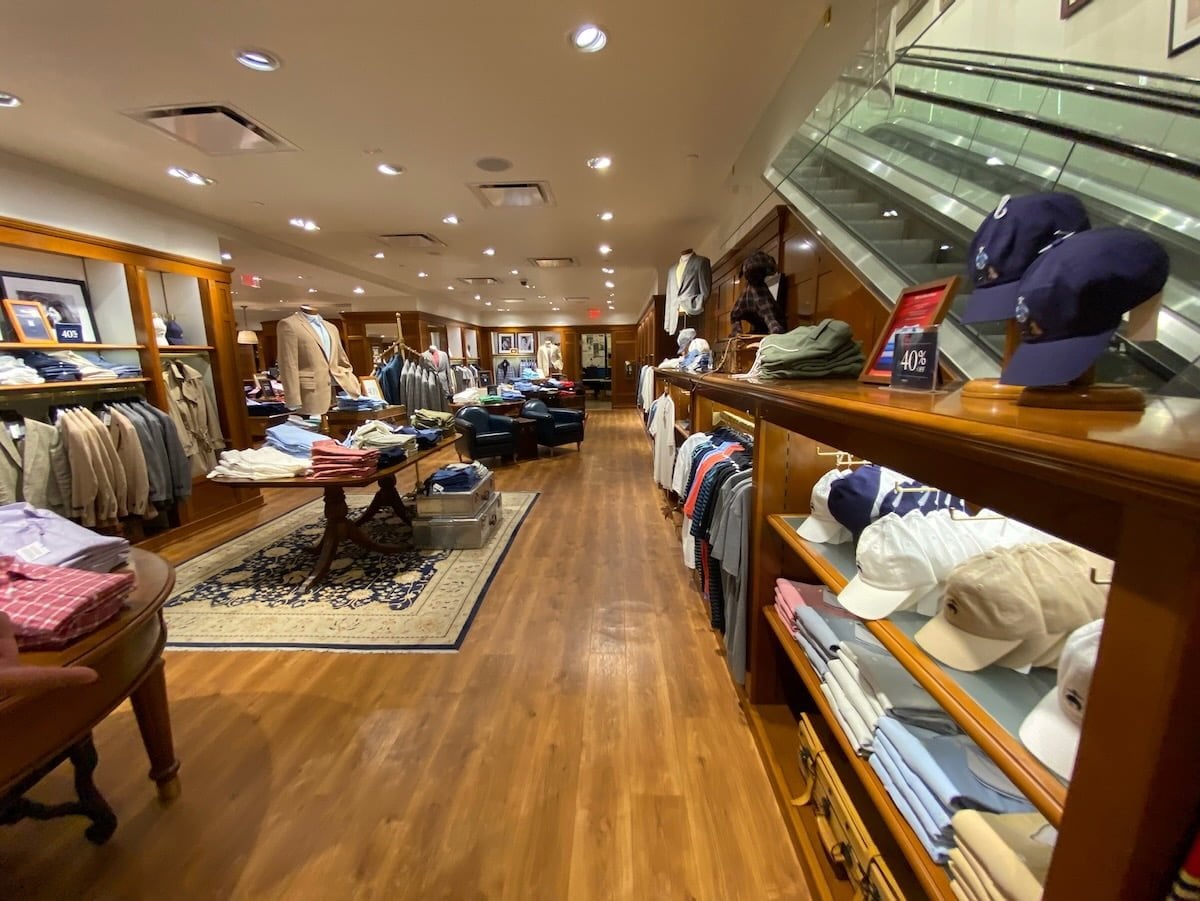
Brooks Brothers moved into its current space at 110 Bloor Street West in the spring of 2014. The store currently spans two levels including a street-level space and a concourse level. An employee at Brooks Brothers told us that a spa has already leased the lower level of the store.
With the exit of Brooks Brothers, every Bloor Street-facing retailer at 110 Bloor Street West, other than Winners, will have vacated the podium. Prior to the pandemic, retailers facing Bloor Street at 110 included Calvin Klein Underwear, Guerlain, Browns Shoes, Brooks Brothers and J. Crew.
New tenants set to open on the Bloor side of 110 Bloor Street West will include the first Canadian locations for foodservice concept Paris Baguette, French ‘white shirt’ luxury brand Anne Fontaine, and American luxury fashion brand Alexander Wang. The former J. Crew and Brooks Brothers spaces are still for lease on the street level of the podium.
110 Bloor St. W. on July 24, 2022. Photo: Craig Patterson
Bloor Street West is said to be seeing a flurry of leasing activity with several new retailers set to be announced. We’ll follow up on this story as we continue to announce these new stores over the coming weeks. Brokers are saying that there is considerable interest in space on the stretch of Bloor between Bay Street and Avenue Road after some tough times partly due to the pandemic.
In Canada, Brooks Brothers currently operates five full-priced stores and seven factory outlet stores. The brand closed a full-priced store at Bayview Village in Toronto during the pandemic. Besides the current Bloor Street store, full-priced Brooks Brothers locations in Canada include Royal Bank Plaza in Toronto, CF Shops at Don Mills in Toronto, The CORE in Calgary, and 1026 Alberni Street in Vancouver. Factory outlet stores are in Ontario at Vaughan Mills, Toronto Premium Outlets, Outlet Collection at Niagara, Tanger Outlets Ottawa; BC at McArthurGlen Designer Outlets and Tsawwassen Mills; and Alberta at CrossIron Mills near Calgary.
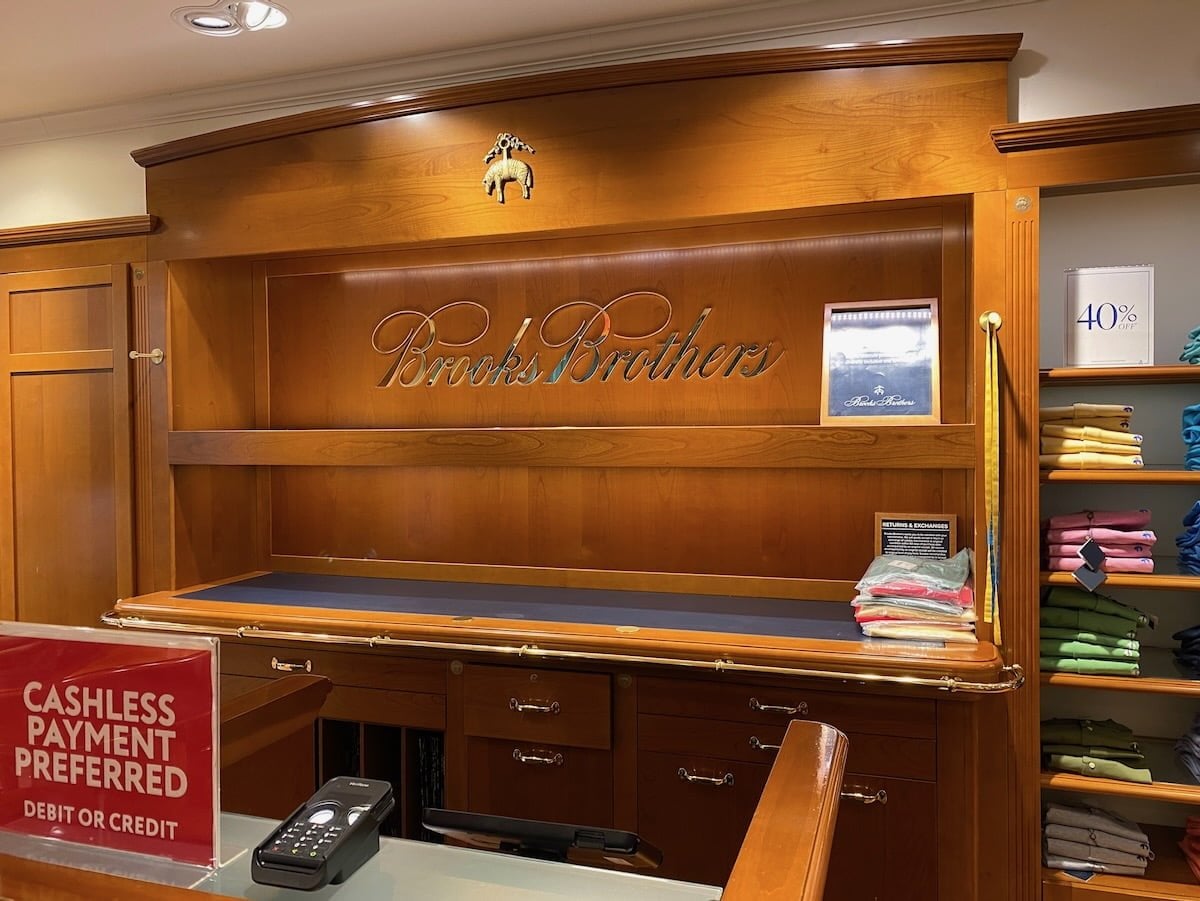
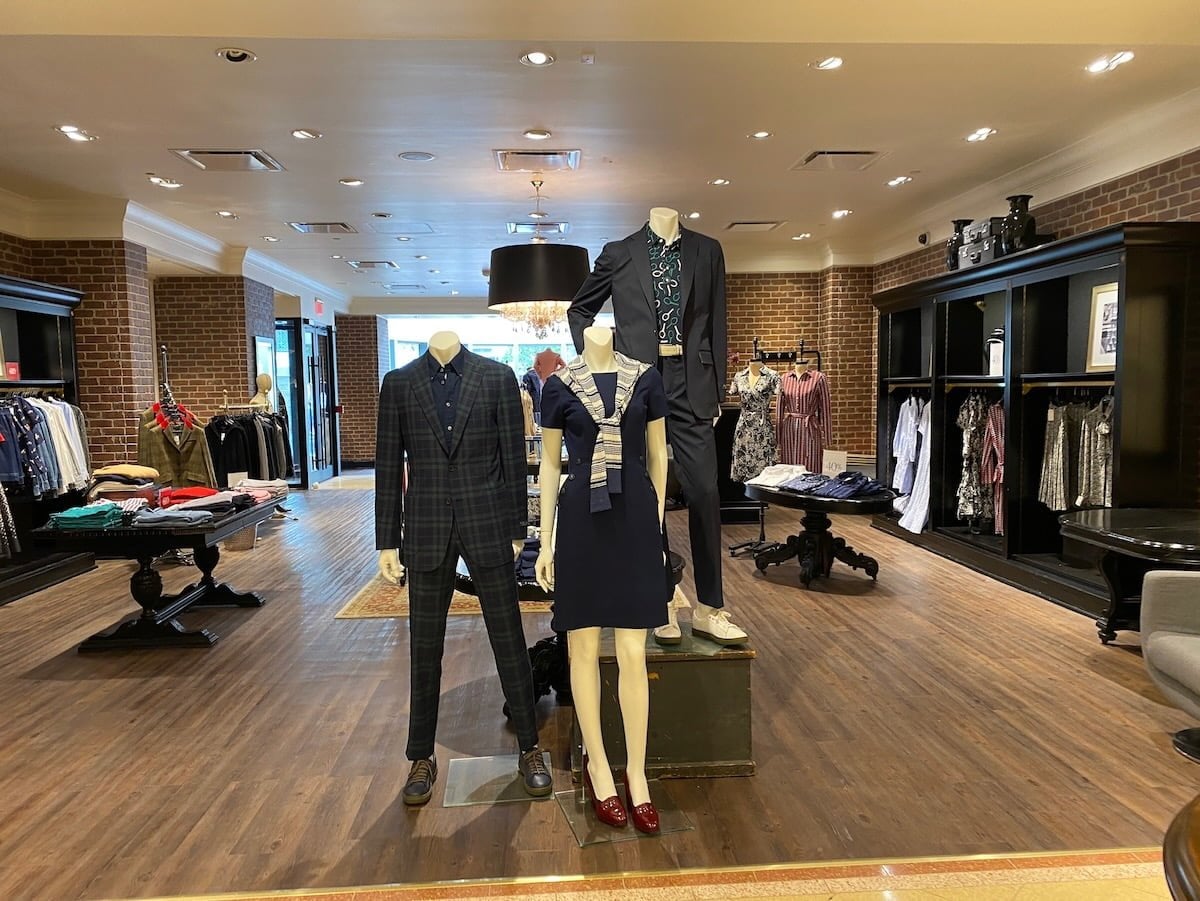
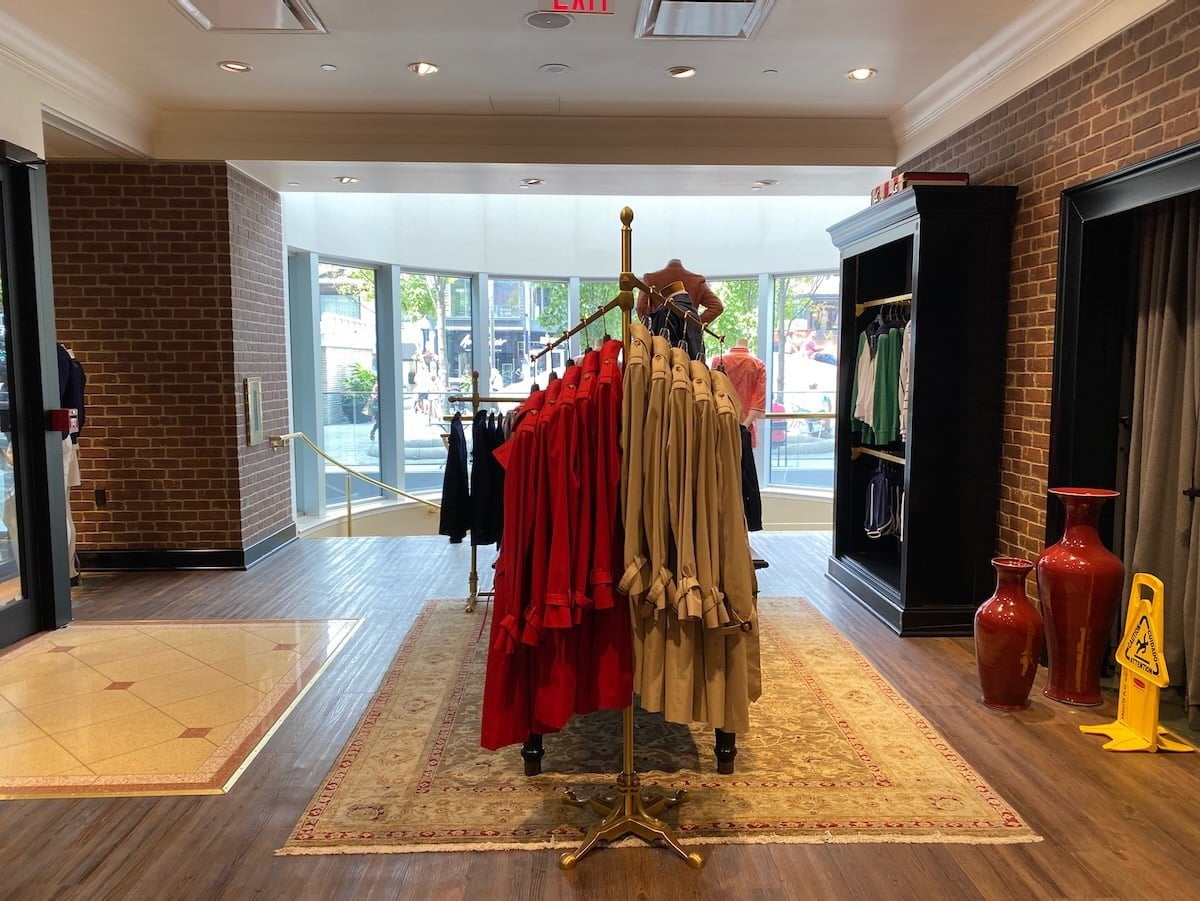
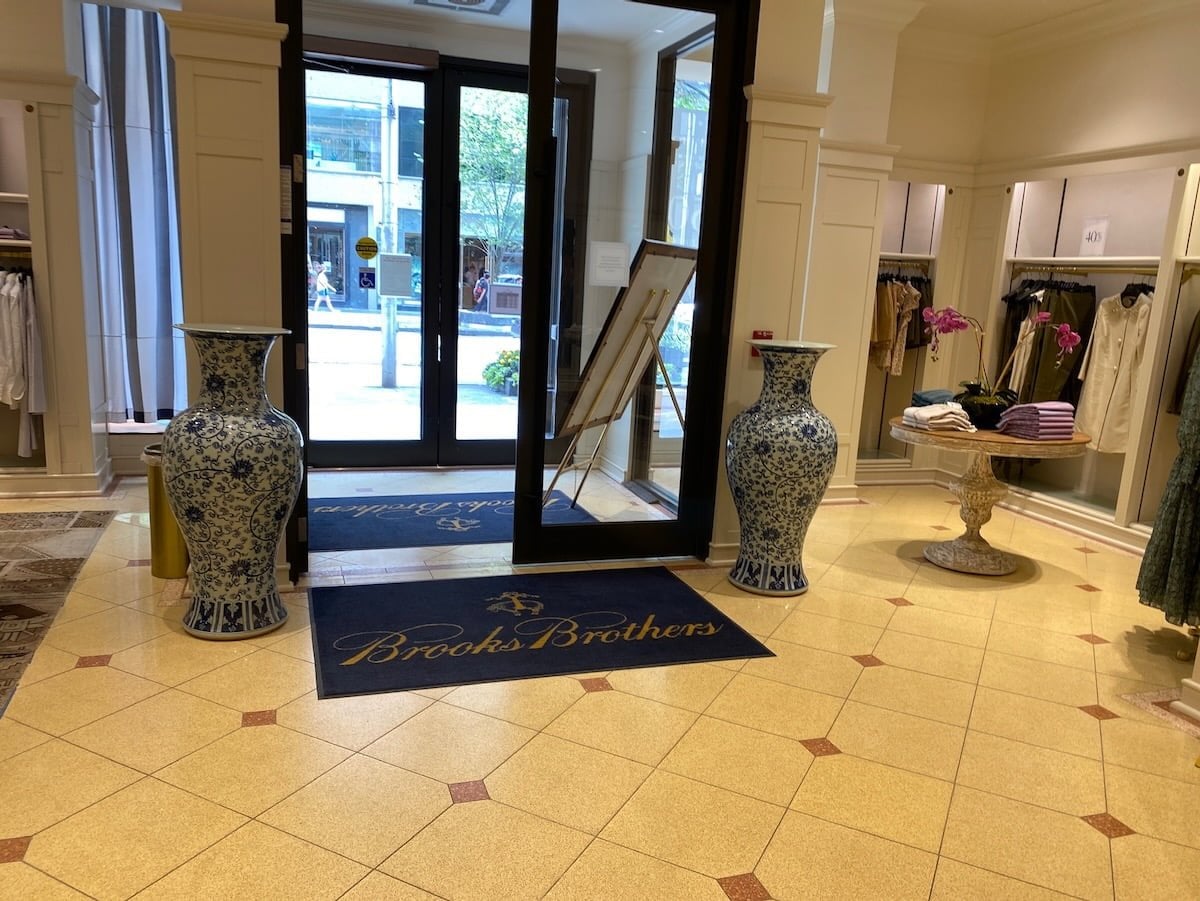
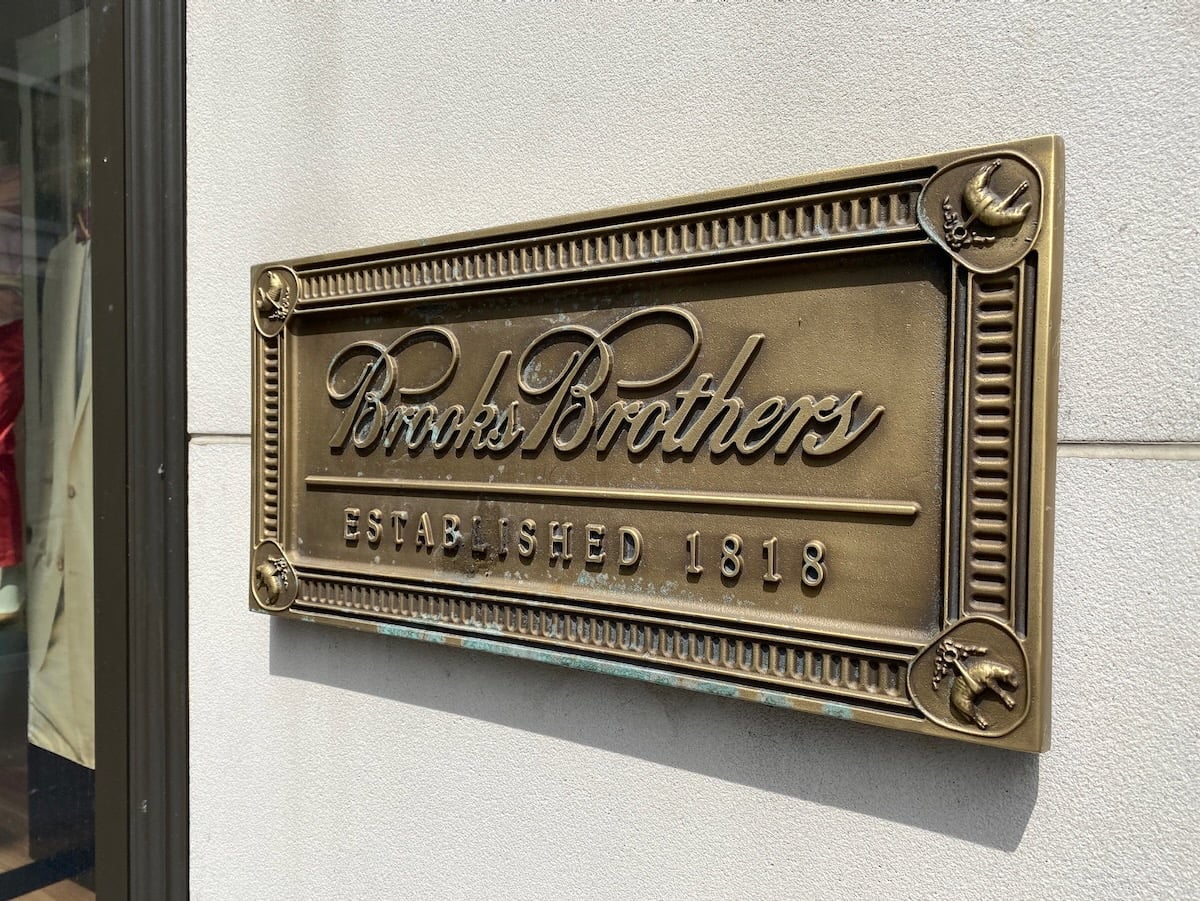
See below for images inside of the Brooks Brothers store at 110 Bloor Street West. All images below are by Dustin Fuhs.
IKEA Plan and Order Point Boisbriand (Image: IKEA Canada)
IKEA Canada has opened its first Plan and order point concept in Boisbriand, Quebec, in the heart of Montreal’s North Shore community, with plans to roll out the concept to many other locations across Canada.
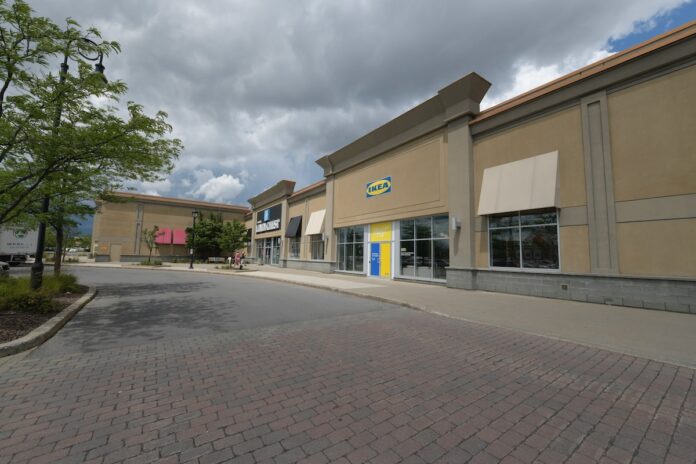
The new concept store, located in the Faubourg Boisbriand shopping centre adjacent to Linen Chest and HomeSense, focuses on inspiring and supporting customers who are looking to plan, order and purchase complex home furnishing solutions for the kitchen, bath, bedroom and living room with the help of a knowledgeable IKEA specialist, said Eri Mathy, Head of Business Development & Transformation at IKEA Canada.
Eri Mathy
“Life at home continues to evolve and Canadians are eager to optimize their spaces and create functional homes for their changing needs,” said Mathy.
She added it’s part of the retailer’s global expansion strategy and omni-channel strategy.
“Opening our first Plan and order point in Boisbriand is an important step to meet this growing need and deliver an IKEA experience that is more accessible and convenient to the many people in the Greater Montreal Area.”
IKEA Plan and Order Point Boisbriand (Image: IKEA Canada)IKEA Plan and Order Point Boisbriand (Image: IKEA Canada)
She said a second location will open in the fall in Kitchener, Ontario, with more coming across the country but the company does not have a firm figure yet on those numbers.
The Plan and order point concept is part of a global ambition to bring a new world of IKEA to its customers. There are more than 30 Plan and order points globally in cities such as Copenhagen, Berlin, Stockholm, and Tokyo.
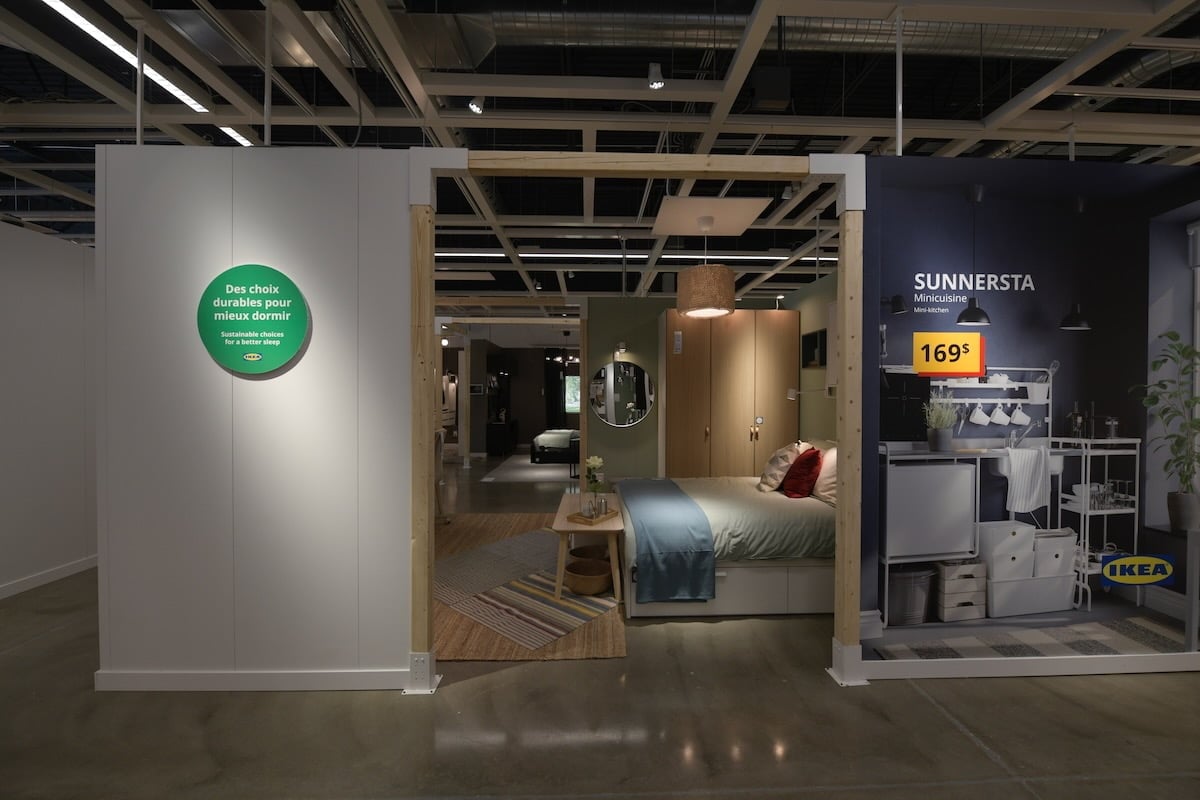
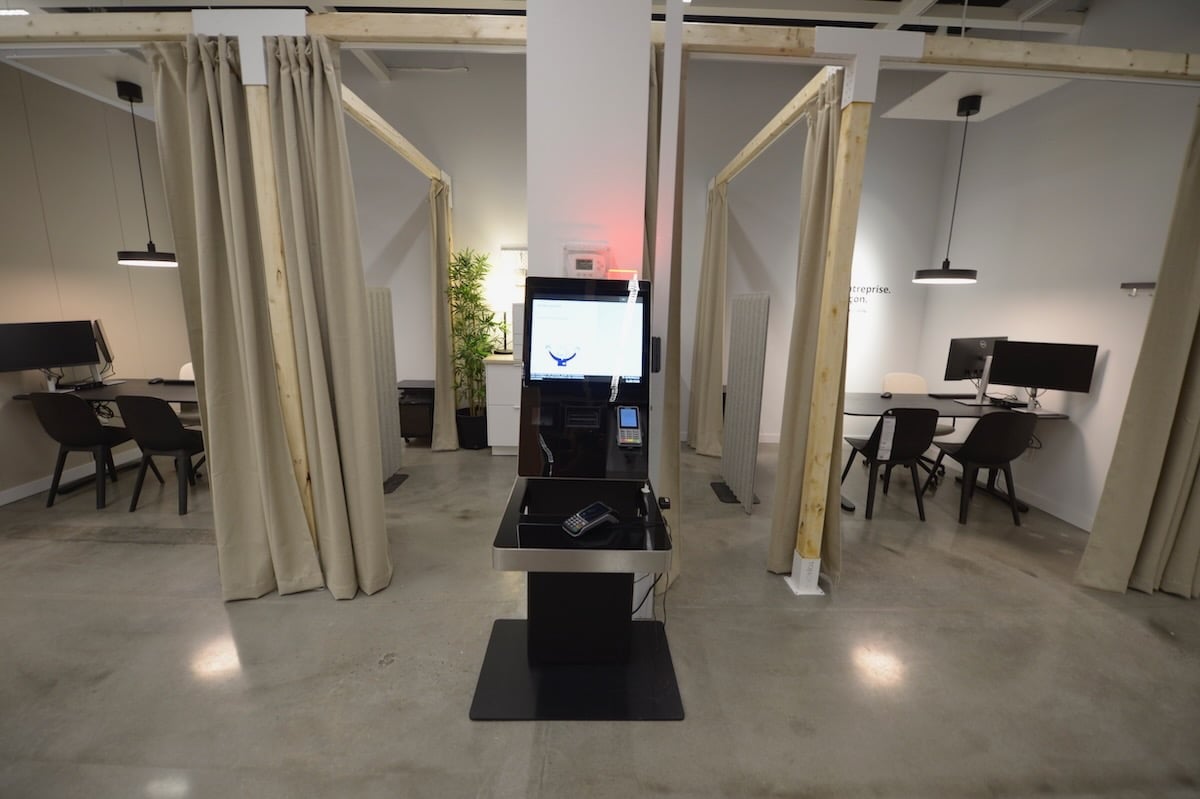
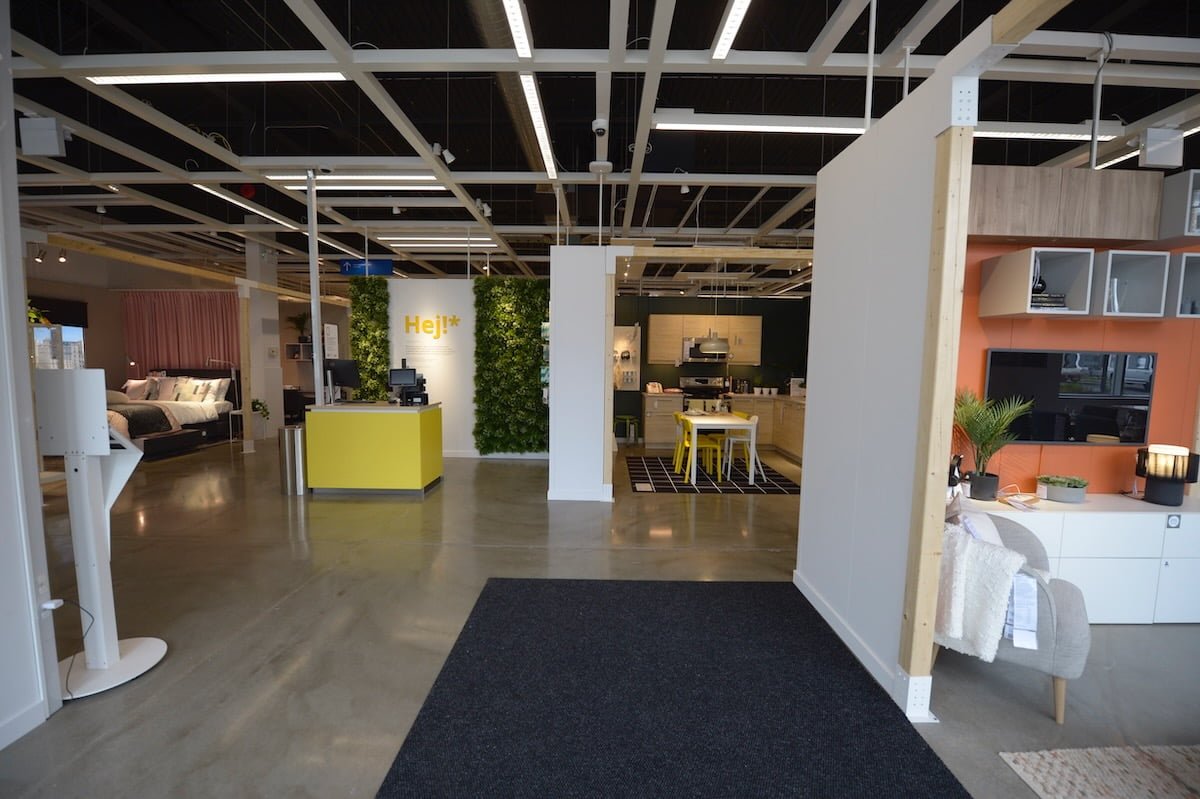
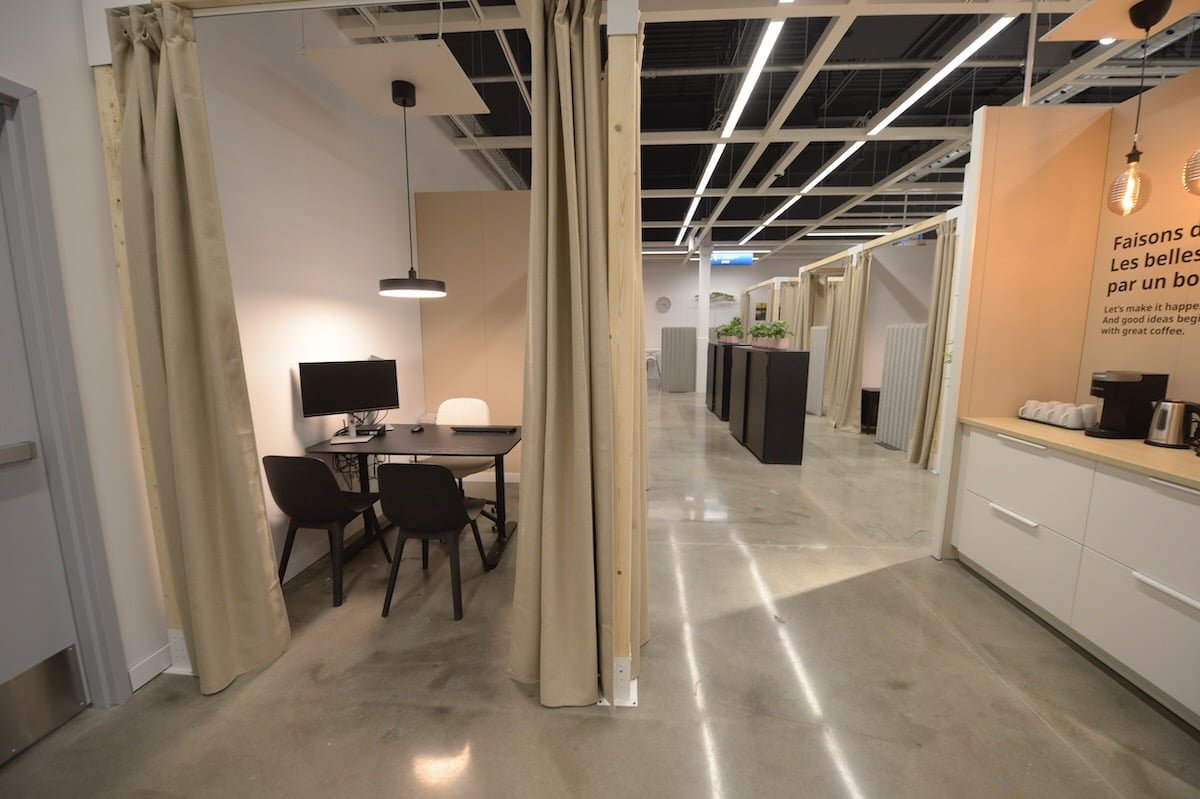
The Boisbriand Plan and order point offers planning services by appointment only for a more personalized experience. It also showcases a curated selection of relevant home furnishing solutions for customers to touch and try. IKEA products or food will not be available for immediate takeaway.
“The IKEA Plan and order point is a space for customers to connect with friendly and knowledgeable IKEA specialists to create custom home furnishing packages that fulfill their individual needs and dreams,” said Mathy.
IKEA Plan and Order Point Boisbriand (Image: IKEA Canada)IKEA Plan and Order Point Boisbriand (Image: IKEA Canada)
Purchases made at an IKEA Plan and order point can be delivered directly to customers’ homes or picked up at local IKEA Pick-up Locations, including PenguinPickUp, 5565 Boulevard Robert Bourassa, in Laval, QC.
The Boisbriand Plan and order point regular store hours will be Monday-Wednesday from 10am-6pm, Thursday-Friday from 10am-9pm and Saturday-Sunday from 10am-5pm.
To learn more about IKEA Plan and order points, visit IKEA.ca/boisbriand.
IKEA Plan and Order Point Boisbriand (Image: IKEA Canada)
Michael Ward
In a LinkedIn post, Michael Ward, CEO and Chief Sustainability Officer at IKEA Canada, said: “This inspiring customer meeting point will allow our customers convenient access to our home furnishing solutions with a focus on Kitchen, Bedroom and Bathroom. There they can meet our home furnishings experts and choose from an array of services to assist them including planning appointments, delivery, assembly and installation. This new meeting point is another important step in our journey to become the leading Omni Channel home furnishing retailer in Canada.”
The giant retailer says the Plan and order points are places where it offers a personalized service designed to help take the guesswork out of people’s complex home furnishing projects.
“Whether you’re looking to update your kitchen or create a custom wardrobe, the Plan and order points is where you can meet one-on-one with one of our planning specialists to plan and order IKEA goods for any room in your home. Don’t worry about lugging furniture – there is no stock at our Plan and order points because we conveniently deliver all goods directly to your home or nearby pick-up location,” says the company.
“The IKEA Plan and order points offers a personalized service designed to make your home furnishing dreams a reality. At a Plan and order points, our planning experts are there to help you navigate complex home projects like kitchen design, bedroom projects, small space living solutions and more.”