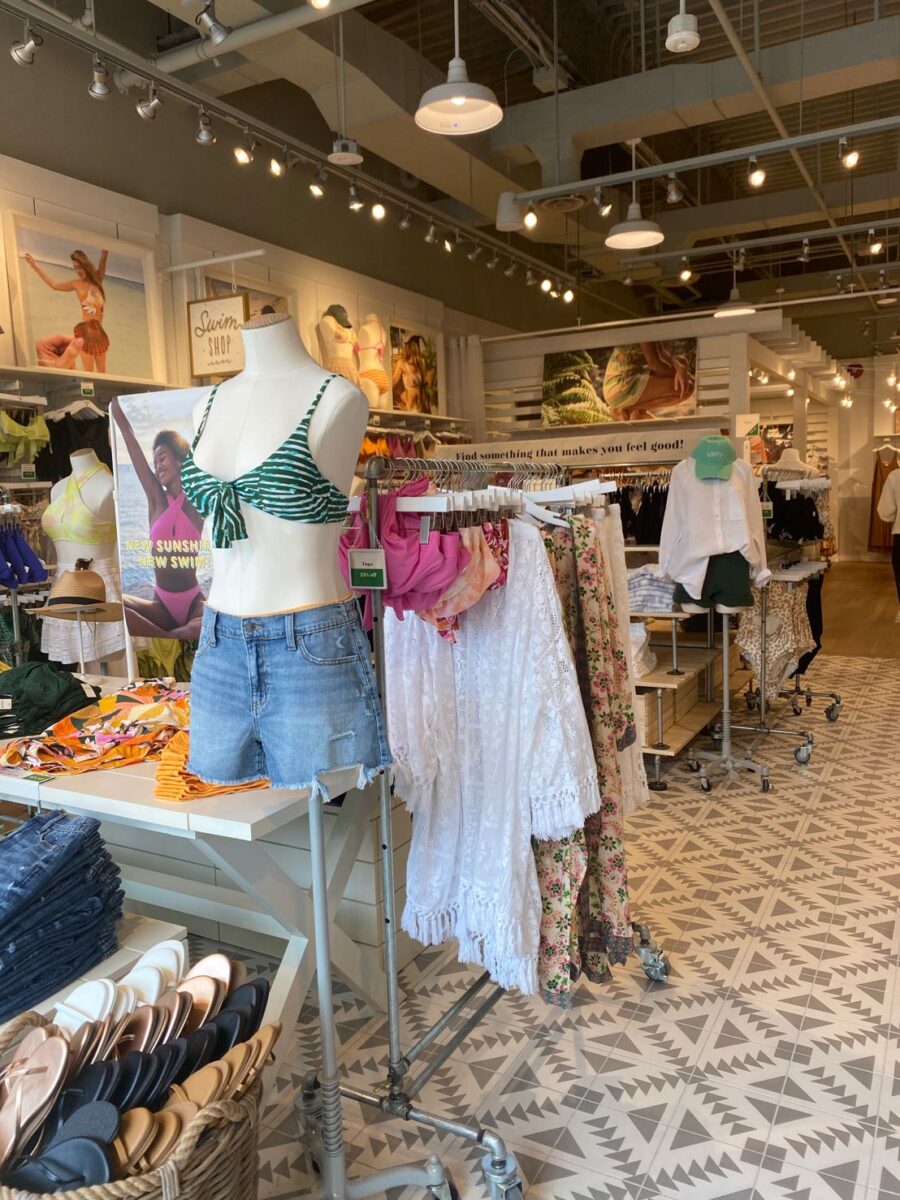
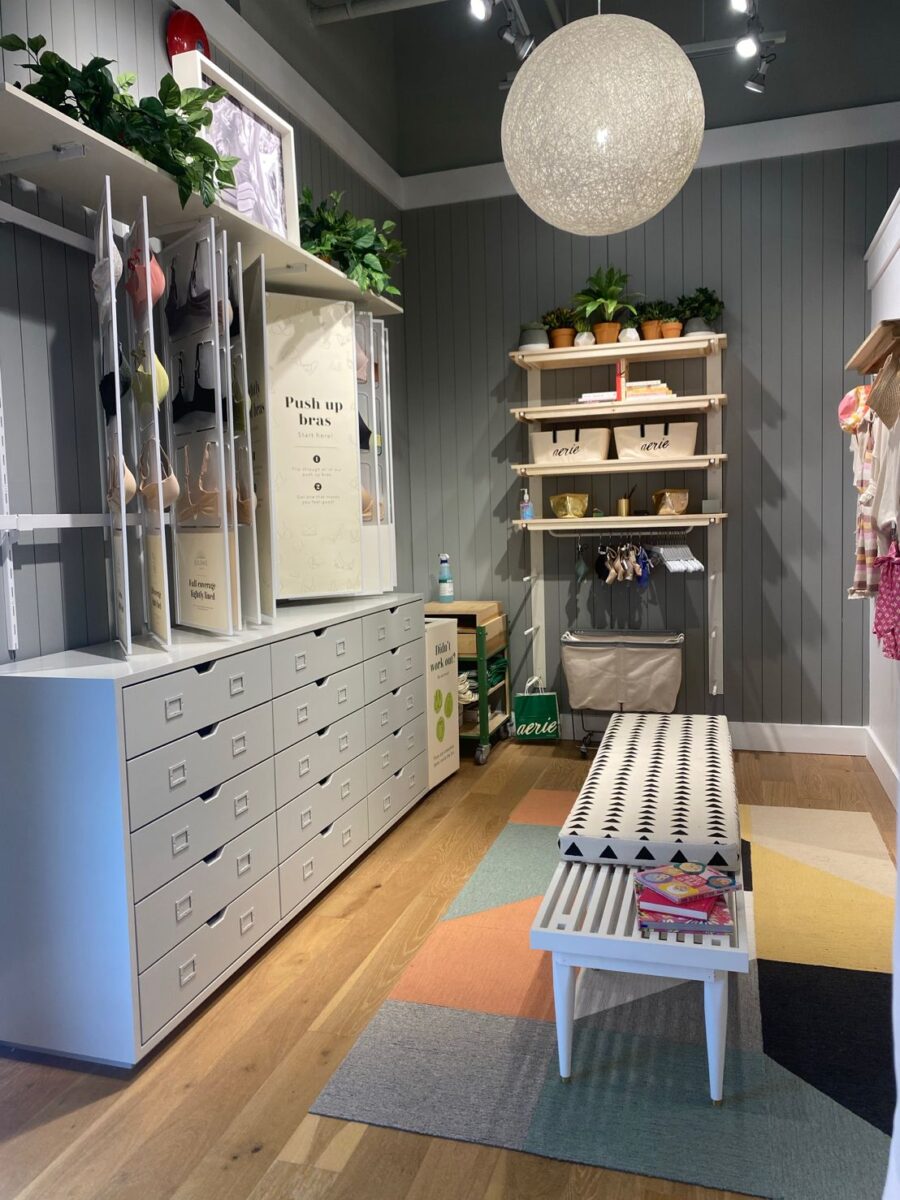
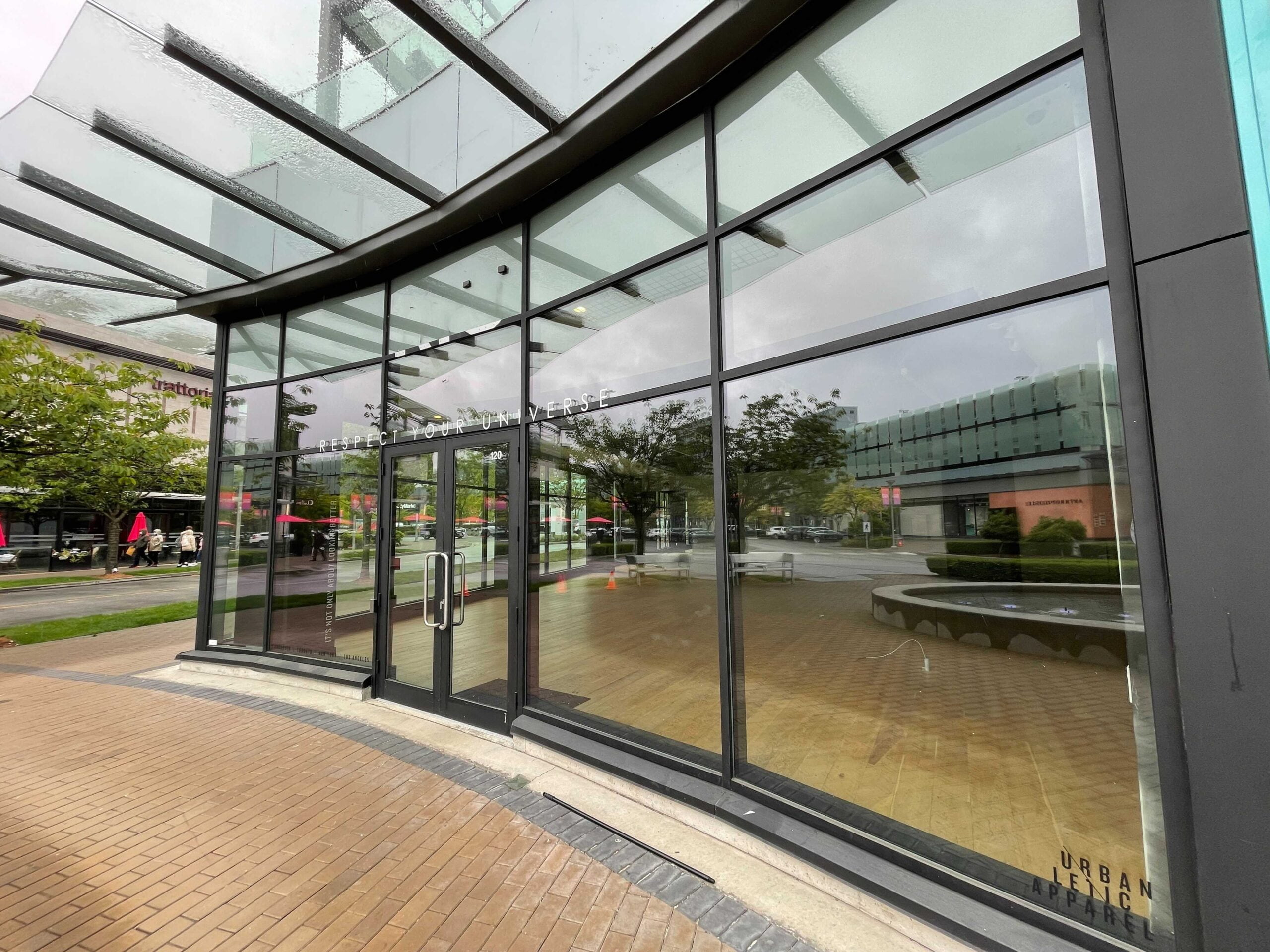
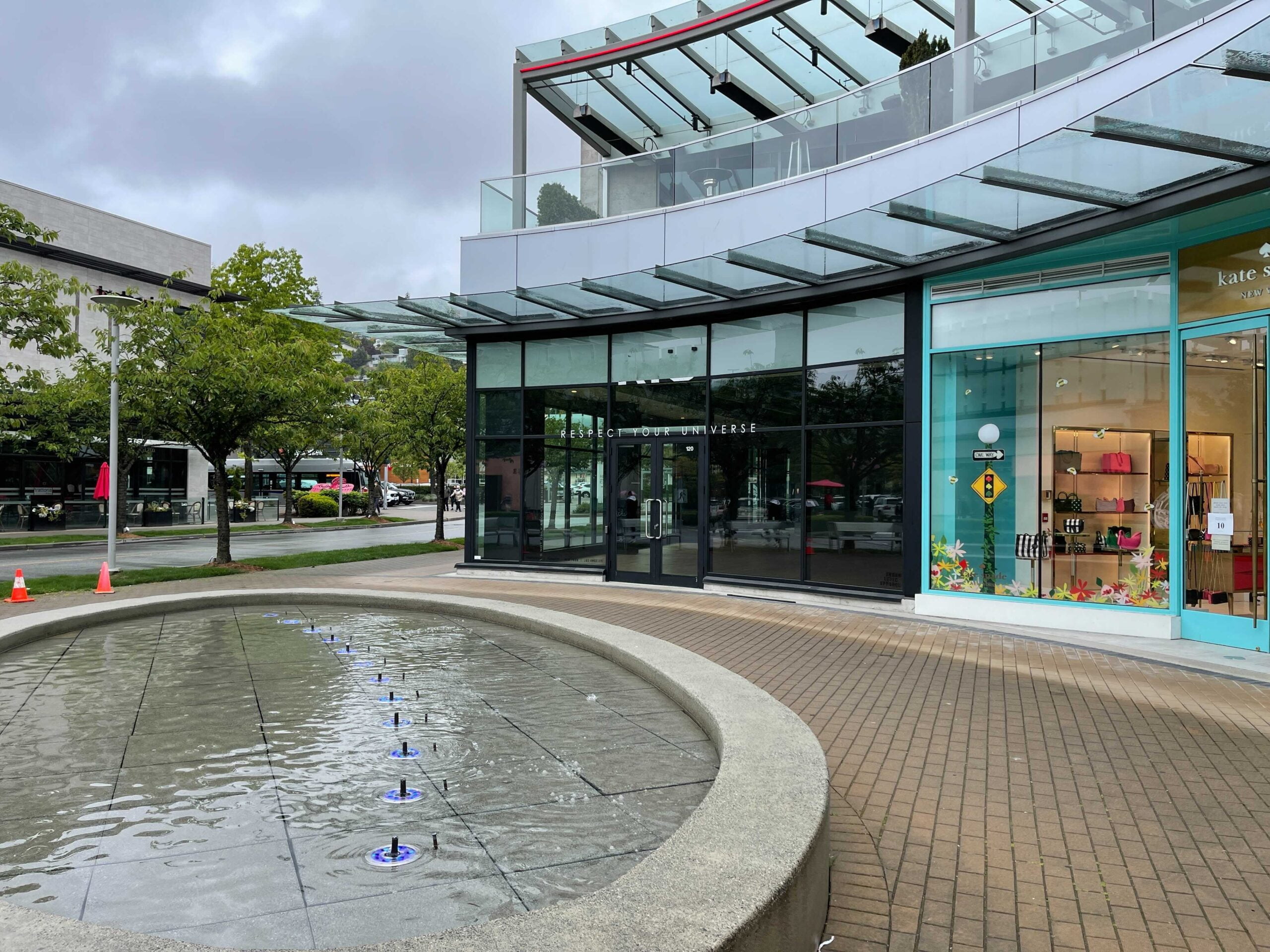
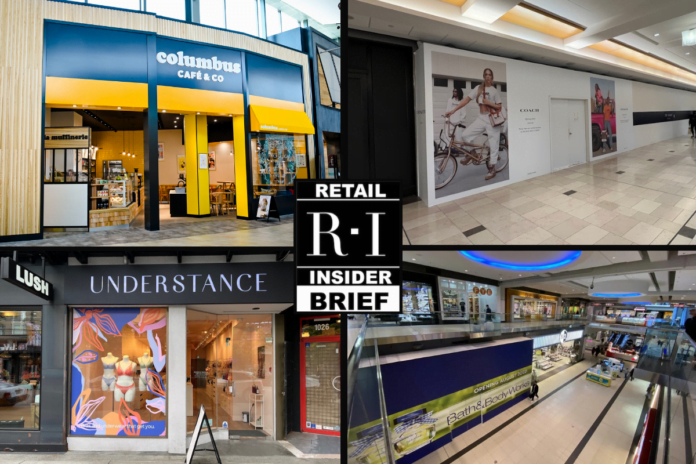
Aerie storefront at Park Royal Shopping Centre in West Vancouver (May 2022). Photo: Shanon Thornley
Intimate apparel brand Aerie has opened at Park Royal Shopping Centre in West Vancouver, B.C. within the “Park Royal South – Exterior” section of the complex. This marks the first stand-alone Aerie location in the Vancouver area for the sub-brand owned by US-based American Eagle Outfitters.
The lifestyle brand was launched in February 2006 in South Carolina. As of May 2022, the store locator on Aerie’s website noted 34 locations across Canada, including:
4 in British Columbia (Park Royal was not included in the list);
4 in Alberta;
16 in Ontario;
6 in Quebec; and
4 in Maritimes.
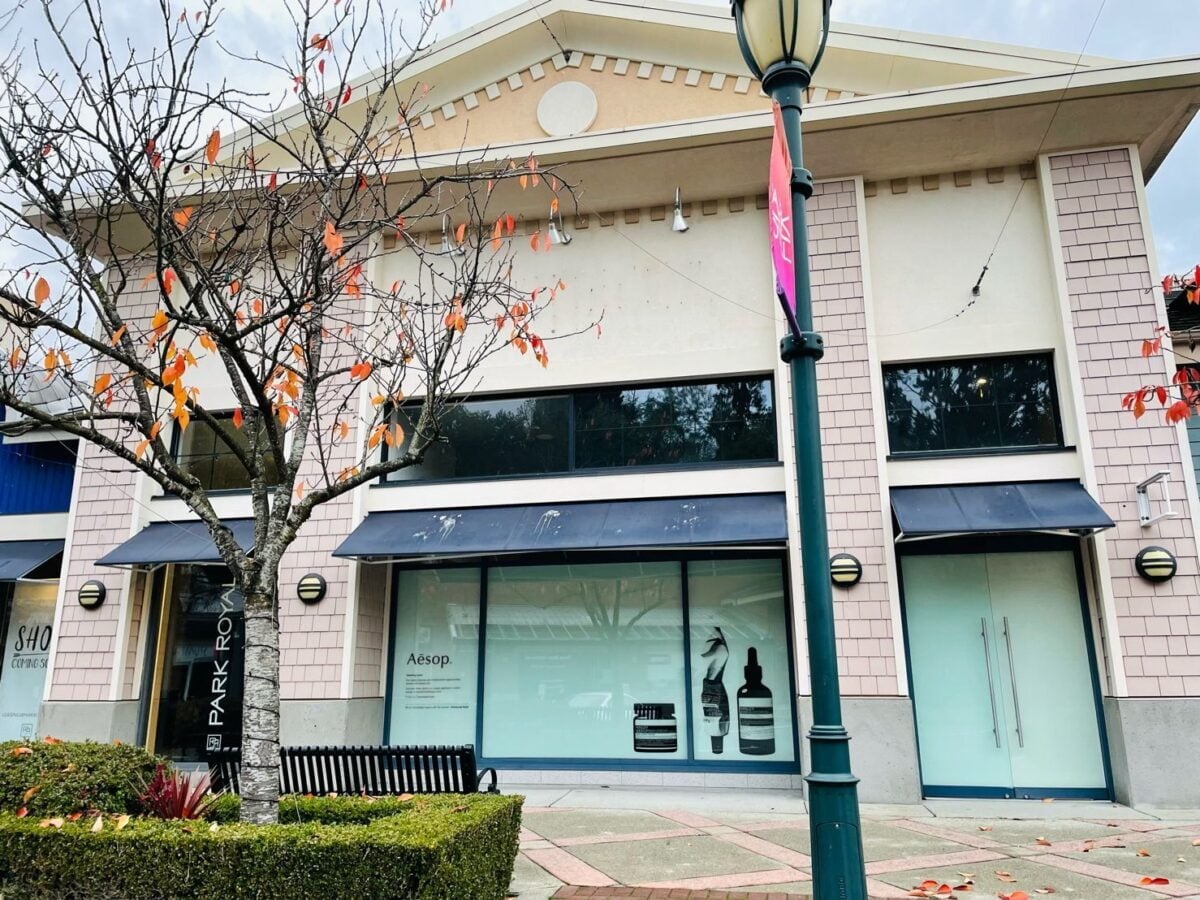
The store replaces an RYU store that once occupied the space. Retail Insider was onsite in late-May 2021 for the Retail Tour Update: Park Royal Shopping Centre in West Vancouver and the former RYU location had been emptied with no indication of the future tenant at that time.
Aerie interior at Park Royal Shopping Centre in West Vancouver (May 2022). Photo: Shanon Thornley
Aerie interior at Park Royal Shopping Centre in West Vancouver (May 2022). Photo: Shanon Thornley
A casualty of restructuring, Vancouver-based RYU (Respect Your Universe) Apparel issued a flurry of news releases in the past few months as it has embarked on stabilizing the retail operations with an optimistic outlook for the future. In Retail Insider’s CEO interview in March 2021, it was noted that the athletic brand RYU announced in February of 2020 several store closures to coincide with its restructuring. In a letter to shareholders, Marcello Leone, the company’s CEO, President and Chairman of the Board at the time, described 2019 as the retailer’s most challenging year since inception. Just over a year ago, the company had a total of 11 stores — there are now just three left in Toronto, Vancouver, and Williamsburg, NY.
Digital Main Street, which assists businesses with their adoption of technology with easy-to-use tools and resources, and Mastercard are expanding their partnership to help Canadian small businesses navigate through the current economic storms and challenges.
Resources, tools and best practices are being added to provide small businesses with ways to safeguard their operations against the increasing threat of cyber attacks.
John Kiru
John Kiru, Executive Director of the Toronto Association of Business Improvement Areas and Founder of Digital Main Street, said the partnership, since the inception of Digital Main Street in 2016, has been “critical in ensuring that we are bringing industry leading resources and opportunities to businesses across the country.”
“In a time where small businesses are being increasingly targeted with cyber attacks, phishing scams and more – this will provide invaluable resources and support to ensure they are protected,” he said.
He said the expanded partnership will help grow educational programs across the country, with a focus on increasing cyber security awareness among small businesses, youth and recent graduates. In addition to the programming, the partnership will also offer new tools and solutions that will help small businesses assess their level of cyber readiness and provide corresponding actionable recommendations to help mitigate existing risks.
“When we were building out the concept for Digital Main Street and the platform, (Mastercard) saw the wisdom of it and they are a founding partner of the program, providing resources, thought leadership, training and more” said Kiru.
Image: Fifi’s Handmade
“The latest of which is going to be the cyber security piece that we’re looking to layer on top of Digital Main Street. Now that we’ve helped small businesses move into that digital realm and helped educate them on how to move from bricks and mortar into bricks and clicks, we feel strongly that we need to support them by providing them the security they need not only for themselves but for their customers and Mastercard has once again stepped up and is offering, as a part of our partnership, their industry leading programming and resources, as well as their know-how in terms of the whole cyber security component for SMBs.”
Sasha Krstic
Sasha Krstic, president of Mastercard in Canada, said small businesses can often be easier targets for cyber attacks because they have less security protection and fewer resources dedicated to cyber security compared to larger corporations.
“Despite their size, small businesses still have valuable data and it’s important that they have access to resources to shield themselves. Our expanded partnership with Digital Main Street will provide added tools and resources for small businesses so that they can focus on growing their operations knowing they are protected,” she said.
Small businesses in Canada can visit www.digitalmainstreet.ca to learn more about how to gain access to these news tools and resources.
Kiru said the initial premise of Digital Main Street, which was launched through TABIA in collaboration with the city of Toronto and founding corporate partners like Mastercard, Google, Microsoft, Shopify and more, was to educate local small business people on the questions to ask and the directions they wanted to go in the digital world as the consumer habits started to shift.
“That was when Amazon was really starting to kick in and we saw the writing on the wall on how big an impact that was going to be. So this was a way of preparing local small businesses, educating them on how they too can play in that world . . . from bricks and mortar to bricks and clicks,” he said.
Image: Digital Main Street
“We never want to lose the bricks because that makes the environment, that makes the local economics, that makes the vitality of the community important but now in order to survive along main streets, etc., you need that supplemental side of things where you find now that the storefront is very much what we all remember, the shelves, the display areas, but once you walk into the back half of the store you’ll see people stuffing envelopes and boxes and at five o’clock that UPS truck shows up and picks up those online sales.
“That combination is what’s going to keep main street vibrant and active.”
With the additional educational resources and content, small business owners will be able to evaluate their level of cyber security protection, learn how to improve it, and most importantly equip themselves with the right tools to address any threats.
“As we move into the digital world and through Digital Main Street, which has become, thanks to the federal government, pan-Canadian, which we’re helping launch across the country, now people are on that digital highway if you will and we’ve all heard and seen cyber security issues where people are getting control of people’s websites or email inboxes, or any other scams that are going out there,” said Kiru.
“We need to make sure that our businesses are protected either with the right software, with the understanding of what to open, what not to open for example. So that whole cyber security becomes that much more critical in the evolution of helping to digitize main street, not only for the retailer but also for the consumer so they have confidence to go onto a small business website, make their transaction knowing that there is security in place and they’re not going to be compromised by shopping at the local small business.
“That’s why it’s absolutely critical at this stage and very fortuitous for us who looks after the small business sector to have somebody like Mastercard step up and help us lead in delivering cyber security education and programming to local small businesses across the country.”
The enhanced partnership follows similar cybersecurity-related initiatives by Mastercard in Canada, which includes investments for the Toronto Metropolitan University and Rogers Cybersecure Catalyst, the University of New Brunswick’s Canadian Institute for Cybersecurity, and a $510 million investment in its new Global Intelligence and Cyber Centre of Excellence in Vancouver.
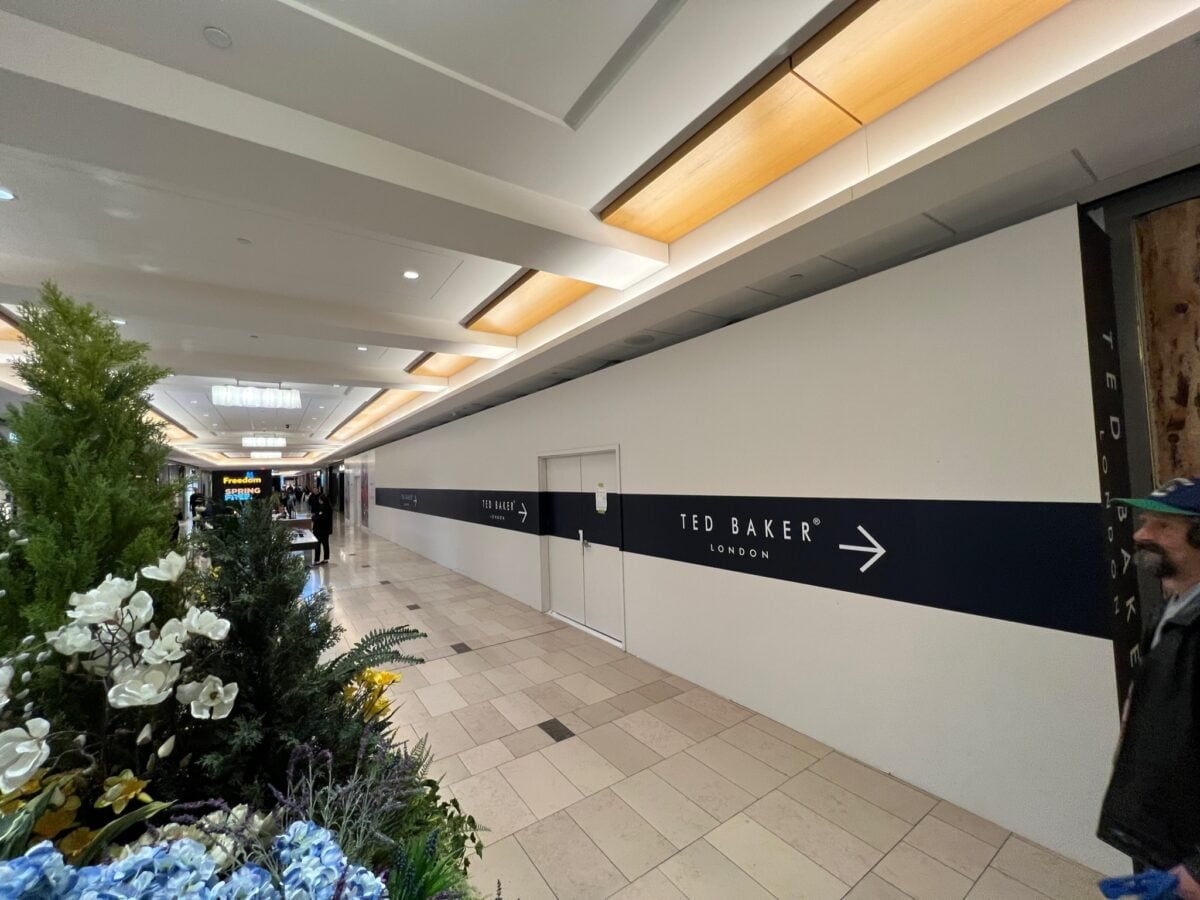
Construction signage at former Massimo Dutti location at CF Pacific Centre in downtown Vancouver (May 2022). Photo: Lee Rivett.
Spanish clothing retailer and sister brand to Zara, exited CF Pacific Centre in downtown Vancouver earlier in the spring 2022. At least part of the space is already leased.
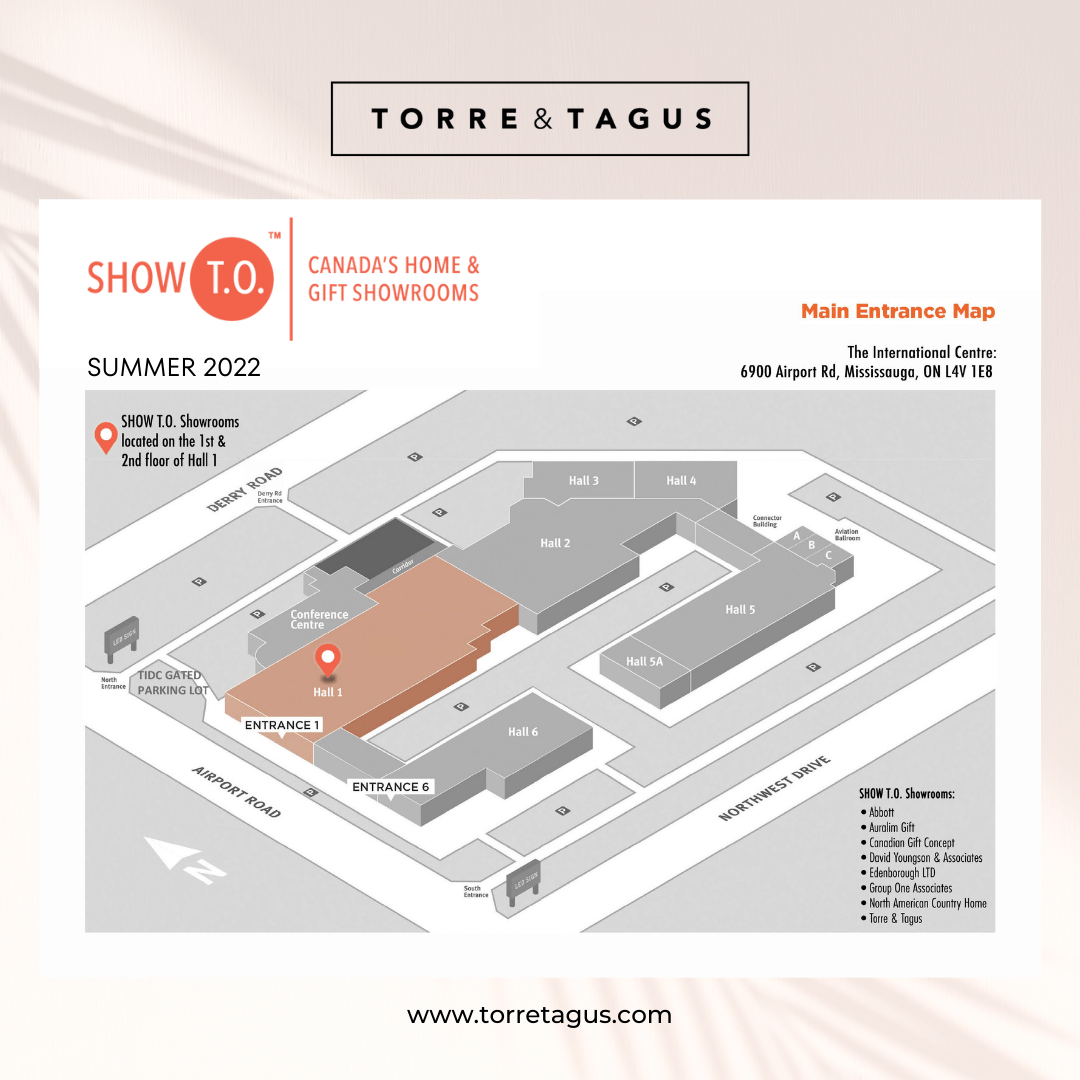
The International Centre at 6900 Airport Rd in Mississauga
Eight retail wholesale distributors are coming together in one building with permanent showrooms open year-round in Toronto to showcase their home and gift merchandise.
The collection, of Canada’s most renowned and best-in-class suppliers, will open this unique concept this summer as SHOW T.O. in 40,000 square feet of space at the International Centre at 6900 Airport Road in Mississauga.
Cesar Gomes, of Torre & Tagus Designs, which is one of the eight wholesale distributors, said “for companies like ourselves that are based out West, having a permanent showroom in the biggest market in Canada is a bold commitment to our customers that we are there for them, not only at tradeshows, but open all year round.”
The eight initially opening in the permanent showrooms are: Abbott, Auralim, Canadian Gift Concept, David Youngson & Associates, Edenborough, Group One Associates, North American Country Home, and Torre & Tagus.
Gomes, whose company is a wholesale distributor of home accessories, giftware and home furnishings based in Vancouver since 1993, said the company supplies stores such as Simons, HBC, Linen Chest and small boutiques.
“Essentially there’s a lot of small, medium and large size businesses, and they all sell products into retail. Like every business there’s trade shows that exist and generally the trade shows are in the major areas in Canada. At one point, there was a lot of regional shows. So you’d have one in Vancouver, Edmonton, Toronto and the Maritimes, Montreal. Over the years, they’ve kind of centralized and now in our industry there’s really only one in Edmonton and another one in Toronto,” said Gomes. “In the US, they’re in major centres as well and oftentimes what happens during those selling markets, in the US because this model doesn’t exist in Canada, there’s permanent showroom buildings and in those showroom buildings they open them up as well obviously to take advantage of people coming to the market.
Image: Show T.O.
“In Canada, one thing COVID has sort of illustrated is that when you can’t have traffic and congregations then you’re really losing your trade show opportunity but if you had a showroom, and we realized that from having a showroom here in Vancouver and we have one in Vegas and Atlanta, there were still several opportunities where you could have people that were coming in, working socially distanced, you could still get business that way.
“For two and a half years, we haven’t had a show in Canada. It really made us focus. We don’t know how long this is going to go and when there’s going to be another outbreak. So we started talking amongst a bunch of different wholesalers and we wanted to have a showroom in Toronto for years. This isn’t something that just happened now. It’s something we talked about for 20 years.”
Each company is working with its own design firm to showcase its well-established brands. Also, many of these inspiring showrooms will feature hospitality areas that invite customers to recharge.
“We’re excited to be part of a destination for buyers across the country – where they can visit year-round to connect with leading vendors, all in one convenient location,” said Jody Abbott.
“Auralim wants to give retailers access to new products every day of the year, and that requires a permanent showroom. We are going to be there when our reps and customers need us, on their own timetable – exciting times ahead for the gift industry,” said Tom Taylor.
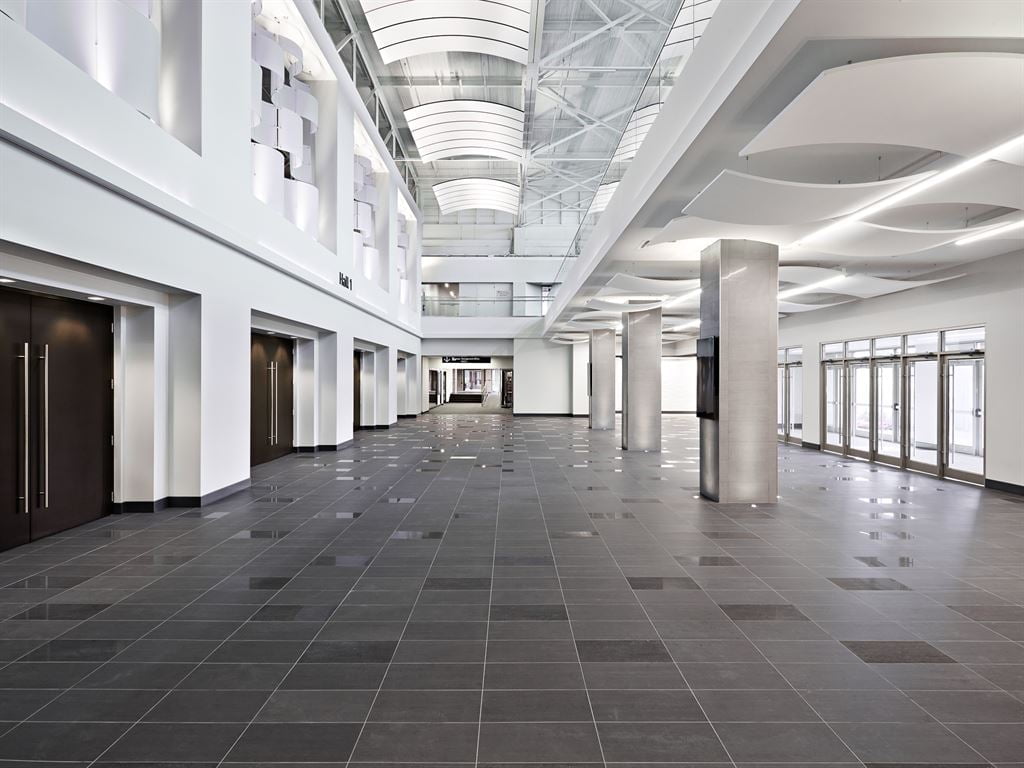
Hall 1 of the International Centre
“Having a permanent showroom allows us to be more creative with merchandising and displays. It also allows us to showcase new brands and product releases added to our roster throughout the year,” said David Youngson.
Gomes said the showroom building coincidentally is near where the industry’s trade show takes place.
“The building itself had old showrooms that were never used or were not leased out with no real focus there. So the exciting thing is we all leased out spaces there and there’s initially eight of us that have taken on these spaces and the landlord is quite excited because they’re now going to start building out some of the other spaces there because they really see that there’s a huge demand,” he said.
He said additional showrooms will open up later in the year and into 2023.
“This is very exciting for us and to be honest I think it’s going to be a game changer for our industry,” added Gomes. “There is a lot of talk about this already. Since we sent the press release out amongst customers, they’re all very excited about having a one-stop shop where they can go, have an alternative to the trade show which just happens twice a year.
“And I think that’s the biggest win for us is we can have business all year round rather than just relying on the trade show which comes around twice a year.”
Queen Street West Businesses (Image: Dustin Fuhs / Retail-Insider.com)
The world around us is changing. Accelerated by impacts of the COVID-19 global pandemic, a digitization of just about every aspect of our environment has precipitated alterations to the ways in which we communicate and interact with one another, share information and ultimately act on it. This evolution could not be more evident than it has been for merchants operating within the retail industry. Shifting consumer preferences and behaviour, hastened by an ever-expanding ecosystem of channels for consumers to traverse throughout their shopping journey, have resulted in a need for retailers to deliver an omnichannel experience to them that includes ease, convenience and a great selection. And, it’s a need that’s putting pressure on small- and medium-sized businesses that have got to enhance their digital presence without the budget or resources of their larger competitors.
Digital kickstart
To help provide merchants across the country with the digital kickstart that’s required, the Canadian federal government recently introduced the Canadian Digital Adoption Program (CDAP). Meant to facilitate competitiveness and growth and provide small- and medium-sized retailers with a means to access a range of digital tools, the $4 billion funding will go a long way toward getting more Canadian businesses online and enhancing their ecommerce presence through a digitization of their operations. It’s an introduction that David Nagy, digital pioneer and Founder of eCommerce Canada, says could serve to be critically important in the near- and long-term health and survival of many retailers in Canada. And, he adds, it’s funding and support that seems to be arriving at just the right time, too.
“It’s such an interesting phase of history that we’re experiencing right now,” he muses. “There’s so much disruption happening at the moment considering the state of global events and supply chain uncertainty, creating a lot of challenges for retailers to navigate through. Add to that the accelerated digitization of everything, an evolution that’s helped to shape evolving consumer preferences and behaviour, and the need for retailers to be online is amplified. In fact, it’s just not optional anymore. Merchants have got to be in the game and have their catalogue on the internet. The past couple of years have served to expose a sizeable percentage of the population to ecommerce for the first time, while heightening expectations along the way. So, not only do merchants need to be online, they’re also responsible for ensuring availability and accuracy, a good user experience, great service and an overall seamless journey across their platforms and touchpoints.”
Meaningful investment
Image: eCommerce Canada
In order to address the range of needs of Main Streets across the country and level the digital playing field, businesses are being offered support and funding by CDAP through two important streams. To assist merchants who have not yet begun their digital evolution in full with costs associated with the adoption and implementation of new digital technologies, the ‘Grow Your Business Online’ micro-grant of $2,400 is available. This funding will be provided to 90,000 eligible small businesses, opening up a number of ecommerce opportunities for them.
The second stream of funding – the ‘Boost Your Business Technology’ grant – is available to eligible small- and medium-sized businesses who may be further along in their evolution and are seeking a more robust approach to digitization of their operations. Businesses that receive approval and entry into the program will be provided with access to a marketplace of digital adoption experts who can help develop a digital adoption plan and strategy, or ‘roadmap’, tailored to their needs. In addition, they’ll receive a $15,000 grant which covers 90 per cent of the cost of their advisory services. And, perhaps most importantly, select businesses will be given the opportunity to secure a 0 per cent interest loan from the Business Development Bank of Canada (BDC) to facilitate the acquisition of new technology. It’s funding that Nagy, whose company eCommerce Canada has been named as one of the trusted digital advisors within the program’s marketplace, applauds the efforts being made by the government, referring to them as “critical” toward the continued success of small- and medium-sized businesses within the country.
“What this program comes down to is really the fact that it’s a meaningful sum of money that the government is investing in the health and strength of small- and medium-sized businesses in the country,” he asserts. “And it equates to a really meaningful sum of money that each of these businesses receives, providing them with immediate effective capitalization. It’s funding that, within each stream, will result in significant deliverables for participating businesses. It arms Canadian businesses with the ability to level up and become a lot more competitive not just here at home, but it will also serve to accelerate their competitiveness globally as well, enhancing their prominence on the world stage.”
Growing Canada’s technology ecosystem
Another aspect of the program that Nagy lauds as integral to its viability is the focus that’s being placed on youth employment and development. Businesses involved in the program can leverage the help of talented post-secondary students and recent graduates through subsidized work placements to support the execution of their digital transformations. It’s a layer that Nagy says will provide substantial reinforcement for merchants involved, adding that it will also prove to be incredibly important toward growing and improving Canada’s technology ecosystem.
“So much of the focus of this project is oriented around youth employment and the development of talent within the technology space,” he explains. “To this point, Canada hasn’t really done a very good job of incubating this talent. We’re aware that we need technical development, both the soft and hard skills within the technology industry, but we haven’t been effective in fostering that talent within real-world scenarios and settings. This program is intentional in its message that it not only wants to support businesses through this endeavour, it also wants to bring young talent into these businesses to gain experience and help propel the industry forward and increase its competitiveness globally. The program’s been thoughtfully built with consideration paid to the multiple stages of online business development, marrying both business success and the future wellbeing of the country’s employment ecosystem.”
For owners of small- and medium-sized businesses who wish to learn more about CDAP and to view the criteria that eligible businesses must meet, visit www.ic.gc.ca/eic/site/152.nsf/eng/home.
The two-day conference will include speakers who are the “who’s who” of retail in North America. RCC STORE 22 will also bring together more than 75 speakers and 2,000 retail delegates and business partners who will be encouraged to talk candidly about their current challenges, how to drive change, and about the future possibilities for retail.
· Ron Wilson, President, International, Best Buy Canada
· Gillian Stein, CEO, Henry’s
· Kate Ancketill, CEO and founder, GDR Creative Intelligence
· Dr. Hadiya Roderique, Diversity and Inclusion Advocate, Journalist, Lawyer
· Dianne Buckner, Host, CBC’s Dragons’ Den
· Ira Kalish, Chief Global Economist, Deloitte
· Paco Underhill, Founder and former CEO, Envirosell
· Jacquelyn Kankam, Senior Director of Sustainability & Social Impact, DECIEM
· Duncan Fulton, Chief Corporate Officer, Restaurant Brands International
· Joanna Griffiths, Founder and CEO, Knix
· Eric Morris, Director Retail, Google Canada
· Diane J. Brisebois, President and CEO, Retail Council of Canada
The conference also provides opportunities to reactivate your network and celebrate retail excellence.
The Excellence in Retailing Award Gala on the evening of Tuesday, May 31 will announce winners in eleven retail categories as well as the Award of Distinction will be awarded to Giant Tiger’s Paul Wood President and CEO, Giant Tiger Stores Limited, and Shashi Behl, Founder and CEO, Joydrop. In addition, sixteen recipients of the RCC’s Retail Scholarship program will be announced.
The Canadian Grand Prix New Product Awards Gala on the evening of Wednesday June 1 will announce the top food and non food products of 2021 ( both national brands and private label products) while also celebrating two Lifetime Achievement Award winners: Margaret Hudson, President, Burnbrae Farms and Darrell Jones, President, Save-on- Foods.
There will also be a silent auction to help Retail Council of Canda fund the scholarships of brightest retail leaders of tomorrow. You might come home from the conference with an amazing deal on some great items including electronics, appliances, patio furniture and gift baskets.
At RCC STORE 22, retailers can attend provocative “big picture” keynote presentations as well as concurrent sessions focusing on store operations, marketing, supply chain, and digital and mobile commerce. The content has been developed to ensure that each retailer, regardless of size or type, can participate in sessions that are most relevant to their business needs. There is also an exciting exhibitor floor which will feature some of the most innovative business partners, from start-ups to leading established companies. These exhibitors will be available to demonstrate their cutting-edge technologies, strategies, and retail solutions.
“Many retailers have changed their business models over the last two years to be much more responsive to their customers’ quickly changing needs, that, as we all know have been influenced by new insights accelerated by the pandemic. RCC STORE 22 will inspire with retail stories of companies and entrepreneurs who have taken advantage of the new landscape to reemerge stronger and better positioned for success well into the future” said Diane J. Brisebois, President and CEO, Retail Council of Canada. “This year’s conference topics and speakers will address tough questions and provide a range of perspectives and insights that retailers can immediately bring to their teams.”
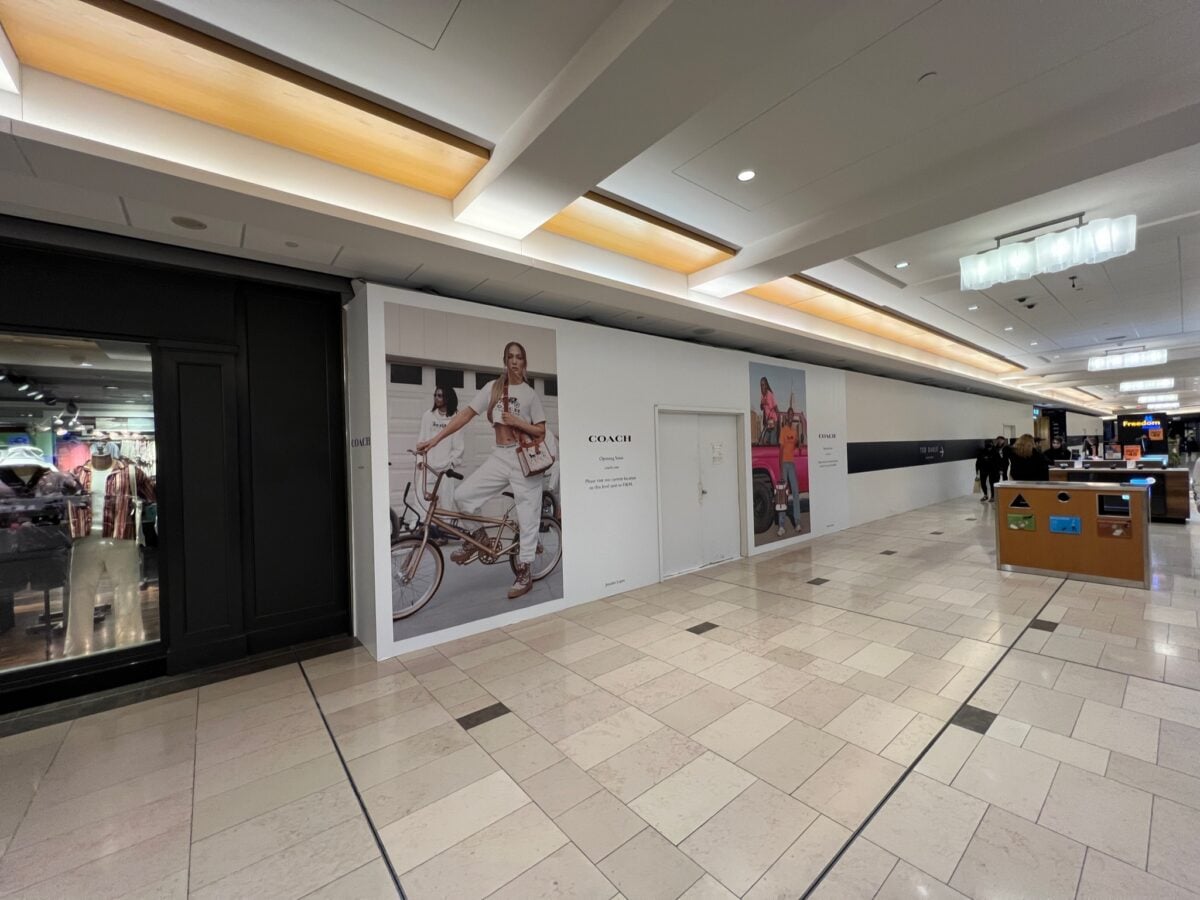
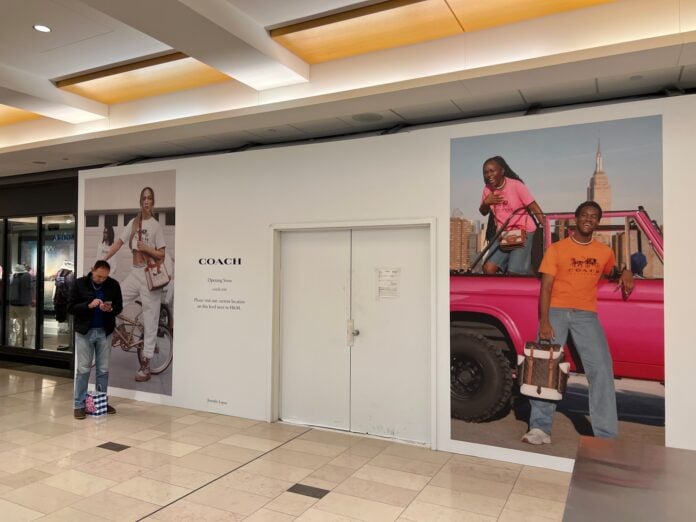
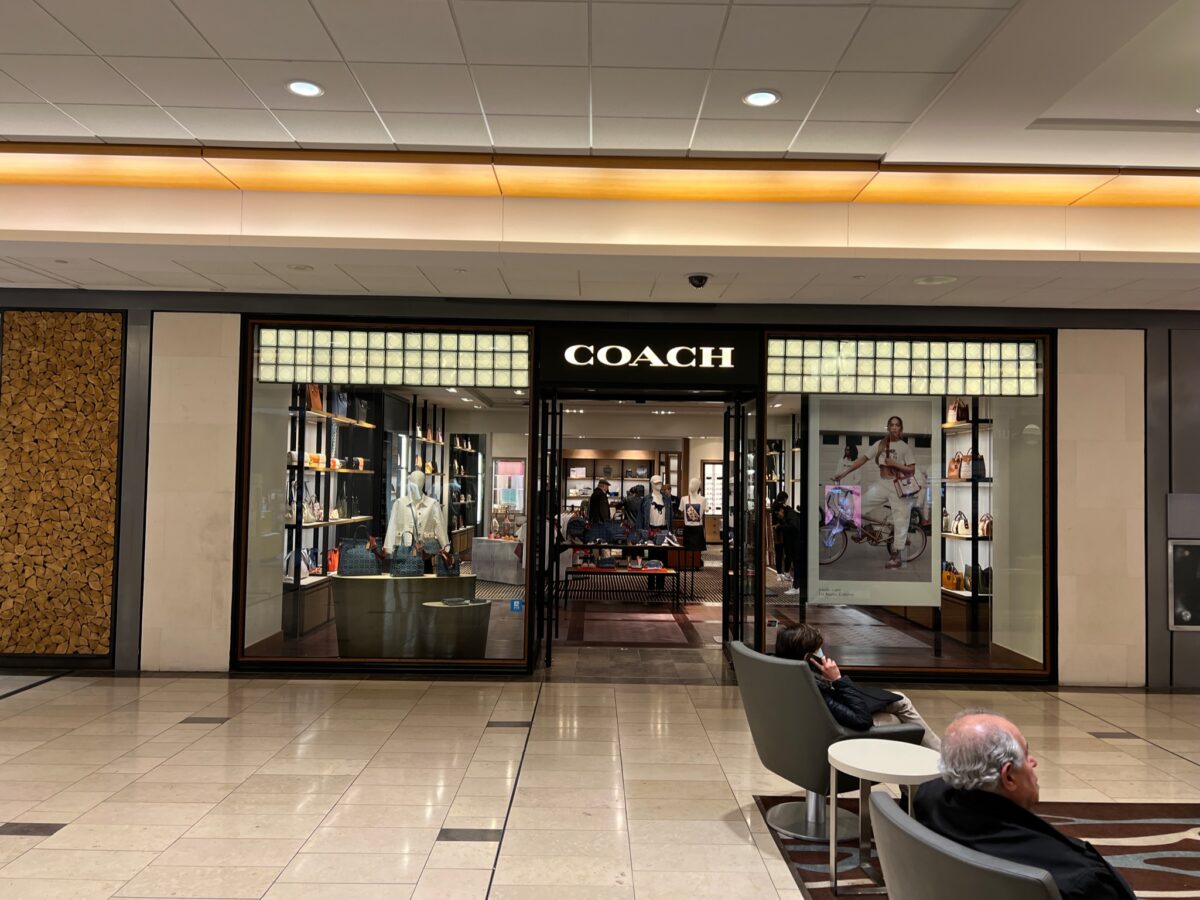
Future COACH location at CF Pacific Centre in downtown Vancouver (May 2022). Photo: Lee Rivett
Upscale New York-based fashion brand COACH is relocating within CF Pacific Centre in downtown Vancouver.
The retailer opened its current 3,660 square foot location over four years ago between H&M and Roots on the lower level of the mall.
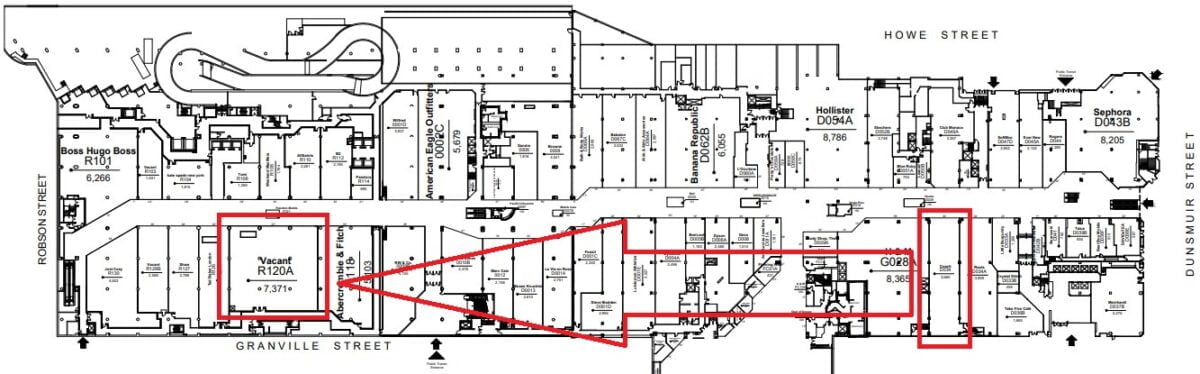
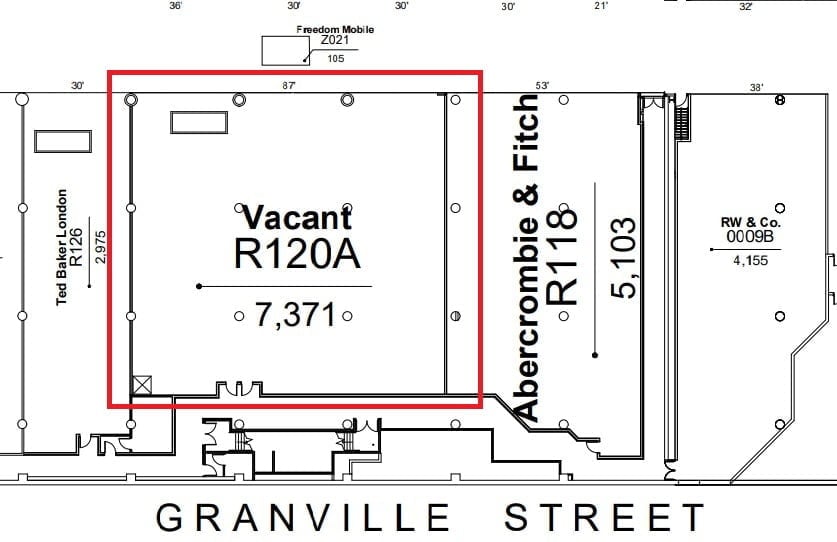
The new location will be on the same level, south of its current location with the new store being located between Ted Baker and Abercrombie & Fitch. COACH’s move is made possible after Massimo Dutti vacated its 7,371 square foot location in the spring 2022. Coach will occupy part of the former Dutti space.
Current and Future COACH location on lower level at CF Pacific Centre in downtown Vancouver. Photo: Cadillac Fairview Lease Plan.
Future COACH location on lower level at CF Pacific Centre in downtown Vancouver. Photo: Cadillac Fairview Lease Plan.
Construction Signage at future COACH location at CF Pacific Centre in downtown Vancouver (May 2022). Photo: Lee Rivett
COACH specializes in leather goods such as handbags, luggage, accessories, and ready-to-wear. COACH was founded in 1941 as a family-run workshop in a loft on 34th Street in Manhattan. In 1985, the Cahns family decided to focus on the family goat/cheese farm and sold COACH to an American consumer-goods company called Sara Lee Corporation. COACH was divested from Sara Lee Corporation in the beginning of 2000 where it became an independent retailer. In 2013, COACH generated $5 billion in sales and operated approximately 1,000 directly operated locations globally. COACH changed its name to Tapestry in 2017 and continued operating the COACH brand in addition to the Kate Spade brand (which was purchased in 2017) and the Stuart Weitzman brand (which was purchased in 2015).
As of May 2022, the store locator on the COACH official website lists 30 Canadian storefronts. These store locations include both full-priced ‘retail’ locations and discounted ‘outlet’ locations. The provincial breakdown included:
6 in British Columbia (four retail stores and two outlet stores);
4 in Alberta (two retail stores and two outlet stores);
1 retail store in Manitoba;
16 in Ontario (ten retail stores and six outlet stores); and
3 in Quebec (two retail stores and one outlet store).
The four retail COACH storefronts in British Columbia include:
755 Burrard Street (Vancouver);
CF Pacific Centre (Vancouver);
Metropolis at Metrotown (Burnaby); and
CF Richmond Centre (Richmond).
The two discount COACH storefronts in British Columbia include:
McArthurGlen Designer Outlet Vancouver (Richmond); and
Tsawwassen Mills Outlets (Delta).
COACH at CF Pacific Centre in downtown Vancouver (May 2022). Photo: Lee Rivett
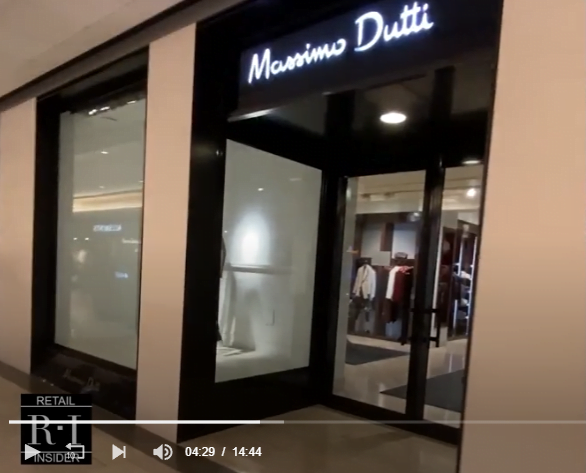
Former Massimo Dutti at CF Pacific Centre (Dec 2020). Photo: Retail Insider CF Pacific Centre Video Tour.
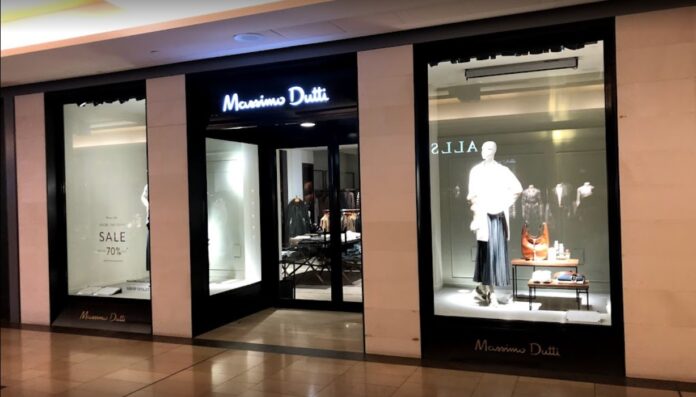
Former Massimo Dutti location at CF Pacific Centre in downtown Vancouver (August 2019). Photo: Saif Al Shamaa/Google Streetview.
Massimo Dutti location at CF Pacific Centre in downtown Vancouver (August 2019). Photo: Saif Al Shamaa/Google Streetview.
Spanish clothing brand Massimo Dutti, sister brand to Zara and owned by Inditex and specializing in cashmere and wool fashions, exited CF Pacific Centre in downtown Vancouver earlier in the spring 2022. At least part of the space is already leased.
Massimo Dutti vacated its prominent 7,371 square foot location between Ted Baker London and Abercrombie & Fitch on the lower level of the mall. The retail space had two separate entrances to the shopping centre and had the square footage of two typical retailers at CF Pacific Centre.
Part of the location is currently under construction to become the new location for COACH which is currently down the corridor from the former Massimo Dutti space.
Future COACH location on lower level at CF Pacific Centre in downtown Vancouver. Photo: Cadillac Fairview Lease Plan.
Construction signage at former Massimo Dutti location at CF Pacific Centre in downtown Vancouver (May 2022). Photo: Lee Rivett.Construction Signage at future COACH location taking over the left portion of the former Massimo Dutti location at CF Pacific Centre in downtown Vancouver (May 2022). Photo: Lee Rivett
Massimo Dutti’s parent company, Inditex, is headquartered in Spain and has other clothing brands including Zara.
In 1991, Inditex company acquired a 65 per cent share of Massimo Dutti when the brand was focused on menswear. Womenswear was added in 1995 when Inditex purchased the remaining 35 per cent share of Massimo Dutti.
Retail Insider reported on the closing of the Massimo Dutti store at CF Rideau Centre in Ottawa in June 2021. The store locator page on Massimo Dutti Canada’s website reports five Massimo Dutti locations as of May 2022:
Yorkdale Centre (Toronto, Ontario)
First Canadian Place (Toronto, Ontario)
CF Toronto Eaton Centre (Toronto, Ontario)
CF Carrefour Laval (Laval, Quebec)
Rockland (Mount Royal, Quebec)
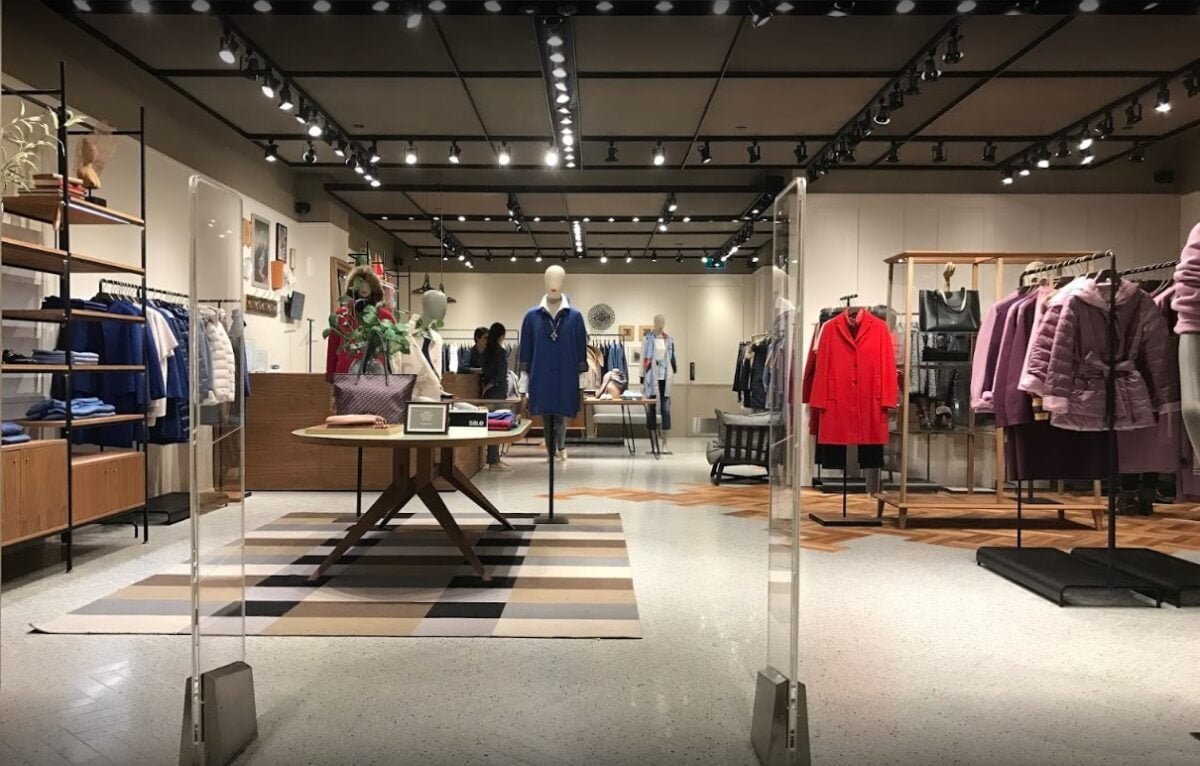
Former Massimo Dutti Interior at CF Pacific Centre in downtown Vancouver (January 2017). Photo: Local Buzz/Google Streetview
Former Massimo Dutti Interior at CF Pacific Centre in downtown Vancouver (January 2017). Photo: Local Buzz/Google Streetview
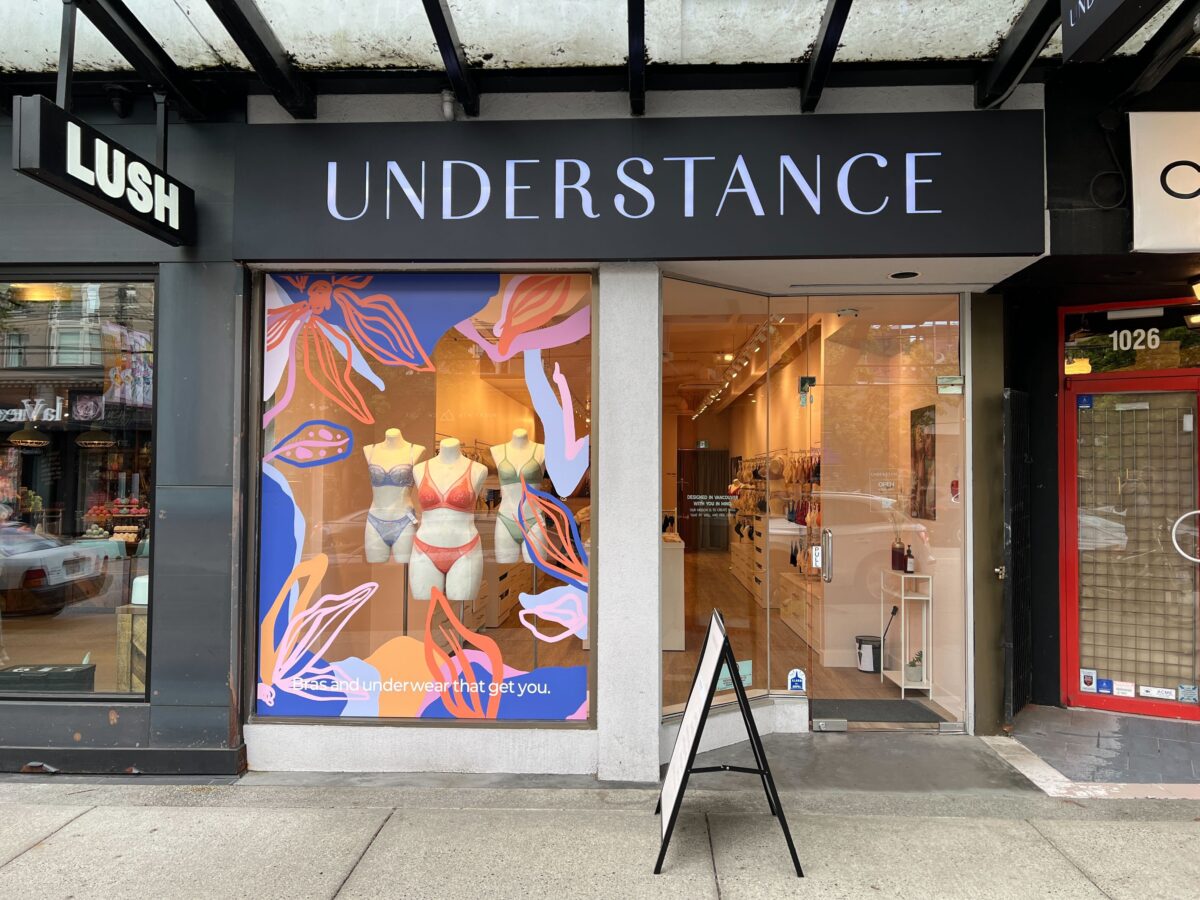
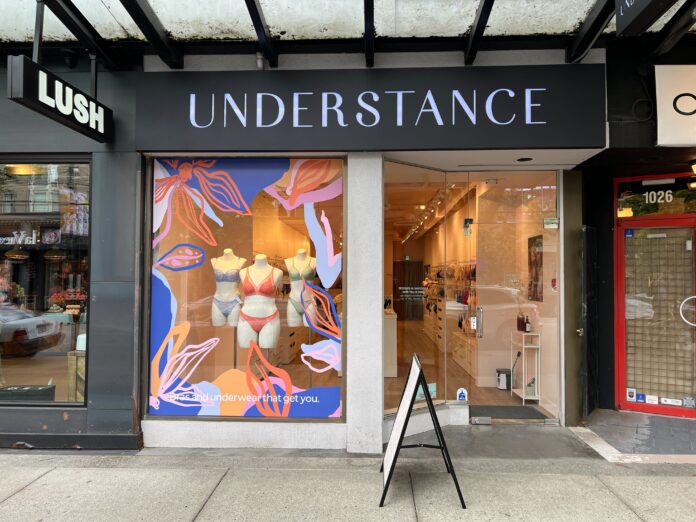
Understance flagship on Robson street (May 2022). Photo: Lee Rivett
Canadian undergarment retailer Understance recently opened its first store in downtown Vancouver. The company is all-female led and is headquartered in the city. The flagship is located at 1024 Robson Street which forms part of the Robson Street Business Association.
The local retailer’s LinkedIn page mentions “We make comfortable, flattering, chic bras that feel as amazing as they look” and the retailer is developing a technical product for women rather than something exclusively regarded as a fashion piece.
The brand focuses on both being ethically and sustainably manufactured. Its factories are an Internationally Certified Ethical Employer where the people making their garments are treated fairly, paid on time, and enjoy great working conditions. It has also been able to produce 50% less wastewater at its factories than other manufacturers and use 100% recycled materials in its tags.
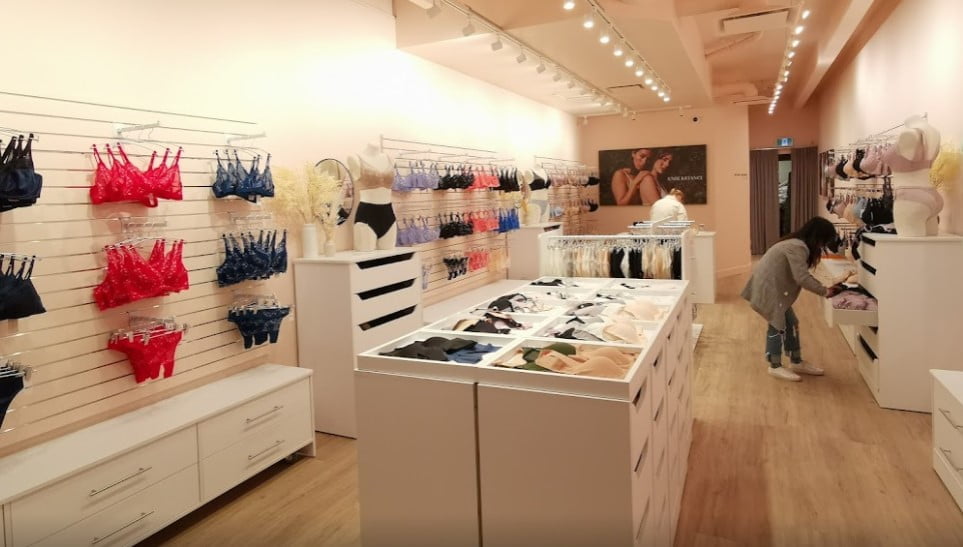
Inside of Understance Flagship on Robson Street (Feb 2022). Photo: Jiayi Lyu/Google Streetview
Inside of Understance Flagship on Robson Street (March 2022). Photo: Michelle/Google Streetview
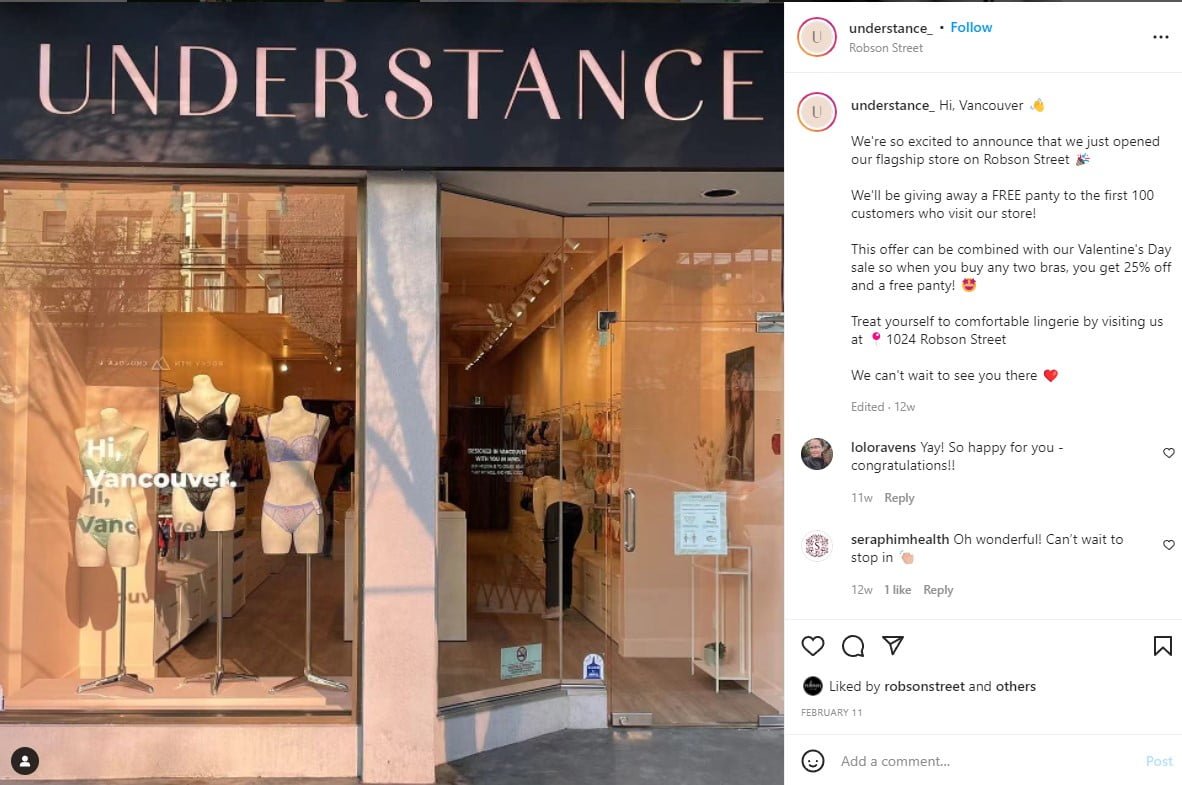
Understance Grand Opening in February 2022. Photo: Understance Instagram Profile.
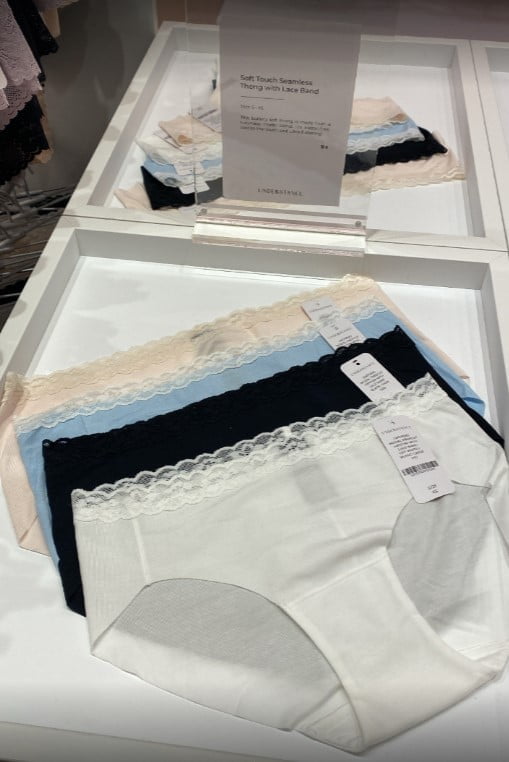
The Understance website includes categories for both underwear and bras. Underwear products were noted as being further broken down by Seamless/Free Cut, Natural Fibers and Lace categories. The bra selection was grouped by bra size.
The company also supports the ‘Downtown Eastside Women’s Center’ and the ‘Lu’ma Native Housing Society’ charities focusing on providing shelter and warm meals to the homeless.
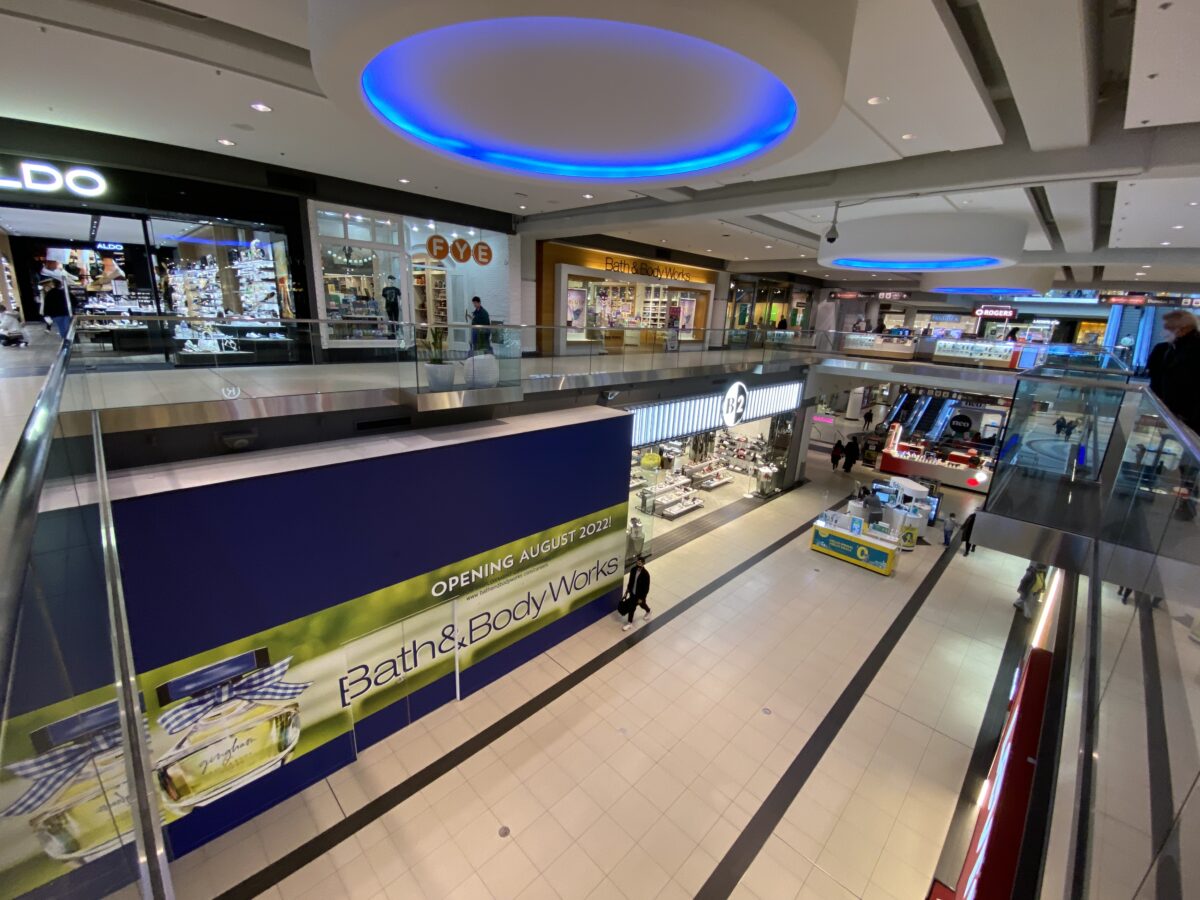
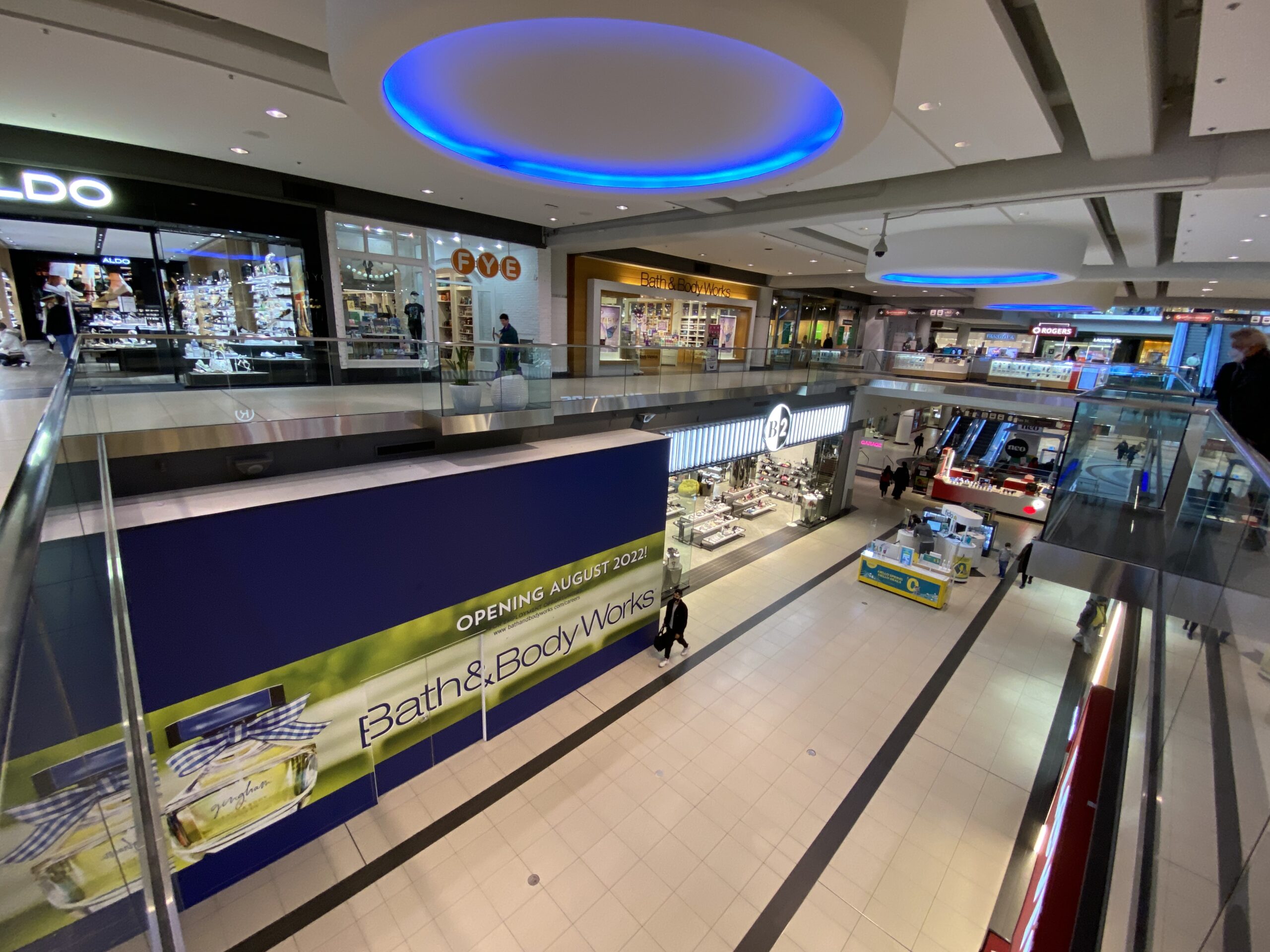
Future Bath & Body Works at CF Toronto Eaton Centre (Image: Dustin Fuhs)
Bath soap and home goods retailer Bath & Body Works has announced that it will be relocating into the former 5,010 square foot Microsoft location on Level One of the CF Toronto Eaton Centre in downtown Toronto.
The current 4,520 square foot space on Level Two, next to the former Disney Store, will close to make way for the summer 2022 relocation.
The new space was made available when Microsoft shuttered all 83 physical stores worldwide in June 2020, which affected seven Canadian locations in BC, Alberta and Ontario. Most recently, The Latest Scoop used the space as a pop-up location before relocating to the former True Religion jean storefront on Level three.
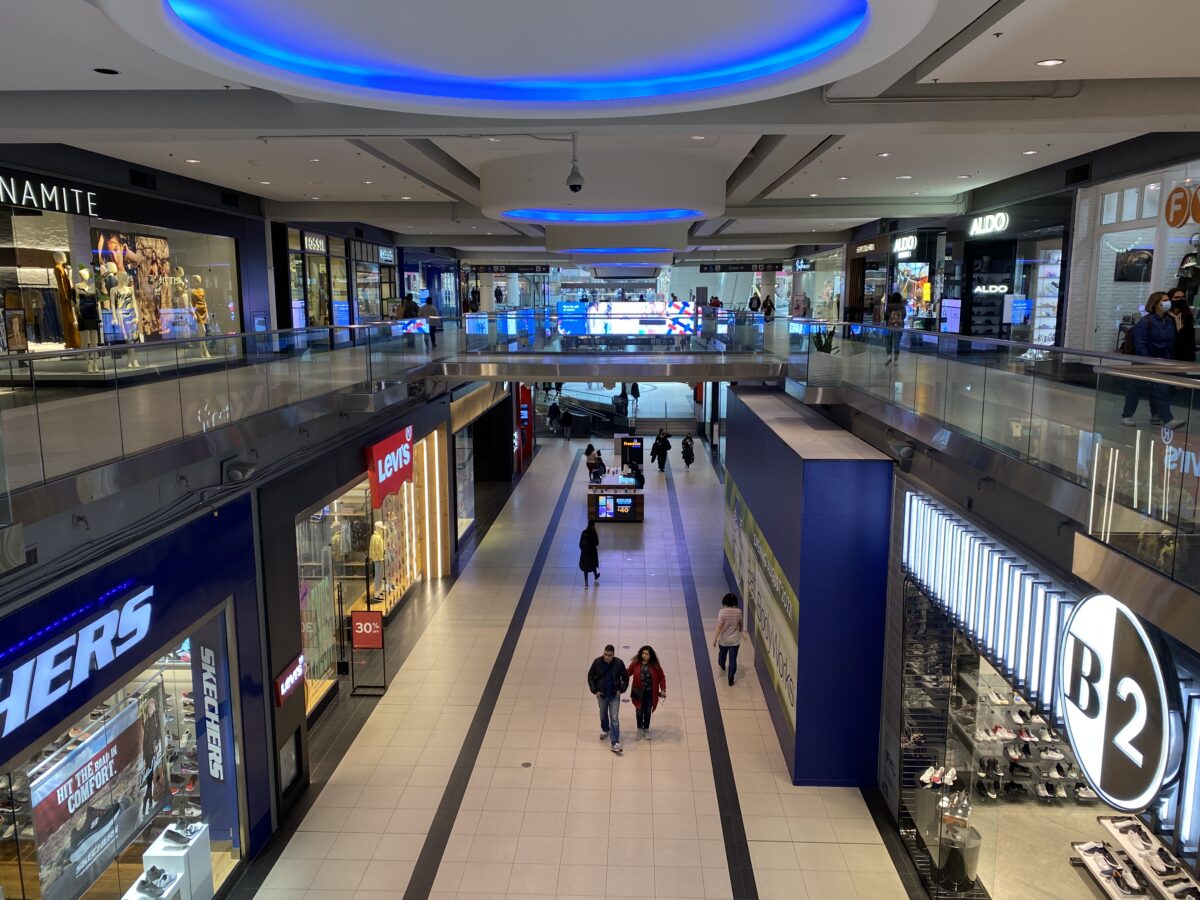
Future Bath & Body Works at CF Toronto Eaton Centre (Image: Dustin Fuhs)
Bath & Body Works was founded in 1990 in New Albany, Ohio, and entered the Canadian market in 2008 with an initial six locations. The brand has subsequently grown to more than 1900 stores worldwide and operates more than 100 in Canada.
Bath & Body Works, Inc (formerly known as L Brands, Limited Brands and The Limited, Inc.) was created as a separate company in 2021 when then L Brands CEO announced that Victoria’s Secret and Bath & Body Works would be separated into two publicly traded companies.
L Brands was the home to a number of brands throughout the years, including Lane Bryant, Abercrombie & Fitch, Structure, Express and La Senza, which was sold to Regent in 2019.