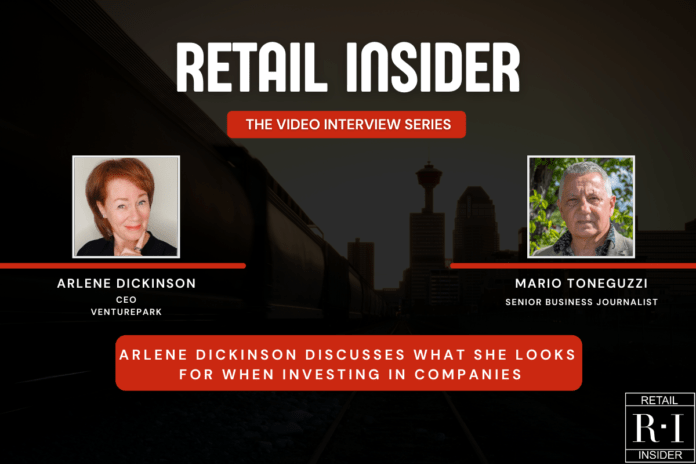
Dickinson talks about the food, health/wellness and services industries, the state of entrepreneurship, being a judge on the Dragons’ Den TV show, and the future of entrepreneurship.
The Video Interview Series by Retail Insider is available on YouTube.
Connect with Mario Toneguzzi, a veteran of the media industry for more than 40 years and named in 2021 a Top Ten Business Journalist in the world and the only Canadian – to learn how you can tell your story, share your message and amplify it to a wide audience. He is Senior National Business Journalist with Retail Insider and owner of Mario Toneguzzi Communications Inc. and can be reached at mdtoneguzzi@gmail.com
Also check out the other series offered by Retail Insider, including The Weekly podcast and The Interview Series, which are both available on Apple Podcasts, Stitcher, TuneIn, Google Podcasts, or through our dedicated RSS feed for Simplecast and other podcast players.
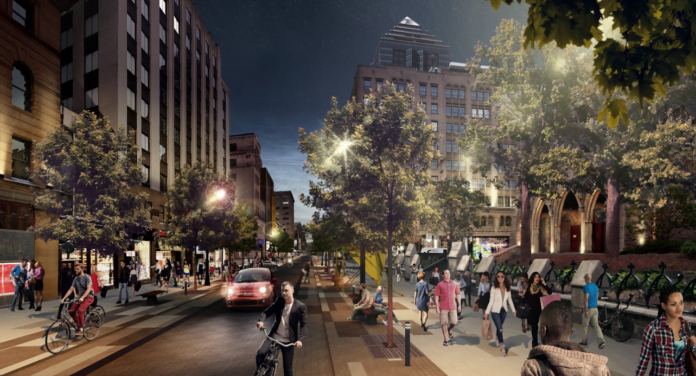
Rue Sainte-Catherine (Provencher_Roy, CIMA+S.E.N.C via Montreal.ca)
Retail was one of the commercial real estate sectors that suffered the most during the COVID-19 pandemic but has exhibited signs of sheer resilience and recovery, says a report by commercial real estate firm Colliers.
“With the progression of vaccine rollouts and ease of public health restrictions, many indoor spaces reopened, and there has been a stellar increase in foot traffic. People are swiftly moving back to their normal commuting patterns, and the caution from travel is subsiding. Consumers continue to spend on goods, food, entertainment, and recreation. A sentiment of hope and confidence is returning among consumers, retailers, retail landlords, and investors,” says the 2022 Retail Outlook.
Jane Domenico
Jane Domenico, SVP & National Lead, Retail Services with Colliers, said retailers are entrepreneurial at heart.
“They saw change coming and they shifted and changed their operating business. When we couldn’t get masks, we saw a lot of people change to producing masks and selling masks. Things of that nature are part and parcel of being a strong retailer,” said Domenico.
“And retail has been evolving. The change that was brought on by COVID is an acceleration of those changes. So once retailers were thinking about their online presence and their click and collect programs, what it did was accelerate those changes and accelerate those plans.
“When people think retail it’s all lumped into one big bucket. But I would say there are four types of retail. There’s the enclosed mall fashion, there’s the necessities retail and then there’s large format which is a mixture of the fashion tenancies and the necessity tenancies together. And then there’s podium or street level retail. Each of them had opportunities and things about their nature that allowed them to pivot and change to meet the COVID economy.”
Domenico said the lack of bankruptcies experienced in the past two years is the story of the retailers as they shifted throughout the pandemic and came out in a new way.
The Colliers retail report said there has been a strong economic recovery with robust growth in the labour market, a boost in home-grown and foreign consumer demand and a greater adaptation of ecommerce. An increase in spending, foot traffic and consumer confidence paved the way for a potential reset. Even though retail vacancy rates are expected to continue to decline, and rental rates are expected to stabilize across the country in 2022, there are concerns to be aware of, it said.
Those concerns include: Omicron has slowed down activity through the start of 2022, though the severity of its forces will be lesser compared to previous waves; with supply chains bottlenecking again in the first quarter of 2022, Canadian consumers should expect delayed shipments, higher prices, and less stock in their local stores and online; and labour shortages continue to pose a dominant issue for retailers and restaurants.
Domenico said supply chain challenges in the past two years have changed both the retailer and the consumer.
“Smart consumers went to stores and bought the products that they wanted for the holiday season of 2022 or they chose to do a click and collect program versus delivery,” she said. “I think click and collect will remain to be a very popular and more affordable option for both the retailer and the consumer . . . This is the first time that the just-in-time model has really shown its problems when there’s a disruption . . . Supply chain is probably one of the biggest factors that our retailers are going to be having to manage and work around.
“It’s an opportunity for Canadian manufacturers to hopefully fill the need for our retailers.”
Domenico said retailers will be looking to ensure that their employees are being treated properly to keep them there. But there are so many jobs available now and it’s really an employee marketplace.
“So smart retailers will ensure that they’re offering their employees a safe and secure workplace and the shopping environment for their consumers. They will be proactive ensuring that their hourly rates are market based. All these things still cost money and put further pressure on the retailer but if you don’t have good people in your stores or in your delivery channels and in your distribution network, you can’t get the product out and therefore the consumer will have dissatisfaction,” she said.
“So concentrating on those items and trying to retain employees is going to be key.”
Domenico said that for the first time this summer the country will see tourism returning. That will potentially improve retail sales across the board.
The Colliers report said international shipping costs had already been rising for several years before the onset of the COVID-19 pandemic, which only exacerbated the situation, exponentially increasing transportation expenses.
“Supply chains were severely affected, especially at the height of the pandemic in 2020, and the trend will continue well into 2022. The following are the main factors that are currently affecting international shipping rates. There is a global shipping container shortage, few alternatives to ocean freight, especially when it comes to transporting low-cost products, and the demand for international shipping which skyrocketed in 2020, hasn’t slowed down. These factors have resulted in higher prices for consumers’ goods and services,” it said.
“Canadian shoppers have more choices on where to buy products than ever before. They can go to their local mall, order online for delivery, or even order online and pick up in-store. Shoppers also have more options for returning their purchases – they can mail them back or return them to a nearby store. Since the beginning of the COVID-19 pandemic, most Canadians have increased their online shopping, and according to Canada Post, parcel deliveries rose by more than 24 per cent in the first eight months of 2020. Delivery of all those online purchases means more courier vans are emitting more greenhouse gases contributing to climate change. A study by Deloitte found that the environmental impact of shopping in-person at a traditional brick- and-mortar mall can be up to 60 per cent more environmentally sustainable than online shopping.
“The study found that several factors, including increased returns (40 per cent) of online purchases versus seven per cent in the case of brick-and-mortar) and additional packaging contributed to ecommerce’s negative environmental impact. At the same time, mall shoppers buy, on average, 3.5 products per trip and visit other places on their way to the mall, which lowers the emissions related explicitly to their mall visit because their outing was divided between multiple stops.”
Colliers said Canada’s retail vacancy rate declined 100 basis points from year-end 2020 down to 7.7 per cent in Q4 2021. With the lifting of many more public health restrictions expected in the first half of 2022, retail fundamentals will continue to improve across the country as more consumers return to shopping and dining in restaurants, it said.
“Many big and small retailers have closed their stores across Canada through the past couple of years. Unfortunately, we keep hearing about more stores closing permanently or filing for bankruptcy because of the pandemic. The upside is that many brands have expanded in Canada in the past year, and many more have major expansion plans or plan to enter the Canadian market for the first time in 2022. As a result, we expect vacancy rates to continue to decline in 2022,” added Colliers.
“Retail rents across provinces depict a fast rebound in 2021 after a significant dip in 2020. The government set up multiple platforms to aid businesses, including rent relief, wage support and loan programs. Yet, many small businesses and restaurants continued to experience closures due to the accumulation of debt and the inability to create an online presence. Rents should continue to stabilize in 2022 as they continue to move closer to pre-pandemic rates.”
As many will attest, the retail industry in Canada has been profoundly impacted by the ongoing COVID-19 pandemic.
Because of the changing retail landscape, it’s more important now than ever that people in the retail industry gather to discuss those changes and what they mean for the future.
“Retail Council of Canada’s annual STORE Conference, this year on May 31 to June 1, 2022 at the Toronto Congress Centre, is the perfect occasion for the industry to bring everyone together to discuss the critical topics affecting retail today,” said retail expert Michael LeBlanc, Founder and President of M.E. LeBlanc & Company, top retail influencer, podcaster, and Senior Retail Advisor with Retail Council of Canada.
“The modern retail customer is savage and a savvy operator. Roger Martin, who is a favourite retail strategist of mine, talks about consumer behaviours as declining assets on your balance sheet. What they used to do, how they used to shop, and what they value, has been altered if not transformed by the COVID era. The challenge in front of us is to understand the difference between short-term accommodations to these unusual times in our lives, versus longer-term systematic changes of consumer behaviours and structure. This to me is what it all boils down to, and what – as an industry – we need to address,” observed LeBlanc.
“We know that COVID accelerated a bunch of things – ecommerce of course being the poster child for that. We know some of that is sticking around. But, what we know less about, is what behaviours have changed forever. I think what’s irrevocably been changed, in terms of how consumers shop, is the role of social media platforms, the role of influencers, and that the “pre-shop” element has become even more interesting and, in some ways, more complex.
“As I often tell retailers I speak with, ‘I don’t know what you’re spending on social media or influencers, but double it, just double it’. And here’s the paradox; those platforms are getting so expensive that retailers are now turning to stores for customer acquisition.
“The cost of customer acquisition was so high through the social platforms that the large marginal dollar is now better spent on a great location, in a great mall, with lots of great traffic. Fascinating, isn’t it? Very different from pre-pandemic. Very different from 10 years ago. These are topics that will be explored at RCC STORE 22, and which I know will sparks tons of new ideas and discussions,” emphasized LeBlanc.
In past years prior to COVID, over 2,500 retail leaders from across Canada regularly attended the STORE Conference.
This year, more than 75 speakers will talk about today’s pressing retail challenges. The agenda will include sessions on: innovation in store operations, leveraging the newest technology frontiers, changing values for employee and customer experiences, customer insights, and supply chain fortification.
“Right now, more than ever, our industry needs the kind of insights that RCC’s STORE Conferences are so famous for initiating. The combination of world-renowned retail thought leaders’ information-packed presentations, exhibitors sharing cutting-edge retail solutions, plus the informal conversations that are remarkably easy to initiate at STORE will be especially powerful this year, said LeBlanc.
“I can’t stress this enough for retailers. It’s the chance to get your team together in a retail learning environment. Many head office support teams have been virtual, are now moving to hybrid, and are looking for opportunities to get people together to build teams. Team rapport and ideas don’t happen in the boardroom or head office anymore. Bring everybody you can to STORE. Get them together. Not at a random event, but at the best-in-class retail event.”
LeBlanc said RCC STORE 22 is also an opportunity to help build professional networks and retail careers.
“You can’t learn that stuff from YouTube and we’ve been missing the in-person learning experience for a couple of years,” said LeBlanc. “If you want to develop your career, develop your insights, and develop your team, come to RCC STORE 22. “
To be part of this year’s in-person RCC STORE Conference in Toronto, visit https://storeconference.ca for tickets. Take advantage the advanced rates by booking by April 29, 2022 and save $100.
*Partner content. To work with Retail Insider, email: craig@retail-insider.com
Retail Insider is streamlining its Canadian retail news from around the web to include a handful of top news stories that can be viewed quickly during the day. Here are the top stories from the past 24 hours.
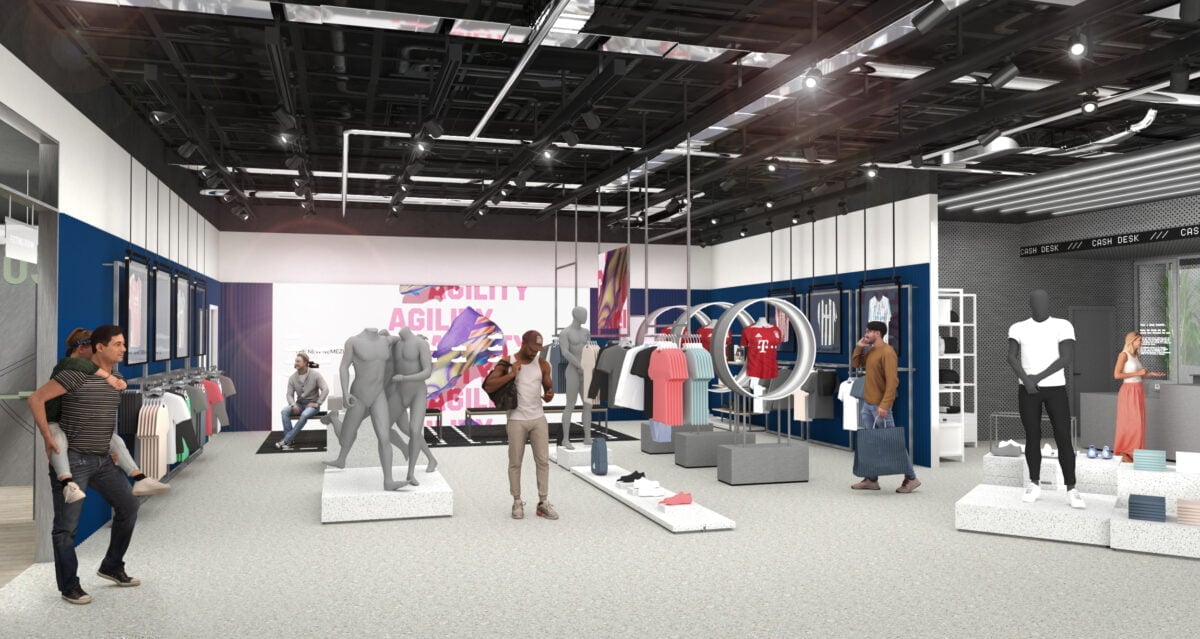
Adidas at CF Toronto Eaton Centre (Renderings: Adidas)
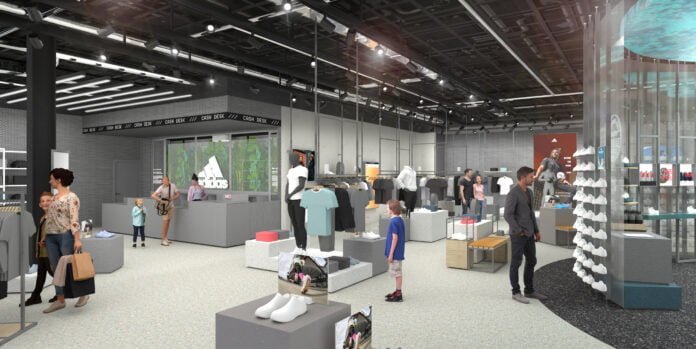
The new concept ‘halo’ store by retail sportswear giant Adidas is closer to opening its nearly 13,000-square-foot space at the CF Toronto Eaton Centre, joining 69 stores worldwide with the unique initiative.
Alim Dhanji
Alim Dhanji, President of Adidas Canada, said the halo store concept has been in the market for many years.
“The inspiration behind the halo store opening this summer for us will be the brand’s best expression and it brings diversity, credibility, sustainability through product, design, experience all under one roof,” he said.
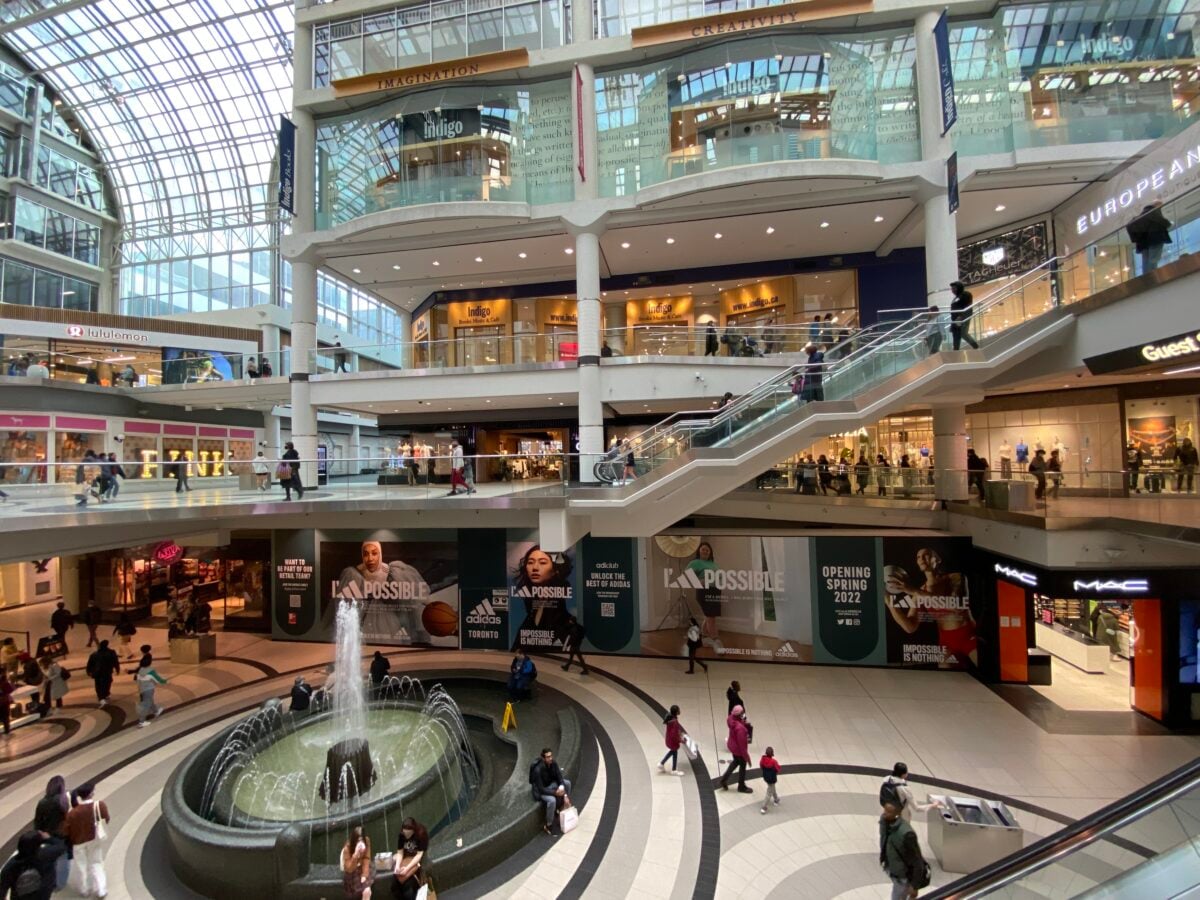
Future Adidas Halo Store at CF Toronto Eaton Centre (Image: Dustin Fuhs)Adidas at CF Toronto Eaton Centre (Renderings: Adidas)
Lesley Hawkins, VP Retail for the company, said the store is on the first level at the bottom of the escalators in the mall where the prior Urban Planet space was located.
Lesley Hawkins
“This is really our opportunity to offer consumers the latest innovations in footwear and apparel. But beyond that, it’s also an opportunity to tell the stories of our Toronto communities and we have a lot of different communities throughout the Greater Toronto Area,” said Hawkins. “And our ability to engage with those communities through this store, we will be doing that through a digital print shop. We actually have a Toronto City shop which will have unique Toronto inspired products that will be available there.
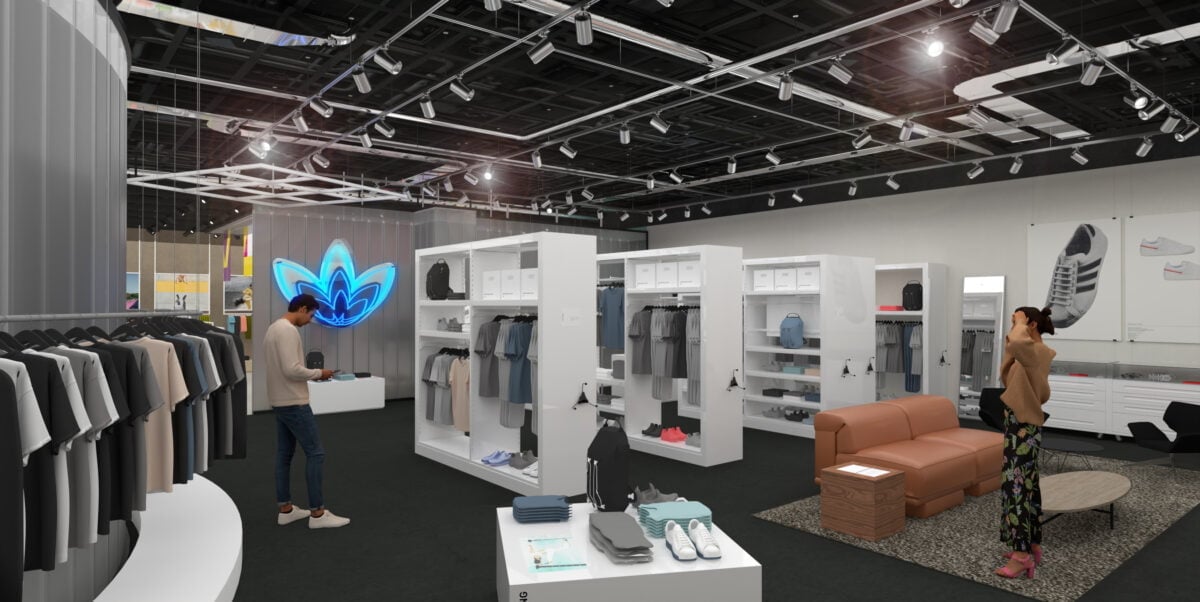
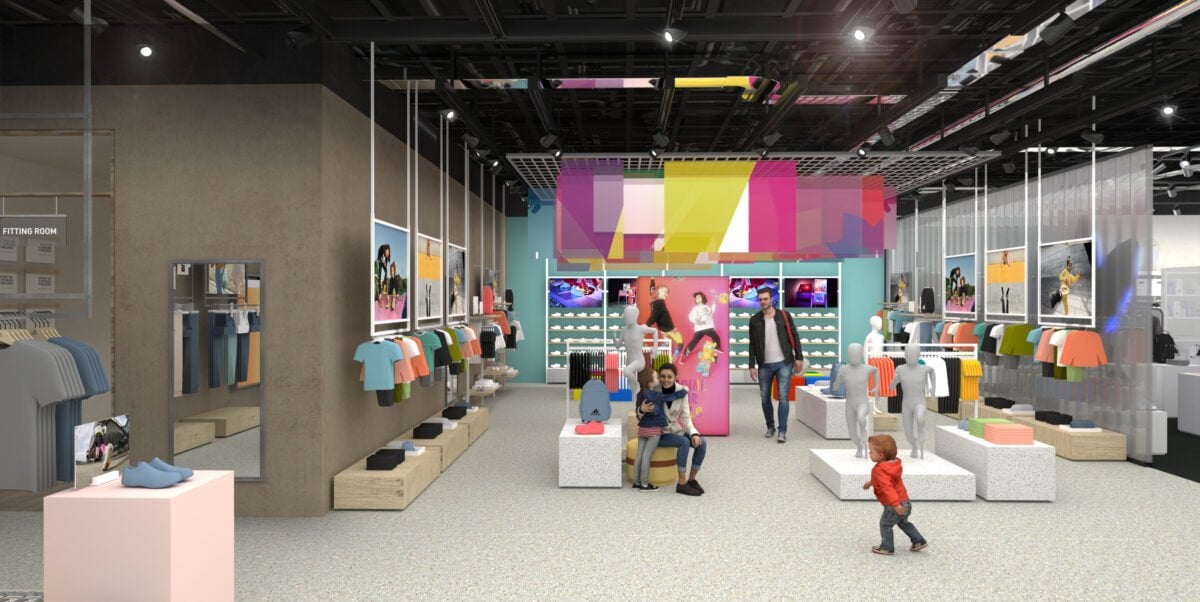
“There will also be a community meeting space. Throughout the whole store you will see a lot of digital touchpoints and this will really allow the consumers to really experience a fully immersive journey with very much a sustainability lens . . . and throughout the store you’ll find that there is space for every member of the family whether you’re looking for some products and some experiences of what the true heritage of our brand, with our original collection, or there’s a very interactive young athlete area or quite frankly the ultimate fan zone space as well.
“There is a lot for everybody in all corners of the store.”
Adidas at CF Toronto Eaton Centre (Renderings: Adidas)
Adidas opened its first halo store in New York City on 5th Avenue in 2016, and have subsequently opened many halo stores in key cities around the world including Dubai and London most recently.
Currently the company has 29 locations in Canada from coast to coast. The locations are a mixture of being in shopping centres, street fronts and strip malls.
“As we look at our opportunities within Canada and we look at specific trade zones within Toronto as being a key city for us and Vancouver as a key city for us, we looked for areas that had high density but also a meaningful opportunity for us to connect with our consumers and the Eaton Centre provides that opportunity of bringing together high traffic as well as we get lots of tourism within the Eaton Centre,” said Dhanji.
“It created a perfect opportunity for us to connect with our consumer.”
Adidas at CF Toronto Eaton Centre (Renderings: Adidas)
Hawkins said the new halo store will open towards the end of June.
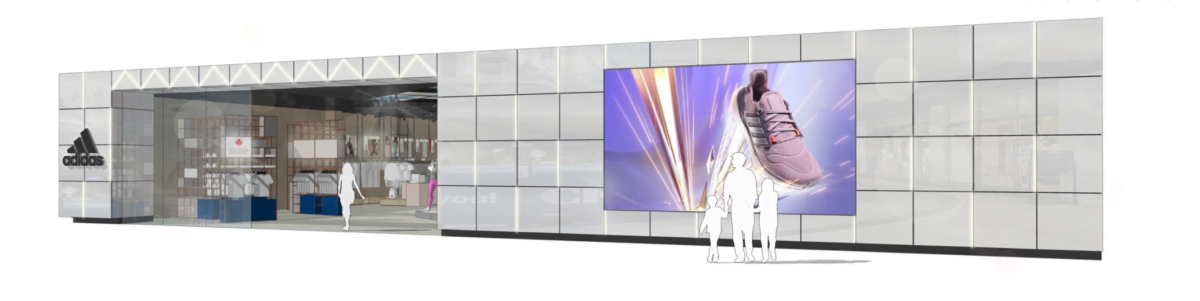
“It will be branded with the Badge of Sport logo that you would normally see both inside the store, on the front facade and also there’s an exterior facade as well. Internally, we refer to it as a halo store but it really is a brand store,” she said.
Dhanji said when the company looks at its overall fleet of stores globally and designing the type of experience it wants to deliver to consumers, the retailer thinks about ‘halo’ as being a full expression of its brand.
“As we think about concepts and what Canada has today and what we’re bringing to market as we expand our fleet, we’re also revitalizing our existing fleet and that’s bringing new store concepts to life within Canada. So that includes the original collection which really does showcase our heritage of the brand. We’re going to be looking at Sneaker Collect for that true sneakerhead and also very excited with our Terrex brand for the outdoor enthusiast and that’s going to be a first for North America. So really excited about bringing the full range of concepts for the Canadian consumer to experience with Adidas,” he said.
Adidas at CF Toronto Eaton Centre (Renderings: Adidas)
Hawkins said the retailer’s other new stores this year will be a blend of brand concept, premium factory outlets and a new concept it will be unveiling in the near future.
“We will be opening more stores this year throughout the country. Another additional four stores,” said Hawkins. “And there will be more retail growth over the coming years which halo will be one of the concepts that we’re going to bring to life. And there will actually be multiple different concepts that we will bring but halo really is our pillar concept. It really does offer that premium, immersive experience.
Dhanji said the brand is excited about the opportunity in Canada for Adidas to continue to grow.
“Consumers are demanding a truly omnichannel experience. We will be expanding our retail footprint over the next four years. What we want to do is ensure that we’re in the right place at the right time for the right consumer,” he said.
“The consumer is looking for an omnichannel experience where it’s seamless for them to navigate online but also have an experience touch point within our stores and offer that seamless ability to order and pick up or return in store. We’re certainly with the expansion of our fleet going to be able to deliver more of that omnichannel capability.”
The CF Toronto Eaton Centre Adidas location has a number of positions available for the Opening Team, including Visual Merchandising, Back of House, and Part Time & Full Time Retail Sales Associates. Interested applicants can visit Careers.Adidas-Group.com for more information.
Podcast: Retail Insider Marks 10 Year Anniversary, Retrospective with Founder Craig Patterson
This week Craig and Lee talk about Retail Insider marking 10 years of operations, including how the news platform got started and some memorable happenings in the Canadian retail industry during that time.
Craig Patterson founded Retail Insider in April of 2012 in Vancouver. Operations are now run out of Toronto where Patterson relocated in 2016. This spring Retail Insider is launching Retail Insider the magazine and other initiatives will also be announced this spring.
The Weekly podcast by Retail Insider Canada is available on Apple Podcasts, Stitcher, TuneIn, Google Play, or through our dedicated RSS feed for Overcast and other podcast players. Also check out ourThe Interview Seriespodcast where Craig interviews guests from across the Canadian retail landscape as part of theThe Retail Insider Podcast Network.
Subscribe, Rate, and Review our Retail Insider Podcast!
Drop us a line at Craig@Retail-Insider.com. You can also rate us in Apple Podcasts or recommend us in Overcast to help more people discover the show!
Background Music Credit: Hard Boiled Kevin MacLeod (incompetech.com). Licensed under Creative Commons: By Attribution 3.0 License. http://creativecommons.org/licenses/by/3.0/
As any restaurant worker or owner can tell you, the Covid-19 pandemic has sent devastating shockwaves throughout the entire hospitality industry.
Following the initial shutdowns in March 2020, the month of April brought the lowest sales period for the industry in over two decades. Sales improved the following year but were drastically slowed by the third and fourth Covid waves that eliminated in-person dining. As of 2021, more than half (51.2%) of food and beverage services in Canada stated that they did not know how long they could continue operations before having to consider closure or bankruptcy. An additional 81% took on additional debt due to the pandemic, with 60% of table-service restaurants operating at a loss.
These numbers and the lasting effects of Covid-19 restrictions can be seen in today’s industry through business closures, staffing shortages, and unfortunately a decreased number of unique independent businesses. The negative impacts trickled down to also impact foodservice operators and suppliers across the country. As the industry re-emerges, business owners and industry suppliers are working to pay off their increased debts and lower operating costs to get services and profits back to pre-pandemic numbers.
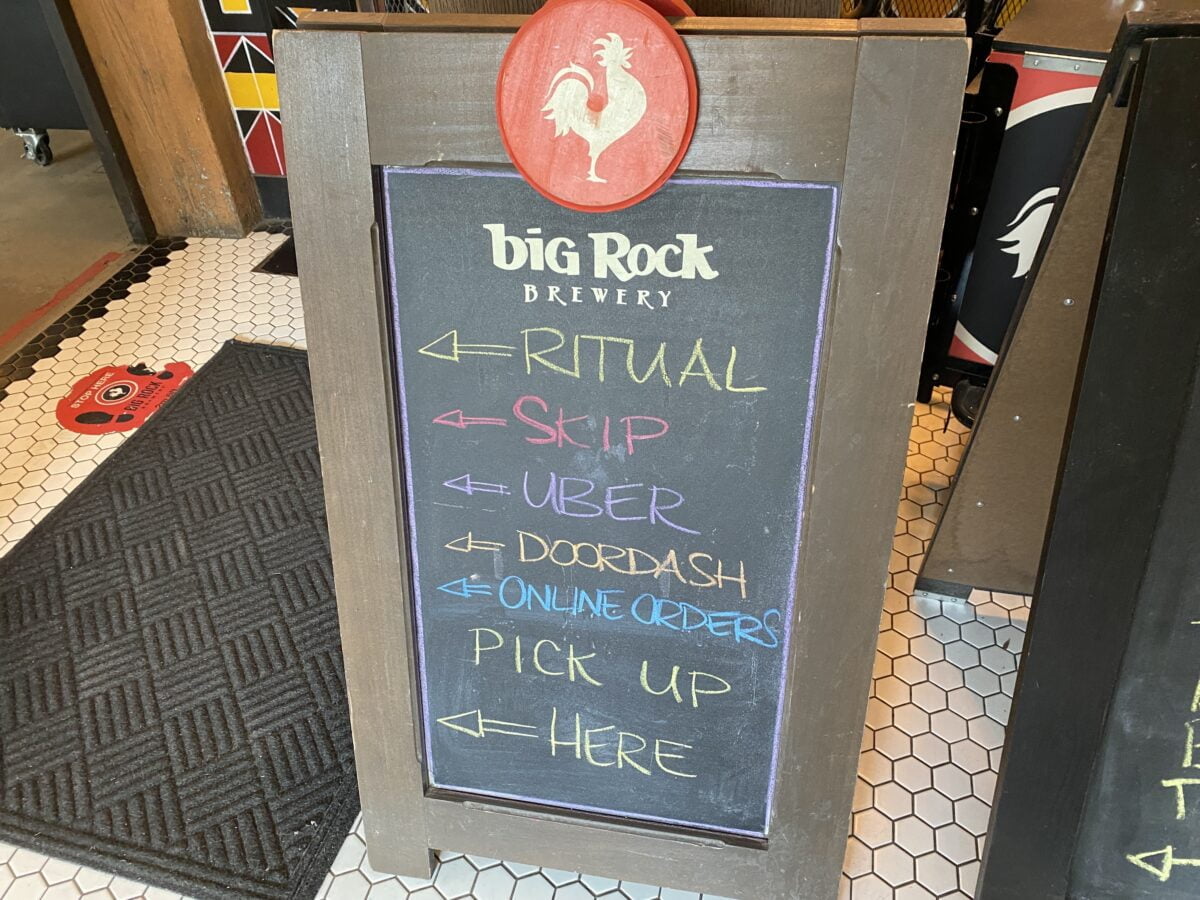
A new trend emerging out of this has been an increased reliance on food delivery and take-away solutions. Canadian hospitality data shows that traditional restaurants are seeing annual growth of 11.45% when it comes to food delivery services. By definition, food delivery services refer to any method of take-away experience, whether that is third-party delivery apps, first-person delivery, or pick-up from the location. With most restaurants choosing to partner with third-party delivery services like SkipTheDishes, DoorDash, and Uber Eats, they’re forced to make the difficult choice between meeting customer demands for increased delivery options and losing 20% of profit to the third-party services or not realizing that incremental revenue potential
Big Rock Brewery in Liberty Village (Image: Dustin Fuhs)
Restaurant owners are looking for new ways to tap into this growing trend without having to sacrifice a significant profit margin. This search for a middle ground has opened the door for new opportunities, specifically strategic partnerships between virtual brands and traditional restaurants. Restaurants typically lose 20-25% of profit when partnering with third-party delivery services for existing menus. By introducing a new stream of revenue using ghost kitchens, the surcharge is less impactful to the pre-existing restaurant revenue and less time and money are spent on the creation and operating process behind new menu items. By partnering with ghost kitchens, restaurants open the door to unlocking new earning potential through a program that offers menus, recipes, training, technology, branding, marketing, and promotions.
From the perspective of the ghost kitchen operators, it is imperative to partner with a professional and experienced restaurant that can introduce curated brands to their community. To make this relationship work, the curated brands must fit with the original restaurant audience and fit into the setup of the existing kitchen. Once set up, customers can select the virtual brands from the same method of online ordering as they would with the original restaurant. The virtual brands multiply the digital storefronts and increase incremental revenue potential substantially. The restaurant takes majority of the profit, less fees to the managing virtual restaurant company.
One thing is very clear – Canadians love food delivery services and show no sign of decreasing demand. With the Canadian food delivery market projected to reach $98 billion by 2027, restaurant operators will have to integrate delivery services to stay on top of the growing demand. Many creative strategies are hitting the market (drone deliveries, for example), but not all of them will be a fit for every audience and customer base. Ghost kitchens offer a unique opportunity to increase delivery services and serve a variety of offerings, without losing profits from pre-existing operations. The mutual benefits received by ghost kitchen and restaurant partnerships offer a new approach to overcoming the damage of the past two years. The hospitality industry must work together to rebuild what was lost and ghost kitchens might be the key in doing so.
About Ryan Moreno:
Ryan Moreno is the CEO and co-founder of the collective hospitality group, The Joseph Richard Group (JRG). Since first opening in 2009, JRG has expanded exponentially, now featuring more than 25 unique locations, including an impressive list of restaurants, Public Houses, Liquor Outlets, Private-label beer & wine, ghost kitchens, and a Hotel.
Direct access to senior leaders from the biggest retailers in Canada is the hallmark of Retail Council of Canada’s exclusive In Conversation with Retail Leaders in Canada series. These events provide access for vendors and suppliers to hear directly from senior retail executives about their business strategies and future plans – without retail competitors or media in the room.
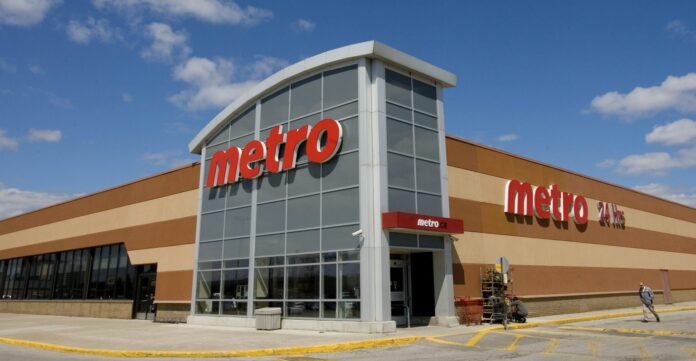
RCC’s 2022 series will kick-off on May 5, 2022 in Toronto with the first in person event since 2019! The event will feature Carmen Fortino, Executive Vice President and Metro Ontario Division Head and National Supply Chain with Metro Inc. Join Carmen in conversation with President and CEO of Retail Council of Canada Diane J. Brisebois, as they touch on topics like modernization, the future of grocery at METRO, and more.
Mr. Fortino brings a lifetime of Canadian food retail experience and success to METRO, complemented by experiences in the health and wellness sector internationally. He has a deep understanding of the Ontario market, having grown up in a family of grocers. He’s focused on delivering a great customer experience that drives results and has extensive experience in operations, merchandising and supply chain/logistics along with great leadership skills.
The event will take place at the Delta Toronto Airport Hotel and Conference Centre. Take full advantage of networking opportunities as team members from these companies will also be present to answer questions from attendees.
To register for these events, visit RetailCouncil.org/events. Individual tickets are available, but vendors and suppliers can receive a 10% discount when they register five or more team members.
Again, please note, this event is only open to the retail supplier/vendor community.
By Maurizio Patarnello, CEO of Flow Alkaline Spring Water
The more we hear companies talk about purpose, the more it runs the risk of becoming another catch-all buzzword. More than a marketing tool, purpose speaks to the very existence of a company, offering a roadmap for decision-making in an ever-changing retail environment.
Companies used to be able to rely on a linear purpose, turning to their product or service offering to communicate their reason for being. But in a time where customers seek opportunities to connect with brands past the point of purchase, transformative purpose expands the impact a company can have on customers and the community. Customer and shareholder demand is driving the corporate conversation on sustainability and stakeholder-driven, transformative purpose. In a 2019 Insights report, Deloitte found that purpose-driven companies grow an average of three times faster than competitors, enjoying higher rates of customer satisfaction.
Flow Water’s purpose has been the same since our founding in 2014, to reduce environmental impacts with products that maximize our customers’ health and wellness. Flow’s reason for being is tied to our commitment to sustainable business practices, such as becoming a carbon negative business by 2025. Successful purpose-driven companies are transparent, making it clear to customers where and how sustainability plays a role in everything from product offerings to corporate decision-making. Flow differentiates itself by being mission-driven, e.g. sourcing our naturally alkaline (pH ±8.1), electrolyte-rich water from two artesian springs and using renewable, plant-based packaging.
Inevitably, conversations about purpose and sustainability lead companies to invest in and prioritize corporate social responsibility (CSR). Last year’s Meaningful Brands report found that 71% of surveyed customers have “little faith” that companies will deliver on sustainability promises. These never-ending commitments to social responsibility have fueled public skepticism as companies often lack follow-through. Businesses need to take measurable action and be transparent about how they are fulfilling promises, so that CSR commitments are more than just a few notes on a slide deck and have an impact on their communities.
Flow aggressively pursued a “Best for the World” B Corporation™ Certified status because being authentic in our sustainability efforts is paramount to our success as a purpose-driven company. A recent study showed that 58% of customers label themselves as belief-driven, supporting and advocating for businesses based on their core values. Customers have more choices than ever before, but through these shared values, Flow has been able to form authentic connections with customers based around CSR.
McKinsey recently named inaction on sustainability as one of five consumer zero tolerance factors. Companies can no longer afford to be stagnant, and a truly transformative purpose will push a company to go further with CSR. In 2021, Flow joined The Climate Pledge (TCP), a global commitment to reach net-zero carbon emissions by 2040 and meet the Paris Agreement goals a decade early. Expanding the scope of our sustainability commitments strengthens our relationship with customers and community stakeholders.
Flow actively works to lower our carbon footprint through packaging, renewable energy use and carbon mitigation and offsetting strategies. While the company currently operates carbon neutral, purpose helps us evolve as we widen our impact—Flow is working towards the ambitious goal of being carbon negative by 2025, and will continue to be transparent in this process.
Just as it is outdated to frame sustainability and profitability as mutually exclusive, it is misguided for companies to see purpose as a quick sales fix. When we talk about the importance of transparency and authenticity in purpose-driven companies, the key element is consistency. A guiding, transformative purpose helps ensure that companies are consistent in their corporate citizenship. Companies like Flow lead with purpose, discovering additional opportunities that have positive impact on customers and their communities as we grow.
Maurizio Patarnello is the CEO of Flow Alkaline Spring Water.
Maurizio joined Flow after an impressive 27+ year career working for Nestlé. During his tenure he assumed various positions of increasing responsibility around the world, including throughout western and eastern Europe, Asia, and the Middle East. In 2017 he was appointed CEO and Chairman of Nestlé Waters, a role that he occupied through the end of 2019.
He has dedicated the large majority of his career to the bottled water business, in which he significantly contributed to Nestlé Waters’ growth of iconic multibillion dollar brands such as Nestle Pure Life, Perrier, San Pellegrino, Acqua Panna and Poland Spring. He is also a pioneer in the global consumer health movement from carbonated soft drinks to bottled water.
Montreal-based Lightspeed, a leading provider of cloud-based, omnichannel commerce platforms, announced on Friday two significant initiatives for Earth Day 2022. That includes an expansion of its Carbon Free Dining initiative as well as plans to plant 3,000 trees in Africa.
Lightspeed’s Carbon Free Dinning is an exclusive Restaurant Rewards program in partnership with Sustainably Run which allows diners at restaurants using Lightspeed to have the option to add a small contribution to their bill so Sustainably Run can plant trees in developing countries.
The tree planting, as a result, is said to help reverse the problems caused by industrial farming that can have a negative impact on the biodiversity of a region caused by soil erosion, water pollution and an increase in atmospheric carbon dioxide.
For every six trees planted because of that particular restaurant, Lightspeed says that it will credit the restaurateur to save on their subscription with Lightspeed.
Lightspeed’s head offices in Montreal. Photo: Lightspeed
Since it was piloted in the UK, Lightspeed’s Carbon Free Dining initiative has resulted in over 1-million trees having already been planted. On Friday Lightspeed announced intentions to plant a further 3,000 trees in Africa, which has been hit hard by industrial farming. Lightspeed also says that it will also be incentivizing its employees to participate in their Sustainability Week LinkedIn Learning Challenge to learn more about sustainability by completing a pre-set course.
Lightspeed was founded in 2005 by Dax Dasilva, beginning with four employees working out of a Montreal apartment. Lightspeed has seen remarkable growth — the company is now publicly traded and is a force to be reckoned with in the world of retail as well as restaurants and other services as Lightspeed offers various options in the omni-channel world. Dasilva recently stepped down as CEO with JP Chauvet taking over the reigns — Dasilva himself is working on various environmental initiatives which includes millions of dollars in philanthropy.
The first Earth Day was observed on April 22, 1970, when 20 million people across the US celebrated by filling their local streets, parks and auditoriums to demand a healthy, sustainable environment. They were concerned about their cities laden with smog, polluted rivers, rampant pollution, and other environmental hazards.