Gender inequality. It’s an issue that’s plagued societies all over the world for millennia, and one that continues to challenge the ethics and morality of our time. It’s a flaw in our thinking as people that results only in the denial of opportunity and marginalization of voices within our communities, limiting our progress as a species. The disparate treatment of men and women within the business world poses the same adverse impact on companies and brands which, through this obtuse way of thinking, diminishes their understanding and perspective of the market, inhibiting the growth and success of their organizations.
Though progress has been made through the years, largely by way of the passionate and courageous work undertaken by groups like the National Woman Suffrage Association, the Women’s Liberation Movement and a multitude of others that continue the fight today, there is still much improvement required if people and businesses are to fulfill their true potential. It’s a fact that Diane J. Brisebois, President and CEO of Retail Council of Canada, says is a simple one to grasp, but one which can yield a constraining and suppressing effect on the companies that are unable to take it to heart.
“It goes without saying that women bring different perspectives and experiences to the table,” she asserts. “They have very strong IQs as well as EQs and are often able to see the grey rather than simply the black or white within certain situations. Women are also extremely effective leaders who don’t shy away from confrontation and are great at team building and bringing people together in pursuit of a common goal or objective. It’s not to suggest that men don’t possess these qualities and characteristics. But they are certainly qualities and characteristics that many women have also brought to the retail C-suite throughout my career within the industry. Beyond these intangibles, however, 50 percent of the world’s population is female. If an organization does not include women throughout its enterprise, not just in the C-suite, they’re cutting off access to half of the labour pool, much of which is top talent that can help their brands move forward and grow. As a result, it’s fundamental for companies to make the necessary investments in order to ensure that diversity. And if they don’t, they’re poorer for it.”
Gender equality is good for business
Natasha Koifman, President and Founder of one of the country’s leading public relations agencies, NKPR
Brisebois, who’s been leading Canada’s national retail association for more than a quarter century, has personally witnessed much of the recent advancements toward gender equality within the workforce. She points to the growth potential for brands that ensure diversity throughout their ranks, adding that the impact of a collective industry effort to achieve equity could have a profound impact on the overall economy. In fact, according to a recent report from the McKinsey Global Institute (MGI) titled The Power of Parity, a globally comparable advancement of women’s equality in which women match men’s participation in the workforce, their sector mix, and their full-time mix of jobs, the global GDP could rise by an astronomical $28 trillion by 2025, representing a mammoth increase of 26 percent over current levels. It’s an opportunity that’s recognized by Natasha Koifman, President and Founder of one of the country’s leading public relations agencies, NKPR, who suggests that it’s a result that’s inevitable for organization’s that make an earnest commitment toward including female representation at the top.
“It’s important to have all genders, and ethnicities, represented at the table because different perspectives are what create progressive outcomes,” she states. “Research shows that Fortune 500 companies that had more women on their boards financially outperformed companies with less women – meaning more women in executive seats literally translates to increased economic margins. Similar studies show that gender balance in the workplace influences positive job satisfaction and wellness, which also leads to increased employee retention.”
Although the financial outcomes are critical to retailers and their continued success across the country, monetary gain is not the only benefit available to companies who achieve relative equity throughout their operations. In fact, according to Sarah Jordan, CEO of Mastermind Toys, the positive ramifications that can come about as a consequence to proactively ensuring equality throughout an organization are far-reaching and have the potential to facilitate inventiveness, productivity and the creation of a constructive environment.
“Diversity is important and critical for business – and that goes beyond financial performance,” she says. “Having female representation at the table sparks innovation and growth, which has been especially important for retailers navigating new challenges throughout the pandemic. Mixed-gender teams allow for diverse perspectives and thinking when solving problems and more accurately reflects the experiences of the customers you’re serving. Companies with diversity in gender among managers are linked to innovation and can better manage group conflict. I’m proud to say women represent over 65 percent of Mastermind Toys’ leadership roles, with the majority having P&L responsibility, and are key contributors to our brand transformation.”
Barriers to success
Despite Jordan’s rise to a leadership position within the industry, which is undoubtedly credited to her strong work ethic and determination, she understands that these qualities are sometimes unfortunately not enough to ensure success within an organization. She believes that there are still barriers that exist for women looking to progress within their careers which result in undue limitations on their capabilities and realization of personal and professional achievements.
“We know that women face a number of barriers that can impact their rise through the corporate ranks, from experiencing microaggressions in the workplace due to unconscious biases, to spending disproportionately more time dedicated to caregiving responsibilities,” she says. “As a leader, I’m interested in how we can take action to support female talent and not only recognize that these barriers exist. I’ve been lucky to have sponsors in my life who have pounded the pavement for my growth and who have helped me seize my potential to get me to where I am today. Now being in a leadership role, I believe I have a responsibility to advocate for other women to help reduce the barriers in their path and create an inclusive environment that makes their growth achievable. My advice for leaders is to ask yourself: who are you sponsoring? Who are you inviting to the table? And who are you creating growth opportunities for?”
Though ongoing MGI research related to gender inequality indicates that meaningful progress has largely not been made over the course of the past five years, there have been significant improvements in mindset among CEOs in North America during this time. According to its data, 87 percent of the continent’s companies today report that gender diversity is a top priority, compared with 74 percent in 2015. Regardless of this philosophical shift, however, MGI research also indicates that action is required on the part of organizations in order to really move the needle forward concerning the issue. In fact, representation of women in the C-suite in North America is a paltry 21 percent. It’s clear that there remains a chasmic gap in participation between the genders when it comes to leadership positions. And, as Shannon Stewart, EVP, Chief Product Officer at Harry Rosen, acknowledges, it’s a gap that needs closing in order for organizations to broaden their accessibility to the markets they serve.
“In many cases women are the decision-makers when it comes to purchasing, so it is important that we understand the impact that has on our business,” she says. “Our stores need to be a place anyone feels welcome in, including women. Any team, including an executive team, benefits from a balanced approach to decision-making. Having women present at the table ensures all aspects of a business problem are explored, including numbers-driven results as well as empathy towards those people driving the business.”
Stewart’s colleague at Harry Rosen, the company’s Chief Marketing Officer, EVP Marketing & E-Commerce, Trinh Tham, agrees, adding that there are opportunities for women currently in leadership positions within the industry to inspire younger generations. And, this, she says, can be easily achieved through the sharing of experiences, providing some guidance and direction for young women to follow.
“Female leaders are leading by example to show that women can strive to reach more senior positions within their companies and be recognized for their contributions,” she explains. “I think it’s important for women who have achieved success in their careers to share their stories and how they navigated challenges and opportunities to help others sort through theirs. I also think there is a positive impact to be gained when younger generations share their perspectives with female leaders as this helps everyone learn and grow.”
Mentoring talent
Tham goes on to explain that to nurture that inspiration and properly support the development of young female talent within the industry, retail organizations have got to place far greater emphasis on the creation of mentorship opportunities. Not only does the development of meaningful and effective mentorship benefit the talent that’s being developed, she says, they also provide incredible learning moments for the entire organization.
“I would suggest that recognizing female talent and actively providing mentorship is an opportunity for both men and women leaders to reward and develop female high performers,” she says. “One of the challenges within the industry is in achieving longevity of these mentorships and maintaining the relationship over time and at different career and life phases. This requires effort from both parties involved. But, from my perspective, this is where senior executives need to put in a bit of extra effort in order to set a strong example with respect to what’s possible and to realize how rewarding this type of experience can be for everyone involved. I have been very fortunate to have enjoyed long-standing relationships with mentors, both male and female, and relationships with female mentees who I continue to learn so much from.”
It’s generally observed that a genuine recognition of the issue of gender inequality, intentions to lead by example and the development of strong mentorship opportunities are all fantastic steps toward addressing the shortcomings of businesses everywhere. In isolation, however, each are somewhat ineffective. To help ensure that proper progress is made concerning the issue, Mona Kennedy, Chief Financial Officer at Roots, suggests the provision of a strong framework and structure within which each initiative and effort can be highlighted, tracked and managed accordingly.
“Nurturing diverse talent is a business imperative,” she says. “We focus a lot of time and attention here at Roots on skill and being planful in our hiring practices, introducing case studies into our hiring practices and bringing in support to actively broaden the candidate pool when hiring. In addition, what gets measured gets managed. You need to have data to see where you are and target where you are going. We conducted a diversity, equity and inclusion engagement survey across all of our locations, including head office, distribution centres, retail stores and leather factory, to inform our plans, enable our team to play an active role in our diversity, equity and inclusion strategy and initiatives, and set a baseline against which we can measure our progress.”
Outcomes and accountability
Kennedy goes on to explain that by measuring and tracking outcomes, organizations are afforded a full view into the progress of their initiatives. In addition, she says that as a result of the transparency, those responsible for the outcomes are accountable for them, ensuring commitment and dedication toward achieving the organizations diversity, equity and inclusion goals and objectives.
“Taking an outcome-focused approach by creating defined objectives, and by holding people accountable for the outcomes, empowers employees to determine how to do their jobs in a way that positions them for the greatest success,” she says. “At Roots, we have a cross-functional diversity, equity and inclusion Council. We have also established a formal platform, ‘Together at Roots’, and have created a new diversity, equity and inclusion Specialist role. We also consistently review our related initiatives and provide updates directly to our board of directors. In the end, diversity is good for the business, and you have to manage it rigorously like any business opportunity.”
Further progress and improvement
Though the issue of gender inequality remains a societal issue that requires attention, the intentions of leaders within the retail industry to eradicate the scourge are increasing. It’s representative of a shift in philosophy that Brisebois believes has been accelerated by impacts of the COVID-19 global pandemic, compelling people the world over to reassess their values and understand with greater clarity the things that matter most to them in their lives. The same has been true for CEOs of retail companies and brands operating across the country, she says, adding that the crisis that we’re all collectively facing may, in fact, serve to advance issues around equality and help the industry’s leaders realize just how great retail can be.
“Leaders within our industry, across the country, have an incredible opportunity in front of them to leverage the crisis that we’re currently living through and to take on some of the biggest challenges that retailers everywhere are facing. It’s providing them with a chance to take a closer look at their organizations, the weaknesses within them and the areas of opportunity for improvement. Going forward, addressing these concerns, and making positive progress around these kinds of societal issues, is going to be key in rallying teams together in order to make everyone better. In this way, retail leaders have the opportunity to advance their diversity initiatives and enrich the lives of their employees, customers and all other stakeholders involved.”
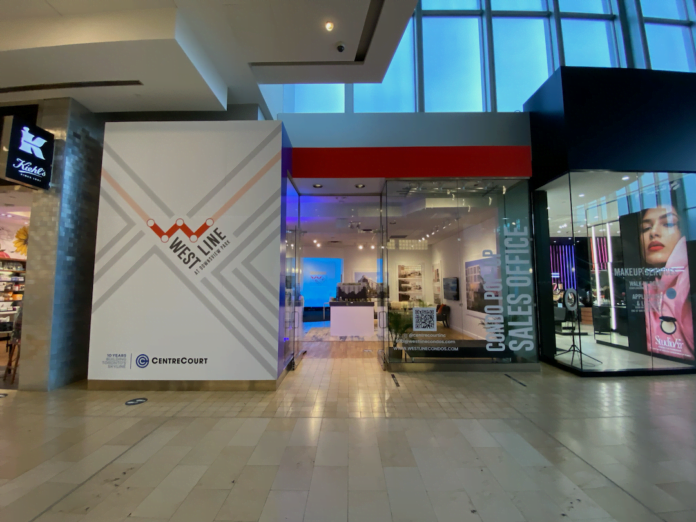
Westline Condos Pop-Up Sales Centre at Yorkdale (Photo by Dustin Fuhs)
With the demise of many big box stores in recent years, shopping centres across the country have thought of different and innovative ways to lease up space left behind by huge retail giants.
Jason Lam
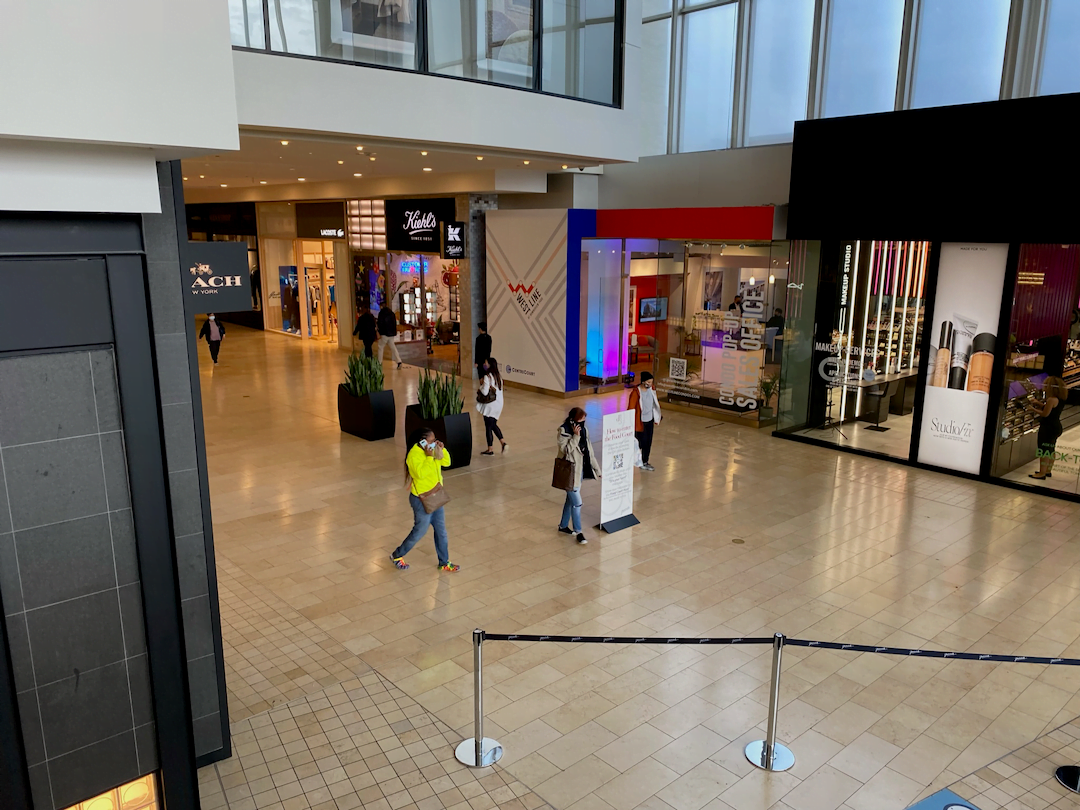
From breaking up large space into more units to attracting different non-traditional retail use, malls in Canada are thinking out of the box and the Yorkdale Shopping Centre, one of the country’s iconic retail properties, has been home to a sales office for a major condo development.
Jason Lam, VP of Sales and Marketing from CentreCourt, which is building the 15-storey, 422-unit, WestLine Condos project just steps from Downsview Park, said the pop-up sales office will continue in operation until later in November. The concept began in the mall on October 1. The pop-up sales office was originally intended to be open daily until October 31. But it’s been extended because of the popularity of the concept.
It’s located in the former BOSE location, directly beside MAC Cosmetics and across from the Food Court Escalators.
Westline Condos Pop-Up Sales Centre at Yorkdale (Photo by Dustin Fuhs)
The project is in the pre-construction and pre-selling stage. Construction is expected to begin in early 2022 and the project, which launched on September 7, is over 70 per cent sold. Target completion date is mid-2024.
“Yorkdale mall in Toronto is the premier shopping centre. It’s run by Oxford. It’s actually perfectly placed because it’s got subway connectivity as well as highway connectivity. So it’s convenient,” said Lam.
“For us, the Downsview area is a bit of an unknown commodity. It requires education. It requires people to see it, to believe it, to feel it. We like the energy of Yorkdale. No one’s really done this concept. No one’s really brought this sort of pop-up selling condominiums out of a mall. The energy in the mall and the brands within the mall. If you think of Yorkdale mall, it’s a premium space. We’re a premium developer. We’re incredibly active in the GTA.
“We get so much traffic of people walking into our space because people are curious. It’s growing our brand as an organization and as a project. The amount of traffic you get in a mall, especially Yorkdale, makes so much sense.”
Westline Condos Pop-Up Sales Centre at Yorkdale (Photo by Dustin Fuhs)
Bruce Winder
Bruce Winder, author of RETAIL Before, During & After COVID-19 and President of Bruce Winder Retail, said the recent WestLine condos pop-up sales centre at Yorkdale makes sense and represents a new age where non-traditional tenants use select malls to showcase relevant products and services.
“In this instance, WestLine will be building condominiums near Yorkdale mall – a short walking distance or short subway ride – and have smartly used the facility to entice shoppers who may already live nearby or wish to. As they say in marketing “fish where the fish are” and this initiative does just that. The affluent demographic of the mall fits nicely with the demographic of the Toronto condo shopper so one can see the parallel in lifestyles. Not to mention the obvious geographic connection,” he said.
“This type of pop-up has been a trend of late as brands look for places that they can insert themselves into a given target customers’ purchase process. That is, this pop-up acts as an external stimulus to potential condo shoppers or just shoppers in general who may not be aware of the project and the many benefits it brings.
“We have seen several new tenants take up space in malls including automobile brands (see last week’s Retail Insider article on Toyota opening in the West Edmonton Mall), education providers, health care providers, digitally native brands, gyms, e-commerce pick up centres and of course various seasonal pop-up stores. Marketers see malls as physical (and digital) marketplaces whereby shoppers of the same or similar demographic get things done or be entertained. As a result of this or maybe because of this, shopping centres have polarized based on lifestyle.”
Westline Condos Pop-Up Sales Centre at Yorkdale (Photo by Dustin Fuhs)
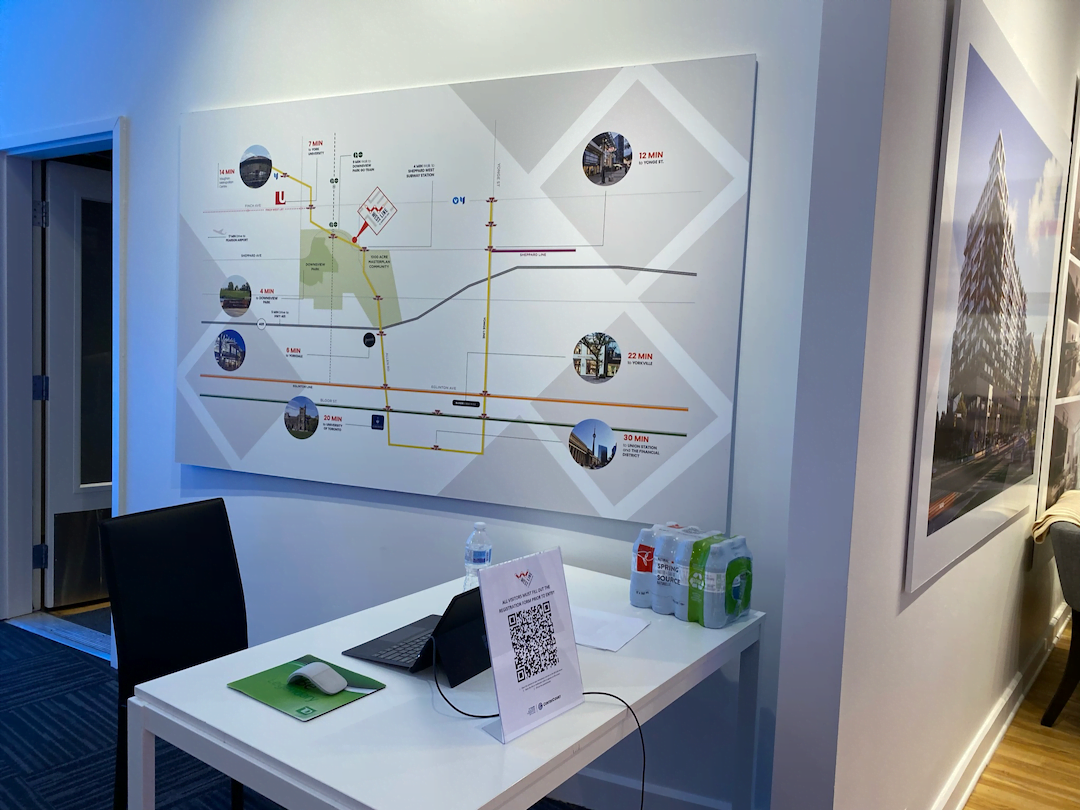
WestLine is directly beside the Sheppard West TTC Station, a short walk to the GO Train, minutes from Highway 401 and just steps from Downsview Park. It offers fully connected living with easy access to every major mode of transportation.
The project will be two subway stops away from Yorkdale, and an under five minute drive away, at Allen Road and Sheppard Avenue West, just alongside the future 1,000-acre Downsview redevelopment, the largest masterplan in the Greater Toronto Area.
“The reason why we looked at the site and got excited is it’s pretty much the only site in all of the GTA that has GO Train subway access and highway,” said Lam. “And we believe the city is prioritizing this location . . . they’re prioritizing employment.
“An added layer to that is this big, huge urban park which is 291 acres and you don’t get that every day. You don’t really get that opportunity especially in Toronto Rarely do you get the opportunity to open your door and say wow I have access to public transportation. It’s about cost-effectiveness. How can I get from point A to B? Cost of living in Toronto is getting pretty crazy. So how do I get to work, to school, to entertainment, on an effective basis, efficiently from a cost perspective. But also now I can have lifestyle. I’ve got this 291-acre park that has a forest, that has a lake, that has a farm, that has a sports area . . . You can get lost in this thing, it’s so big.”
The condo project is also close to York University.
CentreCourt is a real estate company focused on the development of high-rise residential communities located near major amenities, rapid transit networks and employment areas across the GTA. Ranked #11 on the 2020 Growth List ranking of Canada’s Fastest Growing Companies, CentreCourt is one of the most active high-rise developers in the GTA with 18 high-rise residential projects, collectively representing over 9,000 homes and over $6.6 billion of development value.
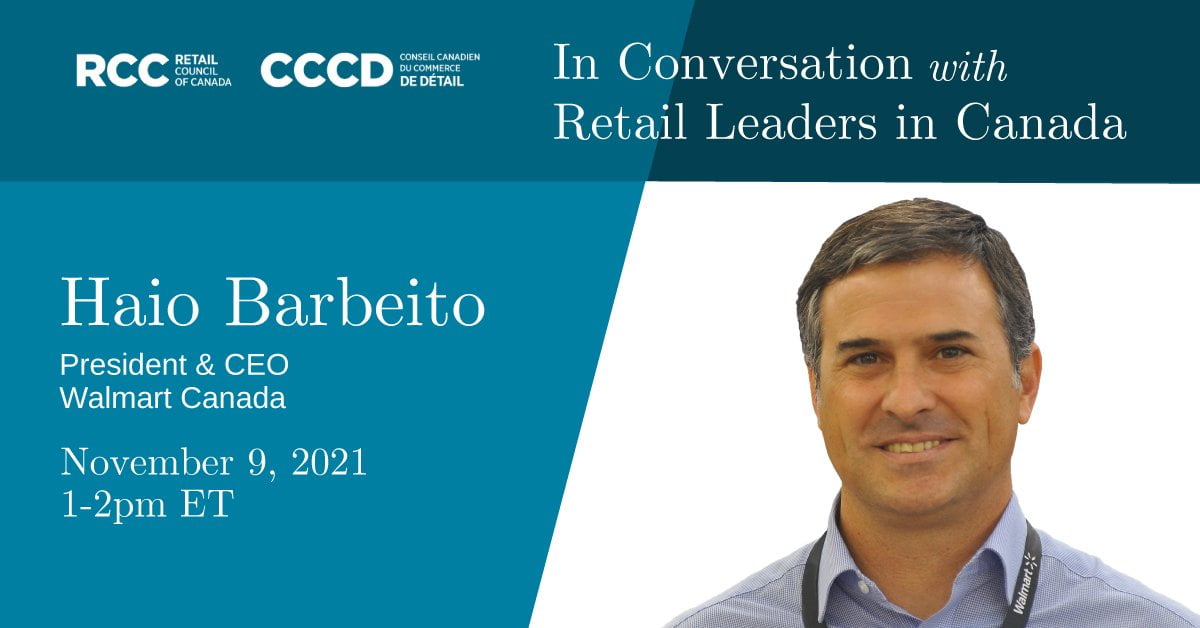
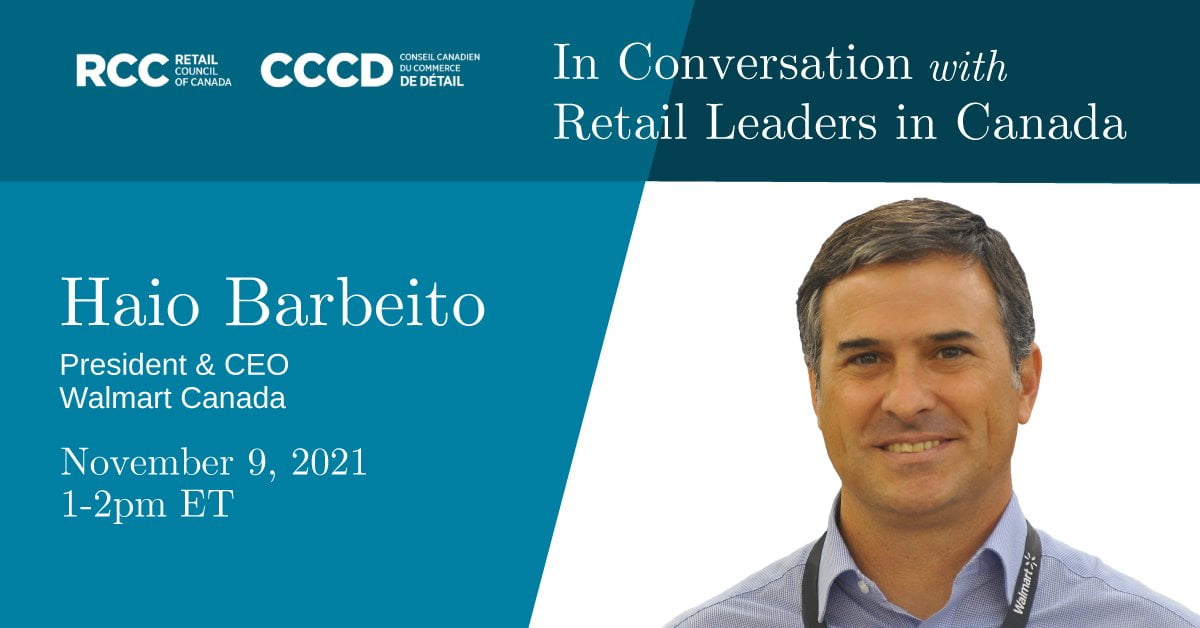
Retail is changing. No one knows this better than Haio Barbeito, President and CEO of Walmart Canada.
To help retailers better understand how they can prepare their leaders and associates for what is ahead, Haio will discuss the future of retail with Diane J. Brisebois, President and CEO, Retail Council of Canada at RCC’s In Conversation with Retail Leaders in Canada, a virtual event hosted November 9th from 1:00 pm – 2:00pm ET.
Talent
Walmart Canada is looking at the many ways they can support retail talent – at all levels of the organization, from CEO to retail associates and their partners – to help them thrive. With a focus on cross-training, associates throughout the Walmart organization are supported so they can grow, regardless of their intended career path, and meet the shift in critical skills needed today and in the future.
Culture
Walmart Canada also believes strongly in the importance of wellbeing and exemplary leadership. To help their managers model and encourage wellbeing practices, Walmart has partnered with Arianna Huffington to equip Walmart’s leaders and associates with tools and practices embodied in the Thrive Wellbeing Journey, an initiative that helps identify and address stress triggers before they become symptoms. Walmart Canada strongly believes that a commitment to wellness will not just help shape the company’s culture but that the impact will be much broader – it will also positively affect the lives of Walmart employees, their families, and the communities in which they serve.
Technology
Walmart Canada also recognizes that one of the changes underway in retail is that the role of the associate is both tech enabled AND customer centric. Haio will also share how Walmart Canada has focused on innovation that engages its associates and encourages business growth. He will discuss Walmart’s responsive omni channel platform that incorporates agile technologies, modular architecture, and consumer-driven insights to create a seamless, consistent experience from desktop, tablet, or mobile device.
Regeneration
In addition, Walmart Canada is passionate about moving beyond sustainability towards regeneration. In 2020, they set a goal to place nature and humanity at the center of their business practices. Now, as Walmart works to go beyond sustainability to restore, renew, replenish, and preserve our planet, it is working across its business to tackle issues related to climate, nature, waste, and people in our supply chains. In the next steps of this journey, Walmart has several new goals to support their efforts, including achieving a 15% absolute reduction of their virgin plastic footprint by 2025, sourcing 100% more sustainable cotton, and 50% recycled polyester for private brand apparel and soft home textile products by 2025, and so much more.
Don’t miss what is sure to be an insightful conversation on November 9th between Haio Barbeito, President and CEO of Walmart Canada and RCC President and CEO Diane J. Brisebois.
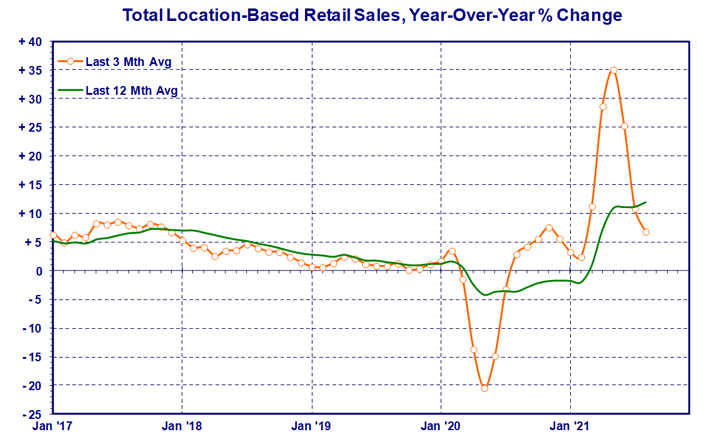
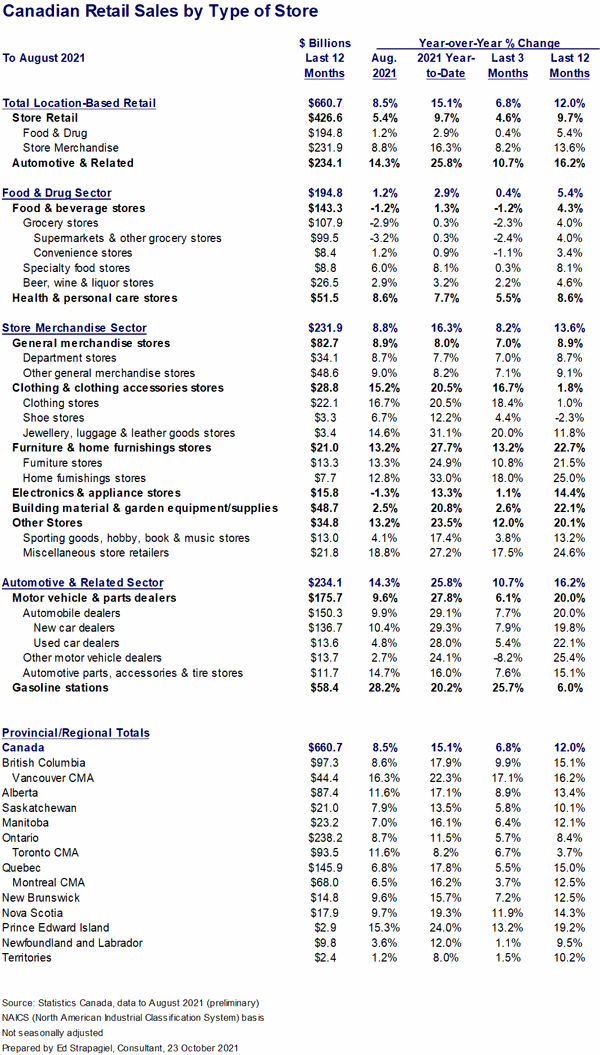
The latest data from Statistics Canada show that the recovery in retail sales is cooling off. There was a huge COVID rebound in Q2 2021 after dismal year ago results, but that is now working its way out of the picture.
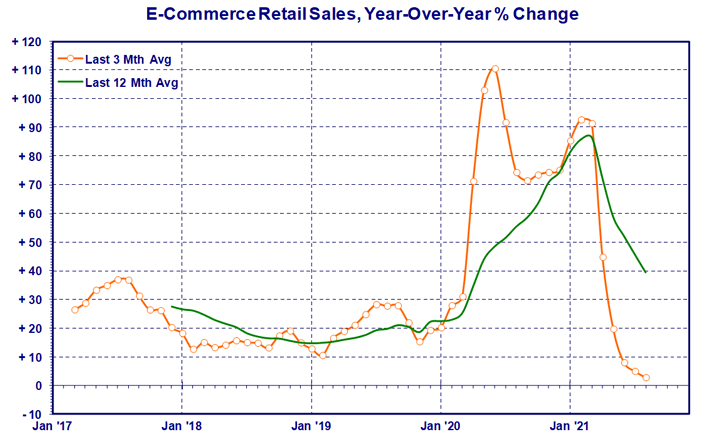
For the 3 months ending August 2021, total retail sales were up 6.8% year-over-year, but this is about 1/3 of the growth rate recorded for the first half of the year. The 3 month trend (orange line in the chart below) is deteriorating rapidly, and the underlying 12 month trend (green line) has now gone flat.
Another factor is that the same cooling off pattern is more or less occurring in all the major retail sectors, even e-commerce.
Food & Drug
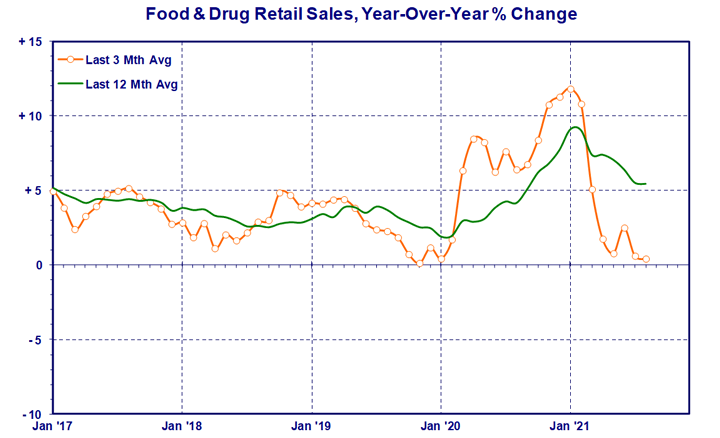
The 3 month growth trend for Food & Drug retailers has dropped like a rock since the start of the year. For the 3 months ending August 2021, retail sales gained just 0.4% versus a year ago. The underlying 12 month trend has also weakened and is likely to finish the year with a less than 5% gain, which would be consistent with pre-pandemic performance.
Supermarkets & other grocery stores slipped again in the latest results, with retail sales down 2.4% year-over-year for the 3 months ending August. Convenience stores’ retail sales also declined 1.1% at the same time. On the other hand, specialty food stores did manage to eke out a small gain, thus reversing recent negative trends.
The overall Food & Drug sector did come out in the black however, thanks to good performance at health & personal care stores. Their sales were up 5.5% in the latest 3 month period.
Store Merchandise
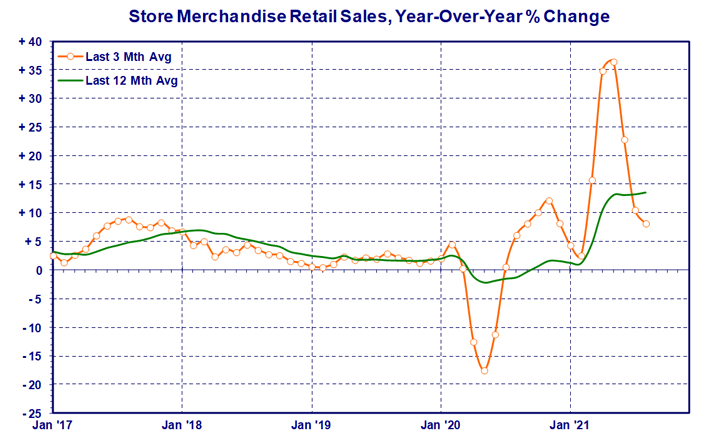
The Store Merchandise sector had high year-over-year retail sales gains in Q2 of this year, largely because of pandemic-induced declined performance a year ago. This is now abating and sales trends are returning to more normal levels. For the 3 months ending August 2021, retail sales were up 8.2% year-over-year, but this is on a downward trajectory. The underlying 12 month trend has also gone flat, and is likely to weaken further before the end of the year.
All store types in the sector had positive year-over-year retail sales gains for the 3 months ending August 2021. Clothing & clothing accessories stores led the way with a 16.7% gain, followed by furniture & home furnishings retailers whose sales were up 13.2%. General merchandise stores’ retail sales were up by a more modest but solid 7.0%. Electronics & appliance stores were the poor cousin of the sector with a gain of just 1.1%.
Automotive & Related
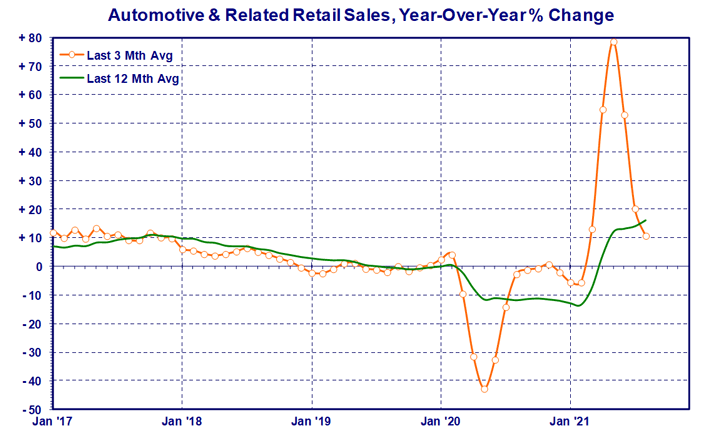
Retail sales gains in the Automotive & Related have sharply declined since earlier in the year. For the 3 months ending August however, sales were still up 10.7% versus a year ago, and the underlying 12 month trend still managed to improve.
Retail sales at automobile dealers have been cooling off recently but were still up 7.7% year-over-year in the last 3 months. Parts supply and shipping issues may however lead to lower sales growth over the balance of the year.
The overall Automotive & Related sector did better mostly due to a robust retail sales increase at gasoline stations, up 25.7% in the last 3 months. As people drive more and pump prices increase, gas station retail sales are likely to remain strong for some time.
By The Numbers
Note that the data and analysis in this report are always based on not seasonally adjusted (or unadjusted) retail sales statistics.
Canadian e-commerce retail sales.increased significantly due to the COVID pandemic, as many retailers had to suspend in-store shopping and many consumers became reluctant to socialize. The explosion in retail e-commerce now appears to be past its peak. For the 3 months ending August 2021, sales were up just 2.9% versus a year ago, the lowest such result since the numbers have been kept. There’s even a chance that e-commerce sales will decline in the next few months as in-store shopping restrictions are eased.
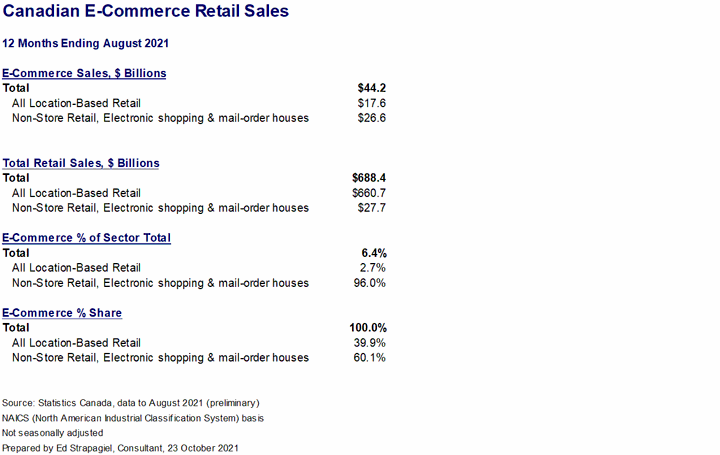
Overall, e-commerce represented about 6.4% of Canadian retail sales over the past 12 months, including both pure plays as well as bricks & clicks stores. Note that Canadian consumers may also buy online from foreign websites which is not captured in these numbers.
Location based retail is the same as that in the preceding “By The Numbers” table. It’s what’s normally reported as Canadian retail sales. Except that it isn’t. Location based retail excludes another section called Non-Store Retailers (NAICS code 454), which includes electronic shopping and mail-order houses, which in turn is where (mostly) pure play e-commerce businesses are. Over the 12 months ending August 2021, electronic shopping and mail-order houses had an estimated $26.6 billion in e-commerce sales.
But that’s not the only source of e-commerce, as (mostly) bricks & mortar location-based retailers also sell online. For the 12 months ending August 2021, this group had an estimated $17.6 billion in e-commerce sales. With electronic shopping and mail-order houses, there’s a grand total of $44.2 billion in e-commerce sales by Canadian operators. Note that this does not include foreign e-commerce purchases made by Canadian consumers, but it does include e-commerce purchases made by foreigners at Canadian operations.
For electronic shopping and mail-order houses, an estimated 96.0% of their sales are currently allocated to e-commerce. For (mostly) bricks & mortar retailers, it can be estimated that 2.7% of their total sales are attributable to e-commerce.
In the final section of the above table, (mostly) pure play operators (namely, under electronic shopping and mail-order houses) generated an estimated 60.1% of all e-commerce sales in Canada, while (mostly) bricks & mortar location-based retailers’ share of e-commerce was 39.9%.
This analysis is updated monthly as new numbers are published by Statistics Canada. If you would like notification from Linkedin of when an update becomes available (and you’ve read this far), please connect with Ed Strapagiel on LinkedIn.
The COVID-19 pandemic forced countless businesses to reinvent the customer experience. With large numbers of employees working from home, the launch of remote contact centres surged when shutdowns began.
From travel firms to insurance companies, suddenly the traditional model didn’t hold up. Companies needed a way to connect their teams, and the cloud provided the perfect avenue to do this quickly so they could best serve customers. Amazon Web Services (AWS) reported that at the start of the pandemic, customers deployed more than 5,000 new contact centres for voice, chat and task management in the cloud. Using Amazon Connect—one of its fastest growing services—customers could be agile with its cost-effective, scalable, and easy-to-use platform that can be set up in minutes from remote locations. All that’s needed is a headset and internet service connection for contact centre reps to get started.
Gore Mutual is just one Canadian company re-imagining customer service and experiences with Amazon Connect. “The agility has been phenomenal,” said Andy Taylor, CEO of Gore Mutual. “When we recognized that our existing technology wasn’t going to enable our digital transformation, AWS’ cloud technology became fundamental to successfully executing our strategy.”
Gore Mutual used Amazon Connect to enhance both the customer and broker experience. Service levels were accelerated from days to minutes, and brokers have reported that the new technology has been a game-changer. Real-time data, dashboards and analytics give Gore agility and adaptability.
“Amazon Connect led to a complete transformation of Gore Mutual by allowing the construction of new servers on the cloud within minutes — and with the click of a button” said Jas Dhinsda, Chief Technology and Data Officer at Gore Mutual. “The client personalization this enabled has allowed Gore agents to know who’s calling with customer-specific details, while AI sentiment analysis and chatbots all work together to create an enhanced customer experience.”
Global travel company Priceline, experienced a 300 per cent increase in call centre volume during the pandemic. Amazon Connect allowed Priceline to address the spike in demand immediately by re-routing calls and handling backlogs as more than 1,000 agents were quickly moved to a work-from-home model. Amazon Connect also allowed Priceline agents to prioritize customers with flights taking off within 72 hours—an important feat that would not have been possible without the new platform.
The New York Times leverages Amazon Connect for its own products, using detailed analytics and sentiment analysis via speech and natural language processing for its call centre. This has allowed the Times to generate transcripts and determine customer needs through common words and phrases used in calls, facilitating interaction across all channels.
“Amazon Connect has several features that dramatically enhance the customer service experience, including customer profiles that provide more personalized service that results in a 25% reduction in call centre handle time,” said Annie Weinberger, Head of Product Marketing for Business Applications at AWS. “Amazon Connect Wisdom gives contact centre agents critical information at the right time, recommendations through scripts, as well as actions to take to resolve issues based on real-time conversation understanding powered by machine learning. These are just a few reasons why it’s been such a boon to clients throughout the pandemic.”
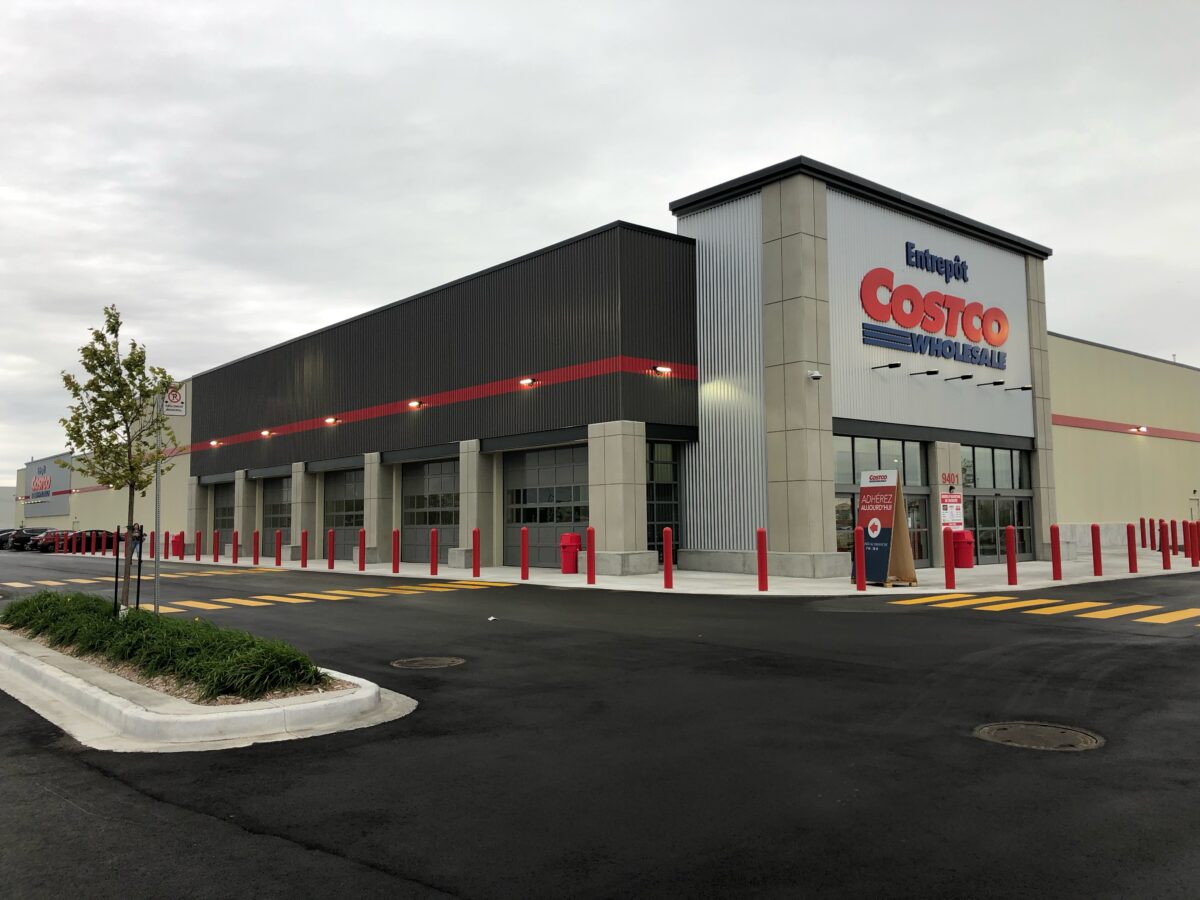
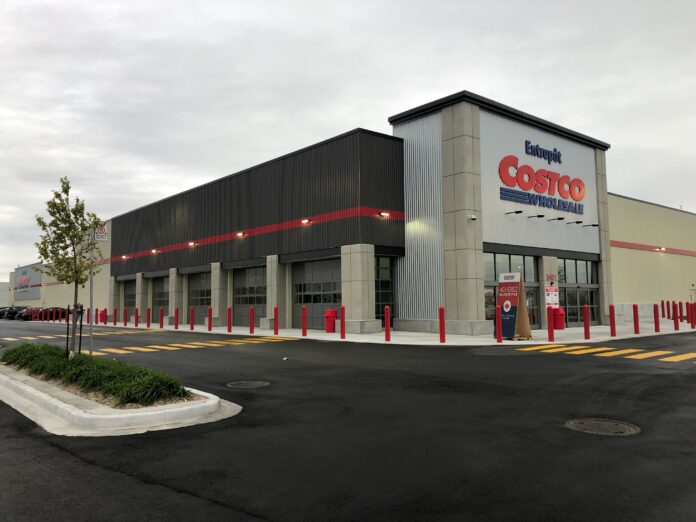
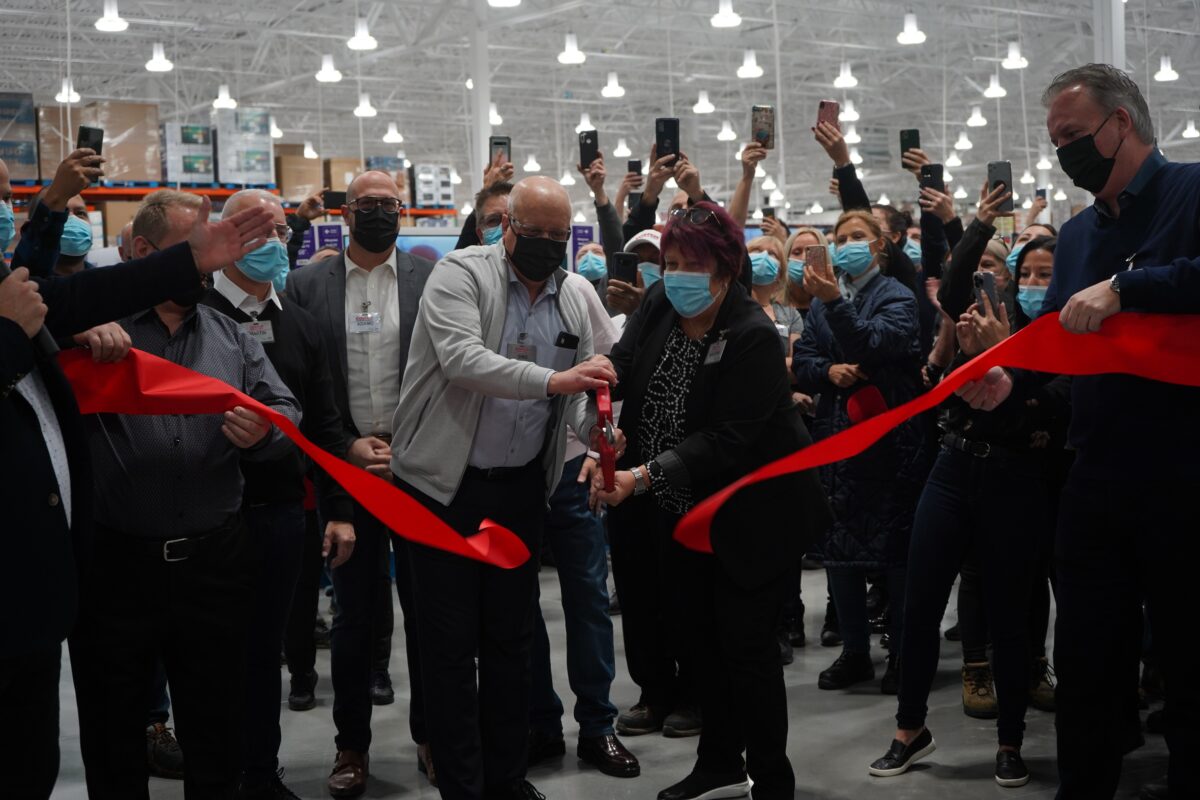
COSTCO WHOLESALE OPENS NEW WAREHOUSE CLUB IN ANJOU, QUEBEC
Costco Wholesale Canada has opened a new 155,733 square foot location in Montreal’s Anjou area to replace a former location which will be converted to a Costco Business Centre.
The new location is 20% larger than the former location with 13 checkout registers, six station self-checkout section, 1000 shopping carts, 900 parking spots and more than 3,800 product skus.
“With the opening of this new warehouse, we can serve all of our members in the Anjou and surrounding area and can bring new consumers and businesses to uncover the benefits of a Costco membership,” said Pierre Riel, Senior Vice-President and Country Manager, Costco Wholesale Canada. “We are very proud to share this new location with our valued members and member businesses in the local community and throughout the area.”
Costco Anjou Ribbon Cutting, October 27, 2021. Pictured in the ribbon cutting photo (from the left) are: Gino Dorico, Senior Vice-President & General Manager, Costco Wholesale Eastern Canada; Martine Bouthillier, Costco Anjou Warehouse General Manager; and Randy Martel, Vice-President, Costco, District 1
Costco Wholesale currently operates 817 warehouses worldwide and 105 warehouses across Canada. The first Costco Wholesale location opened in Burnaby, BC in October 1985.
The first Quebec location opened in St. Laurent (Montreal), QC in 1986 and has since closed.
Costco Wholesale employs over 40,000 people in Canada, with 9,605 employees currently in Quebec.
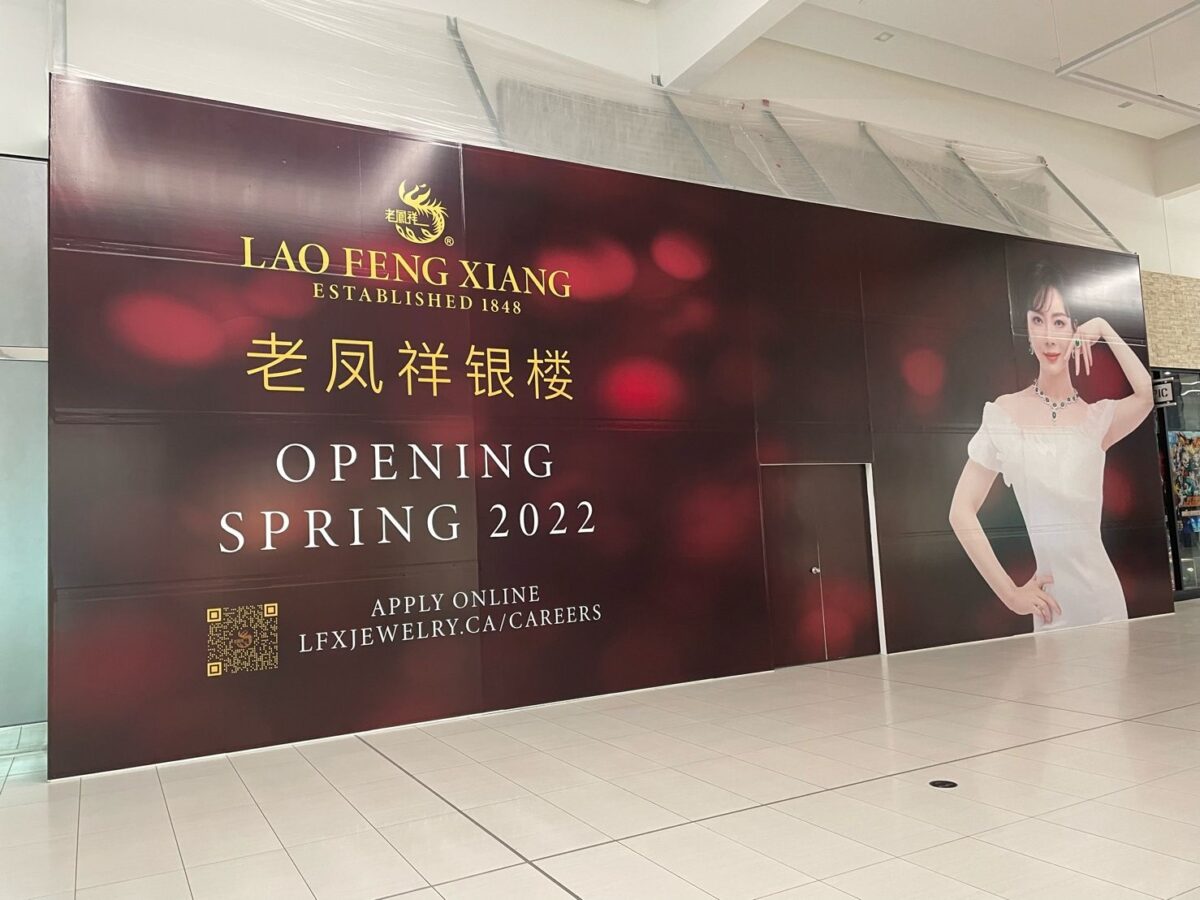
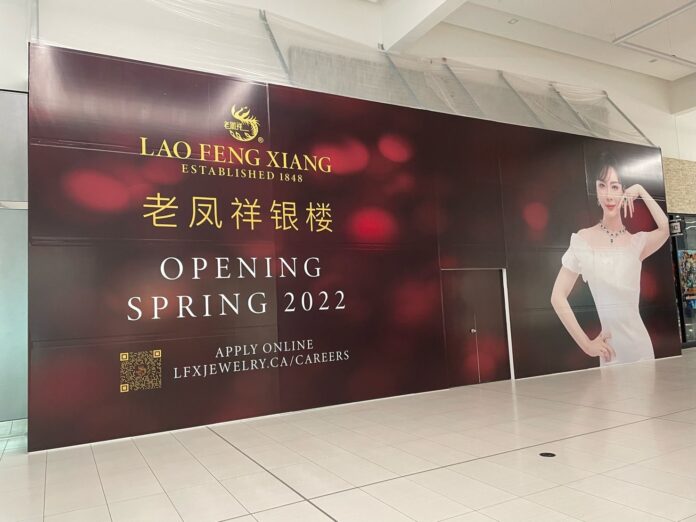
Lao Feng Xiang Construction Signage at Park Royal Shopping Centre (Oct 2021). Photo: Shanon Thornley (LinkedIn).
China’s premier fine jewellery brand Lao Feng Xiang will open its third Canadian location at the Park Royal Shopping Centre in West Vancouver this year. It will become the retailer’s fourth North American location as there is one boutique located outside of Canada on New York City’s Fifth Avenue.
Lao Feng Xiang is China’s oldest jewellery brand, as well as the world’s 16th-largest luxury goods company. Founded in Shanghai in 1848 (during the Qing Dynasty), Lao Feng Xiang retails fine jewellery featuring gold, silver, diamonds, coloured gemstones, jade, pearl and enamel, as well as a robust bridal business. The company has over 2,700 retail stores throughout Mainland China and one in Sydney, Australia. Lao Feng Xiang is particularly known for its 24-karat gold and jade creations.
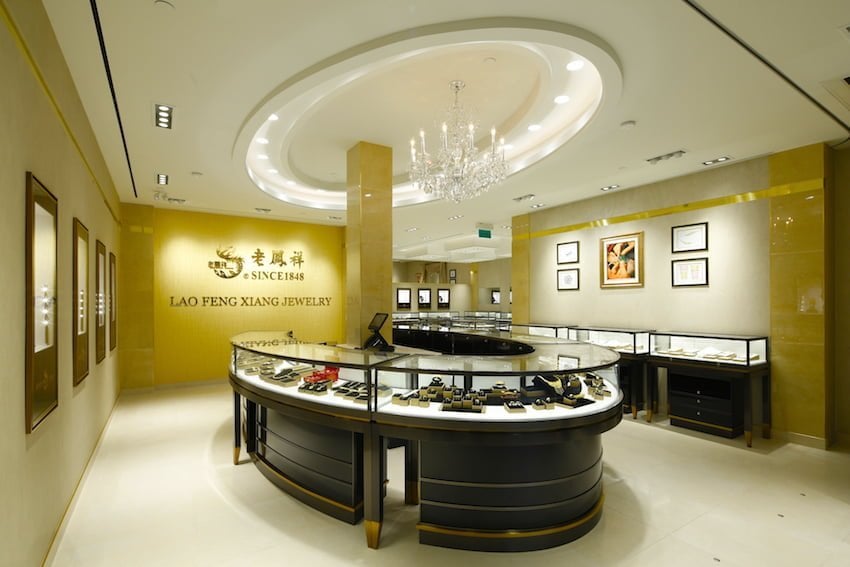
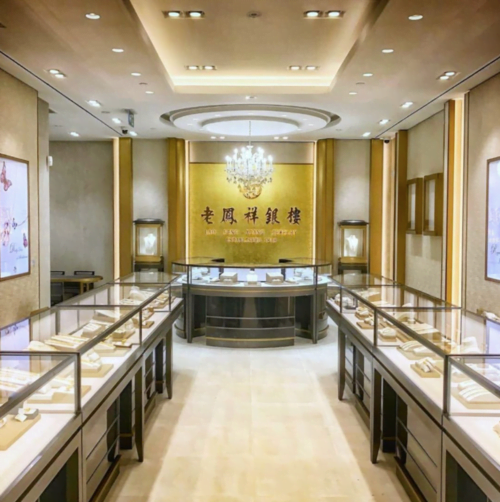
Interior of Lao Feng Xiang on Alberni Street in downtown Vancouver. Photo: Lao Feng Xiang
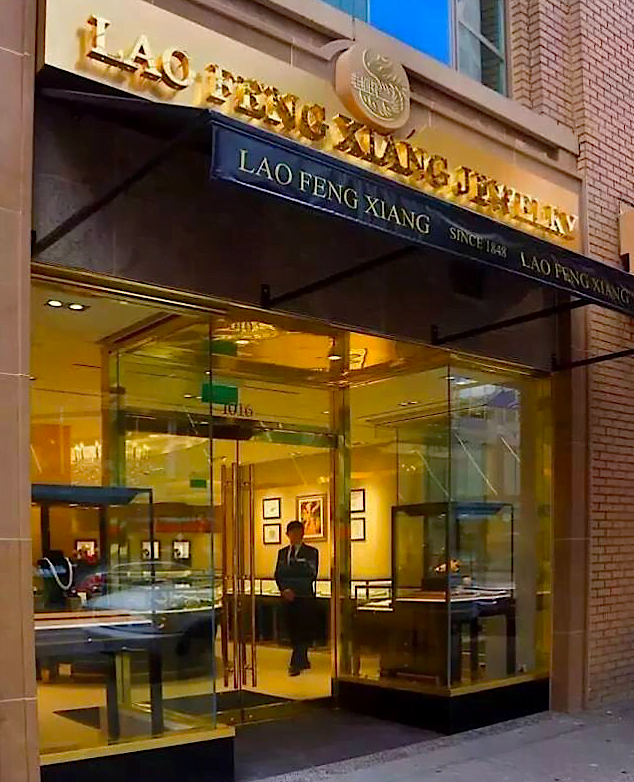
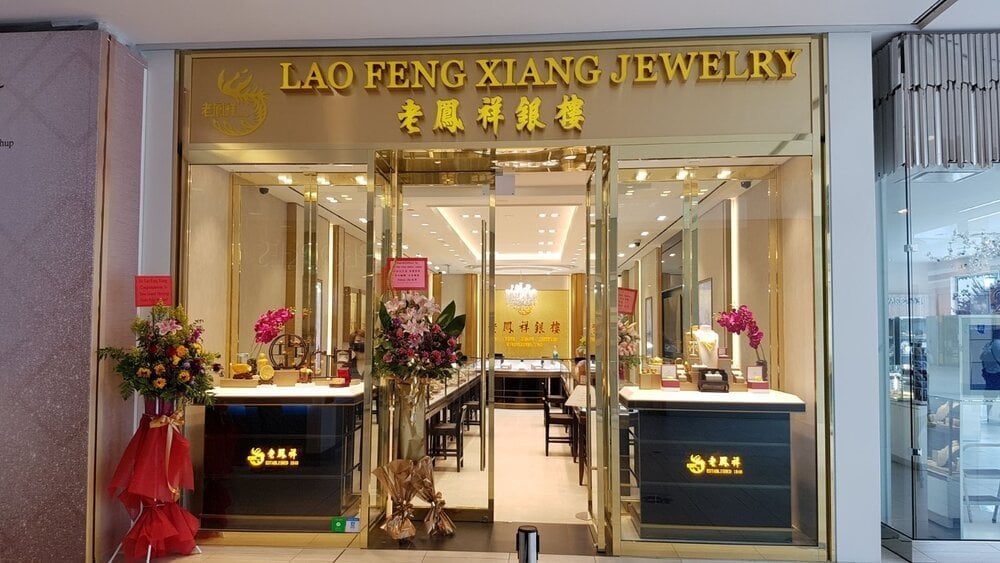
Facade of Lao Feng Xiang on Alberni Street in downtown Vancouver. Photo: Lao Feng Xiang
Lao Feng Xiang
Facade of Lao Feng Xiang at CF Richmond Centre. Photo: Ritchie Po
INTERIOR OF LAO FENG XIANG AT CF RICHMOND CENTRE. PHOTO: MARTIN MORIARTY
The Park Royal Shopping Centre has located the new Lao Feng Xiang boutique in the “Park Royal South” indoor shopping centre. This new jewellery brand will be an addition to the long list of jewelery retailers at the shopping centre, including:
Birks
Lugaro
Rolex
Omega
Michael Hill
Arctic Fame Diamonds
Blue Ruby Jewellery
The new Lao Feng Xiang location will be nestled between the Austria-based Swarovski boutique featuring crystal luxury goods, including jewelery and Hot Topic, a privately owned counterculture-related clothing and accessory retailer based out of California.
Marcus & Millichap negotiated the lease deal for the new boutique space on behalf of the retailer under the direction of Martin Moriarty.
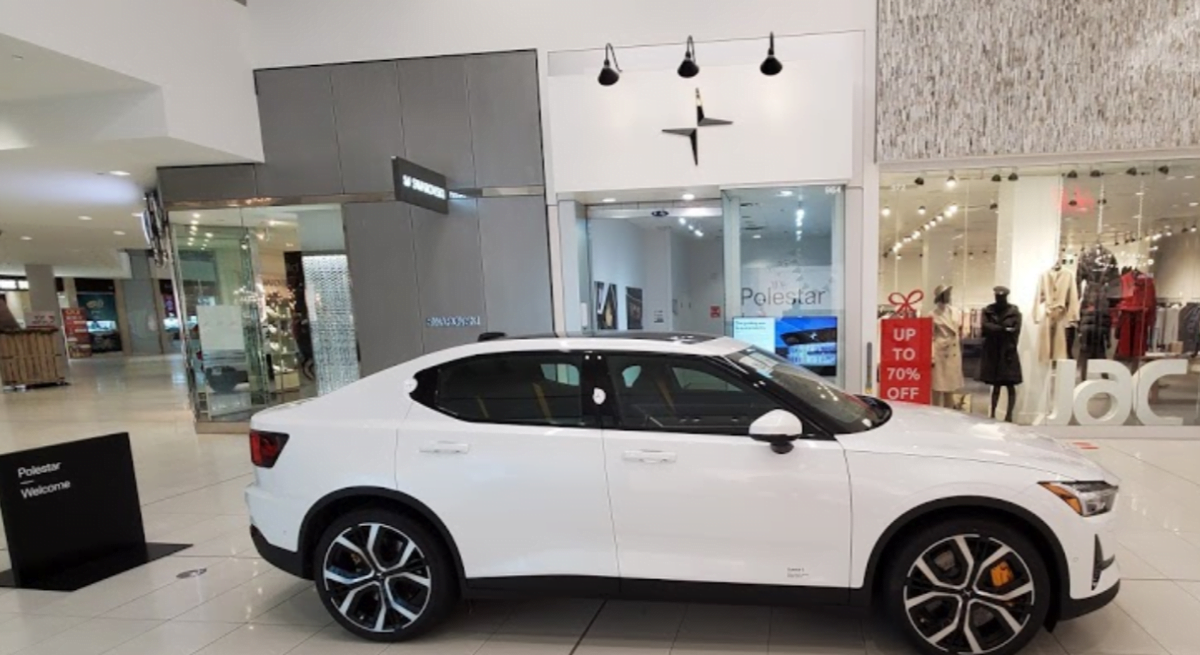
Former Polstar (temporary location) and former JAC by JC retail locations with construction boarding erected (October 10, 2021). Photo: Lee Rivett.
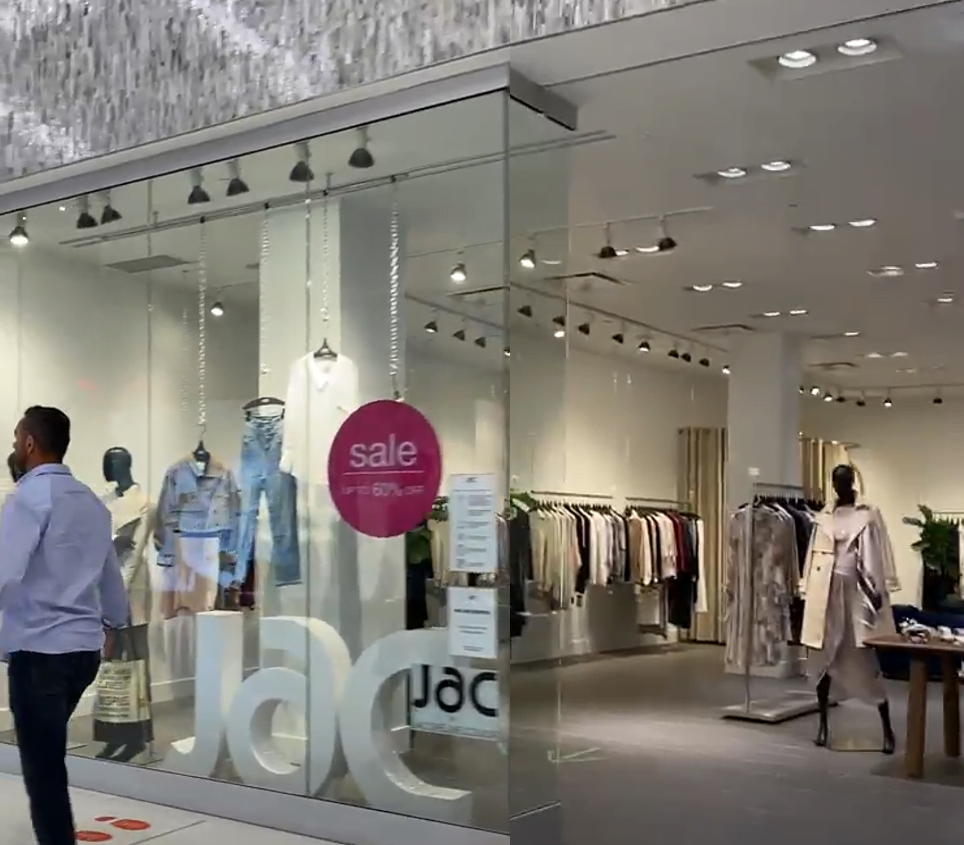
Former JAC by JC at Park Royal during Retail Insider video tour (September 2020). Photo: Lee Rivett.
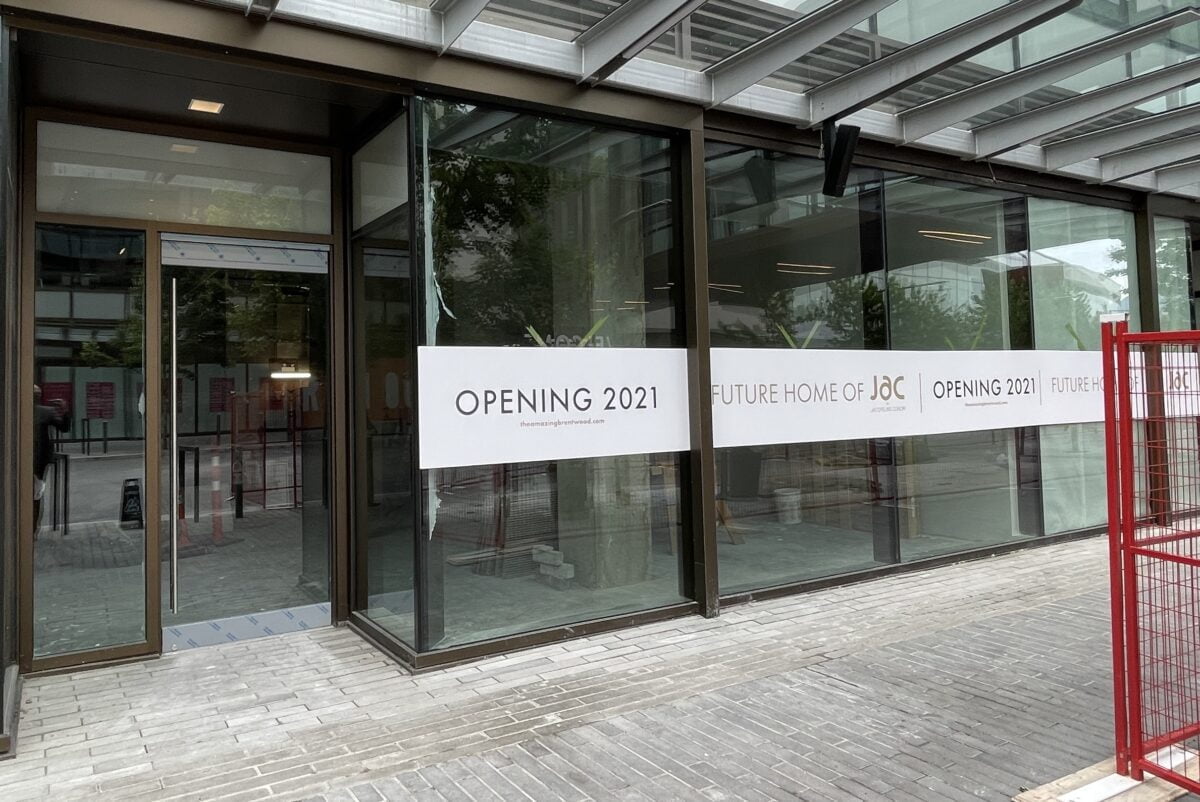
Upcoming JAC by Jacqueline Conoir at The Amazing Brentwood (June 2021). Photo: Lee RivettJAC by Jacqueline Conoir at CF Richmond Centre. Photo: Geetanjali Sharma