For years, retailers, mall owners, and business improvement areas have been turning to the same types of data from the same sources to make the same types of sales predictions. But 2021 turned the life of retailers and mall owners upside down and inside out. If ever there was a time to look for new awareness, it’s now.
The usual way of understanding a place has become as formulaic as ordering a pizza. Stats Can census data are your base. Mobility data are the sauce. Daytime population estimates are the cheese. From data providers, you can pay a lot more for extra toppings like insights from surveys. But you can never be sure how fresh those insights are, how well sourced, or whether they are organic or extrapolated from a can.
The problem is that grasping the health, interconnectedness, and poetry of city life has zero in common with making a pizza. After all, what does census data from before COVID times tell us about life today? What do surveys on consumption from 2020 tell us about how, where, why, who, and when people currently are shopping and spending time? How do such stale tools assist Main Street Davids compete with Goliath’s like Amazon?
If we are going to help our great Canadian public spaces such as malls and main streets recover, we have to be frank that analytics we’ve been ordering – while comprehensive and intermittently easy to apply – don’t tell us a great deal about inflection moments like these when cities and consumer behaviours are being reshuffled.
Happily, big advances in data innovation and digital technology are revealing new evidence-based means to make investment decisions based on what matters to people. If we look at hard data from across Canada and Europe, the most successful places turn out to be those which are safe, engaging, and have a magnetic diversity of uses and attractions.
Using geo-social data, Citiscope measures how diverse, exciting, safe, and engaging spaces actually are. We use machine learning to create esoteric tools that capture what people actually like about the places that they visit.
In essence, we’ve turned billions of social media posts about settings and places into an analytic tool that can help you improve visitor experiences and so promote communities that are more sustainable and liveable.
We identify the quantitative and qualitative strengths of your address by focusing on what people love about them. With that deep dive into community lifestyles, you’re able to compare property dynamics of malls or main streets across the same city or region.
For instance, visitors to a neighbourhood often have a hard time experiencing the optimal ambience just by checking a map or using a trip rating site. Citiscope can help visitors improve their shopping experiences by measuring the intensity of social activities that happen in a mall or on a main street. We also score streets based on certain old-timey geo-spatial points of interest data like footfall to shops with newer insights derived from, say, robustness of digital footprints of businesses, numbers of events, accesses to public space, even quality of air.
We see shops, main streets, and malls as existing within a super-local ecosystem that integrates destinations where the attractions of all boost or rub off on each other.
We can also help you create a baseline for retail strategizing so that you can view impacts over time. That can make positive differences as our long COVID winter finally begins turning into something more hopeful, roaring, and exciting.
*Retail Insider partnered with Citiscope for this article.
Dorn Townsend
Citiscope was founded by Dorn Townsend, a Toronto native whose interest in learning how people engage with cities began after university when he spent a year as a bike messenger in Toronto and Vancouver. He spent years working on urban issues around the world with the UN while he was also contributing to media like The Economist, Foreign Affairs, and The New York Times. The software’s back-end was built by a team of PhDs in math and telecommunications engineering. The platform is uniquely built to take and seamlessly integrate information from different sources including in-house data, Internet of Things, smart-city sensors, and social media.
Voilà has expanded its e-commerce offering to Alberta, with the launch of “Voilà by Safeway Curbside Pickup” setting the stage for its online grocery home delivery service in the province in 2023.
A Customer Fulfilment Centre is currently being built in Rocky View County, just outside of Calgary city limits, to facilitate the future growth. The new facility will create about 1,500 jobs in the province.
“We’re excited to continue investing in Alberta, bringing our cutting-edge technology to Albertans,” said Sarah Joyce, SVP E-commerce, Empire Company Limited. “These new online options will complement the exceptional in-store experience and assortment customers have come to expect of our Safeway, Sobeys, IGA, and FreshCo stores in Alberta.”
Julie Filion, Head of Marketing, ECommerce at Sobeys, said the Voilà concept was launched June 22 in the Toronto market with its delivery business being the first launch in the country.
1 of 2
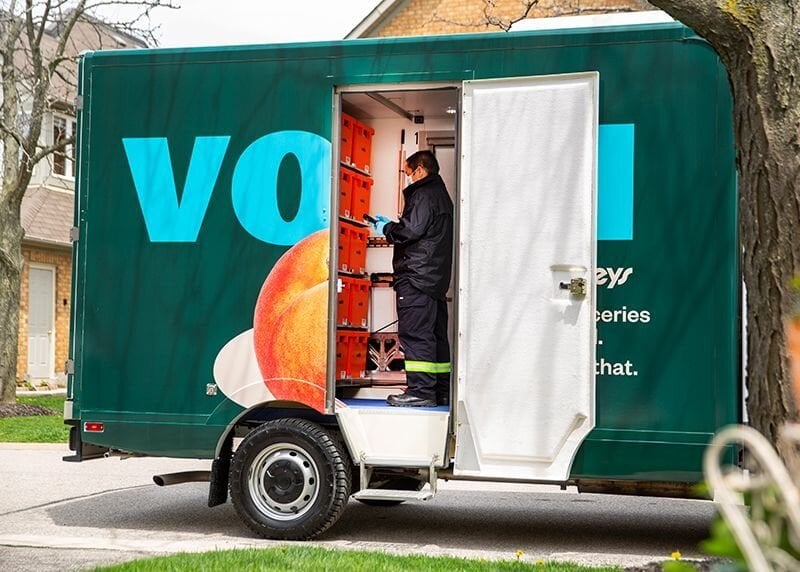
Voilà by Sobeys delivery truck. Photo: Sobeys
Voilà by Sobeys delivery truck. Photo: Sobeys
“That business model we’re delivering out of the CFC. The Toronto CFC was the first CFC for the delivery-based model. This September we launched curbside pickup as a way to extend our e-commerce offering to more Canadians. We launched in curbside pickup in Nova Scotia as our first market.”
Currently Voilà covers the entire Greater Toronto Area and Greater Hamilton Area for delivery.
“We’re in the process of rolling out curbside pickup for hundreds of stores across the country,” said Filion. “We just launched four (Safeway) stores in Alberta — three in Calgary and one in Edmonton. And we have an additional eight stores in Nova Scotia and you can expect a future rollout of stores across the country in the coming year.”
Safeway curbside pickup locations in Alberta include:
● Safeway Shawnessy – 70 Shawville Boulevard SE, Calgary;
Orders are assembled by Voilà staff and delivered directly to customers’ cars to provide a contactless experience. Local customers can order online at Voilà.ca or by downloading the Voilà mobile app.
At the CFCs, robots assemble orders in an automated warehouse, resulting in minimal product handling, while Voilà staff use enhanced COVID-19 sanitization protocols to deliver orders safely to customers’ homes.
The first centre was established in Vaughan, Ontario. The company’s plan is to have four centres across the country. Another centre is coming in Pointe Claire, Quebec. A previous news release said that facility will be ready to deliver to customers in early 2022. The location of the fourth facility has not been announced. The first centre is 255,000 square feet and each facility’s size will depend on the market they are serving. They will be able to fulfil very large orders very rapidly. They are also huge opportunities for job creation.
1 of 2
Voilà by Sobeys website. Photo: Sobeys
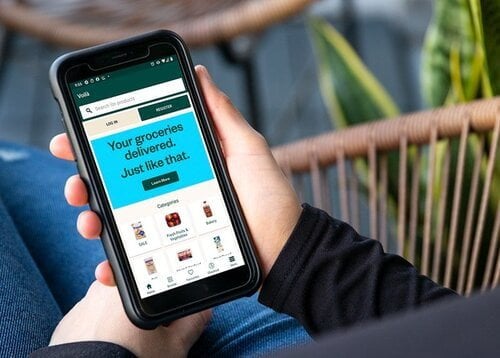
Voilà by Sobeys app. Photo: Sobeys
“Our four fulfiment centres will allow us to serve 75 percent of Canadian households. Our curbside pickup model will be an alternative option where the market density doesn’t justify a fulfilment centre or like in the case of Alberta while we wait for the fulfilment centre to be built,” said Filion.
“This is allowing us to really bring an industry-leading online shopping experience to Canadians. Before the pandemic, and even more so with the pandemic, we have seen an acceleration of grocery e-commerce and this is a solution that Canadian families are looking to have to have increased convenience, a great shopping experience and we partner specifically with Ocado. Ocado is our technology partner.”
In Toronto, the concept is called Voilà by Sobeys. When it is launched in Quebec, it will be called Voilà par IGA and in Alberta it is Voilà by Safeway.
All the brands fall under the Empire Company Limited umbrella which is based in Stellarton, Nova Scotia, with about $28.4 billion in annual sales, $15 billion in assets, and employing about 127,000 people.
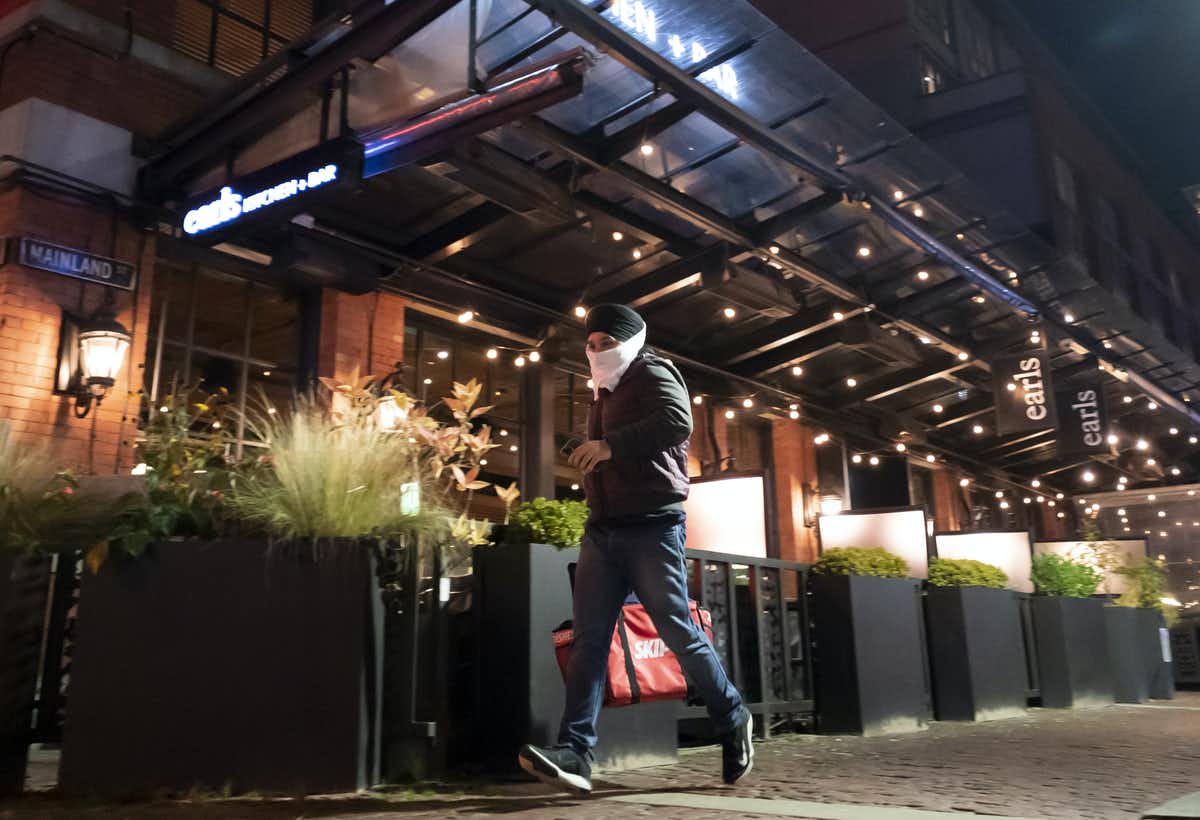
A food delivery worker wearing a face mask to help curb the spread of COVID-19 is framed by a large public art installation while riding a bike in Vancouver in November 2020. Photo: THE CANADIAN PRESS/Darryl Dyck
To say it’s been a rough year for the foodservice industry is an understatement.
Restaurants across Canada have suffered immensely from stay-at-home orders, strict in-person seating capacity restrictions and other lockdown measures induced by the COVID-19 pandemic. Ten per cent of Canada’s independent restaurants have already permanently shut down in light of pandemic-related hardships, and recent estimates project that another 40 per cent may not survive beyond March 2021.
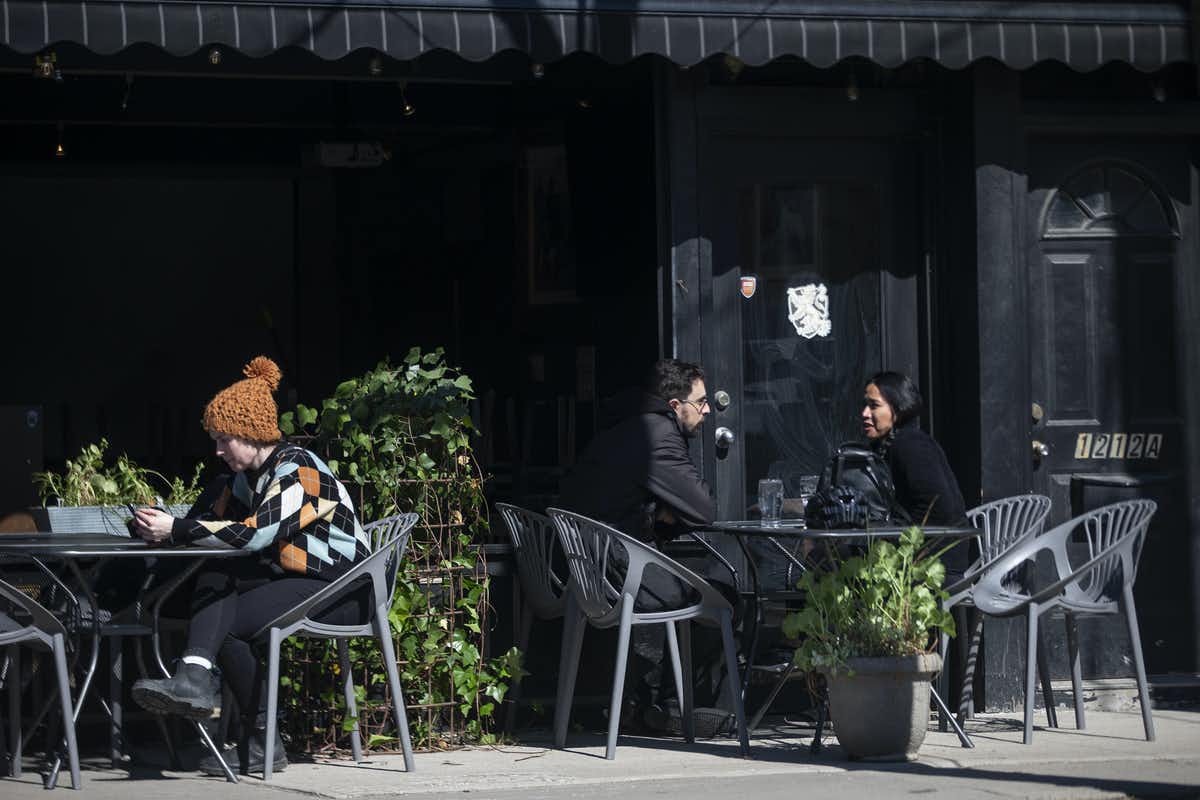
Customers sit on a patio at a bar in Toronto on March 20, 2021 — the day restaurants in Toronto and Peel Region were allowed to offer customers outdoor dining. Photo: THE CANADIAN PRESS/Chris Young
To remain afloat during these trying times, many restaurants have relied — often reluctantly — on food delivery applications like Uber Eats, Door Dash and Skip the Dishes, despite recognizing the untenability of the high commission fees they command, some as high as 30 per cent.
In an effort to help restaurants, several provinces have proposed capping food delivery fees and, while laudable, these efforts do not suffice. If the intent is to save restaurants, many of which are deeply woven in the fabric of neighbourhoods and communities across Canada, a bolder solution is needed. The Canadian government must partner with restaurant associations to create its own no-fee food delivery platform.
Monumental Growth
In this past year, third-party food delivery apps have experienced monumental growth and have come to represent a significant share of restaurants’ overall business, making them all the more indispensable during these trying times. These apps work by connecting hungry customers to their favourite restaurants and enable seamless mobile transactions in exchange for a commission fee.
While it may be argued that such apps served as a lifeline for restaurants during the pandemic, many restaurant owners are quick to point out that the increase in delivery app sales did not necessarily translate to higher earnings. That’s because the revenue generated through these apps were largely negated by exorbitant commission fees.
Whatever modest short-term revenue gains restaurants did experience through delivery apps has also come at the expense of their long-term chances of success. At the best of times, restaurants operate on razor-thin margins and simply cannot afford to have delivery apps shave off an additional portion of their revenues.
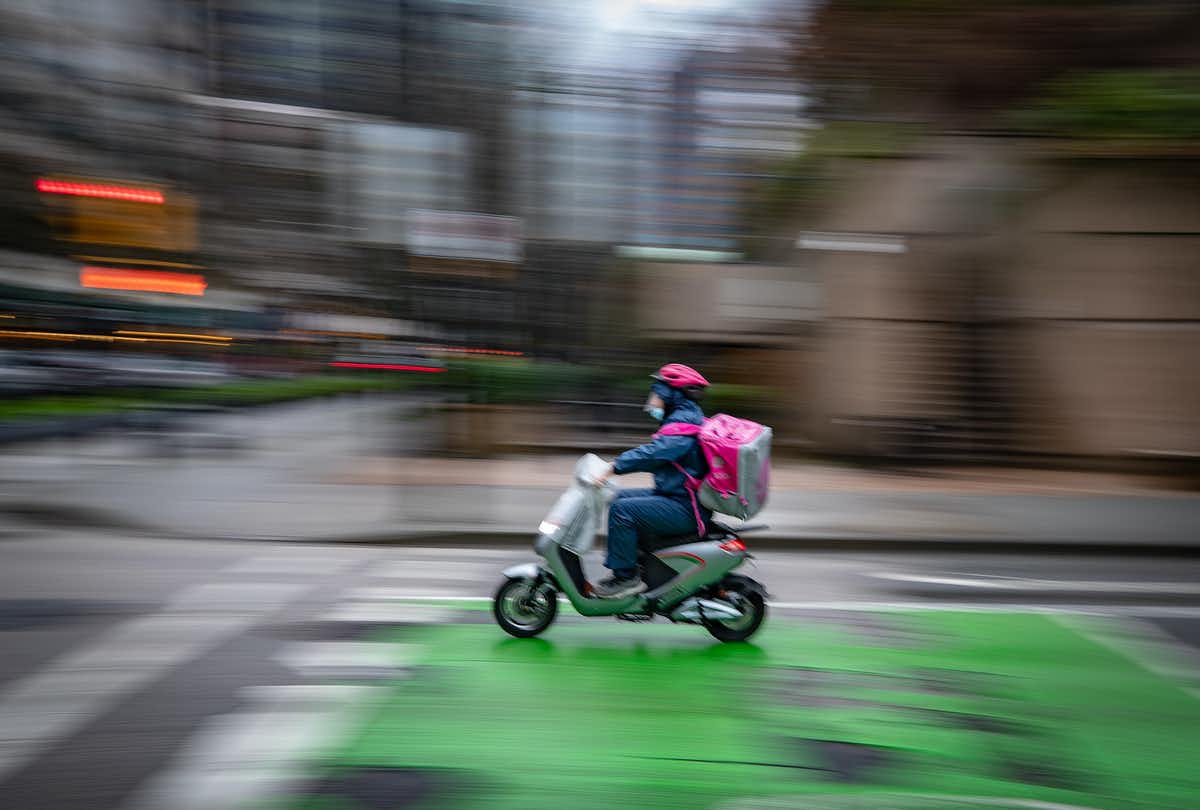
A food delivery worker rides an electric bike in downtown Vancouver in January 2021. Photo: THE CANADIAN PRESS/Darryl Dyck
Restaurants’ reliance on delivery apps may have been necessary during the pandemic, when trying to avoid bankruptcy. But it cannot be sustained indefinitely, especially if online orders end up permanently replacing those that would otherwise have been made through restaurants directly.
Many have accused food delivery companies of being greedy given how much restaurants have suffered during the pandemic, and have pressured governments to intervene. Heeding to mounting concerns from their constituents, mayors and premiers across Canada passed legislation to cap food delivery charges.
Only Minor Concessions
But unfortunately, these efforts have only led to minor concessions from food delivery apps and are largely regarded as insufficient by Canadian restaurant associations, many of which saw their members lose upwards of 80 per cent of their business at a time when food delivery apps were registering soaring profits.
This sentiment was further echoed by many Canadians who did not place much trust in these temporary measures — nor in bargaining with Silicon Valley-based companies — and did not wish to imagine their cities devoid of the life, vibrancy and diversity that restaurants contribute. To ensure the survival of restaurants, governments must go beyond capping food delivery charges, and must offer a no-fee food delivery platform.
A food delivery man wears a protective face mask to prevent the spread of COVID-19 as he picks up food in Vancouver in December 2020. Photo: THE CANADIAN PRESS/Jonathan Hayward
Admittedly, government agencies are not often top of mind when it comes to app development. But they could easily use a portion of the $1.5 billion promised as part of the federal government’s Regional Relief and Recovery Fund to outsource this task.
Or they could use some of this fund to support existing efforts led by Canadian restaurant associations. The Ontario Restaurant Hotel and Motel Association, for instance, is in the midst of launching a food delivery app in Toronto that promises to charge less than 10 per cent commission fees and expects to expand its services to other jurisdictions in the near future.
Partnering on such initiatives and offering financial support to enable restaurant association-backed apps to reduce their commission fees even further during the pandemic would not only provide restaurants with much-needed relief. It would also prepare them for a future in which app-based deliveries account for a sizeable share of their overall sales.
Apps Are Here to Stay
According to a recent study by researchers at Dalhousie University, 64 per cent of Canadians have ordered food online in the past six months. But even more striking is that almost 50 per cent say they intend to keep doing so at least once per week once the pandemic is over.
Food delivery apps are here to stay, but bargaining with large tech companies or passing temporary legislation to limit their fees will do very little to help the restaurant industry succeed in a post-pandemic world.
Instead, the federal government must support grassroots efforts led by restaurant associations to create a no-commission-fee delivery app option during the pandemic. The fees can later be increased to cover the app’s operating costs, at which point it will hopefully have garnered a large enough base of users to compete with the food delivery giants.
Only then will the Canadian restaurant industry have the tools necessary to ensure its survival both during and beyond the COVID-19 pandemic.
As the COVID-19 pandemic worsened in Canada and worldwide, virus-curbing restrictions meant that merchants and shoppers alike had to get more acquainted with e-commerce. For example, the year-on-year growth spanned from 175% to 625% for Canadian online sales from March to May 2020.
The internet’s reach meant that retailers often sold products to customers that would never shop at a company’s stores in-person, often due to geographical distance. What does that remote selling mean for business taxes this year?
James Peterson, a tax professional with a private practice in southwestern Ontario, who is currently serving as chairperson of the Association of Tax & Accounting Professionals, has some valuable expertise to share.
E-commerce May Go Beyond Browser-Based Sales
First, merchants that pay taxes in Canada must be aware that e-commerce doesn’t only relate to sales occurring via web browsers. Instead, Peterson clarified, “…The federal government defines e-commerce as the delivery of information, products, services or payments by telephone, computer, or other automated media.”
He continued, “Vendors that do not have a website might find themselves subject to the rules around e-commerce, especially when it comes to collecting and remitting sales tax.” In short, Canadian residents must report worldwide sales from e-commerce when filing their tax returns.
However, the situation differs in other countries. Merchants that sell online in the United States must pay applicable sales taxes concerning transactions across state lines. However, each state has different rules about which businesses must collect and pay those taxes.
Merchants in the European Union have new rules for value-added taxes for goods sold via the internet. More specifically, there is a €10,000 threshold for so-called distance sales. Cross-border business-to-consumer transactions up to that amount follow the VAT rules of the supplier’s member state. However, sales exceeding that limit abide by the VAT rules in the recipient’s member state.
Reporting Rules Apply
Most businesspeople know they must follow specific procedures when reporting their income for tax purposes. Otherwise, they could make an error that might make an audit more likely to happen.
Peterson explained, “While all existing tax laws apply to business conducted over the internet, if you earn income from one or more websites, you need to list your five highest-grossing sites and report the total percent of your overall revenue made up by internet sales.”
Online revenue doesn’t stop at website sales. “The definition of a website would encompass a traditional webpage as well as any online platform that is accessed via a computer or a smartphone,” Peterson said. Moreover, Canadian business owners would detail such income on T1 or T2 tax forms, depending on their company structures.
In the United States, what constitutes business income is not necessarily straightforward. For example, a person who paints as a hobby could sell work on eBay and not count that transaction as a business sale. However, U.S. tax authorities determined a hobby turning a profit for three out of five years becomes a business and must file taxes to reflect that change.
However, Americans who used their recent extra time at home due to COVID-19 restrictions to sell used items they no longer want shouldn’t worry about business tax impacts in those cases. Generally, if people use items then sell them for less than the purchase price, they don’t owe taxes on the goods.
How Does the Goods and Services Tax/Harmonized Sales Tax Apply to Remote Sales Targeting Canadians?
Canada has a regime called the Goods and Services Tax/Harmonized Sales Tax (GST/HST). Merchants registered for it must follow the associated rules whether they sell something online or in-person.
“If you are registered for GST/HST, you must collect it on any transactions within Canada, whether the sale is made in-person or over the internet. The requirement to collect GST/HST extends beyond Canadian residents. Non-resident vendors that sell in Canada via [the] phone or internet might be required to register for GST/HST depending on their circumstances,” Peterson noted.
Indeed, as of July 1, 2021, vendors operating outside of Canada with sales exceeding $30,000 CAD to Canadian consumers annually must abide by a simplified GST/HST framework.
The specifics most relevant to the topic at hand are that GST/HST applies to:
Foreign-based digital businesses selling digital products or cross-border services to Canadians.
Transactions associated with foreign companies selling goods originating from fulfillment warehouses in Canada and distributed to consumers in the country.
Getting Tax Guidance Can Bring Peace of Mind
The specifics here cover some general topics that many business owners will find helpful as they get their tax paperwork in order this year. It may prove valuable for the foreseeable future, too, especially with consumers often concluding that buying things online is a convenient solution.
Devin Partida is a writer and blogger, as well as the Editor-in-Chief of ReHack.com
However, anyone who needs further guidance would likely find it worthwhile to get input from a tax expert familiar with their individual situations. Then, people will have the highest likelihood of filing without issues and ensuring they enter the correct information on the relevant forms.
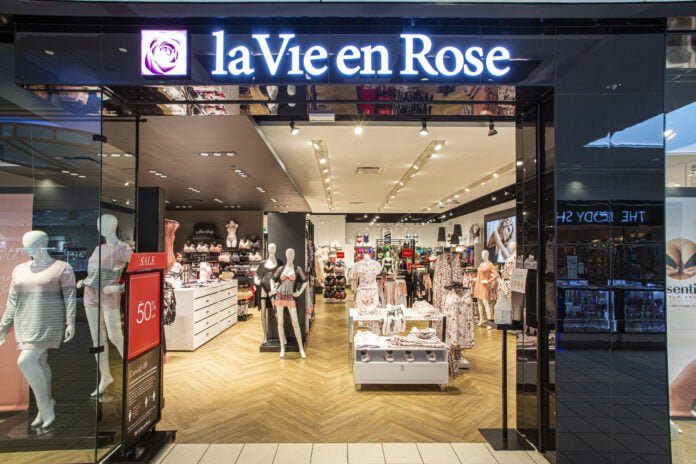
La Vie en Rose at Sherwood Park Mall, February 2021. Photo: Primaris Management
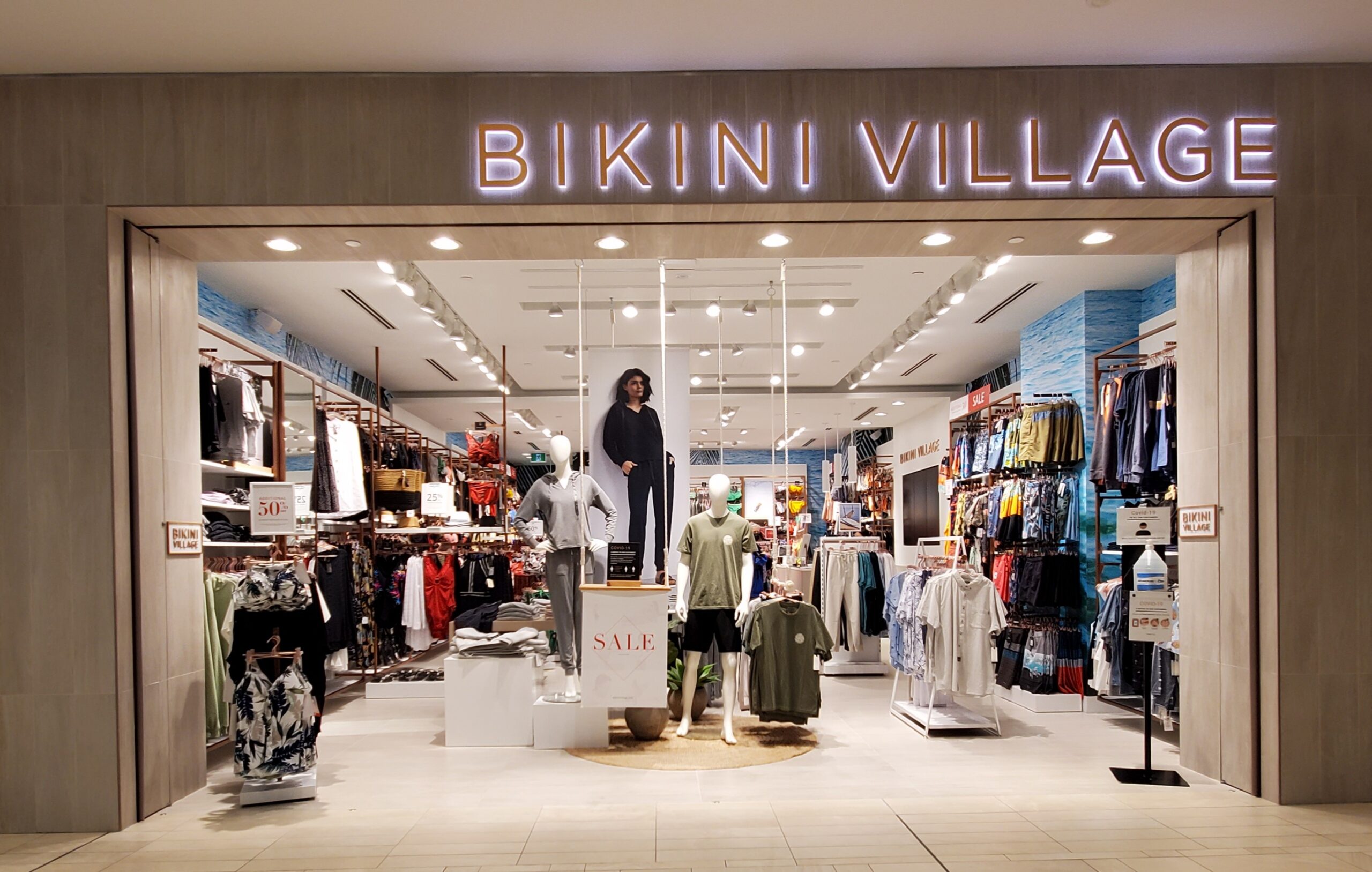
While other retailers are cutting back on their footprints across Canada or even closing their doors, François Roberge is looking at expansion for his brands La Vie en Rose and Bikini Village.
This year marks the 25th anniversary of when Roberge, President and CEO, and his two partners, his wife Lina Di Liello and his brother-in-law, John Izzo, acquired the iconic Canadian brand La Vie en Rose.
François Roberge
“It was such a heartwarming feeling to realize that 2021 marks the 25th year that La Vie en Rose has been under our ownership. I can say that celebrating a company anniversary like this one is quite a success in our industry nowadays. Retail is far from being a walk in the park, especially in the last year, which has by far been my biggest challenge as an entrepreneur. I’m staying optimistic and I can’t wait to see what the future holds,” said Roberge, of the lingerie, sleepwear, and swimsuit retailer.
The company has its head office and distribution centre in Montreal and employs more than 3,000 people across the country.
Today, La Vie en Rose has 201 locations across Canada, as well as 89 others in 16 different countries. After launching the La Vie en Rose swimsuit collection in 1998 and creating the e-commerce website in 2001, the entrepreneur took a giant leap in 2015. He acquired the swimsuit and beachwear retailer Bikini Village along with its 48 stores. The banner now has over 65 stores nationwide.
“In February 1996, we took over a little chain of 23 stores, mainly in Ontario. I thought at that time it had huge potential because the name was strong, the location was good, the stock and the staff were there,” said Roberge. “I thought this was a future growth market. When I moved the head office to Montreal, there were 12 people. Now we’re more than 350.
“When you look over the last 25 years, it’s crazy because we never stopped. I always say to everybody that in retail you grow or you die. And this is my philosophy in the last 25 years. Always push the machine to maximize the potential of the banner.
“I still have fun. This is one of the important keys when you are a retailer. If you don’t have fun, you should do something else.”
1 of 5
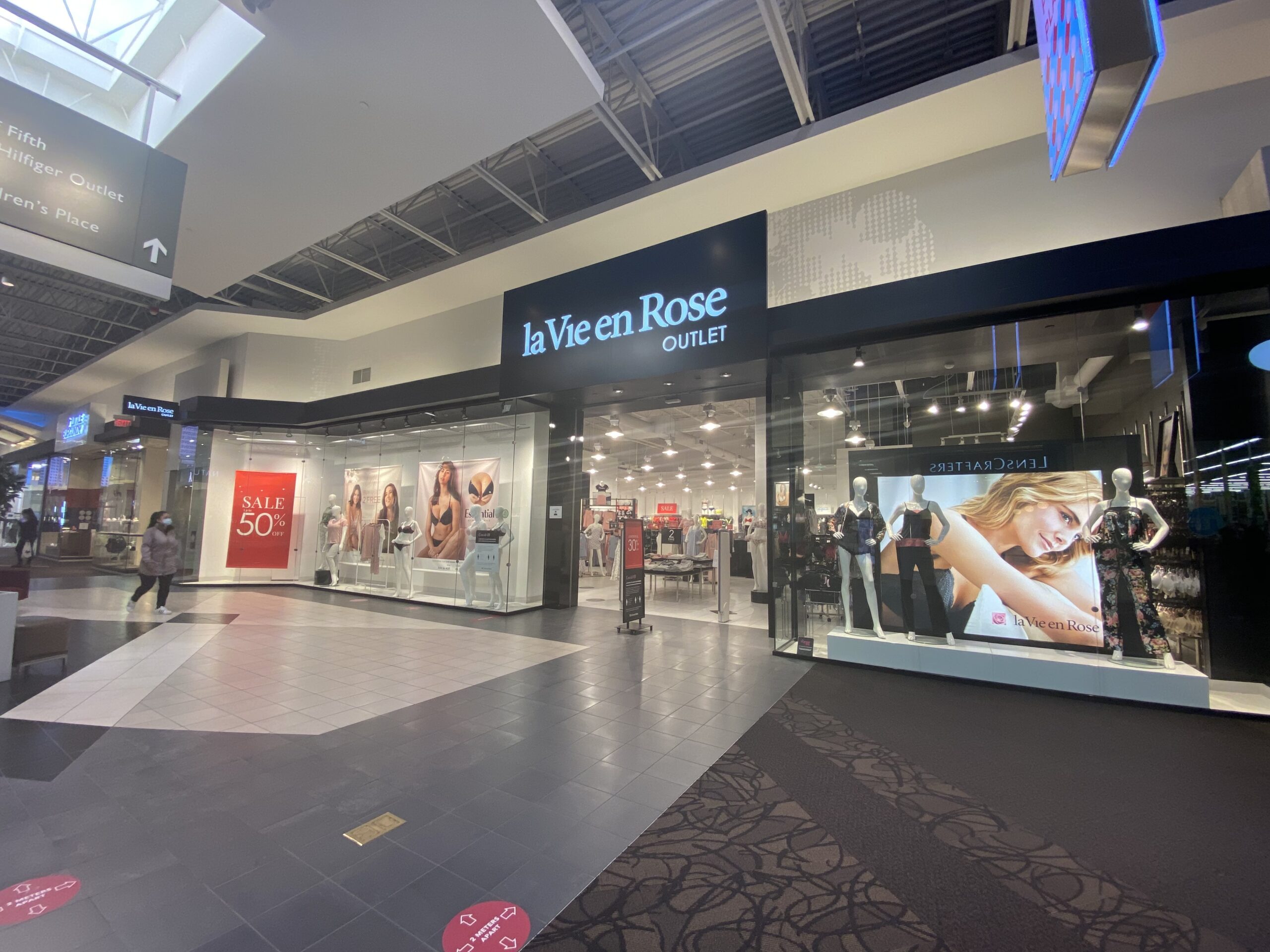
la Vie en Rose at CrossIron Mills. Photo: Jessica Finch
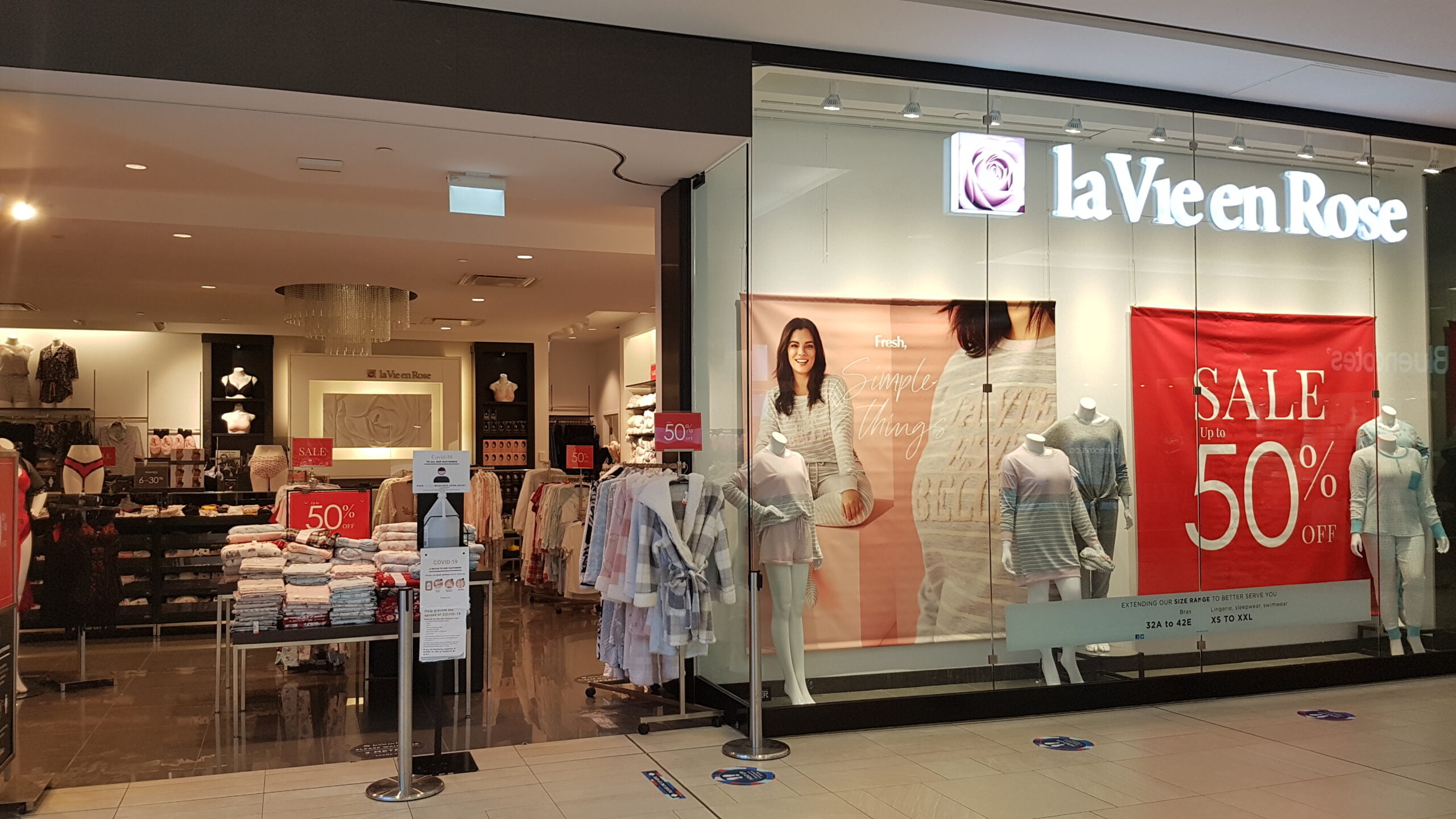
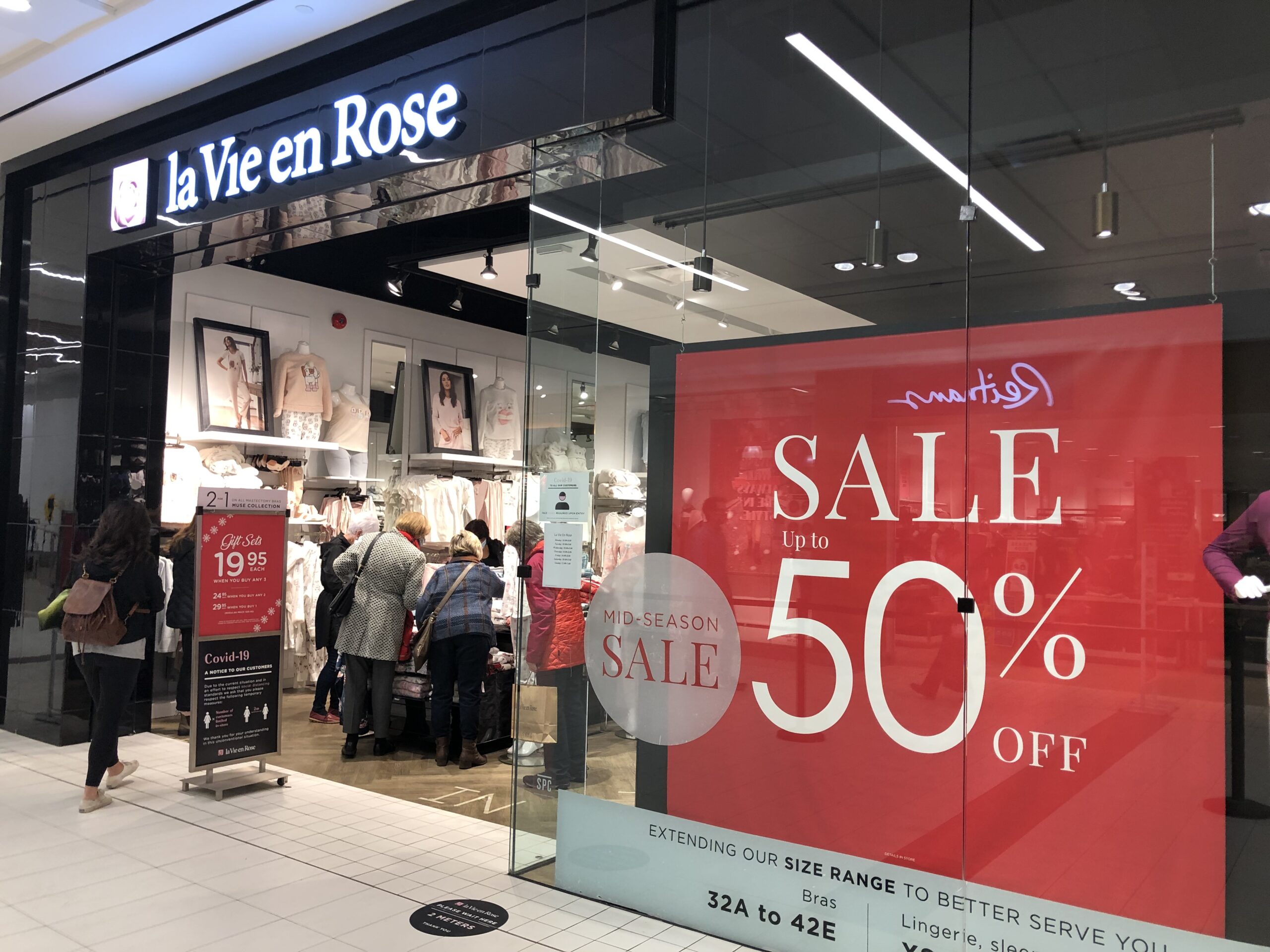
la Vie en Rose at CF Richmond Centre. Photo: Ritchie Po
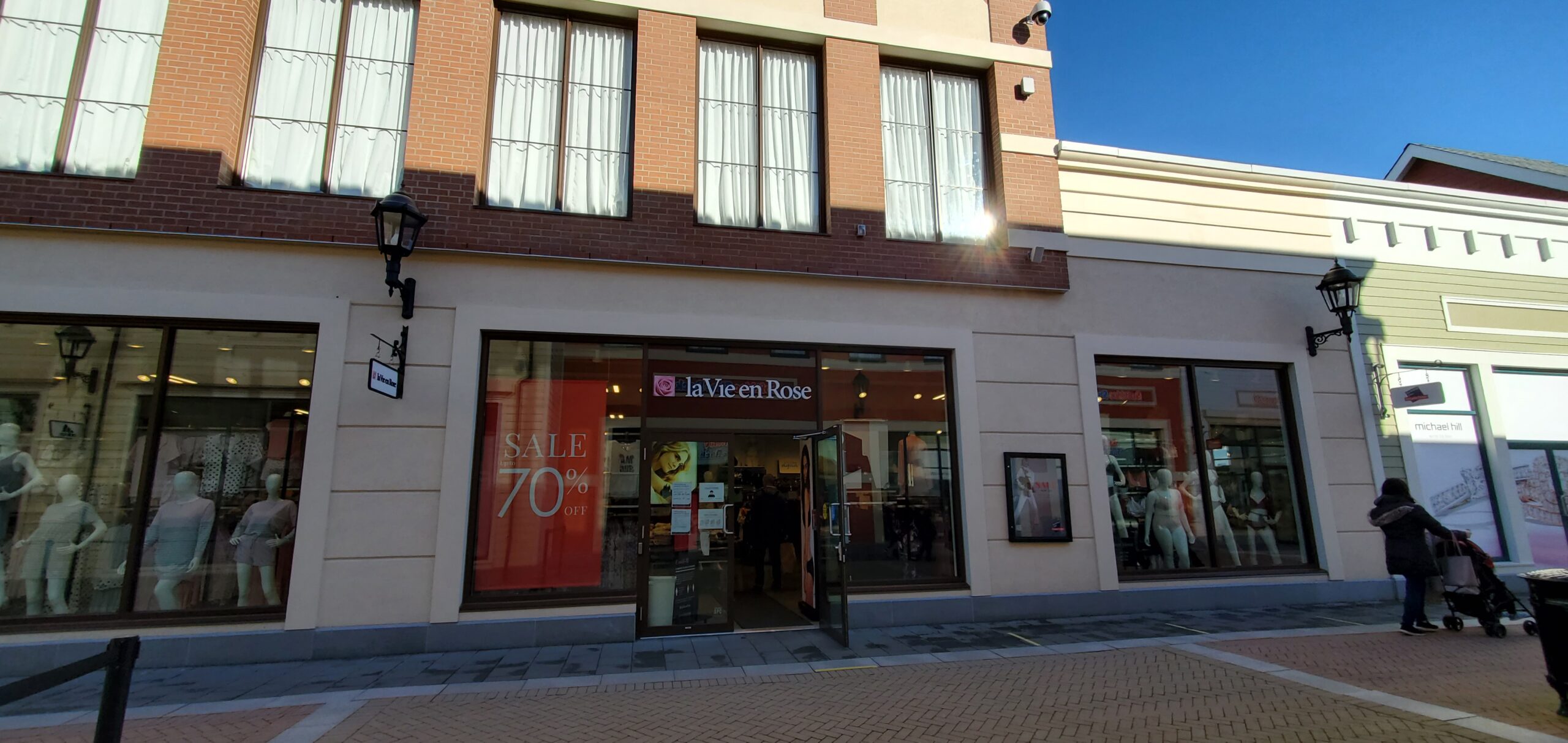
La Vie en Rose at McArthur Glen. Photo: Geetanjali Sharma
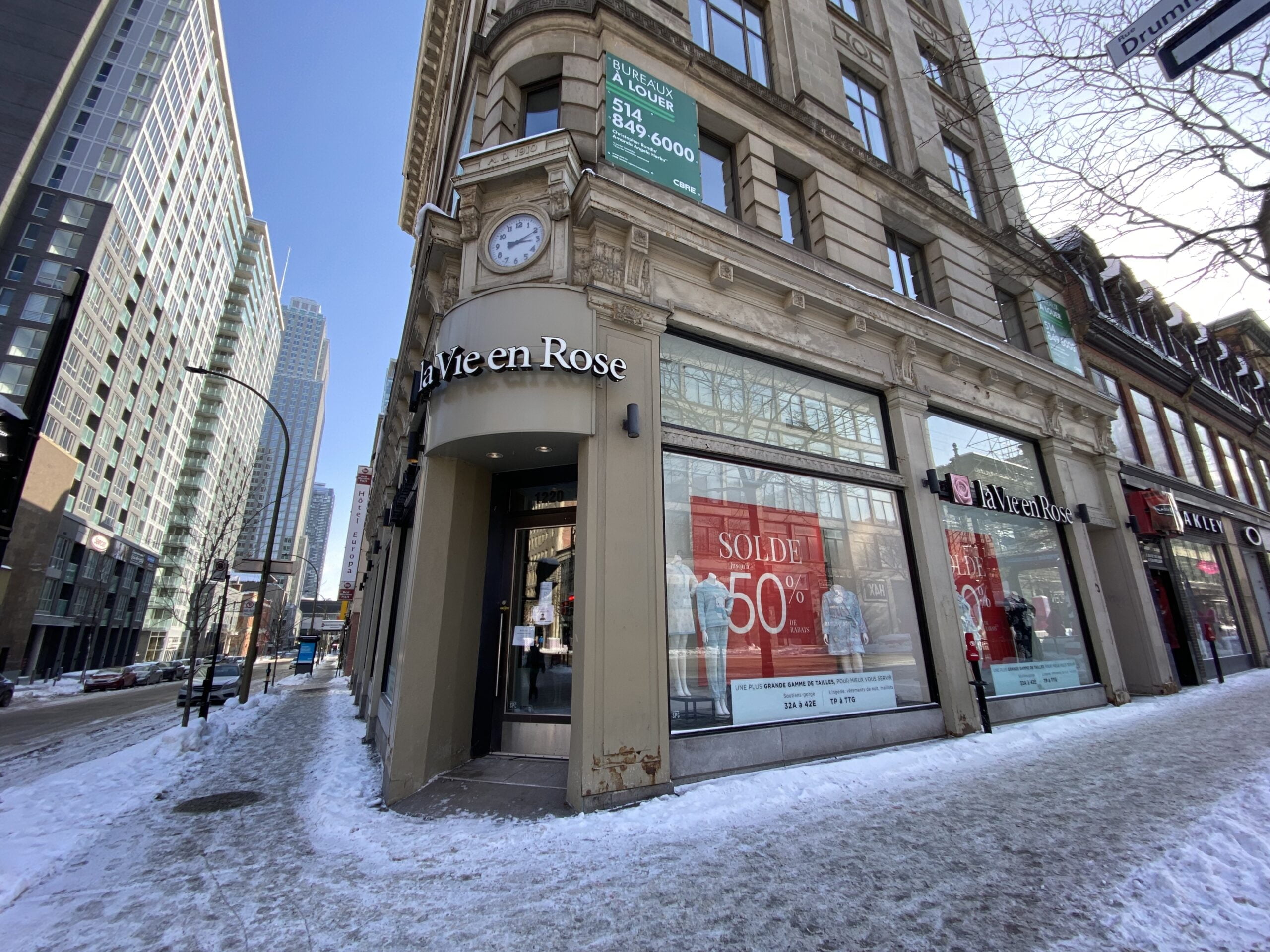
La Vie en Rose (1220 Saint-Catherine St W) PHOTO: MAXIME FRECHETTE
La Vie en Rose at Avalon Mall. January 2021. Photo: Crombie REIT
Roberge said the company has impressive plans to grow both banners in the near future especially since there has been a number of bankruptcies and creditor protection filings in the lingerie and swimsuit retail categories.
“There’s a lot of opportunity and I think it’s important to be aggressive. So if you look at what’s coming for the next six months, wow it’s crazy. We’re going to take a couple of La Senza’s . . . There’s an opportunity for us to take some market share. I’m going to do Willowbrook in Langley. I’m also taking a lease of La Senza in Red Deer. I’m taking a lease in Peter Pond Mall in Fort McMurray, which was also a La Senza. I’m taking the one in Cambridge. Also I’m taking the Mapleton Centre in Moncton, the Justice store. There’s a lot of stores we can take now and the market is for us,” said Roberge.
“Also, I’m taking five Swimco locations — mainly in the West — for Bikini Village.
“We’re moving. I think the next two years will be fantastic after the pandemic and I want to be ready to maximize every opportunity.”
Unlike many of his competitors, Roberge did not close any of the company’s stores during the pandemic — outside of mandated lockdowns. He is a firm believer in the value of physical stores with a strong omnichannel presence. Managing inventory has been a bit of a challenge over the past year particularly in the swimsuit category which has been impacted by travel restrictions. Communication within the store and its staff has been important to navigate through this tough economic time.
As a business owner, one of the key lessons Roberge said he has learned through the pandemic year is it’s a privilege to open a store. As the pandemic has shown, any government could close you down through lockdowns.
1 of 3
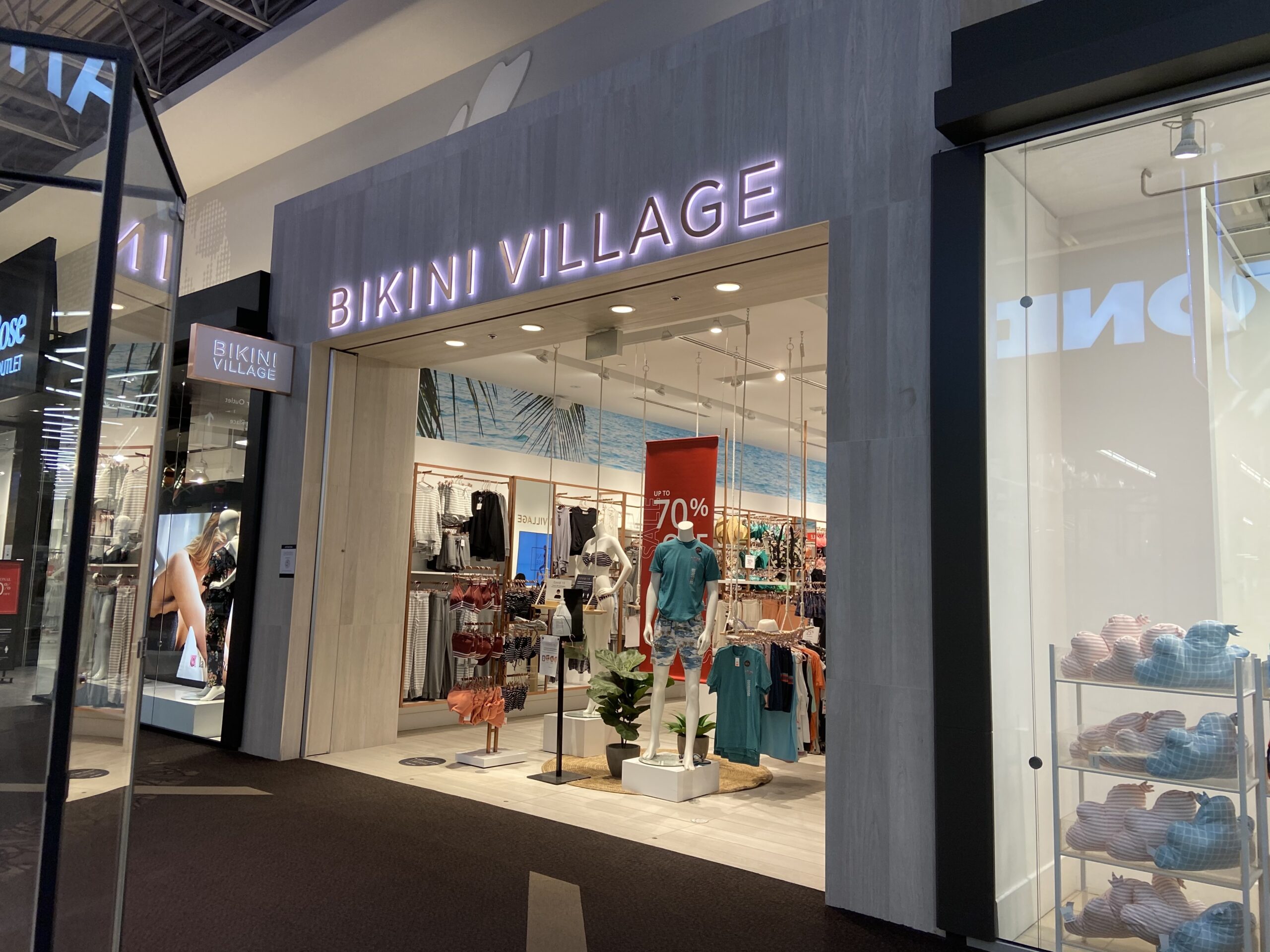
Bikini Village at CrossIron Mills. Photo: Jessica Finch
Bikini Village at Guildford. Photo by Lee Rivett
Bikini Village at CF Richmond Centre. Photo: Geetanjali Sharma
“It’s a privilege to be a retailer and to open a store because government can control much more than that. That’s my biggest learning. It’s an experience and communication and to build a bridge with government is important for a retailer,” he said.
Roberge said he believes brick and mortar stores mixed with a strong online presence is going to be the future for retailers. Price, quality, service, and reputation are important in success.
“The store is one of the keys for the future,” he said. “People can’t always stay at home and just wait and look at the computer. I think they like to go out. We’re going to see an evolution of the mall in the future because malls cannot just be fashion. They need to revise the business plan and everybody is working very hard on that.
“I believe that brick and mortar mixed with a strong web, customer service, is going to be the future.”
As an entrepreneur, Roberge began in the retail industry working for Boutiques San Francisco in a number of roles including Construction Director and Banner Director.
He acquired La Vie en Rose when he was 33 years old.
In 2002, Roberge created the Roses of Hope Foundation. This charitable organization’s mission is to financially support organizations that are committed to the well-being of women. Nineteen years later, $2.5 million has been donated, with more than half going towards the fight against breast cancer and support for women affected by the disease. La Vie en Rose also gives back to many other causes, in particular to organizations in its Montréal borough, Hochelaga-Maisonneuve.
Roberge has been President of the Board of Directors of mmode, the Metropolitan Fashion Cluster, for five years. The cluster’s mission is to improve the competitiveness and growth of the Quebec fashion industry. He also sits on the Chamber of Commerce of Metropolitan Montréal’s Metropolitan and Urban Affairs Committee and acts as mentor for many Canadian entrepreneurs.
La Vie En Rose works with brokerage Oberfeld Snowcap for its Canadian real estate negotiations.
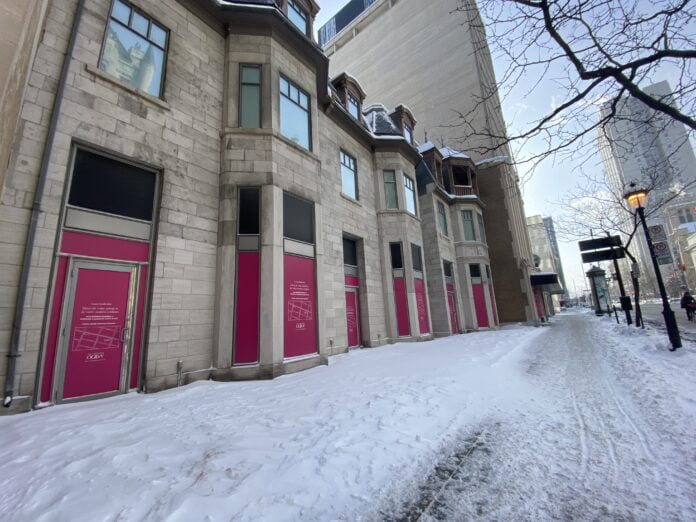
Former Holt Renfrew store at 1300 Sherbrooke St. W., photo by Maxime Frechette
Retail Insider continues its Photo Tour series by building on our extensive Saint-Catherine Street in Montreal During COVID-19 tour which we published on March 16, 2021. This time we’re delving deeper into the upscale Golden Square Mile in the downtown core that includes several luxury stores as well as some very interesting retail history.
The Golden Square Mile’s streetscape includes grand streets, attractive architecture and several large mansions from years past. Between the years 1870 and 1900, about 70% of the wealth in Canada was held by about 50 households living in the area and particularly north of where our tour was photographed.
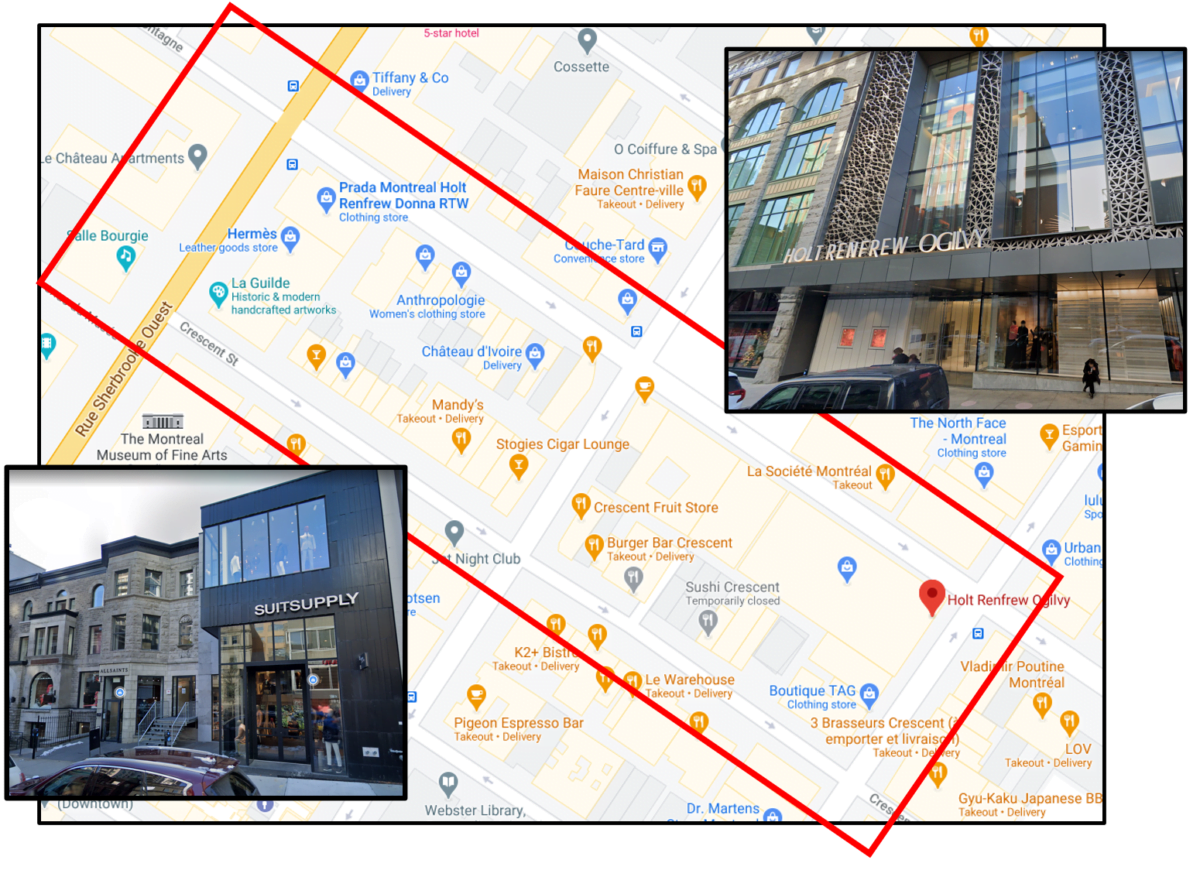
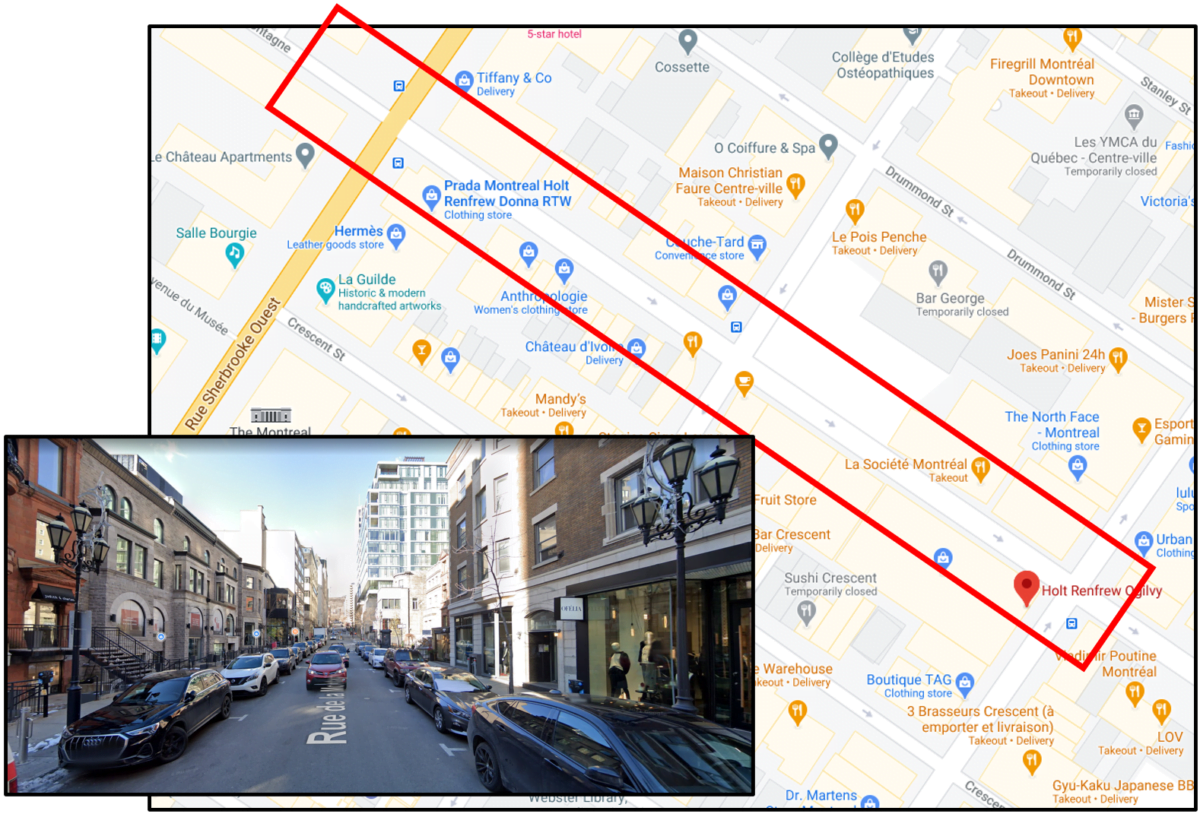
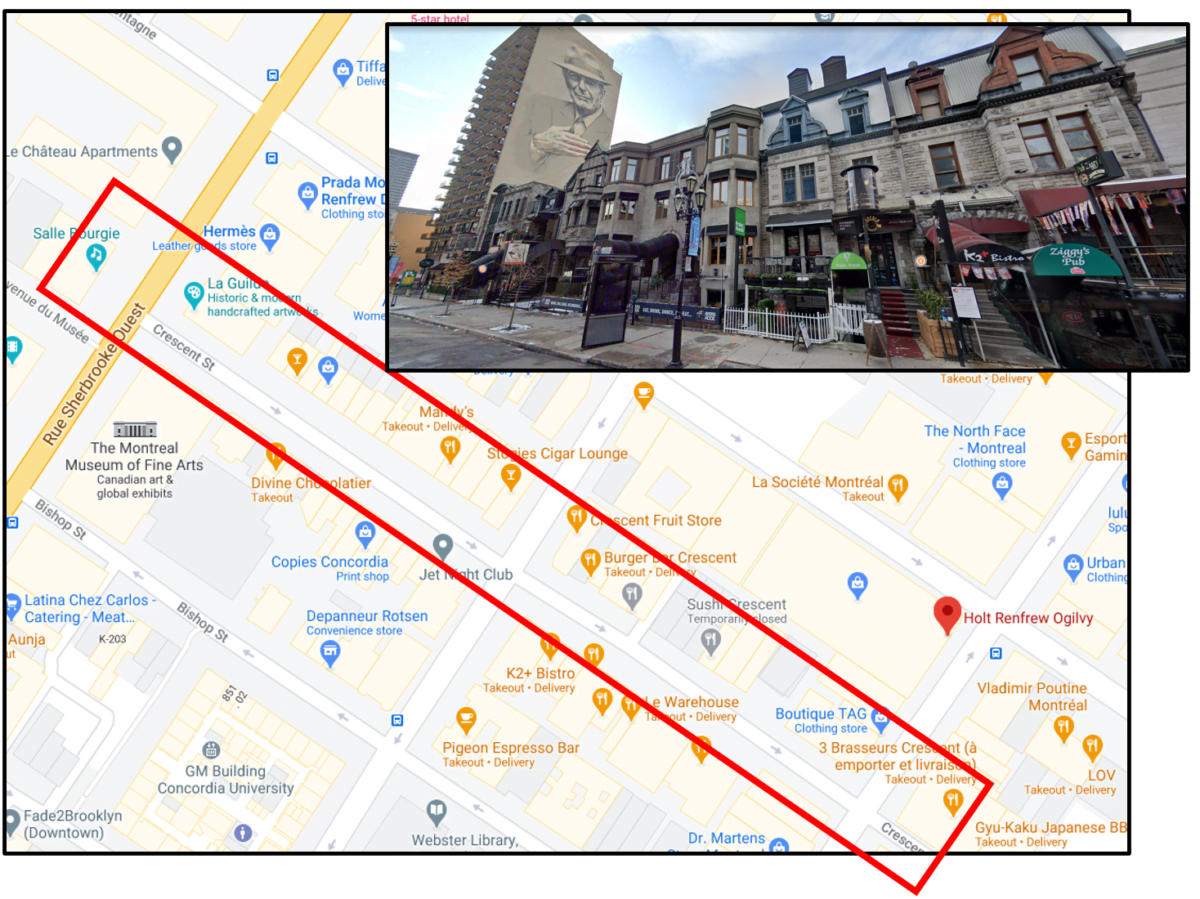
The photos in this tour were taken along the two block retail zone between Sherbrooke Street West and Saint-Catherine Street on Rue de la Montagne and Crescent Street. Come for a journey where we discuss what’s there, and the interesting retail that once was.
Map of the Montreal Luxury Zone between Rue Sherbrooke Ouest and Sainte-Catherine Street. Photo: Google Maps
Holt Renfrew Ogilvy (Saint-Catherine Street and Rue de la Montagne)
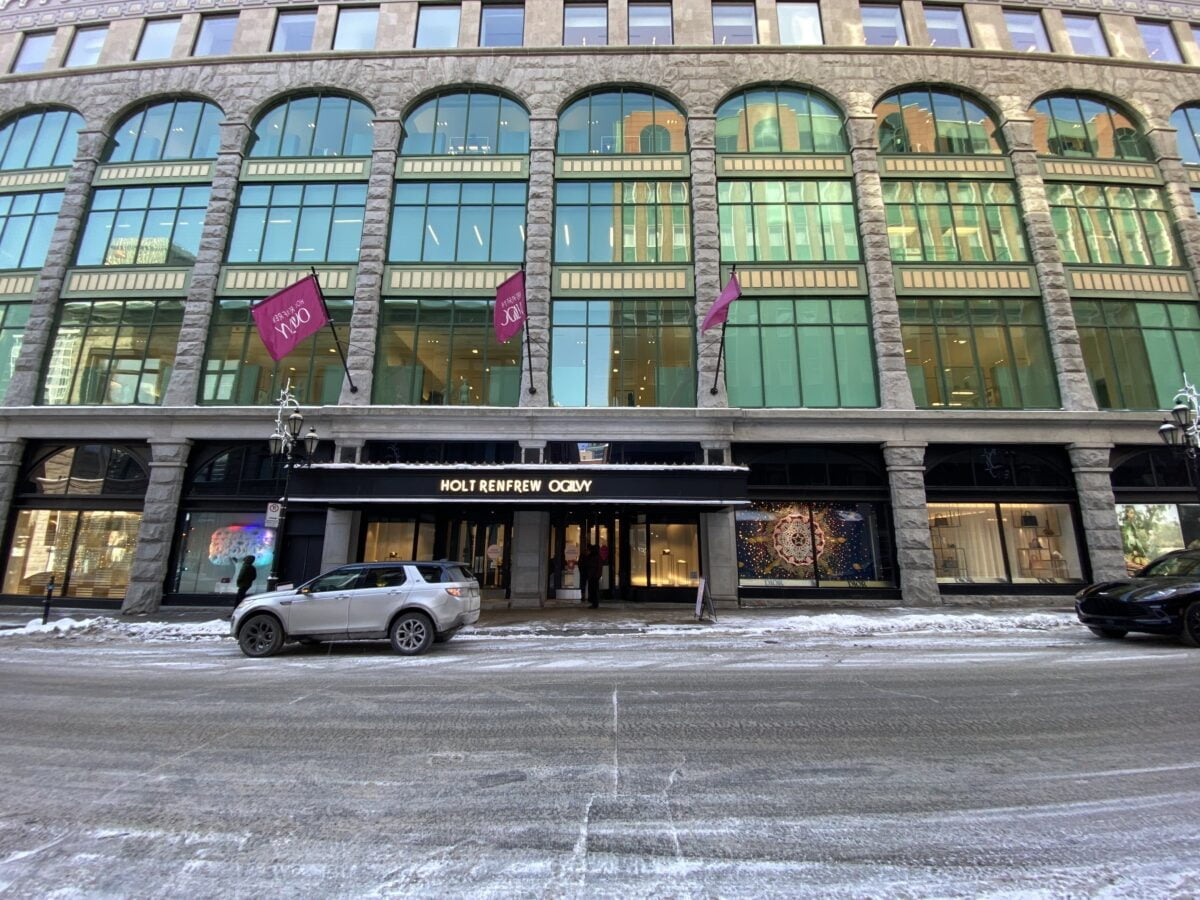
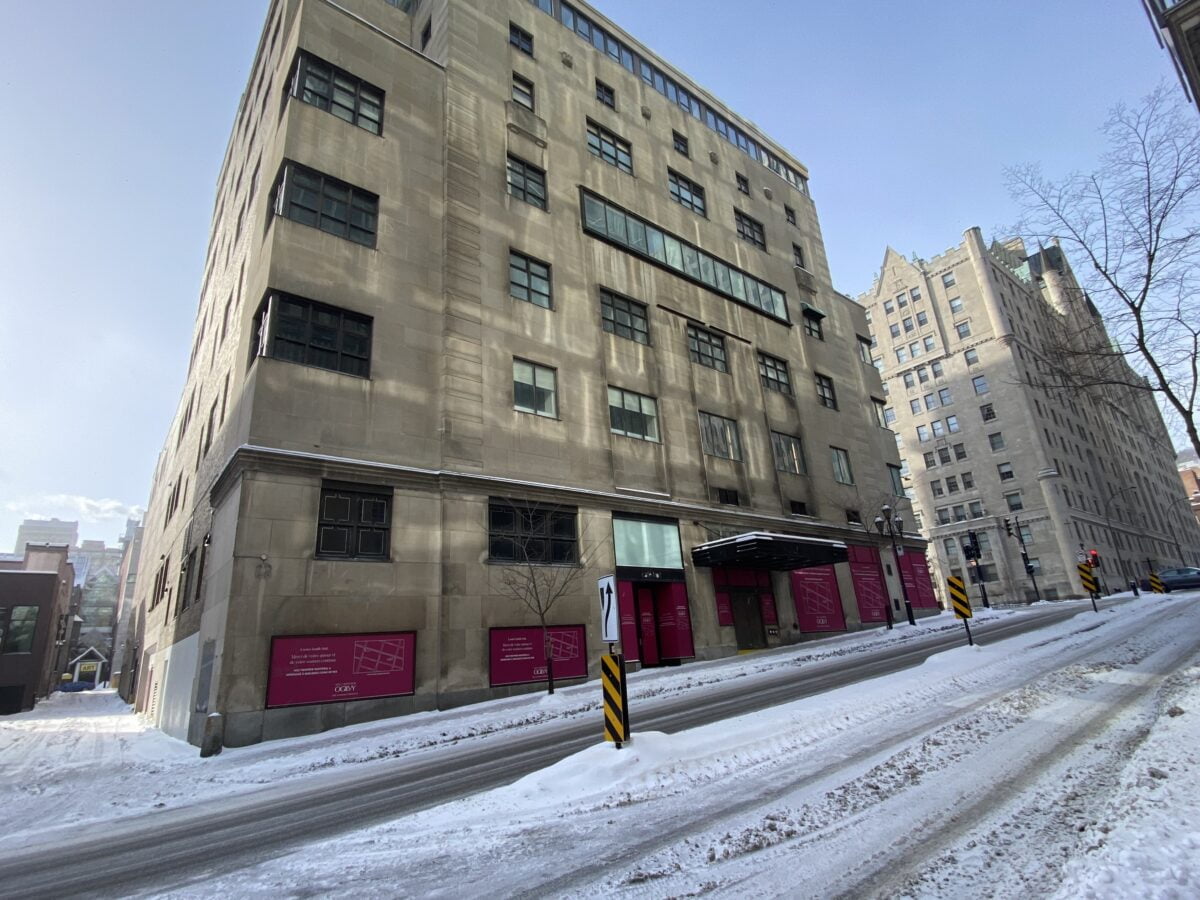
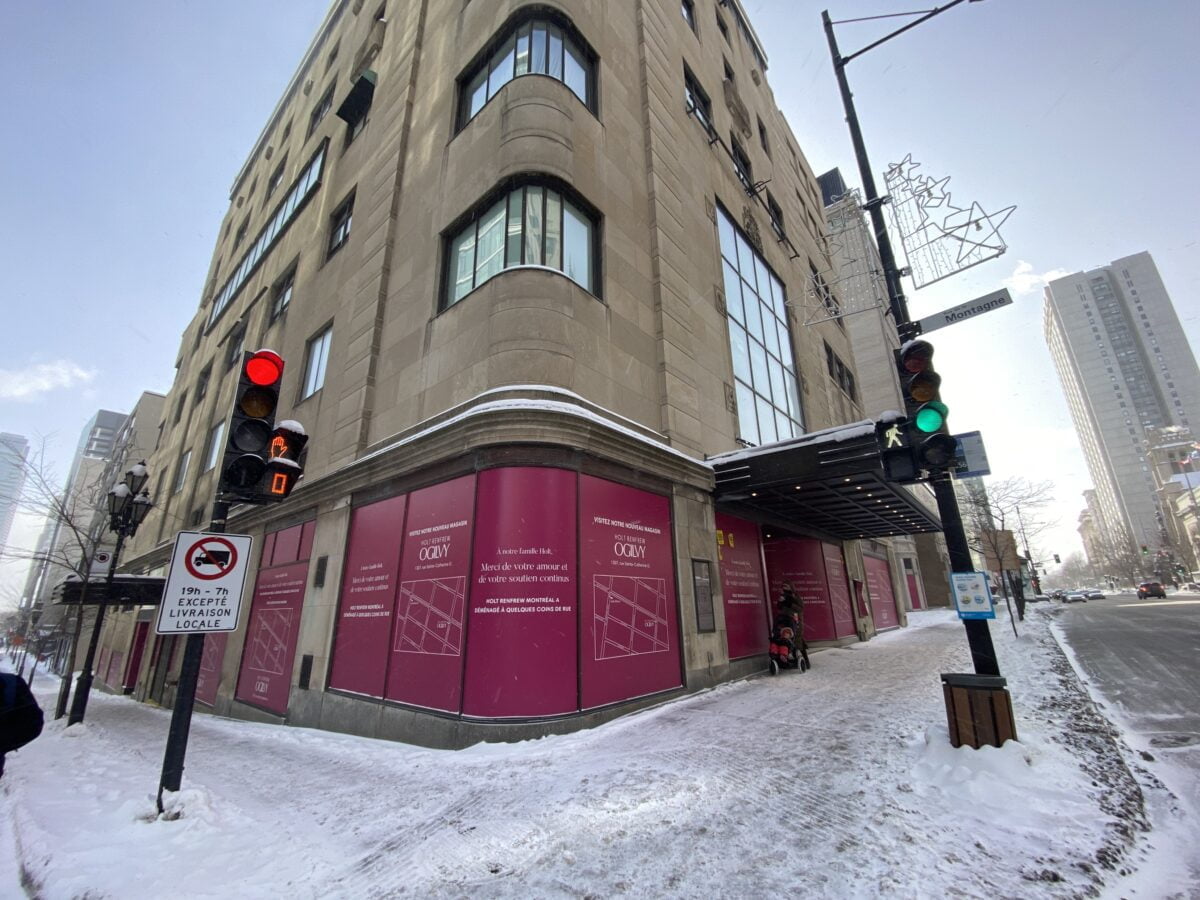
Arriving at Rue de la Montagne reveals the beautiful Holt Renfrew Ogilvy that has been reported on extensively in Retail Insider. The original Ogilvy’s department store was founded by the Ogilvy family in the 1800s and changed ownership several times over the years. Two major ownership shifts occurred, including the Ogilvy ownership being purchased by Equidev (a Montreal development group), which performed major updates to the building in the 1980s that included developing a concession model housing 52 designer boutiques. The retailer changed owners a couple more times as decades passed and most recently was purchased in 2011 by Wittington Investments which also owns Holt Renfrew within its subsidiary company, Selfridges Group Limited.
The existing Montreal Holt Renfrew store, which had previously operated nearby at 1300 Sherbrooke Street West since 1937, closed in June 2020 to coincide with the opening of the expanded Holt Renfrew Ogilvy store on Saint-Catherine Street. The 250,000-square-foot Holt Renfrew Ogilvy store is one of the largest multi-brand luxury stores in North America and is the largest showcase of luxury brands in the Montreal market. All six retail levels were renovated and reopened in July 2020.
Holt Renfrew Ogilvy at 1307 Saint-Catherine St W. Photo: Maxime Frechette
Rue de la Montagne
Map of the Montreal Luxury Zone on Rue de la Montagne. Photo: Google Maps
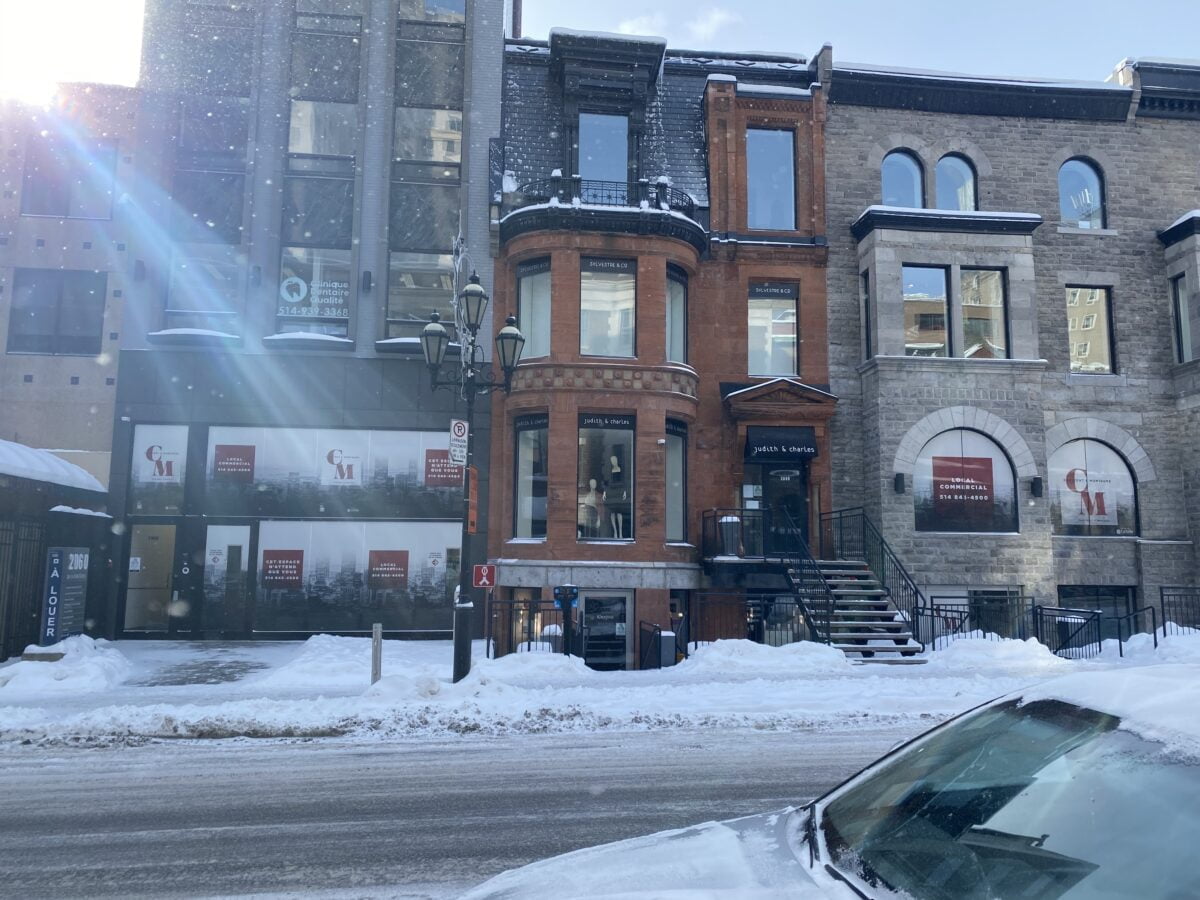
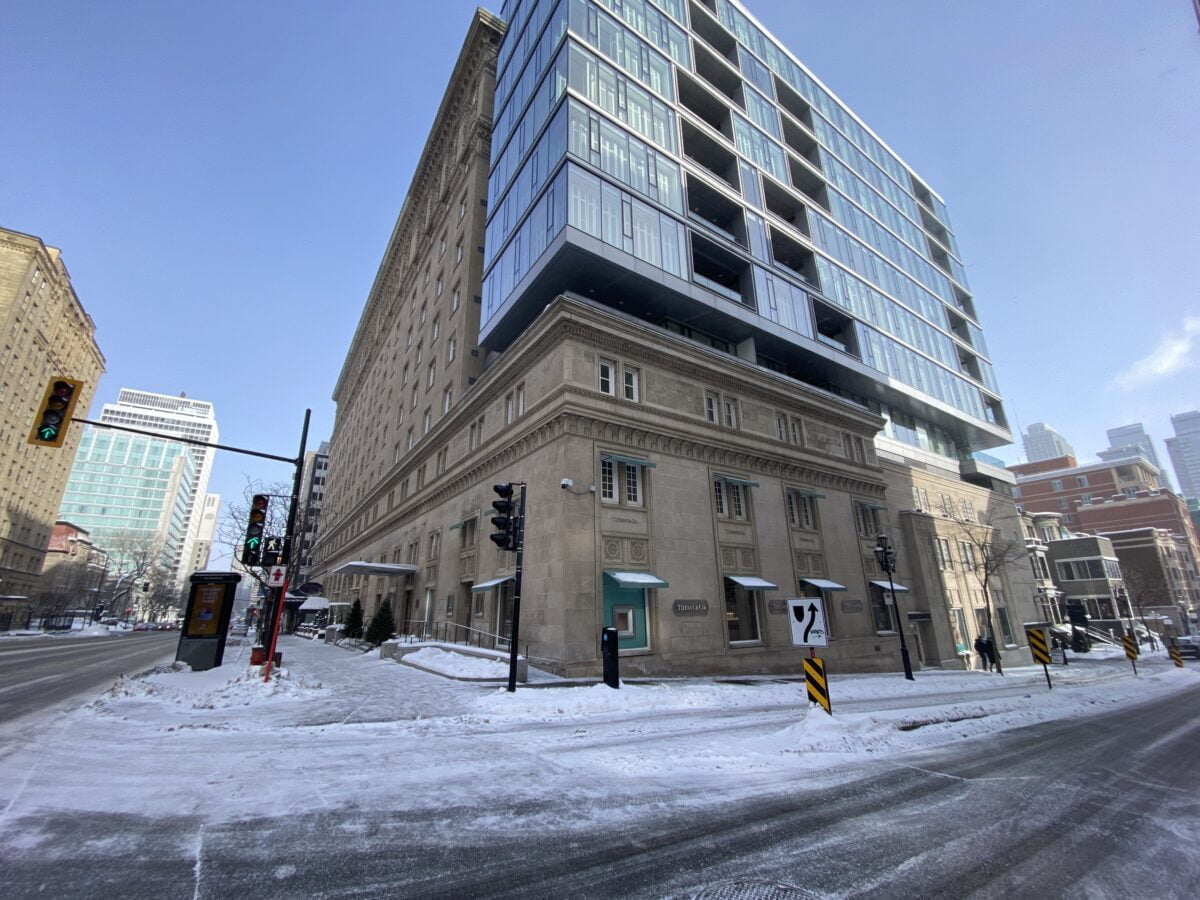
The two block stretch of Rue de la Montagne between Sherbrooke Street and Ste-Catherine Street is the closest thing that Montreal has to a retail “luxury run”. Several upscale stores have opened over the years on the street that is anchored by the Ritz Carlton Hotel to the north and Holt Renfrew Ogilvy to the south. At the Ritz is a 2,000 square foot Tiffany & Co. store that opened in February of 2012. The store is less than 250 metres from the 2,500 square foot Tiffany & Co. concession that opened at Holt Renfrew Ogilvy last year.
Chanel on Rue De La Montagne in Montreal. Photo: Maxime Frechette
The bilevel 3,300-square-foot Chanel boutique on the street level of Holt Renfrew Ogilvy opened in the fall of 2019. A Louis Vuitton boutique is located further to the left.
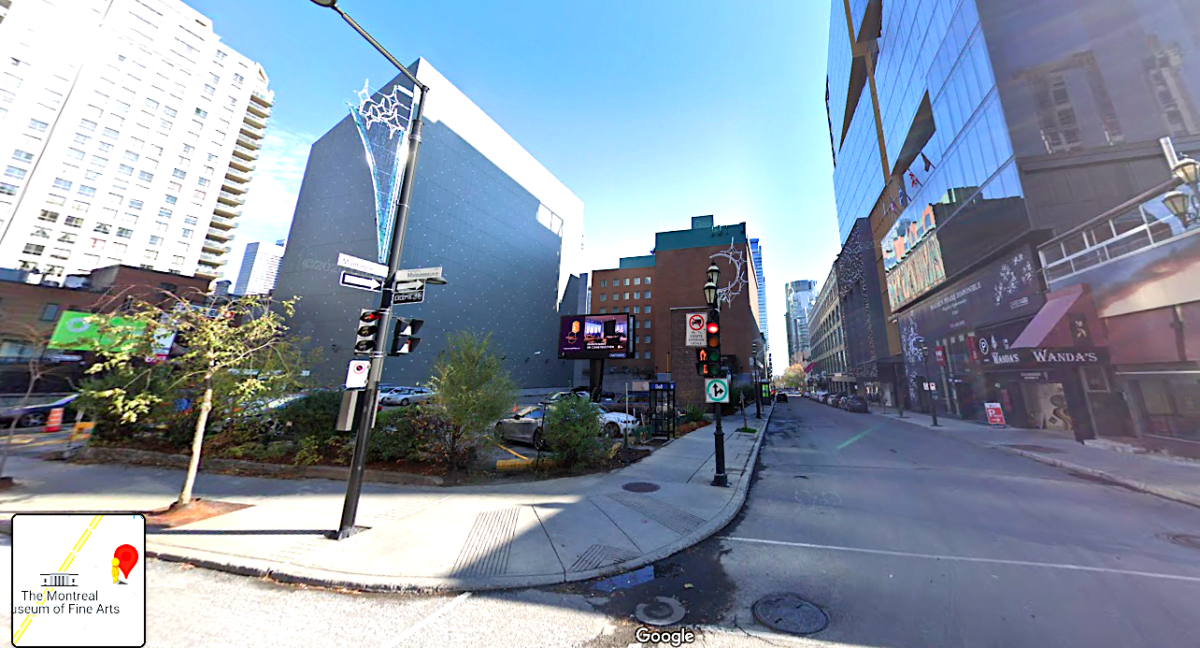
1455 Rue de la Montagne with Holt Renfrew Ogilvy and the Four Seasons to the right (as well as Wanda’s strip bar). Image via Google Street View
Toronto-based Carttera Private Equities Inc. acquired 1455 Rue de la Montagne in September of 2020 with plans to create a high-end residential building. At its base will be retail spaces, offering an opportunity for brands to move across from Holt Renfrew Ogilvy. The 31,750-square-foot surface parking lot sold for $48.5 million on the corner of De La Montagne and De Maisonneuve Boulevard West.
Rue De La Montagne in Montreal. PHOTOS: MAXIME FRECHETTE
1 of 3
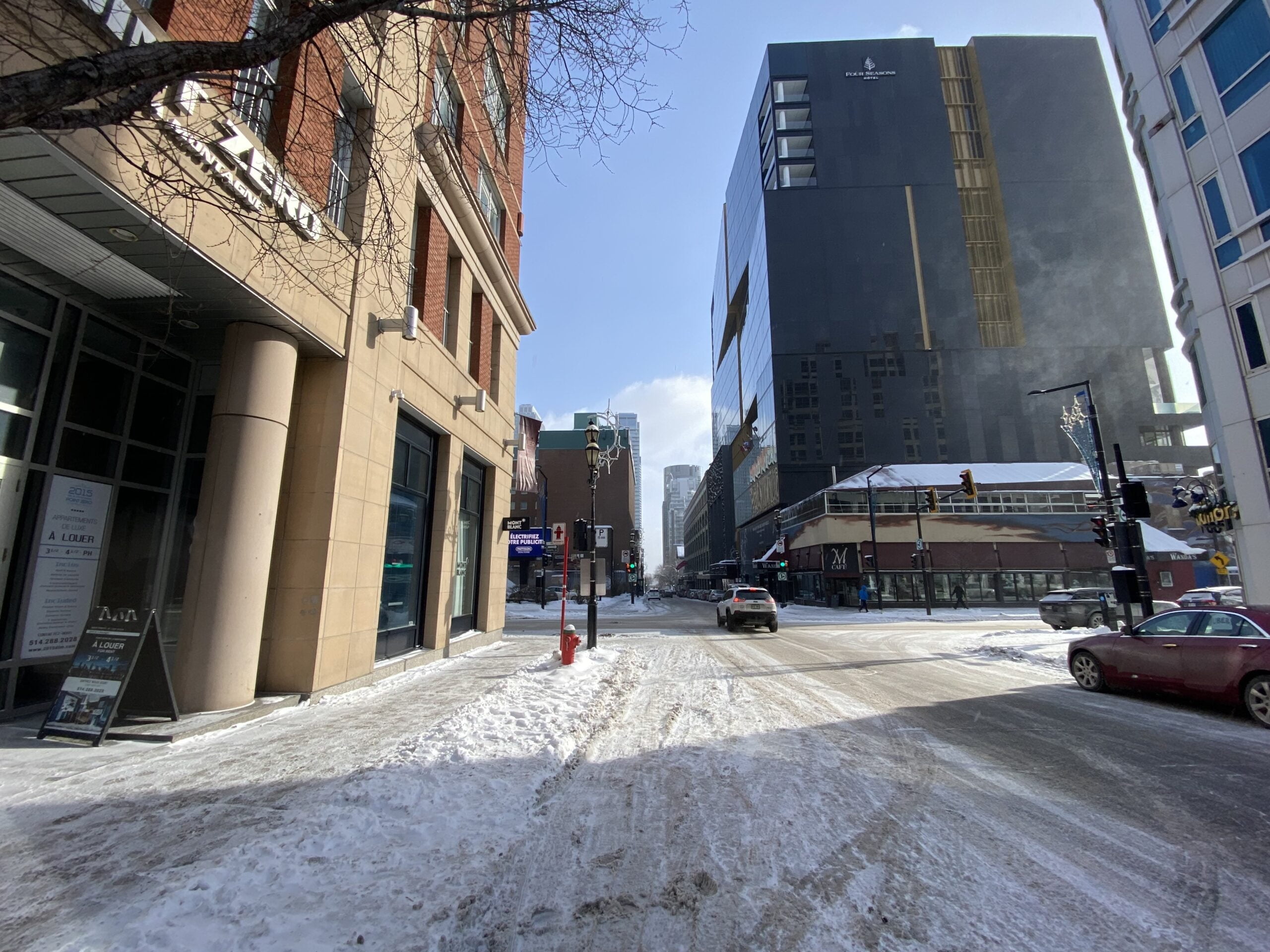
Former Point Zero on Rue De La Montagne in Montreal. PHOTO: MAXIME FRECHETTE
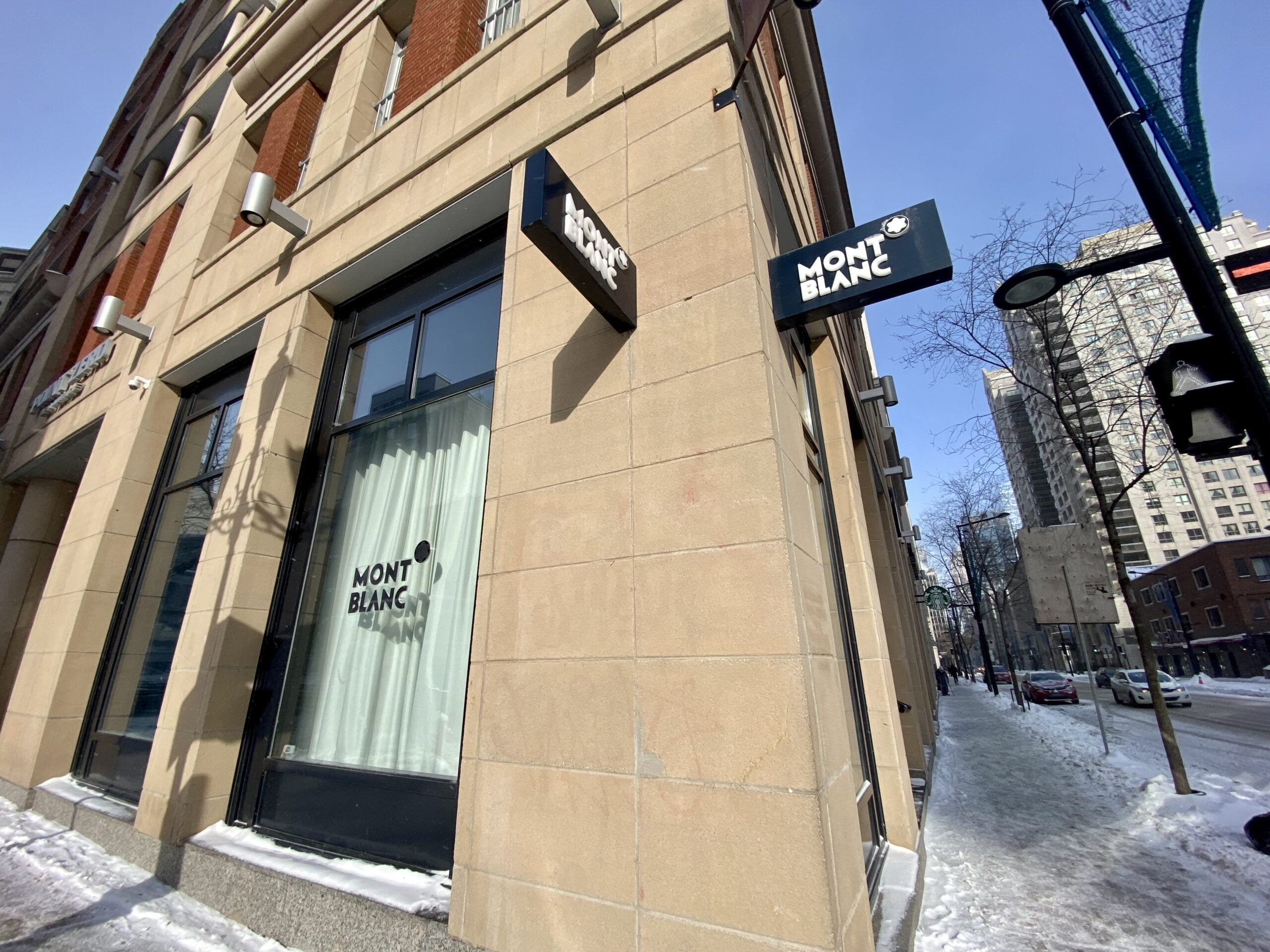
MontBlanc on Rue De La Montagne in Montreal. Photo: Maxime Frechette
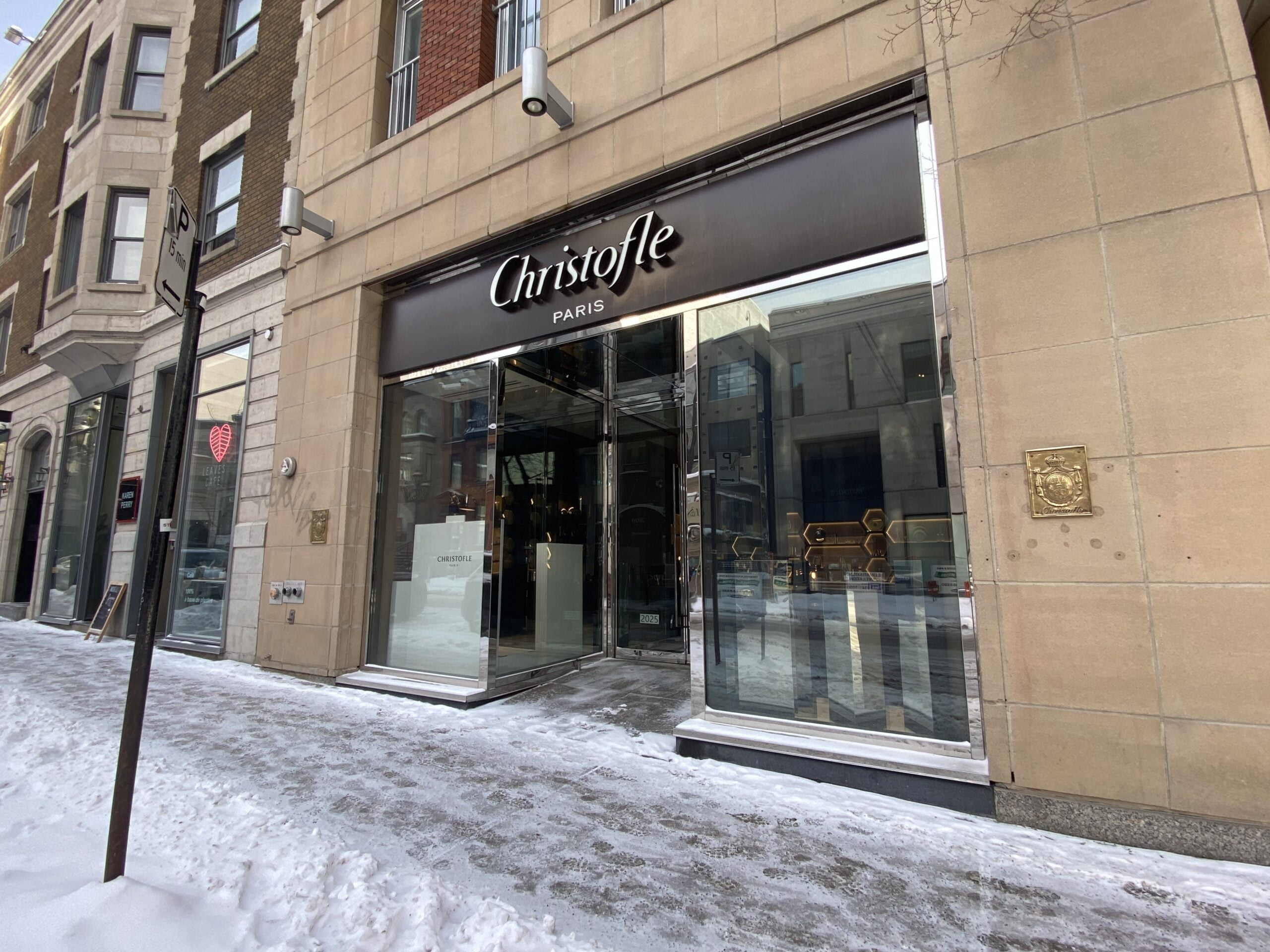
Christofle on Rue De La Montagne in Montreal. Photo: Maxime Frechette
Above is a slideshow on Rue de la Montagne. Swiss luxury brand Montblanc opened at 1289 Boulevard de Maisonneuve West in 2014, and Pavillon Christofle’s only Canadian store opened in the winter of 2016 at 2025 Rue de la Montagne. In the first photo is the new Four Seasons Hotel and Private Residences which is connected to Holt Renfrew Ogilvy. The Residences at the Four Seasons are among the priciest in Montreal. A 3,105-square-foot condominium apartment on the 14th floor is currently asking $7,190,000 and a 6,910-square-foot penthouse on the 18th floor is asking $15,435,000.
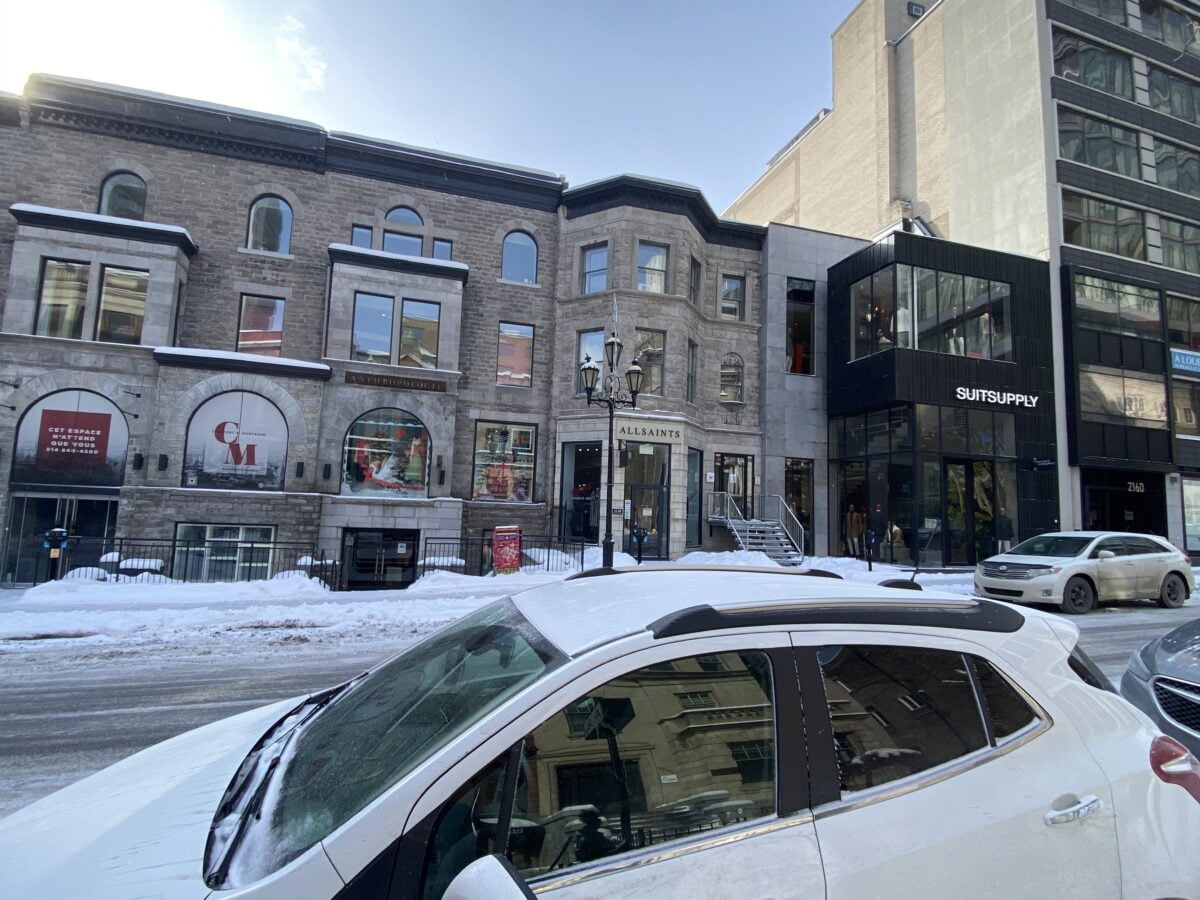
Montreal is a beautiful city with unique grey stone architecture. This row of shops on Rue de la Montagne includes the AllSaints store. Other upscale brands are said to be interested in locating in the area.
Chateau D’Ivoire on Rue De La Montagne in Montreal. Photo: Maxime Frechette
Prestigious jewellery retailer Chateau d’Ivoire is almost finished building a new store on Rue de la Montagne just north of Boulevard Maisonneuve. The current location to the right of the new store will close when the new one opens this year.
Ritz Carleton on Rue De La Montagne in Montreal. Photo: Maxime Frechette
The 2,000-square-foot Tiffany & Co. store at the corner of Rue de la Montagne and Sherbrooke Street West at the Ritz Carlton Hotel. Some are questioning the future of the store given its proximity to the Holt Renfrew Ogilvy Tiffany concession down the street. This photo was taken from in front of the former Holt Renfrew store at 1300 Sherbrooke Street West that closed over the summer to coincide with the completion of the nearby Holt Renfrew Ogilvy.
Rue Sherbrooke Ouest
Old Holt Renfrew location from Rue De La Montagne in Montreal. Photo: Maxime Frechette
The photo above is of the former Holt Renfrew store taken from Rue de la Montagne. The shorter windows furthest to the right were for a lower-level restaurant space. The building was constructed in 1937 and for years operated as the company’s flagship store prior to the Toronto store gaining that status in 1979.
Old Holt Renfrew location from Sherbrooke in Montreal. Photo: Maxime Frechette
The photo above is the corner of the former Holt Renfrew store at 1300 Sherbrooke Street West. The original store spanned about 30,000 square feet when it was built and was expanded to more than 80,000 square feet prior to its closure. In the 1990s Holt Renfrew operated a Giorgio Armani boutique on the main floor facing Sherbrooke Street.
Old Holt Renfrew location from Crescent in Montreal. Photo: Maxime Frechette
The photo above is of the corner of Sherbrooke Street and Crescent Street. Holt Renfrew’s men’s department occupied the corner until 2016 when it was relocated as part of a reduction of the store’s footprint. The Holt Renfrew store occupied several buildings and in the late 1990s integrated several historic townhouse facades to expand the store as per the photo below.
Former Holt Renfrew at 1300 Sherbrooke St. W., photo by Maxime Frechette
Prior to the townhouses being integrated into the Holt Renfrew store, several retailers operated standalone stores there. In years past, a Polo Ralph Lauren store operated at 1316 Sherbrooke Street (prior to relocating to where Tiffany is now at the Ritz) and in the 1980s a Yves Saint Laurent Rive Gauche boutique was located at 1330 Sherbrooke Street West. The Saint Laurent boutique was operated by York Hannover which also owned the boutique at Hazelton Lanes in Toronto. French designer Sonia Rykiel had a store at 1320 Sherbrooke Street West that was connected to multi-brand retailer Clubissimo from 1986 until the early 1990s.
In the 1980s, Montreal’s Sherbrooke Street was home to several other significant luxury stores over a six block stretch which have all since closed. This included Emanuel Ungaro at 1430 Sherbrooke Street West, Pratesi at 1448 Sherbrooke Street West, Davidoff at 1452 Sherbrooke Street West, Cartier at 1498 Sherbrooke Street West, and Georg Jensen at 1178 Sherbrooke Street West in the 1980s which was replaced by Versace for several years. A pricey Zilli men’s boutique operated at 1472 Sherbrooke Street West between 2007 and 2011 and was the only store for the Italian brand in Canada.
Tiffany & Co. at the Ritz and an Escada store at 1214 Sherbrooke Street West are the only two remaining luxury brands on the street. Escada is in financial trouble and Tiffany’s future is uncertain on the street — it could be the case that all luxury retail will soon exit beautiful Sherbrooke Street which is home to several museums, heritage apartment buildings, and McGill University.
Crescent Street
Map of the Montreal Luxury Zone on Crescent Street. Photo: Google Maps.
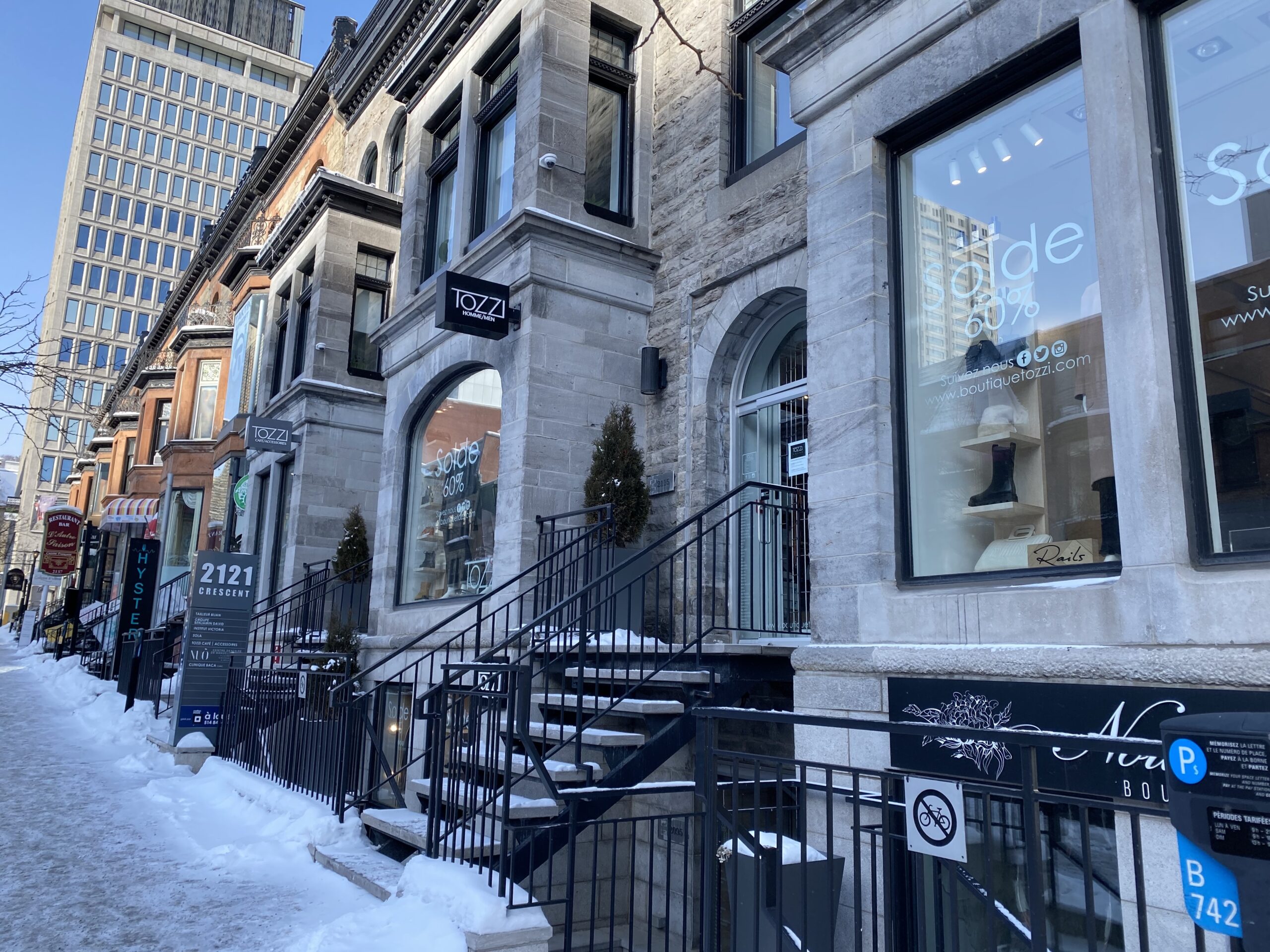
Crescent Street is known for many for its restaurants which were frequented by students prior to the pandemic. In years past, several upscale stores and even luxury brand stores operated on Crescent Street.
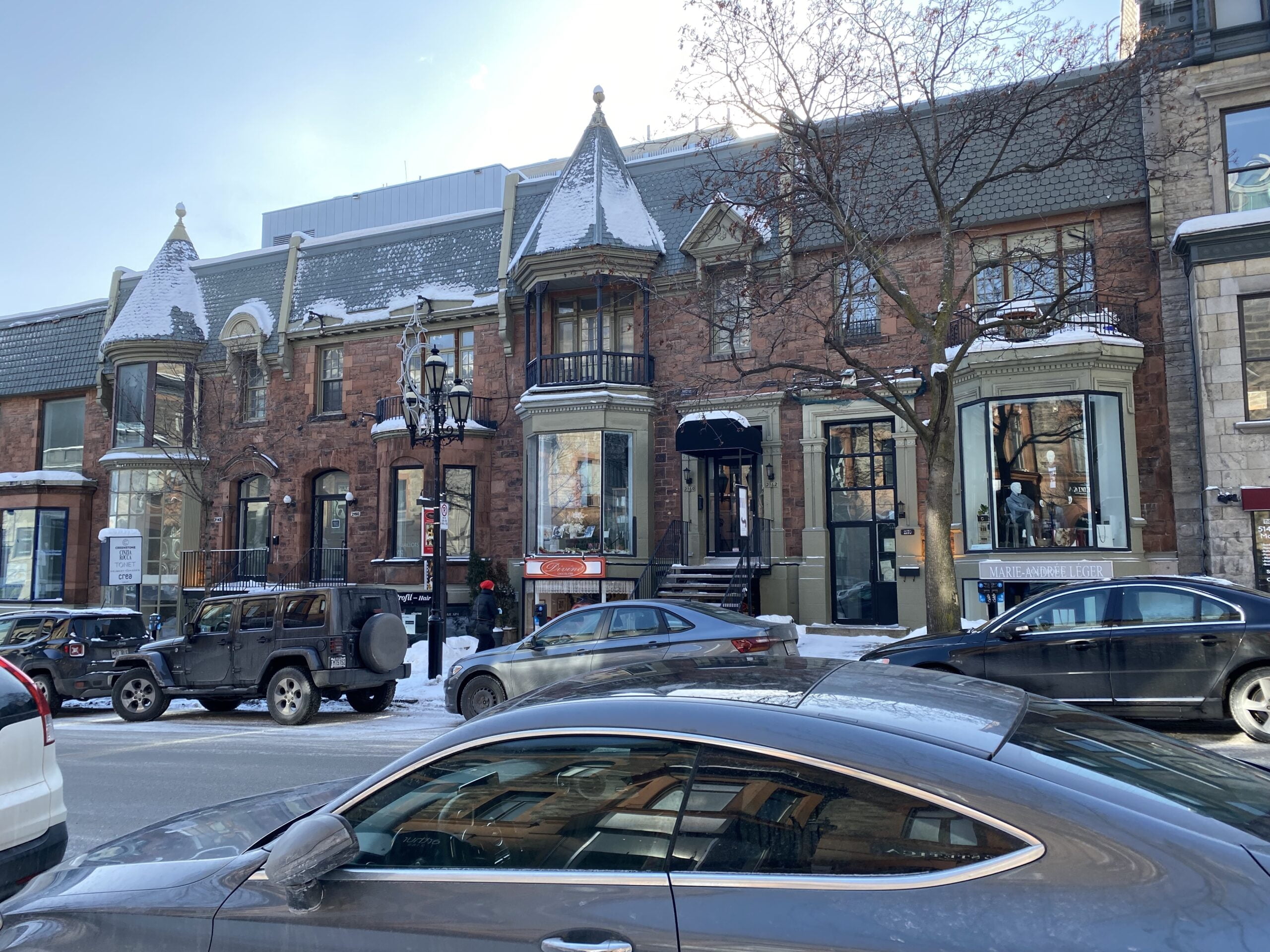
Crescent Street is quite different now from what it was in decades past in terms of retail tenants. In the 1980s, Crescent Street was considered to be a luxury address which included several important women’s fashion stores in a row of beautiful brown stone buildings. French women’s luxury brand Celine once had a store at 2142 Crescent Street, French fashion brand Courreges had a store at 2160 Crescent Street, Upscale French women’s fashion brand Georges Rech operated at 2070 Crescent Street, Canadian fashion brand The Kettle Creek Canvas Company had a store at 2145 Crescent Street, and UK fashion and home goods brand Laura Ashley had a store at 2110 Crescent. Luxury multi-brand retailer Grege, which focused on Japanese brands, operated at 2130 Crescent Street from 1976 to 1995 when the company was dissolved. Various other upscale boutiques and food and beverage options made for a desirable destination. At one time Crescent Street advertised itself in local papers to draw in shoppers and we have included a clipping of one from 1985 below, noting that all of the upscale boutiques have since shuttered.
Crescent Street advertisement in the Montreal Gazette on 27 June 1985. Image via Newspapers.com Overall Crescent Street in Montreal. Photo: Maxime Frechette
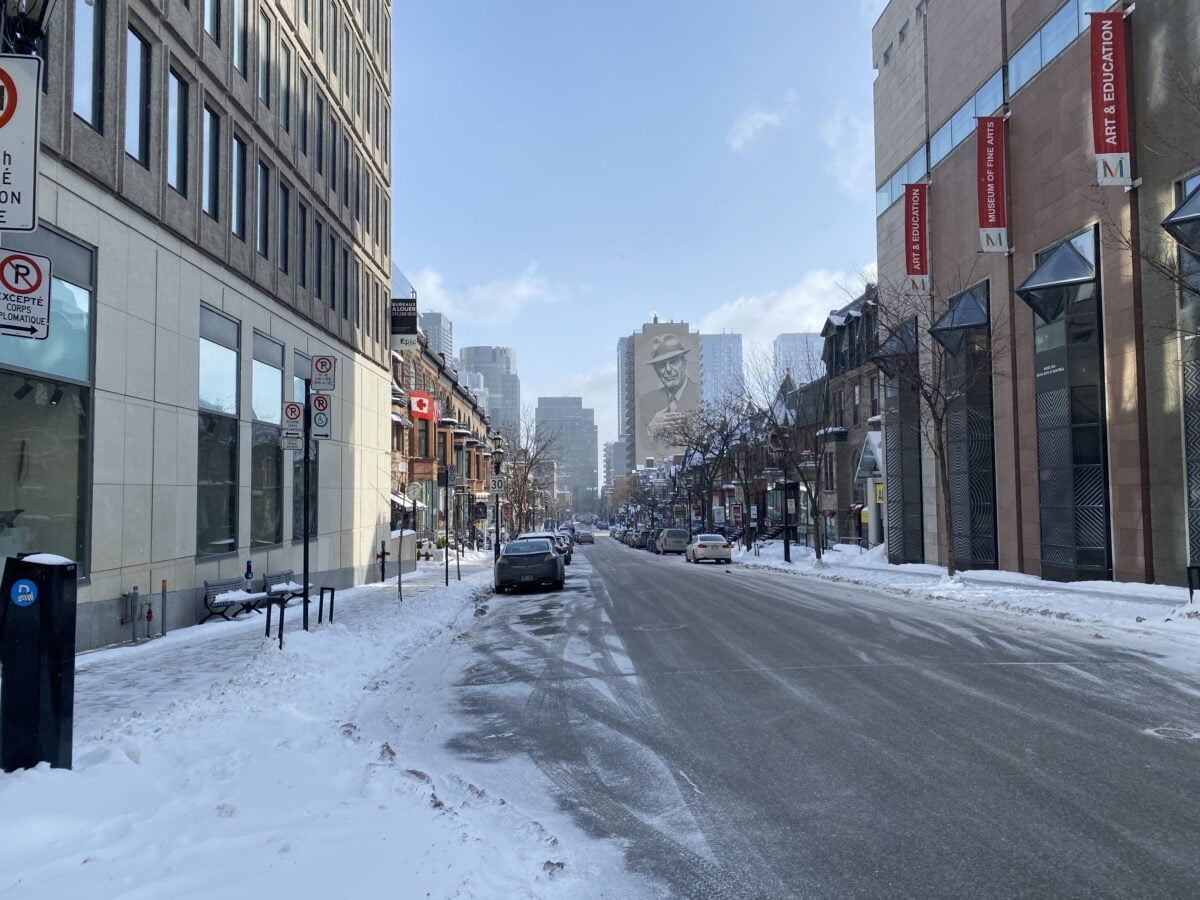
The photo above was taken from Sherbrooke Street looking down Crescent Street. Holt Renfrew Men occupied the building to the left for years and a museum is located to the right.
Crescent Street in Montreal. Photos: Maxime Frechette
1 of 2
Former Shan location on Crescent Street in Montreal. PHOTO: MAXIME FRECHETTE
Overall Crescent Street in Montreal. Photo: Maxime Frechette
The photo above showcases some of the beautiful architecture on Crescent Street south of Sherbrooke Street. This complex was the heart of the former luxury brand stretch that characterized Crescent Street particularly in the 1980s when Montreal was a fashion mecca. French Luxury brand Celine had a store in the second storefront from the left with the bow window in the 1980s.
CNTRBND on Crescent Street in Montreal
1 of 2
CNTRBND on Crescent Street in Montreal. Photo: Maxime Frechette
CNTRBND on Crescent Street in Montreal. Photo: Maxime Frechette
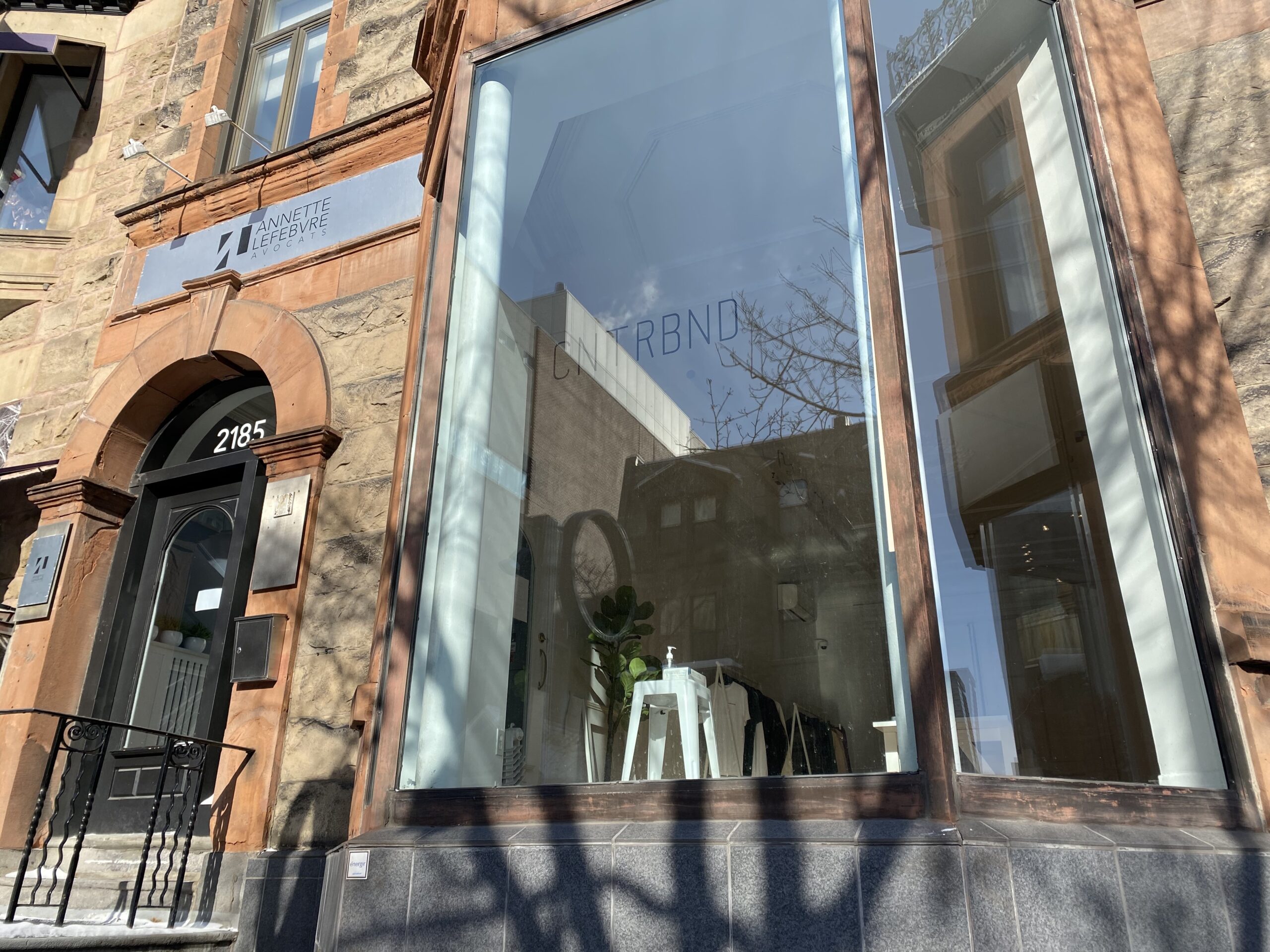
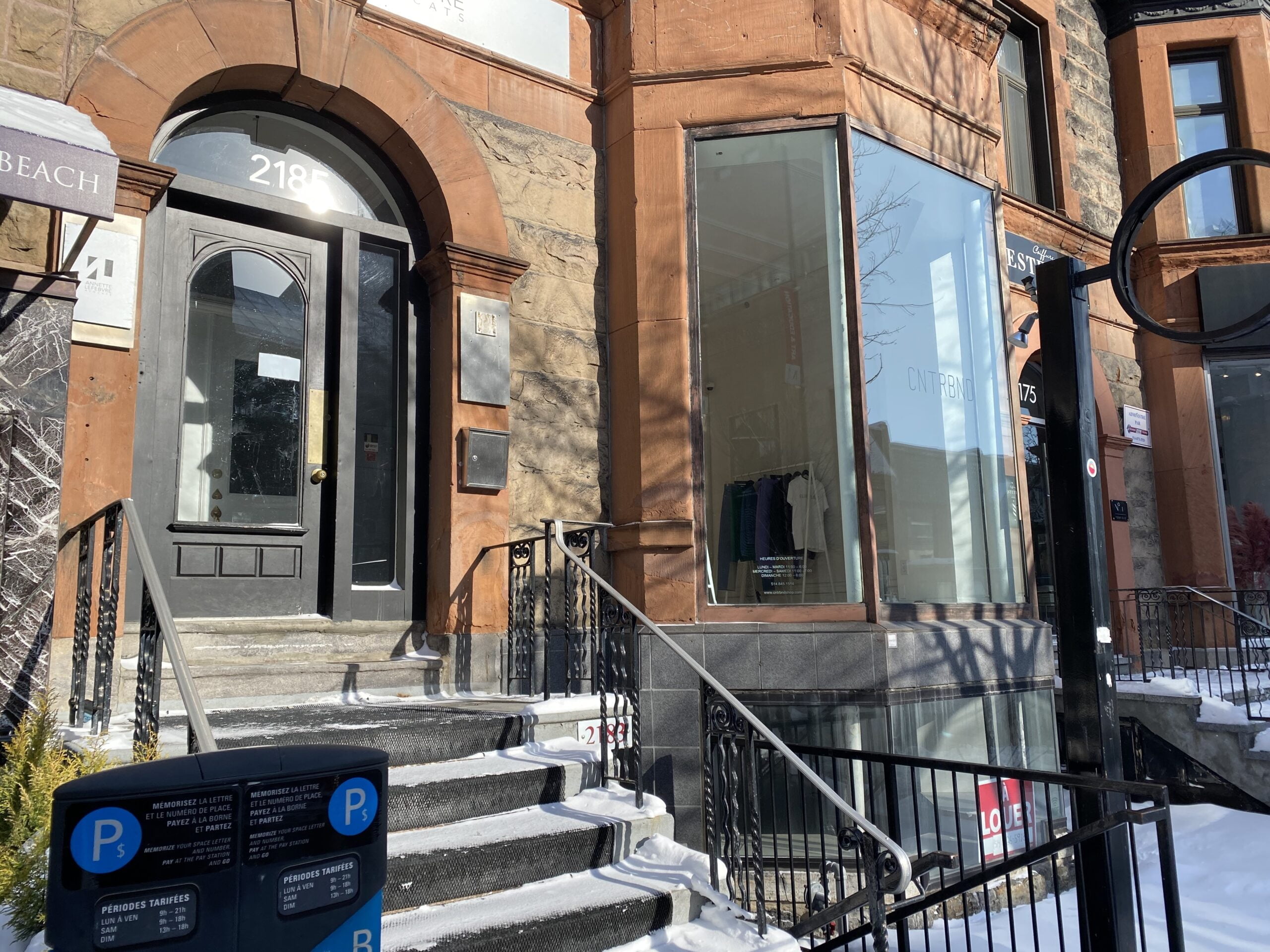
Upscale Toronto-based multi-brand retailer CNTRBND opened a store at 2185 Crescent Street last year. The store is located in a historic townhouse and features unique architecture inside and out. CNTRBND also has stores in Toronto and Vancouver and will be announcing a new location soon.
Given the unique situation of the street and CNTRBND’s relationship with brands, the retailer could bring new concepts to Crescent Street in the future.
Kaufmann on Crescent Street in Montreal. Photo: Maxime Frechette
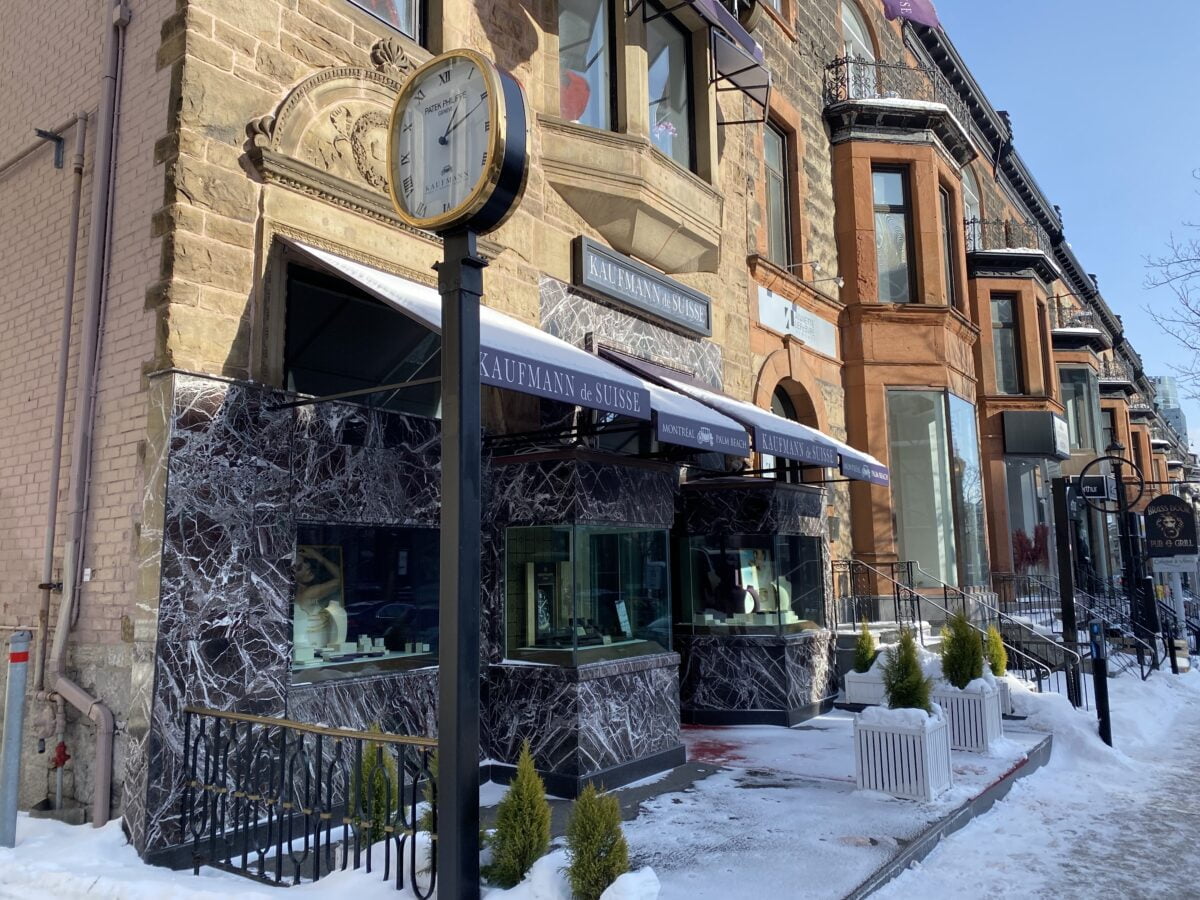
Jewellery retailer Kaufmann de Suisse has operated for years at 2195 Crescent Street. It is one of the few long-term, upscale retail tenants on the street.
SQDC (former Parasucco location) on Crescent Street in Montreal
1 of 2
SQDC occupies half the building (former Parasucco location) on Crescent Street in Montreal. Photo: Maxime Frechette
SQDC occupies half the building (former Parasucco location) on Crescent Street in Montreal. Photo: Maxime Frechette
The building above was formerly occupied by denim brand Parasucco and is now a CQDC.
Crescent Street Retailers in Montreal
1 of 5
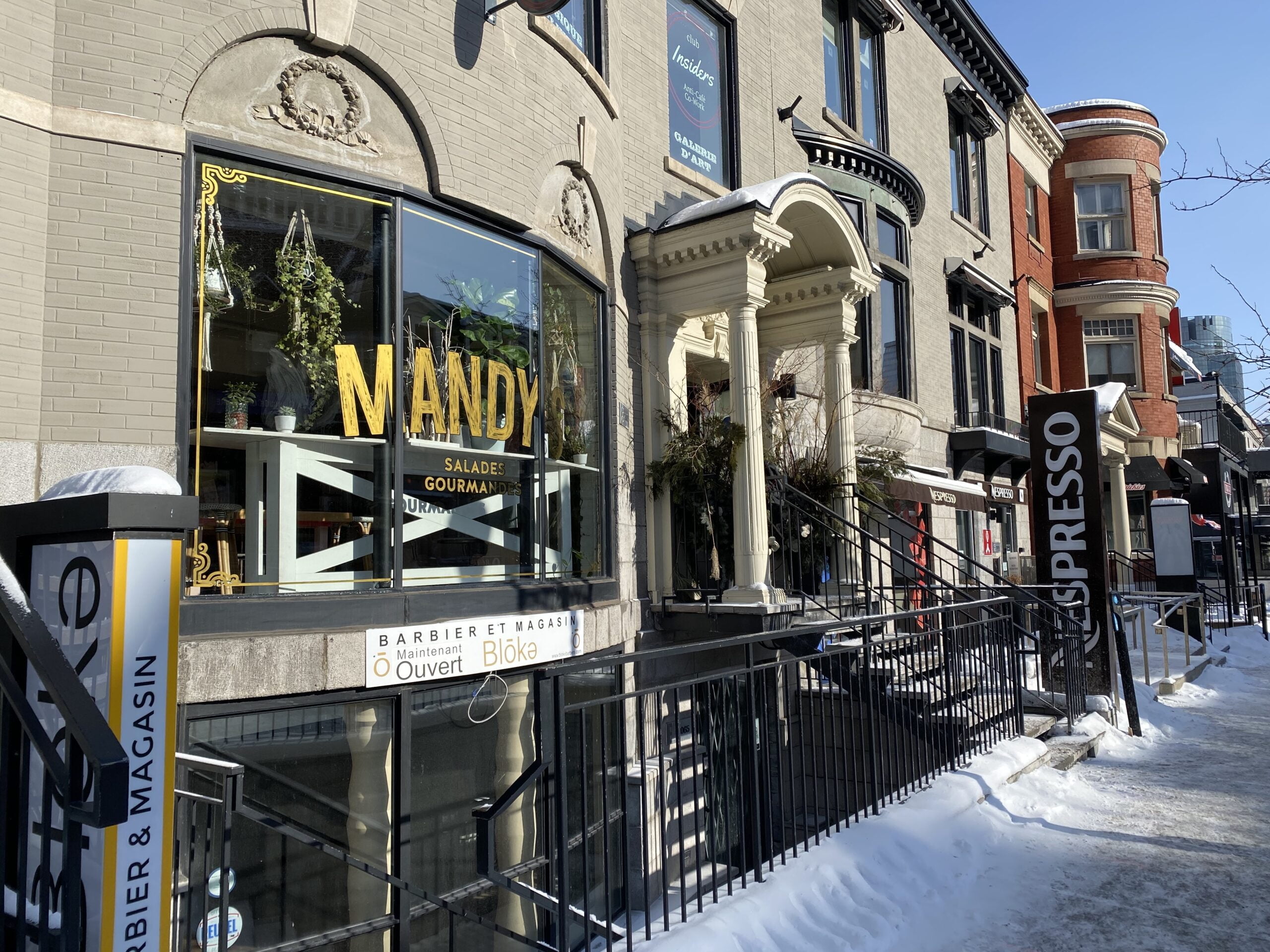
Mandys on Crescent Street in Montreal. Photo: Maxime Frechette
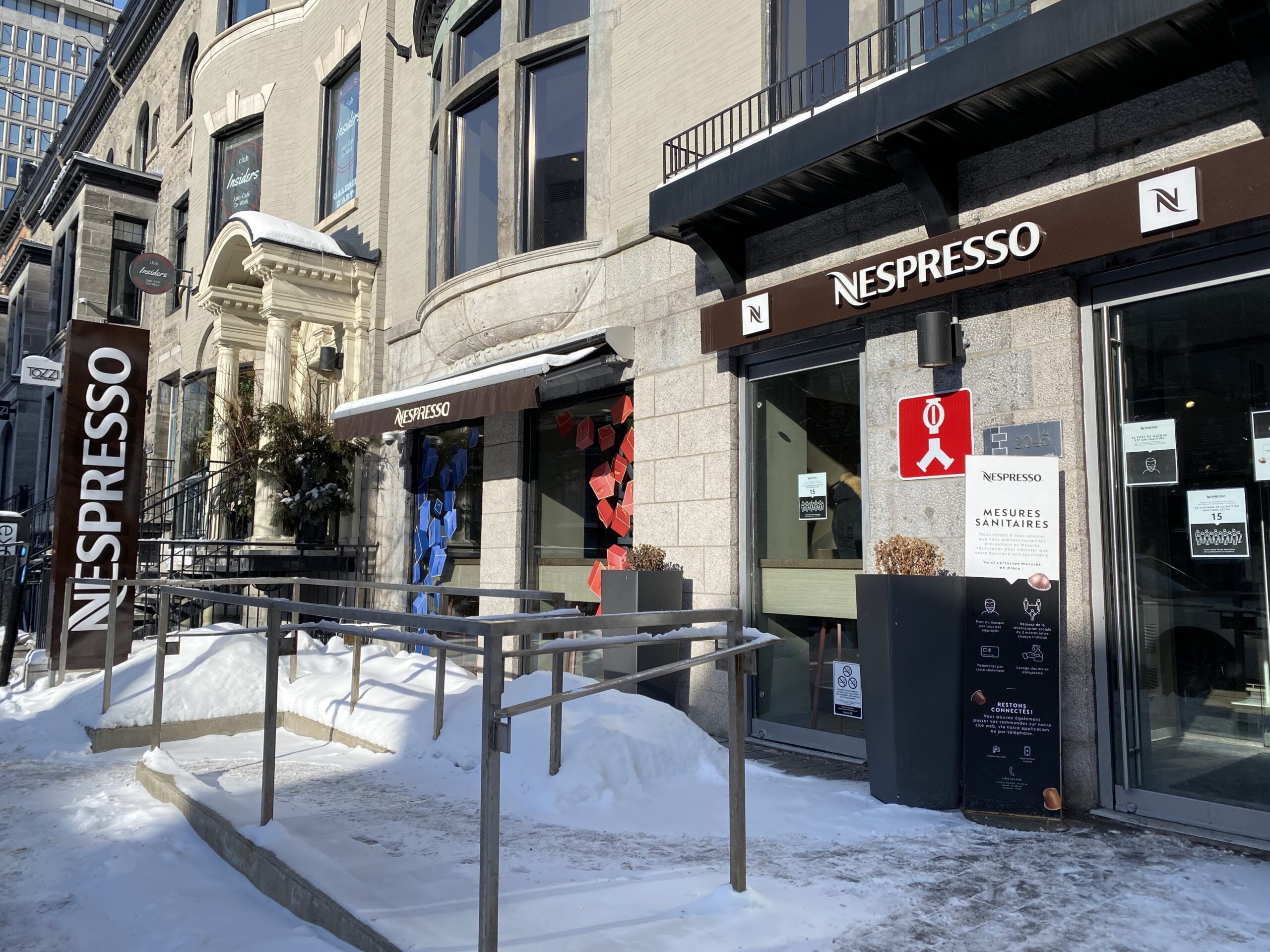
Nespresso on Crescent Street in Montreal. Photo: Maxime Frechette
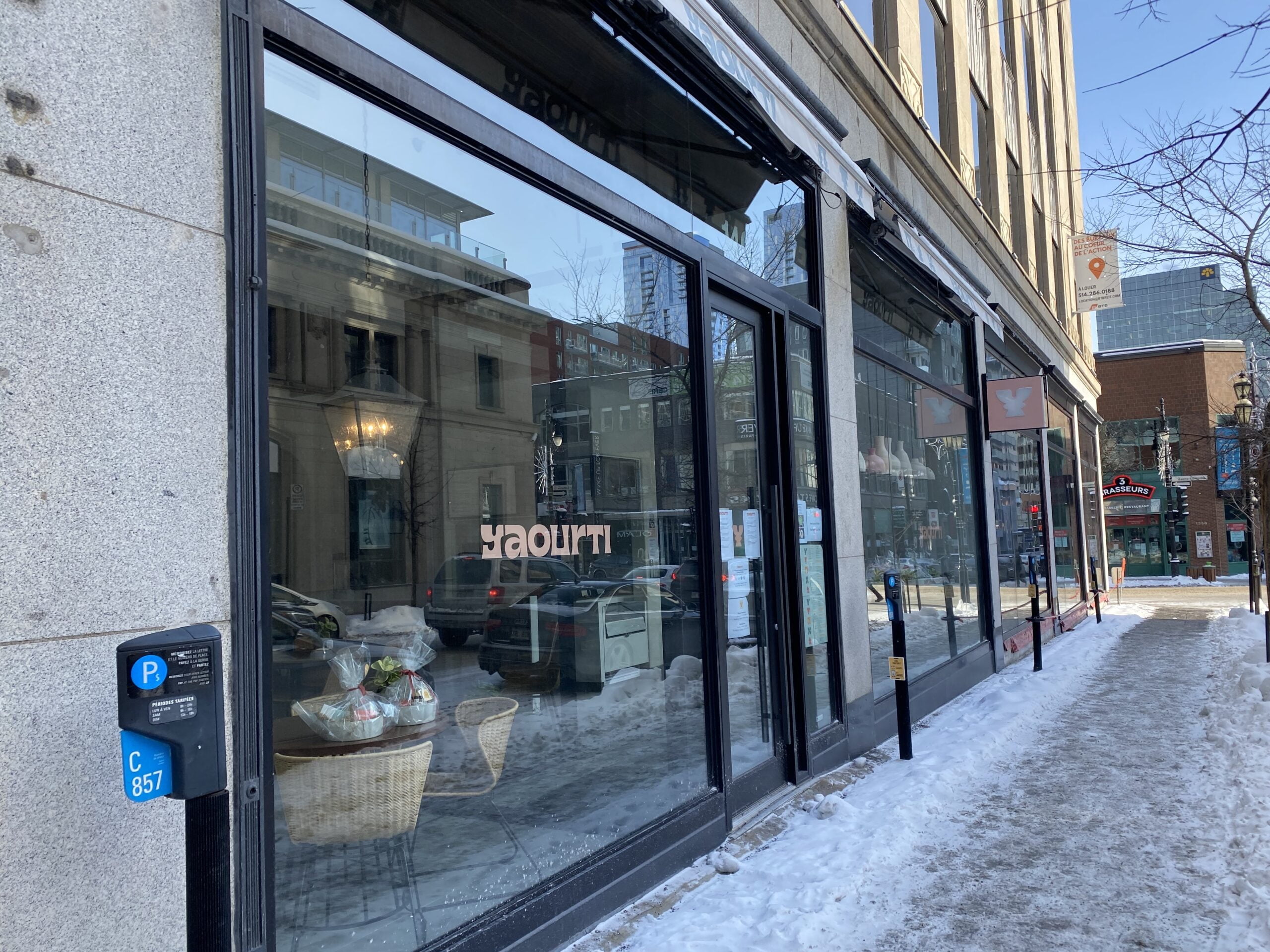
Yaourti on Crescent Street in Montreal. Photo: Maxime Frechette
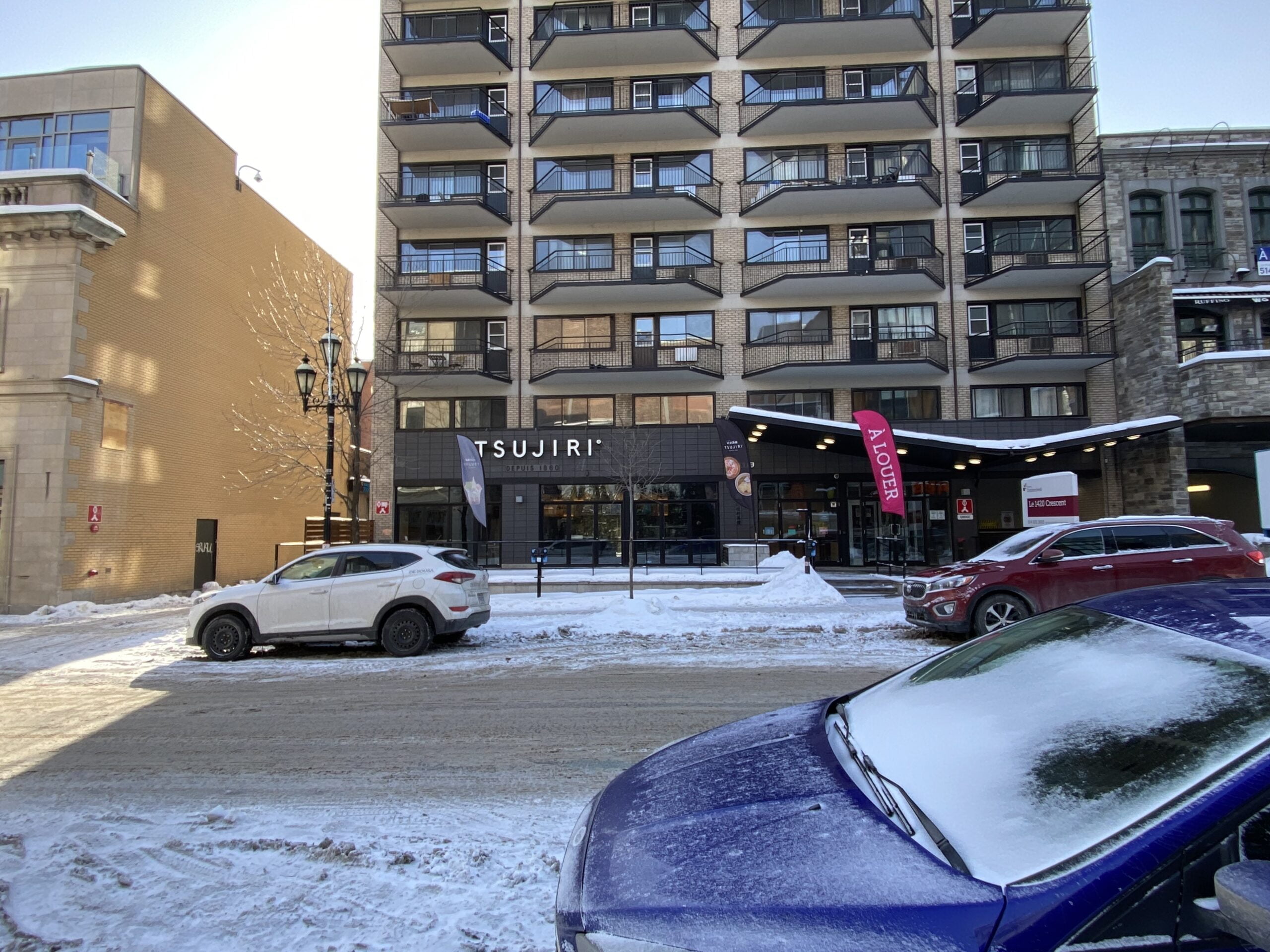
TSUJIRI on Crescent Street in Montreal. Photo: Maxime Frechette
Tozzi on Crescent Street in Montreal. Photo: Maxime Frechette
The above slideshow includes: Montreal-based restaurant Mandy’s, known for its gourmet salads, which has several stores in Montreal including one on Crescent Street. Mandy’s will be entering the Toronto market as part of an expansion. Nestlé-owned coffee concept Nespresso which operates a café and retail space on Crescent Street, and various other independent retailers and restaurants currently occupy retail spaces on the stretch between Sherbrooke and Sainte-Catherine Streets.
Thank you for joining us on this brief tour of a loop in downtown Montreal’s Golden Square Mile. The area has changed over the years and there’s more to come. Feel free to comment on your thoughts and favourite memories below.
And thank you Maxime Frechette for taking photos for this article.
Discover More Related Retail Photo Tours From Retail Insider:
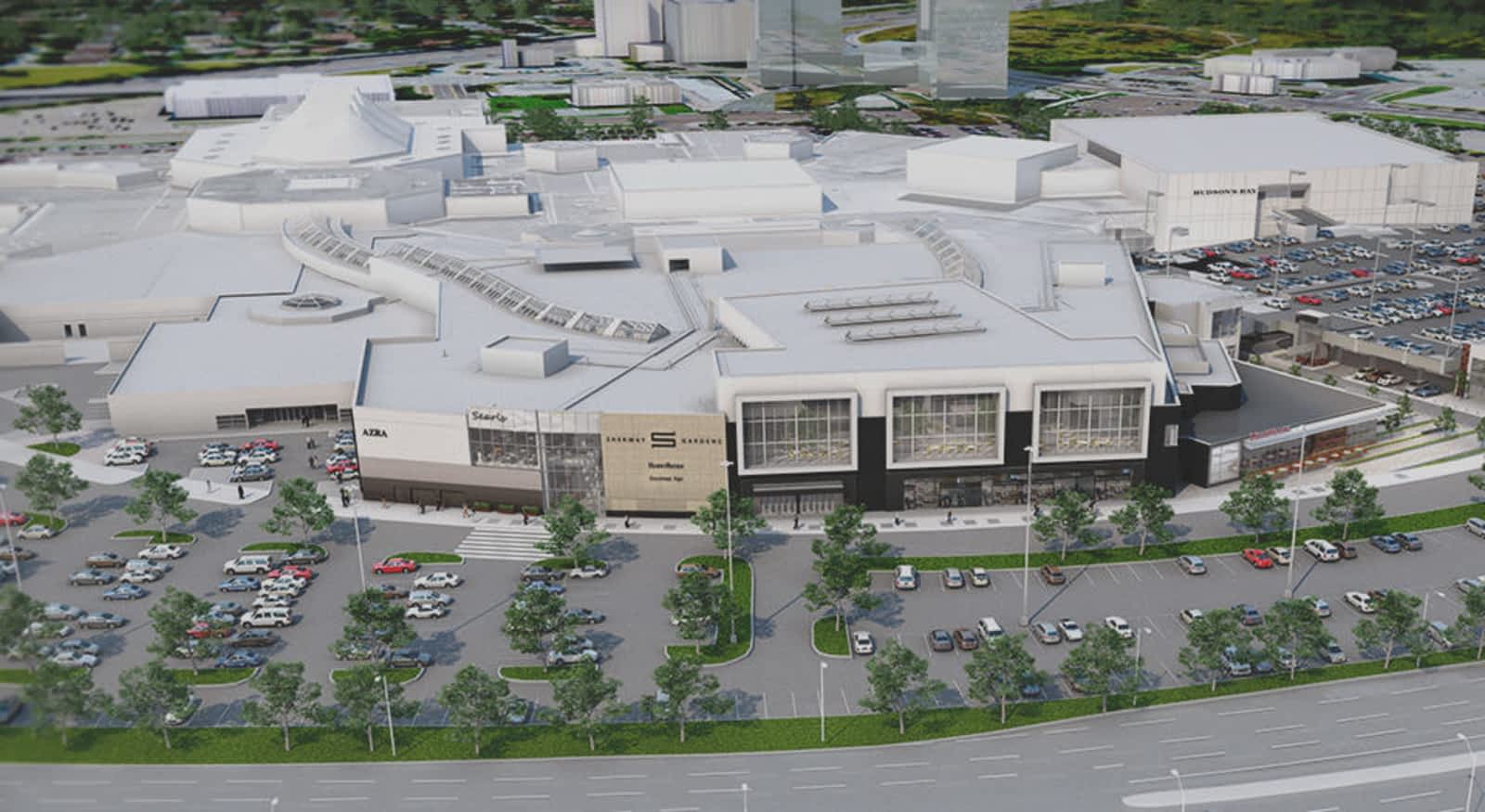
Aerial view of CF Sherway Gardens. Photo: Cadillac Fairview
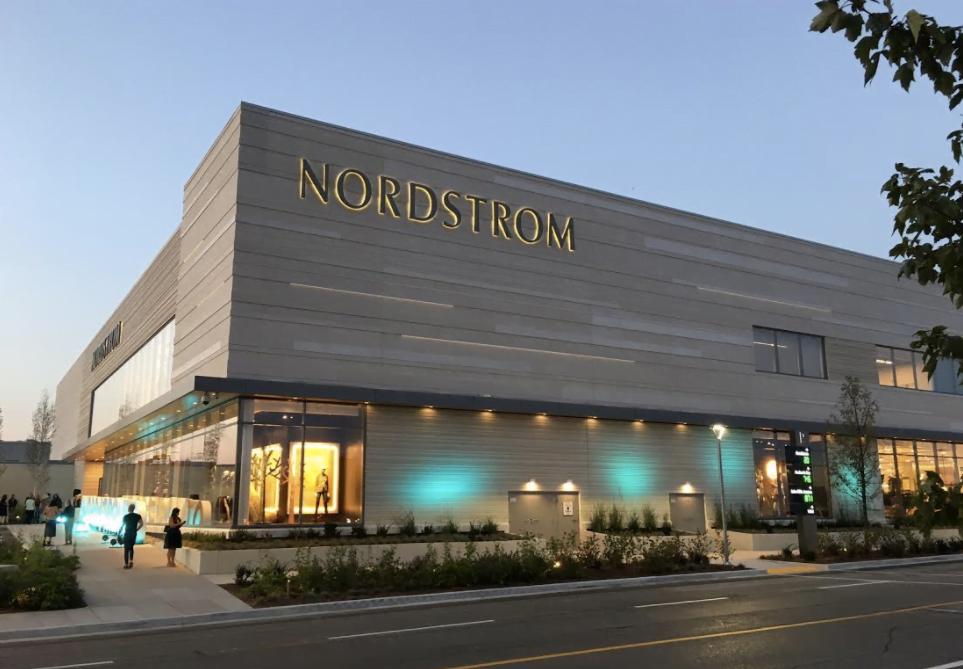
Nordstrom at CF Sherway Gardens. Photo: Nordstrom
NORDSTROM AT SHERWAY GARDENS
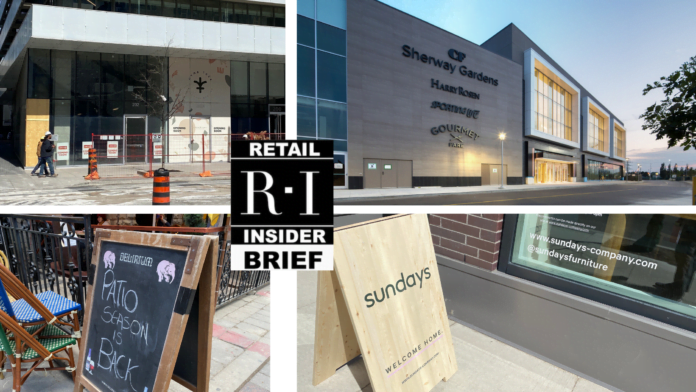
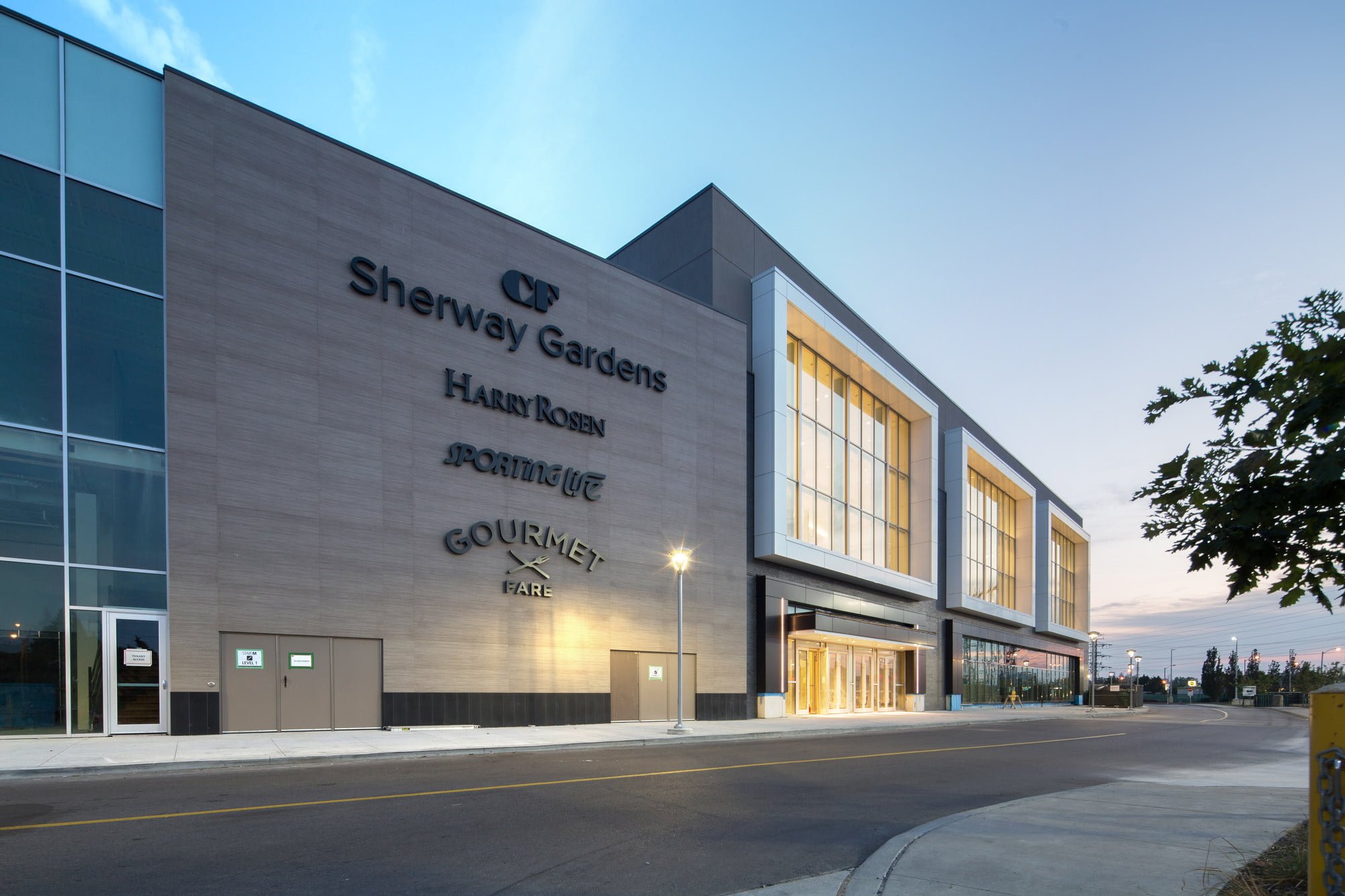
The CF Sherway Gardens shopping centre in Toronto is marking its 50th birthday this spring. The Cadillac Fairview-managed centre opened in 1971 and the centre has seen expansions over the years, resulting in it becoming one of the leading shopping centres in the country in terms of appearance and tenant mix.
The original $21.5 million shopping centre was built by The Rouse Corporation in an S-shaped configuration spanning about 850,000 square feet with 127 stores. The mall featured fountains, indoor greenery, benches and couches, as well as an intimate low ceiling design. In order to gain the best visibility from both the QEW/Gardiner Expressway and Highway 427, original anchor tenant, Eaton’s, had the mall’s design turned sideways so that its storefront was most visible. The former Eaton’s space is now occupied by Saks Fifth Avenue and Sport Chek. Simpsons was the other main anchor store at CF Sherway Gardens and that space is now occupied by a Hudson’s Bay store.
In 1975 the centre’s ‘S’ layout became a figure eight with an expansion that added 75 retailers. In 1987 Holt Renfrew opened a store in a new wing to the north where the store operated until 2016. A south wing added in 1989 included a tent-like roof structure designed by Zeidler Roberts Partnership Architects — Ottawa-based upscale department store chain Brettons anchored the new wing.
In 2013 Cadillac Fairview announced a $550 million renovation and expansion that added 210,000 square feet to the shopping centre. Other changes to the centre include a new 143,000-square-foot Saks Fifth Avenue store that opened in February of 2016 and a 140,000-square-foot Nordstrom store that opened in the fall of 2017. CF Sherway Gardens is one of the most productive malls in the country in terms of sales per square foot and it is also one of the largest shopping centres in Canada.
“For five decades, CF Sherway Gardens has provided a welcoming space for community members to come together to experience the best of retail, dining and vibrant seasonal and celebratory moments,” said Martin Wray, Vice President of Retail Operations, Cadillac Fairview. “It has been an honour to evolve alongside our community, and we look forward to a time when we can celebrate these special moments together.”
“Our team is committed to creating meaningful community connections while providing consumers with safe and memorable experiences and access to top retailers, restaurants and services to meet their needs,” said Andy Traynor, General Manager, CF Sherway Gardens. “From day one we’ve garnered strong regional support and built a true sense of togetherness with local patrons, which continues to be our priority and is a testament to our longstanding success.”
Brass Rail Tavern Strip Bar to Close on Yonge Street Amid Area Changes
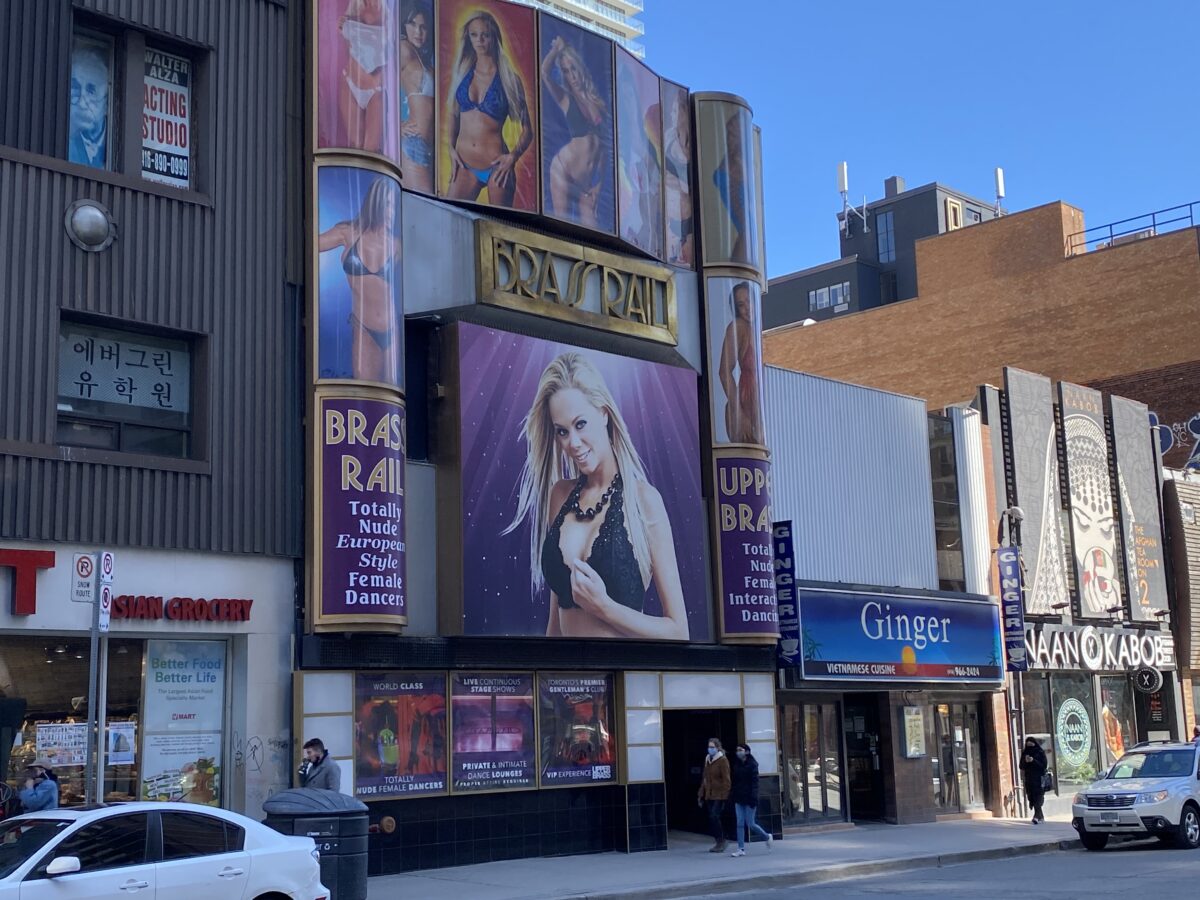
The Brass Rail on Yonge Street, Friday April 2. Photo: Craig Patterson
The Globe & Mail this week reported that the Brass Rail Tavern strip club at 701 Yonge Street, south of Bloor Street, is set to be redeveloped as part of changes happening within the area. The 0.21-acre site could fetch about $32 million according to market estimates amid booming land values in Toronto’s downtown core.
Redevelopment of the block signals significant changes to the Yonge Street strip south of Bloor Street, which has also seen other recent developments directly on Bloor. That includes the 1 Bloor Street East commercial podium, now owned by First Capital REIT, which is anchored by a Nordstrom Rack store. The ONE at 1 Bloor Street West is under construction and is expected to be a draw when an Apple retail store opens on the corner in a couple of years. A University of Toronto-owned residential building at the northwest corner of Yonge and Charles Street will see its retail podium renovated as well, and last year a revitalized heritage renovation to the south included the opening of a two-level Shoppers Drug Mart store.
The revitalization of the area is expected to again see a more upscale retail mix move southward along Yonge Street. In decades past, several upscale fashion stores such as Allan Cherry and Alan Goouch operated in the area, along with international brands such as Benetton. New developments have in some instances changed the character of Yonge Street from small pedestrian-friendly storefronts to larger podium formats at the base of tower structures, causing some concern among heritage preservationists.
Vancouver-Based Furniture Brand ‘Sundays’ Opens Pop Up Store in Toronto’s Downtown
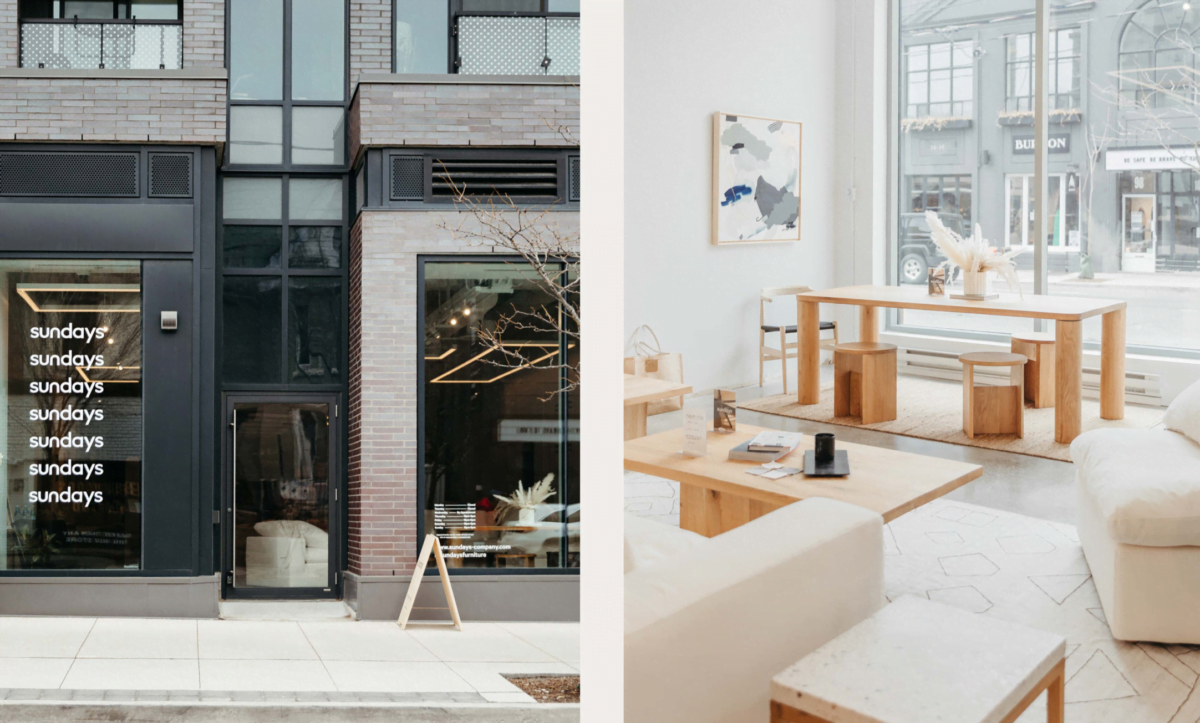
Sundays at 113 Ossington Avenue. Photo by Dustin Fuhs
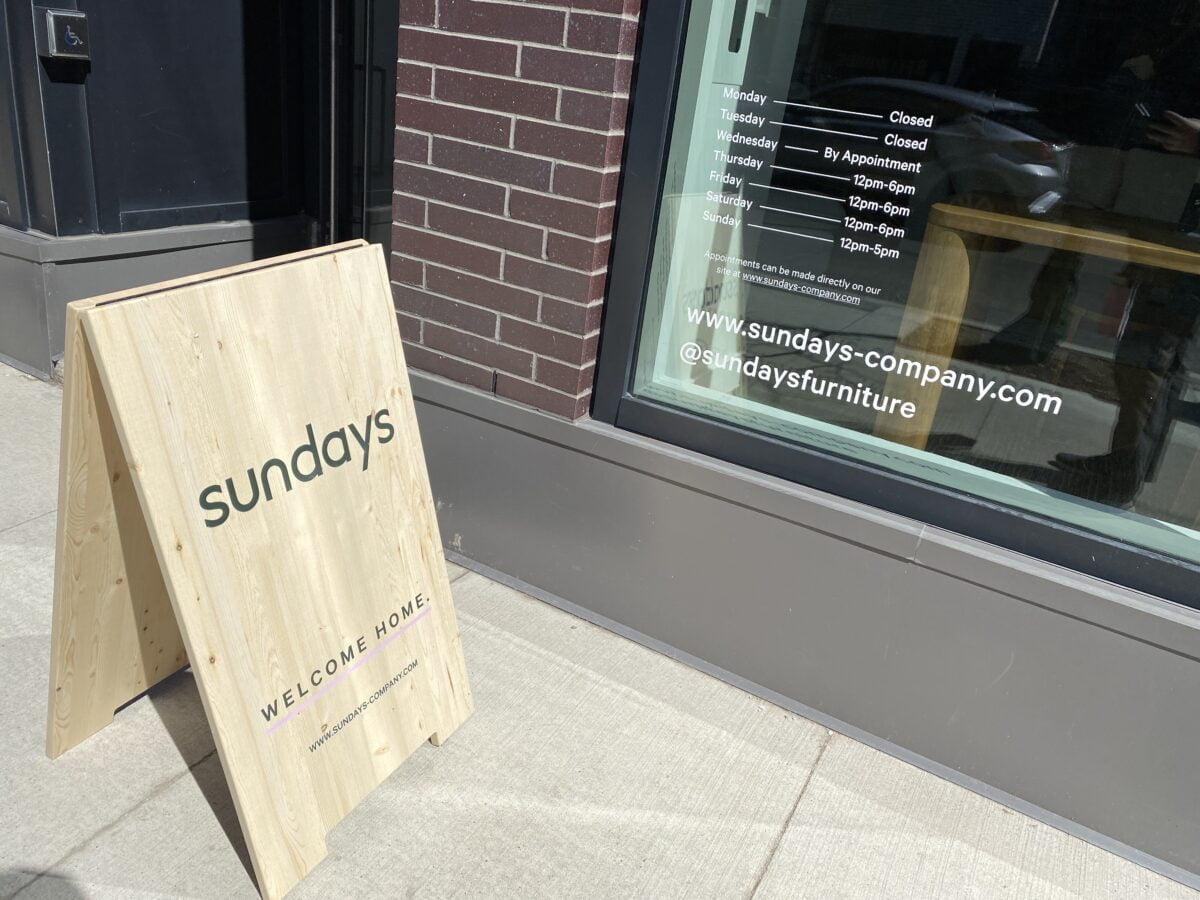
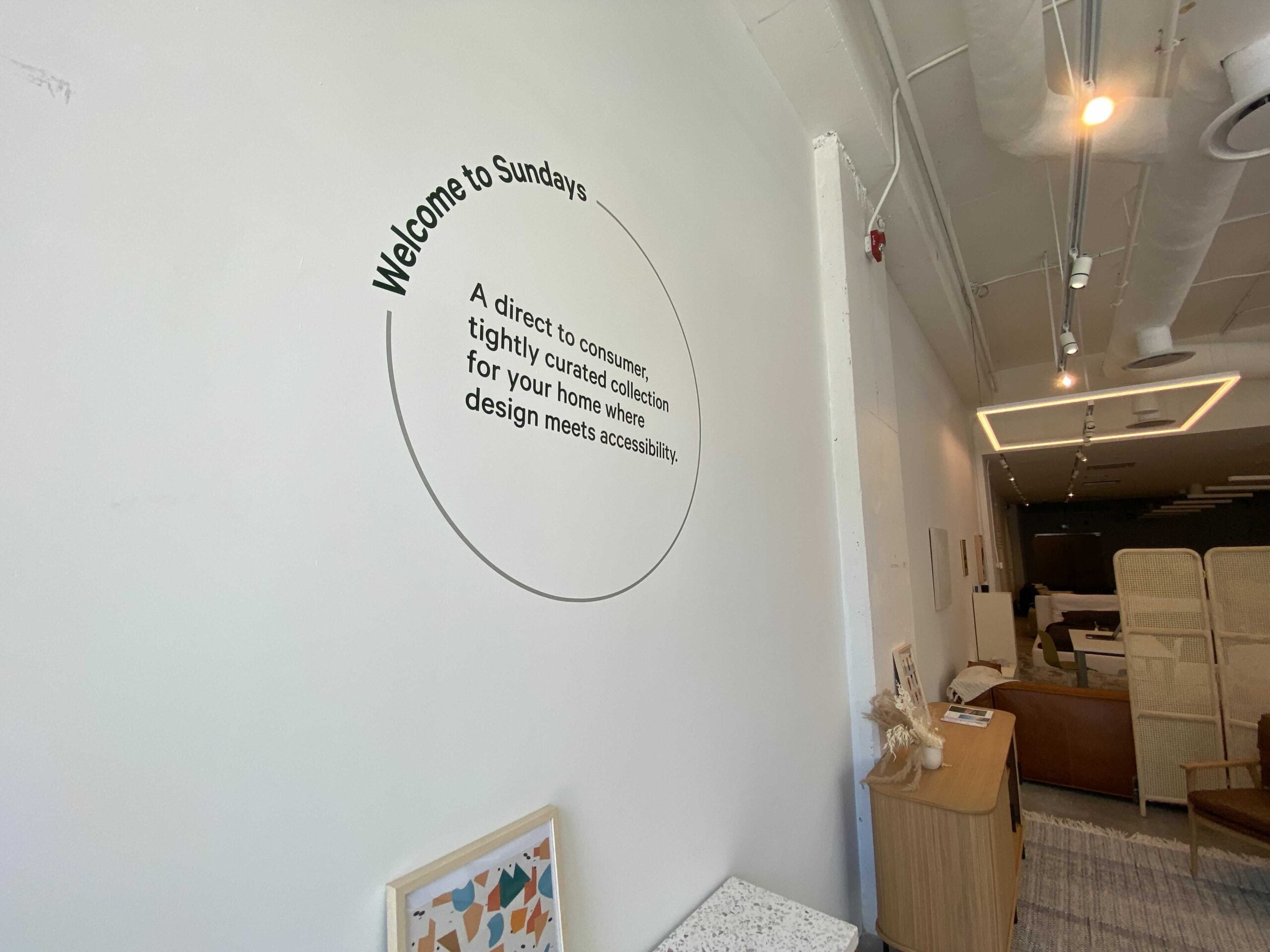
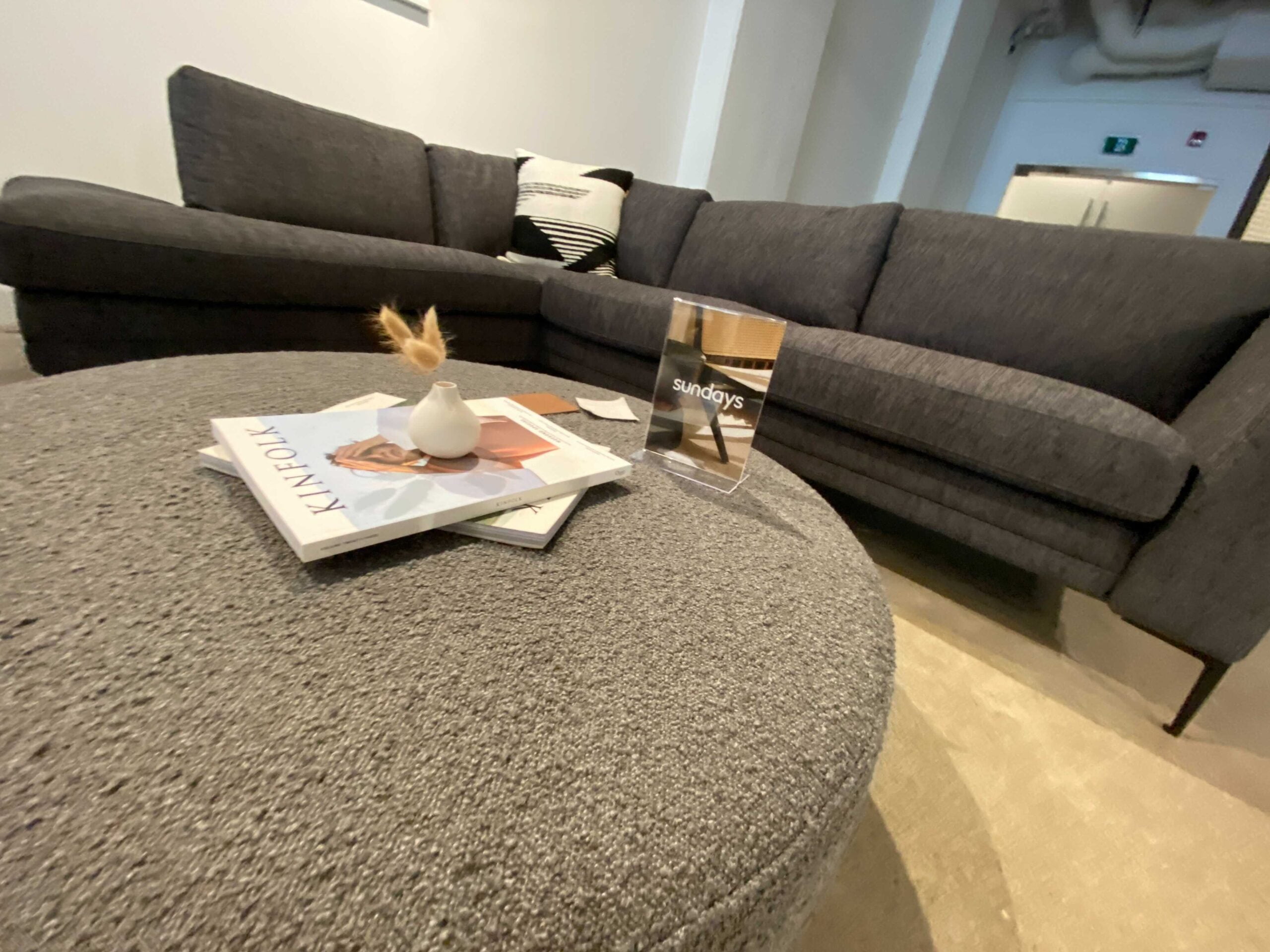
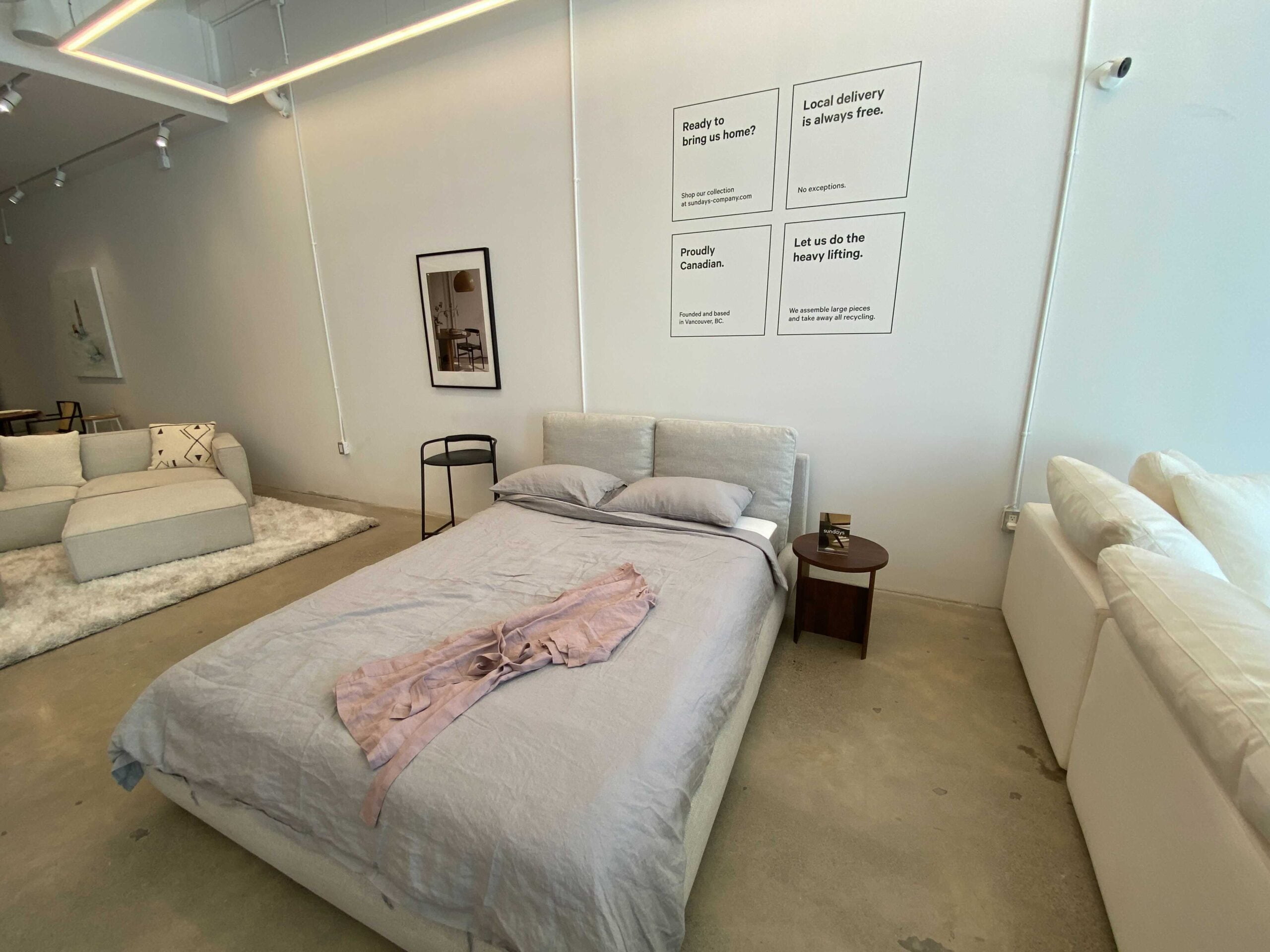
Canadian furniture brand, Sundays, has opened a pop up shop In Toronto at 113 Ossington Avenue. After the success of its two previous pop ups in Vancouver, along with a rapidly-growing digital following, the brand is giving Torontonians the opportunity to touch, feel, and experience Sundays in person.
“Despite the pandemic and growing digital trends, there is something truly special about walking into a brick and mortar store,” says Noah Morse, Co-Founder and Director of Product Development and Design. “E-commerce and new business models have made goods more affordable and transparent, but walking into a shop, touching the fabrics, seeing the pieces, and having a human to interact with is an irreplaceable experience.”
Sundays at 113 Ossington Avenue - Photos by Dustin Fuhs
1 of 4
Interior of Sundays at 113 Ossignton Ave. Photo: Dustin Fuhs
Interior of Sundays at 113 Ossignton Ave. Photo: Dustin Fuhs
Interior of Sundays at 113 Ossignton Ave. Photo: Dustin Fuhs
Interior of Sundays at 113 Ossignton Ave. Photo: Dustin Fuhs
The space is described as being relaxed, bright, and welcoming, and showcases Sundays’ furniture “as if it were in your own home”. On display are bestselling pieces such as the Movie Night sofa and the Field Dining table, as well as pieces from the growing bedroom and outdoor collections.
The surrounding neighbourhood was a deciding factor for Sundays when choosing a location for the pop up. Since Ossington is mostly made up of small, local brands, Sundays said that it would be right at home in the popular urban hotspot.
In addition to its own furniture, Sundays integrated local Toronto products into its pop up experience. Products from brands such as Euclid Farms and ENSEMBL are also available to customers.
Newly-Announced Ontario Lockdowns to Hit Retailers
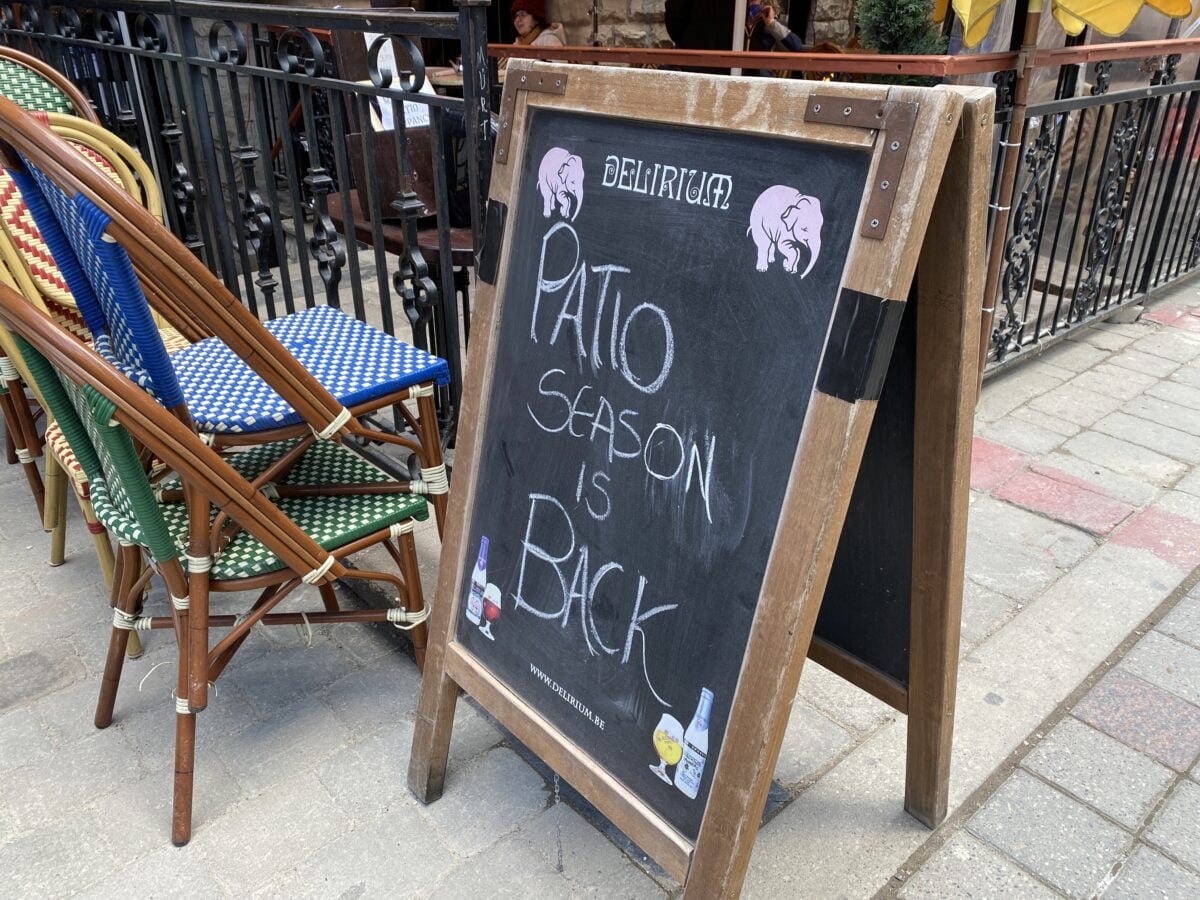
Downtown Toronto bar advertising patio season before the most recent lockdown was implemented Ontario, forcing closures. Photo: Dustin Fuhs
On Thursday Ontario Premier, Doug Ford, announced a ‘circuit-breaker’ lockdown for at least 28 days that will see recently-opened restaurant patios shut again. The Retail Insider team in Toronto has been touring neighbourhoods since patios were allowed to open on March 20 and we noticed a distinct increase in foot traffic in areas throughout the city.
Toronto’s Bloor-Yorkville area once again became vibrant after extended lockdowns over the winter months. While retailers were permitted to again open at 25% capacity on March 8, it was the reopening of restaurant patios that saw a renewed vibrancy to the neighbourhood.
It is questionable if outdoor dining had led to COVID-19 transmission, and business owners and the public are becoming increasingly angry at repeated shutdowns. Retail areas such as Bloor-Yorkville and others will again struggle with reduced foot traffic as ‘destination ecosystems’ are shut down with in-person dining options limited.
Circle K Opening Steps Away from Bloor Street Luxury Run
Circle K construction on Bloor Street – Photo by Craig Patterson
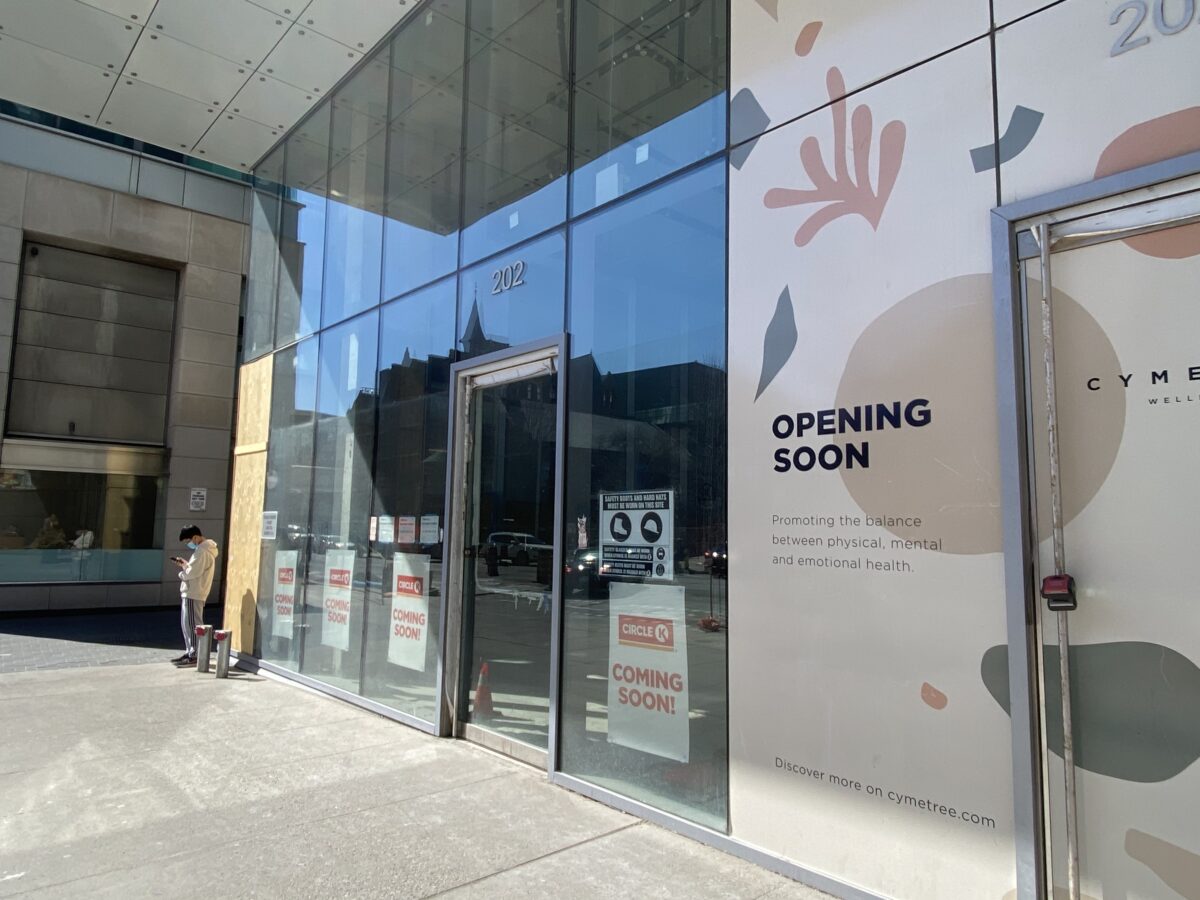
The Circle K convenience store under construction at 202 Bloor Street West. Photo: Dustin Fuhs
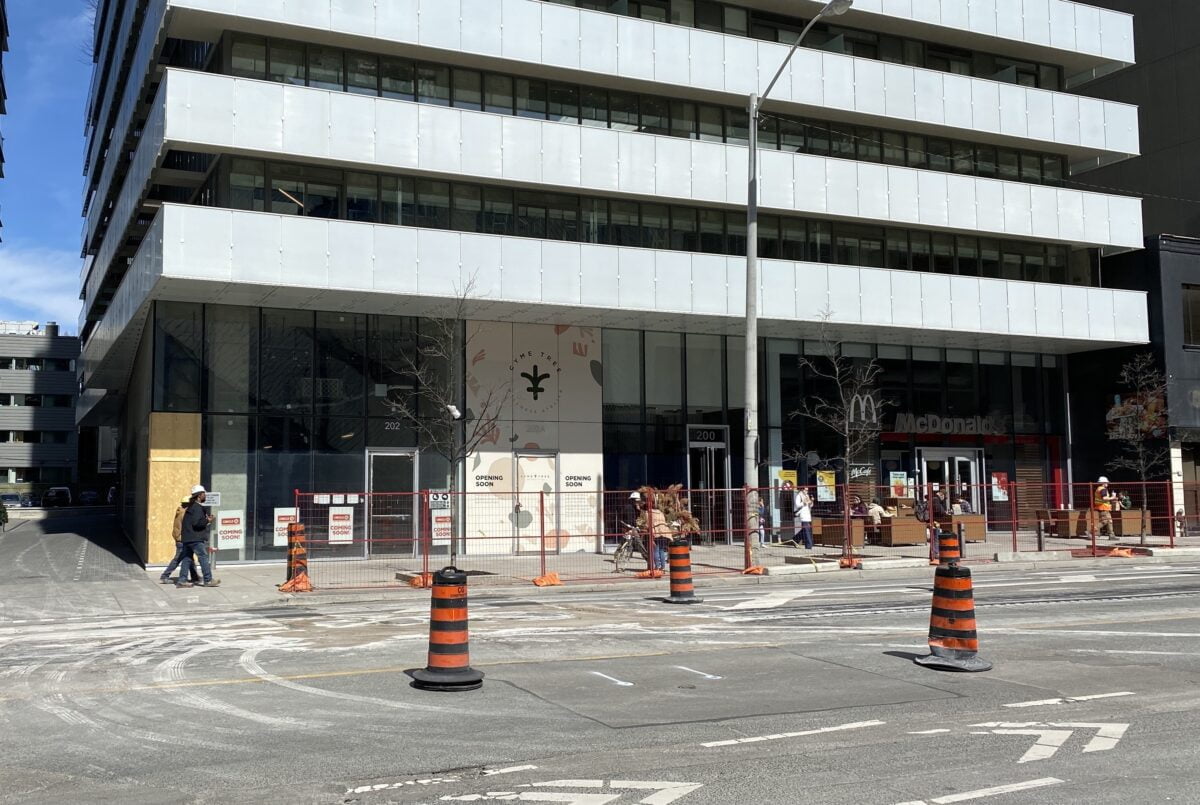
A Circle K convenience store is under construction at 202 Bloor Street West. The store will be located at the base of a condominium building that was completed in 2017. The space has been for lease since then and the other commercial tenant in the building is a McDonald’s restaurant.
The 202 Bloor podium is located a few steps west of Avenue Road, and is considered to be the marker for the luxury stretch of Bloor Street West that extends eastward towards Holt Renfrew and Yonge Street. The luxury run currently has several vacancies, and brokers working in the area say several offers have already been made for vacated retail spaces, including the former Club Monaco store at 157 Bloor Street West and the former Gap store at 60 Bloor Street West.
A very quiet King Street West in Toronto with empty retail stores. Photo: Dustin Fuhs
The latest month-long lockdown mandated by the Ontario government will deal a crushing blow to many small businesses in the province who have been hanging by a thread for months.
“Small businesses are tired of being a scapegoat for the Ontario government’s lack of planning or foresight. For months, they have been told that there is light at the end of the tunnel and for months nothing has changed,” said Ryan Mallough, Director of Provincial Affairs for Ontario, for the Canadian Federation of Independent Business.
Ryan Mallough
“Toronto and Peel have been largely shut down since November while cases have climbed and fallen and climbed again in that timeframe with thousands of small businesses never seeing a single customer. To continue the same broken approach is a choice. A choice that is costing thousands of Ontarians their jobs and livelihoods. We have to do better.”
Mallough said 74,000 additional businesses are in danger of closing due to the pandemic. The latest lockdown will accelerate business closures.
“It’s grim,” he said. “The support grants (from government) are nice but with the mounting debt, with having to pay employees, and all the uncertainty around when you’re going to be able to reopen — I don’t think anyone expects everything to be open a month from now at full capacity — it’s going to take a while to ramp up and it’s a very long road ahead when it comes to even starting to talk about recovery.”
On Thursday the Ontario government announced a provincewide “emergency brake” for at least four weeks that includes limiting indoor/outdoor gatherings to a maximum of five people, 50 percent capacity limits for grocery and convenience stores, no indoor or outdoor dining, and a 25 percent capacity for big box and other retailers.
“We are facing a serious situation and drastic measures are required to contain the rapid spread of the virus, especially the new variants of concern,” said Premier Doug Ford. “I know pulling the emergency brake will be difficult on many people across the province, but we must try and prevent more people from getting infected and overwhelming our hospitals. Our vaccine rollout is steadily increasing, and I encourage everyone who is eligible to get vaccinated. That is our best protection against this deadly virus.”
James Rilett
The provincewide emergency brake will be effective Saturday, April 3, at 12:01 a.m. and the government intends to keep this in place for at least four weeks.
James Rilett, Vice-President, Central Canada, for Restaurants Canada, said the organization is really disappointed in the Ontario government announcement.
“We think the province is going down the same road that they’ve gone down for the last six months that hasn’t worked. We have parts of the province where restaurants have been closed for six months. We haven’t seen restaurant closures affect a downward trend of (COVID) numbers at all and we think this is the wrong thing to do,” said Rilett.
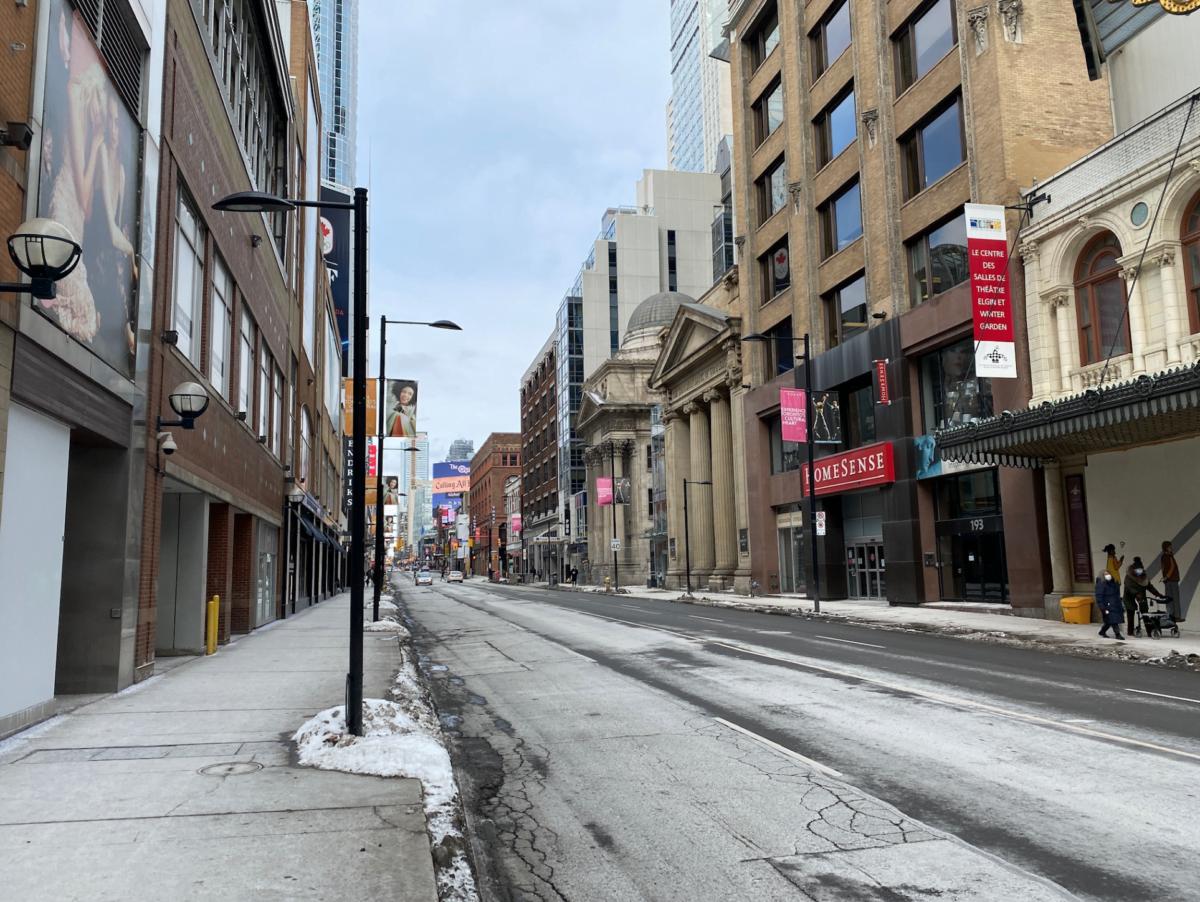
An empty Yonge Street in Toronto. Photo: Dustin Fuhs
He said this would definitely accelerate the closure of more restaurants in the province.
“It was only 12 days ago that public health officials were encouraging people to open their patios. So they’ve invested money, they’ve invested time, they’ve hired back staff with that in mind,” added Rilett. “And they were just thinking, okay finally light at the end of the tunnel. And that’s been yanked away from them. I’m sure a lot will say this is the last straw.”
Daniel Safayeni, Vice-President, Policy, at the Ontario Chamber of Commerce, said the province’s business community is understandably frustrated with the current situation.
Daniel Safayeni
“Seeing our southern neighbours being inoculated while we wait perhaps adds to that as well. But really the bottom line is delays in distribution are heavy blows to businesses who are going through further restrictions and lockdowns,” he said. “We urge all orders of government to work together on this and to be as clear and consistent as possible around what warrants changes in lockdowns.
“The lack of predictability is adding to this growing frustration. And so while we strongly believe public health and a healthy economy are interdependent, we realize right now we’re in the midst of a third wave. ICU capacity is at a critical level. This is all greatly concerning and we can’t pave a path to recovery without first controlling the virus. We understand this acutely but at the same time we’ve repeatedly expressed our concerns now at this point about inconsistent and unclear public health guidelines that trigger a shutdown and what we can do to improve that situation.”
Bruce Winder, author of RETAIL Before, During & After COVID-19 and President of Bruce Winder Retail, said another shutdown in Ontario will continue to weigh on an already struggling retail industry.
“Although the lockdown is needed, it causes further strain on an industry hanging on by a thread. Some retailers will need to lay off staff again and will have brought in inventory in anticipation of the spring season,” said Winder.
Bruce Winder
“Restaurants will have food that will spoil as patio business is lost. Perhaps one positive from this lockdown is that non-essential retailers will be allowed to open at 25 percent capacity — which offers some relief. Those that count April as one of their biggest sales months will need to scramble to pivot quickly. Government subsidies continue to help those that qualify but they can’t last forever. One of the most damaging byproducts of this pandemic is the deterioration of mental health in retail (and all industries). This issue desperately needs more attention and resources from governments and businesses alike. Ontario has lost round one in the race between inoculation and variants of concern.”
If there was ever anything that could derail morale of small business owners and all businesses it’s a third lockdown, said veteran retail expert George Minakakis, a global retail executive with over 25 years of experience and CEO of the Inception Retail Group.
“But we shouldn’t be surprised by it. We reopened and the number of cases never really got under 1,000 per day. Just today we are over 2,500. I was surprised we even expanded restaurant dining about a week ago,” he said.
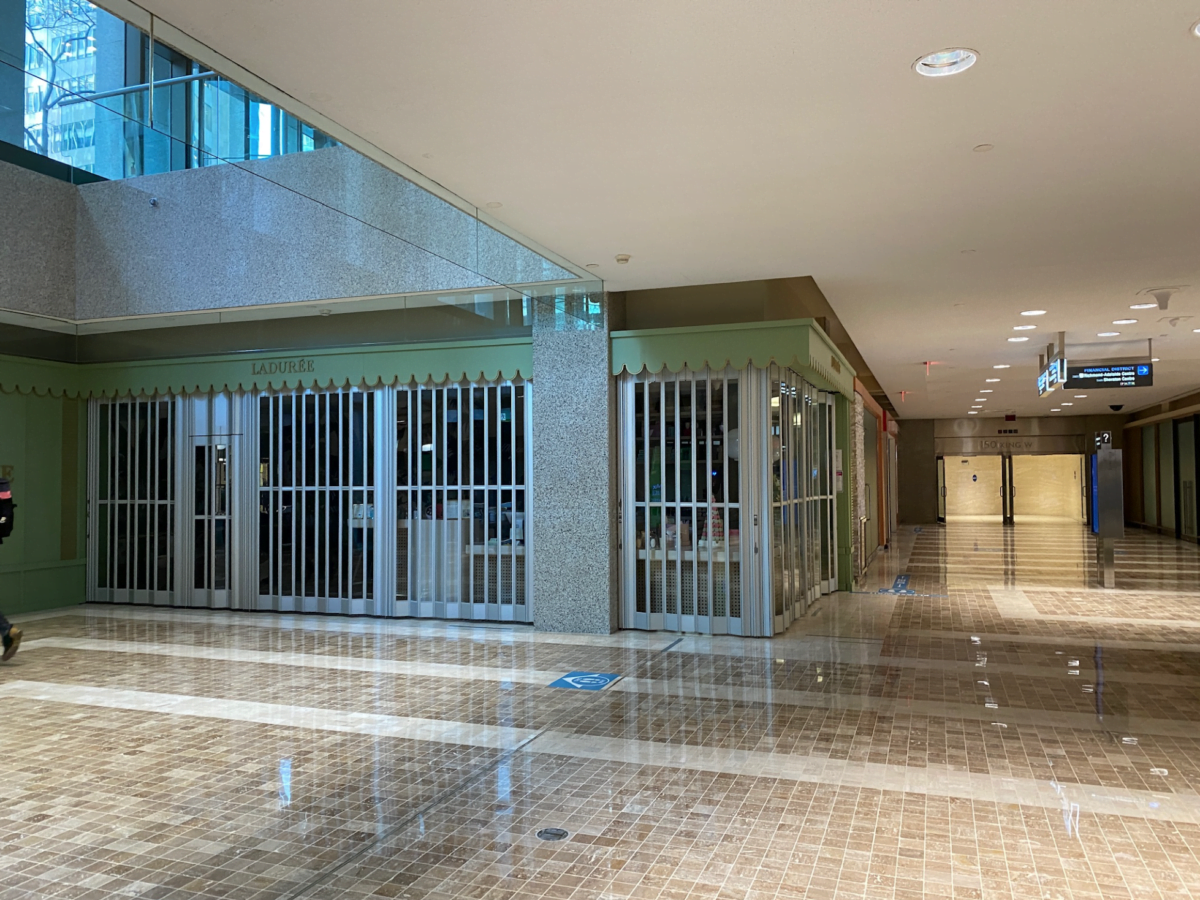
A shuttered Laduree cafe in Toronto’s PATH. Photo: Dustin Fuhs
“I already know of retail chains that are not making rent payments. I can only begin to imagine the number of small businesses that are in the same situation. And what bank covenants have been breached by them, from not having enough sales?
“It is my opinion that the business recovery is now not going to begin until 2022 because of this current situation. And it solidifies that the retail landscape will be more different than we first imagined.”
George Minakakis
He said this lockdown could go longer than expected with the new variant.
Whether businesses were allowed to stay open or not consumers have been trained to react and stay at home.
“We already have excess capacity in available vaccines. Part of the problem is the AstraZeneca news and that likely has the public concerned. Which means more delays in a recovery. You can’t force the public to line up for something they question,” he said. “You need a very powerful and trustworthy PR campaign to convince the public that it is safe.”
Minakakis said the provincial and federal governments will have to do a lot more than count on pent-up demand for example for hair cuts or the idea of revenge shopping to reboot economies.
“I am also very doubtful of consumers opening their bank accounts to spend their “excess” savings. That whole concept is contrary to telling Canadians they are carrying too much debt. Especially if we don’t know what the future is going to be like. This means e-commerce will take more share as will the likes of UberEats,” he said.
“I know this all sounds dismal however, this looks more like a domino effect to me with a whole set of underlying issues that will surface and cascade, making a recovery even more challenging. Even if we ride this third wave out we will be behind in any recovery plan and small businesses will fail silently during this period. The only saving grace for them will be how benevolent landlords and banks will be.”
The CFIB is calling on provincial governments across Canada for lockdown alternatives and increased financial support for small businesses as provinces announce or consider a third round of closures across the country.
On average, Ontario small businesses have taken on $207,000 in COVID-19-related debt. Three quarters of them report that it will take more than a year to pay off, added the CFIB.
Dan Kelly
“It is unconscionable that over a year into the pandemic governments continue to rely almost exclusively on blanket lockdowns,” said CFIB President Dan Kelly. “The first two shutdowns were devastating with one in six businesses considering permanent closure, for an estimated 74,000 permanent small business closures expected in Ontario. A third round will only ensure that number grows higher.
“More than 70 percent of small businesses across Canada report that government supports are essential to their survival. Lockdowns do not stop bills from coming in. We urge governments to extend their application deadlines, broaden eligibility, and increase payments to recognize the impact new and prolonged lockdowns and restrictions are having on local businesses.”